
A English
Mix Examples-Chemical Bonding Questions in English
Class 11 Chemistry · Chemical Bonding and Molecular Structure · Mix Examples-Chemical Bonding
489+
Questions
English
Language
100%
With Solutions
Showing 50 of 489 questions in English
301
Easy
Write Lewis dot symbols for atoms of the following elements: $Mg, Na, B, O, N, Br$.
Solution
(N/A) Lewis dot symbols represent the valence electrons of an atom as dots around the chemical symbol.
$Mg$ (Group $2$): $2$ valence electrons $\rightarrow \cdot Mg \cdot$
$Na$ (Group $1$): $1$ valence electron $\rightarrow Na \cdot$
$B$ (Group $13$): $3$ valence electrons $\rightarrow \cdot \dot{B} \cdot$
$O$ (Group $16$): $6$ valence electrons $\rightarrow \cdot \ddot{O} \cdot \cdot$
$N$ (Group $15$): $5$ valence electrons $\rightarrow \cdot \ddot{N} \cdot \cdot$
$Br$ (Group $17$): $7$ valence electrons $\rightarrow \cdot \ddot{Br} \cdot \cdot \cdot$
$Mg$ (Group $2$): $2$ valence electrons $\rightarrow \cdot Mg \cdot$
$Na$ (Group $1$): $1$ valence electron $\rightarrow Na \cdot$
$B$ (Group $13$): $3$ valence electrons $\rightarrow \cdot \dot{B} \cdot$
$O$ (Group $16$): $6$ valence electrons $\rightarrow \cdot \ddot{O} \cdot \cdot$
$N$ (Group $15$): $5$ valence electrons $\rightarrow \cdot \ddot{N} \cdot \cdot$
$Br$ (Group $17$): $7$ valence electrons $\rightarrow \cdot \ddot{Br} \cdot \cdot \cdot$
0 likes
View Solution302
Medium
What is the electronic theory of chemical bonding?
Solution
(N/A) The electronic theory of chemical bonding,developed by Kossel and Lewis in $1916$,explains how atoms combine to form chemical bonds.
$1$. Octet Rule: Atoms tend to combine by transferring valence electrons (gaining or losing) or by sharing valence electrons to achieve a stable octet ($8$ electrons) in their outermost shell.
$2$. Chemical Combination: This theory proposes that atoms achieve stability by attaining the noble gas configuration through the formation of ionic or covalent bonds.
$3$. Limitations: The theory does not explain the stability of molecules with expanded octets (e.g.,$PF_5$,where $P$ has $10$ electrons) or incomplete octets (e.g.,$BF_3$).
$1$. Octet Rule: Atoms tend to combine by transferring valence electrons (gaining or losing) or by sharing valence electrons to achieve a stable octet ($8$ electrons) in their outermost shell.
$2$. Chemical Combination: This theory proposes that atoms achieve stability by attaining the noble gas configuration through the formation of ionic or covalent bonds.
$3$. Limitations: The theory does not explain the stability of molecules with expanded octets (e.g.,$PF_5$,where $P$ has $10$ electrons) or incomplete octets (e.g.,$BF_3$).
0 likes
View Solution303
Difficult
Draw Lewis structures of the following molecules and ions: $H_2S$,$SiCl_4$,$BeF_2$,$CO_3^{2-}$,$HCOOH$.
Solution
(N/A) The Lewis structures represent the valence electrons of atoms in a molecule or ion. The structures are as follows:
| Name / Formula | Lewis Structure |
|---|---|
| Hydrogen sulphide $(H_2S)$ | $H:\ddot{S}:H$ |
| Silicon tetrachloride $(SiCl_4)$ | $\ddot{Cl}:\ddot{Si}:\ddot{Cl}$ (with $Cl$ atoms at four corners) |
| Beryllium fluoride $(BeF_2)$ | $:\ddot{F}:Be:\ddot{F}:$ |
| Carbonate ion $(CO_3^{2-})$ | $[ :\ddot{O}:\ddot{C}:\ddot{O}: ]^{2-}$ (with one double bond to $O$) |
| Formic acid $(HCOOH)$ | $H:\ddot{C}:\ddot{O}:H$ (with a double bonded $O$ on $C$) |
0 likes
View Solution304
Difficult
What is formal charge? Explain by example.
Solution
When a molecule or ion is represented by a Lewis dot structure,the charge on an atom is called the formal charge. If an atom has more electrons than valence electrons,it has a negative formal charge,and if it has fewer electrons than valence electrons,it has a positive formal charge.
Calculation of formal charge is expressed by the following equation:
$F.C = (\text{Total number of valence electrons}) - (\text{Total number of non-bonding electrons}) - \frac{1}{2}(\text{Total number of bonding electrons})$
Note: Formal charge is not a real charge in a molecule,but it provides information about the position and arrangement of electrons.
Example: Formal charge of oxygen in an ozone molecule $(O_3)$.
The central $O$ atom marked $1$:
$F.C = (\text{Valence electron of neutral oxygen}) - (\text{Non-bonding electrons of } O_1) - \frac{1}{2}(\text{Bonding electrons of } O_1)$
$F.C = 6 - 2 - \frac{1}{2}(6) = +1$
The end $O$ atom marked $2$:
$F.C = (\text{Valence electron of } O) - (\text{Non-bonding electrons of } O_2) - \frac{1}{2}(\text{Bonding electrons of } O_2) = 6 - 4 - \frac{1}{2}(4) = 0$
The end $O$ atom marked $3$:
$F.C = (\text{Valence electron of } O) - (\text{Non-bonding electrons of } O_3) - \frac{1}{2}(\text{Bonding electrons of } O_3) = 6 - 6 - \frac{1}{2}(2) = -1$
Hence,the structure of $O_3$ with formal charges is indicated.
Calculation of formal charge is expressed by the following equation:
$F.C = (\text{Total number of valence electrons}) - (\text{Total number of non-bonding electrons}) - \frac{1}{2}(\text{Total number of bonding electrons})$
Note: Formal charge is not a real charge in a molecule,but it provides information about the position and arrangement of electrons.
Example: Formal charge of oxygen in an ozone molecule $(O_3)$.
The central $O$ atom marked $1$:
$F.C = (\text{Valence electron of neutral oxygen}) - (\text{Non-bonding electrons of } O_1) - \frac{1}{2}(\text{Bonding electrons of } O_1)$
$F.C = 6 - 2 - \frac{1}{2}(6) = +1$
The end $O$ atom marked $2$:
$F.C = (\text{Valence electron of } O) - (\text{Non-bonding electrons of } O_2) - \frac{1}{2}(\text{Bonding electrons of } O_2) = 6 - 4 - \frac{1}{2}(4) = 0$
The end $O$ atom marked $3$:
$F.C = (\text{Valence electron of } O) - (\text{Non-bonding electrons of } O_3) - \frac{1}{2}(\text{Bonding electrons of } O_3) = 6 - 6 - \frac{1}{2}(2) = -1$
Hence,the structure of $O_3$ with formal charges is indicated.
0 likes
View Solution305
Difficult
Write the formal charges on atoms in $CO_3^{2-}$ and $HNO_3$.
Solution
The formal charge on an atom in a Lewis structure is calculated as: $FC = [\text{Total number of valence electrons}] - [\text{Total number of non-bonding electrons}] - \frac{1}{2} [\text{Total number of bonding electrons}]$.
For $CO_3^{2-}$:
$1$. Carbon atom: $FC = 4 - 0 - \frac{1}{2}(8) = 0$.
$2$. Double-bonded Oxygen: $FC = 6 - 4 - \frac{1}{2}(4) = 0$.
$3$. Single-bonded Oxygen atoms (two): $FC = 6 - 6 - \frac{1}{2}(2) = -1$.
For $HNO_3$ (in the structure $H-O-N(=O)_2$):
$1$. Hydrogen: $FC = 1 - 0 - \frac{1}{2}(2) = 0$.
$2$. Hydroxyl Oxygen: $FC = 6 - 4 - \frac{1}{2}(4) = 0$.
$3$. Nitrogen: $FC = 5 - 0 - \frac{1}{2}(8) = 1$.
$4$. Double-bonded Oxygen: $FC = 6 - 4 - \frac{1}{2}(4) = 0$.
$5$. Single-bonded Oxygen (dative bond): $FC = 6 - 6 - \frac{1}{2}(2) = -1$.
For $CO_3^{2-}$:
$1$. Carbon atom: $FC = 4 - 0 - \frac{1}{2}(8) = 0$.
$2$. Double-bonded Oxygen: $FC = 6 - 4 - \frac{1}{2}(4) = 0$.
$3$. Single-bonded Oxygen atoms (two): $FC = 6 - 6 - \frac{1}{2}(2) = -1$.
For $HNO_3$ (in the structure $H-O-N(=O)_2$):
$1$. Hydrogen: $FC = 1 - 0 - \frac{1}{2}(2) = 0$.
$2$. Hydroxyl Oxygen: $FC = 6 - 4 - \frac{1}{2}(4) = 0$.
$3$. Nitrogen: $FC = 5 - 0 - \frac{1}{2}(8) = 1$.
$4$. Double-bonded Oxygen: $FC = 6 - 4 - \frac{1}{2}(4) = 0$.
$5$. Single-bonded Oxygen (dative bond): $FC = 6 - 6 - \frac{1}{2}(2) = -1$.
0 likes
View Solution306
Advanced
Define the octet rule. Write its significance and limitations.
Solution
(N/A) Definition: The octet rule states that atoms of elements tend to combine in such a way that their atoms have eight electrons in their valence shells,giving them the same electronic configuration as a noble gas.
Significance of the octet rule:
- It helps in predicting the structure of molecules and ions.
- It explains the stability of atoms that achieve a complete octet.
- It is useful in calculating the formal charge of atoms in a molecule or ion.
- It provides a basic understanding of the bonding in organic compounds and compounds of second-period elements.
Limitations of the octet rule:
$I$. Incomplete octet of the central atom:
In some compounds,the number of electrons surrounding the central atom is less than eight. This is especially common for elements of groups $1, 2,$ and $13$ (e.g.,$LiCl, BeH_2, BeCl_2, BF_3, AlCl_3$).
$II$. Odd-electron molecules:
In molecules with an odd number of electrons,like nitric oxide $(NO)$ and nitrogen dioxide $(NO_2)$,the octet rule cannot be satisfied for all atoms.
$III$. The expanded octet:
Elements in and beyond the third period of the periodic table have $d$-orbitals available for bonding. These elements can accommodate more than eight electrons around the central atom,forming an expanded octet (e.g.,$PF_5, SF_6, H_2SO_4$).
Significance of the octet rule:
- It helps in predicting the structure of molecules and ions.
- It explains the stability of atoms that achieve a complete octet.
- It is useful in calculating the formal charge of atoms in a molecule or ion.
- It provides a basic understanding of the bonding in organic compounds and compounds of second-period elements.
Limitations of the octet rule:
$I$. Incomplete octet of the central atom:
In some compounds,the number of electrons surrounding the central atom is less than eight. This is especially common for elements of groups $1, 2,$ and $13$ (e.g.,$LiCl, BeH_2, BeCl_2, BF_3, AlCl_3$).
$II$. Odd-electron molecules:
In molecules with an odd number of electrons,like nitric oxide $(NO)$ and nitrogen dioxide $(NO_2)$,the octet rule cannot be satisfied for all atoms.
$III$. The expanded octet:
Elements in and beyond the third period of the periodic table have $d$-orbitals available for bonding. These elements can accommodate more than eight electrons around the central atom,forming an expanded octet (e.g.,$PF_5, SF_6, H_2SO_4$).
0 likes
View Solution307
Medium
Arrange the bonds in order of increasing ionic character in the molecules: $LiF, K_2O, N_2, SO_2$ and $ClF_3$.
Solution
(N/A) The ionic character of a bond depends on the electronegativity difference between the bonded atoms. $A$ larger electronegativity difference corresponds to a higher ionic character.
Increasing order of ionic character: $N_2 < ClF_3 < SO_2 < K_2O < LiF$
Comparing $SO_2$ and $ClF_3$ (both have $\Delta EN = 1.0$): Based on Fajan's rule,smaller cations and larger anions increase covalent character. $S^{2+}$ is smaller than $Cl^{+}$,and $O^{2-}$ is larger than $F^{-}$,making $ClF_3$ more covalent than $SO_2$. Thus,$SO_2$ has slightly more ionic character than $ClF_3$.
Increasing order of ionic character: $N_2 < ClF_3 < SO_2 < K_2O < LiF$
| $N_2$ | $100 \%$ covalent (homonuclear),$0 \%$ ionic. |
| $SO_2$ | Electronegativity difference: $|3.5 - 2.5| = 1.0$. |
| $ClF_3$ | Electronegativity difference: $|4.0 - 3.0| = 1.0$. |
| $K_2O$ | Electronegativity difference: $|3.5 - 0.8| = 2.7$ (highly ionic). |
| $LiF$ | Electronegativity difference: $|4.0 - 1.0| = 3.0$ (maximum ionic character). |
Comparing $SO_2$ and $ClF_3$ (both have $\Delta EN = 1.0$): Based on Fajan's rule,smaller cations and larger anions increase covalent character. $S^{2+}$ is smaller than $Cl^{+}$,and $O^{2-}$ is larger than $F^{-}$,making $ClF_3$ more covalent than $SO_2$. Thus,$SO_2$ has slightly more ionic character than $ClF_3$.
0 likes
View Solution308
EasyMCQ
What is the limitation of the framework model?
A
It does not indicate the atoms.
B
It does not provide information about atomic size.
C
It emphasizes the pattern of bonds of a molecule.
D
All of the above.
Solution
(D) The limitations of the framework model are as follows:
$i$. It does not explicitly indicate the atoms present in the structure.
$ii$. This model does not provide any information regarding the relative atomic size.
$iii$. This model primarily emphasizes the pattern of bonds within a molecule.
$i$. It does not explicitly indicate the atoms present in the structure.
$ii$. This model does not provide any information regarding the relative atomic size.
$iii$. This model primarily emphasizes the pattern of bonds within a molecule.
0 likes
View Solution309
DifficultMCQ
Determine the correct $(T)$ and incorrect $(F)$ statements for the permanganate ion $(MnO_4^-)$:
$(a)$ $MnO_4^-$ contains $\sigma$ bonds.
$(b)$ $MnO_4^-$ contains $\pi$ bonds.
$(c)$ $MnO_4^-$ contains both $\sigma$ and $\pi$ bonds.
$(d)$ $MnO_4^-$ is paramagnetic.
$(a)$ $MnO_4^-$ contains $\sigma$ bonds.
$(b)$ $MnO_4^-$ contains $\pi$ bonds.
$(c)$ $MnO_4^-$ contains both $\sigma$ and $\pi$ bonds.
$(d)$ $MnO_4^-$ is paramagnetic.
A
$(a) T, (b) T, (c) T, (d) F$
B
$(a) T, (b) F, (c) T, (d) T$
C
$(a) F, (b) T, (c) T, (d) F$
D
$(a) T, (b) T, (c) T, (d) T$
Solution
(A) The permanganate ion $(MnO_4^-)$ has a tetrahedral geometry where the central $Mn$ atom is in the $+7$ oxidation state.
The electronic configuration of $Mn$ is $[Ar] 3d^5 4s^2$,and for $Mn^{7+}$,it is $[Ar] 3d^0 4s^0$.
$(a)$ There are $4$ $Mn-O$ $\sigma$ bonds formed by the overlap of $Mn$ $sd^3$ hybrid orbitals with $O$ $2p$ orbitals. Thus,$(a)$ is True $(T)$.
$(b)$ There are $3$ $Mn-O$ $d\pi-p\pi$ bonds. Thus,$(b)$ is True $(T)$.
$(c)$ Since it contains both $\sigma$ and $\pi$ bonds,$(c)$ is True $(T)$.
$(d)$ Since $Mn^{7+}$ has a $d^0$ configuration,there are no unpaired electrons,making it diamagnetic. Thus,$(d)$ is False $(F)$.
The electronic configuration of $Mn$ is $[Ar] 3d^5 4s^2$,and for $Mn^{7+}$,it is $[Ar] 3d^0 4s^0$.
$(a)$ There are $4$ $Mn-O$ $\sigma$ bonds formed by the overlap of $Mn$ $sd^3$ hybrid orbitals with $O$ $2p$ orbitals. Thus,$(a)$ is True $(T)$.
$(b)$ There are $3$ $Mn-O$ $d\pi-p\pi$ bonds. Thus,$(b)$ is True $(T)$.
$(c)$ Since it contains both $\sigma$ and $\pi$ bonds,$(c)$ is True $(T)$.
$(d)$ Since $Mn^{7+}$ has a $d^0$ configuration,there are no unpaired electrons,making it diamagnetic. Thus,$(d)$ is False $(F)$.
0 likes
View Solution310
Medium
What is the structure of $BeCl_2$ molecule in gaseous and solid state?
Solution
(N/A) In the solid state,$BeCl_2$ has a polymeric chain-like structure. Each $Be$ atom is surrounded by four $Cl$ atoms,where two $Cl$ atoms are bonded through covalent bonds and the other two are bonded through coordinate bonds. This is shown in structure $A$.
In the gaseous state,beryllium chloride exists as a dimer $(Be_2Cl_4)$ at lower temperatures,which has a bridged structure. At high temperatures (about $1200 \ K$),it dissociates into a monomer $(BeCl_2)$,which is linear in structure. This is shown in structure $B$.
In the gaseous state,beryllium chloride exists as a dimer $(Be_2Cl_4)$ at lower temperatures,which has a bridged structure. At high temperatures (about $1200 \ K$),it dissociates into a monomer $(BeCl_2)$,which is linear in structure. This is shown in structure $B$.
0 likes
View Solution311
Medium
Give reasons for the following:
$A$. Covalent bonds are directional bonds while ionic bonds are non-directional.
$B$. Water molecule has bent structure whereas carbon dioxide molecule is linear.
$C$. Ethyne molecule is linear.
$A$. Covalent bonds are directional bonds while ionic bonds are non-directional.
$B$. Water molecule has bent structure whereas carbon dioxide molecule is linear.
$C$. Ethyne molecule is linear.
Solution
(N/A) . $A$ covalent bond is formed by the overlapping of atomic orbitals. The direction of overlapping gives the direction of the bond. In an ionic bond,the electrostatic field of an ion is non-directional.
Each positive ion is surrounded by a number of anions in any direction depending upon its size and vice-versa. That is why covalent bonds are directional and ionic bonds are non-directional.
$B$. In $H_{2}O$,the oxygen atom is $sp^{3}$ hybridised with two lone pairs. The four $sp^{3}$ hybridised orbitals possess a tetrahedral geometry with two corners occupied by hydrogen atoms and the other two by the lone pairs.
The bond angle is reduced to $104.5^{\circ}$ from $109.5^{\circ}$ because of greater repulsive forces between $lp-lp$ (lone pair-lone pair) and the molecule gains a $V$-shape or bent structure (angular structure).
In the $CO_{2}$ molecule,the carbon atom is $sp$-hybridised. The two $sp$ hybrid orbitals are oriented in opposite directions forming an angle of $180^{\circ}$.
$O=C=O$
So,the $H_{2}O$ molecule has a bent structure and the $CO_{2}$ molecule is linear.
$C$. In the ethyne molecule,both carbon atoms are $sp$ hybridised,having two unhybridised orbitals,i.e.,$2p_{x}$ and $2p_{y}$. The two $sp$ hybrid orbitals of both carbon atoms are oriented in opposite directions forming an angle of $180^{\circ}$.
So,the ethyne molecule is linear.
Each positive ion is surrounded by a number of anions in any direction depending upon its size and vice-versa. That is why covalent bonds are directional and ionic bonds are non-directional.
$B$. In $H_{2}O$,the oxygen atom is $sp^{3}$ hybridised with two lone pairs. The four $sp^{3}$ hybridised orbitals possess a tetrahedral geometry with two corners occupied by hydrogen atoms and the other two by the lone pairs.
The bond angle is reduced to $104.5^{\circ}$ from $109.5^{\circ}$ because of greater repulsive forces between $lp-lp$ (lone pair-lone pair) and the molecule gains a $V$-shape or bent structure (angular structure).
In the $CO_{2}$ molecule,the carbon atom is $sp$-hybridised. The two $sp$ hybrid orbitals are oriented in opposite directions forming an angle of $180^{\circ}$.
$O=C=O$
So,the $H_{2}O$ molecule has a bent structure and the $CO_{2}$ molecule is linear.
$C$. In the ethyne molecule,both carbon atoms are $sp$ hybridised,having two unhybridised orbitals,i.e.,$2p_{x}$ and $2p_{y}$. The two $sp$ hybrid orbitals of both carbon atoms are oriented in opposite directions forming an angle of $180^{\circ}$.
So,the ethyne molecule is linear.

0 likes
View Solution312
Medium
What is an ionic bond? With two suitable examples,explain the difference between an ionic and a covalent bond.
Solution
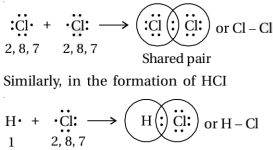
(N/A) An ionic bond is the electrostatic force of attraction between oppositely charged ions formed by the complete transfer of one or more electrons from one atom to another.
Differences:
Differences:
| Property | Ionic Bond | Covalent Bond |
| Formation | Complete transfer of electrons. | Mutual sharing of electrons. |
| Examples | $NaCl, MgCl_2$ | $Cl_2, CH_4$ |
| Melting Point | High | Generally low |
0 likes
View Solution313
Easy
Who first provided an explanation for the formation of chemical bonds in terms of electrons?
Solution
(N/A) In $1916$,$Kossel$ and $Lewis$ independently succeeded in providing a satisfactory explanation for the formation of chemical bonds in terms of electrons.
0 likes
View Solution314
Medium
For the following molecules/ions,identify whether the octet rule is obeyed or not obeyed. Provide the reason.
$(1)$ $PCl_5$ $(2)$ $SF_6$ $(3)$ $PF_5$ $(4)$ $NH_4^+$ $(5)$ $BeCl_2$ $(6)$ $NCl_3$
$(1)$ $PCl_5$ $(2)$ $SF_6$ $(3)$ $PF_5$ $(4)$ $NH_4^+$ $(5)$ $BeCl_2$ $(6)$ $NCl_3$
Solution
(N/A) The octet rule states that atoms tend to gain,lose,or share electrons to achieve a stable configuration of $8$ electrons in their valence shell.
$(1)$ $PCl_5$: Phosphorus has $10$ electrons in its valence shell (expanded octet). Rule not obeyed.
$(2)$ $SF_6$: Sulfur has $12$ electrons in its valence shell (expanded octet). Rule not obeyed.
$(3)$ $PF_5$: Phosphorus has $10$ electrons in its valence shell (expanded octet). Rule not obeyed.
$(4)$ $NH_4^+$: Nitrogen has $8$ electrons in its valence shell. Rule obeyed.
$(5)$ $BeCl_2$: Beryllium has $4$ electrons in its valence shell (incomplete octet). Rule not obeyed.
$(6)$ $NCl_3$: Nitrogen has $8$ electrons in its valence shell. Rule obeyed.
$(1)$ $PCl_5$: Phosphorus has $10$ electrons in its valence shell (expanded octet). Rule not obeyed.
$(2)$ $SF_6$: Sulfur has $12$ electrons in its valence shell (expanded octet). Rule not obeyed.
$(3)$ $PF_5$: Phosphorus has $10$ electrons in its valence shell (expanded octet). Rule not obeyed.
$(4)$ $NH_4^+$: Nitrogen has $8$ electrons in its valence shell. Rule obeyed.
$(5)$ $BeCl_2$: Beryllium has $4$ electrons in its valence shell (incomplete octet). Rule not obeyed.
$(6)$ $NCl_3$: Nitrogen has $8$ electrons in its valence shell. Rule obeyed.
0 likes
View Solution315
MediumMCQ
Identify the odd-electron molecules among $NO$,$NO_2$,$CO$,and $CO_2$. Explain why.
A
$NO$ and $CO$
B
$NO$ and $NO_2$
C
$CO$ and $CO_2$
D
$NO_2$ and $CO_2$
Solution
(B) To identify odd-electron molecules,we calculate the total number of valence electrons in each molecule:
$1$. $NO$: Valence electrons = $5 (N) + 6 (O) = 11$. Since $11$ is an odd number,$NO$ is an odd-electron molecule.
$2$. $NO_2$: Valence electrons = $5 (N) + 2 \times 6 (O) = 17$. Since $17$ is an odd number,$NO_2$ is an odd-electron molecule.
$3$. $CO$: Valence electrons = $4 (C) + 6 (O) = 10$. Since $10$ is an even number,$CO$ is not an odd-electron molecule.
$4$. $CO_2$: Valence electrons = $4 (C) + 2 \times 6 (O) = 16$. Since $16$ is an even number,$CO_2$ is not an odd-electron molecule.
Therefore,$NO$ and $NO_2$ are odd-electron molecules.
$1$. $NO$: Valence electrons = $5 (N) + 6 (O) = 11$. Since $11$ is an odd number,$NO$ is an odd-electron molecule.
$2$. $NO_2$: Valence electrons = $5 (N) + 2 \times 6 (O) = 17$. Since $17$ is an odd number,$NO_2$ is an odd-electron molecule.
$3$. $CO$: Valence electrons = $4 (C) + 6 (O) = 10$. Since $10$ is an even number,$CO$ is not an odd-electron molecule.
$4$. $CO_2$: Valence electrons = $4 (C) + 2 \times 6 (O) = 16$. Since $16$ is an even number,$CO_2$ is not an odd-electron molecule.
Therefore,$NO$ and $NO_2$ are odd-electron molecules.
0 likes
View Solution316
Easy
What are the similarities and differences in the Lewis structures of $H_2SO_4$ and $SO_4^{2-}$?
Solution
(N/A) Similarity: In both structures,the central sulfur atom is surrounded by four oxygen atoms,and the total number of valence electrons involved in bonding and lone pairs is consistent with the octet rule or expanded octet requirements for sulfur.
Difference: $H_2SO_4$ is a neutral molecule where two hydrogen atoms are covalently bonded to two oxygen atoms. $SO_4^{2-}$ is an ion with a $-2$ charge,where the two hydrogen atoms have been removed as $H^+$,leaving their electrons behind on the oxygen atoms,resulting in two oxygen atoms carrying a formal negative charge.
Difference: $H_2SO_4$ is a neutral molecule where two hydrogen atoms are covalently bonded to two oxygen atoms. $SO_4^{2-}$ is an ion with a $-2$ charge,where the two hydrogen atoms have been removed as $H^+$,leaving their electrons behind on the oxygen atoms,resulting in two oxygen atoms carrying a formal negative charge.
0 likes
View Solution317
EasyMCQ
Which bond is shorter: $C=O$ or $N=O$? Why?
A
$C=O$ is shorter due to higher bond order.
B
$N=O$ is shorter due to smaller atomic size of $N$.
C
$C=O$ is shorter due to higher electronegativity difference.
D
Both have equal bond lengths.
Solution
(A) . The bond length depends on the atomic radii and bond order.
In $C=O$ (as in carbon monoxide,$CO$),the bond length is approximately $1.128 \ \mathring{A}$.
In $N=O$ (as in nitric oxide,$NO$),the bond length is approximately $1.150 \ \mathring{A}$.
Therefore,$C=O$ is shorter than $N=O$. This is primarily due to the higher bond order and the specific electronic environment in $CO$ compared to the $NO$ radical.
In $C=O$ (as in carbon monoxide,$CO$),the bond length is approximately $1.128 \ \mathring{A}$.
In $N=O$ (as in nitric oxide,$NO$),the bond length is approximately $1.150 \ \mathring{A}$.
Therefore,$C=O$ is shorter than $N=O$. This is primarily due to the higher bond order and the specific electronic environment in $CO$ compared to the $NO$ radical.
0 likes
View Solution318
Medium
Arrange the following in decreasing order of their bond length: $HF, HCl, HBr, HI$. Provide the reason.
Solution
(A) The decreasing order of bond length is: $HI > HBr > HCl > HF$.
Reason: As the size of the halogen atom increases from $F$ to $I$,the bond length increases. Therefore,$HI$ has the longest bond length and $HF$ has the shortest bond length.
Reason: As the size of the halogen atom increases from $F$ to $I$,the bond length increases. Therefore,$HI$ has the longest bond length and $HF$ has the shortest bond length.
0 likes
View Solution319
EasyMCQ
Arrange the following in the decreasing order of their bond enthalpy: $H_2, O_2, N_2$.
A
$N_2 > H_2 > O_2$
B
$H_2 > O_2 > N_2$
C
$N_2 > O_2 > H_2$
D
$O_2 > H_2 > N_2$
Solution
(A) The bond enthalpy depends on the bond order and the size of the atoms involved. The bond enthalpies for the given molecules are as follows:
Comparing these values,the decreasing order of bond enthalpy is $N_2 > H_2 > O_2$.
| $Molecule$ | $Bond \text{ } Enthalpy \text{ } (\Delta H) \text{ } (kJ \text{ } mol^{-1})$ |
| $N_2$ | $946$ |
| $H_2$ | $435.8$ |
| $O_2$ | $408$ |
Comparing these values,the decreasing order of bond enthalpy is $N_2 > H_2 > O_2$.
0 likes
View Solution320
Medium
What are the successes and failures of the Lewis theory in explaining chemical bonding?
Solution
(N/A) The Lewis approach is successful in explaining the sharing of electrons between atoms to form covalent bonds and the formation of simple molecules.
However,it fails to explain the following:
$1$. It does not explain the shape of polyatomic molecules.
$2$. It does not provide information about the energy of the bond (bond enthalpy) or the bond length.
$3$. It fails to explain the stability of molecules based on the electronic configuration.
However,it fails to explain the following:
$1$. It does not explain the shape of polyatomic molecules.
$2$. It does not provide information about the energy of the bond (bond enthalpy) or the bond length.
$3$. It fails to explain the stability of molecules based on the electronic configuration.
0 likes
View Solution321
Medium
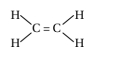
State the bond angle and bond length in ethene. What are the bond angles in $PCl_5$?
Solution
(N/A) Structure of ethene $(C_2H_4)$:
$C-C$ bond length is $134 \text{ pm}$.
Bond angles: $\angle H-C-H = 117.6^{\circ}$ and $\angle H-C-C = 121^{\circ}$.
Structure of $PCl_5$:
$PCl_5$ has a trigonal bipyramidal geometry.
Three $P-Cl$ bonds lie in the same equatorial plane with a bond angle of $120^{\circ}$ $(\angle Cl-P-Cl)$.
Two $P-Cl$ bonds are axial, perpendicular to the equatorial plane, with bond angles of $90^{\circ}$ with the equatorial bonds.
$C-C$ bond length is $134 \text{ pm}$.
Bond angles: $\angle H-C-H = 117.6^{\circ}$ and $\angle H-C-C = 121^{\circ}$.
Structure of $PCl_5$:
$PCl_5$ has a trigonal bipyramidal geometry.
Three $P-Cl$ bonds lie in the same equatorial plane with a bond angle of $120^{\circ}$ $(\angle Cl-P-Cl)$.
Two $P-Cl$ bonds are axial, perpendicular to the equatorial plane, with bond angles of $90^{\circ}$ with the equatorial bonds.
0 likes
View Solution322
Medium
Fill in the blanks given below:
$(i)$ The attractive force which holds atoms,molecules,and ions together is called ......... .
$(ii)$ First of all,............ and ............ scientists provided detailed information about valency.
$(iii)$ In the structure of an atom,when only the electrons of the outermost shell participate,they are known as ............ .
$(iv)$ The symbol used to represent valence electrons in an atom is called ........ .
$(i)$ The attractive force which holds atoms,molecules,and ions together is called ......... .
$(ii)$ First of all,............ and ............ scientists provided detailed information about valency.
$(iii)$ In the structure of an atom,when only the electrons of the outermost shell participate,they are known as ............ .
$(iv)$ The symbol used to represent valence electrons in an atom is called ........ .
Solution
(N/A) $(i)$ Chemical bond
$(ii)$ Kossel and Lewis
$(iii)$ Valence electrons
$(iv)$ Lewis symbol
$(ii)$ Kossel and Lewis
$(iii)$ Valence electrons
$(iv)$ Lewis symbol
0 likes
View Solution323
Medium
Fill in the blanks given below:
$(i)$ The electronic configuration of noble gases is .......... .
$(ii)$ The bond formed by electrostatic attraction between a cation and an anion is called ........... .
$(iii)$ The octet rule is also known as ............ .
$(iv)$ The equilibrium distance between the centers of two bonded atoms in a molecule is called .......... .
$(i)$ The electronic configuration of noble gases is .......... .
$(ii)$ The bond formed by electrostatic attraction between a cation and an anion is called ........... .
$(iii)$ The octet rule is also known as ............ .
$(iv)$ The equilibrium distance between the centers of two bonded atoms in a molecule is called .......... .
Solution
(N/A) $(i)$ $ns^{2} np^{6}$
$(ii)$ Electrovalent bond (or Ionic bond)
$(iii)$ Lewis octet rule
$(iv)$ Bond length
$(ii)$ Electrovalent bond (or Ionic bond)
$(iii)$ Lewis octet rule
$(iv)$ Bond length
0 likes
View Solution324
Medium
Fill in the blanks given below:
$(i)$ The energy required to completely separate one mole of a solid ionic compound into its gaseous constituent ions is called ........... .
$(ii)$ The angle formed between the orbitals containing bonding electrons around the central atom is called ........... .
$(iii)$ The energy required to break one mole of bonds is called ........... .
$(iv)$ The $VSEPR$ theory was proposed by scientists ............ and ........... .
$(i)$ The energy required to completely separate one mole of a solid ionic compound into its gaseous constituent ions is called ........... .
$(ii)$ The angle formed between the orbitals containing bonding electrons around the central atom is called ........... .
$(iii)$ The energy required to break one mole of bonds is called ........... .
$(iv)$ The $VSEPR$ theory was proposed by scientists ............ and ........... .
Solution
(N/A) $(i)$ Lattice enthalpy
$(ii)$ Bond angle
$(iii)$ Bond enthalpy
$(iv)$ Sidgwick and Powell
$(ii)$ Bond angle
$(iii)$ Bond enthalpy
$(iv)$ Sidgwick and Powell
0 likes
View Solution325
Medium
Fill in the blanks:
$(i)$ In $1927$,Heitler and London proposed the ........ theory.
$(ii)$ The ${\rm{ClF}}_3$ molecule has a .... shape.
$(iii)$ The number of bonding pairs in ions with a square planar shape is .......... .
$(iv)$ The value of the dipole moment in ${\rm{HBr}}$ is .......... .
$(i)$ In $1927$,Heitler and London proposed the ........ theory.
$(ii)$ The ${\rm{ClF}}_3$ molecule has a .... shape.
$(iii)$ The number of bonding pairs in ions with a square planar shape is .......... .
$(iv)$ The value of the dipole moment in ${\rm{HBr}}$ is .......... .
Solution
(N/A) $(i)$ Valence Bond Theory $(VBT)$.
$(ii)$ $T$-shaped.
$(iii)$ $4$.
$(iv)$ $0.79 \ D$.
$(ii)$ $T$-shaped.
$(iii)$ $4$.
$(iv)$ $0.79 \ D$.
0 likes
View Solution326
Medium
Fill in the blanks given below:
$(i)$ The two theories based on the principles of quantum mechanics are ........ and ......... .
$(ii)$ The electronic configuration of carbon in the excited state is ........... .
$(iii)$ Through the combination of atomic orbitals,....... are formed.
$(iv)$ The ${\rm{CH}}_4$ molecule has a .......... shape.
$(i)$ The two theories based on the principles of quantum mechanics are ........ and ......... .
$(ii)$ The electronic configuration of carbon in the excited state is ........... .
$(iii)$ Through the combination of atomic orbitals,....... are formed.
$(iv)$ The ${\rm{CH}}_4$ molecule has a .......... shape.
Solution
(N/A) $(i)$ Valence Bond Theory and Molecular Orbital Theory.
$(ii)$ $[He] 2s^{1} 2p_{x}^{1} 2p_{y}^{1} 2p_{z}^{1}$.
$(iii)$ Covalent bonds.
$(iv)$ Tetrahedral.
$(ii)$ $[He] 2s^{1} 2p_{x}^{1} 2p_{y}^{1} 2p_{z}^{1}$.
$(iii)$ Covalent bonds.
$(iv)$ Tetrahedral.
0 likes
View Solution327
Easy
Match the scientists given in List-$I$ with their discoveries given in List-$II$.
| List-$I$ | List-$II$ |
| $(1)$ Kossel and Lewis | $(A)$ $VSEPR$ |
| $(2)$ Langmuir | $(B)$ Molecular Orbital Theory |
| $(3)$ Sidgwick and Powell | $(C)$ Covalent Bond |
| $(4)$ Heitler and London | $(D)$ Octet Rule |
| $(5)$ $F$. Hund and Mulliken | $(E)$ Valence Bond Theory |
Solution
(D) The correct matches are:
$(1)$ Kossel and Lewis proposed the $(D)$ Octet Rule.
$(2)$ Langmuir introduced the concept of $(C)$ Covalent Bond.
$(3)$ Sidgwick and Powell proposed the $(A)$ $VSEPR$ theory.
$(4)$ Heitler and London proposed the $(E)$ Valence Bond Theory.
$(5)$ $F$. Hund and Mulliken proposed the $(B)$ Molecular Orbital Theory.
Thus,the correct sequence is $(1-D, 2-C, 3-A, 4-E, 5-B)$.
$(1)$ Kossel and Lewis proposed the $(D)$ Octet Rule.
$(2)$ Langmuir introduced the concept of $(C)$ Covalent Bond.
$(3)$ Sidgwick and Powell proposed the $(A)$ $VSEPR$ theory.
$(4)$ Heitler and London proposed the $(E)$ Valence Bond Theory.
$(5)$ $F$. Hund and Mulliken proposed the $(B)$ Molecular Orbital Theory.
Thus,the correct sequence is $(1-D, 2-C, 3-A, 4-E, 5-B)$.
0 likes
View Solution328
Easy
Match the items in List-$I$ with the appropriate examples in List-$II$.
| List-$I$ | List-$II$ |
| $(1)$ Hydrogen bond | $(A)$ ${\rm{C}}$ |
| $(2)$ Resonance | $(B)$ ${\rm{LiF}}$ |
| $(3)$ Ionic solid | $(C)$ ${\rm{H}}_2$ |
| $(4)$ Covalent solid | $(D)$ ${\rm{HF}}$ |
| $(E)$ ${\rm{O}}_3$ |
Solution
(D) The correct matches are:
$(1)$ Hydrogen bond $\rightarrow (D) \text{ } {\rm{HF}}$
$(2)$ Resonance $\rightarrow (E) \text{ } {\rm{O}}_3$
$(3)$ Ionic solid $\rightarrow (B) \text{ } {\rm{LiF}}$
$(4)$ Covalent solid $\rightarrow (A) \text{ } {\rm{C}}$
Therefore,the correct sequence is $(1-D, 2-E, 3-B, 4-A)$.
$(1)$ Hydrogen bond $\rightarrow (D) \text{ } {\rm{HF}}$
$(2)$ Resonance $\rightarrow (E) \text{ } {\rm{O}}_3$
$(3)$ Ionic solid $\rightarrow (B) \text{ } {\rm{LiF}}$
$(4)$ Covalent solid $\rightarrow (A) \text{ } {\rm{C}}$
Therefore,the correct sequence is $(1-D, 2-E, 3-B, 4-A)$.
0 likes
View Solution329
Medium
For the following species,determine whether the octet rule is obeyed or not obeyed. Provide the reason for each:
$(1) BeF_4^{2-}$
$(2) BF_3$
$(3) CO_2$
$(4) NO$
$(5) NH_3$
$(1) BeF_4^{2-}$
$(2) BF_3$
$(3) CO_2$
$(4) NO$
$(5) NH_3$
Solution
(N/A) The octet rule states that atoms tend to gain,lose,or share electrons to achieve a stable configuration of $8$ electrons in their valence shell.
$(1) BeF_4^{2-}$: Obeyed. The central $Be$ atom shares $4$ pairs of electrons,resulting in $8$ electrons in its valence shell.
$(2) BF_3$: Not obeyed. The central $B$ atom has only $6$ electrons in its valence shell (electron-deficient molecule).
$(3) CO_2$: Obeyed. Both $C$ and $O$ atoms complete their octets through double bonds.
$(4) NO$: Not obeyed. This is an odd-electron molecule with $11$ valence electrons,leaving the $N$ atom with $7$ electrons.
$(5) NH_3$: Obeyed. The central $N$ atom has $8$ electrons in its valence shell ($3$ shared pairs and $1$ lone pair).
$(1) BeF_4^{2-}$: Obeyed. The central $Be$ atom shares $4$ pairs of electrons,resulting in $8$ electrons in its valence shell.
$(2) BF_3$: Not obeyed. The central $B$ atom has only $6$ electrons in its valence shell (electron-deficient molecule).
$(3) CO_2$: Obeyed. Both $C$ and $O$ atoms complete their octets through double bonds.
$(4) NO$: Not obeyed. This is an odd-electron molecule with $11$ valence electrons,leaving the $N$ atom with $7$ electrons.
$(5) NH_3$: Obeyed. The central $N$ atom has $8$ electrons in its valence shell ($3$ shared pairs and $1$ lone pair).
0 likes
View Solution330
Easy
What do you mean by strength and reactivity of a bond?
Solution
(N/A) Bond strength refers to the amount of energy required to break a chemical bond,also known as bond dissociation enthalpy. Higher bond strength indicates a more stable bond.
Reactivity refers to the ease with which a bond can be broken or participate in a chemical reaction. Generally,a weaker bond is more reactive because it requires less energy to break.
Reactivity refers to the ease with which a bond can be broken or participate in a chemical reaction. Generally,a weaker bond is more reactive because it requires less energy to break.
0 likes
View Solution331
EasyMCQ
Which of the following cannot act as a Lewis base?
A
$BF_{3}$
B
$NH_{3}$
C
$H_{2}O$
D
$OH^{-}$
Solution
(A) Lewis base is defined as a species that can donate a lone pair of electrons.
$BF_{3}$ is an electron-deficient molecule with an incomplete octet on the central boron atom,making it a Lewis acid,not a Lewis base.
$NH_{3}$,$H_{2}O$,and $OH^{-}$ all possess lone pairs of electrons that they can donate,thus acting as Lewis bases.
$BF_{3}$ is an electron-deficient molecule with an incomplete octet on the central boron atom,making it a Lewis acid,not a Lewis base.
$NH_{3}$,$H_{2}O$,and $OH^{-}$ all possess lone pairs of electrons that they can donate,thus acting as Lewis bases.
0 likes
View Solution332
EasyMCQ
Which of the following is $NOT$ likely to act as a Lewis base?
A
$BF_3$
B
$NH_3$
C
$H_2O$
D
$OH^-$
Solution
(A) Lewis base is defined as a substance that can donate a lone pair of electrons.
$NH_3$,$H_2O$,and $OH^-$ all possess at least one lone pair of electrons on the central atom,allowing them to act as Lewis bases.
$BF_3$ is an electron-deficient molecule with an incomplete octet (only $6$ electrons around the central $B$ atom).
Therefore,$BF_3$ acts as a Lewis acid because it accepts an electron pair,not a Lewis base.
$NH_3$,$H_2O$,and $OH^-$ all possess at least one lone pair of electrons on the central atom,allowing them to act as Lewis bases.
$BF_3$ is an electron-deficient molecule with an incomplete octet (only $6$ electrons around the central $B$ atom).
Therefore,$BF_3$ acts as a Lewis acid because it accepts an electron pair,not a Lewis base.
0 likes
View Solution333
MediumMCQ
Which of the following fluoro compounds acts as a Lewis base?
A
$PF_{3}$
B
$SF_{4}$
C
$SiF_{4}$
D
$BF_{3}$
Solution
(A) Lewis base is a substance that can donate a lone pair of electrons.
In $PF_{3}$,the phosphorus atom has one lone pair of electrons.
Therefore,$PF_{3}$ can act as a Lewis base.
In contrast,$SF_{4}$,$SiF_{4}$,and $BF_{3}$ are Lewis acids because they have vacant orbitals or are electron-deficient and can accept electron pairs.
In $PF_{3}$,the phosphorus atom has one lone pair of electrons.
Therefore,$PF_{3}$ can act as a Lewis base.
In contrast,$SF_{4}$,$SiF_{4}$,and $BF_{3}$ are Lewis acids because they have vacant orbitals or are electron-deficient and can accept electron pairs.
0 likes
View Solution334
DifficultMCQ
The number of $Cl=O$ bonds in perchloric acid is:
A
$1$
B
$2$
C
$3$
D
$4$
Solution
(C) The chemical formula of perchloric acid is $HClO_4$.
In the structure of perchloric acid,the central chlorine atom is bonded to one hydroxyl group $(-OH)$ and three oxygen atoms via double bonds $(Cl=O)$.
Therefore,there are $3$ $Cl=O$ bonds in the molecule.
The correct option is $C$.
In the structure of perchloric acid,the central chlorine atom is bonded to one hydroxyl group $(-OH)$ and three oxygen atoms via double bonds $(Cl=O)$.
Therefore,there are $3$ $Cl=O$ bonds in the molecule.
The correct option is $C$.
0 likes
View Solution335
EasyMCQ
The correct order of $S-S$ bond length in the following oxyanions is:
$(I) \, S_2O_4^{2-}$
$(II) \, S_2O_5^{2-}$
$(III) \, S_2O_6^{2-}$
$(I) \, S_2O_4^{2-}$
$(II) \, S_2O_5^{2-}$
$(III) \, S_2O_6^{2-}$
A
$I > II > III$
B
$I > III > II$
C
$III > II > I$
D
$III > I > II$
Solution
(A) The $S-S$ bond length depends on the oxidation state of sulfur and the repulsion between lone pairs on the sulfur atoms.
In $S_2O_4^{2-}$ (dithionite),each sulfur atom has one lone pair,leading to significant $L.P.-L.P.$ repulsion between the two sulfur atoms,which increases the $S-S$ bond length.
In $S_2O_5^{2-}$ (disulfite),one sulfur has a lone pair and the other does not,resulting in less repulsion compared to $S_2O_4^{2-}$.
In $S_2O_6^{2-}$ (dithionate),both sulfur atoms are in a higher oxidation state and have no lone pairs involved in $S-S$ repulsion,resulting in the shortest $S-S$ bond length.
Therefore,the correct order of $S-S$ bond length is $I > II > III$.
In $S_2O_4^{2-}$ (dithionite),each sulfur atom has one lone pair,leading to significant $L.P.-L.P.$ repulsion between the two sulfur atoms,which increases the $S-S$ bond length.
In $S_2O_5^{2-}$ (disulfite),one sulfur has a lone pair and the other does not,resulting in less repulsion compared to $S_2O_4^{2-}$.
In $S_2O_6^{2-}$ (dithionate),both sulfur atoms are in a higher oxidation state and have no lone pairs involved in $S-S$ repulsion,resulting in the shortest $S-S$ bond length.
Therefore,the correct order of $S-S$ bond length is $I > II > III$.
0 likes
View Solution336
MediumMCQ
Which of the following compounds $CANNOT$ act as a Lewis base?
A
$NF_{3}$
B
$PCl_{5}$
C
$SF_{4}$
D
$ClF_{3}$
Solution
(B) Lewis base is a chemical species that has the capability to donate an electron pair.
In $NF_{3}$,the central atom $N$ has one lone pair.
In $SF_{4}$,the central atom $S$ has one lone pair.
In $ClF_{3}$,the central atom $Cl$ has two lone pairs.
Therefore,$NF_{3}$,$SF_{4}$,and $ClF_{3}$ can act as Lewis bases.
In $PCl_{5}$,the central atom $P$ is in its maximum oxidation state $(+5)$ and has no lone pairs available for donation. Thus,it cannot act as a Lewis base.
In $NF_{3}$,the central atom $N$ has one lone pair.
In $SF_{4}$,the central atom $S$ has one lone pair.
In $ClF_{3}$,the central atom $Cl$ has two lone pairs.
Therefore,$NF_{3}$,$SF_{4}$,and $ClF_{3}$ can act as Lewis bases.
In $PCl_{5}$,the central atom $P$ is in its maximum oxidation state $(+5)$ and has no lone pairs available for donation. Thus,it cannot act as a Lewis base.
0 likes
View Solution337
MediumMCQ
Which of the following are isostructural pairs?
$A.$ $SO_{4}^{2-}$ and $CrO_{4}^{2-}$
$B.$ $SiCl_{4}$ and $TiCl_{4}$
$C.$ $NH_{3}$ and $NO_{3}^{-}$
$D.$ $BCl_{3}$ and $BrCl_{3}$
$A.$ $SO_{4}^{2-}$ and $CrO_{4}^{2-}$
$B.$ $SiCl_{4}$ and $TiCl_{4}$
$C.$ $NH_{3}$ and $NO_{3}^{-}$
$D.$ $BCl_{3}$ and $BrCl_{3}$
A
$C$ and $D$ only
B
$A$ and $B$ only
C
$A$ and $C$ only
D
$B$ and $C$ only
Solution
(B) Isostructural species have the same geometry and hybridization.
$A.$ $SO_{4}^{2-}$ and $CrO_{4}^{2-}$ are both tetrahedral ($sp^3$ hybridization).
$B.$ $SiCl_{4}$ and $TiCl_{4}$ are both tetrahedral ($sp^3$ hybridization).
$C.$ $NH_{3}$ is trigonal pyramidal $(sp^3)$,while $NO_{3}^{-}$ is trigonal planar $(sp^2)$.
$D.$ $BCl_{3}$ is trigonal planar $(sp^2)$,while $BrCl_{3}$ is $T$-shaped $(sp^3d)$.
Therefore,the isostructural pairs are $A$ and $B$.
$A.$ $SO_{4}^{2-}$ and $CrO_{4}^{2-}$ are both tetrahedral ($sp^3$ hybridization).
$B.$ $SiCl_{4}$ and $TiCl_{4}$ are both tetrahedral ($sp^3$ hybridization).
$C.$ $NH_{3}$ is trigonal pyramidal $(sp^3)$,while $NO_{3}^{-}$ is trigonal planar $(sp^2)$.
$D.$ $BCl_{3}$ is trigonal planar $(sp^2)$,while $BrCl_{3}$ is $T$-shaped $(sp^3d)$.
Therefore,the isostructural pairs are $A$ and $B$.
0 likes
View Solution338
MediumMCQ
The ionization enthalpy of $Na^{+}$ formation from $Na_{(g)}$ is $495.8 \ kJ \ mol^{-1},$ while the electron gain enthalpy of $Br_{(g)}$ is $-325.0 \ kJ \ mol^{-1}$. Given the lattice enthalpy of $NaBr_{(s)}$ is $-728.4 \ kJ \ mol^{-1}$. The energy for the reaction $Na_{(g)} + Br_{(g)} \rightarrow NaBr_{(s)}$ is $(-) \dots \dots \dots \dots \dots \times 10^{-1} \ kJ \ mol^{-1}$.
A
$5581$
B
$4856$
C
$5596$
D
$5576$
Solution
(D) The reaction is $Na_{(g)} + Br_{(g)} \rightarrow NaBr_{(s)}$.
According to the Born-Haber cycle,the enthalpy change for this reaction is given by the sum of the ionization enthalpy of $Na_{(g)}$,the electron gain enthalpy of $Br_{(g)}$,and the lattice enthalpy of $NaBr_{(s)}$.
$\Delta H = IE_{1} + \Delta H_{eg} + LE$
$\Delta H = 495.8 \ kJ \ mol^{-1} + (-325.0 \ kJ \ mol^{-1}) + (-728.4 \ kJ \ mol^{-1})$
$\Delta H = 495.8 - 325.0 - 728.4 = -557.6 \ kJ \ mol^{-1}$
To express this in the form $x \times 10^{-1} \ kJ \ mol^{-1}$,we have:
$-557.6 \ kJ \ mol^{-1} = -5576 \times 10^{-1} \ kJ \ mol^{-1}$
Thus,the value is $5576$.
According to the Born-Haber cycle,the enthalpy change for this reaction is given by the sum of the ionization enthalpy of $Na_{(g)}$,the electron gain enthalpy of $Br_{(g)}$,and the lattice enthalpy of $NaBr_{(s)}$.
$\Delta H = IE_{1} + \Delta H_{eg} + LE$
$\Delta H = 495.8 \ kJ \ mol^{-1} + (-325.0 \ kJ \ mol^{-1}) + (-728.4 \ kJ \ mol^{-1})$
$\Delta H = 495.8 - 325.0 - 728.4 = -557.6 \ kJ \ mol^{-1}$
To express this in the form $x \times 10^{-1} \ kJ \ mol^{-1}$,we have:
$-557.6 \ kJ \ mol^{-1} = -5576 \times 10^{-1} \ kJ \ mol^{-1}$
Thus,the value is $5576$.
0 likes
View Solution339
MediumMCQ
Which of the following statements is incorrect?
A
The bond angle follows the order $109^{\circ}28' > 107^{\circ} > 104.5^{\circ} > 92^{\circ}$ (i.e.,$CH_{4} > NH_{3} > H_{2}O > H_{2}S$)
B
The bond order follows the order $O_{2}^{+} > O_{2} > O_{2}^{-} > O_{2}^{2-}$
C
Strength of $H$-bond follows the order $HF > H_{2}O > NH_{3} > HCl$
D
Of $\overline{O}-C \equiv \stackrel{+}{O}$ and $O=C=O$,the structure $\overline{O}-C \equiv \stackrel{+}{O}$ is the most stable structure
Solution
(D) $1$. The bond angle order $CH_{4} (109.5^{\circ}) > NH_{3} (107^{\circ}) > H_{2}O (104.5^{\circ}) > H_{2}S (92^{\circ})$ is correct due to the presence of lone pairs.
$2$. The bond order for $O_{2}$ species is $O_{2}^{+} (2.5) > O_{2} (2.0) > O_{2}^{-} (1.5) > O_{2}^{2-} (1.0)$,which is correct.
$3$. The strength of $H$-bond depends on electronegativity. $HF > H_{2}O > NH_{3}$ is correct,but $HCl$ does not form significant $H$-bonds,so the order is correct.
$4$. In $CO_{2}$,the structure $O=C=O$ is more stable than $\overline{O}-C \equiv \stackrel{+}{O}$ because $O=C=O$ has no formal charges and satisfies the octet rule for all atoms. Therefore,option $D$ is incorrect.
$2$. The bond order for $O_{2}$ species is $O_{2}^{+} (2.5) > O_{2} (2.0) > O_{2}^{-} (1.5) > O_{2}^{2-} (1.0)$,which is correct.
$3$. The strength of $H$-bond depends on electronegativity. $HF > H_{2}O > NH_{3}$ is correct,but $HCl$ does not form significant $H$-bonds,so the order is correct.
$4$. In $CO_{2}$,the structure $O=C=O$ is more stable than $\overline{O}-C \equiv \stackrel{+}{O}$ because $O=C=O$ has no formal charges and satisfies the octet rule for all atoms. Therefore,option $D$ is incorrect.
1 likes
View Solution340
EasyMCQ
Number of electron-deficient molecules among the following $PH_{3}$,$B_{2}H_{6}$,$CCl_{4}$,$NH_{3}$,$LiH$,and $BCl_{3}$ is ..... .
A
$0$
B
$1$
C
$2$
D
$3$
Solution
(D) Electron-deficient species are those in which the central atom has an incomplete octet,meaning it has fewer than $8$ electrons in its valence shell.
$1$. $PH_{3}$: $P$ has $8$ electrons (octet complete).
$2$. $B_{2}H_{6}$: Boron has $6$ electrons (electron-deficient).
$3$. $CCl_{4}$: $C$ has $8$ electrons (octet complete).
$4$. $NH_{3}$: $N$ has $8$ electrons (octet complete).
$5$. $LiH$: $Li$ has $2$ electrons (electron-deficient).
$6$. $BCl_{3}$: $B$ has $6$ electrons (electron-deficient).
Therefore,the electron-deficient molecules are $B_{2}H_{6}$,$LiH$,and $BCl_{3}$.
The total number of electron-deficient molecules is $3$.
$1$. $PH_{3}$: $P$ has $8$ electrons (octet complete).
$2$. $B_{2}H_{6}$: Boron has $6$ electrons (electron-deficient).
$3$. $CCl_{4}$: $C$ has $8$ electrons (octet complete).
$4$. $NH_{3}$: $N$ has $8$ electrons (octet complete).
$5$. $LiH$: $Li$ has $2$ electrons (electron-deficient).
$6$. $BCl_{3}$: $B$ has $6$ electrons (electron-deficient).
Therefore,the electron-deficient molecules are $B_{2}H_{6}$,$LiH$,and $BCl_{3}$.
The total number of electron-deficient molecules is $3$.
0 likes
View Solution341
EasyMCQ
Amongst the following,the number of oxide$(s)$ which are paramagnetic in nature is $Na_2O$,$KO_2$,$NO_2$,$N_2O$,$ClO_2$,$NO$,$SO_2$,$Cl_2O$.
A
$1$
B
$2$
C
$4$
D
$3$
Solution
(C) To determine the paramagnetism,we check for the presence of unpaired electrons:
$Na_2O$: Diamagnetic (all electrons paired).
$KO_2$: Paramagnetic (contains $O_2^-$ ion with one unpaired electron).
$NO_2$: Paramagnetic (odd number of valence electrons,$17$ valence electrons).
$N_2O$: Diamagnetic (all electrons paired).
$ClO_2$: Paramagnetic (odd number of valence electrons,$19$ valence electrons).
$NO$: Paramagnetic (odd number of valence electrons,$11$ valence electrons).
$SO_2$: Diamagnetic (all electrons paired).
$Cl_2O$: Diamagnetic (all electrons paired).
The paramagnetic oxides are $KO_2$,$NO_2$,$ClO_2$,and $NO$.
Therefore,the total number of paramagnetic oxides is $4$.
$Na_2O$: Diamagnetic (all electrons paired).
$KO_2$: Paramagnetic (contains $O_2^-$ ion with one unpaired electron).
$NO_2$: Paramagnetic (odd number of valence electrons,$17$ valence electrons).
$N_2O$: Diamagnetic (all electrons paired).
$ClO_2$: Paramagnetic (odd number of valence electrons,$19$ valence electrons).
$NO$: Paramagnetic (odd number of valence electrons,$11$ valence electrons).
$SO_2$: Diamagnetic (all electrons paired).
$Cl_2O$: Diamagnetic (all electrons paired).
The paramagnetic oxides are $KO_2$,$NO_2$,$ClO_2$,and $NO$.
Therefore,the total number of paramagnetic oxides is $4$.
0 likes
View Solution342
MediumMCQ
Which of the following pairs of molecules contains an odd-electron molecule and an expanded octet molecule?
A
$BCl_{3}$ and $SF_{6}$
B
$NO$ and $H_{2}SO_{4}$
C
$SF_{6}$ and $H_{2}SO_{4}$
D
$BCl_{3}$ and $NO$
Solution
(B) An odd-electron molecule is one that has an odd number of valence electrons,such as $NO$ (Nitric oxide,$5+6=11$ valence electrons).
An expanded octet molecule is one where the central atom has more than $8$ electrons in its valence shell,such as $H_{2}SO_{4}$ (Sulfuric acid).
In $H_{2}SO_{4}$,the central sulfur atom is bonded to four oxygen atoms (two double bonds and two single bonds),resulting in $12$ electrons in its valence shell.
Thus,the pair containing an odd-electron molecule $(NO)$ and an expanded octet molecule $(H_{2}SO_{4})$ is $NO$ and $H_{2}SO_{4}$.
An expanded octet molecule is one where the central atom has more than $8$ electrons in its valence shell,such as $H_{2}SO_{4}$ (Sulfuric acid).
In $H_{2}SO_{4}$,the central sulfur atom is bonded to four oxygen atoms (two double bonds and two single bonds),resulting in $12$ electrons in its valence shell.
Thus,the pair containing an odd-electron molecule $(NO)$ and an expanded octet molecule $(H_{2}SO_{4})$ is $NO$ and $H_{2}SO_{4}$.
0 likes
View Solution343
MediumMCQ
The isoelectronic pair is
A
$CO, N_2$
B
$O_2, NO$
C
$CO, N_2$ and $F_2, HCl$
D
$F_2, HCl$
Solution
(C) Isoelectronic species are those that have the same number of electrons.
Let us calculate the total number of electrons for each pair:
$(A) \ CO, N_2$: $CO = 6 + 8 = 14$; $N_2 = 7 + 7 = 14$. (Isoelectronic)
$(B) \ O_2, NO$: $O_2 = 8 + 8 = 16$; $NO = 7 + 8 = 15$. (Not isoelectronic)
$(D) \ F_2, HCl$: $F_2 = 9 + 9 = 18$; $HCl = 1 + 17 = 18$. (Isoelectronic)
Since both $(A)$ and $(D)$ represent isoelectronic pairs,the correct choice is $(C)$.
Let us calculate the total number of electrons for each pair:
$(A) \ CO, N_2$: $CO = 6 + 8 = 14$; $N_2 = 7 + 7 = 14$. (Isoelectronic)
$(B) \ O_2, NO$: $O_2 = 8 + 8 = 16$; $NO = 7 + 8 = 15$. (Not isoelectronic)
$(D) \ F_2, HCl$: $F_2 = 9 + 9 = 18$; $HCl = 1 + 17 = 18$. (Isoelectronic)
Since both $(A)$ and $(D)$ represent isoelectronic pairs,the correct choice is $(C)$.
0 likes
View Solution344
MediumMCQ
The numbers of lone pairs and bond pairs in hydrazine are,respectively
A
$2$ and $4$
B
$2$ and $6$
C
$2$ and $5$
D
$1$ and $5$
Solution
(C) The molecular formula of hydrazine is $NH_2-NH_2$.
In the structure of hydrazine,each nitrogen atom has one lone pair,so there are $2$ lone pairs in total.
The bond pairs consist of $4$ $N-H$ bonds and $1$ $N-N$ bond,totaling $5$ bond pairs.
Therefore,the number of lone pairs is $2$ and the number of bond pairs is $5$.
In the structure of hydrazine,each nitrogen atom has one lone pair,so there are $2$ lone pairs in total.
The bond pairs consist of $4$ $N-H$ bonds and $1$ $N-N$ bond,totaling $5$ bond pairs.
Therefore,the number of lone pairs is $2$ and the number of bond pairs is $5$.
0 likes
View Solution345
MediumMCQ
Among the molecules $O_2$,$KO_2$,$H_2O_2$,$F_2O_2$ and $BaO_2$,the pair that has the most similar oxygen-oxygen bond length is:
A
$O_2$ and $H_2O_2$
B
$KO_2$ and $H_2O_2$
C
$O_2$ and $BaO_2$
D
$KO_2$ and $F_2O_2$
Solution
(D) The oxygen-oxygen bond lengths are determined by the bond order and the electronic environment.
$1$. $O_2$: Bond order is $2.0$,bond length $\approx 121 \text{ pm}$.
$2$. $KO_2$: Contains superoxide ion $O_2^-$,bond order is $1.5$,bond length $\approx 128 \text{ pm}$.
$3$. $H_2O_2$: Contains peroxide ion $O_2^{2-}$,bond order is $1.0$,bond length $\approx 148 \text{ pm}$.
$4$. $F_2O_2$: Bond order is $1.0$,but due to the high electronegativity of $F$,the $O-O$ bond length is $\approx 122 \text{ pm}$.
$5$. $BaO_2$: Contains peroxide ion $O_2^{2-}$,bond order is $1.0$,bond length $\approx 149 \text{ pm}$.
Comparing the values,$KO_2$ $(128 \text{ pm})$ and $F_2O_2$ $(122 \text{ pm})$ have the most similar bond lengths among the given choices.
$1$. $O_2$: Bond order is $2.0$,bond length $\approx 121 \text{ pm}$.
$2$. $KO_2$: Contains superoxide ion $O_2^-$,bond order is $1.5$,bond length $\approx 128 \text{ pm}$.
$3$. $H_2O_2$: Contains peroxide ion $O_2^{2-}$,bond order is $1.0$,bond length $\approx 148 \text{ pm}$.
$4$. $F_2O_2$: Bond order is $1.0$,but due to the high electronegativity of $F$,the $O-O$ bond length is $\approx 122 \text{ pm}$.
$5$. $BaO_2$: Contains peroxide ion $O_2^{2-}$,bond order is $1.0$,bond length $\approx 149 \text{ pm}$.
Comparing the values,$KO_2$ $(128 \text{ pm})$ and $F_2O_2$ $(122 \text{ pm})$ have the most similar bond lengths among the given choices.
0 likes
View Solution346
MediumMCQ
The sum of $\pi$-bonds present in peroxodisulphuric acid and pyrosulphuric acid is:
A
$8$
B
$16$
C
$24$
D
$32$
Solution
(A) Peroxodisulphuric acid $(H_2S_2O_8)$ has the structure $HO-SO_2-O-O-SO_2-OH$. Each sulfur atom is double-bonded to two oxygen atoms,resulting in $4$ $\pi$-bonds.
Pyrosulphuric acid $(H_2S_2O_7)$ has the structure $HO-SO_2-O-SO_2-OH$. Each sulfur atom is double-bonded to two oxygen atoms,resulting in $4$ $\pi$-bonds.
Total number of $\pi$-bonds $= 4 + 4 = 8$.
Pyrosulphuric acid $(H_2S_2O_7)$ has the structure $HO-SO_2-O-SO_2-OH$. Each sulfur atom is double-bonded to two oxygen atoms,resulting in $4$ $\pi$-bonds.
Total number of $\pi$-bonds $= 4 + 4 = 8$.
0 likes
View Solution347
MediumMCQ
The total number of lone pairs of electrons on oxygen atoms of ozone $(O_3)$ is $...........$.
A
$5$
B
$6$
C
$4$
D
$3$
Solution
(B) The Lewis structure of ozone $(O_3)$ consists of a central oxygen atom bonded to two other oxygen atoms.
One oxygen atom has a double bond with the central oxygen atom and possesses $2$ lone pairs.
The central oxygen atom has a positive charge and possesses $1$ lone pair.
The third oxygen atom has a single bond with the central oxygen atom and possesses $3$ lone pairs.
Total number of lone pairs $= 2 + 1 + 3 = 6$.
One oxygen atom has a double bond with the central oxygen atom and possesses $2$ lone pairs.
The central oxygen atom has a positive charge and possesses $1$ lone pair.
The third oxygen atom has a single bond with the central oxygen atom and possesses $3$ lone pairs.
Total number of lone pairs $= 2 + 1 + 3 = 6$.
0 likes
View Solution348
DifficultMCQ
The number of molecules or ions from the following,which do not have an odd number of electrons are $...............$.
$A. NO_2$ $B. ICl_4^{-}$ $C. BrF_3$ $D. ClO_2$ $E. NO_2^{+}$ $F. NO$
$A. NO_2$ $B. ICl_4^{-}$ $C. BrF_3$ $D. ClO_2$ $E. NO_2^{+}$ $F. NO$
A
$3$
B
$5$
C
$4$
D
$1$
Solution
(A) To determine if a molecule or ion has an odd number of electrons,we calculate the total valence electrons:
$A. NO_2$: $5 + 2(6) = 17$ (Odd)
$B. ICl_4^{-}$: $7 + 4(7) + 1 = 36$ (Even)
$C. BrF_3$: $7 + 3(7) = 28$ (Even)
$D. ClO_2$: $7 + 2(6) = 19$ (Odd)
$E. NO_2^{+}$: $5 + 2(6) - 1 = 16$ (Even)
$F. NO$: $5 + 6 = 11$ (Odd)
The species with an even number of electrons are $ICl_4^{-}$,$BrF_3$,and $NO_2^{+}$.
Therefore,the total count is $3$.
$A. NO_2$: $5 + 2(6) = 17$ (Odd)
$B. ICl_4^{-}$: $7 + 4(7) + 1 = 36$ (Even)
$C. BrF_3$: $7 + 3(7) = 28$ (Even)
$D. ClO_2$: $7 + 2(6) = 19$ (Odd)
$E. NO_2^{+}$: $5 + 2(6) - 1 = 16$ (Even)
$F. NO$: $5 + 6 = 11$ (Odd)
The species with an even number of electrons are $ICl_4^{-}$,$BrF_3$,and $NO_2^{+}$.
Therefore,the total count is $3$.
0 likes
View Solution349
MediumMCQ
$O-O$ bond length in $H_2O_2$ is $\underline{X}$ than the $O-O$ bond length in $F_2O_2$. The $O-H$ bond length in $H_2O_2$ is $Y$ than that of the $O-F$ bond in $F_2O_2$. Choose the correct option for $\underline{X}$ and $\underline{Y}$ from the given below.
A
$X$-shorter,$Y$-shorter
B
$X$-shorter,$Y$-longer
C
$X$-longer,$Y$-longer
D
$X$-longer,$Y$-shorter
Solution
(D) The $O-O$ bond length in $H_2O_2$ is $1.48 \ \mathring{A}$,while in $F_2O_2$ it is $1.22 \ \mathring{A}$. Thus,the $O-O$ bond in $H_2O_2$ is longer $(X = \text{longer})$.
The $O-H$ bond length in $H_2O_2$ is approximately $0.95 \ \mathring{A}$,whereas the $O-F$ bond length in $F_2O_2$ is approximately $1.41 \ \mathring{A}$. Thus,the $O-H$ bond is shorter $(Y = \text{shorter})$.
Therefore,the correct option is $D$.
The $O-H$ bond length in $H_2O_2$ is approximately $0.95 \ \mathring{A}$,whereas the $O-F$ bond length in $F_2O_2$ is approximately $1.41 \ \mathring{A}$. Thus,the $O-H$ bond is shorter $(Y = \text{shorter})$.
Therefore,the correct option is $D$.
0 likes
View Solution350
MediumMCQ
The number of molecules from the following which contain only two lone pairs of electrons is $........$.
$H_2O, N_2, CO, XeF_4, NH_3, NO, CO_2, F_2$
$H_2O, N_2, CO, XeF_4, NH_3, NO, CO_2, F_2$
A
$3$
B
$2$
C
$4$
D
$1$
Solution
(C) Let us determine the number of lone pairs for each molecule:
$1$. $H_2O$: Oxygen has $2$ lone pairs.
$2$. $N_2$: Each Nitrogen atom has $1$ lone pair,total $2$ lone pairs.
$3$. $CO$: Carbon has $1$ lone pair and Oxygen has $1$ lone pair,total $2$ lone pairs.
$4$. $XeF_4$: Xenon has $2$ lone pairs.
$5$. $NH_3$: Nitrogen has $1$ lone pair.
$6$. $NO$: Nitrogen has $1$ lone pair and Oxygen has $2$ lone pairs (total $3$ lone pairs).
$7$. $CO_2$: Carbon has $0$ lone pairs,each Oxygen has $2$ lone pairs (total $4$ lone pairs).
$8$. $F_2$: Each Fluorine has $3$ lone pairs (total $6$ lone pairs).
Thus,the molecules with exactly $2$ lone pairs are $H_2O, N_2, CO,$ and $XeF_4$.
The total count is $4$.
$1$. $H_2O$: Oxygen has $2$ lone pairs.
$2$. $N_2$: Each Nitrogen atom has $1$ lone pair,total $2$ lone pairs.
$3$. $CO$: Carbon has $1$ lone pair and Oxygen has $1$ lone pair,total $2$ lone pairs.
$4$. $XeF_4$: Xenon has $2$ lone pairs.
$5$. $NH_3$: Nitrogen has $1$ lone pair.
$6$. $NO$: Nitrogen has $1$ lone pair and Oxygen has $2$ lone pairs (total $3$ lone pairs).
$7$. $CO_2$: Carbon has $0$ lone pairs,each Oxygen has $2$ lone pairs (total $4$ lone pairs).
$8$. $F_2$: Each Fluorine has $3$ lone pairs (total $6$ lone pairs).
Thus,the molecules with exactly $2$ lone pairs are $H_2O, N_2, CO,$ and $XeF_4$.
The total count is $4$.
0 likes
View SolutionChemical Bonding and Molecular Structure — Mix Examples-Chemical Bonding · Frequently Asked Questions
1Are these Chemical Bonding and Molecular Structure questions useful for JEE and NEET?
Yes. All questions in this section are mapped to JEE Main and NEET exam patterns. Previous year questions from JEE Main, NEET, GUJCET and state-level exams are included with full solutions.
2Can I switch to Hindi or Gujarati for these questions?
Yes. Use the language tabs in the hero section or the sidebar to view the same questions and solutions in English, Hindi or Gujarati.
3How do I generate a question paper from this subtopic?
Use the Vedclass Exam Paper Generator — select the chapter and subtopic, set difficulty, and generate Sets A, B, C, D automatically. First 3 chapters of every subject are free.
Vedclass Products
For Students
Vedclass Test Series
Mock tests in real JEE/NEET style with performance analysis. 5-day free trial.
Start Free TrialFor Teachers
Exam Paper Generator
Generate Set A/B/C/D papers from this chapter in 2 minutes. 3 chapters free.
Try FreeFor Institutes
Online Exam Module
Live online exams with unlimited students, 360° analytics & white-label branding.
See DemoFor Teachers & Institutes
Generate a Chemical Bonding and Molecular Structure Exam Paper in 2 Minutes
Select subtopic & difficulty — Sets A, B, C, D auto-generated with No Repeat logic.
First 3 chapters of every subject are free — no payment required.