
A English
Electrovalent bonding Questions in English
Class 11 Chemistry · Chemical Bonding and Molecular Structure · Electrovalent bonding
152+
Questions
English
Language
100%
With Solutions
Showing 49 of 152 questions in English
101
MediumMCQ
Which of the following can conduct electricity in the fused state?
A
$RbCl$
B
$NaCl$
C
$BaCl_2$
D
All
Solution
(D) Ionic compounds consist of ions held together by strong electrostatic forces of attraction in the solid state,which prevents them from moving freely.
In the fused (molten) state,the crystal lattice breaks down,allowing the ions to move freely.
Since $RbCl$,$NaCl$,and $BaCl_2$ are all ionic compounds,they can conduct electricity in the fused state.
In the fused (molten) state,the crystal lattice breaks down,allowing the ions to move freely.
Since $RbCl$,$NaCl$,and $BaCl_2$ are all ionic compounds,they can conduct electricity in the fused state.
0 likes
View Solution102
MediumMCQ
Which of the following factors does not favor the formation of an electrovalent (ionic) bond?
A
Low charge on ions
B
High charge on ions
C
Large cation and small anion
D
Small cation and large anion
Solution
(C) The formation of an ionic bond is favored by:
$1$. Low ionization enthalpy of the metal (forming a cation).
$2$. High electron gain enthalpy of the non-metal (forming an anion).
$3$. High lattice energy,which is favored by small size and high charge on ions.
Conversely,a large cation and a small anion do not favor the formation of an ionic bond because they lead to lower lattice energy and increased covalent character (Fajans' rule). Therefore,option $C$ is the correct answer.
$1$. Low ionization enthalpy of the metal (forming a cation).
$2$. High electron gain enthalpy of the non-metal (forming an anion).
$3$. High lattice energy,which is favored by small size and high charge on ions.
Conversely,a large cation and a small anion do not favor the formation of an ionic bond because they lead to lower lattice energy and increased covalent character (Fajans' rule). Therefore,option $C$ is the correct answer.
0 likes
View Solution103
MediumMCQ
Elements $X$ and $Y$ have $2$ and $6$ electrons in their valence shells,respectively. If they combine,what will be the possible formula of the compound formed?
A
$XY$
B
$X_2Y$
C
$X_2Y_3$
D
$XY$
Solution
(A) The valence shell of element $X$ contains $2$ electrons,so it will lose $2$ electrons to achieve a stable octet,forming an ion $X^{2+}$.
The valence shell of element $Y$ contains $6$ electrons,so it will gain $2$ electrons to achieve a stable octet,forming an ion $Y^{2-}$.
When $X^{2+}$ and $Y^{2-}$ combine in a $1:1$ ratio,the resulting compound formula is $XY$.
The valence shell of element $Y$ contains $6$ electrons,so it will gain $2$ electrons to achieve a stable octet,forming an ion $Y^{2-}$.
When $X^{2+}$ and $Y^{2-}$ combine in a $1:1$ ratio,the resulting compound formula is $XY$.
0 likes
View Solution104
MediumMCQ
Which of the following is the correct order of lattice energy for the given ionic compounds?
A
$Al_2O_3 > CaO > MgBr_2 > NaCl$
B
$NaCl > CaO > MgBr_2 > Al_2O_3$
C
$Al_2O_3 > MgBr_2 > CaO > NaCl$
D
$MgBr_2 > Al_2O_3 > CaO > NaCl$
Solution
(A) The lattice energy of an ionic compound is directly proportional to the product of the charges of the ions $(q_1 \times q_2)$ and inversely proportional to the inter-ionic distance $(r_0)$.
Formula: $U \propto \frac{|q_1 q_2|}{r_0}$.
Let us analyze the charges of the ions:
$Al_2O_3$: $Al^{3+}$ and $O^{2-}$ (Product of charges = $3 \times 2 = 6$)
$CaO$: $Ca^{2+}$ and $O^{2-}$ (Product of charges = $2 \times 2 = 4$)
$MgBr_2$: $Mg^{2+}$ and $Br^-$ (Product of charges = $2 \times 1 = 2$)
$NaCl$: $Na^+$ and $Cl^-$ (Product of charges = $1 \times 1 = 1$)
Based on the product of charges,the order is $Al_2O_3 > CaO > MgBr_2 > NaCl$.
Formula: $U \propto \frac{|q_1 q_2|}{r_0}$.
Let us analyze the charges of the ions:
$Al_2O_3$: $Al^{3+}$ and $O^{2-}$ (Product of charges = $3 \times 2 = 6$)
$CaO$: $Ca^{2+}$ and $O^{2-}$ (Product of charges = $2 \times 2 = 4$)
$MgBr_2$: $Mg^{2+}$ and $Br^-$ (Product of charges = $2 \times 1 = 2$)
$NaCl$: $Na^+$ and $Cl^-$ (Product of charges = $1 \times 1 = 1$)
Based on the product of charges,the order is $Al_2O_3 > CaO > MgBr_2 > NaCl$.
0 likes
View Solution105
MediumMCQ
Calcium and chlorine combine to form $CaCl_2$,but they do not form $CaCl$. This is because:
A
Removing one electron from calcium requires less energy than removing two electrons.
B
More energy is released when a chlorine atom forms a chloride ion during the formation of $CaCl_{2(s)}$ compared to $CaCl_{(s)}$.
C
The lattice energy of $CaCl_{(s)}$ is less exothermic than that of $CaCl_{2(s)}$.
D
More energy is released when $CaCl_{(s)}$ is formed from its elements compared to $CaCl_{2(s)}$.
Solution
(C) The formation of an ionic compound depends on the total energy change,which includes the energy required to ionize the metal and the lattice energy released upon the formation of the crystal lattice.
For $Ca^{2+}$,the sum of the first and second ionization energies is relatively low due to the stable noble gas configuration achieved.
However,the lattice energy of $CaCl_{2(s)}$ is significantly higher (more negative) than that of $CaCl_{(s)}$ because the $Ca^{2+}$ ion has a higher charge density and forms a more stable crystal lattice with two $Cl^-$ ions.
Therefore,the formation of $CaCl_{2(s)}$ is energetically more favorable than $CaCl_{(s)}$.
For $Ca^{2+}$,the sum of the first and second ionization energies is relatively low due to the stable noble gas configuration achieved.
However,the lattice energy of $CaCl_{2(s)}$ is significantly higher (more negative) than that of $CaCl_{(s)}$ because the $Ca^{2+}$ ion has a higher charge density and forms a more stable crystal lattice with two $Cl^-$ ions.
Therefore,the formation of $CaCl_{2(s)}$ is energetically more favorable than $CaCl_{(s)}$.
0 likes
View Solution106
MediumMCQ
Which of the following compounds is the least ionic?
A
$C_2H_5Cl$
B
$KCl$
C
$BaCl_2$
D
$C_6H_5NH_3^+Cl^-$
Solution
(A) Ionic character depends on the electronegativity difference between the bonded atoms.
$KCl$ and $BaCl_2$ are typical ionic compounds formed between metals and non-metals.
$C_6H_5NH_3^+Cl^-$ is an ionic salt (anilinium chloride).
$C_2H_5Cl$ (ethyl chloride) is a covalent organic compound where the $C-Cl$ bond is polar covalent but possesses the least ionic character among the given options due to the small electronegativity difference between $C$ $(2.5)$ and $Cl$ $(3.0)$.
$KCl$ and $BaCl_2$ are typical ionic compounds formed between metals and non-metals.
$C_6H_5NH_3^+Cl^-$ is an ionic salt (anilinium chloride).
$C_2H_5Cl$ (ethyl chloride) is a covalent organic compound where the $C-Cl$ bond is polar covalent but possesses the least ionic character among the given options due to the small electronegativity difference between $C$ $(2.5)$ and $Cl$ $(3.0)$.
0 likes
View Solution107
MediumMCQ
Which combination forms the strongest ionic bond?
A
$Ca^{2+}, Cl^{-}$
B
$K^{+}, O^{2-}$
C
$K^{+}, Cl^{-}$
D
$Ca^{2+}, O^{2-}$
Solution
(D) The strength of an ionic bond is determined by lattice energy,which depends on two main factors:
$a)$ Ionic charge: The greater the product of the charges of the ions,the stronger the electrostatic attraction and the stronger the ionic bond.
$b)$ Ionic size: The smaller the sum of the ionic radii (inter-ionic distance),the stronger the ionic bond.
Comparing the given pairs:
$1)$ For $Ca^{2+}$ and $O^{2-}$,the product of charges is $|(+2) \times (-2)| = 4$.
$2)$ For $K^{+}$ and $O^{2-}$,the product of charges is $|(+1) \times (-2)| = 2$.
$3)$ For $Ca^{2+}$ and $Cl^{-}$,the product of charges is $|(+2) \times (-1)| = 2$.
$4)$ For $K^{+}$ and $Cl^{-}$,the product of charges is $|(+1) \times (-1)| = 1$.
Since $Ca^{2+}$ and $O^{2-}$ have the highest product of charges and relatively small ionic radii,they form the strongest ionic bond.
Therefore,the correct option is $D$.
$a)$ Ionic charge: The greater the product of the charges of the ions,the stronger the electrostatic attraction and the stronger the ionic bond.
$b)$ Ionic size: The smaller the sum of the ionic radii (inter-ionic distance),the stronger the ionic bond.
Comparing the given pairs:
$1)$ For $Ca^{2+}$ and $O^{2-}$,the product of charges is $|(+2) \times (-2)| = 4$.
$2)$ For $K^{+}$ and $O^{2-}$,the product of charges is $|(+1) \times (-2)| = 2$.
$3)$ For $Ca^{2+}$ and $Cl^{-}$,the product of charges is $|(+2) \times (-1)| = 2$.
$4)$ For $K^{+}$ and $Cl^{-}$,the product of charges is $|(+1) \times (-1)| = 1$.
Since $Ca^{2+}$ and $O^{2-}$ have the highest product of charges and relatively small ionic radii,they form the strongest ionic bond.
Therefore,the correct option is $D$.
0 likes
View Solution108
DifficultMCQ
The correct order of lattice energy of the following compounds is:
A
$NaCl < MgBr_2 < CaO < Al_2O_3$
B
$Al_2O_3 > MgBr_2 > CaO > NaCl$
C
$MgBr_2 > Al_2O_3 > CaO > NaCl$
D
$Al_2O_3 > CaO > MgBr_2 > NaCl$
Solution
(D) Lattice energy is directly proportional to the product of the charges of the ions $(q_1 \times q_2)$ and inversely proportional to the interionic distance $(r_0)$.
For the given compounds,the charges are:
$NaCl$: $Na^+$,$Cl^-$ (Product of charges = $1 \times 1 = 1$)
$MgBr_2$: $Mg^{2+}$,$Br^-$ (Product of charges = $2 \times 1 = 2$)
$CaO$: $Ca^{2+}$,$O^{2-}$ (Product of charges = $2 \times 2 = 4$)
$Al_2O_3$: $Al^{3+}$,$O^{2-}$ (Product of charges = $3 \times 2 = 6$)
Comparing the product of charges,the order is $Al_2O_3 (6) > CaO (4) > MgBr_2 (2) > NaCl (1)$.
Thus,the correct order of lattice energy is $Al_2O_3 > CaO > MgBr_2 > NaCl$.
For the given compounds,the charges are:
$NaCl$: $Na^+$,$Cl^-$ (Product of charges = $1 \times 1 = 1$)
$MgBr_2$: $Mg^{2+}$,$Br^-$ (Product of charges = $2 \times 1 = 2$)
$CaO$: $Ca^{2+}$,$O^{2-}$ (Product of charges = $2 \times 2 = 4$)
$Al_2O_3$: $Al^{3+}$,$O^{2-}$ (Product of charges = $3 \times 2 = 6$)
Comparing the product of charges,the order is $Al_2O_3 (6) > CaO (4) > MgBr_2 (2) > NaCl (1)$.
Thus,the correct order of lattice energy is $Al_2O_3 > CaO > MgBr_2 > NaCl$.
0 likes
View Solution109
DifficultMCQ
The principal reason that the melting point of $NaF$ is much higher than that of $RbBr$ is that
A
the two crystals are not isomorphs
B
the molar mass of $NaF$ is smaller than that of $RbBr$
C
the bond in $RbBr$ has more covalent character than the bond in $NaF$
D
the internuclear distance $(r^+ + r^-)$ is greater for $RbBr$ than for $NaF$
Solution
(D) The melting point $(MP)$ of an ionic crystal is directly proportional to its lattice energy.
Lattice energy is inversely proportional to the internuclear distance $(r^+ + r^-)$ between the ions.
Since $Na^+$ and $F^-$ are smaller ions compared to $Rb^+$ and $Br^-$,the internuclear distance $(r^+ + r^-)$ is significantly smaller for $NaF$ than for $RbBr$.
Therefore,$NaF$ has a much higher lattice energy and a higher melting point compared to $RbBr$.
Lattice energy is inversely proportional to the internuclear distance $(r^+ + r^-)$ between the ions.
Since $Na^+$ and $F^-$ are smaller ions compared to $Rb^+$ and $Br^-$,the internuclear distance $(r^+ + r^-)$ is significantly smaller for $NaF$ than for $RbBr$.
Therefore,$NaF$ has a much higher lattice energy and a higher melting point compared to $RbBr$.
0 likes
View Solution110
DifficultMCQ
The strongest ionic bond is present in:
A
$MgF_2$
B
$Na_2O$
C
$MgO$
D
$NaCl$
Solution
(C) The strength of an ionic bond is directly proportional to the Lattice Energy $(LE)$,which is given by the relation $LE \propto \frac{q_1 q_2}{r}$,where $q_1$ and $q_2$ are the charges on the ions and $r$ is the internuclear distance.
Comparing the given compounds:
$NaCl$: Charges are $+1, -1$.
$Na_2O$: Charges are $+1, -2$.
$MgF_2$: Charges are $+2, -1$.
$MgO$: Charges are $+2, -2$.
Since $MgO$ has the highest product of charges $(|(+2) \times (-2)| = 4)$ and relatively small ionic radii,it possesses the highest lattice energy and thus the strongest ionic bond.
Comparing the given compounds:
$NaCl$: Charges are $+1, -1$.
$Na_2O$: Charges are $+1, -2$.
$MgF_2$: Charges are $+2, -1$.
$MgO$: Charges are $+2, -2$.
Since $MgO$ has the highest product of charges $(|(+2) \times (-2)| = 4)$ and relatively small ionic radii,it possesses the highest lattice energy and thus the strongest ionic bond.
0 likes
View Solution111
MediumMCQ
Select the incorrect statement.
A
Anhydrous $AlCl_3$ exists as $Al_2Cl_6$ (dimer).
B
Anhydrous $AlCl_3$ is a trigonal planar molecule.
C
Anhydrous $AlCl_3$ fumes in air.
D
Anhydrous $AlCl_3$ is ionic.
Solution
(D) Anhydrous $AlCl_3$ is a covalent compound,not ionic. It exists as a dimer $Al_2Cl_6$ in the vapor phase and in non-polar solvents to complete its octet. In the solid state,it has a layer structure. It fumes in moist air due to the hydrolysis reaction: $AlCl_3 + 3H_2O \rightarrow Al(OH)_3 + 3HCl$. Therefore,the statement that it is ionic is incorrect.
0 likes
View Solution112
EasyMCQ
Which of the following has the strongest bond?
A
$CsF$
B
$NaCl$
C
$CsF$ and $NaCl$
D
None of these
Solution
(A) The strength of an ionic bond is determined by the lattice energy,which is inversely proportional to the interionic distance $(r_+ + r_-)$.
$CsF$ consists of $Cs^+$ and $F^-$ ions,while $NaCl$ consists of $Na^+$ and $Cl^-$ ions.
The ionic radius of $F^-$ is significantly smaller than that of $Cl^-$.
Although $Cs^+$ is larger than $Na^+$,the small size of the $F^-$ ion leads to a shorter interionic distance in $CsF$ compared to $NaCl$.
Furthermore,the lattice energy is higher for $CsF$ due to the high charge density of the fluoride ion,making the $Cs-F$ bond stronger in terms of lattice stability.
$CsF$ consists of $Cs^+$ and $F^-$ ions,while $NaCl$ consists of $Na^+$ and $Cl^-$ ions.
The ionic radius of $F^-$ is significantly smaller than that of $Cl^-$.
Although $Cs^+$ is larger than $Na^+$,the small size of the $F^-$ ion leads to a shorter interionic distance in $CsF$ compared to $NaCl$.
Furthermore,the lattice energy is higher for $CsF$ due to the high charge density of the fluoride ion,making the $Cs-F$ bond stronger in terms of lattice stability.
0 likes
View Solution113
MediumMCQ
Which of the following has the highest lattice energy?
A
$RbF$
B
$CsF$
C
$NaF$
D
$KF$
Solution
(C) Lattice energy is inversely proportional to the inter-ionic distance between the cation and the anion.
$Lattice \ Energy \propto \frac{1}{r_+ + r_-}$
As the size of the alkali metal cation increases $(Na^+ < K^+ < Rb^+ < Cs^+)$,the inter-ionic distance increases.
Therefore,the lattice energy decreases as the size of the cation increases.
Among the given options,$Na^+$ has the smallest ionic radius,resulting in the shortest inter-ionic distance with the $F^-$ ion.
Thus,$NaF$ has the highest lattice energy.
$Lattice \ Energy \propto \frac{1}{r_+ + r_-}$
As the size of the alkali metal cation increases $(Na^+ < K^+ < Rb^+ < Cs^+)$,the inter-ionic distance increases.
Therefore,the lattice energy decreases as the size of the cation increases.
Among the given options,$Na^+$ has the smallest ionic radius,resulting in the shortest inter-ionic distance with the $F^-$ ion.
Thus,$NaF$ has the highest lattice energy.
0 likes
View Solution114
AdvancedMCQ
Magnesium reacts with an element $(X)$ to form an ionic compound. If the ground state electronic configuration of $(X)$ is $1s^{2} 2s^{2} 2p^{3},$ the simplest formula for this compound is
A
$Mg_{2}X_{3}$
B
$MgX_{2}$
C
$Mg_{2}X$
D
$Mg_{3}X_{2}$
Solution
(D) The electronic configuration of element $(X)$ is $1s^{2} 2s^{2} 2p^{3}$.
This corresponds to Nitrogen $(N)$,which has $5$ valence electrons and needs $3$ electrons to complete its octet,forming an ion with a charge of $-3$ $(N^{3-})$.
Magnesium $(Mg)$ is an alkaline earth metal with $2$ valence electrons,forming an ion with a charge of $+2$ $(Mg^{2+})$.
To form a neutral ionic compound,the charges must balance: $3 \times (+2) + 2 \times (-3) = 0$.
Therefore,the simplest formula for the compound is $Mg_{3}X_{2}$.
This corresponds to Nitrogen $(N)$,which has $5$ valence electrons and needs $3$ electrons to complete its octet,forming an ion with a charge of $-3$ $(N^{3-})$.
Magnesium $(Mg)$ is an alkaline earth metal with $2$ valence electrons,forming an ion with a charge of $+2$ $(Mg^{2+})$.
To form a neutral ionic compound,the charges must balance: $3 \times (+2) + 2 \times (-3) = 0$.
Therefore,the simplest formula for the compound is $Mg_{3}X_{2}$.
0 likes
View Solution115
Medium
Write Lewis symbols for the following atoms and ions:
$S$ and $S^{2-}$; $Al$ and $Al^{3+}$; $H$ and $H^{-}$
$S$ and $S^{2-}$; $Al$ and $Al^{3+}$; $H$ and $H^{-}$
Solution
(N/A) $(i)$ $S$ and $S^{2-}$
The number of valence electrons in sulphur is $6$.
The Lewis dot symbol of sulphur $(S)$ is $: \ddot{S} :$.
The dinegative charge infers that there will be two electrons more in addition to the six valence electrons. Hence,the Lewis dot symbol of $S^{2-}$ is $\left[ : \underset{\cdot \cdot}{\ddot{S}} : \right]^{2-}$.
$(ii)$ $Al$ and $Al^{3+}$
The number of valence electrons in aluminium is $3$.
The Lewis dot symbol of aluminium $(Al)$ is $\cdot \underset{\cdot}{A}l \cdot$.
The tripositive charge on a species infers that it has donated its three electrons. Hence,the Lewis dot symbol is $[Al]^{3+}$.
$(iii)$ $H$ and $H^{-}$
The number of valence electrons in hydrogen is $1$.
The Lewis dot symbol of hydrogen $(H)$ is $H \cdot$.
The uninegative charge infers that there will be one electron more in addition to the one valence electron. Hence,the Lewis dot symbol is $\left[ \ddot{H} \right]^{-}$.
The number of valence electrons in sulphur is $6$.
The Lewis dot symbol of sulphur $(S)$ is $: \ddot{S} :$.
The dinegative charge infers that there will be two electrons more in addition to the six valence electrons. Hence,the Lewis dot symbol of $S^{2-}$ is $\left[ : \underset{\cdot \cdot}{\ddot{S}} : \right]^{2-}$.
$(ii)$ $Al$ and $Al^{3+}$
The number of valence electrons in aluminium is $3$.
The Lewis dot symbol of aluminium $(Al)$ is $\cdot \underset{\cdot}{A}l \cdot$.
The tripositive charge on a species infers that it has donated its three electrons. Hence,the Lewis dot symbol is $[Al]^{3+}$.
$(iii)$ $H$ and $H^{-}$
The number of valence electrons in hydrogen is $1$.
The Lewis dot symbol of hydrogen $(H)$ is $H \cdot$.
The uninegative charge infers that there will be one electron more in addition to the one valence electron. Hence,the Lewis dot symbol is $\left[ \ddot{H} \right]^{-}$.
0 likes
View Solution116
Medium
Write the favourable factors for the formation of ionic bond.
Solution
(N/A) The formation of an ionic bond is governed by the following factors:
$1$. Low Ionization Enthalpy: The formation of a cation from a neutral atom $(M_{(g)} \rightarrow M_{(g)}^{+} + e^{-})$ requires energy. Lower ionization enthalpy $(\Delta_{i} H)$ makes it easier to form the cation.
$2$. High Negative Electron Gain Enthalpy: The formation of an anion from a neutral atom $(X_{(g)} + e^{-} \rightarrow X_{(g)}^{-})$ releases energy. $A$ more negative electron gain enthalpy $(\Delta_{eg} H)$ is favorable for the formation of the anion.
$3$. High Lattice Enthalpy: The formation of the crystal lattice from gaseous ions $(M_{(g)}^{+} + X_{(g)}^{-} \rightarrow MX_{(s)})$ releases a large amount of energy. $A$ high negative lattice enthalpy $(\Delta_{L} H)$ stabilizes the ionic compound.
In summary,ionic bonds form most easily between elements with low ionization enthalpies and elements with high negative electron gain enthalpies,leading to a stable crystal lattice structure.
$1$. Low Ionization Enthalpy: The formation of a cation from a neutral atom $(M_{(g)} \rightarrow M_{(g)}^{+} + e^{-})$ requires energy. Lower ionization enthalpy $(\Delta_{i} H)$ makes it easier to form the cation.
$2$. High Negative Electron Gain Enthalpy: The formation of an anion from a neutral atom $(X_{(g)} + e^{-} \rightarrow X_{(g)}^{-})$ releases energy. $A$ more negative electron gain enthalpy $(\Delta_{eg} H)$ is favorable for the formation of the anion.
$3$. High Lattice Enthalpy: The formation of the crystal lattice from gaseous ions $(M_{(g)}^{+} + X_{(g)}^{-} \rightarrow MX_{(s)})$ releases a large amount of energy. $A$ high negative lattice enthalpy $(\Delta_{L} H)$ stabilizes the ionic compound.
In summary,ionic bonds form most easily between elements with low ionization enthalpies and elements with high negative electron gain enthalpies,leading to a stable crystal lattice structure.
0 likes
View Solution117
Medium
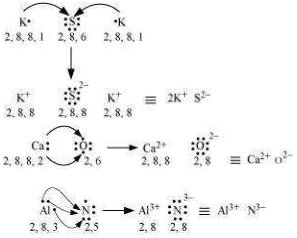
Use Lewis symbols to show electron transfer between the following atoms to form cations and anions:
$(a)$ $K$ and $S$
$(b)$ $Ca$ and $O$
$(c)$ $Al$ and $N$
$(a)$ $K$ and $S$
$(b)$ $Ca$ and $O$
$(c)$ $Al$ and $N$
Solution
(N/A) $K$ and $S$:
The electronic configurations of $K$ and $S$ are as follows:
$K: 2, 8, 8, 1$
$S: 2, 8, 6$
Sulphur $(S)$ requires $2$ more electrons to complete its octet. Potassium $(K)$ requires one electron more than the nearest noble gas,i.e.,Argon. Two $K$ atoms transfer one electron each to one $S$ atom to form $2K^+$ and $S^{2-}$.
$(b)$ $Ca$ and $O$:
The electronic configurations of $Ca$ and $O$ are as follows:
$Ca: 2, 8, 8, 2$
$O: 2, 6$
Oxygen requires two electrons to complete its octet,whereas calcium has two electrons more than the nearest noble gas,i.e.,Argon. $Ca$ transfers two electrons to $O$ to form $Ca^{2+}$ and $O^{2-}$.
$(c)$ $Al$ and $N$:
The electronic configurations of $Al$ and $N$ are as follows:
$Al: 2, 8, 3$
$N: 2, 5$
Nitrogen is three electrons short of the nearest noble gas (Neon),whereas aluminium has three electrons more than Neon. $Al$ transfers three electrons to $N$ to form $Al^{3+}$ and $N^{3-}$.
The electronic configurations of $K$ and $S$ are as follows:
$K: 2, 8, 8, 1$
$S: 2, 8, 6$
Sulphur $(S)$ requires $2$ more electrons to complete its octet. Potassium $(K)$ requires one electron more than the nearest noble gas,i.e.,Argon. Two $K$ atoms transfer one electron each to one $S$ atom to form $2K^+$ and $S^{2-}$.
$(b)$ $Ca$ and $O$:
The electronic configurations of $Ca$ and $O$ are as follows:
$Ca: 2, 8, 8, 2$
$O: 2, 6$
Oxygen requires two electrons to complete its octet,whereas calcium has two electrons more than the nearest noble gas,i.e.,Argon. $Ca$ transfers two electrons to $O$ to form $Ca^{2+}$ and $O^{2-}$.
$(c)$ $Al$ and $N$:
The electronic configurations of $Al$ and $N$ are as follows:
$Al: 2, 8, 3$
$N: 2, 5$
Nitrogen is three electrons short of the nearest noble gas (Neon),whereas aluminium has three electrons more than Neon. $Al$ transfers three electrons to $N$ to form $Al^{3+}$ and $N^{3-}$.
0 likes
View Solution118
EasyMCQ
Arrange the bonds in order of increasing ionic character in the molecules: $LiF$,$K_{2}O$,$N_{2}$,$SO_{2}$ and $ClF_{3}$
A
$N_{2} < SO_{2} < ClF_{3} < K_{2}O < LiF$
B
$N_{2} < ClF_{3} < SO_{2} < K_{2}O < LiF$
C
$LiF < K_{2}O < ClF_{3} < SO_{2} < N_{2}$
D
$SO_{2} < N_{2} < ClF_{3} < LiF < K_{2}O$
Solution
(B) The ionic character in a molecule is dependent upon the electronegativity difference between the constituting atoms. The greater the difference,the greater will be the ionic character of the molecule.
$1$. $N_{2}$: Electronegativity difference is $0$ (non-polar covalent).
$2$. $SO_{2}$: Electronegativity difference between $S$ $(2.58)$ and $O$ $(3.44)$ is $0.86$.
$3$. $ClF_{3}$: Electronegativity difference between $Cl$ $(3.16)$ and $F$ $(3.98)$ is $0.82$.
$4$. $K_{2}O$: Electronegativity difference between $K$ $(0.82)$ and $O$ $(3.44)$ is $2.62$.
$5$. $LiF$: Electronegativity difference between $Li$ $(0.98)$ and $F$ $(3.98)$ is $3.00$.
Comparing these values,the order of increasing ionic character is $N_{2} < ClF_{3} < SO_{2} < K_{2}O < LiF$.
$1$. $N_{2}$: Electronegativity difference is $0$ (non-polar covalent).
$2$. $SO_{2}$: Electronegativity difference between $S$ $(2.58)$ and $O$ $(3.44)$ is $0.86$.
$3$. $ClF_{3}$: Electronegativity difference between $Cl$ $(3.16)$ and $F$ $(3.98)$ is $0.82$.
$4$. $K_{2}O$: Electronegativity difference between $K$ $(0.82)$ and $O$ $(3.44)$ is $2.62$.
$5$. $LiF$: Electronegativity difference between $Li$ $(0.98)$ and $F$ $(3.98)$ is $3.00$.
Comparing these values,the order of increasing ionic character is $N_{2} < ClF_{3} < SO_{2} < K_{2}O < LiF$.
0 likes
View Solution119
Advanced
What is an electrovalent (ionic) bond? Explain with any two examples.
Solution
(N/A) Electrovalent (ionic) bond: The bond formed as a result of the electrostatic attraction between positive and negative ions is termed as an electrovalent bond.
Example-$1$: Ionic bond formation in sodium chloride $(NaCl)$.
$Na$ (alkali metal) is a highly electropositive metal and forms a $Na^{+}$ ion by the loss of one electron to attain a stable noble gas electronic configuration.
$Na ([Ne] 3s^{1}) \longrightarrow Na^{+} ([Ne]) + e^{-}$
Chlorine is a highly electronegative halogen. It converts into a $Cl^{-}$ negative ion by gaining the electron lost by the sodium atom. This $Cl^{-}$ ion attains the stable electron configuration of the noble gas $Ar ([Ne] 3s^{2} 3p^{6})$.
$Cl ([Ne] 3s^{2} 3p^{5}) + e^{-} \longrightarrow Cl^{-} ([Ar] \text{ or } [Ne] 3s^{2} 3p^{6})$
Example-$2$: Ionic bond (electrovalent) formation in $CaF_{2}$.
Calcium loses two electrons to attain the stable noble gas configuration of argon and is converted into a $Ca^{2+}$ ion.
$Ca ([Ar] 4s^{2}) \longrightarrow Ca^{2+} ([Ar]) + 2e^{-}$
Fluorine is a highly electronegative halogen atom that gains one electron to achieve a stable outer shell configuration,converting into a fluoride ion.
$F ([He] 2s^{2} 2p^{5}) + e^{-} \longrightarrow F^{-} ([He] 2s^{2} 2p^{6} \text{ or } [Ne])$
The positive $Ca^{2+}$ ion and two negative $F^{-}$ ions are held together by strong electrostatic forces of attraction to form the electrovalent compound $CaF_{2}$.
$Ca^{2+} + 2F^{-} \longrightarrow CaF_{2}$
Example-$1$: Ionic bond formation in sodium chloride $(NaCl)$.
$Na$ (alkali metal) is a highly electropositive metal and forms a $Na^{+}$ ion by the loss of one electron to attain a stable noble gas electronic configuration.
$Na ([Ne] 3s^{1}) \longrightarrow Na^{+} ([Ne]) + e^{-}$
Chlorine is a highly electronegative halogen. It converts into a $Cl^{-}$ negative ion by gaining the electron lost by the sodium atom. This $Cl^{-}$ ion attains the stable electron configuration of the noble gas $Ar ([Ne] 3s^{2} 3p^{6})$.
$Cl ([Ne] 3s^{2} 3p^{5}) + e^{-} \longrightarrow Cl^{-} ([Ar] \text{ or } [Ne] 3s^{2} 3p^{6})$
Example-$2$: Ionic bond (electrovalent) formation in $CaF_{2}$.
Calcium loses two electrons to attain the stable noble gas configuration of argon and is converted into a $Ca^{2+}$ ion.
$Ca ([Ar] 4s^{2}) \longrightarrow Ca^{2+} ([Ar]) + 2e^{-}$
Fluorine is a highly electronegative halogen atom that gains one electron to achieve a stable outer shell configuration,converting into a fluoride ion.
$F ([He] 2s^{2} 2p^{5}) + e^{-} \longrightarrow F^{-} ([He] 2s^{2} 2p^{6} \text{ or } [Ne])$
The positive $Ca^{2+}$ ion and two negative $F^{-}$ ions are held together by strong electrostatic forces of attraction to form the electrovalent compound $CaF_{2}$.
$Ca^{2+} + 2F^{-} \longrightarrow CaF_{2}$
0 likes
View Solution120
Difficult
What is the electrovalency of an ion? Give an example.
Solution
(N/A) The electrovalency of an ion is defined as the number of unit charges present on the ion.
Example: In $NaCl$,the $Na^{+}$ ion has one unit of positive charge,so its electrovalency is $+1$. In $CaF_{2}$,the $Ca^{2+}$ ion has two units of positive charge,so its electrovalency is $+2$.
Similarly,in $F^{-}$ and $Cl^{-}$,there is one unit of negative charge,so the valency is $-1$.
Example: In $NaCl$,the $Na^{+}$ ion has one unit of positive charge,so its electrovalency is $+1$. In $CaF_{2}$,the $Ca^{2+}$ ion has two units of positive charge,so its electrovalency is $+2$.
Similarly,in $F^{-}$ and $Cl^{-}$,there is one unit of negative charge,so the valency is $-1$.
| Valency | Examples |
| $+1$ | $Na^{+}, K^{+}, Rb^{+}, Cs^{+}, H^{+}, Cu^{+}, Hg^{+}, NH_{4}^{+}$ |
| $+2$ | $Mg^{2+}, Ca^{2+}, Sr^{2+}, Ba^{2+}, Cu^{2+}, Cd^{2+}, Ti^{2+}, Cr^{2+}, Mn^{2+}, Fe^{2+}$ |
| $+3$ | $Al^{3+}, Sc^{3+}, Cr^{3+}, Fe^{3+}$ |
| $+4$ | $Si^{4+}, Sn^{4+}$ |
| $-1$ | Halogen (e.g.,$F^{-}, Cl^{-}, Br^{-}, I^{-}$),$H^{-}, OH^{-}, NO_{3}^{-}$ |
| $-2$ | Oxygen group $(O^{2-}, S^{2-}, Se^{2-}, Te^{2-})$,$CO_{3}^{2-}, SO_{4}^{2-}$ |
| $-3$ | Nitrogen group $(N^{3-}, P^{3-})$,$PO_{4}^{3-}, AsO_{4}^{3-}$ |
0 likes
View Solution121
Medium
Write the postulate of Kossel for the formation of an ionic bond.
Solution
(N/A) In the periodic table,the highly electronegative halogens and the highly electropositive alkali metals are separated by the noble gases.
The formation of a negative ion from a halogen atom and a positive ion from an alkali metal atom is associated with the gain and loss of an electron by the respective atoms.
The negative and positive ions thus formed attain stable noble gas electronic configurations. The noble gases (with the exception of helium which has a duplet of electrons) have a particularly stable outer shell configuration of eight (octet) electrons $ns^{2} np^{6}$.
The negative and positive ions are stabilized by electrostatic attraction.
Kossel's postulation provides the basis for modern concepts regarding ion-formation by electron transfer and the formation of ionic crystalline compounds.
The formation of a negative ion from a halogen atom and a positive ion from an alkali metal atom is associated with the gain and loss of an electron by the respective atoms.
The negative and positive ions thus formed attain stable noble gas electronic configurations. The noble gases (with the exception of helium which has a duplet of electrons) have a particularly stable outer shell configuration of eight (octet) electrons $ns^{2} np^{6}$.
The negative and positive ions are stabilized by electrostatic attraction.
Kossel's postulation provides the basis for modern concepts regarding ion-formation by electron transfer and the formation of ionic crystalline compounds.
0 likes
View Solution122
Difficult
Write Lewis symbols for the following atoms and ions: $S$ and $S^{2-}$,$Al$ and $Al^{3+}$,$H$ and $H^{+}$.
Solution
(N/A) Lewis symbols represent the valence electrons of an atom or ion as dots around the chemical symbol.
$1$. For $S$ and $S^{2-}$:
- $S$ (atomic number $16$): Valence shell configuration is $3s^2 3p^4$. It has $6$ valence electrons. Lewis symbol: $\cdot \cdot \ddot{S} \cdot \cdot$
- $S^{2-}$: Gains $2$ electrons to complete the octet. Lewis symbol: $[ \cdot \cdot \ddot{\underset{\cdot \cdot}{S}} \cdot \cdot ]^{2-}$
$2$. For $Al$ and $Al^{3+}$:
- $Al$ (atomic number $13$): Valence shell configuration is $3s^2 3p^1$. It has $3$ valence electrons. Lewis symbol: $\cdot \dot{Al} \cdot$
- $Al^{3+}$: Loses $3$ electrons. Lewis symbol: $[Al]^{3+}$
$3$. For $H$ and $H^{+}$:
- $H$ (atomic number $1$): Has $1$ valence electron. Lewis symbol: $H \cdot$
- $H^{+}$: Loses $1$ electron. Lewis symbol: $H^{+}$
$1$. For $S$ and $S^{2-}$:
- $S$ (atomic number $16$): Valence shell configuration is $3s^2 3p^4$. It has $6$ valence electrons. Lewis symbol: $\cdot \cdot \ddot{S} \cdot \cdot$
- $S^{2-}$: Gains $2$ electrons to complete the octet. Lewis symbol: $[ \cdot \cdot \ddot{\underset{\cdot \cdot}{S}} \cdot \cdot ]^{2-}$
$2$. For $Al$ and $Al^{3+}$:
- $Al$ (atomic number $13$): Valence shell configuration is $3s^2 3p^1$. It has $3$ valence electrons. Lewis symbol: $\cdot \dot{Al} \cdot$
- $Al^{3+}$: Loses $3$ electrons. Lewis symbol: $[Al]^{3+}$
$3$. For $H$ and $H^{+}$:
- $H$ (atomic number $1$): Has $1$ valence electron. Lewis symbol: $H \cdot$
- $H^{+}$: Loses $1$ electron. Lewis symbol: $H^{+}$
0 likes
View Solution123
Difficult
Use Lewis symbols to show electron transfer between the following atoms to form cations and anions:
$(a)$ $K$ and $S$
$(b)$ $Ca$ and $O$
$(c)$ $Al$ and $N$
$(a)$ $K$ and $S$
$(b)$ $Ca$ and $O$
$(c)$ $Al$ and $N$
Solution
(N/A) $K$ and $S$:
$K$ $([Ar] 4s^1)$ loses one electron to form $K^+$. $S$ $([Ne] 3s^2 3p^4)$ gains two electrons to form $S^{2-}$. Two $K$ atoms transfer electrons to one $S$ atom to form $K_2S$ $(2K^+ + S^{2-})$.
$(b)$ $Ca$ and $O$:
$Ca$ $([Ar] 4s^2)$ loses two electrons to form $Ca^{2+}$. $O$ $([He] 2s^2 2p^4)$ gains two electrons to form $O^{2-}$. They combine to form $CaO$ $(Ca^{2+} + O^{2-})$.
$(c)$ $Al$ and $N$:
$Al$ $([Ne] 3s^2 3p^1)$ loses three electrons to form $Al^{3+}$. $N$ $([He] 2s^2 2p^3)$ gains three electrons to form $N^{3-}$. They combine to form $AlN$ $(Al^{3+} + N^{3-})$.
$K$ $([Ar] 4s^1)$ loses one electron to form $K^+$. $S$ $([Ne] 3s^2 3p^4)$ gains two electrons to form $S^{2-}$. Two $K$ atoms transfer electrons to one $S$ atom to form $K_2S$ $(2K^+ + S^{2-})$.
$(b)$ $Ca$ and $O$:
$Ca$ $([Ar] 4s^2)$ loses two electrons to form $Ca^{2+}$. $O$ $([He] 2s^2 2p^4)$ gains two electrons to form $O^{2-}$. They combine to form $CaO$ $(Ca^{2+} + O^{2-})$.
$(c)$ $Al$ and $N$:
$Al$ $([Ne] 3s^2 3p^1)$ loses three electrons to form $Al^{3+}$. $N$ $([He] 2s^2 2p^3)$ gains three electrons to form $N^{3-}$. They combine to form $AlN$ $(Al^{3+} + N^{3-})$.
0 likes
View Solution124
Difficult
Write the favourable factors for the formation of ionic bond.
Solution
(N/A) The formation of an ionic bond depends on the ease of formation of positive and negative ions from neutral atoms and their subsequent arrangement in a crystal lattice. The favourable factors are:
$1$. Low Ionization Enthalpy: The metal atom should have low ionization enthalpy so that it can easily lose electrons to form a cation $(M \rightarrow M^+ + e^-)$.
$2$. High Electron Gain Enthalpy: The non-metal atom should have high negative electron gain enthalpy so that it can easily gain electrons to form an anion $(X + e^- \rightarrow X^-)$.
$3$. High Lattice Enthalpy: The ions formed should arrange themselves in a crystal lattice such that the energy released (lattice enthalpy) is high,which stabilizes the ionic compound.
$1$. Low Ionization Enthalpy: The metal atom should have low ionization enthalpy so that it can easily lose electrons to form a cation $(M \rightarrow M^+ + e^-)$.
$2$. High Electron Gain Enthalpy: The non-metal atom should have high negative electron gain enthalpy so that it can easily gain electrons to form an anion $(X + e^- \rightarrow X^-)$.
$3$. High Lattice Enthalpy: The ions formed should arrange themselves in a crystal lattice such that the energy released (lattice enthalpy) is high,which stabilizes the ionic compound.
1 likes
View Solution125
Medium
Explain the Lattice Enthalpy.
Solution
Lattice Enthalpy: The lattice enthalpy of an ionic compound is the enthalpy change that occurs when one mole of an ionic compound dissociates into its ions in the gaseous state.
$Na^{+}Cl^{-}_{(s)} \rightarrow Na^{+}_{(g)} + Cl^{-}_{(g)}; \Delta_{lattice} H = +788 \ kJ / mol$
Different steps of the formation of $NaCl$ and its related enthalpy can be explained by the Born-Haber cycle as follows:
$(1)$ $Na_{(s)} \rightarrow Na_{(g)}$; sublimation of sodium,$\Delta_{sub} H = 108.4 \ kJ \ mol^{-1}$
$(2)$ Ionization enthalpy: $Na_{(g)} \rightarrow Na^{+}_{(g)} + e^{-}_{(g)}; \Delta_{i} H = 496 \ kJ / mol$
$(3)$ Dissociation of chlorine: $\frac{1}{2} Cl_{2(g)} \rightarrow Cl_{(g)}; \frac{1}{2} \Delta_{bond} H = 121 \ kJ / mol$
$(4)$ Electron gain enthalpy: $Cl_{(g)} + e^{-} \rightarrow Cl^{-}_{(g)}; \Delta_{eg} H = -348.6 \ kJ / mol$
$(5)$ Lattice formation: $Na^{+}_{(g)} + Cl^{-}_{(g)} \rightarrow Na^{+}Cl^{-}_{(s)}; \Delta_{U} H = ?$
$(6)$ Enthalpy of formation of $NaCl$: $Na_{(s)} + \frac{1}{2} Cl_{2(g)} \rightarrow NaCl_{(s)}; \Delta_{f} H = -411.2 \ kJ / mol$
Applying Hess's law,we get:
$\Delta_{lattice} H = \Delta_{f} H - (\Delta_{sub} H + \frac{1}{2} \Delta_{bond} H + \Delta_{i} H + \Delta_{eg} H)$
$= -(-411.2) - (108.4 + 121 + 496 - 348.6) = +788 \ kJ / mol$
For $NaCl_{(s)} \rightarrow Na^{+}_{(g)} + Cl^{-}_{(g)}$,the internal energy is smaller by $2RT$ and is equal to $+783 \ kJ / mol$.
We use the lattice enthalpy to calculate the enthalpy of solution using the expression:
$\Delta_{sol} H = \Delta_{lattice} H + \Delta_{hyd} H$
For one mole of $NaCl_{(s)}$,lattice enthalpy $= +788 \ kJ / mol$ and $\Delta_{hyd} H = -784 \ kJ / mol$.
$\therefore \Delta_{sol} H = +788 - 784 = +4 \ kJ / mol$
$Na^{+}Cl^{-}_{(s)} \rightarrow Na^{+}_{(g)} + Cl^{-}_{(g)}; \Delta_{lattice} H = +788 \ kJ / mol$
Different steps of the formation of $NaCl$ and its related enthalpy can be explained by the Born-Haber cycle as follows:
$(1)$ $Na_{(s)} \rightarrow Na_{(g)}$; sublimation of sodium,$\Delta_{sub} H = 108.4 \ kJ \ mol^{-1}$
$(2)$ Ionization enthalpy: $Na_{(g)} \rightarrow Na^{+}_{(g)} + e^{-}_{(g)}; \Delta_{i} H = 496 \ kJ / mol$
$(3)$ Dissociation of chlorine: $\frac{1}{2} Cl_{2(g)} \rightarrow Cl_{(g)}; \frac{1}{2} \Delta_{bond} H = 121 \ kJ / mol$
$(4)$ Electron gain enthalpy: $Cl_{(g)} + e^{-} \rightarrow Cl^{-}_{(g)}; \Delta_{eg} H = -348.6 \ kJ / mol$
$(5)$ Lattice formation: $Na^{+}_{(g)} + Cl^{-}_{(g)} \rightarrow Na^{+}Cl^{-}_{(s)}; \Delta_{U} H = ?$
$(6)$ Enthalpy of formation of $NaCl$: $Na_{(s)} + \frac{1}{2} Cl_{2(g)} \rightarrow NaCl_{(s)}; \Delta_{f} H = -411.2 \ kJ / mol$
Applying Hess's law,we get:
$\Delta_{lattice} H = \Delta_{f} H - (\Delta_{sub} H + \frac{1}{2} \Delta_{bond} H + \Delta_{i} H + \Delta_{eg} H)$
$= -(-411.2) - (108.4 + 121 + 496 - 348.6) = +788 \ kJ / mol$
For $NaCl_{(s)} \rightarrow Na^{+}_{(g)} + Cl^{-}_{(g)}$,the internal energy is smaller by $2RT$ and is equal to $+783 \ kJ / mol$.
We use the lattice enthalpy to calculate the enthalpy of solution using the expression:
$\Delta_{sol} H = \Delta_{lattice} H + \Delta_{hyd} H$
For one mole of $NaCl_{(s)}$,lattice enthalpy $= +788 \ kJ / mol$ and $\Delta_{hyd} H = -784 \ kJ / mol$.
$\therefore \Delta_{sol} H = +788 - 784 = +4 \ kJ / mol$
0 likes
View Solution126
Medium
Use the following data to calculate $\Delta _{lattice}H^{\theta }$ for $NaBr$. $\Delta _{sub}H^{\theta }$ for sodium metal $= 108.4 \ kJ \ mol^{-1}$,ionization enthalpy of sodium $= 496 \ kJ \ mol^{-1}$,electron gain enthalpy of bromine $= -325 \ kJ \ mol^{-1}$,bond dissociation enthalpy of bromine $= 192 \ kJ \ mol^{-1}$,$\Delta _{f}H^{\theta }$ for $NaBr_{(s)}$ $= -360.1 \ kJ \ mol^{-1}$.
Solution
(D) According to the Born-Haber cycle,the standard enthalpy of formation $\Delta _{f}H^{\theta }$ is given by the sum of all energy changes involved in the process:
$\Delta _{f}H^{\theta } = \Delta _{sub}H^{\theta } + IE + \frac{1}{2}\Delta _{diss}H^{\theta } + \Delta _{eg}H^{\theta } + \Delta _{lattice}H^{\theta }$
Substituting the given values:
$-360.1 = 108.4 + 496 + \frac{1}{2}(192) + (-325) + \Delta _{lattice}H^{\theta }$
$-360.1 = 108.4 + 496 + 96 - 325 + \Delta _{lattice}H^{\theta }$
$-360.1 = 375.4 + \Delta _{lattice}H^{\theta }$
$\Delta _{lattice}H^{\theta } = -360.1 - 375.4 = -735.5 \ kJ \ mol^{-1}$
$\Delta _{f}H^{\theta } = \Delta _{sub}H^{\theta } + IE + \frac{1}{2}\Delta _{diss}H^{\theta } + \Delta _{eg}H^{\theta } + \Delta _{lattice}H^{\theta }$
Substituting the given values:
$-360.1 = 108.4 + 496 + \frac{1}{2}(192) + (-325) + \Delta _{lattice}H^{\theta }$
$-360.1 = 108.4 + 496 + 96 - 325 + \Delta _{lattice}H^{\theta }$
$-360.1 = 375.4 + \Delta _{lattice}H^{\theta }$
$\Delta _{lattice}H^{\theta } = -360.1 - 375.4 = -735.5 \ kJ \ mol^{-1}$
0 likes
View Solution127
Easy
Write the Lewis symbols for the elements of the second period.
Solution
(N/A) The Lewis symbols for the elements of the second period are as follows:
$Li$: $\cdot Li$
$Be$: $\cdot Be \cdot$
$B$: $\cdot \dot{B} \cdot$
$C$: $\cdot \dot{C} \cdot \cdot$
$N$: $\cdot \dot{N} :$
$O$: $: \dot{O} :$
$F$: $: \ddot{F} :$
$Ne$: $: \ddot{Ne} :$
$Li$: $\cdot Li$
$Be$: $\cdot Be \cdot$
$B$: $\cdot \dot{B} \cdot$
$C$: $\cdot \dot{C} \cdot \cdot$
$N$: $\cdot \dot{N} :$
$O$: $: \dot{O} :$
$F$: $: \ddot{F} :$
$Ne$: $: \ddot{Ne} :$
0 likes
View Solution128
Easy
Describe the steps involved in the formation of an ionic bond and the associated energy changes.
Solution
(N/A) The formation of an ionic bond involves three main energy steps:
$1$. Formation of the gaseous cation: This requires energy,known as the ionization enthalpy,which is always endothermic.
$2$. Formation of the gaseous anion: This releases energy,known as the electron gain enthalpy,which is typically exothermic.
$3$. Formation of the ionic solid: The gaseous ions combine to form a crystal lattice,releasing a large amount of energy known as the lattice enthalpy,which is highly exothermic.
$1$. Formation of the gaseous cation: This requires energy,known as the ionization enthalpy,which is always endothermic.
$2$. Formation of the gaseous anion: This releases energy,known as the electron gain enthalpy,which is typically exothermic.
$3$. Formation of the ionic solid: The gaseous ions combine to form a crystal lattice,releasing a large amount of energy known as the lattice enthalpy,which is highly exothermic.
0 likes
View Solution129
Medium
Provide the steps and their corresponding enthalpies for the formation of $NaCl$ (sodium chloride).
Solution
The formation of $NaCl$ involves the following steps:
$1$. Ionization of sodium: $Na_{(g)} \rightarrow Na_{(g)}^{+} + e^{-}; \Delta_{i}H = 495.8 \, kJ \, mol^{-1}$
$2$. Electron gain by chlorine: $Cl_{(g)} + e^{-} \rightarrow Cl_{(g)}^{-}; \Delta_{eg}H = -348.7 \, kJ \, mol^{-1}$
$3$. Lattice formation: $Na_{(g)}^{+} + Cl_{(g)}^{-} \rightarrow NaCl_{(s)}; \Delta_{L}H = -788 \, kJ \, mol^{-1}$
$4$. The total enthalpy of formation is given by: $\Delta_{f}H(NaCl) = \Delta_{i}H + \Delta_{eg}H + \Delta_{L}H$
$\Delta_{f}H(NaCl) = 495.8 - 348.7 - 788 = -640.9 \, kJ \, mol^{-1}$
$1$. Ionization of sodium: $Na_{(g)} \rightarrow Na_{(g)}^{+} + e^{-}; \Delta_{i}H = 495.8 \, kJ \, mol^{-1}$
$2$. Electron gain by chlorine: $Cl_{(g)} + e^{-} \rightarrow Cl_{(g)}^{-}; \Delta_{eg}H = -348.7 \, kJ \, mol^{-1}$
$3$. Lattice formation: $Na_{(g)}^{+} + Cl_{(g)}^{-} \rightarrow NaCl_{(s)}; \Delta_{L}H = -788 \, kJ \, mol^{-1}$
$4$. The total enthalpy of formation is given by: $\Delta_{f}H(NaCl) = \Delta_{i}H + \Delta_{eg}H + \Delta_{L}H$
$\Delta_{f}H(NaCl) = 495.8 - 348.7 - 788 = -640.9 \, kJ \, mol^{-1}$
0 likes
View Solution130
MediumMCQ
The Born-Haber cycle for $KCl$ is evaluated with the following data:
$\Delta_{f} H^{\ominus}$ for $KCl = -436.7 \ kJ \ mol^{-1}$
$\Delta_{sub} H^{\ominus}$ for $K = 89.2 \ kJ \ mol^{-1}$
$\Delta_{ionization} H^{\ominus}$ for $K = 419.0 \ kJ \ mol^{-1}$
$\Delta_{electron \ gain} H^{\ominus}$ for $Cl_{(g)} = -348.6 \ kJ \ mol^{-1}$
$\Delta_{bond} H^{\ominus}$ for $Cl_2 = 243.0 \ kJ \ mol^{-1}$
The magnitude of lattice enthalpy of $KCl$ in $kJ \ mol^{-1}$ is ..... . (Nearest integer)
$\Delta_{f} H^{\ominus}$ for $KCl = -436.7 \ kJ \ mol^{-1}$
$\Delta_{sub} H^{\ominus}$ for $K = 89.2 \ kJ \ mol^{-1}$
$\Delta_{ionization} H^{\ominus}$ for $K = 419.0 \ kJ \ mol^{-1}$
$\Delta_{electron \ gain} H^{\ominus}$ for $Cl_{(g)} = -348.6 \ kJ \ mol^{-1}$
$\Delta_{bond} H^{\ominus}$ for $Cl_2 = 243.0 \ kJ \ mol^{-1}$
The magnitude of lattice enthalpy of $KCl$ in $kJ \ mol^{-1}$ is ..... . (Nearest integer)
A
$718$
B
$951$
C
$632$
D
$521$
Solution
(A) The Born-Haber cycle equation is given by:
$\Delta_{f} H^{\ominus}_{KCl} = \Delta_{sub} H^{\ominus}_{(K)} + \Delta_{ionization} H^{\ominus}_{(K)} + \frac{1}{2} \Delta_{bond} H^{\ominus}_{(Cl_2)} + \Delta_{electron \ gain} H^{\ominus}_{(Cl)} + \Delta_{lattice} H^{\ominus}_{(KCl)}$
Substituting the given values:
$-436.7 = 89.2 + 419.0 + \frac{1}{2}(243.0) + (-348.6) + \Delta_{lattice} H^{\ominus}_{(KCl)}$
$-436.7 = 89.2 + 419.0 + 121.5 - 348.6 + \Delta_{lattice} H^{\ominus}_{(KCl)}$
$-436.7 = 281.1 + \Delta_{lattice} H^{\ominus}_{(KCl)}$
$\Delta_{lattice} H^{\ominus}_{(KCl)} = -436.7 - 281.1 = -717.8 \ kJ \ mol^{-1}$
The magnitude of lattice enthalpy is the absolute value,which is $717.8 \ kJ \ mol^{-1}$.
Rounding to the nearest integer,we get $718 \ kJ \ mol^{-1}$.
$\Delta_{f} H^{\ominus}_{KCl} = \Delta_{sub} H^{\ominus}_{(K)} + \Delta_{ionization} H^{\ominus}_{(K)} + \frac{1}{2} \Delta_{bond} H^{\ominus}_{(Cl_2)} + \Delta_{electron \ gain} H^{\ominus}_{(Cl)} + \Delta_{lattice} H^{\ominus}_{(KCl)}$
Substituting the given values:
$-436.7 = 89.2 + 419.0 + \frac{1}{2}(243.0) + (-348.6) + \Delta_{lattice} H^{\ominus}_{(KCl)}$
$-436.7 = 89.2 + 419.0 + 121.5 - 348.6 + \Delta_{lattice} H^{\ominus}_{(KCl)}$
$-436.7 = 281.1 + \Delta_{lattice} H^{\ominus}_{(KCl)}$
$\Delta_{lattice} H^{\ominus}_{(KCl)} = -436.7 - 281.1 = -717.8 \ kJ \ mol^{-1}$
The magnitude of lattice enthalpy is the absolute value,which is $717.8 \ kJ \ mol^{-1}$.
Rounding to the nearest integer,we get $718 \ kJ \ mol^{-1}$.
0 likes
View Solution131
MediumMCQ
The lattice energies of $NaCl$,$NaF$,$KCl$,and $RbCl$ follow the order:
A
$KCl < RbCl < NaCl < NaF$
B
$NaF < NaCl < KCl < RbCl$
C
$RbCl < KCl < NaCl < NaF$
D
$NaCl < RbCl < NaF < KCl$
Solution
(C) Lattice energy is the energy required to completely separate one mole of a solid ionic compound into its gaseous constituent ions.
Lattice energy is inversely proportional to the inter-ionic distance $(r_0 = r_+ + r_-)$.
As the size of the ions decreases,the inter-ionic distance decreases,which leads to stronger electrostatic forces of attraction and higher lattice energy.
Comparing the given compounds:
$RbCl$ ($Rb^+$ is largest),$KCl$ $(K^+)$,$NaCl$ $(Na^+)$,$NaF$ ($F^-$ is smallest).
The size order of ions is $Rb^+ > K^+ > Na^+$ and $Cl^- > F^-$.
Therefore,the lattice energy order is $RbCl < KCl < NaCl < NaF$.
Lattice energy is inversely proportional to the inter-ionic distance $(r_0 = r_+ + r_-)$.
As the size of the ions decreases,the inter-ionic distance decreases,which leads to stronger electrostatic forces of attraction and higher lattice energy.
Comparing the given compounds:
$RbCl$ ($Rb^+$ is largest),$KCl$ $(K^+)$,$NaCl$ $(Na^+)$,$NaF$ ($F^-$ is smallest).
The size order of ions is $Rb^+ > K^+ > Na^+$ and $Cl^- > F^-$.
Therefore,the lattice energy order is $RbCl < KCl < NaCl < NaF$.
0 likes
View Solution132
MediumMCQ
The element which readily forms an ionic bond has the electronic configuration
A
$1 s^2 2 s^2 2 p^3$
B
$1 s^2 2 s^2 2 p^1$
C
$1 s^2 2 s^2 2 p^2$
D
$1 s^2 2 s^2 2 p^6 3 s^1$
Solution
(D) . Alkali metals have the highest tendency to form ionic bonds because they possess low ionization energy.
The general electronic configuration of an alkali metal is $ns^1$.
Among the given configurations,$1 s^2 2 s^2 2 p^6 3 s^1$ corresponds to $Na$ (Sodium),which is an alkali metal and thus readily forms an ionic bond.
The general electronic configuration of an alkali metal is $ns^1$.
Among the given configurations,$1 s^2 2 s^2 2 p^6 3 s^1$ corresponds to $Na$ (Sodium),which is an alkali metal and thus readily forms an ionic bond.
0 likes
View Solution133
MediumMCQ
The pair in which the first compound is ionic and the second compound is covalent,is
A
$Fe(OH)_2, CH_3OH$
B
$Fe(OH)_2, Cu(OH)_2$
C
$CH_3OH, CH_3CH_2OH$
D
$Ca(OH)_2, Cu(OH)_2$
Solution
(A) An ionic compound is typically formed by the electrostatic attraction between a metal cation and a non-metal anion,whereas a covalent compound is formed by the sharing of electrons between non-metal atoms.
In the given options:
$Fe(OH)_2$ is an ionic compound (metal hydroxide).
$CH_3OH$ (methanol) is a covalent compound (organic molecule).
$Cu(OH)_2$ is an ionic compound.
$Ca(OH)_2$ is an ionic compound.
$CH_3CH_2OH$ (ethanol) is a covalent compound.
Therefore,the pair where the first is ionic and the second is covalent is $Fe(OH)_2$ and $CH_3OH$.
In the given options:
$Fe(OH)_2$ is an ionic compound (metal hydroxide).
$CH_3OH$ (methanol) is a covalent compound (organic molecule).
$Cu(OH)_2$ is an ionic compound.
$Ca(OH)_2$ is an ionic compound.
$CH_3CH_2OH$ (ethanol) is a covalent compound.
Therefore,the pair where the first is ionic and the second is covalent is $Fe(OH)_2$ and $CH_3OH$.
0 likes
View Solution134
MediumMCQ
Which of the following compounds has the highest lattice enthalpy?
A
$LiCl$
B
$NaCl$
C
$BeF_2$
D
$CaCl_2$
Solution
(C) Lattice enthalpy is directly proportional to the product of the charges of the ions and inversely proportional to the inter-ionic distance (sum of ionic radii).
$Lattice \ Enthalpy \propto \frac{|q_+ q_-|}{r_+ + r_-}$.
Comparing the given compounds:
$LiCl$: $Li^+$ $(+1)$,$Cl^-$ $(-1)$
$NaCl$: $Na^+$ $(+1)$,$Cl^-$ $(-1)$
$BeF_2$: $Be^{2+}$ $(+2)$,$F^-$ $(-1)$
$CaCl_2$: $Ca^{2+}$ $(+2)$,$Cl^-$ $(-1)$
$BeF_2$ has the highest charge product $(|(+2) \times (-1)| = 2)$ and the smallest ionic radii sum ($Be^{2+}$ and $F^-$ are smaller than $Ca^{2+}$ and $Cl^-$). Therefore,$BeF_2$ has the highest lattice enthalpy.
$Lattice \ Enthalpy \propto \frac{|q_+ q_-|}{r_+ + r_-}$.
Comparing the given compounds:
$LiCl$: $Li^+$ $(+1)$,$Cl^-$ $(-1)$
$NaCl$: $Na^+$ $(+1)$,$Cl^-$ $(-1)$
$BeF_2$: $Be^{2+}$ $(+2)$,$F^-$ $(-1)$
$CaCl_2$: $Ca^{2+}$ $(+2)$,$Cl^-$ $(-1)$
$BeF_2$ has the highest charge product $(|(+2) \times (-1)| = 2)$ and the smallest ionic radii sum ($Be^{2+}$ and $F^-$ are smaller than $Ca^{2+}$ and $Cl^-$). Therefore,$BeF_2$ has the highest lattice enthalpy.
0 likes
View Solution135
EasyMCQ
Which of the following is true for the compound $AB$,if it is formed by the transfer of an electron from $A$ to $B$?
A
$B$ is divalent
B
$A$ is divalent
C
$AB$ forms an electrovalent bond
D
$AB$ forms a covalent bond
Solution
(C) When an electron is transferred from atom $A$ to atom $B$,$A$ loses one electron to form a cation $A^+$ and $B$ gains one electron to form an anion $B^-$.
Since the bond is formed by the electrostatic force of attraction between the oppositely charged ions ($A^+$ and $B^-$),it is an electrovalent or ionic bond.
Therefore,the compound $AB$ exhibits an electrovalent bond.
Since the bond is formed by the electrostatic force of attraction between the oppositely charged ions ($A^+$ and $B^-$),it is an electrovalent or ionic bond.
Therefore,the compound $AB$ exhibits an electrovalent bond.
0 likes
View Solution136
MediumMCQ
Which of the following is an ionic compound?
A
$SO_{2}$
B
$ICl$
C
$CHCl_{3}$
D
$KI$
Solution
(D) An ionic compound is formed by the transfer of electrons between a metal and a non-metal.
$KI$ (Potassium Iodide) consists of a metal $(K^+)$ and a non-metal $(I^-)$,which are held together by strong electrostatic forces of attraction,making it an ionic compound.
$SO_{2}$,$ICl$,and $CHCl_{3}$ are covalent compounds formed by the sharing of electrons between non-metals.
Therefore,the correct option is $D$.
$KI$ (Potassium Iodide) consists of a metal $(K^+)$ and a non-metal $(I^-)$,which are held together by strong electrostatic forces of attraction,making it an ionic compound.
$SO_{2}$,$ICl$,and $CHCl_{3}$ are covalent compounds formed by the sharing of electrons between non-metals.
Therefore,the correct option is $D$.
0 likes
View Solution137
MediumMCQ
Which bond in a molecule of ethyl magnesium bromide is ionic in nature?
A
$C - C$ bond
B
$C - Mg$ bond
C
$Mg - Br$ bond
D
$C - H$ bond
Solution
(C) In a molecule of ethyl magnesium bromide $(CH_3CH_2MgBr)$,the $Mg - Br$ bond is ionic in nature.
This is because the electronegativity difference between magnesium $(Mg)$ and bromine $(Br)$ is significantly large compared to the other bonds present in the molecule.
Consequently,the $Mg - Br$ bond exhibits the highest ionic character.
This is because the electronegativity difference between magnesium $(Mg)$ and bromine $(Br)$ is significantly large compared to the other bonds present in the molecule.
Consequently,the $Mg - Br$ bond exhibits the highest ionic character.
0 likes
View Solution138
MediumMCQ
$HCl$ gas is covalent and $NaCl$ is an ionic compound. This is because
A
Sodium is highly electropositive
B
Hydrogen is a non-metal.
C
$HCl$ is a gas.
D
Electronegativity difference between $H$ and $Cl$ is less than $2.1$.
Solution
(D) The electronegativity difference between $H$ and $Cl$ is approximately $0.9$,which is significantly less than $2.1$.
According to the Pauling scale,if the electronegativity difference between two atoms is less than $1.7$ (or $2.1$ in some conventions),the bond formed is predominantly covalent.
In $NaCl$,the electronegativity difference between $Na$ $(0.9)$ and $Cl$ $(3.0)$ is $2.1$,resulting in an ionic bond.
According to the Pauling scale,if the electronegativity difference between two atoms is less than $1.7$ (or $2.1$ in some conventions),the bond formed is predominantly covalent.
In $NaCl$,the electronegativity difference between $Na$ $(0.9)$ and $Cl$ $(3.0)$ is $2.1$,resulting in an ionic bond.
0 likes
View Solution139
MediumMCQ
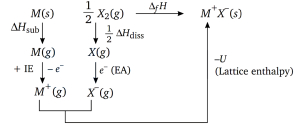
Consider the Born-Haber cycle for the formation of an ionic compound given below and identify the compound $Z$ formed.
$M_{(s)}$ $\xrightarrow{\Delta H_1} M_{(g)}$ $\xrightarrow{\Delta H_2} M^{+}_{(g)}$
$\frac{1}{2} X_{2(g)}$ $\xrightarrow{\Delta H_3} X_{(g)}$ $\xrightarrow{\Delta H_4} X^{-}_{(g)}$
$M^{+}_{(g)} + X^{-}_{(g)} \xrightarrow{\Delta H_5} Z$
$M_{(s)}$ $\xrightarrow{\Delta H_1} M_{(g)}$ $\xrightarrow{\Delta H_2} M^{+}_{(g)}$
$\frac{1}{2} X_{2(g)}$ $\xrightarrow{\Delta H_3} X_{(g)}$ $\xrightarrow{\Delta H_4} X^{-}_{(g)}$
$M^{+}_{(g)} + X^{-}_{(g)} \xrightarrow{\Delta H_5} Z$
A
$M^{+} X^{-}$
B
$M^{+} X^{-}_{(s)}$
C
$MX$
D
$M^{+} X^{-}_{(g)}$
Solution
(B) In the Born-Haber cycle,the final step $(\Delta H_5)$ represents the lattice enthalpy,where gaseous ions $M^{+}_{(g)}$ and $X^{-}_{(g)}$ combine to form one mole of a solid ionic compound $M^{+} X^{-}_{(s)}$.
Thus,$Z$ is $M^{+} X^{-}_{(s)}$.
Thus,$Z$ is $M^{+} X^{-}_{(s)}$.
0 likes
View Solution140
EasyMCQ
Given below are two statements:
Assertion $(A)$: Ionic compounds are formed by non-directional bonds.
Reasoning $(R)$: They are soluble in nonpolar solvents.
The correct answer is:
Assertion $(A)$: Ionic compounds are formed by non-directional bonds.
Reasoning $(R)$: They are soluble in nonpolar solvents.
The correct answer is:
A
Both $(A)$ and $(R)$ are correct and $(R)$ is the correct explanation of $(A)$
B
Both $(A)$ and $(R)$ are correct and $(R)$ is not the correct explanation of $(A)$
C
$(A)$ is correct but $(R)$ is not correct
D
$(A)$ is not correct but $(R)$ is correct
Solution
(C) Ionic bonds are electrostatic forces of attraction that are non-directional in nature,meaning they act in all directions equally. Thus,Assertion $(A)$ is correct.
Ionic compounds are polar in nature and are soluble in polar solvents (like water) due to ion-dipole interactions. They are generally insoluble in nonpolar solvents. Thus,Reasoning $(R)$ is incorrect.
Ionic compounds are polar in nature and are soluble in polar solvents (like water) due to ion-dipole interactions. They are generally insoluble in nonpolar solvents. Thus,Reasoning $(R)$ is incorrect.
0 likes
View Solution141
EasyMCQ
Assertion $(A)$: Higher lattice enthalpy leads to greater stability of ionic compounds.
Reason $(R)$: Lattice enthalpy is a direct measure of the electrostatic forces of repulsion among the constituent ions in an ionic solid.
The correct answer is
Reason $(R)$: Lattice enthalpy is a direct measure of the electrostatic forces of repulsion among the constituent ions in an ionic solid.
The correct answer is
A
Both $(A)$ and $(R)$ are correct and $(R)$ is the correct explanation of $(A)$
B
Both $(A)$ and $(R)$ are correct and $(R)$ is not the correct explanation of $(A)$
C
$(A)$ is correct,but $(R)$ is not correct
D
$(A)$ is not correct,but $(R)$ is correct
Solution
(C) Lattice enthalpy is defined as the energy required to completely separate one mole of a solid ionic compound into its gaseous constituent ions. Higher lattice enthalpy indicates stronger electrostatic forces of attraction between the ions,which leads to greater stability of the ionic compound. Thus,Assertion $(A)$ is correct.
Reason $(R)$ states that lattice enthalpy is a measure of repulsion,which is incorrect. Lattice enthalpy is a measure of the electrostatic forces of attraction between oppositely charged ions,not repulsion. Thus,Reason $(R)$ is incorrect.
Therefore,the correct option is $(C)$.
Reason $(R)$ states that lattice enthalpy is a measure of repulsion,which is incorrect. Lattice enthalpy is a measure of the electrostatic forces of attraction between oppositely charged ions,not repulsion. Thus,Reason $(R)$ is incorrect.
Therefore,the correct option is $(C)$.
0 likes
View Solution142
EasyMCQ
If an element in group $2$ forms a compound with an element in group $17$ of the periodic table,the compound formed is likely to
A
conduct electricity in the solid state
B
have a low boiling point
C
dissolve in non-polar solvents
D
be a crystalline solid
Solution
(D) Elements in group-$2$ are alkaline earth metals,and elements in group-$17$ are halogens (non-metals).
When a metal reacts with a non-metal,electrons are transferred from the metal to the non-metal,resulting in the formation of an ionic bond.
Ionic compounds typically exist as crystalline solids at room temperature due to strong electrostatic forces of attraction between ions.
Therefore,the compound formed is likely to be a crystalline solid.
When a metal reacts with a non-metal,electrons are transferred from the metal to the non-metal,resulting in the formation of an ionic bond.
Ionic compounds typically exist as crystalline solids at room temperature due to strong electrostatic forces of attraction between ions.
Therefore,the compound formed is likely to be a crystalline solid.
0 likes
View Solution143
EasyMCQ
Which among the following compounds shows the highest lattice energy?
A
$LiF$
B
$CsF$
C
$NaF$
D
$KF$
Solution
(A) Lattice energy is inversely proportional to the inter-ionic distance between the cation and the anion.
Since the fluoride ion $(F^{-})$ is common in all the given compounds,the lattice energy depends on the size of the alkali metal cation.
As the size of the cation increases from $Li^{+}$ to $Cs^{+}$,the inter-ionic distance increases,leading to a decrease in lattice energy.
Therefore,$LiF$ has the smallest inter-ionic distance and consequently the highest lattice energy.
Since the fluoride ion $(F^{-})$ is common in all the given compounds,the lattice energy depends on the size of the alkali metal cation.
As the size of the cation increases from $Li^{+}$ to $Cs^{+}$,the inter-ionic distance increases,leading to a decrease in lattice energy.
Therefore,$LiF$ has the smallest inter-ionic distance and consequently the highest lattice energy.
0 likes
View Solution144
EasyMCQ
Find out the correct order of ionic character in the following molecules:
$(i)$ $O_2$
$(ii)$ $K_2O$
$(iii)$ $N_2$
$(iv)$ $LiF$
$(i)$ $O_2$
$(ii)$ $K_2O$
$(iii)$ $N_2$
$(iv)$ $LiF$
A
$iv > ii > i > iii$
B
$iv > ii > iii > i$
C
$ii > iv > i > iii$
D
$ii > iv > iii > i$
Solution
(A) The ionic character of a bond is directly proportional to the electronegativity difference between the bonded atoms.
$(i)$ $O_2$: Electronegativity difference = $3.5 - 3.5 = 0$.
$(ii)$ $K_2O$: Electronegativity difference = $3.5 - 0.8 = 2.7$.
$(iii)$ $N_2$: Electronegativity difference = $3.0 - 3.0 = 0$.
$(iv)$ $LiF$: Electronegativity difference = $4.0 - 1.0 = 3.0$.
Comparing the values: $LiF$ $(3.0)$ > $K_2O$ $(2.7)$ > $O_2$ $(0)$ = $N_2$ $(0)$.
Since $O_2$ and $N_2$ are non-polar covalent molecules,they have negligible ionic character. Between $O_2$ and $N_2$,$O_2$ is slightly more polarizable,but both are essentially $0$. Thus,the order is $iv > ii > i > iii$ or $iv > ii > iii > i$ depending on convention,but $iv > ii > i > iii$ is the standard representation.
$(i)$ $O_2$: Electronegativity difference = $3.5 - 3.5 = 0$.
$(ii)$ $K_2O$: Electronegativity difference = $3.5 - 0.8 = 2.7$.
$(iii)$ $N_2$: Electronegativity difference = $3.0 - 3.0 = 0$.
$(iv)$ $LiF$: Electronegativity difference = $4.0 - 1.0 = 3.0$.
Comparing the values: $LiF$ $(3.0)$ > $K_2O$ $(2.7)$ > $O_2$ $(0)$ = $N_2$ $(0)$.
Since $O_2$ and $N_2$ are non-polar covalent molecules,they have negligible ionic character. Between $O_2$ and $N_2$,$O_2$ is slightly more polarizable,but both are essentially $0$. Thus,the order is $iv > ii > i > iii$ or $iv > ii > iii > i$ depending on convention,but $iv > ii > i > iii$ is the standard representation.
0 likes
View Solution145
MediumMCQ
Among the following compounds,the one with the highest lattice energy is
A
$LiF$
B
$NaCl$
C
$MgO$
D
$LiCl$
Solution
(C) The lattice energy of an ionic compound is directly proportional to the product of the charges of the ions and inversely proportional to the sum of the ionic radii.
$Lattice \ Energy \propto \frac{|q_+ \times q_-|}{r_+ + r_-}$
For $LiF$,$NaCl$,and $LiCl$,the ions have charges of $\pm 1$. For $MgO$,the ions have charges of $\pm 2$.
Since the charge product for $MgO$ $(2 \times 2 = 4)$ is significantly higher than that of the others $(1 \times 1 = 1)$,$MgO$ has a much higher lattice energy.
Additionally,$Mg^{2+}$ and $O^{2-}$ ions are relatively small,which further increases the lattice energy.
Therefore,$MgO$ has the highest lattice energy.
Hence,option $C$ is correct.
$Lattice \ Energy \propto \frac{|q_+ \times q_-|}{r_+ + r_-}$
For $LiF$,$NaCl$,and $LiCl$,the ions have charges of $\pm 1$. For $MgO$,the ions have charges of $\pm 2$.
Since the charge product for $MgO$ $(2 \times 2 = 4)$ is significantly higher than that of the others $(1 \times 1 = 1)$,$MgO$ has a much higher lattice energy.
Additionally,$Mg^{2+}$ and $O^{2-}$ ions are relatively small,which further increases the lattice energy.
Therefore,$MgO$ has the highest lattice energy.
Hence,option $C$ is correct.
0 likes
View Solution146
MediumMCQ
Which of the following is not correct regarding the properties of ionic compounds?
A
Ionic compounds have high melting and boiling points
B
Their reaction velocity in aqueous medium is very high
C
Ionic compounds in their molten and aqueous solutions do not conduct electricity
D
They are highly soluble in polar solvents
Solution
(C) Ionic compounds consist of ions that are held together by strong electrostatic forces of attraction.
In the solid state,these ions are fixed in a lattice and cannot move,making them poor conductors.
However,in the molten state or when dissolved in water,the ions become free to move,which allows them to conduct electricity.
Therefore,the statement that ionic compounds do not conduct electricity in molten or aqueous solutions is incorrect.
In the solid state,these ions are fixed in a lattice and cannot move,making them poor conductors.
However,in the molten state or when dissolved in water,the ions become free to move,which allows them to conduct electricity.
Therefore,the statement that ionic compounds do not conduct electricity in molten or aqueous solutions is incorrect.
0 likes
View Solution147
MediumMCQ
The atomic numbers of the elements $X, Y, Z$ are $a, a+1, a+2$ respectively. $Z$ is an alkali metal. The nature of bonding in the compound formed by $X$ and $Z$ is
A
Covalent
B
Metallic
C
Ionic
D
Coordinate covalent
Solution
(C) Given that $Z$ is an alkali metal with atomic number $a+2$.
Alkali metals belong to Group $1$ of the periodic table.
If $Z$ is an alkali metal,then $Y$ (atomic number $a+1$) is a noble gas (Group $18$) and $X$ (atomic number $a$) is a halogen (Group $17$).
$X$ is a non-metal (halogen) and $Z$ is a metal (alkali metal).
The bond formed between a metal and a non-metal is typically ionic in nature.
Therefore,the compound formed by $X$ and $Z$ is ionic.
Alkali metals belong to Group $1$ of the periodic table.
If $Z$ is an alkali metal,then $Y$ (atomic number $a+1$) is a noble gas (Group $18$) and $X$ (atomic number $a$) is a halogen (Group $17$).
$X$ is a non-metal (halogen) and $Z$ is a metal (alkali metal).
The bond formed between a metal and a non-metal is typically ionic in nature.
Therefore,the compound formed by $X$ and $Z$ is ionic.
0 likes
View Solution148
MediumMCQ
The correct order of melting points of the following salts is $LiF$ $(I)$,$LiCl$ $(II)$,$LiI$ $(III)$.
A
$I > II > III$
B
$II > I > III$
C
$III > II > I$
D
$II > III > I$
Solution
(A) The melting point of ionic compounds depends on the lattice energy of the crystal lattice.
Lattice energy is inversely proportional to the interionic distance.
As the size of the anion increases from $F^{-}$ to $Cl^{-}$ to $I^{-}$,the interionic distance increases,leading to a decrease in lattice energy.
Therefore,the melting point decreases in the order $LiF > LiCl > LiI$.
This corresponds to the order $I > II > III$.
Lattice energy is inversely proportional to the interionic distance.
As the size of the anion increases from $F^{-}$ to $Cl^{-}$ to $I^{-}$,the interionic distance increases,leading to a decrease in lattice energy.
Therefore,the melting point decreases in the order $LiF > LiCl > LiI$.
This corresponds to the order $I > II > III$.
0 likes
View Solution149
MediumMCQ
$AB$ is an ionic solid. The ionic radii of $A^{+}$ and $B^{-}$ are respectively $r_c$ and $r_a$. Lattice energy of $AB$ is proportional to:
A
$\frac{r_c}{r_a}$
B
$(r_c + r_a)$
C
$\frac{r_a}{r_c}$
D
$\frac{1}{(r_c + r_a)}$
Solution
(D) The lattice energy $(U)$ of an ionic crystal is defined as the energy released when gaseous ions combine to form one mole of the solid ionic crystal.
According to the Born-Landé equation,the lattice energy is inversely proportional to the inter-ionic distance $(r_0)$.
Since the inter-ionic distance $r_0$ is the sum of the ionic radii of the cation $(r_c)$ and the anion $(r_a)$,we have $r_0 = r_c + r_a$.
Therefore,the lattice energy $U$ is proportional to $\frac{1}{(r_c + r_a)}$.
According to the Born-Landé equation,the lattice energy is inversely proportional to the inter-ionic distance $(r_0)$.
Since the inter-ionic distance $r_0$ is the sum of the ionic radii of the cation $(r_c)$ and the anion $(r_a)$,we have $r_0 = r_c + r_a$.
Therefore,the lattice energy $U$ is proportional to $\frac{1}{(r_c + r_a)}$.
0 likes
View SolutionChemical Bonding and Molecular Structure — Electrovalent bonding · Frequently Asked Questions
1Are these Chemical Bonding and Molecular Structure questions useful for JEE and NEET?
Yes. All questions in this section are mapped to JEE Main and NEET exam patterns. Previous year questions from JEE Main, NEET, GUJCET and state-level exams are included with full solutions.
2Can I switch to Hindi or Gujarati for these questions?
Yes. Use the language tabs in the hero section or the sidebar to view the same questions and solutions in English, Hindi or Gujarati.
3How do I generate a question paper from this subtopic?
Use the Vedclass Exam Paper Generator — select the chapter and subtopic, set difficulty, and generate Sets A, B, C, D automatically. First 3 chapters of every subject are free.
Vedclass Products
For Students
Vedclass Test Series
Mock tests in real JEE/NEET style with performance analysis. 5-day free trial.
Start Free TrialFor Teachers
Exam Paper Generator
Generate Set A/B/C/D papers from this chapter in 2 minutes. 3 chapters free.
Try FreeFor Institutes
Online Exam Module
Live online exams with unlimited students, 360° analytics & white-label branding.
See DemoFor Teachers & Institutes
Generate a Chemical Bonding and Molecular Structure Exam Paper in 2 Minutes
Select subtopic & difficulty — Sets A, B, C, D auto-generated with No Repeat logic.
First 3 chapters of every subject are free — no payment required.