
A English
Dipole moment Questions in English
Class 11 Chemistry · Chemical Bonding and Molecular Structure · Dipole moment
317+
Questions
English
Language
100%
With Solutions
Showing 14 of 317 questions in English
301
MediumMCQ
The set of molecules among the following with zero dipole moment is $CCl_4$,$BF_3$,$CHCl_3$,$CS_2$,$NH_3$,$1,4$-dichlorobenzene,$CO_2$.
A
$CO_2, CS_2, BF_3, NH_3, CHCl_3$ only
B
$CCl_4, BF_3, CO_2, CS_2, 1,4$-dichlorobenzene only
C
$CO_2, CS_2, 1,4$-dichlorobenzene only
D
$CO_2, CS_2$ only
Solution
(B) molecule has a zero dipole moment if its net dipole moment is zero. This occurs in highly symmetric molecules where the bond dipoles cancel each other out.
$1$. $CCl_4$: Tetrahedral geometry,all $C-Cl$ bond dipoles cancel. $\mu = 0$.
$2$. $BF_3$: Trigonal planar geometry,all $B-F$ bond dipoles cancel. $\mu = 0$.
$3$. $CHCl_3$: Asymmetric,$\mu \neq 0$.
$4$. $CS_2$: Linear geometry,$S=C=S$ bond dipoles cancel. $\mu = 0$.
$5$. $NH_3$: Pyramidal geometry with a lone pair,$\mu \neq 0$.
$6$. $1,4$-dichlorobenzene: Para-substituted benzene,the two $C-Cl$ bond dipoles are equal and opposite. $\mu = 0$.
$7$. $CO_2$: Linear geometry,$O=C=O$ bond dipoles cancel. $\mu = 0$.
Thus,the molecules with zero dipole moment are $CCl_4, BF_3, CO_2, CS_2, 1,4$-dichlorobenzene.
$1$. $CCl_4$: Tetrahedral geometry,all $C-Cl$ bond dipoles cancel. $\mu = 0$.
$2$. $BF_3$: Trigonal planar geometry,all $B-F$ bond dipoles cancel. $\mu = 0$.
$3$. $CHCl_3$: Asymmetric,$\mu \neq 0$.
$4$. $CS_2$: Linear geometry,$S=C=S$ bond dipoles cancel. $\mu = 0$.
$5$. $NH_3$: Pyramidal geometry with a lone pair,$\mu \neq 0$.
$6$. $1,4$-dichlorobenzene: Para-substituted benzene,the two $C-Cl$ bond dipoles are equal and opposite. $\mu = 0$.
$7$. $CO_2$: Linear geometry,$O=C=O$ bond dipoles cancel. $\mu = 0$.
Thus,the molecules with zero dipole moment are $CCl_4, BF_3, CO_2, CS_2, 1,4$-dichlorobenzene.
0 likes
View Solution302
MediumMCQ
One Debye is equal to how many coulomb meter?
A
$3.33 \times 10^{-30}$
B
$2.22 \times 10^{-20}$
C
$1.11 \times 10^{-10}$
D
$4.44 \times 10^{-24}$
Solution
(A) The dipole moment $(\mu)$ is defined as the product of the magnitude of the charge $(q)$ and the distance $(d)$ between the charges: $\mu = q \times d$.
The unit of dipole moment is Debye $(D)$.
One Debye is defined as $1 \ D = 10^{-18} \ esu \ cm$.
To convert this to $SI$ units (coulomb meter,$C \ m$):
$1 \ D = 10^{-18} \ esu \ cm \times (3.33564 \times 10^{-10} \ C / 1 \ esu) \times (10^{-2} \ m / 1 \ cm)$
$1 \ D \approx 3.33 \times 10^{-30} \ C \ m$.
The unit of dipole moment is Debye $(D)$.
One Debye is defined as $1 \ D = 10^{-18} \ esu \ cm$.
To convert this to $SI$ units (coulomb meter,$C \ m$):
$1 \ D = 10^{-18} \ esu \ cm \times (3.33564 \times 10^{-10} \ C / 1 \ esu) \times (10^{-2} \ m / 1 \ cm)$
$1 \ D \approx 3.33 \times 10^{-30} \ C \ m$.
0 likes
View Solution303
DifficultMCQ
Match the following molecules in List-$I$ with their respective dipole moments in List-$II$.
| List-$I$ (Molecules) | List-$II$ (Dipole moment) |
| $A$. $HBr$ | $I$. $1.04$ |
| $B$. $H_2S$ | $II$. $0$ |
| $C$. $NH_3$ | $III$. $0.79$ |
| $D$. $CHCl_3$ | $IV$. $0.95$ |
| $V$. $1.47$ |
A
$A-III, B-IV, C-V, D-I$
B
$A-III, B-IV, C-V, D-I$
C
$A-I, B-V, C-II, D-IV$
D
$A-IV, B-V, C-I, D-III$
Solution
(A) The dipole moments of the given molecules are as follows:
$A$. $HBr$: The dipole moment is $0.79 \ D$ $(III)$.
$B$. $H_2S$: The dipole moment is $0.95 \ D$ $(IV)$.
$C$. $NH_3$: The dipole moment is $1.47 \ D$ $(V)$.
$D$. $CHCl_3$: The dipole moment is $1.04 \ D$ $(I)$.
Therefore,the correct match is $A-III, B-IV, C-V, D-I$.
$A$. $HBr$: The dipole moment is $0.79 \ D$ $(III)$.
$B$. $H_2S$: The dipole moment is $0.95 \ D$ $(IV)$.
$C$. $NH_3$: The dipole moment is $1.47 \ D$ $(V)$.
$D$. $CHCl_3$: The dipole moment is $1.04 \ D$ $(I)$.
Therefore,the correct match is $A-III, B-IV, C-V, D-I$.
0 likes
View Solution304
MediumMCQ
Arrange the following compounds in the increasing order of their dipole moment.
A
$iv < i < ii < iii$
B
$i < iv < iii < ii$
C
$iv < iii < ii < i$
D
$iii < iv < ii < i$
Solution
(A) The compounds are:
$(i)$ Toluene $(C_6H_5CH_3)$
(ii) $m$-Dichlorobenzene
(iii) $o$-Dichlorobenzene
(iv) $p$-Dichlorobenzene
$1$. For $p$-dichlorobenzene (iv),the two $C-Cl$ bond dipoles are equal and opposite,so they cancel each other out,resulting in a dipole moment of $0$.
$2$. For toluene $(i)$,the dipole moment is small due to the weak electron-donating effect of the $-CH_3$ group.
$3$. For $m$-dichlorobenzene (ii),the angle between the two $C-Cl$ bonds is $120^{\circ}$. The resultant dipole moment is $\sqrt{\mu^2 + \mu^2 + 2\mu^2 \cos(120^{\circ})} = \mu$.
$4$. For $o$-dichlorobenzene (iii),the angle between the two $C-Cl$ bonds is $60^{\circ}$. The resultant dipole moment is $\sqrt{\mu^2 + \mu^2 + 2\mu^2 \cos(60^{\circ})} = \sqrt{3}\mu$.
Comparing these,the order is $iv (0) < i < ii < iii$.
Thus,the correct option is $A$.
$(i)$ Toluene $(C_6H_5CH_3)$
(ii) $m$-Dichlorobenzene
(iii) $o$-Dichlorobenzene
(iv) $p$-Dichlorobenzene
$1$. For $p$-dichlorobenzene (iv),the two $C-Cl$ bond dipoles are equal and opposite,so they cancel each other out,resulting in a dipole moment of $0$.
$2$. For toluene $(i)$,the dipole moment is small due to the weak electron-donating effect of the $-CH_3$ group.
$3$. For $m$-dichlorobenzene (ii),the angle between the two $C-Cl$ bonds is $120^{\circ}$. The resultant dipole moment is $\sqrt{\mu^2 + \mu^2 + 2\mu^2 \cos(120^{\circ})} = \mu$.
$4$. For $o$-dichlorobenzene (iii),the angle between the two $C-Cl$ bonds is $60^{\circ}$. The resultant dipole moment is $\sqrt{\mu^2 + \mu^2 + 2\mu^2 \cos(60^{\circ})} = \sqrt{3}\mu$.
Comparing these,the order is $iv (0) < i < ii < iii$.
Thus,the correct option is $A$.
0 likes
View Solution305
MediumMCQ
Which of the following compounds has the highest dipole moment $(D)$?
A
$HBr$
B
$CH_3COCH_3$
C
$H_2S$
D
$COCl_2$
Solution
(B) The dipole moments of the given compounds are as follows:
$(a)$ For $HBr$,$\mu = 0.82 \ D$.
$(b)$ For acetone $(CH_3COCH_3)$,the electron-releasing methyl groups increase the electron density towards the oxygen atom,resulting in a net dipole moment of $\mu_{net} = 2.69 \ D$.
$(c)$ For $H_2S$,$\mu_{net} = 0.97 \ D$.
$(d)$ For $COCl_2$,$\mu_{net} = 1.17 \ D$.
Comparing these values,acetone $(CH_3COCH_3)$ has the highest dipole moment.
$(a)$ For $HBr$,$\mu = 0.82 \ D$.
$(b)$ For acetone $(CH_3COCH_3)$,the electron-releasing methyl groups increase the electron density towards the oxygen atom,resulting in a net dipole moment of $\mu_{net} = 2.69 \ D$.
$(c)$ For $H_2S$,$\mu_{net} = 0.97 \ D$.
$(d)$ For $COCl_2$,$\mu_{net} = 1.17 \ D$.
Comparing these values,acetone $(CH_3COCH_3)$ has the highest dipole moment.
0 likes
View Solution306
MediumMCQ
Which is the correct order of dipole moments of $BF_3$,$NF_3$ and $NH_3$?
A
$NH_3 > BF_3 > NF_3$
B
$BF_3 > NF_3 > NH_3$
C
$NH_3 > NF_3 > BF_3$
D
$NF_3 > NH_3 > BF_3$
Solution
(C) $BF_3$ has a zero dipole moment due to its symmetrical trigonal planar geometry.
In $NH_3$,$N$ is more electronegative than $H$. The bond dipoles of the three $N-H$ bonds and the lone pair on the nitrogen atom are in the same direction,which reinforces each other,resulting in a high net dipole moment.
In $NF_3$,$F$ is more electronegative than $N$. The bond dipoles of the three $N-F$ bonds are in the opposite direction to the dipole moment of the lone pair on the nitrogen atom,which partially cancels out the net dipole moment.
Therefore,the dipole moment of $NH_3$ is greater than that of $NF_3$,and $BF_3$ has the lowest (zero) dipole moment.
The correct order is $NH_3 > NF_3 > BF_3$.
In $NH_3$,$N$ is more electronegative than $H$. The bond dipoles of the three $N-H$ bonds and the lone pair on the nitrogen atom are in the same direction,which reinforces each other,resulting in a high net dipole moment.
In $NF_3$,$F$ is more electronegative than $N$. The bond dipoles of the three $N-F$ bonds are in the opposite direction to the dipole moment of the lone pair on the nitrogen atom,which partially cancels out the net dipole moment.
Therefore,the dipole moment of $NH_3$ is greater than that of $NF_3$,and $BF_3$ has the lowest (zero) dipole moment.
The correct order is $NH_3 > NF_3 > BF_3$.
0 likes
View Solution307
MediumMCQ
Identify the correct statements from the following. $(1)$ The dipole moment of $CO_2$ and $BF_3$ is zero. $(2)$ The dipole moment of $NF_3$ is higher than the dipole moment of $NH_3$. $(3)$ The dipole moment of $HI$ is lower than the dipole moment of $HCl$.
A
$1, 3$
B
$1, 2$
C
$2, 3$
D
$1, 2, 3$
Solution
(A) $1$. $CO_2$ is linear and $BF_3$ is trigonal planar. Due to their symmetrical geometry,the net dipole moment is zero. This statement is correct.
$2$. In $NH_3$,the dipole moments of $N-H$ bonds and the lone pair are in the same direction,leading to a higher net dipole moment. In $NF_3$,the dipole moments of $N-F$ bonds are in the opposite direction to the lone pair moment,resulting in a smaller net dipole moment. Thus,the dipole moment of $NF_3$ is lower than that of $NH_3$. This statement is incorrect.
$3$. The dipole moment $\mu = q \times d$. Although the bond length of $HI$ is greater than $HCl$,the electronegativity difference in $HCl$ is much larger than in $HI$,making the charge separation $q$ significantly higher in $HCl$. Thus,$HI$ has a lower dipole moment than $HCl$. This statement is correct.
$2$. In $NH_3$,the dipole moments of $N-H$ bonds and the lone pair are in the same direction,leading to a higher net dipole moment. In $NF_3$,the dipole moments of $N-F$ bonds are in the opposite direction to the lone pair moment,resulting in a smaller net dipole moment. Thus,the dipole moment of $NF_3$ is lower than that of $NH_3$. This statement is incorrect.
$3$. The dipole moment $\mu = q \times d$. Although the bond length of $HI$ is greater than $HCl$,the electronegativity difference in $HCl$ is much larger than in $HI$,making the charge separation $q$ significantly higher in $HCl$. Thus,$HI$ has a lower dipole moment than $HCl$. This statement is correct.
0 likes
View Solution308
DifficultMCQ
Dipole moment of $HCl = 1.03 \ D$ and $HI = 0.38 \ D$. Bond length of $HCl = 1.3 \ \mathring{A}$ and $HI = 1.6 \ \mathring{A}$. The ratio of the fraction of electric charge,$\delta$,existing on each atom in $HCl$ and $HI$ is:
A
$12: 1$
B
$2.7: 1$
C
$3.3: 1$
D
$1: 3.3$
Solution
(C) From the definition of dipole moment,$\mu = \delta \times d$,where $\delta$ is the magnitude of the electric charge and $d$ is the bond length.
Therefore,$\delta = \frac{\mu}{d}$.
The ratio of the fraction of electric charge for $HCl$ and $HI$ is given by:
$\frac{\delta_{HCl}}{\delta_{HI}} = \frac{\mu_{HCl}}{d_{HCl}} \times \frac{d_{HI}}{\mu_{HI}}$
Substituting the given values:
$\frac{\delta_{HCl}}{\delta_{HI}} = \frac{1.03 \times 1.6}{1.3 \times 0.38} = \frac{1.648}{0.494} \approx 3.33: 1$.
Thus,the ratio is approximately $3.3: 1$.
Therefore,$\delta = \frac{\mu}{d}$.
The ratio of the fraction of electric charge for $HCl$ and $HI$ is given by:
$\frac{\delta_{HCl}}{\delta_{HI}} = \frac{\mu_{HCl}}{d_{HCl}} \times \frac{d_{HI}}{\mu_{HI}}$
Substituting the given values:
$\frac{\delta_{HCl}}{\delta_{HI}} = \frac{1.03 \times 1.6}{1.3 \times 0.38} = \frac{1.648}{0.494} \approx 3.33: 1$.
Thus,the ratio is approximately $3.3: 1$.
0 likes
View Solution309
DifficultMCQ
The bond length of $HCl$ molecule is $1.275 \ \text{Å}$ and its dipole moment is $1.03 \ \text{D}$. The ionic character of the molecule (in percent) (charge of the electron $= 4.8 \times 10^{-10} \ \text{esu}$) is
A
$100$
B
$67.3$
C
$33.6$
D
$16.83$
Solution
(D) Given: Observed dipole moment $= 1.03 \ \text{D}$.
Bond length of $HCl$ molecule,$d = 1.275 \ \text{Å} = 1.275 \times 10^{-8} \ \text{cm}$.
Charge of electron,$e = 4.8 \times 10^{-10} \ \text{esu}$.
Theoretical dipole moment $= e \times d = (4.8 \times 10^{-10} \ \text{esu}) \times (1.275 \times 10^{-8} \ \text{cm}) = 6.12 \times 10^{-18} \ \text{esu} \cdot \text{cm} = 6.12 \ \text{D}$.
Percentage ionic character $= (\text{Observed dipole moment} / \text{Theoretical dipole moment}) \times 100$.
Percentage ionic character $= (1.03 / 6.12) \times 100 = 16.83 \%$.
Bond length of $HCl$ molecule,$d = 1.275 \ \text{Å} = 1.275 \times 10^{-8} \ \text{cm}$.
Charge of electron,$e = 4.8 \times 10^{-10} \ \text{esu}$.
Theoretical dipole moment $= e \times d = (4.8 \times 10^{-10} \ \text{esu}) \times (1.275 \times 10^{-8} \ \text{cm}) = 6.12 \times 10^{-18} \ \text{esu} \cdot \text{cm} = 6.12 \ \text{D}$.
Percentage ionic character $= (\text{Observed dipole moment} / \text{Theoretical dipole moment}) \times 100$.
Percentage ionic character $= (1.03 / 6.12) \times 100 = 16.83 \%$.
0 likes
View Solution310
DifficultMCQ
If the bond length and dipole moment of a diatomic molecule are $1.25 \ \mathring{A}$ and $1.0 \ D$ respectively,what is the percent ionic character of the bond?
A
$10.66$
B
$12.33$
C
$16.66$
D
$19.33$
Solution
(C) The dipole moment of a purely ionic bond is calculated as $\mu_{\text{theoretical}} = q \times d$.
Given: bond length $d = 1.25 \ \mathring{A} = 1.25 \times 10^{-8} \ cm$.
The charge of an electron $q = 4.8 \times 10^{-10} \ esu$.
$\mu_{\text{theoretical}} = 1.25 \times 10^{-8} \ cm \times 4.8 \times 10^{-10} \ esu = 6.0 \times 10^{-18} \ esu \ cm = 6.0 \ D$.
Given experimental dipole moment $\mu_{\text{experimental}} = 1.0 \ D$.
Percent ionic character $= \frac{\mu_{\text{experimental}}}{\mu_{\text{theoretical}}} \times 100 = \frac{1.0}{6.0} \times 100 = 16.66 \%$.
Given: bond length $d = 1.25 \ \mathring{A} = 1.25 \times 10^{-8} \ cm$.
The charge of an electron $q = 4.8 \times 10^{-10} \ esu$.
$\mu_{\text{theoretical}} = 1.25 \times 10^{-8} \ cm \times 4.8 \times 10^{-10} \ esu = 6.0 \times 10^{-18} \ esu \ cm = 6.0 \ D$.
Given experimental dipole moment $\mu_{\text{experimental}} = 1.0 \ D$.
Percent ionic character $= \frac{\mu_{\text{experimental}}}{\mu_{\text{theoretical}}} \times 100 = \frac{1.0}{6.0} \times 100 = 16.66 \%$.
0 likes
View Solution311
DifficultMCQ
$CO$ is practically non-polar since
A
the $\sigma$-electron drift from $C$ to $O$ is almost nullified by the $\pi$-electron drift from $O$ to $C$
B
the $\sigma$-electron drift from $O$ to $C$ is almost nullified by the $\pi$-electron drift from $C$ to $O$
C
the bond moment is low
D
there is a triple bond between $C$ and $O$
Solution
(A) In the $CO$ molecule,the electronegativity difference suggests a dipole moment,but the actual dipole moment is very small $(0.11 \ D)$.
This is because the $\sigma$-electron drift from $C$ to $O$ (due to the lone pair on $C$) is almost completely nullified by the back-donation of $\pi$-electrons from $O$ to $C$ through $\pi$-bonding.
Thus,the net dipole moment is nearly zero,making it practically non-polar.
This is because the $\sigma$-electron drift from $C$ to $O$ (due to the lone pair on $C$) is almost completely nullified by the back-donation of $\pi$-electrons from $O$ to $C$ through $\pi$-bonding.
Thus,the net dipole moment is nearly zero,making it practically non-polar.
0 likes
View Solution312
EasyMCQ
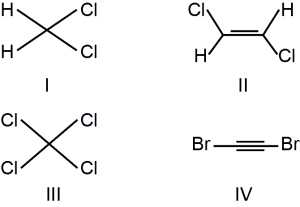
The compound that will have a permanent dipole moment among the following is
A
$I$
B
$II$
C
$III$
D
$IV$
Solution
(A) molecule has a permanent dipole moment if it is polar,meaning its net dipole moment $(\mu_{net})$ is not equal to zero.
$I$: $CH_{2}Cl_{2}$ (dichloromethane) is a non-symmetrical tetrahedral molecule. The bond dipoles of $C-H$ and $C-Cl$ bonds do not cancel each other out,resulting in a non-zero net dipole moment $(\mu_{net} \neq 0)$.
$II$: $trans-1,2-dichloroethene$ is a symmetrical molecule where the bond dipoles cancel each other out,resulting in $\mu_{net} = 0$.
$III$: $CCl_{4}$ (carbon tetrachloride) is a highly symmetrical tetrahedral molecule where all four $C-Cl$ bond dipoles cancel each other out,resulting in $\mu_{net} = 0$.
$IV$: $1,2-dibromoethyne$ is a linear,symmetrical molecule where the bond dipoles cancel each other out,resulting in $\mu_{net} = 0$.
Therefore,the compound with a permanent dipole moment is $I$.
$I$: $CH_{2}Cl_{2}$ (dichloromethane) is a non-symmetrical tetrahedral molecule. The bond dipoles of $C-H$ and $C-Cl$ bonds do not cancel each other out,resulting in a non-zero net dipole moment $(\mu_{net} \neq 0)$.
$II$: $trans-1,2-dichloroethene$ is a symmetrical molecule where the bond dipoles cancel each other out,resulting in $\mu_{net} = 0$.
$III$: $CCl_{4}$ (carbon tetrachloride) is a highly symmetrical tetrahedral molecule where all four $C-Cl$ bond dipoles cancel each other out,resulting in $\mu_{net} = 0$.
$IV$: $1,2-dibromoethyne$ is a linear,symmetrical molecule where the bond dipoles cancel each other out,resulting in $\mu_{net} = 0$.
Therefore,the compound with a permanent dipole moment is $I$.
0 likes
View Solution313
EasyMCQ
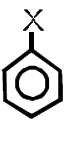
The dipole moment of chlorobenzene is $1.5 \ D$. The dipole moment of $o-$dichlorobenzene is (in $D$)
A
$1.5$
B
$2.25$
C
$2.54$
D
$0$
Solution
(C) The dipole moment of a molecule is the vector sum of the individual bond dipoles. For chlorobenzene,the dipole moment is $1.5 \ D$. Let the dipole moment of a $C-Cl$ bond be $\mu$.
For $o-$dichlorobenzene,the two $C-Cl$ bonds are at an angle of $60^{\circ}$ to each other.
The resultant dipole moment is given by $\mu_{net} = \sqrt{\mu^2 + \mu^2 + 2\mu^2 \cos(60^{\circ})}$.
Since $\cos(60^{\circ}) = 0.5$,we have $\mu_{net} = \sqrt{2\mu^2 + 2\mu^2(0.5)} = \sqrt{3\mu^2} = \mu \sqrt{3}$.
Given $\mu = 1.5 \ D$,the dipole moment of $o-$dichlorobenzene is $1.5 \times 1.732 \approx 2.54 \ D$.
For $o-$dichlorobenzene,the two $C-Cl$ bonds are at an angle of $60^{\circ}$ to each other.
The resultant dipole moment is given by $\mu_{net} = \sqrt{\mu^2 + \mu^2 + 2\mu^2 \cos(60^{\circ})}$.
Since $\cos(60^{\circ}) = 0.5$,we have $\mu_{net} = \sqrt{2\mu^2 + 2\mu^2(0.5)} = \sqrt{3\mu^2} = \mu \sqrt{3}$.
Given $\mu = 1.5 \ D$,the dipole moment of $o-$dichlorobenzene is $1.5 \times 1.732 \approx 2.54 \ D$.
0 likes
View Solution314
DifficultMCQ
Among $H_2S$,$H_2O$,$NF_3$,$NH_3$ and $CHCl_3$,identify the molecule $(X)$ with the lowest dipole moment value. The number of lone pairs of electrons present on the central atom of the molecule $(X)$ is:
A
$2$
B
$0$
C
$1$
D
$3$
Solution
(C) The dipole moments of the given molecules are as follows:
$H_2S = 0.95 \ D$
$H_2O = 1.85 \ D$
$NF_3 = 0.23 \ D$
$NH_3 = 1.47 \ D$
$CHCl_3 = 1.04 \ D$
Comparing these values,$NF_3$ has the lowest dipole moment.
Therefore,the molecule $(X)$ is $NF_3$.
In $NF_3$,the central atom is Nitrogen $(N)$.
Nitrogen has $5$ valence electrons. It forms $3$ single bonds with $3$ Fluorine atoms,leaving $1$ lone pair on the Nitrogen atom.
Thus,the number of lone pairs on the central atom is $1$.
$H_2S = 0.95 \ D$
$H_2O = 1.85 \ D$
$NF_3 = 0.23 \ D$
$NH_3 = 1.47 \ D$
$CHCl_3 = 1.04 \ D$
Comparing these values,$NF_3$ has the lowest dipole moment.
Therefore,the molecule $(X)$ is $NF_3$.
In $NF_3$,the central atom is Nitrogen $(N)$.
Nitrogen has $5$ valence electrons. It forms $3$ single bonds with $3$ Fluorine atoms,leaving $1$ lone pair on the Nitrogen atom.
Thus,the number of lone pairs on the central atom is $1$.
0 likes
View SolutionChemical Bonding and Molecular Structure — Dipole moment · Frequently Asked Questions
1Are these Chemical Bonding and Molecular Structure questions useful for JEE and NEET?
Yes. All questions in this section are mapped to JEE Main and NEET exam patterns. Previous year questions from JEE Main, NEET, GUJCET and state-level exams are included with full solutions.
2Can I switch to Hindi or Gujarati for these questions?
Yes. Use the language tabs in the hero section or the sidebar to view the same questions and solutions in English, Hindi or Gujarati.
3How do I generate a question paper from this subtopic?
Use the Vedclass Exam Paper Generator — select the chapter and subtopic, set difficulty, and generate Sets A, B, C, D automatically. First 3 chapters of every subject are free.
Vedclass Products
For Students
Vedclass Test Series
Mock tests in real JEE/NEET style with performance analysis. 5-day free trial.
Start Free TrialFor Teachers
Exam Paper Generator
Generate Set A/B/C/D papers from this chapter in 2 minutes. 3 chapters free.
Try FreeFor Institutes
Online Exam Module
Live online exams with unlimited students, 360° analytics & white-label branding.
See DemoFor Teachers & Institutes
Generate a Chemical Bonding and Molecular Structure Exam Paper in 2 Minutes
Select subtopic & difficulty — Sets A, B, C, D auto-generated with No Repeat logic.
First 3 chapters of every subject are free — no payment required.