
A English
Covalent bonding Questions in English
Class 11 Chemistry · Chemical Bonding and Molecular Structure · Covalent bonding
244+
Questions
English
Language
100%
With Solutions
Showing 41 of 244 questions in English
201
EasyMCQ
When is the bond formed according to the $VB$ theory?
A
When the atoms are far apart.
B
When the potential energy of the system is maximum.
C
When the potential energy of the system is minimum.
D
When the electrons are transferred from one atom to another.
Solution
(C) According to the $VB$ (Valence Bond) theory,a chemical bond is formed when two atoms approach each other such that the potential energy of the system reaches a minimum value.
At this minimum energy state,the attractive forces between the nuclei and electrons of the two atoms are balanced by the repulsive forces,resulting in a stable bond formation.
At this minimum energy state,the attractive forces between the nuclei and electrons of the two atoms are balanced by the repulsive forces,resulting in a stable bond formation.
0 likes
View Solution202
Easy
Define the following: $(i)$ Bonding electron pair $(ii)$ Lone pair of electrons.
Solution
(N/A) $(i)$ Bonding electron pair: The electron pairs that are shared between two atoms in a covalent bond are known as bonding electron pairs or shared pairs.
$(ii)$ Lone pair of electrons: The valence electron pairs that are not involved in bonding and remain on a single atom are known as lone pairs or non-bonding electron pairs.
$(ii)$ Lone pair of electrons: The valence electron pairs that are not involved in bonding and remain on a single atom are known as lone pairs or non-bonding electron pairs.
0 likes
View Solution203
EasyMCQ
What is a multiple bond?
A
$A$ bond formed by the sharing of one electron pair.
B
$A$ bond formed by the sharing of two or more electron pairs.
C
$A$ bond formed by the transfer of electrons.
D
$A$ bond formed by the electrostatic attraction between ions.
Solution
(B) multiple bond is a chemical bond where two or more electron pairs are shared between two atoms.
This includes double bonds (sharing of two electron pairs) and triple bonds (sharing of three electron pairs).
This includes double bonds (sharing of two electron pairs) and triple bonds (sharing of three electron pairs).
0 likes
View Solution204
DifficultMCQ
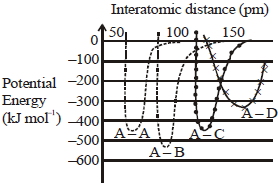
The intermolecular potential energy for the molecules $A-A$,$A-B$,$A-C$ and $A-D$ given below suggests that:
A
$D$ is more electronegative than other atoms
B
$A-D$ has the shortest bond length
C
$A-B$ has the stiffest bond
D
$A-A$ has the largest bond enthalpy
Solution
(C) From the given graph,the potential energy of the $A-B$ molecule is the most negative (minimum).
This indicates that the $A-B$ bond is the most stable and has the highest bond dissociation enthalpy (bond strength) among the given molecules.
$A$ steeper potential energy well corresponds to a higher force constant,meaning the bond is stiffer.
Since the $A-B$ curve is the deepest and narrowest,it represents the strongest and stiffest bond.
Therefore,the correct option is $C$.
This indicates that the $A-B$ bond is the most stable and has the highest bond dissociation enthalpy (bond strength) among the given molecules.
$A$ steeper potential energy well corresponds to a higher force constant,meaning the bond is stiffer.
Since the $A-B$ curve is the deepest and narrowest,it represents the strongest and stiffest bond.
Therefore,the correct option is $C$.
0 likes
View Solution205
MediumMCQ
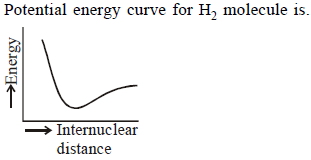
The potential energy curve for the $H_2$ molecule as a function of internuclear distance is:
A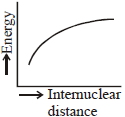
B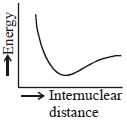
C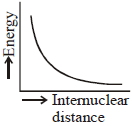
D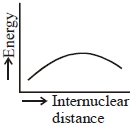
Solution
(B) The potential energy curve for the $H_2$ molecule represents the variation of potential energy with respect to the internuclear distance between the two hydrogen atoms.
At very large distances,the potential energy is zero.
As the atoms approach each other,the attractive forces dominate,and the potential energy decreases.
At a specific distance (the equilibrium bond length),the potential energy reaches a minimum,which corresponds to the most stable state of the molecule.
If the atoms are brought even closer,the repulsive forces between the nuclei become dominant,causing the potential energy to increase sharply.
This characteristic shape,showing a minimum,is represented by the graph in option $B$.
At very large distances,the potential energy is zero.
As the atoms approach each other,the attractive forces dominate,and the potential energy decreases.
At a specific distance (the equilibrium bond length),the potential energy reaches a minimum,which corresponds to the most stable state of the molecule.
If the atoms are brought even closer,the repulsive forces between the nuclei become dominant,causing the potential energy to increase sharply.
This characteristic shape,showing a minimum,is represented by the graph in option $B$.
0 likes
View Solution206
MediumMCQ
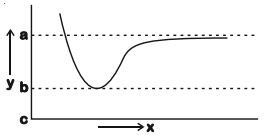
The potential energy $(y)$ curve for $H_2$ formation as a function of internuclear distance $(x)$ of the $H$ atoms is shown below.
The bond energy of $H_2$ is
The bond energy of $H_2$ is
A
$(c-a)$
B
$(a-b)$
C
$\frac{(c-a)}{2}$
D
$\frac{(b-a)}{2}$
Solution
(B) The potential energy of two $H$ atoms at an infinite distance is represented by $a$.
The potential energy of the $H_2$ molecule at the equilibrium bond length is represented by $b$.
The bond energy is defined as the energy required to break the bond,which is the difference between the energy of the separated atoms and the energy of the bonded molecule.
Therefore,the bond energy is $(a-b)$.
The potential energy of the $H_2$ molecule at the equilibrium bond length is represented by $b$.
The bond energy is defined as the energy required to break the bond,which is the difference between the energy of the separated atoms and the energy of the bonded molecule.
Therefore,the bond energy is $(a-b)$.
0 likes
View Solution207
EasyMCQ
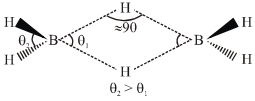
The correct statement about $B_{2}H_{6}$ is
A
Terminal $B-H$ bonds have less $p$-character when compared to bridging bonds.
B
The two $B-H-B$ bonds are not of the same length.
C
All $B-H-B$ angles are of $120^{\circ}$.
D
Its fragment,$BH_{3}$,behaves as a Lewis base.
Solution
(A) In $B_{2}H_{6}$,the terminal $B-H$ bonds are $sp^{3}$ hybridized,while the bridging $B-H-B$ bonds involve $3c-2e$ (three-center two-electron) bonds.
According to Bent's rule,more $p$-character is directed towards the more electronegative atom or the bond with a smaller bond angle.
Since the bond angle $\theta_{2}$ (terminal $H-B-H$) is greater than $\theta_{1}$ (bridging $B-H-B$ angle),the terminal $B-H$ bonds have more $s$-character and less $p$-character compared to the bridging bonds.
Thus,option $A$ is correct.
$BH_{3}$ is an electron-deficient species and acts as a Lewis acid,not a base.
According to Bent's rule,more $p$-character is directed towards the more electronegative atom or the bond with a smaller bond angle.
Since the bond angle $\theta_{2}$ (terminal $H-B-H$) is greater than $\theta_{1}$ (bridging $B-H-B$ angle),the terminal $B-H$ bonds have more $s$-character and less $p$-character compared to the bridging bonds.
Thus,option $A$ is correct.
$BH_{3}$ is an electron-deficient species and acts as a Lewis acid,not a base.
0 likes
View Solution208
MediumMCQ
In which one of the following molecules is the strongest back donation of an electron pair from halide to boron expected?
A
$BCl_{3}$
B
$BF_{3}$
C
$BBr_{3}$
D
$BI_{3}$
Solution
(B) Back bonding in boron trihalides involves the donation of a lone pair from the halide $p$-orbital to the empty $2p$-orbital of boron.
This is a $(p\pi-p\pi)$ back bonding.
The strength of back bonding depends on the effective overlap between the orbitals.
For $BF_{3}$,the overlap is $(2p\pi-2p\pi)$,which is the most effective due to similar size.
For $BCl_{3}$,it is $(2p\pi-3p\pi)$,for $BBr_{3}$ it is $(2p\pi-4p\pi)$,and for $BI_{3}$ it is $(2p\pi-5p\pi)$.
As the size of the halide increases,the energy gap increases and the overlap efficiency decreases.
Therefore,the order of back bonding strength is $BF_{3} > BCl_{3} > BBr_{3} > BI_{3}$.
This is a $(p\pi-p\pi)$ back bonding.
The strength of back bonding depends on the effective overlap between the orbitals.
For $BF_{3}$,the overlap is $(2p\pi-2p\pi)$,which is the most effective due to similar size.
For $BCl_{3}$,it is $(2p\pi-3p\pi)$,for $BBr_{3}$ it is $(2p\pi-4p\pi)$,and for $BI_{3}$ it is $(2p\pi-5p\pi)$.
As the size of the halide increases,the energy gap increases and the overlap efficiency decreases.
Therefore,the order of back bonding strength is $BF_{3} > BCl_{3} > BBr_{3} > BI_{3}$.
0 likes
View Solution209
MediumMCQ
The tendency of $X$ in $BX_{3}$ $(X = F, Cl, OMe, NMe_{2})$ to form a $\pi$-bond with boron follows the order:
A
$BCl_{3} < BF_{3} < B(OMe)_{3} < B(NMe_{2})_{3}$
B
$BF_{3} < BCl_{3} < B(OMe)_{3} < B(NMe_{2})_{3}$
C
$BCl_{3} < B(NMe_{2})_{3} < B(OMe)_{3} < BF_{3}$
D
$BCl_{3} < BF_{3} < B(NMe_{2})_{3} < B(OMe)_{3}$
Solution
(A) The boron atom in $BX_{3}$ has an incomplete octet and can accept a lone pair from the substituent $X$ to form a $\pi$-bond,commonly known as back bonding.
The extent of back bonding depends on the electronegativity of $X$ and the energy match between the orbitals of $X$ and $B$. Lower electronegativity of $X$ facilitates better donation of the lone pair.
Comparing the substituents: $Cl$ and $F$ are more electronegative than $OMe$ and $NMe_{2}$,so their back bonding tendency is lower.
Between $BCl_{3}$ and $BF_{3}$,$Cl$ has a lower tendency to form a $\pi$-bond due to the size mismatch between its $3p$-orbital and boron's $2p$-orbital.
Between $B(OMe)_{3}$ and $B(NMe_{2})_{3}$,the $NMe_{2}$ group has a higher tendency to form a $\pi$-bond because nitrogen is less electronegative than oxygen,making its lone pair more available for donation.
Thus,the correct order of the tendency to form a $\pi$-bond with boron is $BCl_{3} < BF_{3} < B(OMe)_{3} < B(NMe_{2})_{3}$.
The extent of back bonding depends on the electronegativity of $X$ and the energy match between the orbitals of $X$ and $B$. Lower electronegativity of $X$ facilitates better donation of the lone pair.
Comparing the substituents: $Cl$ and $F$ are more electronegative than $OMe$ and $NMe_{2}$,so their back bonding tendency is lower.
Between $BCl_{3}$ and $BF_{3}$,$Cl$ has a lower tendency to form a $\pi$-bond due to the size mismatch between its $3p$-orbital and boron's $2p$-orbital.
Between $B(OMe)_{3}$ and $B(NMe_{2})_{3}$,the $NMe_{2}$ group has a higher tendency to form a $\pi$-bond because nitrogen is less electronegative than oxygen,making its lone pair more available for donation.
Thus,the correct order of the tendency to form a $\pi$-bond with boron is $BCl_{3} < BF_{3} < B(OMe)_{3} < B(NMe_{2})_{3}$.
0 likes
View Solution210
MediumMCQ
Among $NH_3, BCl_3, Cl_2$ and $N_2$,the compound that does not satisfy the octet rule is
A
$NH_3$
B
$BCl_3$
C
$Cl_2$
D
$N_2$
Solution
(B) The correct answer is $B$.
According to the octet rule,atoms of different elements combine with each other to complete their respective octets (i.e.,$8$ electrons in their outermost shell,or $2$ electrons in the case of $H, Li,$ and $Be$ to attain a stable nearest noble gas configuration).
In $BCl_3$,the central Boron $(B)$ atom has only $6$ electrons in its valence shell after forming three covalent bonds with Chlorine atoms.
Since $6 < 8$,$BCl_3$ is an electron-deficient molecule and does not satisfy the octet rule.
According to the octet rule,atoms of different elements combine with each other to complete their respective octets (i.e.,$8$ electrons in their outermost shell,or $2$ electrons in the case of $H, Li,$ and $Be$ to attain a stable nearest noble gas configuration).
In $BCl_3$,the central Boron $(B)$ atom has only $6$ electrons in its valence shell after forming three covalent bonds with Chlorine atoms.
Since $6 < 8$,$BCl_3$ is an electron-deficient molecule and does not satisfy the octet rule.
0 likes
View Solution211
MediumMCQ
The number of covalent bonds in $C_4H_7Br$ is $.......$
A
$12$
B
$10$
C
$13$
D
$11$
Solution
(A) The chemical formula $C_4H_7Br$ represents a molecule such as $1$-bromobut-$2$-ene $(CH_3-CH=CH-CH_2Br)$.
To find the total number of covalent bonds,we count all single and multiple bonds in the structure:
$1$. $C-H$ bonds: There are $7$ $C-H$ bonds.
$2$. $C-C$ bonds: There are $2$ single $C-C$ bonds and $1$ double $C=C$ bond (total $3$ bonds).
$3$. $C-Br$ bond: There is $1$ $C-Br$ bond.
Total number of covalent bonds = $7 + 3 + 1 = 11$.
Wait,let us re-examine the provided image structure: The image shows a chain with $12$ numbered bonds. Counting them directly from the provided structure: $1$ $(H-C)$,$2$ $(C-H)$,$3,4$ $(C=C)$,$5,6$ $(C-C)$,$7$ $(C-H)$,$8$ $(C-H)$,$9$ $(C-C)$,$10$ $(C-H)$,$11$ $(C-H)$,$12$ $(C-Br)$.
Total count = $12$.
To find the total number of covalent bonds,we count all single and multiple bonds in the structure:
$1$. $C-H$ bonds: There are $7$ $C-H$ bonds.
$2$. $C-C$ bonds: There are $2$ single $C-C$ bonds and $1$ double $C=C$ bond (total $3$ bonds).
$3$. $C-Br$ bond: There is $1$ $C-Br$ bond.
Total number of covalent bonds = $7 + 3 + 1 = 11$.
Wait,let us re-examine the provided image structure: The image shows a chain with $12$ numbered bonds. Counting them directly from the provided structure: $1$ $(H-C)$,$2$ $(C-H)$,$3,4$ $(C=C)$,$5,6$ $(C-C)$,$7$ $(C-H)$,$8$ $(C-H)$,$9$ $(C-C)$,$10$ $(C-H)$,$11$ $(C-H)$,$12$ $(C-Br)$.
Total count = $12$.
0 likes
View Solution212
MediumMCQ
The ratio of $\sigma$ and $\pi$ bonds present in pyrophosphoric acid $(H_4P_2O_7)$ is $......$.
A
$6$
B
$8$
C
$5$
D
$4$
Solution
(A) The chemical formula of pyrophosphoric acid is $H_4P_2O_7$.
Its structure consists of two $P$ atoms linked by an oxygen bridge $(P-O-P)$.
Each $P$ atom is double-bonded to an oxygen atom $(P=O)$ and bonded to two hydroxyl groups $(-OH)$.
Counting the bonds:
- Total $\sigma$ bonds: There are $4$ $P-OH$ bonds,$2$ $P=O$ bonds (each has $1$ $\sigma$),$1$ $P-O-P$ bridge (which has $2$ $\sigma$ bonds),and $4$ $O-H$ bonds. Total $\sigma$ bonds = $4 + 2 + 2 + 4 = 12$.
- Total $\pi$ bonds: There are $2$ $P=O$ bonds,each containing $1$ $\pi$ bond. Total $\pi$ bonds = $2$.
- The ratio of $\sigma$ to $\pi$ bonds = $\frac{12}{2} = 6$.
Therefore,the correct option is $A$.
Its structure consists of two $P$ atoms linked by an oxygen bridge $(P-O-P)$.
Each $P$ atom is double-bonded to an oxygen atom $(P=O)$ and bonded to two hydroxyl groups $(-OH)$.
Counting the bonds:
- Total $\sigma$ bonds: There are $4$ $P-OH$ bonds,$2$ $P=O$ bonds (each has $1$ $\sigma$),$1$ $P-O-P$ bridge (which has $2$ $\sigma$ bonds),and $4$ $O-H$ bonds. Total $\sigma$ bonds = $4 + 2 + 2 + 4 = 12$.
- Total $\pi$ bonds: There are $2$ $P=O$ bonds,each containing $1$ $\pi$ bond. Total $\pi$ bonds = $2$.
- The ratio of $\sigma$ to $\pi$ bonds = $\frac{12}{2} = 6$.
Therefore,the correct option is $A$.
0 likes
View Solution213
MediumMCQ
Amongst the given options,which of the following molecules/ions acts as a Lewis acid?
A
$OH^{-}$
B
$NH_{3}$
C
$H_{2}O$
D
$BF_{3}$
Solution
(D) Lewis acids are species that accept a lone pair of electrons due to the presence of a vacant orbital in their outermost shell.
$H_{2}\ddot{O}:$ acts as a Lewis base because it has lone pairs on the oxygen atom.
$BF_{3}$ acts as a Lewis acid because the boron atom has an incomplete octet (only $6$ electrons in its valence shell) and can accept a lone pair.
$OH^{-}$ acts as a Lewis base due to the presence of lone pairs on the oxygen atom.
$\ddot{N}H_{3}$ acts as a Lewis base because the nitrogen atom has a lone pair of electrons available for donation.
$H_{2}\ddot{O}:$ acts as a Lewis base because it has lone pairs on the oxygen atom.
$BF_{3}$ acts as a Lewis acid because the boron atom has an incomplete octet (only $6$ electrons in its valence shell) and can accept a lone pair.
$OH^{-}$ acts as a Lewis base due to the presence of lone pairs on the oxygen atom.
$\ddot{N}H_{3}$ acts as a Lewis base because the nitrogen atom has a lone pair of electrons available for donation.
0 likes
View Solution214
EasyMCQ
Among $B_2H_6, B_3N_3H_6, N_2O, N_2O_4, H_2S_2O_3$ and $H_2S_2O_8$,the total number of molecules containing a covalent bond between two atoms of the same kind is . . . .
A
$2$
B
$4$
C
$8$
D
$10$
Solution
(B) Let us analyze the structures of the given molecules to identify those with a covalent bond between two atoms of the same kind:
$1$. $B_2H_6$ (Diborane): Contains $B-H-B$ bridge bonds. There is no $B-B$ bond.
$2$. $B_3N_3H_6$ (Borazine): Contains $B-N$ bonds. There is no $B-B$ or $N-N$ bond.
$3$. $N_2O$: The structure is $N \equiv N \rightarrow O$. It contains an $N-N$ bond.
$4$. $N_2O_4$: The structure is $O_2N-NO_2$. It contains an $N-N$ bond.
$5$. $H_2S_2O_3$ (Thiosulfuric acid): The structure contains an $S-S$ bond.
$6$. $H_2S_2O_8$ (Peroxodisulfuric acid): The structure contains an $O-O$ (peroxide) bond.
Thus,the molecules containing a covalent bond between two atoms of the same kind are $N_2O, N_2O_4, H_2S_2O_3$,and $H_2S_2O_8$.
The total number of such molecules is $4$.
$1$. $B_2H_6$ (Diborane): Contains $B-H-B$ bridge bonds. There is no $B-B$ bond.
$2$. $B_3N_3H_6$ (Borazine): Contains $B-N$ bonds. There is no $B-B$ or $N-N$ bond.
$3$. $N_2O$: The structure is $N \equiv N \rightarrow O$. It contains an $N-N$ bond.
$4$. $N_2O_4$: The structure is $O_2N-NO_2$. It contains an $N-N$ bond.
$5$. $H_2S_2O_3$ (Thiosulfuric acid): The structure contains an $S-S$ bond.
$6$. $H_2S_2O_8$ (Peroxodisulfuric acid): The structure contains an $O-O$ (peroxide) bond.
Thus,the molecules containing a covalent bond between two atoms of the same kind are $N_2O, N_2O_4, H_2S_2O_3$,and $H_2S_2O_8$.
The total number of such molecules is $4$.
0 likes
View Solution215
MediumMCQ
What different types of bonds are formed by chlorine with oxygen in perchloric acid $(HClO_4)$?
A
$2$ single bonds and $2$ double bonds
B
$3$ single bonds and $1$ double bond
C
$2$ single bonds and $3$ double bonds
D
$1$ single bond and $3$ double bonds
Solution
(D) In perchloric acid $(HClO_4)$,the central chlorine atom is bonded to four oxygen atoms.
One oxygen atom is bonded to a hydrogen atom ($O-H$ single bond).
The chlorine atom forms one single bond with this oxygen atom $(Cl-O-H)$.
The remaining three oxygen atoms are bonded to the chlorine atom via double bonds $(Cl=O)$.
Therefore,the structure contains $1$ single bond $(Cl-O)$ and $3$ double bonds $(Cl=O)$ between chlorine and oxygen atoms.
One oxygen atom is bonded to a hydrogen atom ($O-H$ single bond).
The chlorine atom forms one single bond with this oxygen atom $(Cl-O-H)$.
The remaining three oxygen atoms are bonded to the chlorine atom via double bonds $(Cl=O)$.
Therefore,the structure contains $1$ single bond $(Cl-O)$ and $3$ double bonds $(Cl=O)$ between chlorine and oxygen atoms.
0 likes
View Solution216
MediumMCQ
Which of the following compounds follows the octet rule?
A
$H_2SO_4$
B
$NO_2$
C
$SCl_2$
D
$SF_6$
Solution
(C) In $H_2SO_4$ and $SF_6$,the central atoms have an expanded octet,meaning they have more than $8$ electrons in their valence shell.
$NO_2$ is an odd-electron molecule,which violates the octet rule.
In $SCl_2$,the central sulphur atom forms two covalent bonds with chlorine atoms,resulting in $8$ electrons in its valence shell,thus obeying the octet rule.
$NO_2$ is an odd-electron molecule,which violates the octet rule.
In $SCl_2$,the central sulphur atom forms two covalent bonds with chlorine atoms,resulting in $8$ electrons in its valence shell,thus obeying the octet rule.
0 likes
View Solution217
EasyMCQ
Which of the following molecules does $NOT$ obey the octet rule?
A
$CCl_4$
B
$Cl_2$
C
$O_2$
D
$BeF_2$
Solution
(D) In $BeF_2$,the central atom $Be$ has only $4$ electrons in its valence shell after forming two covalent bonds with $F$ atoms.
Since the number of electrons is less than $8$,it is an electron-deficient molecule and does not obey the octet rule.
Since the number of electrons is less than $8$,it is an electron-deficient molecule and does not obey the octet rule.
0 likes
View Solution218
EasyMCQ
What is the formal charge on the carbon atom in the following Lewis structure?

A
$0$
B
$1$
C
$-1$
D
$2$
Solution
(A) The formula for formal charge is: $\text{Formal Charge} = \text{Total valence electrons} - \text{Non-bonding electrons} - \frac{1}{2} \times \text{Bonding electrons}$.
For the carbon atom $(C)$ in the $CO_2$ molecule:
- Total valence electrons $(VE)$ = $4$
- Non-bonding electrons $(NE)$ = $0$
- Bonding electrons $(BE)$ = $8$ (four bonds,each with two electrons)
$\text{Formal Charge on } C = 4 - 0 - \frac{8}{2} = 4 - 4 = 0$.
For the carbon atom $(C)$ in the $CO_2$ molecule:
- Total valence electrons $(VE)$ = $4$
- Non-bonding electrons $(NE)$ = $0$
- Bonding electrons $(BE)$ = $8$ (four bonds,each with two electrons)
$\text{Formal Charge on } C = 4 - 0 - \frac{8}{2} = 4 - 4 = 0$.
0 likes
View Solution219
MediumMCQ
Identify the molecule containing a triple bond.
A
Ammonia
B
Dinitrogen
C
Water
D
Methane
Solution
(B) The molecule $N_2$ (Dinitrogen) consists of two nitrogen atoms bonded together by a triple bond. The Lewis structure is represented as $:N \equiv N:$.
0 likes
View Solution220
MediumMCQ
Which of the following molecules does not obey the octet rule?
A
$N_2$
B
$NaCl$
C
$Cl_2$
D
$SF_6$
Solution
(D) The octet rule states that atoms tend to form bonds such that they have $8$ electrons in their valence shell.
In the molecule $SF_6$,the central sulfur atom is bonded to $6$ fluorine atoms.
Each $S-F$ bond consists of $2$ electrons,so the sulfur atom has $6 \times 2 = 12$ electrons in its valence shell.
Since $12 > 8$,$SF_6$ is an example of an expanded octet and does not obey the octet rule.
In the molecule $SF_6$,the central sulfur atom is bonded to $6$ fluorine atoms.
Each $S-F$ bond consists of $2$ electrons,so the sulfur atom has $6 \times 2 = 12$ electrons in its valence shell.
Since $12 > 8$,$SF_6$ is an example of an expanded octet and does not obey the octet rule.
0 likes
View Solution221
EasyMCQ
What is the number of lone pairs of electrons on the iodine atom in the $IF$ molecule?
A
$3$
B
$2$
C
$1$
D
$0$
Solution
(A) The iodine atom $(I)$ has $7$ valence electrons. In the $IF$ molecule,iodine forms one covalent bond with the fluorine atom $(F)$.
After forming one bond,$6$ electrons remain on the iodine atom,which corresponds to $3$ lone pairs of electrons.
Therefore,the number of lone pairs on the iodine atom in $IF$ is $3$.
After forming one bond,$6$ electrons remain on the iodine atom,which corresponds to $3$ lone pairs of electrons.
Therefore,the number of lone pairs on the iodine atom in $IF$ is $3$.
0 likes
View Solution222
MediumMCQ
Which of the following bonds has the highest bond enthalpy?
A
$N-H$ in $NH_3$
B
$O=O$ in $O_2$
C
$C-H$ in $CH_4$
D
$N \equiv N$ in $N_2$
Solution
(D) The bond enthalpy is directly related to the bond order or the number of bonds between atoms.
$N_2$ contains a triple bond $(N \equiv N)$,which is significantly stronger than the single bonds in $NH_3$ $(N-H)$ and $CH_4$ $(C-H)$,or the double bond in $O_2$ $(O=O)$.
Therefore,$N_2$ has the highest bond enthalpy.
$N_2$ contains a triple bond $(N \equiv N)$,which is significantly stronger than the single bonds in $NH_3$ $(N-H)$ and $CH_4$ $(C-H)$,or the double bond in $O_2$ $(O=O)$.
Therefore,$N_2$ has the highest bond enthalpy.
0 likes
View Solution223
EasyMCQ
Which of the following bonds has the maximum bond length?
A
$C-O$
B
$C-H$
C
$C-C$
D
$C-N$
Solution
(C) Bond length is approximately the sum of the covalent radii of the bonded atoms.
Using the approximate covalent radii: $r_H \approx 0.37 \ \mathring{A}$,$r_C \approx 0.77 \ \mathring{A}$,$r_N \approx 0.75 \ \mathring{A}$,$r_O \approx 0.73 \ \mathring{A}$.
Calculating the bond lengths:
$C-C \approx 0.77 + 0.77 = 1.54 \ \mathring{A}$
$C-N \approx 0.77 + 0.75 = 1.52 \ \mathring{A}$
$C-O \approx 0.77 + 0.73 = 1.50 \ \mathring{A}$
$C-H \approx 0.77 + 0.37 = 1.14 \ \mathring{A}$
Comparing these values,the $C-C$ bond has the maximum bond length.
Using the approximate covalent radii: $r_H \approx 0.37 \ \mathring{A}$,$r_C \approx 0.77 \ \mathring{A}$,$r_N \approx 0.75 \ \mathring{A}$,$r_O \approx 0.73 \ \mathring{A}$.
Calculating the bond lengths:
$C-C \approx 0.77 + 0.77 = 1.54 \ \mathring{A}$
$C-N \approx 0.77 + 0.75 = 1.52 \ \mathring{A}$
$C-O \approx 0.77 + 0.73 = 1.50 \ \mathring{A}$
$C-H \approx 0.77 + 0.37 = 1.14 \ \mathring{A}$
Comparing these values,the $C-C$ bond has the maximum bond length.
0 likes
View Solution224
MediumMCQ
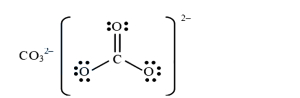
What is the formal charge on the carbon atom in the $CO_3^{2-}$ ion?
A
$-2$
B
$-4$
C
$4$
D
$\text{zero}$
Solution
(D) The formal charge $(FC)$ on an atom in a Lewis structure is calculated using the formula:
$FC = V - L - \frac{1}{2}S$
Where:
$V$ = Number of valence electrons of the free atom
$L$ = Number of non-bonding (lone pair) electrons
$S$ = Number of bonding (shared) electrons
For the carbon atom in $CO_3^{2-}$:
$V = 4$ (Carbon belongs to group $14$)
$L = 0$ (Carbon has no lone pairs in the carbonate ion)
$S = 8$ (Carbon forms $4$ bonds: one double bond and two single bonds)
$FC = 4 - 0 - \frac{1}{2}(8) = 4 - 4 = 0$.
$FC = V - L - \frac{1}{2}S$
Where:
$V$ = Number of valence electrons of the free atom
$L$ = Number of non-bonding (lone pair) electrons
$S$ = Number of bonding (shared) electrons
For the carbon atom in $CO_3^{2-}$:
$V = 4$ (Carbon belongs to group $14$)
$L = 0$ (Carbon has no lone pairs in the carbonate ion)
$S = 8$ (Carbon forms $4$ bonds: one double bond and two single bonds)
$FC = 4 - 0 - \frac{1}{2}(8) = 4 - 4 = 0$.
0 likes
View Solution225
MediumMCQ
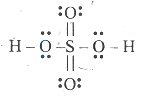
What is the formal charge on sulfur in the following Lewis structure?
A
$2$
B
$-2$
C
$0$
D
$-1$
Solution
(C) The formula for formal charge $(FC)$ is: $FC = V.E. - N.E. - \frac{1}{2}(B.E.)$
Where $V.E.$ is the number of valence electrons,$N.E.$ is the number of non-bonding electrons,and $B.E.$ is the number of bonding electrons.
For sulfur $(S)$ in the given structure:
Valence electrons $(V.E.)$ = $6$
Non-bonding electrons $(N.E.)$ = $0$
Bonding electrons $(B.E.)$ = $12$ (six bonds: two double bonds and two single bonds)
$FC = 6 - 0 - \frac{1}{2}(12) = 6 - 6 = 0$
Where $V.E.$ is the number of valence electrons,$N.E.$ is the number of non-bonding electrons,and $B.E.$ is the number of bonding electrons.
For sulfur $(S)$ in the given structure:
Valence electrons $(V.E.)$ = $6$
Non-bonding electrons $(N.E.)$ = $0$
Bonding electrons $(B.E.)$ = $12$ (six bonds: two double bonds and two single bonds)
$FC = 6 - 0 - \frac{1}{2}(12) = 6 - 6 = 0$
0 likes
View Solution226
EasyMCQ
Which among the following is an electron-deficient compound?
A
$SiF_4$
B
$BCl_3$
C
$PCl_5$
D
$CCl_4$
Solution
(B) An electron-deficient compound is one in which the central atom has fewer than $8$ electrons in its valence shell (incomplete octet).
In $BCl_3$,the Boron atom is bonded to $3$ Chlorine atoms,resulting in $3$ covalent bonds.
Each bond consists of $2$ electrons,so the Boron atom has a total of $6$ electrons in its valence shell.
Since $6 < 8$,$BCl_3$ is an electron-deficient compound.
In $BCl_3$,the Boron atom is bonded to $3$ Chlorine atoms,resulting in $3$ covalent bonds.
Each bond consists of $2$ electrons,so the Boron atom has a total of $6$ electrons in its valence shell.
Since $6 < 8$,$BCl_3$ is an electron-deficient compound.
0 likes
View Solution227
EasyMCQ
Which of the following is the correct electron dot structure of $N_{2}O$ molecule?
A
$:\ddot{N}=N^{+}=\ddot{O}:^{-}$
B
$:\ddot{N}^{-}-N^{+}\equiv O:$
C
$:\ddot{N}=N=\ddot{O}:$
D
$:\ddot{N}^{-}-N=\ddot{O}^{+}$
Solution
(B) The $N_{2}O$ molecule has a linear structure with the connectivity $N-N-O$.
Total valence electrons $= (5 \times 2) + 6 = 16 \ e^{-}$.
To satisfy the octet rule for all atoms,the most stable Lewis structure involves a triple bond between the two nitrogen atoms and a single bond between the central nitrogen and oxygen,or a double bond between both pairs.
The most significant resonance contributor is $:\ddot{N}^{-}-N^{+}\equiv O:$,where the central nitrogen has a formal charge of $+1$,the terminal nitrogen has a formal charge of $-1$,and the oxygen has a formal charge of $0$.
Total valence electrons $= (5 \times 2) + 6 = 16 \ e^{-}$.
To satisfy the octet rule for all atoms,the most stable Lewis structure involves a triple bond between the two nitrogen atoms and a single bond between the central nitrogen and oxygen,or a double bond between both pairs.
The most significant resonance contributor is $:\ddot{N}^{-}-N^{+}\equiv O:$,where the central nitrogen has a formal charge of $+1$,the terminal nitrogen has a formal charge of $-1$,and the oxygen has a formal charge of $0$.
0 likes
View Solution228
MediumMCQ
The electronic configuration of $X$ and $Y$ are given below:
$X: 1s^2 2s^2 2p^6 3s^2 3p^3$
$Y: 1s^2 2s^2 2p^6 3s^2 3p^5$
Which of the following is the correct molecular formula and type of bond formed between $X$ and $Y$?
$X: 1s^2 2s^2 2p^6 3s^2 3p^3$
$Y: 1s^2 2s^2 2p^6 3s^2 3p^5$
Which of the following is the correct molecular formula and type of bond formed between $X$ and $Y$?
A
$X_3 Y$,ionic bond
B
$X_2 Y_3$,coordinate bond
C
$XY_3$,covalent bond
D
$X_2 Y$,covalent bond
Solution
(C) $X$ has $5$ valence electrons $(3s^2 3p^3)$,so it is a non-metal (Phosphorus,$P$).
$Y$ has $7$ valence electrons $(3s^2 3p^5)$,so it is a non-metal (Chlorine,$Cl$).
Non-metals share electrons to complete their octet,forming covalent bonds.
The valency of $X$ is $3$ and the valency of $Y$ is $1$.
Therefore,the formula is $XY_3$ (e.g.,$PCl_3$).
Thus,the bond formed is covalent.
$Y$ has $7$ valence electrons $(3s^2 3p^5)$,so it is a non-metal (Chlorine,$Cl$).
Non-metals share electrons to complete their octet,forming covalent bonds.
The valency of $X$ is $3$ and the valency of $Y$ is $1$.
Therefore,the formula is $XY_3$ (e.g.,$PCl_3$).
Thus,the bond formed is covalent.
0 likes
View Solution229
MediumMCQ
Which of the following is not a characteristic of a covalent compound?
A
No definite geometry
B
Insoluble in polar solvent
C
Small difference in electronegativity between the combining atoms
D
Low melting point
Solution
(A) Covalent bonds are directional in nature.
Therefore,covalent compounds possess a definite geometry,such as $CH_4$ being tetrahedral and $C_2H_2$ being linear.
Thus,the statement 'No definite geometry' is incorrect for covalent compounds.
Therefore,covalent compounds possess a definite geometry,such as $CH_4$ being tetrahedral and $C_2H_2$ being linear.
Thus,the statement 'No definite geometry' is incorrect for covalent compounds.
0 likes
View Solution230
MediumMCQ
The correct statement is
A
$BF_{3}$ is the strongest Lewis acid among the other boron halides.
B
$BI_{3}$ is the weakest Lewis acid among the boron halides.
C
There is maximum $p\pi-p\pi$ back bonding in $BF_{3}$.
D
There is minimum $p\pi-p\pi$ back bonding in $BF_{3}$.
Solution
(C) In boron halides $(BX_{3})$,the boron atom has an incomplete octet and acts as a Lewis acid.
Back bonding occurs due to the donation of electron density from the filled $p$-orbital of the halogen to the empty $p$-orbital of boron.
In $BF_{3}$,the $2p$ orbital of $F$ and the $2p$ orbital of $B$ have similar sizes,leading to effective $p\pi-p\pi$ overlap.
Therefore,there is maximum $p\pi-p\pi$ back bonding in $BF_{3}$,which reduces its Lewis acidity.
Back bonding occurs due to the donation of electron density from the filled $p$-orbital of the halogen to the empty $p$-orbital of boron.
In $BF_{3}$,the $2p$ orbital of $F$ and the $2p$ orbital of $B$ have similar sizes,leading to effective $p\pi-p\pi$ overlap.
Therefore,there is maximum $p\pi-p\pi$ back bonding in $BF_{3}$,which reduces its Lewis acidity.
0 likes
View Solution231
DifficultMCQ
Which of the following does not have a triple bond between the atoms?
A
$N_2$
B
$CO$
C
$NO$
D
$C_2^{2-}$
Solution
(C) The nitrogen molecule $(N_2)$ has a triple bond $(N \equiv N)$.
Carbon monoxide $(CO)$ has a triple bond $(C \equiv O)$.
The acetylide ion $(C_2^{2-})$ has a triple bond $([C \equiv C]^{2-})$.
Nitric oxide $(NO)$ has $11$ valence electrons and a bond order of $2.5$,which corresponds to a bond between a double and a triple bond,but it does not possess a formal triple bond.
Carbon monoxide $(CO)$ has a triple bond $(C \equiv O)$.
The acetylide ion $(C_2^{2-})$ has a triple bond $([C \equiv C]^{2-})$.
Nitric oxide $(NO)$ has $11$ valence electrons and a bond order of $2.5$,which corresponds to a bond between a double and a triple bond,but it does not possess a formal triple bond.
0 likes
View Solution232
EasyMCQ
Which of the following is not the property of covalent substances?
A
have definite shape
B
have low melting points
C
good conductors of electricity
D
soluble in non-polar solvents
Solution
(C) Covalent substances are generally poor conductors of electricity because they do not contain free electrons or ions to carry charge. Therefore,being a good conductor of electricity is not a property of covalent substances.
0 likes
View Solution233
MediumMCQ
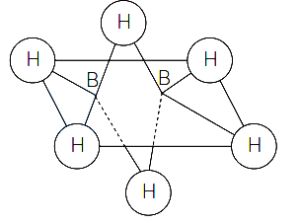
According to the given figure,which of the following statements is incorrect?
A
The $2$ bridged hydrogen atoms and $2$ boron atoms lie in one plane.
B
Out of $6$ $B-H$ bonds,two bonds can be described in terms of $3$-centre-$2$-electron bonds.
C
Out of $6$ $B-H$ bonds,four bonds can be described in terms of $3$-centre-$2$-electron bonds.
D
The four terminal $B-H$ bonds are $2$-centre-$2$-electron regular bonds.
Solution
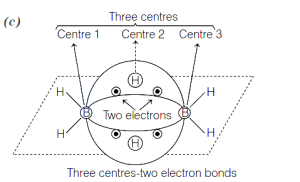
(C) In $B_2H_6$,there are $4$ terminal $B-H$ bonds which are $2$-centre-$2$-electron $(2c-2e)$ bonds.
There are $2$ bridged hydrogen atoms which form $2$ bridge $B-H-B$ bonds.
Each bridge $B-H-B$ bond is a $3$-centre-$2$-electron $(3c-2e)$ bond.
Therefore,there are only $2$ such $3c-2e$ bonds,not $4$.
Thus,statement $(C)$ is incorrect.
There are $2$ bridged hydrogen atoms which form $2$ bridge $B-H-B$ bonds.
Each bridge $B-H-B$ bond is a $3$-centre-$2$-electron $(3c-2e)$ bond.
Therefore,there are only $2$ such $3c-2e$ bonds,not $4$.
Thus,statement $(C)$ is incorrect.
0 likes
View Solution234
MediumMCQ
Which of the following sulphur compounds follows the octet rule?
A
$H_2SO_4$
B
$SF_6$
C
$SCl_2$
D
$SF_4$
Solution
(C) To determine which compound follows the octet rule,we calculate the number of valence electrons around the central sulphur $(S)$ atom in each molecule:
$1$. In $H_2SO_4$,the sulphur atom is bonded to two $OH$ groups and two oxygen atoms (via double bonds),resulting in $12$ electrons around $S$,which is an expanded octet.
$2$. In $SF_6$,the sulphur atom is bonded to six fluorine atoms,resulting in $12$ electrons around $S$,which is an expanded octet.
$3$. In $SF_4$,the sulphur atom is bonded to four fluorine atoms and has one lone pair,resulting in $10$ electrons around $S$,which is an expanded octet.
$4$. In $SCl_2$,the sulphur atom is bonded to two chlorine atoms and has two lone pairs. The total number of electrons around $S$ is $2 \times 2$ (bonding) $+ 2 \times 2$ (lone pairs) $= 8$ electrons. Thus,$SCl_2$ follows the octet rule.
$1$. In $H_2SO_4$,the sulphur atom is bonded to two $OH$ groups and two oxygen atoms (via double bonds),resulting in $12$ electrons around $S$,which is an expanded octet.
$2$. In $SF_6$,the sulphur atom is bonded to six fluorine atoms,resulting in $12$ electrons around $S$,which is an expanded octet.
$3$. In $SF_4$,the sulphur atom is bonded to four fluorine atoms and has one lone pair,resulting in $10$ electrons around $S$,which is an expanded octet.
$4$. In $SCl_2$,the sulphur atom is bonded to two chlorine atoms and has two lone pairs. The total number of electrons around $S$ is $2 \times 2$ (bonding) $+ 2 \times 2$ (lone pairs) $= 8$ electrons. Thus,$SCl_2$ follows the octet rule.
0 likes
View Solution235
EasyMCQ
Which one of the following compounds is hypervalent?
A
$NO_3^-$
B
$BF_3$
C
$PCl_5$
D
$CH_4$
Solution
(C) Hypervalent compounds are those in which the central atom has more than $8$ electrons in its valence shell (expanded octet).
In $PCl_5$,the central phosphorus atom $(P)$ is bonded to $5$ chlorine atoms,resulting in $5 \times 2 = 10$ electrons in its valence shell.
Since $10 > 8$,$PCl_5$ is a hypervalent compound.
In contrast,$NO_3^-$ follows the octet rule,$BF_3$ is hypovalent ($6$ electrons),and $CH_4$ follows the octet rule ($8$ electrons).
In $PCl_5$,the central phosphorus atom $(P)$ is bonded to $5$ chlorine atoms,resulting in $5 \times 2 = 10$ electrons in its valence shell.
Since $10 > 8$,$PCl_5$ is a hypervalent compound.
In contrast,$NO_3^-$ follows the octet rule,$BF_3$ is hypovalent ($6$ electrons),and $CH_4$ follows the octet rule ($8$ electrons).
0 likes
View Solution236
MediumMCQ
Which one of the following has the longest covalent bond distance?
A
$C-C$
B
$C-H$
C
$C-N$
D
$C-O$
Solution
(A) The bond length is defined as the average distance between the centers of the nuclei of two bonded atoms in a molecule. It depends on factors such as atomic size, hybridization, and electronegativity difference.
As the atomic size increases, the bond length generally increases.
Comparing the covalent radii of the atoms involved:
$C-C$ bond length is approximately $154 \ pm$.
$C-H$ bond length is approximately $109 \ pm$.
$C-N$ bond length is approximately $147 \ pm$.
$C-O$ bond length is approximately $143 \ pm$.
Therefore, the $C-C$ bond has the longest bond distance among the given options.
As the atomic size increases, the bond length generally increases.
Comparing the covalent radii of the atoms involved:
$C-C$ bond length is approximately $154 \ pm$.
$C-H$ bond length is approximately $109 \ pm$.
$C-N$ bond length is approximately $147 \ pm$.
$C-O$ bond length is approximately $143 \ pm$.
Therefore, the $C-C$ bond has the longest bond distance among the given options.
0 likes
View Solution237
MediumMCQ
The type of bonds present in sulphuric anhydride $(SO_3)$ are:
A
$3 \sigma$ and three $p \pi-d \pi$ bonds
B
$3 \sigma$,one $p \pi-p \pi$ and two $p \pi-d \pi$ bonds
C
$2 \sigma$ and three $p \pi-d \pi$ bonds
D
$2 \sigma$ and two $p \pi-d \pi$ bonds
Solution
(B) Sulphuric anhydride is $SO_3$. In its structure,the central sulfur atom is $sp^2$ hybridized.
It forms three $\sigma$ bonds with three oxygen atoms.
Out of the three $\pi$ bonds,one is a $p \pi-p \pi$ bond (formed by the overlap of $p$-orbitals of $S$ and $O$) and two are $p \pi-d \pi$ bonds (formed by the overlap of $d$-orbitals of $S$ and $p$-orbitals of $O$).
Therefore,the molecule contains $3 \sigma$,$1 p \pi-p \pi$,and $2 p \pi-d \pi$ bonds.
It forms three $\sigma$ bonds with three oxygen atoms.
Out of the three $\pi$ bonds,one is a $p \pi-p \pi$ bond (formed by the overlap of $p$-orbitals of $S$ and $O$) and two are $p \pi-d \pi$ bonds (formed by the overlap of $d$-orbitals of $S$ and $p$-orbitals of $O$).
Therefore,the molecule contains $3 \sigma$,$1 p \pi-p \pi$,and $2 p \pi-d \pi$ bonds.
0 likes
View Solution238
EasyMCQ
Covalent bond length of a chlorine molecule is $1.98 \mathring{A}$. Covalent radius (in $\mathring{A}$) of chlorine atom is $........$
A
$1.98$
B
$0.99$
C
$3.96$
D
$0.49$
Solution
(B) The covalent bond length of a homonuclear diatomic molecule like $Cl_2$ is defined as the distance between the nuclei of the two covalently bonded atoms.
Therefore,the covalent radius $(r)$ is half of the covalent bond length $(d)$.
$r = \frac{d}{2}$
Given,bond length $d = 1.98 \mathring{A}$.
$r = \frac{1.98 \mathring{A}}{2} = 0.99 \mathring{A}$.
Therefore,the covalent radius $(r)$ is half of the covalent bond length $(d)$.
$r = \frac{d}{2}$
Given,bond length $d = 1.98 \mathring{A}$.
$r = \frac{1.98 \mathring{A}}{2} = 0.99 \mathring{A}$.
0 likes
View Solution239
MediumMCQ
Bond dissociation energies of $HF, HCl, HBr$ follow the order:
A
$HCl > HBr > HF$
B
$HF > HBr > HCl$
C
$HF > HCl > HBr$
D
$HBr > HCl > HF$
Solution
(C) The bond dissociation energy depends on the bond length. As the size of the halogen atom increases from $F$ to $Br$,the bond length increases,which leads to a decrease in the bond dissociation energy.
The atomic size order is $F < Cl < Br$.
Therefore,the bond length order is $H-F < H-Cl < H-Br$.
Consequently,the bond dissociation energy order is $HF > HCl > HBr$.
The atomic size order is $F < Cl < Br$.
Therefore,the bond length order is $H-F < H-Cl < H-Br$.
Consequently,the bond dissociation energy order is $HF > HCl > HBr$.
0 likes
View Solution240
DifficultMCQ
The correct increasing order of $C-H(A)$, $C-O(B)$, $C=O(C)$ and $C\equiv N(D)$ bonds in terms of covalent bond length is:
A
$A < D < C < B$
B
$A < C < D < B$
C
$D < C < B < A$
D
$D < C < A < B$
Solution
(A) The bond lengths of the given bonds are approximately as follows:
$C-H(A) \approx 107 \ pm$
$C\equiv N(D) \approx 116 \ pm$
$C=O(C) \approx 121 \ pm$
$C-O(B) \approx 143 \ pm$
Comparing these values, the increasing order of bond length is $A < D < C < B$.
$C-H(A) \approx 107 \ pm$
$C\equiv N(D) \approx 116 \ pm$
$C=O(C) \approx 121 \ pm$
$C-O(B) \approx 143 \ pm$
Comparing these values, the increasing order of bond length is $A < D < C < B$.
0 likes
View Solution241
MediumMCQ
The covalent radii of atoms $A$ and $B$ are $r_A$ and $r_B$,respectively. The covalent bond length and total length of $AB$ molecule are respectively
A
$(r_A + r_B), 2(r_A + r_B)$
B
$\frac{1}{2}(r_A + r_B), (r_A + r_B)$
C
$(r_A + r_B), (r_A + r_B)$
D
$2(r_A + r_B), \frac{1}{2}(r_A + r_B)$
Solution
(C) The covalent bond length is defined as the sum of the covalent radii of the two bonded atoms,which is given by $d = r_A + r_B$.
In a simple diatomic molecule $AB$,the total bond length (internuclear distance) is the distance between the centers of the two nuclei,which is equal to the sum of their covalent radii,$r_A + r_B$.
Therefore,both the covalent bond length and the total length of the $AB$ molecule are $(r_A + r_B)$ and $(r_A + r_B)$ respectively.
In a simple diatomic molecule $AB$,the total bond length (internuclear distance) is the distance between the centers of the two nuclei,which is equal to the sum of their covalent radii,$r_A + r_B$.
Therefore,both the covalent bond length and the total length of the $AB$ molecule are $(r_A + r_B)$ and $(r_A + r_B)$ respectively.
0 likes
View SolutionChemical Bonding and Molecular Structure — Covalent bonding · Frequently Asked Questions
1Are these Chemical Bonding and Molecular Structure questions useful for JEE and NEET?
Yes. All questions in this section are mapped to JEE Main and NEET exam patterns. Previous year questions from JEE Main, NEET, GUJCET and state-level exams are included with full solutions.
2Can I switch to Hindi or Gujarati for these questions?
Yes. Use the language tabs in the hero section or the sidebar to view the same questions and solutions in English, Hindi or Gujarati.
3How do I generate a question paper from this subtopic?
Use the Vedclass Exam Paper Generator — select the chapter and subtopic, set difficulty, and generate Sets A, B, C, D automatically. First 3 chapters of every subject are free.
Vedclass Products
For Students
Vedclass Test Series
Mock tests in real JEE/NEET style with performance analysis. 5-day free trial.
Start Free TrialFor Teachers
Exam Paper Generator
Generate Set A/B/C/D papers from this chapter in 2 minutes. 3 chapters free.
Try FreeFor Institutes
Online Exam Module
Live online exams with unlimited students, 360° analytics & white-label branding.
See DemoFor Teachers & Institutes
Generate a Chemical Bonding and Molecular Structure Exam Paper in 2 Minutes
Select subtopic & difficulty — Sets A, B, C, D auto-generated with No Repeat logic.
First 3 chapters of every subject are free — no payment required.