
A English
Covalent bonding Questions in English
Class 11 Chemistry · Chemical Bonding and Molecular Structure · Covalent bonding
244+
Questions
English
Language
100%
With Solutions
Showing 50 of 244 questions in English
151
EasyMCQ
What type of bond is present in the $H_2S$ molecule?
A
Covalent
B
Ionic
C
Coordinate covalent
D
All of the above
Solution
(A) In the $H_2S$ molecule,the sulfur atom $(S)$ shares its valence electrons with two hydrogen atoms $(H)$ to complete its octet.
Since the bond is formed by the sharing of electrons between two non-metals,it is a covalent bond.
Therefore,the correct option is $A$.
Since the bond is formed by the sharing of electrons between two non-metals,it is a covalent bond.
Therefore,the correct option is $A$.
0 likes
View Solution152
EasyMCQ
In which of the following is $p\pi - d\pi$ bonding observed?
A
$NO_3^-$
B
$SO_3^{2-}$
C
$BO_3^{3-}$
D
$CO_3^{2-}$
Solution
(B) In $SO_3^{2-}$ (sulfite ion),the central sulfur atom has an oxidation state of $+4$. The electronic configuration of sulfur is $[Ne] 3s^2 3p^4$.
In the formation of $SO_3^{2-}$,sulfur undergoes $sp^3$ hybridization.
One of the $p$-orbitals of oxygen overlaps with the empty $d$-orbital of sulfur to form a $p\pi - d\pi$ bond.
In $NO_3^-$,$BO_3^{3-}$,and $CO_3^{2-}$,the central atoms $(N, B, C)$ belong to the second period and do not have $d$-orbitals available for bonding,so they only exhibit $p\pi - p\pi$ bonding.
In the formation of $SO_3^{2-}$,sulfur undergoes $sp^3$ hybridization.
One of the $p$-orbitals of oxygen overlaps with the empty $d$-orbital of sulfur to form a $p\pi - d\pi$ bond.
In $NO_3^-$,$BO_3^{3-}$,and $CO_3^{2-}$,the central atoms $(N, B, C)$ belong to the second period and do not have $d$-orbitals available for bonding,so they only exhibit $p\pi - p\pi$ bonding.
0 likes
View Solution153
MediumMCQ
What type of bond exists between the two carbon atoms in calcium carbide $(CaC_2)$?
A
One sigma and one pi
B
One sigma and two pi
C
Two sigma and one pi
D
Two sigma and two pi
Solution
(B) Calcium carbide $(CaC_2)$ is an ionic compound consisting of $Ca^{2+}$ ions and acetylide ions $(C_2^{2-})$.
The structure of the acetylide ion is $[C \equiv C]^{2-}$.
In the $C \equiv C$ triple bond,there is one sigma $(\sigma)$ bond and two pi $(\pi)$ bonds.
Therefore,the correct option is $B$.
The structure of the acetylide ion is $[C \equiv C]^{2-}$.
In the $C \equiv C$ triple bond,there is one sigma $(\sigma)$ bond and two pi $(\pi)$ bonds.
Therefore,the correct option is $B$.
0 likes
View Solution154
DifficultMCQ
Arrange the following bonds according to their average bond energies in descending order:
$C-Cl, C-Br, C-F, C-I$
$C-Cl, C-Br, C-F, C-I$
A
$C-I > C-Br > C-Cl > C-F$
B
$C-Br > C-I > C-Cl > C-F$
C
$C-F > C-Cl > C-Br > C-I$
D
$C-Cl > C-Br > C-I > C-F$
Solution
(C) The bond length of carbon-halogen bonds increases as the size of the halogen atom increases.
The order of bond lengths is: $C-F < C-Cl < C-Br < C-I$.
Since bond energy is inversely proportional to bond length,the bond energy decreases as the bond length increases.
Therefore,the order of bond energies in descending order is: $C-F > C-Cl > C-Br > C-I$.
The order of bond lengths is: $C-F < C-Cl < C-Br < C-I$.
Since bond energy is inversely proportional to bond length,the bond energy decreases as the bond length increases.
Therefore,the order of bond energies in descending order is: $C-F > C-Cl > C-Br > C-I$.
0 likes
View Solution155
Medium
Write the Lewis dot structure of $CO$ molecule.
Solution
(N/A) Step $1$. Count the total number of valence electrons of carbon and oxygen atoms. The outer (valence) shell configurations of carbon and oxygen atoms are: $2s^{2} 2p^{2}$ and $2s^{2} 2p^{4}$ respectively. The valence electrons available are $4+6=10$.
Step $2$. The skeletal structure of $CO$ is written as: $C-O$.
Step $3$. Draw a triple bond between $C$ and $O$ atoms to satisfy the octet rule for both. Each atom contributes electrons to form three shared pairs,and each atom retains one lone pair.
The Lewis dot structure is: $:C \equiv O:$
Step $2$. The skeletal structure of $CO$ is written as: $C-O$.
Step $3$. Draw a triple bond between $C$ and $O$ atoms to satisfy the octet rule for both. Each atom contributes electrons to form three shared pairs,and each atom retains one lone pair.
The Lewis dot structure is: $:C \equiv O:$
0 likes
View Solution156
Medium
Draw the Lewis structures for the following molecules and ions:
$H_2S, SiCl_4, BeF_2, CO_3^{2-}, HCOOH$
$H_2S, SiCl_4, BeF_2, CO_3^{2-}, HCOOH$
Solution
(N/A) The Lewis structures are drawn by representing valence electrons as dots and bonds as lines:
$1. H_2S$: Sulfur is the central atom with two lone pairs and two $S-H$ single bonds.
$2. SiCl_4$: Silicon is the central atom bonded to four chlorine atoms by single bonds,with each chlorine atom having three lone pairs.
$3. BeF_2$: Beryllium is the central atom bonded to two fluorine atoms by single bonds,with each fluorine atom having three lone pairs.
$4. CO_3^{2-}$: Carbon is the central atom bonded to three oxygen atoms. One oxygen is double-bonded to carbon,and two are single-bonded with a negative charge,with all oxygens having lone pairs.
$5. HCOOH$: Carbon is the central atom bonded to one hydrogen,one oxygen (double bond),and one hydroxyl group $(-OH)$.
$1. H_2S$: Sulfur is the central atom with two lone pairs and two $S-H$ single bonds.
$2. SiCl_4$: Silicon is the central atom bonded to four chlorine atoms by single bonds,with each chlorine atom having three lone pairs.
$3. BeF_2$: Beryllium is the central atom bonded to two fluorine atoms by single bonds,with each fluorine atom having three lone pairs.
$4. CO_3^{2-}$: Carbon is the central atom bonded to three oxygen atoms. One oxygen is double-bonded to carbon,and two are single-bonded with a negative charge,with all oxygens having lone pairs.
$5. HCOOH$: Carbon is the central atom bonded to one hydrogen,one oxygen (double bond),and one hydroxyl group $(-OH)$.
0 likes
View Solution157
Medium
Define the octet rule. Write its significance and limitations.
Solution
(N/A) The octet rule,or the electronic theory of chemical bonding,was developed by Kossel and Lewis. According to this rule,atoms combine either by the transfer of valence electrons from one atom to another or by sharing their valence electrons to attain the nearest noble gas configuration by having an octet in their valence shell.
Significance: The octet rule successfully explained the formation of chemical bonds depending upon the nature of the element.
Limitations of the octet theory:
$(a)$ The rule failed to predict the shape and relative stability of molecules.
$(b)$ It is based upon the inert nature of noble gases. However,some noble gases like xenon and krypton form compounds such as $XeF_{2}$,$KrF_{2}$,etc.
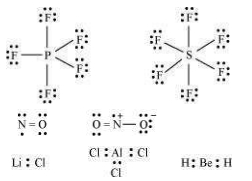
$(c)$ The octet rule cannot be applied to elements in and beyond the third period of the periodic table. The elements present in these periods have more than eight valence electrons around the central atom. For example: $PF_{5}$,$SF_{6}$,etc.
$(d)$ The octet rule is not satisfied for all atoms in a molecule having an odd number of electrons. For example,$NO$ and $NO_{2}$ do not satisfy the octet rule.
$(e)$ This rule cannot be applied to those compounds in which the number of electrons surrounding the central atom is less than eight. For example,$LiCl$,$BeH_{2}$,$AlCl_{3}$,etc.,do not obey the octet rule.
Significance: The octet rule successfully explained the formation of chemical bonds depending upon the nature of the element.
Limitations of the octet theory:
$(a)$ The rule failed to predict the shape and relative stability of molecules.
$(b)$ It is based upon the inert nature of noble gases. However,some noble gases like xenon and krypton form compounds such as $XeF_{2}$,$KrF_{2}$,etc.
$(c)$ The octet rule cannot be applied to elements in and beyond the third period of the periodic table. The elements present in these periods have more than eight valence electrons around the central atom. For example: $PF_{5}$,$SF_{6}$,etc.
$(d)$ The octet rule is not satisfied for all atoms in a molecule having an odd number of electrons. For example,$NO$ and $NO_{2}$ do not satisfy the octet rule.
$(e)$ This rule cannot be applied to those compounds in which the number of electrons surrounding the central atom is less than eight. For example,$LiCl$,$BeH_{2}$,$AlCl_{3}$,etc.,do not obey the octet rule.
0 likes
View Solution158
Easy
Define the bond length.
Solution
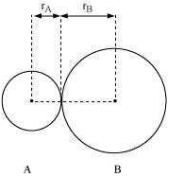
(N/A) Bond length is defined as the equilibrium distance between the nuclei of two bonded atoms in a molecule.
Bond lengths are expressed in terms of $\mathring{A}$ $(10^{-10} \ m)$ or picometer $(10^{-12} \ m)$ and are measured by spectroscopic $X$-ray diffraction and electron-diffraction techniques.
In an ionic compound,the bond length is the sum of the ionic radii of the constituting atoms $(d = r_+ + r_-)$. In a covalent compound,it is the sum of their covalent radii $(d = r_A + r_B)$.
Bond lengths are expressed in terms of $\mathring{A}$ $(10^{-10} \ m)$ or picometer $(10^{-12} \ m)$ and are measured by spectroscopic $X$-ray diffraction and electron-diffraction techniques.
In an ionic compound,the bond length is the sum of the ionic radii of the constituting atoms $(d = r_+ + r_-)$. In a covalent compound,it is the sum of their covalent radii $(d = r_A + r_B)$.
0 likes
View Solution159
Medium
Explain the polar covalent bond with the help of a suitable example.
Solution
(N/A) When two dissimilar atoms having different electronegativities combine to form a covalent bond,the bond pair of electrons is not shared equally.
The bond pair shifts towards the nucleus of the atom having greater electronegativity. As a result,the electron distribution becomes distorted and the electron cloud is displaced towards the more electronegative atom.
Consequently,the electronegative atom acquires a partial negative charge $(\delta^-)$,while the other atom acquires a partial positive charge $(\delta^+)$. Thus,opposite poles are developed in the molecule,and this type of bond is called a polar covalent bond.
Example: $HCl$ contains a polar covalent bond. The chlorine atom is more electronegative than the hydrogen atom. Hence,the bond pair lies closer to the chlorine atom,which acquires a partial negative charge,while the hydrogen atom acquires a partial positive charge: $H^{\delta+} - Cl^{\delta-}$.
The bond pair shifts towards the nucleus of the atom having greater electronegativity. As a result,the electron distribution becomes distorted and the electron cloud is displaced towards the more electronegative atom.
Consequently,the electronegative atom acquires a partial negative charge $(\delta^-)$,while the other atom acquires a partial positive charge $(\delta^+)$. Thus,opposite poles are developed in the molecule,and this type of bond is called a polar covalent bond.
Example: $HCl$ contains a polar covalent bond. The chlorine atom is more electronegative than the hydrogen atom. Hence,the bond pair lies closer to the chlorine atom,which acquires a partial negative charge,while the hydrogen atom acquires a partial positive charge: $H^{\delta+} - Cl^{\delta-}$.
0 likes
View Solution160
Easy
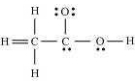
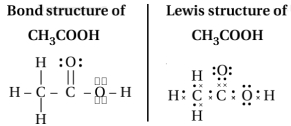
The skeletal structure of $CH_{3}COOH$ as shown below is incorrect because some of the bonds are represented wrongly. Write the correct Lewis structure for acetic acid.
Solution
(N/A) In the given structure,the carbon atom is shown to have five bonds,which is incorrect as carbon is tetravalent. The correct Lewis structure for acetic acid $(CH_{3}COOH)$ involves a double bond between the carbonyl carbon and the oxygen atom,and a single bond between the carbonyl carbon and the hydroxyl oxygen. The correct structure is:
$H_{3}C-C(=O)OH$
$H_{3}C-C(=O)OH$
0 likes
View Solution161
Medium
Explain the formation of $H_{2}$ molecule on the basis of valence bond theory.
Solution
(N/A) Let us assume that two hydrogen atoms ($A$ and $B$) with nuclei ($N_{A}$ and $N_{B}$) and electrons ($e_{A}$ and $e_{B}$) are taken to undergo a reaction to form a hydrogen molecule.
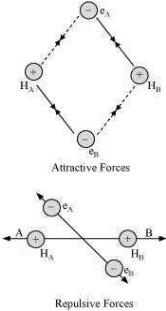
When $A$ and $B$ are at a large distance,there is no interaction between them. As they begin to approach each other,the attractive and repulsive forces start operating.
Attractive force arises between:
$(a)$ Nucleus of one atom and its own electron i.e.,$N_{A}-e_{A}$ and $N_{B}-e_{B}$
$(b)$ Nucleus of one atom and electron of another atom i.e.,$N_{A}-e_{B}$ and $N_{B}-e_{A}$
Repulsive force arises between:
$(a)$ Electrons of two atoms i.e.,$e_{A}-e_{B}$
$(b)$ Nuclei of two atoms i.e.,$N_{A}-N_{B}$
The force of attraction brings the two atoms together,whereas the force of repulsion tends to push them apart.
The magnitude of the attractive forces is more than that of the repulsive forces. Hence,the two atoms approach each other. As a result,the potential energy decreases. Finally,a state is reached when the attractive forces balance the repulsive forces and the system acquires minimum energy. This leads to the formation of a dihydrogen molecule.
When $A$ and $B$ are at a large distance,there is no interaction between them. As they begin to approach each other,the attractive and repulsive forces start operating.
Attractive force arises between:
$(a)$ Nucleus of one atom and its own electron i.e.,$N_{A}-e_{A}$ and $N_{B}-e_{B}$
$(b)$ Nucleus of one atom and electron of another atom i.e.,$N_{A}-e_{B}$ and $N_{B}-e_{A}$
Repulsive force arises between:
$(a)$ Electrons of two atoms i.e.,$e_{A}-e_{B}$
$(b)$ Nuclei of two atoms i.e.,$N_{A}-N_{B}$
The force of attraction brings the two atoms together,whereas the force of repulsion tends to push them apart.
The magnitude of the attractive forces is more than that of the repulsive forces. Hence,the two atoms approach each other. As a result,the potential energy decreases. Finally,a state is reached when the attractive forces balance the repulsive forces and the system acquires minimum energy. This leads to the formation of a dihydrogen molecule.
0 likes
View Solution162
Difficult
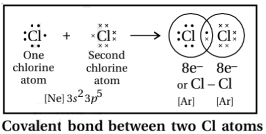
Who gave the concept of a covalent bond? What is a covalent bond? Explain with one example.
Solution
(N/A) Langmuir $(1919)$ refined the Lewis postulations by abandoning the idea of the stationary cubical arrangement of the octet and by introducing the term covalent bond.
According to the Lewis-Langmuir theory,atoms can combine by sharing electrons between them. This type of bond is called a covalent bond,and each atom contributes an equal number of electrons for sharing in order to acquire the configuration of the nearest noble gas.
Example: Covalent bond in a dichlorine $(Cl_{2})$ molecule.
The $Cl$ atom with electronic configuration: $[Ne] \ 3s^{2} 3p^{5}$,is one electron short of the argon noble gas configuration.
The formation of the $Cl_{2}$ molecule can be understood in terms of the sharing of $1$ pair of electrons between the two chlorine atoms,each chlorine atom contributing one electron to the shared pair.
The electron pair takes part in the octet of both $Cl$ atoms.
So,both chlorine atoms get an octet like $Ar$: $[Ne] \ 3s^{2} 3p^{6}$ or $[Ar]$.
Note: '$\circ$' and '$x$' symbols are used to represent electrons of both chlorine atoms. '-' is used to represent the covalent bond between two $Cl$ atoms.
According to the Lewis-Langmuir theory,atoms can combine by sharing electrons between them. This type of bond is called a covalent bond,and each atom contributes an equal number of electrons for sharing in order to acquire the configuration of the nearest noble gas.
Example: Covalent bond in a dichlorine $(Cl_{2})$ molecule.
The $Cl$ atom with electronic configuration: $[Ne] \ 3s^{2} 3p^{5}$,is one electron short of the argon noble gas configuration.
The formation of the $Cl_{2}$ molecule can be understood in terms of the sharing of $1$ pair of electrons between the two chlorine atoms,each chlorine atom contributing one electron to the shared pair.
The electron pair takes part in the octet of both $Cl$ atoms.
So,both chlorine atoms get an octet like $Ar$: $[Ne] \ 3s^{2} 3p^{6}$ or $[Ar]$.
Note: '$\circ$' and '$x$' symbols are used to represent electrons of both chlorine atoms. '-' is used to represent the covalent bond between two $Cl$ atoms.
0 likes
View Solution163
Difficult
State the number of covalent bonds in $H_{2}O$ and $CCl_{4}$ and provide their bond structures and Lewis structures.
Solution
(N/A) In water $(H_{2}O)$,there are two $O-H$ covalent bonds. In carbon tetrachloride $(CCl_{4})$,there are four $C-Cl$ covalent bonds.
$H_{2}O$ Structure:
- Each $H$ atom attains a duplet (two electrons).
- The $O$ atom attains an octet (eight electrons).
$CCl_{4}$ Structure:
- Each $C-Cl$ bond consists of one electron from $C$ and one electron from $Cl$,satisfying the octet for all atoms.
$H_{2}O$ Structure:
- Each $H$ atom attains a duplet (two electrons).
- The $O$ atom attains an octet (eight electrons).
$CCl_{4}$ Structure:
- Each $C-Cl$ bond consists of one electron from $C$ and one electron from $Cl$,satisfying the octet for all atoms.
0 likes
View Solution164
Difficult
What is a multiple bond? Give the difference between a single bond,a double bond,and a triple bond.
Solution
(N/A) multiple bond is a covalent bond formed by the sharing of more than one pair of electrons between two atoms. When two atoms share two or more electron pairs,it is called a multiple bond (e.g.,double or triple bonds).
| Feature | Single Bond | Double Bond | Triple Bond |
| :--- | :--- | :--- | :--- |
| Electron pairs shared | $1$ pair ($2$ electrons) | $2$ pairs ($4$ electrons) | $3$ pairs ($6$ electrons) |
| Representation | $-$ | $=$ | $\equiv$ |
| Example | $Cl_2$ $(Cl-Cl)$ | $O_2$ $(O=O)$ | $N_2$ $(N\equiv N)$ |
| Feature | Single Bond | Double Bond | Triple Bond |
| :--- | :--- | :--- | :--- |
| Electron pairs shared | $1$ pair ($2$ electrons) | $2$ pairs ($4$ electrons) | $3$ pairs ($6$ electrons) |
| Representation | $-$ | $=$ | $\equiv$ |
| Example | $Cl_2$ $(Cl-Cl)$ | $O_2$ $(O=O)$ | $N_2$ $(N\equiv N)$ |
0 likes
View Solution165
Difficult
Which multiple bonds are present in $CO_{2}$,$C_{2}H_{4}$,$N_{2}$,and $C_{2}H_{2}$? Draw the Lewis and simple bond structures of these molecules.
Solution
(N/A) Carbon dioxide $(CO_{2})$: In the $CO_{2}$ molecule,two double bonds are present. Each $C=O$ bond involves two electron pairs (four electrons) shared between $C$ and $O$ atoms.
$(b)$ Ethene $(C_{2}H_{4})$: In this molecule,one double bond $(C=C)$ is present between two carbon atoms,and four single $C-H$ bonds are present. Between the two carbon atoms,two electron pairs (four electrons) are shared,forming a double bond.
$(c)$ Dinitrogen $(N_{2})$: In the $N_{2}$ molecule,a triple bond $(N \equiv N)$ is present between the two nitrogen atoms,involving three electron pairs (six electrons).
$(d)$ Ethyne $(C_{2}H_{2})$: In this molecule,one triple bond $(C \equiv C)$ is present between two carbon atoms,and two single $C-H$ bonds are present. Between the two carbon atoms,three electron pairs (six electrons) are shared,forming a triple bond.
$(b)$ Ethene $(C_{2}H_{4})$: In this molecule,one double bond $(C=C)$ is present between two carbon atoms,and four single $C-H$ bonds are present. Between the two carbon atoms,two electron pairs (four electrons) are shared,forming a double bond.
$(c)$ Dinitrogen $(N_{2})$: In the $N_{2}$ molecule,a triple bond $(N \equiv N)$ is present between the two nitrogen atoms,involving three electron pairs (six electrons).
$(d)$ Ethyne $(C_{2}H_{2})$: In this molecule,one triple bond $(C \equiv C)$ is present between two carbon atoms,and two single $C-H$ bonds are present. Between the two carbon atoms,three electron pairs (six electrons) are shared,forming a triple bond.
0 likes
View Solution166
Medium
What are the conditions for the formation of a covalent bond according to the Lewis dot structure?
Solution
(N/A) $1$. Each covalent bond is formed as a result of the sharing of an electron pair between the atoms.
$2$. Each combining atom contributes at least one electron to the shared pair.
$3$. The combining atoms attain the outer shell noble gas configuration (octet or duplet) as a result of the sharing of electrons.
$2$. Each combining atom contributes at least one electron to the shared pair.
$3$. The combining atoms attain the outer shell noble gas configuration (octet or duplet) as a result of the sharing of electrons.
0 likes
View Solution167
Difficult
Explain: Lewis dot representation.
Solution
(N/A) Number of total electrons in a neutral molecule: The total number of electrons required for writing the structures is obtained by adding the valence electrons of the combining atoms. For example,in the $CH_{4}$ molecule,there are eight valence electrons available for bonding ($4$ from carbon and $4$ from the four hydrogen atoms).
Number of electrons in a negative ion: Each negative charge means the addition of one electron to the total number of valence electrons. e.g.,For the $CO_{3}^{2-}$ ion,in Lewis representation,there are a total of $24$ electrons,in which $4$ $e^{-}$ are from one carbon,$18$ $e^{-}$ are from three oxygen atoms,and $2$ additional $e^{-}$ are from the two negative charges.
$(\text{Number of electrons in negative ion}) = (\text{Total valence electrons of all atoms}) + (\text{Number of negative charges})$
Number of electrons in a positive ion:
$(\text{Number of electrons in positive ion}) = (\text{Total valence electrons of all atoms}) - (\text{Number of positive charges})$
e.g.,$(\text{Total electrons in } NH_{4}^{+}) = (\text{Valence electrons of } N \text{ and } 4 H) - 1$
$= (5 + 4) - 1 = 8$
Distribution of electrons: Knowing the chemical symbols of the combining atoms and having knowledge of the skeletal structure of the compound (known or guessed intelligently),it is easy to distribute the total number of electrons as bonding shared pairs between the atoms in proportion to the total bonds.
Position of electrons: After accounting for the shared pairs of electrons for single bonds,the remaining electron pairs are either utilized for multiple bonding or remain as lone pairs. The basic requirement is that each bonded atom gets an octet of electrons.
Number of electrons in a negative ion: Each negative charge means the addition of one electron to the total number of valence electrons. e.g.,For the $CO_{3}^{2-}$ ion,in Lewis representation,there are a total of $24$ electrons,in which $4$ $e^{-}$ are from one carbon,$18$ $e^{-}$ are from three oxygen atoms,and $2$ additional $e^{-}$ are from the two negative charges.
$(\text{Number of electrons in negative ion}) = (\text{Total valence electrons of all atoms}) + (\text{Number of negative charges})$
Number of electrons in a positive ion:
$(\text{Number of electrons in positive ion}) = (\text{Total valence electrons of all atoms}) - (\text{Number of positive charges})$
e.g.,$(\text{Total electrons in } NH_{4}^{+}) = (\text{Valence electrons of } N \text{ and } 4 H) - 1$
$= (5 + 4) - 1 = 8$
Distribution of electrons: Knowing the chemical symbols of the combining atoms and having knowledge of the skeletal structure of the compound (known or guessed intelligently),it is easy to distribute the total number of electrons as bonding shared pairs between the atoms in proportion to the total bonds.
Position of electrons: After accounting for the shared pairs of electrons for single bonds,the remaining electron pairs are either utilized for multiple bonding or remain as lone pairs. The basic requirement is that each bonded atom gets an octet of electrons.
0 likes
View Solution168
Difficult
State the points required for Lewis dot representation.
Solution
(N/A) $1$. Total number of electrons in a neutral molecule: The total number of electrons required for writing the structures is obtained by adding the valence electrons of the combining atoms. For example,in the $CH_{4}$ molecule,there are eight valence electrons available for bonding ($4$ from carbon and $4$ from the four hydrogen atoms).
$2$. Number of electrons in a negative ion: Each negative charge means the addition of one electron to the total number of valence electrons. For example,for the $CO_{3}^{2-}$ ion,in the Lewis representation,there are a total of $24$ electrons: $4 \ e^{-}$ from one carbon,$18 \ e^{-}$ from three oxygen atoms,and $2$ additional $e^{-}$ due to the two negative charges.
$\left(\begin{array}{c} \text{Number of} \\ \text{electrons in} \\ \text{negative ion} \end{array}\right) = \left(\begin{array}{c} \text{Total valence} \\ \text{electrons} \\ \text{of all atoms} \end{array}\right) + \left(\begin{array}{c} \text{Number of} \\ \text{negative} \\ \text{charges} \end{array}\right)$
$3$. Number of electrons in a positive ion: Each positive charge means the subtraction of one electron from the total number of valence electrons.
$\left(\begin{array}{c} \text{Number of} \\ \text{electrons in} \\ \text{positive ion} \end{array}\right) = \left(\begin{array}{c} \text{Total valence} \\ \text{electrons} \\ \text{of all atoms} \end{array}\right) - \left(\begin{array}{c} \text{Number of} \\ \text{positive} \\ \text{charges} \end{array}\right)$
For example,$\left(\begin{array}{c} \text{Total} \\ \text{electrons} \\ \text{in} \ NH_{4}^{+} \end{array}\right) = \left(\begin{array}{c} \text{Valence} \\ \text{electrons of} \\ N \ \text{and} \ 4 \ H \end{array}\right) - 1 = (5+4)-1 = 8$.
$4$. Distribution of electrons: Knowing the chemical symbols of the combining atoms and the skeletal structure of the compound,it is easy to distribute the total number of electrons as bonding shared pairs between the atoms.
$5$. Position of electrons: After accounting for the shared pairs of electrons for single bonds,the remaining electron pairs are either utilized for multiple bonding or remain as lone pairs. The basic requirement is that each bonded atom attains an octet of electrons.
$2$. Number of electrons in a negative ion: Each negative charge means the addition of one electron to the total number of valence electrons. For example,for the $CO_{3}^{2-}$ ion,in the Lewis representation,there are a total of $24$ electrons: $4 \ e^{-}$ from one carbon,$18 \ e^{-}$ from three oxygen atoms,and $2$ additional $e^{-}$ due to the two negative charges.
$\left(\begin{array}{c} \text{Number of} \\ \text{electrons in} \\ \text{negative ion} \end{array}\right) = \left(\begin{array}{c} \text{Total valence} \\ \text{electrons} \\ \text{of all atoms} \end{array}\right) + \left(\begin{array}{c} \text{Number of} \\ \text{negative} \\ \text{charges} \end{array}\right)$
$3$. Number of electrons in a positive ion: Each positive charge means the subtraction of one electron from the total number of valence electrons.
$\left(\begin{array}{c} \text{Number of} \\ \text{electrons in} \\ \text{positive ion} \end{array}\right) = \left(\begin{array}{c} \text{Total valence} \\ \text{electrons} \\ \text{of all atoms} \end{array}\right) - \left(\begin{array}{c} \text{Number of} \\ \text{positive} \\ \text{charges} \end{array}\right)$
For example,$\left(\begin{array}{c} \text{Total} \\ \text{electrons} \\ \text{in} \ NH_{4}^{+} \end{array}\right) = \left(\begin{array}{c} \text{Valence} \\ \text{electrons of} \\ N \ \text{and} \ 4 \ H \end{array}\right) - 1 = (5+4)-1 = 8$.
$4$. Distribution of electrons: Knowing the chemical symbols of the combining atoms and the skeletal structure of the compound,it is easy to distribute the total number of electrons as bonding shared pairs between the atoms.
$5$. Position of electrons: After accounting for the shared pairs of electrons for single bonds,the remaining electron pairs are either utilized for multiple bonding or remain as lone pairs. The basic requirement is that each bonded atom attains an octet of electrons.
1 likes
View Solution169
Medium
Write the Lewis representation of the following molecules / ions:
$(i) H_2$
$(ii) O_2$
$(iii) O_3$
$(iv) NF_3$
$(v) CO_3^{2-}$
$(vi) HNO_3$
$(i) H_2$
$(ii) O_2$
$(iii) O_3$
$(iv) NF_3$
$(v) CO_3^{2-}$
$(vi) HNO_3$
Solution
(N/A) The Lewis structures represent the valence electrons of atoms in a molecule or ion. The structures are as follows:
$(i) H_2: H:H$
$(ii) O_2: :\ddot{O}::\ddot{O}:$
$(iii) O_3: :\ddot{O}-\ddot{O}=\ddot{O}:$
$(iv) NF_3: \text{The central } N \text{ atom is bonded to three } F \text{ atoms with one lone pair on } N.$
$(v) CO_3^{2-}: \text{The central } C \text{ atom is double bonded to one } O \text{ and single bonded to two } O^- \text{ atoms.}$
$(vi) HNO_3: \text{The central } N \text{ atom is bonded to one } =O, \text{ one } -OH, \text{ and one } -O^- \text{ (dative bond).}$
$(i) H_2: H:H$
$(ii) O_2: :\ddot{O}::\ddot{O}:$
$(iii) O_3: :\ddot{O}-\ddot{O}=\ddot{O}:$
$(iv) NF_3: \text{The central } N \text{ atom is bonded to three } F \text{ atoms with one lone pair on } N.$
$(v) CO_3^{2-}: \text{The central } C \text{ atom is double bonded to one } O \text{ and single bonded to two } O^- \text{ atoms.}$
$(vi) HNO_3: \text{The central } N \text{ atom is bonded to one } =O, \text{ one } -OH, \text{ and one } -O^- \text{ (dative bond).}$
0 likes
View Solution170
Easy
The skeletal structure of $CH_3COOH$ is shown below. Identify the correct Lewis structure for acetic acid.
Solution
(N/A) The correct Lewis structure for acetic acid $(CH_3COOH)$ requires a double bond between the carbonyl carbon and one oxygen atom $(C=O)$,while the other oxygen is single-bonded to both the carbon and a hydrogen atom $(C-OH)$. The methyl group $(CH_3)$ consists of three $C-H$ single bonds. The structure is represented as follows:
$H_3C-C(=O)OH$
$H_3C-C(=O)OH$
0 likes
View Solution171
Easy
Write the Lewis dot structure of the $CO$ molecule.
Solution
(N/A) $(i)$ $C$ has electronic configuration $[He] 2s^2 2p^2$,so valence electrons $= 4$.
$O$ has electronic configuration $[He] 2s^2 2p^4$,so valence electrons $= 6$.
Therefore,total valence electrons in $CO = 4 + 6 = 10$.
$(ii)$ The skeletal structure of $CO$ is $C-O$.
$(iii)$ If we place a single bond between $C$ and $O$,the octet is not satisfied for $C$. By forming a triple bond between $C$ and $O$,we share $6$ electrons.
$(iv)$ The final Lewis structure is $:C \equiv O:$,where $C$ and $O$ both complete their octets through sharing $6$ electrons and having one lone pair each.
$O$ has electronic configuration $[He] 2s^2 2p^4$,so valence electrons $= 6$.
Therefore,total valence electrons in $CO = 4 + 6 = 10$.
$(ii)$ The skeletal structure of $CO$ is $C-O$.
$(iii)$ If we place a single bond between $C$ and $O$,the octet is not satisfied for $C$. By forming a triple bond between $C$ and $O$,we share $6$ electrons.
$(iv)$ The final Lewis structure is $:C \equiv O:$,where $C$ and $O$ both complete their octets through sharing $6$ electrons and having one lone pair each.
0 likes
View Solution172
Medium
Define bond length. What is bond length and how is it measured?
Solution
(N/A) Bond length is defined as the equilibrium distance between the nuclei of two bonded atoms in a molecule.
Bond lengths are measured using experimental techniques such as spectroscopic methods,$X$-ray diffraction,and electron diffraction.
Bond lengths are measured using experimental techniques such as spectroscopic methods,$X$-ray diffraction,and electron diffraction.
0 likes
View Solution173
Difficult
What is bond order according to the Lewis theory? Write the structure and bond order of $H_2, O_2, N_2, CO,$ and $NO^{+}$.
Solution
(N/A) According to the Lewis theory of covalent bonding,the bond order is defined as the number of chemical bonds between two atoms in a molecule.
| Molecule and Structure | Bond Order |
|---|---|
| $H_2$ (dihydrogen): $H-H$ | $1$ |
| $O_2$ (dioxygen): $O=O$ | $2$ |
| $N_2$ (dinitrogen): $N \equiv N$ | $3$ |
| $CO$ (carbon monoxide): $C \equiv O$ | $3$ |
| $NO^{+}$: $[N \equiv O]^+$ | $3$ |
0 likes
View Solution174
Difficult
Explain: Non-polar and polar covalent bonds.
Solution
(N/A) The existence of a $100\%$ ionic or covalent bond represents an ideal situation. In reality,no bond or compound is either completely covalent or ionic. Even in the case of a covalent bond between two hydrogen atoms,there is some ionic character.
Non-polar covalent bond: When a covalent bond is formed between two similar atoms,the shared pair of electrons is equally attracted by the two atoms. As a result,the electron pair is situated exactly between the two identical nuclei. The bond so formed is called a non-polar covalent bond.
Example: Non-polar covalent bonds in $H_2, N_2, O_2, F_2, Cl_2$.
Polar covalent bond: When atoms of two different elements (heteronuclear) combine by a covalent bond,the electron pair in the bond is attracted more by the more electronegative atom. Consequently,it acquires a partial negative charge $(-\delta)$ and the other atom acquires a partial positive charge $(+\delta)$. Such a covalent bond is called a polar covalent bond.
In an $AB$ molecule,if $A$ is less electronegative and $B$ is more electronegative,the $A-B$ bond will be $A^{+\delta}-B^{-\delta}$ (polar bond).
Non-polar covalent bond: When a covalent bond is formed between two similar atoms,the shared pair of electrons is equally attracted by the two atoms. As a result,the electron pair is situated exactly between the two identical nuclei. The bond so formed is called a non-polar covalent bond.
Example: Non-polar covalent bonds in $H_2, N_2, O_2, F_2, Cl_2$.
| Molecule | $H_2, N_2, O_2, F_2, Cl_2$ |
| Bond structure | $H-H, N \equiv N, O=O, F-F, Cl-Cl$ |
Polar covalent bond: When atoms of two different elements (heteronuclear) combine by a covalent bond,the electron pair in the bond is attracted more by the more electronegative atom. Consequently,it acquires a partial negative charge $(-\delta)$ and the other atom acquires a partial positive charge $(+\delta)$. Such a covalent bond is called a polar covalent bond.
In an $AB$ molecule,if $A$ is less electronegative and $B$ is more electronegative,the $A-B$ bond will be $A^{+\delta}-B^{-\delta}$ (polar bond).
| Molecule | $HF$ | $HCl$ | $CO$ | $NO$ |
| Real bond | $H^{+\delta}-F^{-\delta}$ | $H^{+\delta}-Cl^{-\delta}$ | $C^{+\delta} \equiv O^{-\delta}$ | $N^{+\delta}=O^{-\delta}$ |
0 likes
View Solution175
Medium
What do you understand by bond pairs and lone pairs of electrons? Illustrate by giving one example of each type.
Solution
(N/A) Bond pairs are the shared electrons between two atoms in a covalent bond. For example,in the $H-H$ molecule,the shared pair of electrons between the two $H$ atoms constitutes a bond pair.
Lone pairs are valence shell electron pairs that are not involved in bonding and remain on a single atom. For example,in the $H_2O$ molecule,the oxygen atom has two lone pairs of electrons that do not participate in bonding.
Lone pairs are valence shell electron pairs that are not involved in bonding and remain on a single atom. For example,in the $H_2O$ molecule,the oxygen atom has two lone pairs of electrons that do not participate in bonding.
0 likes
View Solution176
Difficult
Explain the formation of $H_{2}$ molecule on the basis of Valence Bond Theory.
Solution
(N/A) Consider two hydrogen atoms $A$ and $B$ approaching each other, having nuclei $N_{A}$ and $N_{B}$, and electrons represented by $e_{A}$ and $e_{B}$.
When the two atoms are at a large distance from each other, there is no interaction between them. At this stage, the energy of the system is equal to the sum of the energies of both isolated $H$ atoms. In each atom, the nucleus and electron have an attractive interaction ($N_{A}-e_{A}$ and $N_{B}-e_{B}$).
When both atoms $H_{A}$ and $H_{B}$ approach each other, both attractive and repulsive forces are generated:
$(i)$ Attractive forces: These occur between the nucleus of one atom and its own electron ($N_{A}-e_{A}$, $N_{B}-e_{B}$) and between the nucleus of one atom and the electron of the other atom ($N_{A}-e_{B}$ and $N_{B}-e_{A}$).
$(ii)$ Repulsive forces: These occur between the electrons of the two atoms $(e_{A}-e_{B})$ and between the nuclei of the two atoms $(N_{A}-N_{B})$.
- Attractive forces pull the atoms toward each other, while repulsive forces push them apart.
- Experimental evidence shows that the magnitude of attractive forces is greater than that of repulsive forces. Consequently, the atoms move closer, and the potential energy of the system decreases.
$H_{2}$ formation: $(i)$ The atoms approach until the attractive and repulsive forces are balanced. $(ii)$ The system attains minimum potential energy. $(iii)$ At this stage, the two hydrogen atoms combine. $(iv)$ A stable hydrogen molecule is formed. $(v)$ The equilibrium bond length is $74 \ pm$.
When the two atoms are at a large distance from each other, there is no interaction between them. At this stage, the energy of the system is equal to the sum of the energies of both isolated $H$ atoms. In each atom, the nucleus and electron have an attractive interaction ($N_{A}-e_{A}$ and $N_{B}-e_{B}$).
When both atoms $H_{A}$ and $H_{B}$ approach each other, both attractive and repulsive forces are generated:
$(i)$ Attractive forces: These occur between the nucleus of one atom and its own electron ($N_{A}-e_{A}$, $N_{B}-e_{B}$) and between the nucleus of one atom and the electron of the other atom ($N_{A}-e_{B}$ and $N_{B}-e_{A}$).
$(ii)$ Repulsive forces: These occur between the electrons of the two atoms $(e_{A}-e_{B})$ and between the nuclei of the two atoms $(N_{A}-N_{B})$.
- Attractive forces pull the atoms toward each other, while repulsive forces push them apart.
- Experimental evidence shows that the magnitude of attractive forces is greater than that of repulsive forces. Consequently, the atoms move closer, and the potential energy of the system decreases.
$H_{2}$ formation: $(i)$ The atoms approach until the attractive and repulsive forces are balanced. $(ii)$ The system attains minimum potential energy. $(iii)$ At this stage, the two hydrogen atoms combine. $(iv)$ A stable hydrogen molecule is formed. $(v)$ The equilibrium bond length is $74 \ pm$.
0 likes
View Solution177
Advanced
Explain the Valence Bond Theory $(VBT)$.
Solution
(N/A) The $VBT$ was introduced by Heitler and London $(1927)$ and further developed by Pauling and others. It addresses the limitations of the Lewis approach and $VSEPR$ theory.
Key postulates of $VBT$:
$1$. Formation of a covalent bond: It occurs due to the overlapping of half-filled atomic orbitals of the participating atoms.
$2$. Energy minimization: As two atoms approach each other,attractive and repulsive forces act between them. At a specific distance,the system reaches a state of minimum potential energy,resulting in a stable covalent bond. For example,in $H_2$,the energy decreases by $435.8 \ kJ \ mol^{-1}$.
$3$. Extent of overlapping: The strength of a covalent bond is directly proportional to the extent of overlapping of the atomic orbitals.
$4$. Directional properties: The geometry of a molecule is determined by the directional nature of the overlapping atomic orbitals (e.g.,tetrahedral geometry in $CH_4$).
$5$. Types of bonds: Overlapping along the internuclear axis results in a $\sigma$ bond,while lateral (perpendicular) overlapping results in a $\pi$ bond.
$6$. Hybridization: Atomic orbitals undergo hybridization to form equivalent hybrid orbitals,which then overlap to form bonds.
Key postulates of $VBT$:
$1$. Formation of a covalent bond: It occurs due to the overlapping of half-filled atomic orbitals of the participating atoms.
$2$. Energy minimization: As two atoms approach each other,attractive and repulsive forces act between them. At a specific distance,the system reaches a state of minimum potential energy,resulting in a stable covalent bond. For example,in $H_2$,the energy decreases by $435.8 \ kJ \ mol^{-1}$.
$3$. Extent of overlapping: The strength of a covalent bond is directly proportional to the extent of overlapping of the atomic orbitals.
$4$. Directional properties: The geometry of a molecule is determined by the directional nature of the overlapping atomic orbitals (e.g.,tetrahedral geometry in $CH_4$).
$5$. Types of bonds: Overlapping along the internuclear axis results in a $\sigma$ bond,while lateral (perpendicular) overlapping results in a $\pi$ bond.
$6$. Hybridization: Atomic orbitals undergo hybridization to form equivalent hybrid orbitals,which then overlap to form bonds.
0 likes
View Solution178
Medium
What are electron-deficient compounds? Are $BCl_3$ and $SiCl_4$ electron-deficient species? Explain.
Solution
(N/A) Electron-deficient compounds are those in which the central atom has an incomplete octet,meaning it has fewer than $8$ electrons in its valence shell.
$(i)$ $BCl_3$: In $BCl_3$,the Boron atom has $3$ valence electrons. After forming $3$ covalent bonds with chlorine atoms,it has $6$ electrons in its valence shell. Since $6 < 8$,$BCl_3$ is an electron-deficient species.
$(ii)$ $SiCl_4$: Silicon has $4$ valence electrons. After forming $4$ covalent bonds with chlorine atoms,it completes its octet with $8$ electrons. Therefore,$SiCl_4$ is not an electron-deficient species.
$(i)$ $BCl_3$: In $BCl_3$,the Boron atom has $3$ valence electrons. After forming $3$ covalent bonds with chlorine atoms,it has $6$ electrons in its valence shell. Since $6 < 8$,$BCl_3$ is an electron-deficient species.
$(ii)$ $SiCl_4$: Silicon has $4$ valence electrons. After forming $4$ covalent bonds with chlorine atoms,it completes its octet with $8$ electrons. Therefore,$SiCl_4$ is not an electron-deficient species.
0 likes
View Solution179
EasyMCQ
What is used to represent the $C=C$ bond in a ball and stick model?
A
Wooden balls
B
Springs
C
Metal rods
D
Plastic connectors
Solution
(B) In the ball and stick model,atoms are represented by balls and bonds are represented by sticks. For double bonds $(C=C)$ and triple bonds $(C \equiv C)$,springs are used instead of rigid sticks to represent the curvature and flexibility of the multiple bonds.
0 likes
View Solution180
EasyMCQ
What is the maximum covalency of the first-period elements? Why?
A
$1$
B
$2$
C
$3$
D
$4$
Solution
(D) The maximum covalency of the first-period elements (specifically $Li$ to $Be$ and $B$) is limited to $4$.
This is because they possess only four valence orbitals ($one$ $2s$ and $three$ $2p$ orbitals) available for bonding.
For example,in the case of boron,it can form the $[BF_4]^-$ ion.
This is because they possess only four valence orbitals ($one$ $2s$ and $three$ $2p$ orbitals) available for bonding.
For example,in the case of boron,it can form the $[BF_4]^-$ ion.
0 likes
View Solution181
EasyMCQ
Why can the maximum covalency of elements of the second period not be more than $4$?
A
Due to the absence of $d$-orbitals in the valence shell.
B
Due to the presence of $d$-orbitals in the valence shell.
C
Due to the small atomic size.
D
Due to high electronegativity.
Solution
(A) The elements of the second period ($Li$ to $Ne$) have only $2s$ and $2p$ orbitals in their valence shell.
Since there are only four orbitals available ($one$ $2s$ and $three$ $2p$),they can accommodate a maximum of $8$ electrons,limiting their maximum covalency to $4$.
Since there are only four orbitals available ($one$ $2s$ and $three$ $2p$),they can accommodate a maximum of $8$ electrons,limiting their maximum covalency to $4$.
0 likes
View Solution182
Medium
Write the Lewis structure of the following compounds and show the formal charge on each atom: $HNO_3, NO_2, H_2SO_4$.
Solution
(N/A) The Lewis structures and formal charges on each atom are calculated using the formula: $\text{Formal charge} = [\text{Total valence electrons}] - [\text{Total non-bonding electrons}] - \frac{1}{2} [\text{Total shared electrons}]$.
$(i)$ $HNO_3$:
Formal charge on $H = 1 - 0 - \frac{1}{2}(2) = 0$
Formal charge on $N = 5 - 0 - \frac{1}{2}(8) = +1$
Formal charge on $O(1) = 6 - 4 - \frac{1}{2}(4) = 0$
Formal charge on $O(2) = 6 - 4 - \frac{1}{2}(4) = 0$
Formal charge on $O(3) = 6 - 6 - \frac{1}{2}(2) = -1$
$(ii)$ $NO_2$:
Formal charge on $O(1) = 6 - 4 - \frac{1}{2}(4) = 0$
Formal charge on $N = 5 - 1 - \frac{1}{2}(6) = +1$
Formal charge on $O(2) = 6 - 6 - \frac{1}{2}(2) = -1$
$(iii)$ $H_2SO_4$:
In $H_2SO_4$,the central $S$ atom is bonded to two $OH$ groups and two $O$ atoms via double bonds. All atoms follow the octet rule (except $H$). The formal charge on $S = 6 - 0 - \frac{1}{2}(12) = 0$. The formal charge on $OH$ oxygen atoms $= 6 - 4 - \frac{1}{2}(4) = 0$. The formal charge on double-bonded oxygen atoms $= 6 - 4 - \frac{1}{2}(4) = 0$.
$(i)$ $HNO_3$:
Formal charge on $H = 1 - 0 - \frac{1}{2}(2) = 0$
Formal charge on $N = 5 - 0 - \frac{1}{2}(8) = +1$
Formal charge on $O(1) = 6 - 4 - \frac{1}{2}(4) = 0$
Formal charge on $O(2) = 6 - 4 - \frac{1}{2}(4) = 0$
Formal charge on $O(3) = 6 - 6 - \frac{1}{2}(2) = -1$
$(ii)$ $NO_2$:
Formal charge on $O(1) = 6 - 4 - \frac{1}{2}(4) = 0$
Formal charge on $N = 5 - 1 - \frac{1}{2}(6) = +1$
Formal charge on $O(2) = 6 - 6 - \frac{1}{2}(2) = -1$
$(iii)$ $H_2SO_4$:
In $H_2SO_4$,the central $S$ atom is bonded to two $OH$ groups and two $O$ atoms via double bonds. All atoms follow the octet rule (except $H$). The formal charge on $S = 6 - 0 - \frac{1}{2}(12) = 0$. The formal charge on $OH$ oxygen atoms $= 6 - 4 - \frac{1}{2}(4) = 0$. The formal charge on double-bonded oxygen atoms $= 6 - 4 - \frac{1}{2}(4) = 0$.
0 likes
View Solution183
Difficult
Briefly describe the valence bond theory of covalent bond formation by taking an example of hydrogen.
Solution
(N/A) Valence bond theory $(VBT)$ was introduced by Heitler and London $(1927)$ and developed further by Pauling and others. $VBT$ is based on the knowledge of atomic orbitals, electronic configurations of elements, the overlap criteria of atomic orbitals, the hybridization of atomic orbitals, and the principles of variation and superposition.
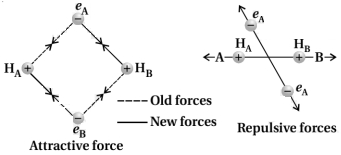
Consider two hydrogen atoms $A$ and $B$ approaching each other, having nuclei $N_{A}$ and $N_{B}$, and electrons represented by $e_{A}$ and $e_{B}$. When the two atoms are at a large distance from each other, there is no interaction between them.
As these two atoms approach each other, new attractive and repulsive forces begin to operate.
- Attractive forces arise between:
$(i)$ Nucleus of one atom and its own electron: i.e., $N_{A}-e_{A}$ and $N_{B}-e_{B}$
$(ii)$ Nucleus of one atom and the electron of the other atom: i.e., $N_{A}-e_{B}$ and $N_{B}-e_{A}$
- Similarly, repulsive forces arise between:
$(i)$ Electrons of the two atoms: $e_{A}-e_{B}$
$(ii)$ Nuclei of the two atoms: $N_{A}-N_{B}$
Experimentally, it is found that the magnitude of the new attractive forces is greater than the new repulsive forces. As a result, the two atoms approach each other and the potential energy decreases. A stage is reached where the net force of attraction balances the force of repulsion, and the system attains minimum energy. At this stage, the two $H$ atoms are bonded together to form a stable molecule having a bond length of $74 \text{ pm}$.
Energy is released when the bond is formed between two hydrogen atoms, making the hydrogen molecule more stable than isolated hydrogen atoms.
Consider two hydrogen atoms $A$ and $B$ approaching each other, having nuclei $N_{A}$ and $N_{B}$, and electrons represented by $e_{A}$ and $e_{B}$. When the two atoms are at a large distance from each other, there is no interaction between them.
As these two atoms approach each other, new attractive and repulsive forces begin to operate.
- Attractive forces arise between:
$(i)$ Nucleus of one atom and its own electron: i.e., $N_{A}-e_{A}$ and $N_{B}-e_{B}$
$(ii)$ Nucleus of one atom and the electron of the other atom: i.e., $N_{A}-e_{B}$ and $N_{B}-e_{A}$
- Similarly, repulsive forces arise between:
$(i)$ Electrons of the two atoms: $e_{A}-e_{B}$
$(ii)$ Nuclei of the two atoms: $N_{A}-N_{B}$
Experimentally, it is found that the magnitude of the new attractive forces is greater than the new repulsive forces. As a result, the two atoms approach each other and the potential energy decreases. A stage is reached where the net force of attraction balances the force of repulsion, and the system attains minimum energy. At this stage, the two $H$ atoms are bonded together to form a stable molecule having a bond length of $74 \text{ pm}$.
Energy is released when the bond is formed between two hydrogen atoms, making the hydrogen molecule more stable than isolated hydrogen atoms.
0 likes
View Solution184
Medium
Write the limitations of the Lewis covalent bond theory.
Solution
(N/A) The Lewis covalent bond theory,while useful for understanding the formation of covalent bonds,has several limitations:
$1$. It does not explain the shape and geometry of molecules.
$2$. It fails to explain the stability of molecules with an odd number of electrons (e.g.,$NO$,$NO_2$).
$3$. It cannot explain the stability of molecules where the central atom has an incomplete octet (e.g.,$BeCl_2$,$BF_3$) or an expanded octet (e.g.,$PF_5$,$SF_6$).
$4$. It does not provide any information regarding the energy of the molecule or the relative stability of different structures.
$5$. It does not account for the magnetic properties of molecules,such as the paramagnetic nature of $O_2$.
$1$. It does not explain the shape and geometry of molecules.
$2$. It fails to explain the stability of molecules with an odd number of electrons (e.g.,$NO$,$NO_2$).
$3$. It cannot explain the stability of molecules where the central atom has an incomplete octet (e.g.,$BeCl_2$,$BF_3$) or an expanded octet (e.g.,$PF_5$,$SF_6$).
$4$. It does not provide any information regarding the energy of the molecule or the relative stability of different structures.
$5$. It does not account for the magnetic properties of molecules,such as the paramagnetic nature of $O_2$.
0 likes
View Solution185
MediumMCQ
Who coined the term 'covalent bond'? And who explained the covalent bond using the electronic theory?
A
Lewis and Kossel
B
Langmuir and Lewis
C
Kossel and Langmuir
D
Lewis and Langmuir
Solution
(B) The term 'covalent bond' was coined by $Irving \ Langmuir$ in $1919$.
The electronic theory of covalent bonding was proposed by $G.N. \ Lewis$ in $1916$.
The electronic theory of covalent bonding was proposed by $G.N. \ Lewis$ in $1916$.
0 likes
View Solution186
Medium
According to Lewis and Langmuir,how and why is a covalent bond formed?
Solution
(N/A) covalent bond is formed by the sharing of unpaired electrons between two atoms. This sharing allows each atom to attain a stable noble gas electronic configuration.
0 likes
View Solution187
Easy
What change occurs in the electronic configuration of atoms forming a covalent bond?
Solution
(N/A) When a covalent bond is formed,both atoms involved in the bond achieve the stable electronic configuration of the nearest noble gas by sharing electrons to complete their octets (or duplets in the case of hydrogen).
0 likes
View Solution188
Easy
How many electrons are involved in each covalent bond,and to whom do they belong?
Solution
(N/A) In a covalent bond,each participating atom contributes one electron to the shared pair. After the bond is formed,these shared electrons are counted towards the octet of both bonded atoms.
0 likes
View Solution189
EasyMCQ
When is a multiple bond said to exist between two atoms?
A
When one electron pair is shared.
B
When two or more electron pairs are shared.
C
When electrons are transferred.
D
When no electrons are shared.
Solution
(B) multiple bond is said to exist between two atoms when more than one pair of electrons is shared between them. For example,a double bond involves the sharing of $2$ electron pairs,and a triple bond involves the sharing of $3$ electron pairs.
0 likes
View Solution190
EasyMCQ
What are multiple bonds? Why are they called so?
A
Bonds formed by sharing of one electron pair.
B
Bonds formed by sharing of two or more electron pairs.
C
Bonds formed by complete transfer of electrons.
D
Bonds formed by electrostatic attraction.
Solution
(B) Multiple bonds are double and triple bonds.
They are called multiple bonds because they involve the sharing of more than one electron pair between two atoms.
$A$ double bond involves the sharing of $2$ electron pairs,while a triple bond involves the sharing of $3$ electron pairs.
They are called multiple bonds because they involve the sharing of more than one electron pair between two atoms.
$A$ double bond involves the sharing of $2$ electron pairs,while a triple bond involves the sharing of $3$ electron pairs.
0 likes
View Solution191
Easy
Calculate the number of covalent bonds in $H_2O$,$NH_3$,and $CCl_4$. Why?
Solution
(N/A) The number of covalent bonds in a molecule is determined by the number of shared electron pairs between atoms to achieve a stable octet or duplet configuration.
$1$. In $H_2O$: The central oxygen atom shares two electrons with two hydrogen atoms,forming $2$ $O-H$ covalent bonds.
$2$. In $NH_3$: The central nitrogen atom shares three electrons with three hydrogen atoms,forming $3$ $N-H$ covalent bonds.
$3$. In $CCl_4$: The central carbon atom shares four electrons with four chlorine atoms,forming $4$ $C-Cl$ covalent bonds.
The number of bonds is determined by the valency of the central atom and the requirement to complete the valence shell of each atom involved in the bonding.
$1$. In $H_2O$: The central oxygen atom shares two electrons with two hydrogen atoms,forming $2$ $O-H$ covalent bonds.
$2$. In $NH_3$: The central nitrogen atom shares three electrons with three hydrogen atoms,forming $3$ $N-H$ covalent bonds.
$3$. In $CCl_4$: The central carbon atom shares four electrons with four chlorine atoms,forming $4$ $C-Cl$ covalent bonds.
The number of bonds is determined by the valency of the central atom and the requirement to complete the valence shell of each atom involved in the bonding.
0 likes
View Solution192
Medium
Why does $NH_{3}$ have three covalent bonds but not a triple bond?
Solution
(N/A) In $NH_{3}$,there are three $N-H$ single bonds. $A$ triple bond requires three bonds between the same two atoms,whereas in $NH_{3}$,the nitrogen atom is bonded to three separate hydrogen atoms.
0 likes
View Solution193
EasyMCQ
Why does $N_2$ contain a triple bond?
A
Due to the presence of three lone pairs.
B
Due to the sharing of three electron pairs between two nitrogen atoms.
C
Due to the high electronegativity of nitrogen.
D
Due to the small size of the nitrogen atom.
Solution
(B) The nitrogen atom has an electronic configuration of $1s^2 2s^2 2p^3$.
To complete its octet,each nitrogen atom requires $3$ more electrons.
Therefore,two nitrogen atoms share $3$ pairs of electrons to form a triple bond $(N \equiv N)$.
To complete its octet,each nitrogen atom requires $3$ more electrons.
Therefore,two nitrogen atoms share $3$ pairs of electrons to form a triple bond $(N \equiv N)$.
0 likes
View Solution194
Easy
How many bonds are present between carbon and oxygen in $CO_2$? Explain.
Solution
(N/A) In $CO_2$ (carbon dioxide),the carbon atom is at the center and is bonded to two oxygen atoms.
The structure is $O=C=O$.
There are two double bonds present in the molecule.
Each $C=O$ bond consists of one sigma $(\sigma)$ bond and one pi $(\pi)$ bond.
The structure is $O=C=O$.
There are two double bonds present in the molecule.
Each $C=O$ bond consists of one sigma $(\sigma)$ bond and one pi $(\pi)$ bond.
0 likes
View Solution195
EasyMCQ
Does $CO_2$ contain multiple bonds? If so,identify them.
A
Yes,it contains two double bonds.
B
Yes,it contains one double bond.
C
No,it contains only single bonds.
D
Yes,it contains one triple bond.
Solution
(A) Yes,$CO_2$ contains multiple bonds.
In the $CO_2$ molecule,the carbon atom is central and is bonded to each oxygen atom by a double bond.
Therefore,the structure is $O=C=O$,which contains two $C=O$ double bonds.
In the $CO_2$ molecule,the carbon atom is central and is bonded to each oxygen atom by a double bond.
Therefore,the structure is $O=C=O$,which contains two $C=O$ double bonds.
0 likes
View Solution196
Easy
What type of bond is present in ethyne $(C_2H_2)$? Why? Explain.
Solution
(N/A) Ethyne $(C_2H_2)$ contains a triple bond between the two carbon atoms.
This is because there are three shared electron pairs between the two carbon atoms.
The structure is represented as $H-C \equiv C-H$.
This is because there are three shared electron pairs between the two carbon atoms.
The structure is represented as $H-C \equiv C-H$.
0 likes
View Solution197
Medium
Distinguish between the Lewis structures of the following pairs of molecules:
$(i)$ $BCl_3$ and $BH_3$
$(ii)$ $BeCl_2$ and $BeH_2$
$(i)$ $BCl_3$ and $BH_3$
$(ii)$ $BeCl_2$ and $BeH_2$
Solution
(N/A) In $BCl_3$,the $B$ atom has an incomplete octet (sextet),while each $Cl$ atom has a complete octet.
In $BH_3$,the $B$ atom has an incomplete octet (sextet),and the $H$ atoms have a duplet configuration (not an octet).
In $BeCl_2$,the $Be$ atom has an incomplete octet (quartet),while each $Cl$ atom has a complete octet.
In $BeH_2$,the $Be$ atom has an incomplete octet (quartet),and the $H$ atoms have a duplet configuration.
Thus,in both pairs,the central atom ($B$ or $Be$) has an incomplete octet,but the terminal atoms differ in their valence shell completion ($Cl$ completes its octet,whereas $H$ completes its duplet).
In $BH_3$,the $B$ atom has an incomplete octet (sextet),and the $H$ atoms have a duplet configuration (not an octet).
In $BeCl_2$,the $Be$ atom has an incomplete octet (quartet),while each $Cl$ atom has a complete octet.
In $BeH_2$,the $Be$ atom has an incomplete octet (quartet),and the $H$ atoms have a duplet configuration.
Thus,in both pairs,the central atom ($B$ or $Be$) has an incomplete octet,but the terminal atoms differ in their valence shell completion ($Cl$ completes its octet,whereas $H$ completes its duplet).
0 likes
View Solution198
Easy
Arrange the following bonds in increasing order of bond length and provide the reason: $C-C$,$C=C$,$C\equiv C$.
Solution
(A) The bond length depends on the bond order. As the bond order increases,the bond length decreases.
$C-C$ (single bond) has a bond order of $1$.
$C=C$ (double bond) has a bond order of $2$.
$C\equiv C$ (triple bond) has a bond order of $3$.
Therefore,the increasing order of bond length is: $C\equiv C < C=C < C-C$.
$C-C$ (single bond) has a bond order of $1$.
$C=C$ (double bond) has a bond order of $2$.
$C\equiv C$ (triple bond) has a bond order of $3$.
Therefore,the increasing order of bond length is: $C\equiv C < C=C < C-C$.
0 likes
View Solution199
MediumMCQ
Provide a diagrammatic representation of the forces of attraction and repulsion during the formation of an $H_{2}$ molecule.
A
The forces of attraction between the nucleus of one atom and the electron of another atom.
B
The forces of repulsion between the nuclei of both atoms and the electrons of both atoms.
C
Both attraction and repulsion forces are present.
D
No forces are present.
Solution
(C) During the formation of an $H_{2}$ molecule from two hydrogen atoms ($H_{A}$ and $H_{B}$),two types of forces operate:
$1$. Attractive forces: Between the nucleus of one atom and its own electron,and between the nucleus of one atom and the electron of the other atom $(N_{A}-e_{A}, N_{B}-e_{B}, N_{A}-e_{B}, N_{B}-e_{A})$.
$2$. Repulsive forces: Between the nuclei of the two atoms $(N_{A}-N_{B})$ and between the electrons of the two atoms $(e_{A}-e_{B})$.
When the attractive forces exceed the repulsive forces,the potential energy of the system decreases,leading to the formation of a stable $H_{2}$ molecule.
$1$. Attractive forces: Between the nucleus of one atom and its own electron,and between the nucleus of one atom and the electron of the other atom $(N_{A}-e_{A}, N_{B}-e_{B}, N_{A}-e_{B}, N_{B}-e_{A})$.
$2$. Repulsive forces: Between the nuclei of the two atoms $(N_{A}-N_{B})$ and between the electrons of the two atoms $(e_{A}-e_{B})$.
When the attractive forces exceed the repulsive forces,the potential energy of the system decreases,leading to the formation of a stable $H_{2}$ molecule.
0 likes
View Solution200
MediumMCQ
Describe the relationship between the internuclear distance and the potential energy of the system during the formation of an $H_{2}$ molecule.
A
The potential energy decreases as the atoms approach each other, reaching a minimum at the equilibrium internuclear distance.
B
The potential energy increases continuously as the atoms approach each other.
C
The potential energy remains constant regardless of the internuclear distance.
D
The potential energy reaches a maximum at the equilibrium internuclear distance.
Solution
$(A)$ As two hydrogen atoms approach each other, the potential energy of the system decreases due to the attractive forces between the nucleus of one atom and the electron of the other.
At a specific internuclear distance (the bond length, $74 \text{ pm}$), the potential energy reaches a minimum, representing the most stable state of the $H_{2}$ molecule.
If the atoms get closer than this distance, the repulsive forces between the nuclei and between the electrons dominate, causing the potential energy to increase sharply.
At a specific internuclear distance (the bond length, $74 \text{ pm}$), the potential energy reaches a minimum, representing the most stable state of the $H_{2}$ molecule.
If the atoms get closer than this distance, the repulsive forces between the nuclei and between the electrons dominate, causing the potential energy to increase sharply.
0 likes
View SolutionChemical Bonding and Molecular Structure — Covalent bonding · Frequently Asked Questions
1Are these Chemical Bonding and Molecular Structure questions useful for JEE and NEET?
Yes. All questions in this section are mapped to JEE Main and NEET exam patterns. Previous year questions from JEE Main, NEET, GUJCET and state-level exams are included with full solutions.
2Can I switch to Hindi or Gujarati for these questions?
Yes. Use the language tabs in the hero section or the sidebar to view the same questions and solutions in English, Hindi or Gujarati.
3How do I generate a question paper from this subtopic?
Use the Vedclass Exam Paper Generator — select the chapter and subtopic, set difficulty, and generate Sets A, B, C, D automatically. First 3 chapters of every subject are free.
Vedclass Products
For Students
Vedclass Test Series
Mock tests in real JEE/NEET style with performance analysis. 5-day free trial.
Start Free TrialFor Teachers
Exam Paper Generator
Generate Set A/B/C/D papers from this chapter in 2 minutes. 3 chapters free.
Try FreeFor Institutes
Online Exam Module
Live online exams with unlimited students, 360° analytics & white-label branding.
See DemoFor Teachers & Institutes
Generate a Chemical Bonding and Molecular Structure Exam Paper in 2 Minutes
Select subtopic & difficulty — Sets A, B, C, D auto-generated with No Repeat logic.
First 3 chapters of every subject are free — no payment required.