
A English
Covalent bonding Questions in English
Class 11 Chemistry · Chemical Bonding and Molecular Structure · Covalent bonding
244+
Questions
English
Language
100%
With Solutions
Showing 50 of 244 questions in English
101
MediumMCQ
Which of the following have $3c-2e^-$ bonds?
$I. \ Al_2Cl_6, \ II. \ B_2H_6, \ III. \ Fe_2Cl_6, \ IV. \ Si_2H_6$
$I. \ Al_2Cl_6, \ II. \ B_2H_6, \ III. \ Fe_2Cl_6, \ IV. \ Si_2H_6$
A
$I, \ II$
B
$II, \ IV$
C
Only $II$
D
$I, \ III, \ IV$
Solution
(C) In $B_2H_6$ (diborane),the two bridging hydrogen atoms are involved in $3c-2e^-$ (three-center two-electron) bonds,also known as banana bonds.
$Al_2Cl_6$ and $Fe_2Cl_6$ contain $3c-4e^-$ bonds (due to coordinate bonds from chlorine to metal).
$Si_2H_6$ (disilane) contains normal $2c-2e^-$ covalent bonds.
Therefore,only $B_2H_6$ contains $3c-2e^-$ bonds.
$Al_2Cl_6$ and $Fe_2Cl_6$ contain $3c-4e^-$ bonds (due to coordinate bonds from chlorine to metal).
$Si_2H_6$ (disilane) contains normal $2c-2e^-$ covalent bonds.
Therefore,only $B_2H_6$ contains $3c-2e^-$ bonds.
0 likes
View Solution102
MediumMCQ
Which of the following has $p\pi-d\pi$ bonding?
A
$NO_3^-$
B
$SO_3^{2-}$
C
$BO_3^{3-}$
D
$CO_3^{2-}$
Solution
(B) In $SO_3^{2-}$,the central sulfur atom has an expanded octet and utilizes its vacant $d$-orbitals to form $\pi$-bonds with oxygen atoms.
Specifically,the lone pair on the oxygen atom is donated into the vacant $d$-orbital of the sulfur atom,resulting in $p\pi-d\pi$ bonding.
In contrast,$NO_3^-$,$BO_3^{3-}$,and $CO_3^{2-}$ involve elements from the second period ($N$,$B$,$C$),which lack $d$-orbitals,and thus only exhibit $p\pi-p\pi$ bonding.
Therefore,the correct option is $B$.
Specifically,the lone pair on the oxygen atom is donated into the vacant $d$-orbital of the sulfur atom,resulting in $p\pi-d\pi$ bonding.
In contrast,$NO_3^-$,$BO_3^{3-}$,and $CO_3^{2-}$ involve elements from the second period ($N$,$B$,$C$),which lack $d$-orbitals,and thus only exhibit $p\pi-p\pi$ bonding.
Therefore,the correct option is $B$.
0 likes
View Solution103
DifficultMCQ
Which of the following is a Lewis acid?
A
$PH_3$
B
$NF_3$
C
$NaH$
D
$B(CH_3)_3$
Solution
(D) Lewis acid is defined as an electron-pair acceptor.
$PH_3$ and $NF_3$ have a lone pair on the central atom,making them Lewis bases.
$NaH$ is an ionic hydride containing the hydride ion $(H^-)$,which acts as a Lewis base.
In $B(CH_3)_3$,the central Boron atom has only $6$ valence electrons (an incomplete octet),as shown in the structure. Therefore,it can accept an electron pair to complete its octet,making it a Lewis acid.
$PH_3$ and $NF_3$ have a lone pair on the central atom,making them Lewis bases.
$NaH$ is an ionic hydride containing the hydride ion $(H^-)$,which acts as a Lewis base.
In $B(CH_3)_3$,the central Boron atom has only $6$ valence electrons (an incomplete octet),as shown in the structure. Therefore,it can accept an electron pair to complete its octet,making it a Lewis acid.
0 likes
View Solution104
MediumMCQ
The number and type of bonds in $C_2^{2-}$ ion in $CaC_2$ are
A
One $\sigma$ bond and one $\pi$ bond
B
One $\sigma$ bond and two $\pi$ bonds
C
Two $\sigma$ bonds and two $\pi$ bonds
D
Two $\sigma$ bonds and one $\pi$ bond
Solution
(B) The $CaC_2$ compound consists of $Ca^{2+}$ and $C_2^{2-}$ ions.
In the $C_2^{2-}$ ion,the two carbon atoms are linked by a triple bond.
$A$ triple bond consists of one $\sigma$ bond and two $\pi$ bonds.
Therefore,the $C_2^{2-}$ ion contains one $\sigma$ bond and two $\pi$ bonds.
In the $C_2^{2-}$ ion,the two carbon atoms are linked by a triple bond.
$A$ triple bond consists of one $\sigma$ bond and two $\pi$ bonds.
Therefore,the $C_2^{2-}$ ion contains one $\sigma$ bond and two $\pi$ bonds.
0 likes
View Solution105
MediumMCQ
In which of the following molecules are $\pi-$ electrons not delocalized?
A
Pyrrole cation
B
Anilinium ion
C
$H_2C=C=CH_2$
D
Borirene derivative
Solution
(C) Delocalization of $\pi-$ electrons requires a conjugated system where $p-$ orbitals overlap across adjacent atoms.
$1$. In the pyrrole cation,the nitrogen atom is part of a cyclic system with $4n+2$ $\pi-$ electrons,allowing for delocalization.
$2$. In the anilinium ion $(C_6H_5NH_3^+)$,the $\pi-$ electrons within the benzene ring remain delocalized.
$3$. In $H_2C=C=CH_2$ (allene),the central carbon is $sp$ hybridized. The two $\pi-$ bonds are perpendicular to each other,preventing continuous $p-$ orbital overlap across the entire molecule. Thus,the $\pi-$ electrons are localized in their respective $\pi-$ bonds.
$4$. In the borirene derivative,the boron atom has an empty $p-$ orbital,which allows for delocalization of the $\pi-$ electrons from the double bond into the boron $p-$ orbital.
Therefore,the molecule where $\pi-$ electrons are not delocalized across the entire system is allene $(H_2C=C=CH_2)$.
$1$. In the pyrrole cation,the nitrogen atom is part of a cyclic system with $4n+2$ $\pi-$ electrons,allowing for delocalization.
$2$. In the anilinium ion $(C_6H_5NH_3^+)$,the $\pi-$ electrons within the benzene ring remain delocalized.
$3$. In $H_2C=C=CH_2$ (allene),the central carbon is $sp$ hybridized. The two $\pi-$ bonds are perpendicular to each other,preventing continuous $p-$ orbital overlap across the entire molecule. Thus,the $\pi-$ electrons are localized in their respective $\pi-$ bonds.
$4$. In the borirene derivative,the boron atom has an empty $p-$ orbital,which allows for delocalization of the $\pi-$ electrons from the double bond into the boron $p-$ orbital.
Therefore,the molecule where $\pi-$ electrons are not delocalized across the entire system is allene $(H_2C=C=CH_2)$.
0 likes
View Solution106
MediumMCQ
The bond having the highest bond energy is
A
$C = C$
B
$C = S$
C
$C = O$
D
$P = N$
Solution
(C) The bond energy depends on the extent of orbital overlap and the bond length.
Oxygen has a smaller atomic size compared to sulfur,and carbon has a smaller size compared to phosphorus.
Due to the smaller size of the $O$ atom,the $2p-2p$ sideways overlap between $C$ and $O$ is more effective than the $2p-3p$ overlap in $C=S$ or other combinations.
Additionally,oxygen is highly electronegative,which contributes to a stronger bond.
Therefore,the $C = O$ bond has the highest bond energy among the given options.
Oxygen has a smaller atomic size compared to sulfur,and carbon has a smaller size compared to phosphorus.
Due to the smaller size of the $O$ atom,the $2p-2p$ sideways overlap between $C$ and $O$ is more effective than the $2p-3p$ overlap in $C=S$ or other combinations.
Additionally,oxygen is highly electronegative,which contributes to a stronger bond.
Therefore,the $C = O$ bond has the highest bond energy among the given options.
0 likes
View Solution107
EasyMCQ
Which atom can have more than eight valence electrons when it is forming covalent bonds?
A
$H$
B
$N$
C
$F$
D
$Cl$
Solution
(D) Due to the presence of vacant $d$-orbitals,excitation occurs in the $Cl$ atom.
It can expand its octet and have more than eight valence electrons when forming hypervalent compounds like $HClO_4$ or $PCl_5$.
It can expand its octet and have more than eight valence electrons when forming hypervalent compounds like $HClO_4$ or $PCl_5$.
0 likes
View Solution108
AdvancedMCQ
Which set contains only covalently bonded molecules?
A
$BCl_3$,$SiCl_4$,$PCl_3$
B
$NH_4Br$,$N_2H_4$,$HBr$
C
$I_2$,$H_2S$,$NaI$
D
$Al_2O_3$,$As_4$
Solution
(A) The set of compounds $BCl_3$,$SiCl_4$,and $PCl_3$ consists of molecules formed by covalent bonding between non-metals.
$(B)$ $NH_4Br$ is an ionic compound containing $NH_4^+$ and $Br^-$ ions.
$(C)$ $NaI$ is an ionic compound.
$(D)$ $Al_2O_3$ is an ionic compound with a giant lattice structure.
$(B)$ $NH_4Br$ is an ionic compound containing $NH_4^+$ and $Br^-$ ions.
$(C)$ $NaI$ is an ionic compound.
$(D)$ $Al_2O_3$ is an ionic compound with a giant lattice structure.
0 likes
View Solution109
DifficultMCQ
Which statement is true about the most stable Lewis structure for $CS_2$?
A
There are no lone pairs in the molecule.
B
All bonds are double bonds.
C
The central atom does not have an octet of electrons.
D
$A$ sulfur atom must be the central atom for the structure to be stable.
Solution
(B) The Lewis structure of $CS_2$ is $S=C=S$,where each sulfur atom has two lone pairs and the carbon atom is the central atom.
Each sulfur atom is bonded to the carbon atom by a double bond.
Therefore,all bonds in the molecule are double bonds.
Both sulfur atoms and the central carbon atom satisfy the octet rule.
Each sulfur atom is bonded to the carbon atom by a double bond.
Therefore,all bonds in the molecule are double bonds.
Both sulfur atoms and the central carbon atom satisfy the octet rule.
0 likes
View Solution110
AdvancedMCQ
On decreasing the internuclear distance below the optimum distance (where potential energy is minimum),there is a steep increase in potential energy due to:
A
Increase in force of attraction between electrons and nucleus
B
Increase in stability of bonded atoms
C
Equal probability of finding bonding electrons near to either of nuclei
D
Increase in interelectronic and internuclear repulsions
Solution
(D) When the internuclear distance is decreased below the optimum distance,the electron clouds of the two atoms begin to overlap significantly,and the nuclei come closer to each other.
This leads to a sharp increase in the electrostatic repulsions between the electrons of the two atoms (interelectronic repulsion) and between the two positively charged nuclei (internuclear repulsion).
These repulsive forces dominate over the attractive forces,causing a steep increase in the potential energy of the system.
This leads to a sharp increase in the electrostatic repulsions between the electrons of the two atoms (interelectronic repulsion) and between the two positively charged nuclei (internuclear repulsion).
These repulsive forces dominate over the attractive forces,causing a steep increase in the potential energy of the system.
0 likes
View Solution111
AdvancedMCQ
In which of the following compounds $B-F$ bond length is shortest?
A
$BF_4^-$
B
$BF_3 \leftarrow NH_3$
C
$BF_3$
D
$BF_3 \leftarrow N(CH_3)_3$
Solution
(C) In $BF_3$,the boron atom has an empty $2p$ orbital,which allows for $p\pi - p\pi$ back-bonding from the fluorine lone pairs to the boron atom.
This back-bonding imparts partial double bond character to the $B-F$ bond,thereby shortening its length.
In the other compounds ($BF_4^-$,$BF_3 \leftarrow NH_3$,and $BF_3 \leftarrow N(CH_3)_3$),the boron atom is $sp^3$ hybridized and does not have a vacant $p$-orbital,so no back-bonding occurs.
Therefore,the $B-F$ bond length is shortest in $BF_3$.
This back-bonding imparts partial double bond character to the $B-F$ bond,thereby shortening its length.
In the other compounds ($BF_4^-$,$BF_3 \leftarrow NH_3$,and $BF_3 \leftarrow N(CH_3)_3$),the boron atom is $sp^3$ hybridized and does not have a vacant $p$-orbital,so no back-bonding occurs.
Therefore,the $B-F$ bond length is shortest in $BF_3$.
0 likes
View Solution112
MediumMCQ
Which of the following bonds has the lowest bond energy?
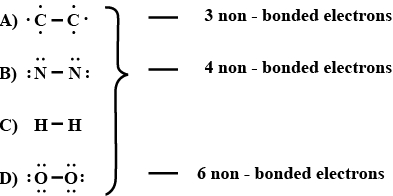
A
$C-C$
B
$N-N$
C
$H-H$
D
$O-O$
Solution
(D) The bond energy is inversely proportional to the extent of lone pair-lone pair repulsion between the bonded atoms.
As the number of lone pairs (non-bonded electrons) on the bonded atoms increases,the repulsion between them increases,which weakens the bond and decreases the bond energy.
Comparing the number of non-bonded electrons:
$C-C$ has $3+3 = 6$ non-bonded electrons (in the provided structure).
$N-N$ has $4+4 = 8$ non-bonded electrons (in the provided structure).
$H-H$ has $0$ non-bonded electrons.
$O-O$ has $6+6 = 12$ non-bonded electrons (in the provided structure).
Since the $O-O$ bond has the highest number of non-bonded electrons,the inter-electronic repulsion is maximum,making the $O-O$ bond the weakest with the lowest bond energy.
As the number of lone pairs (non-bonded electrons) on the bonded atoms increases,the repulsion between them increases,which weakens the bond and decreases the bond energy.
Comparing the number of non-bonded electrons:
$C-C$ has $3+3 = 6$ non-bonded electrons (in the provided structure).
$N-N$ has $4+4 = 8$ non-bonded electrons (in the provided structure).
$H-H$ has $0$ non-bonded electrons.
$O-O$ has $6+6 = 12$ non-bonded electrons (in the provided structure).
Since the $O-O$ bond has the highest number of non-bonded electrons,the inter-electronic repulsion is maximum,making the $O-O$ bond the weakest with the lowest bond energy.
0 likes
View Solution113
DifficultMCQ
$Mg_2C_3$ reacts with water to form propyne gas. The $C_3^{4-}$ ion has:
A
two sigma and two pi bonds
B
three sigma and one pi bond
C
two sigma and one pi bond
D
two sigma and three pi bonds
Solution
(A) $Mg_2C_3 + 4H_2O \longrightarrow 2Mg(OH)_2 + C_3H_4$ (Propyne)
The structure of the $C_3^{4-}$ ion is $[C \equiv C - C]^{4-}$.
In this structure,there is one triple bond (containing $1$ $\sigma$ and $2$ $\pi$ bonds) and one single bond (containing $1$ $\sigma$ bond).
Total bonds: $2$ $\sigma$ bonds and $2$ $\pi$ bonds.
The structure of the $C_3^{4-}$ ion is $[C \equiv C - C]^{4-}$.
In this structure,there is one triple bond (containing $1$ $\sigma$ and $2$ $\pi$ bonds) and one single bond (containing $1$ $\sigma$ bond).
Total bonds: $2$ $\sigma$ bonds and $2$ $\pi$ bonds.
0 likes
View Solution114
MediumMCQ
Which of the following is an electron deficient molecule?
A
$LiH$
B
$B_2H_6$
C
$LiBH_4$
D
$B_3N_3H_6$
Solution
(B) An electron-deficient molecule is one in which the central atom has fewer than $8$ electrons in its valence shell,or the total number of valence electrons is insufficient to form standard two-center two-electron $(2c-2e)$ bonds for all atoms.
In $B_2H_6$ (diborane),each boron atom is bonded to two terminal hydrogen atoms by normal $2c-2e$ covalent bonds. The two boron atoms are linked by two bridging hydrogen atoms,forming two $3c-2e$ (three-center two-electron) bonds. Because of these $3c-2e$ bonds,the molecule is electron-deficient.
$LiH$ is an ionic hydride,$LiBH_4$ contains the $BH_4^-$ ion (which is electron-precise),and $B_3N_3H_6$ (borazine) is an electron-precise molecule.
Therefore,option $B$ is correct.
In $B_2H_6$ (diborane),each boron atom is bonded to two terminal hydrogen atoms by normal $2c-2e$ covalent bonds. The two boron atoms are linked by two bridging hydrogen atoms,forming two $3c-2e$ (three-center two-electron) bonds. Because of these $3c-2e$ bonds,the molecule is electron-deficient.
$LiH$ is an ionic hydride,$LiBH_4$ contains the $BH_4^-$ ion (which is electron-precise),and $B_3N_3H_6$ (borazine) is an electron-precise molecule.
Therefore,option $B$ is correct.
0 likes
View Solution115
EasyMCQ
The bond dissociation energies of $F_2, Cl_2, Br_2$ and $I_2$ are $37, 58, 46$ and $36 \ kcal/mol$ respectively. Which of these has the strongest bond?
A
$Br_2$
B
$I_2$
C
$Cl_2$
D
$F_2$
Solution
(C) Bond strength is directly proportional to bond dissociation energy.
Since $Cl_2$ has the highest bond dissociation energy $(58 \ kcal/mol)$,it possesses the strongest bond.
Although $F_2$ is the smallest,the $F-F$ bond is weaker than the $Cl-Cl$ bond due to significant inter-electronic repulsion between the lone pairs of the small fluorine atoms.
Since $Cl_2$ has the highest bond dissociation energy $(58 \ kcal/mol)$,it possesses the strongest bond.
Although $F_2$ is the smallest,the $F-F$ bond is weaker than the $Cl-Cl$ bond due to significant inter-electronic repulsion between the lone pairs of the small fluorine atoms.
0 likes
View Solution116
MediumMCQ
Which of the following is the type of bonding in an $HCl$ molecule?
A
Pure covalent
B
Polar covalent
C
Highly polar
D
$H$-bonding
Solution
(B) The $HCl$ molecule exhibits polar covalent bonding.
This is due to the difference in electronegativity between the $H$ atom and the $Cl$ atom,which causes an unequal sharing of the bonding electron pair.
This is due to the difference in electronegativity between the $H$ atom and the $Cl$ atom,which causes an unequal sharing of the bonding electron pair.
0 likes
View Solution117
EasyMCQ
At $25\,^oC$,hydrogen chloride is:
A
Ionic and liquid.
B
Covalent and gas.
C
Ionic and gas.
D
None of the above.
Solution
(B) At $25\,^oC$,hydrogen chloride $(HCl)$ exists as a polar covalent gas.
0 likes
View Solution118
EasyMCQ
Which of the following has the strongest bond?
A
$F - F$
B
$F - Cl$
C
$F - Br$
D
$Cl - Br$
Solution
(A) The bond strength depends on the effective overlapping of orbitals.
In the $F - F$ bond,there is an effective overlapping between the $2p - 2p$ orbitals of similar energy.
Although the $F - F$ bond is weakened by inter-electronic repulsion due to the small size of the fluorine atom,it is generally considered stronger than the other interhalogen bonds listed here due to the effective $2p - 2p$ overlap compared to $2p - 3p$ or $3p - 4p$ overlaps.
In the $F - F$ bond,there is an effective overlapping between the $2p - 2p$ orbitals of similar energy.
Although the $F - F$ bond is weakened by inter-electronic repulsion due to the small size of the fluorine atom,it is generally considered stronger than the other interhalogen bonds listed here due to the effective $2p - 2p$ overlap compared to $2p - 3p$ or $3p - 4p$ overlaps.
0 likes
View Solution119
MediumMCQ
$P\pi - P\pi$ bonding occurs between oxygen and
A
Phosphorus in $P_4O_{10}$
B
Nitrogen in $N_2O_5$
C
Chlorine in $HClO_4$
D
Anionic part of solid $Cl_2O_6$
Solution
(B) $P\pi - P\pi$ bonding involves the overlap of $2p$ orbitals of oxygen with the $2p$ orbitals of another atom.
In $P_4O_{10}$,phosphorus uses $3d$ orbitals for $d\pi - p\pi$ bonding.
In $N_2O_5$,nitrogen uses $2p$ orbitals,but the structure involves $p\pi - p\pi$ bonding between $N$ and $O$.
However,specifically in the context of $P\pi - P\pi$ bonding,it refers to the overlap of $2p$ orbitals of both atoms.
In $N_2O_5$,the $N$ atom $(2p)$ and $O$ atom $(2p)$ form $p\pi - p\pi$ bonds.
Therefore,the correct option is $B$.
In $P_4O_{10}$,phosphorus uses $3d$ orbitals for $d\pi - p\pi$ bonding.
In $N_2O_5$,nitrogen uses $2p$ orbitals,but the structure involves $p\pi - p\pi$ bonding between $N$ and $O$.
However,specifically in the context of $P\pi - P\pi$ bonding,it refers to the overlap of $2p$ orbitals of both atoms.
In $N_2O_5$,the $N$ atom $(2p)$ and $O$ atom $(2p)$ form $p\pi - p\pi$ bonds.
Therefore,the correct option is $B$.
0 likes
View Solution120
MediumMCQ
The electronic configuration of three elements $A$,$B$ and $C$ are given below. Stable form of $C$ may be represented by the formula
$A : 1s^2, 2s^2, 2p^6$
$B : 1s^2, 2s^2, 2p^6, 3s^2, 3p^3$
$C : 1s^2, 2s^2, 2p^6, 3s^2, 3p^5$
$A : 1s^2, 2s^2, 2p^6$
$B : 1s^2, 2s^2, 2p^6, 3s^2, 3p^3$
$C : 1s^2, 2s^2, 2p^6, 3s^2, 3p^5$
A
$C$
B
$C_2$
C
$C_3$
D
$C_4$
Solution
(B) Element $C$ has the electronic configuration $1s^2, 2s^2, 2p^6, 3s^2, 3p^5$,which corresponds to Chlorine $(Cl)$.
Chlorine is a halogen with $7$ valence electrons and requires $1$ electron to complete its octet.
Therefore,two Chlorine atoms share one electron each to form a stable diatomic molecule,$Cl_2$ (or $C_2$ in this context).
The molecular orbital configuration for $C_2$ (if $C$ were Carbon) would be $KK [\sigma_{2s}]^2 [\sigma_{2s}^*]^2 [\pi_{2px}]^2 [\pi_{2py}]^2$,but here $C$ represents a halogen,so it forms a stable diatomic molecule $C_2$.
Chlorine is a halogen with $7$ valence electrons and requires $1$ electron to complete its octet.
Therefore,two Chlorine atoms share one electron each to form a stable diatomic molecule,$Cl_2$ (or $C_2$ in this context).
The molecular orbital configuration for $C_2$ (if $C$ were Carbon) would be $KK [\sigma_{2s}]^2 [\sigma_{2s}^*]^2 [\pi_{2px}]^2 [\pi_{2py}]^2$,but here $C$ represents a halogen,so it forms a stable diatomic molecule $C_2$.
0 likes
View Solution121
MediumMCQ
The electronic configuration of three elements $A$,$B$,and $C$ are given below. The bond between $B$ and $C$ will be:
$A: 1s^2, 2s^2, 2p^6$
$B: 1s^2, 2s^2, 2p^6, 3s^2, 3p^3$
$C: 1s^2, 2s^2, 2p^6, 3s^2, 3p^5$
$A: 1s^2, 2s^2, 2p^6$
$B: 1s^2, 2s^2, 2p^6, 3s^2, 3p^3$
$C: 1s^2, 2s^2, 2p^6, 3s^2, 3p^5$
A
Ionic Bond
B
Covalent Bond
C
Hydrogen Bond
D
Coordinate Bond
Solution
(B) Element $B$ has the valence shell configuration $3s^2, 3p^3$,which means it has $5$ valence electrons. It needs $3$ electrons to complete its octet.
Element $C$ has the valence shell configuration $3s^2, 3p^5$,which means it has $7$ valence electrons. It needs $1$ electron to complete its octet.
Both $B$ and $C$ are non-metals. When two non-metals combine,they share electrons to complete their octets,resulting in the formation of a covalent bond.
Therefore,the bond between $B$ and $C$ will be a covalent bond.
Element $C$ has the valence shell configuration $3s^2, 3p^5$,which means it has $7$ valence electrons. It needs $1$ electron to complete its octet.
Both $B$ and $C$ are non-metals. When two non-metals combine,they share electrons to complete their octets,resulting in the formation of a covalent bond.
Therefore,the bond between $B$ and $C$ will be a covalent bond.
0 likes
View Solution122
MediumMCQ
Compare $\pi$-bond strength between $B$ and $N$ in the following compounds:
$(I)$ $((CH_3)_3Si)_2N-BH_2$
$(II)$ $((CH_3)_3C)_2N-BH_2$
$(I)$ $((CH_3)_3Si)_2N-BH_2$
$(II)$ $((CH_3)_3C)_2N-BH_2$
A
There is no $\pi$-bond character between $B$ and $N$
B
Same in $I$ and $II$
C
$I > II$
D
$II > I$
Solution
(D) In compound $(I)$,the lone pair of nitrogen is involved in $p\pi-d\pi$ back-bonding with the empty $d$-orbitals of silicon.
This reduces the availability of the lone pair for $p\pi-p\pi$ back-bonding with boron.
In compound $(II)$,carbon has no empty $d$-orbitals,so the lone pair of nitrogen is fully available for $p\pi-p\pi$ back-bonding with boron.
Therefore,the $\pi$-bond strength between $B$ and $N$ is greater in $(II)$ than in $(I)$.
This reduces the availability of the lone pair for $p\pi-p\pi$ back-bonding with boron.
In compound $(II)$,carbon has no empty $d$-orbitals,so the lone pair of nitrogen is fully available for $p\pi-p\pi$ back-bonding with boron.
Therefore,the $\pi$-bond strength between $B$ and $N$ is greater in $(II)$ than in $(I)$.
0 likes
View Solution123
AdvancedMCQ
In which of the following species $p\pi - d\pi$ bond is present but $p\pi - p\pi$ bond is absent?
A
$SiH_4$
B
$CS_2$
C
$SO_2$
D
$SO_2Cl_2$
Solution
(D) In $SO_2Cl_2$,the central $S$ atom is $sp^3$ hybridized.
It forms two $S-Cl$ sigma bonds and two $S=O$ double bonds.
Each $S=O$ bond consists of one $\sigma$ bond (formed by $p-p$ overlap) and one $p\pi - d\pi$ back-bonding (formed by the overlap of the filled $2p$ orbital of $O$ and the empty $3d$ orbital of $S$).
Since there are no $p\pi - p\pi$ bonds (which would require $p-p$ overlap for $\pi$ bonding),the correct answer is $SO_2Cl_2$.
It forms two $S-Cl$ sigma bonds and two $S=O$ double bonds.
Each $S=O$ bond consists of one $\sigma$ bond (formed by $p-p$ overlap) and one $p\pi - d\pi$ back-bonding (formed by the overlap of the filled $2p$ orbital of $O$ and the empty $3d$ orbital of $S$).
Since there are no $p\pi - p\pi$ bonds (which would require $p-p$ overlap for $\pi$ bonding),the correct answer is $SO_2Cl_2$.
0 likes
View Solution124
MediumMCQ
In which of the following does the central atom not follow the octet rule?
A
$CO_2$
B
$BF_3$
C
$H_2O$
D
$PCl_3$
Solution
(B) The octet rule states that atoms tend to gain,lose,or share electrons to achieve a stable configuration of $8$ electrons in their valence shell.
In $BF_3$,the central Boron atom has $3$ valence electrons and forms $3$ covalent bonds with Fluorine atoms.
This results in a total of $3 \times 2 = 6$ electrons around the Boron atom.
Since $6 < 8$,$BF_3$ is an electron-deficient molecule and does not follow the octet rule.
In $CO_2$,$H_2O$,and $PCl_3$,the central atoms ($C$,$O$,and $P$ respectively) satisfy the octet rule.
In $BF_3$,the central Boron atom has $3$ valence electrons and forms $3$ covalent bonds with Fluorine atoms.
This results in a total of $3 \times 2 = 6$ electrons around the Boron atom.
Since $6 < 8$,$BF_3$ is an electron-deficient molecule and does not follow the octet rule.
In $CO_2$,$H_2O$,and $PCl_3$,the central atoms ($C$,$O$,and $P$ respectively) satisfy the octet rule.
0 likes
View Solution125
EasyMCQ
In a covalent bond,....................
A
electrons are transferred
B
electrons are shared
C
electrons are shared by only one atom
D
none of the above
Solution
(B) covalent bond is formed by the mutual sharing of electrons between two atoms to achieve a stable electronic configuration (usually an octet).
Therefore,in a covalent bond,electrons are shared between the participating atoms.
Therefore,in a covalent bond,electrons are shared between the participating atoms.
0 likes
View Solution126
MediumMCQ
The electronic configurations of four elements are given below:
$(I) \, 1s^2 \, (II) \, 1s^2 2s^2 2p^2 \, (III) \, 1s^2 2s^2 2p^5 \, (IV) \, 1s^2 2s^2 2p^6$
Which element has the ability to form both ionic and covalent bonds?
$(I) \, 1s^2 \, (II) \, 1s^2 2s^2 2p^2 \, (III) \, 1s^2 2s^2 2p^5 \, (IV) \, 1s^2 2s^2 2p^6$
Which element has the ability to form both ionic and covalent bonds?
A
$I$
B
$II$
C
$III$
D
$IV$
Solution
(C) The electronic configurations are:
$(I) \, 1s^2$: Helium $(He)$,a noble gas,inert.
$(II) \, 1s^2 2s^2 2p^2$: Carbon $(C)$,which has $4$ valence electrons. It primarily forms covalent bonds but can form carbides (ionic) with electropositive metals.
$(III) \, 1s^2 2s^2 2p^5$: Fluorine $(F)$,which has $7$ valence electrons. It forms ionic bonds with metals and covalent bonds with non-metals.
$(IV) \, 1s^2 2s^2 2p^6$: Neon $(Ne)$,a noble gas,inert.
Between $II$ and $III$,$III$ (Fluorine) is the most electronegative element and is well-known for forming strong ionic bonds with metals and covalent bonds with non-metals. However,in the context of typical chemistry curriculum questions regarding the ability to form both,$III$ is the standard answer.
$(I) \, 1s^2$: Helium $(He)$,a noble gas,inert.
$(II) \, 1s^2 2s^2 2p^2$: Carbon $(C)$,which has $4$ valence electrons. It primarily forms covalent bonds but can form carbides (ionic) with electropositive metals.
$(III) \, 1s^2 2s^2 2p^5$: Fluorine $(F)$,which has $7$ valence electrons. It forms ionic bonds with metals and covalent bonds with non-metals.
$(IV) \, 1s^2 2s^2 2p^6$: Neon $(Ne)$,a noble gas,inert.
Between $II$ and $III$,$III$ (Fluorine) is the most electronegative element and is well-known for forming strong ionic bonds with metals and covalent bonds with non-metals. However,in the context of typical chemistry curriculum questions regarding the ability to form both,$III$ is the standard answer.
0 likes
View Solution127
MediumMCQ
According to recent research,carbon suboxide $(C_3O_2)$ is a component of the atmosphere of Mercury. What is the Lewis structure of carbon suboxide in its ground state?
A
$:O:C::C::C:O:$
B
$:O::C::C::C::O:$
C
$:O::C::C::C::O:$
D
$:O:C:C:C:O:$
Solution
(B) The chemical formula of carbon suboxide is $C_3O_2$.
To determine the Lewis structure,we calculate the total number of valence electrons: $3 \times 4 (C) + 2 \times 6 (O) = 12 + 12 = 24$ electrons.
The structure must satisfy the octet rule for all atoms.
The linear arrangement is $O=C=C=C=O$.
Counting the electrons in this structure: Each double bond represents $4$ electrons.
There are $4$ double bonds,so $4 \times 4 = 16$ electrons.
Each oxygen atom has $2$ lone pairs ($4$ electrons),so $2 \times 4 = 8$ electrons.
Total electrons = $16 + 8 = 24$ electrons.
This matches the total valence electrons,confirming the structure is $O=C=C=C=O$,which corresponds to option $B$.
To determine the Lewis structure,we calculate the total number of valence electrons: $3 \times 4 (C) + 2 \times 6 (O) = 12 + 12 = 24$ electrons.
The structure must satisfy the octet rule for all atoms.
The linear arrangement is $O=C=C=C=O$.
Counting the electrons in this structure: Each double bond represents $4$ electrons.
There are $4$ double bonds,so $4 \times 4 = 16$ electrons.
Each oxygen atom has $2$ lone pairs ($4$ electrons),so $2 \times 4 = 8$ electrons.
Total electrons = $16 + 8 = 24$ electrons.
This matches the total valence electrons,confirming the structure is $O=C=C=C=O$,which corresponds to option $B$.
0 likes
View Solution128
EasyMCQ
Covalent compounds are soluble in ..............
A
Non-polar solvents
B
Polar solvents
C
Concentrated acids
D
All solvents
Solution
(A) Covalent compounds are generally non-polar in nature. According to the principle of 'like dissolves like',non-polar substances dissolve in non-polar solvents (such as benzene,carbon tetrachloride,etc.). Therefore,covalent compounds are soluble in non-polar solvents.
0 likes
View Solution129
EasyMCQ
The bond between two identical non-metallic atoms contains electrons that are:
A
unequally shared between the two
B
completely transferred from one atom to another
C
having the same spin
D
equally shared between them
Solution
(D) When two identical non-metallic atoms form a covalent bond,they have the same electronegativity.
Therefore,the shared pair of electrons is attracted equally by both nuclei.
This results in an equal sharing of electrons between the two atoms.
Therefore,the shared pair of electrons is attracted equally by both nuclei.
This results in an equal sharing of electrons between the two atoms.
0 likes
View Solution130
EasyMCQ
The number of electrons shared by each $N$ atom in the $N_2$ molecule is ...........
A
$2$
B
$1$
C
$3$
D
$4$
Solution
(C) In an $N_2$ molecule,each nitrogen atom has $5$ valence electrons. To complete its octet,each nitrogen atom needs $3$ more electrons. Therefore,each nitrogen atom shares $3$ electrons with the other to form a triple covalent bond $(N \equiv N)$. Thus,the number of electrons shared by each $N$ atom is $3$.
0 likes
View Solution131
MediumMCQ
Which of the following contains both polar and non-polar bonds?
A
$NH_4Cl$
B
$HCN$
C
$H_2O_2$
D
$CH_4$
Solution
(C) In $H_2O_2$ (Hydrogen peroxide),the structure is $H-O-O-H$.
The $O-H$ bond is a polar covalent bond due to the electronegativity difference between $O$ and $H$.
The $O-O$ bond is a non-polar covalent bond because the electronegativity difference between two identical oxygen atoms is zero.
Therefore,$H_2O_2$ contains both polar and non-polar bonds.
The $O-H$ bond is a polar covalent bond due to the electronegativity difference between $O$ and $H$.
The $O-O$ bond is a non-polar covalent bond because the electronegativity difference between two identical oxygen atoms is zero.
Therefore,$H_2O_2$ contains both polar and non-polar bonds.
0 likes
View Solution132
EasyMCQ
The linear combination of atomic orbitals of two different atoms,each containing one electron,forms a ............ .
A
$\sigma$-bond
B
$\pi$-bond
C
Double bond
D
Coordinate covalent bond
Solution
(A) When two atomic orbitals,each containing one unpaired electron,overlap linearly (head-on),they form a $\sigma$-bond. This is the fundamental concept of Valence Bond Theory $(VBT)$ for the formation of covalent bonds.
0 likes
View Solution133
MediumMCQ
When two atoms of an element with electrons having the same spin approach each other for bonding,which of the following phenomena occurs?
A
Orbitals do not overlap
B
Bonding does not occur
C
Both $a$ and $b$ are correct
D
All of the above are incorrect
Solution
(C) According to the Pauli Exclusion Principle and the valence bond theory,for a stable covalent bond to form,the electrons in the overlapping orbitals must have opposite spins. If the electrons have the same spin,the Pauli Exclusion Principle prevents them from occupying the same region of space with the same quantum numbers. Consequently,the orbitals do not overlap effectively,and no chemical bond is formed. Therefore,both statements $a$ and $b$ are correct.
0 likes
View Solution134
MediumMCQ
Which of the following contains $p \pi - d \pi$ bonding?
A
$NO_3^-$
B
$SO_3^{2-}$
C
$BO_3^{3-}$
D
$CO_3^{2-}$
Solution
(B) In $SO_3^{2-}$ (sulfite ion),the central sulfur atom has an oxidation state of $+4$ and its valence shell configuration is $3s^2 3p^4$.
Sulfur forms three $S-O$ sigma bonds using $sp^3$ hybridization.
One lone pair is present on sulfur.
The remaining $3d$ orbitals of sulfur overlap with the $2p$ orbitals of oxygen to form $p \pi - d \pi$ bonds.
In $NO_3^-$,$BO_3^{3-}$,and $CO_3^{2-}$,the central atoms $(N, B, C)$ belong to the second period and do not have $d$-orbitals available for bonding,so they only exhibit $p \pi - p \pi$ bonding.
Sulfur forms three $S-O$ sigma bonds using $sp^3$ hybridization.
One lone pair is present on sulfur.
The remaining $3d$ orbitals of sulfur overlap with the $2p$ orbitals of oxygen to form $p \pi - d \pi$ bonds.
In $NO_3^-$,$BO_3^{3-}$,and $CO_3^{2-}$,the central atoms $(N, B, C)$ belong to the second period and do not have $d$-orbitals available for bonding,so they only exhibit $p \pi - p \pi$ bonding.
0 likes
View Solution135
MediumMCQ
Which of the following is a non-polar bond?
A
$C-H$
B
$N-H$
C
$F-F$
D
$O-H$
Solution
(C) bond is considered non-polar if there is no electronegativity difference between the bonded atoms.
In the bonds $C-H$,$N-H$,and $O-H$,there is a significant electronegativity difference between the two different atoms,making these bonds polar.
In the case of $F-F$,two identical atoms are bonded together. Therefore,the electronegativity difference is zero,making the $F-F$ bond non-polar.
In the bonds $C-H$,$N-H$,and $O-H$,there is a significant electronegativity difference between the two different atoms,making these bonds polar.
In the case of $F-F$,two identical atoms are bonded together. Therefore,the electronegativity difference is zero,making the $F-F$ bond non-polar.
0 likes
View Solution136
DifficultMCQ
The $X-X$ bond length is $1.00 \mathring{A}$ and $C-C$ bond length is $1.54 \mathring{A}$. If $EN$ of $X$ and $C$ are $3.0$ and $2.0$ respectively,the $C-X$ bond length is likely to be ............ $\mathring{A}$.
A
$1.27$
B
$1.38$
C
$1.18$
D
$1.08$
Solution
(C) The covalent radii are calculated as $r_X = \frac{1.00}{2} = 0.50 \mathring{A}$ and $r_C = \frac{1.54}{2} = 0.77 \mathring{A}$.
Using the Schomaker-Stevenson equation for bond length: $d_{C-X} = r_C + r_X - 0.09 |\chi_C - \chi_X|$.
Substituting the values: $d_{C-X} = 0.77 + 0.50 - 0.09 |2.0 - 3.0|$.
$d_{C-X} = 1.27 - 0.09(1) = 1.18 \mathring{A}$.
Using the Schomaker-Stevenson equation for bond length: $d_{C-X} = r_C + r_X - 0.09 |\chi_C - \chi_X|$.
Substituting the values: $d_{C-X} = 0.77 + 0.50 - 0.09 |2.0 - 3.0|$.
$d_{C-X} = 1.27 - 0.09(1) = 1.18 \mathring{A}$.
0 likes
View Solution137
MediumMCQ
The molecule having the highest bond energy among the following is:
A
$N-N$
B
$F-F$
C
$C-C$
D
$O-O$
Solution
(C) The bond energy depends on the strength of the bond between atoms. In the given molecules ($N-N$,$F-F$,$C-C$,$O-O$),all are connected by single bonds.
$1$. In $F-F$,$O-O$,and $N-N$,the atoms possess lone pairs of electrons. These lone pairs cause significant inter-electronic repulsion,which increases the bond length and decreases the bond dissociation energy.
$2$. Carbon atoms in $C-C$ do not have lone pairs,resulting in less repulsion and a stronger,more stable bond compared to the others.
Therefore,the molecule with the highest bond energy is $C-C$.
$1$. In $F-F$,$O-O$,and $N-N$,the atoms possess lone pairs of electrons. These lone pairs cause significant inter-electronic repulsion,which increases the bond length and decreases the bond dissociation energy.
$2$. Carbon atoms in $C-C$ do not have lone pairs,resulting in less repulsion and a stronger,more stable bond compared to the others.
Therefore,the molecule with the highest bond energy is $C-C$.
0 likes
View Solution138
DifficultMCQ
Which of the following compounds is not matched correctly with its structure?
A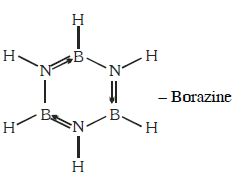
B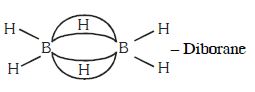
C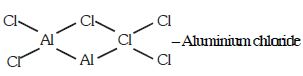
D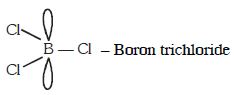
Solution
(D) In option $C$,the structure shown is for the dimer $Al_2Cl_6$. However,the label provided is 'Aluminium chloride' $(AlCl_3)$,which exists as a monomer in the gas phase at high temperatures but as a dimer in the solid state. The structure shown is specifically the dimer.
In option $D$,the structure for $BCl_3$ is shown with lone pairs on the Boron atom,which is incorrect. $BCl_3$ is a trigonal planar molecule with $sp^2$ hybridization on the Boron atom and no lone pair on the Boron atom. The Chlorine atoms have lone pairs,but the Boron atom is electron-deficient. Therefore,option $D$ is the most incorrectly matched structure.
In option $D$,the structure for $BCl_3$ is shown with lone pairs on the Boron atom,which is incorrect. $BCl_3$ is a trigonal planar molecule with $sp^2$ hybridization on the Boron atom and no lone pair on the Boron atom. The Chlorine atoms have lone pairs,but the Boron atom is electron-deficient. Therefore,option $D$ is the most incorrectly matched structure.
0 likes
View Solution139
DifficultMCQ
Identify the type of bonding present in the solid crystal of carborundum $(SiC)$.
A
Metallic bond
B
Ionic bond
C
Covalent bond
D
Van der Waals forces
Solution
(C) Carborundum is silicon carbide $(SiC)$.
In $SiC$,each silicon atom is bonded to four carbon atoms and each carbon atom is bonded to four silicon atoms through strong covalent bonds.
This forms a giant three-dimensional network structure similar to diamond.
Therefore,the type of bonding present is a covalent bond.
In $SiC$,each silicon atom is bonded to four carbon atoms and each carbon atom is bonded to four silicon atoms through strong covalent bonds.
This forms a giant three-dimensional network structure similar to diamond.
Therefore,the type of bonding present is a covalent bond.
0 likes
View Solution140
EasyMCQ
Identify the Lewis acid from the following.
A
$NaCl$
B
$AlCl_3$
C
$NH_2^-$
D
$F^-$
Solution
(B) Lewis acid is defined as an electron pair acceptor.
$AlCl_3$ is an electron-deficient compound because the central $Al$ atom has only $6$ electrons in its valence shell.
Therefore,it can accept a lone pair of electrons to complete its octet,making it a Lewis acid.
$NaCl$ is an ionic salt,while $NH_2^-$ and $F^-$ are Lewis bases because they have lone pairs of electrons to donate.
$AlCl_3$ is an electron-deficient compound because the central $Al$ atom has only $6$ electrons in its valence shell.
Therefore,it can accept a lone pair of electrons to complete its octet,making it a Lewis acid.
$NaCl$ is an ionic salt,while $NH_2^-$ and $F^-$ are Lewis bases because they have lone pairs of electrons to donate.
0 likes
View Solution141
MediumMCQ
$AlCl_3$ is ...
A
Anhydrous and covalent.
B
Anhydrous and ionic.
C
Covalent and basic.
D
Coordinate and acidic.
Solution
(A) $AlCl_3$ is an electron-deficient compound because the $Al$ atom has only $6$ electrons in its valence shell.
Due to this,it acts as a Lewis acid.
In its anhydrous form,$AlCl_3$ exists as a dimer $Al_2Cl_6$ with covalent bonds,where chlorine atoms act as bridges.
Therefore,$AlCl_3$ is anhydrous and covalent.
Due to this,it acts as a Lewis acid.
In its anhydrous form,$AlCl_3$ exists as a dimer $Al_2Cl_6$ with covalent bonds,where chlorine atoms act as bridges.
Therefore,$AlCl_3$ is anhydrous and covalent.
0 likes
View Solution142
MediumMCQ
Which of the following molecules is electron-deficient?
A
$C_2H_6$
B
$SiH_4$
C
$PH_3$
D
$B_2H_6$
Solution
(D) An electron-deficient molecule is one in which the central atom has fewer than $8$ electrons in its valence shell,or the molecule has fewer electrons than required for conventional Lewis structures.
In $B_2H_6$ (diborane),each Boron atom is bonded to three terminal Hydrogen atoms and two bridging Hydrogen atoms.
Each Boron atom has only $6$ valence electrons in its bonding environment,making it an electron-deficient molecule (often referred to as a $3$-center-$2$-electron bond system).
$C_2H_6$,$SiH_4$,and $PH_3$ all follow the octet rule for their central atoms.
In $B_2H_6$ (diborane),each Boron atom is bonded to three terminal Hydrogen atoms and two bridging Hydrogen atoms.
Each Boron atom has only $6$ valence electrons in its bonding environment,making it an electron-deficient molecule (often referred to as a $3$-center-$2$-electron bond system).
$C_2H_6$,$SiH_4$,and $PH_3$ all follow the octet rule for their central atoms.
0 likes
View Solution143
MediumMCQ
Which of the following statements is incorrect regarding the $B-F$ bond in $BF_3$?
A
All three $B-F$ bond lengths are equal and each is shorter than the sum of the covalent radii of boron and fluorine.
B
The bond energy of the $B-F$ bond is very high,which is higher than the bond energy of any other single bond.
C
The unusual shortness and strength of the $B-F$ bond can be explained by $p\pi - p\pi$ interaction between boron and fluorine.
D
The unusual shortness and strength of the $B-F$ bond can be explained by $p\pi - d\pi$ interaction between boron and fluorine.
Solution
(D) In $BF_3$,boron is $sp^2$ hybridized and the molecule is planar.
Due to the vacant $2p$ orbital on the boron atom and the filled $2p$ orbitals on the fluorine atoms,there is a $p\pi - p\pi$ back-bonding (back-donation) from $F$ to $B$.
This gives the $B-F$ bond partial double bond character,making it shorter and stronger than a typical single bond.
Therefore,the statement that it is explained by $p\pi - d\pi$ interaction is incorrect,as boron does not have $d$-orbitals.
Due to the vacant $2p$ orbital on the boron atom and the filled $2p$ orbitals on the fluorine atoms,there is a $p\pi - p\pi$ back-bonding (back-donation) from $F$ to $B$.
This gives the $B-F$ bond partial double bond character,making it shorter and stronger than a typical single bond.
Therefore,the statement that it is explained by $p\pi - d\pi$ interaction is incorrect,as boron does not have $d$-orbitals.
0 likes
View Solution144
MediumMCQ
$BCl_3$ does not exist as a dimer,whereas $BH_3$ exists as a dimer $(B_2H_6)$,because -
A
Chlorine is more electronegative than hydrogen.
B
$BCl_3$ has $p\pi - p\pi$ back bonding,but $BH_3$ does not have such multiple bonding.
C
Large chlorine atoms do not fit between small boron atoms,while small hydrogen atoms fit between boron atoms.
D
None of these.
Solution
(B) In $BCl_3$,the boron atom has an incomplete octet. The lone pair of electrons on the chlorine atom is donated to the vacant $p$-orbital of the boron atom,resulting in $p\pi - p\pi$ back bonding. This stabilizes the molecule and satisfies the octet of boron,preventing dimerization. In $BH_3$,hydrogen does not have a lone pair to participate in back bonding,so $BH_3$ dimerizes to form $B_2H_6$ to complete the octet of boron.
0 likes
View Solution145
EasyMCQ
Which of the following forces hold the carbon atoms together in diamond?
A
Ionic
B
Covalent
C
Dipolar
D
Van der Waals
Solution
(B) In diamond,each carbon atom is $sp^3$ hybridized and is bonded to four other carbon atoms through strong $C-C$ covalent bonds. This creates a rigid,three-dimensional network structure,which is responsible for the hardness of diamond. Therefore,the correct option is $B$.
0 likes
View Solution146
MediumMCQ
In carbon monoxide $(CO)$,how are the carbon and oxygen atoms bonded?
A
Only by $\sigma$ bonds
B
Only by $\pi$ bonds
C
By $\sigma$ and $\pi$ bonds
D
Neither by $\sigma$ nor $\pi$ bonds
Solution
(C) The Lewis structure of carbon monoxide $(CO)$ consists of a triple bond between the carbon and oxygen atoms.
This triple bond is composed of one $\sigma$ bond and two $\pi$ bonds.
Therefore,the atoms are bonded by both $\sigma$ and $\pi$ bonds.
This triple bond is composed of one $\sigma$ bond and two $\pi$ bonds.
Therefore,the atoms are bonded by both $\sigma$ and $\pi$ bonds.
0 likes
View Solution147
MediumMCQ
Which of the following has the maximum bond dissociation enthalpy?
A
$O-O$
B
$C-C$
C
$N-N$
D
$F-F$
Solution
(B) The bond dissociation enthalpy depends on the size of the atoms and the lone pair-lone pair repulsion.
For $O-O$,$N-N$,and $F-F$,the atoms are small and have lone pairs that cause significant inter-electronic repulsion,weakening the bond.
$C-C$ is a single covalent bond between carbon atoms which does not suffer from such lone pair repulsion.
Therefore,the $C-C$ bond has a higher bond dissociation enthalpy compared to the others listed.
For $O-O$,$N-N$,and $F-F$,the atoms are small and have lone pairs that cause significant inter-electronic repulsion,weakening the bond.
$C-C$ is a single covalent bond between carbon atoms which does not suffer from such lone pair repulsion.
Therefore,the $C-C$ bond has a higher bond dissociation enthalpy compared to the others listed.
0 likes
View Solution148
MediumMCQ
The $B-F$ bond dissociation energy in $BF_3$ is $646 \ kJ \ mol^{-1}$,whereas the $C-F$ bond dissociation energy in $CF_4$ is $515 \ kJ \ mol^{-1}$. Which of the following is the correct reason for the $B-F$ bond dissociation energy being higher than the $C-F$ bond dissociation energy?
A
Smaller size of $B$ atom compared to $C$ atom.
B
Stronger bond between $B$ and $F$ in $BF_3$ compared to the weaker bond between $C$ and $F$ in $CF_4$.
C
Presence of $p\pi - p\pi$ back-bonding between $B$ and $F$ in $BF_3$,which is not possible between $C$ and $F$ in $CF_4$.
D
Less interaction between $C$ and $F$ in $CF_4$ compared to the $p\pi - p\pi$ interaction between $B$ and $F$ in $BF_3$.
Solution
(C) In $BF_3$,the Boron atom is electron-deficient and has an empty $2p$ orbital. The Fluorine atom has lone pairs in its $2p$ orbitals.
This allows for $p\pi - p\pi$ back-bonding (donation of electron density from $F$ to $B$),which imparts partial double bond character to the $B-F$ bond.
This additional bond character increases the bond strength and consequently the bond dissociation energy.
In $CF_4$,Carbon has a complete octet and no empty $p$ orbitals,so no such back-bonding occurs.
Therefore,the $B-F$ bond is stronger than the $C-F$ bond.
This allows for $p\pi - p\pi$ back-bonding (donation of electron density from $F$ to $B$),which imparts partial double bond character to the $B-F$ bond.
This additional bond character increases the bond strength and consequently the bond dissociation energy.
In $CF_4$,Carbon has a complete octet and no empty $p$ orbitals,so no such back-bonding occurs.
Therefore,the $B-F$ bond is stronger than the $C-F$ bond.
0 likes
View Solution149
MediumMCQ
Which of the following has the least covalent $P-H$ bond?
A
$PH_3$
B
$P_2H_6^{2+}$
C
$P_2H_5^+$
D
$PH_4^+$
Solution
(D) The covalent character of a bond is related to the electronegativity difference and the formal charge on the atoms involved.
In $PH_4^+$,the phosphorus atom carries a positive charge.
$A$ positive charge on an atom increases its electronegativity,which decreases the electronegativity difference between $P$ and $H$.
However,the $P-H$ bond in $PH_4^+$ is more ionic in character compared to $PH_3$ due to the formal charge,making it the least covalent among the given options.
In $PH_4^+$,the phosphorus atom carries a positive charge.
$A$ positive charge on an atom increases its electronegativity,which decreases the electronegativity difference between $P$ and $H$.
However,the $P-H$ bond in $PH_4^+$ is more ionic in character compared to $PH_3$ due to the formal charge,making it the least covalent among the given options.
0 likes
View Solution150
MediumMCQ
During the formation of $N_2O_4$ from $NO_2$,the odd electrons on two $NO_2$ molecules pair up to form ............
A
a weak $N-N$ bond,two equal $N-O$ bonds,and two other unequal $N-O$ bonds.
B
a weak $N-N$ bond and four equal $N-O$ bonds.
C
a weak $N-N$ bond and four unequal $N-O$ bonds.
D
a strong $N-N$ bond and four equal $N-O$ bonds.
Solution
(B) The $NO_2$ molecule is an odd electron species with a paramagnetic character due to the presence of an unpaired electron on the nitrogen atom.
When two $NO_2$ molecules combine to form $N_2O_4$,the unpaired electrons on the nitrogen atoms of each $NO_2$ molecule pair up to form a $N-N$ single bond.
This $N-N$ bond is relatively weak due to the repulsion between the lone pairs on the oxygen atoms.
In the $N_2O_4$ structure,the four $N-O$ bonds are equivalent due to resonance,resulting in a planar structure.
When two $NO_2$ molecules combine to form $N_2O_4$,the unpaired electrons on the nitrogen atoms of each $NO_2$ molecule pair up to form a $N-N$ single bond.
This $N-N$ bond is relatively weak due to the repulsion between the lone pairs on the oxygen atoms.
In the $N_2O_4$ structure,the four $N-O$ bonds are equivalent due to resonance,resulting in a planar structure.
0 likes
View SolutionChemical Bonding and Molecular Structure — Covalent bonding · Frequently Asked Questions
1Are these Chemical Bonding and Molecular Structure questions useful for JEE and NEET?
Yes. All questions in this section are mapped to JEE Main and NEET exam patterns. Previous year questions from JEE Main, NEET, GUJCET and state-level exams are included with full solutions.
2Can I switch to Hindi or Gujarati for these questions?
Yes. Use the language tabs in the hero section or the sidebar to view the same questions and solutions in English, Hindi or Gujarati.
3How do I generate a question paper from this subtopic?
Use the Vedclass Exam Paper Generator — select the chapter and subtopic, set difficulty, and generate Sets A, B, C, D automatically. First 3 chapters of every subject are free.
Vedclass Products
For Students
Vedclass Test Series
Mock tests in real JEE/NEET style with performance analysis. 5-day free trial.
Start Free TrialFor Teachers
Exam Paper Generator
Generate Set A/B/C/D papers from this chapter in 2 minutes. 3 chapters free.
Try FreeFor Institutes
Online Exam Module
Live online exams with unlimited students, 360° analytics & white-label branding.
See DemoFor Teachers & Institutes
Generate a Chemical Bonding and Molecular Structure Exam Paper in 2 Minutes
Select subtopic & difficulty — Sets A, B, C, D auto-generated with No Repeat logic.
First 3 chapters of every subject are free — no payment required.