
A English
Purification of Organic Compounds Questions in English
Class 11 Chemistry · 8-3.Organic Chemistry : Purification and characterization · Purification of Organic Compounds
188+
Questions
English
Language
100%
With Solutions
Showing 50 of 188 questions in English
51
Medium
What is meant by the term "chromatography"?
Solution
(N/A) Chromatography is a collective term used for a family of laboratory techniques for the separation of mixtures.
The term is derived from Greek words 'chroma' meaning 'colour' and 'graphein' meaning 'to write'.
Chromatographic techniques are based on the principle that different components of a mixture are adsorbed to different extents on a stationary phase.
There are several chromatographic techniques such as paper chromatography,column chromatography,gas chromatography,etc.
The term is derived from Greek words 'chroma' meaning 'colour' and 'graphein' meaning 'to write'.
Chromatographic techniques are based on the principle that different components of a mixture are adsorbed to different extents on a stationary phase.
There are several chromatographic techniques such as paper chromatography,column chromatography,gas chromatography,etc.
0 likes
View Solution52
EasyMCQ
What criterion is followed for the selection of the stationary phase in chromatography?
A
The stationary phase must be a liquid.
B
The stationary phase must be a solid.
C
The components of the mixture must have different solubilities in the stationary phase.
D
The stationary phase must be chemically reactive with the components.
Solution
(C) The stationary phase is selected such that the components of the mixture have different solubilities or affinities for it.
Due to these differences in solubility or affinity,the components move at different rates through the stationary phase.
This differential migration allows the components to be separated from each other.
Due to these differences in solubility or affinity,the components move at different rates through the stationary phase.
This differential migration allows the components to be separated from each other.
0 likes
View Solution53
Medium
Explain why an organic liquid vaporises at a temperature below its boiling point during steam distillation.
Solution
(N/A) In steam distillation,the organic liquid starts to vaporise when the sum of the vapour pressure of the organic liquid $(p_1)$ and the vapour pressure of water $(p_2)$ becomes equal to the atmospheric pressure $(p).$ That is,$p = p_1 + p_2.$ Since $p_1 < p,$ the organic liquid vaporises at a temperature lower than its normal boiling point.
0 likes
View Solution54
EasyMCQ
The best and latest technique for isolation,purification and separation of organic compounds is:
A
Crystallisation
B
Distillation
C
Chromatography
D
Sublimation
Solution
(C) Chromatography is the most versatile and modern technique used for the isolation,purification,and separation of organic compounds.
It is highly effective for separating components of a mixture based on their differential distribution between a stationary phase and a mobile phase.
It is highly effective for separating components of a mixture based on their differential distribution between a stationary phase and a mobile phase.
0 likes
View Solution55
Easy
Which are the methods of purification of organic compounds?
Solution
(N/A) Once an organic compound is extracted from a natural source or synthesized in the laboratory,it is essential to purify it.
The common techniques used for purification of organic compounds are as follows:
$(i)$ Sublimation
$(ii)$ Crystallisation
$(iii)$ Distillation
$(iv)$ Differential extraction
$(v)$ Chromatography
The common techniques used for purification of organic compounds are as follows:
$(i)$ Sublimation
$(ii)$ Crystallisation
$(iii)$ Distillation
$(iv)$ Differential extraction
$(v)$ Chromatography
0 likes
View Solution56
Medium
Explain the sublimation technique used for the purification of organic compounds.
Solution
(N/A) Definition: On heating,some solid substances change directly from the solid state to the vapour state without passing through the liquid state. The purification technique based on this principle is known as sublimation.
Uses: It is used to separate sublimable compounds from non-sublimable impurities.
Examples: The sublimation technique is used for the purification of a mixture of $CaSO_4$ and camphor. Camphor undergoes sublimation and is separated,while $CaSO_4$ remains at the bottom as it does not sublime.
Uses: It is used to separate sublimable compounds from non-sublimable impurities.
Examples: The sublimation technique is used for the purification of a mixture of $CaSO_4$ and camphor. Camphor undergoes sublimation and is separated,while $CaSO_4$ remains at the bottom as it does not sublime.
0 likes
View Solution57
Medium
Describe the crystallisation technique used for the purification of organic compounds.
Solution
(N/A) Crystallisation is one of the most commonly used techniques for the purification of solid organic compounds.
Principle: It is based on the difference in the solubilities of the compound and the impurities in a suitable solvent. The compound is generally more soluble in a hot solvent and less soluble in a cold solvent.
Method:
$1$. The impure compound is dissolved in a minimum amount of a suitable solvent in which it is sparingly soluble at room temperature but appreciably soluble at higher temperatures.
$2$. The solution is heated to dissolve the compound completely and then filtered while hot to remove insoluble impurities.
$3$. The hot solution is then allowed to cool slowly. As the solution cools,the pure compound crystallises out.
$4$. The crystals are separated from the remaining liquid (mother liquor) by filtration. The mother liquor contains the impurities and a small quantity of the dissolved compound.
$5$. If the compound is highly soluble in one solvent and very little soluble in another,crystallisation can be carried out using a mixture of these solvents.
$6$. Impurities that impart colour to the solution are removed by adsorbing them onto activated charcoal.
$7$. Repeated crystallisation is necessary for the purification of compounds containing impurities with comparable solubilities.
Flowchart:
Solution of crystals of impure compound $\rightarrow$ Filtrate $\rightarrow$ (Precipitate: crystals of pure compound) $AND$ (Filtrate: mother liquor containing impurities + very little quantity of compound).
Principle: It is based on the difference in the solubilities of the compound and the impurities in a suitable solvent. The compound is generally more soluble in a hot solvent and less soluble in a cold solvent.
Method:
$1$. The impure compound is dissolved in a minimum amount of a suitable solvent in which it is sparingly soluble at room temperature but appreciably soluble at higher temperatures.
$2$. The solution is heated to dissolve the compound completely and then filtered while hot to remove insoluble impurities.
$3$. The hot solution is then allowed to cool slowly. As the solution cools,the pure compound crystallises out.
$4$. The crystals are separated from the remaining liquid (mother liquor) by filtration. The mother liquor contains the impurities and a small quantity of the dissolved compound.
$5$. If the compound is highly soluble in one solvent and very little soluble in another,crystallisation can be carried out using a mixture of these solvents.
$6$. Impurities that impart colour to the solution are removed by adsorbing them onto activated charcoal.
$7$. Repeated crystallisation is necessary for the purification of compounds containing impurities with comparable solubilities.
Flowchart:
Solution of crystals of impure compound $\rightarrow$ Filtrate $\rightarrow$ (Precipitate: crystals of pure compound) $AND$ (Filtrate: mother liquor containing impurities + very little quantity of compound).
0 likes
View Solution58
Advanced
Describe the simple distillation method for the purification of liquid compounds.
Solution
(N/A) Principle: Simple distillation is used to purify liquids that boil without decomposition and have sufficient difference in their boiling points.
$(B)$ Procedure: The liquid mixture is taken in a round-bottom flask. The flask is fitted with a thermometer,a condenser,and a water inlet/outlet. $A$ conical flask is placed at the open end of the condenser to collect the distillate.
The mixture is heated carefully. The component with the lower boiling point vaporizes first. These vapours pass through the condenser,where they are cooled by circulating cold water,and condense back into a pure liquid,which is collected in the receiver (conical flask).
$(C)$ Example: $A$ mixture of chloroform (boiling point $334 \ K$) and aniline (boiling point $457 \ K$) can be easily separated by this technique.
$(B)$ Procedure: The liquid mixture is taken in a round-bottom flask. The flask is fitted with a thermometer,a condenser,and a water inlet/outlet. $A$ conical flask is placed at the open end of the condenser to collect the distillate.
The mixture is heated carefully. The component with the lower boiling point vaporizes first. These vapours pass through the condenser,where they are cooled by circulating cold water,and condense back into a pure liquid,which is collected in the receiver (conical flask).
$(C)$ Example: $A$ mixture of chloroform (boiling point $334 \ K$) and aniline (boiling point $457 \ K$) can be easily separated by this technique.
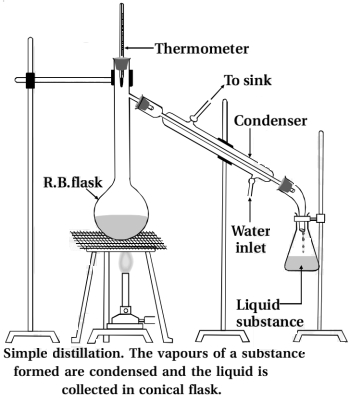
0 likes
View Solution59
Difficult
Explain the process of fractional distillation.
Solution
(N/A) Fractional distillation is a technique used to separate a mixture of two or more liquids when the difference in their boiling points is not large.
In this process,the liquid mixture is taken in a round-bottom $(R.B.)$ flask and heated slowly. The vapours of the mixture are passed through a fractionating column before condensation. The fractionating column is fitted over the mouth of the $R.B.$ flask.
As the vapours rise up the column,they undergo repeated condensation and vaporization. The vapours of the liquid with the higher boiling point condense more readily and return to the flask,while the vapours of the liquid with the lower boiling point rise to the top of the column.
Thus,the vapours reaching the top of the column become progressively richer in the more volatile component (the liquid with the lower boiling point). These vapours are then condensed and collected in a receiver.
In this process,the liquid mixture is taken in a round-bottom $(R.B.)$ flask and heated slowly. The vapours of the mixture are passed through a fractionating column before condensation. The fractionating column is fitted over the mouth of the $R.B.$ flask.
As the vapours rise up the column,they undergo repeated condensation and vaporization. The vapours of the liquid with the higher boiling point condense more readily and return to the flask,while the vapours of the liquid with the lower boiling point rise to the top of the column.
Thus,the vapours reaching the top of the column become progressively richer in the more volatile component (the liquid with the lower boiling point). These vapours are then condensed and collected in a receiver.
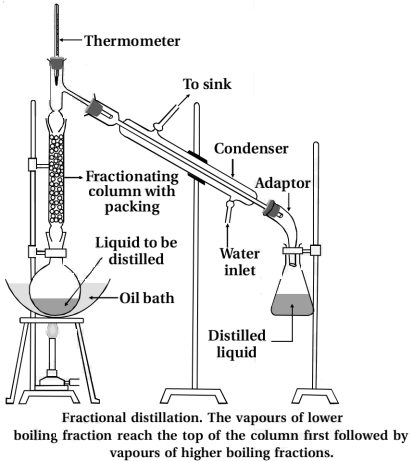
0 likes
View Solution60
Difficult
Explain distillation under reduced pressure.
Solution
(N/A) $(i)$ This method is used to purify liquids having very high boiling points.
$(ii)$ It is used for liquids that decompose at or below their boiling points.
Such liquids are made to boil at a temperature lower than their normal boiling points by reducing the pressure on their surface.
$A$ liquid boils at a temperature at which its vapour pressure is equal to the external pressure.
The pressure is reduced with the help of a water pump or vacuum pump.
Use: Glycerol can be separated from spent-lye in the soap industry by using this technique.
$(ii)$ It is used for liquids that decompose at or below their boiling points.
Such liquids are made to boil at a temperature lower than their normal boiling points by reducing the pressure on their surface.
$A$ liquid boils at a temperature at which its vapour pressure is equal to the external pressure.
The pressure is reduced with the help of a water pump or vacuum pump.
Use: Glycerol can be separated from spent-lye in the soap industry by using this technique.
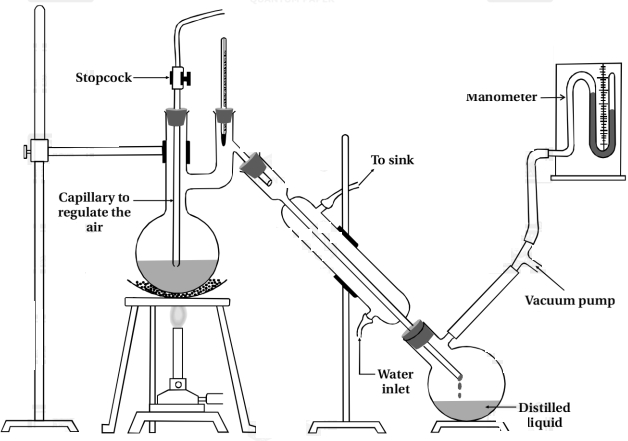
0 likes
View Solution61
Difficult
Explain the process of steam distillation.
Solution
(N/A) Steam distillation is a technique used to separate substances that are steam volatile and immiscible with water.
Procedure:
$(i)$ The substance to be purified is taken in a round-bottom flask.
$(ii)$ Steam from a steam generator is passed through the heated flask containing the liquid.
$(iii)$ The mixture of steam and the volatile organic compound is condensed using a condenser and collected in a receiver.
$(iv)$ The organic compound is then separated from the water using a separating funnel.
Theoretical Principle:
During steam distillation,the total vapour pressure $p$ is equal to the sum of the vapour pressures of the individual components:
$p = p_{1} + p_{2}$
Where:
$p_{1} =$ vapour pressure of the organic liquid
$p_{2} =$ vapour pressure of water
Since $p$ becomes equal to atmospheric pressure at a temperature lower than the boiling point of either component,the substance distills at a lower temperature.
Procedure:
$(i)$ The substance to be purified is taken in a round-bottom flask.
$(ii)$ Steam from a steam generator is passed through the heated flask containing the liquid.
$(iii)$ The mixture of steam and the volatile organic compound is condensed using a condenser and collected in a receiver.
$(iv)$ The organic compound is then separated from the water using a separating funnel.
Theoretical Principle:
During steam distillation,the total vapour pressure $p$ is equal to the sum of the vapour pressures of the individual components:
$p = p_{1} + p_{2}$
Where:
$p_{1} =$ vapour pressure of the organic liquid
$p_{2} =$ vapour pressure of water
Since $p$ becomes equal to atmospheric pressure at a temperature lower than the boiling point of either component,the substance distills at a lower temperature.
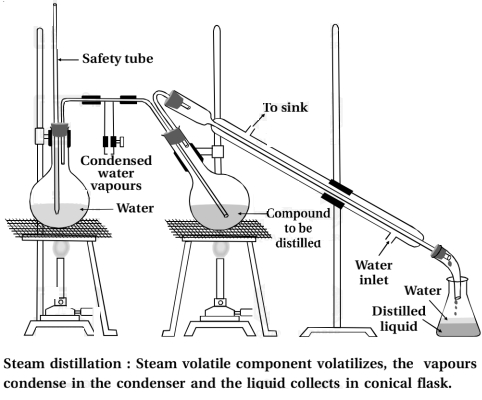
0 likes
View Solution62
Advanced
Explain differential extraction.
Solution
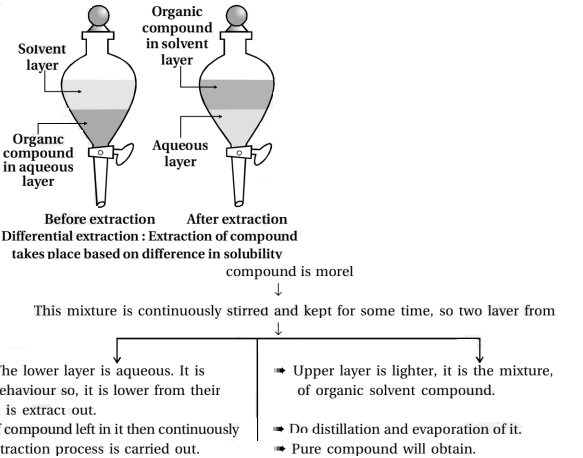
(N/A) Differential extraction is a technique used to separate an organic compound from an aqueous solution.
$1$. The process involves shaking the aqueous solution containing the organic compound with an organic solvent in which the compound is more soluble than in water.
$2$. The organic solvent and the aqueous solution must be immiscible,forming two distinct layers that can be separated using a separatory funnel.
$3$. After shaking,the layers are allowed to settle. The layer containing the organic compound is separated.
$4$. The organic solvent is then removed by distillation or evaporation to recover the pure organic compound.
$5$. If the compound is less soluble in the organic solvent,a large quantity of solvent is required. In such cases,continuous extraction is employed,where the same solvent is repeatedly used for extraction.
$1$. The process involves shaking the aqueous solution containing the organic compound with an organic solvent in which the compound is more soluble than in water.
$2$. The organic solvent and the aqueous solution must be immiscible,forming two distinct layers that can be separated using a separatory funnel.
$3$. After shaking,the layers are allowed to settle. The layer containing the organic compound is separated.
$4$. The organic solvent is then removed by distillation or evaporation to recover the pure organic compound.
$5$. If the compound is less soluble in the organic solvent,a large quantity of solvent is required. In such cases,continuous extraction is employed,where the same solvent is repeatedly used for extraction.
0 likes
View Solution63
Medium
Explain why an organic liquid vaporizes at a temperature below its boiling point during steam distillation.
Solution
(N/A) In steam distillation,steam is passed through the organic liquid. The mixture of water vapor and organic liquid vapor exerts a total vapor pressure equal to the atmospheric pressure $(P_{total} = P_{water} + P_{organic} = P_{atm})$. Since the total pressure is the sum of the partial pressures of water and the organic liquid,the organic liquid reaches its boiling point at a temperature lower than its normal boiling point (where its individual vapor pressure would equal $1 \ atm$).
0 likes
View Solution64
Difficult
What is the difference between distillation,distillation under reduced pressure,and steam distillation?
Solution
(N/A)
| Distillation | Distillation under reduced pressure | Steam distillation |
|---|---|---|
| $i$. Used to separate two liquids having a sufficient difference (more than $30^{\circ}C$) in their boiling points and to purify impure liquids. | $i$. Used to purify liquids having very high boiling points that decompose at or below their boiling points by lowering the pressure. | $i$. Applied to substances that are steam volatile and immiscible with water. |
| $ii$. Purified liquid is obtained directly. | $ii$. Pure liquid is obtained after the process. | $ii$. $A$ mixture of water and the liquid is obtained,which is then separated using a separatory funnel. |
| $iii$. Pressure in the flask does not need to be decreased. | $iii$. Pressure in the flask must be decreased. | $iii$. Steam is passed through the mixture. |
0 likes
View Solution65
Difficult
$(a)$ Give uses of chromatography.
$(b)$ Give the meaning of the word chromatography.
$(c)$ Write the first use of chromatography.
$(b)$ Give the meaning of the word chromatography.
$(c)$ Write the first use of chromatography.
Solution
(N/A) The uses of the chromatography technique are as follows:
$(i)$ In the purification of compounds.
$(ii)$ To test the purity of compounds.
$(iii)$ To separate mixtures into their individual components.
$(b)$ The name chromatography is derived from the Greek word $chroma$,meaning $color$. It was named chromatography because it was initially used to separate colored substances.
$(c)$ Chromatography was first used for the separation of colored substances found in plants. The procedure is as follows:
$(i)$ The mixture of colored substances obtained from the plant is applied onto a stationary phase,which may be a solid or a liquid.
$(ii)$ $A$ pure solvent,a mixture of solvents,or a gas is allowed to move slowly over the stationary phase.
$(iii)$ The components of the adsorbate mixture get gradually separated from one another.
$(iv)$ The phase moving over the stationary phase (liquid or gas) is called the mobile phase.
$(i)$ In the purification of compounds.
$(ii)$ To test the purity of compounds.
$(iii)$ To separate mixtures into their individual components.
$(b)$ The name chromatography is derived from the Greek word $chroma$,meaning $color$. It was named chromatography because it was initially used to separate colored substances.
$(c)$ Chromatography was first used for the separation of colored substances found in plants. The procedure is as follows:
$(i)$ The mixture of colored substances obtained from the plant is applied onto a stationary phase,which may be a solid or a liquid.
$(ii)$ $A$ pure solvent,a mixture of solvents,or a gas is allowed to move slowly over the stationary phase.
$(iii)$ The components of the adsorbate mixture get gradually separated from one another.
$(iv)$ The phase moving over the stationary phase (liquid or gas) is called the mobile phase.
0 likes
View Solution66
Medium
What is adsorption chromatography? Write its types.
Solution
(N/A) Adsorption chromatography is a technique based on the differential adsorption of various components of a mixture on a suitable adsorbent.
Since some compounds are more strongly adsorbed than others,they travel through the stationary phase at different rates,leading to their separation.
The two main types of adsorption chromatography are:
$(i)$ Column chromatography
$(ii)$ Thin layer chromatography
Since some compounds are more strongly adsorbed than others,they travel through the stationary phase at different rates,leading to their separation.
The two main types of adsorption chromatography are:
$(i)$ Column chromatography
$(ii)$ Thin layer chromatography
0 likes
View Solution67
Advanced
Write about column chromatography.
Solution
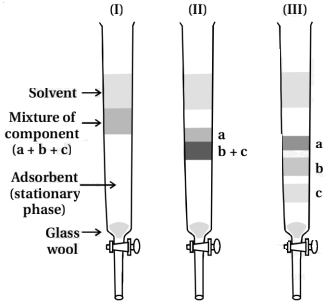
(N/A) Principle: The principle of column chromatography is based on the different adsorption capacities of the components of a mixture on an adsorbent.
Procedure:
$1$. In this method,a suitable adsorbent (e.g.,silica gel or alumina) is packed as a column in a long glass tube (similar to a burette) with a stopcock at the bottom.
$2$. $A$ plug of cotton or glass wool is placed at the bottom of the column to support the adsorbent. This acts as the stationary phase.
$3$. The mixture $(a+b+c)$ to be separated is dissolved in a suitable solvent and poured onto the top of the adsorbent column.
$4$. $A$ suitable solvent or mixture of solvents is then added continuously from the top,which is called elution.
$5$. The added solvent acts as the mobile phase,which moves down the column.
$6$. As the mobile phase moves,the components of the mixture are separated based on their differential adsorption. The component that is weakly adsorbed is eluted more rapidly than the component that is more strongly adsorbed.
$7$. The process of elution is repeated multiple times to achieve complete separation.
$8$. The different components are collected in separate conical flasks as different fractions.
Procedure:
$1$. In this method,a suitable adsorbent (e.g.,silica gel or alumina) is packed as a column in a long glass tube (similar to a burette) with a stopcock at the bottom.
$2$. $A$ plug of cotton or glass wool is placed at the bottom of the column to support the adsorbent. This acts as the stationary phase.
$3$. The mixture $(a+b+c)$ to be separated is dissolved in a suitable solvent and poured onto the top of the adsorbent column.
$4$. $A$ suitable solvent or mixture of solvents is then added continuously from the top,which is called elution.
$5$. The added solvent acts as the mobile phase,which moves down the column.
$6$. As the mobile phase moves,the components of the mixture are separated based on their differential adsorption. The component that is weakly adsorbed is eluted more rapidly than the component that is more strongly adsorbed.
$7$. The process of elution is repeated multiple times to achieve complete separation.
$8$. The different components are collected in separate conical flasks as different fractions.
0 likes
View Solution68
Advanced
Write about thin layer chromatography $(TLC)$.
Solution
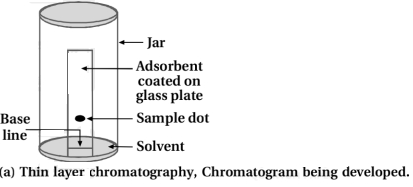
(N/A) Thin layer chromatography $(TLC)$ is a type of adsorption chromatography in which the separation of the components of a mixture is achieved over a thin layer of an adsorbent.
$TLC$ Plate: $A$ thin layer (about $0.2 \ mm$ thick) of an adsorbent (such as silica gel or alumina) is spread over a glass plate of suitable size. This plate is known as a thin layer chromatography plate or chromaplate.
Procedure:
$(i)$ The solution of the mixture to be separated is applied as a small spot about $2 \ cm$ above one end of the $TLC$ plate.
$(ii)$ The glass plate is then placed in a closed jar containing the eluant (solvent).
Observation: As the eluant rises up the plate,the components of the mixture move up along with the eluant to different distances depending on their degree of adsorption,and separation takes place. The relative adsorption of each component of the mixture is expressed in terms of its retardation factor,i.e.,$R_{f}$ value.
$R_{f} = \frac{\text{Distance moved by the substance from base line}}{\text{Distance moved by the solvent from base line}} = \frac{x}{y}$
Where:
$x = \text{Distance moved by the substance from base line}$
$y = \text{Distance moved by the solvent from base line}$
Note: The $R_{f}$ value of every component is specific and different for different components in a mixture.
$TLC$ Plate: $A$ thin layer (about $0.2 \ mm$ thick) of an adsorbent (such as silica gel or alumina) is spread over a glass plate of suitable size. This plate is known as a thin layer chromatography plate or chromaplate.
Procedure:
$(i)$ The solution of the mixture to be separated is applied as a small spot about $2 \ cm$ above one end of the $TLC$ plate.
$(ii)$ The glass plate is then placed in a closed jar containing the eluant (solvent).
Observation: As the eluant rises up the plate,the components of the mixture move up along with the eluant to different distances depending on their degree of adsorption,and separation takes place. The relative adsorption of each component of the mixture is expressed in terms of its retardation factor,i.e.,$R_{f}$ value.
$R_{f} = \frac{\text{Distance moved by the substance from base line}}{\text{Distance moved by the solvent from base line}} = \frac{x}{y}$
Where:
$x = \text{Distance moved by the substance from base line}$
$y = \text{Distance moved by the solvent from base line}$
Note: The $R_{f}$ value of every component is specific and different for different components in a mixture.
0 likes
View Solution69
Difficult
Explain partition chromatography. What is partition chromatography? Describe paper chromatography.
Solution
(N/A) Partition chromatography: Partition chromatography is based on the continuous differential partitioning of components of a mixture between stationary and mobile phases. For example,paper chromatography is a type of partition chromatography.
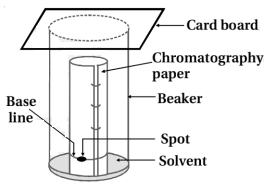
Paper chromatography: Paper chromatography is a form of partition chromatography. $A$ special quality chromatography paper is used. In this method,a line is drawn with a pencil on the chromatography paper parallel to one edge (at a height of approximately $2 cm$ from the bottom),which is called the base line. Then,a drop of the mixture solution is applied as a small spot on this line. The spot is dried by blowing hot air over it.
After drying,the paper is placed in a closed chamber,and the edge of the filter paper is dipped into a suitable solvent (developer) for development.
Here,the solvent acts as the mobile phase and the water trapped in the cellulose fibers of the paper acts as the stationary phase. The solvent rises up the paper by capillary action and flows over the spot. The components of the mixture move upwards along with the solvent to different extents due to their different solubilities in the mobile and stationary phases,leading to their separation.
Paper chromatography: Paper chromatography is a form of partition chromatography. $A$ special quality chromatography paper is used. In this method,a line is drawn with a pencil on the chromatography paper parallel to one edge (at a height of approximately $2 cm$ from the bottom),which is called the base line. Then,a drop of the mixture solution is applied as a small spot on this line. The spot is dried by blowing hot air over it.
After drying,the paper is placed in a closed chamber,and the edge of the filter paper is dipped into a suitable solvent (developer) for development.
Here,the solvent acts as the mobile phase and the water trapped in the cellulose fibers of the paper acts as the stationary phase. The solvent rises up the paper by capillary action and flows over the spot. The components of the mixture move upwards along with the solvent to different extents due to their different solubilities in the mobile and stationary phases,leading to their separation.
0 likes
View Solution70
Difficult
Give a brief description of the principles of the following techniques taking an example in each case. $(a)$ Crystallisation $(b)$ Distillation $(c)$ Chromatography
Solution
(N/A) Principle of crystallisation: The solubility of a component is less at low temperature than at high temperature,allowing pure crystals to be obtained from the solution. The impure component is dissolved in a suitable solvent,and impurities are removed by filtration. The solution is then heated,concentrated,and cooled,and the obtained crystals are separated out.
$(b)$ Distillation: Distillation is a technique used to purify liquids and separate liquid mixtures. Principle: Every liquid boils at a definite temperature,transitioning through $liquid$ $\rightarrow vapour$ $\rightarrow liquid$ states. In simple distillation,the impure liquid or liquid mixture is placed in a flask where the boiling point difference should be high (greater than $20^{\circ} C$). In the distillation flask,the more volatile liquid is condensed by a condenser and separated as a pure component. e.g.,Benzene - bromobenzene,chloroform - chlorobenzene,etc. mixtures are separated by this technique.
$(c)$ Chromatography: It is based on the principle of adsorption and partition. Each compound adsorbs and separates in a definite proportion. The stationary phase and mobile phase are used in the chromatography technique. In the adsorption process,the stable component (solid or liquid) is kept in the mobile liquid phase,where it is adsorbed and travels different distances. In partition chromatography,the stationary phase is a liquid or gas. The partition of components in the solvent differs,leading to their separation. Generally,chromatography is used to separate coloured compounds.
$(b)$ Distillation: Distillation is a technique used to purify liquids and separate liquid mixtures. Principle: Every liquid boils at a definite temperature,transitioning through $liquid$ $\rightarrow vapour$ $\rightarrow liquid$ states. In simple distillation,the impure liquid or liquid mixture is placed in a flask where the boiling point difference should be high (greater than $20^{\circ} C$). In the distillation flask,the more volatile liquid is condensed by a condenser and separated as a pure component. e.g.,Benzene - bromobenzene,chloroform - chlorobenzene,etc. mixtures are separated by this technique.
$(c)$ Chromatography: It is based on the principle of adsorption and partition. Each compound adsorbs and separates in a definite proportion. The stationary phase and mobile phase are used in the chromatography technique. In the adsorption process,the stable component (solid or liquid) is kept in the mobile liquid phase,where it is adsorbed and travels different distances. In partition chromatography,the stationary phase is a liquid or gas. The partition of components in the solvent differs,leading to their separation. Generally,chromatography is used to separate coloured compounds.
0 likes
View Solution71
Medium
Explain the principle of paper chromatography.
Solution
(N/A) Paper chromatography is a type of partition chromatography.
In this technique,a specialized filter paper acts as the stationary phase,which is primarily composed of cellulose.
The moisture trapped within the cellulose fibers acts as the stationary liquid phase.
The mobile phase,which is a suitable solvent or mixture of solvents,moves through the paper via capillary action.
When a mixture is spotted on the paper,the individual components partition themselves between the stationary phase (water trapped in cellulose) and the moving mobile phase.
Since each component has a different partition coefficient,they migrate at different rates along the paper,leading to their separation.
In this technique,a specialized filter paper acts as the stationary phase,which is primarily composed of cellulose.
The moisture trapped within the cellulose fibers acts as the stationary liquid phase.
The mobile phase,which is a suitable solvent or mixture of solvents,moves through the paper via capillary action.
When a mixture is spotted on the paper,the individual components partition themselves between the stationary phase (water trapped in cellulose) and the moving mobile phase.
Since each component has a different partition coefficient,they migrate at different rates along the paper,leading to their separation.
0 likes
View Solution72
Easy
What is column chromatography?
Solution
(N/A) Column chromatography is a technique used to separate components of a mixture based on the differential adsorption of the components on an adsorbent material.
In this process,a mixture is placed on the top of a column packed with a suitable adsorbent (stationary phase),such as silica gel or alumina.
An eluent (mobile phase) is then passed through the column.
As the mobile phase moves down the column,the components of the mixture move at different rates depending on their affinity for the stationary phase versus the mobile phase.
Consequently,the components are separated into distinct bands and can be collected individually as they elute from the bottom of the column.
In this process,a mixture is placed on the top of a column packed with a suitable adsorbent (stationary phase),such as silica gel or alumina.
An eluent (mobile phase) is then passed through the column.
As the mobile phase moves down the column,the components of the mixture move at different rates depending on their affinity for the stationary phase versus the mobile phase.
Consequently,the components are separated into distinct bands and can be collected individually as they elute from the bottom of the column.
0 likes
View Solution73
MediumMCQ
The mixture of compounds $A$ and $B$ is passed through a column of $Al_2O_3$ by using alcohol as eluant. Compound $A$ is eluted in preference to compound $B$. Which of the compounds $A$ or $B$ is more readily adsorbed on the column?
A
$A$
B
$B$
C
Both $A$ and $B$ are adsorbed equally
D
Neither $A$ nor $B$ is adsorbed
Solution
(B) In column chromatography,the compound that is more strongly adsorbed on the stationary phase $(Al_2O_3)$ moves more slowly and is eluted later.
Since compound $A$ is eluted in preference to compound $B$,it means compound $A$ has a lower affinity for the stationary phase than compound $B$.
Therefore,compound $B$ is more readily adsorbed on the column.
Since compound $A$ is eluted in preference to compound $B$,it means compound $A$ has a lower affinity for the stationary phase than compound $B$.
Therefore,compound $B$ is more readily adsorbed on the column.
0 likes
View Solution74
EasyMCQ
Which substance is used in the purification of bone charcoal?
A
Hydrochloric acid $(HCl)$
B
Sulfuric acid $(H_2SO_4)$
C
Nitric acid $(HNO_3)$
D
Acetic acid $(CH_3COOH)$
Solution
(A) Bone charcoal is prepared by the destructive distillation of bones. It contains about $10-12\%$ of carbon and the rest is mainly calcium phosphate $(Ca_3(PO_4)_2)$.
To purify bone charcoal and remove the calcium phosphate,it is treated with dilute hydrochloric acid $(HCl)$.
The acid dissolves the calcium phosphate,leaving behind the pure carbon residue.
To purify bone charcoal and remove the calcium phosphate,it is treated with dilute hydrochloric acid $(HCl)$.
The acid dissolves the calcium phosphate,leaving behind the pure carbon residue.
0 likes
View Solution75
Easy
What is mother liquor?
Solution
(N/A) In the process of crystallization,an impure compound is dissolved in a suitable solvent to form a hot saturated solution. After the pure crystals are separated by cooling and filtration,the remaining liquid that contains the dissolved impurities and a small amount of the compound is known as the mother liquor.
0 likes
View Solution76
EasyMCQ
How will you separate a mixture of two organic compounds which have different solubilities in the same solvent?
A
Simple distillation
B
Fractional crystallisation
C
Sublimation
D
Chromatography
Solution
(B) The separation of two organic compounds having different solubilities in the same solvent is achieved by $ \text{fractional crystallisation} $.
In this process,the mixture is dissolved in a minimum amount of a suitable hot solvent and then allowed to cool.
The compound with lower solubility crystallizes out first,while the more soluble compound remains in the solution (mother liquor).
In this process,the mixture is dissolved in a minimum amount of a suitable hot solvent and then allowed to cool.
The compound with lower solubility crystallizes out first,while the more soluble compound remains in the solution (mother liquor).
0 likes
View Solution77
EasyMCQ
By the crystallisation of an impure compound,if the mother liquor becomes coloured,what shall be done to remove the colour?
A
Add more solvent
B
Add activated charcoal
C
Perform distillation
D
Perform sublimation
Solution
(B) The powder of activated charcoal is added to the solution and kept for some time.
Consequently,coloured impurities adsorb onto the surface of the charcoal.
Through filtration,the charcoal containing the adsorbed impurities is removed,and a colourless solution is obtained.
Consequently,coloured impurities adsorb onto the surface of the charcoal.
Through filtration,the charcoal containing the adsorbed impurities is removed,and a colourless solution is obtained.
0 likes
View Solution78
Medium
Give the information of the following in short.
$(i)$ Fractional column $(ii)$ Theoretical plate $(iii)$ Mechanism of fractional column.
$(i)$ Fractional column $(ii)$ Theoretical plate $(iii)$ Mechanism of fractional column.
Solution
(N/A) $(i)$ Fractional column: It is a long vertical tube filled with glass beads or metal plates,used in fractional distillation to increase the surface area for heat exchange between rising vapors and falling liquid.
$(ii)$ Theoretical plate: It is a hypothetical zone or stage in a distillation column where two phases (liquid and vapor) establish equilibrium with each other. $A$ higher number of theoretical plates indicates better separation efficiency.
$(iii)$ Mechanism of fractional column: As hot vapors rise through the column,they condense on the cooler surfaces (beads/plates). The heat released by condensation vaporizes the more volatile component from the liquid film. This process repeats multiple times,enriching the vapor in the more volatile component as it moves towards the top.
$(ii)$ Theoretical plate: It is a hypothetical zone or stage in a distillation column where two phases (liquid and vapor) establish equilibrium with each other. $A$ higher number of theoretical plates indicates better separation efficiency.
$(iii)$ Mechanism of fractional column: As hot vapors rise through the column,they condense on the cooler surfaces (beads/plates). The heat released by condensation vaporizes the more volatile component from the liquid film. This process repeats multiple times,enriching the vapor in the more volatile component as it moves towards the top.
0 likes
View Solution79
Medium
Give the answer of the following questions in short:
$(i)$ When is simple distillation used?
$(ii)$ When is fractional distillation used?
$(iii)$ Which liquid is obtained first in fractional distillation?
$(iv)$ Which liquid is cooled first in fractional distillation?
$(v)$ What happens in the fractional column?
$(i)$ When is simple distillation used?
$(ii)$ When is fractional distillation used?
$(iii)$ Which liquid is obtained first in fractional distillation?
$(iv)$ Which liquid is cooled first in fractional distillation?
$(v)$ What happens in the fractional column?
Solution
(N/A) $(i)$ $(a)$ For the purification of volatile liquids. $(b)$ For the separation of liquids in which the difference in boiling point is more than $30^{\circ} C$.
$(ii)$ $(a)$ For the separation of liquids in which the difference in boiling point is small. $(b)$ In the petroleum industry to separate different components.
$(iii)$ The liquid which is more volatile and has a lower boiling point is obtained first.
$(iv)$ In fractional distillation,the condensation of the liquid with a higher boiling point takes place first,followed by the condensation of the liquid with a lower boiling point.
$(v)$ In the fractional distillation column,there is a heat exchange between the vapour moving upward and the liquid moving downward. The condensed liquid absorbs heat from the vapour and converts back into vapour. As a result,the concentration of the liquid with the lower boiling point increases in the vapour phase.
$(ii)$ $(a)$ For the separation of liquids in which the difference in boiling point is small. $(b)$ In the petroleum industry to separate different components.
$(iii)$ The liquid which is more volatile and has a lower boiling point is obtained first.
$(iv)$ In fractional distillation,the condensation of the liquid with a higher boiling point takes place first,followed by the condensation of the liquid with a lower boiling point.
$(v)$ In the fractional distillation column,there is a heat exchange between the vapour moving upward and the liquid moving downward. The condensed liquid absorbs heat from the vapour and converts back into vapour. As a result,the concentration of the liquid with the lower boiling point increases in the vapour phase.
0 likes
View Solution80
EasyMCQ
What is a theoretical plate?
A
$A$ physical plate used in distillation
B
$A$ unit of measurement for pressure
C
Each successive condensation and vaporization unit in a fractionating column
D
$A$ type of chemical bond
Solution
(C) In the context of fractional distillation,a theoretical plate is defined as each successive condensation and vaporization unit within the fractionating column that contributes to the separation of components based on their boiling points.
0 likes
View Solution81
EasyMCQ
How is glycerol separated from spent-lye in the soap industry?
A
Fractional distillation
B
Distillation under reduced pressure
C
Steam distillation
D
Sublimation
Solution
(B) In the soap industry,glycerol is obtained as a byproduct in the form of spent-lye. Since glycerol has a high boiling point $(290 \ ^\circ C)$ and tends to decompose at its boiling point,it is separated from the spent-lye by distillation under reduced pressure (vacuum distillation).
0 likes
View Solution82
EasyMCQ
When is steam distillation applied?
A
To separate substances that are steam volatile and immiscible with water.
B
To separate substances that are non-volatile and miscible with water.
C
To separate substances that are steam volatile and miscible with water.
D
To separate substances that are non-volatile and immiscible with water.
Solution
(A) Steam distillation is a technique used to separate substances that are steam volatile and are immiscible with water.
In this process,the substance is heated with steam,and the mixture of steam and the vapor of the substance is condensed and collected.
In this process,the substance is heated with steam,and the mixture of steam and the vapor of the substance is condensed and collected.
0 likes
View Solution83
EasyMCQ
What is collected in the flask at the end in steam distillation?
A
Pure organic compound
B
Pure water
C
$A$ mixture of organic compound and water
D
$A$ mixture of organic compound and steam
Solution
(C) In steam distillation,the organic compound is distilled along with steam. Upon condensation,the distillate collected in the flask consists of a mixture of the organic compound and water,which typically form two separate layers due to their immiscibility.
0 likes
View Solution84
EasyMCQ
At what temperature and pressure does a liquid vaporize in steam distillation?
A
$373 \ K$ and $1 \ atm$
B
$373 \ K$ and less than $1 \ atm$
C
Less than $373 \ K$ and $1 \ atm$
D
Less than $373 \ K$ and less than $1 \ atm$
Solution
(D) In steam distillation,the organic liquid vaporizes at a temperature lower than its boiling point.
This occurs when the sum of the vapor pressure of the organic liquid $(P_1)$ and the vapor pressure of water $(P_2)$ becomes equal to the atmospheric pressure $(P = P_1 + P_2)$.
Since the total pressure is $1 \ atm$,the individual vapor pressure of the organic liquid is less than $1 \ atm$,meaning it boils at a temperature lower than $373 \ K$.
This occurs when the sum of the vapor pressure of the organic liquid $(P_1)$ and the vapor pressure of water $(P_2)$ becomes equal to the atmospheric pressure $(P = P_1 + P_2)$.
Since the total pressure is $1 \ atm$,the individual vapor pressure of the organic liquid is less than $1 \ atm$,meaning it boils at a temperature lower than $373 \ K$.
0 likes
View Solution85
EasyMCQ
The boiling point of aniline is $457 \ K$. At which temperature does aniline boil in simple distillation and in steam distillation?
A
Simple distillation: $457 \ K$,Steam distillation: $373 \ K$
B
Simple distillation: $373 \ K$,Steam distillation: $457 \ K$
C
Simple distillation: $457 \ K$,Steam distillation: $457 \ K$
D
Simple distillation: $373 \ K$,Steam distillation: $373 \ K$
Solution
(A) In simple distillation,the substance boils at its normal boiling point,which is $457 \ K$.
In steam distillation,the mixture boils at a temperature lower than the boiling point of both water and the organic substance. Since the boiling point of water is $373 \ K$,the mixture boils at a temperature below $373 \ K$ (approximately $371 \ K$).
In steam distillation,the mixture boils at a temperature lower than the boiling point of both water and the organic substance. Since the boiling point of water is $373 \ K$,the mixture boils at a temperature below $373 \ K$ (approximately $371 \ K$).
0 likes
View Solution86
Easy
Compare the pressure of aniline and water in vapour phase distillation.
Solution
(N/A) In steam distillation,the mixture of organic liquid (aniline) and water boils when the sum of their individual vapour pressures equals the atmospheric pressure.
Let $p_1$ be the vapour pressure of water and $p_2$ be the vapour pressure of aniline.
The total pressure $p$ is given by Dalton's law of partial pressures as:
$p = p_1 + p_2$
Since the mixture boils at a temperature lower than the boiling point of either pure component,the individual vapour pressures $p_1$ and $p_2$ are each less than the total atmospheric pressure $p$.
Let $p_1$ be the vapour pressure of water and $p_2$ be the vapour pressure of aniline.
The total pressure $p$ is given by Dalton's law of partial pressures as:
$p = p_1 + p_2$
Since the mixture boils at a temperature lower than the boiling point of either pure component,the individual vapour pressures $p_1$ and $p_2$ are each less than the total atmospheric pressure $p$.
0 likes
View Solution87
Medium
Identify the purification technique for the following mixtures:
$(i)$ Chloroform and aniline
$(ii)$ Impure acetone
$(iii)$ Impure aniline
$(iv)$ Chlorobenzene and bromobenzene
$(i)$ Chloroform and aniline
$(ii)$ Impure acetone
$(iii)$ Impure aniline
$(iv)$ Chlorobenzene and bromobenzene
Solution
(N/A) $(i)$ Simple distillation: Used for liquids with a large difference in boiling points.
$(ii)$ Simple distillation: Used to separate a volatile liquid from non-volatile impurities.
$(iii)$ Steam distillation: Used for organic compounds that are steam-volatile and insoluble in water.
$(iv)$ Fractional distillation: Used for liquids with a small difference in boiling points.
$(ii)$ Simple distillation: Used to separate a volatile liquid from non-volatile impurities.
$(iii)$ Steam distillation: Used for organic compounds that are steam-volatile and insoluble in water.
$(iv)$ Fractional distillation: Used for liquids with a small difference in boiling points.
0 likes
View Solution88
EasyMCQ
Describe the use of a separatory funnel in the extraction of an organic compound.
A
To separate two immiscible liquids based on their density differences.
B
To filter solid impurities from a liquid mixture.
C
To distill a volatile liquid from a non-volatile solute.
D
To measure the exact volume of a liquid reagent.
Solution
(A) separatory funnel is used for the liquid-liquid extraction process.
It is designed to separate two immiscible liquids (usually an organic solvent and an aqueous solution) based on their differences in density.
The liquid with the higher density settles at the bottom and can be drained out through the stopcock,while the lighter liquid remains in the funnel.
It is designed to separate two immiscible liquids (usually an organic solvent and an aqueous solution) based on their differences in density.
The liquid with the higher density settles at the bottom and can be drained out through the stopcock,while the lighter liquid remains in the funnel.
0 likes
View Solution89
EasyMCQ
Which technique is used for the separation of a compound present in an aqueous solution?
A
Distillation
B
Differential extraction
C
Sublimation
D
Crystallization
Solution
(B) Differential extraction is the technique used to separate an organic compound from an aqueous solution by shaking it with a suitable organic solvent in which the compound is more soluble than in water.
0 likes
View Solution90
EasyMCQ
Which type of solvent is added to an aqueous solution in the differential extraction method?
A
$A$ solvent that is miscible with water.
B
$A$ solvent that is immiscible with water and has higher solubility for the solute.
C
$A$ solvent that reacts with the solute.
D
$A$ solvent that has a higher boiling point than water.
Solution
(B) The differential extraction method relies on the following criteria for the solvent:
$ (i) $ The solvent must be immiscible with water.
$ (ii) $ The solute must be significantly more soluble in the organic solvent than in water.
$ (iii) $ The solvent should be easily volatile to allow for easy recovery of the solute.
$ (i) $ The solvent must be immiscible with water.
$ (ii) $ The solute must be significantly more soluble in the organic solvent than in water.
$ (iii) $ The solvent should be easily volatile to allow for easy recovery of the solute.
0 likes
View Solution91
Easy
In the differential extraction method using a separating funnel,two layers are formed. What is the difference in the mixture before shaking the solution and at the end of the process?
Solution
(N/A) Initially,the organic compound is primarily dissolved in the aqueous layer.
After shaking and allowing the layers to separate,the compound is distributed between the two solvents based on its partition coefficient,resulting in a higher concentration in the organic solvent layer and a lower concentration in the aqueous layer.
After shaking and allowing the layers to separate,the compound is distributed between the two solvents based on its partition coefficient,resulting in a higher concentration in the organic solvent layer and a lower concentration in the aqueous layer.
0 likes
View Solution92
EasyMCQ
Which apparatus is used to reduce pressure in distillation under reduced pressure?
A
Water pump
B
Vacuum pump
C
Both $(A)$ and $(B)$
D
None of these
Solution
(C) Distillation under reduced pressure is used for liquids that boil at temperatures higher than their boiling points or decompose at their boiling points.
To reduce the pressure in the system,either a $Water pump$ or a $Vacuum pump$ is used.
To reduce the pressure in the system,either a $Water pump$ or a $Vacuum pump$ is used.
0 likes
View Solution93
EasyMCQ
Which are the types of chromatography?
A
Adsorption chromatography
B
Partition chromatography
C
Both $a$ and $b$
D
None of these
Solution
(C) Chromatography is a technique used to separate mixtures into their components. The two main types of chromatography based on the principle of separation are:
$1.$ Adsorption chromatography: Based on the differential adsorption of substances on the surface of a stationary phase.
$2.$ Partition chromatography: Based on the continuous differential partitioning of components between stationary and mobile phases.
$1.$ Adsorption chromatography: Based on the differential adsorption of substances on the surface of a stationary phase.
$2.$ Partition chromatography: Based on the continuous differential partitioning of components between stationary and mobile phases.
0 likes
View Solution94
Easy
Give the difference between paper chromatography and thin layer chromatography.
Solution
(N/A)
| Paper chromatography | Thin layer chromatography |
| $(i)$ It is a partition chromatography. | $(i)$ It is an adsorption chromatography. |
| $(ii)$ Special cellulose paper is used as a stationary phase. | $(ii)$ $A$ thin layer of silica gel or alumina spread over a glass plate is used as a stationary phase. |
| $(iii)$ Mobile phase is a liquid. | $(iii)$ Mobile phase can be a liquid or a gas. |
0 likes
View Solution95
EasyMCQ
What is $R_f$?
A
$R_f$ is the rate of flow.
B
$R_f$ is the retardation factor.
C
$R_f$ is the retention factor.
D
$R_f$ is the reaction factor.
Solution
(B) $R_f$ stands for retardation factor.
In chromatography,the $R_f$ value is defined as the ratio of the distance traveled by the substance to the distance traveled by the solvent front from the base line.
$R_f = \frac{\text{Distance moved by the substance from base line } (x)}{\text{Distance moved by the solvent from base line } (y)}$
In chromatography,the $R_f$ value is defined as the ratio of the distance traveled by the substance to the distance traveled by the solvent front from the base line.
$R_f = \frac{\text{Distance moved by the substance from base line } (x)}{\text{Distance moved by the solvent from base line } (y)}$
0 likes
View Solution96
EasyMCQ
What is an eluant?
A
$A$ stationary phase in chromatography
B
$A$ mobile phase used in chromatography
C
$A$ solid support in column chromatography
D
$A$ chemical reagent used to precipitate compounds
Solution
(B) An eluant is the mobile phase (liquid or gas) used in chromatography. It carries the mixture of compounds over the stationary phase,allowing for the separation of components based on their differential affinities.
0 likes
View Solution97
Easy
Write the applications of chromatography.
Solution
(N/A) $i$. To purify the compounds.
$ii$. To separate mixtures into their components.
$iii$. To test the purity of compounds.
$ii$. To separate mixtures into their components.
$iii$. To test the purity of compounds.
0 likes
View Solution98
Easy
What is a chromatogram?
Solution
(N/A) In the chromatography technique,the record of the separated components obtained on the stationary phase is called a chromatogram. It consists of the spots or bands of different compounds that have been separated based on their differential distribution between the stationary and mobile phases.
0 likes
View Solution99
EasyMCQ
Chromatography is used for which type of compounds?
A
Coloured compounds
B
Compounds that produce colour with iodine
C
Compounds that produce different spots by spraying with an appropriate reagent
D
All of the above
Solution
(D) Chromatography is a versatile technique used for the separation and identification of various compounds:
$(i)$ It is used for naturally coloured compounds.
$(ii)$ It is used for compounds that produce colour when treated with iodine.
$(iii)$ It is used for colourless compounds that can be visualized by spraying the chromatogram with an appropriate reagent to produce distinct spots.
$(iv)$ For example,metal ions like $Pb^{2+}$,$Cd^{2+}$,and $Cu^{2+}$ can be identified by spraying with $H_2S$ to form characteristic coloured sulphide spots.
$(i)$ It is used for naturally coloured compounds.
$(ii)$ It is used for compounds that produce colour when treated with iodine.
$(iii)$ It is used for colourless compounds that can be visualized by spraying the chromatogram with an appropriate reagent to produce distinct spots.
$(iv)$ For example,metal ions like $Pb^{2+}$,$Cd^{2+}$,and $Cu^{2+}$ can be identified by spraying with $H_2S$ to form characteristic coloured sulphide spots.
0 likes
View Solution100
EasyMCQ
What is the characteristic of $R_f$ value?
A
It is variable for a given compound.
B
It is definite and constant for a given compound under specific conditions.
C
It depends only on the amount of substance.
D
It is always equal to $1$.
Solution
(B) The $R_f$ (retention factor) value is defined as the ratio of the distance traveled by the solute to the distance traveled by the solvent front.
For a given compound,the $R_f$ value is definite and constant under specific experimental conditions (such as temperature,solvent,and stationary phase).
Therefore,the $R_f$ value serves as a characteristic property for the identification of a compound,similar to other physical constants.
For a given compound,the $R_f$ value is definite and constant under specific experimental conditions (such as temperature,solvent,and stationary phase).
Therefore,the $R_f$ value serves as a characteristic property for the identification of a compound,similar to other physical constants.
0 likes
View Solution8-3.Organic Chemistry : Purification and characterization — Purification of Organic Compounds · Frequently Asked Questions
1Are these 8-3.Organic Chemistry : Purification and characterization questions useful for JEE and NEET?
Yes. All questions in this section are mapped to JEE Main and NEET exam patterns. Previous year questions from JEE Main, NEET, GUJCET and state-level exams are included with full solutions.
2Can I switch to Hindi or Gujarati for these questions?
Yes. Use the language tabs in the hero section or the sidebar to view the same questions and solutions in English, Hindi or Gujarati.
3How do I generate a question paper from this subtopic?
Use the Vedclass Exam Paper Generator — select the chapter and subtopic, set difficulty, and generate Sets A, B, C, D automatically. First 3 chapters of every subject are free.
Vedclass Products
For Students
Vedclass Test Series
Mock tests in real JEE/NEET style with performance analysis. 5-day free trial.
Start Free TrialFor Teachers
Exam Paper Generator
Generate Set A/B/C/D papers from this chapter in 2 minutes. 3 chapters free.
Try FreeFor Institutes
Online Exam Module
Live online exams with unlimited students, 360° analytics & white-label branding.
See DemoFor Teachers & Institutes
Generate a 8-3.Organic Chemistry : Purification and characterization Exam Paper in 2 Minutes
Select subtopic & difficulty — Sets A, B, C, D auto-generated with No Repeat logic.
First 3 chapters of every subject are free — no payment required.