
A English
Purification of Organic Compounds Questions in English
Class 11 Chemistry · 8-3.Organic Chemistry : Purification and characterization · Purification of Organic Compounds
188+
Questions
English
Language
100%
With Solutions
Showing 50 of 188 questions in English
101
EasyMCQ
On which principle does the solute move on chromatography paper?
A
Adsorption
B
Partition chromatography
C
Capillary action
D
Sublimation
Solution
(C) The movement of the solvent and the solute on chromatography paper is based on the principle of $capillary \ action$.
In paper chromatography,the stationary phase is water trapped in the cellulose fibers of the paper,and the mobile phase moves through the paper via $capillary \ action$.
In paper chromatography,the stationary phase is water trapped in the cellulose fibers of the paper,and the mobile phase moves through the paper via $capillary \ action$.
0 likes
View Solution102
Easy
What is the principle of extraction in a separatory funnel?
Solution
(N/A) The principle of extraction in a separatory funnel is based on the difference in the solubility of an organic compound in two immiscible solvents,typically an organic solvent and water. The organic compound is more soluble in the organic solvent than in water,allowing it to be separated from an aqueous solution by shaking it with the organic solvent.
0 likes
View Solution103
EasyMCQ
$A$ liquid contains a non-volatile impurity. Which technique will be applied for its purification?
A
Sublimation
B
Distillation
C
Crystallization
D
Chromatography
Solution
(B) Distillation is the technique used to separate a volatile liquid from a non-volatile impurity. In this process,the liquid is heated to its boiling point to form vapor,which is then condensed back into a liquid,leaving the non-volatile impurity behind in the distillation flask.
0 likes
View Solution104
Easy
How do you perform the purification of the following?
$(i)$ The boiling point of liquid $X$ is $450 \ K$ and it decomposes at $400 \ K$ temperature.
$(ii)$ Mixture of $60 \% \ \text{Camphor}$ and $40 \% \ BaSO_4$.
$(i)$ The boiling point of liquid $X$ is $450 \ K$ and it decomposes at $400 \ K$ temperature.
$(ii)$ Mixture of $60 \% \ \text{Camphor}$ and $40 \% \ BaSO_4$.
Solution
(N/A) $(i)$ Distillation under reduced pressure (or vacuum distillation) is used because the liquid decomposes below its boiling point.
$(ii)$ Sublimation is used because camphor is a sublimable solid,while $BaSO_4$ is non-sublimable.
$(ii)$ Sublimation is used because camphor is a sublimable solid,while $BaSO_4$ is non-sublimable.
0 likes
View Solution105
MediumMCQ
When the $TLC$ solvent reaches a height of $10 \, cm$,compound $(A)$ reaches $8 \, cm$ and compound $(B)$ reaches $6 \, cm$. Calculate the $R_f$ values of $(A)$ and $(B)$.
A
$R_f(A) = 0.8, R_f(B) = 0.6$
B
$R_f(A) = 0.6, R_f(B) = 0.8$
C
$R_f(A) = 0.08, R_f(B) = 0.06$
D
$R_f(A) = 8, R_f(B) = 6$
Solution
(A) The retardation factor $(R_f)$ is calculated using the formula: $R_f = \frac{\text{Distance travelled by the compound}}{\text{Distance travelled by the solvent front}}$.
For compound $(A)$: $R_f(A) = \frac{8 \, cm}{10 \, cm} = 0.8$.
For compound $(B)$: $R_f(B) = \frac{6 \, cm}{10 \, cm} = 0.6$.
Therefore,the $R_f$ values are $0.8$ and $0.6$ respectively.
For compound $(A)$: $R_f(A) = \frac{8 \, cm}{10 \, cm} = 0.8$.
For compound $(B)$: $R_f(B) = \frac{6 \, cm}{10 \, cm} = 0.6$.
Therefore,the $R_f$ values are $0.8$ and $0.6$ respectively.
0 likes
View Solution106
EasyMCQ
In $TLC$ for compound $X$,$R_f = 0.7$ and for $B$,$R_f = 0.4$. Which substance migrates more?
A
Compound $X$
B
Compound $B$
C
Both migrate equally
D
Cannot be determined
Solution
(A) The $R_f$ value is defined as the ratio of the distance traveled by the substance to the distance traveled by the solvent front.
$R_f = \frac{\text{distance traveled by substance}}{\text{distance traveled by solvent front}}$.
Since $R_f$ for $X$ is $0.7$ and $R_f$ for $B$ is $0.4$,compound $X$ has traveled a greater distance relative to the solvent front.
Therefore,compound $X$ migrates more.
$R_f = \frac{\text{distance traveled by substance}}{\text{distance traveled by solvent front}}$.
Since $R_f$ for $X$ is $0.7$ and $R_f$ for $B$ is $0.4$,compound $X$ has traveled a greater distance relative to the solvent front.
Therefore,compound $X$ migrates more.
0 likes
View Solution107
EasyMCQ
$X$ and $Y$ have $R_f$ values of $0.75$ and $0.25$ respectively. In column chromatography,which component is obtained first?
A
$X$
B
$Y$
C
Both $X$ and $Y$ simultaneously
D
None of these
Solution
(A) In column chromatography,the component with the lower $R_f$ value interacts more strongly with the stationary phase and moves slower down the column.
Conversely,the component with the higher $R_f$ value interacts less with the stationary phase and moves faster.
Therefore,the component with the higher $R_f$ value is eluted (obtained) first.
Since $R_f(X) = 0.75$ and $R_f(Y) = 0.25$,$X$ will be obtained first.
Conversely,the component with the higher $R_f$ value interacts less with the stationary phase and moves faster.
Therefore,the component with the higher $R_f$ value is eluted (obtained) first.
Since $R_f(X) = 0.75$ and $R_f(Y) = 0.25$,$X$ will be obtained first.
0 likes
View Solution108
EasyMCQ
Which two organic compounds are purified by the sublimation technique?
A
Camphor and Naphthalene
B
Benzoic acid and Aniline
C
Naphthalene and Aniline
D
Camphor and Benzoic acid
Solution
(A) Sublimation is a technique used to separate substances that sublime upon heating.
Common organic compounds purified by this method include:
$(i)$ Camphor
$(ii)$ Naphthalene
$(iii)$ Anthracene
$(iv)$ Benzoic acid
Therefore,the correct pair is Camphor and Naphthalene.
Common organic compounds purified by this method include:
$(i)$ Camphor
$(ii)$ Naphthalene
$(iii)$ Anthracene
$(iv)$ Benzoic acid
Therefore,the correct pair is Camphor and Naphthalene.
0 likes
View Solution109
Easy
Match Column-$I$ and Column-$II$ with the correct relation:
| Column-$I$ | Column-$II$ |
|---|---|
| $(i)$ Aniline + chloroform | $(p)$ Steam distillation |
| $(ii)$ Aqueous solution of compound | $(q)$ Fractional distillation |
| $(iii)$ Mixture of liquids with small difference in boiling point | $(r)$ Differential extraction |
| $(iv)$ Purification of aniline | $(s)$ Simple distillation |
Solution
(A) The correct matches are as follows:
$(i)$ Aniline and chloroform have a large difference in boiling points,so they are separated by $(s)$ Simple distillation.
$(ii)$ An aqueous solution of a compound is separated using $(r)$ Differential extraction.
$(iii)$ $A$ mixture of liquids with a small difference in boiling points is separated by $(q)$ Fractional distillation.
$(iv)$ Aniline is purified using $(p)$ Steam distillation.
Therefore,the correct sequence is $(i-s, ii-r, iii-q, iv-p)$.
$(i)$ Aniline and chloroform have a large difference in boiling points,so they are separated by $(s)$ Simple distillation.
$(ii)$ An aqueous solution of a compound is separated using $(r)$ Differential extraction.
$(iii)$ $A$ mixture of liquids with a small difference in boiling points is separated by $(q)$ Fractional distillation.
$(iv)$ Aniline is purified using $(p)$ Steam distillation.
Therefore,the correct sequence is $(i-s, ii-r, iii-q, iv-p)$.
0 likes
View Solution110
Medium
Match Column-$I$ and Column-$II$ with correct relation:
| Column-$I$ | Column-$II$ |
|---|---|
| $(i)$ Differential extraction | $(p)$ High difference of boiling point |
| $(ii)$ Steam distillation | $(q)$ Separatory funnel |
| $(iii)$ Distillation at low pressure | $(r)$ Component of petroleum |
| $(iv)$ Simple distillation | $(s)$ Liquid decompose at high temperature |
| $(v)$ Fractional distillation | $(t)$ Vacuum pump |
Solution
(A) The correct matches are as follows:
$(i)$ Differential extraction is performed using a $(q)$ Separatory funnel.
$(ii)$ Steam distillation is used for substances that are $(s)$ Liquid decompose at high temperature.
$(iii)$ Distillation at low pressure is performed using a $(t)$ Vacuum pump.
$(iv)$ Simple distillation is used for liquids with a $(p)$ High difference of boiling point.
$(v)$ Fractional distillation is used to separate $(r)$ Component of petroleum.
Therefore,the correct sequence is: $(i-q, ii-s, iii-t, iv-p, v-r)$.
$(i)$ Differential extraction is performed using a $(q)$ Separatory funnel.
$(ii)$ Steam distillation is used for substances that are $(s)$ Liquid decompose at high temperature.
$(iii)$ Distillation at low pressure is performed using a $(t)$ Vacuum pump.
$(iv)$ Simple distillation is used for liquids with a $(p)$ High difference of boiling point.
$(v)$ Fractional distillation is used to separate $(r)$ Component of petroleum.
Therefore,the correct sequence is: $(i-q, ii-s, iii-t, iv-p, v-r)$.
0 likes
View Solution111
Easy
Match column $-I$ and column $-II$ with the correct relation:
| Column $-I$ | Column $-II$ |
| $(i)$ Liquid boiled at low temperature | $(a)$ Fractional distillation |
| $(ii)$ Glycerol from lye | $(b)$ Simple distillation |
| $(iii)$ The liquid with lower boiling point condenses first | $(c)$ Steam distillation |
| $(iv)$ The liquid with higher boiling point condenses first | $(d)$ Distillation under reduced pressure |
Solution
(A) The correct matches are:
$(i)$ Liquid boiled at low temperature is achieved by $(d)$ Distillation under reduced pressure.
$(ii)$ Glycerol from lye is purified by $(c)$ Steam distillation (or distillation under reduced pressure,but in standard contexts,it is associated with distillation under reduced pressure; however,given the options,$(c)$ is often used for volatile substances,while $(d)$ is specific for heat-sensitive liquids like glycerol).
$(iii)$ The liquid with lower boiling point condenses first in $(b)$ Simple distillation.
$(iv)$ The liquid with higher boiling point condenses first in $(a)$ Fractional distillation.
Thus,the correct sequence is $(i-d), (ii-c), (iii-b), (iv-a)$.
$(i)$ Liquid boiled at low temperature is achieved by $(d)$ Distillation under reduced pressure.
$(ii)$ Glycerol from lye is purified by $(c)$ Steam distillation (or distillation under reduced pressure,but in standard contexts,it is associated with distillation under reduced pressure; however,given the options,$(c)$ is often used for volatile substances,while $(d)$ is specific for heat-sensitive liquids like glycerol).
$(iii)$ The liquid with lower boiling point condenses first in $(b)$ Simple distillation.
$(iv)$ The liquid with higher boiling point condenses first in $(a)$ Fractional distillation.
Thus,the correct sequence is $(i-d), (ii-c), (iii-b), (iv-a)$.
0 likes
View Solution112
Medium
State True or False for the following statements:
$(i)$ The volatile liquid is purified by fractional distillation or simple distillation.
$(ii)$ Two liquids are separated by fractional distillation.
$(iii)$ Liquids with a small difference in boiling points are separated by fractional distillation.
$(iv)$ Liquids with a large difference in boiling points are separated by fractional distillation.
$(i)$ The volatile liquid is purified by fractional distillation or simple distillation.
$(ii)$ Two liquids are separated by fractional distillation.
$(iii)$ Liquids with a small difference in boiling points are separated by fractional distillation.
$(iv)$ Liquids with a large difference in boiling points are separated by fractional distillation.
Solution
(N/A) $(i) \text{ False, } (ii) \text{ False, } (iii) \text{ True, } (iv) \text{ False}$.
Explanation:
$(i)$ Volatile liquids are purified by distillation,but the choice between simple and fractional depends on the boiling point difference.
$(ii)$ Two liquids can be separated by simple or fractional distillation depending on their boiling points,not just fractional.
$(iii)$ Fractional distillation is specifically used when the boiling point difference is small (less than $20 \ K$).
$(iv)$ Liquids with a large difference in boiling points are separated by simple distillation,not fractional.
Explanation:
$(i)$ Volatile liquids are purified by distillation,but the choice between simple and fractional depends on the boiling point difference.
$(ii)$ Two liquids can be separated by simple or fractional distillation depending on their boiling points,not just fractional.
$(iii)$ Fractional distillation is specifically used when the boiling point difference is small (less than $20 \ K$).
$(iv)$ Liquids with a large difference in boiling points are separated by simple distillation,not fractional.
0 likes
View Solution113
Medium
State whether the following statements are True or False:
$(i)$ The purification of a solid is done by crystallisation.
$(ii)$ Crystallisation purifies the solid and distillation purifies the liquid.
$(iii)$ $A$ liquid is purified by sublimation.
$(iv)$ To separate a mixture of ammonium chloride and sodium chloride,the distillation method is applied.
$(i)$ The purification of a solid is done by crystallisation.
$(ii)$ Crystallisation purifies the solid and distillation purifies the liquid.
$(iii)$ $A$ liquid is purified by sublimation.
$(iv)$ To separate a mixture of ammonium chloride and sodium chloride,the distillation method is applied.
Solution
(N/A) $(i) - \text{True}, (ii) - \text{False}, (iii) - \text{False}, (iv) - \text{False}$.
$(i)$ Crystallisation is a standard method for the purification of solid organic compounds.
$(ii)$ Crystallisation is used for solids,while distillation is used for liquids. The statement is false because it incorrectly claims distillation purifies solids.
$(iii)$ Sublimation is used to purify solids that sublime on heating,not liquids.
$(iv)$ Ammonium chloride $(NH_4Cl)$ is a sublimable solid,while sodium chloride $(NaCl)$ is not. Therefore,sublimation is used to separate this mixture,not distillation.
$(i)$ Crystallisation is a standard method for the purification of solid organic compounds.
$(ii)$ Crystallisation is used for solids,while distillation is used for liquids. The statement is false because it incorrectly claims distillation purifies solids.
$(iii)$ Sublimation is used to purify solids that sublime on heating,not liquids.
$(iv)$ Ammonium chloride $(NH_4Cl)$ is a sublimable solid,while sodium chloride $(NaCl)$ is not. Therefore,sublimation is used to separate this mixture,not distillation.
0 likes
View Solution114
Easy
State whether the following statements are True or False:
$(i)$ The boiling points of chloroform and aniline are $334 \ K$ and $457 \ K$ respectively.
$(ii)$ The vapour of chloroform is obtained after aniline in simple distillation.
$(iii)$ Chloroform is more volatile than aniline.
$(i)$ The boiling points of chloroform and aniline are $334 \ K$ and $457 \ K$ respectively.
$(ii)$ The vapour of chloroform is obtained after aniline in simple distillation.
$(iii)$ Chloroform is more volatile than aniline.
Solution
(A) $(i)$ True: Chloroform has a boiling point of $334 \ K$ and aniline has $457 \ K$.
$(ii)$ False: Since chloroform has a lower boiling point $(334 \ K)$ compared to aniline $(457 \ K)$,it will vaporize first during distillation.
$(iii)$ True: Substances with lower boiling points are more volatile. Since chloroform $(334 \ K)$ has a lower boiling point than aniline $(457 \ K)$,it is more volatile.
$(ii)$ False: Since chloroform has a lower boiling point $(334 \ K)$ compared to aniline $(457 \ K)$,it will vaporize first during distillation.
$(iii)$ True: Substances with lower boiling points are more volatile. Since chloroform $(334 \ K)$ has a lower boiling point than aniline $(457 \ K)$,it is more volatile.
0 likes
View Solution115
Medium
State True or False for the following statements regarding steam distillation:
$(i)$ The liquid is boiled at a temperature lower than its normal boiling point.
$(ii)$ The vapour pressure of the liquid is less than the atmospheric pressure.
$(iii)$ The sum of the vapour pressure of the liquid and the vapour pressure of water is equal to the atmospheric pressure.
$(iv)$ The mixture of organic liquid and water is obtained as the distillate.
$(v)$ The condensation of the mixture of water vapour and organic liquid vapour takes place.
$(i)$ The liquid is boiled at a temperature lower than its normal boiling point.
$(ii)$ The vapour pressure of the liquid is less than the atmospheric pressure.
$(iii)$ The sum of the vapour pressure of the liquid and the vapour pressure of water is equal to the atmospheric pressure.
$(iv)$ The mixture of organic liquid and water is obtained as the distillate.
$(v)$ The condensation of the mixture of water vapour and organic liquid vapour takes place.
Solution
(A) The correct statements are:
$(i)$ True: Steam distillation allows liquids to boil at temperatures below their normal boiling points.
$(ii)$ True: The liquid boils when the sum of its vapour pressure and the water's vapour pressure equals atmospheric pressure,meaning the liquid's individual vapour pressure is less than atmospheric pressure.
$(iii)$ True: This is the fundamental principle of steam distillation where $P_{total} = P_{liquid} + P_{water} = P_{atm}$. (Note: The original provided solution was incorrect; the correct sequence is $(i-T, ii-T, iii-T, iv-T, v-T)$).
$(iv)$ True: The distillate collected is a mixture of the organic liquid and water.
$(v)$ True: The vapours are condensed to form the liquid mixture.
$(i)$ True: Steam distillation allows liquids to boil at temperatures below their normal boiling points.
$(ii)$ True: The liquid boils when the sum of its vapour pressure and the water's vapour pressure equals atmospheric pressure,meaning the liquid's individual vapour pressure is less than atmospheric pressure.
$(iii)$ True: This is the fundamental principle of steam distillation where $P_{total} = P_{liquid} + P_{water} = P_{atm}$. (Note: The original provided solution was incorrect; the correct sequence is $(i-T, ii-T, iii-T, iv-T, v-T)$).
$(iv)$ True: The distillate collected is a mixture of the organic liquid and water.
$(v)$ True: The vapours are condensed to form the liquid mixture.
0 likes
View Solution116
Medium
State whether the following statements regarding steam distillation at reduced pressure are True or False:
$i$. It is used in the soap industry.
$ii$. Water pumps,vacuum pumps,or air pumps are used.
$iii$. Liquids with high boiling points do not decompose.
$iv$. The liquid is decomposed.
$v$. The liquid is boiled at a low temperature.
$i$. It is used in the soap industry.
$ii$. Water pumps,vacuum pumps,or air pumps are used.
$iii$. Liquids with high boiling points do not decompose.
$iv$. The liquid is decomposed.
$v$. The liquid is boiled at a low temperature.
Solution
(A) The correct statements are:
$i$. True (It is used to separate glycerol from spent lye in the soap industry).
$ii$. False (Vacuum pumps are used,but air pumps are generally not used for this purpose).
$iii$. True (Distillation at reduced pressure prevents the decomposition of heat-sensitive substances).
$iv$. False (The process is specifically designed to prevent decomposition).
$v$. True (Reducing the pressure lowers the boiling point of the liquid).
Summary: $i-T, ii-F, iii-T, iv-F, v-T$.
$i$. True (It is used to separate glycerol from spent lye in the soap industry).
$ii$. False (Vacuum pumps are used,but air pumps are generally not used for this purpose).
$iii$. True (Distillation at reduced pressure prevents the decomposition of heat-sensitive substances).
$iv$. False (The process is specifically designed to prevent decomposition).
$v$. True (Reducing the pressure lowers the boiling point of the liquid).
Summary: $i-T, ii-F, iii-T, iv-F, v-T$.
0 likes
View Solution117
Medium
State whether the following statements regarding fractional distillation are True or False:
$(i)$ The freezing of vapour of a liquid with a high boiling point takes place first.
$(ii)$ In the column,the more volatile liquid is present in a higher concentration in the vapour phase at higher levels.
$(iii)$ The condensed liquid flows down and provides heat to the vaporizing liquid.
$(iv)$ The liquid with the highest boiling point reaches the top of the column.
$(i)$ The freezing of vapour of a liquid with a high boiling point takes place first.
$(ii)$ In the column,the more volatile liquid is present in a higher concentration in the vapour phase at higher levels.
$(iii)$ The condensed liquid flows down and provides heat to the vaporizing liquid.
$(iv)$ The liquid with the highest boiling point reaches the top of the column.
Solution
(N/A) $(i)$ False,$(ii)$ True,$(iii)$ True,$(iv)$ False.
0 likes
View Solution118
Medium
Fill in the blanks:
$1$. In formulas and reactions,the electron pair displacement is indicated by a curved arrow,and the single electron displacement is indicated by a ..........
$2$. There are more than .......... plates in the columns of fractional distillation.
$3$. Fractional distillation is used for the separation of liquids with a .......... difference in boiling points,and simple distillation is used for the separation of liquids with a .......... difference in boiling points.
$4$. The .......... technique is applied to separate different fractions of crude oil in petroleum.
$1$. In formulas and reactions,the electron pair displacement is indicated by a curved arrow,and the single electron displacement is indicated by a ..........
$2$. There are more than .......... plates in the columns of fractional distillation.
$3$. Fractional distillation is used for the separation of liquids with a .......... difference in boiling points,and simple distillation is used for the separation of liquids with a .......... difference in boiling points.
$4$. The .......... technique is applied to separate different fractions of crude oil in petroleum.
Solution
(N/A) $1$. Half-headed curved arrow (fish-hook arrow)
$2$. $100$
$3$. Small,large
$4$. Fractional distillation
$2$. $100$
$3$. Small,large
$4$. Fractional distillation

0 likes
View Solution119
Medium
Fill in the Blanks :
$(1)$ The steam distillation of $.......$ liquid is done and it is boiled at $.........$ temperature.
$(2)$ $.........$ and $........$ used to reduce pressure in distillation under reduced pressure.
$(3)$ In steam distillation the equation of total vapour pressure is $P = p_1 + p_2$ where $p_1$ is more than $...........$
$(4)$ $.........$ apparatus is used in differential extraction.
$(1)$ The steam distillation of $.......$ liquid is done and it is boiled at $.........$ temperature.
$(2)$ $.........$ and $........$ used to reduce pressure in distillation under reduced pressure.
$(3)$ In steam distillation the equation of total vapour pressure is $P = p_1 + p_2$ where $p_1$ is more than $...........$
$(4)$ $.........$ apparatus is used in differential extraction.
Solution
(N/A) $(1)$ The steam distillation of $\text{immiscible}$ liquid is done and it is boiled at $\text{lower}$ temperature.
$(2)$ $\text{Vacuum pump}$ and $\text{water pump}$ are used to reduce pressure in distillation under reduced pressure.
$(3)$ In steam distillation the equation of total vapour pressure is $P = p_1 + p_2$ where $p_1$ is more than $\text{vapour pressure of water } (p_2)$.
$(4)$ $\text{Separatory funnel}$ apparatus is used in differential extraction.
$(2)$ $\text{Vacuum pump}$ and $\text{water pump}$ are used to reduce pressure in distillation under reduced pressure.
$(3)$ In steam distillation the equation of total vapour pressure is $P = p_1 + p_2$ where $p_1$ is more than $\text{vapour pressure of water } (p_2)$.
$(4)$ $\text{Separatory funnel}$ apparatus is used in differential extraction.
0 likes
View Solution120
Medium
Fill in the blanks:
$1$. In differential extraction from two layers,the .......... layer is above because .............
$2$. The organic solvent used in differential extraction is .......... in water.
$3$. If an organic compound is ......... soluble in an organic solvent,then the continuous extraction technique is used.
$4$. ........ solution is added to produce the precipitate of halide for the estimation of halogen.
$1$. In differential extraction from two layers,the .......... layer is above because .............
$2$. The organic solvent used in differential extraction is .......... in water.
$3$. If an organic compound is ......... soluble in an organic solvent,then the continuous extraction technique is used.
$4$. ........ solution is added to produce the precipitate of halide for the estimation of halogen.
Solution
(N/A) $1$. The organic layer is above because its density is less than that of water.
$2$. Immiscible.
$3$. Less.
$4$. $AgNO_3$ (Silver nitrate).
$2$. Immiscible.
$3$. Less.
$4$. $AgNO_3$ (Silver nitrate).
0 likes
View Solution121
EasyMCQ
If a liquid compound decomposes at its boiling point,which method$(s)$ can you choose for its purification? It is known that the compound is stable at low pressure,steam volatile,and insoluble in water.
A
Distillation under reduced pressure
B
Steam distillation
C
Both $(A)$ and $(B)$
D
Fractional distillation
Solution
(C) liquid that decomposes at its boiling point can be purified by distillation under reduced pressure because the boiling point decreases as pressure decreases.
Since the compound is also steam volatile and insoluble in water,it can be purified by steam distillation.
Therefore,both methods are suitable for its purification.
Since the compound is also steam volatile and insoluble in water,it can be purified by steam distillation.
Therefore,both methods are suitable for its purification.
0 likes
View Solution122
Medium
By mistake,an alcohol (boiling point $97\,^{\circ}C$) was mixed with a hydrocarbon (boiling point $68\,^{\circ}C$). Suggest a suitable method to separate the two compounds. Explain the reason for your choice.
Solution
(N/A) The suitable method to separate these two compounds is $Simple \ Distillation$.
Reason: The boiling points of the two components are $97\,^{\circ}C$ and $68\,^{\circ}C$. The difference in their boiling points is $97\,^{\circ}C - 68\,^{\circ}C = 29\,^{\circ}C$. Since the difference in boiling points is greater than $20\,^{\circ}C$,$Simple \ Distillation$ is effective. In this process,the component with the lower boiling point $(68\,^{\circ}C)$ vaporizes first,leaving the component with the higher boiling point $(97\,^{\circ}C)$ behind in the distillation flask.
Reason: The boiling points of the two components are $97\,^{\circ}C$ and $68\,^{\circ}C$. The difference in their boiling points is $97\,^{\circ}C - 68\,^{\circ}C = 29\,^{\circ}C$. Since the difference in boiling points is greater than $20\,^{\circ}C$,$Simple \ Distillation$ is effective. In this process,the component with the lower boiling point $(68\,^{\circ}C)$ vaporizes first,leaving the component with the higher boiling point $(97\,^{\circ}C)$ behind in the distillation flask.
0 likes
View Solution123
Easy
Match the type of mixture of compounds in Column-$I$ with the technique of separation/purification given in Column-$II$.
| Column-$I$ | Column-$II$ |
|---|---|
| $A$. Two solids which have different solubilities in a solvent and which do not undergo reaction when dissolved in it | $1$. Crystallisation |
| $B$. Liquid that decomposes at its boiling point | $2$. Distillation under reduced pressure |
| $C$. Steam volatile liquid | $3$. Steam distillation |
| $D$. Two liquids which have boiling points close to each other | $4$. Fractional distillation |
| $E$. Two liquids with large difference in boiling points | $5$. Simple distillation |
Solution
(A-1, B-2, C-3, D-4, E-5) The correct matches are as follows:
$A$. Two solids with different solubilities in a solvent are separated by $1$. Crystallisation.
$B$. Liquids that decompose at their boiling point are purified by $2$. Distillation under reduced pressure.
$C$. Steam volatile liquids are separated by $3$. Steam distillation.
$D$. Two liquids with boiling points close to each other are separated by $4$. Fractional distillation.
$E$. Two liquids with a large difference in boiling points are separated by $5$. Simple distillation.
Thus,the correct sequence is $A-1, B-2, C-3, D-4, E-5$.
$A$. Two solids with different solubilities in a solvent are separated by $1$. Crystallisation.
$B$. Liquids that decompose at their boiling point are purified by $2$. Distillation under reduced pressure.
$C$. Steam volatile liquids are separated by $3$. Steam distillation.
$D$. Two liquids with boiling points close to each other are separated by $4$. Fractional distillation.
$E$. Two liquids with a large difference in boiling points are separated by $5$. Simple distillation.
Thus,the correct sequence is $A-1, B-2, C-3, D-4, E-5$.
0 likes
View Solution124
Medium
Benzoic acid is an organic compound. Its crude sample can be purified by crystallisation from hot water. What characteristic differences in the properties of benzoic acid and the impurity make this process of purification suitable?
Solution
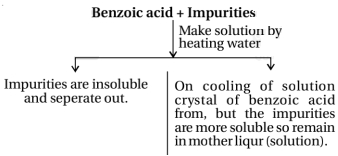
(N/A) Benzoic acid can be purified from hot water because of the following characteristics:
$(i)$ Benzoic acid is more soluble in hot water and less soluble in cold water.
$(ii)$ Impurities associated with benzoic acid are either insoluble in water or are more soluble in water to such an extent that when a hot saturated solution of benzoic acid is cooled,the impurities remain in the solution.
$(i)$ Benzoic acid is more soluble in hot water and less soluble in cold water.
$(ii)$ Impurities associated with benzoic acid are either insoluble in water or are more soluble in water to such an extent that when a hot saturated solution of benzoic acid is cooled,the impurities remain in the solution.
0 likes
View Solution125
Medium
$A$ liquid with a high boiling point decomposes on simple distillation,but it can be steam distilled for its purification. Explain how this is possible.
Solution
(N/A) In steam distillation,the vapour of the organic compound and water are distilled out. Steam (water vapour) is passed into the liquid that is to be purified.
Consequently,the vapour of the liquid and the vapour of water rise and pass into the condenser. The liquid and water are immiscible and form separate layers.
When the sum of the partial vapour pressures of the liquid $(p_1)$ and water $(p_2)$ becomes equal to the atmospheric pressure $(p)$,distillation takes place.
Mathematically,$p = p_1 + p_2$. Since $p_1 < p$,the liquid distills at a temperature lower than its normal boiling point.
Therefore,steam distillation takes place at a lower temperature than the boiling point of the organic liquid,preventing thermal decomposition.
Consequently,the vapour of the liquid and the vapour of water rise and pass into the condenser. The liquid and water are immiscible and form separate layers.
When the sum of the partial vapour pressures of the liquid $(p_1)$ and water $(p_2)$ becomes equal to the atmospheric pressure $(p)$,distillation takes place.
Mathematically,$p = p_1 + p_2$. Since $p_1 < p$,the liquid distills at a temperature lower than its normal boiling point.
Therefore,steam distillation takes place at a lower temperature than the boiling point of the organic liquid,preventing thermal decomposition.
0 likes
View Solution126
MediumMCQ
Glycerol is separated in soap industries by
A
Steam distillation
B
Differential extraction
C
Distillation under reduced pressure
D
Fractional distillation
Solution
(C) Glycerol has a high boiling point and tends to decompose at its boiling point. Therefore,it is separated from spent lye in soap industries by distillation under reduced pressure,which lowers its boiling point and prevents decomposition.
0 likes
View Solution127
EasyMCQ
Paper chromatography is an example of
A
Column chromatography
B
Adsorption chromatography
C
Partition chromatography
D
Thin layer chromatography
Solution
(C) Paper chromatography is based on the principle of partition chromatography.
In this technique,the substances are distributed or partitioned between two liquid phases.
The stationary phase is the water molecules held in the pores of the filter paper,while the mobile phase is a solvent or mixture of solvents that moves over the paper.
In this technique,the substances are distributed or partitioned between two liquid phases.
The stationary phase is the water molecules held in the pores of the filter paper,while the mobile phase is a solvent or mixture of solvents that moves over the paper.
0 likes
View Solution128
MediumMCQ
$A$ liquid compound $(x)$ can be purified by steam distillation only if it is
A
Not steam volatile,immiscible with water
B
Steam volatile,immiscible with water
C
Not steam volatile,miscible with water
D
Steam volatile,miscible with water
Solution
(B) Steam distillation is a separation technique used for substances that are steam volatile and immiscible with water.
In this process,the compound vaporizes at a temperature lower than its boiling point,allowing for purification without decomposition.
In this process,the compound vaporizes at a temperature lower than its boiling point,allowing for purification without decomposition.
0 likes
View Solution129
MediumMCQ
Which of the following statements is incorrect for paper chromatography?
A
It is a type of partition chromatography.
B
It is a stationary phase.
C
$R_{f}$ value decreases when the rate of adsorption increases.
D
None of these.
Solution
(B) Paper chromatography is a technique based on partition chromatography,where the stationary phase is water trapped in the cellulose fibers of the paper and the mobile phase is a solvent.
Option $B$ is incorrect because paper chromatography is a method or technique,not a stationary phase itself.
The stationary phase is the water held by the paper,not the paper itself.
Option $B$ is incorrect because paper chromatography is a method or technique,not a stationary phase itself.
The stationary phase is the water held by the paper,not the paper itself.
0 likes
View Solution130
MediumMCQ
In chromatography technique,the purification of a compound is independent of:
A
Mobility or flow of solvent system
B
Solubility of the compound
C
Length of the column or $TLC$ plate
D
Physical state of the pure compound
Solution
(D) In chromatography technique,the separation and purification of a compound depend on the differential distribution of the substance between the stationary phase and the mobile phase. This process relies on factors such as the solubility of the compound in the solvent,the mobility of the solvent system,and the length of the column or $TLC$ plate. However,the purification process is independent of the physical state (solid,liquid,or gas) of the pure compound itself.
1 likes
View Solution131
MediumMCQ
Given below are two statements:
Statement-$I$: Retardation factor $(R_f)$ can be measured in $meter/centimeter$.
Statement-$II$: $R_f$ value of a compound remains constant in all solvents.
Choose the most appropriate answer from the options given below:
Statement-$I$: Retardation factor $(R_f)$ can be measured in $meter/centimeter$.
Statement-$II$: $R_f$ value of a compound remains constant in all solvents.
Choose the most appropriate answer from the options given below:
A
Statement-$I$ is true but statement-$II$ is false.
B
Both statement-$I$ and statement-$II$ are true.
C
Both statement-$I$ and statement-$II$ are false.
D
Statement-$I$ is false but statement-$II$ is true.
Solution
(C) $R_f$ (Retardation factor) is defined as the ratio of the distance travelled by the substance to the distance travelled by the solvent front from the reference line.
$R_f = \frac{\text{Distance travelled by the substance from reference line (cm)}}{\text{Distance travelled by the solvent from reference line (cm)}}$
Since $R_f$ is a ratio of two identical units (length),it is a dimensionless quantity. Thus,Statement-$I$ is false.
The $R_f$ value of a compound depends on the nature of the solvent and the stationary phase used. Therefore,it is not constant for all solvents. Thus,Statement-$II$ is false.
$R_f = \frac{\text{Distance travelled by the substance from reference line (cm)}}{\text{Distance travelled by the solvent from reference line (cm)}}$
Since $R_f$ is a ratio of two identical units (length),it is a dimensionless quantity. Thus,Statement-$I$ is false.
The $R_f$ value of a compound depends on the nature of the solvent and the stationary phase used. Therefore,it is not constant for all solvents. Thus,Statement-$II$ is false.
0 likes
View Solution132
MediumMCQ
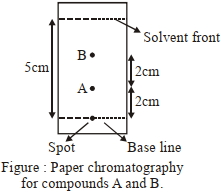
Using the provided information in the following paper chromatogram,calculate the $R_{f}$ value of $A$ .......... $\times 10^{-1}$.
A
$2$
B
$1$
C
$4$
D
$3$
Solution
(C) The $R_{f}$ value is calculated using the formula:
$R_{f} = \frac{\text{Distance travelled by compound from base line}}{\text{Distance travelled by solvent from base line}}$
From the chromatogram:
Distance travelled by compound $A$ from the base line $= 2 \, cm$
Distance travelled by solvent front from the base line $= 5 \, cm$
Therefore,$R_{f} = \frac{2}{5} = 0.4$
Expressing this as $\times 10^{-1}$:
$0.4 = 4 \times 10^{-1}$
Thus,the value is $4$.
$R_{f} = \frac{\text{Distance travelled by compound from base line}}{\text{Distance travelled by solvent from base line}}$
From the chromatogram:
Distance travelled by compound $A$ from the base line $= 2 \, cm$
Distance travelled by solvent front from the base line $= 5 \, cm$
Therefore,$R_{f} = \frac{2}{5} = 0.4$
Expressing this as $\times 10^{-1}$:
$0.4 = 4 \times 10^{-1}$
Thus,the value is $4$.
0 likes
View Solution133
MediumMCQ
Given below are two statements: one is labelled as Assertion $(A)$ and the other is labelled as Reason $(R)$:
Assertion $(A):$ $A$ simple distillation can be used to separate a mixture of propanol and propanone.
Reason $(R):$ Two liquids with a difference of more than $20^{\circ}C$ in their boiling points can be separated by simple distillation.
In the light of the above statements,choose the most appropriate answer from the options given below:
Assertion $(A):$ $A$ simple distillation can be used to separate a mixture of propanol and propanone.
Reason $(R):$ Two liquids with a difference of more than $20^{\circ}C$ in their boiling points can be separated by simple distillation.
In the light of the above statements,choose the most appropriate answer from the options given below:
A
$(A)$ is false but $(R)$ is true.
B
Both $(A)$ and $(R)$ are correct but $(R)$ is not the correct explanation of $(A)$.
C
$(A)$ is true but $(R)$ is false.
D
Both $(A)$ and $(R)$ are correct and $(R)$ is the correct explanation of $(A)$.
Solution
(D) The boiling point of propanone is approximately $56^{\circ}C$ and the boiling point of propanol is approximately $97^{\circ}C$.
Since the difference in their boiling points is $97^{\circ}C - 56^{\circ}C = 41^{\circ}C$,which is greater than $20^{\circ}C$,they can be separated by simple distillation.
Therefore,both Assertion $(A)$ and Reason $(R)$ are correct,and Reason $(R)$ is the correct explanation of Assertion $(A)$.
Since the difference in their boiling points is $97^{\circ}C - 56^{\circ}C = 41^{\circ}C$,which is greater than $20^{\circ}C$,they can be separated by simple distillation.
Therefore,both Assertion $(A)$ and Reason $(R)$ are correct,and Reason $(R)$ is the correct explanation of Assertion $(A)$.
0 likes
View Solution134
MediumMCQ
Which purification technique is used for high boiling organic liquid compounds that decompose near their boiling point?
A
Steam distillation
B
Simple distillation
C
Fractional distillation
D
Reduced pressure distillation
Solution
(D) Reduced pressure distillation (also known as vacuum distillation) is used for the purification of high boiling organic liquids that decompose at or below their boiling point. By reducing the pressure,the boiling point of the liquid is lowered,allowing it to boil and vaporize without reaching the temperature at which it would decompose.
0 likes
View Solution135
EasyMCQ
Which of the following is the structure of a separating funnel?
A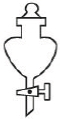
B
C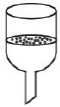
D
Solution
(A) separating funnel is a piece of laboratory glassware used in liquid-liquid extractions to separate the components of a mixture into two immiscible solvent phases of different densities.
It typically has a pear-shaped body with a stopper at the top and a stopcock at the bottom to control the flow of the lower layer.
The structure shown in image $208873-a$ represents a standard separating funnel.
It typically has a pear-shaped body with a stopper at the top and a stopcock at the bottom to control the flow of the lower layer.
The structure shown in image $208873-a$ represents a standard separating funnel.
0 likes
View Solution136
EasyMCQ
Which one of the following techniques is not used to spot components of a mixture separated on a thin layer chromatographic plate?
A
$I_{2}$ (Solid)
B
$U.V.$ Light
C
Visualisation agent as a component of mobile phase
D
Spraying of an appropriate reagent
Solution
(C) In Thin Layer Chromatography $(TLC)$,the separated components are often invisible to the naked eye. To visualize them,several techniques are used:
$1$. $I_{2}$ (Solid) chambers: Iodine vapors adsorb onto the components,making them visible.
$2$. $U.V.$ Light: Many organic compounds fluoresce under $U.V.$ light.
$3$. Spraying of an appropriate reagent: Chemical reagents react with the components to produce colored spots.
However,adding a visualization agent directly to the mobile phase is not a standard technique for spotting components on a $TLC$ plate,as it would interfere with the separation process itself.
$1$. $I_{2}$ (Solid) chambers: Iodine vapors adsorb onto the components,making them visible.
$2$. $U.V.$ Light: Many organic compounds fluoresce under $U.V.$ light.
$3$. Spraying of an appropriate reagent: Chemical reagents react with the components to produce colored spots.
However,adding a visualization agent directly to the mobile phase is not a standard technique for spotting components on a $TLC$ plate,as it would interfere with the separation process itself.
0 likes
View Solution137
MediumMCQ
Which technique among the following is most appropriate for the separation of a mixture of $100 \ mg$ of $p-$nitrophenol and picric acid?
A
Steam distillation
B
$2-5 \ ft$ long column of silica gel
C
Sublimation
D
Preparative $TLC$ (Thin Layer Chromatography)
Solution
(D) $p-$nitrophenol exhibits intermolecular hydrogen bonding,while picric acid ($2,4,6-$trinitrophenol) exhibits intramolecular hydrogen bonding.
Due to these differences in hydrogen bonding,they possess different polarities and adsorption characteristics on a stationary phase like silica gel.
For a small quantity like $100 \ mg$,chromatographic techniques are highly effective.
Preparative $TLC$ is a suitable technique for separating small amounts of mixtures based on differences in their $R_f$ values.
Due to these differences in hydrogen bonding,they possess different polarities and adsorption characteristics on a stationary phase like silica gel.
For a small quantity like $100 \ mg$,chromatographic techniques are highly effective.
Preparative $TLC$ is a suitable technique for separating small amounts of mixtures based on differences in their $R_f$ values.
0 likes
View Solution138
MediumMCQ
Match List-$I$ with List-$II$:
| List-$I$ | List-$II$ |
| $(A)$ Chloroform and Aniline | $(I)$ Steam distillation |
| $(B)$ Benzoic acid and Naphthalene | $(II)$ Sublimation |
| $(C)$ Water and Aniline | $(III)$ Distillation |
| $(D)$ Naphthalene and Sodium chloride | $(IV)$ Crystallisation |
A
$(A-IV, B-III, C-I, D-II)$
B
$(A-III, B-I, C-IV, D-II)$
C
$(A-III, B-IV, C-II, D-I)$
D
$(A-III, B-IV, C-I, D-II)$
Solution
(D) Chloroform and Aniline are separated by $(III)$ Distillation because they have different boiling points.
$(B)$ Benzoic acid and Naphthalene are separated by $(IV)$ Crystallisation based on differences in their solubilities in a suitable solvent.
$(C)$ Water and Aniline are separated by $(I)$ Steam distillation as Aniline is steam volatile and immiscible with water.
$(D)$ Naphthalene and Sodium chloride are separated by $(II)$ Sublimation because Naphthalene sublimes while Sodium chloride does not.
$(B)$ Benzoic acid and Naphthalene are separated by $(IV)$ Crystallisation based on differences in their solubilities in a suitable solvent.
$(C)$ Water and Aniline are separated by $(I)$ Steam distillation as Aniline is steam volatile and immiscible with water.
$(D)$ Naphthalene and Sodium chloride are separated by $(II)$ Sublimation because Naphthalene sublimes while Sodium chloride does not.
0 likes
View Solution139
MediumMCQ
Given below are two statements: One is labelled as Assertion $A$ and the other is labelled as Reason $R$.
Assertion $A$: Thin layer chromatography is an adsorption chromatography.
Reason $R$: $A$ thin layer of silica gel is spread over a glass plate of suitable size in thin layer chromatography which acts as an adsorbent.
In the light of the above statements,choose the correct answer from the options given below.
Assertion $A$: Thin layer chromatography is an adsorption chromatography.
Reason $R$: $A$ thin layer of silica gel is spread over a glass plate of suitable size in thin layer chromatography which acts as an adsorbent.
In the light of the above statements,choose the correct answer from the options given below.
A
Both $A$ and $R$ are true and $R$ is the correct explanation of $A$.
B
Both $A$ and $R$ are true but $R$ is $NOT$ the correct explanation of $A$.
C
$A$ is true but $R$ is false.
D
$A$ is false but $R$ is true.
Solution
(A) Thin layer chromatography $(TLC)$ is a type of adsorption chromatography.
It involves the separation of substances of a mixture over a thin layer of an adsorbent coated on a glass plate.
$A$ thin layer (about $0.2 \ mm$ thick) of an adsorbent,such as silica gel or alumina,is spread over a glass plate of suitable size.
Since the separation is based on the differential adsorption of the components on the stationary phase (silica gel),both the Assertion $(A)$ and the Reason $(R)$ are true,and $(R)$ is the correct explanation of $(A)$.
It involves the separation of substances of a mixture over a thin layer of an adsorbent coated on a glass plate.
$A$ thin layer (about $0.2 \ mm$ thick) of an adsorbent,such as silica gel or alumina,is spread over a glass plate of suitable size.
Since the separation is based on the differential adsorption of the components on the stationary phase (silica gel),both the Assertion $(A)$ and the Reason $(R)$ are true,and $(R)$ is the correct explanation of $(A)$.
0 likes
View Solution140
MediumMCQ
The organic compound which can be purified by steam distillation is
A
acetone
B
aniline
C
glucose
D
ethanol
Solution
(B)
Aniline can be purified by steam distillation. This method is used to separate compounds that are steam volatile and insoluble in water. In this process,steam from a generator is passed through a flask containing the liquid to be distilled. The resulting mixture of steam and the volatile organic compound is condensed and collected in a receiver.
Aniline can be purified by steam distillation. This method is used to separate compounds that are steam volatile and insoluble in water. In this process,steam from a generator is passed through a flask containing the liquid to be distilled. The resulting mixture of steam and the volatile organic compound is condensed and collected in a receiver.
0 likes
View Solution141
MediumMCQ
The species that exhibits the highest $R_f$ value in a thin layer chromatogram using a non-polar solvent on a silica gel plate is
A
Propylbenzene
B
Pyridine
C
$N$-methylpyridinium ion
D
Phenol
Solution
(A) In thin layer chromatography $(TLC)$,the stationary phase (silica gel) is polar in nature.
The $R_f$ value is inversely proportional to the polarity of the compound.
Non-polar compounds interact less with the polar stationary phase and move faster with the non-polar solvent,resulting in a higher $R_f$ value.
Comparing the polarities:
$1$. $N$-methylpyridinium ion is an ionic species,making it the most polar.
$2$. Phenol has an $-OH$ group,allowing for hydrogen bonding,making it polar.
$3$. Pyridine is polar due to the lone pair on nitrogen.
$4$. Propylbenzene is a hydrocarbon and is the least polar among the given options.
Therefore,propylbenzene will have the highest $R_f$ value.
The $R_f$ value is inversely proportional to the polarity of the compound.
Non-polar compounds interact less with the polar stationary phase and move faster with the non-polar solvent,resulting in a higher $R_f$ value.
Comparing the polarities:
$1$. $N$-methylpyridinium ion is an ionic species,making it the most polar.
$2$. Phenol has an $-OH$ group,allowing for hydrogen bonding,making it polar.
$3$. Pyridine is polar due to the lone pair on nitrogen.
$4$. Propylbenzene is a hydrocarbon and is the least polar among the given options.
Therefore,propylbenzene will have the highest $R_f$ value.
0 likes
View Solution142
DifficultMCQ
Match List-$I$ with List-$II$:
| List-$I$ (Mixture) | List-$II$ (Separation Technique) |
|---|---|
| $A$. $CHCl_3 + C_6H_5NH_2$ | $I$. Steam distillation |
| $B$. $C_6H_{14} + C_5H_{12}$ | $II$. Differential extraction |
| $C$. $C_6H_5NH_2 + H_2O$ | $III$. Distillation |
| $D$. Organic compound in $H_2O$ | $IV$. Fractional distillation |
A
$A-IV, B-I, C-III, D-II$
B
$A-III, B-IV, C-I, D-II$
C
$A-II, B-I, C-III, D-IV$
D
$A-III, B-I, C-IV, D-II$
Solution
(B) The correct matches are:
$A$. $CHCl_3 + C_6H_5NH_2$ (Chloroform and Aniline) are separated by $III$. Distillation due to difference in boiling points.
$B$. $C_6H_{14} + C_5H_{12}$ (Hexane and Pentane) are separated by $IV$. Fractional distillation as they are miscible liquids with close boiling points.
$C$. $C_6H_5NH_2 + H_2O$ (Aniline and Water) are separated by $I$. Steam distillation.
$D$. Organic compound in $H_2O$ is separated by $II$. Differential extraction (solvent extraction).
Therefore,the correct sequence is $A-III, B-IV, C-I, D-II$.
$A$. $CHCl_3 + C_6H_5NH_2$ (Chloroform and Aniline) are separated by $III$. Distillation due to difference in boiling points.
$B$. $C_6H_{14} + C_5H_{12}$ (Hexane and Pentane) are separated by $IV$. Fractional distillation as they are miscible liquids with close boiling points.
$C$. $C_6H_5NH_2 + H_2O$ (Aniline and Water) are separated by $I$. Steam distillation.
$D$. Organic compound in $H_2O$ is separated by $II$. Differential extraction (solvent extraction).
Therefore,the correct sequence is $A-III, B-IV, C-I, D-II$.
0 likes
View Solution143
DifficultMCQ
Match items of Column-$I$ and Column-$II$.
Correct match is:
| Column-$I$ (Mixture of compounds) | Column-$II$ (Separation Technique) |
|---|---|
| $A$. $H_2O / CH_2Cl_2$ | $I$. Crystallization |
| $B$. $\alpha$-tetralone / $p$-nitrophenol | $II$. Differential solvent extraction |
| $C$. Kerosene / Naphthalene | $III$. Column chromatography |
| $D$. $C_6H_{12}O_6 / NaCl$ | $IV$. Fractional Distillation |
Correct match is:
A
$A-III, B-IV, C-II, D-I$
B
$A-I, B-III, C-II, D-IV$
C
$A-II, B-III, C-IV, D-I$
D
$A-II, B-IV, C-I, D-III$
Solution
(C) . $H_2O / CH_2Cl_2 \rightarrow II$. $CH_2Cl_2$ and $H_2O$ are immiscible liquids with different densities,so they can be separated by differential solvent extraction.
$B$. $\alpha$-tetralone / $p$-nitrophenol $\rightarrow III$. Due to the presence of an $-OH$ group in $p$-nitrophenol,it exhibits hydrogen bonding and has different polarity compared to $\alpha$-tetralone,allowing separation by column chromatography.
$C$. Kerosene / Naphthalene $\rightarrow IV$. Due to the difference in boiling points,they can be separated by fractional distillation.
$D$. $C_6H_{12}O_6 / NaCl \rightarrow I$. $NaCl$ (ionic compound) can be separated from glucose by crystallization based on solubility differences.
$B$. $\alpha$-tetralone / $p$-nitrophenol $\rightarrow III$. Due to the presence of an $-OH$ group in $p$-nitrophenol,it exhibits hydrogen bonding and has different polarity compared to $\alpha$-tetralone,allowing separation by column chromatography.
$C$. Kerosene / Naphthalene $\rightarrow IV$. Due to the difference in boiling points,they can be separated by fractional distillation.
$D$. $C_6H_{12}O_6 / NaCl \rightarrow I$. $NaCl$ (ionic compound) can be separated from glucose by crystallization based on solubility differences.
0 likes
View Solution144
DifficultMCQ
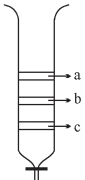
From the figure of column chromatography given below,identify the incorrect statements.
$A.$ Compound '$c$' is more polar than '$a$' and '$b$'
$B.$ Compound '$a$' is least polar
$C.$ Compound '$b$' comes out of the column before '$c$' and after '$a$'
$D.$ Compound '$a$' spends more time in the column
Choose the correct answer from the options given below :-
$A.$ Compound '$c$' is more polar than '$a$' and '$b$'
$B.$ Compound '$a$' is least polar
$C.$ Compound '$b$' comes out of the column before '$c$' and after '$a$'
$D.$ Compound '$a$' spends more time in the column
Choose the correct answer from the options given below :-
A
$A, B$ and $C$ only
B
$B, C$ and $D$ only
C
$A, B$ and $D$ only
D
$B$ and $D$ only
Solution
(A) In column chromatography,the stationary phase is typically polar (e.g.,silica gel).
The compound that is least polar moves faster and elutes first,while the most polar compound moves slower and elutes last.
Based on the figure,compound '$a$' is at the top,'$b$' is in the middle,and '$c$' is at the bottom (closest to the exit).
Therefore,the order of elution is '$c$' (first),then '$b$',then '$a$' (last).
This implies that '$c$' is the least polar and '$a$' is the most polar.
Let's evaluate the statements:
$A.$ '$c$' is more polar than '$a$' and '$b$': Incorrect,'$c$' is the least polar.
$B.$ '$a$' is least polar: Incorrect,'$a$' is the most polar.
$C.$ '$b$' comes out of the column before '$c$' and after '$a$': Incorrect,'$c$' comes out first,then '$b$',then '$a$.'
$D.$ '$a$' spends more time in the column: Correct,as it is the most polar and interacts most strongly with the stationary phase.
The incorrect statements are $A, B,$ and $C$.
The compound that is least polar moves faster and elutes first,while the most polar compound moves slower and elutes last.
Based on the figure,compound '$a$' is at the top,'$b$' is in the middle,and '$c$' is at the bottom (closest to the exit).
Therefore,the order of elution is '$c$' (first),then '$b$',then '$a$' (last).
This implies that '$c$' is the least polar and '$a$' is the most polar.
Let's evaluate the statements:
$A.$ '$c$' is more polar than '$a$' and '$b$': Incorrect,'$c$' is the least polar.
$B.$ '$a$' is least polar: Incorrect,'$a$' is the most polar.
$C.$ '$b$' comes out of the column before '$c$' and after '$a$': Incorrect,'$c$' comes out first,then '$b$',then '$a$.'
$D.$ '$a$' spends more time in the column: Correct,as it is the most polar and interacts most strongly with the stationary phase.
The incorrect statements are $A, B,$ and $C$.
0 likes
View Solution145
MediumMCQ
Using column chromatography,a mixture of two compounds '$A$' and '$B$' was separated. '$A$' eluted first,this indicates '$B$' has
A
low $R_f$,weaker adsorption
B
high $R_f$,stronger adsorption
C
high $R_f$,weaker adsorption
D
low $R_f$,stronger adsorption
Solution
(D) In column chromatography,the compound that elutes first has a weaker interaction with the stationary phase and a higher $R_f$ value.
Conversely,the compound that elutes later has a stronger interaction (adsorption) with the stationary phase and a lower $R_f$ value.
Since '$A$' eluted first,'$B$' must have eluted later.
Therefore,'$B$' has a lower $R_f$ value and stronger adsorption to the stationary phase.
$R_f = \frac{\text{distance covered by substance}}{\text{distance covered by solvent}}$
Conversely,the compound that elutes later has a stronger interaction (adsorption) with the stationary phase and a lower $R_f$ value.
Since '$A$' eluted first,'$B$' must have eluted later.
Therefore,'$B$' has a lower $R_f$ value and stronger adsorption to the stationary phase.
$R_f = \frac{\text{distance covered by substance}}{\text{distance covered by solvent}}$
0 likes
View Solution146
MediumMCQ
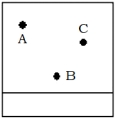
Thin layer chromatography of a mixture shows the following observation:
The correct order of elution in the silica gel column chromatography is
The correct order of elution in the silica gel column chromatography is
A
$A, C, B$
B
$B, C, A$
C
$C, A, B$
D
$B, A, C$
Solution
(A) In thin layer chromatography $(TLC)$,the component that travels the furthest has the highest $R_f$ value,indicating it is the least adsorbed on the stationary phase (silica gel) and has the highest affinity for the mobile phase.
In column chromatography,the component with the highest affinity for the mobile phase elutes first.
Based on the provided $TLC$ plate,the order of distance traveled is $A > C > B$.
Therefore,the order of elution (from first to last) is $A, C, B$.
In column chromatography,the component with the highest affinity for the mobile phase elutes first.
Based on the provided $TLC$ plate,the order of distance traveled is $A > C > B$.
Therefore,the order of elution (from first to last) is $A, C, B$.
0 likes
View Solution147
MediumMCQ
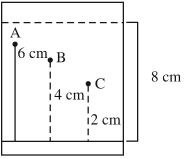
Three organic compounds $A$,$B$ and $C$ were allowed to run in thin layer chromatography using hexane and gave the following result (see figure). The $R_f$ value of the most polar compound is $............\, \times 10^{-2}$
A
$24$
B
$25$
C
$23$
D
$22$
Solution
(B) In thin layer chromatography $(TLC)$,the stationary phase is polar (silica gel) and the mobile phase is non-polar (hexane).
Compounds that are more polar interact more strongly with the stationary phase and travel a shorter distance,resulting in a lower $R_f$ value.
Compounds that are less polar travel a longer distance,resulting in a higher $R_f$ value.
From the figure,the distances traveled by compounds $A$,$B$,and $C$ are $6 \ cm$,$4 \ cm$,and $2 \ cm$ respectively,with the solvent front at $8 \ cm$.
The compound that travels the shortest distance is the most polar.
Thus,compound $C$ is the most polar.
The $R_f$ value for compound $C$ is calculated as:
$R_f = \frac{\text{Distance traveled by compound } C}{\text{Distance traveled by solvent}} = \frac{2 \ cm}{8 \ cm} = 0.25$
Converting this to the required format:
$0.25 = 25 \times 10^{-2}$
Compounds that are more polar interact more strongly with the stationary phase and travel a shorter distance,resulting in a lower $R_f$ value.
Compounds that are less polar travel a longer distance,resulting in a higher $R_f$ value.
From the figure,the distances traveled by compounds $A$,$B$,and $C$ are $6 \ cm$,$4 \ cm$,and $2 \ cm$ respectively,with the solvent front at $8 \ cm$.
The compound that travels the shortest distance is the most polar.
Thus,compound $C$ is the most polar.
The $R_f$ value for compound $C$ is calculated as:
$R_f = \frac{\text{Distance traveled by compound } C}{\text{Distance traveled by solvent}} = \frac{2 \ cm}{8 \ cm} = 0.25$
Converting this to the required format:
$0.25 = 25 \times 10^{-2}$
0 likes
View Solution148
DifficultMCQ
Which of the following statements is correct for paper chromatography?
A
Water present in the mobile phase gets absorbed by the paper which then forms the stationary phase.
B
Water present in the pores of the paper forms the stationary phase.
C
Paper sheet forms the stationary phase.
D
Paper and water present in its pores together form the stationary phase.
Solution
(B) In paper chromatography,a special quality paper known as chromatography paper is used.
This paper contains water trapped in its pores,which acts as the stationary phase.
This paper contains water trapped in its pores,which acts as the stationary phase.
0 likes
View Solution149
DifficultMCQ
The technique used for purification of steam volatile water immiscible substances is:
A
Fractional distillation
B
Fractional distillation under reduced pressure
C
Distillation
D
Steam distillation
Solution
(D) Steam distillation is the technique used for the purification of substances that are steam volatile and immiscible with water.
In this process,the substance is heated by passing steam through it,which carries the volatile component along with it,leaving behind non-volatile impurities.
In this process,the substance is heated by passing steam through it,which carries the volatile component along with it,leaving behind non-volatile impurities.
0 likes
View Solution150
DifficultMCQ
Chromatographic technique/s based on the principle of differential adsorption is/are:
$A$. Column chromatography
$B$. Thin layer chromatography
$C$. Paper chromatography
Choose the most appropriate answer from the options given below:
$A$. Column chromatography
$B$. Thin layer chromatography
$C$. Paper chromatography
Choose the most appropriate answer from the options given below:
A
$B$ only
B
$A$ only
C
$A$ and $B$ only
D
$C$ only
Solution
(C) The principle of differential adsorption is the basis for adsorption chromatography.
$1$. Column chromatography is a type of adsorption chromatography where the stationary phase is a solid adsorbent.
$2$. Thin layer chromatography $(TLC)$ is also a type of adsorption chromatography where a thin layer of adsorbent is coated on a glass or plastic plate.
$3$. Paper chromatography is primarily based on the principle of partition chromatography,where the stationary phase is water trapped in the cellulose fibers of the paper.
Therefore,both Column chromatography $(A)$ and Thin layer chromatography $(B)$ are based on differential adsorption.
$1$. Column chromatography is a type of adsorption chromatography where the stationary phase is a solid adsorbent.
$2$. Thin layer chromatography $(TLC)$ is also a type of adsorption chromatography where a thin layer of adsorbent is coated on a glass or plastic plate.
$3$. Paper chromatography is primarily based on the principle of partition chromatography,where the stationary phase is water trapped in the cellulose fibers of the paper.
Therefore,both Column chromatography $(A)$ and Thin layer chromatography $(B)$ are based on differential adsorption.
0 likes
View Solution8-3.Organic Chemistry : Purification and characterization — Purification of Organic Compounds · Frequently Asked Questions
1Are these 8-3.Organic Chemistry : Purification and characterization questions useful for JEE and NEET?
Yes. All questions in this section are mapped to JEE Main and NEET exam patterns. Previous year questions from JEE Main, NEET, GUJCET and state-level exams are included with full solutions.
2Can I switch to Hindi or Gujarati for these questions?
Yes. Use the language tabs in the hero section or the sidebar to view the same questions and solutions in English, Hindi or Gujarati.
3How do I generate a question paper from this subtopic?
Use the Vedclass Exam Paper Generator — select the chapter and subtopic, set difficulty, and generate Sets A, B, C, D automatically. First 3 chapters of every subject are free.
Vedclass Products
For Students
Vedclass Test Series
Mock tests in real JEE/NEET style with performance analysis. 5-day free trial.
Start Free TrialFor Teachers
Exam Paper Generator
Generate Set A/B/C/D papers from this chapter in 2 minutes. 3 chapters free.
Try FreeFor Institutes
Online Exam Module
Live online exams with unlimited students, 360° analytics & white-label branding.
See DemoFor Teachers & Institutes
Generate a 8-3.Organic Chemistry : Purification and characterization Exam Paper in 2 Minutes
Select subtopic & difficulty — Sets A, B, C, D auto-generated with No Repeat logic.
First 3 chapters of every subject are free — no payment required.