
A English
Purification of Organic Compounds Questions in English
Class 11 Chemistry · 8-3.Organic Chemistry : Purification and characterization · Purification of Organic Compounds
188+
Questions
English
Language
100%
With Solutions
Showing 48 of 188 questions in English
1
MediumMCQ
$A$ mixture of methyl alcohol and acetone can be separated by
A
Distillation
B
Fractional distillation
C
Steam distillation
D
Distillation under reduced pressure
Solution
(B) The boiling points of methanol and acetone are $338 \, K$ and $330 \, K$ respectively.
Since their boiling points are very close to each other,they are separated by the fractional distillation method.
Since their boiling points are very close to each other,they are separated by the fractional distillation method.
0 likes
View Solution2
EasyMCQ
Chromatography is a valuable method for the separation,isolation,purification,and identification of the constituents of a mixture. It is based on the general principle of:
A
Phase rule
B
Phase distribution
C
Interphase separation
D
Phase operation
Solution
(B) Chromatography is a technique used for the separation of components of a mixture. It is based on the principle of differential distribution of the components of a mixture between two phases: a stationary phase and a mobile phase. This is known as phase distribution.
0 likes
View Solution3
EasyMCQ
Chromatography is used for the purification of:
A
Solids
B
Liquids
C
Gases
D
All of these
Solution
(D) Chromatography is a versatile technique used for the purification of organic compounds regardless of their physical state (solid,liquid,or gas).
For solid or liquid organic compounds,column chromatography is commonly employed by dissolving the substance in an appropriate solvent.
For gaseous compounds,gas chromatography is used.
Therefore,chromatography is applicable to all these states.
For solid or liquid organic compounds,column chromatography is commonly employed by dissolving the substance in an appropriate solvent.
For gaseous compounds,gas chromatography is used.
Therefore,chromatography is applicable to all these states.
0 likes
View Solution4
EasyMCQ
The latest technique for the purification of organic compounds is
A
Fractional distillation
B
Chromatography
C
Vacuum distillation
D
Crystallisation
Solution
(B) Chromatography is the latest technique for the purification of organic compounds. Chromatography is of various types,such as column chromatography,gas chromatography,paper chromatography,etc.
0 likes
View Solution5
MediumMCQ
$p-$nitrophenol and $o-$nitrophenol are separated by
A
Crystallisation
B
Fractional crystallisation
C
Distillation
D
Steam distillation
Solution
(D) $o-$nitrophenol exhibits intra-molecular hydrogen bonding,whereas $p-$nitrophenol exhibits inter-molecular hydrogen bonding,which is significantly stronger.
Due to this difference in hydrogen bonding,the boiling point of $o-$nitrophenol is much lower than that of $p-$nitrophenol.
Consequently,$o-$nitrophenol is steam volatile and can be separated from $p-$nitrophenol using steam distillation.
Due to this difference in hydrogen bonding,the boiling point of $o-$nitrophenol is much lower than that of $p-$nitrophenol.
Consequently,$o-$nitrophenol is steam volatile and can be separated from $p-$nitrophenol using steam distillation.
0 likes
View Solution6
MediumMCQ
Gasoline is obtained from crude petroleum oil by its
A
Fractional distillation
B
Vacuum distillation
C
Steam distillation
D
Pyrolysis
Solution
(A) Fractional distillation is used because the difference between the boiling points of the different components in crude oil is relatively small,allowing them to be separated based on their volatility.
0 likes
View Solution7
MediumMCQ
Ethylene has a high $b.p.$ and high vapour pressure at $100\,^{\circ}C$ and does not dissolve in water. Hence,ethylene is separated by this method:
A
Simple distillation
B
Vacuum distillation
C
Vapour distillation
D
Alkali treatment
Solution
(C) Steam distillation,also known as vapour distillation,is a technique used for separating substances that are immiscible with water,volatile in steam,and possess high vapour pressure at the boiling temperature of water.
It is also used for purifying liquids that decompose at their normal boiling points.
Since ethylene has a high $b.p.$ and high vapour pressure at $100\,^{\circ}C$ and does not dissolve in water,it is separated by the vapour distillation method.
It is also used for purifying liquids that decompose at their normal boiling points.
Since ethylene has a high $b.p.$ and high vapour pressure at $100\,^{\circ}C$ and does not dissolve in water,it is separated by the vapour distillation method.
0 likes
View Solution8
DifficultMCQ
Glycerol boils at $290\,^{\circ}C$ with slight decomposition. Impure glycerine can be purified by
A
Steam distillation
B
Simple distillation
C
Vacuum distillation
D
Extraction with a solvent
Solution
(C) Liquids that decompose at their boiling point can be purified by vacuum distillation.
Glycerol,which decomposes at its normal boiling point $(563\,K)$,can be distilled without decomposition at $453\,K$ under reduced pressure $(12\,mm\,Hg)$.
Glycerol,which decomposes at its normal boiling point $(563\,K)$,can be distilled without decomposition at $453\,K$ under reduced pressure $(12\,mm\,Hg)$.
0 likes
View Solution9
MediumMCQ
Aniline is usually purified by
A
Steam distillation
B
Simple distillation
C
Vacuum distillation
D
Extraction with a solvent
Solution
(A) Aniline is purified by steam distillation.
The temperature required for the simple distillation of aniline is too high,which causes it to decompose.
Steam distillation allows the process to occur at a lower temperature,preventing decomposition.
The temperature required for the simple distillation of aniline is too high,which causes it to decompose.
Steam distillation allows the process to occur at a lower temperature,preventing decomposition.
0 likes
View Solution10
EasyMCQ
In chromatography,what does $R_f$ stand for?
A
Retention factor
B
Reduced formula
C
Reduction factor
D
Retention frequency
Solution
(A) In chromatography,the term $R_f$ stands for the $Retention \ factor$.
It is defined as the ratio of the distance traveled by the solute to the distance traveled by the solvent front from the baseline.
Mathematically,$R_f = \frac{\text{distance traveled by the solute}}{\text{distance traveled by the solvent front}}$.
It is defined as the ratio of the distance traveled by the solute to the distance traveled by the solvent front from the baseline.
Mathematically,$R_f = \frac{\text{distance traveled by the solute}}{\text{distance traveled by the solvent front}}$.
0 likes
View Solution11
EasyMCQ
Which property should a solvent used in crystallization possess?
A
The impure compound should be sparingly soluble in it at room temperature.
B
The impure compound should be highly soluble in it at high temperatures.
C
Both $A$ and $B$.
D
Neither $A$ nor $B$.
Solution
(C) Crystallization is a technique used to purify solid organic compounds. The basic principle is that the compound to be purified should be sparingly soluble in a suitable solvent at room temperature but should dissolve readily in the same solvent at higher temperatures (near its boiling point). Upon cooling the hot saturated solution,the pure compound crystallizes out,leaving the impurities in the solution. Therefore,both properties mentioned in $A$ and $B$ are essential for an ideal solvent.
0 likes
View Solution12
EasyMCQ
Suggest the method for the purification of naphthalene.
A
Sublimation
B
Crystallization
C
Fractional distillation
D
Distillation
Solution
(A) Naphthalene is an organic compound that undergoes sublimation,which is the process of direct transition from solid to gas phase upon heating. Therefore,it is purified by the method of $Sublimation$.
0 likes
View Solution13
EasyMCQ
Chromatography is used for the purification of which of the following?
A
Solids
B
Liquids
C
Gases
D
All of the above
Solution
(D) Chromatography is a versatile technique used for the separation and purification of mixtures. It can be applied to substances in various physical states,including $solids$,$liquids$,and $gases$. Therefore,all the given options are correct.
0 likes
View Solution14
EasyMCQ
Which purification method is used to separate a volatile liquid from non-volatile impurities?
A
Sublimation
B
Distillation
C
Crystallization
D
Fractional crystallization
Solution
(B) Distillation is the process used to separate a volatile liquid from non-volatile impurities. In this method,the liquid is heated to its boiling point to form vapor,which is then condensed back into a liquid,leaving the non-volatile impurities behind in the distillation flask.
0 likes
View Solution15
EasyMCQ
Which purification method is used to separate liquids that have a sufficient difference in their boiling points?
A
Sublimation
B
Distillation
C
Filtration
D
Crystallization
Solution
(B) Distillation is the process used to separate a mixture of liquids that have a sufficient difference in their boiling points.
In this process,the liquid with the lower boiling point vaporizes first,is condensed,and then collected,while the liquid with the higher boiling point remains in the distillation flask.
In this process,the liquid with the lower boiling point vaporizes first,is condensed,and then collected,while the liquid with the higher boiling point remains in the distillation flask.
0 likes
View Solution16
EasyMCQ
Which method is used to separate glycerol from spent lye in the soap industry?
A
Simple distillation
B
Fractional distillation
C
Distillation under reduced pressure
D
None of the above
Solution
(C) In the soap industry,glycerol is obtained as a byproduct.
It is separated from the spent lye by the process of distillation under reduced pressure.
This is because glycerol has a high boiling point and tends to decompose at its normal boiling point.
By reducing the pressure,the boiling point is lowered,allowing it to be distilled without decomposition.
It is separated from the spent lye by the process of distillation under reduced pressure.
This is because glycerol has a high boiling point and tends to decompose at its normal boiling point.
By reducing the pressure,the boiling point is lowered,allowing it to be distilled without decomposition.
0 likes
View Solution17
MediumMCQ
Which method is used to separate a mixture of aniline and water?
A
Steam distillation
B
Distillation under reduced pressure
C
Sublimation
D
None of the above
Solution
(A) Aniline is steam volatile and insoluble in water. Therefore,a mixture of aniline and water is separated by the process of $Steam \ distillation$.
0 likes
View Solution18
MediumMCQ
Which of the following methods is used for the purification of organic compounds?
A
Oxidation
B
Reduction
C
Distillation
D
Hydrolysis
Solution
(C) The purification of organic compounds is achieved through various techniques such as sublimation,crystallization,distillation,differential extraction,and chromatography.
Among the given options,$Distillation$ is a standard method used for the purification of liquids,especially those that boil without decomposition and have sufficient difference in their boiling points.
Among the given options,$Distillation$ is a standard method used for the purification of liquids,especially those that boil without decomposition and have sufficient difference in their boiling points.
0 likes
View Solution19
EasyMCQ
The fragrance of flowers is due to the presence of some steam-volatile organic compounds. These compounds are known as essential oils. At room temperature,these oils are insoluble in water but are miscible with water vapor. Name the suitable method for the extraction of these oils from flowers.
A
Distillation
B
Crystallization
C
Distillation under reduced pressure
D
Steam distillation
Solution
(D) Essential oils are steam-volatile and are immiscible with water.
They can be extracted from flowers using $Steam \ distillation$.
In this process,steam is passed through the plant material,which carries the volatile essential oils with it,and the mixture is then condensed and separated.
They can be extracted from flowers using $Steam \ distillation$.
In this process,steam is passed through the plant material,which carries the volatile essential oils with it,and the mixture is then condensed and separated.
0 likes
View Solution20
EasyMCQ
How can an organic compound present in an aqueous solution be separated?
A
Distillation
B
Solvent extraction
C
Fractional distillation
D
Steam distillation
Solution
(B) The process of separating an organic compound from an aqueous solution is known as $Solvent \ extraction$.
In this method,the organic compound is more soluble in an organic solvent (like ether or chloroform) than in water.
When the organic solvent is added to the aqueous solution in a separating funnel,the organic compound gets transferred to the organic layer,which can then be separated.
In this method,the organic compound is more soluble in an organic solvent (like ether or chloroform) than in water.
When the organic solvent is added to the aqueous solution in a separating funnel,the organic compound gets transferred to the organic layer,which can then be separated.
0 likes
View Solution21
EasyMCQ
Suggest a method for the purification of camphor contaminated with salt.
A
Crystallization
B
Fractional crystallization
C
Sublimation
D
Distillation
Solution
(C) Camphor is a sublime substance,meaning it changes directly from a solid to a gas upon heating. Salt $(NaCl)$ does not sublime. Therefore,sublimation is the most suitable method to separate camphor from salt impurities.
0 likes
View Solution22
EasyMCQ
What is chromatography used for?
A
Separation of mixtures
B
Purification of compounds
C
Testing the purity of compounds
D
All of the above
Solution
(D) Chromatography is a versatile technique used in chemistry for multiple purposes.
It is primarily used for the $1.$ separation of components in a mixture,$2.$ purification of chemical compounds,and $3.$ testing the purity of compounds.
Therefore,all the given options are correct.
It is primarily used for the $1.$ separation of components in a mixture,$2.$ purification of chemical compounds,and $3.$ testing the purity of compounds.
Therefore,all the given options are correct.
0 likes
View Solution23
EasyMCQ
What is the purification method based on the principle that the compound and the impurities have different solubilities in a given solvent?
A
Sublimation
B
Crystallization
C
Distillation
D
Fractional distillation
Solution
(B) The purification method based on the difference in solubilities of the compound and its impurities in a suitable solvent is known as $Crystallization$. In this process,the impure solid is dissolved in a minimum amount of a suitable solvent at a high temperature and then cooled slowly to obtain pure crystals of the compound.
0 likes
View Solution24
EasyMCQ
When is distillation under reduced pressure used?
A
When the liquid has a high boiling point and decomposes at or below its boiling point.
B
When the liquid has a very low boiling point.
C
When the liquid is insoluble in water.
D
When the liquid is insoluble in organic solvents.
Solution
(A) Distillation under reduced pressure is used for liquids that have high boiling points and tend to decompose at or below their boiling points at atmospheric pressure. By reducing the pressure,the boiling point of the liquid is lowered,allowing it to boil and vaporize at a temperature below its decomposition point.
0 likes
View Solution25
MediumMCQ
Suggest a method for the separation of a mixture of $o$-nitroaniline and $p$-nitroaniline.
A
Distillation
B
Chromatography
C
Fractional crystallization
D
All of these
0 likes
View Solution26
MediumMCQ
Aniline is separated from a mixture by
A
Fractional crystallization
B
Fractional distillation
C
Vacuum distillation
D
Steam distillation
Solution
(D) Steam distillation is used for the separation of aniline from a mixture.
Aniline is insoluble in water,but it is steam volatile.
Aniline is insoluble in water,but it is steam volatile.
0 likes
View Solution27
MediumMCQ
The most suitable method of separation of a $1:1$ mixture of $ortho$- and $para$-nitrophenols is:
A
Chromatography
B
Crystallisation
C
Steam distillation
D
Sublimation
Solution
(C) $o$-Nitrophenol and $p$-nitrophenol can be separated by steam distillation.
$o$-Nitrophenol is steam volatile due to the presence of intramolecular hydrogen bonding,which reduces its intermolecular attraction.
In contrast,$p$-nitrophenol exhibits intermolecular hydrogen bonding,leading to the association of molecules,which makes it less volatile.
Therefore,$o$-nitrophenol distills over with steam,while $p$-nitrophenol remains in the distillation flask.
$o$-Nitrophenol is steam volatile due to the presence of intramolecular hydrogen bonding,which reduces its intermolecular attraction.
In contrast,$p$-nitrophenol exhibits intermolecular hydrogen bonding,leading to the association of molecules,which makes it less volatile.
Therefore,$o$-nitrophenol distills over with steam,while $p$-nitrophenol remains in the distillation flask.
0 likes
View Solution28
MediumMCQ
The distillation technique most suited for separating glycerol from spent-lye in the soap industry is:
A
Steam distillation.
B
Distillation under reduced pressure.
C
Simple distillation.
D
Fractional distillation.
Solution
(B) Spent-lye and glycerol are separated by distillation under reduced pressure.
Under reduced pressure,the liquid boils at a lower temperature,preventing thermal decomposition.
For example,glycerol boils at $290^{\circ}C$ with decomposition at atmospheric pressure,but at reduced pressure,it boils at $180^{\circ}C$ without decomposition.
Under reduced pressure,the liquid boils at a lower temperature,preventing thermal decomposition.
For example,glycerol boils at $290^{\circ}C$ with decomposition at atmospheric pressure,but at reduced pressure,it boils at $180^{\circ}C$ without decomposition.
0 likes
View Solution29
MediumMCQ
In an aniline and water mixture,aniline can be separated by:
A
Steam distillation
B
Fractional distillation
C
Simple distillation
D
Distillation under reduced pressure
Solution
(A) Steam distillation is a separation process used to purify substances that are volatile in steam,immiscible with water,and possess a high boiling point.
The principle of steam distillation is that the mixture boils when the sum of the vapor pressures of the two immiscible liquids (water and the organic compound) equals the atmospheric pressure.
Since the vapor pressure of the mixture is higher than that of the individual components,the mixture boils at a temperature lower than the boiling point of either component.
Aniline is immiscible with water and has a high boiling point $(184 \ ^{\circ}C)$,making steam distillation the ideal method for its separation.
The principle of steam distillation is that the mixture boils when the sum of the vapor pressures of the two immiscible liquids (water and the organic compound) equals the atmospheric pressure.
Since the vapor pressure of the mixture is higher than that of the individual components,the mixture boils at a temperature lower than the boiling point of either component.
Aniline is immiscible with water and has a high boiling point $(184 \ ^{\circ}C)$,making steam distillation the ideal method for its separation.
0 likes
View Solution30
EasyMCQ
To separate different fractions of crude oil in the petroleum industry,the method used is:
A
Fractional distillation
B
Steam distillation
C
Reduced pressure distillation
D
Simple distillation
Solution
(A) Crude oil is a mixture of various hydrocarbons with different boiling points.
Fractional distillation is the process used to separate these components based on their differences in boiling points.
In the petroleum industry,this is carried out in a fractionating column where the crude oil is heated,and different fractions are collected at different heights corresponding to their boiling ranges.
Fractional distillation is the process used to separate these components based on their differences in boiling points.
In the petroleum industry,this is carried out in a fractionating column where the crude oil is heated,and different fractions are collected at different heights corresponding to their boiling ranges.
0 likes
View Solution31
EasyMCQ
Aniline-water mixture can be separated by
A
Steam distillation
B
Extraction
C
Chromatography
D
Sublimation
Solution
(A) Steam distillation is a separation process used for substances that are volatile in steam and immiscible with water.
The principle of steam distillation is that the mixture boils when the sum of the vapor pressures of the two components (water and the organic substance) equals the atmospheric pressure.
Since the vapor pressure of the mixture is higher than the vapor pressure of the individual components,the mixture boils at a temperature lower than the boiling point of either component.
Aniline is immiscible with water and volatile in steam,making steam distillation the ideal method for its separation from water.
The principle of steam distillation is that the mixture boils when the sum of the vapor pressures of the two components (water and the organic substance) equals the atmospheric pressure.
Since the vapor pressure of the mixture is higher than the vapor pressure of the individual components,the mixture boils at a temperature lower than the boiling point of either component.
Aniline is immiscible with water and volatile in steam,making steam distillation the ideal method for its separation from water.
0 likes
View Solution32
MediumMCQ
Which of the following statements is incorrect?
A
Ortho-nitrophenol and para-nitrophenol are separated by steam distillation.
B
When the difference in boiling points of two organic compounds is $10\,^{\circ}C$ or less,they are separated by fractional distillation.
C
Aniline is purified by steam distillation.
D
In the soap industry,glycerol is separated by fractional distillation.
Solution
(D) $1$. Ortho-nitrophenol is steam volatile due to intramolecular hydrogen bonding,while para-nitrophenol is not due to intermolecular hydrogen bonding. Thus,they are separated by steam distillation. (Correct)
$2$. Fractional distillation is used when the difference in boiling points is small (less than $20\,^{\circ}C$ to $30\,^{\circ}C$). The statement mentioning $10\,^{\circ}C$ is generally acceptable in this context. (Correct)
$3$. Aniline is sensitive to high temperatures and decomposes before boiling at atmospheric pressure; therefore,it is purified by steam distillation. (Correct)
$4$. Glycerol is separated from spent lye in the soap industry by distillation under reduced pressure,not by fractional distillation. (Incorrect)
$2$. Fractional distillation is used when the difference in boiling points is small (less than $20\,^{\circ}C$ to $30\,^{\circ}C$). The statement mentioning $10\,^{\circ}C$ is generally acceptable in this context. (Correct)
$3$. Aniline is sensitive to high temperatures and decomposes before boiling at atmospheric pressure; therefore,it is purified by steam distillation. (Correct)
$4$. Glycerol is separated from spent lye in the soap industry by distillation under reduced pressure,not by fractional distillation. (Incorrect)
0 likes
View Solution33
EasyMCQ
Which of the following compounds is used as an adsorbent in column chromatography?
A
$Na_2O$
B
$Na_2SO_4$
C
$Al_2O_3$
D
$NaCl$
Solution
(C) The most commonly used adsorbents in column chromatography are $Al_2O_3$ (alumina) and silica gel $(SiO_2)$.
These materials are preferred because they possess a high surface area and are porous in nature,allowing them to adsorb substances onto their surface through intermolecular forces.
These materials are preferred because they possess a high surface area and are porous in nature,allowing them to adsorb substances onto their surface through intermolecular forces.
0 likes
View Solution34
DifficultMCQ
Which of the following compounds can be separated by the steam distillation method?
A
Steam volatile but insoluble in water
B
Steam volatile but soluble in water
C
Steam non-volatile but sparingly soluble in water
D
Liquid in steam but solid in water
Solution
(A) Steam distillation is a technique used for the purification of organic compounds that are steam volatile and insoluble in water.
For a compound to be separated by this method,it must possess a high vapor pressure at the boiling point of water $(100 \ ^\circ C)$ and should not react with water.
For a compound to be separated by this method,it must possess a high vapor pressure at the boiling point of water $(100 \ ^\circ C)$ and should not react with water.
0 likes
View Solution35
AdvancedMCQ
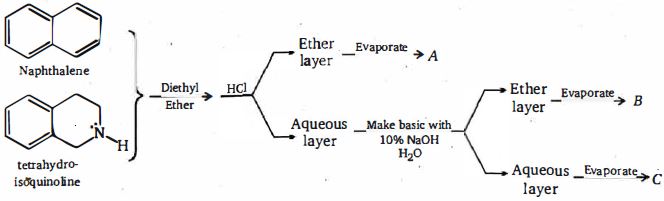
Choose the statement that is true about $A$,$B$ and $C$ in the following separation scheme.
A
$A =$ tetrahydroisoquinoline,$B =$ naphthalene and $C =$ inorganic ions such as $Na^{+}$ and $Cl^{-}$
B
$A =$ naphthalene,$B =$ tetrahydroisoquinoline and $C =$ inorganic ions such as $Na^{+}$ and $Cl^{-}$
C
$A =$ inorganic ions such as $Na^{+}$ and $Cl^{-}$,$B =$ naphthalene and $C =$ tetrahydroisoquinoline
D
$A =$ naphthalene,$B =$ inorganic ions such as $Na^{+}$ and $Cl^{-}$ and $C =$ tetrahydroisoquinoline
Solution
(B) $1$. Naphthalene is a neutral organic compound,while tetrahydroisoquinoline is a basic amine.
$2$. When treated with $HCl$,the basic tetrahydroisoquinoline reacts to form a water-soluble salt (tetrahydroisoquinolinium chloride),which enters the aqueous layer.
$3$. Naphthalene remains in the diethyl ether layer. Evaporation of the ether layer yields $A =$ naphthalene.
$4$. The aqueous layer contains the salt of the amine. Adding $NaOH$ makes the solution basic,converting the salt back to the free base (tetrahydroisoquinoline),which is organic-soluble and moves into the ether layer.
$5$. Evaporation of this second ether layer yields $B =$ tetrahydroisoquinoline.
$6$. The remaining aqueous layer contains inorganic salts like $NaCl$ formed during the neutralization. Evaporation of this layer yields $C =$ inorganic ions such as $Na^{+}$ and $Cl^{-}$.
$2$. When treated with $HCl$,the basic tetrahydroisoquinoline reacts to form a water-soluble salt (tetrahydroisoquinolinium chloride),which enters the aqueous layer.
$3$. Naphthalene remains in the diethyl ether layer. Evaporation of the ether layer yields $A =$ naphthalene.
$4$. The aqueous layer contains the salt of the amine. Adding $NaOH$ makes the solution basic,converting the salt back to the free base (tetrahydroisoquinoline),which is organic-soluble and moves into the ether layer.
$5$. Evaporation of this second ether layer yields $B =$ tetrahydroisoquinoline.
$6$. The remaining aqueous layer contains inorganic salts like $NaCl$ formed during the neutralization. Evaporation of this layer yields $C =$ inorganic ions such as $Na^{+}$ and $Cl^{-}$.
0 likes
View Solution36
DifficultMCQ
The correct match between items of List-$I$ and List-$II$ is
| List-$I$ | List-$II$ |
| $A$. Coloured impurity | $(p)$. Steam distillation |
| $B$. Mixture of $o-$nitrophenol and $p-$nitrophenol | $(q)$. Fractional distillation |
| $C$. Crude naphtha | $(r)$. Charcoal treatment |
| $D$. Mixture of glycerol and sugars | $(s)$. Distillation under reduced pressure |
A
$A-r, B-p, C-q, D-s$
B
$A-p, B-s, C-r, D-q$
C
$A-r, B-p, C-s, D-q$
D
$A-r, B-q, C-p, D-s$
Solution
(A) . Coloured impurity is removed by charcoal treatment $(r)$.
$B$. Mixture of $o-$nitrophenol and $p-$nitrophenol is separated by steam distillation $(p)$ because $o-$nitrophenol is steam volatile due to intramolecular hydrogen bonding.
$C$. Crude naphtha is separated by fractional distillation $(q)$.
$D$. Mixture of glycerol and sugars is separated by distillation under reduced pressure $(s)$ to prevent decomposition of glycerol at high temperatures.
Therefore,the correct match is $A-r, B-p, C-q, D-s$.
$B$. Mixture of $o-$nitrophenol and $p-$nitrophenol is separated by steam distillation $(p)$ because $o-$nitrophenol is steam volatile due to intramolecular hydrogen bonding.
$C$. Crude naphtha is separated by fractional distillation $(q)$.
$D$. Mixture of glycerol and sugars is separated by distillation under reduced pressure $(s)$ to prevent decomposition of glycerol at high temperatures.
Therefore,the correct match is $A-r, B-p, C-q, D-s$.
0 likes
View Solution37
DifficultMCQ
Which of the following statements is not true about partition chromatography?
A
Mobile phase can be a gas
B
Stationary phase is a finely divided solid adsorbent
C
Separation depends upon equilibration of solute between a mobile and a stationary phase
D
Paper chromatography is an example of partition chromatography
Solution
(B) Partition chromatography is based on the continuous differential partitioning of components of a mixture between a stationary phase and a mobile phase.
In partition chromatography,the stationary phase is typically a liquid held on a solid support,whereas in adsorption chromatography,the stationary phase is a finely divided solid adsorbent.
Therefore,the statement that the stationary phase is a finely divided solid adsorbent is incorrect for partition chromatography.
In partition chromatography,the stationary phase is typically a liquid held on a solid support,whereas in adsorption chromatography,the stationary phase is a finely divided solid adsorbent.
Therefore,the statement that the stationary phase is a finely divided solid adsorbent is incorrect for partition chromatography.
0 likes
View Solution38
DifficultMCQ
The correct match between Item $I$ and Item $II$ is
| Item $I$ | Item $II$ |
| $a$. Benzaldehyde | $p$. Mobile phase |
| $b$. Alumina | $q$. Adsorbent |
| $c$. Acetonitrile | $r$. Adsorbate |
A
$a \to q, b \to p, c \to r$
B
$a \to r, b \to q, c \to p$
C
$a \to q, b \to r, c \to p$
D
$a \to p, b \to r, c \to q$
Solution
(B) In chromatography,the substance being separated is the adsorbate,the stationary phase is the adsorbent,and the solvent is the mobile phase.
$a$. Benzaldehyde acts as the adsorbate $(r)$ which is adsorbed on the stationary phase.
$b$. Alumina $(Al_2O_3)$ is a common stationary phase used as an adsorbent $(q)$.
$c$. Acetonitrile is a common solvent used as a mobile phase $(p)$.
Therefore,the correct matching is $a \to r, b \to q, c \to p$.
$a$. Benzaldehyde acts as the adsorbate $(r)$ which is adsorbed on the stationary phase.
$b$. Alumina $(Al_2O_3)$ is a common stationary phase used as an adsorbent $(q)$.
$c$. Acetonitrile is a common solvent used as a mobile phase $(p)$.
Therefore,the correct matching is $a \to r, b \to q, c \to p$.
0 likes
View Solution39
DifficultMCQ
If dichloromethane $(DCM)$ and water $(H_2O)$ are used for differential extraction,which one of the following statements is correct?
A
$DCM$ and $H_2O$ would stay as lower and upper layer respectively in the $S.F$.
B
$DCM$ and $H_2O$ will make turbid/colloidal mixture.
C
$DCM$ and $H_2O$ would stay as upper and lower layer respectively in the separating funnel $(S.F)$.
D
$DCM$ and $H_2O$ will be miscible clearly.
Solution
(A) The density of dichloromethane $(DCM)$ is approximately $1.33 \ g/cm^3$,which is greater than the density of water $(H_2O)$,which is $1.00 \ g/cm^3$.
Because $DCM$ is denser than water,it will form the lower layer,and water will form the upper layer in a separating funnel $(S.F)$.
Because $DCM$ is denser than water,it will form the lower layer,and water will form the upper layer in a separating funnel $(S.F)$.
0 likes
View Solution40
MediumMCQ
The principle of column chromatography is
A
Differential absorption of the substances on the solid phase.
B
Differential adsorption of the substances on the solid phase.
C
Gravitational force.
D
Capillary action.
Solution
(B) Column chromatography is based on the principle of differential adsorption of substances on the solid stationary phase.
As the mixture moves through the column,different components are adsorbed to different extents,leading to their separation.
Therefore,option $B$ is correct.
As the mixture moves through the column,different components are adsorbed to different extents,leading to their separation.
Therefore,option $B$ is correct.
0 likes
View Solution41
MediumMCQ
Glycerol boils at $290\,^oC$ with slight decomposition. Impure glycerin can be purified by:
A
Steam distillation
B
Simple distillation
C
Vacuum distillation
D
Extraction with a solvent
Solution
(C) Liquids that decompose at or near their boiling point are purified by vacuum distillation.
Since glycerol decomposes at its normal boiling point of $563\,K$ $(290\,^oC)$,it is distilled under reduced pressure.
By lowering the pressure to $12\,mm\,Hg$,the boiling point of glycerol is reduced to $453\,K$,allowing it to be distilled without decomposition.
Since glycerol decomposes at its normal boiling point of $563\,K$ $(290\,^oC)$,it is distilled under reduced pressure.
By lowering the pressure to $12\,mm\,Hg$,the boiling point of glycerol is reduced to $453\,K$,allowing it to be distilled without decomposition.
0 likes
View Solution42
EasyMCQ
Glycerol is purified by
A
Steam distillation
B
Vacuum distillation
C
Sublimation
D
Simple distillation
Solution
(B) Liquids that decompose at or below their boiling point are purified by vacuum distillation.
Glycerol decomposes at its normal boiling point of $563 \, K$.
By reducing the pressure to $12 \, mm \, Hg$,glycerol can be distilled at a lower temperature of $453 \, K$ without undergoing decomposition.
Glycerol decomposes at its normal boiling point of $563 \, K$.
By reducing the pressure to $12 \, mm \, Hg$,glycerol can be distilled at a lower temperature of $453 \, K$ without undergoing decomposition.
0 likes
View Solution43
EasyMCQ
Which of the following can be purified by sublimation?
A
$F_2$
B
$Cl_2$
C
$Br_2$
D
$I_2$
Solution
(D) Sublimation is a process used to purify substances that change directly from solid to gas phase upon heating.
Among the given halogens,$F_2$ is a gas,$Cl_2$ is a gas,and $Br_2$ is a liquid at room temperature.
$I_2$ (iodine) is a solid at room temperature and readily undergoes sublimation when heated.
Therefore,$I_2$ can be purified by the process of sublimation.
Among the given halogens,$F_2$ is a gas,$Cl_2$ is a gas,and $Br_2$ is a liquid at room temperature.
$I_2$ (iodine) is a solid at room temperature and readily undergoes sublimation when heated.
Therefore,$I_2$ can be purified by the process of sublimation.
0 likes
View Solution44
AdvancedMCQ
$A$ chromatography column,packed with silica gel as the stationary phase,was used to separate a mixture of compounds consisting of $(A)$ benzanilide,$(B)$ aniline,and $(C)$ acetophenone. When the column is eluted with a mixture of solvents,hexane: ethyl acetate $(20: 80)$,the sequence of obtained compounds is:
A
$(B), (C)$ and $(A)$
B
$(C), (A)$ and $(B)$
C
$(A), (B)$ and $(C)$
D
$(B), (A)$ and $(C)$
Solution
(B) In silica gel column chromatography,the stationary phase is polar (silica gel,$SiO_2$).
Compounds are separated based on their polarity; the least polar compound elutes first,and the most polar compound elutes last.
The polarity of the given compounds is determined by their dipole moments and hydrogen bonding capability:
$1.$ Acetophenone $(Ph-CO-CH_3)$: Dipole moment $\approx 3.05 \ D$.
$2.$ Benzanilide $(Ph-NH-CO-Ph)$: Dipole moment $\approx 2.71 \ D$ (has hydrogen bonding).
$3.$ Aniline $(Ph-NH_2)$: Dipole moment $\approx 1.59 \ D$ (has strong hydrogen bonding with silica gel).
However,considering the interaction with the polar stationary phase,the elution order depends on the strength of adsorption.
Aniline,being a primary amine,interacts strongly with the acidic silanol groups of silica gel.
Acetophenone is the least polar among the three.
Thus,the elution order is $(C)$ (Acetophenone) followed by $(A)$ (Benzanilide) and finally $(B)$ (Aniline).
Compounds are separated based on their polarity; the least polar compound elutes first,and the most polar compound elutes last.
The polarity of the given compounds is determined by their dipole moments and hydrogen bonding capability:
$1.$ Acetophenone $(Ph-CO-CH_3)$: Dipole moment $\approx 3.05 \ D$.
$2.$ Benzanilide $(Ph-NH-CO-Ph)$: Dipole moment $\approx 2.71 \ D$ (has hydrogen bonding).
$3.$ Aniline $(Ph-NH_2)$: Dipole moment $\approx 1.59 \ D$ (has strong hydrogen bonding with silica gel).
However,considering the interaction with the polar stationary phase,the elution order depends on the strength of adsorption.
Aniline,being a primary amine,interacts strongly with the acidic silanol groups of silica gel.
Acetophenone is the least polar among the three.
Thus,the elution order is $(C)$ (Acetophenone) followed by $(A)$ (Benzanilide) and finally $(B)$ (Aniline).
0 likes
View Solution45
MediumMCQ
$A$ flask contains a mixture of isohexane and $3-$methylpentane. One of the liquids boils at $63^{\circ}C$ while the other boils at $60^{\circ}C$. What is the best way to separate the two liquids and which one will be distilled out first?
A
simple distillation,$3-$methylpentane
B
simple distillation,isohexane
C
fractional distillation,isohexane
D
fractional distillation,$3-$methylpentane
0 likes
View Solution46
Medium
Give a brief description of the principles of the following techniques taking an example in each case.
$(a)$ Crystallisation
$(b)$ Distillation
$(c)$ Chromatography
$(a)$ Crystallisation
$(b)$ Distillation
$(c)$ Chromatography
Solution
(N/A) Crystallisation
Crystallisation is one of the most commonly used techniques for the purification of solid organic compounds.
Principle: It is based on the difference in the solubilities of the compound and the impurities in a given solvent. The impure compound is dissolved in a solvent in which it is sparingly soluble at room temperature but appreciably soluble at higher temperatures. The solution is concentrated to obtain a nearly saturated solution. On cooling the solution,the pure compound crystallises out and is removed by filtration.
Example: Pure aspirin is obtained by recrystallising crude aspirin. Approximately $2-4 \ g$ of crude aspirin is dissolved in about $20 \ mL$ of ethyl alcohol. The solution is heated to ensure complete dissolution. The solution is then left undisturbed until crystals start to separate out. The crystals are then filtered and dried.
$(b)$ Distillation
This method is used to separate volatile liquids from non-volatile impurities or a mixture of liquids that have a sufficient difference in their boiling points.
Principle: It is based on the fact that liquids having different boiling points vaporise at different temperatures. The vapours are then cooled and the liquids so formed are collected separately.
Example: $A$ mixture of chloroform $(b.p. = 334 \ K)$ and aniline $(b.p. = 457 \ K)$ can be separated by distillation. The mixture is heated in a round-bottom flask. Chloroform,being more volatile,vaporises first,passes into the condenser,and is collected as a liquid. Aniline remains in the flask.
$(c)$ Chromatography
It is one of the most useful methods for the separation and purification of organic compounds.
Principle: It is based on the difference in movement of individual components of a mixture through a stationary phase under the influence of a mobile phase.
Example: $A$ mixture of red and blue ink can be separated by chromatography. $A$ drop of the mixture is placed on the chromatogram. The component that is less adsorbed on the stationary phase moves faster with the mobile phase,while the more strongly adsorbed component moves slower.
Crystallisation is one of the most commonly used techniques for the purification of solid organic compounds.
Principle: It is based on the difference in the solubilities of the compound and the impurities in a given solvent. The impure compound is dissolved in a solvent in which it is sparingly soluble at room temperature but appreciably soluble at higher temperatures. The solution is concentrated to obtain a nearly saturated solution. On cooling the solution,the pure compound crystallises out and is removed by filtration.
Example: Pure aspirin is obtained by recrystallising crude aspirin. Approximately $2-4 \ g$ of crude aspirin is dissolved in about $20 \ mL$ of ethyl alcohol. The solution is heated to ensure complete dissolution. The solution is then left undisturbed until crystals start to separate out. The crystals are then filtered and dried.
$(b)$ Distillation
This method is used to separate volatile liquids from non-volatile impurities or a mixture of liquids that have a sufficient difference in their boiling points.
Principle: It is based on the fact that liquids having different boiling points vaporise at different temperatures. The vapours are then cooled and the liquids so formed are collected separately.
Example: $A$ mixture of chloroform $(b.p. = 334 \ K)$ and aniline $(b.p. = 457 \ K)$ can be separated by distillation. The mixture is heated in a round-bottom flask. Chloroform,being more volatile,vaporises first,passes into the condenser,and is collected as a liquid. Aniline remains in the flask.
$(c)$ Chromatography
It is one of the most useful methods for the separation and purification of organic compounds.
Principle: It is based on the difference in movement of individual components of a mixture through a stationary phase under the influence of a mobile phase.
Example: $A$ mixture of red and blue ink can be separated by chromatography. $A$ drop of the mixture is placed on the chromatogram. The component that is less adsorbed on the stationary phase moves faster with the mobile phase,while the more strongly adsorbed component moves slower.
0 likes
View Solution47
Medium
What is the difference between distillation,distillation under reduced pressure,and steam distillation?
Solution
(N/A) The differences among distillation,distillation under reduced pressure,and steam distillation are summarized in the table below.
| Method | Description and Application |
| $1$. Distillation | Used for liquids that do not decompose on boiling and have sufficient difference in boiling points. Example: Separation of petrol and kerosene. |
| $2$. Distillation under reduced pressure | Used for liquids that decompose at their boiling point. Reduced pressure lowers the boiling point,preventing decomposition. Example: Purification of glycerol. |
| $3$. Steam distillation | Used for organic compounds that are steam volatile and immiscible in water. Example: Separation of aniline from water. |
0 likes
View Solution48
Medium
Explain the principle of paper chromatography.
Solution
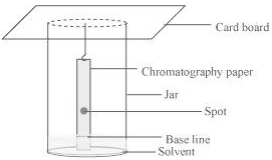
(N/A) Paper chromatography is a type of partition chromatography.
It involves the use of a special quality paper known as chromatography paper.
This paper contains water trapped in it,which acts as the stationary phase.
$A$ solution of the mixture is spotted on the base of this chromatography paper.
The paper strip is then suspended in a suitable solvent or a mixture of solvents,which acts as the mobile phase.
This solvent rises up the chromatography paper by capillary action and flows over the spot.
The components of the mixture are selectively retained on the paper based on their differing partition coefficients between the stationary phase (water) and the mobile phase.
As the mobile phase moves,the components travel to different heights on the paper.
The final paper strip obtained is known as a chromatogram.
It involves the use of a special quality paper known as chromatography paper.
This paper contains water trapped in it,which acts as the stationary phase.
$A$ solution of the mixture is spotted on the base of this chromatography paper.
The paper strip is then suspended in a suitable solvent or a mixture of solvents,which acts as the mobile phase.
This solvent rises up the chromatography paper by capillary action and flows over the spot.
The components of the mixture are selectively retained on the paper based on their differing partition coefficients between the stationary phase (water) and the mobile phase.
As the mobile phase moves,the components travel to different heights on the paper.
The final paper strip obtained is known as a chromatogram.
0 likes
View Solution8-3.Organic Chemistry : Purification and characterization — Purification of Organic Compounds · Frequently Asked Questions
1Are these 8-3.Organic Chemistry : Purification and characterization questions useful for JEE and NEET?
Yes. All questions in this section are mapped to JEE Main and NEET exam patterns. Previous year questions from JEE Main, NEET, GUJCET and state-level exams are included with full solutions.
2Can I switch to Hindi or Gujarati for these questions?
Yes. Use the language tabs in the hero section or the sidebar to view the same questions and solutions in English, Hindi or Gujarati.
3How do I generate a question paper from this subtopic?
Use the Vedclass Exam Paper Generator — select the chapter and subtopic, set difficulty, and generate Sets A, B, C, D automatically. First 3 chapters of every subject are free.
Vedclass Products
For Students
Vedclass Test Series
Mock tests in real JEE/NEET style with performance analysis. 5-day free trial.
Start Free TrialFor Teachers
Exam Paper Generator
Generate Set A/B/C/D papers from this chapter in 2 minutes. 3 chapters free.
Try FreeFor Institutes
Online Exam Module
Live online exams with unlimited students, 360° analytics & white-label branding.
See DemoFor Teachers & Institutes
Generate a 8-3.Organic Chemistry : Purification and characterization Exam Paper in 2 Minutes
Select subtopic & difficulty — Sets A, B, C, D auto-generated with No Repeat logic.
First 3 chapters of every subject are free — no payment required.