
A English
Purification of Organic Compounds Questions in English
Class 11 Chemistry · 8-3.Organic Chemistry : Purification and characterization · Purification of Organic Compounds
188+
Questions
English
Language
100%
With Solutions
Showing 38 of 188 questions in English
151
DifficultMCQ
On a thin layer chromatographic plate,an organic compound moved by $3.5 \ cm$,while the solvent moved by $5 \ cm$. The retardation factor of the organic compound is . . . . . . $\times 10^{-1}$.
A
$06$
B
$07$
C
$8$
D
$5$
Solution
(B) The retardation factor $(R_f)$ is calculated as the ratio of the distance travelled by the substance to the distance travelled by the solvent front.
$R_f = \frac{\text{Distance travelled by organic compound}}{\text{Distance travelled by solvent}}$
$R_f = \frac{3.5 \ cm}{5 \ cm} = 0.7$
To express this in the form $\times 10^{-1}$,we write $0.7 = 7 \times 10^{-1}$.
Thus,the value is $7$.
$R_f = \frac{\text{Distance travelled by organic compound}}{\text{Distance travelled by solvent}}$
$R_f = \frac{3.5 \ cm}{5 \ cm} = 0.7$
To express this in the form $\times 10^{-1}$,we write $0.7 = 7 \times 10^{-1}$.
Thus,the value is $7$.
0 likes
View Solution152
DifficultMCQ
Which among the following purification methods is based on the principle of "Solubility" in two different solvents?
A
Column Chromatography
B
Sublimation
C
Distillation
D
Differential Extraction
Solution
(D) Differential extraction is based on the principle of difference in solubility of a compound in two immiscible solvents.
When an organic compound is present in an aqueous solution,it can be extracted by shaking the solution with an organic solvent in which the compound is more soluble.
This process results in the formation of two distinct layers,which can be separated using a separating funnel.
When an organic compound is present in an aqueous solution,it can be extracted by shaking the solution with an organic solvent in which the compound is more soluble.
This process results in the formation of two distinct layers,which can be separated using a separating funnel.
0 likes
View Solution153
DifficultMCQ
Match List-$I$ with List-$II$:
Choose the correct answer from the options given below:
| List-$I$ (Technique) | List-$II$ (Application) |
|---|---|
| $A$. Distillation | $I$. Chloroform-Aniline |
| $B$. Fractional distillation | $II$. Separation of crude oil fractions |
| $C$. Steam distillation | $III$. Aniline-Water mixture |
| $D$. Distillation under reduced pressure | $IV$. Separation of glycerol from spent-lye |
Choose the correct answer from the options given below:
A
$A-IV, B-I, C-II, D-III$
B
$A-I, B-II, C-III, D-IV$
C
$A-I, B-II, C-IV, D-III$
D
$A-II, B-III, C-I, D-IV$
Solution
(B) The correct matches are as follows:
$A$. Distillation is used for the separation of liquids with large differences in boiling points,such as $Chloroform$ $(bp = 334 \ K)$ and $Aniline$ $(bp = 457 \ K)$.
$B$. Fractional distillation is used for the separation of crude oil fractions.
$C$. Steam distillation is used for substances that are steam volatile and immiscible with water,such as $Aniline-Water$ mixture.
$D$. Distillation under reduced pressure is used for liquids that decompose at their boiling points,such as the separation of glycerol from spent-lye in the soap industry.
Therefore,the correct sequence is $A-I, B-II, C-III, D-IV$.
$A$. Distillation is used for the separation of liquids with large differences in boiling points,such as $Chloroform$ $(bp = 334 \ K)$ and $Aniline$ $(bp = 457 \ K)$.
$B$. Fractional distillation is used for the separation of crude oil fractions.
$C$. Steam distillation is used for substances that are steam volatile and immiscible with water,such as $Aniline-Water$ mixture.
$D$. Distillation under reduced pressure is used for liquids that decompose at their boiling points,such as the separation of glycerol from spent-lye in the soap industry.
Therefore,the correct sequence is $A-I, B-II, C-III, D-IV$.
0 likes
View Solution154
DifficultMCQ
The fragrance of flowers is due to the presence of some steam volatile organic compounds called essential oils. These are generally insoluble in water at room temperature but are miscible with water vapour in the vapour phase. $A$ suitable method for the extraction of these oils from the flowers is:
A
crystallisation
B
distillation under reduced pressure
C
distillation
D
steam distillation
Solution
(D) Steam distillation is a technique used to separate substances that are steam volatile and immiscible with water. Since essential oils are steam volatile and insoluble in water,this method is the most suitable for their extraction.
0 likes
View Solution155
MediumMCQ
Using the given figure,the ratio of $R_f$ values of sample $A$ and sample $C$ is $x \times 10^{-2}$. The value of $x$ is . . . . . . . .
Table: Paper chromatography of Samples
| Component | Distance from base line (cm) |
| :--- | :--- |
| Sample $A$ | $5.0$ |
| Sample $B$ | $6.5$ |
| Sample $C$ | $10.0$ |
| Solvent front | $12.5$ |
Table: Paper chromatography of Samples
| Component | Distance from base line (cm) |
| :--- | :--- |
| Sample $A$ | $5.0$ |
| Sample $B$ | $6.5$ |
| Sample $C$ | $10.0$ |
| Solvent front | $12.5$ |
A
$50$
B
$40$
C
$30$
D
$20$
Solution
(A) $R_f$ value is defined as the ratio of the distance traveled by the substance to the distance traveled by the solvent front.
$R_f(A) = \frac{5.0}{12.5} = 0.4$
$R_f(C) = \frac{10.0}{12.5} = 0.8$
Ratio of $R_f$ values of sample $A$ and sample $C = \frac{R_f(A)}{R_f(C)} = \frac{0.4}{0.8} = 0.5$
Given that the ratio is $x \times 10^{-2}$,we have $0.5 = x \times 10^{-2}$.
Therefore,$x = 0.5 \times 10^2 = 50$.
$R_f(A) = \frac{5.0}{12.5} = 0.4$
$R_f(C) = \frac{10.0}{12.5} = 0.8$
Ratio of $R_f$ values of sample $A$ and sample $C = \frac{R_f(A)}{R_f(C)} = \frac{0.4}{0.8} = 0.5$
Given that the ratio is $x \times 10^{-2}$,we have $0.5 = x \times 10^{-2}$.
Therefore,$x = 0.5 \times 10^2 = 50$.
0 likes
View Solution156
MediumMCQ
Which of the following statements are correct?
$A$. Glycerol is purified by vacuum distillation because it decomposes at its normal boiling point.
$B$. Aniline is purified by steam distillation as it is immiscible in water.
$C$. Ethanol can be separated from an ethanol-water mixture by azeotropic distillation because it forms an azeotrope.
$D$. An organic compound is pure if the mixed $M.P.$ remains the same.
Choose the most appropriate answer from the options given below:
$A$. Glycerol is purified by vacuum distillation because it decomposes at its normal boiling point.
$B$. Aniline is purified by steam distillation as it is immiscible in water.
$C$. Ethanol can be separated from an ethanol-water mixture by azeotropic distillation because it forms an azeotrope.
$D$. An organic compound is pure if the mixed $M.P.$ remains the same.
Choose the most appropriate answer from the options given below:
A
$A, B, C$ only
B
$A, C, D$ only
C
$B, C, D$ only
D
$A, B, D$ only
Solution
(B) . Glycerol decomposes at its boiling point,so vacuum distillation is used. This is correct.
$B$. Aniline is immiscible in water and volatile with steam,so it is purified by steam distillation. This is correct.
$C$. Ethanol and water form an azeotrope,so they cannot be separated by simple distillation; azeotropic distillation is required. This is correct.
$D$. The mixed melting point $(M.P.)$ test is a standard method to check the purity of a solid organic compound. If the $M.P.$ remains the same upon mixing with a pure sample,the compound is pure. This is correct.
Therefore,statements $A, B, C,$ and $D$ are all correct. However,based on the provided options,the most appropriate choice is $A, C, D$ only,assuming a potential error in the premise of $B$ in the source material or a specific curriculum interpretation.
$B$. Aniline is immiscible in water and volatile with steam,so it is purified by steam distillation. This is correct.
$C$. Ethanol and water form an azeotrope,so they cannot be separated by simple distillation; azeotropic distillation is required. This is correct.
$D$. The mixed melting point $(M.P.)$ test is a standard method to check the purity of a solid organic compound. If the $M.P.$ remains the same upon mixing with a pure sample,the compound is pure. This is correct.
Therefore,statements $A, B, C,$ and $D$ are all correct. However,based on the provided options,the most appropriate choice is $A, C, D$ only,assuming a potential error in the premise of $B$ in the source material or a specific curriculum interpretation.
0 likes
View Solution157
MediumMCQ
The correct statements among the following,for a chromatography purification method is:
A
Organic compounds run faster than solvent in the thin layer chromatographic plate.
B
Non-polar compounds are retained at top and polar compounds come down in column chromatography.
C
$R_f$ of a polar compound is smaller than that of a non-polar compound.
D
$R_f$ is an integral value.
Solution
(C) In chromatography,the $R_f$ (retardation factor) value is defined as the ratio of the distance traveled by the substance to the distance traveled by the solvent front.
Polar compounds interact more strongly with the stationary phase (e.g.,silica gel),causing them to move slower and resulting in a smaller $R_f$ value.
Non-polar compounds interact less with the stationary phase and move faster,resulting in a larger $R_f$ value.
Therefore,the $R_f$ of a polar compound is smaller than that of a non-polar compound.
Polar compounds interact more strongly with the stationary phase (e.g.,silica gel),causing them to move slower and resulting in a smaller $R_f$ value.
Non-polar compounds interact less with the stationary phase and move faster,resulting in a larger $R_f$ value.
Therefore,the $R_f$ of a polar compound is smaller than that of a non-polar compound.
0 likes
View Solution158
MediumMCQ
Methods used for purification of organic compounds are based on:
A
neither on nature of compound nor on the impurity present.
B
nature of compound only.
C
nature of compound and presence of impurity.
D
presence of impurity only.
Solution
(C) The choice of a purification method for organic compounds depends on both the physical and chemical properties of the compound itself and the nature of the impurities present in the mixture.
0 likes
View Solution159
DifficultMCQ
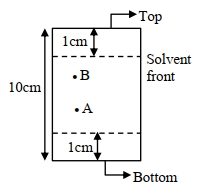
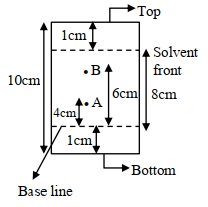
In the given $TLC$ plate,the distances of spots $A$ and $B$ from the base line are $4 \ cm$ and $6 \ cm$,respectively. The distance moved by the solvent front from the base line is $8 \ cm$. If the $R_f$ value of $B$ is $x \times 10^{-1}$ times that of $A$,find the value of $x$.
A
$10$
B
$15$
C
$20$
D
$25$
Solution
(B) $R_f = \frac{\text{Distance moved by substance from base line}}{\text{Distance moved by solvent from base line}}$
For spot $A$:
$(R_f)_A = \frac{4 \ cm}{8 \ cm} = 0.5$
For spot $B$:
$(R_f)_B = \frac{6 \ cm}{8 \ cm} = 0.75$
Given that $(R_f)_B = (x \times 10^{-1}) \times (R_f)_A$:
$0.75 = (x \times 10^{-1}) \times 0.5$
$0.75 = x \times 0.05$
$x = \frac{0.75}{0.05} = 15$
For spot $A$:
$(R_f)_A = \frac{4 \ cm}{8 \ cm} = 0.5$
For spot $B$:
$(R_f)_B = \frac{6 \ cm}{8 \ cm} = 0.75$
Given that $(R_f)_B = (x \times 10^{-1}) \times (R_f)_A$:
$0.75 = (x \times 10^{-1}) \times 0.5$
$0.75 = x \times 0.05$
$x = \frac{0.75}{0.05} = 15$
0 likes
View Solution160
MediumMCQ
On heating,some solid substances change from solid to vapour state without passing through liquid state. The technique used for the purification of such solid substances based on the above principle is known as
A
Sublimation
B
Distillation
C
Chromatography
D
Crystallization
Solution
(A) $(1)$ Sublimation: It is the purification technique based on the principle that on heating,some solid substances change from solid to vapour state without passing through the liquid state.
$(2)$ Distillation: It is used to separate volatile liquids from non-volatile impurities or liquids having a sufficient difference in their boiling points.
$(3)$ Chromatography: It is based on the separation of components using stationary and mobile phases.
$(4)$ Crystallization: It is based on the difference in the solubilities of the compound and its impurities in a suitable solvent.
$(2)$ Distillation: It is used to separate volatile liquids from non-volatile impurities or liquids having a sufficient difference in their boiling points.
$(3)$ Chromatography: It is based on the separation of components using stationary and mobile phases.
$(4)$ Crystallization: It is based on the difference in the solubilities of the compound and its impurities in a suitable solvent.
0 likes
View Solution161
MediumMCQ
The purification method based on the following physical transformation is $:$
$\text{Solid} (X)$ $\xrightarrow{\text{Heat}} \text{Vapour} (X)$ $\xrightarrow{\text{Cool}} \text{Solid} (X)$
$\text{Solid} (X)$ $\xrightarrow{\text{Heat}} \text{Vapour} (X)$ $\xrightarrow{\text{Cool}} \text{Solid} (X)$
A
Sublimation
B
Distillation
C
Crystallization
D
Extraction
Solution
(A) The given process represents the direct conversion of a solid into its vapour upon heating and the subsequent conversion of that vapour back into a solid upon cooling,without passing through the liquid phase.
This process is known as sublimation.
Therefore,the correct option is $A$.
This process is known as sublimation.
Therefore,the correct option is $A$.
0 likes
View Solution162
MediumMCQ
Given below are two statements $:$
Statement $(I) :$ In partition chromatography,stationary phase is a thin film of liquid present on an inert support.
Statement $(II) :$ In paper chromatography,the material of the paper acts as a stationary phase.
In the light of the above statements,choose the correct answer from the options given below $:$
Statement $(I) :$ In partition chromatography,stationary phase is a thin film of liquid present on an inert support.
Statement $(II) :$ In paper chromatography,the material of the paper acts as a stationary phase.
In the light of the above statements,choose the correct answer from the options given below $:$
A
Both Statement $I$ and Statement $II$ are false
B
Statement $I$ is true but Statement $II$ is false
C
Both Statement $I$ and Statement $II$ are true
D
Statement $I$ is false but Statement $II$ is true
Solution
(B) Statement $I$ is true. In partition chromatography,the stationary phase is a thin film of liquid held on an inert solid support.
Statement $II$ is false. In paper chromatography,the stationary phase is actually water trapped in the cellulose fibers of the paper,not the paper material itself.
Statement $II$ is false. In paper chromatography,the stationary phase is actually water trapped in the cellulose fibers of the paper,not the paper material itself.
0 likes
View Solution163
MediumMCQ
Match List-$I$ with List-$II$.
Choose the correct answer from the options given below $:$
| List-$I$ (Purification technique) | List-$II$ (Mixture of organic compounds) |
| $(A)$ Distillation (simple) | $(I)$ Diesel + Petrol |
| $(B)$ Fractional distillation | $(II)$ Aniline + Water |
| $(C)$ Distillation under reduced pressure | $(III)$ Chloroform + Aniline |
| $(D)$ Steam distillation | $(IV)$ Glycerol + Spent-lye |
Choose the correct answer from the options given below $:$
A
$A-III, B-I, C-IV, D-II$
B
$A-II, B-IV, C-I, D-III$
C
$A-III, B-IV, C-II, D-I$
D
$A-II, B-I, C-IV, D-III$
Solution
(A) The correct matches are as follows:
$1$. Simple distillation is used for liquids with a large difference in boiling points,such as $Chloroform$ ($bp$ $334 \ K$) and $Aniline$ ($bp$ $457 \ K$). Thus,$(A)-(III)$.
$2$. Fractional distillation is used for liquids with boiling points close to each other,such as $Diesel$ and $Petrol$. Thus,$(B)-(I)$.
$3$. Distillation under reduced pressure is used for liquids that decompose at their boiling points,such as $Glycerol$ from spent-lye. Thus,$(C)-(IV)$.
$4$. Steam distillation is used for substances that are steam volatile and insoluble in water,such as $Aniline$ and $Water$. Thus,$(D)-(II)$.
Therefore,the correct sequence is $A-III, B-I, C-IV, D-II$.
$1$. Simple distillation is used for liquids with a large difference in boiling points,such as $Chloroform$ ($bp$ $334 \ K$) and $Aniline$ ($bp$ $457 \ K$). Thus,$(A)-(III)$.
$2$. Fractional distillation is used for liquids with boiling points close to each other,such as $Diesel$ and $Petrol$. Thus,$(B)-(I)$.
$3$. Distillation under reduced pressure is used for liquids that decompose at their boiling points,such as $Glycerol$ from spent-lye. Thus,$(C)-(IV)$.
$4$. Steam distillation is used for substances that are steam volatile and insoluble in water,such as $Aniline$ and $Water$. Thus,$(D)-(II)$.
Therefore,the correct sequence is $A-III, B-I, C-IV, D-II$.
0 likes
View Solution164
MediumMCQ
Match List-$I$ with List-$II$:
Choose the correct answer from the options given below:
| List-$I$ (Separation of) | List-$II$ (Separation Technique) |
|---|---|
| $A$. Aniline from aniline$-water$ mixture | $I$. Simple distillation |
| $B$. Glycerol from spent$-lye$ in soap industry | $II$. Fractional distillation |
| $C$. Different fractions of crude oil in petroleum industry | $III$. Distillation at reduced pressure |
| $D$. Chloroform$-Aniline$ mixture | $IV$. Steam distillation |
Choose the correct answer from the options given below:
A
$A-IV, B-III, C-II, D-I$
B
$A-I, B-II, C-III, D-IV$
C
$A-III, B-IV, C-I, D-II$
D
$A-II, B-I, C-IV, D-III$
Solution
(A) . Aniline from aniline$-water$ mixture is separated by steam distillation $(IV)$.
$B$. Glycerol from spent$-lye$ in the soap industry is separated by distillation under reduced pressure $(III)$.
$C$. Different fractions of crude oil in the petroleum industry are separated by fractional distillation $(II)$.
$D$. Chloroform and aniline mixture is separated by simple distillation $(I)$.
Therefore,the correct matching is $A-IV, B-III, C-II, D-I$.
$B$. Glycerol from spent$-lye$ in the soap industry is separated by distillation under reduced pressure $(III)$.
$C$. Different fractions of crude oil in the petroleum industry are separated by fractional distillation $(II)$.
$D$. Chloroform and aniline mixture is separated by simple distillation $(I)$.
Therefore,the correct matching is $A-IV, B-III, C-II, D-I$.
0 likes
View Solution165
DifficultMCQ
Match List-$I$ with List-$II$:
Choose the correct answer from the options given below:
| List-$I$ $(\text{Mixture})$ | List-$II$ $(\text{Method of Separation})$ |
|---|---|
| $A. CHCl_3 + C_6H_5NH_2$ | $I. \text{Distillation under reduced pressure}$ |
| $B. \text{Crude oil in petroleum industry}$ | $II. \text{Steam distillation}$ |
| $C. \text{Glycerol from spent-lye}$ | $III. \text{Fractional distillation}$ |
| $D. \text{Aniline-water}$ | $IV. \text{Simple distillation}$ |
Choose the correct answer from the options given below:
A
$A-IV, B-III, C-I, D-II$
B
$A-IV, B-III, C-II, D-I$
C
$A-III, B-IV, C-I, D-II$
D
$A-III, B-IV, C-II, D-I$
Solution
(A) The correct matching is as follows:
$1$. $CHCl_3$ (boiling point $334 \text{ K}$) and $C_6H_5NH_2$ (boiling point $457 \text{ K}$) have a large difference in boiling points,so they are separated by $IV. \text{Simple distillation}$.
$2$. Crude oil is a mixture of various hydrocarbons with different boiling points,separated by $III. \text{Fractional distillation}$.
$3$. Glycerol decomposes at its boiling point,so it is separated from spent-lye by $I. \text{Distillation under reduced pressure}$.
$4$. Aniline is steam volatile and insoluble in water,so it is separated by $II. \text{Steam distillation}$.
Therefore,the correct sequence is $A-IV, B-III, C-I, D-II$.
$1$. $CHCl_3$ (boiling point $334 \text{ K}$) and $C_6H_5NH_2$ (boiling point $457 \text{ K}$) have a large difference in boiling points,so they are separated by $IV. \text{Simple distillation}$.
$2$. Crude oil is a mixture of various hydrocarbons with different boiling points,separated by $III. \text{Fractional distillation}$.
$3$. Glycerol decomposes at its boiling point,so it is separated from spent-lye by $I. \text{Distillation under reduced pressure}$.
$4$. Aniline is steam volatile and insoluble in water,so it is separated by $II. \text{Steam distillation}$.
Therefore,the correct sequence is $A-IV, B-III, C-I, D-II$.
0 likes
View Solution166
EasyMCQ
Which of the following compounds is used as an adsorbent in column chromatography?
A
$Na_{2}O$
B
Silica gel
C
$Al_{2}O_{3}$
D
Both $(b)$ and $(c)$
Solution
(D) In column chromatography,the stationary phase consists of a solid adsorbent material.
Commonly used adsorbents include silica gel $(SiO_{2})$ and alumina $(Al_{2}O_{3})$.
Therefore,both silica gel and alumina are used as adsorbents.
Commonly used adsorbents include silica gel $(SiO_{2})$ and alumina $(Al_{2}O_{3})$.
Therefore,both silica gel and alumina are used as adsorbents.
0 likes
View Solution167
MediumMCQ
Thin-layer chromatography is an example of
A
Partition chromatography
B
Column chromatography
C
Gas-chromatography
D
Adsorption chromatography
Solution
(D) Thin-layer chromatography $(TLC)$ is a type of adsorption chromatography.
In this technique,a thin layer of an adsorbent material (like silica gel or alumina) is spread over a glass or plastic plate.
The mixture to be separated is applied to the plate,and the components are separated based on their differential adsorption on the stationary phase as the mobile phase moves up the plate.
In this technique,a thin layer of an adsorbent material (like silica gel or alumina) is spread over a glass or plastic plate.
The mixture to be separated is applied to the plate,and the components are separated based on their differential adsorption on the stationary phase as the mobile phase moves up the plate.
0 likes
View Solution168
MediumMCQ
Consider the following table$-$
The correct match is $-$
| Column-$I$ | Column-$II$ |
|---|---|
| $(A).$ Best and latest technique for isolation,purification and separation of organic compounds | $(i).$ Chromatography |
| $(B).$ In Lassaigne's test for $N$ | $(ii).$ Vacuum distillation (distillation under reduced pressure) |
| $(C).$ In Lassaigne's test for $S$ | $(iii).$ Violet coloured complex is formed |
| $(D).$ Aniline is purified from water by | $(iv).$ Prussian blue coloured complex is formed |
| $(E).$ Glycerol is purified from spent lye | $(v).$ Steam distillation |
The correct match is $-$
A
$A-i, B-iv, C-iii, D-v, E-ii$
B
$A-iv, B-v, C-iii, D-ii, E-i$
C
$A-i, B-iv, C-iii, D-v, E-ii$
D
$A-v, B-iii, C-iv, D-ii, E-i$
Solution
(A) Best and latest technique for isolation,purification and separation of organic compounds is Chromatography $(i)$.
$(B)$ In Lassaigne's test for $N$,Prussian blue coloured complex is formed $(iv)$.
$(C)$ In Lassaigne's test for $S$,Violet coloured complex is formed $(iii)$.
$(D)$ Aniline is purified from water by Steam distillation $(v)$.
$(E)$ Glycerol is purified from spent lye by Vacuum distillation $(ii)$.
Therefore,the correct match is $A-i, B-iv, C-iii, D-v, E-ii$.
$(B)$ In Lassaigne's test for $N$,Prussian blue coloured complex is formed $(iv)$.
$(C)$ In Lassaigne's test for $S$,Violet coloured complex is formed $(iii)$.
$(D)$ Aniline is purified from water by Steam distillation $(v)$.
$(E)$ Glycerol is purified from spent lye by Vacuum distillation $(ii)$.
Therefore,the correct match is $A-i, B-iv, C-iii, D-v, E-ii$.
0 likes
View Solution169
MediumMCQ
The correct match between items of List-$I$ and List-$II$ is:
| List-$I$ | List-$II$ |
| $A$. Coloured impurity | $P$. Steam distillation |
| $B$. Mixture of $o$-nitrophenol and $p$-nitrophenol | $Q$. Fractional distillation |
| $C$. Crude oil | $R$. Charcoal treatment |
| $D$. Mixture of glycerol and sugars | $S$. Distillation under reduced pressure |
A
$A-R, B-P, C-Q, D-S$
B
$A-P, B-S, C-R, D-Q$
C
$A-R, B-P, C-S, D-Q$
D
$A-R, B-S, C-P, D-Q$
Solution
(A) . Coloured impurities are removed by adsorption using activated charcoal $(R)$.
$B$. $o$-nitrophenol is steam volatile due to intramolecular hydrogen bonding,while $p$-nitrophenol is not,so they are separated by steam distillation $(P)$.
$C$. Crude oil is a mixture of various hydrocarbons with different boiling points,separated by fractional distillation $(Q)$.
$D$. Glycerol decomposes at its boiling point,so it is separated from sugars by distillation under reduced pressure $(S)$.
Thus,the correct match is $A-R, B-P, C-Q, D-S$.
$B$. $o$-nitrophenol is steam volatile due to intramolecular hydrogen bonding,while $p$-nitrophenol is not,so they are separated by steam distillation $(P)$.
$C$. Crude oil is a mixture of various hydrocarbons with different boiling points,separated by fractional distillation $(Q)$.
$D$. Glycerol decomposes at its boiling point,so it is separated from sugars by distillation under reduced pressure $(S)$.
Thus,the correct match is $A-R, B-P, C-Q, D-S$.
0 likes
View Solution170
DifficultMCQ
Which of the following organic compounds could not be dried by anhydrous $CaCl_{2}$?
A
Ethanol
B
Benzene
C
Chloroform
D
Ethyl acetate
Solution
(A) Ethanol cannot be dried using anhydrous $CaCl_{2}$ because it reacts with $CaCl_{2}$ to form an addition compound (solvate). The reaction is as follows:
$CaCl_{2} + 4C_{2}H_{5}OH \rightarrow CaCl_{2} \cdot 4C_{2}H_{5}OH$ (solid)
$CaCl_{2} + 4C_{2}H_{5}OH \rightarrow CaCl_{2} \cdot 4C_{2}H_{5}OH$ (solid)
0 likes
View Solution171
EasyMCQ
Which one of the following can be purified by sublimation?
A
$F_{2}$
B
$Cl_{2}$
C
$Br_{2}$
D
$I_{2}$
Solution
(D) Sublimation is a process in which a solid substance converts directly into vapours without passing through the liquid state.
$I_{2}$ (Iodine) is a solid at room temperature and undergoes sublimation upon heating.
$F_{2}$ and $Cl_{2}$ are gases,while $Br_{2}$ is a liquid at room temperature.
Therefore,$I_{2}$ can be purified by sublimation.
$I_{2}$ (Iodine) is a solid at room temperature and undergoes sublimation upon heating.
$F_{2}$ and $Cl_{2}$ are gases,while $Br_{2}$ is a liquid at room temperature.
Therefore,$I_{2}$ can be purified by sublimation.
0 likes
View Solution172
EasyMCQ
Which method is used to purify liquids having very high boiling points and liquids which decompose at or below their boiling point?
A
Distillation
B
Fractional distillation
C
Distillation under reduced pressure
D
Steam distillation
Solution
(C) Liquids that have very high boiling points or decompose at or below their boiling point cannot be purified by simple distillation because they would degrade before vaporizing.
Distillation under reduced pressure (also known as vacuum distillation) is used in these cases.
By reducing the pressure above the liquid,the boiling point of the liquid is lowered,allowing it to boil and vaporize at a temperature below its decomposition point.
Distillation under reduced pressure (also known as vacuum distillation) is used in these cases.
By reducing the pressure above the liquid,the boiling point of the liquid is lowered,allowing it to boil and vaporize at a temperature below its decomposition point.
0 likes
View Solution173
MediumMCQ
When the difference in boiling points of two liquids is very small,the separation is carried out by:
A
Steam distillation
B
Simple distillation
C
Fractional distillation
D
Vacuum distillation
Solution
(C) If the difference in boiling points of two liquids is not significant,simple distillation cannot be used to separate them effectively.
In such cases,the vapours of both liquids are formed within the same temperature range and condense simultaneously.
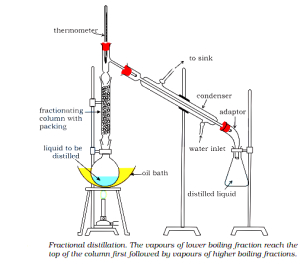
Therefore,the technique of fractional distillation is employed,which uses a fractionating column to allow for multiple vaporization-condensation cycles,effectively separating components with close boiling points.
In such cases,the vapours of both liquids are formed within the same temperature range and condense simultaneously.
Therefore,the technique of fractional distillation is employed,which uses a fractionating column to allow for multiple vaporization-condensation cycles,effectively separating components with close boiling points.
0 likes
View Solution174
EasyMCQ
Among the following,in which type of chromatography,both stationary and mobile phases are in liquid state?
A
Gas-liquid chromatography
B
Ascending paper chromatography (Partition chromatography)
C
High performance liquid chromatography $(HPLC)$
D
Thin layer chromatography $(TLC)$
Solution
(B) In paper chromatography,both the mobile and stationary phases are liquids. The stationary phase is typically water trapped in the cellulose fibers of the paper,which acts as a liquid phase immiscible with the mobile phase.
Column chromatography,$HPLC$,and thin layer chromatography $(TLC)$ are examples of liquid-solid chromatography,where the mobile phase is a liquid and the stationary phase is a solid adsorbent.
Column chromatography,$HPLC$,and thin layer chromatography $(TLC)$ are examples of liquid-solid chromatography,where the mobile phase is a liquid and the stationary phase is a solid adsorbent.
0 likes
View Solution175
MediumMCQ
$A$ mixture of dichloromethane and aniline can be separated by
A
distillation
B
sublimation
C
crystallisation
D
fractional distillation
Solution
(A) The boiling point of dichloromethane is $39.4^{\circ}C$ and the boiling point of aniline is $184.1^{\circ}C$.
Since both components exist in the liquid state and have a significant difference in their boiling points,they can be separated by the process of distillation.
Since both components exist in the liquid state and have a significant difference in their boiling points,they can be separated by the process of distillation.
0 likes
View Solution176
EasyMCQ
In thin layer chromatography,a substance moved by a distance of $4 \ cm$,whereas the solvent moved by a distance of $5 \ cm$. Then the value of retardation factor $(R_f)$ is
A
$0.8$
B
$1.0$
C
$9.0$
D
$1.25$
Solution
(A) The retardation factor $(R_f)$ is defined as the ratio of the distance travelled by the solute to the distance travelled by the solvent front.
$R_f = \frac{\text{distance travelled by solute}}{\text{distance travelled by solvent}}$
Given,distance travelled by solute = $4 \ cm$ and distance travelled by solvent = $5 \ cm$.
$R_f = \frac{4}{5} = 0.8$
$R_f = \frac{\text{distance travelled by solute}}{\text{distance travelled by solvent}}$
Given,distance travelled by solute = $4 \ cm$ and distance travelled by solvent = $5 \ cm$.
$R_f = \frac{4}{5} = 0.8$
0 likes
View Solution177
MediumMCQ
Steam distillation process cannot be used for purifying which of the following?
A
Aniline
B
$p-$nitrophenol
C
Toluene
D
Nitrobenzene
Solution
(B) Steam distillation is a technique used to separate substances which are steam volatile and immiscible in water.
It is commonly used for the purification of organic compounds that are sensitive to high temperatures.
$p-$nitrophenol is steam volatile due to intramolecular hydrogen bonding,but it is often separated from $o-$nitrophenol using this method.
However,the question asks which cannot be purified; actually,all listed compounds are typically purified by steam distillation except those that are highly water-soluble or non-volatile.
Given the standard options,$p-$nitrophenol is often cited in textbooks as being steam volatile,but if the question implies a compound that is $NOT$ steam volatile or is highly water-soluble,none of these fit perfectly.
However,based on standard competitive exam patterns,$p-$nitrophenol is the intended answer because it is less steam volatile than $o-$nitrophenol due to intermolecular hydrogen bonding.
It is commonly used for the purification of organic compounds that are sensitive to high temperatures.
$p-$nitrophenol is steam volatile due to intramolecular hydrogen bonding,but it is often separated from $o-$nitrophenol using this method.
However,the question asks which cannot be purified; actually,all listed compounds are typically purified by steam distillation except those that are highly water-soluble or non-volatile.
Given the standard options,$p-$nitrophenol is often cited in textbooks as being steam volatile,but if the question implies a compound that is $NOT$ steam volatile or is highly water-soluble,none of these fit perfectly.
However,based on standard competitive exam patterns,$p-$nitrophenol is the intended answer because it is less steam volatile than $o-$nitrophenol due to intermolecular hydrogen bonding.
0 likes
View Solution178
EasyMCQ
Identify the correct statements from the following:
$(i)$ Electromeric effect is a permanent effect.
$(ii)$ Hyperconjugation is a temporary effect.
$(iii)$ Fractional distillation is used to separate two liquids from a mixture if the difference in their boiling points is less.
$(iv)$ Different compounds are adsorbed on an adsorbent to different extents.
$(i)$ Electromeric effect is a permanent effect.
$(ii)$ Hyperconjugation is a temporary effect.
$(iii)$ Fractional distillation is used to separate two liquids from a mixture if the difference in their boiling points is less.
$(iv)$ Different compounds are adsorbed on an adsorbent to different extents.
A
$ii, iii, iv$
B
$i, ii, iii$
C
$ii, iv$
D
$iii, iv$
Solution
(D) $(i)$ The electromeric effect is a temporary effect,as it occurs only in the presence of an attacking reagent.
$(ii)$ Hyperconjugation is a permanent effect involving the delocalization of $\sigma$-electrons into an adjacent empty or partially filled $p$-orbital.
$(iii)$ Fractional distillation is used to separate liquids with a small difference in their boiling points,which is a correct statement.
$(iv)$ Different compounds are adsorbed on an adsorbent to different extents,which is the principle behind chromatography,making this a correct statement.
Therefore,statements $(iii)$ and $(iv)$ are correct.
$(ii)$ Hyperconjugation is a permanent effect involving the delocalization of $\sigma$-electrons into an adjacent empty or partially filled $p$-orbital.
$(iii)$ Fractional distillation is used to separate liquids with a small difference in their boiling points,which is a correct statement.
$(iv)$ Different compounds are adsorbed on an adsorbent to different extents,which is the principle behind chromatography,making this a correct statement.
Therefore,statements $(iii)$ and $(iv)$ are correct.
0 likes
View Solution179
EasyMCQ
$A$ mixture of three compounds $A, B, C$ is passed through a column of $Al_2O_3$ by using alcohol as eluant. The order in which they are eluted out of the column is $C, B, A$. Which of the following statements is true?
A
$C$ is strongly adsorbed on the adsorbent
B
$C$ is weakly adsorbed on the adsorbent
C
$A$ is weakly adsorbed on the solvent
D
The order of elution does not depend on the extent of adsorption
Solution
(B) In column chromatography,the compound that is least strongly adsorbed on the stationary phase $(Al_2O_3)$ moves faster and is eluted first.
Given the elution order is $C, B, A$,it implies that $C$ is the least strongly adsorbed,followed by $B$,and $A$ is the most strongly adsorbed.
Therefore,the order of adsorption is $A > B > C$.
Since $C$ is eluted first,it is weakly adsorbed on the adsorbent.
Thus,the correct option is $(b)$.
Given the elution order is $C, B, A$,it implies that $C$ is the least strongly adsorbed,followed by $B$,and $A$ is the most strongly adsorbed.
Therefore,the order of adsorption is $A > B > C$.
Since $C$ is eluted first,it is weakly adsorbed on the adsorbent.
Thus,the correct option is $(b)$.
0 likes
View Solution180
MediumMCQ
Which one of the following mixtures can be separated by steam distillation technique?
A
$n-$Hexane $+ n-$Heptane
B
$CHCl_3 +$ Aniline
C
Aniline $+ H_2O$
D
Glucose $+ NaCl$
Solution
(C) Steam distillation is a technique used to separate substances which are steam volatile and are immiscible with water.
Aniline is steam volatile and is practically immiscible with water.
Therefore,a mixture of Aniline and $H_2O$ can be separated by steam distillation.
$n-$Hexane and $n-$Heptane are separated by fractional distillation.
$CHCl_3$ and Aniline are separated by distillation.
Glucose and $NaCl$ are non-volatile and cannot be separated by steam distillation.
Aniline is steam volatile and is practically immiscible with water.
Therefore,a mixture of Aniline and $H_2O$ can be separated by steam distillation.
$n-$Hexane and $n-$Heptane are separated by fractional distillation.
$CHCl_3$ and Aniline are separated by distillation.
Glucose and $NaCl$ are non-volatile and cannot be separated by steam distillation.
0 likes
View Solution181
MediumMCQ
Which purification method is generally used for a high boiling organic liquid compound,which decomposes below its boiling point?
A
Distillation
B
Distillation under reduced pressure
C
Steam distillation
D
Fractional distillation
Solution
(B) For organic liquids that have high boiling points and decompose at or below their boiling temperatures,distillation under reduced pressure is the most suitable method.
By reducing the pressure,the boiling point of the liquid is lowered,allowing it to vaporize at a temperature below its decomposition point.
By reducing the pressure,the boiling point of the liquid is lowered,allowing it to vaporize at a temperature below its decomposition point.
0 likes
View Solution182
EasyMCQ
Which one of the following methods is suitable to separate a mixture of $n$-pentane and toluene?
A
Steam distillation
B
Simple distillation
C
Sublimation
D
Vacuum distillation
Solution
(B) $n$-Pentane (boiling point $\approx 36 \ ^\circ C$) and toluene (boiling point $\approx 111 \ ^\circ C$) are miscible liquids with a significant difference in their boiling points.
Simple distillation is used to separate liquids that have a difference in boiling points of more than $20-25 \ K$ and are stable at their boiling temperatures.
Since the boiling point difference between $n$-pentane and toluene is large,simple distillation is the suitable method for their separation.
Simple distillation is used to separate liquids that have a difference in boiling points of more than $20-25 \ K$ and are stable at their boiling temperatures.
Since the boiling point difference between $n$-pentane and toluene is large,simple distillation is the suitable method for their separation.
0 likes
View Solution183
MediumMCQ
Which of the following statements about $TLC$ are correct?
$(i)$ Glycine is identified on $TLC$ plate due to its colour.
$(ii)$ Amino acids can be detected by spraying the $TLC$ plate with $Ninhydrin$ solution.
$(iii)$ The retardation factor $(R_f)$ is the ratio of the distance travelled by the solute to that of the solvent from the base line.
$(iv)$ Sodium chloride is commonly used as an adsorbent.
$(i)$ Glycine is identified on $TLC$ plate due to its colour.
$(ii)$ Amino acids can be detected by spraying the $TLC$ plate with $Ninhydrin$ solution.
$(iii)$ The retardation factor $(R_f)$ is the ratio of the distance travelled by the solute to that of the solvent from the base line.
$(iv)$ Sodium chloride is commonly used as an adsorbent.
A
$(ii)$,$(iii)$
B
$(i)$,$(ii)$,$(iii)$
C
$(ii)$,$(iii)$,$(iv)$
D
$(i)$,$(iii)$
Solution
(A) Statement $(i)$ is incorrect because glycine is a colourless amino acid and cannot be identified by its colour.
Statement $(ii)$ is correct because amino acids react with $Ninhydrin$ to form a purple-coloured complex,allowing for their detection.
Statement $(iii)$ is correct because the retardation factor $(R_f)$ is defined as the ratio of the distance travelled by the solute to the distance travelled by the solvent from the base line.
Statement $(iv)$ is incorrect because sodium chloride is not used as an adsorbent; commonly used adsorbents in $TLC$ are silica gel,aluminium oxide,or cellulose.
Therefore,statements $(ii)$ and $(iii)$ are correct.
Statement $(ii)$ is correct because amino acids react with $Ninhydrin$ to form a purple-coloured complex,allowing for their detection.
Statement $(iii)$ is correct because the retardation factor $(R_f)$ is defined as the ratio of the distance travelled by the solute to the distance travelled by the solvent from the base line.
Statement $(iv)$ is incorrect because sodium chloride is not used as an adsorbent; commonly used adsorbents in $TLC$ are silica gel,aluminium oxide,or cellulose.
Therefore,statements $(ii)$ and $(iii)$ are correct.
0 likes
View Solution184
DifficultMCQ
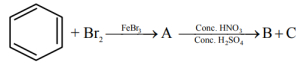
The method used for the separation of the mixture of products ($B$ and $C$) obtained in the following reaction is:
A
Simple distillation
B
Sublimation
C
Steam distillation
D
Fractional distillation
Solution
(D) The reaction of benzene with $Br_2$ in the presence of $FeBr_3$ gives bromobenzene $(A)$.
Nitration of bromobenzene with conc. $HNO_3$ and conc. $H_2SO_4$ yields a mixture of ortho-bromonitrobenzene $(B)$ and para-bromonitrobenzene $(C)$.
Since ortho- and para-isomers have different boiling points due to differences in their polarity and intermolecular forces,they are separated by fractional distillation.
Nitration of bromobenzene with conc. $HNO_3$ and conc. $H_2SO_4$ yields a mixture of ortho-bromonitrobenzene $(B)$ and para-bromonitrobenzene $(C)$.
Since ortho- and para-isomers have different boiling points due to differences in their polarity and intermolecular forces,they are separated by fractional distillation.
0 likes
View Solution185
MediumMCQ
Given below are two statements:
Statement $I$: Vapours of the liquid with higher boiling point condense before vapours of the liquid with lower boiling points in fractional distillation.
Statement $II$: The vapours rising up in the fractionating column become richer in high boiling component of the mixture.
Statement $I$: Vapours of the liquid with higher boiling point condense before vapours of the liquid with lower boiling points in fractional distillation.
Statement $II$: The vapours rising up in the fractionating column become richer in high boiling component of the mixture.
A
Both Statement $I$ and Statement $II$ are true
B
Both Statement $I$ and Statement $II$ are false
C
Statement $I$ is true but Statement $II$ is false
D
Statement $I$ is false but Statement $II$ is true
Solution
(B) In fractional distillation,the component with the lower boiling point is more volatile and stays in the vapour phase longer,reaching the top of the column.
The component with the higher boiling point condenses more easily and returns to the flask.
Therefore,the vapours rising up the fractionating column become richer in the more volatile (lower boiling point) component.
Statement $I$ is false because the higher boiling point component condenses first.
Statement $II$ is false because the vapours become richer in the lower boiling point component,not the higher one.
Thus,both statements are false.
The component with the higher boiling point condenses more easily and returns to the flask.
Therefore,the vapours rising up the fractionating column become richer in the more volatile (lower boiling point) component.
Statement $I$ is false because the higher boiling point component condenses first.
Statement $II$ is false because the vapours become richer in the lower boiling point component,not the higher one.
Thus,both statements are false.
0 likes
View Solution186
MediumMCQ
Given below are two statements:
Statement $I$: $A$ mixture of $C_{12}H_{22}O_{11}$ (sugar) and $NaCl$ can be separated by dissolving sugar in alcohol,due to differential solubility.
Statement $II$: Rose essence from rose petals is separated by steam distillation due to its high volatility and insolubility in $H_2O$.
Statement $I$: $A$ mixture of $C_{12}H_{22}O_{11}$ (sugar) and $NaCl$ can be separated by dissolving sugar in alcohol,due to differential solubility.
Statement $II$: Rose essence from rose petals is separated by steam distillation due to its high volatility and insolubility in $H_2O$.
A
Both Statement $I$ and Statement $II$ are true
B
Both Statement $I$ and Statement $II$ are false
C
Statement $I$ is true but Statement $II$ is false
D
Statement $I$ is false but Statement $II$ is true
Solution
(D) Statement $I$: Sugar $(C_{12}H_{22}O_{11})$ is a polar covalent compound that is soluble in water but has very low solubility in organic solvents like alcohol. $NaCl$ is an ionic compound and is insoluble in alcohol. Therefore,this method is not standard for separating sugar and $NaCl$. However,in the context of competitive chemistry,it is often noted that sugar is slightly soluble in hot ethanol,but this is not an effective separation technique compared to other methods. Re-evaluating the standard scientific consensus: Statement $I$ is considered false because sugar is not effectively separated from $NaCl$ using alcohol.
Statement $II$: Steam distillation is a technique used to separate substances that are steam-volatile and immiscible with water. Rose essence (essential oils) meets these criteria perfectly. Thus,Statement $II$ is true.
Statement $II$: Steam distillation is a technique used to separate substances that are steam-volatile and immiscible with water. Rose essence (essential oils) meets these criteria perfectly. Thus,Statement $II$ is true.
0 likes
View Solution187
MediumMCQ
Match List-$I$ with List-$II$.
| List-$I$ (Purification technique) | List-$II$ (Used to separate) |
| $A$. Simple distillation | $I$. Steam volatile compound |
| $B$. Fractional distillation | $II$. Two liquids with large difference in boiling points |
| $C$. Steam distillation | $III$. Liquid decomposing at its boiling point |
| $D$. Distillation under reduced pressure | $IV$. Two liquids with close boiling points |
A
$A-II, B-III, C-I, D-IV$
B
$A-II, B-IV, C-I, D-III$
C
$A-II, B-IV, C-III, D-I$
D
$A-IV, B-III, C-II, D-I$
Solution
(B) Simple distillation is used for separating two liquids that have a large difference in their boiling points $(A-II)$.
Fractional distillation is used for separating two liquids that have close boiling points $(B-IV)$.
Steam distillation is used for the separation of steam-volatile compounds from non-volatile impurities $(C-I)$.
Distillation under reduced pressure is used for liquids that decompose at or below their normal boiling point $(D-III)$.
Therefore,the correct matching is $A-II, B-IV, C-I, D-III$.
Fractional distillation is used for separating two liquids that have close boiling points $(B-IV)$.
Steam distillation is used for the separation of steam-volatile compounds from non-volatile impurities $(C-I)$.
Distillation under reduced pressure is used for liquids that decompose at or below their normal boiling point $(D-III)$.
Therefore,the correct matching is $A-II, B-IV, C-I, D-III$.
0 likes
View Solution188
MediumMCQ
Two products $X$ and $Y$ are formed in the following reaction sequence: Benzene + $CH_3Cl \xrightarrow{Anhydr. AlCl_3} W \xrightarrow{dil. HNO_3/dil. H_2SO_4, warm} X + Y$. The suitable method that can be used for the separation of products $X$ and $Y$ is:
A
Continuous extraction
B
Differential extraction
C
Sublimation
D
Fractional distillation
Solution
(D) The reaction of benzene with methyl chloride via Friedel-Crafts alkylation produces toluene $(W)$.
Nitration of toluene with dilute $HNO_3/H_2SO_4$ produces a mixture of ortho-nitrotoluene $(X)$ and para-nitrotoluene $(Y)$.
These isomers have significantly different boiling points due to differences in polarity and intermolecular forces,making fractional distillation the ideal method for their separation.
Nitration of toluene with dilute $HNO_3/H_2SO_4$ produces a mixture of ortho-nitrotoluene $(X)$ and para-nitrotoluene $(Y)$.
These isomers have significantly different boiling points due to differences in polarity and intermolecular forces,making fractional distillation the ideal method for their separation.
0 likes
View Solution8-3.Organic Chemistry : Purification and characterization — Purification of Organic Compounds · Frequently Asked Questions
1Are these 8-3.Organic Chemistry : Purification and characterization questions useful for JEE and NEET?
Yes. All questions in this section are mapped to JEE Main and NEET exam patterns. Previous year questions from JEE Main, NEET, GUJCET and state-level exams are included with full solutions.
2Can I switch to Hindi or Gujarati for these questions?
Yes. Use the language tabs in the hero section or the sidebar to view the same questions and solutions in English, Hindi or Gujarati.
3How do I generate a question paper from this subtopic?
Use the Vedclass Exam Paper Generator — select the chapter and subtopic, set difficulty, and generate Sets A, B, C, D automatically. First 3 chapters of every subject are free.
Vedclass Products
For Students
Vedclass Test Series
Mock tests in real JEE/NEET style with performance analysis. 5-day free trial.
Start Free TrialFor Teachers
Exam Paper Generator
Generate Set A/B/C/D papers from this chapter in 2 minutes. 3 chapters free.
Try FreeFor Institutes
Online Exam Module
Live online exams with unlimited students, 360° analytics & white-label branding.
See DemoFor Teachers & Institutes
Generate a 8-3.Organic Chemistry : Purification and characterization Exam Paper in 2 Minutes
Select subtopic & difficulty — Sets A, B, C, D auto-generated with No Repeat logic.
First 3 chapters of every subject are free — no payment required.