
A English
Optical isomerism Questions in English
Class 11 Chemistry · 8-2.Organic Chemistry : Isomerism · Optical isomerism
338+
Questions
English
Language
100%
With Solutions
Showing 33 of 338 questions in English
301
MediumMCQ
If $n$ represents the total number of asymmetric carbon atoms in a compound,the possible number of optical isomers of the compound is-
A
$2n$
B
$n^2$
C
$2^n$
D
$2n+2$
Solution
(C) The number of optical isomers for a compound containing $n$ asymmetric carbon atoms (chiral centers) is given by the formula $2^n$,provided that the molecule does not possess any internal plane of symmetry (i.e.,it is not a meso compound).
0 likes
View Solution302
DifficultMCQ
$\alpha$-hydroxy propanoic acid has $..........$ asymmetric carbon atoms.
A
$4$
B
$3$
C
$2$
D
$1$
Solution
(D) An asymmetric carbon atom (chiral center) is a carbon atom bonded to four different groups.
The structure of $\alpha$-hydroxy propanoic acid is $CH_3-CH(OH)-COOH$.
The central carbon atom is bonded to $-H$,$-OH$,$-CH_3$,and $-COOH$ groups.
Since all four groups are different,the central carbon is asymmetric.
Thus,$\alpha$-hydroxy propanoic acid has $1$ asymmetric carbon atom.
The structure of $\alpha$-hydroxy propanoic acid is $CH_3-CH(OH)-COOH$.
The central carbon atom is bonded to $-H$,$-OH$,$-CH_3$,and $-COOH$ groups.
Since all four groups are different,the central carbon is asymmetric.
Thus,$\alpha$-hydroxy propanoic acid has $1$ asymmetric carbon atom.
0 likes
View Solution303
EasyMCQ
Which of the following compounds is optically active?
A
Butanal
B
Butan$-1-$ol
C
Butan$-2-$ol
D
$2-$methylpropan$-2-$ol
Solution
(C) compound is optically active if it contains at least one chiral carbon atom (a carbon atom bonded to four different groups).
In butan$-2-$ol $(CH_3-CH_2-CH(OH)-CH_3)$,the second carbon atom is bonded to four different groups: $-H$,$-OH$,$-CH_3$,and $-CH_2CH_3$.
Therefore,butan$-2-$ol is optically active.
In butan$-2-$ol $(CH_3-CH_2-CH(OH)-CH_3)$,the second carbon atom is bonded to four different groups: $-H$,$-OH$,$-CH_3$,and $-CH_2CH_3$.
Therefore,butan$-2-$ol is optically active.
0 likes
View Solution304
MediumMCQ
Which of the following compounds does not exhibit optical isomerism?
A
$3-$Iodohexane
B
$2-$Iodopentane
C
$2-$Iodo$-2-$methylbutane
D
$2-$Iodo$-3-$methylbutane
Solution
(C) Optical isomerism is exhibited by compounds that contain at least one chiral carbon atom (a carbon atom bonded to four different groups).
$A$. $3-$Iodohexane: $CH_3-CH_2-CH(I)-CH_2-CH_2-CH_3$. The $C3$ atom is bonded to $-H, -I, -CH_2CH_3, -CH_2CH_2CH_3$. It is chiral.
$B$. $2-$Iodopentane: $CH_3-CH(I)-CH_2-CH_2-CH_3$. The $C2$ atom is bonded to $-H, -I, -CH_3, -CH_2CH_2CH_3$. It is chiral.
$C$. $2-$Iodo$-2-$methylbutane: $CH_3-C(I)(CH_3)-CH_2-CH_3$. The $C2$ atom is bonded to two identical $-CH_3$ groups. It is achiral.
$D$. $2-$Iodo$-3-$methylbutane: $CH_3-CH(I)-CH(CH_3)_2$. The $C2$ atom is bonded to $-H, -I, -CH_3, -CH(CH_3)_2$. It is chiral.
Therefore,$2-$Iodo$-2-$methylbutane does not exhibit optical isomerism.
$A$. $3-$Iodohexane: $CH_3-CH_2-CH(I)-CH_2-CH_2-CH_3$. The $C3$ atom is bonded to $-H, -I, -CH_2CH_3, -CH_2CH_2CH_3$. It is chiral.
$B$. $2-$Iodopentane: $CH_3-CH(I)-CH_2-CH_2-CH_3$. The $C2$ atom is bonded to $-H, -I, -CH_3, -CH_2CH_2CH_3$. It is chiral.
$C$. $2-$Iodo$-2-$methylbutane: $CH_3-C(I)(CH_3)-CH_2-CH_3$. The $C2$ atom is bonded to two identical $-CH_3$ groups. It is achiral.
$D$. $2-$Iodo$-3-$methylbutane: $CH_3-CH(I)-CH(CH_3)_2$. The $C2$ atom is bonded to $-H, -I, -CH_3, -CH(CH_3)_2$. It is chiral.
Therefore,$2-$Iodo$-2-$methylbutane does not exhibit optical isomerism.
0 likes
View Solution305
EasyMCQ
How many optically active isomers are possible for the compound with the molecular formula $C_4H_9Br$?
A
$4$
B
$2$
C
$1$
D
$3$
Solution
(B) The molecular formula $C_4H_9Br$ corresponds to butyl bromide isomers.
Among the structural isomers,$2$-bromobutane $(CH_3-CH_2-CH(Br)-CH_3)$ contains a chiral carbon atom (the $C_2$ carbon is bonded to four different groups: $-H$,$-CH_3$,$-CH_2CH_3$,and $-Br$).
$A$ molecule with one chiral center exists as a pair of enantiomers (two optically active isomers: $d$- and $l$-forms).
Therefore,there are $2$ optically active isomers possible for this compound.
Among the structural isomers,$2$-bromobutane $(CH_3-CH_2-CH(Br)-CH_3)$ contains a chiral carbon atom (the $C_2$ carbon is bonded to four different groups: $-H$,$-CH_3$,$-CH_2CH_3$,and $-Br$).
$A$ molecule with one chiral center exists as a pair of enantiomers (two optically active isomers: $d$- and $l$-forms).
Therefore,there are $2$ optically active isomers possible for this compound.
0 likes
View Solution306
EasyMCQ
$A$ polarimeter is used to determine . . . . . . of compounds.
A
$D$ and $L$ configuration
B
$d$ and $l$ configuration
C
$R$ and $S$ configuration
D
Both $D$ and $L$ as well as $d$ and $l$ configuration
Solution
(B) polarimeter is an instrument used to measure the angle of rotation caused by passing polarized light through an optically active substance.
This rotation determines whether a compound is dextrorotatory ($d$ or $+$) or levorotatory ($l$ or $-$).
Therefore,it is used to determine the $d$ and $l$ configuration (optical rotation) of compounds.
This rotation determines whether a compound is dextrorotatory ($d$ or $+$) or levorotatory ($l$ or $-$).
Therefore,it is used to determine the $d$ and $l$ configuration (optical rotation) of compounds.
0 likes
View Solution307
EasyMCQ
Which one of the following compounds is optically inactive?
A
$3-$chlorobut$-1-$ene
B
$2,3-$dichlorobutane
C
$2-$hydroxypropanoic acid
D
$2,2-$dichloropentane
Solution
(D) compound is optically inactive if it lacks a chiral center or possesses a plane of symmetry (meso compound).
$1$. $3-$chlorobut$-1-$ene: The $C3$ atom is bonded to a hydrogen,a chlorine,a methyl group,and a vinyl group. It is chiral.
$2$. $2,3-$dichlorobutane: This can exist as a meso form (achiral) or chiral enantiomers. However,$2,2-$dichloropentane is definitively achiral.
$3$. $2-$hydroxypropanoic acid (lactic acid): The $C2$ atom is bonded to a hydrogen,a hydroxyl group,a methyl group,and a carboxyl group. It is chiral.
$4$. $2,2-$dichloropentane: The $C2$ atom is bonded to two identical chlorine atoms. Since it lacks a chiral center,it is optically inactive.
$1$. $3-$chlorobut$-1-$ene: The $C3$ atom is bonded to a hydrogen,a chlorine,a methyl group,and a vinyl group. It is chiral.
$2$. $2,3-$dichlorobutane: This can exist as a meso form (achiral) or chiral enantiomers. However,$2,2-$dichloropentane is definitively achiral.
$3$. $2-$hydroxypropanoic acid (lactic acid): The $C2$ atom is bonded to a hydrogen,a hydroxyl group,a methyl group,and a carboxyl group. It is chiral.
$4$. $2,2-$dichloropentane: The $C2$ atom is bonded to two identical chlorine atoms. Since it lacks a chiral center,it is optically inactive.
0 likes
View Solution308
MediumMCQ
$A$ pair of compounds having the same boiling points are
A
$cis$-but-$2$-ene and $trans$-but-$2$-ene
B
$n$-hexane and neo-hexane
C
benzene and naphthalene
D
$(+)$ butan-$2$-ol and $(-)$ butan-$2$-ol
Solution
(D) Enantiomers,such as $(+)$ butan-$2$-ol and $(-)$ butan-$2$-ol,are non-superimposable mirror images of each other.
They possess identical physical properties,including boiling points,melting points,and refractive indices,in an achiral environment.
They differ only in their interaction with plane-polarized light and their reactivity with other chiral substances.
Therefore,$(+)$ butan-$2$-ol and $(-)$ butan-$2$-ol have the same boiling point.
They possess identical physical properties,including boiling points,melting points,and refractive indices,in an achiral environment.
They differ only in their interaction with plane-polarized light and their reactivity with other chiral substances.
Therefore,$(+)$ butan-$2$-ol and $(-)$ butan-$2$-ol have the same boiling point.
0 likes
View Solution309
MediumMCQ
The number of optical isomers of the compound $CH_{3}CHBrCHBrCOOH$ is
A
$0$
B
$1$
C
$3$
D
$4$
Solution
(D) The given compound is $CH_{3}CHBrCHBrCOOH$. It contains two chiral carbon atoms $(n=2)$.
Since the molecule is unsymmetrical (the two ends are different: $-CH_{3}$ and $-COOH$),it cannot be divided into two equal halves.
For an unsymmetrical molecule,the number of optical isomers is given by $2^{n}$,where $n$ is the number of chiral centers.
Here,$n=2$,so the number of optical isomers $= 2^{2} = 4$.
These $4$ isomers consist of $2$ pairs of enantiomers,and there are no meso forms $(m=0)$.
Thus,the total number of optical isomers is $4$.
Since the molecule is unsymmetrical (the two ends are different: $-CH_{3}$ and $-COOH$),it cannot be divided into two equal halves.
For an unsymmetrical molecule,the number of optical isomers is given by $2^{n}$,where $n$ is the number of chiral centers.
Here,$n=2$,so the number of optical isomers $= 2^{2} = 4$.
These $4$ isomers consist of $2$ pairs of enantiomers,and there are no meso forms $(m=0)$.
Thus,the total number of optical isomers is $4$.
0 likes
View Solution310
EasyMCQ
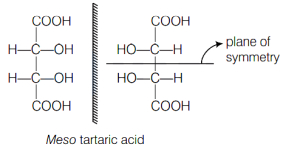
Meso compounds do not show optical activity because
A
they do not contain chiral carbon atoms
B
they have non-superimposable mirror images
C
they contain plane of symmetry
D
they do not contain plane of symmetry
Solution
(C) The correct answer is $C$. Meso compounds are those compounds whose molecules are superimposable on their mirror images despite the presence of asymmetric carbon atoms.
This is due to internal compensation.
The two halves of the molecule rotate the plane of polarised light in opposite directions and hence cancel the effect of each other,making the molecule optically inactive.
Thus,the optical inactivity in meso compounds is due to the presence of a plane of symmetry or molecular symmetry,which leads to internal compensation.
This is due to internal compensation.
The two halves of the molecule rotate the plane of polarised light in opposite directions and hence cancel the effect of each other,making the molecule optically inactive.
Thus,the optical inactivity in meso compounds is due to the presence of a plane of symmetry or molecular symmetry,which leads to internal compensation.
0 likes
View Solution311
DifficultMCQ
The maximum number of possible optical isomers in $1-$bromo$-2-$methylcyclobutane is
A
$4$
B
$2$
C
$8$
D
$16$
Solution
(A) The molecule $1-$bromo$-2-$methylcyclobutane contains two chiral centers at $C1$ and $C2$.
Since the ring is not symmetric,the number of stereoisomers is given by $2^n$,where $n$ is the number of chiral centers.
Here,$n = 2$,so the total number of stereoisomers is $2^2 = 4$.
These $4$ stereoisomers consist of two pairs of enantiomers (cis-isomer pair and trans-isomer pair),all of which are optically active.
Therefore,the maximum number of possible optical isomers is $4$.
Since the ring is not symmetric,the number of stereoisomers is given by $2^n$,where $n$ is the number of chiral centers.
Here,$n = 2$,so the total number of stereoisomers is $2^2 = 4$.
These $4$ stereoisomers consist of two pairs of enantiomers (cis-isomer pair and trans-isomer pair),all of which are optically active.
Therefore,the maximum number of possible optical isomers is $4$.
0 likes
View Solution312
MediumMCQ
How many optically active stereoisomers are possible for butan-$2,3$-diol?
A
$1$
B
$2$
C
$3$
D
$4$
Solution
(B) The structure of butan-$2,3$-diol is $CH_3-CH(OH)-CH(OH)-CH_3$.
It has two chiral centers $(n=2)$.
Since the molecule is symmetrical,the number of optically active stereoisomers is given by $2^{n-1}$.
Here,$n=2$,so the number of optically active isomers $= 2^{2-1} = 2^{1} = 2$.
These two optically active isomers are the $(2R, 3R)$ and $(2S, 3S)$ forms. The $(2R, 3S)$ form is a meso compound and is optically inactive.
It has two chiral centers $(n=2)$.
Since the molecule is symmetrical,the number of optically active stereoisomers is given by $2^{n-1}$.
Here,$n=2$,so the number of optically active isomers $= 2^{2-1} = 2^{1} = 2$.
These two optically active isomers are the $(2R, 3R)$ and $(2S, 3S)$ forms. The $(2R, 3S)$ form is a meso compound and is optically inactive.
0 likes
View Solution313
MediumMCQ
How many chiral carbon atoms are present in $2,3,4$-trichloropentane?
A
$4$
B
$1$
C
$2$
D
$3$
Solution
(C) The structure of $2,3,4$-trichloropentane is $CH_3-CHCl-CHCl-CHCl-CH_3$.
In this molecule,the carbon atoms at positions $2$ and $4$ are bonded to four different groups: a hydrogen atom $(-H)$,a chlorine atom $(-Cl)$,a methyl group $(-CH_3)$,and a $-CHCl-CHCl_2$ group (for $C-2$) or a $-CHCl-CH_3$ group (for $C-4$).
The carbon atom at position $3$ is not chiral because it is bonded to two identical $-CHCl-CH_3$ groups.
Therefore,there are $2$ chiral carbon atoms present in $2,3,4$-trichloropentane.
In this molecule,the carbon atoms at positions $2$ and $4$ are bonded to four different groups: a hydrogen atom $(-H)$,a chlorine atom $(-Cl)$,a methyl group $(-CH_3)$,and a $-CHCl-CHCl_2$ group (for $C-2$) or a $-CHCl-CH_3$ group (for $C-4$).
The carbon atom at position $3$ is not chiral because it is bonded to two identical $-CHCl-CH_3$ groups.
Therefore,there are $2$ chiral carbon atoms present in $2,3,4$-trichloropentane.
0 likes
View Solution314
MediumMCQ
The optically inactive compound from the following is
A
$2-$Bromopropanal
B
$3-$Bromopropanal
C
$3-$Bromo-$2-$iodopropanal
D
$2-$Bromo-$3-$iodopropanal
Solution
(B) An optically inactive compound is one that does not contain any chiral centers (asymmetric carbon atoms).
$2-$Bromopropanal: $CH_3-CH(Br)-CHO$ (The $C-2$ carbon is chiral).
$3-$Bromopropanal: $Br-CH_2-CH_2-CHO$ (No chiral carbon exists).
$3-$Bromo-$2-$iodopropanal: $Br-CH_2-CH(I)-CHO$ (The $C-2$ carbon is chiral).
$2-$Bromo-$3-$iodopropanal: $CH_2(I)-CH(Br)-CHO$ (The $C-2$ carbon is chiral).
Therefore,$3-$Bromopropanal is the optically inactive compound.
$2-$Bromopropanal: $CH_3-CH(Br)-CHO$ (The $C-2$ carbon is chiral).
$3-$Bromopropanal: $Br-CH_2-CH_2-CHO$ (No chiral carbon exists).
$3-$Bromo-$2-$iodopropanal: $Br-CH_2-CH(I)-CHO$ (The $C-2$ carbon is chiral).
$2-$Bromo-$3-$iodopropanal: $CH_2(I)-CH(Br)-CHO$ (The $C-2$ carbon is chiral).
Therefore,$3-$Bromopropanal is the optically inactive compound.
0 likes
View Solution315
EasyMCQ
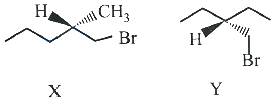
Identify the chirality of the molecules $X$ and $Y$ shown below:
A
$X=Y=$ Achiral
B
$X=Y=$ Chiral
C
$X=$ Chiral,$Y=$ Achiral
D
$X=$ Achiral,$Y=$ Chiral
Solution
(C) molecule is chiral if it contains at least one chiral carbon atom (a carbon atom bonded to four different groups).
In molecule $X$,the central carbon is bonded to $-H$,$-CH_3$,$-CH_2CH_2CH_3$,and $-CH_2Br$. Since all four groups are different,the carbon is chiral,making molecule $X$ chiral.
In molecule $Y$,the central carbon is bonded to $-H$,$-Br$,and two identical $-CH_2CH_3$ (ethyl) groups. Since two groups are identical,the carbon is not chiral,making molecule $Y$ achiral.
Therefore,$X$ is chiral and $Y$ is achiral.
In molecule $X$,the central carbon is bonded to $-H$,$-CH_3$,$-CH_2CH_2CH_3$,and $-CH_2Br$. Since all four groups are different,the carbon is chiral,making molecule $X$ chiral.
In molecule $Y$,the central carbon is bonded to $-H$,$-Br$,and two identical $-CH_2CH_3$ (ethyl) groups. Since two groups are identical,the carbon is not chiral,making molecule $Y$ achiral.
Therefore,$X$ is chiral and $Y$ is achiral.
0 likes
View Solution316
MediumMCQ
The number of optical isomers possible for $2-$Bromo$-3-$chlorobutane are
A
$8$
B
$10$
C
$4$
D
$2$
Solution
(C) The structure of $2-$Bromo$-3-$chlorobutane is $CH_3-CH(Br)-CH(Cl)-CH_3$.
This molecule contains two chiral centers (at $C-2$ and $C-3$).
Since the molecule does not have a plane of symmetry (the groups attached to the chiral centers are different),the number of optical isomers is given by $2^n$,where $n$ is the number of chiral centers.
Here,$n = 2$.
Therefore,the number of optical isomers $= 2^2 = 4$.
The four isomers are $(2R, 3R)$,$(2S, 3S)$,$(2R, 3S)$,and $(2S, 3R)$.
This molecule contains two chiral centers (at $C-2$ and $C-3$).
Since the molecule does not have a plane of symmetry (the groups attached to the chiral centers are different),the number of optical isomers is given by $2^n$,where $n$ is the number of chiral centers.
Here,$n = 2$.
Therefore,the number of optical isomers $= 2^2 = 4$.
The four isomers are $(2R, 3R)$,$(2S, 3S)$,$(2R, 3S)$,and $(2S, 3R)$.
0 likes
View Solution317
MediumMCQ
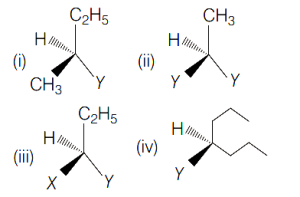
Identify chiral molecules from the following:
A
$i, iii$
B
$ii, iii, iv$
C
$ii, iii$
D
$ii, iv$
Solution
(A) molecule is chiral if it has a carbon atom bonded to four different groups.
$(i)$ The central carbon is bonded to $H$,$C_2H_5$,$CH_3$,and $Y$. All four groups are different,so it is chiral.
(ii) The central carbon is bonded to $H$,$CH_3$,$Y$,and $Y$. Since two groups $(Y)$ are the same,it is achiral.
(iii) The central carbon is bonded to $H$,$C_2H_5$,$X$,and $Y$. All four groups are different,so it is chiral.
(iv) The central carbon is bonded to $H$,$Y$,and two identical alkyl chains. Since two groups are the same,it is achiral.
Therefore,molecules $(i)$ and $(iii)$ are chiral.
$(i)$ The central carbon is bonded to $H$,$C_2H_5$,$CH_3$,and $Y$. All four groups are different,so it is chiral.
(ii) The central carbon is bonded to $H$,$CH_3$,$Y$,and $Y$. Since two groups $(Y)$ are the same,it is achiral.
(iii) The central carbon is bonded to $H$,$C_2H_5$,$X$,and $Y$. All four groups are different,so it is chiral.
(iv) The central carbon is bonded to $H$,$Y$,and two identical alkyl chains. Since two groups are the same,it is achiral.
Therefore,molecules $(i)$ and $(iii)$ are chiral.
0 likes
View Solution318
MediumMCQ
Identify the chiral molecule among the following.
A
Isopropyl alcohol
B
$2-$Pentanol
C
$1-$Bromo$-3-$butene
D
Isobutyl alcohol
Solution
(B) carbon atom bonded to four different groups or atoms is called a chiral carbon.
$A$ chiral molecule exists in two stereoisomers that are non-superimposable mirror images of each other,called enantiomers.
$1$. $CH_3-CH(OH)-CH_3$ (Isopropyl alcohol): The central carbon is bonded to two identical methyl groups,so it is achiral.
$2$. $CH_3-CH(OH)-CH_2-CH_2-CH_3$ ($2-$Pentanol): The second carbon is bonded to four different groups ($-H$,$-OH$,$-CH_3$,and $-CH_2CH_2CH_3$),making it a chiral center. Thus,it is a chiral molecule.
$3$. $BrCH_2-CH_2-CH=CH_2$ ($1-$Bromo$-3-$butene): No carbon atom is bonded to four different groups,so it is achiral.
$4$. $(CH_3)_2CH-CH_2OH$ (Isobutyl alcohol): The carbon attached to the hydroxyl group is bonded to two identical hydrogen atoms,so it is achiral.
$A$ chiral molecule exists in two stereoisomers that are non-superimposable mirror images of each other,called enantiomers.
$1$. $CH_3-CH(OH)-CH_3$ (Isopropyl alcohol): The central carbon is bonded to two identical methyl groups,so it is achiral.
$2$. $CH_3-CH(OH)-CH_2-CH_2-CH_3$ ($2-$Pentanol): The second carbon is bonded to four different groups ($-H$,$-OH$,$-CH_3$,and $-CH_2CH_2CH_3$),making it a chiral center. Thus,it is a chiral molecule.
$3$. $BrCH_2-CH_2-CH=CH_2$ ($1-$Bromo$-3-$butene): No carbon atom is bonded to four different groups,so it is achiral.
$4$. $(CH_3)_2CH-CH_2OH$ (Isobutyl alcohol): The carbon attached to the hydroxyl group is bonded to two identical hydrogen atoms,so it is achiral.
0 likes
View Solution319
DifficultMCQ
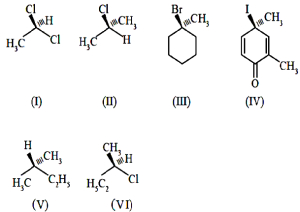
The chiral compounds among the following are:
A
$IV$ and $VI$
B
$II$ and $IV$
C
$IV$ and $V$
D
$I$ and $III$
Solution
(A) molecule is chiral if it is non-superimposable on its mirror image. This typically occurs when a carbon atom is bonded to four different groups,known as a chiral center.
Analyzing the structures:
$(I)$ $CH_3-CHCl_2$: The central carbon is bonded to two identical $Cl$ atoms. Achiral.
$(II)$ $CH_3-CHCl-CH_3$: The central carbon is bonded to two identical $CH_3$ groups. Achiral.
$(III)$ $1-bromo-1-methylcyclohexane$: The carbon at position $1$ is bonded to two identical $CH_2$ groups of the ring. Achiral.
$(IV)$ The carbon bonded to $I$ and $CH_3$ is attached to four different groups ($I$,$CH_3$,and two different paths around the ring). Chiral.
$(V)$ $CH_3-CH(CH_3)-C_2H_5$: The central carbon is bonded to two identical $CH_3$ groups. Achiral.
$(VI)$ $CH_3-CH(Cl)-C_2H_5$: The central carbon is bonded to four different groups ($H$,$CH_3$,$Cl$,$C_2H_5$). Chiral.
Thus,$(IV)$ and $(VI)$ are chiral.
Analyzing the structures:
$(I)$ $CH_3-CHCl_2$: The central carbon is bonded to two identical $Cl$ atoms. Achiral.
$(II)$ $CH_3-CHCl-CH_3$: The central carbon is bonded to two identical $CH_3$ groups. Achiral.
$(III)$ $1-bromo-1-methylcyclohexane$: The carbon at position $1$ is bonded to two identical $CH_2$ groups of the ring. Achiral.
$(IV)$ The carbon bonded to $I$ and $CH_3$ is attached to four different groups ($I$,$CH_3$,and two different paths around the ring). Chiral.
$(V)$ $CH_3-CH(CH_3)-C_2H_5$: The central carbon is bonded to two identical $CH_3$ groups. Achiral.
$(VI)$ $CH_3-CH(Cl)-C_2H_5$: The central carbon is bonded to four different groups ($H$,$CH_3$,$Cl$,$C_2H_5$). Chiral.
Thus,$(IV)$ and $(VI)$ are chiral.
0 likes
View Solution320
MediumMCQ
In which of the following properties do the two enantiomers of lactic acid differ from each other?
A
Sign of specific rotation
B
Density
C
Melting point
D
Refractive Index
Solution
(A) Enantiomers are stereoisomers that are non-superimposable mirror images of each other.
They possess identical physical properties such as melting point,boiling point,density,and refractive index in an achiral environment.
However,they differ in their interaction with plane-polarized light.
One enantiomer rotates the plane of plane-polarized light to the right (dextrorotatory,denoted by $+$),while the other rotates it to the left (levorotatory,denoted by $-$) to the same extent.
Therefore,they differ in the sign of their specific rotation.
They possess identical physical properties such as melting point,boiling point,density,and refractive index in an achiral environment.
However,they differ in their interaction with plane-polarized light.
One enantiomer rotates the plane of plane-polarized light to the right (dextrorotatory,denoted by $+$),while the other rotates it to the left (levorotatory,denoted by $-$) to the same extent.
Therefore,they differ in the sign of their specific rotation.
0 likes
View Solution321
MediumMCQ
Which one of the following exhibits enantiomerism?
A
$BrCH_2-CH_2-CH_2-CH_2Br$
B
$CH_3-CH(Br)-CH_2-CH_3$
C
$CH_3-CH_2-CH_2-CH_2Br$
D
$CH_3-CH_2-CBr_2-CH_3$
Solution
(B) compound exhibits enantiomerism if it contains at least one chiral center (an asymmetric carbon atom,which is bonded to four different groups).
In $CH_3-CH(Br)-CH_2-CH_3$ ($2$-bromobutane),the second carbon atom is bonded to four different groups: $-H$,$-CH_3$,$-Br$,and $-CH_2CH_3$.
Since it has a chiral center,it is optically active and exhibits enantiomerism.
The other options do not contain any chiral carbon atoms.
In $CH_3-CH(Br)-CH_2-CH_3$ ($2$-bromobutane),the second carbon atom is bonded to four different groups: $-H$,$-CH_3$,$-Br$,and $-CH_2CH_3$.
Since it has a chiral center,it is optically active and exhibits enantiomerism.
The other options do not contain any chiral carbon atoms.
0 likes
View Solution322
EasyMCQ
The two enantiomers of secondary butyl chloride differ from each other in which one of the following properties?
A
Boiling point
B
Specific rotation
C
Density
D
$C-Cl$ bond length
Solution
(B) Enantiomers are stereoisomers that are non-superimposable mirror images of each other.
They possess identical physical properties such as boiling point,density,and bond lengths in an achiral environment.
However,they differ in their interaction with plane-polarized light,which is measured as specific rotation.
Therefore,the two enantiomers of secondary butyl chloride differ in specific rotation.
They possess identical physical properties such as boiling point,density,and bond lengths in an achiral environment.
However,they differ in their interaction with plane-polarized light,which is measured as specific rotation.
Therefore,the two enantiomers of secondary butyl chloride differ in specific rotation.
0 likes
View Solution323
MediumMCQ
Which of the following pairs of $2,3-$butanediol are enantiomers?
A
$2R, 3R$ and $2S, 3S$
B
$2S, 3S$ and $2S, 3R$
C
$2R, 3R$ and $2R, 3S$
D
$2S, 3S$ and $2R, 3S$
Solution
(A) Enantiomers are non-superimposable mirror images of each other. For a molecule with multiple chiral centers,the enantiomer is formed by inverting the configuration at every chiral center.
For $2,3-$butanediol,the chiral centers are at positions $2$ and $3$.
The enantiomer of the $(2R, 3R)$ isomer is the $(2S, 3S)$ isomer.
Therefore,the pair $(2R, 3R)$ and $(2S, 3S)$ represents enantiomers.
For $2,3-$butanediol,the chiral centers are at positions $2$ and $3$.
The enantiomer of the $(2R, 3R)$ isomer is the $(2S, 3S)$ isomer.
Therefore,the pair $(2R, 3R)$ and $(2S, 3S)$ represents enantiomers.
0 likes
View Solution324
DifficultMCQ
The concentration of an organic compound in chloroform is $6.15 \ g$ per $100 \ mL$ of solution. $A$ portion of this solution in a $5 \ cm$ polarimeter tube causes an observed rotation of $-1.2^{\circ}$. What is the specific rotation of the compound?
A
$+12^{\circ}$
B
$-3.9^{\circ}$
C
$-39^{\circ}$
D
$+61.5^{\circ}$
Solution
(C) The formula for specific rotation is $[\alpha] = \frac{\alpha}{l \times c}$,where $\alpha$ is the observed rotation in degrees,$l$ is the path length in decimeters $(dm)$,and $c$ is the concentration in $g/mL$.
Given: $\alpha = -1.2^{\circ}$,$l = 5 \ cm = 0.5 \ dm$,and $c = 6.15 \ g / 100 \ mL = 0.0615 \ g/mL$.
Substituting these values: $[\alpha] = \frac{-1.2}{0.5 \times 0.0615} = \frac{-1.2}{0.03075} = -39^{\circ}$.
Given: $\alpha = -1.2^{\circ}$,$l = 5 \ cm = 0.5 \ dm$,and $c = 6.15 \ g / 100 \ mL = 0.0615 \ g/mL$.
Substituting these values: $[\alpha] = \frac{-1.2}{0.5 \times 0.0615} = \frac{-1.2}{0.03075} = -39^{\circ}$.
0 likes
View Solution325
MediumMCQ
The compound$(s)$ showing optical activity is/are:
A
Glycine $(H_2N-CH_2-COOH)$
B
Lactic acid $(CH_3-CH(OH)-COOH)$
C
Glyceraldehyde $(HOCH_2-CH(OH)-CHO)$
D
Tartaric acid $(HOOC-CH(OH)-CH(OH)-COOH)$
Solution
(B, C) compound is optically active if it possesses at least one chiral center and lacks a plane of symmetry or center of symmetry.
$(A)$ Glycine $(H_2N-CH_2-COOH)$ has no chiral center.
$(B)$ Lactic acid $(CH_3-CH(OH)-COOH)$ has one chiral center at the central carbon atom,making it optically active.
$(C)$ Glyceraldehyde $(HOCH_2-CH(OH)-CHO)$ has one chiral center at the central carbon atom,making it optically active.
$(D)$ Tartaric acid $(HOOC-CH(OH)-CH(OH)-COOH)$ has two chiral centers,but the meso form has a plane of symmetry and is optically inactive. However,the chiral isomers of tartaric acid are optically active.
Given the options provided,$(B)$ and $(C)$ are clearly optically active.
$(A)$ Glycine $(H_2N-CH_2-COOH)$ has no chiral center.
$(B)$ Lactic acid $(CH_3-CH(OH)-COOH)$ has one chiral center at the central carbon atom,making it optically active.
$(C)$ Glyceraldehyde $(HOCH_2-CH(OH)-CHO)$ has one chiral center at the central carbon atom,making it optically active.
$(D)$ Tartaric acid $(HOOC-CH(OH)-CH(OH)-COOH)$ has two chiral centers,but the meso form has a plane of symmetry and is optically inactive. However,the chiral isomers of tartaric acid are optically active.
Given the options provided,$(B)$ and $(C)$ are clearly optically active.
0 likes
View Solution326
MediumMCQ
Which of the following represent$(s)$ the enantiomer of $Y$?
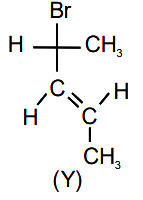
A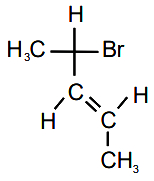
B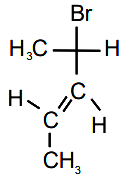
C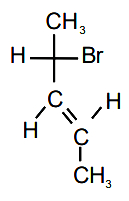
D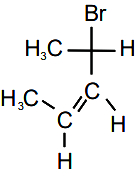
Solution
(B) To find the enantiomer of $Y$,we must look for a structure that is a non-superimposable mirror image of $Y$.
$1$. The molecule $Y$ contains a chiral center. The priority order of groups attached to the chiral center is: $-Br (1) > -CH=CHCH_3 (2) > -CH_3 (3) > -H (4)$.
$2$. In $Y$,the configuration of the chiral center is '$R$'.
$3$. An enantiomer must have the opposite configuration ('$S$') at the chiral center while maintaining the same geometry at the double bond $(trans)$.
$4$. Analyzing the options:
- Option $A$ has the same configuration as $Y$ (identical).
- Option $B$ has the '$S$' configuration at the chiral center and maintains the $trans$ geometry,making it the enantiomer of $Y$.
- Option $C$ has the '$S$' configuration but the structure is different.
- Option $D$ has a different geometry at the double bond $(cis)$,so it is a diastereomer,not an enantiomer.
$1$. The molecule $Y$ contains a chiral center. The priority order of groups attached to the chiral center is: $-Br (1) > -CH=CHCH_3 (2) > -CH_3 (3) > -H (4)$.
$2$. In $Y$,the configuration of the chiral center is '$R$'.
$3$. An enantiomer must have the opposite configuration ('$S$') at the chiral center while maintaining the same geometry at the double bond $(trans)$.
$4$. Analyzing the options:
- Option $A$ has the same configuration as $Y$ (identical).
- Option $B$ has the '$S$' configuration at the chiral center and maintains the $trans$ geometry,making it the enantiomer of $Y$.
- Option $C$ has the '$S$' configuration but the structure is different.
- Option $D$ has a different geometry at the double bond $(cis)$,so it is a diastereomer,not an enantiomer.
0 likes
View Solution327
DifficultMCQ
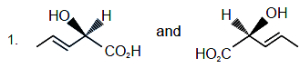
The relationship between the pair of compounds shown below is respectively:
A
enantiomer,diastereomer,diastereomer
B
enantiomer,enantiomer,diastereomer
C
enantiomer,homomer (identical),diastereomer
D
homomer (identical),diastereomer,geometrical isomer
Solution
(B) The given pair of compounds are non-superimposable mirror images of each other.
By assigning $R/S$ configurations using the Cahn-Ingold-Prelog $(CIP)$ priority rules:
$1$. The priority order is $-OH > -CO_2H > -CH=CH-CH_3 > -H$.
$2$. In the first structure,the configuration is $R$.
$3$. In the second structure,the configuration is $S$.
Since they are mirror images and have opposite configurations at the chiral center,they are enantiomers.
By assigning $R/S$ configurations using the Cahn-Ingold-Prelog $(CIP)$ priority rules:
$1$. The priority order is $-OH > -CO_2H > -CH=CH-CH_3 > -H$.
$2$. In the first structure,the configuration is $R$.
$3$. In the second structure,the configuration is $S$.
Since they are mirror images and have opposite configurations at the chiral center,they are enantiomers.
0 likes
View Solution328
EasyMCQ
In a mixture,two enantiomers are found to be present in $85 \%$ and $15 \%$ respectively. The enantiomeric excess $(ee)$ is (in $\%$)
A
$85$
B
$15$
C
$70$
D
$60$
Solution
(C) The enantiomeric excess $(ee)$ is defined as the difference between the percentages of the two enantiomers in a mixture.
$ee = |\% \text{ of enantiomer } 1 - \% \text{ of enantiomer } 2|$
Given the percentages are $85 \%$ and $15 \%$,the calculation is:
$ee = 85 \% - 15 \% = 70 \%$
$ee = |\% \text{ of enantiomer } 1 - \% \text{ of enantiomer } 2|$
Given the percentages are $85 \%$ and $15 \%$,the calculation is:
$ee = 85 \% - 15 \% = 70 \%$
0 likes
View Solution329
EasyMCQ
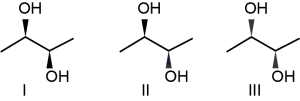
The correct statement regarding the following compounds is:
A
all three compounds are chiral
B
only $I$ and $II$ are chiral
C
$I$ and $III$ are diastereomers
D
only $I$ and $III$ are chiral
Solution
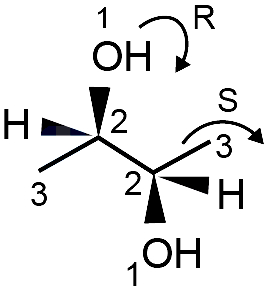
(D) The structures represent butane-$2,3$-diol isomers.
$I$ is $(2R, 3R)$-butane-$2,3$-diol,which is chiral.
$II$ is $(2R, 3S)$-butane-$2,3$-diol,which is a meso compound (achiral) due to an internal plane of symmetry.
$III$ is $(2S, 3S)$-butane-$2,3$-diol,which is chiral.
Therefore,only $I$ and $III$ are chiral.
$I$ is $(2R, 3R)$-butane-$2,3$-diol,which is chiral.
$II$ is $(2R, 3S)$-butane-$2,3$-diol,which is a meso compound (achiral) due to an internal plane of symmetry.
$III$ is $(2S, 3S)$-butane-$2,3$-diol,which is chiral.
Therefore,only $I$ and $III$ are chiral.
0 likes
View Solution330
DifficultMCQ
The optically active molecule is
A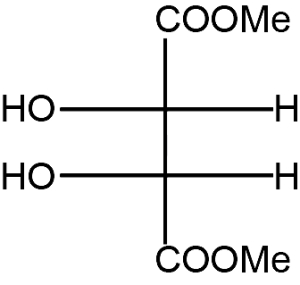
B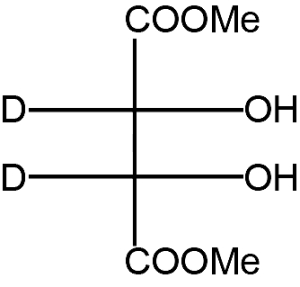
C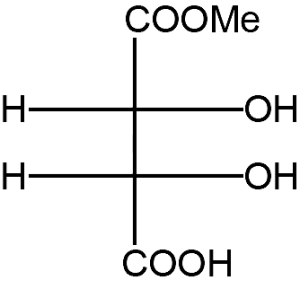
D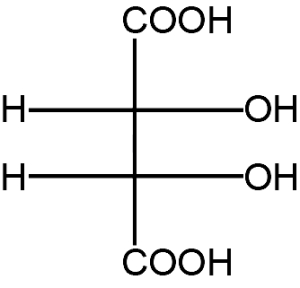
Solution
(C) An optically active molecule must lack a plane of symmetry or a center of inversion.
In option $(A)$,the molecule has a plane of symmetry,making it a meso compound.
In option $(B)$,the molecule has a plane of symmetry,making it a meso compound.
In option $(C)$,the molecule has different functional groups at the ends ($COOMe$ and $COOH$),which prevents the existence of a plane of symmetry,thus making it optically active.
In option $(D)$,the molecule has a plane of symmetry,making it a meso compound.
Therefore,only molecule $(C)$ is optically active.
In option $(A)$,the molecule has a plane of symmetry,making it a meso compound.
In option $(B)$,the molecule has a plane of symmetry,making it a meso compound.
In option $(C)$,the molecule has different functional groups at the ends ($COOMe$ and $COOH$),which prevents the existence of a plane of symmetry,thus making it optically active.
In option $(D)$,the molecule has a plane of symmetry,making it a meso compound.
Therefore,only molecule $(C)$ is optically active.
0 likes
View Solution331
MediumMCQ
The well-known compounds,$(+)$-lactic acid and $(-)$-lactic acid,have the same molecular formula,$C_{3}H_{6}O_{3}$. The correct relationship between them is
A
constitutional isomerism
B
geometrical isomerism
C
identicalness
D
optical isomerism
Solution
(D) $(+)$-lactic acid and $(-)$-lactic acid are non-superimposable mirror images of each other.
They possess a chiral carbon atom and rotate the plane of plane-polarized light in opposite directions.
Therefore,they are enantiomers,which is a type of optical isomerism.
They possess a chiral carbon atom and rotate the plane of plane-polarized light in opposite directions.
Therefore,they are enantiomers,which is a type of optical isomerism.
0 likes
View Solution332
EasyMCQ
Which one of the following will show optical isomerism?
A
Glycolic acid: $HO-CH_2-COOH$
B
Lactic acid: $CH_3-CH(OH)-COOH$
C
Isobutyric acid: $(CH_3)_2CH-COOH$
D
$2-$chloro$-2-$methylpropanoic acid: $CH_3-C(Cl)(CH_3)-COOH$
Solution
(B) molecule exhibits optical isomerism if it contains a chiral carbon atom,which is a carbon atom bonded to four different groups.
$A$. Glycolic acid $(HO-CH_2-COOH)$: The central carbon is bonded to two identical hydrogen atoms. It is achiral.
$B$. Lactic acid $(CH_3-CH(OH)-COOH)$: The central carbon is bonded to four different groups: $-H$,$-OH$,$-CH_3$,and $-COOH$. It is chiral and shows optical isomerism.
$C$. Isobutyric acid $((CH_3)_2CH-COOH)$: The central carbon is bonded to two identical methyl groups. It is achiral.
$D$. $2-$chloro$-2-$methylpropanoic acid $(CH_3-C(Cl)(CH_3)-COOH)$: The central carbon is bonded to two identical methyl groups. It is achiral.
Therefore,lactic acid is the correct answer.
$A$. Glycolic acid $(HO-CH_2-COOH)$: The central carbon is bonded to two identical hydrogen atoms. It is achiral.
$B$. Lactic acid $(CH_3-CH(OH)-COOH)$: The central carbon is bonded to four different groups: $-H$,$-OH$,$-CH_3$,and $-COOH$. It is chiral and shows optical isomerism.
$C$. Isobutyric acid $((CH_3)_2CH-COOH)$: The central carbon is bonded to two identical methyl groups. It is achiral.
$D$. $2-$chloro$-2-$methylpropanoic acid $(CH_3-C(Cl)(CH_3)-COOH)$: The central carbon is bonded to two identical methyl groups. It is achiral.
Therefore,lactic acid is the correct answer.
0 likes
View Solution333
MediumMCQ
The following structures are:
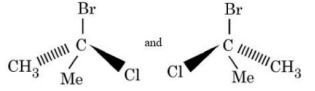
A
enantiomers.
B
identical molecules.
C
diastereomers.
D
meso compounds.
Solution
(A) The structures shown are mirror images of each other and are non-superimposable.
They represent the $(R)$ and $(S)$ configurations of the chiral center.
Since they are non-superimposable mirror images,they are enantiomers.
They represent the $(R)$ and $(S)$ configurations of the chiral center.
Since they are non-superimposable mirror images,they are enantiomers.
0 likes
View Solution8-2.Organic Chemistry : Isomerism — Optical isomerism · Frequently Asked Questions
1Are these 8-2.Organic Chemistry : Isomerism questions useful for JEE and NEET?
Yes. All questions in this section are mapped to JEE Main and NEET exam patterns. Previous year questions from JEE Main, NEET, GUJCET and state-level exams are included with full solutions.
2Can I switch to Hindi or Gujarati for these questions?
Yes. Use the language tabs in the hero section or the sidebar to view the same questions and solutions in English, Hindi or Gujarati.
3How do I generate a question paper from this subtopic?
Use the Vedclass Exam Paper Generator — select the chapter and subtopic, set difficulty, and generate Sets A, B, C, D automatically. First 3 chapters of every subject are free.
Vedclass Products
For Students
Vedclass Test Series
Mock tests in real JEE/NEET style with performance analysis. 5-day free trial.
Start Free TrialFor Teachers
Exam Paper Generator
Generate Set A/B/C/D papers from this chapter in 2 minutes. 3 chapters free.
Try FreeFor Institutes
Online Exam Module
Live online exams with unlimited students, 360° analytics & white-label branding.
See DemoFor Teachers & Institutes
Generate a 8-2.Organic Chemistry : Isomerism Exam Paper in 2 Minutes
Select subtopic & difficulty — Sets A, B, C, D auto-generated with No Repeat logic.
First 3 chapters of every subject are free — no payment required.