
A English
Mix Examples- Transport in Plants Questions in English
Class 11 Biology · Transport in Plants · Mix Examples- Transport in Plants
72+
Questions
English
Language
100%
With Solutions
Showing 22 of 72 questions in English
51
MediumMCQ
The phenomenon of guttation:
A
Is regulated by Cohesion-Tension
B
Is due to active solute accumulation by phloem
C
Takes place to release excessive solutes
D
More than one option is correct
Solution
(NONE) Guttation is the exudation of water droplets from the margins of leaves through specialized structures called hydathodes. It occurs due to root pressure,which is generated when the rate of active water absorption by roots is high and the rate of transpiration is low. This creates a positive hydrostatic pressure in the xylem,forcing water and dissolved solutes out of the hydathodes. None of the options $A$,$B$,or $C$ correctly describe this process,as guttation is not regulated by cohesion-tension,is not due to phloem activity,and is not primarily for solute release. Therefore,none of the provided options are correct.
0 likes
View Solution52
MediumMCQ
$A.$ Most researchers agree that water is mainly 'pulled' upward through the plant, where transpiration is the driving force.
$B.$ Less than one percent of water reaching the leaves is used in plant growth and photosynthesis.
$C.$ Cobalt chloride paper turns blue on absorbing water.
$B.$ Less than one percent of water reaching the leaves is used in plant growth and photosynthesis.
$C.$ Cobalt chloride paper turns blue on absorbing water.
A
All are correct
B
Only $C$ is incorrect
C
Only $B$ is incorrect
D
Only $A$ is correct
Solution
(B) $A.$ The cohesion-tension-transpiration pull model is the most widely accepted theory for water transport in plants, where transpiration creates the negative pressure (pull) required to move water upward.
$B.$ It is a well-established fact that less than $1\%$ of the water absorbed by the plant is utilized in photosynthesis and plant growth; the rest is lost via transpiration.
$C.$ Cobalt chloride paper is a chemical indicator used to detect moisture. It is blue when dry and turns pink upon absorbing water. Therefore, statement $C$ is incorrect.
$B.$ It is a well-established fact that less than $1\%$ of the water absorbed by the plant is utilized in photosynthesis and plant growth; the rest is lost via transpiration.
$C.$ Cobalt chloride paper is a chemical indicator used to detect moisture. It is blue when dry and turns pink upon absorbing water. Therefore, statement $C$ is incorrect.
0 likes
View Solution53
EasyMCQ
- Transport of water and minerals in $Xylem$ is $\underline{A}$.
- Transport of organic and mineral nutrients is $\underline{B}$.
- Transport of organic and mineral nutrients is $\underline{B}$.
A
$A$ - Unidirectional,$B$ - Unidirectional
B
$A$ - Multidirectional,$B$ - Multidirectional
C
$A$ - Multidirectional,$B$ - Unidirectional
D
$A$ - Unidirectional,$B$ - Multidirectional
Solution
(D) - Unidirectional,i.e.,from roots to leaves or tips.
$B$ - Multidirectional,because the source and sink are variable in plants.
$B$ - Multidirectional,because the source and sink are variable in plants.
0 likes
View Solution54
MediumMCQ
$A$. Much of the nitrogen in xylem sap is carried in organic form.
$B$. In phloem,the movement of nutrients is always unidirectional.
$B$. In phloem,the movement of nutrients is always unidirectional.
A
Only $A$ is correct
B
Only $B$ is correct
C
Both $A$ and $B$ are correct
D
Both $A$ and $B$ are incorrect
Solution
(A) - Statement $A$ is correct: Nitrogen is primarily taken up by plants as inorganic ions ($NO_3^-$ or $NH_4^+$),but it is transported in the xylem sap largely in organic forms such as amino acids and amides.
- Statement $B$ is incorrect: The movement of nutrients in the phloem is multidirectional,not unidirectional. This is because the source (where sugar is produced) and the sink (where sugar is consumed or stored) can change depending on the plant's needs and developmental stage.
- Statement $B$ is incorrect: The movement of nutrients in the phloem is multidirectional,not unidirectional. This is because the source (where sugar is produced) and the sink (where sugar is consumed or stored) can change depending on the plant's needs and developmental stage.
0 likes
View Solution55
MediumMCQ
$A$: There is an indirect relationship between the rate of respiration and water absorption.
$R$: Increased metabolism increases mineral uptake.
$R$: Increased metabolism increases mineral uptake.
A
Assertion and Reason both are correct and Reason is the correct explanation of Assertion.
B
Assertion and Reason both are correct but Reason is not the correct explanation of Assertion.
C
Assertion is correct,but Reason is incorrect.
D
Both Assertion and Reason are incorrect.
Solution
(C) The rate of respiration is directly related to the rate of water and mineral absorption because mineral absorption is an active process that requires $ATP$ produced during respiration.
Increased metabolism leads to higher $ATP$ production,which facilitates active mineral uptake.
Since the Assertion states there is an indirect relationship,it is incorrect.
The Reason is correct as increased metabolism supports active transport of minerals.
Therefore,the correct option is $C$.
Increased metabolism leads to higher $ATP$ production,which facilitates active mineral uptake.
Since the Assertion states there is an indirect relationship,it is incorrect.
The Reason is correct as increased metabolism supports active transport of minerals.
Therefore,the correct option is $C$.
0 likes
View Solution56
MediumMCQ
$A$: Endodermis onwards,the movement of water occurs through the living part of the cell. $R$: The inner boundary of the cortex possesses an impermeable band of lignified matrix.
A
Assertion and Reason both are correct and Reason is the correct explanation of Assertion.
B
Assertion and Reason both are correct but Reason is not the correct explanation of Assertion.
C
Assertion is correct,but Reason is incorrect.
D
Both Assertion and Reason are incorrect.
Solution
(C) The Assertion $(A)$ is correct because from the endodermis onwards,the movement of water occurs through the symplastic pathway,which involves the living parts of the cell (cytoplasm and plasmodesmata).
The Reason $(R)$ is incorrect because the inner boundary of the cortex (endodermis) possesses an impermeable band of suberized matrix,known as the Casparian strip. It is composed of suberin,not lignin.
The Reason $(R)$ is incorrect because the inner boundary of the cortex (endodermis) possesses an impermeable band of suberized matrix,known as the Casparian strip. It is composed of suberin,not lignin.
0 likes
View Solution57
MediumMCQ
Match List-$I$ with List-$II$.
Choose the correct answer from the options given below:
| List-$I$ | List-$II$ |
| $(a)$ Cohesion | $(i)$ More attraction in liquid phase |
| $(b)$ Adhesion | $(ii)$ Mutual attraction between water molecules |
| $(c)$ Surface tension | $(iii)$ Water loss in liquid phase |
| $(d)$ Guttation | $(iv)$ Attraction towards polar surfaces |
Choose the correct answer from the options given below:
A
$(iii)-(i)-(iv)-(ii)$
B
$(iv)-(iii)-(ii)-(i)$
C
$(ii)-(iv)-(i)-(iii)$
D
$(ii)-(i)-(iv)-(iii)$
Solution
$(C)$ Cohesion refers to the mutual attraction between water molecules.
$(b)$ Adhesion refers to the attraction of water molecules to polar surfaces.
$(c)$ Surface tension explains why water molecules are more attracted to each other in the liquid phase than in the gaseous phase.
$(d)$ Guttation is the process of water loss in liquid form from the tips of leaves.
Therefore, the correct matching is $(a)-(ii), (b)-(iv), (c)-(i), (d)-(iii)$.
$(b)$ Adhesion refers to the attraction of water molecules to polar surfaces.
$(c)$ Surface tension explains why water molecules are more attracted to each other in the liquid phase than in the gaseous phase.
$(d)$ Guttation is the process of water loss in liquid form from the tips of leaves.
Therefore, the correct matching is $(a)-(ii), (b)-(iv), (c)-(i), (d)-(iii)$.
0 likes
View Solution58
Medium
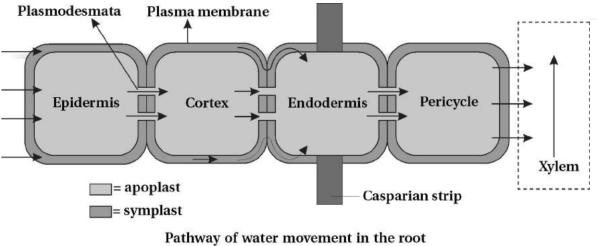
Differentiate between apoplast and symplast pathways of water movement. Which of these would need active transport?
Solution
(N/A) The movement of water through the root occurs via two distinct pathways:
$1$. Apoplast Pathway: The apoplast is the system of adjacent cell walls that is continuous throughout the plant,except at the Casparian strips of the endodermis in the roots. Water movement occurs exclusively through intercellular spaces and cell walls. It does not involve crossing the cell membrane and is dependent on a gradient. It is a passive process involving mass flow.
$2$. Symplast Pathway: The symplastic system is the system of interconnected protoplasts. Neighbouring cells are connected through cytoplasmic strands that extend through plasmodesmata. Water enters the cells through the cell membrane,making the movement relatively slower. It is also a passive process occurring down a potential gradient,though it may be aided by cytoplasmic streaming.
Regarding active transport: Neither the apoplast nor the symplast pathway of water movement requires active transport. Water movement in both pathways is passive,driven by water potential gradients.
$1$. Apoplast Pathway: The apoplast is the system of adjacent cell walls that is continuous throughout the plant,except at the Casparian strips of the endodermis in the roots. Water movement occurs exclusively through intercellular spaces and cell walls. It does not involve crossing the cell membrane and is dependent on a gradient. It is a passive process involving mass flow.
$2$. Symplast Pathway: The symplastic system is the system of interconnected protoplasts. Neighbouring cells are connected through cytoplasmic strands that extend through plasmodesmata. Water enters the cells through the cell membrane,making the movement relatively slower. It is also a passive process occurring down a potential gradient,though it may be aided by cytoplasmic streaming.
Regarding active transport: Neither the apoplast nor the symplast pathway of water movement requires active transport. Water movement in both pathways is passive,driven by water potential gradients.
0 likes
View Solution59
Medium
Correct the following statements:
$(a)$ Cells shrink in hypotonic solutions and swell in hypertonic solutions.
$(b)$ Imbibition is a special type of diffusion when water is absorbed by solids—colloids—causing them to increase in volume.
$(c)$ Most of the water flow in the roots occurs via the symplast.
$(a)$ Cells shrink in hypotonic solutions and swell in hypertonic solutions.
$(b)$ Imbibition is a special type of diffusion when water is absorbed by solids—colloids—causing them to increase in volume.
$(c)$ Most of the water flow in the roots occurs via the symplast.
Solution
(N/A) Cells swell in hypotonic solutions and shrink in hypertonic solutions. In a hypotonic solution,water enters the cell due to osmosis,causing it to swell. In a hypertonic solution,water leaves the cell,causing it to shrink.
$(b)$ Imbibition is a special type of diffusion where water is absorbed by solids—specifically colloids—causing them to increase in volume. The statement is correct as it describes the physical process of water uptake by substances like seeds or dry wood.
$(c)$ Most of the water flow in the roots occurs via the apoplast pathway. The apoplast is the system of adjacent cell walls that is continuous throughout the plant,except at the casparian strips of the endodermis in the roots.
$(b)$ Imbibition is a special type of diffusion where water is absorbed by solids—specifically colloids—causing them to increase in volume. The statement is correct as it describes the physical process of water uptake by substances like seeds or dry wood.
$(c)$ Most of the water flow in the roots occurs via the apoplast pathway. The apoplast is the system of adjacent cell walls that is continuous throughout the plant,except at the casparian strips of the endodermis in the roots.
0 likes
View Solution60
MediumMCQ
Which of the following is not observed during the apoplastic pathway?
A
The movement does not involve crossing of cell membrane.
B
The movement is aided by cytoplasmic streaming.
C
Apoplast is continuous and does not provide any barrier to water movement.
D
Movement of water occurs through intercellular spaces and wall of the cells.
Solution
(B) The apoplastic pathway involves the movement of water through the cell walls and intercellular spaces. In this pathway,water does not cross the cell membrane or cytoplasm. Cytoplasmic streaming is a characteristic feature of the symplastic pathway,where water moves through the cytoplasm and plasmodesmata. Therefore,the statement that the movement is aided by cytoplasmic streaming is not observed during the apoplastic pathway.
0 likes
View Solution61
EasyMCQ
Which of the following components are transported within plants?
$I -$ Water,$II -$ Plant growth regulators,$III -$ Mineral nutrients,$IV -$ Organic nutrients
$I -$ Water,$II -$ Plant growth regulators,$III -$ Mineral nutrients,$IV -$ Organic nutrients
A
$I, IV$
B
$I, III, IV$
C
$I, II, IV$
D
$I, II, III, IV$
Solution
(D) In plants,various substances are transported over long distances to support growth and metabolic activities.
$I -$ Water is absorbed by roots and transported to all parts of the plant via xylem.
$II -$ Plant growth regulators (hormones) are synthesized in specific regions and transported to other parts to regulate physiological processes.
$III -$ Mineral nutrients are absorbed from the soil and transported through the xylem to various plant parts.
$IV -$ Organic nutrients (primarily sucrose) are synthesized in leaves and transported to other parts of the plant via phloem.
Therefore,all the listed components $(I, II, III, IV)$ are transported within plants.
$I -$ Water is absorbed by roots and transported to all parts of the plant via xylem.
$II -$ Plant growth regulators (hormones) are synthesized in specific regions and transported to other parts to regulate physiological processes.
$III -$ Mineral nutrients are absorbed from the soil and transported through the xylem to various plant parts.
$IV -$ Organic nutrients (primarily sucrose) are synthesized in leaves and transported to other parts of the plant via phloem.
Therefore,all the listed components $(I, II, III, IV)$ are transported within plants.
0 likes
View Solution62
MediumMCQ
How do short-distance transport and long-distance transport occur in plants?
$I -$ By diffusion
$II -$ By translocation (xylem and phloem)
$III -$ By active transport of cytoplasmic streaming
Select the correct combination for short-distance transport and long-distance transport respectively.
$I -$ By diffusion
$II -$ By translocation (xylem and phloem)
$III -$ By active transport of cytoplasmic streaming
Select the correct combination for short-distance transport and long-distance transport respectively.
A
$I, III$ and $II$
B
$II$ and $I, III$
C
$I$ and $II, III$
D
$II, III$ and $I$
Solution
(A) In plants,short-distance transport occurs via diffusion $(I)$ and cytoplasmic streaming $(III)$,which helps in the movement of substances within a cell or between adjacent cells.
Long-distance transport occurs through the vascular tissues,specifically xylem and phloem,which is known as translocation $(II)$.
Therefore,short-distance transport involves $I$ and $III$,while long-distance transport involves $II$.
Long-distance transport occurs through the vascular tissues,specifically xylem and phloem,which is known as translocation $(II)$.
Therefore,short-distance transport involves $I$ and $III$,while long-distance transport involves $II$.
0 likes
View Solution63
EasyMCQ
Select the correct option from the following.
A
$A$ mature corn plant absorbs almost three liters of water in a day.
B
$A$ mustard plant absorbs water equal to its own weight in about five hours.
C
Water is a limiting factor for plant growth and productivity in both agricultural and natural environments.
D
All of the above.
Solution
(D) $1$. $A$ mature corn plant absorbs almost three liters of water in a day. This is a standard observation regarding plant water requirements.
$2$. $A$ mustard plant absorbs water equal to its own weight in about five hours. This highlights the high rate of transpiration and water uptake in plants.
$3$. Water is a limiting factor for plant growth and productivity in both agricultural and natural environments. This is a fundamental concept in plant physiology as water availability often dictates the distribution of plants and crop yield.
$4$. Since all the statements provided are scientifically accurate,the correct option is $D$.
$2$. $A$ mustard plant absorbs water equal to its own weight in about five hours. This highlights the high rate of transpiration and water uptake in plants.
$3$. Water is a limiting factor for plant growth and productivity in both agricultural and natural environments. This is a fundamental concept in plant physiology as water availability often dictates the distribution of plants and crop yield.
$4$. Since all the statements provided are scientifically accurate,the correct option is $D$.
0 likes
View Solution64
MediumMCQ
In which direction does water move?
A
From higher water potential to lower water potential
B
From dilute solution to concentrated solution
C
From lower osmotic pressure to higher osmotic pressure
D
All of the above
Solution
(D) Water moves from a region of higher water potential $(\Psi_w)$ to a region of lower water potential $(\Psi_w)$.
Since a dilute solution has more free water molecules, it has higher water potential compared to a concentrated solution.
Osmotic pressure is the pressure required to prevent the movement of water into a solution; water moves towards the region of higher osmotic pressure (where solute concentration is higher).
Therefore, all the given statements correctly describe the direction of water movement.
Since a dilute solution has more free water molecules, it has higher water potential compared to a concentrated solution.
Osmotic pressure is the pressure required to prevent the movement of water into a solution; water moves towards the region of higher osmotic pressure (where solute concentration is higher).
Therefore, all the given statements correctly describe the direction of water movement.
0 likes
View Solution65
MediumMCQ
Select the correct option regarding the vascular tissues in plants.
A
Xylem - Negative water potential gradient (Garden hose)
Phloem - Positive hydrostatic pressure gradient (Suction through a straw)
Phloem - Positive hydrostatic pressure gradient (Suction through a straw)
B
Xylem - Positive hydrostatic pressure gradient (Suction through a straw)
Phloem - Negative water potential gradient (Garden hose)
Phloem - Negative water potential gradient (Garden hose)
C
Xylem - Negative hydrostatic pressure gradient (Suction through a straw)
Phloem - Positive hydrostatic pressure gradient (Garden hose)
Phloem - Positive hydrostatic pressure gradient (Garden hose)
D
Xylem - Positive hydrostatic pressure gradient (Garden hose)
Phloem - Negative hydrostatic pressure gradient (Suction through a straw)
Phloem - Negative hydrostatic pressure gradient (Suction through a straw)
Solution
(C) In plants,transport occurs through two main vascular tissues:
$1$. $Xylem$: It transports water and minerals from roots to leaves. This process is driven by transpiration,which creates a negative pressure (tension) or a negative hydrostatic pressure gradient,similar to sucking water through a straw.
$2$. $Phloem$: It transports food (sucrose) from source to sink. This process is driven by the pressure-flow hypothesis,where high sugar concentration at the source creates a positive hydrostatic pressure gradient,pushing the sap through the sieve tubes,similar to water flowing through a garden hose.
$1$. $Xylem$: It transports water and minerals from roots to leaves. This process is driven by transpiration,which creates a negative pressure (tension) or a negative hydrostatic pressure gradient,similar to sucking water through a straw.
$2$. $Phloem$: It transports food (sucrose) from source to sink. This process is driven by the pressure-flow hypothesis,where high sugar concentration at the source creates a positive hydrostatic pressure gradient,pushing the sap through the sieve tubes,similar to water flowing through a garden hose.
0 likes
View Solution66
MediumMCQ
Select the correct option regarding water transport in plants.
A
Water is primarily pulled upwards by plants.
B
Upward movement of water in plants is a result of transpiration.
C
The model for water transport in plants is presented as the Cohesion-Tension-Transpiration Pull model.
D
All of the above.
Solution
(D) The transport of water in plants occurs through the xylem.
$1$. Plants lose water through stomata in the leaves,a process known as transpiration.
$2$. This creates a negative pressure or tension in the xylem vessels,which pulls the water column upwards from the roots to the leaves.
$3$. The water molecules remain connected due to cohesive and adhesive forces,forming a continuous column.
$4$. This mechanism is widely accepted as the Cohesion-Tension-Transpiration Pull model.
Therefore,all the given statements are correct.
$1$. Plants lose water through stomata in the leaves,a process known as transpiration.
$2$. This creates a negative pressure or tension in the xylem vessels,which pulls the water column upwards from the roots to the leaves.
$3$. The water molecules remain connected due to cohesive and adhesive forces,forming a continuous column.
$4$. This mechanism is widely accepted as the Cohesion-Tension-Transpiration Pull model.
Therefore,all the given statements are correct.
0 likes
View Solution67
MediumMCQ
Identify the correct statements from the following:
$I-$ Xylem transports only inorganic nutrients.
$II-$ Phloem transports only organic materials.
$III-$ There is an exchange of materials between xylem and phloem.
$IV-$ In xylem,inorganic nitrogen is present along with organic nitrogen in the form of amino acids and other components.
$V-$ Organic phosphorus and sulfur are also found in xylem tissue.
$I-$ Xylem transports only inorganic nutrients.
$II-$ Phloem transports only organic materials.
$III-$ There is an exchange of materials between xylem and phloem.
$IV-$ In xylem,inorganic nitrogen is present along with organic nitrogen in the form of amino acids and other components.
$V-$ Organic phosphorus and sulfur are also found in xylem tissue.
A
$I, II, III, IV, V$
B
$III, IV, V$
C
$I, II, III, IV$
D
$III, IV$
Solution
(B) Statement $I$ is incorrect because xylem can also transport some organic nitrogenous compounds.
Statement $II$ is incorrect because phloem can also transport some inorganic ions.
Statement $III$ is correct as there is an exchange of materials between xylem and phloem.
Statement $IV$ is correct because xylem sap contains inorganic nitrogen as well as organic nitrogen in the form of amino acids and related compounds.
Statement $V$ is correct because organic phosphorus and sulfur are also transported through the xylem.
Therefore,the correct statements are $III, IV,$ and $V$.
Statement $II$ is incorrect because phloem can also transport some inorganic ions.
Statement $III$ is correct as there is an exchange of materials between xylem and phloem.
Statement $IV$ is correct because xylem sap contains inorganic nitrogen as well as organic nitrogen in the form of amino acids and related compounds.
Statement $V$ is correct because organic phosphorus and sulfur are also transported through the xylem.
Therefore,the correct statements are $III, IV,$ and $V$.
0 likes
View Solution68
MediumMCQ
Match List $I$ with List $II$ :
Choose the correct answer from the options given below :
| List $I$ | List $II$ |
| $A$. Cohesion | $I$. More attraction in liquid phase |
| $B$. Adhesion | $II$. Mutual attraction among water molecules |
| $C$. Surface tension | $III$. Water loss in liquid phase |
| $D$. Guttation | $IV$. Attraction towards polar surfaces |
Choose the correct answer from the options given below :
A
$A-II, B-I, C-IV, D-III$
B
$A-II, B-IV, C-I, D-III$
C
$A-IV, B-III, C-II, D-I$
D
$A-III, B-I, C-IV, D-II$
Solution
(B) The correct matches are as follows:
$A$. Cohesion: Mutual attraction among water molecules $(II)$.
$B$. Adhesion: Attraction of water molecules to polar surfaces $(IV)$.
$C$. Surface tension: Water molecules are attracted to each other in the liquid phase more than to water in the gas phase $(I)$.
$D$. Guttation: Loss of water in liquid phase $(III)$.
Therefore, the correct sequence is $A-II, B-IV, C-I, D-III$, which corresponds to option $B$.
$A$. Cohesion: Mutual attraction among water molecules $(II)$.
$B$. Adhesion: Attraction of water molecules to polar surfaces $(IV)$.
$C$. Surface tension: Water molecules are attracted to each other in the liquid phase more than to water in the gas phase $(I)$.
$D$. Guttation: Loss of water in liquid phase $(III)$.
Therefore, the correct sequence is $A-II, B-IV, C-I, D-III$, which corresponds to option $B$.
0 likes
View Solution69
EasyMCQ
In plants,active absorption usually does $NOT$ occur when . . . . . . .
A
stomata are open
B
stomata are closed
C
transpiration stops
D
it is night time
Solution
(A) Active absorption is an energy-dependent process ($ATP$ is consumed) that occurs when the rate of transpiration is low.
When stomata are open,the rate of transpiration is high,which creates a strong transpiration pull.
This pull facilitates passive absorption of water,which is the primary mechanism for water uptake during the day.
Therefore,active absorption is generally not the dominant process when stomata are open.
When stomata are open,the rate of transpiration is high,which creates a strong transpiration pull.
This pull facilitates passive absorption of water,which is the primary mechanism for water uptake during the day.
Therefore,active absorption is generally not the dominant process when stomata are open.
0 likes
View Solution70
EasyMCQ
Which of the following statements are correct regarding the factors affecting absorption by plants?
$i$. In dicots,the guard cells are dumbbell shaped.
$ii$. The transport of food through phloem is bidirectional.
$iii$. Capillary water is available to plants.
$iv$. Lenticels are small,raised structures composed of compactly arranged complementary cells.
$v$. Stomatal transpiration occurs during day time only.
Choose the correct option:
$i$. In dicots,the guard cells are dumbbell shaped.
$ii$. The transport of food through phloem is bidirectional.
$iii$. Capillary water is available to plants.
$iv$. Lenticels are small,raised structures composed of compactly arranged complementary cells.
$v$. Stomatal transpiration occurs during day time only.
Choose the correct option:
A
$i, ii$ and $iii$ only
B
$ii, iii$ and $iv$ only
C
$i, iii$ and $iv$ only
D
$ii, iii$ and $v$ only
Solution
(D) Statement $i$ is incorrect because guard cells are kidney-shaped in dicots and dumbbell-shaped in monocots.
Statement $ii$ is correct because the transport of food (sucrose) through phloem is bidirectional (from source to sink,and vice versa depending on the season).
Statement $iii$ is correct because capillary water is the water held in the soil pores by surface tension,which is the primary source of water for plants.
Statement $iv$ is incorrect because lenticels are composed of loosely arranged complementary cells,not compactly arranged cells.
Statement $v$ is incorrect because while stomatal transpiration is primarily a daytime process,it can occur at night in certain conditions,and it is not the only factor affecting absorption.
Therefore,statements $ii$ and $iii$ are correct. However,based on the provided options,the most appropriate choice is $D$ (assuming $v$ is considered correct in the context of standard textbook definitions of stomatal transpiration).
Statement $ii$ is correct because the transport of food (sucrose) through phloem is bidirectional (from source to sink,and vice versa depending on the season).
Statement $iii$ is correct because capillary water is the water held in the soil pores by surface tension,which is the primary source of water for plants.
Statement $iv$ is incorrect because lenticels are composed of loosely arranged complementary cells,not compactly arranged cells.
Statement $v$ is incorrect because while stomatal transpiration is primarily a daytime process,it can occur at night in certain conditions,and it is not the only factor affecting absorption.
Therefore,statements $ii$ and $iii$ are correct. However,based on the provided options,the most appropriate choice is $D$ (assuming $v$ is considered correct in the context of standard textbook definitions of stomatal transpiration).
0 likes
View Solution71
EasyMCQ
Which of the following statements are correct regarding the factors affecting the absorption of water by plants?
$(i)$ In plants,the rate of water absorption is minimum at a soil temperature of $20^{\circ}C$ to $30^{\circ}C$.
(ii) The presence of capillary water is essential in the soil.
(iii) Poorly aerated soil shows a poor absorption rate.
(iv) $A$ low transpiration rate accelerates the rate of absorption of water in irrigated soil.
$(v)$ $A$ high concentration of solutes in soil water reduces the rate of absorption of water.
$(i)$ In plants,the rate of water absorption is minimum at a soil temperature of $20^{\circ}C$ to $30^{\circ}C$.
(ii) The presence of capillary water is essential in the soil.
(iii) Poorly aerated soil shows a poor absorption rate.
(iv) $A$ low transpiration rate accelerates the rate of absorption of water in irrigated soil.
$(v)$ $A$ high concentration of solutes in soil water reduces the rate of absorption of water.
A
$ii$ and $iii$ only
B
$ii, iii$ and $v$ only
C
$i, ii, iii$ and $iv$ only
D
$i, ii, iii$ and $v$ only
Solution
(B) $(i)$ Incorrect: The rate of water absorption is maximum,not minimum,at a soil temperature of $20^{\circ}C$ to $30^{\circ}C$.
(ii) Correct: Capillary water is the form of water available to plants for absorption.
(iii) Correct: Poorly aerated soil lacks oxygen,which is necessary for the metabolic energy required for active water absorption.
(iv) Incorrect: $A$ high transpiration rate,not a low one,creates a pull (transpiration pull) that accelerates water absorption.
$(v)$ Correct: $A$ high concentration of solutes in the soil creates a hypertonic environment,making it difficult for water to enter the root hairs via osmosis.
(ii) Correct: Capillary water is the form of water available to plants for absorption.
(iii) Correct: Poorly aerated soil lacks oxygen,which is necessary for the metabolic energy required for active water absorption.
(iv) Incorrect: $A$ high transpiration rate,not a low one,creates a pull (transpiration pull) that accelerates water absorption.
$(v)$ Correct: $A$ high concentration of solutes in the soil creates a hypertonic environment,making it difficult for water to enter the root hairs via osmosis.
0 likes
View Solution72
EasyMCQ
Given below are two statements in relation to the limitations of the capillarity theory of water transport in plants.
Statement $I$: Xylem, i.e., the capillarity tube, must be with closed end walls and not hollow.
Statement $II$: The capillarity tube, i.e., xylem, is not in direct contact with soil water and contains a barrier of root cells between the xylem and soil water.
In the light of the above statements, choose the most appropriate answer from the options given below:
Statement $I$: Xylem, i.e., the capillarity tube, must be with closed end walls and not hollow.
Statement $II$: The capillarity tube, i.e., xylem, is not in direct contact with soil water and contains a barrier of root cells between the xylem and soil water.
In the light of the above statements, choose the most appropriate answer from the options given below:
A
Both Statement-$I$ and Statement-$II$ are correct.
B
Both Statement-$I$ and Statement-$II$ are incorrect.
C
Statement-$I$ is correct and Statement-$II$ is incorrect.
D
Statement-$I$ is incorrect but Statement-$II$ is correct.
Solution
(D) The capillarity theory suggests that water rises in xylem vessels due to surface tension and adhesion-cohesion forces, similar to a capillary tube.
For this theory to be physically valid, the capillary tube (xylem) must be a continuous, hollow, and open-ended pipe.
Statement-$I$ is incorrect because xylem vessels are hollow and open at the ends to allow continuous water flow, not closed.
Statement-$II$ is correct because xylem is located deep within the root and is separated from the soil water by the epidermis, cortex, and endodermis, meaning it does not have direct contact with soil water as a physical capillary tube would.
Therefore, Statement-$I$ is incorrect and Statement-$II$ is correct.
For this theory to be physically valid, the capillary tube (xylem) must be a continuous, hollow, and open-ended pipe.
Statement-$I$ is incorrect because xylem vessels are hollow and open at the ends to allow continuous water flow, not closed.
Statement-$II$ is correct because xylem is located deep within the root and is separated from the soil water by the epidermis, cortex, and endodermis, meaning it does not have direct contact with soil water as a physical capillary tube would.
Therefore, Statement-$I$ is incorrect and Statement-$II$ is correct.
0 likes
View SolutionTransport in Plants — Mix Examples- Transport in Plants · Frequently Asked Questions
1Are these Transport in Plants questions useful for JEE and NEET?
Yes. All questions in this section are mapped to JEE Main and NEET exam patterns. Previous year questions from JEE Main, NEET, GUJCET and state-level exams are included with full solutions.
2Can I switch to Hindi or Gujarati for these questions?
Yes. Use the language tabs in the hero section or the sidebar to view the same questions and solutions in English, Hindi or Gujarati.
3How do I generate a question paper from this subtopic?
Use the Vedclass Exam Paper Generator — select the chapter and subtopic, set difficulty, and generate Sets A, B, C, D automatically. First 3 chapters of every subject are free.
Vedclass Products
For Students
Vedclass Test Series
Mock tests in real JEE/NEET style with performance analysis. 5-day free trial.
Start Free TrialFor Teachers
Exam Paper Generator
Generate Set A/B/C/D papers from this chapter in 2 minutes. 3 chapters free.
Try FreeFor Institutes
Online Exam Module
Live online exams with unlimited students, 360° analytics & white-label branding.
See DemoFor Teachers & Institutes
Generate a Transport in Plants Exam Paper in 2 Minutes
Select subtopic & difficulty — Sets A, B, C, D auto-generated with No Repeat logic.
First 3 chapters of every subject are free — no payment required.