
A English
Taxonomic categories Questions in English
Class 11 Biology · The Living World · Taxonomic categories
567+
Questions
English
Language
100%
With Solutions
Showing 50 of 567 questions in English
451
MediumMCQ
Match column $I$ with column $II$ and choose the correct option.
| Column-$I$ | Column-$II$ |
| $A$. Family | $V$. Solanaceae |
| $B$. Kingdom | $IV$. Plantae |
| $C$. Order | $II$. Polymoniales |
| $D$. Species | $I$. tuberosum |
| $E$. Genus | $III$. Solanum |
A
$A-IV, B-II, C-V, D-II, E-I$
B
$A-V, B-IV, C-II, D-I, E-III$
C
$A-IV, B-V, C-II, D-I, E-III$
D
$A-V, B-III, C-II, D-I, E-IV$
Solution
(B) The taxonomic classification of potato $(Solanum \, tuberosum)$ is as follows:
$A$. Family: Solanaceae $(V)$
$B$. Kingdom: Plantae $(IV)$
$C$. Order: Polymoniales $(II)$
$D$. Species: tuberosum $(I)$
$E$. Genus: Solanum $(III)$
Therefore, the correct matching is $A-V, B-IV, C-II, D-I, E-III$.
$A$. Family: Solanaceae $(V)$
$B$. Kingdom: Plantae $(IV)$
$C$. Order: Polymoniales $(II)$
$D$. Species: tuberosum $(I)$
$E$. Genus: Solanum $(III)$
Therefore, the correct matching is $A-V, B-IV, C-II, D-I, E-III$.
0 likes
View Solution452
MediumMCQ
Which one of the following animals is correctly matched with its particular named taxonomic category?
A
Tiger $-$ Tigris, the species
B
Cuttle fish $-$ Mollusca, a class
C
Humans $-$ Primata, the family
D
Housefly $-$ Musca, an order
Solution
(A) In the scientific name $Panthera \text{ } tigris$ (Tiger), $Panthera$ is the genus and $tigris$ is the specific epithet (species). Thus, $Tigris$ is correctly matched as the species.
$Cuttle \text{ } fish$ belongs to the phylum $Mollusca$, not a class.
$Humans$ belong to the order $Primata$, not a family.
$Housefly$ belongs to the genus $Musca$, not an order.
$Cuttle \text{ } fish$ belongs to the phylum $Mollusca$, not a class.
$Humans$ belong to the order $Primata$, not a family.
$Housefly$ belongs to the genus $Musca$, not an order.
0 likes
View Solution453
EasyMCQ
Which of the following taxonomic categories of the housefly is incorrectly matched?
A
Genus $-$ Musca
B
Family $-$ Muscidae
C
Order $-$ Primata
D
Class $-$ Insecta
Solution
(C) The taxonomic classification of the housefly ($Musca$ $domestica$) is as follows:
$1$. Kingdom: Animalia
$2$. Phylum: Arthropoda
$3$. Class: Insecta
$4$. Order: Diptera
$5$. Family: Muscidae
$6$. Genus: Musca
$7$. Species: domestica
Therefore,the option 'Order $-$ Primata' is incorrectly matched because the order of the housefly is Diptera,not Primata.
$1$. Kingdom: Animalia
$2$. Phylum: Arthropoda
$3$. Class: Insecta
$4$. Order: Diptera
$5$. Family: Muscidae
$6$. Genus: Musca
$7$. Species: domestica
Therefore,the option 'Order $-$ Primata' is incorrectly matched because the order of the housefly is Diptera,not Primata.
0 likes
View Solution454
MediumMCQ
Which of the following organisms is not correctly matched with its taxonomic category?
A
Human beings $-$ Sapiens,species
B
Lion $-$ Panthera,genus
C
Cats $-$ Felidae,genus
D
Datura $-$ Solanaceae,family
Solution
(C) In the given options,the match for 'Cats' is incorrect. Cats belong to the family $Felidae$,whereas the genus for cats is $Felis$. Therefore,$Felidae$ is a family,not a genus.
0 likes
View Solution455
MediumMCQ
Match the taxonomic categories given in column $I$ with their feature given in column $II$.
| Column $I$ | Column $II$ |
| $A$. Taxon | $I$. Basic unit of classification |
| $B$. Species | $II$. $A$ taxonomic group of any rank |
| $C$. Phylum | $III$. Division is the same category in case of plants. |
| $D$. Genus | $IV$. Category identified based on the aggregates of characters |
| $E$. Order | $V$. Group of related species |
A
$A-V, B-II, C-IV, D-III, E-I$
B
$A-III, B-I, C-IV, D-II, E-V$
C
$A-II, B-I, C-III, D-V, E-IV$
D
$A-III, B-II, C-IV, D-I, E-V$
Solution
(C) The correct matching is as follows:
$A$. Taxon: $II$. $A$ taxonomic group of any rank.
$B$. Species: $I$. Basic unit of classification.
$C$. Phylum: $III$. Division is the same category in case of plants.
$D$. Genus: $V$. Group of related species.
$E$. Order: $IV$. Category identified based on the aggregates of characters.
Therefore, the correct sequence is $A-II, B-I, C-III, D-V, E-IV$.
$A$. Taxon: $II$. $A$ taxonomic group of any rank.
$B$. Species: $I$. Basic unit of classification.
$C$. Phylum: $III$. Division is the same category in case of plants.
$D$. Genus: $V$. Group of related species.
$E$. Order: $IV$. Category identified based on the aggregates of characters.
Therefore, the correct sequence is $A-II, B-I, C-III, D-V, E-IV$.
0 likes
View Solution456
EasyMCQ
Which of the following taxonomic categories is being described by the given statements $(i-iii)$?
$(i)$ It is the basic unit of classification.
$(ii)$ It is defined as the group of individuals which resemble in their morphological and reproductive characters and interbreed among themselves and produce fertile offspring.
$(iii)$ Human beings belong to the species $sapiens$ which is grouped in the genus $Homo$.
$(i)$ It is the basic unit of classification.
$(ii)$ It is defined as the group of individuals which resemble in their morphological and reproductive characters and interbreed among themselves and produce fertile offspring.
$(iii)$ Human beings belong to the species $sapiens$ which is grouped in the genus $Homo$.
A
Species
B
Genus
C
Order
D
Family
Solution
(A) All the given descriptions are related to the taxonomic category called species.
Species is the lowest and most fundamental category in the taxonomic hierarchy,serving as the basic unit of classification.
It is defined as a group of individual organisms that share fundamental morphological and reproductive similarities,are capable of interbreeding among themselves,and produce fertile offspring.
For example,human beings belong to the species $sapiens$,which is placed under the genus $Homo$.
Species is the lowest and most fundamental category in the taxonomic hierarchy,serving as the basic unit of classification.
It is defined as a group of individual organisms that share fundamental morphological and reproductive similarities,are capable of interbreeding among themselves,and produce fertile offspring.
For example,human beings belong to the species $sapiens$,which is placed under the genus $Homo$.
0 likes
View Solution457
MediumMCQ
Which of the following $statement(s)$ is/are not correct?
$(i)$ Genus comprises a group of related species which has more characters in common in comparison to species of other genera.
$(ii)$ Three different genera such as Solanum,Datura and Petunia are placed in the family Malvaceae.
$(iii)$ In case of plants,classes with a few similar characters are assigned to a higher category called Division.
$(i)$ Genus comprises a group of related species which has more characters in common in comparison to species of other genera.
$(ii)$ Three different genera such as Solanum,Datura and Petunia are placed in the family Malvaceae.
$(iii)$ In case of plants,classes with a few similar characters are assigned to a higher category called Division.
A
Both $(i)$ and $(ii)$
B
Both $(ii)$ and $(iii)$
C
Both $(i)$ and $(iii)$
D
All of these
Solution
(B) Statement $(i)$ is correct: $A$ genus is a group of related species that share more common characters with each other than with species of other genera.
Statement $(ii)$ is incorrect: The genera Solanum,Datura,and Petunia are placed in the family Solanaceae,not Malvaceae.
Statement $(iii)$ is correct: In plant taxonomy,classes with a few similar characters are grouped into a higher category known as Division (equivalent to Phylum in animals).
Statement $(ii)$ is incorrect: The genera Solanum,Datura,and Petunia are placed in the family Solanaceae,not Malvaceae.
Statement $(iii)$ is correct: In plant taxonomy,classes with a few similar characters are grouped into a higher category known as Division (equivalent to Phylum in animals).
0 likes
View Solution458
MediumMCQ
Select the correct statements $(i-iv)$ regarding taxonomic categories.
$(i)$ Each step or rank in the hierarchy is called a taxonomic category.
$(ii)$ Species is a group of individual organisms with fundamental similarities capable of breeding among themselves.
$(iii)$ Taxonomic studies of all known organisms have led to the development of common categories like kingdom,phylum or division,class,order,family,genus and species.
$(iv)$ Lower the category,greater is the difficulty of determining the relationship to other taxa at the same level.
$(i)$ Each step or rank in the hierarchy is called a taxonomic category.
$(ii)$ Species is a group of individual organisms with fundamental similarities capable of breeding among themselves.
$(iii)$ Taxonomic studies of all known organisms have led to the development of common categories like kingdom,phylum or division,class,order,family,genus and species.
$(iv)$ Lower the category,greater is the difficulty of determining the relationship to other taxa at the same level.
A
$(i)$ and $(ii)$ only
B
$(ii)$ and $(iv)$ only
C
$(i)$,$(ii)$ and $(iii)$ only
D
All of the above
Solution
(C) Statement $(i)$ is correct: Each step or rank in the taxonomic hierarchy is referred to as a taxonomic category.
Statement $(ii)$ is correct: Species are defined as a group of individual organisms with fundamental similarities that are capable of interbreeding.
Statement $(iii)$ is correct: Taxonomic studies of all known organisms have led to the development of common categories like kingdom,phylum or division,class,order,family,genus,and species.
Statement $(iv)$ is incorrect: The rule states that 'Higher the category,greater is the difficulty of determining the relationship to other taxa at the same level.' As we go higher in the hierarchy,the number of common characteristics decreases,making it harder to determine relationships.
Therefore,statements $(i)$,$(ii)$,and $(iii)$ are correct.
Statement $(ii)$ is correct: Species are defined as a group of individual organisms with fundamental similarities that are capable of interbreeding.
Statement $(iii)$ is correct: Taxonomic studies of all known organisms have led to the development of common categories like kingdom,phylum or division,class,order,family,genus,and species.
Statement $(iv)$ is incorrect: The rule states that 'Higher the category,greater is the difficulty of determining the relationship to other taxa at the same level.' As we go higher in the hierarchy,the number of common characteristics decreases,making it harder to determine relationships.
Therefore,statements $(i)$,$(ii)$,and $(iii)$ are correct.
0 likes
View Solution459
MediumMCQ
Dicotyledons like mango,brinjal and monocotyledons like wheat and rice are placed under a taxonomic category known as
A
Phylum - Angiospermae
B
Division - Angiospermae
C
Class - Angiospermae
D
Series - Polypetalae
Solution
(B) In plant taxonomy,the taxonomic category higher than 'Class' is 'Division'.
'Phylum' is the term used for animals,whereas 'Division' is the equivalent term used for plants.
Since mango,brinjal,wheat,and rice are all flowering plants,they are grouped under the 'Division' known as 'Angiospermae'.
'Phylum' is the term used for animals,whereas 'Division' is the equivalent term used for plants.
Since mango,brinjal,wheat,and rice are all flowering plants,they are grouped under the 'Division' known as 'Angiospermae'.
0 likes
View Solution460
MediumMCQ
Which of the following is incorrect $w.r.t.$ Binomial nomenclature?
A
Biological names are generally in Latin
B
The first word in a biological name represents the genus
C
Biological names are printed in italics
D
The first word of the genus starts with a small letter
Solution
(D) According to the rules of Binomial nomenclature:
$1$. Biological names are generally in Latin and written in italics.
$2$. The first word in a biological name represents the genus, while the second component denotes the specific epithet.
$3$. The first word denoting the genus starts with a capital letter, while the specific epithet starts with a small letter.
Therefore, the statement that the first word of the genus starts with a small letter is incorrect.
$1$. Biological names are generally in Latin and written in italics.
$2$. The first word in a biological name represents the genus, while the second component denotes the specific epithet.
$3$. The first word denoting the genus starts with a capital letter, while the specific epithet starts with a small letter.
Therefore, the statement that the first word of the genus starts with a small letter is incorrect.
0 likes
View Solution461
MediumMCQ
What do $A, B$ and $C$ represent in the given scientific name respectively?
| Mangifera | indica | Linn |
| $C$ | $B$ | $A$ |
A
Generic name,specific name and author's name
B
Specific name,generic name and author's name
C
Author's name,specific name and generic name
D
Generic name,author's name and specific name
Solution
(C) In binomial nomenclature, the scientific name consists of two parts: the genus and the species epithet.
Following these, the name of the author who first described the species is often written in an abbreviated form at the end.
In the given example, $Mangifera$ is the genus $(C)$, $indica$ is the specific epithet $(B)$, and $Linn$ (abbreviation for Linnaeus) is the author's name $(A)$.
Following these, the name of the author who first described the species is often written in an abbreviated form at the end.
In the given example, $Mangifera$ is the genus $(C)$, $indica$ is the specific epithet $(B)$, and $Linn$ (abbreviation for Linnaeus) is the author's name $(A)$.
0 likes
View Solution462
MediumMCQ
Which of the following is incorrect $w.r.t.$ Species?
A
$A$ group of individual organisms with fundamental similarities
B
Two different species breed together to produce fertile offsprings
C
Human beings belong to the species sapiens
D
$Panthera$ has many specific epithet as tigris,leo and pardus
Solution
(B) The statement that two different species breed together to produce fertile offspring is incorrect.
By definition, a species is a group of organisms that can interbreed under natural conditions to produce fertile offspring.
Members of different species are reproductively isolated and cannot produce fertile offspring.
By definition, a species is a group of organisms that can interbreed under natural conditions to produce fertile offspring.
Members of different species are reproductively isolated and cannot produce fertile offspring.
0 likes
View Solution463
EasyMCQ
Taxonomy deals with
A
Development of zoological parks
B
Study of kinds and diversity of microorganisms only
C
Evolutionary relationships between organisms
D
Classification of diverse organisms in different taxa
Solution
(D) Taxonomy is the branch of science that deals with the characterization,identification,nomenclature,and classification of organisms into different taxa based on their similarities and differences.
0 likes
View Solution464
MediumMCQ
Which of the following features are not shown by scientific names of various organisms?
A
They consist of two components
B
They have Latin origin
C
They always have "$Linn$" abbreviation at the end of the second component
D
They are printed in italics
Solution
(C) Scientific names are based on binomial nomenclature, which consists of two components: the generic name and the specific epithet.
They are derived from Latin or are Latinized.
When printed, they are written in italics.
The name of the author appears after the specific epithet in an abbreviated form, but it is not mandatory to include it in every scientific name, nor is it restricted to "$Linn$" (Linnaeus).
Therefore, the statement that they always have "$Linn$" at the end is incorrect.
They are derived from Latin or are Latinized.
When printed, they are written in italics.
The name of the author appears after the specific epithet in an abbreviated form, but it is not mandatory to include it in every scientific name, nor is it restricted to "$Linn$" (Linnaeus).
Therefore, the statement that they always have "$Linn$" at the end is incorrect.
0 likes
View Solution465
EasyMCQ
The correct sequence of taxonomic study of a newly discovered organism is
A
First classification then identification,nomenclature and characterization
B
First identification then classifying organism and then characterizations and nomenclature
C
First nomenclature then characterization,identification and classification
D
First characterisation then identification and classification and then nomenclature
Solution
(D) The correct sequence of taxonomic study involves the following steps:
$1$. Characterisation: Understanding the morphological and other traits of the organism.
$2$. Identification: Determining the identity of the organism based on its characteristics.
$3$. Nomenclature: Assigning a scientific name to the organism.
$4$. Classification: Grouping the organism into various taxonomic categories.
Therefore, the sequence is: $\text{Characterisation} \rightarrow \text{Identification} \rightarrow \text{Nomenclature} \rightarrow \text{Classification}$.
$1$. Characterisation: Understanding the morphological and other traits of the organism.
$2$. Identification: Determining the identity of the organism based on its characteristics.
$3$. Nomenclature: Assigning a scientific name to the organism.
$4$. Classification: Grouping the organism into various taxonomic categories.
Therefore, the sequence is: $\text{Characterisation} \rightarrow \text{Identification} \rightarrow \text{Nomenclature} \rightarrow \text{Classification}$.
0 likes
View Solution466
MediumMCQ
Which one of the following statements given below is not included in the universal rules of nomenclature?
A
Generic names and specific epithets should be in Latin words.
B
Generic name is immediately followed by the name of the taxonomist who described it firstly.
C
Generic name must begin with a capital letter.
D
All letters of the specific name must be small.
Solution
(B) According to the universal rules of binomial nomenclature:
$1$. Biological names are generally in Latin and written in italics.
$2$. The first word in a biological name represents the genus while the second component denotes the specific epithet.
$3$. Both the words in a biological name,when handwritten,are separately underlined,or printed in italics to indicate their Latin origin.
$4$. The first word denoting the genus starts with a capital letter while the specific epithet starts with a small letter.
$5$. The name of the author appears after the specific epithet at the end of the biological name and is written in an abbreviated form (e.g.,Mangifera indica Linn.).
Option $B$ is incorrect because the author's name is written after the specific epithet,not immediately after the generic name.
$1$. Biological names are generally in Latin and written in italics.
$2$. The first word in a biological name represents the genus while the second component denotes the specific epithet.
$3$. Both the words in a biological name,when handwritten,are separately underlined,or printed in italics to indicate their Latin origin.
$4$. The first word denoting the genus starts with a capital letter while the specific epithet starts with a small letter.
$5$. The name of the author appears after the specific epithet at the end of the biological name and is written in an abbreviated form (e.g.,Mangifera indica Linn.).
Option $B$ is incorrect because the author's name is written after the specific epithet,not immediately after the generic name.
0 likes
View Solution467
EasyMCQ
Find the correct sequence of taxonomic categories.
A
Division $\rightarrow$ Kingdom $\rightarrow$ Genus $\rightarrow$ Order
B
Species $\rightarrow$ Genus $\rightarrow$ Family $\rightarrow$ Order
C
Class $\rightarrow$ Order $\rightarrow$ Family $\rightarrow$ Division
D
Kingdom $\rightarrow$ Class $\rightarrow$ Species $\rightarrow$ Order
Solution
(B) The taxonomic hierarchy follows a specific order of classification from the most specific to the most general (or vice versa).
The standard sequence is: Species $\rightarrow$ Genus $\rightarrow$ Family $\rightarrow$ Order $\rightarrow$ Class $\rightarrow$ Phylum/Division $\rightarrow$ Kingdom.
Option $B$ represents a correct ascending sequence of these categories.
The standard sequence is: Species $\rightarrow$ Genus $\rightarrow$ Family $\rightarrow$ Order $\rightarrow$ Class $\rightarrow$ Phylum/Division $\rightarrow$ Kingdom.
Option $B$ represents a correct ascending sequence of these categories.
0 likes
View Solution468
MediumMCQ
Which of the following is a class?
A
Mammalia
B
Sapindales
C
Primata
D
Poales
Solution
(A) In biological classification,the taxonomic hierarchy follows the order: Kingdom,Phylum,Class,Order,Family,Genus,Species.
$Mammalia$ is a class of vertebrates.
$Sapindales$ is an order of flowering plants.
$Primata$ (often referred to as $Primates$) is an order of mammals.
$Poales$ is an order of monocotyledonous flowering plants.
Therefore,$Mammalia$ is the correct class.
$Mammalia$ is a class of vertebrates.
$Sapindales$ is an order of flowering plants.
$Primata$ (often referred to as $Primates$) is an order of mammals.
$Poales$ is an order of monocotyledonous flowering plants.
Therefore,$Mammalia$ is the correct class.
0 likes
View Solution469
MediumMCQ
$Order$ is the assemblage of families which exhibit a few similar characters.
A
Class
B
Genus
C
Species
D
Order
Solution
(D) In biological classification, the hierarchy of taxonomic categories is as follows:
$Species \rightarrow Genus \rightarrow Family \rightarrow Order \rightarrow Class \rightarrow Phylum/Division \rightarrow Kingdom$.
An $Order$ is a higher taxonomic category that includes a group of related families which share a few similar characters. For example, the families $Felidae$ and $Canidae$ are included in the order $Carnivora$.
$Species \rightarrow Genus \rightarrow Family \rightarrow Order \rightarrow Class \rightarrow Phylum/Division \rightarrow Kingdom$.
An $Order$ is a higher taxonomic category that includes a group of related families which share a few similar characters. For example, the families $Felidae$ and $Canidae$ are included in the order $Carnivora$.
0 likes
View Solution470
MediumMCQ
Fill in the blanks $A$ and $B$ in the following taxonomic hierarchy:
Kingdom $\rightarrow$ Phylum $\rightarrow$ $[A]$ $\rightarrow$ Order $\rightarrow$ $[B]$
Kingdom $\rightarrow$ Phylum $\rightarrow$ $[A]$ $\rightarrow$ Order $\rightarrow$ $[B]$
A
$A -$ Genus; $B -$ Species
B
$A -$ Family; $B -$ Class
C
$A -$ Class; $B -$ Family
D
$A -$ Species; $B -$ Division
Solution
(C) The taxonomic hierarchy in biological classification follows a specific order: Kingdom $\rightarrow$ Phylum $\rightarrow$ Class $\rightarrow$ Order $\rightarrow$ Family $\rightarrow$ Genus $\rightarrow$ Species.
Comparing this with the given sequence: Kingdom $\rightarrow$ Phylum $\rightarrow$ $[A]$ $\rightarrow$ Order $\rightarrow$ $[B]$,we can identify that $[A]$ corresponds to Class and $[B]$ corresponds to Family.
Therefore,the correct option is $C$.
Comparing this with the given sequence: Kingdom $\rightarrow$ Phylum $\rightarrow$ $[A]$ $\rightarrow$ Order $\rightarrow$ $[B]$,we can identify that $[A]$ corresponds to Class and $[B]$ corresponds to Family.
Therefore,the correct option is $C$.
0 likes
View Solution471
MediumMCQ
Genus is a category which comes in between the
A
Family and Species
B
Class and Family
C
Order and Phylum
D
Kingdom and Class
Solution
(A) The taxonomic hierarchy follows the sequence: Species $\rightarrow$ Genus $\rightarrow$ Family $\rightarrow$ Order $\rightarrow$ Class $\rightarrow$ Phylum/Division $\rightarrow$ Kingdom.
Therefore,the Genus category is placed between the Species and the Family.
Therefore,the Genus category is placed between the Species and the Family.
0 likes
View Solution472
MediumMCQ
Three different genera $Solanum$,$Petunia$,and $Datura$ are placed in the family:
A
Poaceae
B
Anacardiaceae
C
Hominidae
D
Solanaceae
Solution
(D) In biological classification,related genera are grouped into a family.
$Solanum$,$Petunia$,and $Datura$ are three distinct genera that share common morphological and reproductive characteristics.
These genera are collectively placed under the family $Solanaceae$.
$Solanum$,$Petunia$,and $Datura$ are three distinct genera that share common morphological and reproductive characteristics.
These genera are collectively placed under the family $Solanaceae$.
0 likes
View Solution473
EasyMCQ
Cat and dog are placed in which families respectively?
A
Felidae and Hominidae
B
Muscidae and Felidae
C
Poaceae and Canidae
D
Felidae and Canidae
Solution
(D) In biological classification,organisms are grouped into hierarchical taxonomic categories.
For the domestic cat ($Felis$ $catus$),the family is $Felidae$.
For the domestic dog ($Canis$ $lupus$ $familiaris$),the family is $Canidae$.
Therefore,the correct sequence for cat and dog is $Felidae$ and $Canidae$ respectively.
For the domestic cat ($Felis$ $catus$),the family is $Felidae$.
For the domestic dog ($Canis$ $lupus$ $familiaris$),the family is $Canidae$.
Therefore,the correct sequence for cat and dog is $Felidae$ and $Canidae$ respectively.
0 likes
View Solution474
EasyMCQ
Which one of the following criteria is/are essential and form the basis of classical taxonomic studies?
A
Ecological information of organisms
B
Development process
C
External and internal structure
D
External structure
Solution
(D) Classical taxonomy,also known as alpha taxonomy,is primarily based on the morphological characteristics of organisms.
Specifically,it relies on the study of external and internal structure (morphology and anatomy) to classify organisms.
In contrast,modern taxonomic studies (systematics) incorporate additional criteria such as ecological information,developmental processes,and phylogenetic relationships alongside structural data.
Specifically,it relies on the study of external and internal structure (morphology and anatomy) to classify organisms.
In contrast,modern taxonomic studies (systematics) incorporate additional criteria such as ecological information,developmental processes,and phylogenetic relationships alongside structural data.
0 likes
View Solution475
MediumMCQ
In the taxonomic hierarchy,which of the following groups of taxa will have the fewest number of similarities compared to the others?
A
Solanaceae,Convolvulaceae and Poaceae
B
Polymoniales,Poales and Sapindales
C
Solanum,Petunia and Atropa
D
Leopard,tiger and lion
Solution
(B) The taxonomic hierarchy follows the order: Species < Genus < Family < Order < Class < Phylum < Kingdom.
As we move from species to kingdom,the number of common characteristics decreases.
$(1)$ $Solanaceae$,$Convolvulaceae$,and $Poaceae$ are families.
$(2)$ $Polymoniales$,$Poales$,and $Sapindales$ are orders.
$(3)$ $Solanum$,$Petunia$,and $Atropa$ are genera.
$(4)$ Leopard,tiger,and lion belong to the same genus $(Panthera)$,representing species.
Since the group with the highest taxonomic rank will have the fewest shared characteristics,the group of orders ($Polymoniales$,$Poales$,and $Sapindales$) will have the least number of similarities.
As we move from species to kingdom,the number of common characteristics decreases.
$(1)$ $Solanaceae$,$Convolvulaceae$,and $Poaceae$ are families.
$(2)$ $Polymoniales$,$Poales$,and $Sapindales$ are orders.
$(3)$ $Solanum$,$Petunia$,and $Atropa$ are genera.
$(4)$ Leopard,tiger,and lion belong to the same genus $(Panthera)$,representing species.
Since the group with the highest taxonomic rank will have the fewest shared characteristics,the group of orders ($Polymoniales$,$Poales$,and $Sapindales$) will have the least number of similarities.
0 likes
View Solution476
MediumMCQ
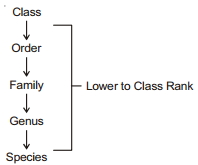
Taxonomic categories which come lower to the rank of class are
A
Order,phylum,family,species
B
Order,family,genus,species
C
Division,family,order,genus
D
Order,division,genus,species
Solution
(B) The taxonomic hierarchy in descending order is: Kingdom > Phylum/Division > Class > Order > Family > Genus > Species.
Categories that are lower in rank than 'Class' are those that follow it in the hierarchy.
These are: Order,Family,Genus,and Species.
Therefore,option $B$ is the correct answer.
Categories that are lower in rank than 'Class' are those that follow it in the hierarchy.
These are: Order,Family,Genus,and Species.
Therefore,option $B$ is the correct answer.
0 likes
View Solution477
EasyMCQ
Two animals $A$ and $B$ have similar morphological features and are fundamentally similar with each other,they must be treated as
A
One biological species
B
Two distinct species
C
One biological genera
D
Two distinct genera
Solution
(A) According to the biological concept of species,a species is defined as a group of individual organisms that share similar morphological features and are fundamentally similar to each other,capable of interbreeding to produce fertile offspring.
Since animals $A$ and $B$ possess similar morphological features and are fundamentally similar,they belong to the same biological species.
Since animals $A$ and $B$ possess similar morphological features and are fundamentally similar,they belong to the same biological species.

0 likes
View Solution478
MediumMCQ
Carolus Linnaeus is known as the father of taxonomy primarily due to which of his contributions?
A
Genera Plantarum
B
Binomial nomenclature
C
Described nearly ten thousand plant and animal species
D
Die Natürlichen Pflanzenfamilien
Solution
(B) Carolus Linnaeus is considered the father of taxonomy because he introduced the system of $Binomial \ nomenclature$. This system provides a standardized way of naming organisms using two components: the generic name (genus) and the specific epithet (species). This method revolutionized biological classification and remains the standard in scientific nomenclature today.
0 likes
View Solution479
EasyMCQ
Binomial nomenclature consists of:
A
Two Latin names only
B
Two italicized names written in Latin
C
Two Latin names followed by the author's name in Roman script
D
Two Latin names and the author's name in italics
Solution
(C) Binomial nomenclature,as proposed by Carolus Linnaeus,consists of two components: the generic name and the specific epithet. These names are derived from Latin or are Latinized. According to the rules of biological nomenclature,the scientific name is printed in italics to indicate its Latin origin,and the name of the author who first described the species is written in Roman script after the specific epithet.
0 likes
View Solution480
MediumMCQ
Given organisms belong to how many genera?
| Wheat,Brinjal,Potato,Lion,Dog,Tiger |
A
Three
B
Two
C
Four
D
Five
Solution
(C) To determine the number of genera,we classify the given organisms:
$1$. Wheat: $Triticum$
$2$. Brinjal: $Solanum$
$3$. Potato: $Solanum$
$4$. Lion: $Panthera$
$5$. Dog: $Canis$
$6$. Tiger: $Panthera$
Grouping by genus:
- Genus $1$: $Triticum$ (Wheat)
- Genus $2$: $Solanum$ (Brinjal,Potato)
- Genus $3$: $Panthera$ (Lion,Tiger)
- Genus $4$: $Canis$ (Dog)
Therefore,there are $4$ distinct genera.
$1$. Wheat: $Triticum$
$2$. Brinjal: $Solanum$
$3$. Potato: $Solanum$
$4$. Lion: $Panthera$
$5$. Dog: $Canis$
$6$. Tiger: $Panthera$
Grouping by genus:
- Genus $1$: $Triticum$ (Wheat)
- Genus $2$: $Solanum$ (Brinjal,Potato)
- Genus $3$: $Panthera$ (Lion,Tiger)
- Genus $4$: $Canis$ (Dog)
Therefore,there are $4$ distinct genera.
0 likes
View Solution481
EasyMCQ
Organisms which can freely interbreed and produce fertile offspring and have similar coded information or blue print for making these organisms are called
A
Species
B
Tribe
C
Genus
D
Sub-genus
Solution
(A) $Species$ is defined as a group of organisms that can interbreed under natural conditions to produce fertile offspring.
They share a common gene pool and possess similar genetic information or a 'blueprint' that determines their specific characteristics.
Therefore,the correct answer is $Species$.
They share a common gene pool and possess similar genetic information or a 'blueprint' that determines their specific characteristics.
Therefore,the correct answer is $Species$.
0 likes
View Solution482
EasyMCQ
The correct sequence of taxonomic categories is
A
Division—class—family—tribe—order—genus—species
B
Division—class—order—family—tribe—genus—species
C
Phylum—order—class—tribe—family—genus—species
D
Class—phylum—tribe—order—family—genus—species
Solution
(B) The taxonomic hierarchy represents the arrangement of categories in a descending order.
For plants,the sequence is: Kingdom $\rightarrow$ Division $\rightarrow$ Class $\rightarrow$ Order $\rightarrow$ Family $\rightarrow$ Genus $\rightarrow$ Species.
In the given options,option $B$ follows the correct hierarchical order: Division $\rightarrow$ Class $\rightarrow$ Order $\rightarrow$ Family $\rightarrow$ Tribe $\rightarrow$ Genus $\rightarrow$ Species (where Tribe is an optional intermediate category between Family and Genus).
For plants,the sequence is: Kingdom $\rightarrow$ Division $\rightarrow$ Class $\rightarrow$ Order $\rightarrow$ Family $\rightarrow$ Genus $\rightarrow$ Species.
In the given options,option $B$ follows the correct hierarchical order: Division $\rightarrow$ Class $\rightarrow$ Order $\rightarrow$ Family $\rightarrow$ Tribe $\rightarrow$ Genus $\rightarrow$ Species (where Tribe is an optional intermediate category between Family and Genus).
0 likes
View Solution483
EasyMCQ
$A$ genus having many species is known as
A
Polytypic
B
Monotypic
C
Polygamic
D
Both $(a)$ and $(c)$
Solution
(A) genus that contains more than one species is called a polytypic genus. For example,the genus $Solanum$ includes species like $Solanum$ $tuberosum$ (potato) and $Solanum$ $melongena$ (brinjal). In contrast,a monotypic genus contains only a single species.
0 likes
View Solution484
MediumMCQ
In taxonomic hierarchy,which of the following groups of taxa will have the highest number of similarities compared to others?
A
Anacardiaceae,Convolvulaceae and Poaceae
B
Polymoniales,Poales and Sapindales
C
Solanum,Petunia and Atropa
D
Leopard,tiger and lion
Solution
(D) In the taxonomic hierarchy,as we move from the kingdom towards the species level,the number of common characteristics or similarities increases.
$1$. $Anacardiaceae, Convolvulaceae$ and $Poaceae$ are families.
$2$. $Polymoniales, Poales$ and $Sapindales$ are orders.
$3$. $Solanum, Petunia$ and $Atropa$ are genera.
$4$. $Leopard$ ($Panthera$ $pardus$),$tiger$ ($Panthera$ $tigris$) and $lion$ ($Panthera$ $leo$) belong to the same genus,$Panthera$.
Since organisms belonging to the same genus share more common features than those in the same family or order,the group $Leopard, tiger$ and $lion$ exhibits the highest number of similarities.
$1$. $Anacardiaceae, Convolvulaceae$ and $Poaceae$ are families.
$2$. $Polymoniales, Poales$ and $Sapindales$ are orders.
$3$. $Solanum, Petunia$ and $Atropa$ are genera.
$4$. $Leopard$ ($Panthera$ $pardus$),$tiger$ ($Panthera$ $tigris$) and $lion$ ($Panthera$ $leo$) belong to the same genus,$Panthera$.
Since organisms belonging to the same genus share more common features than those in the same family or order,the group $Leopard, tiger$ and $lion$ exhibits the highest number of similarities.
0 likes
View Solution485
MediumMCQ
In which of the following pairs of categories is it more difficult to determine the relationship to other taxa at the same level,thus making the problem of classification more complex?
A
Genus and species
B
Variety and genus
C
Division and phylum
D
Species and family
Solution
(C) In the taxonomic hierarchy,as we move from species to kingdom,the number of common characteristics decreases.
Categories at higher levels (such as $Division$ and $Phylum$) contain organisms with fewer shared traits compared to lower categories.
Because there are fewer common characteristics at higher taxonomic levels,it becomes increasingly difficult to determine the evolutionary relationships between different taxa at the same level.
Therefore,the problem of classification becomes more complex at higher taxonomic ranks like $Division$ and $Phylum$.
Categories at higher levels (such as $Division$ and $Phylum$) contain organisms with fewer shared traits compared to lower categories.
Because there are fewer common characteristics at higher taxonomic levels,it becomes increasingly difficult to determine the evolutionary relationships between different taxa at the same level.
Therefore,the problem of classification becomes more complex at higher taxonomic ranks like $Division$ and $Phylum$.
0 likes
View Solution486
MediumMCQ
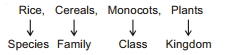
Rice,cereals,monocots and plants represent
A
Different taxa at different level
B
Same taxa of different category
C
Different category of same taxa
D
Same category for different taxa
Solution
(A) In biological classification,each level in the taxonomic hierarchy represents a rank or category.
Rice is a species,cereals belong to a family (Poaceae),monocots represent a class (Monocotyledonae),and plants represent a kingdom (Plantae).
Since these represent different taxonomic groups (taxa) at different hierarchical levels,they are considered different taxa at different levels.
Rice is a species,cereals belong to a family (Poaceae),monocots represent a class (Monocotyledonae),and plants represent a kingdom (Plantae).
Since these represent different taxonomic groups (taxa) at different hierarchical levels,they are considered different taxa at different levels.
0 likes
View Solution487
MediumMCQ
The equivalent rank of $Carnivora$ in taxonomic categories of man and housefly is respectively:
A
$Homo$ and $Musca$
B
$Hominidae$ and $Muscidae$
C
$Mammalia$ and $Insecta$
D
$Primata$ and $Diptera$
Solution
(D) In taxonomic classification,$Carnivora$ is an $Order$.
For man ($Homo$ $sapiens$),the $Order$ is $Primata$.
For housefly ($Musca$ $domestica$),the $Order$ is $Diptera$.
Therefore,the equivalent rank of $Carnivora$ for man and housefly is $Primata$ and $Diptera$ respectively.
For man ($Homo$ $sapiens$),the $Order$ is $Primata$.
For housefly ($Musca$ $domestica$),the $Order$ is $Diptera$.
Therefore,the equivalent rank of $Carnivora$ for man and housefly is $Primata$ and $Diptera$ respectively.
0 likes
View Solution488
EasyMCQ
All of the following are suffixes used for the taxonomic category of class,except:
A
-phyta
B
-opsida
C
-phyceae
D
-ae
Solution
(A) In biological classification,specific suffixes are used for different taxonomic ranks.
-phyta is a suffix used for the rank of $Division$.
-opsida is a suffix used for the rank of $Class$.
-phyceae is a suffix used for the rank of $Class$.
-ae is a suffix used for the rank of $Class$.
Therefore,$-phyta$ is the exception as it represents a $Division$.
-phyta is a suffix used for the rank of $Division$.
-opsida is a suffix used for the rank of $Class$.
-phyceae is a suffix used for the rank of $Class$.
-ae is a suffix used for the rank of $Class$.
Therefore,$-phyta$ is the exception as it represents a $Division$.
0 likes
View Solution489
MediumMCQ
Which category comes after phylum in descending order in taxonomic hierarchy?
A
Genus
B
Family
C
Class
D
Species
Solution
(C) In the taxonomic hierarchy,the categories are arranged in descending order as follows: Kingdom $\rightarrow$ Phylum $\rightarrow$ Class $\rightarrow$ Order $\rightarrow$ Family $\rightarrow$ Genus $\rightarrow$ Species.
Therefore,the category that comes immediately after Phylum in descending order is Class.
Therefore,the category that comes immediately after Phylum in descending order is Class.
0 likes
View Solution490
MediumMCQ
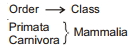
The orders Primata and Carnivora are placed in the same class,i.e.
A
Hominidae
B
Mammalia
C
Insecta
D
Chordata
Solution
(B) In biological classification,the taxonomic hierarchy follows the order: Kingdom,Phylum,Class,Order,Family,Genus,Species.
Both the order Primata (which includes monkeys,gorillas,and humans) and the order Carnivora (which includes tigers,cats,and dogs) share common features such as the presence of mammary glands and hair on the skin.
Due to these shared characteristics,both of these orders are placed under the same class,which is Mammalia.
Both the order Primata (which includes monkeys,gorillas,and humans) and the order Carnivora (which includes tigers,cats,and dogs) share common features such as the presence of mammary glands and hair on the skin.
Due to these shared characteristics,both of these orders are placed under the same class,which is Mammalia.
0 likes
View Solution491
MediumMCQ
Choose the odd one out with respect to $Panthera \ leo$.
A
Common name of tiger
B
$Panthera$ represents generic name
C
$leo$ represents specific epithet
D
$Panthera$ represents a higher level of taxon than $leo$
Solution
(A) $Panthera \ leo$ is the scientific name of the lion.
Option $A$ is the odd one out because $Panthera \ leo$ refers to the lion,not the tiger.
Option $B$ is correct as $Panthera$ is the genus.
Option $C$ is correct as $leo$ is the specific epithet.
Option $D$ is correct because the genus $(Panthera)$ is a higher taxonomic category than the species $(leo)$.
Option $A$ is the odd one out because $Panthera \ leo$ refers to the lion,not the tiger.
Option $B$ is correct as $Panthera$ is the genus.
Option $C$ is correct as $leo$ is the specific epithet.
Option $D$ is correct because the genus $(Panthera)$ is a higher taxonomic category than the species $(leo)$.
0 likes
View Solution492
MediumMCQ
Potato and brinjal belong to the genus $Solanum$,which reflects that
A
They belong to single species
B
They are a group of related species
C
They both are morphologically and structurally similar to each other in all respects
D
They can always produce fertile hybrid
Solution
(B) In biological classification,a genus is a taxonomic category that comprises a group of related species which have more characters in common in comparison to species of other genera. Potato ($Solanum$ $tuberosum$) and Brinjal ($Solanum$ $melongena$) are distinct species that share enough common features to be placed under the same genus,$Solanum$.
0 likes
View Solution493
MediumMCQ
Class $Mammalia$ consists of:
A
Order $Carnivora$ only
B
Families like $Felidae$ and $Canidae$ only
C
Related orders like $Carnivora$,$Primata$,etc.
D
All animals belonging to various phyla
Solution
(C) In biological classification,a $Class$ is a taxonomic category that ranks above $Order$ and below $Phylum$.
Class $Mammalia$ is a broad category that includes various related orders.
Examples of orders included within the class $Mammalia$ are $Carnivora$ (which includes families like $Felidae$ and $Canidae$) and $Primata$ (which includes monkeys,gorillas,and humans).
Therefore,class $Mammalia$ consists of multiple related orders.
Class $Mammalia$ is a broad category that includes various related orders.
Examples of orders included within the class $Mammalia$ are $Carnivora$ (which includes families like $Felidae$ and $Canidae$) and $Primata$ (which includes monkeys,gorillas,and humans).
Therefore,class $Mammalia$ consists of multiple related orders.
0 likes
View Solution494
EasyMCQ
Dicots like mango,brinjal and monocot like wheat are placed under a common taxonomic category known as
A
Phylum -Arthropoda
B
Phylum -Angiospermae
C
Order -Angiospermae
D
Division -Angiospermae
Solution
(D) In plant taxonomy,the category 'Division' is equivalent to 'Phylum' in animal taxonomy.
Plants like mango (dicot),brinjal (dicot),and wheat (monocot) all belong to the same Division,which is $Angiospermae$ (flowering plants).
Therefore,they are placed under the common taxonomic category of Division $Angiospermae$.
Plants like mango (dicot),brinjal (dicot),and wheat (monocot) all belong to the same Division,which is $Angiospermae$ (flowering plants).
Therefore,they are placed under the common taxonomic category of Division $Angiospermae$.
0 likes
View Solution495
EasyMCQ
Rice and brinjal belong to the category ending with the suffix:
A
$-\text{aceae}$
B
$-\text{ales}$
C
$-\text{phyta}$
D
$-\text{ae}$
Solution
(A) In biological classification, the taxonomic category 'Family' for plants typically ends with the suffix $-\text{aceae}$.
Both rice and brinjal belong to the family level, which uses the suffix $-\text{aceae}$.
| Plant | Family |
|---|---|
| Rice | Poaceae |
| Brinjal | Solanaceae |
Both rice and brinjal belong to the family level, which uses the suffix $-\text{aceae}$.
0 likes
View Solution496
MediumMCQ
Various taxonomic categories are
A
Mere morphological aggregates
B
Distinct biological entities
C
International codes used for nomenclature
D
Collection of organisms on structural similarities only
Solution
(B) Taxonomic categories are not merely morphological aggregates or collections based on structural similarities. Each category,such as species,genus,family,order,class,phylum,or kingdom,represents a distinct biological entity that reflects a specific level of classification in the taxonomic hierarchy. These categories are fundamental units of classification that help in organizing the diversity of life.
0 likes
View Solution497
DifficultMCQ
Plants belonging to different classes,with a few similar characters are assigned to a category called
A
Phylum
B
Order
C
Division
D
Genus
Solution
(C) In biological classification,the taxonomic hierarchy for plants is: Species $\rightarrow$ Genus $\rightarrow$ Family $\rightarrow$ Order $\rightarrow$ Class $\rightarrow$ Division $\rightarrow$ Kingdom.
Classes with a few similar characters are grouped together into a higher category called Division. In animals,this equivalent category is known as Phylum.
Classes with a few similar characters are grouped together into a higher category called Division. In animals,this equivalent category is known as Phylum.
0 likes
View Solution498
MediumMCQ
$A :$ Members of a species are reproductively isolated from the members of other species.
$R :$ Species is the basic taxonomic category.
$R :$ Species is the basic taxonomic category.
A
Assertion and Reason both are correct and Reason is the correct explanation of Assertion.
B
Assertion and Reason both are correct but Reason is not the correct explanation of Assertion.
C
Assertion is correct,but Reason is incorrect.
D
Both Assertion and Reason are incorrect.
Solution
(B) The Assertion is correct because,according to the biological species concept,members of a species are reproductively isolated from members of other species.
The Reason is also correct because species is indeed the basic taxonomic category in the hierarchy of classification.
However,the fact that species is the basic taxonomic category does not explain why members of a species are reproductively isolated.
Therefore,both are correct,but the Reason is not the correct explanation of the Assertion.
The Reason is also correct because species is indeed the basic taxonomic category in the hierarchy of classification.
However,the fact that species is the basic taxonomic category does not explain why members of a species are reproductively isolated.
Therefore,both are correct,but the Reason is not the correct explanation of the Assertion.
0 likes
View Solution499
MediumMCQ
$A :$ Panthera is a polytypic genus.
$R :$ Panthera has specific epithets like leo,tigris,pardus.
$R :$ Panthera has specific epithets like leo,tigris,pardus.
A
Assertion and Reason both are correct and Reason is the correct explanation of Assertion.
B
Assertion and Reason both are correct but Reason is not the correct explanation of Assertion.
C
Assertion is correct,but Reason is incorrect.
D
Both Assertion and Reason are incorrect.
Solution
(A) genus is considered polytypic if it contains more than one species.
$Panthera$ is a polytypic genus because it includes multiple species such as $Panthera$ $leo$ (lion),$Panthera$ $tigris$ (tiger),and $Panthera$ $pardus$ (leopard).
Since the genus contains multiple specific epithets,the assertion is correct and the reason provides the correct explanation for why it is classified as polytypic.
$Panthera$ is a polytypic genus because it includes multiple species such as $Panthera$ $leo$ (lion),$Panthera$ $tigris$ (tiger),and $Panthera$ $pardus$ (leopard).
Since the genus contains multiple specific epithets,the assertion is correct and the reason provides the correct explanation for why it is classified as polytypic.
0 likes
View Solution500
MediumMCQ
$A :$ $A$ group of closely related families forms an order.
$R :$ The families of an order show close resemblance in certain fundamental features and also in evolutionary trends.
$R :$ The families of an order show close resemblance in certain fundamental features and also in evolutionary trends.
A
Assertion and Reason both are correct and Reason is the correct explanation of Assertion.
B
Assertion and Reason both are correct but Reason is not the correct explanation of Assertion.
C
Assertion is correct,but Reason is incorrect.
D
Both Assertion and Reason are incorrect.
Solution
(A) In biological classification,the taxonomic hierarchy follows the sequence: Species $\rightarrow$ Genus $\rightarrow$ Family $\rightarrow$ Order $\rightarrow$ Class $\rightarrow$ Phylum $\rightarrow$ Kingdom.
An order is a higher taxonomic category that includes a group of closely related families.
These families exhibit significant similarities in fundamental features and share common evolutionary trends,which justifies their grouping into a single order.
Therefore,both the Assertion and the Reason are correct,and the Reason provides the correct explanation for the Assertion.
An order is a higher taxonomic category that includes a group of closely related families.
These families exhibit significant similarities in fundamental features and share common evolutionary trends,which justifies their grouping into a single order.
Therefore,both the Assertion and the Reason are correct,and the Reason provides the correct explanation for the Assertion.
0 likes
View SolutionThe Living World — Taxonomic categories · Frequently Asked Questions
1Are these The Living World questions useful for JEE and NEET?
Yes. All questions in this section are mapped to JEE Main and NEET exam patterns. Previous year questions from JEE Main, NEET, GUJCET and state-level exams are included with full solutions.
2Can I switch to Hindi or Gujarati for these questions?
Yes. Use the language tabs in the hero section or the sidebar to view the same questions and solutions in English, Hindi or Gujarati.
3How do I generate a question paper from this subtopic?
Use the Vedclass Exam Paper Generator — select the chapter and subtopic, set difficulty, and generate Sets A, B, C, D automatically. First 3 chapters of every subject are free.
Vedclass Products
For Students
Vedclass Test Series
Mock tests in real JEE/NEET style with performance analysis. 5-day free trial.
Start Free TrialFor Teachers
Exam Paper Generator
Generate Set A/B/C/D papers from this chapter in 2 minutes. 3 chapters free.
Try FreeFor Institutes
Online Exam Module
Live online exams with unlimited students, 360° analytics & white-label branding.
See DemoFor Teachers & Institutes
Generate a The Living World Exam Paper in 2 Minutes
Select subtopic & difficulty — Sets A, B, C, D auto-generated with No Repeat logic.
First 3 chapters of every subject are free — no payment required.