
A English
Taxonomic categories Questions in English
Class 11 Biology · The Living World · Taxonomic categories
567+
Questions
English
Language
100%
With Solutions
Showing 50 of 567 questions in English
501
MediumMCQ
$A :$ Biological concept of species is based on reproductive isolation.
$R :$ Most accepted species concept was given by Linnaeus.
$R :$ Most accepted species concept was given by Linnaeus.
A
Assertion and Reason both are correct and Reason is the correct explanation of Assertion.
B
Assertion and Reason both are correct but Reason is not the correct explanation of Assertion.
C
Assertion is correct,but Reason is incorrect.
D
Both Assertion and Reason are incorrect.
Solution
(C) The Biological Concept of Species was proposed by Ernst Mayr,which defines a species as a group of organisms that can interbreed in nature and produce fertile offspring,emphasizing reproductive isolation.
Linnaeus is known as the 'Father of Taxonomy' and proposed the Binomial Nomenclature system,but he did not propose the modern biological concept of species.
Therefore,the Assertion is correct,but the Reason is incorrect.
Linnaeus is known as the 'Father of Taxonomy' and proposed the Binomial Nomenclature system,but he did not propose the modern biological concept of species.
Therefore,the Assertion is correct,but the Reason is incorrect.
0 likes
View Solution502
MediumMCQ
$A:$ Synonyms are concerned with one of the most important rules of $ICBN$.
$R:$ Out of the two or more scientific names given to the organism,the oldest name is recognized as the valid name,and other names are recognized as synonyms.
$R:$ Out of the two or more scientific names given to the organism,the oldest name is recognized as the valid name,and other names are recognized as synonyms.
A
Assertion and Reason both are correct and Reason is the correct explanation of Assertion.
B
Assertion and Reason both are correct but Reason is not the correct explanation of Assertion.
C
Assertion is correct,but Reason is incorrect.
D
Both Assertion and Reason are incorrect.
Solution
(A) The $ICBN$ (International Code of Nomenclature for algae,fungi,and plants) follows the principle of priority. According to this principle,the earliest validly published name is considered the correct name. If an organism has been given multiple names,the oldest valid name is accepted as the correct name,and the subsequent names are treated as synonyms. Therefore,both the Assertion and the Reason are scientifically correct,and the Reason provides the correct explanation for the Assertion.
0 likes
View Solution503
MediumMCQ
$A :$ Two plants $A$ and $B$ are treated as two taxonomic species.
$R :$ Both $A$ and $B$ are different in correlated characters.
$R :$ Both $A$ and $B$ are different in correlated characters.
A
Assertion and Reason both are correct and Reason is the correct explanation of Assertion.
B
Assertion and Reason both are correct but Reason is not the correct explanation of Assertion.
C
Assertion is correct,but Reason is incorrect.
D
Both Assertion and Reason are incorrect.
Solution
(A) In taxonomy,a species is defined as a group of individual organisms with fundamental similarities. Two organisms are considered distinct taxonomic species if they exhibit significant differences in their correlated morphological and physiological characters. Since the Reason correctly explains the criteria used to distinguish between two taxonomic species,both the Assertion and Reason are correct,and the Reason is the correct explanation of the Assertion.
0 likes
View Solution504
MediumMCQ
$A :$ Species is a genetically closed system.
$R :$ Because the reproductive isolation constitutes the most important boundary between different species.
$R :$ Because the reproductive isolation constitutes the most important boundary between different species.
A
Assertion and Reason both are correct and Reason is the correct explanation of Assertion.
B
Assertion and Reason both are correct but Reason is not the correct explanation of Assertion.
C
Assertion is correct,but Reason is incorrect.
D
Both Assertion and Reason are incorrect.
Solution
(A) species is defined as a group of organisms that can interbreed under natural conditions and produce fertile offspring.
Reproductive isolation acts as a biological barrier that prevents members of different species from interbreeding.
Because gene flow between different species is restricted by this isolation,a species functions as a genetically closed system.
Therefore,the Reason correctly explains why the Assertion is true.
Reproductive isolation acts as a biological barrier that prevents members of different species from interbreeding.
Because gene flow between different species is restricted by this isolation,a species functions as a genetically closed system.
Therefore,the Reason correctly explains why the Assertion is true.
0 likes
View Solution505
MediumMCQ
$A :$ Scientific names for plants have been standardized through $ICBN$.
$R :$ Naming system which uses three-word format was given by Linnaeus.
$R :$ Naming system which uses three-word format was given by Linnaeus.
A
Assertion and Reason both are correct and Reason is the correct explanation of Assertion.
B
Assertion and Reason both are correct but Reason is not the correct explanation of Assertion.
C
Assertion is correct,but Reason is incorrect.
D
Both Assertion and Reason are incorrect.
Solution
(C) The Assertion is correct because the $ICBN$ (International Code for Botanical Nomenclature) provides the rules and criteria for the scientific naming of plants.
The Reason is incorrect because the three-word naming system,known as trinomial nomenclature,was proposed by $Lamarck$ and $Huxley$,not by $Linnaeus$. $Linnaeus$ is known for binomial nomenclature,which uses a two-word format (genus and species).
The Reason is incorrect because the three-word naming system,known as trinomial nomenclature,was proposed by $Lamarck$ and $Huxley$,not by $Linnaeus$. $Linnaeus$ is known for binomial nomenclature,which uses a two-word format (genus and species).
0 likes
View Solution506
MediumMCQ
$DNA$ sequence is the basis of grouping organisms in
A
Karyotaxonomy
B
Cytotaxonomy
C
Phenetics
D
Chemotaxonomy
Solution
(D) Chemotaxonomy is a method of biological classification based on the chemical constituents of organisms.
It involves the grouping of organisms on the basis of:
- $DNA$ sequence
- $RNA$ sequence
- Chemical nature of proteins,amino acids,and secondary metabolites.
Therefore,the correct answer is $Chemotaxonomy$.
It involves the grouping of organisms on the basis of:
- $DNA$ sequence
- $RNA$ sequence
- Chemical nature of proteins,amino acids,and secondary metabolites.
Therefore,the correct answer is $Chemotaxonomy$.
0 likes
View Solution507
Medium
Give a scientific reason: Classification is essential for understanding the inter-relation among living organisms.
Solution
(N/A) $\rightarrow$ All organisms share direct or indirect inter-relations with one another.
$\rightarrow$ Taxonomical studies are highly useful in fields like agriculture,forestry,and industry,as well as in understanding our bioresources and their immense diversity.
$\rightarrow$ Through taxonomic study,we can document and categorize the flora and fauna of various geographical regions,which helps in identifying evolutionary relationships and ecological dependencies.
$\rightarrow$ Taxonomical studies are highly useful in fields like agriculture,forestry,and industry,as well as in understanding our bioresources and their immense diversity.
$\rightarrow$ Through taxonomic study,we can document and categorize the flora and fauna of various geographical regions,which helps in identifying evolutionary relationships and ecological dependencies.
0 likes
View Solution508
EasyMCQ
Define the term: Genus.
A
$A$ group of related species which has more characters in common in comparison to species of other genera.
B
$A$ group of organisms that can interbreed.
C
$A$ taxonomic rank used in the biological classification of living and fossil organisms.
D
$A$ group of individuals that are morphologically identical.
Solution
(A) Genus is a taxonomic category that comprises a group of related species which has more characters in common in comparison to species of other genera.
For example,potato ($Solanum$ $tuberosum$) and brinjal ($Solanum$ $melongena$) are two different species but both belong to the genus $Solanum$.
For example,potato ($Solanum$ $tuberosum$) and brinjal ($Solanum$ $melongena$) are two different species but both belong to the genus $Solanum$.
0 likes
View Solution509
MediumMCQ
Define the taxonomic category: Family.
A
$A$ group of related species
B
$A$ group of related genera
C
$A$ group of related orders
D
$A$ group of related classes
Solution
(B) family is a taxonomic category that includes a group of related genera.
For example,in plants,the genera $Solanum$,$Petunia$,and $Datura$ are placed in the family $Solanaceae$ because they share several common features.
For example,in plants,the genera $Solanum$,$Petunia$,and $Datura$ are placed in the family $Solanaceae$ because they share several common features.
0 likes
View Solution510
EasyMCQ
Linnaeus is considered the Father of Taxonomy. Name two other botanists known for their contribution to the field of plant taxonomy.
A
Bentham and Hooker
B
Engler and Prantl
C
Hutchinson and Takhtajan
D
All of the above
Solution
(D) Linnaeus is known as the Father of Taxonomy for his work on binomial nomenclature and hierarchical classification.
Other prominent botanists who contributed significantly to plant taxonomy include:
$1$. George Bentham and Joseph Dalton Hooker,who proposed a natural system of classification for seed plants.
$2$. Adolf Engler and Karl Prantl,who developed a phylogenetic system of classification.
Other prominent botanists who contributed significantly to plant taxonomy include:
$1$. George Bentham and Joseph Dalton Hooker,who proposed a natural system of classification for seed plants.
$2$. Adolf Engler and Karl Prantl,who developed a phylogenetic system of classification.
0 likes
View Solution511
EasyMCQ
In the taxonomic categories, which hierarchical arrangement in ascending order is correct in the case of animals?
A
Kingdom, Class, Phylum, Family, Order, Genus, Species
B
Kingdom, Order, Class, Phylum, Family, Genus, Species
C
Kingdom, Order, Phylum, Class, Family, Genus, Species
D
Species, Genus, Family, Order, Class, Phylum, Kingdom
Solution
(D) The taxonomic hierarchy is a sequence of categories in a decreasing or increasing order from Kingdom to Species and vice versa.
In ascending order (from the smallest unit to the largest unit), the arrangement is: $Species < Genus < Family < Order < Class < Phylum < Kingdom$.
Option D in the original list was provided as a descending order (Kingdom to Species). Since the question asks for ascending order, the correct sequence is $Species, Genus, Family, Order, Class, Phylum, Kingdom$.
In ascending order (from the smallest unit to the largest unit), the arrangement is: $Species < Genus < Family < Order < Class < Phylum < Kingdom$.
Option D in the original list was provided as a descending order (Kingdom to Species). Since the question asks for ascending order, the correct sequence is $Species, Genus, Family, Order, Class, Phylum, Kingdom$.
0 likes
View Solution512
EasyMCQ
Who is known as the Father of Taxonomy?
A
Theophrastus
B
Aristotle
C
Ernst Mayr
D
Carolus Linnaeus
Solution
(D) Carolus Linnaeus is known as the Father of Taxonomy.
He developed the binomial nomenclature system,which is the formal system of naming organisms that is still used today.
He published his work in books like 'Systema Naturae' and 'Species Plantarum'.
He developed the binomial nomenclature system,which is the formal system of naming organisms that is still used today.
He published his work in books like 'Systema Naturae' and 'Species Plantarum'.
0 likes
View Solution513
EasyMCQ
What does the third word in the scientific name of modern humans represent?
A
Genus
B
Subspecies
C
Species
D
Family
Solution
(B) The scientific name of modern humans is $Homo$ $sapiens$ $sapiens$.
In binomial nomenclature,the first word represents the genus $(Homo)$ and the second word represents the species $(sapiens)$.
When a third word is added,it represents the subspecies (or variety),which in this case is $sapiens$.
In binomial nomenclature,the first word represents the genus $(Homo)$ and the second word represents the species $(sapiens)$.
When a third word is added,it represents the subspecies (or variety),which in this case is $sapiens$.
0 likes
View Solution514
MediumMCQ
Which of the following represents the correct scientific name of the mango?
A
$Mangifera$ $indica$ $L.$
B
$Mangifera$ $Indica$ $L.$
C
$mangifera$ $indica$ $L.$
D
$MANGIFERA$ $indica$ $L.$
Solution
(A) According to the rules of binomial nomenclature:
$1$. The scientific name consists of two components: the genus name and the specific epithet.
$2$. The genus name starts with a capital letter,while the specific epithet starts with a small letter.
$3$. When handwritten,both words are underlined separately,and when printed,they are in italics.
$4$. The name of the author ($L.$ for Linnaeus) appears after the specific epithet in abbreviated form and is written in Roman script.
Therefore,$Mangifera$ $indica$ $L.$ is the correct representation.
$1$. The scientific name consists of two components: the genus name and the specific epithet.
$2$. The genus name starts with a capital letter,while the specific epithet starts with a small letter.
$3$. When handwritten,both words are underlined separately,and when printed,they are in italics.
$4$. The name of the author ($L.$ for Linnaeus) appears after the specific epithet in abbreviated form and is written in Roman script.
Therefore,$Mangifera$ $indica$ $L.$ is the correct representation.
0 likes
View Solution515
MediumMCQ
Which of the following is incorrect regarding the rules of nomenclature?
A
Biological names are generally in Latin and written in italics.
B
The first component in a biological name represents the genus,while the second component denotes the species.
C
When both components of a biological name are handwritten,each word is separately underlined.
D
The first letter of the species name is written in capital letters,and the genus name is written in small letters.
Solution
(D) According to the rules of binomial nomenclature:
$1$. Biological names are generally in Latin and written in italics.
$2$. The first word in a biological name represents the genus while the second component denotes the specific epithet (species).
$3$. Both the words in a biological name,when handwritten,are separately underlined,or printed in italics to indicate their Latin origin.
$4$. The first word denoting the genus starts with a capital letter while the specific epithet (species) starts with a small letter.
Therefore,option $D$ is incorrect because it reverses the capitalization rule for the genus and species.
$1$. Biological names are generally in Latin and written in italics.
$2$. The first word in a biological name represents the genus while the second component denotes the specific epithet (species).
$3$. Both the words in a biological name,when handwritten,are separately underlined,or printed in italics to indicate their Latin origin.
$4$. The first word denoting the genus starts with a capital letter while the specific epithet (species) starts with a small letter.
Therefore,option $D$ is incorrect because it reverses the capitalization rule for the genus and species.
0 likes
View Solution516
MediumMCQ
What is the basis of modern taxonomic studies?
A
External and internal structure of organisms
B
Developmental processes
C
Ecological information
D
All of the above
Solution
(D) Modern taxonomic studies are based on a comprehensive approach to understanding organisms.
This includes:
$1$. External and internal structure (Morphology and Anatomy).
$2$. Developmental processes (Embryology).
$3$. Ecological information of the organisms.
Therefore,all these factors are essential for modern taxonomy,making $D$ the correct answer.
This includes:
$1$. External and internal structure (Morphology and Anatomy).
$2$. Developmental processes (Embryology).
$3$. Ecological information of the organisms.
Therefore,all these factors are essential for modern taxonomy,making $D$ the correct answer.
0 likes
View Solution517
EasyMCQ
$A$ group of families constitutes a/an ......... .
A
Order
B
Class
C
Genus
D
Species
Solution
(A) In the taxonomic hierarchy,categories are arranged in a specific order from the lowest to the highest rank: Species $\rightarrow$ Genus $\rightarrow$ Family $\rightarrow$ Order $\rightarrow$ Class $\rightarrow$ Phylum/Division $\rightarrow$ Kingdom.
According to this hierarchy,a group of related genera forms a family,and a group of related families constitutes an order. Therefore,the correct answer is Order.
According to this hierarchy,a group of related genera forms a family,and a group of related families constitutes an order. Therefore,the correct answer is Order.
0 likes
View Solution518
EasyMCQ
Identify the correct sequence of taxonomic categories from Kingdom to Species.
A
Kingdom $\rightarrow$ Phylum $\rightarrow$ Class $\rightarrow$ Order $\rightarrow$ Family $\rightarrow$ Genus $\rightarrow$ Species
B
Kingdom $\rightarrow$ Class $\rightarrow$ Phylum $\rightarrow$ Order $\rightarrow$ Family $\rightarrow$ Genus $\rightarrow$ Species
C
Kingdom $\rightarrow$ Species $\rightarrow$ Genus $\rightarrow$ Class $\rightarrow$ Family $\rightarrow$ Order $\rightarrow$ Phylum
D
Kingdom $\rightarrow$ Genus $\rightarrow$ Species $\rightarrow$ Class $\rightarrow$ Phylum $\rightarrow$ Family $\rightarrow$ Order
Solution
(A) The taxonomic hierarchy is a sequence of categories in a decreasing or increasing order of complexity.
The standard hierarchical arrangement from the highest rank (Kingdom) to the lowest rank (Species) is:
Kingdom $\rightarrow$ Phylum (or Division in plants) $\rightarrow$ Class $\rightarrow$ Order $\rightarrow$ Family $\rightarrow$ Genus $\rightarrow$ Species.
Therefore,option $A$ represents the correct sequence.
The standard hierarchical arrangement from the highest rank (Kingdom) to the lowest rank (Species) is:
Kingdom $\rightarrow$ Phylum (or Division in plants) $\rightarrow$ Class $\rightarrow$ Order $\rightarrow$ Family $\rightarrow$ Genus $\rightarrow$ Species.
Therefore,option $A$ represents the correct sequence.
0 likes
View Solution519
MediumMCQ
Match the following columns:
| Column-$I$ | Column-$II$ |
|---|---|
| $P$. Genus | $I$. Poaceae |
| $Q$. Family | $II$. Triticum |
| $R$. Order | $III$. Dicotyledonae |
| $S$. Class | $IV$. Diptera |
A
$P-I, Q-II, R-IV, S-III$
B
$P-II, Q-I, R-III, S-IV$
C
$P-I, Q-II, R-III, S-IV$
D
$P-II, Q-I, R-IV, S-III$
Solution
(D) The taxonomic hierarchy for the given organisms is as follows:
$1$. $P$. Genus: $Triticum$ $(II)$
$2$. $Q$. Family: $Poaceae$ $(I)$
$3$. $R$. Order: $Diptera$ $(IV)$
$4$. $S$. Class: $Dicotyledonae$ $(III)$
Therefore,the correct matching is $P-II, Q-I, R-IV, S-III$.
$1$. $P$. Genus: $Triticum$ $(II)$
$2$. $Q$. Family: $Poaceae$ $(I)$
$3$. $R$. Order: $Diptera$ $(IV)$
$4$. $S$. Class: $Dicotyledonae$ $(III)$
Therefore,the correct matching is $P-II, Q-I, R-IV, S-III$.
0 likes
View Solution520
MediumMCQ
Identify the odd one out from the following.
A
Primata
B
Hominidae
C
Diptera
D
Poales
Solution
(B) In biological classification,taxonomic categories are used to group organisms.
$A$. Primata is an order of mammals.
$B$. Hominidae is a family of primates.
$C$. Diptera is an order of insects.
$D$. Poales is an order of flowering plants.
Among these,$A$,$C$,and $D$ represent taxonomic orders,whereas $B$ (Hominidae) represents a family. Therefore,Hominidae is the odd one out.
$A$. Primata is an order of mammals.
$B$. Hominidae is a family of primates.
$C$. Diptera is an order of insects.
$D$. Poales is an order of flowering plants.
Among these,$A$,$C$,and $D$ represent taxonomic orders,whereas $B$ (Hominidae) represents a family. Therefore,Hominidae is the odd one out.
0 likes
View Solution521
MediumMCQ
As we go from Kingdom to Species, the number of common characteristics $ \dots $ and the number of species $ \dots $.
A
decreases,increases
B
increases,decreases
C
decreases,decreases
D
increases,increases
Solution
(B) In the taxonomic hierarchy, as we move from the Kingdom (highest category) to the Species (lowest category), the number of shared or common characteristics among the organisms increases because they become more closely related.
Conversely, the number of species within a higher taxonomic category decreases as we move down the hierarchy, because each category becomes more specific and exclusive.
Conversely, the number of species within a higher taxonomic category decreases as we move down the hierarchy, because each category becomes more specific and exclusive.
0 likes
View Solution522
MediumMCQ
In the classification of the housefly,what is 'Insecta'?
A
Species
B
Order
C
Class
D
Family
Solution
(C) The taxonomic classification of the housefly ($Musca$ $domestica$) is as follows:
$1$. Kingdom: $Animalia$
$2$. Phylum: $Arthropoda$
$3$. Class: $Insecta$
$4$. Order: $Diptera$
$5$. Family: $Muscidae$
$6$. Genus: $Musca$
$7$. Species: $domestica$
Therefore,'Insecta' represents the Class in the taxonomic hierarchy.
$1$. Kingdom: $Animalia$
$2$. Phylum: $Arthropoda$
$3$. Class: $Insecta$
$4$. Order: $Diptera$
$5$. Family: $Muscidae$
$6$. Genus: $Musca$
$7$. Species: $domestica$
Therefore,'Insecta' represents the Class in the taxonomic hierarchy.
0 likes
View Solution523
MediumMCQ
Match the following columns:
| Column-$I$ (Common Name) | Column-$II$ (Genus) |
| $P$. Man | $I$. Triticum |
| $Q$. Housefly | $II$. Homo |
| $R$. Mango | $III$. Mangifera |
| $S$. Wheat | $IV$. Musca |
A
$(P-II), (Q-IV), (R-III), (S-I)$
B
$(P-II), (Q-I), (R-III), (S-IV)$
C
$(P-II), (Q-IV), (R-I), (S-III)$
D
$(P-IV), (Q-II), (R-III), (S-I)$
Solution
(A) The correct matches for the given organisms and their respective genera are as follows:
$P$. Man belongs to the genus $Homo$.
$Q$. Housefly belongs to the genus $Musca$.
$R$. Mango belongs to the genus $Mangifera$.
$S$. Wheat belongs to the genus $Triticum$.
Therefore, the correct matching is $(P-II), (Q-IV), (R-III), (S-I)$.
$P$. Man belongs to the genus $Homo$.
$Q$. Housefly belongs to the genus $Musca$.
$R$. Mango belongs to the genus $Mangifera$.
$S$. Wheat belongs to the genus $Triticum$.
Therefore, the correct matching is $(P-II), (Q-IV), (R-III), (S-I)$.
0 likes
View Solution524
MediumMCQ
Dicotyledonae is a ....... .
A
Genus
B
Family
C
Order
D
Class
Solution
(D) In biological classification, the taxonomic hierarchy follows the order: Kingdom, Phylum/Division, Class, Order, Family, Genus, and Species.
$Dicotyledonae$ (dicots) represents a group of flowering plants characterized by having two cotyledons in their seeds.
According to the taxonomic hierarchy, $Dicotyledonae$ is classified as a $Class$.
$Dicotyledonae$ (dicots) represents a group of flowering plants characterized by having two cotyledons in their seeds.
According to the taxonomic hierarchy, $Dicotyledonae$ is classified as a $Class$.
0 likes
View Solution525
MediumMCQ
Select the incorrect option from the following.
A
Homo - Genus
B
Sapindales - Order
C
Angiospermae - Division
D
Anacardiaceae - Class
Solution
(D) In biological classification,the taxonomic hierarchy follows a specific order: Kingdom,Phylum/Division,Class,Order,Family,Genus,and Species.
$1$. $Homo$ is a Genus.
$2$. $Sapindales$ is an Order.
$3$. $Angiospermae$ is a Division.
$4$. $Anacardiaceae$ is a Family,not a Class. Therefore,option $D$ is incorrect because $Anacardiaceae$ is a family of flowering plants.
$1$. $Homo$ is a Genus.
$2$. $Sapindales$ is an Order.
$3$. $Angiospermae$ is a Division.
$4$. $Anacardiaceae$ is a Family,not a Class. Therefore,option $D$ is incorrect because $Anacardiaceae$ is a family of flowering plants.
0 likes
View Solution526
MediumMCQ
What are $Panthera$,$Solanum$,and $Mangifera$?
A
Species
B
Genus
C
Class
D
Phylum
Solution
(B) In biological classification,$Panthera$,$Solanum$,and $Mangifera$ represent the taxonomic category of $Genus$.
$Panthera$ is the genus for big cats (e.g.,$Panthera$ $leo$ - lion).
$Solanum$ is the genus for plants like potato ($Solanum$ $tuberosum$) and tomato ($Solanum$ $lycopersicum$).
$Mangifera$ is the genus for mango ($Mangifera$ $indica$).
Therefore,these are examples of a genus.
$Panthera$ is the genus for big cats (e.g.,$Panthera$ $leo$ - lion).
$Solanum$ is the genus for plants like potato ($Solanum$ $tuberosum$) and tomato ($Solanum$ $lycopersicum$).
$Mangifera$ is the genus for mango ($Mangifera$ $indica$).
Therefore,these are examples of a genus.
0 likes
View Solution527
MediumMCQ
Which of the following plants does not belong to the genus $Solanum$?
A
Potato
B
Nightshade (Makoi)
C
Pea
D
Brinjal
Solution
(C) The genus $Solanum$ includes several important plants such as $Solanum$ $tuberosum$ (Potato),$Solanum$ $nigrum$ (Nightshade/Makoi),and $Solanum$ $melongena$ (Brinjal).
Pea belongs to the genus $Pisum$ (specifically $Pisum$ $sativum$).
Therefore,the plant that does not belong to the genus $Solanum$ is the Pea.
Pea belongs to the genus $Pisum$ (specifically $Pisum$ $sativum$).
Therefore,the plant that does not belong to the genus $Solanum$ is the Pea.
0 likes
View Solution528
MediumMCQ
Which of the following taxonomic categories contains the maximum number of organisms?
A
Kingdom
B
Phylum
C
Genus
D
Species
Solution
(A) In the taxonomic hierarchy, the categories are arranged in descending order of their inclusiveness. The order is: $Kingdom > Phylum > Class > Order > Family > Genus > Species$.
As we move from $Species$ to $Kingdom$, the number of common characteristics decreases, while the number of organisms in the category increases.
Therefore, $Kingdom$ is the highest taxonomic category and contains the maximum number of organisms, whereas $Species$ is the lowest category and contains the minimum number of organisms.
As we move from $Species$ to $Kingdom$, the number of common characteristics decreases, while the number of organisms in the category increases.
Therefore, $Kingdom$ is the highest taxonomic category and contains the maximum number of organisms, whereas $Species$ is the lowest category and contains the minimum number of organisms.
0 likes
View Solution529
MediumMCQ
Select the correct option for $Panthera$ $leo$,$Panthera$ $pardus$,and $Panthera$ $tigris$.
A
All three belong to the same species.
B
All three belong to the same class.
C
All three belong to the same genus.
D
All of the above.
Solution
(D) The scientific names provided are $Panthera$ $leo$ (Lion),$Panthera$ $pardus$ (Leopard),and $Panthera$ $tigris$ (Tiger).
In binomial nomenclature,the first word represents the genus and the second word represents the species.
All three organisms share the same genus,which is $Panthera$.
They belong to different species ($leo$,$pardus$,and $tigris$ respectively).
However,they all belong to the same family $(Felidae)$,the same order $(Carnivora)$,and the same class $(Mammalia)$.
Since they share the same genus,class,and order,options $B$ and $C$ are technically correct in a hierarchical sense,but in the context of taxonomic classification questions,the most specific shared category provided is the genus. Given the options,$D$ is the most appropriate answer as they share the same genus,order,and class.
In binomial nomenclature,the first word represents the genus and the second word represents the species.
All three organisms share the same genus,which is $Panthera$.
They belong to different species ($leo$,$pardus$,and $tigris$ respectively).
However,they all belong to the same family $(Felidae)$,the same order $(Carnivora)$,and the same class $(Mammalia)$.
Since they share the same genus,class,and order,options $B$ and $C$ are technically correct in a hierarchical sense,but in the context of taxonomic classification questions,the most specific shared category provided is the genus. Given the options,$D$ is the most appropriate answer as they share the same genus,order,and class.
0 likes
View Solution530
MediumMCQ
Which of the following is not a genus?
A
Felis
B
Canis
C
Panthera
D
Carnivora
Solution
(D) In biological classification,the taxonomic hierarchy follows the order: Kingdom,Phylum,Class,Order,Family,Genus,and Species.
$Felis$ (cat),$Canis$ (dog),and $Panthera$ (lion/tiger) are all examples of genera.
$Carnivora$ is an Order that includes various families like Felidae and Canidae.
Therefore,$Carnivora$ is not a genus.
$Felis$ (cat),$Canis$ (dog),and $Panthera$ (lion/tiger) are all examples of genera.
$Carnivora$ is an Order that includes various families like Felidae and Canidae.
Therefore,$Carnivora$ is not a genus.
0 likes
View Solution531
MediumMCQ
$I$ - Species,$II$ - Kingdom,$III$ - Class,$IV$ - Genus,$V$ - Family,$VI$ - Phylum,$VII$ - Order
Categories classified based on similar characteristics - $P$
Categories classified based on a group of characteristics - $Q$
Select the correct option for $P$ and $Q$.
$P\quad\quad\quad\quad\quad Q$
Categories classified based on similar characteristics - $P$
Categories classified based on a group of characteristics - $Q$
Select the correct option for $P$ and $Q$.
$P\quad\quad\quad\quad\quad Q$
A
$I, II, IV, VI \quad\quad\quad\quad III, V, VII$
B
$I, IV, V \quad\quad\quad\quad II, III, VI, VII$
C
$II, III, VI, VII\quad\quad\quad\quad I, IV, V$
D
$III, V, VII\quad\quad\quad\quad I, II, V, VI$
Solution
(B) In biological classification,categories are organized based on the complexity and number of shared characteristics.
$P$ (Categories based on similar characteristics): These are the lower taxonomic categories where organisms share a high degree of similarity. These include $I$ (Species),$IV$ (Genus),and $V$ (Family).
$Q$ (Categories based on a group of characteristics): These are the higher taxonomic categories where organisms are grouped based on broader,more general characteristics. These include $II$ (Kingdom),$III$ (Class),$VI$ (Phylum),and $VII$ (Order).
Therefore,$P = I, IV, V$ and $Q = II, III, VI, VII$. The correct option is $B$.
$P$ (Categories based on similar characteristics): These are the lower taxonomic categories where organisms share a high degree of similarity. These include $I$ (Species),$IV$ (Genus),and $V$ (Family).
$Q$ (Categories based on a group of characteristics): These are the higher taxonomic categories where organisms are grouped based on broader,more general characteristics. These include $II$ (Kingdom),$III$ (Class),$VI$ (Phylum),and $VII$ (Order).
Therefore,$P = I, IV, V$ and $Q = II, III, VI, VII$. The correct option is $B$.
0 likes
View Solution532
MediumMCQ
Plant families like $Convolvulaceae$ and $Solanaceae$ are included in the order $Polymoniales$ mainly based on their . . . . . . characters.
A
Vegetative characters
B
Floral characters
C
Root characters
D
Stem characters
Solution
(B) In biological classification,the order $Polymoniales$ includes plant families such as $Convolvulaceae$ and $Solanaceae$.
This classification is primarily based on the floral characters of these plants.
Floral characters are considered more conservative and reliable for higher taxonomic categories like order compared to vegetative characters.
This classification is primarily based on the floral characters of these plants.
Floral characters are considered more conservative and reliable for higher taxonomic categories like order compared to vegetative characters.
0 likes
View Solution533
MediumMCQ
Animals like tigers,cats,and dogs are included in the order ....
A
Canidae
B
Carnivora
C
Felidae
D
Primata
Solution
(B) In biological classification,the order $Carnivora$ includes animals that are primarily meat-eaters.
Both cats (family $Felidae$) and dogs (family $Canidae$) belong to the order $Carnivora$.
Therefore,tigers,cats,and dogs are all included in the order $Carnivora$.
Both cats (family $Felidae$) and dogs (family $Canidae$) belong to the order $Carnivora$.
Therefore,tigers,cats,and dogs are all included in the order $Carnivora$.
0 likes
View Solution534
MediumMCQ
Animals like monkeys,gorillas,and gibbons are included in the order ...... .
A
Canidae
B
Carnivora
C
Felidae
D
Primata
Solution
(D) In biological classification,the order $Primata$ includes monkeys,gorillas,gibbons,and humans.
$Canidae$ and $Felidae$ are families within the order $Carnivora$.
Therefore,the correct order for monkeys,gorillas,and gibbons is $Primata$.
$Canidae$ and $Felidae$ are families within the order $Carnivora$.
Therefore,the correct order for monkeys,gorillas,and gibbons is $Primata$.
0 likes
View Solution535
MediumMCQ
If an organism belongs to different orders but the same phylum,it may also belong to the same ......... .
A
Class
B
Species
C
Genus
D
All of the above
Solution
(A) In the taxonomic hierarchy,the order of categories is: Kingdom > Phylum > Class > Order > Family > Genus > Species.
If two organisms belong to the same phylum but different orders,they must share the taxonomic category that is higher than the order but lower than or equal to the phylum.
Among the given options,'Class' is the only category that is higher than 'Order' and lower than 'Phylum'.
Therefore,organisms belonging to different orders but the same phylum can be classified under the same 'Class'.
If two organisms belong to the same phylum but different orders,they must share the taxonomic category that is higher than the order but lower than or equal to the phylum.
Among the given options,'Class' is the only category that is higher than 'Order' and lower than 'Phylum'.
Therefore,organisms belonging to different orders but the same phylum can be classified under the same 'Class'.
0 likes
View Solution536
MediumMCQ
Complete the following table regarding Mango $(Mangifera \text{ } indica)$:
$P \quad \quad \quad \quad Q \quad \quad \quad \quad R$
| Kingdom | Plantae |
| Division | $P$ |
| Class | Dicotyledonae |
| $Q$ | Sapindales |
| $R$ | Anacardiaceae |
$P \quad \quad \quad \quad Q \quad \quad \quad \quad R$
A
Order,Family,Angiospermae
B
Mangifera,Family,Order
C
Angiospermae,Order,Family
D
Angiospermae,Family,Genus
Solution
(C) The taxonomic hierarchy for Mango $(Mangifera \text{ } indica)$ is as follows:
$1$. Kingdom: Plantae
$2$. Division: Angiospermae $(P)$
$3$. Class: Dicotyledonae
$4$. Order: Sapindales $(Q)$
$5$. Family: Anacardiaceae $(R)$
$6$. Genus: Mangifera
$7$. Species: indica
Therefore, $P$ is Angiospermae, $Q$ is Order, and $R$ is Family.
$1$. Kingdom: Plantae
$2$. Division: Angiospermae $(P)$
$3$. Class: Dicotyledonae
$4$. Order: Sapindales $(Q)$
$5$. Family: Anacardiaceae $(R)$
$6$. Genus: Mangifera
$7$. Species: indica
Therefore, $P$ is Angiospermae, $Q$ is Order, and $R$ is Family.
0 likes
View Solution537
MediumMCQ
Identify the family of the animal.
A
Anacardiaceae
B
Muscidae
C
Fabaceae
D
Poaceae
Solution
(B) In biological classification,the taxonomic category 'family' ends with the suffix '-idae' for animals and '-aceae' for plants.
$A$. Anacardiaceae is a family of plants (e.g.,mango).
$B$. Muscidae is a family of animals (e.g.,housefly).
$C$. Fabaceae is a family of plants (e.g.,pea).
$D$. Poaceae is a family of plants (e.g.,wheat).
Therefore,the correct option is $B$.
$A$. Anacardiaceae is a family of plants (e.g.,mango).
$B$. Muscidae is a family of animals (e.g.,housefly).
$C$. Fabaceae is a family of plants (e.g.,pea).
$D$. Poaceae is a family of plants (e.g.,wheat).
Therefore,the correct option is $B$.
0 likes
View Solution538
EasyMCQ
$A$ group of closely related species is known as.......
A
Class
B
Kingdom
C
Family
D
Genus
Solution
(D) In biological classification, the taxonomic hierarchy follows a specific order: Species, Genus, Family, Order, Class, Phylum, and Kingdom.
$A$ $Genus$ is defined as a group of closely related species that share a common evolutionary ancestor and possess many similar morphological characters.
For example, the genus $Panthera$ includes closely related species like $Panthera$ $leo$ (lion) and $Panthera$ $tigris$ (tiger).
$A$ $Genus$ is defined as a group of closely related species that share a common evolutionary ancestor and possess many similar morphological characters.
For example, the genus $Panthera$ includes closely related species like $Panthera$ $leo$ (lion) and $Panthera$ $tigris$ (tiger).
0 likes
View Solution539
MediumMCQ
Identify the correct pair (Genus - Family).
A
Homo - Hominidae
B
Musca - Muscidae
C
Mangifera - Sapindales
D
Triticum - Monocotyledonae
Solution
(A) The analysis of the given options is as follows:
$1$. $Homo$ is a Genus and $Hominidae$ is its Family. This pair is correct.
$2$. $Musca$ is a Genus and $Muscidae$ is its Family. This pair is also correct.
$3$. $Mangifera$ is a Genus and $Anacardiaceae$ is its Family,whereas $Sapindales$ is its Order.
$4$. $Triticum$ is a Genus and $Poaceae$ is its Family,whereas $Monocotyledonae$ is its Class.
Note: Both $A$ and $B$ are technically correct pairs of (Genus - Family). However,in many standard biological contexts,$Homo - Hominidae$ is the primary example cited for human classification.
$1$. $Homo$ is a Genus and $Hominidae$ is its Family. This pair is correct.
$2$. $Musca$ is a Genus and $Muscidae$ is its Family. This pair is also correct.
$3$. $Mangifera$ is a Genus and $Anacardiaceae$ is its Family,whereas $Sapindales$ is its Order.
$4$. $Triticum$ is a Genus and $Poaceae$ is its Family,whereas $Monocotyledonae$ is its Class.
Note: Both $A$ and $B$ are technically correct pairs of (Genus - Family). However,in many standard biological contexts,$Homo - Hominidae$ is the primary example cited for human classification.
0 likes
View Solution540
MediumMCQ
$Leo$ and $nigrum$ are respectively .......
A
Species and Species
B
Species and Genus
C
Genus and Species
D
Genus and Genus
Solution
(A) In biological nomenclature,the scientific name of an organism consists of two parts: the genus name and the specific epithet (species name).
$1$. $Panthera$ $leo$ is the scientific name for the lion,where $Panthera$ is the genus and $leo$ is the species.
$2$. $Solanum$ $nigrum$ is the scientific name for the black nightshade,where $Solanum$ is the genus and $nigrum$ is the species.
Therefore,$leo$ and $nigrum$ both represent the specific epithet or species name of their respective organisms.
$1$. $Panthera$ $leo$ is the scientific name for the lion,where $Panthera$ is the genus and $leo$ is the species.
$2$. $Solanum$ $nigrum$ is the scientific name for the black nightshade,where $Solanum$ is the genus and $nigrum$ is the species.
Therefore,$leo$ and $nigrum$ both represent the specific epithet or species name of their respective organisms.
0 likes
View Solution541
MediumMCQ
Match the following columns:
| Column-$I$ | Column-$II$ |
| $P$. Chemotaxonomy | $I$. Uses computers to easily process data based on all observable characteristics. |
| $Q$. Cytotaxonomy | $II$. Based on evolutionary relationships. |
| $R$. Numerical taxonomy | $III$. Uses chemical constituents of plants. |
| $S$. Phylogenetic taxonomy | $IV$. Uses information like chromosome number, structure, and behavior. |
A
$P-IV, Q-III, R-I, S-II$
B
$P-III, Q-IV, R-II, S-I$
C
$P-III, Q-IV, R-I, S-II$
D
$P-II, Q-I, R-IV, S-III$
Solution
(C) The correct matches are as follows:
$P$. Chemotaxonomy: Uses chemical constituents of plants to resolve taxonomic confusion $(P-III)$.
$Q$. Cytotaxonomy: Based on cytological information like chromosome number, structure, and behavior $(Q-IV)$.
$R$. Numerical taxonomy: Carried out using computers and is based on all observable characteristics $(R-I)$.
$S$. Phylogenetic taxonomy: Based on evolutionary relationships between the various organisms $(S-II)$.
Therefore, the correct sequence is $P-III, Q-IV, R-I, S-II$.
$P$. Chemotaxonomy: Uses chemical constituents of plants to resolve taxonomic confusion $(P-III)$.
$Q$. Cytotaxonomy: Based on cytological information like chromosome number, structure, and behavior $(Q-IV)$.
$R$. Numerical taxonomy: Carried out using computers and is based on all observable characteristics $(R-I)$.
$S$. Phylogenetic taxonomy: Based on evolutionary relationships between the various organisms $(S-II)$.
Therefore, the correct sequence is $P-III, Q-IV, R-I, S-II$.
0 likes
View Solution542
EasyMCQ
What is the taxonomic rank of $Rhizobium$?
A
Species
B
Genus
C
Family
D
Order
Solution
(B) $Rhizobium$ is a well-known genus of bacteria that fix atmospheric nitrogen in the root nodules of leguminous plants. In biological classification,it belongs to the rank of Genus.
0 likes
View Solution543
MediumMCQ
Which of the following taxonomic categories contains organisms least similar to one another?
A
Class
B
Genus
C
Family
D
Species
Solution
(A) In the taxonomic hierarchy,as we move from the species level to the kingdom level,the number of common characteristics shared by the organisms decreases.
This means that organisms in higher taxonomic categories are less similar to each other compared to those in lower categories.
The hierarchy is: $Species < Genus < Family < Order < Class < Phylum < Kingdom$.
Among the given options ($Class$,$Genus$,$Family$,$Species$),$Class$ is the highest taxonomic category.
Therefore,organisms belonging to the same $Class$ share the fewest common characteristics,making them the least similar to one another.
This means that organisms in higher taxonomic categories are less similar to each other compared to those in lower categories.
The hierarchy is: $Species < Genus < Family < Order < Class < Phylum < Kingdom$.
Among the given options ($Class$,$Genus$,$Family$,$Species$),$Class$ is the highest taxonomic category.
Therefore,organisms belonging to the same $Class$ share the fewest common characteristics,making them the least similar to one another.
0 likes
View Solution544
MediumMCQ
Which of the following is not a broad category in the taxonomic hierarchy?
A
Class
B
Sub kingdom
C
Division
D
Order
Solution
(B) The taxonomic hierarchy consists of obligate categories which are: Kingdom,Phylum (for animals) or Division (for plants),Class,Order,Family,Genus,and Species.
'Sub kingdom' is not considered a primary or broad category in the standard taxonomic hierarchy; it is an intermediate category used for further classification within a Kingdom.
Therefore,'Sub kingdom' is the correct answer.
'Sub kingdom' is not considered a primary or broad category in the standard taxonomic hierarchy; it is an intermediate category used for further classification within a Kingdom.
Therefore,'Sub kingdom' is the correct answer.
0 likes
View Solution545
EasyMCQ
Which of the following is the correct ascending order of different taxonomic categories used in plant classification?
A
Species $\rightarrow$ Genus $\rightarrow$ Order $\rightarrow$ Class $\rightarrow$ Family $\rightarrow$ Division $\rightarrow$ Kingdom
B
Species $\rightarrow$ Order $\rightarrow$ Genus $\rightarrow$ Class $\rightarrow$ Family $\rightarrow$ Division $\rightarrow$ Kingdom
C
Species $\rightarrow$ Genus $\rightarrow$ Family $\rightarrow$ Order $\rightarrow$ Class $\rightarrow$ Division $\rightarrow$ Kingdom
D
Species $\rightarrow$ Order $\rightarrow$ Class $\rightarrow$ Genus $\rightarrow$ Family $\rightarrow$ Phylum $\rightarrow$ Kingdom
Solution
(C) The taxonomic hierarchy is a sequence of categories in a decreasing or increasing order from Kingdom to Species or vice versa.
In plant classification,the hierarchy in ascending order (from smallest to largest) is:
$1$. Species
$2$. Genus
$3$. Family
$4$. Order
$5$. Class
$6$. Division (equivalent to Phylum in animals)
$7$. Kingdom
Therefore,the correct sequence is Species $\rightarrow$ Genus $\rightarrow$ Family $\rightarrow$ Order $\rightarrow$ Class $\rightarrow$ Division $\rightarrow$ Kingdom.
In plant classification,the hierarchy in ascending order (from smallest to largest) is:
$1$. Species
$2$. Genus
$3$. Family
$4$. Order
$5$. Class
$6$. Division (equivalent to Phylum in animals)
$7$. Kingdom
Therefore,the correct sequence is Species $\rightarrow$ Genus $\rightarrow$ Family $\rightarrow$ Order $\rightarrow$ Class $\rightarrow$ Division $\rightarrow$ Kingdom.
0 likes
View Solution546
EasyMCQ
In which of the following systems of classification is each character given equal importance,and at the same time,hundreds of characters can be considered?
A
Numerical taxonomy
B
Natural classification
C
Chemotaxonomy
D
Cytotaxonomy
Solution
(A) Numerical taxonomy is a system of classification that uses mathematical methods to evaluate observable characteristics.
In this system,each character is given equal importance,and hundreds of characters can be considered simultaneously using computers.
This approach helps in minimizing human bias in classification.
In this system,each character is given equal importance,and hundreds of characters can be considered simultaneously using computers.
This approach helps in minimizing human bias in classification.
0 likes
View Solution547
MediumMCQ
How many of the following statements are correct?
$(A)$ Each taxonomic category is a unit of classification.
$(B)$ Taxonomic groups are distinct biological entities.
$(C)$ Genera are aggregates of closely related families.
$(D)$ Both vegetative and reproductive characters are used to characterise the families.
$(A)$ Each taxonomic category is a unit of classification.
$(B)$ Taxonomic groups are distinct biological entities.
$(C)$ Genera are aggregates of closely related families.
$(D)$ Both vegetative and reproductive characters are used to characterise the families.
A
$2$
B
$3$
C
$1$
D
$4$
Solution
(B) Let us analyze each statement:
$(A)$ Each taxonomic category is a unit of classification: This is correct. Every rank or category represents a unit of classification.
$(B)$ Taxonomic groups are distinct biological entities: This is correct. They are not merely morphological aggregates but represent distinct biological groups.
$(C)$ Genera are aggregates of closely related families: This is incorrect. $A$ genus is an aggregate of closely related species,not families. Families are aggregates of related genera.
$(D)$ Both vegetative and reproductive characters are used to characterise the families: This is correct. In plant taxonomy,both vegetative and reproductive features are essential for classification.
Therefore,statements $(A)$,$(B)$,and $(D)$ are correct. The total number of correct statements is $3$.
$(A)$ Each taxonomic category is a unit of classification: This is correct. Every rank or category represents a unit of classification.
$(B)$ Taxonomic groups are distinct biological entities: This is correct. They are not merely morphological aggregates but represent distinct biological groups.
$(C)$ Genera are aggregates of closely related families: This is incorrect. $A$ genus is an aggregate of closely related species,not families. Families are aggregates of related genera.
$(D)$ Both vegetative and reproductive characters are used to characterise the families: This is correct. In plant taxonomy,both vegetative and reproductive features are essential for classification.
Therefore,statements $(A)$,$(B)$,and $(D)$ are correct. The total number of correct statements is $3$.
0 likes
View Solution548
MediumMCQ
Identify the true statements from below $:-$
$(a)$ Convolvulaceae and Solanaceae belong to the same order
$(b)$ Animals,mammals,and dogs represent different taxa at same levels
$(c)$ Musca domestica is the scientific name of housefly
$(d)$ Taxonomic categories are distinct biological entities
$(a)$ Convolvulaceae and Solanaceae belong to the same order
$(b)$ Animals,mammals,and dogs represent different taxa at same levels
$(c)$ Musca domestica is the scientific name of housefly
$(d)$ Taxonomic categories are distinct biological entities
A
$(a, b, d)$
B
$(a, b, c)$
C
$(a, c, d)$
D
$(b, c, d)$
Solution
(C) Statement $(a)$ is true: Both Convolvulaceae and Solanaceae belong to the order Polymoniales.
Statement $(b)$ is false: Animals (Kingdom),mammals (Class),and dogs (Species) represent different taxa at different levels,not the same level.
Statement $(c)$ is true: Musca domestica is the scientific name of the housefly.
Statement $(d)$ is true: Taxonomic categories are distinct biological entities,not merely morphological aggregates.
Therefore,statements $(a), (c),$ and $(d)$ are correct.
Statement $(b)$ is false: Animals (Kingdom),mammals (Class),and dogs (Species) represent different taxa at different levels,not the same level.
Statement $(c)$ is true: Musca domestica is the scientific name of the housefly.
Statement $(d)$ is true: Taxonomic categories are distinct biological entities,not merely morphological aggregates.
Therefore,statements $(a), (c),$ and $(d)$ are correct.
0 likes
View Solution549
MediumMCQ
In the given taxonomic sequence,what could $A, B$,and $C$ be?
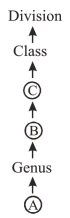
A
$A-$ Sub species,$B-$ Family,$C-$ Kingdom
B
$A-$ Species,$B-$ Order,$C-$ Family
C
$A-$ Species,$B-$ Family,$C-$ Order
D
$A-$ Order,$B-$ Family,$C-$ Kingdom
Solution
(C) The taxonomic hierarchy in ascending order is: Species $\rightarrow$ Genus $\rightarrow$ Family $\rightarrow$ Order $\rightarrow$ Class $\rightarrow$ Phylum/Division $\rightarrow$ Kingdom.
Given the sequence: $A \rightarrow$ Genus $\rightarrow B \rightarrow C \rightarrow$ Class $\rightarrow$ Division.
Comparing this with the standard hierarchy:
$A$ must be Species (as it is below Genus).
$B$ must be Family (as it is above Genus).
$C$ must be Order (as it is above Family and below Class).
Therefore,the correct sequence is $A-$ Species,$B-$ Family,$C-$ Order.
Given the sequence: $A \rightarrow$ Genus $\rightarrow B \rightarrow C \rightarrow$ Class $\rightarrow$ Division.
Comparing this with the standard hierarchy:
$A$ must be Species (as it is below Genus).
$B$ must be Family (as it is above Genus).
$C$ must be Order (as it is above Family and below Class).
Therefore,the correct sequence is $A-$ Species,$B-$ Family,$C-$ Order.
0 likes
View Solution550
MediumMCQ
Which of the following statement$(s)$ is/are true?
$A.$ An organism represents/occupies a place or position in the system of classification.
$B.$ One specific epithet may be present in different genera representing different species.
$C.$ Human belongs to $Homo$ species.
$D.$ Animals,mammals,and dogs represent the taxa at the same level.
Options:
$A.$ An organism represents/occupies a place or position in the system of classification.
$B.$ One specific epithet may be present in different genera representing different species.
$C.$ Human belongs to $Homo$ species.
$D.$ Animals,mammals,and dogs represent the taxa at the same level.
Options:
A
$A, B$ and $C$
B
$A, B, C$ and $D$
C
$A, B$ and $D$
D
$A$ and $B$
Solution
(D) $A.$ True: Every organism is assigned a specific rank or position in the taxonomic hierarchy.
$B.$ True: $A$ specific epithet (the second part of a binomial name) can be shared by different species belonging to different genera (e.g.,$Mangifera$ $indica$ and $Tamarindus$ $indica$).
$C.$ False: Human belongs to the genus $Homo$ and the species $sapiens$. Thus,the scientific name is $Homo$ $sapiens$.
$D.$ False: Animals (Kingdom),mammals (Class),and dogs (Species/Genus level) represent taxa at different hierarchical levels,not the same level.
$B.$ True: $A$ specific epithet (the second part of a binomial name) can be shared by different species belonging to different genera (e.g.,$Mangifera$ $indica$ and $Tamarindus$ $indica$).
$C.$ False: Human belongs to the genus $Homo$ and the species $sapiens$. Thus,the scientific name is $Homo$ $sapiens$.
$D.$ False: Animals (Kingdom),mammals (Class),and dogs (Species/Genus level) represent taxa at different hierarchical levels,not the same level.
0 likes
View SolutionThe Living World — Taxonomic categories · Frequently Asked Questions
1Are these The Living World questions useful for JEE and NEET?
Yes. All questions in this section are mapped to JEE Main and NEET exam patterns. Previous year questions from JEE Main, NEET, GUJCET and state-level exams are included with full solutions.
2Can I switch to Hindi or Gujarati for these questions?
Yes. Use the language tabs in the hero section or the sidebar to view the same questions and solutions in English, Hindi or Gujarati.
3How do I generate a question paper from this subtopic?
Use the Vedclass Exam Paper Generator — select the chapter and subtopic, set difficulty, and generate Sets A, B, C, D automatically. First 3 chapters of every subject are free.
Vedclass Products
For Students
Vedclass Test Series
Mock tests in real JEE/NEET style with performance analysis. 5-day free trial.
Start Free TrialFor Teachers
Exam Paper Generator
Generate Set A/B/C/D papers from this chapter in 2 minutes. 3 chapters free.
Try FreeFor Institutes
Online Exam Module
Live online exams with unlimited students, 360° analytics & white-label branding.
See DemoFor Teachers & Institutes
Generate a The Living World Exam Paper in 2 Minutes
Select subtopic & difficulty — Sets A, B, C, D auto-generated with No Repeat logic.
First 3 chapters of every subject are free — no payment required.