
A English
Mix Examples-The Living World Questions in English
Class 11 Biology · The Living World · Mix Examples-The Living World
88+
Questions
English
Language
100%
With Solutions
Showing 50 of 88 questions in English
1
MediumMCQ
How is the scientific name of an organism written?
A
Underlined
B
In capital letters
C
Italicized
D
All of the above
Solution
(D) According to the rules of binomial nomenclature:
$1$. The scientific name is printed in italics to indicate its Latin origin.
$2$. When handwritten,both the genus and species names are separately underlined to indicate their Latin origin.
$3$. The generic name starts with a capital letter,and the specific epithet starts with a small letter.
Therefore,the options provided describe the formatting conventions used in scientific literature and manuscripts.
$1$. The scientific name is printed in italics to indicate its Latin origin.
$2$. When handwritten,both the genus and species names are separately underlined to indicate their Latin origin.
$3$. The generic name starts with a capital letter,and the specific epithet starts with a small letter.
Therefore,the options provided describe the formatting conventions used in scientific literature and manuscripts.
0 likes
View Solution2
MediumMCQ
The International Code of $Biological$ $Nomenclature$ is applicable to:
A
Plants
B
Animals
C
Both animals and plants
D
None of the above
Solution
(C) The $International$ $Code$ $of$ $Biological$ $Nomenclature$ (often referred to as $ICBN$ for plants and $ICZN$ for animals) provides the rules for naming organisms.
Specifically,the $International$ $Code$ $of$ $Nomenclature$ $for$ $algae,$ $fungi,$ $and$ $plants$ $(ICN)$ governs plants,while the $International$ $Code$ $of$ $Zoological$ $Nomenclature$ $(ICZN)$ governs animals.
Since the question refers to the general system of biological nomenclature applicable to living organisms,it encompasses both plants and animals.
Specifically,the $International$ $Code$ $of$ $Nomenclature$ $for$ $algae,$ $fungi,$ $and$ $plants$ $(ICN)$ governs plants,while the $International$ $Code$ $of$ $Zoological$ $Nomenclature$ $(ICZN)$ governs animals.
Since the question refers to the general system of biological nomenclature applicable to living organisms,it encompasses both plants and animals.
0 likes
View Solution3
MediumMCQ
Why are jams and pickles immersed in concentrated sugar solution or oil?
A
They do not rot due to their own growth.
B
They do not rot due to fungal or bacterial action.
C
They do not dry.
D
They become good in taste.
Solution
(B) Jams and pickles are preserved by adding high concentrations of sugar or salt (or oil).
These substances create a hypertonic environment around the microbes.
Due to the process of $plasmolysis$,water moves out of the microbial cells into the surrounding concentrated medium.
As a result,the microbial cells lose water,shrink,and eventually die,preventing the spoilage of the food by fungal or bacterial action.
These substances create a hypertonic environment around the microbes.
Due to the process of $plasmolysis$,water moves out of the microbial cells into the surrounding concentrated medium.
As a result,the microbial cells lose water,shrink,and eventually die,preventing the spoilage of the food by fungal or bacterial action.
0 likes
View Solution4
EasyMCQ
Epiphytes are plants which are dependent on other plants:
A
Only for water
B
For water and food
C
Only for food
D
Only for shelter (support)
Solution
(D) Epiphytes are plants that grow on other plants,using them only for physical support or shelter. They do not derive water or nutrients from the host plant; instead,they obtain moisture and nutrients from the atmosphere,rain,and debris. Because they occupy space on the host without harming it,they are sometimes referred to as space parasites.
0 likes
View Solution5
EasyMCQ
Match the names of branches of biology listed under column $I$ with the field of study given under column $II$; choose the answer which gives the correct combination of the alphabets of the two columns.
Column $I$ (Branch of biology) | Column $II$ (Field of study)
$A$ Palynology | $p$ Silkworms
$B$ Oncology | $q$ Pollens
$C$ Phycology | $r$ Cancer
$D$ Sericulture | $s$ Algae
Column $I$ (Branch of biology) | Column $II$ (Field of study)
$A$ Palynology | $p$ Silkworms
$B$ Oncology | $q$ Pollens
$C$ Phycology | $r$ Cancer
$D$ Sericulture | $s$ Algae
A
$A = s, B = q, C = r, D = p$
B
$A = q, B = r, C = s, D = p$
C
$A = s, B = r, C = q, D = p$
D
$A = r, B = q, C = s, D = p$
Solution
(B) The correct matches are as follows:
$A$ Palynology: Study of pollen grains and spores $(q)$.
$B$ Oncology: Study of cancer and tumors $(r)$.
$C$ Phycology: Study of algae $(s)$.
$D$ Sericulture: Rearing of silkworms for the production of silk $(p)$.
Therefore,the correct combination is $A = q, B = r, C = s, D = p$.
$A$ Palynology: Study of pollen grains and spores $(q)$.
$B$ Oncology: Study of cancer and tumors $(r)$.
$C$ Phycology: Study of algae $(s)$.
$D$ Sericulture: Rearing of silkworms for the production of silk $(p)$.
Therefore,the correct combination is $A = q, B = r, C = s, D = p$.
0 likes
View Solution6
EasyMCQ
"Pedology" is the study of
A
Soil
B
Locomotion of animals
C
Rocks
D
Crop diseases
Solution
$(A)$ The term "pedology" is derived from two Greek words: "pedos" meaning soil and "logy" meaning study.
Therefore, pedology is defined as the scientific study of soil, including its formation, classification, and mapping.
Therefore, pedology is defined as the scientific study of soil, including its formation, classification, and mapping.
0 likes
View Solution7
EasyMCQ
Clay soil is typically found in which of the following locations?
A
In deserts
B
Around ponds
C
On seashores
D
On rocks
Solution
(B) Clay soil consists of very fine particles with high water-holding capacity. It is commonly found in areas where water accumulates and sediments settle,such as around ponds,lakes,or riverbeds,where the fine particles can deposit over time.
0 likes
View Solution8
EasyMCQ
Plants growing on sandstone are known as:
A
Psammophytes
B
Oxylophytes
C
Lithophytes
D
Phanerophytes
Solution
(C) Plants that grow on rocks or stone surfaces are called $Lithophytes$.
$Psammophytes$ are plants that grow in sandy soils.
$Oxylophytes$ are plants that grow in acidic soils.
$Phanerophytes$ are plants whose perennating buds are exposed to the air.
Therefore,the correct answer is $Lithophytes$.
$Psammophytes$ are plants that grow in sandy soils.
$Oxylophytes$ are plants that grow in acidic soils.
$Phanerophytes$ are plants whose perennating buds are exposed to the air.
Therefore,the correct answer is $Lithophytes$.
0 likes
View Solution9
EasyMCQ
About how much water is recycled in the form of rains per year?
A
$4.46 \times 10^5 \text{ g/year}$
B
$4.46 \times 10^{10} \text{ g/year}$
C
$4.46 \times 10^{20} \text{ g/year}$
D
$4.46 \times 10^{30} \text{ g/year}$
Solution
(C) The total world precipitation (rainfall) is estimated to be approximately $4.46 \times 10^{20} \text{ g}$ per year.
This value represents the global hydrological cycle's annual turnover of water in the form of precipitation.
Consequently,the correct option is $C$.
This value represents the global hydrological cycle's annual turnover of water in the form of precipitation.
Consequently,the correct option is $C$.
0 likes
View Solution10
EasyMCQ
Petroleum is derived from the words 'Petra' meaning rock and 'Oleum' meaning oil. The words 'Petra' and 'Oleum' are:
A
Greek words
B
Latin words
C
Indian words
D
Chinese words
Solution
(B) The term 'Petroleum' is derived from two Latin words: 'Petra' which means rock or stone,and 'Oleum' which means oil.
Therefore,the correct answer is Latin words.
Therefore,the correct answer is Latin words.
0 likes
View Solution11
EasyMCQ
Match the following columns:
| Column-$I$ | Column-$II$ |
| $(A)$ Linnaeus | $(i)$ First discovered virus |
| $(B)$ Ivanowsky | $(ii)$ First discovered lichen |
| $(C)$ Iyengar | $(iii)$ Father of Indian Bryology |
| $(D)$ Tulasane | $(iv)$ Father of Taxonomy |
| $(E)$ Shiv Ram Kashyap | $(v)$ Father of modern Phycology in India |
A
$(A-iv), (B-i), (C-v), (D-ii), (E-iii)$
B
$(A-iii), (B-ii), (C-i), (D-iv), (E-v)$
C
$(A-i), (B-ii), (C-iii), (D-v), (E-iv)$
D
$(A-iv), (B-v), (C-i), (D-iii), (E-ii)$
Solution
(A) The correct matches are as follows:
$(A)$ Linnaeus is known as the Father of Taxonomy $(iv)$.
$(B)$ Ivanowsky discovered the tobacco mosaic virus $(i)$.
$(C)$ $M$.$O$.$P$. Iyengar is known as the Father of modern Phycology in India $(v)$.
$(D)$ Tulasane was the first to describe the symbiotic nature of lichens $(ii)$.
$(E)$ Shiv Ram Kashyap is known as the Father of Indian Bryology $(iii)$.
Therefore, the correct sequence is $(A-iv), (B-i), (C-v), (D-ii), (E-iii)$.
$(A)$ Linnaeus is known as the Father of Taxonomy $(iv)$.
$(B)$ Ivanowsky discovered the tobacco mosaic virus $(i)$.
$(C)$ $M$.$O$.$P$. Iyengar is known as the Father of modern Phycology in India $(v)$.
$(D)$ Tulasane was the first to describe the symbiotic nature of lichens $(ii)$.
$(E)$ Shiv Ram Kashyap is known as the Father of Indian Bryology $(iii)$.
Therefore, the correct sequence is $(A-iv), (B-i), (C-v), (D-ii), (E-iii)$.
0 likes
View Solution12
MediumMCQ
Which of the following scientific names is written correctly according to the rules of binomial nomenclature?
A
$Solanum\, tuberosum$
B
$Solanum\, Tuberosum$
C
$Solanum\, tuberosum\, Linn.$
D
All of the above
Solution
(D) According to the rules of binomial nomenclature:
$1$. The scientific name consists of two parts: the genus name and the specific epithet.
$2$. The genus name starts with a capital letter,and the specific epithet starts with a small letter.
$3$. Therefore,$Solanum\, tuberosum$ is correctly written.
$4$. $Solanum\, Tuberosum$ is incorrect because the specific epithet starts with a capital letter.
$5$. $Solanum\, tuberosum\, Linn.$ is also considered correct as it includes the name of the author (Linnaeus) who first described the species,written in an abbreviated form after the specific epithet.
$6$. Since both $A$ and $C$ follow the standard conventions,and $D$ is an option,the most comprehensive answer is $D$.
$1$. The scientific name consists of two parts: the genus name and the specific epithet.
$2$. The genus name starts with a capital letter,and the specific epithet starts with a small letter.
$3$. Therefore,$Solanum\, tuberosum$ is correctly written.
$4$. $Solanum\, Tuberosum$ is incorrect because the specific epithet starts with a capital letter.
$5$. $Solanum\, tuberosum\, Linn.$ is also considered correct as it includes the name of the author (Linnaeus) who first described the species,written in an abbreviated form after the specific epithet.
$6$. Since both $A$ and $C$ follow the standard conventions,and $D$ is an option,the most comprehensive answer is $D$.
0 likes
View Solution13
EasyMCQ
The process by which anything is grouped into convenient categories based on some easily observable characters is called ......
A
Biodiversity
B
Classification
C
Identification
D
Nomenclature
Solution
(B) Classification is the process by which anything is grouped into convenient categories based on some easily observable characters.
It makes the study of a vast number of organisms easier by organizing them into groups and subgroups based on their similarities and differences.
It makes the study of a vast number of organisms easier by organizing them into groups and subgroups based on their similarities and differences.
0 likes
View Solution14
MediumMCQ
Which of the following statements is $NOT$ true for a species?
A
Variations occur among the members of a species.
B
No genetic flow is observed between populations of a species.
C
Each species is reproductively isolated from every other species.
D
Members of a species can interbreed.
Solution
(B) species is defined as a group of organisms that can interbreed under natural conditions to produce fertile offspring.
Members of the same species share a common gene pool,and genetic flow (gene flow) occurs between populations of the same species through migration and interbreeding.
Therefore,the statement that 'No genetic flow is observed between populations of a species' is incorrect,as gene flow is a characteristic feature of populations within a species.
Variations are common among members of a species,and reproductive isolation is the mechanism that separates one species from another.
Members of the same species share a common gene pool,and genetic flow (gene flow) occurs between populations of the same species through migration and interbreeding.
Therefore,the statement that 'No genetic flow is observed between populations of a species' is incorrect,as gene flow is a characteristic feature of populations within a species.
Variations are common among members of a species,and reproductive isolation is the mechanism that separates one species from another.
0 likes
View Solution15
EasyMCQ
Who is known as the "Father of Zoology"?
A
Aristotle
B
Theophrastus
C
Lazzaro Spallanzani
D
Carolus Linnaeus
Solution
(A) Aristotle is widely recognized as the "Father of Zoology" because he was the first to classify animals based on their characteristics and provided detailed observations on their anatomy and behavior in his works like "Historia Animalium".
0 likes
View Solution16
MediumMCQ
Identify the correct match:
| List-$I$ (Scientist) | List-$II$ (Contribution) |
| $a$. Andreas Vesalius | $p$. Micrographia |
| $b$. $A$.$V$. Leeuwenhoek | $q$. De Humani Corporis Fabrica |
| $c$. $W$. Harvey | $r$. Species Plantarum |
| $d$. $C$. Linnaeus | $s$. Philosophie Zoologique |
| $e$. Robert Hooke | $t$. Exercitatio Anatomica de Motu Cordis et Sanguinis in Animalibus |
| $f$. Lamarck |
A
$a-q, c-t, d-r, e-p, f-s$
B
$a-q, b-t, d-r, e-p, f-s$
C
$a-q, b-t, c-r, d-p, f-s$
D
$a-q, b-q, c-t, d-r, e-s$
Solution
(A) The correct matches are as follows:
$1$. Andreas Vesalius $(a)$ wrote 'De Humani Corporis Fabrica' $(q)$.
$2$. $A$.$V$. Leeuwenhoek is famous for his observations of microorganisms, but he is not linked to these specific titles in the list.
$3$. $W$. Harvey $(c)$ wrote 'Exercitatio Anatomica de Motu Cordis et Sanguinis in Animalibus' $(t)$.
$4$. $C$. Linnaeus $(d)$ wrote 'Species Plantarum' $(r)$.
$5$. Robert Hooke $(e)$ wrote 'Micrographia' $(p)$.
$6$. Lamarck $(f)$ wrote 'Philosophie Zoologique' $(s)$.
Matching these: $a-q, c-t, d-r, e-p, f-s$. Therefore, option $A$ is correct.
$1$. Andreas Vesalius $(a)$ wrote 'De Humani Corporis Fabrica' $(q)$.
$2$. $A$.$V$. Leeuwenhoek is famous for his observations of microorganisms, but he is not linked to these specific titles in the list.
$3$. $W$. Harvey $(c)$ wrote 'Exercitatio Anatomica de Motu Cordis et Sanguinis in Animalibus' $(t)$.
$4$. $C$. Linnaeus $(d)$ wrote 'Species Plantarum' $(r)$.
$5$. Robert Hooke $(e)$ wrote 'Micrographia' $(p)$.
$6$. Lamarck $(f)$ wrote 'Philosophie Zoologique' $(s)$.
Matching these: $a-q, c-t, d-r, e-p, f-s$. Therefore, option $A$ is correct.
0 likes
View Solution17
EasyMCQ
In which language does the term '$des$' mean 'away' or 'apart'?
A
Dutch
B
French
C
English
D
Latin
Solution
(B) The prefix '$des-$' is derived from the French language.
In French,'$des-$' is used to indicate 'away','apart',or 'reversal' of an action.
This prefix is commonly used in biological and medical terminology to denote the removal or separation of something (e.g.,desensitization).
In French,'$des-$' is used to indicate 'away','apart',or 'reversal' of an action.
This prefix is commonly used in biological and medical terminology to denote the removal or separation of something (e.g.,desensitization).
0 likes
View Solution18
EasyMCQ
Which of the following books was written by Theophrastus?
A
Enquiry into Plants
B
Causes of Plants
C
Historia Plantarum
D
All of the above
Solution
(D) Theophrastus is known as the 'Father of Botany'. He wrote two major botanical works:
$1$. 'Enquiry into Plants' (Historia Plantarum),which describes the classification and morphology of plants.
$2$. 'Causes of Plants',which deals with the physiology and growth of plants.
Since 'Enquiry into Plants' is also known as 'Historia Plantarum',all the mentioned options are works authored by Theophrastus.
$1$. 'Enquiry into Plants' (Historia Plantarum),which describes the classification and morphology of plants.
$2$. 'Causes of Plants',which deals with the physiology and growth of plants.
Since 'Enquiry into Plants' is also known as 'Historia Plantarum',all the mentioned options are works authored by Theophrastus.
0 likes
View Solution19
MediumMCQ
Systematics is related to which of the following?
A
Classification
B
Nomenclature
C
All of the above
D
Identification
Solution
(C) Systematics is a branch of biology that deals with the diversity of organisms and their comparative and evolutionary relationships.
It includes the study of identification,nomenclature,and classification of organisms.
Therefore,all these processes are integral parts of systematics.
It includes the study of identification,nomenclature,and classification of organisms.
Therefore,all these processes are integral parts of systematics.
0 likes
View Solution20
EasyMCQ
What are the essential bases for modern taxonomic studies?
A
External and internal structure
B
Cellular structure
C
Developmental process and ecological information
D
All of the above
Solution
(D) Modern taxonomic studies rely on a comprehensive approach to classify organisms.
$1$. External and internal structure (morphology and anatomy) provide fundamental data for identification.
$2$. Cellular structure (cytology) helps in understanding the organization and evolutionary relationships.
$3$. Developmental process (embryology) and ecological information (ecology) are crucial for understanding the life cycle and habitat adaptations of organisms.
Therefore,all these factors are essential for modern taxonomy.
$1$. External and internal structure (morphology and anatomy) provide fundamental data for identification.
$2$. Cellular structure (cytology) helps in understanding the organization and evolutionary relationships.
$3$. Developmental process (embryology) and ecological information (ecology) are crucial for understanding the life cycle and habitat adaptations of organisms.
Therefore,all these factors are essential for modern taxonomy.
0 likes
View Solution21
MediumMCQ
Assertion $(A)$: Theophrastus classified plants into four groups based on their habit.
Reason $(R)$: This Greek naturalist is known as the Father of Botany.
Reason $(R)$: This Greek naturalist is known as the Father of Botany.
A
$A$ and $R$ are true,and $R$ is the correct explanation of $A$.
B
$A$ and $R$ are true,but $R$ is not the correct explanation of $A$.
C
$A$ is true,but $R$ is false.
D
$A$ is false,but $R$ is true.
Solution
(A) Theophrastus $(370-285 \text{ BC})$ was a Greek philosopher and student of Aristotle. He is widely regarded as the 'Father of Botany' because he was the first to classify plants systematically in his book 'Historia Plantarum'. He classified plants into four groups based on their growth habit: trees,shrubs,undershrubs,and herbs. Therefore,both the assertion and the reason are correct,and the reason provides the historical context for his contribution to botany.
0 likes
View Solution22
MediumMCQ
Which of the following pairs is mismatched?
A
Sea water does not freeze - Latent heat
B
Planktons can float on the water surface - Viscosity
C
Temperature remains uniform in every part of the body - Thermal conductivity
D
Mechanical shocks are not felt in water - Cohesive force
Solution
(D) The correct answer is $D$. The property of water that prevents mechanical shocks is its high specific heat capacity and its ability to act as a cushion,not primarily the cohesive force. Cohesive force is responsible for surface tension and the formation of droplets. Therefore,the pair 'Mechanical shocks are not felt in water - Cohesive force' is mismatched.
0 likes
View Solution23
MediumMCQ
Based on the levels of biological organization,what does the part labeled "$P$" indicate in the branches of science?
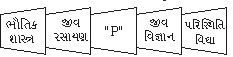
A
Physiology
B
Genetics
C
Cytology
D
Embryology
Solution
(C) The hierarchy of biological organization typically progresses from smaller,simpler units to larger,more complex systems. In the provided sequence: Physics -> Biochemistry -> "$P$" -> Biology -> Ecology. The level between Biochemistry (molecular level) and Biology (organismal level) in this context represents Cytology (Cell Biology),as cells are the fundamental structural and functional units of life that bridge molecular components and whole organisms.
0 likes
View Solution24
MediumMCQ
Match the terms in Column-$I$ with their definitions in Column-$II$:
| Column-$I$ | Column-$II$ |
| $(a)$ Growth | $(i)$ The number of individuals of each species remains limited. |
| $(b)$ Development | $(ii)$ New organisms differ from parents and may lead to new species. |
| $(c)$ Death | $(iii)$ Organisms increase in body size after birth. |
| $(d)$ Adaptation | $(iv)$ Organisms adjust to the environment by changing their structure,function,or behavior. |
| $(e)$ Variation | $(v)$ Cells of the zygote undergo changes according to their specific functions. |
| $(vi)$ Organization of membranes and organelles by macromolecules. |
A
$(a)-(i), (b)-(ii), (c)-(v), (d)-(vi), (e)-(iii)$
B
$(a)-(vi), (b)-(v), (c)-(iii), (d)-(ii), (e)-(i)$
C
$(a)-(iii), (b)-(v), (c)-(i), (d)-(iv), (e)-(ii)$
D
$(a)-(v), (b)-(vi), (c)-(i), (d)-(iv), (e)-(ii)$
Solution
(C) The correct matching is as follows:
$(a)$ Growth: $(iii)$ Organisms increase in body size after birth.
$(b)$ Development: $(v)$ Cells of the zygote undergo changes according to their specific functions.
$(c)$ Death: $(i)$ The number of individuals of each species remains limited (population control).
$(d)$ Adaptation: $(iv)$ Organisms adjust to the environment by changing their structure,function,or behavior.
$(e)$ Variation: $(ii)$ New organisms differ from parents and may lead to new species.
Therefore,the correct sequence is $(a)-(iii), (b)-(v), (c)-(i), (d)-(iv), (e)-(ii)$.
$(a)$ Growth: $(iii)$ Organisms increase in body size after birth.
$(b)$ Development: $(v)$ Cells of the zygote undergo changes according to their specific functions.
$(c)$ Death: $(i)$ The number of individuals of each species remains limited (population control).
$(d)$ Adaptation: $(iv)$ Organisms adjust to the environment by changing their structure,function,or behavior.
$(e)$ Variation: $(ii)$ New organisms differ from parents and may lead to new species.
Therefore,the correct sequence is $(a)-(iii), (b)-(v), (c)-(i), (d)-(iv), (e)-(ii)$.
0 likes
View Solution25
EasyMCQ
What is the meaning of classification?
A
Systematic arrangement of organisms.
B
The process by which anything is grouped into convenient categories based on some easily observable characters.
C
The process of grouping organisms into specific meaningful groups at the primary level.
D
All of the above.
Solution
(D) Classification is the process by which anything is grouped into convenient categories based on some easily observable characters.
It involves the systematic arrangement of organisms into groups or categories based on their similarities and differences.
This process makes the study of diverse organisms simple and organized.
Since all the given options describe different aspects or definitions of classification,the correct answer is $D$.
It involves the systematic arrangement of organisms into groups or categories based on their similarities and differences.
This process makes the study of diverse organisms simple and organized.
Since all the given options describe different aspects or definitions of classification,the correct answer is $D$.
0 likes
View Solution26
EasyMCQ
In which text is the classification of organisms mentioned?
A
Sushruta Samhita
B
Manusmriti
C
Upanishad
D
Ayurveda
Solution
(A) The classification of organisms is mentioned in the $Sushruta Samhita$. This ancient Indian medical text provides insights into the early understanding of living beings and their categorization based on various characteristics.
0 likes
View Solution27
MediumMCQ
Which of the following methods is $NOT$ a classification system developed by integrating other disciplines?
A
Chemotaxonomy
B
Animal taxonomy
C
Cytotaxonomy
D
Numerical taxonomy
Solution
(B) Taxonomy has evolved over time by integrating data from various scientific disciplines to improve the accuracy of classification.
$1$. Chemotaxonomy uses chemical constituents of plants to resolve taxonomic confusion.
$2$. Cytotaxonomy is based on cytological information like chromosome number,structure,and behavior.
$3$. Numerical taxonomy is carried out using computers and is based on all observable characteristics.
$4$. Animal taxonomy is a broad,traditional field of biology concerned with the identification,nomenclature,and classification of animals,rather than a specific modern system developed by integrating other disciplines in the same way as the others listed.
$1$. Chemotaxonomy uses chemical constituents of plants to resolve taxonomic confusion.
$2$. Cytotaxonomy is based on cytological information like chromosome number,structure,and behavior.
$3$. Numerical taxonomy is carried out using computers and is based on all observable characteristics.
$4$. Animal taxonomy is a broad,traditional field of biology concerned with the identification,nomenclature,and classification of animals,rather than a specific modern system developed by integrating other disciplines in the same way as the others listed.
0 likes
View Solution28
EasyMCQ
Match the scientists in Column-$I$ with their respective contributions in Column-$II$:
| Column-$I$ (Scientist) | Column-$II$ (Contribution) |
| $(a)$ Carolus Linnaeus | $(i)$ New Systematics |
| $(b)$ Julian Huxley | $(ii)$ Five Kingdom Classification |
| $(c)$ Whittaker | $(iii)$ Plant Taxonomy Books |
| $(d)$ Bentham and Hooker | $(iv)$ Binomial Nomenclature |
A
$a-i, b-ii, c-iv, d-iii$
B
$a-iv, b-ii, c-i, d-iii$
C
$a-iv, b-i, c-ii, d-iii$
D
$a-iv, b-iii, c-ii, d-i$
Solution
(C) The correct matches are as follows:
$1$. Carolus Linnaeus is known as the father of taxonomy and proposed the Binomial Nomenclature system $(a-iv)$.
$2$. Julian Huxley introduced the term 'New Systematics' or 'Biosystematics' $(b-i)$.
$3$. $R$.$H$. Whittaker proposed the Five Kingdom Classification system $(c-ii)$.
$4$. Bentham and Hooker are famous for their natural system of plant classification published in 'Genera Plantarum' $(d-iii)$.
Therefore, the correct sequence is $a-iv, b-i, c-ii, d-iii$.
$1$. Carolus Linnaeus is known as the father of taxonomy and proposed the Binomial Nomenclature system $(a-iv)$.
$2$. Julian Huxley introduced the term 'New Systematics' or 'Biosystematics' $(b-i)$.
$3$. $R$.$H$. Whittaker proposed the Five Kingdom Classification system $(c-ii)$.
$4$. Bentham and Hooker are famous for their natural system of plant classification published in 'Genera Plantarum' $(d-iii)$.
Therefore, the correct sequence is $a-iv, b-i, c-ii, d-iii$.
0 likes
View Solution29
EasyMCQ
Select the correct pair from the following.
A
Carolus Linnaeus - Sushruta Samhita
B
Julian Huxley - New Systematics
C
Whittaker - Father of Taxonomy
D
Bentham and Hooker - Five Kingdom Classification
Solution
(B) $1$. Carolus Linnaeus is known as the 'Father of Taxonomy',not the author of Sushruta Samhita.
$2$. Julian Huxley introduced the term 'New Systematics' (or Biosystematics) in $1940$,which emphasizes the study of species based on evolutionary relationships and population genetics.
$3$. $R$.$H$. Whittaker proposed the 'Five Kingdom Classification' system in $1969$.
$4$. Bentham and Hooker are famous for their 'Natural System of Classification' for seed plants.
Therefore,the correct pair is Julian Huxley - New Systematics.
$2$. Julian Huxley introduced the term 'New Systematics' (or Biosystematics) in $1940$,which emphasizes the study of species based on evolutionary relationships and population genetics.
$3$. $R$.$H$. Whittaker proposed the 'Five Kingdom Classification' system in $1969$.
$4$. Bentham and Hooker are famous for their 'Natural System of Classification' for seed plants.
Therefore,the correct pair is Julian Huxley - New Systematics.
0 likes
View Solution30
MediumMCQ
Match Column-$I$ (Scientist) with Column-$II$ (Contribution) and select the correct option:
| Column-$I$ (Scientist) | Column-$II$ (Contribution) |
|---|---|
| $(a)$ Carolus Linnaeus | $(i)$ New Systematics |
| $(b)$ Julian Huxley | $(ii)$ Five Kingdom Classification |
| $(c)$ Whittaker | $(iii)$ Plant Classification Systems |
| $(d)$ Bentham and Hooker | $(iv)$ Binomial Nomenclature |
A
$a-i, b-ii, c-iv, d-iii$
B
$a-iv, b-ii, c-i, d-iii$
C
$a-iv, b-i, c-ii, d-iii$
D
$a-iv, b-iii, c-ii, d-i$
Solution
(C) The correct matches are as follows:
$1$. Carolus Linnaeus is known as the father of taxonomy and proposed the Binomial Nomenclature system $(a-iv)$.
$2$. Julian Huxley coined the term 'New Systematics' or 'Biosystematics' $(b-i)$.
$3$. $R$.$H$. Whittaker proposed the Five Kingdom Classification system in $1969$ $(c-ii)$.
$4$. George Bentham and Joseph Dalton Hooker proposed a natural system of classification for seed plants $(d-iii)$.
Therefore,the correct sequence is $a-iv, b-i, c-ii, d-iii$.
$1$. Carolus Linnaeus is known as the father of taxonomy and proposed the Binomial Nomenclature system $(a-iv)$.
$2$. Julian Huxley coined the term 'New Systematics' or 'Biosystematics' $(b-i)$.
$3$. $R$.$H$. Whittaker proposed the Five Kingdom Classification system in $1969$ $(c-ii)$.
$4$. George Bentham and Joseph Dalton Hooker proposed a natural system of classification for seed plants $(d-iii)$.
Therefore,the correct sequence is $a-iv, b-i, c-ii, d-iii$.
0 likes
View Solution31
MediumMCQ
Which of the following statements is $NOT$ appropriate for the study of taxonomy?
A
It is an essential condition for a student of taxonomy to have knowledge of the characteristics of organisms,their groups,and the specific features of taxa.
B
The student does not need to undergo training for field studies.
C
During the study,qualities like curiosity,concentration,and patience are necessary.
D
It is mandatory to follow the rules of field studies.
Solution
(B) Taxonomy is a branch of biology that involves the identification,nomenclature,and classification of organisms.
$1$. $A$ taxonomist must have deep knowledge of organismal characteristics and taxonomic hierarchies (Option $A$).
$2$. Taxonomy relies heavily on observation,which requires patience,curiosity,and concentration (Option $C$).
$3$. Field studies are a fundamental part of taxonomy,as they provide primary data about organisms in their natural habitats. Therefore,training in field studies is essential,not optional (Option $B$ is incorrect).
$4$. Adherence to ethical and scientific rules during field work is mandatory to ensure accurate data collection (Option $D$).
$1$. $A$ taxonomist must have deep knowledge of organismal characteristics and taxonomic hierarchies (Option $A$).
$2$. Taxonomy relies heavily on observation,which requires patience,curiosity,and concentration (Option $C$).
$3$. Field studies are a fundamental part of taxonomy,as they provide primary data about organisms in their natural habitats. Therefore,training in field studies is essential,not optional (Option $B$ is incorrect).
$4$. Adherence to ethical and scientific rules during field work is mandatory to ensure accurate data collection (Option $D$).
0 likes
View Solution32
MediumMCQ
What is the essential requirement for a student of taxonomy?
A
Knowledge of the characteristics of organisms
B
Knowledge of the specific characteristics of a group
C
Knowledge of the specific characteristics of a taxon
D
All of the above
Solution
(D) Taxonomy is the branch of science that deals with the characterization,identification,nomenclature,and classification of organisms. To perform these tasks effectively,a student must possess:
$1$. Knowledge of the characteristics of individual organisms to identify them.
$2$. Knowledge of the specific characteristics of groups (taxa) to classify them into appropriate categories.
$3$. Knowledge of the specific characteristics of a taxon to distinguish it from others.
Therefore,all these requirements are essential for a student of taxonomy.
$1$. Knowledge of the characteristics of individual organisms to identify them.
$2$. Knowledge of the specific characteristics of groups (taxa) to classify them into appropriate categories.
$3$. Knowledge of the specific characteristics of a taxon to distinguish it from others.
Therefore,all these requirements are essential for a student of taxonomy.
0 likes
View Solution33
EasyMCQ
What should a student of taxonomy $NOT$ possess?
A
Concentration
B
Ignorance of the subject matter
C
Agility
D
Patience
Solution
(B) Taxonomy is the branch of science that deals with the classification,nomenclature,and identification of organisms. It requires a high level of precision,observation,and deep knowledge.
$1$. Concentration $(A)$ is essential for detailed study.
$2$. Agility $(C)$ helps in field work and quick identification.
$3$. Patience $(D)$ is required for long-term research and observation.
$4$. Ignorance of the subject matter $(B)$ is a negative trait that hinders the scientific process and is therefore something a student of taxonomy should not possess.
$1$. Concentration $(A)$ is essential for detailed study.
$2$. Agility $(C)$ helps in field work and quick identification.
$3$. Patience $(D)$ is required for long-term research and observation.
$4$. Ignorance of the subject matter $(B)$ is a negative trait that hinders the scientific process and is therefore something a student of taxonomy should not possess.
0 likes
View Solution34
MediumMCQ
Match the following columns:
| Column-$I$ (Genus) | Column-$II$ (Family) |
| $i$. $Zea$ | $a$. $Blattidae$ |
| $ii$. $Helianthus$ | $b$. $Poaceae$ |
| $iii$. $Pheretima$ | $c$. $Asteraceae$ |
| $iv$. $Periplaneta$ | $d$. $Megascolecidae$ |
A
$i-b, ii-c, iii-d, iv-a$
B
$i-b, ii-d, iii-a, iv-c$
C
$i-b, ii-a, iii-d, iv-c$
D
$i-c, ii-a, iii-d, iv-b$
Solution
(A) The correct matches are as follows:
$i$. $Zea$ (Maize) belongs to the family $Poaceae$.
$ii$. $Helianthus$ (Sunflower) belongs to the family $Asteraceae$.
$iii$. $Pheretima$ (Earthworm) belongs to the family $Megascolecidae$.
$iv$. $Periplaneta$ (Cockroach) belongs to the family $Blattidae$.
Therefore, the correct matching is $i-b, ii-c, iii-d, iv-a$.
$i$. $Zea$ (Maize) belongs to the family $Poaceae$.
$ii$. $Helianthus$ (Sunflower) belongs to the family $Asteraceae$.
$iii$. $Pheretima$ (Earthworm) belongs to the family $Megascolecidae$.
$iv$. $Periplaneta$ (Cockroach) belongs to the family $Blattidae$.
Therefore, the correct matching is $i-b, ii-c, iii-d, iv-a$.
0 likes
View Solution35
MediumMCQ
Match the scientific names in Column-$I$ with their respective families in Column-$II$:
| Column-$I$ (Scientific Name) | Column-$II$ (Family) |
|---|---|
| $(a)$ Rana tigrina | $(i)$ Megascolecidae |
| $(b)$ Helianthus annuus | $(ii)$ Poaceae |
| $(c)$ Zea mays | $(iii)$ Ranidae |
| $(d)$ Pheretima posthuma | $(iv)$ Asteraceae |
A
$a-iii, b-iv, c-ii, d-i$
B
$a-iii, b-ii, c-iv, d-i$
C
$a-i, b-ii, c-iv, d-iii$
D
$a-iii, b-ii, c-i, d-iv$
Solution
(A) The correct matches are as follows:
$1$. $(a)$ Rana tigrina (Indian Bullfrog) belongs to the family Ranidae.
$2$. $(b)$ Helianthus annuus (Sunflower) belongs to the family Asteraceae.
$3$. $(c)$ Zea mays (Maize) belongs to the family Poaceae.
$4$. $(d)$ Pheretima posthuma (Earthworm) belongs to the family Megascolecidae.
Therefore,the correct sequence is $a-iii, b-iv, c-ii, d-i$.
$1$. $(a)$ Rana tigrina (Indian Bullfrog) belongs to the family Ranidae.
$2$. $(b)$ Helianthus annuus (Sunflower) belongs to the family Asteraceae.
$3$. $(c)$ Zea mays (Maize) belongs to the family Poaceae.
$4$. $(d)$ Pheretima posthuma (Earthworm) belongs to the family Megascolecidae.
Therefore,the correct sequence is $a-iii, b-iv, c-ii, d-i$.
0 likes
View Solution36
EasyMCQ
$Assertion (S)$: Asterales is an order of maize.
$Reason (R)$: The family of maize is Megascolecidae.
$(a)$ Both $S$ and $R$ are true,$R$ is the correct explanation of $S$.
$(b)$ Both $S$ and $R$ are true,but $R$ is not the correct explanation of $S$.
$(c)$ $S$ is true and $R$ is false.
$(d)$ $S$ is false and $R$ is true.
$(e)$ Both $S$ and $R$ are false.
$Reason (R)$: The family of maize is Megascolecidae.
$(a)$ Both $S$ and $R$ are true,$R$ is the correct explanation of $S$.
$(b)$ Both $S$ and $R$ are true,but $R$ is not the correct explanation of $S$.
$(c)$ $S$ is true and $R$ is false.
$(d)$ $S$ is false and $R$ is true.
$(e)$ Both $S$ and $R$ are false.
A
$a$
B
$b$
C
$c$
D
$d$
Solution
(D) The scientific name of maize (corn) is $Zea \ mays$.
It belongs to the family $Poaceae$ (also known as $Gramineae$) and the order $Poales$.
Therefore,the statement $S$ is false because $Asterales$ is an order of flowering plants (e.g.,sunflowers),not maize.
The statement $R$ is also false because $Megascolecidae$ is a family of earthworms,not maize.
Thus,both $S$ and $R$ are false.
It belongs to the family $Poaceae$ (also known as $Gramineae$) and the order $Poales$.
Therefore,the statement $S$ is false because $Asterales$ is an order of flowering plants (e.g.,sunflowers),not maize.
The statement $R$ is also false because $Megascolecidae$ is a family of earthworms,not maize.
Thus,both $S$ and $R$ are false.
0 likes
View Solution37
MediumMCQ
Match the following correctly:
| $(A)$ Growth | $(i)$ The number of organisms of each species remains limited |
| $(B)$ Development | $(ii)$ New organisms differ from their parents and create new species |
| $(C)$ Death | $(iii)$ Organisms increase in body size after birth |
| $(D)$ Adaptation | $(iv)$ Organisms change their body structure,functioning,or behavior to adjust to the environment |
| $(E)$ Variation | $(v)$ Cells of the zygote undergo changes according to their specific functions |
| $(vi)$ Organization of membranes and membrane-bound organelles by macromolecules |
A
$A-i, B-ii, C-v, D-vi, E-iii$
B
$A-vi, B-v, C-iii, D-ii, E-i$
C
$A-iii, B-v, C-i, D-iv, E-ii$
D
$A-v, B-vi, C-i, D-iv, E-ii$
Solution
$(C)$ The correct matching is as follows:
$(A)$ Growth: $(iii)$ Organisms increase in body size after birth.
$(B)$ Development: $(v)$ Cells of the zygote undergo changes according to their specific functions.
$(C)$ Death: $(i)$ The number of organisms of each species remains limited (population control).
$(D)$ Adaptation: $(iv)$ Organisms change their body structure,functioning,or behavior to adjust to the environment.
$(E)$ Variation: $(ii)$ New organisms differ from their parents and create new species.
Therefore,the correct sequence is $A-iii, B-v, C-i, D-iv, E-ii$.
$(A)$ Growth: $(iii)$ Organisms increase in body size after birth.
$(B)$ Development: $(v)$ Cells of the zygote undergo changes according to their specific functions.
$(C)$ Death: $(i)$ The number of organisms of each species remains limited (population control).
$(D)$ Adaptation: $(iv)$ Organisms change their body structure,functioning,or behavior to adjust to the environment.
$(E)$ Variation: $(ii)$ New organisms differ from their parents and create new species.
Therefore,the correct sequence is $A-iii, B-v, C-i, D-iv, E-ii$.
0 likes
View Solution38
MediumMCQ
Identify the correct option for the following statements:
$(i)$ It represents a group at different levels in classification.
$(ii)$ It is a meaningful event for organisms.
$(iii)$ Organisms strive to achieve this for the maximum utilization of nature.
$(iv)$ Morphogenesis occurs during this process.
$(i)$ It represents a group at different levels in classification.
$(ii)$ It is a meaningful event for organisms.
$(iii)$ Organisms strive to achieve this for the maximum utilization of nature.
$(iv)$ Morphogenesis occurs during this process.
A
$(i)$ Taxon,$(ii)$ Reproduction,$(iii)$ Variation,$(iv)$ Embryonic development
B
$(i)$ Taxon,$(ii)$ Reproduction,$(iii)$ Adaptations,$(iv)$ Development
C
$(i)$ Taxon,$(ii)$ Death,$(iii)$ Adaptations,$(iv)$ Development
D
$(i)$ Taxon,$(ii)$ Death,$(iii)$ Adaptations,$(iv)$ Embryonic development
Solution
(B) The correct identification for the given statements is as follows:
$(i)$ $A$ 'Taxon' represents a group at different levels in biological classification.
$(ii)$ 'Reproduction' is a meaningful event for organisms as it ensures the continuity of species.
$(iii)$ 'Adaptations' are the traits that organisms strive to achieve or possess to ensure the maximum utilization of nature and survival in their environment.
$(iv)$ 'Development' (or specifically embryonic development) is the process during which morphogenesis (the biological process that causes an organism to develop its shape) occurs.
Therefore,the correct sequence is $(i)$ Taxon,$(ii)$ Reproduction,$(iii)$ Adaptations,$(iv)$ Development.
$(i)$ $A$ 'Taxon' represents a group at different levels in biological classification.
$(ii)$ 'Reproduction' is a meaningful event for organisms as it ensures the continuity of species.
$(iii)$ 'Adaptations' are the traits that organisms strive to achieve or possess to ensure the maximum utilization of nature and survival in their environment.
$(iv)$ 'Development' (or specifically embryonic development) is the process during which morphogenesis (the biological process that causes an organism to develop its shape) occurs.
Therefore,the correct sequence is $(i)$ Taxon,$(ii)$ Reproduction,$(iii)$ Adaptations,$(iv)$ Development.
0 likes
View Solution39
EasyMCQ
Match the items in Column-$A$ with Column-$B$ and select the correct option:
| Column-$A$ | Column-$B$ |
|---|---|
| $(1)$ Binomial Nomenclature | $(W)$ Bentham and Hooker |
| $(2)$ New Systematics | $(X)$ Aristotle |
| $(3)$ Plant Classification | $(Y)$ Sir Julian Huxley |
| $(4)$ Classification of Organisms | $(Z)$ Carolus Linnaeus |
A
$(1-W), (2-X), (3-Y), (4-Z)$
B
$(1-Z), (2-Y), (3-W), (4-X)$
C
$(1-X), (2-Y), (3-Z), (4-W)$
D
$(1-Z), (2-W), (3-Y), (4-X)$
Solution
(B) The correct matches are as follows:
$(1)$ Binomial Nomenclature was proposed by Carolus Linnaeus $(Z)$.
$(2)$ New Systematics (or Biosystematics) was introduced by Sir Julian Huxley $(Y)$.
$(3)$ Plant Classification (Natural system) was proposed by Bentham and Hooker $(W)$.
$(4)$ Classification of Organisms (Earliest attempt) was done by Aristotle $(X)$.
Therefore,the correct sequence is $(1-Z), (2-Y), (3-W), (4-X)$.
$(1)$ Binomial Nomenclature was proposed by Carolus Linnaeus $(Z)$.
$(2)$ New Systematics (or Biosystematics) was introduced by Sir Julian Huxley $(Y)$.
$(3)$ Plant Classification (Natural system) was proposed by Bentham and Hooker $(W)$.
$(4)$ Classification of Organisms (Earliest attempt) was done by Aristotle $(X)$.
Therefore,the correct sequence is $(1-Z), (2-Y), (3-W), (4-X)$.
0 likes
View Solution40
EasyMCQ
Find the mismatched pair.
A
Father of Taxonomy - Linnaeus
B
Father of Botany - Theophrastus
C
Philosopher who proposed the classification of organisms - Bentham and Hooker
D
Binomial Nomenclature - Linnaeus
Solution
(C) The correct answer is $C$.
$1$. Father of Taxonomy is Carolus Linnaeus.
$2$. Father of Botany is Theophrastus.
$3$. Binomial Nomenclature was proposed by Carolus Linnaeus.
$4$. The classification of organisms was proposed by various scientists like Aristotle,Linnaeus,Whittaker,etc. Bentham and Hooker are famous for their system of classification of seed plants,but they are not referred to as the philosophers who proposed the classification of organisms in the general sense compared to the others listed.
$1$. Father of Taxonomy is Carolus Linnaeus.
$2$. Father of Botany is Theophrastus.
$3$. Binomial Nomenclature was proposed by Carolus Linnaeus.
$4$. The classification of organisms was proposed by various scientists like Aristotle,Linnaeus,Whittaker,etc. Bentham and Hooker are famous for their system of classification of seed plants,but they are not referred to as the philosophers who proposed the classification of organisms in the general sense compared to the others listed.
0 likes
View Solution41
EasyMCQ
Which statement is consistent with classification?
A
Grouping of organisms into convenient categories based on easily observable characters.
B
The process by which anything is grouped into convenient categories based on some easily observable characters.
C
$A$ system of arranging organisms into groups.
D
All of the above.
Solution
(D) Classification is the process by which anything is grouped into convenient categories based on some easily observable characters.
Option $A$ describes the grouping of organisms into categories.
Option $B$ defines the process of classification itself.
Option $C$ describes the systematic arrangement of organisms.
Since all these statements correctly describe the concept of classification,the correct answer is $D$.
Option $A$ describes the grouping of organisms into categories.
Option $B$ defines the process of classification itself.
Option $C$ describes the systematic arrangement of organisms.
Since all these statements correctly describe the concept of classification,the correct answer is $D$.
0 likes
View Solution42
EasyMCQ
Match the common names of organisms with their scientific names and select the correct option:
| Common Name | Scientific Name |
| $(1)$ Modern Human | $(W)$ $Pheretima\,posthuma$ |
| $(2)$ Extinct Human | $(X)$ $Zea\,mays\,L.$ |
| $(3)$ Maize | $(Y)$ $Homo\,sapiens\,sapiens\,L.$ |
| $(4)$ Earthworm | $(Z)$ $Homo\,erectus\,L.$ |
A
$(1-W), (2-X), (3-Y), (4-Z)$
B
$(1-X), (2-Y), (3-Z), (4-W)$
C
$(1-Y), (2-Z), (3-X), (4-W)$
D
$(1-Z), (2-Y), (3-X), (4-W)$
Solution
(C) The correct matching is as follows:
$(1)$ Modern Human is scientifically known as $Homo\,sapiens\,sapiens\,L.$ $(Y)$.
$(2)$ Extinct Human (specifically referring to early human ancestors like $Homo\,erectus$) is $Homo\,erectus\,L.$ $(Z)$.
$(3)$ Maize is scientifically known as $Zea\,mays\,L.$ $(X)$.
$(4)$ Earthworm is scientifically known as $Pheretima\,posthuma$ $(W)$.
Therefore,the correct sequence is $(1-Y), (2-Z), (3-X), (4-W)$.
$(1)$ Modern Human is scientifically known as $Homo\,sapiens\,sapiens\,L.$ $(Y)$.
$(2)$ Extinct Human (specifically referring to early human ancestors like $Homo\,erectus$) is $Homo\,erectus\,L.$ $(Z)$.
$(3)$ Maize is scientifically known as $Zea\,mays\,L.$ $(X)$.
$(4)$ Earthworm is scientifically known as $Pheretima\,posthuma$ $(W)$.
Therefore,the correct sequence is $(1-Y), (2-Z), (3-X), (4-W)$.
0 likes
View Solution43
EasyMCQ
Arrange the taxonomic categories in the given figure such that the number of organisms decreases as we move from $W$ to $Z$.
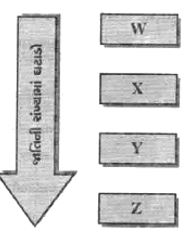
A
$W =$ Class,$X =$ Order,$Y =$ Family,$Z =$ Genus
B
$W =$ Family,$Y =$ Order,$Z =$ Genus,$X =$ Class
C
$X =$ Class,$Y =$ Order,$Z =$ Genus,$W =$ Family
D
$Z =$ Family,$Y =$ Order,$X =$ Order,$W =$ Class
Solution
(A) In the taxonomic hierarchy,as we move from higher categories (like Kingdom) to lower categories (like Species),the number of common characteristics increases,but the number of organisms decreases.
The standard hierarchy is: Kingdom > Phylum > Class > Order > Family > Genus > Species.
Looking at the given figure,the arrow indicates a decrease in the number of organisms from $W$ to $Z$. Therefore,$W$ must be a higher taxonomic category than $X$,$X$ higher than $Y$,and $Y$ higher than $Z$.
Comparing the options,option $A$ ($W =$ Class,$X =$ Order,$Y =$ Family,$Z =$ Genus) follows this descending order correctly.
The standard hierarchy is: Kingdom > Phylum > Class > Order > Family > Genus > Species.
Looking at the given figure,the arrow indicates a decrease in the number of organisms from $W$ to $Z$. Therefore,$W$ must be a higher taxonomic category than $X$,$X$ higher than $Y$,and $Y$ higher than $Z$.
Comparing the options,option $A$ ($W =$ Class,$X =$ Order,$Y =$ Family,$Z =$ Genus) follows this descending order correctly.
0 likes
View Solution44
EasyMCQ
What does '$X$' represent in the given figure?
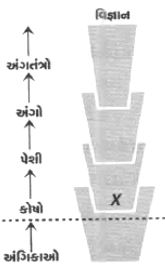
A
Biochemistry
B
Cell Biology
C
Biology
D
Ecology
Solution
(B) The figure illustrates the hierarchical organization of biological systems. The levels shown are: Organelles $\rightarrow$ Cells $\rightarrow$ Tissues $\rightarrow$ Organs $\rightarrow$ Organ Systems. The level '$X$' is placed between 'Organelles' and 'Tissues',corresponding to the 'Cell' level. Therefore,the study of cells is known as 'Cell Biology'.
0 likes
View Solution45
EasyMCQ
What are the levels of organization with conceptual size shown in the figure below?
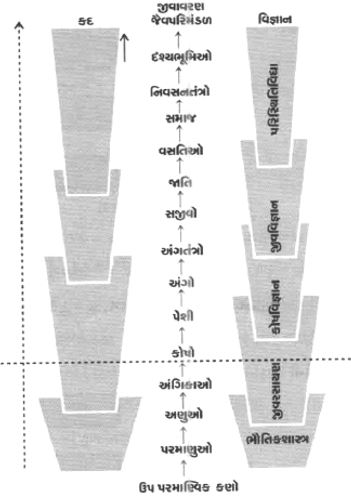
A
Species,Population,Community,Ecosystem,Biosphere
B
Tissues,Organs,Organ systems,Organs,Organisms
C
Subatomic particles,Atoms,Molecules,Organelles
D
Organelles,Cells,Tissues,Organs,Organ systems
Solution
(D) The figure illustrates the hierarchy of biological organization,starting from the smallest units to the largest.
Following the sequence from the bottom upwards:
$1$. Subatomic particles
$2$. Atoms
$3$. Molecules
$4$. Organelles
$5$. Cells
$6$. Tissues
$7$. Organs
$8$. Organ systems
$9$. Organisms
$10$. Species
$11$. Populations
$12$. Communities
$13$. Ecosystems
$14$. Landscapes
$15$. Biosphere.
Option $D$ correctly lists a segment of this hierarchy: Organelles,Cells,Tissues,Organs,and Organ systems.
Following the sequence from the bottom upwards:
$1$. Subatomic particles
$2$. Atoms
$3$. Molecules
$4$. Organelles
$5$. Cells
$6$. Tissues
$7$. Organs
$8$. Organ systems
$9$. Organisms
$10$. Species
$11$. Populations
$12$. Communities
$13$. Ecosystems
$14$. Landscapes
$15$. Biosphere.
Option $D$ correctly lists a segment of this hierarchy: Organelles,Cells,Tissues,Organs,and Organ systems.
0 likes
View Solution46
EasyMCQ
What are '$X$' and '$Y$' in the given figure?
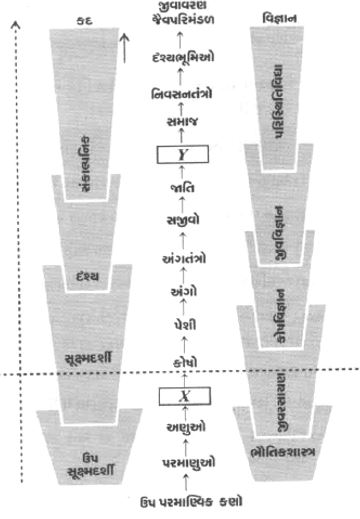
A
$X-$ Organelle,$Y-$ Population
B
$Y-$ Organelle,$X-$ Population
C
$X-$ Membranes,$Y-$ Species
D
$Y-$ Membranes,$X-$ Species
Solution
(A) The figure represents the biological hierarchy of organization.
In the hierarchy,atoms combine to form molecules,and molecules combine to form organelles (represented by $X$).
Organelles then form cells,tissues,organs,organ systems,and organisms.
Organisms of the same species form a population (represented by $Y$).
Therefore,$X$ is an organelle and $Y$ is a population.
In the hierarchy,atoms combine to form molecules,and molecules combine to form organelles (represented by $X$).
Organelles then form cells,tissues,organs,organ systems,and organisms.
Organisms of the same species form a population (represented by $Y$).
Therefore,$X$ is an organelle and $Y$ is a population.
0 likes
View Solution47
EasyMCQ
Which of the following are unique characteristics observed in living organisms?
A
Reproduction
B
Growth
C
Death
D
All of the above $(A), (B)$ and $(C)$
Solution
(D) In the study of biology,living organisms exhibit several characteristics such as growth,reproduction,and death.
However,growth and reproduction are not considered 'defining' properties because non-living objects can also exhibit growth (e.g.,accumulation of material on the surface) and not all living organisms reproduce (e.g.,sterile worker bees,infertile human couples).
Death is a natural process for all living organisms.
Since the question asks for characteristics observed in living organisms,all three options $(A), (B),$ and $(C)$ are features associated with the life cycle of organisms.
However,growth and reproduction are not considered 'defining' properties because non-living objects can also exhibit growth (e.g.,accumulation of material on the surface) and not all living organisms reproduce (e.g.,sterile worker bees,infertile human couples).
Death is a natural process for all living organisms.
Since the question asks for characteristics observed in living organisms,all three options $(A), (B),$ and $(C)$ are features associated with the life cycle of organisms.
0 likes
View Solution48
EasyMCQ
Match Column $X$ with Column $Y$ and select the correct option:
| Column $X$ | Column $Y$ |
| $(1)$ Linnaeus | $(P)$ Proposed modern classification system |
| $(2)$ Huxley | $(Q)$ Proponent of the theory of natural selection |
| $(3)$ Darwin | $(R)$ Father of Taxonomy |
| $(4)$ Whittaker | $(S)$ Proposed five-kingdom classification system |
A
$(1-R), (2-P), (3-S), (4-Q)$
B
$(1-P), (2-Q), (3-S), (4-R)$
C
$(1-S), (2-P), (3-Q), (4-R)$
D
$(1-R), (2-P), (3-Q), (4-S)$
Solution
(D) The correct matches are as follows:
$(1)$ Linnaeus is known as the Father of Taxonomy $(R)$.
$(2)$ Julian Huxley is associated with the development of the modern synthetic theory of evolution and modern classification systems $(P)$.
$(3)$ Charles Darwin is the proponent of the theory of natural selection $(Q)$.
$(4)$ $R$.$H$. Whittaker proposed the five-kingdom classification system $(S)$.
Therefore, the correct sequence is $(1-R), (2-P), (3-Q), (4-S)$.
$(1)$ Linnaeus is known as the Father of Taxonomy $(R)$.
$(2)$ Julian Huxley is associated with the development of the modern synthetic theory of evolution and modern classification systems $(P)$.
$(3)$ Charles Darwin is the proponent of the theory of natural selection $(Q)$.
$(4)$ $R$.$H$. Whittaker proposed the five-kingdom classification system $(S)$.
Therefore, the correct sequence is $(1-R), (2-P), (3-Q), (4-S)$.
0 likes
View Solution49
MediumMCQ
Match the items in Column $X$ with Column $Y$ and select the correct option:
| Column $X$ | Column $Y$ |
| $(1)$ Death | $(P)$ Measure of disorder |
| $(2)$ Earthworm | $(Q)$ Proponent of New Systematics |
| $(3)$ Entropy | $(R)$ Process maintaining life continuity |
| $(4)$ Huxley | $(S)$ Annelida |
| $(5)$ Reproduction | $(T)$ Process maintaining population size |
A
$(1-T), (2-S), (3-P), (4-Q), (5-R)$
B
$(1-T), (2-S), (3-P), (4-R), (5-Q)$
C
$(1-T), (2-S), (3-Q), (4-P), (5-R)$
D
$(1-T), (2-P), (3-Q), (4-R), (5-S)$
Solution
(A) The correct matching is as follows:
$(1)$ Death: It is a process that maintains the population size of a species by removing older individuals $(1-T)$.
$(2)$ Earthworm: It belongs to the phylum Annelida $(2-S)$.
$(3)$ Entropy: It is a thermodynamic term representing the measure of disorder in a system $(3-P)$.
$(4)$ Huxley: Julian Huxley is known as the proponent of New Systematics $(4-Q)$.
$(5)$ Reproduction: It is a biological process that ensures the continuity of life from one generation to the next $(5-R)$.
Therefore,the correct sequence is $(1-T), (2-S), (3-P), (4-Q), (5-R)$.
$(1)$ Death: It is a process that maintains the population size of a species by removing older individuals $(1-T)$.
$(2)$ Earthworm: It belongs to the phylum Annelida $(2-S)$.
$(3)$ Entropy: It is a thermodynamic term representing the measure of disorder in a system $(3-P)$.
$(4)$ Huxley: Julian Huxley is known as the proponent of New Systematics $(4-Q)$.
$(5)$ Reproduction: It is a biological process that ensures the continuity of life from one generation to the next $(5-R)$.
Therefore,the correct sequence is $(1-T), (2-S), (3-P), (4-Q), (5-R)$.
0 likes
View Solution50
MediumMCQ
Match Column $X$ with Column $Y$ and select the correct option:
| Column $X$ | Column $Y$ |
| $(1)$ Population | $(P)$ Group of closely related species |
| $(2)$ Differentiation | $(Q)$ Result of metabolism |
| $(3)$ Family | $(R)$ Energy available for any system's work |
| $(4)$ Growth | $(S)$ Formed by individual organisms |
| $(5)$ Potential energy | $(T)$ Change in embryonic cells according to their specific functions |
A
$(1-S), (2-T), (3-P), (4-R), (5-Q)$
B
$(1-S), (2-T), (3-P), (4-Q), (5-R)$
C
$(1-S), (2-T), (3-R), (4-P), (5-Q)$
D
$(1-S), (2-T), (3-Q), (4-P), (5-R)$
Solution
(B) The correct matching is as follows:
$(1)$ Population: Formed by individual organisms $(S)$.
$(2)$ Differentiation: Change in embryonic cells according to their specific functions $(T)$.
$(3)$ Family: Group of closely related species $(P)$.
$(4)$ Growth: Result of metabolism $(Q)$.
$(5)$ Potential energy: Energy available for any system's work $(R)$.
Therefore, the correct sequence is $(1-S), (2-T), (3-P), (4-Q), (5-R)$.
$(1)$ Population: Formed by individual organisms $(S)$.
$(2)$ Differentiation: Change in embryonic cells according to their specific functions $(T)$.
$(3)$ Family: Group of closely related species $(P)$.
$(4)$ Growth: Result of metabolism $(Q)$.
$(5)$ Potential energy: Energy available for any system's work $(R)$.
Therefore, the correct sequence is $(1-S), (2-T), (3-P), (4-Q), (5-R)$.
0 likes
View SolutionThe Living World — Mix Examples-The Living World · Frequently Asked Questions
1Are these The Living World questions useful for JEE and NEET?
Yes. All questions in this section are mapped to JEE Main and NEET exam patterns. Previous year questions from JEE Main, NEET, GUJCET and state-level exams are included with full solutions.
2Can I switch to Hindi or Gujarati for these questions?
Yes. Use the language tabs in the hero section or the sidebar to view the same questions and solutions in English, Hindi or Gujarati.
3How do I generate a question paper from this subtopic?
Use the Vedclass Exam Paper Generator — select the chapter and subtopic, set difficulty, and generate Sets A, B, C, D automatically. First 3 chapters of every subject are free.
Vedclass Products
For Students
Vedclass Test Series
Mock tests in real JEE/NEET style with performance analysis. 5-day free trial.
Start Free TrialFor Teachers
Exam Paper Generator
Generate Set A/B/C/D papers from this chapter in 2 minutes. 3 chapters free.
Try FreeFor Institutes
Online Exam Module
Live online exams with unlimited students, 360° analytics & white-label branding.
See DemoFor Teachers & Institutes
Generate a The Living World Exam Paper in 2 Minutes
Select subtopic & difficulty — Sets A, B, C, D auto-generated with No Repeat logic.
First 3 chapters of every subject are free — no payment required.