
A English
Taxonomic categories Questions in English
Class 11 Biology · The Living World · Taxonomic categories
567+
Questions
English
Language
100%
With Solutions
Showing 50 of 567 questions in English
401
MediumMCQ
Brinjal and potato belong to the same genus $Solanum$,but to two different species. What defines them as separate species?
A
They cannot interbreed.
B
They have different morphological features.
C
They are reproductively isolated.
D
All of the above.
Solution
(D) Brinjal ($Solanum$ $melongena$) and potato ($Solanum$ $tuberosum$) belong to the same genus $Solanum$ because they share common correlated characters.
They are classified as separate species because:
$(i)$ They exhibit distinct morphological features.
$(ii)$ They possess reproductive isolation,meaning they are unable to interbreed under natural conditions.
Therefore,all the given options are correct factors that define them as separate species.
They are classified as separate species because:
$(i)$ They exhibit distinct morphological features.
$(ii)$ They possess reproductive isolation,meaning they are unable to interbreed under natural conditions.
Therefore,all the given options are correct factors that define them as separate species.
0 likes
View Solution402
MediumMCQ
$A$ plant may have different names in different regions or countries of the world. How do botanists solve this problem?
A
By giving a single local name to all plants.
B
By using a standardized system of nomenclature (Binomial Nomenclature).
C
By ignoring the names and using only descriptions.
D
By assigning names based on the person who discovered the plant.
Solution
(B) To avoid confusion caused by local names,botanists use a standardized system of nomenclature known as $Binomial Nomenclature$.
This system was proposed by $Carolus Linnaeus$.
Under this system,each organism is given a unique scientific name consisting of two components: the $Genus$ and the $species$ epithet.
This ensures that a specific plant has only one universally accepted scientific name,regardless of the region or language.
This system was proposed by $Carolus Linnaeus$.
Under this system,each organism is given a unique scientific name consisting of two components: the $Genus$ and the $species$ epithet.
This ensures that a specific plant has only one universally accepted scientific name,regardless of the region or language.
0 likes
View Solution403
Medium
Brassica campestris Linn
$(a)$ Give the common name of the plant.
$(b)$ What do the first two parts of the name denote?
$(c)$ Why are they written in italics?
$(d)$ What is the meaning of Linn written at the end of the name?
$(a)$ Give the common name of the plant.
$(b)$ What do the first two parts of the name denote?
$(c)$ Why are they written in italics?
$(d)$ What is the meaning of Linn written at the end of the name?
Solution
(N/A) The common name of the plant is Mustard.
$(b)$ The first part denotes the genus (generic name),and the second part denotes the specific epithet (species name).
$(c)$ According to the rules of binomial nomenclature,scientific names are printed in italics to indicate their Latin origin.
$(d)$ Linn is the abbreviation for the scientist Carolus Linnaeus,who first described and named this plant species.
$(b)$ The first part denotes the genus (generic name),and the second part denotes the specific epithet (species name).
$(c)$ According to the rules of binomial nomenclature,scientific names are printed in italics to indicate their Latin origin.
$(d)$ Linn is the abbreviation for the scientist Carolus Linnaeus,who first described and named this plant species.
0 likes
View Solution404
Medium
Define a taxon. What is meant by taxonomic hierarchy? Give a flow diagram from the lowest to highest category for a plant and an animal. What happens to the number of individuals and the number of shared characters as we go up the taxonomic hierarchy?
Solution
(N/A) $\rightarrow$ Taxon: $A$ taxon is a scientific term used to represent any rank or level in the classification system.
$\rightarrow$ Taxonomic Hierarchy: Taxonomic hierarchy is the arrangement of various taxonomic categories in an ascending order,which describes the systematic position of any living organism.
$\rightarrow$ Flow Diagram (Lowest to Highest):
Species $\rightarrow$ Genus $\rightarrow$ Family $\rightarrow$ Order $\rightarrow$ Class $\rightarrow$ Phylum (for animals) / Division (for plants) $\rightarrow$ Kingdom.
$\rightarrow$ Example:
- Plant: $Solanum$ $tuberosum$ (Species) $\rightarrow$ $Solanum$ (Genus) $\rightarrow$ Solanaceae (Family) $\rightarrow$ Polymoniales (Order) $\rightarrow$ Dicotyledonae (Class) $\rightarrow$ Angiospermae (Division) $\rightarrow$ Plantae (Kingdom).
- Animal: $Panthera$ $leo$ (Species) $\rightarrow$ $Panthera$ (Genus) $\rightarrow$ Felidae (Family) $\rightarrow$ Carnivora (Order) $\rightarrow$ Mammalia (Class) $\rightarrow$ Chordata (Phylum) $\rightarrow$ Animalia (Kingdom).
$\rightarrow$ Trends as we go up the hierarchy:
$1$. Number of individuals: Increases.
$2$. Number of shared characters: Decreases.
$\rightarrow$ Taxonomic Hierarchy: Taxonomic hierarchy is the arrangement of various taxonomic categories in an ascending order,which describes the systematic position of any living organism.
$\rightarrow$ Flow Diagram (Lowest to Highest):
Species $\rightarrow$ Genus $\rightarrow$ Family $\rightarrow$ Order $\rightarrow$ Class $\rightarrow$ Phylum (for animals) / Division (for plants) $\rightarrow$ Kingdom.
$\rightarrow$ Example:
- Plant: $Solanum$ $tuberosum$ (Species) $\rightarrow$ $Solanum$ (Genus) $\rightarrow$ Solanaceae (Family) $\rightarrow$ Polymoniales (Order) $\rightarrow$ Dicotyledonae (Class) $\rightarrow$ Angiospermae (Division) $\rightarrow$ Plantae (Kingdom).
- Animal: $Panthera$ $leo$ (Species) $\rightarrow$ $Panthera$ (Genus) $\rightarrow$ Felidae (Family) $\rightarrow$ Carnivora (Order) $\rightarrow$ Mammalia (Class) $\rightarrow$ Chordata (Phylum) $\rightarrow$ Animalia (Kingdom).
$\rightarrow$ Trends as we go up the hierarchy:
$1$. Number of individuals: Increases.
$2$. Number of shared characters: Decreases.
0 likes
View Solution405
MediumMCQ
Identify the correct terms for the following analogies:
$(i)$ Cat : Felidae :: Dog : ....
$(ii)$ Scientific name of Mango : Mangifera indica :: Wheat : .....
$(i)$ Cat : Felidae :: Dog : ....
$(ii)$ Scientific name of Mango : Mangifera indica :: Wheat : .....
A
$(i)$ Canidae,$(ii)$ Triticum aestivum
B
$(i)$ Canidae,$(ii)$ Oryza sativa
C
$(i)$ Felidae,$(ii)$ Triticum aestivum
D
$(i)$ Canidae,$(ii)$ Solanum tuberosum
Solution
(A) $(i)$ The family of a cat is Felidae. Similarly,the family of a dog is Canidae.
$(ii)$ The scientific name of Mango is Mangifera indica. Similarly,the scientific name of Wheat is Triticum aestivum.
$(ii)$ The scientific name of Mango is Mangifera indica. Similarly,the scientific name of Wheat is Triticum aestivum.
0 likes
View Solution406
EasyMCQ
Select the correct option from the following statements:
$(i)$ Flora/Monograph provides information for identification of names of species found in an area.
$(ii)$ Each category,referred to as a unit of classification,is termed as a taxonomic category/taxonomic rank.
$(i)$ Flora/Monograph provides information for identification of names of species found in an area.
$(ii)$ Each category,referred to as a unit of classification,is termed as a taxonomic category/taxonomic rank.
A
$(i)$ Flora,$(ii)$ Taxonomic category
B
$(i)$ Monograph,$(ii)$ Taxonomic hierarchy
C
$(i)$ Manual,$(ii)$ Taxon
D
$(i)$ Flora,$(ii)$ Taxon
Solution
(A) $(i)$ Flora contains the actual account of habitat and distribution of plants of a given area. These provide the index to the plant species found in a particular area.
$(ii)$ Each category,referred to as a unit of classification,is in fact a rank and is commonly termed as a taxonomic category or taxonomic rank.
$(ii)$ Each category,referred to as a unit of classification,is in fact a rank and is commonly termed as a taxonomic category or taxonomic rank.
0 likes
View Solution407
Medium
What are the rules of binomial nomenclature?
Solution
(N/A) Binomial nomenclature is a standardized system of naming living organisms.
The universal rules of binomial nomenclature are as follows:
$(1)$ Biological names are generally in Latin and written in italics. They are Latinized or derived from Latin, irrespective of their origin.
$(2)$ The first word in a biological name represents the genus, while the second component denotes the specific epithet.
$(3)$ Both the words in a biological name, when handwritten, are separately underlined, or when printed, are written in italics to indicate their Latin origin.
$(4)$ The first word denoting the genus starts with a capital letter, while the specific epithet starts with a small letter.
This can be illustrated with the example of $Mangifera \, indica$.
$(5)$ The name of the author appears after the specific epithet, i.e., at the end of the biological name, and is written in an abbreviated form, e.g., $Mangifera \, indica \, Linn$.
This indicates that this species was first described by Linnaeus.
The universal rules of binomial nomenclature are as follows:
$(1)$ Biological names are generally in Latin and written in italics. They are Latinized or derived from Latin, irrespective of their origin.
$(2)$ The first word in a biological name represents the genus, while the second component denotes the specific epithet.
$(3)$ Both the words in a biological name, when handwritten, are separately underlined, or when printed, are written in italics to indicate their Latin origin.
$(4)$ The first word denoting the genus starts with a capital letter, while the specific epithet starts with a small letter.
This can be illustrated with the example of $Mangifera \, indica$.
$(5)$ The name of the author appears after the specific epithet, i.e., at the end of the biological name, and is written in an abbreviated form, e.g., $Mangifera \, indica \, Linn$.
This indicates that this species was first described by Linnaeus.
0 likes
View Solution408
Medium
Explain the terms Taxa,Taxonomy,and Systematics.
Solution
(N/A) $\rightarrow$ Taxa: Each category referred to as a unit of classification represents a rank and is commonly termed as a taxon (plural: taxa).
$\rightarrow$ Dogs,cats,mammals,wheat,rice,plants,and animals are convenient categories we use to study organisms. The scientific term for these categories is taxa.
$\rightarrow$ Taxa can indicate categories at very different levels. For example,'plants' form a taxon,'wheat' is a taxon,and 'mammals' are also a taxon. Since a dog is a mammal and mammals are animals,these represent taxa at different levels.
$\rightarrow$ Taxonomy: Based on characteristics,all living organisms can be classified into different taxa. This process of classification is called taxonomy.
$\rightarrow$ External and internal structure,along with the structure of the cell,development process,and ecological information of organisms,are essential and form the basis of modern taxonomic studies. Characterization,identification,classification,and nomenclature are the processes basic to taxonomy.
$\rightarrow$ Systematics: Human beings have always been interested in knowing more about different kinds of organisms and their diversities,as well as the relationships among them. This branch of study is referred to as systematics.
$\rightarrow$ The word systematics is derived from the Latin word 'systema',which means the systematic arrangement of organisms. Linnaeus used 'Systema Naturae' as the title of his publication. The scope of systematics was later enlarged to include identification,nomenclature,and classification.
$\rightarrow$ Dogs,cats,mammals,wheat,rice,plants,and animals are convenient categories we use to study organisms. The scientific term for these categories is taxa.
$\rightarrow$ Taxa can indicate categories at very different levels. For example,'plants' form a taxon,'wheat' is a taxon,and 'mammals' are also a taxon. Since a dog is a mammal and mammals are animals,these represent taxa at different levels.
$\rightarrow$ Taxonomy: Based on characteristics,all living organisms can be classified into different taxa. This process of classification is called taxonomy.
$\rightarrow$ External and internal structure,along with the structure of the cell,development process,and ecological information of organisms,are essential and form the basis of modern taxonomic studies. Characterization,identification,classification,and nomenclature are the processes basic to taxonomy.
$\rightarrow$ Systematics: Human beings have always been interested in knowing more about different kinds of organisms and their diversities,as well as the relationships among them. This branch of study is referred to as systematics.
$\rightarrow$ The word systematics is derived from the Latin word 'systema',which means the systematic arrangement of organisms. Linnaeus used 'Systema Naturae' as the title of his publication. The scope of systematics was later enlarged to include identification,nomenclature,and classification.
0 likes
View Solution409
Medium
Write a short note on taxonomic categories.
Solution
(N/A) $\rightarrow$ Classification is not a single-step process but involves a hierarchy of steps in which each step represents a taxonomic rank.
$\rightarrow$ Each category,referred to as a unit of classification,represents a rank and is commonly termed as a $taxon$ (plural: $taxa$).
$\rightarrow$ Taxonomic categories and hierarchy can be illustrated by an example.
$\rightarrow$ Insects represent a group of organisms sharing common features like three pairs of jointed legs.
$\rightarrow$ This means insects are recognizable concrete objects which can be classified and thus were given a rank or category.
$\rightarrow$ Groups represent a category and further denote a rank.
$\rightarrow$ Each rank or $taxon$ represents a unit of classification.
$\rightarrow$ These taxonomic groups/categories are distinct biological entities and not merely morphological aggregates.
$\rightarrow$ Taxonomical studies of all known organisms have led to the development of common categories.
$\rightarrow$ All organisms,including those in plant and animal kingdoms,have $species$ as the lowest category.
$\rightarrow$ To place an organism in various categories,the basic requirement is the knowledge of characters.
$\rightarrow$ This helps in identifying similarities and dissimilarities among the individuals of the same kind of organisms as well as of other kinds of organisms.
$\rightarrow$ Each category,referred to as a unit of classification,represents a rank and is commonly termed as a $taxon$ (plural: $taxa$).
$\rightarrow$ Taxonomic categories and hierarchy can be illustrated by an example.
$\rightarrow$ Insects represent a group of organisms sharing common features like three pairs of jointed legs.
$\rightarrow$ This means insects are recognizable concrete objects which can be classified and thus were given a rank or category.
$\rightarrow$ Groups represent a category and further denote a rank.
$\rightarrow$ Each rank or $taxon$ represents a unit of classification.
$\rightarrow$ These taxonomic groups/categories are distinct biological entities and not merely morphological aggregates.
$\rightarrow$ Taxonomical studies of all known organisms have led to the development of common categories.
$\rightarrow$ All organisms,including those in plant and animal kingdoms,have $species$ as the lowest category.
$\rightarrow$ To place an organism in various categories,the basic requirement is the knowledge of characters.
$\rightarrow$ This helps in identifying similarities and dissimilarities among the individuals of the same kind of organisms as well as of other kinds of organisms.
0 likes
View Solution410
Easy
Describe various categories of taxonomical studies.
Solution
(N/A) $(i)$ Species:
$\rightarrow$ Taxonomic studies consider a group of individual organisms with fundamental similarities as a species,which are distinct based on morphological differences.
$\rightarrow$ Example: $Mangifera$ $indica$,$Solanum$ $tuberosum$ (potato),and $Panthera$ $leo$ (lion).
$\rightarrow$ The words $indica$,$tuberosum$,and $leo$ represent the specific epithets,while $Mangifera$,$Solanum$,and $Panthera$ are genera,representing a higher level of taxon or category.
$\rightarrow$ Each genus may have one or more than one specific epithet representing different organisms that share morphological similarities.
$\rightarrow$ For example,$Panthera$ has another specific epithet called $tigris$,and $Solanum$ includes species like $nigrum$ and $melongena$.
$\rightarrow$ Human beings belong to the species $sapiens$,which is grouped in the genus $Homo$.
$\rightarrow$ The scientific name for human beings is written as $Homo$ $sapiens$.
$(ii)$ Genus:
$\rightarrow$ Genus comprises a group of related species which have more characters in common in comparison to species of other genera.
$\rightarrow$ Genera are aggregates of closely related species.
$\rightarrow$ For example,potato and brinjal are two different species but both belong to the genus $Solanum$. Lion ($Panthera$ $leo$),leopard ($P.$ $pardus$),and tiger ($P.$ $tigris$) are all species of the genus $Panthera$.
$\rightarrow$ This genus differs from the genus $Felis$,which includes cats.
$(iii)$ Family:
$\rightarrow$ Family consists of a group of related genera with fewer similarities compared to genus and species.
$\rightarrow$ Families are characterized on the basis of both vegetative and reproductive features of plant species.
$\rightarrow$ Among plants,for example,three different genera $Solanum$,$Petunia$,and $Datura$ are placed in the family $Solanaceae$.
$\rightarrow$ Taxonomic studies consider a group of individual organisms with fundamental similarities as a species,which are distinct based on morphological differences.
$\rightarrow$ Example: $Mangifera$ $indica$,$Solanum$ $tuberosum$ (potato),and $Panthera$ $leo$ (lion).
$\rightarrow$ The words $indica$,$tuberosum$,and $leo$ represent the specific epithets,while $Mangifera$,$Solanum$,and $Panthera$ are genera,representing a higher level of taxon or category.
$\rightarrow$ Each genus may have one or more than one specific epithet representing different organisms that share morphological similarities.
$\rightarrow$ For example,$Panthera$ has another specific epithet called $tigris$,and $Solanum$ includes species like $nigrum$ and $melongena$.
$\rightarrow$ Human beings belong to the species $sapiens$,which is grouped in the genus $Homo$.
$\rightarrow$ The scientific name for human beings is written as $Homo$ $sapiens$.
$(ii)$ Genus:
$\rightarrow$ Genus comprises a group of related species which have more characters in common in comparison to species of other genera.
$\rightarrow$ Genera are aggregates of closely related species.
$\rightarrow$ For example,potato and brinjal are two different species but both belong to the genus $Solanum$. Lion ($Panthera$ $leo$),leopard ($P.$ $pardus$),and tiger ($P.$ $tigris$) are all species of the genus $Panthera$.
$\rightarrow$ This genus differs from the genus $Felis$,which includes cats.
$(iii)$ Family:
$\rightarrow$ Family consists of a group of related genera with fewer similarities compared to genus and species.
$\rightarrow$ Families are characterized on the basis of both vegetative and reproductive features of plant species.
$\rightarrow$ Among plants,for example,three different genera $Solanum$,$Petunia$,and $Datura$ are placed in the family $Solanaceae$.
0 likes
View Solution411
Easy
Describe the hierarchical arrangement of taxonomic categories with a flow chart.
Solution
(N/A) The taxonomic categories from species to kingdom are arranged in ascending order as follows:
Kingdom
$\uparrow$
Phylum or Division
$\uparrow$
Class
$\uparrow$
Order
$\uparrow$
Family
$\uparrow$
Genus
$\uparrow$
Species
These are the broad taxonomic categories. Taxonomists have also developed sub-categories within this hierarchy to facilitate a more precise and scientific placement of various taxa.
Key points regarding this hierarchy:
$1$. As we move higher from Species to Kingdom,the number of common characteristics among the organisms decreases.
$2$. The lower the taxon,the more characteristics the members within that group share.
$3$. The higher the category,the greater the difficulty in determining the relationship between organisms at the same level.
$4$. Consequently,the process of classification becomes more complex as we move up the hierarchy.
Kingdom
$\uparrow$
Phylum or Division
$\uparrow$
Class
$\uparrow$
Order
$\uparrow$
Family
$\uparrow$
Genus
$\uparrow$
Species
These are the broad taxonomic categories. Taxonomists have also developed sub-categories within this hierarchy to facilitate a more precise and scientific placement of various taxa.
Key points regarding this hierarchy:
$1$. As we move higher from Species to Kingdom,the number of common characteristics among the organisms decreases.
$2$. The lower the taxon,the more characteristics the members within that group share.
$3$. The higher the category,the greater the difficulty in determining the relationship between organisms at the same level.
$4$. Consequently,the process of classification becomes more complex as we move up the hierarchy.
0 likes
View Solution412
EasyMCQ
How are scientific names of plants and animals assigned?
A
By local common names
B
By International Codes of Nomenclature
C
By random selection
D
By regional committees
Solution
(B) Scientific names are assigned based on universally accepted principles and criteria to ensure consistency across the globe.
$\rightarrow$ For plants,scientific names are based on agreed principles and criteria provided in the International Code for Botanical Nomenclature [$ICBN$].
$\rightarrow$ For animals,taxonomists have evolved the International Code of Zoological Nomenclature [$ICZN$].
$\rightarrow$ For plants,scientific names are based on agreed principles and criteria provided in the International Code for Botanical Nomenclature [$ICBN$].
$\rightarrow$ For animals,taxonomists have evolved the International Code of Zoological Nomenclature [$ICZN$].
0 likes
View Solution413
EasyMCQ
Give an example of a taxonomic category hierarchy.
A
Kingdom: Animalia,Phylum: Chordata,Class: Mammalia,Order: Primates,Family: Hominidae,Genus: Homo,Species: sapiens
B
Kingdom: Plantae,Phylum: Angiospermae,Class: Dicotyledonae,Order: Sapindales,Family: Anacardiaceae,Genus: Mangifera,Species: indica
C
Both $A$ and $B$
D
None of the above
Solution
(C) Taxonomic hierarchy is the sequence of arrangements of taxonomic categories in a descending order during the classification of an organism.
$1$. For humans: Kingdom: $Animalia$,Phylum: $Chordata$,Class: $Mammalia$,Order: $Primates$,Family: $Hominidae$,Genus: $Homo$,Species: $sapiens$.
$2$. For mango: Kingdom: $Plantae$,Phylum: $Angiospermae$,Class: $Dicotyledonae$,Order: $Sapindales$,Family: $Anacardiaceae$,Genus: $Mangifera$,Species: $indica$.
Both examples correctly represent the hierarchical arrangement of taxonomic categories from higher to lower ranks.
$1$. For humans: Kingdom: $Animalia$,Phylum: $Chordata$,Class: $Mammalia$,Order: $Primates$,Family: $Hominidae$,Genus: $Homo$,Species: $sapiens$.
$2$. For mango: Kingdom: $Plantae$,Phylum: $Angiospermae$,Class: $Dicotyledonae$,Order: $Sapindales$,Family: $Anacardiaceae$,Genus: $Mangifera$,Species: $indica$.
Both examples correctly represent the hierarchical arrangement of taxonomic categories from higher to lower ranks.
0 likes
View Solution414
MediumMCQ
Why does the problem of classification become more complex at higher taxonomic categories?
A
Because the number of common characteristics increases.
B
Because the number of common characteristics decreases.
C
Because the number of organisms decreases.
D
Because the number of species increases.
Solution
(B) $\rightarrow$ As we move higher in the taxonomic hierarchy from Species to Kingdom,the number of common characteristics shared by the organisms decreases.
$\rightarrow$ The lower the taxon,the more characteristics the members within that group share.
$\rightarrow$ Conversely,at higher categories,it becomes increasingly difficult to determine the evolutionary relationships between different taxa at the same level.
$\rightarrow$ Therefore,the problem of classification becomes more complex as we move to higher taxonomic categories.
$\rightarrow$ The lower the taxon,the more characteristics the members within that group share.
$\rightarrow$ Conversely,at higher categories,it becomes increasingly difficult to determine the evolutionary relationships between different taxa at the same level.
$\rightarrow$ Therefore,the problem of classification becomes more complex as we move to higher taxonomic categories.
0 likes
View Solution415
Difficult
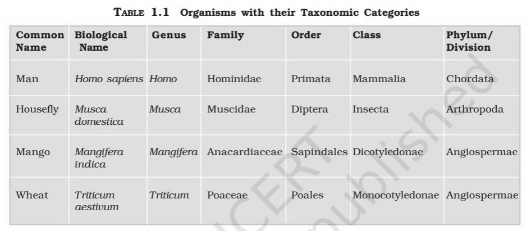
State the taxonomic categories of Man, Housefly, Mango, and Wheat. Also, explain the importance of taxonomic studies.
Solution
(N/A) Taxonomic studies are essential for understanding the diversity of organisms, their evolutionary relationships, and for the identification, nomenclature, and classification of new species. They provide a systematic framework for organizing biological information.
| Common Name | Biological Name | Genus | Family | Order | Class | Phylum/Division |
| Man | Homo sapiens | Homo | Hominidae | Primata | Mammalia | Chordata |
| Housefly | Musca domestica | Musca | Muscidae | Diptera | Insecta | Arthropoda |
| Mango | Mangifera indica | Mangifera | Anacardiaceae | Sapindales | Dicotyledonae | Angiospermae |
| Wheat | Triticum aestivum | Triticum | Poaceae | Poales | Monocotyledonae | Angiospermae |
0 likes
View Solution416
Medium
Differentiate between Taxonomy and Systematics.
Solution
(N/A)
| Taxonomy | Systematics |
|---|---|
| $(1)$ It is the branch of science dealing with the characterization,identification,nomenclature,and classification of organisms. | $(1)$ It is the study of the diversity of organisms and all their comparative and evolutionary relationships. |
| $(2)$ It focuses primarily on the rules and principles of classification. | $(2)$ It includes taxonomy along with the study of evolutionary relationships (phylogeny) between organisms. |
0 likes
View Solution417
MediumMCQ
Identify the correct sequence of taxonomic categories.
A
Species $\rightarrow$ Genus $\rightarrow$ Order $\rightarrow$ Class $\rightarrow$ Family $\rightarrow$ Phylum/Division $\rightarrow$ Kingdom
B
Species $\rightarrow$ Genus $\rightarrow$ Family $\rightarrow$ Class $\rightarrow$ Phylum/Division $\rightarrow$ Order $\rightarrow$ Kingdom
C
Species $\rightarrow$ Genus $\rightarrow$ Family $\rightarrow$ Order $\rightarrow$ Class $\rightarrow$ Phylum/Division $\rightarrow$ Kingdom
D
Species $\rightarrow$ Genus $\rightarrow$ Family $\rightarrow$ Order $\rightarrow$ Class $\rightarrow$ Phylum/Division $\rightarrow$ Kingdom
Solution
(C) The taxonomic hierarchy is an arrangement of categories in a descending or ascending order. The correct ascending order is: Species $\rightarrow$ Genus $\rightarrow$ Family $\rightarrow$ Order $\rightarrow$ Class $\rightarrow$ Phylum/Division $\rightarrow$ Kingdom.
Species is the basic unit of classification.
Genus is a group of related species.
Family is a group of related genera.
Order is a group of related families.
Class is a group of related orders.
Phylum (in animals) or Division (in plants) is a group of related classes.
Kingdom is the highest taxonomic category.
Species is the basic unit of classification.
Genus is a group of related species.
Family is a group of related genera.
Order is a group of related families.
Class is a group of related orders.
Phylum (in animals) or Division (in plants) is a group of related classes.
Kingdom is the highest taxonomic category.
0 likes
View Solution418
MediumMCQ
Two animals which are the members of the same order must also be the members of the same . . . . . .
A
class
B
family
C
genus
D
species
Solution
(A) In the taxonomic hierarchy,the categories are arranged in the order: Kingdom,Phylum,Class,Order,Family,Genus,and Species.
Since 'Order' is a higher taxonomic category than 'Family','Genus',and 'Species',any two animals belonging to the same 'Order' must necessarily belong to the same 'Class' and 'Phylum' (or 'Division').
Among the given options,'Class' is the only category that is higher than 'Order' in the hierarchy,meaning all members of the same order share the same class.
Since 'Order' is a higher taxonomic category than 'Family','Genus',and 'Species',any two animals belonging to the same 'Order' must necessarily belong to the same 'Class' and 'Phylum' (or 'Division').
Among the given options,'Class' is the only category that is higher than 'Order' in the hierarchy,meaning all members of the same order share the same class.
0 likes
View Solution419
EasyMCQ
Genus represents
A
an individual plant or animal.
B
a collection of plants or animals.
C
group of closely related species of plants or animals.
D
none of the above.
Solution
(C) Genus is the first higher category above the level of species.
$A$ genus comprises a group of related species which has more characters in common in comparison to species of other genera.
$A$ genus may have one to several species.
$A$ genus having a single species is called monotypic (e.g.,$Homo$ $sapiens$).
$A$ genus having two or more species is called polytypic (e.g.,$Panthera$ includes $P. leo$,$P. tigris$,$P. onca$,and $P. pardus$).
$A$ genus comprises a group of related species which has more characters in common in comparison to species of other genera.
$A$ genus may have one to several species.
$A$ genus having a single species is called monotypic (e.g.,$Homo$ $sapiens$).
$A$ genus having two or more species is called polytypic (e.g.,$Panthera$ includes $P. leo$,$P. tigris$,$P. onca$,and $P. pardus$).
0 likes
View Solution420
EasyMCQ
The taxonomic unit 'phylum' in the classification of animals is equivalent to which hierarchical level in the classification of plants?
A
Class
B
Order
C
Division
D
Family
Solution
(C) In biological classification,the taxonomic hierarchy consists of several ranks.
'Phylum' is a taxonomic category used for animals that is higher than 'class' and lower than 'kingdom'.
For plants,the equivalent taxonomic category is known as 'division'.
Therefore,'phylum' in animals corresponds to 'division' in plants.
'Phylum' is a taxonomic category used for animals that is higher than 'class' and lower than 'kingdom'.
For plants,the equivalent taxonomic category is known as 'division'.
Therefore,'phylum' in animals corresponds to 'division' in plants.
0 likes
View Solution421
MediumMCQ
Which of the following characters given below displays the description of the lowest taxonomic category of organisms in the plant and animal kingdom?
A
It includes one or more than one order.
B
It is a group containing one or more families.
C
It is a group of related organisms that resemble one another.
D
It is a group of organisms that are closely related and share similar characteristics.
Solution
(C) The lowest taxonomic category in the biological classification hierarchy is the $Species$. $A$ $Species$ is defined as a group of individual organisms that are closely related,resemble one another,and are capable of interbreeding to produce fertile offspring. While options $C$ and $D$ describe aspects of a species,option $C$ specifically highlights the fundamental concept of resemblance among related organisms,which is the core definition of a species in taxonomy.
0 likes
View Solution422
MediumMCQ
Which of the following shows the correct example of the taxonomic category - Genus?
A
Potato, tomato and brinjal belong to $Solanum$.
B
Monkey, gorilla and gibbon are placed in $Mammalia$.
C
$Solanum$, $Petunia$, and $Datura$ are placed in $Solanaceae$.
D
$Mangifera \text{ } indica$, $Solanum \text{ } tuberosum$, and $Panthera \text{ } leo$.
Solution
(A) Potato, tomato, and brinjal are three different species, but they all belong to the same genus, $Solanum$.
Genus is an assembly of related species which evolved from a common ancestor and share certain common characters.
$Solanum$ is a polytypic genus containing more than one species.
Genus is an assembly of related species which evolved from a common ancestor and share certain common characters.
$Solanum$ is a polytypic genus containing more than one species.
0 likes
View Solution423
EasyMCQ
In printed scientific names, only the . . . . . . is capitalized.
A
class
B
species
C
genus
D
family
Solution
(C) In binomial nomenclature, scientific names are printed in italics. The first word representing the genus starts with a capital letter, while the specific epithet (species) starts with a small letter. For example, in $Solanum \, tuberosum$, $Solanum$ is the genus and $tuberosum$ is the species.
0 likes
View Solution424
MediumMCQ
The order generally ends with
A
ales
B
aceae
C
eae
D
none of these
Solution
(A) In biological classification,the taxonomic category 'Order' generally ends with the suffix '-ales'.
For example,in plants,the order 'Polymoniales' includes families like Convolvulaceae and Solanaceae.
'aceae' is the suffix used for 'Family',not 'Order'.
For example,in plants,the order 'Polymoniales' includes families like Convolvulaceae and Solanaceae.
'aceae' is the suffix used for 'Family',not 'Order'.
0 likes
View Solution425
MediumMCQ
Match column-$I$ (Biological name) with column-$II$ (Class) and choose the correct option.
| Column-$I$ (Biological name) | Column-$II$ (Class) |
| $A$. Homo sapiens | $I$. Dicotyledonae |
| $B$. Musca domestica | $II$. Mammalia |
| $C$. Mangifera indica | $III$. Monocotyledonae |
| $D$. Triticum aestivum | $IV$. Insecta |
A
$A-IV, B-II, C-I, D-III$
B
$A-II, B-IV, C-III, D-I$
C
$A-II, B-IV, C-I, D-III$
D
$A-II, B-I, C-IV, D-III$
Solution
(C) The correct classification for the given organisms is as follows:
$1$. $Homo$ $sapiens$ belongs to the class $Mammalia$.
$2$. $Musca$ $domestica$ (housefly) belongs to the class $Insecta$.
$3$. $Mangifera$ $indica$ (mango) belongs to the class $Dicotyledonae$.
$4$. $Triticum$ $aestivum$ (wheat) belongs to the class $Monocotyledonae$.
Therefore, the correct matching is $A-II, B-IV, C-I, D-III$.
$1$. $Homo$ $sapiens$ belongs to the class $Mammalia$.
$2$. $Musca$ $domestica$ (housefly) belongs to the class $Insecta$.
$3$. $Mangifera$ $indica$ (mango) belongs to the class $Dicotyledonae$.
$4$. $Triticum$ $aestivum$ (wheat) belongs to the class $Monocotyledonae$.
Therefore, the correct matching is $A-II, B-IV, C-I, D-III$.
0 likes
View Solution426
MediumMCQ
Match Column-$I$ with Column-$II$ and choose the correct option.
| Column-$I$ | Column-$II$ |
| $A$. Family | $I$. $Ipomoea$ |
| $B$. Kingdom | $II$. Polymoniales |
| $C$. Order | $III$. $Solanum$ |
| $D$. Species | $IV$. Plantae |
| $E$. Genus | $V$. Solanaceae |
A
$A-IV, B-III, C-V, D-II, E-I$
B
$A-V, B-IV, C-II, D-I, E-III$
C
$A-IV, B-V, C-II, D-I, E-III$
D
$A-V, B-III, C-II, D-I, E-IV$
Solution
(B) The correct taxonomic classification is as follows:
$A$. Family: $V$. Solanaceae
$B$. Kingdom: $IV$. Plantae
$C$. Order: $II$. Polymoniales
$D$. Species: $I$. $Ipomoea$ (Note: $Ipomoea$ is a genus, but in the context of this specific matching, it represents the species level identifier provided)
$E$. Genus: $III$. $Solanum$
Therefore, the correct match is $A-V, B-IV, C-II, D-I, E-III$.
$A$. Family: $V$. Solanaceae
$B$. Kingdom: $IV$. Plantae
$C$. Order: $II$. Polymoniales
$D$. Species: $I$. $Ipomoea$ (Note: $Ipomoea$ is a genus, but in the context of this specific matching, it represents the species level identifier provided)
$E$. Genus: $III$. $Solanum$
Therefore, the correct match is $A-V, B-IV, C-II, D-I, E-III$.
0 likes
View Solution427
MediumMCQ
Which of the following statements are not correct?
$(i)$ Lower the taxon,more are the characteristics that the members within the taxon share.
$(ii)$ Order is the assemblage of genera which exhibit a few similar characters.
$(iii)$ $Cat$ and $dog$ are included in the same family Felidae.
$(iv)$ Binomial nomenclature was introduced by Carolus Linnaeus.
$(i)$ Lower the taxon,more are the characteristics that the members within the taxon share.
$(ii)$ Order is the assemblage of genera which exhibit a few similar characters.
$(iii)$ $Cat$ and $dog$ are included in the same family Felidae.
$(iv)$ Binomial nomenclature was introduced by Carolus Linnaeus.
A
$(i), (ii)$ and $(iii)$
B
$(ii), (iii)$ and $(iv)$
C
$(i)$ and $(iv)$
D
$(ii)$ and $(iii)$
Solution
(D) Statement $(i)$ is correct: As we go lower in the taxonomic hierarchy,the number of common characteristics shared by the members increases.
Statement $(ii)$ is incorrect: Order is the assemblage of families which exhibit a few similar characters,not genera.
Statement $(iii)$ is incorrect: $Cat$ belongs to the family $Felidae$,while $dog$ belongs to the family $Canidae$.
Statement $(iv)$ is correct: Binomial nomenclature was introduced by $Carolus$ $Linnaeus$.
Therefore,statements $(ii)$ and $(iii)$ are not correct.
Statement $(ii)$ is incorrect: Order is the assemblage of families which exhibit a few similar characters,not genera.
Statement $(iii)$ is incorrect: $Cat$ belongs to the family $Felidae$,while $dog$ belongs to the family $Canidae$.
Statement $(iv)$ is correct: Binomial nomenclature was introduced by $Carolus$ $Linnaeus$.
Therefore,statements $(ii)$ and $(iii)$ are not correct.
0 likes
View Solution428
MediumMCQ
Which of the following statements are correct?
$(i)$. Genus comprises a group of related species.
$(ii)$. Taxon represents a taxonomic group of individual organisms.
$(iii)$. Family comprises a group of related genera.
$(iv)$. Taxonomic category class includes related orders.
$(i)$. Genus comprises a group of related species.
$(ii)$. Taxon represents a taxonomic group of individual organisms.
$(iii)$. Family comprises a group of related genera.
$(iv)$. Taxonomic category class includes related orders.
A
$(i), (ii)$,and $(iv)$
B
$(ii)$ and $(iv)$
C
$(i), (iii)$,and $(iv)$
D
$(ii), (iii)$,and $(iv)$
Solution
(C) $(i)$. Correct: $A$ genus is a group of related species that have more characters in common in comparison to species of other genera.
$(ii)$. Incorrect: $A$ taxon represents a taxonomic group of any rank,not just individual organisms.
$(iii)$. Correct: Families are characterized on the basis of both vegetative and reproductive features of plant species and include a group of related genera.
$(iv)$. Correct: The class includes related orders (e.g.,order Primata comprising monkey,gorilla and gibbon is placed in class Mammalia along with order Carnivora).
Therefore,statements $(i), (iii)$,and $(iv)$ are correct.
$(ii)$. Incorrect: $A$ taxon represents a taxonomic group of any rank,not just individual organisms.
$(iii)$. Correct: Families are characterized on the basis of both vegetative and reproductive features of plant species and include a group of related genera.
$(iv)$. Correct: The class includes related orders (e.g.,order Primata comprising monkey,gorilla and gibbon is placed in class Mammalia along with order Carnivora).
Therefore,statements $(i), (iii)$,and $(iv)$ are correct.
0 likes
View Solution429
MediumMCQ
Which of the following $statement(s)$ is/are not correct?
$(i)$ Genus comprises a group of related species which has more characters in common in comparison to species of other genera.
$(ii)$ Three different genera such as $Solanum$,$Datura$ and $Petunia$ are placed in the family $Malvaceae$.
$(iii)$ In case of plants,classes with a few similar characters are assigned to a higher category called phylum.
$(i)$ Genus comprises a group of related species which has more characters in common in comparison to species of other genera.
$(ii)$ Three different genera such as $Solanum$,$Datura$ and $Petunia$ are placed in the family $Malvaceae$.
$(iii)$ In case of plants,classes with a few similar characters are assigned to a higher category called phylum.
A
Both $(i)$ and $(ii)$
B
Only $(iii)$
C
Both $(ii)$ and $(iii)$
D
All of these
Solution
(C) Statement $(i)$ is correct. $A$ genus is a group of related species that share more common characters compared to species of other genera.
Statement $(ii)$ is incorrect. The genera $Solanum$,$Datura$,and $Petunia$ are placed in the family $Solanaceae$,not $Malvaceae$.
Statement $(iii)$ is incorrect. In plants,classes with a few similar characters are assigned to a higher category called division,whereas the term phylum is used for animals.
Statement $(ii)$ is incorrect. The genera $Solanum$,$Datura$,and $Petunia$ are placed in the family $Solanaceae$,not $Malvaceae$.
Statement $(iii)$ is incorrect. In plants,classes with a few similar characters are assigned to a higher category called division,whereas the term phylum is used for animals.
0 likes
View Solution430
MediumMCQ
Select the correct statements $(i-iv)$ regarding taxonomic categories.
$(i)$ Each step or rank in hierarchy is called taxonomic category.
$(ii)$ Species is a group of individual organisms with fundamental similarities capable of breeding among themselves.
$(iii)$ Taxonomic studies of all unknown organisms have led to the development of common categories like kingdom,phylum or division,class,order,family,genus and species.
$(iv)$ Lower the category,greater is the difficulty of determining the relationship to other taxa at the same level.
$(i)$ Each step or rank in hierarchy is called taxonomic category.
$(ii)$ Species is a group of individual organisms with fundamental similarities capable of breeding among themselves.
$(iii)$ Taxonomic studies of all unknown organisms have led to the development of common categories like kingdom,phylum or division,class,order,family,genus and species.
$(iv)$ Lower the category,greater is the difficulty of determining the relationship to other taxa at the same level.
A
$(i)$ & $(ii)$ only
B
$(ii)$ & $(iv)$ only
C
$(i)$,$(ii)$ & $(iii)$ only
D
All of the above
Solution
(C) Statement $(i)$ is correct: Taxonomic hierarchy consists of various steps or ranks,each referred to as a taxonomic category.
Statement $(ii)$ is correct: $A$ species is defined as a group of individual organisms that share fundamental similarities and are capable of interbreeding to produce fertile offspring.
Statement $(iii)$ is correct: Taxonomic studies have established a universal hierarchy of categories including kingdom,phylum (for animals) or division (for plants),class,order,family,genus,and species.
Statement $(iv)$ is incorrect: As we go lower in the taxonomic hierarchy (towards species),the organisms share more characteristics,making it easier to determine their relationships. Conversely,the higher the category,the greater the difficulty of determining relationships to other taxa at the same level.
Therefore,statements $(i)$,$(ii)$,and $(iii)$ are correct.
Statement $(ii)$ is correct: $A$ species is defined as a group of individual organisms that share fundamental similarities and are capable of interbreeding to produce fertile offspring.
Statement $(iii)$ is correct: Taxonomic studies have established a universal hierarchy of categories including kingdom,phylum (for animals) or division (for plants),class,order,family,genus,and species.
Statement $(iv)$ is incorrect: As we go lower in the taxonomic hierarchy (towards species),the organisms share more characteristics,making it easier to determine their relationships. Conversely,the higher the category,the greater the difficulty of determining relationships to other taxa at the same level.
Therefore,statements $(i)$,$(ii)$,and $(iii)$ are correct.
0 likes
View Solution431
MediumMCQ
Which of the following statements is incorrect?
A
The scientific name for humans is $Homo$ $sapiens$.
B
Organisms placed in the same genus are least closely related.
C
Moving from species to kingdom,more different species are included in each higher category.
D
Species that are in the same genus share very specific characteristics.
Solution
(B) Genus comprises a group of related species which has more characters in common in comparison to species of other genera.
Organisms placed in the same genus are most closely related.
Therefore,the statement that organisms placed in the same genus are least closely related is incorrect.
Organisms placed in the same genus are most closely related.
Therefore,the statement that organisms placed in the same genus are least closely related is incorrect.
0 likes
View Solution432
EasyMCQ
Identify the correct sequence of taxonomic categories.
A
Species,Genus,Order,Class,Family,Phylum/Division,Kingdom
B
Species,Genus,Family,Class,Phylum/Division,Order,Kingdom
C
Species,Genus,Class,Family,Order,Phylum/Division,Kingdom
D
Species,Genus,Family,Order,Class,Phylum/Division,Kingdom
Solution
(D) The taxonomic hierarchy follows a specific order of increasing complexity and decreasing common characteristics.
$1$. $Species$: The basic unit of classification.
$2$. $Genus$: $A$ group of closely related species.
$3$. $Family$: $A$ group of related genera.
$4$. $Order$: $A$ group of related families.
$5$. $Class$: $A$ group of related orders.
$6$. $Phylum/Division$: $A$ group of related classes.
$7$. $Kingdom$: The highest taxonomic category.
Thus,the correct sequence is $Species \rightarrow Genus \rightarrow Family \rightarrow Order \rightarrow Class \rightarrow Phylum/Division \rightarrow Kingdom$.
$1$. $Species$: The basic unit of classification.
$2$. $Genus$: $A$ group of closely related species.
$3$. $Family$: $A$ group of related genera.
$4$. $Order$: $A$ group of related families.
$5$. $Class$: $A$ group of related orders.
$6$. $Phylum/Division$: $A$ group of related classes.
$7$. $Kingdom$: The highest taxonomic category.
Thus,the correct sequence is $Species \rightarrow Genus \rightarrow Family \rightarrow Order \rightarrow Class \rightarrow Phylum/Division \rightarrow Kingdom$.
0 likes
View Solution433
EasyMCQ
$Taxa$ differs from $taxon$ due to being
A
a higher taxonomic category than $taxon$.
B
lower taxonomic category than $taxon$.
C
the plural of $taxon$.
D
the singular of $taxon$.
Solution
(C) $Taxa$ is the plural form of $taxon$.
$Taxon$ is a grouping of organisms at any level in the hierarchical classification system,which is based on some common characteristics.
It represents real biological objects placed in any category,whereas the category itself is an abstract term.
$Taxon$ is a grouping of organisms at any level in the hierarchical classification system,which is based on some common characteristics.
It represents real biological objects placed in any category,whereas the category itself is an abstract term.
0 likes
View Solution434
MediumMCQ
Taxonomic hierarchy refers to
A
step-wise arrangement of all categories for classification of plants and animals.
B
a group of senior taxonomists who decide the nomenclature of plants and animals.
C
a list of botanists or zoologists who have worked on taxonomy of a species or group.
D
classification of a species based on fossil record.
Solution
(A) Taxonomic hierarchy (introduced by Linnaeus) is the step-wise arrangement of all taxonomic categories in a descending order,starting from Kingdom up to Species.
This hierarchy represents the various levels of biological classification.
The number of similar characters among organisms decreases as we move from the lowest rank (Species) to the highest rank (Kingdom).
There are $7$ obligate categories that constitute the taxonomic hierarchy: Kingdom,Phylum/Division,Class,Order,Family,Genus,and Species.
In addition to these,there are some optional categories such as Tribe,Subclass,and Superclass.
This hierarchy represents the various levels of biological classification.
The number of similar characters among organisms decreases as we move from the lowest rank (Species) to the highest rank (Kingdom).
There are $7$ obligate categories that constitute the taxonomic hierarchy: Kingdom,Phylum/Division,Class,Order,Family,Genus,and Species.
In addition to these,there are some optional categories such as Tribe,Subclass,and Superclass.
0 likes
View Solution435
MediumMCQ
The common characteristics between $tomato$ and $potato$ will be maximum at the level of their.
A
genus
B
family
C
order
D
division
Solution
(B) Taxonomic categories are arranged in a hierarchy where the number of common characteristics decreases as we move from species to kingdom.
$Tomato$ ($Solanum$ $lycopersicum$) and $potato$ ($Solanum$ $tuberosum$) are distinct species but belong to the same genus $Solanum$ and the same family $Solanaceae$.
Since $family$ is a lower taxonomic category than $order$ or $division$,the organisms sharing the same family exhibit a higher degree of common characteristics compared to those sharing only an order or division.
Therefore,the common characteristics between $tomato$ and $potato$ are maximum at the level of their $family$.
$Tomato$ ($Solanum$ $lycopersicum$) and $potato$ ($Solanum$ $tuberosum$) are distinct species but belong to the same genus $Solanum$ and the same family $Solanaceae$.
Since $family$ is a lower taxonomic category than $order$ or $division$,the organisms sharing the same family exhibit a higher degree of common characteristics compared to those sharing only an order or division.
Therefore,the common characteristics between $tomato$ and $potato$ are maximum at the level of their $family$.
0 likes
View Solution436
EasyMCQ
Which one of the following is the first step in taxonomy?
A
Naming
B
Description
C
Identification
D
Classification
Solution
(C) Taxonomy involves several processes such as characterization,identification,nomenclature,and classification.
Identification is the first and most fundamental step in taxonomy.
It involves determining the correct place of an organism in a system of classification and finding out its correct name.
This process is carried out with the help of taxonomic keys.
It not only assigns the organism to a particular group and locates its correct name but also provides information if the organism is new to science and requires a new name.
Identification is the first and most fundamental step in taxonomy.
It involves determining the correct place of an organism in a system of classification and finding out its correct name.
This process is carried out with the help of taxonomic keys.
It not only assigns the organism to a particular group and locates its correct name but also provides information if the organism is new to science and requires a new name.
0 likes
View Solution437
EasyMCQ
Which of the following is the only taxonomic category that has a real existence?
A
Phylum
B
Species
C
Genus
D
Kingdom
Solution
(B) Species is considered the only taxonomic category that has a real existence in nature.
It is the basic unit of classification.
$A$ species consists of one or more natural populations of individuals that resemble one another more closely than individuals of other species.
These individuals interbreed freely,share a distinct genetic makeup,and are reproductively isolated from other species.
Examples include $Panthera$ $leo$ (Lion),$Mangifera$ $indica$ (Mango),and $Solanum$ $tuberosum$ (Potato).
It is the basic unit of classification.
$A$ species consists of one or more natural populations of individuals that resemble one another more closely than individuals of other species.
These individuals interbreed freely,share a distinct genetic makeup,and are reproductively isolated from other species.
Examples include $Panthera$ $leo$ (Lion),$Mangifera$ $indica$ (Mango),and $Solanum$ $tuberosum$ (Potato).
0 likes
View Solution438
EasyMCQ
As we go from species to kingdom in a taxonomic hierarchy,the number of common characteristics
A
will decrease.
B
will increase.
C
remain same.
D
may increase or decrease.
Solution
(A) In a taxonomic hierarchy,organisms are grouped based on shared characteristics.
Species is the lowest category and contains organisms with the maximum number of common characteristics.
As we move up the hierarchy from species to kingdom (i.e.,genus,family,order,class,phylum/division,kingdom),the number of shared or common characteristics among the organisms decreases.
Therefore,the higher the category,the lower the number of common characteristics shared by the members.
Species is the lowest category and contains organisms with the maximum number of common characteristics.
As we move up the hierarchy from species to kingdom (i.e.,genus,family,order,class,phylum/division,kingdom),the number of shared or common characteristics among the organisms decreases.
Therefore,the higher the category,the lower the number of common characteristics shared by the members.
0 likes
View Solution439
MediumMCQ
If an organism is in the same class but not in the same family,then it may belong to the same
A
genus
B
species
C
variety
D
order
Solution
(D) The taxonomic hierarchy follows the order: Kingdom > Phylum > Class > Order > Family > Genus > Species.
If two organisms belong to the same class but not the same family,they must share a taxonomic category that is higher than the family level but lower than or equal to the class level.
Among the given options,'Order' is the only category that fits this criteria,as it is situated between 'Class' and 'Family' in the hierarchy.
Therefore,organisms in the same class but different families can belong to the same order.
If two organisms belong to the same class but not the same family,they must share a taxonomic category that is higher than the family level but lower than or equal to the class level.
Among the given options,'Order' is the only category that fits this criteria,as it is situated between 'Class' and 'Family' in the hierarchy.
Therefore,organisms in the same class but different families can belong to the same order.
0 likes
View Solution440
EasyMCQ
Refer to the botanical name of wheat $Triticum\ aestivum$ and identify the statement which correctly describes it.
A
The second word belongs to the genus and starts with a small letter.
B
Both the words $Triticum\ aestivum$ denote the specific epithet.
C
The first word $Triticum$ denotes the genus which starts with a capital letter.
D
The first word $Triticum$ denotes the specific epithet while the second word denotes the genus.
Solution
(C) According to the rules of binomial nomenclature,a scientific name consists of two parts: the genus and the specific epithet.
In the botanical name of wheat $(Triticum\ aestivum)$:
$1$. The first word $Triticum$ represents the genus,which must start with a capital letter.
$2$. The second word $aestivum$ represents the specific epithet,which must start with a small letter.
Therefore,the statement that the first word $Triticum$ denotes the genus starting with a capital letter is correct.
In the botanical name of wheat $(Triticum\ aestivum)$:
$1$. The first word $Triticum$ represents the genus,which must start with a capital letter.
$2$. The second word $aestivum$ represents the specific epithet,which must start with a small letter.
Therefore,the statement that the first word $Triticum$ denotes the genus starting with a capital letter is correct.
0 likes
View Solution441
EasyMCQ
Which of the following characters given below displays the description of the lowest taxonomic category of organisms in the plant and animal kingdom?
A
It includes one or more than one order.
B
It is a group containing one or more families.
C
It is a group of related organisms that have related genera.
D
It is a group that has closely related organisms that can interbreed.
Solution
(D) Species is the lowest category in the taxonomic hierarchy. $A$ species is defined as a group of individual organisms that share common characteristics and are capable of interbreeding to produce fertile offspring,while being reproductively isolated from other such groups.
0 likes
View Solution442
MediumMCQ
Which of the following options contains organisms that all belong to the same $Genus$?
A
Potato,tomato,and brinjal
B
Monkey,gorilla,and gibbon
C
$Solanum$,$Petunia$,and $Datura$
D
$Mangifera$ $indica$,$Solanum$ $tuberosum$,and $Panthera$ $leo$
Solution
(A) Potato ($Solanum$ $tuberosum$),tomato ($Solanum$ $lycopersicum$),and brinjal ($Solanum$ $melongena$) are three different species,but they all belong to the same $Genus$ $Solanum$.
Monkey,gorilla,and gibbon belong to the same $Order$ $Primata$.
$Solanum$,$Petunia$,and $Datura$ are different genera that belong to the same $Family$ $Solanaceae$.
$Mangifera$ $indica$,$Solanum$ $tuberosum$,and $Panthera$ $leo$ belong to different genera.
Monkey,gorilla,and gibbon belong to the same $Order$ $Primata$.
$Solanum$,$Petunia$,and $Datura$ are different genera that belong to the same $Family$ $Solanaceae$.
$Mangifera$ $indica$,$Solanum$ $tuberosum$,and $Panthera$ $leo$ belong to different genera.
0 likes
View Solution443
MediumMCQ
$X$ being a higher category is the assemblage of families which exhibit a few $Y$ characters. The $Z$ characters are less in number as compared to different genera included in a family. Identify $X$, $Y$, and $Z$.
A
$X -$ Order; $Y -$ Similar; $Z -$ Similar
B
$X -$ Genus; $Y -$ Similar; $Z -$ Different
C
$X -$ Species; $Y -$ Different; $Z -$ Similar
D
$X -$ Class; $Y -$ Different; $Z -$ Different
Solution
(A) In biological classification, an Order is a higher taxonomic category that consists of a group of related families.
These families share a few similar characters.
As we move higher in the taxonomic hierarchy, the number of shared (similar) characters decreases.
Therefore, the number of similar characters in an Order is less than the number of similar characters found among different genera within a single family.
Thus, $X$ is Order, $Y$ is Similar, and $Z$ is Similar.
These families share a few similar characters.
As we move higher in the taxonomic hierarchy, the number of shared (similar) characters decreases.
Therefore, the number of similar characters in an Order is less than the number of similar characters found among different genera within a single family.
Thus, $X$ is Order, $Y$ is Similar, and $Z$ is Similar.
0 likes
View Solution444
MediumMCQ
Consider the following diagram and fill in the blank spaces/boxes.
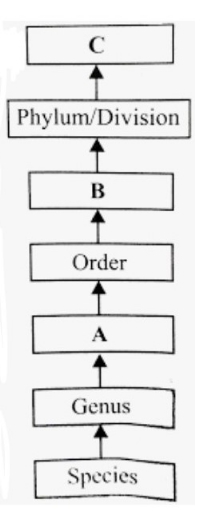
A
$A-$ Class,$B-$ Family,$C-$ Sub kingdom
B
$A-$ Family,$B-$ Class,$C-$ Kingdom
C
$A-$ Supra Genus,$B-$ Subclass,$C-$ SupraPhylum
D
$A-$ Kingdom,$B-$ Class,$C-$ Family
Solution
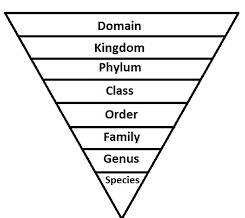
(B) The taxonomic hierarchy consists of $7$ obligate categories. The sequence from the base to the top is: Species $\rightarrow$ Genus $\rightarrow$ Family $\rightarrow$ Order $\rightarrow$ Class $\rightarrow$ Phylum/Division $\rightarrow$ Kingdom.
Comparing this with the given diagram:
$1$. Species is followed by Genus.
$2$. The box $A$ is above Genus,which corresponds to Family.
$3$. The box $B$ is above Order,which corresponds to Class.
$4$. The box $C$ is above Phylum/Division,which corresponds to Kingdom.
Therefore,$A-$ Family,$B-$ Class,and $C-$ Kingdom.
Comparing this with the given diagram:
$1$. Species is followed by Genus.
$2$. The box $A$ is above Genus,which corresponds to Family.
$3$. The box $B$ is above Order,which corresponds to Class.
$4$. The box $C$ is above Phylum/Division,which corresponds to Kingdom.
Therefore,$A-$ Family,$B-$ Class,and $C-$ Kingdom.
0 likes
View Solution445
EasyMCQ
Each category of taxonomic hierarchy is referred to as a unit of . . . . . . .
A
systematics
B
identification
C
nomenclature
D
classification
Solution
(D) Taxonomic hierarchy is the sequence of arrangement of taxonomic categories in a descending order during the classification of organisms.
Each category in the taxonomic hierarchy represents a rank or level,which is known as a unit of classification.
Each category in the taxonomic hierarchy represents a rank or level,which is known as a unit of classification.
0 likes
View Solution446
EasyMCQ
$Taxon$ is a
A
unit of classification.
B
species.
C
highest rank of classification.
D
group of closely related organisms.
Solution
(A) $Taxon$ (plural: $taxa$) is a grouping of organisms at any level in a hierarchical classification system,which is based on some common characteristics.
It represents real biological objects placed in any category,whereas the category itself is an abstract term that acts as a unit of classification.
It represents real biological objects placed in any category,whereas the category itself is an abstract term that acts as a unit of classification.
0 likes
View Solution447
EasyMCQ
In plant classification,the order generally ends with . . . . . . .
A
-ales
B
-aceae
C
-deae
D
none of these
Solution
(A) In biological classification,the taxonomic category 'Order' is an assemblage of families that exhibit a few similar characters. In plant taxonomy,the names of orders typically end with the suffix $-ales$. For example,the order $Polymoniales$ includes families like $Convolvulaceae$ and $Solanaceae$.
0 likes
View Solution448
EasyMCQ
Match the common name given in column $I$ with their taxonomic category order given in column $II$ and choose the correct combination from the options given below.
| Column-$I$ (Common name) | Column-$II$ (Taxonomic category-Order) |
| $A$. Wheat | $I$. Primata |
| $B$. Mango | $II$. Diptera |
| $C$. Housefly | $III$. Sapindales |
| $D$. Man | $IV$. Poales |
A
$A-I, B-II, C-IV, D-III$
B
$A-IV, B-III, C-II, D-I$
C
$A-II, B-IV, C-I, D-III$
D
$A-III, B-IV, C-II, D-I$
Solution
(B) The taxonomic classification for the given organisms is as follows:
$1$. Wheat ($Triticum$ $aestivum$): Kingdom-Plantae,Division-Angiospermae,Class-Monocotyledonae,Order-$Poales$.
$2$. Mango ($Mangifera$ $indica$): Kingdom-Plantae,Division-Angiospermae,Class-Dicotyledonae,Order-$Sapindales$.
$3$. Housefly ($Musca$ $domestica$): Kingdom-Animalia,Phylum-Arthropoda,Class-Insecta,Order-$Diptera$.
$4$. Man ($Homo$ $sapiens$): Kingdom-Animalia,Phylum-Chordata,Class-Mammalia,Order-$Primata$.
Therefore,the correct matching is $A-IV, B-III, C-II, D-I$.
$1$. Wheat ($Triticum$ $aestivum$): Kingdom-Plantae,Division-Angiospermae,Class-Monocotyledonae,Order-$Poales$.
$2$. Mango ($Mangifera$ $indica$): Kingdom-Plantae,Division-Angiospermae,Class-Dicotyledonae,Order-$Sapindales$.
$3$. Housefly ($Musca$ $domestica$): Kingdom-Animalia,Phylum-Arthropoda,Class-Insecta,Order-$Diptera$.
$4$. Man ($Homo$ $sapiens$): Kingdom-Animalia,Phylum-Chordata,Class-Mammalia,Order-$Primata$.
Therefore,the correct matching is $A-IV, B-III, C-II, D-I$.
0 likes
View Solution449
EasyMCQ
Match the common name given in column $I$ with their taxonomic category family given in column $II$ and choose the correct combination from the options given below.
| Column-$I$ (Common Name) | Column-$II$ (Taxonomic category- Family) |
| $A$. Man | $I$. Poaceae |
| $B$. Datura | $II$. Anacardiaceae |
| $C$. Mango | $III$. Solanaceae |
| $D$. Wheat | $IV$. Hominidae |
A
$A - IV, B - III, C - II, D - I$
B
$A - IV, B - III, C - I, D - II$
C
$A - I, B - II, C - III, D - IV$
D
$A - I, B - III, C - II, D - IV$
Solution
(A) The correct taxonomic families for the given organisms are as follows:
$1$. Man belongs to the family $Hominidae$.
$2$. Datura belongs to the family $Solanaceae$.
$3$. Mango belongs to the family $Anacardiaceae$.
$4$. Wheat belongs to the family $Poaceae$.
Therefore, the correct matching is $A - IV, B - III, C - II, D - I$.
$1$. Man belongs to the family $Hominidae$.
$2$. Datura belongs to the family $Solanaceae$.
$3$. Mango belongs to the family $Anacardiaceae$.
$4$. Wheat belongs to the family $Poaceae$.
Therefore, the correct matching is $A - IV, B - III, C - II, D - I$.
0 likes
View Solution450
EasyMCQ
Match column-$I$ with column-$II$ and choose the correct option.
| Column-$I$ (Biological name) | Column-$II$ (Class) |
|---|---|
| $A$. Homo sapiens | $I$. Dicotyledonae |
| $B$. Musca domestica | $II$. Mammalia |
| $C$. Mangifera indica | $III$. Monocotyledonae |
| $D$. Triticum aestivum | $IV$. Insecta |
A
$A-IV, B-II, C-I, D-III$
B
$A-II, B-IV, C-III, D-I$
C
$A-II, B-IV, C-I, D-III$
D
$A-II, B-I, C-IV, D-III$
Solution
(C) To match the biological names with their respective classes,we refer to the taxonomic categories provided in the $NCERT$ textbook:
$1$. $A$. Homo sapiens (Man) belongs to the class Mammalia $(II)$.
$2$. $B$. Musca domestica (Housefly) belongs to the class Insecta $(IV)$.
$3$. $C$. Mangifera indica (Mango) belongs to the class Dicotyledonae $(I)$.
$4$. $D$. Triticum aestivum (Wheat) belongs to the class Monocotyledonae $(III)$.
Therefore,the correct matching is $A-II, B-IV, C-I, D-III$. Thus,option $C$ is correct.
$1$. $A$. Homo sapiens (Man) belongs to the class Mammalia $(II)$.
$2$. $B$. Musca domestica (Housefly) belongs to the class Insecta $(IV)$.
$3$. $C$. Mangifera indica (Mango) belongs to the class Dicotyledonae $(I)$.
$4$. $D$. Triticum aestivum (Wheat) belongs to the class Monocotyledonae $(III)$.
Therefore,the correct matching is $A-II, B-IV, C-I, D-III$. Thus,option $C$ is correct.
0 likes
View SolutionThe Living World — Taxonomic categories · Frequently Asked Questions
1Are these The Living World questions useful for JEE and NEET?
Yes. All questions in this section are mapped to JEE Main and NEET exam patterns. Previous year questions from JEE Main, NEET, GUJCET and state-level exams are included with full solutions.
2Can I switch to Hindi or Gujarati for these questions?
Yes. Use the language tabs in the hero section or the sidebar to view the same questions and solutions in English, Hindi or Gujarati.
3How do I generate a question paper from this subtopic?
Use the Vedclass Exam Paper Generator — select the chapter and subtopic, set difficulty, and generate Sets A, B, C, D automatically. First 3 chapters of every subject are free.
Vedclass Products
For Students
Vedclass Test Series
Mock tests in real JEE/NEET style with performance analysis. 5-day free trial.
Start Free TrialFor Teachers
Exam Paper Generator
Generate Set A/B/C/D papers from this chapter in 2 minutes. 3 chapters free.
Try FreeFor Institutes
Online Exam Module
Live online exams with unlimited students, 360° analytics & white-label branding.
See DemoFor Teachers & Institutes
Generate a The Living World Exam Paper in 2 Minutes
Select subtopic & difficulty — Sets A, B, C, D auto-generated with No Repeat logic.
First 3 chapters of every subject are free — no payment required.