
A English
Mix Examples - Structural Organisation In Animals Questions in English
Class 11 Biology · Structural Organisation In Animals · Mix Examples - Structural Organisation In Animals
110+
Questions
English
Language
100%
With Solutions
Showing 50 of 110 questions in English
51
MediumMCQ
Which of the following is a common feature found in both cockroaches and earthworms?
A
Cuticular exoskeleton
B
Solid and ventral nerve cord
C
Nephridia
D
Malpighian tubules
Solution
(B) Both cockroaches $(Periplaneta \text{ } americana)$ and earthworms $(Pheretima \text{ } posthuma)$ possess a solid, ventral nerve cord as part of their nervous system.
Cockroaches have an exoskeleton made of chitin, whereas earthworms do not.
Nephridia are the excretory organs of earthworms, while Malpighian tubules are the excretory organs of cockroaches.
Therefore, the presence of a solid and ventral nerve cord is the common feature.
Cockroaches have an exoskeleton made of chitin, whereas earthworms do not.
Nephridia are the excretory organs of earthworms, while Malpighian tubules are the excretory organs of cockroaches.
Therefore, the presence of a solid and ventral nerve cord is the common feature.
0 likes
View Solution52
EasyMCQ
Which gland in mammals secretes odoriferous substances?
A
Bartholin's gland
B
Prostate gland
C
Anal gland
D
Liver
Solution
(C) In many mammals,$Anal$ glands are specialized exocrine glands located near the anus. These glands secrete odoriferous (scent-producing) substances that are used for marking territory,communication,and defense. Therefore,the correct option is $C$.
0 likes
View Solution53
EasyMCQ
$A$ tissue,which is a group of cells,possesses:
A
Common origin and dissimilarity in function
B
Dissimilar origin and similarity in function
C
Dissimilar origin and dissimilarity in function
D
Common origin and usually perform a common function
Solution
(D) tissue is defined as a group of cells having a common embryonic origin and usually performing a common function.
These cells work together to perform specific tasks within an organism.
Therefore,the correct characteristic is that they share a common origin and generally perform a common function.
These cells work together to perform specific tasks within an organism.
Therefore,the correct characteristic is that they share a common origin and generally perform a common function.
0 likes
View Solution54
EasyMCQ
What is a diastema?
A
$A$ part of the pelvic girdle in rabbits.
B
$A$ type of tooth found in rabbits.
C
$A$ gap between teeth in some mammals.
D
$A$ structure found in the eye of a rabbit.
Solution
(C) $diastema$ is a gap or space between two teeth. In many herbivorous mammals,such as rabbits,a $diastema$ is present between the incisors and the premolars. This gap is created due to the absence of canine teeth,which allows the animal to manipulate food more effectively while chewing.
0 likes
View Solution55
MediumMCQ
If the dental formula of a rabbit is $2033/1033$,then it indicates that:
A
The total number of teeth in the rabbit is $15$.
B
The total number of incisors is $3$.
C
$A$ diastema is present between the incisors and the premolars.
D
The $2033$ in the formula is for adults and $1033$ is for the young ones.
Solution
(C) The dental formula of a rabbit is represented as $I: 2/1, C: 0/0, PM: 3/2, M: 3/3$.
In the given formula $2033/1033$,the upper jaw has $2$ incisors,$0$ canines,$3$ premolars,and $3$ molars on one side.
The lower jaw has $1$ incisor,$0$ canines,$3$ premolars,and $3$ molars on one side.
Since canines are absent in rabbits,a gap is created between the incisors and the premolars,which is known as the diastema.
Therefore,option $C$ is the correct statement.
In the given formula $2033/1033$,the upper jaw has $2$ incisors,$0$ canines,$3$ premolars,and $3$ molars on one side.
The lower jaw has $1$ incisor,$0$ canines,$3$ premolars,and $3$ molars on one side.
Since canines are absent in rabbits,a gap is created between the incisors and the premolars,which is known as the diastema.
Therefore,option $C$ is the correct statement.
0 likes
View Solution56
EasyMCQ
The total number of teeth in a rabbit is:
A
$43$
B
$24$
C
$28$
D
$32$
Solution
(C) The dental formula of an adult rabbit is $I \frac{2}{1}, C \frac{0}{0}, PM \frac{3}{2}, M \frac{3}{3}$.
Calculating the total number of teeth: $2(2+0+3+3) / 2(1+0+2+3) = 2(8) / 2(6) = 16 / 12$.
Total number of teeth = $16 + 12 = 28$.
Calculating the total number of teeth: $2(2+0+3+3) / 2(1+0+2+3) = 2(8) / 2(6) = 16 / 12$.
Total number of teeth = $16 + 12 = 28$.
0 likes
View Solution57
EasyMCQ
How many lobes are present in the liver of a rabbit?
A
$2$
B
$4$
C
$5$
D
$6$
Solution
(C) The liver of a rabbit is a large,dark-red gland located in the abdominal cavity just below the diaphragm.
It is divided into $5$ distinct lobes: the left lateral,left central,right central,right lateral,and the caudate lobe.
Therefore,the correct answer is $5$.
It is divided into $5$ distinct lobes: the left lateral,left central,right central,right lateral,and the caudate lobe.
Therefore,the correct answer is $5$.
0 likes
View Solution58
EasyMCQ
In both vertebrates and invertebrates,the gut develops from the .......
A
Pharyngeal pouches
B
Ectoderm
C
Endoderm
D
Mesoderm
Solution
(C) The gut (alimentary canal) in both vertebrates and invertebrates is primarily derived from the endoderm. During embryonic development,the endoderm forms the epithelial lining of the entire digestive tract,including the associated glands like the liver and pancreas.
0 likes
View Solution59
MediumMCQ
In a rabbit,the hard palate is formed by the:
A
Premaxilla,maxilla,and palatine bones
B
Premaxilla,mandible,and palatine bones
C
Sphenoid,nasal,and maxilla bones
D
Nasal,mandible,and ethmoid bones
Solution
(A) The hard palate in a rabbit is the bony roof of the mouth cavity. It is formed by the fusion of three pairs of bones: the $Premaxilla$ (anteriorly),the $Maxilla$ (middle),and the $Palatine$ (posteriorly). These bones provide structural support to the roof of the mouth,separating the oral cavity from the nasal passage.
0 likes
View Solution60
EasyMCQ
The nictitating membrane in a rabbit is $.....$.
A
also called the third eyelid.
B
located at the inner corner of the eye.
C
capable of moving over the eyeball to clean it.
D
all of the above.
Solution
(D) The nictitating membrane in a rabbit is known as the third eyelid.
It is situated at the inner corner (medial canthus) of the eye.
This membrane is capable of moving across the surface of the eyeball to clean it and provide protection against debris or injury.
Therefore,all the given statements are correct.
It is situated at the inner corner (medial canthus) of the eye.
This membrane is capable of moving across the surface of the eyeball to clean it and provide protection against debris or injury.
Therefore,all the given statements are correct.
0 likes
View Solution61
EasyMCQ
What is the full form of $PMNL$?
A
Polymorphonuclear leukocytes
B
Polymer nuclear leukocytes
C
Polymer nuclear lymphocytes
D
Polymorpho number lymphocytes
Solution
(A) $PMNL$ stands for Polymorphonuclear leukocytes. These are a type of white blood cell (leukocytes) characterized by having a lobed nucleus,which gives them a multi-shaped appearance. Neutrophils are the most common type of $PMNL$ and play a crucial role in the innate immune system by phagocytosing pathogens.
0 likes
View Solution62
EasyMCQ
What do tissues combine to form?
A
Tissue level of organization
B
Organ level of organization
C
Organ system level of organization
D
Cellular level of organization
Solution
(B) In the hierarchy of biological organization,cells are the basic structural and functional units. When similar cells performing a common function aggregate together,they form a tissue. When different tissues combine in a specific proportion and pattern to perform a particular function,they form an organ. Therefore,tissues combine to form the organ level of organization.
0 likes
View Solution63
MediumMCQ
Which of the following structures is common between an earthworm and a cockroach?
A
Ventral nerve cord
B
Closed circulatory system
C
Nephridia
D
Trachea
Solution
(A) Both earthworms $(Pheretima)$ and cockroaches $(Periplaneta)$ belong to the phylum $Annelida$ and $Arthropoda$ respectively.
They share a common anatomical feature known as the $Ventral$ $nerve$ $cord$.
In both organisms, the nervous system consists of a $Ventral$ $nerve$ $cord$ that runs along the length of the body, which is a characteristic feature of most invertebrates.
They share a common anatomical feature known as the $Ventral$ $nerve$ $cord$.
In both organisms, the nervous system consists of a $Ventral$ $nerve$ $cord$ that runs along the length of the body, which is a characteristic feature of most invertebrates.
0 likes
View Solution64
EasyMCQ
Select the mismatched pair from the following.
A
Earthworm - Periplaneta americana
B
Frog - Rana tigrina
C
Sunflower - Helianthus annuus
D
Maize - Zea mays
Solution
(A) The scientific name of the Earthworm is $Pheretima$ $posthuma$.
$Periplaneta$ $americana$ is the scientific name of the Cockroach.
Therefore, the pair $Earthworm - Periplaneta$ $americana$ is mismatched.
$Rana$ $tigrina$ is the correct scientific name for the Frog.
$Helianthus$ $annuus$ is the correct scientific name for the Sunflower.
$Zea$ $mays$ is the correct scientific name for Maize.
$Periplaneta$ $americana$ is the scientific name of the Cockroach.
Therefore, the pair $Earthworm - Periplaneta$ $americana$ is mismatched.
$Rana$ $tigrina$ is the correct scientific name for the Frog.
$Helianthus$ $annuus$ is the correct scientific name for the Sunflower.
$Zea$ $mays$ is the correct scientific name for Maize.
0 likes
View Solution65
EasyMCQ
Match the common names in Column-$I$ with their scientific names in Column-$II$:
| Column-$I$ (Common Name) | Column-$II$ (Scientific Name) |
| $(a)$ Sunflower | $(i)$ Periplaneta americana |
| $(b)$ Earthworm | $(ii)$ Rana tigrina |
| $(c)$ Cockroach | $(iii)$ Pheretima posthuma |
| $(d)$ Maize | $(iv)$ Zea mays |
| $(v)$ Helianthus annuus |
A
$a-v, b-iii, c-i, d-iv$
B
$a-iii, b-v, c-i, d-iv$
C
$a-i, b-ii, c-iii, d-iv$
D
$a-iv, b-iii, c-v, d-ii$
Solution
(A) The correct matches are as follows:
$(a)$ Sunflower is scientifically known as $Helianthus \ annuus$ $(v)$.
$(b)$ Earthworm is scientifically known as $Pheretima \ posthuma$ $(iii)$.
$(c)$ Cockroach is scientifically known as $Periplaneta \ americana$ $(i)$.
$(d)$ Maize is scientifically known as $Zea \ mays$ $(iv)$.
Therefore,the correct sequence is $a-v, b-iii, c-i, d-iv$.
$(a)$ Sunflower is scientifically known as $Helianthus \ annuus$ $(v)$.
$(b)$ Earthworm is scientifically known as $Pheretima \ posthuma$ $(iii)$.
$(c)$ Cockroach is scientifically known as $Periplaneta \ americana$ $(i)$.
$(d)$ Maize is scientifically known as $Zea \ mays$ $(iv)$.
Therefore,the correct sequence is $a-v, b-iii, c-i, d-iv$.
0 likes
View Solution66
MediumMCQ
Select the correct option for the matching pairs:
| Column-$I$ | Column-$II$ | Column-$III$ |
|---|---|---|
| $(1)$ Cockroach | $(p)$ Anis | $(w)$ Posthuma |
| $(2)$ Frog | $(q)$ Asterias | $(x)$ Megascolecidae |
| $(3)$ Maize | $(r)$ Anura | $(y)$ Opisthopora |
| $(4)$ Earthworm | $(s)$ Zea | $(z)$ Poaceae |
A
$(1-p-x)$
B
$(2-q-z)$
C
$(3-s-z)$
D
$(4-r-y)$
Solution
(C) The correct matching is as follows:
$(1)$ Cockroach belongs to the genus $Periplaneta$ (not listed) and family $Blattidae$ (not listed). The provided options are incorrect for this entry.
$(2)$ Frog belongs to the order $Anura$ and family $Ranidae$ (not listed).
$(3)$ Maize ($Zea$ $mays$) belongs to the genus $Zea$ and family $Poaceae$.
$(4)$ Earthworm ($Pheretima$ $posthuma$) belongs to the family $Megascolecidae$ and order $Opisthopora$.
Therefore,the correct match is $(3-s-z)$.
$(1)$ Cockroach belongs to the genus $Periplaneta$ (not listed) and family $Blattidae$ (not listed). The provided options are incorrect for this entry.
$(2)$ Frog belongs to the order $Anura$ and family $Ranidae$ (not listed).
$(3)$ Maize ($Zea$ $mays$) belongs to the genus $Zea$ and family $Poaceae$.
$(4)$ Earthworm ($Pheretima$ $posthuma$) belongs to the family $Megascolecidae$ and order $Opisthopora$.
Therefore,the correct match is $(3-s-z)$.
0 likes
View Solution67
EasyMCQ
Organs and organ systems are formed by the organization of which of the following?
A
Tissues
B
Atoms
C
Cells
D
Membranous organelles
Solution
(A) The biological hierarchy of organization starts from atoms and molecules,which form cells.
Cells are the basic structural and functional units of life.
Groups of similar cells performing a specific function form tissues.
Different tissues organize to form organs,and organs work together to form organ systems.
Therefore,organs and organ systems are formed by the organization of tissues.
Cells are the basic structural and functional units of life.
Groups of similar cells performing a specific function form tissues.
Different tissues organize to form organs,and organs work together to form organ systems.
Therefore,organs and organ systems are formed by the organization of tissues.
0 likes
View Solution68
EasyMCQ
Match Column $X$ with Column $Y$ and select the correct option:
| Column $X$ | Column $Y$ |
| $(1)$ Pheretima posthuma | $(P)$ Sunflower |
| $(2)$ Helianthus annuus | $(Q)$ Modern human |
| $(3)$ Rana tigrina | $(R)$ Earthworm |
| $(4)$ Homo sapiens sapiens | $(S)$ Frog |
A
$(1-R), (2-P), (3-S), (4-Q)$
B
$(1-R), (2-Q), (3-S), (4-P)$
C
$(1-R), (2-P), (3-Q), (4-S)$
D
$(1-R), (2-P), (3-S), (4-Q)$
Solution
(A) The correct matches are as follows:
$(1)$ $Pheretima$ $posthuma$ is the scientific name of the Earthworm $(R)$.
$(2)$ $Helianthus$ $annuus$ is the scientific name of the Sunflower $(P)$.
$(3)$ $Rana$ $tigrina$ is the scientific name of the Frog $(S)$.
$(4)$ $Homo$ $sapiens$ $sapiens$ is the scientific name of Modern human $(Q)$.
Therefore, the correct sequence is $(1-R), (2-P), (3-S), (4-Q)$.
$(1)$ $Pheretima$ $posthuma$ is the scientific name of the Earthworm $(R)$.
$(2)$ $Helianthus$ $annuus$ is the scientific name of the Sunflower $(P)$.
$(3)$ $Rana$ $tigrina$ is the scientific name of the Frog $(S)$.
$(4)$ $Homo$ $sapiens$ $sapiens$ is the scientific name of Modern human $(Q)$.
Therefore, the correct sequence is $(1-R), (2-P), (3-S), (4-Q)$.
0 likes
View Solution69
EasyMCQ
What is the level of organization in the body?
A
Tissues
B
Organs and organ systems
C
Cell aggregates
D
Macromolecules
Solution
(B) The biological organization in complex multicellular organisms follows a hierarchical structure.
$1$. Cells are the fundamental units of life.
$2$. Groups of similar cells form tissues.
$3$. Different tissues organize to form organs.
$4$. Organs work together to form organ systems,which constitute the body of complex organisms.
Therefore,the correct level of organization for the body is organs and organ systems.
$1$. Cells are the fundamental units of life.
$2$. Groups of similar cells form tissues.
$3$. Different tissues organize to form organs.
$4$. Organs work together to form organ systems,which constitute the body of complex organisms.
Therefore,the correct level of organization for the body is organs and organ systems.
0 likes
View Solution70
MediumMCQ
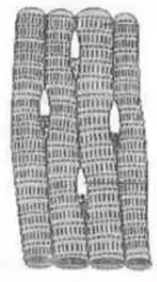
Identify the tissue shown in the diagram and match it with its characteristics and location.
A
Smooth muscles,show branching,found in the wall of the heart
B
Cardiac muscles,unbranched muscles,found in the walls of the heart
C
Striated muscles,tapering at both ends,attached with the bones of the ribs
D
Skeletal muscles show striations and are closely attached with the bones of the limbs
Solution
(B) The diagram shows cardiac muscle fibers. Cardiac muscle tissue is a contractile tissue present only in the heart. Cell junctions fuse the plasma membranes of cardiac muscle cells and make them stick together. Communication junctions (intercalated discs) at some fusion points allow the cells to contract as a unit,i.e.,when one cell receives a signal to contract,its neighbors are also stimulated to contract. These muscles are branched and striated. Therefore,the correct identification is cardiac muscle,which is branched and found in the heart wall. Note: The provided options contain a discrepancy as the diagram clearly depicts cardiac muscle (branched),but option $(d)$ is often cited in standard textbooks for skeletal muscle identification. Given the visual evidence of branching,the tissue is cardiac muscle.
0 likes
View Solution71
MediumMCQ
Match the following:
| Column-$I$ | Column-$II$ |
| $1$. Smooth muscles | $p$. Hard and not pliable ground substance |
| $2$. Skeletal muscles | $q$. Blood vessel,stomach,intestine |
| $3$. Bone | $r$. Chondroblast |
| $4$. Cartilage | $s$. $A$-band |
A
$(1-p), (2-q), (3-r), (4-s)$
B
$(1-q), (2-p), (3-s), (4-r)$
C
$(1-q), (2-s), (3-p), (4-r)$
D
$(1-p), (2-r), (3-s), (4-q)$
Solution
(C) The correct matching is as follows:
$1$. Smooth muscles are found in the walls of internal organs like the blood vessel,stomach,and intestine $(q)$.
$2$. Skeletal muscles are striated muscles that contain $A$-bands $(s)$.
$3$. Bone is a specialized connective tissue with a hard and non-pliable ground substance rich in calcium salts $(p)$.
$4$. Cartilage is a specialized connective tissue formed by cells called chondroblasts $(r)$.
Therefore,the correct sequence is $(1-q), (2-s), (3-p), (4-r)$.
$1$. Smooth muscles are found in the walls of internal organs like the blood vessel,stomach,and intestine $(q)$.
$2$. Skeletal muscles are striated muscles that contain $A$-bands $(s)$.
$3$. Bone is a specialized connective tissue with a hard and non-pliable ground substance rich in calcium salts $(p)$.
$4$. Cartilage is a specialized connective tissue formed by cells called chondroblasts $(r)$.
Therefore,the correct sequence is $(1-q), (2-s), (3-p), (4-r)$.
0 likes
View Solution72
MediumMCQ
Select the correct pair.
A
Skeletal muscle - fiber taper at both ends
B
Smooth muscle - Closely attached to skeletal
C
Cardiac muscle - present only in the heart
D
Neural tissue - help in movement.
Solution
(C) The correct pair is $C$.
$1$. Skeletal muscles are cylindrical and multinucleated,not tapered at both ends.
$2$. Smooth muscles are fusiform (tapered at both ends) and are found in the walls of internal organs,not attached to the skeleton.
$3$. Cardiac muscles are specialized contractile tissues found exclusively in the heart.
$4$. Neural tissue is responsible for the control and coordination of body activities,not for movement (which is the function of muscular tissue).
$1$. Skeletal muscles are cylindrical and multinucleated,not tapered at both ends.
$2$. Smooth muscles are fusiform (tapered at both ends) and are found in the walls of internal organs,not attached to the skeleton.
$3$. Cardiac muscles are specialized contractile tissues found exclusively in the heart.
$4$. Neural tissue is responsible for the control and coordination of body activities,not for movement (which is the function of muscular tissue).
0 likes
View Solution73
MediumMCQ
Match the following columns.
| Column-$I$ | Column-$II$ |
| $A$. Areolar tissue | $1$. Fat cells |
| $B$. Adipose tissue | $2$. Osteocytes |
| $C$. Ligament | $3$. Loose connective tissue |
| $D$. Bone | $4$. Dense regular connective tissue |
A
$A-3, B-1, C-4, D-2$
B
$A-1, B-2, C-3, D-4$
C
$A-4, B-3, C-2, D-1$
D
$A-2, B-1, C-4, D-3$
Solution
(A) The correct matching is as follows:
$A$. Areolar tissue is a type of loose connective tissue $(A-3)$.
$B$. Adipose tissue is specialized for the storage of fats and contains fat cells or adipocytes $(B-1)$.
$C$. Ligament is a type of dense regular connective tissue that connects bone to bone $(C-4)$.
$D$. Bone is a specialized connective tissue containing cells called osteocytes $(D-2)$.
Thus,the correct sequence is $A-3, B-1, C-4, D-2$.
$A$. Areolar tissue is a type of loose connective tissue $(A-3)$.
$B$. Adipose tissue is specialized for the storage of fats and contains fat cells or adipocytes $(B-1)$.
$C$. Ligament is a type of dense regular connective tissue that connects bone to bone $(C-4)$.
$D$. Bone is a specialized connective tissue containing cells called osteocytes $(D-2)$.
Thus,the correct sequence is $A-3, B-1, C-4, D-2$.
0 likes
View Solution74
MediumMCQ
What is a common characteristic between cockroaches and frogs?
A
Invertebrate animals
B
Always beneficial for mankind
C
Both have a skeletal system
D
Oviparous
Solution
(D) Cockroaches are invertebrates (arthropods),while frogs are vertebrates (amphibians).
Both organisms reproduce by laying eggs,which makes them both oviparous.
Cockroaches do not have an internal bony skeleton (they have an exoskeleton),whereas frogs have an internal endoskeleton.
Therefore,the common characteristic is that both are oviparous.
Both organisms reproduce by laying eggs,which makes them both oviparous.
Cockroaches do not have an internal bony skeleton (they have an exoskeleton),whereas frogs have an internal endoskeleton.
Therefore,the common characteristic is that both are oviparous.
0 likes
View Solution75
MediumMCQ
Choose the correct group of structures that are associated with any one specific system in both cockroach and frog.
A
Spiracles,lungs,trachea,circular muscles,nostrils.
B
Ostia,sinus venosus,cloaca,anal cerci.
C
Fallopian tube,ovary,stomach,skin,appendages,mouth parts.
D
Ganglia,eyes,brain,liver,testis,bifid tongue.
Solution
(D) The question asks for a group of structures associated with a specific system in both cockroach and frog.
Option $D$ contains structures related to the nervous system (ganglia,brain,eyes) and the reproductive/digestive systems (testis,liver,bifid tongue).
However,looking at the options,there is no single system that encompasses all listed items in any option.
Re-evaluating the question: If we look for structures that are part of the same biological system in both organisms,option $D$ is the most plausible if interpreted as a collection of organs from various systems present in both.
Actually,none of the options provide a single system for both.
However,in many standard biology contexts,this question is often framed to identify organs present in both.
Given the structure of the options,$D$ is the most appropriate choice as it lists organs found in both organisms.
Option $D$ contains structures related to the nervous system (ganglia,brain,eyes) and the reproductive/digestive systems (testis,liver,bifid tongue).
However,looking at the options,there is no single system that encompasses all listed items in any option.
Re-evaluating the question: If we look for structures that are part of the same biological system in both organisms,option $D$ is the most plausible if interpreted as a collection of organs from various systems present in both.
Actually,none of the options provide a single system for both.
However,in many standard biology contexts,this question is often framed to identify organs present in both.
Given the structure of the options,$D$ is the most appropriate choice as it lists organs found in both organisms.
0 likes
View Solution76
MediumMCQ
Choose the incorrect sentence.
A
Excretory material in frog is urea.
B
In cockroach,the excretory material is uric acid.
C
In frog,fertilization is external and occurs in water.
D
In cockroach,fertilization is internal and development is direct.
Solution
(D) $1$. Frogs are ureotelic,meaning they excrete urea as their primary nitrogenous waste. This statement is correct.
$2$. Cockroaches are uricotelic,meaning they excrete uric acid to conserve water. This statement is correct.
$3$. Frogs exhibit external fertilization,which takes place in water. This statement is correct.
$4$. Cockroaches exhibit internal fertilization,but their development is indirect,involving a nymphal stage that undergoes multiple molts (metamorphosis). Therefore,the statement claiming 'direct development' is incorrect.
$2$. Cockroaches are uricotelic,meaning they excrete uric acid to conserve water. This statement is correct.
$3$. Frogs exhibit external fertilization,which takes place in water. This statement is correct.
$4$. Cockroaches exhibit internal fertilization,but their development is indirect,involving a nymphal stage that undergoes multiple molts (metamorphosis). Therefore,the statement claiming 'direct development' is incorrect.
0 likes
View Solution77
MediumMCQ
Which character is present in frog but absent in cockroach?
A
Presence of reproductive system
B
Presence of digestive system
C
Presence of sensory organs
D
Capacity to change the skin color
Solution
(D) Frogs possess specialized cells called chromatophores in their skin,which allow them to change their skin color for camouflage or thermoregulation. Cockroaches do not possess this ability. Both organisms possess reproductive systems,digestive systems,and sensory organs.
0 likes
View Solution78
MediumMCQ
What is a similarity between an earthworm and a cockroach?
A
Blood circulatory system
B
Sexes
C
Complete digestive tract
D
Phylum
Solution
(C) Both the earthworm $(Pheretima)$ and the cockroach $(Periplaneta)$ possess a complete digestive tract,which means they have a distinct mouth at the anterior end and an anus at the posterior end,allowing for extracellular digestion.
- Earthworms and cockroaches belong to different phyla (Annelida and Arthropoda,respectively).
- Earthworms are hermaphrodites (monoecious),whereas cockroaches are dioecious (separate sexes).
- Earthworms have a closed circulatory system,while cockroaches have an open circulatory system.
- Earthworms and cockroaches belong to different phyla (Annelida and Arthropoda,respectively).
- Earthworms are hermaphrodites (monoecious),whereas cockroaches are dioecious (separate sexes).
- Earthworms have a closed circulatory system,while cockroaches have an open circulatory system.
0 likes
View Solution79
MediumMCQ
Match the following:
| Column-$I$ | Column-$II$ |
| $A$. Caecum in earthworm | $1$. Tubular |
| $B$. Caecum in cockroach | $2$. Foregut |
| $C$. Gizzard in earthworm | $3$. $26^{th}$ segment |
| $D$. Gizzard in cockroach | $4$. $8-9$ segment |
A
$A-1, B-4, C-2, D-3$
B
$A-4, B-2, C-1, D-3$
C
$A-3, B-1, C-4, D-2$
D
$A-3, B-1, C-2, D-3$
Solution
(C) The correct matches are as follows:
$A$. Caecum in earthworm is located at the $26^{th}$ segment $(A-3)$.
$B$. Caecum in cockroach is tubular in structure $(B-1)$.
$C$. Gizzard in earthworm is located at the $8-9$ segment $(C-4)$.
$D$. Gizzard in cockroach is part of the foregut $(D-2)$.
Therefore,the correct sequence is $A-3, B-1, C-4, D-2$.
$A$. Caecum in earthworm is located at the $26^{th}$ segment $(A-3)$.
$B$. Caecum in cockroach is tubular in structure $(B-1)$.
$C$. Gizzard in earthworm is located at the $8-9$ segment $(C-4)$.
$D$. Gizzard in cockroach is part of the foregut $(D-2)$.
Therefore,the correct sequence is $A-3, B-1, C-4, D-2$.
0 likes
View Solution80
MediumMCQ
What are the dissimilarities between a cockroach and a frog?
A
Both have a complete digestive system.
B
Their heads show great mobility in all directions.
C
Both are unisexual animals.
D
Both have paired appendages.
Solution
(B) The correct answer is $B$.
In a cockroach,the head is small and triangular,and it is attached to the thorax by a flexible neck,allowing it to move in all directions.
However,in a frog,the head is somewhat flattened and triangular,and it is fused with the trunk,which restricts its mobility significantly compared to a cockroach.
Options $A$,$C$,and $D$ are similarities: both have a complete digestive system,both are unisexual (dioecious),and both possess paired appendages (legs/limbs).
In a cockroach,the head is small and triangular,and it is attached to the thorax by a flexible neck,allowing it to move in all directions.
However,in a frog,the head is somewhat flattened and triangular,and it is fused with the trunk,which restricts its mobility significantly compared to a cockroach.
Options $A$,$C$,and $D$ are similarities: both have a complete digestive system,both are unisexual (dioecious),and both possess paired appendages (legs/limbs).
0 likes
View Solution81
MediumMCQ
Identify the white blood cells.
A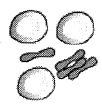
B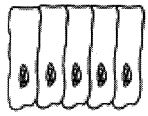
C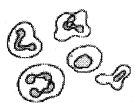
D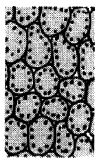
Solution
(C) White blood cells (WBCs),also known as leukocytes,are characterized by their irregular shapes and lobed nuclei,which allow them to perform phagocytosis and immune functions.
In the given options,image $C$ displays various types of leukocytes (such as neutrophils,lymphocytes,and monocytes) which are identifiable by their distinct,often multi-lobed nuclei and irregular cell boundaries.
Image $A$ represents red blood cells (erythrocytes),image $B$ represents columnar epithelial cells,and image $D$ represents parenchyma cells.
In the given options,image $C$ displays various types of leukocytes (such as neutrophils,lymphocytes,and monocytes) which are identifiable by their distinct,often multi-lobed nuclei and irregular cell boundaries.
Image $A$ represents red blood cells (erythrocytes),image $B$ represents columnar epithelial cells,and image $D$ represents parenchyma cells.
0 likes
View Solution82
MediumMCQ
Which one of the following pairs is correctly matched?
A
Thorns of Bougainvillea and tendrils of Cucurbita - Analogous organs
B
Blind spot and eyelid in human eye - Vestigial organs
C
Nephridia in earthworm and Malpighian tubules in cockroach - Excretory organs
D
Wings of honeybee and wings of crow - Homologous organs
Solution
(C) $1$. Thorns of Bougainvillea and tendrils of Cucurbita are homologous organs because they share a common anatomical origin (axillary buds) but perform different functions. Thus,option $A$ is incorrect.
$2$. In the human eye,the blind spot is a physiological region where the optic nerve exits,while the eyelid is a protective structure. Neither is a vestigial organ. Thus,option $B$ is incorrect.
$3$. Nephridia are the primary excretory organs in earthworms $(Pheretima)$,and Malpighian tubules are the primary excretory organs in cockroaches $(Periplaneta)$. This is a correct match. Thus,option $C$ is correct.
$4$. Wings of a honeybee (insect) and wings of a crow (bird) are analogous organs because they perform the same function (flight) but have different structural origins. Thus,option $D$ is incorrect.
$2$. In the human eye,the blind spot is a physiological region where the optic nerve exits,while the eyelid is a protective structure. Neither is a vestigial organ. Thus,option $B$ is incorrect.
$3$. Nephridia are the primary excretory organs in earthworms $(Pheretima)$,and Malpighian tubules are the primary excretory organs in cockroaches $(Periplaneta)$. This is a correct match. Thus,option $C$ is correct.
$4$. Wings of a honeybee (insect) and wings of a crow (bird) are analogous organs because they perform the same function (flight) but have different structural origins. Thus,option $D$ is incorrect.
0 likes
View Solution83
EasyMCQ
In mammals,the scent-producing glands are known as:
A
Rectal glands
B
Prostate glands
C
Adrenal glands
D
Bartholin's glands
Solution
(A) In many mammals,scent glands are specialized structures used for communication,marking territory,or defense. These are often modified sebaceous or sweat glands. Among the given options,rectal glands (or anal glands) are well-known scent-producing glands in many mammals,such as carnivores,used for marking territory. Therefore,the correct option is $A$.
0 likes
View Solution84
MediumMCQ
Which of the following is correctly matched?
A
Human - Renal portal system
B
Earthworm - Closed circulatory system
C
Cockroach - Nephridia
D
None of the above
Solution
(B) Earthworms possess a closed circulatory system,where blood circulates within defined,walled blood vessels.
Renal portal systems are characteristic of amphibians and reptiles,not humans. Humans possess a hepatic portal system that transports venous blood from the digestive system to the liver.
In cockroaches,the primary excretory organs are Malpighian tubules,whereas nephridia are the excretory structures found in annelids like earthworms.
Renal portal systems are characteristic of amphibians and reptiles,not humans. Humans possess a hepatic portal system that transports venous blood from the digestive system to the liver.
In cockroaches,the primary excretory organs are Malpighian tubules,whereas nephridia are the excretory structures found in annelids like earthworms.
0 likes
View Solution85
MediumMCQ
Based on cellular mechanisms,there are two major types of regeneration found in animals. Which one of the following is the correct example of the type mentioned?
A
Morphallaxis - Regeneration of two transversely cut equal pieces of a Hydra into two small Hydras
B
Epimorphosis - Replacement of old and dead erythrocytes by the new ones.
C
Morphallaxis - Healing up of a wound in the skin
D
Epimorphosis - Regeneration of crushed and filtered out pieces of a Planaria into as many new Planarians.
Solution
(A) Regeneration is broadly classified into two types: Morphallaxis and Epimorphosis.
$1$. Morphallaxis involves the reorganization of existing body tissues to form a complete organism from a small fragment,as seen in Hydra.
$2$. Epimorphosis involves the proliferation of cells at the site of injury to replace lost parts,such as limb regeneration or the formation of new Planarians from body fragments.
Therefore,the regeneration of two transversely cut equal pieces of a Hydra into two small Hydras is a classic example of Morphallaxis.
$1$. Morphallaxis involves the reorganization of existing body tissues to form a complete organism from a small fragment,as seen in Hydra.
$2$. Epimorphosis involves the proliferation of cells at the site of injury to replace lost parts,such as limb regeneration or the formation of new Planarians from body fragments.
Therefore,the regeneration of two transversely cut equal pieces of a Hydra into two small Hydras is a classic example of Morphallaxis.
0 likes
View Solution86
Easy
Match the terms in column $I$ with those in column $II$:
| Column $I$ | Column $II$ |
| $(a)$ Compound epithelium | $(i)$ Alimentary canal |
| $(b)$ Compound eye | $(ii)$ Cockroach |
| $(c)$ Septal nephridia | $(iii)$ Skin |
| $(d)$ Open circulatory system | $(iv)$ Mosaic vision |
| $(e)$ Typhlosole | $(v)$ Earthworm |
| $(f)$ Osteocytes | $(vi)$ Phallomere |
| $(g)$ Genitalia | $(vii)$ Bone |
Solution
(A) The correct matches are as follows:
$1$. $(a)$ Compound epithelium provides protection against chemical and mechanical stresses, found in the skin.
$2$. $(b)$ Compound eyes in insects provide mosaic vision.
$3$. $(c)$ Septal nephridia are excretory organs found in the earthworm.
$4$. $(d)$ Open circulatory system is characteristic of cockroaches.
$5$. $(e)$ Typhlosole is a fold in the intestine (alimentary canal) of the earthworm.
$6$. $(f)$ Osteocytes are mature bone cells found in the bone matrix.
$7$. $(g)$ Phallomeres are chitinous structures forming the external genitalia in male cockroaches.
| $(a)$ Compound epithelium | $(iii)$ Skin |
| $(b)$ Compound eye | $(iv)$ Mosaic vision |
| $(c)$ Septal nephridia | $(v)$ Earthworm |
| $(d)$ Open circulatory system | $(ii)$ Cockroach |
| $(e)$ Typhlosole | $(i)$ Alimentary canal |
| $(f)$ Osteocytes | $(vii)$ Bone |
| $(g)$ Genitalia | $(vi)$ Phallomere |
$1$. $(a)$ Compound epithelium provides protection against chemical and mechanical stresses, found in the skin.
$2$. $(b)$ Compound eyes in insects provide mosaic vision.
$3$. $(c)$ Septal nephridia are excretory organs found in the earthworm.
$4$. $(d)$ Open circulatory system is characteristic of cockroaches.
$5$. $(e)$ Typhlosole is a fold in the intestine (alimentary canal) of the earthworm.
$6$. $(f)$ Osteocytes are mature bone cells found in the bone matrix.
$7$. $(g)$ Phallomeres are chitinous structures forming the external genitalia in male cockroaches.
0 likes
View Solution87
MediumMCQ
How are the biological functions of living organisms carried out?
A
By a single cell in all organisms
B
By division of labour among cells,tissues,organs,and organ systems
C
By organs only
D
By tissues only
Solution
(B) $\Rightarrow$ In unicellular organisms,all functions like digestion,respiration,and reproduction are performed by a single cell. In the complex body of multicellular organisms,the same basic functions are carried out by different groups of cells in a well-organized manner.
$\Rightarrow$ In multicellular animals,a group of similar cells along with intercellular substances performs a specific function. Such an organization is called a tissue.
$\Rightarrow$ All complex animals consist of only four basic types of tissues. These tissues are organized in specific proportions and patterns to form an organ (e.g.,lung,heart,stomach,kidney). When two or more organs perform a common function by their physical and/or chemical interaction,they together form an organ system (e.g.,digestive system,respiratory system).
$\Rightarrow$ Cells,tissues,organs,and organ systems split up the work in a way that exhibits division of labour and contributes to the survival of the body as a whole.
$\Rightarrow$ In multicellular animals,a group of similar cells along with intercellular substances performs a specific function. Such an organization is called a tissue.
$\Rightarrow$ All complex animals consist of only four basic types of tissues. These tissues are organized in specific proportions and patterns to form an organ (e.g.,lung,heart,stomach,kidney). When two or more organs perform a common function by their physical and/or chemical interaction,they together form an organ system (e.g.,digestive system,respiratory system).
$\Rightarrow$ Cells,tissues,organs,and organ systems split up the work in a way that exhibits division of labour and contributes to the survival of the body as a whole.
0 likes
View Solution88
Medium
Explain how organs and organ systems are formed.
Solution
(N/A) $\Rightarrow$ Basic tissues organize to form organs,which in turn associate to form organ systems in multicellular organisms. Such an organization is essential for more efficient and better-coordinated activities of millions of cells constituting an organism.
$\Rightarrow$ Each organ in our body is made of one or more types of tissues.
$\Rightarrow$ For example,our heart consists of all four types of tissues (epithelial,connective,muscular,and neural). We notice after careful study that the complexity in organs and organ systems displays certain discernible trends.
$\Rightarrow$ The morphology and anatomy of organisms at different evolutionary levels explain their organization and functioning.
$\Rightarrow$ Morphology refers to the study of form or externally visible features.
$\Rightarrow$ In the case of animals,this refers to the external appearance of organs or parts of the body.
$\Rightarrow$ The word anatomy is conventionally used for the study of the morphology of internal organs in animals.
$\Rightarrow$ Examples include the morphology and anatomy of the earthworm,cockroach,and frog,representing invertebrates and vertebrates.
$\Rightarrow$ Each organ in our body is made of one or more types of tissues.
$\Rightarrow$ For example,our heart consists of all four types of tissues (epithelial,connective,muscular,and neural). We notice after careful study that the complexity in organs and organ systems displays certain discernible trends.
$\Rightarrow$ The morphology and anatomy of organisms at different evolutionary levels explain their organization and functioning.
$\Rightarrow$ Morphology refers to the study of form or externally visible features.
$\Rightarrow$ In the case of animals,this refers to the external appearance of organs or parts of the body.
$\Rightarrow$ The word anatomy is conventionally used for the study of the morphology of internal organs in animals.
$\Rightarrow$ Examples include the morphology and anatomy of the earthworm,cockroach,and frog,representing invertebrates and vertebrates.
0 likes
View Solution89
Medium
Define the following terms:
$(i)$ Haemocytes
$(ii)$ Copulatory pad
$(i)$ Haemocytes
$(ii)$ Copulatory pad
Solution
(N/A) $(i)$ Haemocytes are the blood cells found in the haemolymph of a cockroach. They are involved in phagocytosis and the transport of nutrients.
$(ii)$ $A$ copulatory pad (or nuptial pad) is a specialized structure that develops on the first digit of the forelimbs of male frogs during the breeding season to help them grasp the female during amplexus.
$(ii)$ $A$ copulatory pad (or nuptial pad) is a specialized structure that develops on the first digit of the forelimbs of male frogs during the breeding season to help them grasp the female during amplexus.
0 likes
View Solution90
Medium
Structural organisation in animals attains different levels as cell-organ-organ system. What is missing in this chain? Mention the significance of such an organisation.
Solution
(N/A) The missing level in the chain is 'tissue'. The hierarchy is: $Cell \rightarrow Tissue \rightarrow Organ \rightarrow Organ System \rightarrow Organism$.
Significance:
$1$. Division of Labour: Different tissues and organs are specialized to perform specific functions, which increases the efficiency of the organism.
$2$. Complexity: It allows organisms to perform complex physiological processes (like digestion, respiration, and circulation) that are impossible for single-celled organisms.
$3$. Coordination: The organisation allows for better coordination and regulation of body activities through nervous and endocrine systems.
Significance:
$1$. Division of Labour: Different tissues and organs are specialized to perform specific functions, which increases the efficiency of the organism.
$2$. Complexity: It allows organisms to perform complex physiological processes (like digestion, respiration, and circulation) that are impossible for single-celled organisms.
$3$. Coordination: The organisation allows for better coordination and regulation of body activities through nervous and endocrine systems.
0 likes
View Solution91
EasyMCQ
Identify the correct terms for the following analogy-based questions:
$(i)$ In cockroach,blood is : $Hemolymph$ :: In frog : ..........
$(ii)$ Before nymphal stage : $Wing$ $pad$ :: In adult cockroach : ...
$(iii)$ In earthworm : Tactile receptors :: In cockroach,dorsal side of the head : .....
$(i)$ In cockroach,blood is : $Hemolymph$ :: In frog : ..........
$(ii)$ Before nymphal stage : $Wing$ $pad$ :: In adult cockroach : ...
$(iii)$ In earthworm : Tactile receptors :: In cockroach,dorsal side of the head : .....
A
$(i)$ $Hemoglobin$,$(ii)$ $Wings$,$(iii)$ $Compound$ $eyes$
B
$(i)$ $Plasma$,$(ii)$ $Legs$,$(iii)$ $Ocelli$
C
$(i)$ $Serum$,$(ii)$ $Antennae$,$(iii)$ $Sensilla$
D
$(i)$ $Lymph$,$(ii)$ $Thorax$,$(iii)$ $Maxilla$
Solution
(A) $(i)$ In a cockroach,the circulatory fluid is called $Hemolymph$. In a frog,the blood contains $Hemoglobin$ (a respiratory pigment) within red blood cells.
$(ii)$ In the nymphal stage of a cockroach,$Wing$ $pads$ are present. In the adult cockroach,these develop into fully functional $Wings$.
$(iii)$ In an earthworm,tactile receptors are present for sensory perception. In a cockroach,the dorsal side of the head bears a pair of $Compound$ $eyes$.
$(ii)$ In the nymphal stage of a cockroach,$Wing$ $pads$ are present. In the adult cockroach,these develop into fully functional $Wings$.
$(iii)$ In an earthworm,tactile receptors are present for sensory perception. In a cockroach,the dorsal side of the head bears a pair of $Compound$ $eyes$.
0 likes
View Solution92
MediumMCQ
Select the correct option from the following:
$(i)$ Frogs are $Ureotelic$ / $Uricotelic$.
(ii) The visual unit of the compound eye in cockroaches is $Ommatidia$ / $Ommatidium$.
$(i)$ Frogs are $Ureotelic$ / $Uricotelic$.
(ii) The visual unit of the compound eye in cockroaches is $Ommatidia$ / $Ommatidium$.
A
$(i)$ $Ureotelic$,(ii) $Ommatidia$
B
$(i)$ $Ureotelic$,(ii) $Ommatidium$
C
$(i)$ $Uricotelic$,(ii) $Ommatidia$
D
$(i)$ $Uricotelic$,(ii) $Ommatidium$
Solution
(A) $(i)$ Frogs are $Ureotelic$ because they excrete urea as their primary nitrogenous waste.
(ii) The compound eye of a cockroach consists of several thousand hexagonal visual units called $Ommatidia$ (singular: $Ommatidium$). Therefore,the correct visual unit is $Ommatidium$ (or $Ommatidia$ as plural).
Given the options,the correct choice is $(i)$ $Ureotelic$,(ii) $Ommatidia$.
(ii) The compound eye of a cockroach consists of several thousand hexagonal visual units called $Ommatidia$ (singular: $Ommatidium$). Therefore,the correct visual unit is $Ommatidium$ (or $Ommatidia$ as plural).
Given the options,the correct choice is $(i)$ $Ureotelic$,(ii) $Ommatidia$.
0 likes
View Solution93
EasyMCQ
Select the incorrectly matched pair from the following:
A
Osteocytes - Bone cells
B
Chondrocytes - Smooth muscle cells
C
Neurons - Nerve cells
D
Fibroblast - Areolar tissue
Solution
(B) The correct answer is option $B$ because chondrocytes are not smooth muscle cells; they are the specialized cells found in cartilage.
$A$. Osteocytes are mature bone cells found in lacunae.
$B$. Chondrocytes are cartilage cells,whereas smooth muscle cells are found in the walls of internal organs.
$C$. Neurons are the structural and functional units of the nervous system.
$D$. Fibroblasts are cells present in areolar tissue that produce and secrete fibers.
$A$. Osteocytes are mature bone cells found in lacunae.
$B$. Chondrocytes are cartilage cells,whereas smooth muscle cells are found in the walls of internal organs.
$C$. Neurons are the structural and functional units of the nervous system.
$D$. Fibroblasts are cells present in areolar tissue that produce and secrete fibers.
0 likes
View Solution94
EasyMCQ
Johnston's organ,present in mosquitoes,is used to detect vibrations. Where are they located?
A
Antenna
B
Appendages
C
Anal cerci
D
Mouth parts
Solution
(A) Johnston's organ is a specialized chordotonal sensory organ found at the base of the antennae in insects,including mosquitoes. It is primarily responsible for detecting vibrations and sound waves.
0 likes
View Solution95
MediumMCQ
Match the following (w.r.t. type of metamorphosis involved):
| Column-$I$ | Column-$II$ |
| $(a)$. Paurometabolous | $(i)$. Silk worm |
| $(b)$. Hemimetabolous | $(ii)$. Grasshopper |
| $(c)$. Holometabolous | $(iii)$. Silver fish |
| $(d)$. Ametabolous | $(iv)$. Dragon fly |
A
$a(ii), b(iv), c(i), d(iii)$
B
$a(i), b(iii), c(iv), d(ii)$
C
$a(ii), b(iii), c(i), d(iv)$
D
$a(ii), b(iv), c(iii), d(i)$
Solution
$(a)$. Paurometabolous: Grasshopper. It undergoes gradual metamorphosis where the life cycle includes egg, nymph, and adult stages.
$(b)$. Hemimetabolous: Dragon fly. It undergoes incomplete metamorphosis where the life cycle includes egg, naiad, and imago (adult) stages.
$(c)$. Holometabolous: Silk worm. It undergoes complete metamorphosis where the life cycle includes egg, larva, pupa, and imago stages.
$(d)$. Ametabolous: Silver fish. It undergoes no metamorphosis; the life cycle includes egg, young, and imago stages.
$(b)$. Hemimetabolous: Dragon fly. It undergoes incomplete metamorphosis where the life cycle includes egg, naiad, and imago (adult) stages.
$(c)$. Holometabolous: Silk worm. It undergoes complete metamorphosis where the life cycle includes egg, larva, pupa, and imago stages.
$(d)$. Ametabolous: Silver fish. It undergoes no metamorphosis; the life cycle includes egg, young, and imago stages.
0 likes
View Solution96
EasyMCQ
Which of the following statement$(s)$ is/are correct about muscle tissue?
A
Each muscle is made of many long,cylindrical fibres arranged in parallel arrays.
B
Muscle fibres contract (shorten) in response to stimulation,then relax (lengthen) and return to their uncontracted state in a coordinated fashion.
C
Muscles play an active role in all movements of the body.
D
All of the above
Solution
(D) Muscle tissue is a specialized tissue that is contractile in nature and grouped into coordinated systems for greater efficiency.
Each muscle is composed of many long,cylindrical fibres arranged in parallel arrays.
Muscle fibres contract (shorten) in response to stimulation,then relax (lengthen) and return to their uncontracted state in a coordinated fashion.
Muscles play an active role in all movements of the body,including locomotion and internal organ functions.
Therefore,all the given statements are correct.
Each muscle is composed of many long,cylindrical fibres arranged in parallel arrays.
Muscle fibres contract (shorten) in response to stimulation,then relax (lengthen) and return to their uncontracted state in a coordinated fashion.
Muscles play an active role in all movements of the body,including locomotion and internal organ functions.
Therefore,all the given statements are correct.
0 likes
View Solution97
MediumMCQ
How many of the given statements are true?
$A.$ The dry surface of the skin and the moist surface of the buccal cavity are lined by compound epithelium.
$B.$ Cuboidal epithelium facilitates diffusion across the epithelium.
$C.$ Intercalated discs are the cell junctions between the cardiac muscle cells.
$D.$ Skeletal muscle fibers can be located in the biceps muscle.
$E.$ In a bone,osteocytes are located in lacunae.
$A.$ The dry surface of the skin and the moist surface of the buccal cavity are lined by compound epithelium.
$B.$ Cuboidal epithelium facilitates diffusion across the epithelium.
$C.$ Intercalated discs are the cell junctions between the cardiac muscle cells.
$D.$ Skeletal muscle fibers can be located in the biceps muscle.
$E.$ In a bone,osteocytes are located in lacunae.
A
Two
B
Three
C
Four
D
All
Solution
(C) The correct answer is $C$ (Four).
Statement $A$ is true: Compound epithelium covers the dry surface of the skin and the moist surface of the buccal cavity to provide protection against chemical and mechanical stresses.
Statement $B$ is false: Simple squamous epithelium facilitates diffusion. Cuboidal epithelium is primarily involved in secretion and absorption.
Statement $C$ is true: Intercalated discs are specialized cell junctions that connect cardiac muscle cells,allowing them to contract as a unit.
Statement $D$ is true: Skeletal muscles are attached to bones,and the biceps muscle is a classic example of skeletal muscle.
Statement $E$ is true: Osteocytes are mature bone cells found within small spaces called lacunae in the bone matrix.
Therefore,statements $A, C, D,$ and $E$ are true,making the total count four.
Statement $A$ is true: Compound epithelium covers the dry surface of the skin and the moist surface of the buccal cavity to provide protection against chemical and mechanical stresses.
Statement $B$ is false: Simple squamous epithelium facilitates diffusion. Cuboidal epithelium is primarily involved in secretion and absorption.
Statement $C$ is true: Intercalated discs are specialized cell junctions that connect cardiac muscle cells,allowing them to contract as a unit.
Statement $D$ is true: Skeletal muscles are attached to bones,and the biceps muscle is a classic example of skeletal muscle.
Statement $E$ is true: Osteocytes are mature bone cells found within small spaces called lacunae in the bone matrix.
Therefore,statements $A, C, D,$ and $E$ are true,making the total count four.
0 likes
View Solution98
EasyMCQ
The term 'tissue' was introduced by
A
Robert Hooke
B
Bichat
C
Ruysch
D
Mayer
Solution
(B) $Robert \ Hooke$ first observed cells through a microscope as dead cells.
$Bichat$ introduced the term 'tissue' and is known as the founder of animal histology.
$Mayer$ coined the term 'histology'.
$Ruysch$ introduced the term 'epithelium'.
$Bichat$ introduced the term 'tissue' and is known as the founder of animal histology.
$Mayer$ coined the term 'histology'.
$Ruysch$ introduced the term 'epithelium'.
0 likes
View Solution99
EasyMCQ
The hardest part in the animal body is
A
Bone
B
Hair
C
Dentine
D
Enamel
Solution
(D) The hardest part in the animal body is $Enamel$,which forms the outer protective layer of the teeth. It is the most mineralized substance in the vertebrate body,primarily composed of $Hydroxyapatite$.
0 likes
View Solution100
MediumMCQ
Identify the correctly matched pairs of the germ layers and their derivatives.
$I.$ Ectoderm - Epidermis
$II.$ Endoderm - Dermis
$III.$ Mesoderm - Muscles
$IV.$ Mesoderm - Notochord
$V.$ Endoderm - Enamel of teeth
$I.$ Ectoderm - Epidermis
$II.$ Endoderm - Dermis
$III.$ Mesoderm - Muscles
$IV.$ Mesoderm - Notochord
$V.$ Endoderm - Enamel of teeth
A
$I, III, \text{ and } IV \text{ only}$
B
$I, II, III, \text{ and } V \text{ only}$
C
$I \text{ and } IV \text{ only}$
D
$I \text{ and } II \text{ only}$
Solution
(A) The germ layers give rise to various tissues and organs in the body:
$1$. Ectoderm: Forms the epidermis of the skin,nervous system,and enamel of teeth.
$2$. Mesoderm: Forms the dermis of the skin,muscles,notochord,circulatory system,and bones.
$3$. Endoderm: Forms the epithelial lining of the digestive tract and respiratory system.
Evaluating the given pairs:
$I.$ Ectoderm - Epidermis: Correct.
$II.$ Endoderm - Dermis: Incorrect (Dermis is mesodermal).
$III.$ Mesoderm - Muscles: Correct.
$IV.$ Mesoderm - Notochord: Correct.
$V.$ Endoderm - Enamel of teeth: Incorrect (Enamel is ectodermal).
Therefore,the correctly matched pairs are $I, III, \text{ and } IV$.
$1$. Ectoderm: Forms the epidermis of the skin,nervous system,and enamel of teeth.
$2$. Mesoderm: Forms the dermis of the skin,muscles,notochord,circulatory system,and bones.
$3$. Endoderm: Forms the epithelial lining of the digestive tract and respiratory system.
Evaluating the given pairs:
$I.$ Ectoderm - Epidermis: Correct.
$II.$ Endoderm - Dermis: Incorrect (Dermis is mesodermal).
$III.$ Mesoderm - Muscles: Correct.
$IV.$ Mesoderm - Notochord: Correct.
$V.$ Endoderm - Enamel of teeth: Incorrect (Enamel is ectodermal).
Therefore,the correctly matched pairs are $I, III, \text{ and } IV$.
0 likes
View SolutionStructural Organisation In Animals — Mix Examples - Structural Organisation In Animals · Frequently Asked Questions
1Are these Structural Organisation In Animals questions useful for JEE and NEET?
Yes. All questions in this section are mapped to JEE Main and NEET exam patterns. Previous year questions from JEE Main, NEET, GUJCET and state-level exams are included with full solutions.
2Can I switch to Hindi or Gujarati for these questions?
Yes. Use the language tabs in the hero section or the sidebar to view the same questions and solutions in English, Hindi or Gujarati.
3How do I generate a question paper from this subtopic?
Use the Vedclass Exam Paper Generator — select the chapter and subtopic, set difficulty, and generate Sets A, B, C, D automatically. First 3 chapters of every subject are free.
Vedclass Products
For Students
Vedclass Test Series
Mock tests in real JEE/NEET style with performance analysis. 5-day free trial.
Start Free TrialFor Teachers
Exam Paper Generator
Generate Set A/B/C/D papers from this chapter in 2 minutes. 3 chapters free.
Try FreeFor Institutes
Online Exam Module
Live online exams with unlimited students, 360° analytics & white-label branding.
See DemoFor Teachers & Institutes
Generate a Structural Organisation In Animals Exam Paper in 2 Minutes
Select subtopic & difficulty — Sets A, B, C, D auto-generated with No Repeat logic.
First 3 chapters of every subject are free — no payment required.