
A English
Epithelial tissue Questions in English
Class 11 Biology · Structural Organisation In Animals · Epithelial tissue
263+
Questions
English
Language
100%
With Solutions
Showing 50 of 263 questions in English
201
MediumMCQ
In which one of the following preparations,cell junctions come across most frequently?
A
Ligament
B
Tendon
C
Cartilage
D
Ciliated epithelium
Solution
(D) Cell junctions are most frequently found in epithelial tissues,such as the ciliated epithelium.
Cell junctions are specialized structures that provide contact between neighboring cells or between a cell and the extracellular matrix.
They are essential for the structural integrity of epithelial tissues,as they help form the paracellular barrier and regulate paracellular transport.
In contrast,connective tissues like ligaments,tendons,and cartilage have fewer cell junctions because their cells are widely separated by an abundant extracellular matrix.
Cell junctions are specialized structures that provide contact between neighboring cells or between a cell and the extracellular matrix.
They are essential for the structural integrity of epithelial tissues,as they help form the paracellular barrier and regulate paracellular transport.
In contrast,connective tissues like ligaments,tendons,and cartilage have fewer cell junctions because their cells are widely separated by an abundant extracellular matrix.
0 likes
View Solution202
MediumMCQ
Non-ciliated simple columnar epithelium often contains $ microvilli $ which increase the surface area for secretion and absorption.
A
flagella
B
collagen fibres
C
microvilli
D
all of these
Solution
(C) The columnar epithelium is composed of a single layer of tall and slender cells.
The free surface of these cells often contains microvilli, which are found in the lining of the stomach and intestine.
These structures significantly increase the surface area, thereby facilitating the processes of secretion and absorption.
The free surface of these cells often contains microvilli, which are found in the lining of the stomach and intestine.
These structures significantly increase the surface area, thereby facilitating the processes of secretion and absorption.
0 likes
View Solution203
MediumMCQ
$A$ student was given a sample of tissue. He observes and concludes the following characters.
$(i)$ The cells are composed of a single layer of tall and slender cells.
$(ii)$ Their nuclei are located at the base.
$(iii)$ Free surface may have microvilli.
$(iv)$ It is found in the lining of stomach and intestine.
$(v)$ They help in secretion and absorption. Based on the above features identify the epithelium.
$(i)$ The cells are composed of a single layer of tall and slender cells.
$(ii)$ Their nuclei are located at the base.
$(iii)$ Free surface may have microvilli.
$(iv)$ It is found in the lining of stomach and intestine.
$(v)$ They help in secretion and absorption. Based on the above features identify the epithelium.
A
Cuboidal epithelium
B
Columnar Epithelium
C
Squamous epithelium
D
Glandular epithelium
Solution
(B) Columnar epithelium consists of a single layer of tall and slender cells.
These cells have oval nuclei located at the base.
They are found in the lining of the stomach and intestine,where they perform the functions of secretion and absorption.
The presence of microvilli on the free surface further increases the surface area for absorption.
Therefore,the described characteristics correspond to Columnar epithelium.
These cells have oval nuclei located at the base.
They are found in the lining of the stomach and intestine,where they perform the functions of secretion and absorption.
The presence of microvilli on the free surface further increases the surface area for absorption.
Therefore,the described characteristics correspond to Columnar epithelium.
0 likes
View Solution204
MediumMCQ
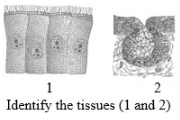
$A$ student was given a sample of two tissues. He observes the tissues under the microscope and draws their figures ($1$ and $2$) as shown below.
A
$1$: Columnar cells bearing cilia; $2$: Unicellular glandular epithelium
B
$1$: Cuboidal cells bearing cilia; $2$: Multicellular glandular epithelium
C
$1$: Compound cells bearing cilia; $2$: Unicellular glandular epithelium
D
$1$: Columnar cells bearing cilia; $2$: Multicellular glandular epithelium
Solution
(A) Tissue $1$ represents ciliated columnar epithelium,characterized by tall,slender cells with cilia on their free surfaces.
Tissue $2$ represents a goblet cell,which is a unicellular gland. Unicellular glands consist of isolated glandular cells (e.g.,goblet cells of the alimentary canal).
Therefore,the correct identification is $1$: Columnar cells bearing cilia; $2$: Unicellular glandular epithelium.
Tissue $2$ represents a goblet cell,which is a unicellular gland. Unicellular glands consist of isolated glandular cells (e.g.,goblet cells of the alimentary canal).
Therefore,the correct identification is $1$: Columnar cells bearing cilia; $2$: Unicellular glandular epithelium.
0 likes
View Solution205
MediumMCQ
The kind of epithelium which forms the inner walls of blood vessels is
A
cuboidal epithelium
B
columnar epithelium
C
ciliated columnar epithelium
D
squamous epithelium
Solution
(D) Squamous epithelium is composed of thin,discoidal,and polygonal cells that fit together like tiles on a floor,which is why it is also known as pavement epithelium.
It is found lining the walls of blood vessels,in the alveoli of the lungs for gas exchange,and in the Bowman's capsule of the nephron for ultrafiltration.
It is found lining the walls of blood vessels,in the alveoli of the lungs for gas exchange,and in the Bowman's capsule of the nephron for ultrafiltration.
0 likes
View Solution206
MediumMCQ
The ciliated columnar epithelial cells in humans occur in
A
Eustachian tube and stomach lining
B
bronchioles and fallopian tubes
C
bile duct and oesophagus
D
fallopian tubes and urethra
Solution
(B) Ciliated columnar epithelial cells are characterized by the presence of cilia on their free surface.
These cells are primarily found in the inner surface of hollow organs like the bronchioles and the fallopian tubes (oviducts).
The movement of cilia helps in the transport of mucus or particles in the respiratory tract and the movement of the ovum in the fallopian tubes.
These cells are primarily found in the inner surface of hollow organs like the bronchioles and the fallopian tubes (oviducts).
The movement of cilia helps in the transport of mucus or particles in the respiratory tract and the movement of the ovum in the fallopian tubes.
0 likes
View Solution207
MediumMCQ
Epithelial tissue is distinguished from connective tissue,muscular,or nervous tissue by its:
A
large extracellular matrix.
B
contractibility.
C
ability to carry action potentials.
D
basement membrane.
Solution
(D) The basement membrane is a thin,extracellular,non-cellular supporting layer that separates a layer of epithelial cells from the underlying connective tissue (lamina propria). It is composed of two layers: the basal lamina and the reticular lamina. This structure is unique to epithelial tissue and is not found in muscular,nervous,or connective tissues.
0 likes
View Solution208
MediumMCQ
Compound squamous epithelium is found in
A
stomach
B
intestine
C
trachea
D
pharynx
Solution
(D) Compound epithelium is made up of more than one layer of cells and thus has a limited role in secretion and absorption. Its main function is to provide protection against chemical and mechanical stresses. It covers the dry surface of the skin,the moist surface of the buccal cavity,the pharynx,the inner lining of the ducts of salivary glands,and the pancreatic ducts.
0 likes
View Solution209
MediumMCQ
Match the epithelial tissue given in column-$I$ with its location given in column-$II$ and choose the correct option.
| Column-$I$ (Epithelial tissue) | Column-$II$ (Location) |
| $A.$ Cuboidal | $I.$ Epidermis of skin |
| $B.$ Ciliated | $II.$ Inner lining of blood vessels |
| $C.$ Columnar | $III.$ Inner surface of gall bladder |
| $D.$ Squamous | $IV.$ Inner lining of fallopian tube |
| $E.$ Keratinized squamous | $V.$ Lining of pancreatic duct |
A
$A-V, B-IV, C-III, D-II, E-I$
B
$A-I, B-IV, C-II, D-III, E-V$
C
$A-IV, B-I, C-III, D-II, E-V$
D
$A-V, B-IV, C-III, D-I, E-II$
Solution
$(A)$ The correct matching is as follows:
$1$. Cuboidal epithelium $(A)$ is found in the lining of pancreatic ducts $(V)$.
$2$. Ciliated epithelium $(B)$ is found in the inner lining of the fallopian tube $(IV)$.
$3$. Columnar epithelium $(C)$ is found in the inner surface of the gall bladder $(III)$.
$4$. Squamous epithelium $(D)$ is found in the inner lining of blood vessels $(II)$.
$5$. Keratinized squamous epithelium $(E)$ is found in the epidermis of the skin $(I)$.
Therefore, the correct sequence is $A-V, B-IV, C-III, D-II, E-I$.
$1$. Cuboidal epithelium $(A)$ is found in the lining of pancreatic ducts $(V)$.
$2$. Ciliated epithelium $(B)$ is found in the inner lining of the fallopian tube $(IV)$.
$3$. Columnar epithelium $(C)$ is found in the inner surface of the gall bladder $(III)$.
$4$. Squamous epithelium $(D)$ is found in the inner lining of blood vessels $(II)$.
$5$. Keratinized squamous epithelium $(E)$ is found in the epidermis of the skin $(I)$.
Therefore, the correct sequence is $A-V, B-IV, C-III, D-II, E-I$.
0 likes
View Solution210
MediumMCQ
Match column-$I$ (type of epithelium) with column-$II$ (Description) and choose the correct option.
| Column-$I$ (Types of epithelium) | Column-$II$ (Description) |
| $A$. Squamous | $I$. It is composed of a single-layer epithelium of cube-like cells |
| $B$. Cuboidal epithelium | $II$. Having cilia on their free surface |
| $C$. Columnar | $III$. It is composed of a single epithelium layer of tall and slender cells |
| $D$. Ciliated | $IV$. It is made up of a single thin layer of flattened cells with irregular boundaries |
A
$A-IV, B-I, C-III, D-II$
B
$A-I, B-IV, C-III, D-II$
C
$A-IV, B-I, C-II, D-III$
D
$A-II, B-I, C-III, D-IV$
Solution
$(A)$ The correct matches are as follows:
$A$. Squamous epithelium: It is made up of a single thin layer of flattened cells with irregular boundaries. $(A-IV)$
$B$. Cuboidal epithelium: It is composed of a single layer of cube-like cells. $(B-I)$
$C$. Columnar epithelium: It is composed of a single layer of tall and slender cells. $(C-III)$
$D$. Ciliated epithelium: These cells have cilia on their free surface. $(D-II)$
Therefore, the correct sequence is $A-IV, B-I, C-III, D-II$.
$A$. Squamous epithelium: It is made up of a single thin layer of flattened cells with irregular boundaries. $(A-IV)$
$B$. Cuboidal epithelium: It is composed of a single layer of cube-like cells. $(B-I)$
$C$. Columnar epithelium: It is composed of a single layer of tall and slender cells. $(C-III)$
$D$. Ciliated epithelium: These cells have cilia on their free surface. $(D-II)$
Therefore, the correct sequence is $A-IV, B-I, C-III, D-II$.
0 likes
View Solution211
MediumMCQ
Match the terms given in column-$I$ with their feature given in column-$II$ and choose the correct option.
| Column-$I$ (Terms) | Column-$II$ (Features) |
| $A$. Exocrine gland | $I$. They help to stop substances from leaking across a tissue |
| $B$. Endocrine gland | $II$. Hormones are secreted directly into the fluid bathing the gland |
| $C$. Tight junctions | $III$. They perform cementing to keep neighbouring cells together |
| $D$. Adhering junctions | $IV$. Secretes mucus,saliva,earwax,oil,milk,digestive enzymes and other cell products |
A
$A-IV, B-II, C-I, D-III$
B
$A-II, B-IV, C-I, D-III$
C
$A-IV, B-II, C-III, D-I$
D
$A-IV, B-II, C-III, D-IV$
Solution
$(A)$. Exocrine glands secrete products like mucus,saliva,earwax,oil,milk,and digestive enzymes through ducts $(A-IV)$.
$B$. Endocrine glands are ductless and secrete hormones directly into the fluid bathing the gland $(B-II)$.
$C$. Tight junctions help to stop substances from leaking across a tissue $(C-I)$.
$D$. Adhering junctions perform cementing to keep neighbouring cells together $(D-III)$.
Therefore,the correct matching is $A-IV, B-II, C-I, D-III$.
$B$. Endocrine glands are ductless and secrete hormones directly into the fluid bathing the gland $(B-II)$.
$C$. Tight junctions help to stop substances from leaking across a tissue $(C-I)$.
$D$. Adhering junctions perform cementing to keep neighbouring cells together $(D-III)$.
Therefore,the correct matching is $A-IV, B-II, C-I, D-III$.
0 likes
View Solution212
MediumMCQ
Match the terms given in column-$I$ with their feature given in column-$II$ and choose the correct option.
| Column $I$ (Terms) | Column $II$ (Features) |
| $A$. Exocrine gland | $I$. They help to stop substances from leaking across a tissue |
| $B$. Endocrine gland | $II$. Hormones are secreted directly into the fluid bathing the gland |
| $C$. Tight junctions | $III$. They perform cementing to keep neighbouring cells together |
| $D$. Adhering junctions | $IV$. Secretes mucus,saliva,earwax,oil,milk,digestive enzymes and other cell products |
A
$A-IV, B-II, C-I, D-III$
B
$A-III, B-IV, C-I, D-II$
C
$A-IV, B-II, C-I, D-I$
D
$A-IV, B-I, C-II, D-III$
Solution
$(A)$ The correct matching is as follows:
$A$. Exocrine gland: These glands secrete products like mucus,saliva,earwax,oil,milk,and digestive enzymes through ducts $(IV)$.
$B$. Endocrine gland: These are ductless glands that secrete hormones directly into the fluid bathing the gland $(II)$.
$C$. Tight junctions: These junctions help to stop substances from leaking across a tissue $(I)$.
$D$. Adhering junctions: These junctions perform cementing to keep neighbouring cells together $(III)$.
Thus,the correct sequence is $A-IV, B-II, C-I, D-III$.
$A$. Exocrine gland: These glands secrete products like mucus,saliva,earwax,oil,milk,and digestive enzymes through ducts $(IV)$.
$B$. Endocrine gland: These are ductless glands that secrete hormones directly into the fluid bathing the gland $(II)$.
$C$. Tight junctions: These junctions help to stop substances from leaking across a tissue $(I)$.
$D$. Adhering junctions: These junctions perform cementing to keep neighbouring cells together $(III)$.
Thus,the correct sequence is $A-IV, B-II, C-I, D-III$.
0 likes
View Solution213
MediumMCQ
Which of the following statements is incorrect regarding cuboidal epithelium?
A
It is an epithelial tissue.
B
It is composed of a single layer of cube-like cells.
C
They are found in the walls of blood vessels and air sacs of lungs.
D
Secretion and absorption are the main functions of these tissues.
Solution
(C) Cuboidal epithelium is composed of a single layer of cube-like cells and is commonly found in the ducts of glands and the tubular parts of nephrons in kidneys. Its main functions are secretion and absorption. The walls of blood vessels and the air sacs of lungs are lined by squamous epithelium,not cuboidal epithelium. Therefore,statement $C$ is incorrect.
0 likes
View Solution214
MediumMCQ
Which of the following statement$(s)$ is/are correct regarding compound epithelium?
A
It is made of more than one layer of cells and thus has a limited role in secretion and absorption.
B
Their main function is to provide protection against chemical and mechanical stresses.
C
They cover the dry surface of the skin,moist surface of buccal cavity,pharynx,inner lining of ducts of salivary glands and pancreatic ducts.
D
All of the above
Solution
(D) Compound epithelium consists of more than one layer of cells (multi-layered).
Only the cells of the deepest layer rest on the basement membrane.
Due to being multi-layered,compound epithelia have a limited role in secretion and absorption.
Their primary function is to provide protection against chemical,mechanical,thermal,or osmotic stresses.
They are found covering the dry surface of the skin,the moist surface of the buccal cavity,the pharynx,and the inner lining of the ducts of salivary glands and pancreatic ducts.
Only the cells of the deepest layer rest on the basement membrane.
Due to being multi-layered,compound epithelia have a limited role in secretion and absorption.
Their primary function is to provide protection against chemical,mechanical,thermal,or osmotic stresses.
They are found covering the dry surface of the skin,the moist surface of the buccal cavity,the pharynx,and the inner lining of the ducts of salivary glands and pancreatic ducts.
0 likes
View Solution215
MediumMCQ
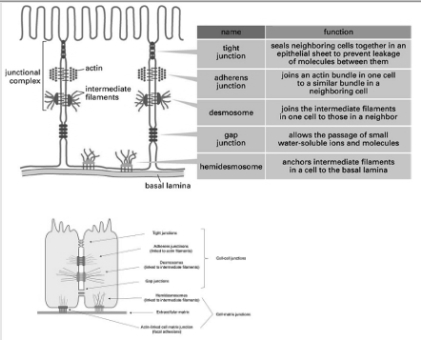
Which of the following statement$(s)$ regarding cell junctions is/are correct?
A
Tight junctions help to stop substances from leaking across a tissue.
B
Adhering junctions perform cementing to keep neighbouring cells together.
C
Gap junctions facilitate the cells to communicate with each other by connecting the cytoplasm of adjoining cells,for rapid transfer of ions,small molecules and sometimes big molecules.
D
All of the above
Solution
(D) cell junction is a specialized structure that provides contact between neighbouring cells or between a cell and the extracellular matrix in animal tissues.
$1$. Tight junctions: These junctions help to stop substances from leaking across a tissue.
$2$. Adhering junctions: These perform cementing to keep neighbouring cells together.
$3$. Gap junctions: These facilitate communication between cells by connecting the cytoplasm of adjoining cells,allowing for the rapid transfer of ions,small molecules,and sometimes big molecules.
Since all the given statements are correct,the correct option is $D$.
$1$. Tight junctions: These junctions help to stop substances from leaking across a tissue.
$2$. Adhering junctions: These perform cementing to keep neighbouring cells together.
$3$. Gap junctions: These facilitate communication between cells by connecting the cytoplasm of adjoining cells,allowing for the rapid transfer of ions,small molecules,and sometimes big molecules.
Since all the given statements are correct,the correct option is $D$.
0 likes
View Solution216
MediumMCQ
Read the following statements and answer the question.
$(i)$ It is made of a single thin layer of flattened cells with irregular boundaries.
$(ii)$ They are found in the walls of blood vessels and air sacs of lungs.
$(iii)$ They are involved in functions like forming a diffusion boundary.
Which of the following characteristics of tissue is being described by the above statements?
$(i)$ It is made of a single thin layer of flattened cells with irregular boundaries.
$(ii)$ They are found in the walls of blood vessels and air sacs of lungs.
$(iii)$ They are involved in functions like forming a diffusion boundary.
Which of the following characteristics of tissue is being described by the above statements?
A
Squamous epithelium
B
Columnar epithelium
C
Ciliated epithelium
D
Compound epithelium
Solution
(A) The statements describe the characteristics of simple squamous epithelium.
$1$. It consists of a single thin layer of flattened cells with irregular boundaries,which gives them a tile-like appearance.
$2$. These cells are found in the walls of blood vessels (endothelium) and air sacs (alveoli) of the lungs,where they facilitate the exchange of gases and nutrients.
$3$. Due to their thin structure,they are primarily involved in forming a diffusion boundary,allowing substances to pass through easily.
Therefore,the correct answer is $A$ (Squamous epithelium).
$1$. It consists of a single thin layer of flattened cells with irregular boundaries,which gives them a tile-like appearance.
$2$. These cells are found in the walls of blood vessels (endothelium) and air sacs (alveoli) of the lungs,where they facilitate the exchange of gases and nutrients.
$3$. Due to their thin structure,they are primarily involved in forming a diffusion boundary,allowing substances to pass through easily.
Therefore,the correct answer is $A$ (Squamous epithelium).
0 likes
View Solution217
MediumMCQ
Mark the correct option with respect to tissue,location,and its function.
A
| $A$. Reticular tissue | Spleen: Secretion |
B
| $B$. Brush bordered cuboidal epithelium | $PCT$: Reabsorption |
C
| $C$. Neurosensory epithelium | Taste buds and cornea: Conversion of electrical stimuli to chemical stimuli |
D
| $D$. Glandular epithelium | Lining of blood vessels: Handle blood pressure |
Solution
(B) The correct option is $B$.
$1$. Brush bordered cuboidal epithelium is found in the Proximal Convoluted Tubule $(PCT)$ of the nephron,where it significantly increases the surface area for the reabsorption of essential nutrients and water.
$2$. Reticular tissue in the spleen functions primarily in filtration and immune response,not secretion.
$3$. The cornea is composed of stratified squamous epithelium,not neurosensory epithelium.
$4$. The lining of blood vessels is composed of simple squamous epithelium (endothelium),not glandular epithelium.
$1$. Brush bordered cuboidal epithelium is found in the Proximal Convoluted Tubule $(PCT)$ of the nephron,where it significantly increases the surface area for the reabsorption of essential nutrients and water.
$2$. Reticular tissue in the spleen functions primarily in filtration and immune response,not secretion.
$3$. The cornea is composed of stratified squamous epithelium,not neurosensory epithelium.
$4$. The lining of blood vessels is composed of simple squamous epithelium (endothelium),not glandular epithelium.
0 likes
View Solution218
MediumMCQ
Presence of tissues in a multicellular organism ensures
A
Faster development
B
Division of labour
C
Higher reproductive potential
D
Body strength
Solution
(B) Tissue is a group of similar cells along with intercellular substances,which are specialized to perform a specific function.
Each tissue performs one or more functions of the body.
Thus,the body of a multicellular organism exhibits division of labour and contributes to the survival of the body as a whole.
Each tissue performs one or more functions of the body.
Thus,the body of a multicellular organism exhibits division of labour and contributes to the survival of the body as a whole.
0 likes
View Solution219
EasyMCQ
$A$ group of cells alike in form,function,and origin constitute a/an
A
Tissue
B
Organ
C
Organelle
D
Organ system
Solution
(A) group of cells that are similar in structure,perform a common function,and have a common embryonic origin is defined as a tissue. Tissues are the fundamental building blocks of organs in multicellular organisms.
0 likes
View Solution220
EasyMCQ
The tissue that covers the external and internal surfaces of parts of the body in animals is
A
Connective
B
Muscular
C
Nervous
D
Epithelial
Solution
(D) Epithelial tissue consists of a sheet of cells that covers the external surface of the body and lines the internal organs and cavities within the body. It acts as a protective barrier and is involved in absorption,secretion,and sensation.
0 likes
View Solution221
EasyMCQ
Cells of germinal epithelium are . . . . . . .
A
Cuboidal
B
Columnar
C
Ciliated
D
Squamous
Solution
(A) The germinal epithelium found in the ovary and seminiferous tubules is composed of cuboidal epithelial cells. These cells are responsible for the production of gametes.
0 likes
View Solution222
EasyMCQ
Cell junctions like tight,adhering,and gap junctions are mainly present between the neighbouring cells of
A
Neural tissue
B
Connective tissue
C
Muscular tissue
D
Epithelial tissue
Solution
(D) Epithelial cells are held together by specialized intercellular junctions,which serve as structural and functional links between adjacent cells.
These junctions are characteristic of epithelial tissues,providing mechanical strength,preventing leakage of substances,and facilitating communication between cells.
These junctions are characteristic of epithelial tissues,providing mechanical strength,preventing leakage of substances,and facilitating communication between cells.
0 likes
View Solution223
EasyMCQ
Pavement epithelium is an alternate name for
A
Squamous epithelium
B
Cuboidal epithelium
C
Columnar epithelium
D
Compound epithelium
Solution
(A) Simple squamous epithelium consists of a single thin layer of flattened cells with irregular boundaries. The cells are closely fitted like tiles in a floor. Therefore,these are also known as pavement epithelium.
0 likes
View Solution224
MediumMCQ
Match the following:
| Column-$I$ | Column-$II$ |
| $(a)$. Squamous epithelium | $(i)$ Lining of intestine |
| $(b)$. Cuboidal epithelium | $(ii)$ Ovary |
| $(c)$. Columnar epithelium | $(iii)$ Blood vessels |
| $(d)$. Ciliated epithelium | $(iv)$ Bronchioles |
A
$a(i), b(ii), c(iii), d(iv)$
B
$a(iii), b(ii), c(i), d(iv)$
C
$a(iii), b(iv), c(i), d(ii)$
D
$a(iv), b(ii), c(i), d(iii)$
Solution
(B) The correct matches are as follows:
$1$. Squamous epithelium: Found in the walls of blood vessels and air sacs of lungs $(a-iii)$.
$2$. Cuboidal epithelium: Found in the ducts of glands and tubular parts of nephrons in kidneys, as well as the germinal epithelium of the ovary $(b-ii)$.
$3$. Columnar epithelium: Found in the lining of the stomach and intestine $(c-i)$.
$4$. Ciliated epithelium: Found in the inner surface of hollow organs like bronchioles and fallopian tubes $(d-iv)$.
Therefore, the correct sequence is $a(iii), b(ii), c(i), d(iv)$.
$1$. Squamous epithelium: Found in the walls of blood vessels and air sacs of lungs $(a-iii)$.
$2$. Cuboidal epithelium: Found in the ducts of glands and tubular parts of nephrons in kidneys, as well as the germinal epithelium of the ovary $(b-ii)$.
$3$. Columnar epithelium: Found in the lining of the stomach and intestine $(c-i)$.
$4$. Ciliated epithelium: Found in the inner surface of hollow organs like bronchioles and fallopian tubes $(d-iv)$.
Therefore, the correct sequence is $a(iii), b(ii), c(i), d(iv)$.
0 likes
View Solution225
EasyMCQ
Brush-bordered columnar epithelial tissue is located in
A
Fallopian tube
B
Oesophagus
C
Trachea
D
Small intestine
Solution
(D) The intestinal epithelium possesses microvilli to increase the surface area for absorption.
This gives a brush-bordered appearance to the epithelium.
Hence,it is called brush-bordered columnar epithelium.
This gives a brush-bordered appearance to the epithelium.
Hence,it is called brush-bordered columnar epithelium.
0 likes
View Solution226
MediumMCQ
Which of the following is incorrect with respect to junctions and their functions?
A
Tight junction - Promotes leaking of substances across a tissue
B
Adhering junction - Keep neighbouring cells together
C
Gap junction - Connecting the cytoplasm of adjoining cells for rapid transfer of ions and small molecules
D
Gap junction - Facilitates the cells to communicate with each other
Solution
(A) Tight junctions are specialized structures that prevent the leakage of substances across a tissue. They are formed by the fusion of plasma membranes in the apical parts of adjacent epithelial cells. Therefore,the statement that tight junctions promote leaking is incorrect.
0 likes
View Solution227
MediumMCQ
$A$ : In non-keratinised stratified squamous epithelium,the stratum corneum is without keratin.
$R$ : Such epithelium occurs over surfaces which are not exposed to drying but are subject to abrasions.
$R$ : Such epithelium occurs over surfaces which are not exposed to drying but are subject to abrasions.
A
Assertion and Reason both are correct and Reason is the correct explanation of Assertion.
B
Assertion and Reason both are correct but Reason is not the correct explanation of Assertion.
C
Assertion is correct,but Reason is incorrect.
D
Both Assertion and Reason are incorrect.
Solution
(A) The Assertion is true because in non-keratinised stratified squamous epithelium,the superficial layers (stratum corneum) are devoid of the insoluble protein called keratin.
The Reason is also true because,due to the absence of keratin,this epithelium is found covering moist surfaces such as the buccal cavity,pharynx,and oesophagus,which are not exposed to drying but are frequently subjected to mechanical abrasions.
Therefore,both Assertion and Reason are true,and the Reason is the correct explanation of the Assertion.
The Reason is also true because,due to the absence of keratin,this epithelium is found covering moist surfaces such as the buccal cavity,pharynx,and oesophagus,which are not exposed to drying but are frequently subjected to mechanical abrasions.
Therefore,both Assertion and Reason are true,and the Reason is the correct explanation of the Assertion.
0 likes
View Solution228
MediumMCQ
$A$: Gap junctions connect the cytoplasm of adjoining cells.
$R$: Gap junctions facilitate the cells to communicate with each other.
$R$: Gap junctions facilitate the cells to communicate with each other.
A
Assertion and Reason both are correct and Reason is the correct explanation of Assertion.
B
Assertion and Reason both are correct but Reason is not the correct explanation of Assertion.
C
Assertion is correct,but Reason is incorrect.
D
Both Assertion and Reason are incorrect.
Solution
(A) Assertion is correct because gap junctions are specialized structures that connect the cytoplasm of adjoining cells,allowing for the passage of ions,small molecules,and sometimes big molecules.
Reason is also correct because these junctions facilitate communication between cells by enabling the rapid transfer of chemical and electrical signals.
However,the primary function of gap junctions is the facilitation of communication,and the structural connection is the mechanism by which this is achieved. In standard biological assessment contexts,the structural connection is considered the definition,and the communication is the functional outcome. Therefore,Reason is the correct explanation for Assertion.
Reason is also correct because these junctions facilitate communication between cells by enabling the rapid transfer of chemical and electrical signals.
However,the primary function of gap junctions is the facilitation of communication,and the structural connection is the mechanism by which this is achieved. In standard biological assessment contexts,the structural connection is considered the definition,and the communication is the functional outcome. Therefore,Reason is the correct explanation for Assertion.
0 likes
View Solution229
MediumMCQ
$A$: Intercellular material is minimum between the cells of epithelial tissue.
$R$: Epithelial cells are not secretory in nature.
$R$: Epithelial cells are not secretory in nature.
A
Assertion and Reason both are correct and Reason is the correct explanation of Assertion.
B
Assertion and Reason both are correct but Reason is not the correct explanation of Assertion.
C
Assertion is correct,but Reason is incorrect.
D
Both Assertion and Reason are incorrect.
Solution
(C) Assertion is true because epithelial tissue consists of cells that are compactly packed with very little intercellular matrix.
Reason is false because epithelial cells are often secretory in nature. They are responsible for secreting various substances,including the basal lamina (basement membrane) and various enzymes or hormones in glandular epithelium.
Therefore,the Assertion is true,but the Reason is false.
Reason is false because epithelial cells are often secretory in nature. They are responsible for secreting various substances,including the basal lamina (basement membrane) and various enzymes or hormones in glandular epithelium.
Therefore,the Assertion is true,but the Reason is false.
0 likes
View Solution230
MediumMCQ
$A$: The inner lining of trachea,bronchi,and fallopian tubes has simple epithelium with non-motile cilia.
$R$: Cilia form the brush-border.
$R$: Cilia form the brush-border.
A
Assertion and Reason both are correct and Reason is the correct explanation of Assertion.
B
Assertion and Reason both are correct but Reason is not the correct explanation of Assertion.
C
Assertion is correct,but Reason is incorrect.
D
Both Assertion and Reason are incorrect.
Solution
(D) The Assertion is false because the inner lining of hollow organs like the trachea,bronchi,and fallopian tubes consists of ciliated columnar epithelium,which possesses motile cilia,not non-motile cilia.
The Reason is also false because the brush-border epithelium is formed by microvilli,which are cytoplasmic extensions found on the surface of cells in the intestinal mucosa,not by cilia.
Therefore,both the Assertion and the Reason are incorrect.
The Reason is also false because the brush-border epithelium is formed by microvilli,which are cytoplasmic extensions found on the surface of cells in the intestinal mucosa,not by cilia.
Therefore,both the Assertion and the Reason are incorrect.
0 likes
View Solution231
EasyMCQ
The walls of capillaries are composed of endothelium,which is:
A
Cuboidal epithelium
B
Squamous epithelium
C
Columnar epithelium
D
Stratified epithelium
Solution
(B) The walls of capillaries are composed of a single layer of cells known as simple squamous epithelium or endothelium. This thin structure is essential as it facilitates the rapid exchange of gases,nutrients,and waste products between the blood and the surrounding tissues.
0 likes
View Solution232
MediumMCQ
The rupture of the urinary bladder is prevented by
A
Pseudostratified epithelium
B
Stratified columnar epithelium
C
Stratified cuboidal epithelium
D
Transitional epithelium
Solution
(D) Transitional epithelium is found in organs that undergo a great degree of distension or expansion,such as the urinary bladder and ureters.
It appears stratified with $4$ to $6$ layers of cells.
This epithelium prevents the rupture of the urinary bladder by allowing it to stretch and accommodate varying volumes of urine.
It is a specialized type of epithelium also known as urothelium.
It appears stratified with $4$ to $6$ layers of cells.
This epithelium prevents the rupture of the urinary bladder by allowing it to stretch and accommodate varying volumes of urine.
It is a specialized type of epithelium also known as urothelium.
0 likes
View Solution233
MediumMCQ
Identify the types of cell junctions that help to stop the leakage of the substances across a tissue and facilitation of communication with neighbouring cells via rapid transfer of ions and molecules.
A
Gap junctions and Adhering junctions,respectively.
B
Tight junctions and Gap junctions,respectively.
C
Adhering junctions and Tight junctions,respectively.
D
Adhering junctions and Gap junctions,respectively.
Solution
(B) $1$. Tight junctions: These junctions help to stop the leakage of substances across a tissue by forming a seal between adjacent cells.
$2$. Adhering junctions: These perform cementing to keep neighbouring cells together.
$3$. Gap junctions: These facilitate communication between neighbouring cells by connecting the cytoplasm of adjoining cells,allowing for the rapid transfer of ions,small molecules,and sometimes big molecules.
Therefore,the correct sequence is Tight junctions and Gap junctions.
$2$. Adhering junctions: These perform cementing to keep neighbouring cells together.
$3$. Gap junctions: These facilitate communication between neighbouring cells by connecting the cytoplasm of adjoining cells,allowing for the rapid transfer of ions,small molecules,and sometimes big molecules.
Therefore,the correct sequence is Tight junctions and Gap junctions.
0 likes
View Solution234
MediumMCQ
$A$ group of cells is called $...........$.
A
Tissue
B
Organ
C
Organ system
D
Complex body
Solution
(A) In biological organization,a group of cells that are similar in structure and perform a common function is known as a tissue.
Cells are the fundamental unit of life.
When similar cells aggregate to perform a specific function,they form a tissue.
Multiple tissues organize to form an organ,and multiple organs work together to form an organ system.
Cells are the fundamental unit of life.
When similar cells aggregate to perform a specific function,they form a tissue.
Multiple tissues organize to form an organ,and multiple organs work together to form an organ system.
0 likes
View Solution235
MediumMCQ
Select the incorrect statement regarding epithelial tissue.
A
Epithelial tissue is commonly referred to as epithelium.
B
Epithelial tissue has a free surface,which faces either a body fluid or the outside environment.
C
It provides a covering or a lining for some parts of the body.
D
It consists of loosely packed cells with a large amount of intercellular space.
Solution
(D) Epithelial tissue is characterized by cells that are very compactly packed with little intercellular matrix. Option $D$ states that it has loosely packed cells with a large amount of intercellular space,which is a characteristic of connective tissue,not epithelial tissue. Therefore,statement $D$ is incorrect.
0 likes
View Solution236
MediumMCQ
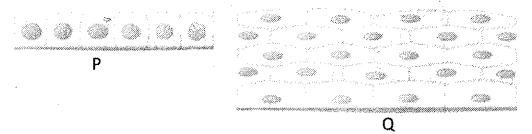
Identify the epithelial tissues given in the figure below.
A
Simple epithelium $\quad\quad$ Compound epithelium
B
Compound epithelium $\quad\quad$ Simple epithelium
C
Loose epithelium $\quad\quad$ Dense epithelium
D
Dense epithelium $\quad\quad$ Loose epithelium
Solution
(A) In the given figure,$P$ represents a single layer of cells resting on a basement membrane,which is characteristic of a Simple epithelium.
$Q$ represents multiple layers of cells,which is characteristic of a Compound epithelium.
Therefore,$P$ is a Simple epithelium and $Q$ is a Compound epithelium.
$Q$ represents multiple layers of cells,which is characteristic of a Compound epithelium.
Therefore,$P$ is a Simple epithelium and $Q$ is a Compound epithelium.
0 likes
View Solution237
MediumMCQ
The lining of body cavities,ducts,and tubes is made up of $.....$.
A
Simple epithelium
B
Compound epithelium
C
Loose epithelium
D
Dense epithelium
Solution
(A) The epithelial tissue is classified into two types based on the number of cell layers: $1$. Simple epithelium and $2$. Compound epithelium.
Simple epithelium is composed of a single layer of cells and functions as a lining for body cavities,ducts,and tubes.
Compound epithelium consists of two or more cell layers and has a protective function against chemical and mechanical stresses.
Therefore,the lining of body cavities,ducts,and tubes is made up of simple epithelium.
Simple epithelium is composed of a single layer of cells and functions as a lining for body cavities,ducts,and tubes.
Compound epithelium consists of two or more cell layers and has a protective function against chemical and mechanical stresses.
Therefore,the lining of body cavities,ducts,and tubes is made up of simple epithelium.
0 likes
View Solution238
MediumMCQ
Which protective tissue is present in our skin?
A
Simple epithelium
B
Compound epithelium
C
Loose epithelium
D
Dense epithelium
Solution
(B) The skin is covered by a compound epithelium,specifically a stratified squamous epithelium.
Unlike simple epithelium,which consists of a single layer of cells,the compound epithelium is made up of two or more layers of cells.
Its primary function is to provide protection against chemical and mechanical stresses,making it ideal for the skin surface.
Unlike simple epithelium,which consists of a single layer of cells,the compound epithelium is made up of two or more layers of cells.
Its primary function is to provide protection against chemical and mechanical stresses,making it ideal for the skin surface.
0 likes
View Solution239
EasyMCQ
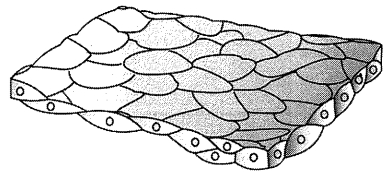
Which of the following statements are correct for the tissue shown in the image?
$I$ - Flattened cells with irregular boundaries
$II$ - Secretory cells
$III$ - Single-layered
$IV$ - Found in the walls of blood vessels and air sacs of lungs
$V$ - Functions as a diffusion boundary
$I$ - Flattened cells with irregular boundaries
$II$ - Secretory cells
$III$ - Single-layered
$IV$ - Found in the walls of blood vessels and air sacs of lungs
$V$ - Functions as a diffusion boundary
A
$I, II, IV$
B
$I, II, IV, V$
C
$I, II, III, IV, V$
D
$I, III, IV, V$
Solution
(D) The image shows Simple Squamous Epithelium.
$I$ - It consists of a single thin layer of flattened cells with irregular boundaries. This is correct.
$II$ - It is not primarily a secretory tissue; glandular epithelium is secretory. This is incorrect.
$III$ - It is a single-layered tissue. This is correct.
$IV$ - It is found in the walls of blood vessels and air sacs of lungs (alveoli). This is correct.
$V$ - It functions as a diffusion boundary,facilitating the exchange of gases and nutrients. This is correct.
Therefore,statements $I, III, IV,$ and $V$ are correct.
$I$ - It consists of a single thin layer of flattened cells with irregular boundaries. This is correct.
$II$ - It is not primarily a secretory tissue; glandular epithelium is secretory. This is incorrect.
$III$ - It is a single-layered tissue. This is correct.
$IV$ - It is found in the walls of blood vessels and air sacs of lungs (alveoli). This is correct.
$V$ - It functions as a diffusion boundary,facilitating the exchange of gases and nutrients. This is correct.
Therefore,statements $I, III, IV,$ and $V$ are correct.
0 likes
View Solution240
MediumMCQ
Which of the following statements are correct regarding the given tissue?
$I -$ Single layer of cuboidal cells.
$II -$ Found in ducts of glands and tubular parts of nephrons in kidneys.
$III -$ Main function is secretion and absorption.
$IV -$ The epithelium of the proximal convoluted tubule $(PCT)$ in the nephron has microvilli.
$I -$ Single layer of cuboidal cells.
$II -$ Found in ducts of glands and tubular parts of nephrons in kidneys.
$III -$ Main function is secretion and absorption.
$IV -$ The epithelium of the proximal convoluted tubule $(PCT)$ in the nephron has microvilli.
A
$I, II, III, IV$
B
$I, II, III$
C
$I, III, IV$
D
$II, III, IV$
Solution
(B) The tissue described is cuboidal epithelium.
Statement $I$ is correct: It consists of a single layer of cube-like cells.
Statement $II$ is correct: It is commonly found in the ducts of glands and the tubular parts of nephrons in the kidneys.
Statement $III$ is correct: The primary functions of cuboidal epithelium are secretion and absorption.
Statement $IV$ is incorrect: The epithelium of the proximal convoluted tubule $(PCT)$ in the nephron has microvilli,not cilia. Cilia are found in ciliated epithelium,whereas microvilli are characteristic of the $PCT$ to increase the surface area for absorption.
Therefore,statements $I, II,$ and $III$ are correct.
Statement $I$ is correct: It consists of a single layer of cube-like cells.
Statement $II$ is correct: It is commonly found in the ducts of glands and the tubular parts of nephrons in the kidneys.
Statement $III$ is correct: The primary functions of cuboidal epithelium are secretion and absorption.
Statement $IV$ is incorrect: The epithelium of the proximal convoluted tubule $(PCT)$ in the nephron has microvilli,not cilia. Cilia are found in ciliated epithelium,whereas microvilli are characteristic of the $PCT$ to increase the surface area for absorption.
Therefore,statements $I, II,$ and $III$ are correct.
0 likes
View Solution241
MediumMCQ
Identify the location of columnar epithelial tissue.
A
Inner lining of the stomach and intestine
B
Outer surface of the stomach and intestine
C
Alveoli of the lungs
D
Proximal convoluted tubule of the nephron
Solution
(A) Columnar epithelial tissue is composed of a single layer of tall and slender cells. Their nuclei are located at the base. This tissue is primarily found in the inner lining of the stomach and intestine,where it helps in secretion and absorption. Therefore,the correct option is $A$.
0 likes
View Solution242
MediumMCQ
Which of the following is incorrect regarding ciliated epithelium?
A
The free surface of squamous or columnar cells bears cilia.
B
They move particles or mucus in a specific direction.
C
They are found on the inner surface of hollow organs like bronchioles and fallopian tubes.
D
None of the above.
Solution
(D) Ciliated epithelium consists of cells that have cilia on their free surface.
These cilia are hair-like projections that beat to move particles or mucus in a specific direction over the epithelial surface.
They are primarily located in the inner lining of hollow organs such as the bronchioles (in the respiratory tract) and the fallopian tubes (in the female reproductive tract).
Since all the statements $A$,$B$,and $C$ are correct descriptions of ciliated epithelium,the correct answer is $D$.
These cilia are hair-like projections that beat to move particles or mucus in a specific direction over the epithelial surface.
They are primarily located in the inner lining of hollow organs such as the bronchioles (in the respiratory tract) and the fallopian tubes (in the female reproductive tract).
Since all the statements $A$,$B$,and $C$ are correct descriptions of ciliated epithelium,the correct answer is $D$.
0 likes
View Solution243
MediumMCQ
Where is the given type of glandular epithelium found?
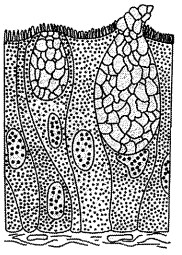
A
Goblet cells of the alimentary canal
B
Salivary gland
C
Mammary gland
D
Sweat gland
Solution
(A) The provided image shows unicellular glandular epithelium,which consists of isolated glandular cells. These cells are specialized for the secretion of mucus. $A$ classic example of unicellular glandular epithelium is the goblet cells found in the lining of the alimentary canal. In contrast,salivary,mammary,and sweat glands are examples of multicellular glandular epithelium.
0 likes
View Solution244
MediumMCQ
Select the correct option for the given glandular epithelium.
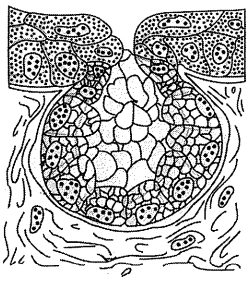
A
Glandular epithelium type = Unicellular
Location = Goblet cells of the alimentary canal
Location = Goblet cells of the alimentary canal
B
Glandular epithelium type = Multicellular
Location = Goblet cells of the alimentary canal
Location = Goblet cells of the alimentary canal
C
Glandular epithelium type = Unicellular
Location = Salivary gland
Location = Salivary gland
D
Glandular epithelium type = Multicellular
Location = Salivary gland
Location = Salivary gland
Solution
(D) The provided image shows a cluster of cells forming a gland.
Since it consists of a group of cells (multicellular) rather than a single isolated cell,it represents a multicellular glandular epithelium.
Unicellular glands,such as goblet cells of the alimentary canal,consist of isolated glandular cells.
Multicellular glands,such as the salivary gland,consist of a cluster of cells.
Therefore,the correct option is multicellular glandular epithelium found in the salivary gland.
Since it consists of a group of cells (multicellular) rather than a single isolated cell,it represents a multicellular glandular epithelium.
Unicellular glands,such as goblet cells of the alimentary canal,consist of isolated glandular cells.
Multicellular glands,such as the salivary gland,consist of a cluster of cells.
Therefore,the correct option is multicellular glandular epithelium found in the salivary gland.
0 likes
View Solution245
MediumMCQ
Identify the location of the tissue shown in the figure.
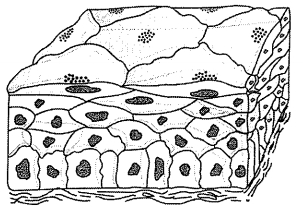
A
Dry surface of the skin
B
Moist surface of the buccal cavity and pharynx
C
Inner lining of salivary glands and pancreatic ducts
D
All of the above
Solution
(A) The figure shows a stratified squamous epithelium.
This tissue is characterized by multiple layers of cells,where the cells of the basal layer are cuboidal or columnar and become flattened towards the surface.
It is primarily protective in function.
It is found in the dry surface of the skin (keratinized) and the moist surface of the buccal cavity and pharynx (non-keratinized).
Option $C$ refers to simple cuboidal epithelium,which is different from the tissue shown.
Therefore,both $A$ and $B$ are correct locations for stratified squamous epithelium,but since $C$ is incorrect,the question implies identifying the tissue type correctly. However,given the options,the most appropriate answer is that the tissue shown is stratified squamous epithelium,which is found in both $A$ and $B$.
This tissue is characterized by multiple layers of cells,where the cells of the basal layer are cuboidal or columnar and become flattened towards the surface.
It is primarily protective in function.
It is found in the dry surface of the skin (keratinized) and the moist surface of the buccal cavity and pharynx (non-keratinized).
Option $C$ refers to simple cuboidal epithelium,which is different from the tissue shown.
Therefore,both $A$ and $B$ are correct locations for stratified squamous epithelium,but since $C$ is incorrect,the question implies identifying the tissue type correctly. However,given the options,the most appropriate answer is that the tissue shown is stratified squamous epithelium,which is found in both $A$ and $B$.
0 likes
View Solution246
MediumMCQ
Match the following columns:
| Column-$I$ | Column-$II$ |
|---|---|
| $P$. Tight junctions | $I$. Stop substances from leaking across a tissue |
| $Q$. Adhering junctions | $II$. Perform cementing to keep neighbouring cells together |
| $R$. Gap junctions | $III$. Facilitate the cells to communicate with each other by connecting the cytoplasm of adjoining cells,for rapid transfer of ions,small molecules and sometimes big molecules |
A
$(P-I), (Q-II), (R-III)$
B
$(P-I), (Q-III), (R-II)$
C
$(P-II), (Q-II), (R-I)$
D
$(P-III), (Q-II), (R-I)$
Solution
(A) The correct matching is as follows:
$1$. Tight junctions $(P-I)$: These junctions help to stop substances from leaking across a tissue.
$2$. Adhering junctions $(Q-II)$: These perform cementing to keep neighbouring cells together.
$3$. Gap junctions $(R-III)$: These facilitate the cells to communicate with each other by connecting the cytoplasm of adjoining cells,for rapid transfer of ions,small molecules and sometimes big molecules.
Therefore,the correct sequence is $(P-I), (Q-II), (R-III)$.
$1$. Tight junctions $(P-I)$: These junctions help to stop substances from leaking across a tissue.
$2$. Adhering junctions $(Q-II)$: These perform cementing to keep neighbouring cells together.
$3$. Gap junctions $(R-III)$: These facilitate the cells to communicate with each other by connecting the cytoplasm of adjoining cells,for rapid transfer of ions,small molecules and sometimes big molecules.
Therefore,the correct sequence is $(P-I), (Q-II), (R-III)$.
0 likes
View Solution247
EasyMCQ
What is a melanocyte?
A
Endocrine gland
B
Protein
C
Cell
D
Enzyme
Solution
(C) melanocyte is a specialized cell found in the skin,eyes,and hair follicles. Its primary function is to produce melanin,a pigment that provides color to these tissues and protects them from ultraviolet $(UV)$ radiation. Therefore,it is classified as a cell.
0 likes
View Solution248
EasyMCQ
Which of the following types of epithelium is present in the bronchioles and Fallopian tubes?
A
Simple squamous epithelium
B
Simple columnar epithelium
C
Ciliated epithelium
D
Stratified squamous epithelium
Solution
(C) The epithelium present in the bronchioles and Fallopian tubes is the ciliated epithelium.
Ciliated epithelium consists of cells that have hair-like projections called cilia on their free surface.
These cilia move particles or mucus in a specific direction over the epithelial surface.
In the Fallopian tubes,the cilia help in the movement of the ovum towards the uterus.
In the bronchioles,the cilia help in moving mucus and trapped dust particles out of the respiratory tract.
Ciliated epithelium consists of cells that have hair-like projections called cilia on their free surface.
These cilia move particles or mucus in a specific direction over the epithelial surface.
In the Fallopian tubes,the cilia help in the movement of the ovum towards the uterus.
In the bronchioles,the cilia help in moving mucus and trapped dust particles out of the respiratory tract.
0 likes
View Solution249
MediumMCQ
Match List-$I$ with List-$II$.
Choose the correct answer from the options given below:
| List-$I$ | List-$II$ |
|---|---|
| $A$. Mast cells | $I$. Ciliated epithelium |
| $B$. Inner surface of bronchiole | $II$. Areolar connective tissue |
| $C$. Blood | $III$. Cuboidal epithelium |
| $D$. Tubular parts of nephron | $IV$. Specialised connective tissue |
Choose the correct answer from the options given below:
A
$A-III, B-IV, C-II, D-I$
B
$A-I, B-II, C-IV, D-III$
C
$A-II, B-III, C-I, D-IV$
D
$A-II, B-I, C-IV, D-III$
Solution
(D) The correct answer is $D$ $(A-II, B-I, C-IV, D-III)$.
- Mast cells are found in the areolar connective tissue,which also contains fibroblasts and macrophages.
- The inner surface of bronchioles is lined by ciliated epithelium,which helps in moving mucus and particles.
- Blood is classified as a specialised connective tissue because it consists of a fluid matrix (plasma) and formed elements.
- The tubular parts of the nephron (such as the proximal convoluted tubule) are lined by cuboidal epithelium,which is involved in absorption and secretion.
- Mast cells are found in the areolar connective tissue,which also contains fibroblasts and macrophages.
- The inner surface of bronchioles is lined by ciliated epithelium,which helps in moving mucus and particles.
- Blood is classified as a specialised connective tissue because it consists of a fluid matrix (plasma) and formed elements.
- The tubular parts of the nephron (such as the proximal convoluted tubule) are lined by cuboidal epithelium,which is involved in absorption and secretion.
0 likes
View Solution250
MediumMCQ
Match List $I$ with List $II$:
Choose the correct answer from the options given below:
| List $I$ | List $II$ |
| $A$. Unicellular glandular epithelium | $I$. Salivary glands |
| $B$. Compound epithelium | $II$. Pancreas |
| $C$. Multicellular glandular epithelium | $III$. Goblet cells of alimentary canal |
| $D$. Endocrine glandular epithelium | $IV$. Moist surface of buccal cavity |
Choose the correct answer from the options given below:
A
$A-IV, B-III, C-I, D-II$
B
$A-III, B-IV, C-I, D-II$
C
$A-II, B-I, C-IV, D-III$
D
$A-II, B-I, C-III, D-IV$
Solution
(B) The correct matching is as follows:
$A$. Unicellular glandular epithelium: These consist of isolated glandular cells, such as the $III$. Goblet cells of the alimentary canal.
$B$. Compound epithelium: This is made of more than one layer of cells and has a limited role in secretion and absorption. It provides protection against chemical and mechanical stresses, such as the $IV$. Moist surface of the buccal cavity.
$C$. Multicellular glandular epithelium: These consist of a cluster of cells, such as the $I$. Salivary glands.
$D$. Endocrine glandular epithelium: These are ductless glands that secrete hormones directly into the fluid bathing the gland, such as the $II$. Pancreas (which has both exocrine and endocrine functions).
Therefore, the correct sequence is $A-III, B-IV, C-I, D-II$, which corresponds to option $B$.
$A$. Unicellular glandular epithelium: These consist of isolated glandular cells, such as the $III$. Goblet cells of the alimentary canal.
$B$. Compound epithelium: This is made of more than one layer of cells and has a limited role in secretion and absorption. It provides protection against chemical and mechanical stresses, such as the $IV$. Moist surface of the buccal cavity.
$C$. Multicellular glandular epithelium: These consist of a cluster of cells, such as the $I$. Salivary glands.
$D$. Endocrine glandular epithelium: These are ductless glands that secrete hormones directly into the fluid bathing the gland, such as the $II$. Pancreas (which has both exocrine and endocrine functions).
Therefore, the correct sequence is $A-III, B-IV, C-I, D-II$, which corresponds to option $B$.
0 likes
View SolutionStructural Organisation In Animals — Epithelial tissue · Frequently Asked Questions
1Are these Structural Organisation In Animals questions useful for JEE and NEET?
Yes. All questions in this section are mapped to JEE Main and NEET exam patterns. Previous year questions from JEE Main, NEET, GUJCET and state-level exams are included with full solutions.
2Can I switch to Hindi or Gujarati for these questions?
Yes. Use the language tabs in the hero section or the sidebar to view the same questions and solutions in English, Hindi or Gujarati.
3How do I generate a question paper from this subtopic?
Use the Vedclass Exam Paper Generator — select the chapter and subtopic, set difficulty, and generate Sets A, B, C, D automatically. First 3 chapters of every subject are free.
Vedclass Products
For Students
Vedclass Test Series
Mock tests in real JEE/NEET style with performance analysis. 5-day free trial.
Start Free TrialFor Teachers
Exam Paper Generator
Generate Set A/B/C/D papers from this chapter in 2 minutes. 3 chapters free.
Try FreeFor Institutes
Online Exam Module
Live online exams with unlimited students, 360° analytics & white-label branding.
See DemoFor Teachers & Institutes
Generate a Structural Organisation In Animals Exam Paper in 2 Minutes
Select subtopic & difficulty — Sets A, B, C, D auto-generated with No Repeat logic.
First 3 chapters of every subject are free — no payment required.