
A English
Epithelial tissue Questions in English
Class 11 Biology · Structural Organisation In Animals · Epithelial tissue
263+
Questions
English
Language
100%
With Solutions
Showing 50 of 263 questions in English
151
MediumMCQ
The tissue that has a free surface,which may contain either cilia or microvilli,is:
A
Neural tissue
B
Muscular tissue
C
Connective tissue
D
Epithelial tissue
Solution
(D) Epithelial tissue is characterized by having a free surface,which faces either a body fluid or the outside environment.
This tissue provides a covering or a lining for some part of the body.
Specialized modifications of the plasma membrane on the free surface,such as cilia (for moving particles or mucus) or microvilli (for increasing surface area for absorption),are commonly found in epithelial cells.
Neural,muscular,and connective tissues do not possess a free surface as their primary structural characteristic.
This tissue provides a covering or a lining for some part of the body.
Specialized modifications of the plasma membrane on the free surface,such as cilia (for moving particles or mucus) or microvilli (for increasing surface area for absorption),are commonly found in epithelial cells.
Neural,muscular,and connective tissues do not possess a free surface as their primary structural characteristic.
0 likes
View Solution152
MediumMCQ
Which type of cells are found in the walls of blood vessels and air sacs of lungs?
A
Squamous
B
Cuboidal
C
Columnar
D
Connective
Solution
(A) The walls of blood vessels and the air sacs (alveoli) of the lungs are lined by a single thin layer of flattened cells with irregular boundaries. This type of epithelium is known as $Squamous$ epithelium. It is primarily involved in functions like forming a diffusion boundary.
0 likes
View Solution153
MediumMCQ
Choose the correct sentences for compound epithelium:
$(I)$ Compound epithelium is made of multi-layered cells.
$(II)$ It has a limited role in secretion and absorption.
$(III)$ It provides protection against chemical and mechanical stresses.
$(IV)$ It is present in $PCT$.
$(I)$ Compound epithelium is made of multi-layered cells.
$(II)$ It has a limited role in secretion and absorption.
$(III)$ It provides protection against chemical and mechanical stresses.
$(IV)$ It is present in $PCT$.
A
Only $I$
B
$I$ and $II$
C
$I, II$ and $III$
D
$I, II$ and $IV$
Solution
$(C)$ Compound epithelium is composed of more than one layer of cells (multi-layered), which makes statement $(I)$ correct.
Due to its multi-layered structure, it has a limited role in secretion and absorption compared to simple epithelium, making statement $(II)$ correct.
The primary function of compound epithelium is to provide protection against chemical and mechanical stresses, making statement $(III)$ correct.
Statement $(IV)$ is incorrect because $PCT$ (Proximal Convoluted Tubule) is lined by simple cuboidal brush-bordered epithelium, not compound epithelium.
Therefore, statements $(I, II, \text{and } III)$ are correct.
Due to its multi-layered structure, it has a limited role in secretion and absorption compared to simple epithelium, making statement $(II)$ correct.
The primary function of compound epithelium is to provide protection against chemical and mechanical stresses, making statement $(III)$ correct.
Statement $(IV)$ is incorrect because $PCT$ (Proximal Convoluted Tubule) is lined by simple cuboidal brush-bordered epithelium, not compound epithelium.
Therefore, statements $(I, II, \text{and } III)$ are correct.
0 likes
View Solution154
MediumMCQ
What is the function of a gap junction?
A
To stop substances from leaking across a tissue.
B
To facilitate communication between cells by connecting the cytoplasm of adjoining cells for the rapid transfer of ions,small molecules,and sometimes big molecules.
C
To perform the function of keeping neighbouring cells together.
D
None of the above.
Solution
(B) Gap junctions are specialized intercellular connections that directly connect the cytoplasm of two cells.
This allows for the rapid transfer of ions,small molecules,and sometimes large molecules between adjacent cells.
They play a crucial role in cell-to-cell communication,allowing tissues to function as a coordinated unit.
Option $A$ describes tight junctions,which prevent leakage.
Option $C$ describes adhering junctions,which cement cells together.
This allows for the rapid transfer of ions,small molecules,and sometimes large molecules between adjacent cells.
They play a crucial role in cell-to-cell communication,allowing tissues to function as a coordinated unit.
Option $A$ describes tight junctions,which prevent leakage.
Option $C$ describes adhering junctions,which cement cells together.
0 likes
View Solution155
MediumMCQ
Match the correct pair:
| $P$. Cartilage | $1$. $PCT$ |
| $Q$. Cuboidal epithelium | $2$. Bronchioles |
| $R$. Compound epithelium | $3$. Limbs |
| $S$. Ciliated epithelium | $4$. Pharynx |
| $5$. Muscles of eyes |
A
$P-3, Q-1, R-5, S-2$
B
$P-3, Q-1, R-4, S-2$
C
$P-3, Q-5, R-4, S-2$
D
$P-4, Q-5, R-2, S-1$
Solution
(B) The correct matches are as follows:
$1$. $P$ (Cartilage) is found in the limbs (e.g.,hyaline cartilage in long bones).
$2$. $Q$ (Cuboidal epithelium) is found in the $PCT$ (Proximal Convoluted Tubule) of the nephron.
$3$. $R$ (Compound epithelium) provides protection against chemical and mechanical stresses and is found in the pharynx.
$4$. $S$ (Ciliated epithelium) is found in the bronchioles to move mucus.
Therefore,the correct sequence is $P-3, Q-1, R-4, S-2$.
$1$. $P$ (Cartilage) is found in the limbs (e.g.,hyaline cartilage in long bones).
$2$. $Q$ (Cuboidal epithelium) is found in the $PCT$ (Proximal Convoluted Tubule) of the nephron.
$3$. $R$ (Compound epithelium) provides protection against chemical and mechanical stresses and is found in the pharynx.
$4$. $S$ (Ciliated epithelium) is found in the bronchioles to move mucus.
Therefore,the correct sequence is $P-3, Q-1, R-4, S-2$.
0 likes
View Solution156
MediumMCQ
Select the incorrect option for compound epithelium.
A
It is made of more than one layer of cells.
B
Main function is to provide protection against chemical and mechanical stress.
C
Cover the dry surface of skin.
D
Cells secrete modified polysaccharides.
Solution
(D) Compound epithelium is made of more than one layer (multi-layered) of cells and thus has a limited role in secretion and absorption.
Its main function is to provide protection against chemical and mechanical stresses.
It covers the dry surface of the skin,the moist surface of the buccal cavity,pharynx,inner lining of ducts of salivary glands,and of pancreatic ducts.
Option $D$ is incorrect because the secretion of substances like modified polysaccharides is primarily a characteristic of glandular epithelium,not compound epithelium.
Its main function is to provide protection against chemical and mechanical stresses.
It covers the dry surface of the skin,the moist surface of the buccal cavity,pharynx,inner lining of ducts of salivary glands,and of pancreatic ducts.
Option $D$ is incorrect because the secretion of substances like modified polysaccharides is primarily a characteristic of glandular epithelium,not compound epithelium.
0 likes
View Solution157
MediumMCQ
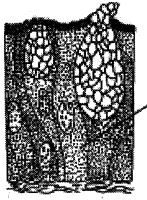
Identify the following figure:
A
Compound epithelium
B
Areolar tissue
C
Adipose tissue
D
Glandular epithelium
Solution
(D) The provided figure shows specialized epithelial cells that are modified for secretion.
These cells are organized into structures that resemble glands,specifically goblet cells within an epithelial layer.
This type of tissue is classified as glandular epithelium,which is responsible for the secretion of substances like mucus.
Therefore,the correct identification is glandular epithelium.
These cells are organized into structures that resemble glands,specifically goblet cells within an epithelial layer.
This type of tissue is classified as glandular epithelium,which is responsible for the secretion of substances like mucus.
Therefore,the correct identification is glandular epithelium.
0 likes
View Solution158
MediumMCQ
Which of the following is not a function of epithelium?
A
Protection
B
Connection
C
Secretion or excretion
D
Absorption
Solution
(B) The primary functions of epithelial tissue include protection,secretion,excretion,absorption,and sensory reception.
Connection is the primary function of connective tissue,which binds,supports,and protects other tissues and organs in the body.
Therefore,connection is not a function of epithelial tissue.
Connection is the primary function of connective tissue,which binds,supports,and protects other tissues and organs in the body.
Therefore,connection is not a function of epithelial tissue.
0 likes
View Solution159
MediumMCQ
Tissue is defined as:
A
a group of similar cells associated by intercellular substances which perform a specific function
B
a single cell with specified functions
C
composed of a single layer with cube-like cells
D
a group of cells which perform dissimilar functions
Solution
(A) tissue is defined as a group of cells along with their intercellular substances that perform a specific function.
In multicellular organisms,cells are organized into tissues to perform complex tasks efficiently.
Option $A$ correctly describes this biological definition.
Option $B$ is incorrect because a tissue is a group of cells,not a single cell.
Option $C$ describes a specific type of epithelium (simple cuboidal),not the general definition of a tissue.
Option $D$ is incorrect because cells in a tissue typically perform a common or coordinated function.
In multicellular organisms,cells are organized into tissues to perform complex tasks efficiently.
Option $A$ correctly describes this biological definition.
Option $B$ is incorrect because a tissue is a group of cells,not a single cell.
Option $C$ describes a specific type of epithelium (simple cuboidal),not the general definition of a tissue.
Option $D$ is incorrect because cells in a tissue typically perform a common or coordinated function.
0 likes
View Solution160
EasyMCQ
Epithelial cells that are thin,flat,and look like tiles are found in ..........
A
Inner lining of the cheek
B
Inner lining of the stomach
C
Inner lining of the fallopian tube
D
Inner lining of the ovary
Solution
(A) The epithelial cells described as thin,flat,and tile-like are known as $Squamous$ $Epithelium$.
These cells are found in the walls of blood vessels and air sacs of lungs,and they also form the inner lining of the cheek (buccal cavity).
Therefore,the correct option is $A$.
These cells are found in the walls of blood vessels and air sacs of lungs,and they also form the inner lining of the cheek (buccal cavity).
Therefore,the correct option is $A$.
0 likes
View Solution161
MediumMCQ
The basement membrane is composed of ........
A
Only epithelial cells
B
Only endothelial cells
C
Both $(a)$ and $(b)$
D
No cells,but it is a product of epithelial cells
Solution
(D) The basement membrane is a thin,fibrous,extracellular matrix of tissue that separates the lining of an internal or external body surface from underlying connective tissue.
It is not composed of cells itself.
Instead,it is a specialized extracellular matrix secreted by the epithelial cells (basal lamina) and the underlying connective tissue cells (reticular lamina).
Therefore,it is a product of epithelial cells and connective tissue cells,rather than being composed of the cells themselves.
It is not composed of cells itself.
Instead,it is a specialized extracellular matrix secreted by the epithelial cells (basal lamina) and the underlying connective tissue cells (reticular lamina).
Therefore,it is a product of epithelial cells and connective tissue cells,rather than being composed of the cells themselves.
0 likes
View Solution162
EasyMCQ
The germinal epithelium is an example of which type of epithelium?
A
Cuboidal
B
Ciliated
C
Columnar
D
Squamous
Solution
(A) The germinal epithelium is the layer of cells that lines the gonads (testes and ovaries) and is responsible for the production of gametes.
It is composed of a single layer of cuboidal epithelial cells.
Therefore,the germinal epithelium is a specialized form of cuboidal epithelium.
It is composed of a single layer of cuboidal epithelial cells.
Therefore,the germinal epithelium is a specialized form of cuboidal epithelium.
0 likes
View Solution163
MediumMCQ
The cells of simple epithelial tissue are . . . . . . .
A
Hardened to provide support to organs.
B
Directly cemented to each other to form a single layer.
C
Continuously dividing to form organs.
D
Loosely connected to each other to form irregular organs.
Solution
(B) Simple epithelial tissue is composed of a single layer of cells that are directly cemented to each other. These cells rest on a basement membrane and function as a lining for body cavities,ducts,and tubes. Because they form a single,continuous layer,they are specialized for absorption,secretion,and filtration.
0 likes
View Solution164
MediumMCQ
In which of the following structures can you observe cellular junctions?
A
Ciliated epithelium
B
Thrombocyte
C
Tendon
D
Hyaline cartilage
Solution
(A) Cellular junctions are specialized structures that provide structural and functional links between individual cells.
These are primarily found in epithelial tissues,where cells are closely packed with little intercellular matrix.
Among the given options,ciliated epithelium is a type of epithelial tissue.
Epithelial cells are characterized by the presence of tight,adhering,and gap junctions that facilitate communication and adhesion between cells.
Thrombocytes (platelets) are blood cells,tendons are connective tissues,and hyaline cartilage is a specialized connective tissue,none of which exhibit the characteristic cellular junctions found in epithelial tissues.
These are primarily found in epithelial tissues,where cells are closely packed with little intercellular matrix.
Among the given options,ciliated epithelium is a type of epithelial tissue.
Epithelial cells are characterized by the presence of tight,adhering,and gap junctions that facilitate communication and adhesion between cells.
Thrombocytes (platelets) are blood cells,tendons are connective tissues,and hyaline cartilage is a specialized connective tissue,none of which exhibit the characteristic cellular junctions found in epithelial tissues.
0 likes
View Solution165
EasyMCQ
Cellular junctions such as ight,adhering,and gap junctions are found in which of the following tissues?
A
Muscular tissue
B
Connective tissue
C
Epithelial tissue
D
Nervous tissue
Solution
(C) Cellular junctions are specialized structures that provide both structural and functional links between individual cells.
In $Epithelial$ $tissue$, cells are compactly packed with little intercellular matrix.
To provide structural integrity and facilitate communication, these cells possess specialized junctions:
$1$. $Tight$ $junctions$: Help to stop substances from leaking across a tissue.
$2$. $Adhering$ $junctions$: Perform cementing to keep neighboring cells together.
$3$. $Gap$ $junctions$: Facilitate the cells to communicate with each other by connecting the cytoplasm of adjoining cells, for rapid transfer of ions, small molecules, and sometimes big molecules.
Therefore, these junctions are characteristic features of $Epithelial$ $tissue$.
In $Epithelial$ $tissue$, cells are compactly packed with little intercellular matrix.
To provide structural integrity and facilitate communication, these cells possess specialized junctions:
$1$. $Tight$ $junctions$: Help to stop substances from leaking across a tissue.
$2$. $Adhering$ $junctions$: Perform cementing to keep neighboring cells together.
$3$. $Gap$ $junctions$: Facilitate the cells to communicate with each other by connecting the cytoplasm of adjoining cells, for rapid transfer of ions, small molecules, and sometimes big molecules.
Therefore, these junctions are characteristic features of $Epithelial$ $tissue$.
0 likes
View Solution166
EasyMCQ
The type of epithelium that forms the inner lining of blood vessels is ..........
A
Cuboidal epithelium
B
Columnar epithelium
C
Ciliated columnar epithelium
D
Squamous epithelium
Solution
(D) The inner lining of blood vessels, heart, and lymphatic vessels is composed of a single thin layer of flattened cells with irregular boundaries.
This type of epithelium is known as the $Squamous$ $epithelium$.
Specifically, it is referred to as the $endothelium$ when it lines the blood vessels.
$Squamous$ $epithelium$ is involved in functions like forming a diffusion boundary.
This type of epithelium is known as the $Squamous$ $epithelium$.
Specifically, it is referred to as the $endothelium$ when it lines the blood vessels.
$Squamous$ $epithelium$ is involved in functions like forming a diffusion boundary.
0 likes
View Solution167
MediumMCQ
Ciliated columnar epithelial cells in humans are found in . . . . . . .
A
Bronchioles and fallopian tubes
B
Bile duct and oesophagus
C
Fallopian tubes and urethra
D
Eustachian tube and stomach lining
Solution
(A) Ciliated epithelium consists of cells that bear cilia on their free surface.
These cilia move particles or mucus in a specific direction over the epithelium.
In humans,ciliated columnar epithelium is primarily found in the inner surface of hollow organs like the bronchioles (respiratory tract) and the fallopian tubes (oviducts) of the female reproductive system.
Therefore,the correct option is $A$.
These cilia move particles or mucus in a specific direction over the epithelium.
In humans,ciliated columnar epithelium is primarily found in the inner surface of hollow organs like the bronchioles (respiratory tract) and the fallopian tubes (oviducts) of the female reproductive system.
Therefore,the correct option is $A$.
0 likes
View Solution168
MediumMCQ
Select the correct match.
A
Ducts of salivary glands - Ciliated epithelium
B
Moist surface of buccal cavity - Glandular epithelium
C
Parts of nephron - Cuboidal epithelium
D
Inner lining of bronchioles - Mucous epithelium
Solution
(C) The correct match is $C$.
$1$. Ducts of salivary glands are lined by cuboidal epithelium.
$2$. The moist surface of the buccal cavity is lined by non-keratinized stratified squamous epithelium.
$3$. Parts of the nephron (tubular parts) are lined by cuboidal epithelium,which helps in absorption and secretion.
$4$. The inner lining of bronchioles is lined by ciliated epithelium to move mucus and trapped particles.
$1$. Ducts of salivary glands are lined by cuboidal epithelium.
$2$. The moist surface of the buccal cavity is lined by non-keratinized stratified squamous epithelium.
$3$. Parts of the nephron (tubular parts) are lined by cuboidal epithelium,which helps in absorption and secretion.
$4$. The inner lining of bronchioles is lined by ciliated epithelium to move mucus and trapped particles.
0 likes
View Solution169
EasyMCQ
What is the function of a gap junction?
A
To stop substances from leaking across a tissue.
B
To perform a cementing function to keep neighboring cells together.
C
To facilitate communication between adjoining cells by connecting the cytoplasm for rapid transfer of ions,small molecules,and sometimes big molecules.
D
To separate cells from each other.
Solution
(C) Gap junctions are specialized intercellular connections that directly connect the cytoplasm of two cells.
This allows for the rapid transfer of ions,small molecules,and sometimes large molecules between adjacent cells.
They play a crucial role in cell-to-cell communication and coordination of activities in tissues like cardiac muscle and smooth muscle.
Therefore,option $C$ is the correct answer.
This allows for the rapid transfer of ions,small molecules,and sometimes large molecules between adjacent cells.
They play a crucial role in cell-to-cell communication and coordination of activities in tissues like cardiac muscle and smooth muscle.
Therefore,option $C$ is the correct answer.
0 likes
View Solution170
MediumMCQ
In four healthy individuals in their $20$s,if the following cells are damaged or destroyed due to injury,which of these cells are most likely to be replaced by new cells?
A
Hepatocytes
B
Neurons
C
Malpighian layer of the skin
D
Auditory hair cells
Solution
(C) The ability of cells to regenerate depends on their capacity to divide.
$1$. Hepatocytes (liver cells) have a high regenerative capacity and can divide to replace damaged tissue.
$2$. The Malpighian layer (stratum basale) of the skin contains stem cells that continuously divide to replace dead skin cells.
$3$. Neurons and auditory hair cells are highly specialized cells that lose their ability to divide after development,meaning they cannot be replaced if destroyed.
Given the options,both Hepatocytes and the Malpighian layer are capable of regeneration. However,in the context of standard biology questions regarding tissue replacement,the Malpighian layer of the skin is the most classic example of continuous cell renewal. If the question implies a single best answer,the Malpighian layer is the most accurate choice for constant turnover.
$1$. Hepatocytes (liver cells) have a high regenerative capacity and can divide to replace damaged tissue.
$2$. The Malpighian layer (stratum basale) of the skin contains stem cells that continuously divide to replace dead skin cells.
$3$. Neurons and auditory hair cells are highly specialized cells that lose their ability to divide after development,meaning they cannot be replaced if destroyed.
Given the options,both Hepatocytes and the Malpighian layer are capable of regeneration. However,in the context of standard biology questions regarding tissue replacement,the Malpighian layer of the skin is the most classic example of continuous cell renewal. If the question implies a single best answer,the Malpighian layer is the most accurate choice for constant turnover.
0 likes
View Solution171
MediumMCQ
The ciliated epithelial cells are required to move particles or mucus in a specific direction. In humans,these cells are mainly present in
A
Bile duct and Bronchioles
B
Fallopian tubes and Pancreatic duct
C
Eustachian tube and Salivary duct
D
Bronchioles and Fallopian tubes
Solution
(D) Ciliated epithelium consists of cells that bear cilia on their free surfaces. The function of these cilia is to move particles or mucus in a specific direction over the epithelium. In humans,ciliated epithelial cells are primarily found in the inner surface of hollow organs like the bronchioles and the Fallopian tubes. In the bronchioles,they help in moving mucus and trapped dust particles out of the respiratory tract,while in the Fallopian tubes,they assist in the movement of the ovum towards the uterus.
0 likes
View Solution172
DifficultMCQ
The type of epithelial cells which line the inner surface of fallopian tubes,bronchioles and small bronchi are known as
A
squamous epithelium
B
columnar epithelium
C
ciliated epithelium
D
cubical epithelium
Solution
(C) Ciliated epithelium consists of cells that possess fine hair-like outgrowths called cilia on their free surfaces.
This type of epithelium lines the inner surface of hollow organs like the fallopian tubes (oviducts),bronchioles,and small bronchi.
The primary function of these cilia is to move particles,mucus,or cells (like the ovum) in a specific direction.
Squamous epithelium is found in the walls of blood vessels and air sacs of lungs.
Columnar epithelium lines the stomach and intestines.
Cuboidal epithelium is found in kidney tubules and glandular ducts.
This type of epithelium lines the inner surface of hollow organs like the fallopian tubes (oviducts),bronchioles,and small bronchi.
The primary function of these cilia is to move particles,mucus,or cells (like the ovum) in a specific direction.
Squamous epithelium is found in the walls of blood vessels and air sacs of lungs.
Columnar epithelium lines the stomach and intestines.
Cuboidal epithelium is found in kidney tubules and glandular ducts.
0 likes
View Solution173
MediumMCQ
Which of the following types of cell junctions is not found in animal tissues?
A
Adhering junction
B
Tight junction
C
Gap junction
D
Plasmodesmata
Solution
(D) Cell junctions are specialized structures that provide structural and functional links between cells.
In animal tissues,three main types of cell junctions are found: $1$. Tight junctions,which prevent substances from leaking across a tissue; $2$. Adhering junctions,which perform cementing to keep neighboring cells together; and $3$. Gap junctions,which facilitate communication between cells by connecting the cytoplasm of adjacent cells.
Plasmodesmata are microscopic channels that traverse the cell walls of plant cells and some algal cells,enabling transport and communication between them. They are not found in animal cells because animal cells lack cell walls.
In animal tissues,three main types of cell junctions are found: $1$. Tight junctions,which prevent substances from leaking across a tissue; $2$. Adhering junctions,which perform cementing to keep neighboring cells together; and $3$. Gap junctions,which facilitate communication between cells by connecting the cytoplasm of adjacent cells.
Plasmodesmata are microscopic channels that traverse the cell walls of plant cells and some algal cells,enabling transport and communication between them. They are not found in animal cells because animal cells lack cell walls.
0 likes
View Solution174
MediumMCQ
Which of the following statements about cell junctions is false?
$(i)$ All the cells of the epithelium are held together with little intercellular materials.
$(ii)$ In almost all animal tissues,specialized junctions provide both structural and functional links between individual cells.
$(iii)$ Tight junctions help to stop substances from leaking across a tissue.
$(iv)$ Adhering junctions provide cementing to keep neighbouring cells together.
$(v)$ Gap junctions provide cytoplasmic channels between cells for the passage of ions,small molecules,and sometimes big molecules.
$(i)$ All the cells of the epithelium are held together with little intercellular materials.
$(ii)$ In almost all animal tissues,specialized junctions provide both structural and functional links between individual cells.
$(iii)$ Tight junctions help to stop substances from leaking across a tissue.
$(iv)$ Adhering junctions provide cementing to keep neighbouring cells together.
$(v)$ Gap junctions provide cytoplasmic channels between cells for the passage of ions,small molecules,and sometimes big molecules.
A
$(ii)$ and $(iii)$
B
$(i)$ and $(ii)$
C
Only $(v)$
D
None of these
Solution
(D) Statement $(i)$ is true: Epithelial cells are compactly packed with very little intercellular matrix.
Statement $(ii)$ is true: Specialized junctions are present in animal tissues to provide structural and functional links.
Statement $(iii)$ is true: Tight junctions prevent substances from leaking across a tissue.
Statement $(iv)$ is true: Adhering junctions perform cementing to keep neighbouring cells together.
Statement $(v)$ is true: Gap junctions facilitate communication between cells by connecting the cytoplasm of adjacent cells for the rapid transfer of ions,small molecules,and sometimes big molecules.
Since all the given statements are correct,none of them are false.
Statement $(ii)$ is true: Specialized junctions are present in animal tissues to provide structural and functional links.
Statement $(iii)$ is true: Tight junctions prevent substances from leaking across a tissue.
Statement $(iv)$ is true: Adhering junctions perform cementing to keep neighbouring cells together.
Statement $(v)$ is true: Gap junctions facilitate communication between cells by connecting the cytoplasm of adjacent cells for the rapid transfer of ions,small molecules,and sometimes big molecules.
Since all the given statements are correct,none of them are false.
0 likes
View Solution175
MediumMCQ
Assertion: The squamous epithelium is made of a single thin layer of flattened cells with irregular boundaries.
Reason: They are found in walls of blood vessels and air sacs of lungs.
Reason: They are found in walls of blood vessels and air sacs of lungs.
A
If both Assertion and Reason are correct and the Reason is a correct explanation of the Assertion.
B
If both Assertion and Reason are correct but Reason is not a correct explanation of the Assertion.
C
If the Assertion is correct but Reason is incorrect.
D
If both the Assertion and Reason are incorrect.
Solution
(A) The squamous epithelium is composed of a single thin layer of flattened cells with irregular boundaries,which is a correct description of its structure. This structure is ideal for diffusion,which is why it is found in the walls of blood vessels (endothelium) and air sacs of lungs (alveoli). Since the structure (Assertion) directly facilitates the function and location (Reason),the Reason is the correct explanation of the Assertion. Therefore,both are correct and the Reason explains the Assertion.
0 likes
View Solution176
MediumMCQ
Match the following cell junctions with their characteristic features:
Select the correct option from the following:
| $(a)$ Tight junctions | $(i)$ Cement neighbouring cells together to form a sheet |
| $(b)$ Adhering junctions | (ii) Transmit information through chemicals to other cells |
| $(c)$ Gap junctions | (iii) Establish a barrier to prevent leakage of fluid across epithelial cells |
| $(d)$ Synaptic junctions | (iv) Cytoplasmic channels to facilitate communication between adjacent cells |
Select the correct option from the following:
A
$(a)-(ii), (b)-(iv), (c)-(i), (d)-(iii)$
B
$(a)-(iv), (b)-(ii), (c)-(i), (d)-(iii)$
C
$(a)-(iii), (b)-(i), (c)-(iv), (d)-(ii)$
D
$(a)-(iv), (b)-(iii), (c)-(i), (d)-(ii)$
Solution
(C) The correct matching is as follows:
$(a)$ Tight junctions: (iii) Establish a barrier to prevent leakage of fluid across epithelial cells.
$(b)$ Adhering junctions: $(i)$ Cement neighbouring cells together to form a sheet.
$(c)$ Gap junctions: (iv) Cytoplasmic channels to facilitate communication between adjacent cells.
$(d)$ Synaptic junctions: (ii) Transmit information through chemicals to other cells.
Therefore,the correct sequence is $(a)-(iii), (b)-(i), (c)-(iv), (d)-(ii)$.
$(a)$ Tight junctions: (iii) Establish a barrier to prevent leakage of fluid across epithelial cells.
$(b)$ Adhering junctions: $(i)$ Cement neighbouring cells together to form a sheet.
$(c)$ Gap junctions: (iv) Cytoplasmic channels to facilitate communication between adjacent cells.
$(d)$ Synaptic junctions: (ii) Transmit information through chemicals to other cells.
Therefore,the correct sequence is $(a)-(iii), (b)-(i), (c)-(iv), (d)-(ii)$.
0 likes
View Solution177
Difficult
Describe various types of epithelial tissues with the help of labelled diagrams.
Solution
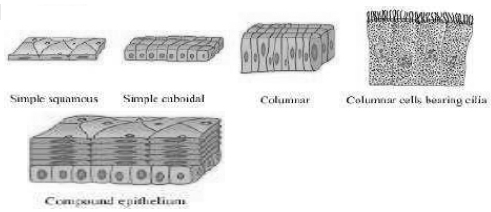
(N/A) Epithelial tissue lines the surface of a body and forms a protective covering. Epithelial cells are packed tightly together with little intercellular matrix. Epithelial tissue in the body is of two types.
$(a)$ Simple epithelium: It consists of a single layer of cells where cells are in direct contact with the basement membrane. It is further sub-divided into the following types:
$(i)$ Simple squamous epithelium: It consists of a single layer of flat cells with irregular boundaries. It is found in the walls of the blood vessels and in the lining of alveoli.
$(ii)$ Simple cuboidal epithelium: It consists of a single layer of cube-like cells. It is present in regions where secretion and absorption of substances takes place such as the proximal convoluted tubule region of the nephron.
$(iii)$ Simple columnar epithelium: It consists of a single layer of tall,slender cells with their nuclei present at the base of the cells. They may bear microvilli on the free surfaces. Columnar epithelium forms the lining of the stomach and intestines,and is involved in the function of secretion and absorption.
$(iv)$ Ciliated epithelium: It consists of columnar or cuboidal cells with cilia on their free surfaces. They are present in bronchioles and oviducts from where they direct mucus and eggs in specific directions.
$(v)$ Glandular epithelium: It consists of columnar or cuboidal cells involved in the secretion of substances. Glands are of two types,unicellular glands (goblet cells of the alimentary canal) and multicellular glands (salivary glands). They can be classified as exocrine (glands with ducts) and endocrine glands (ductless glands) based on the method through which they release their products.
$(b)$ Compound epithelium: It consists of many layers of cells. It is involved mainly in the function of providing protection and has a limited role in secretion and absorption. Examples of compound epithelium include the dry surface of the skin,the moist inner lining of the buccal cavity,pharynx,and the inner lining of ducts of salivary glands.
$(a)$ Simple epithelium: It consists of a single layer of cells where cells are in direct contact with the basement membrane. It is further sub-divided into the following types:
$(i)$ Simple squamous epithelium: It consists of a single layer of flat cells with irregular boundaries. It is found in the walls of the blood vessels and in the lining of alveoli.
$(ii)$ Simple cuboidal epithelium: It consists of a single layer of cube-like cells. It is present in regions where secretion and absorption of substances takes place such as the proximal convoluted tubule region of the nephron.
$(iii)$ Simple columnar epithelium: It consists of a single layer of tall,slender cells with their nuclei present at the base of the cells. They may bear microvilli on the free surfaces. Columnar epithelium forms the lining of the stomach and intestines,and is involved in the function of secretion and absorption.
$(iv)$ Ciliated epithelium: It consists of columnar or cuboidal cells with cilia on their free surfaces. They are present in bronchioles and oviducts from where they direct mucus and eggs in specific directions.
$(v)$ Glandular epithelium: It consists of columnar or cuboidal cells involved in the secretion of substances. Glands are of two types,unicellular glands (goblet cells of the alimentary canal) and multicellular glands (salivary glands). They can be classified as exocrine (glands with ducts) and endocrine glands (ductless glands) based on the method through which they release their products.
$(b)$ Compound epithelium: It consists of many layers of cells. It is involved mainly in the function of providing protection and has a limited role in secretion and absorption. Examples of compound epithelium include the dry surface of the skin,the moist inner lining of the buccal cavity,pharynx,and the inner lining of ducts of salivary glands.
0 likes
View Solution178
Medium
Distinguish between Simple epithelium and Compound epithelium.
Solution
(N/A)
| Simple epithelium | Compound epithelium |
| $(1)$ It is composed of only one layer of cells. | $(1)$ It is composed of many layers of cells. |
| $(2)$ It is mainly involved in the function of absorption and secretion. | $(2)$ It is mainly involved in the function of protection and has a limited role in absorption and secretion. |
| $(3)$ It is present in the lining of the stomach and intestine. | $(3)$ It is present in the lining of the pharynx and buccal cavity. |
0 likes
View Solution179
EasyMCQ
What is ciliated epithelium and where is it found in the animal body?
A
$A$ type of connective tissue found in the skin.
B
$A$ type of epithelial tissue found in the respiratory tract and oviducts.
C
$A$ type of muscular tissue found in the heart.
D
$A$ type of nervous tissue found in the brain.
Solution
(B) Ciliated epithelium is a type of epithelial tissue that consists of simple columnar or cuboidal cells with hair-like projections called cilia on their free surfaces.
It is primarily found on the inner surface of hollow organs like the bronchioles (in the respiratory tract) and the oviducts (Fallopian tubes).
Its main function is to move particles or mucus in a specific direction over the epithelial surface.
It is primarily found on the inner surface of hollow organs like the bronchioles (in the respiratory tract) and the oviducts (Fallopian tubes).
Its main function is to move particles or mucus in a specific direction over the epithelial surface.
0 likes
View Solution180
Medium
Distinguish between simple gland and compound gland.
Solution
(N/A)
| Simple glands | Compound glands |
| $(1)$ They contain isolated glandular cells. | $(1)$ They contain a cluster of secretory cells. |
| $(2)$ They are unicellular. | $(2)$ They are multicellular. |
| $(3)$ Example: Goblet cells of the alimentary canal. | $(3)$ Example: Salivary glands. |
0 likes
View Solution181
Medium
Write a detailed note on Epithelial tissue,giving the types of animal tissue.
Solution
(A) $\Rightarrow$ Based on the function of cells,there are four types of tissues found in animals: $(i)$ Epithelial,$(ii)$ Connective,$(iii)$ Muscular,and $(iv)$ Neural.
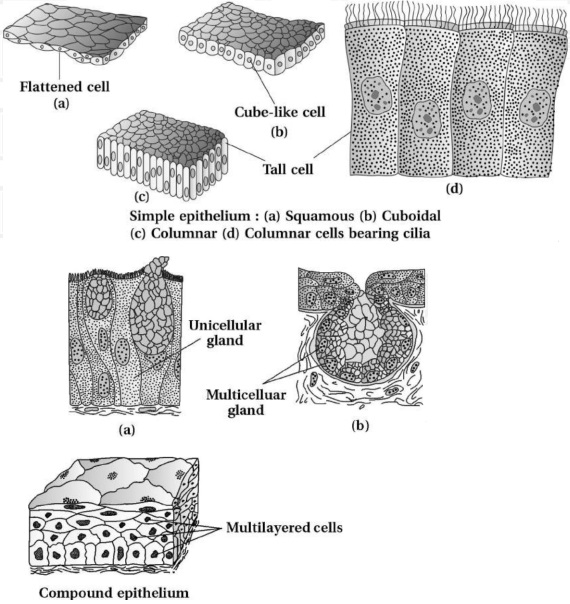
$\Rightarrow$ Epithelial tissue is commonly referred to as epithelium. This tissue has a free surface,which faces either a body fluid or the outside environment,thus providing a covering or a lining for some part of the body. The cells are compactly packed with little intercellular matrix.
$\Rightarrow$ Epithelial tissues are of two types: $(1)$ Simple epithelium,$(2)$ Compound epithelium.
$\Rightarrow$ Simple epithelium is composed of a single layer of cells and functions as a lining for body cavities,ducts,and tubes.
$(1)$ Simple epithelium: Based on the structural modification of the cells,simple epithelium is further divided into three types: $(a)$ Squamous,$(b)$ Cuboidal,$(c)$ Columnar.
$(a)$ Squamous epithelium: It is made up of a single thin layer of flattened cells with irregular boundaries. They are found in the walls of blood vessels and air sacs of lungs and are involved in functions like forming a diffusion boundary.
$(b)$ Cuboidal epithelium: This tissue is made up of a single layer of cube-like cells. It is commonly found in ducts of glands and tubular parts of nephrons in kidneys and its main functions are secretion and absorption.
$(c)$ Columnar epithelium: It is composed of a single layer of tall and slender cells. Their nuclei are located at the base. They are found in the lining of the stomach and intestine and help in absorption and secretion.
$\Rightarrow$ Ciliated epithelium: If the columnar or cuboidal cells bear cilia on their free surface,they are called ciliated epithelium. Their function is to move particles or mucus in a specific direction over the epithelium. They are mainly present in the inner surface of hollow organs like bronchioles and fallopian tubes.
$\Rightarrow$ Glandular epithelium: Some of the columnar or cuboidal cells get specialized for secretion and are called Glandular Epithelium. They are mainly of two types: $(i)$ Unicellular (e.g.,goblet cells of the alimentary canal) and $(ii)$ Multicellular (e.g.,salivary gland). Based on the mode of pouring their secretions,glands are divided into $(i)$ Exocrine (with ducts) and $(ii)$ Endocrine (ductless) glands.
$(2)$ Compound epithelium: It is made up of more than one layer (multi-layered) of cells and thus has a limited role in secretion and absorption. Its main function is to provide protection against chemical and mechanical stresses. It covers the dry surface of the skin,the moist surface of the buccal cavity,pharynx,inner lining of ducts of salivary glands,and of pancreatic ducts.
$\Rightarrow$ Cell Junctions: All cells in epithelium are held together with little intercellular material. Specialized junctions provide both structural and functional links between its individual cells: $(i)$ Tight junctions (help to stop substances from leaking across a tissue),$(ii)$ Adhering junctions (perform cementing to keep neighboring cells together),and $(iii)$ Gap junctions (facilitate the cells to communicate with each other by connecting the cytoplasm of adjoining cells for rapid transfer of ions,small molecules,and sometimes big molecules).
$\Rightarrow$ Epithelial tissue is commonly referred to as epithelium. This tissue has a free surface,which faces either a body fluid or the outside environment,thus providing a covering or a lining for some part of the body. The cells are compactly packed with little intercellular matrix.
$\Rightarrow$ Epithelial tissues are of two types: $(1)$ Simple epithelium,$(2)$ Compound epithelium.
$\Rightarrow$ Simple epithelium is composed of a single layer of cells and functions as a lining for body cavities,ducts,and tubes.
$(1)$ Simple epithelium: Based on the structural modification of the cells,simple epithelium is further divided into three types: $(a)$ Squamous,$(b)$ Cuboidal,$(c)$ Columnar.
$(a)$ Squamous epithelium: It is made up of a single thin layer of flattened cells with irregular boundaries. They are found in the walls of blood vessels and air sacs of lungs and are involved in functions like forming a diffusion boundary.
$(b)$ Cuboidal epithelium: This tissue is made up of a single layer of cube-like cells. It is commonly found in ducts of glands and tubular parts of nephrons in kidneys and its main functions are secretion and absorption.
$(c)$ Columnar epithelium: It is composed of a single layer of tall and slender cells. Their nuclei are located at the base. They are found in the lining of the stomach and intestine and help in absorption and secretion.
$\Rightarrow$ Ciliated epithelium: If the columnar or cuboidal cells bear cilia on their free surface,they are called ciliated epithelium. Their function is to move particles or mucus in a specific direction over the epithelium. They are mainly present in the inner surface of hollow organs like bronchioles and fallopian tubes.
$\Rightarrow$ Glandular epithelium: Some of the columnar or cuboidal cells get specialized for secretion and are called Glandular Epithelium. They are mainly of two types: $(i)$ Unicellular (e.g.,goblet cells of the alimentary canal) and $(ii)$ Multicellular (e.g.,salivary gland). Based on the mode of pouring their secretions,glands are divided into $(i)$ Exocrine (with ducts) and $(ii)$ Endocrine (ductless) glands.
$(2)$ Compound epithelium: It is made up of more than one layer (multi-layered) of cells and thus has a limited role in secretion and absorption. Its main function is to provide protection against chemical and mechanical stresses. It covers the dry surface of the skin,the moist surface of the buccal cavity,pharynx,inner lining of ducts of salivary glands,and of pancreatic ducts.
$\Rightarrow$ Cell Junctions: All cells in epithelium are held together with little intercellular material. Specialized junctions provide both structural and functional links between its individual cells: $(i)$ Tight junctions (help to stop substances from leaking across a tissue),$(ii)$ Adhering junctions (perform cementing to keep neighboring cells together),and $(iii)$ Gap junctions (facilitate the cells to communicate with each other by connecting the cytoplasm of adjoining cells for rapid transfer of ions,small molecules,and sometimes big molecules).
0 likes
View Solution182
Medium
Write the characteristics and functions of squamous epithelium.
Solution
(N/A) $\rightarrow$ It is composed of a single thin layer of flattened cells with irregular boundaries.
$\rightarrow$ The cells are arranged like tiles on a floor.
$\rightarrow$ They are held together by intercellular cement material.
$\rightarrow$ The cells are typically hexagonal in shape and possess a prominent nucleus in the center.
$\rightarrow$ The primary function of this tissue is to form a diffusion boundary and protect underlying tissues.
$\rightarrow$ The cells are arranged like tiles on a floor.
$\rightarrow$ They are held together by intercellular cement material.
$\rightarrow$ The cells are typically hexagonal in shape and possess a prominent nucleus in the center.
$\rightarrow$ The primary function of this tissue is to form a diffusion boundary and protect underlying tissues.
0 likes
View Solution183
Medium
Describe the characteristics,location,and function of cuboidal epithelium.
Solution
(N/A) $\rightarrow$ This tissue is composed of a single layer of cube-like cells. Each cell possesses a centrally located,spherical nucleus.
$\rightarrow$ The cells of this tissue sometimes have microvilli on the free surface to increase the area for absorption,for example,in the proximal convoluted tubule of the nephron.
$\rightarrow$ Location: This tissue is commonly found in the ducts of glands and the tubular parts of nephrons in the kidneys.
$\rightarrow$ In the ovary and testis,these cells are referred to as germinal epithelium.
$\rightarrow$ Function: These cells participate in processes such as secretion (e.g.,gastric juice and intestinal juice),excretion,and absorption.
$\rightarrow$ The cells of this tissue sometimes have microvilli on the free surface to increase the area for absorption,for example,in the proximal convoluted tubule of the nephron.
$\rightarrow$ Location: This tissue is commonly found in the ducts of glands and the tubular parts of nephrons in the kidneys.
$\rightarrow$ In the ovary and testis,these cells are referred to as germinal epithelium.
$\rightarrow$ Function: These cells participate in processes such as secretion (e.g.,gastric juice and intestinal juice),excretion,and absorption.
0 likes
View Solution184
Medium
Describe the characteristics,location,and function of columnar epithelium.
Solution
(N/A) $\rightarrow$ The columnar epithelium is composed of a single layer of tall and slender cells. Their nuclei are located at the base.
$\rightarrow$ The free surface may have microvilli.
$\rightarrow$ Their inner ends are narrow,and the free ends are broad and polygonal.
$\rightarrow$ Location: They are found in the lining of the stomach and intestine.
$\rightarrow$ Function: They help in absorption and secretion.
$\rightarrow$ The free surface may have microvilli.
$\rightarrow$ Their inner ends are narrow,and the free ends are broad and polygonal.
$\rightarrow$ Location: They are found in the lining of the stomach and intestine.
$\rightarrow$ Function: They help in absorption and secretion.
0 likes
View Solution185
Medium
Describe the types and functions of Glandular epithelium.
Solution
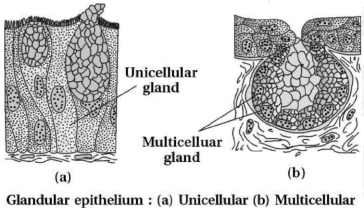
(N/A) $\Rightarrow$ Glandular epithelium: Some of the columnar or cuboidal cells get specialized for secretion and are called Glandular Epithelium.
$\Rightarrow$ They are mainly of two types based on the number of cells:
$(i)$ Unicellular glandular epithelium: It consists of isolated glandular cells (e.g., goblet cells of the alimentary canal).
$(ii)$ Multicellular glandular epithelium: It consists of a cluster of cells (e.g., salivary gland).
$\Rightarrow$ On the basis of the mode of pouring of their secretions, glands are divided into two categories:
$(i)$ Exocrine glands: These glands secrete mucus, saliva, earwax, oil, milk, digestive enzymes, and other cell products. These products are released through ducts or tubes.
$(ii)$ Endocrine glands: These glands do not have ducts. Their products, called hormones, are secreted directly into the fluid bathing the gland.
$\Rightarrow$ They are mainly of two types based on the number of cells:
$(i)$ Unicellular glandular epithelium: It consists of isolated glandular cells (e.g., goblet cells of the alimentary canal).
$(ii)$ Multicellular glandular epithelium: It consists of a cluster of cells (e.g., salivary gland).
$\Rightarrow$ On the basis of the mode of pouring of their secretions, glands are divided into two categories:
$(i)$ Exocrine glands: These glands secrete mucus, saliva, earwax, oil, milk, digestive enzymes, and other cell products. These products are released through ducts or tubes.
$(ii)$ Endocrine glands: These glands do not have ducts. Their products, called hormones, are secreted directly into the fluid bathing the gland.
0 likes
View Solution186
Medium
Describe the location and function of stratified epithelium.
Solution
(N/A) $\rightarrow$ Location: This tissue is found in areas subject to wear and tear,such as the dry surface of the skin,the lining of the rectum,buccal cavity,tongue,pharynx,salivary glands,esophagus,and the vagina of mammals.
$\rightarrow$ Function: It has a limited role in secretion and absorption. Its primary function is to provide protection against chemical and mechanical stress.
$\rightarrow$ Function: It has a limited role in secretion and absorption. Its primary function is to provide protection against chemical and mechanical stress.
0 likes
View Solution187
Medium
Give differences: Simple Epithelium and Compound Epithelium.
Solution
(N/A)
| Simple Epithelium | Compound Epithelium |
|---|---|
| $(1)$ Cells are arranged in a single layer. | $(1)$ Cells are arranged in multiple layers. |
| $(2)$ It lacks a Malpighian layer. | $(2)$ It possesses a Malpighian layer. |
| $(3)$ Cells generally do not possess the property of active division for regeneration. | $(3)$ Cells possess the property of active division for regeneration. |
| $(4)$ Includes squamous,cuboidal,columnar,and pseudostratified epithelium. | $(4)$ Includes stratified and transitional epithelium. |
0 likes
View Solution188
Medium
Describe the location and function of the following tissues:
$(i)$ Squamous Epithelium
$(ii)$ Cuboidal Epithelium
$(i)$ Squamous Epithelium
$(ii)$ Cuboidal Epithelium
Solution
(N/A) $(i)$ Squamous Epithelium:
Location: Found in the walls of blood vessels and air sacs of lungs.
Function: Forms a diffusion boundary.
$(ii)$ Cuboidal Epithelium:
Location: Found in the ducts of glands and tubular parts of nephrons in kidneys.
Function: Secretion and absorption.
Location: Found in the walls of blood vessels and air sacs of lungs.
Function: Forms a diffusion boundary.
$(ii)$ Cuboidal Epithelium:
Location: Found in the ducts of glands and tubular parts of nephrons in kidneys.
Function: Secretion and absorption.
0 likes
View Solution189
Medium
Identify the location and function of the following structures:
$(i)$ Malpighian layer
$(ii)$ Adipose tissue
$(i)$ Malpighian layer
$(ii)$ Adipose tissue
Solution
(N/A) $(i)$ Location: The Malpighian layer (stratum germinativum) is the deepest basal layer of the epidermis in stratified squamous epithelium.
$\Rightarrow$ Function: The cells in this layer divide continuously by mitosis to produce new cells,which replace the worn-out cells of the outer layers,thereby facilitating tissue repair and regeneration.
$(ii)$ Location: Adipose tissue is primarily found beneath the skin (subcutaneous layer),around internal organs,and in the bone marrow.
$\Rightarrow$ Function: It acts as an energy reservoir,provides cushioning for organs,and functions as an insulating layer to maintain body heat.
$\Rightarrow$ Function: The cells in this layer divide continuously by mitosis to produce new cells,which replace the worn-out cells of the outer layers,thereby facilitating tissue repair and regeneration.
$(ii)$ Location: Adipose tissue is primarily found beneath the skin (subcutaneous layer),around internal organs,and in the bone marrow.
$\Rightarrow$ Function: It acts as an energy reservoir,provides cushioning for organs,and functions as an insulating layer to maintain body heat.
0 likes
View Solution190
Medium
Identify the location and function of the following tissues:
$(i)$ Ciliated Epithelium
$(ii)$ Stratified Epithelium
$(i)$ Ciliated Epithelium
$(ii)$ Stratified Epithelium
Solution
(N/A) $(i)$ Ciliated Epithelium:
Location: Inner surface of hollow organs like bronchioles,fallopian tubes,and brain ventricles.
Function: To move particles or mucus in a specific direction over the epithelial surface.
$(ii)$ Stratified Epithelium (specifically Stratified Squamous):
Location: Skin (epidermis),lining of the mouth cavity,pharynx,and esophagus.
Function: Provides protection against chemical and mechanical stress (abrasion).
Location: Inner surface of hollow organs like bronchioles,fallopian tubes,and brain ventricles.
Function: To move particles or mucus in a specific direction over the epithelial surface.
$(ii)$ Stratified Epithelium (specifically Stratified Squamous):
Location: Skin (epidermis),lining of the mouth cavity,pharynx,and esophagus.
Function: Provides protection against chemical and mechanical stress (abrasion).
0 likes
View Solution191
Medium
Stratified epithelial cells have a limited role in secretion. Justify their role in our skin.
Solution
(N/A) $\Rightarrow$ Stratified epithelium consists of multiple layers of cells. Its basal layer is composed of columnar or cuboidal cells.
$\Rightarrow$ It is a type of compound epithelium,and its outer layer often contains a water-resistant protein called keratin.
$\Rightarrow$ The outermost layer consists of dead cells,which are shed during wear and tear. Due to this multi-layered structure,their function is limited in absorption and secretion.
$\Rightarrow$ The primary function of stratified epithelium in the skin is to provide protection to the body against mechanical and chemical stress.
$\Rightarrow$ It is a type of compound epithelium,and its outer layer often contains a water-resistant protein called keratin.
$\Rightarrow$ The outermost layer consists of dead cells,which are shed during wear and tear. Due to this multi-layered structure,their function is limited in absorption and secretion.
$\Rightarrow$ The primary function of stratified epithelium in the skin is to provide protection to the body against mechanical and chemical stress.
0 likes
View Solution192
Medium
Write the appropriate type of tissues in column $II$ according to the functions mentioned in column $I$.
| Column - $I$ | Column - $II$ |
| $(A)$ Secretion and absorption | $(1)$ ............... |
| $(B)$ Protective covering | $(2)$ ............... |
| $(C)$ Linking and supporting framework | $(3)$ ............... |
Solution
$(A-1, B-2, C-3)$ Simple columnar epithelium: This epithelium forms the inner lining of the stomach, intestine, and gallbladder. It forms stomach glands and intestinal glands, where it functions in secretion. Therefore, it is called glandular epithelium. This epithelium has villi in the mucous layer of the intestine, which increases the absorption surface area; hence, it is called brush-bordered columnar epithelium.
$(B)$ Stratified epithelium: It is composed of epithelial cells arranged in more than one layer. It is also known as compound epithelium. Its lowermost layer, situated on the basement membrane, is adapted to withstand wear and tear. Hence, it primarily functions as a protective epithelium.
$(C)$ Connective tissue: This tissue functions to link various tissues or organs and to support various structures of the animal body. It originates from the mesoderm and consists of living cells embedded in an extracellular matrix, e.g., blood is a fluid connective tissue.
$(B)$ Stratified epithelium: It is composed of epithelial cells arranged in more than one layer. It is also known as compound epithelium. Its lowermost layer, situated on the basement membrane, is adapted to withstand wear and tear. Hence, it primarily functions as a protective epithelium.
$(C)$ Connective tissue: This tissue functions to link various tissues or organs and to support various structures of the animal body. It originates from the mesoderm and consists of living cells embedded in an extracellular matrix, e.g., blood is a fluid connective tissue.
0 likes
View Solution193
Medium
Classify and describe epithelial tissue on the basis of structural modifications of cells.
Solution
(N/A) Epithelial tissue is classified into two main types based on the number of cell layers:
$1$. Simple Epithelium: Composed of a single layer of cells,functioning as a lining for body cavities,ducts,and tubes.
- Squamous Epithelium: Made of a single thin layer of flattened cells with irregular boundaries. Found in the walls of blood vessels and air sacs of lungs. Function: Diffusion boundary.
- Cuboidal Epithelium: Composed of a single layer of cube-like cells. Found in ducts of glands and tubular parts of nephrons in kidneys. Function: Secretion and absorption.
- Columnar Epithelium: Composed of a single layer of tall and slender cells. Nuclei are located at the base. Found in the lining of the stomach and intestine. Function: Secretion and absorption.
- Ciliated Epithelium: If columnar or cuboidal cells bear cilia on their free surface,they are called ciliated epithelium. Found in the inner surface of hollow organs like bronchioles and fallopian tubes. Function: To move particles or mucus in a specific direction.
- Glandular Epithelium: Some columnar or cuboidal cells get specialized for secretion. They are unicellular (e.g.,goblet cells) or multicellular (e.g.,salivary gland).
$2$. Compound Epithelium: Made of more than one layer (multi-layered) of cells and thus has a limited role in secretion and absorption. Their main function is to provide protection against chemical and mechanical stresses. They cover the dry surface of the skin,the moist surface of the buccal cavity,pharynx,inner lining of ducts of salivary glands,and pancreatic ducts.
$1$. Simple Epithelium: Composed of a single layer of cells,functioning as a lining for body cavities,ducts,and tubes.
- Squamous Epithelium: Made of a single thin layer of flattened cells with irregular boundaries. Found in the walls of blood vessels and air sacs of lungs. Function: Diffusion boundary.
- Cuboidal Epithelium: Composed of a single layer of cube-like cells. Found in ducts of glands and tubular parts of nephrons in kidneys. Function: Secretion and absorption.
- Columnar Epithelium: Composed of a single layer of tall and slender cells. Nuclei are located at the base. Found in the lining of the stomach and intestine. Function: Secretion and absorption.
- Ciliated Epithelium: If columnar or cuboidal cells bear cilia on their free surface,they are called ciliated epithelium. Found in the inner surface of hollow organs like bronchioles and fallopian tubes. Function: To move particles or mucus in a specific direction.
- Glandular Epithelium: Some columnar or cuboidal cells get specialized for secretion. They are unicellular (e.g.,goblet cells) or multicellular (e.g.,salivary gland).
$2$. Compound Epithelium: Made of more than one layer (multi-layered) of cells and thus has a limited role in secretion and absorption. Their main function is to provide protection against chemical and mechanical stresses. They cover the dry surface of the skin,the moist surface of the buccal cavity,pharynx,inner lining of ducts of salivary glands,and pancreatic ducts.
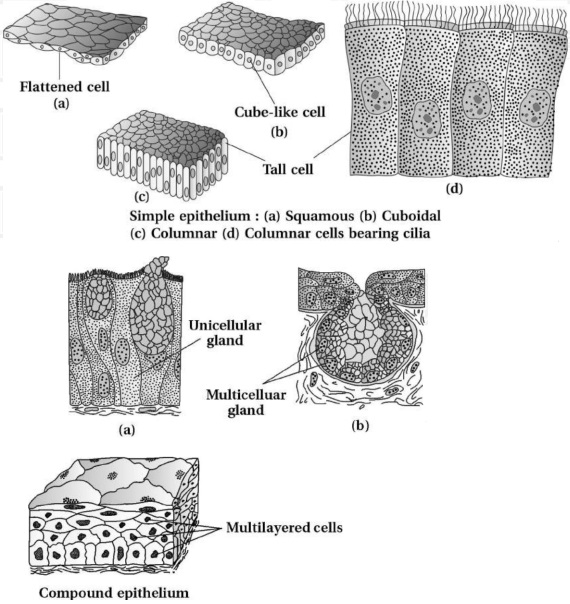
0 likes
View Solution194
EasyMCQ
Cuboidal epithelial cells with brush borders are found in which of the following?
A
Lining of the intestine
B
Ducts of salivary glands
C
Proximal convoluted tubule of the nephron
D
Eustachian tube
Solution
(C) The proximal convoluted tubule $(PCT)$ of the nephron is lined by simple cuboidal brush border epithelium. The brush border is formed by microvilli,which significantly increase the surface area for the reabsorption of essential substances like glucose,amino acids,and water from the filtrate.
0 likes
View Solution195
EasyMCQ
The goblet cells of the alimentary canal are modified from:
A
Squamous epithelial cells
B
Columnar epithelial cells
C
Chondrocytes
D
Compound epithelial cells
Solution
(B) Goblet cells are specialized glandular cells found in the lining of the alimentary canal.
These cells are modified from columnar epithelial cells.
Their primary function is to secrete mucus,which lubricates and protects the lining of the digestive tract.
These cells are modified from columnar epithelial cells.
Their primary function is to secrete mucus,which lubricates and protects the lining of the digestive tract.
0 likes
View Solution196
EasyMCQ
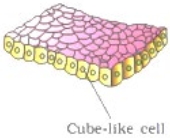
Identify the given diagram of tissue performing secretion and absorption.
A
Simple cuboidal epithelium
B
Simple columnar epithelium
C
Stratified cuboidal epithelium
D
Stratified columnar epithelium
Solution
(A) The given diagram shows a single layer of cube-like cells,which is characteristic of simple cuboidal epithelium.
This tissue is primarily found in ducts of glands and tubular parts of nephrons in kidneys.
Its main functions are secretion and absorption.
This tissue is primarily found in ducts of glands and tubular parts of nephrons in kidneys.
Its main functions are secretion and absorption.
0 likes
View Solution197
MediumMCQ
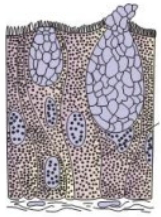
Identify the following diagram.
A
Glandular epithelium
B
Ciliated epithelium
C
Squamous epithelium
D
Areolar connective tissue
Solution
(A) The given diagram shows glandular epithelium.
Some of the columnar or cuboidal cells get specialized for secretion and are called glandular epithelium.
They are mainly of two types: unicellular,consisting of isolated glandular cells (like goblet cells of the alimentary canal),and multicellular,consisting of a cluster of cells (like salivary gland).
Some of the columnar or cuboidal cells get specialized for secretion and are called glandular epithelium.
They are mainly of two types: unicellular,consisting of isolated glandular cells (like goblet cells of the alimentary canal),and multicellular,consisting of a cluster of cells (like salivary gland).
0 likes
View Solution198
MediumMCQ
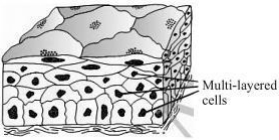
Identify the diagram and its related function.
A
Simple cuboidal epithelium - Diffusion
B
Simple squamous epithelium - Secretion and absorption
C
Compound epithelium - Protection
D
Compound epithelium - Diffusion
Solution
(C) The provided diagram shows a tissue composed of multiple layers of cells,which is characteristic of compound epithelium.
Compound epithelium is made of more than one layer (multi-layered) of cells and thus has a limited role in secretion and absorption.
Its main function is to provide protection against chemical and mechanical stresses.
Compound epithelium is made of more than one layer (multi-layered) of cells and thus has a limited role in secretion and absorption.
Its main function is to provide protection against chemical and mechanical stresses.
0 likes
View Solution199
EasyMCQ
Tissues are
A
Groups of cells which are similar in origin and function
B
Groups of organs which are similar in origin and function
C
Cells which are similar in function but not in origin
D
Groups of cells which are not similar in origin and function
Solution
(A) tissue is defined as a group of cells that have a common embryonic origin and perform a specific,similar function. In multicellular organisms,these cells work together to carry out specialized tasks.
0 likes
View Solution200
MediumMCQ
Lack of blood supply and presence of the noncellular basement membrane are the characteristics of the
A
muscular tissue
B
fluid connective tissue
C
epithelial tissue
D
nervous tissue
Solution
(C) Epithelial tissue covers the body surface or lines the body cavities.
The cells rest upon a non-cellular basement membrane,which is secreted by the epithelial cells themselves.
Epithelial tissue is avascular,meaning it lacks its own blood supply and receives nutrients via diffusion from the underlying connective tissue.
The cells rest upon a non-cellular basement membrane,which is secreted by the epithelial cells themselves.
Epithelial tissue is avascular,meaning it lacks its own blood supply and receives nutrients via diffusion from the underlying connective tissue.
0 likes
View SolutionStructural Organisation In Animals — Epithelial tissue · Frequently Asked Questions
1Are these Structural Organisation In Animals questions useful for JEE and NEET?
Yes. All questions in this section are mapped to JEE Main and NEET exam patterns. Previous year questions from JEE Main, NEET, GUJCET and state-level exams are included with full solutions.
2Can I switch to Hindi or Gujarati for these questions?
Yes. Use the language tabs in the hero section or the sidebar to view the same questions and solutions in English, Hindi or Gujarati.
3How do I generate a question paper from this subtopic?
Use the Vedclass Exam Paper Generator — select the chapter and subtopic, set difficulty, and generate Sets A, B, C, D automatically. First 3 chapters of every subject are free.
Vedclass Products
For Students
Vedclass Test Series
Mock tests in real JEE/NEET style with performance analysis. 5-day free trial.
Start Free TrialFor Teachers
Exam Paper Generator
Generate Set A/B/C/D papers from this chapter in 2 minutes. 3 chapters free.
Try FreeFor Institutes
Online Exam Module
Live online exams with unlimited students, 360° analytics & white-label branding.
See DemoFor Teachers & Institutes
Generate a Structural Organisation In Animals Exam Paper in 2 Minutes
Select subtopic & difficulty — Sets A, B, C, D auto-generated with No Repeat logic.
First 3 chapters of every subject are free — no payment required.