
A English
Mix Examples- Respiration in Plants Questions in English
Class 11 Biology · Respiration in Plants · Mix Examples- Respiration in Plants
141+
Questions
English
Language
100%
With Solutions
Showing 50 of 141 questions in English
51
MediumMCQ
The main purpose of glycolysis,the Krebs cycle,and the electron transport system is the production of .........
A
Nucleic acids
B
$ATP$ in small stepwise units
C
$ATP$ through a single large oxidation process
D
Sugars
Solution
(B) The primary objective of cellular respiration,which includes glycolysis,the Krebs cycle ($TCA$ cycle),and the electron transport system $(ETS)$,is to extract energy from glucose.
This energy is released in a controlled manner through a series of metabolic pathways.
Instead of releasing all energy at once,which would be inefficient and potentially damaging to the cell,the energy is captured in the form of $ATP$ (adenosine triphosphate) in small,manageable,stepwise units.
This allows the cell to efficiently utilize the energy for various biological processes.
This energy is released in a controlled manner through a series of metabolic pathways.
Instead of releasing all energy at once,which would be inefficient and potentially damaging to the cell,the energy is captured in the form of $ATP$ (adenosine triphosphate) in small,manageable,stepwise units.
This allows the cell to efficiently utilize the energy for various biological processes.
0 likes
View Solution52
EasyMCQ
Cellular respiration occurs in . . . . . . .
A
Chloroplast
B
Golgi body
C
Mitochondria
D
Nucleus
Solution
(C) Cellular respiration is the process by which cells derive energy from glucose.
While glycolysis occurs in the cytoplasm,the major stages of aerobic respiration,including the Krebs cycle and the Electron Transport System $(ETS)$,take place within the mitochondria.
Therefore,mitochondria are often referred to as the 'powerhouse of the cell' because they are the primary sites for $ATP$ production via cellular respiration.
While glycolysis occurs in the cytoplasm,the major stages of aerobic respiration,including the Krebs cycle and the Electron Transport System $(ETS)$,take place within the mitochondria.
Therefore,mitochondria are often referred to as the 'powerhouse of the cell' because they are the primary sites for $ATP$ production via cellular respiration.
0 likes
View Solution53
EasyMCQ
The term 'floating respiration' is used when the respiratory substrate is .........
A
Carbohydrate
B
Fat
C
Both $(A)$ and $(B)$
D
Protein
Solution
(C) $1$. Respiratory substrates are the organic compounds that are oxidized during respiration to release energy.
$2$. When carbohydrates or fats are used as respiratory substrates,the process is called 'floating respiration'.
$3$. When proteins are used as respiratory substrates,the process is called 'protoplasmic respiration'.
$4$. Therefore,since both carbohydrates and fats are involved in floating respiration,the correct option is $(C)$.
$2$. When carbohydrates or fats are used as respiratory substrates,the process is called 'floating respiration'.
$3$. When proteins are used as respiratory substrates,the process is called 'protoplasmic respiration'.
$4$. Therefore,since both carbohydrates and fats are involved in floating respiration,the correct option is $(C)$.
0 likes
View Solution54
MediumMCQ
How many $ATP$ molecules are produced from the complete oxidation of one glucose molecule via the $HMP$ shunt (Pentose Phosphate Pathway) (in $ATP$)?
A
$40$
B
$38$
C
$35$
D
$8$
Solution
(C) The $HMP$ shunt (Hexose Monophosphate Shunt) or Pentose Phosphate Pathway is primarily involved in the production of $NADPH$ and pentose sugars rather than direct $ATP$ production.
However,when considering the complete oxidation of one molecule of glucose through this pathway,the net yield of $ATP$ is equivalent to that of aerobic respiration.
In the $HMP$ shunt,$12\ NADPH$ molecules are produced.
Since each $NADPH$ molecule yields approximately $3\ ATP$ during oxidative phosphorylation,the total $ATP$ produced is $12 \times 3 = 36\ ATP$.
Accounting for the $ATP$ consumed in the initial steps,the net gain is typically considered $35\ ATP$ to $36\ ATP$ depending on the shuttle system used.
Among the given options,$35\ ATP$ is the standard accepted value for the net energy yield equivalent in this context.
However,when considering the complete oxidation of one molecule of glucose through this pathway,the net yield of $ATP$ is equivalent to that of aerobic respiration.
In the $HMP$ shunt,$12\ NADPH$ molecules are produced.
Since each $NADPH$ molecule yields approximately $3\ ATP$ during oxidative phosphorylation,the total $ATP$ produced is $12 \times 3 = 36\ ATP$.
Accounting for the $ATP$ consumed in the initial steps,the net gain is typically considered $35\ ATP$ to $36\ ATP$ depending on the shuttle system used.
Among the given options,$35\ ATP$ is the standard accepted value for the net energy yield equivalent in this context.
0 likes
View Solution55
MediumMCQ
During a state of rest,the metabolic requirement is very low. This can be determined by:
A
Pulse
B
Respiration
C
Uptake of $O_2$ and release of $CO_2$
D
All of the above
Solution
(D) The metabolic rate of an organism is directly proportional to the rate of cellular respiration. During a state of rest,the body's energy demand decreases,which leads to a reduction in the rate of oxygen consumption ($O_2$ uptake) and carbon dioxide production ($CO_2$ release). Since respiration is the process of gas exchange that supports metabolism,monitoring the pulse (heart rate) and the rate of breathing (respiration) provides a direct measure of these metabolic requirements. Therefore,all these parameters are indicators of the metabolic state.
0 likes
View Solution56
EasyMCQ
Which of the following is not a type of tooth?
A
Incisor
B
Retrica
C
Molar
D
Canine
Solution
(B) The human dentition consists of four types of teeth: $Incisors$,$Canines$,$Premolars$,and $Molars$.
$Retrica$ is not a biological term for any type of tooth in humans or mammals.
Therefore,$Retrica$ is the correct answer.
$Retrica$ is not a biological term for any type of tooth in humans or mammals.
Therefore,$Retrica$ is the correct answer.
0 likes
View Solution57
EasyMCQ
What is the process of converting $ADP$ to $ATP$ called?
A
Photophosphorylation
B
Phosphorylation
C
Substrate-level phosphorylation
D
Exergonic
Solution
(B) The process of adding a phosphate group to $ADP$ to form $ATP$ is generally known as phosphorylation.
When this process occurs specifically during metabolic pathways like glycolysis or the Krebs cycle,where a phosphate group is transferred directly from a substrate molecule to $ADP$,it is called substrate-level phosphorylation.
Photophosphorylation refers to the synthesis of $ATP$ from $ADP$ and inorganic phosphate in the presence of light in chloroplasts.
Therefore,the general term for the conversion of $ADP$ to $ATP$ is phosphorylation.
When this process occurs specifically during metabolic pathways like glycolysis or the Krebs cycle,where a phosphate group is transferred directly from a substrate molecule to $ADP$,it is called substrate-level phosphorylation.
Photophosphorylation refers to the synthesis of $ATP$ from $ADP$ and inorganic phosphate in the presence of light in chloroplasts.
Therefore,the general term for the conversion of $ADP$ to $ATP$ is phosphorylation.
0 likes
View Solution58
MediumMCQ
Select the correct match for $X$ and $Y$:
| Column $X$ | Column $Y$ |
| $(1)$ Mitochondrial matrix | $(P)$ Photophosphorylation |
| $(2)$ Chloroplast stroma | $(Q)$ Oxidative phosphorylation |
| $(3)$ Cristae | $(R)$ Krebs cycle |
| $(4)$ Granum | $(S)$ Dark reaction |
A
$(1-S), (2-P), (3-Q), (4-R)$
B
$(1-R), (2-S), (3-Q), (4-P)$
C
$(1-Q), (2-P), (3-R), (4-S)$
D
$(1-Q), (2-S), (3-R), (4-P)$
Solution
(B) The correct matches are as follows:
$(1)$ Mitochondrial matrix is the site for the $(R)$ Krebs cycle.
$(2)$ Chloroplast stroma is the site for the $(S)$ Dark reaction (Calvin cycle).
$(3)$ Cristae (inner mitochondrial membrane) is the site for $(Q)$ Oxidative phosphorylation (Electron Transport System).
$(4)$ Granum (thylakoids) is the site for $(P)$ Photophosphorylation (Light reaction).
Therefore, the correct matching is $(1-R), (2-S), (3-Q), (4-P)$.
$(1)$ Mitochondrial matrix is the site for the $(R)$ Krebs cycle.
$(2)$ Chloroplast stroma is the site for the $(S)$ Dark reaction (Calvin cycle).
$(3)$ Cristae (inner mitochondrial membrane) is the site for $(Q)$ Oxidative phosphorylation (Electron Transport System).
$(4)$ Granum (thylakoids) is the site for $(P)$ Photophosphorylation (Light reaction).
Therefore, the correct matching is $(1-R), (2-S), (3-Q), (4-P)$.
0 likes
View Solution59
MediumMCQ
Which of the following is $NOT$ a characteristic of water?
A
Provides an excellent medium for the transport of various chemicals.
B
Possesses very high specific heat and latent heat.
C
Possesses polar nature.
D
Low thermal conductivity.
Solution
(D) Water $(H_2O)$ is a polar molecule that acts as a universal solvent,making it an excellent medium for the transport of various chemicals in biological systems.
It has a very high specific heat capacity and latent heat of vaporization,which helps in thermoregulation.
Due to its polar nature,it forms hydrogen bonds.
However,water is known for its relatively high thermal conductivity compared to many other liquids,which aids in distributing heat within organisms. Therefore,the statement that water has low thermal conductivity is incorrect.
It has a very high specific heat capacity and latent heat of vaporization,which helps in thermoregulation.
Due to its polar nature,it forms hydrogen bonds.
However,water is known for its relatively high thermal conductivity compared to many other liquids,which aids in distributing heat within organisms. Therefore,the statement that water has low thermal conductivity is incorrect.
0 likes
View Solution60
MediumMCQ
Assertion $A$: Carbohydrates are the primary source of energy in living organisms.
Reason $R$: Glucose is the common substrate used in respiration.
Which option is correct for Assertion $A$ and Reason $R$?
Reason $R$: Glucose is the common substrate used in respiration.
Which option is correct for Assertion $A$ and Reason $R$?
A
$A$ and $R$ are both true and $R$ is the correct explanation of $A$.
B
$A$ and $R$ are both true but $R$ is not the correct explanation of $A$.
C
$A$ is true and $R$ is false.
D
$A$ is false and $R$ is true.
Solution
(A) Carbohydrates,especially glucose,serve as the primary fuel for cellular respiration to produce $ATP$.
Living organisms break down glucose through glycolysis and the Krebs cycle to release energy.
Since glucose is a carbohydrate,it confirms that carbohydrates are the primary source of energy.
Therefore,both the assertion and the reason are true,and the reason correctly explains why carbohydrates are the primary energy source.
Living organisms break down glucose through glycolysis and the Krebs cycle to release energy.
Since glucose is a carbohydrate,it confirms that carbohydrates are the primary source of energy.
Therefore,both the assertion and the reason are true,and the reason correctly explains why carbohydrates are the primary energy source.
0 likes
View Solution61
MediumMCQ
$A$: Carbohydrates are the primary source of energy in living organisms.
$R$: Glucose is the common substrate used in respiration.
$R$: Glucose is the common substrate used in respiration.
A
$A$ and $R$ are both true and $R$ is the correct explanation of $A$.
B
$A$ and $R$ are both true,but $R$ is not the correct explanation of $A$.
C
$A$ is true and $R$ is false.
D
$A$ is false and $R$ is true.
Solution
(A) Assertion $(A)$ is true because carbohydrates,especially glucose,are the primary fuel molecules that provide energy to cells through metabolic processes.
Reason $(R)$ is also true because glucose is the most common respiratory substrate that enters the glycolytic pathway to produce $ATP$.
Since the primary reason carbohydrates serve as the main energy source is that they are readily broken down into glucose for respiration,$R$ is the correct explanation of $A$.
Reason $(R)$ is also true because glucose is the most common respiratory substrate that enters the glycolytic pathway to produce $ATP$.
Since the primary reason carbohydrates serve as the main energy source is that they are readily broken down into glucose for respiration,$R$ is the correct explanation of $A$.
0 likes
View Solution62
MediumMCQ
In which processes do the enzymes succinate dehydrogenase and cytochrome oxidase occur,respectively?
A
Krebs cycle,$E.T.S.$
B
Calvin cycle,$E.T.S.$
C
Glycolysis,$E.T.S.$
D
Anaerobic respiration,$E.T.S.$
Solution
(A) Succinate dehydrogenase is a key enzyme of the Krebs cycle (Citric Acid Cycle) that catalyzes the oxidation of succinate to fumarate. It is also a component of Complex $II$ in the Electron Transport System $(E.T.S.)$. Cytochrome oxidase (Complex $IV$) is an essential enzyme complex located in the inner mitochondrial membrane that functions exclusively in the $E.T.S.$ to reduce oxygen to water. Therefore,the correct association is Krebs cycle and $E.T.S.$
0 likes
View Solution63
MediumMCQ
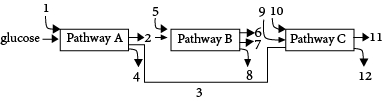
The three boxes in this diagram represent the three major biosynthetic pathways in aerobic respiration. Arrows represent net reactants or products. Arrows numbered $4, 8$ and $12$ can all be
A
$H_2O$
B
$FAD^+$ or $FADH_2$
C
$NADH$
D
$ATP$
Solution
(D) In the given diagram,pathway $A$ represents glycolysis,pathway $B$ represents the Krebs cycle,and pathway $C$ represents oxidative phosphorylation.
During glycolysis (pathway $A$),$ATP$ is produced as a net product (arrow $4$).
During the Krebs cycle (pathway $B$),$ATP$ (or $GTP$) is produced as a net product (arrow $8$).
During oxidative phosphorylation (pathway $C$),$ATP$ is produced as a net product (arrow $12$).
Therefore,arrows numbered $4, 8,$ and $12$ all represent the production of $ATP$.
During glycolysis (pathway $A$),$ATP$ is produced as a net product (arrow $4$).
During the Krebs cycle (pathway $B$),$ATP$ (or $GTP$) is produced as a net product (arrow $8$).
During oxidative phosphorylation (pathway $C$),$ATP$ is produced as a net product (arrow $12$).
Therefore,arrows numbered $4, 8,$ and $12$ all represent the production of $ATP$.
0 likes
View Solution64
MediumMCQ
The overall goal of glycolysis,Krebs' cycle and the electron transport system is the formation of
A
$ATP$ in one large oxidation reaction
B
sugars
C
nucleic acids
D
$ATP$ in small stepwise units
Solution
(D) The correct answer is $D$.
Respiration is an energy-releasing,enzymatically controlled,multistep catabolic process involving the stepwise breakdown of organic substances (hexose sugars) inside living cells.
Aerobic respiration includes three major processes: glycolysis,Krebs' cycle,and the electron transport chain.
During these processes,the substrate is completely broken down to form $CO_2$ and water.
$A$ large amount of energy is released in a stepwise manner in the form of $ATP$ molecules,rather than in a single large reaction,which prevents the loss of energy as heat.
Respiration is an energy-releasing,enzymatically controlled,multistep catabolic process involving the stepwise breakdown of organic substances (hexose sugars) inside living cells.
Aerobic respiration includes three major processes: glycolysis,Krebs' cycle,and the electron transport chain.
During these processes,the substrate is completely broken down to form $CO_2$ and water.
$A$ large amount of energy is released in a stepwise manner in the form of $ATP$ molecules,rather than in a single large reaction,which prevents the loss of energy as heat.
0 likes
View Solution65
MediumMCQ
It is much easier for a small animal to run uphill than for a large animal,because
A
small animals have a lower $O_2$ requirement
B
smaller animals have a higher metabolic rate
C
it is easier to carry a small body weight
D
the efficiency of muscles in large animals is less than in the small animals
Solution
(B) The metabolic rate of an organism is inversely proportional to its body size.
Smaller animals have a higher surface area to volume ratio,which results in a higher metabolic rate to maintain their body temperature and physiological functions.
Because of this higher metabolic rate,small animals can generate energy more rapidly,allowing them to perform strenuous activities like running uphill more easily compared to larger animals,which have a lower metabolic rate relative to their body size.
Therefore,the correct option is $(b)$.
Smaller animals have a higher surface area to volume ratio,which results in a higher metabolic rate to maintain their body temperature and physiological functions.
Because of this higher metabolic rate,small animals can generate energy more rapidly,allowing them to perform strenuous activities like running uphill more easily compared to larger animals,which have a lower metabolic rate relative to their body size.
Therefore,the correct option is $(b)$.
0 likes
View Solution66
EasyMCQ
Which plant absorbs water equal to its own weight in $5$ hours?
A
China rose
B
Mustard
C
Watermelon
D
Water hyacinth
Solution
(B) The correct answer is $B$.
Mustard is a plant that is known to absorb water equal to its own weight in approximately $5$ hours.
This high rate of water absorption is essential for its rapid growth and metabolic processes.
Other plants have different rates of transpiration and absorption depending on their environmental adaptations.
Mustard is a plant that is known to absorb water equal to its own weight in approximately $5$ hours.
This high rate of water absorption is essential for its rapid growth and metabolic processes.
Other plants have different rates of transpiration and absorption depending on their environmental adaptations.
0 likes
View Solution67
MediumMCQ
Which statement can be shared by facilitated diffusion and active transport?
A
Both need carrier transporters which are sensitive to inhibitors that react with protein side chains.
B
Energy is required by both the processes.
C
No energy expenditure in these processes.
D
Both use carbohydrates to move molecules across the membrane.
Solution
(A) Facilitated diffusion and active transport both involve the movement of molecules across the cell membrane using specific membrane proteins known as carrier proteins or transporters.
These carrier proteins are sensitive to inhibitors that react with their protein side chains,as these inhibitors can alter the conformation of the protein,thereby blocking the transport process.
Facilitated diffusion is a passive process that does not require $ATP$,whereas active transport is an active process that requires $ATP$ to move molecules against their concentration gradient.
Therefore,the common feature between them is the reliance on specific carrier proteins that can be inhibited by chemicals affecting protein side chains.
These carrier proteins are sensitive to inhibitors that react with their protein side chains,as these inhibitors can alter the conformation of the protein,thereby blocking the transport process.
Facilitated diffusion is a passive process that does not require $ATP$,whereas active transport is an active process that requires $ATP$ to move molecules against their concentration gradient.
Therefore,the common feature between them is the reliance on specific carrier proteins that can be inhibited by chemicals affecting protein side chains.
0 likes
View Solution68
MediumMCQ
Select the incorrect statement.
A
When tripalmitin is used as a substrate in respiration,the $RQ$ is $0.7$.
B
The intermediate compound which links glycolysis with the Krebs cycle is malic acid.
C
One glucose molecule yields a net gain of $36 \ ATP$.
D
One glucose molecule yields a net gain of $2 \ ATP$ molecules during fermentation.
Solution
(B) The correct answer is $B$.
$1$. Tripalmitin is a fatty acid,and its Respiratory Quotient $(RQ)$ is indeed $0.7$,which is correct.
$2$. The intermediate compound that links glycolysis with the Krebs cycle is Acetyl-CoA,not malic acid. Malic acid is an intermediate within the Krebs cycle itself. Therefore,this statement is incorrect.
$3$. In aerobic respiration,the complete oxidation of one glucose molecule yields a net gain of $36$ or $38 \ ATP$ depending on the shuttle system,so $36 \ ATP$ is a standard accepted value.
$4$. During fermentation,only glycolysis occurs,which results in a net gain of $2 \ ATP$ molecules,which is correct.
$1$. Tripalmitin is a fatty acid,and its Respiratory Quotient $(RQ)$ is indeed $0.7$,which is correct.
$2$. The intermediate compound that links glycolysis with the Krebs cycle is Acetyl-CoA,not malic acid. Malic acid is an intermediate within the Krebs cycle itself. Therefore,this statement is incorrect.
$3$. In aerobic respiration,the complete oxidation of one glucose molecule yields a net gain of $36$ or $38 \ ATP$ depending on the shuttle system,so $36 \ ATP$ is a standard accepted value.
$4$. During fermentation,only glycolysis occurs,which results in a net gain of $2 \ ATP$ molecules,which is correct.
0 likes
View Solution69
MediumMCQ
Choose the incorrect statement.
A
Glycolysis occurs in the cytoplasm of cells.
B
During glycolysis,$4$ molecules of $CO_2$ are released.
C
Kreb's cycle provides a path for complete breakdown.
D
Kreb's cycle takes place in the matrix of mitochondria.
Solution
(B) Glycolysis is the partial oxidation of glucose into two molecules of pyruvic acid. It occurs in the cytoplasm and does not involve the release of $CO_2$. Therefore,the statement that $4$ molecules of $CO_2$ are released during glycolysis is incorrect. The Kreb's cycle occurs in the mitochondrial matrix and is responsible for the complete oxidation of pyruvate into $CO_2$ and $H_2O$.
0 likes
View Solution70
MediumMCQ
Choose the incorrect sentence.
A
In glycolysis,glucose is oxidized into pyruvic acid without the help of oxygen.
B
$42 \ ATP$ molecules are formed during aerobic respiration in eukaryotic organisms.
C
Carbohydrates are generally used as substrates for respiration.
D
During glycolysis,$6 \ ATP$ are formed through oxidative phosphorylation.
Solution
(B) $1$. Glycolysis is an anaerobic process where glucose is converted into pyruvic acid without the requirement of oxygen. Thus,option $A$ is correct.
$2$. In eukaryotic organisms,the net gain of $ATP$ during aerobic respiration is typically $36$ or $38 \ ATP$ molecules,not $42$. Thus,option $B$ is incorrect.
$3$. Carbohydrates are the primary respiratory substrates used by cells to produce energy. Thus,option $C$ is correct.
$4$. Glycolysis involves substrate-level phosphorylation,not oxidative phosphorylation. Furthermore,the net gain of $ATP$ in glycolysis is $2 \ ATP$,not $6$. Thus,option $D$ is also incorrect. However,in the context of standard multiple-choice questions where one must identify the most glaring error regarding respiratory yields,$B$ and $D$ are both factually wrong. Given the standard curriculum,$D$ is often cited as a common misconception regarding the mechanism of $ATP$ production in glycolysis.
$2$. In eukaryotic organisms,the net gain of $ATP$ during aerobic respiration is typically $36$ or $38 \ ATP$ molecules,not $42$. Thus,option $B$ is incorrect.
$3$. Carbohydrates are the primary respiratory substrates used by cells to produce energy. Thus,option $C$ is correct.
$4$. Glycolysis involves substrate-level phosphorylation,not oxidative phosphorylation. Furthermore,the net gain of $ATP$ in glycolysis is $2 \ ATP$,not $6$. Thus,option $D$ is also incorrect. However,in the context of standard multiple-choice questions where one must identify the most glaring error regarding respiratory yields,$B$ and $D$ are both factually wrong. Given the standard curriculum,$D$ is often cited as a common misconception regarding the mechanism of $ATP$ production in glycolysis.
0 likes
View Solution71
MediumMCQ
Choose the incorrect sentence.
A
Glycolysis occurs in the cytoplasm of the cell.
B
Glycolysis is common to all eukaryotic organisms.
C
Anaerobic respiration begins with glycolysis.
D
Aerobic respiration begins with the Krebs cycle.
Solution
(D) The correct answer is $D$. Aerobic respiration does not begin with the Krebs cycle; it begins with glycolysis,which is common to both aerobic and anaerobic respiration. After glycolysis,the end product (pyruvate) enters the mitochondria to undergo the link reaction and then the Krebs cycle. Therefore,the statement 'Aerobic respiration begins with Krebs cycle' is incorrect.
0 likes
View Solution72
MediumMCQ
Choose the correct statements:
$(i)$ The complete combustion of glucose,which produces $CO_2$ and $H_2O$ as end products,yields energy,most of which is given out as heat.
$(ii)$ The scheme of glycolysis was given by Gustav Embden,Otto Meyerhof,and $J$. Parnas and is often referred to as the $EMP$ pathway.
$(iii)$ In glycolysis,$ATP$ is utilised at $2$ steps,not $4$.
$(iv)$ In both lactic acid and alcohol fermentation,not much energy is released; less than $7$ percent of the energy in glucose is released and not all of it is trapped as high-energy bonds of $ATP$.
$(v)$ For aerobic respiration to take place within the mitochondria,the final product of glycolysis,pyruvate,is transported from the cytoplasm into the mitochondria.
$(i)$ The complete combustion of glucose,which produces $CO_2$ and $H_2O$ as end products,yields energy,most of which is given out as heat.
$(ii)$ The scheme of glycolysis was given by Gustav Embden,Otto Meyerhof,and $J$. Parnas and is often referred to as the $EMP$ pathway.
$(iii)$ In glycolysis,$ATP$ is utilised at $2$ steps,not $4$.
$(iv)$ In both lactic acid and alcohol fermentation,not much energy is released; less than $7$ percent of the energy in glucose is released and not all of it is trapped as high-energy bonds of $ATP$.
$(v)$ For aerobic respiration to take place within the mitochondria,the final product of glycolysis,pyruvate,is transported from the cytoplasm into the mitochondria.
A
$(i), (ii), (iv)$
B
$(ii), (iv)$
C
$(i), (iii), (v)$
D
$(ii), (v)$
Solution
(D) Statement $(i)$ is correct: Complete combustion of glucose produces $CO_2$ and $H_2O$,releasing energy mostly as heat.
Statement $(ii)$ is correct: Glycolysis is known as the $EMP$ pathway after Embden,Meyerhof,and Parnas.
Statement $(iii)$ is incorrect: In glycolysis,$ATP$ is utilized at only $2$ steps (hexokinase and phosphofructokinase reactions).
Statement $(iv)$ is incorrect: In fermentation,less than $7$ percent of the energy in glucose is released.
Statement $(v)$ is correct: Pyruvate is transported from the cytoplasm into the mitochondria for the link reaction and the Krebs cycle.
Statement $(ii)$ is correct: Glycolysis is known as the $EMP$ pathway after Embden,Meyerhof,and Parnas.
Statement $(iii)$ is incorrect: In glycolysis,$ATP$ is utilized at only $2$ steps (hexokinase and phosphofructokinase reactions).
Statement $(iv)$ is incorrect: In fermentation,less than $7$ percent of the energy in glucose is released.
Statement $(v)$ is correct: Pyruvate is transported from the cytoplasm into the mitochondria for the link reaction and the Krebs cycle.
0 likes
View Solution73
MediumMCQ
What are the end products of aerobic respiration?
A
Sugar and $O_2$
B
Water and energy
C
$CO_2$, water, and energy
D
$CO_2$ and energy
Solution
(C) Aerobic respiration is the process of breaking down glucose in the presence of oxygen to produce energy.
The overall chemical equation for aerobic respiration is: $C_6H_{12}O_6 + 6O_2 \rightarrow 6CO_2 + 6H_2O + \text{Energy (ATP)}$.
As shown in the equation, the end products are carbon dioxide $(CO_2)$, water $(H_2O)$, and energy (in the form of $ATP$).
The overall chemical equation for aerobic respiration is: $C_6H_{12}O_6 + 6O_2 \rightarrow 6CO_2 + 6H_2O + \text{Energy (ATP)}$.
As shown in the equation, the end products are carbon dioxide $(CO_2)$, water $(H_2O)$, and energy (in the form of $ATP$).
0 likes
View Solution74
MediumMCQ
Which of the following is an essential substance required for the conversion of pyruvic acid into acetyl $CoA$?
A
$LAA$
B
$NAD^+$
C
$TPP$
D
All of the above
Solution
(D) The conversion of pyruvic acid into acetyl $CoA$ is catalyzed by the pyruvate dehydrogenase complex. This reaction is an oxidative decarboxylation process. The essential cofactors and coenzymes required for this reaction include:
$1$. $TPP$ (Thiamine pyrophosphate)
$2$. $NAD^+$ (Nicotinamide adenine dinucleotide)
$3$. $CoA$ (Coenzyme $A$)
$4$. $LAA$ (Lipoic acid)
$5$. $Mg^{2+}$ ions.
Since all the listed substances are essential components of this enzymatic complex,the correct answer is $D$.
$1$. $TPP$ (Thiamine pyrophosphate)
$2$. $NAD^+$ (Nicotinamide adenine dinucleotide)
$3$. $CoA$ (Coenzyme $A$)
$4$. $LAA$ (Lipoic acid)
$5$. $Mg^{2+}$ ions.
Since all the listed substances are essential components of this enzymatic complex,the correct answer is $D$.
0 likes
View Solution75
MediumMCQ
What is the primary objective of glycolysis,the Krebs cycle,and $E.T.S.$?
A
Production of $ATP$ in a single large oxidation process
B
Sugar
C
Nucleic acid
D
Production of $ATP$ in small stepwise units
Solution
(D) The primary objective of cellular respiration,which includes glycolysis,the Krebs cycle,and the Electron Transport System $(E.T.S.)$,is to extract energy from organic molecules like glucose.
Instead of releasing all the energy at once in a single large oxidation process,which would be inefficient and potentially damaging to the cell,these processes break down the substrate in a series of small,controlled steps.
This stepwise oxidation allows the cell to capture the released energy efficiently and store it in the form of $ATP$ molecules,which act as the energy currency of the cell.
Instead of releasing all the energy at once in a single large oxidation process,which would be inefficient and potentially damaging to the cell,these processes break down the substrate in a series of small,controlled steps.
This stepwise oxidation allows the cell to capture the released energy efficiently and store it in the form of $ATP$ molecules,which act as the energy currency of the cell.
0 likes
View Solution76
MediumMCQ
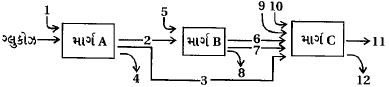
The given schematic diagram shows three main biosynthetic pathways of aerobic respiration in three boxes. The arrows indicate reactants or products. Arrows $4, 8,$ and $12$ all represent -
A
$FAD^+$ or $FADH_2$
B
$NADH$
C
$ATP$
D
$H_2O$
Solution
(C) In the schematic representation of aerobic respiration:
- Pathway $A$ is Glycolysis,Pathway $B$ is the Link Reaction (Pyruvate oxidation),and Pathway $C$ is the Krebs Cycle ($TCA$ cycle).
- In Glycolysis (Pathway $A$),$ATP$ is produced (arrow $4$).
- In the Link Reaction (Pathway $B$),$ATP$ is not directly produced,but in the Krebs Cycle (Pathway $C$),$ATP$ (or $GTP$) is produced (arrow $12$).
- However,looking at the standard representation of these pathways,arrows $4, 8,$ and $12$ represent the net energy currency produced in these stages,which is $ATP$.
- Pathway $A$ is Glycolysis,Pathway $B$ is the Link Reaction (Pyruvate oxidation),and Pathway $C$ is the Krebs Cycle ($TCA$ cycle).
- In Glycolysis (Pathway $A$),$ATP$ is produced (arrow $4$).
- In the Link Reaction (Pathway $B$),$ATP$ is not directly produced,but in the Krebs Cycle (Pathway $C$),$ATP$ (or $GTP$) is produced (arrow $12$).
- However,looking at the standard representation of these pathways,arrows $4, 8,$ and $12$ represent the net energy currency produced in these stages,which is $ATP$.
0 likes
View Solution77
EasyMCQ
Sunken stomata are a characteristic feature of $.........$.
A
Hydrophytes
B
Mesophytes
C
Xerophytes
D
Halophytes
Solution
(C) Sunken stomata are stomata that are located in small pits or depressions on the leaf surface.
This adaptation helps in reducing the rate of transpiration by creating a humid microclimate around the stomatal pore.
This is a critical survival mechanism for plants living in dry or arid environments where water conservation is essential.
Therefore,sunken stomata are a characteristic feature of $Xerophytes$.
This adaptation helps in reducing the rate of transpiration by creating a humid microclimate around the stomatal pore.
This is a critical survival mechanism for plants living in dry or arid environments where water conservation is essential.
Therefore,sunken stomata are a characteristic feature of $Xerophytes$.
0 likes
View Solution78
MediumMCQ
Which of these statements is incorrect?
A
Glycolysis operates as long as it is supplied with $NAD^+$ that can pick up hydrogen atoms.
B
Enzymes of $TCA$ cycle are present in the mitochondrial matrix.
C
Oxidative phosphorylation takes place in the outer mitochondrial membrane.
D
Glycolysis occurs in the cytosol.
Solution
(C) The correct answer is $C$.
$1$. Glycolysis requires $NAD^+$ to act as an electron acceptor to form $NADH + H^+$.
$2$. The enzymes of the $TCA$ cycle (Krebs cycle) are located in the mitochondrial matrix.
$3$. Oxidative phosphorylation (the electron transport system) takes place in the inner mitochondrial membrane,not the outer membrane.
$4$. Glycolysis occurs in the cytosol of the cell.
$1$. Glycolysis requires $NAD^+$ to act as an electron acceptor to form $NADH + H^+$.
$2$. The enzymes of the $TCA$ cycle (Krebs cycle) are located in the mitochondrial matrix.
$3$. Oxidative phosphorylation (the electron transport system) takes place in the inner mitochondrial membrane,not the outer membrane.
$4$. Glycolysis occurs in the cytosol of the cell.
0 likes
View Solution79
MediumMCQ
In the sieve elements,which one of the following is the most likely function of $P-$ proteins?
A
Deposition of callose on sieve plates
B
Providing energy for active translocation
C
Autolytic enzymes
D
Sealing mechanism on wounding
Solution
(D) $P-$ proteins (phloem proteins) are found in the sieve tube elements of angiosperms. Their primary function is to act as a sealing mechanism. When the sieve tube is injured or wounded,these proteins,along with callose,rapidly accumulate at the sieve plate pores to plug them,thereby preventing the loss of phloem sap.
0 likes
View Solution80
MediumMCQ
Assertion : Glycolysis is the first step of respiration in which glucose completely breaks into $CO_2$ and $H_2O$.
Reason : In this process,there is net gain of twenty four molecules of $ATP$.
Reason : In this process,there is net gain of twenty four molecules of $ATP$.
A
If both Assertion and Reason are correct and the Reason is a correct explanation of the Assertion.
B
If both Assertion and Reason are correct but Reason is not a correct explanation of the Assertion.
C
If the Assertion is correct but Reason is incorrect.
D
If both the Assertion and Reason are incorrect.
Solution
(D) Glycolysis is the process of breakdown of glucose or similar hexose sugar into two molecules of pyruvic acid through a series of enzyme-mediated reactions,releasing energy $(ATP)$ and reducing power $(NADH_2)$.
It is the first step of respiration,which occurs inside the cytoplasm and is independent of $O_2$.
In glycolysis,two molecules of $ATP$ are consumed during the double phosphorylation of glucose to form fructose $1, 6$-diphosphate.
Four molecules of $ATP$ are produced in the conversion of $1, 3$-diphosphoglycerate to $3$-phosphoglycerate and phosphoenolpyruvate to pyruvate.
Additionally,two molecules of $NADH_2$ are formed during the oxidation of glyceraldehyde $3$-phosphate to $1, 3$-diphosphoglycerate.
Since each $NADH$ is equivalent to $3\, ATP$,the net gain in glycolysis is $8\, ATP$.
Therefore,both the Assertion and the Reason are incorrect.
It is the first step of respiration,which occurs inside the cytoplasm and is independent of $O_2$.
In glycolysis,two molecules of $ATP$ are consumed during the double phosphorylation of glucose to form fructose $1, 6$-diphosphate.
Four molecules of $ATP$ are produced in the conversion of $1, 3$-diphosphoglycerate to $3$-phosphoglycerate and phosphoenolpyruvate to pyruvate.
Additionally,two molecules of $NADH_2$ are formed during the oxidation of glyceraldehyde $3$-phosphate to $1, 3$-diphosphoglycerate.
Since each $NADH$ is equivalent to $3\, ATP$,the net gain in glycolysis is $8\, ATP$.
Therefore,both the Assertion and the Reason are incorrect.
0 likes
View Solution81
MediumMCQ
Assertion : The inner membrane of mitochondria contains systems involving electron transport.
Reason : The mitochondrial matrix contains enzymes of Kreb's cycle.
Reason : The mitochondrial matrix contains enzymes of Kreb's cycle.
A
If both Assertion and Reason are correct and the Reason is a correct explanation of the Assertion.
B
If both Assertion and Reason are correct but Reason is not a correct explanation of the Assertion.
C
If the Assertion is correct but Reason is incorrect.
D
If both the Assertion and Reason are incorrect.
Solution
(B) The inner mitochondrial membrane contains the electron transport system $(ETS)$ and $ATP$ synthase,which are essential for oxidative phosphorylation.
The mitochondrial matrix contains the enzymes required for the $Kreb's$ cycle (citric acid cycle) and fatty acid oxidation.
Both statements are scientifically correct,but the presence of $Kreb's$ cycle enzymes in the matrix does not explain why the electron transport system is located in the inner membrane. Therefore,the Reason is not the correct explanation for the Assertion.
The mitochondrial matrix contains the enzymes required for the $Kreb's$ cycle (citric acid cycle) and fatty acid oxidation.
Both statements are scientifically correct,but the presence of $Kreb's$ cycle enzymes in the matrix does not explain why the electron transport system is located in the inner membrane. Therefore,the Reason is not the correct explanation for the Assertion.
0 likes
View Solution82
Difficult
Differentiate between (Any two):
$(a)$ Respiration and Combustion
$(b)$ Glycolysis and Krebs' cycle
$(c)$ Aerobic respiration and Fermentation
$(a)$ Respiration and Combustion
$(b)$ Glycolysis and Krebs' cycle
$(c)$ Aerobic respiration and Fermentation
Solution
(N/A) Respiration and Combustion
$(b)$ Glycolysis and Krebs' cycle
$(c)$ Aerobic respiration and Fermentation
| Respiration | Combustion |
| $(1)$ It is a biochemical process. | $(1)$ It is a physiochemical process. |
| $(2)$ It occurs in living cells. | $(2)$ It does not occur in living cells. |
| $(3)$ $ATP$ is generated. | $(3)$ $ATP$ is not generated. |
| $(4)$ Enzymes are required. | $(4)$ Enzymes are not required. |
| $(5)$ It is a biologically-controlled process. | $(5)$ It is an uncontrolled process. |
$(b)$ Glycolysis and Krebs' cycle
| Glycolysis | Krebs' cycle |
| $(1)$ It is a linear pathway. | $(1)$ It is a cyclic pathway. |
| $(2)$ It occurs in the cytoplasm. | $(2)$ It occurs in the mitochondrial matrix. |
| $(3)$ It occurs in both aerobic and anaerobic respiration. | $(3)$ It occurs only in aerobic respiration. |
| $(4)$ It generates $2$ $NADH$ and $2$ $ATP$ molecules per glucose. | $(4)$ It produces $6$ $NADH$, $2$ $FADH_2$, and $2$ $ATP$ per two acetyl-$CoA$ molecules. |
$(c)$ Aerobic respiration and Fermentation
| Aerobic respiration | Fermentation |
| $(1)$ Oxygen is used for energy derivation. | $(1)$ Occurs in the absence of oxygen. |
| $(2)$ Occurs in the cytoplasm and mitochondria. | $(2)$ Occurs only in the cytoplasm. |
| $(3)$ End products are $CO_2$ and $H_2O$. | $(3)$ End products are ethyl alcohol and $CO_2$. |
| $(4)$ Complete oxidation of substrate occurs. | $(4)$ Incomplete oxidation of substrate occurs. |
| $(5)$ About $36$ $ATP$ molecules are produced. | $(5)$ Only $2$ $ATP$ molecules are produced. |
0 likes
View Solution83
Medium
What are the main steps in aerobic respiration? Where does it take place?
Solution
The major steps in aerobic respiration and the sites where they occur are listed in the given table.
| Step | Site of occurrence |
| $(1)$ Glycolysis | $(1)$ Cytoplasm |
| $(2)$ Krebs cycle | $(2)$ Matrix of mitochondria |
| $(3)$ Electron transport system | $(3)$ Inner mitochondrial membrane |
| $(4)$ Oxidative phosphorylation | $(4)$ $F_{0}-F_{1}$ particles in the inner mitochondrial membrane |
0 likes
View Solution84
Medium
Distinguish between the following: (Any two)
$(a)$ Aerobic respiration and Anaerobic respiration
$(b)$ Glycolysis and Fermentation
$(c)$ Glycolysis and Citric acid Cycle
$(a)$ Aerobic respiration and Anaerobic respiration
$(b)$ Glycolysis and Fermentation
$(c)$ Glycolysis and Citric acid Cycle
Solution
(A-D) Aerobic respiration and Anaerobic respiration
$(b)$ Glycolysis and Fermentation
$(c)$ Glycolysis and Citric acid Cycle
| Aerobic respiration | Anaerobic respiration |
| $(1)$ It uses oxygen for deriving energy. | $(1)$ It occurs in the absence of oxygen. |
| $(2)$ It occurs in cytoplasm and mitochondria. | $(2)$ It occurs in cytoplasm. |
| $(3)$ The end products are carbon dioxide and water. | $(3)$ The end products are ethyl alcohol and carbon dioxide (or lactic acid). |
| $(4)$ Complete oxidation of respiratory substrate takes place. | $(4)$ Incomplete oxidation of respiratory substrate takes place. |
| $(5)$ $36-38$ $ATP$ molecules are produced. | $(5)$ Only $2$ $ATP$ molecules are produced. |
$(b)$ Glycolysis and Fermentation
| Glycolysis | Fermentation |
| $(1)$ Glycolysis occurs during both aerobic and anaerobic respiration. | $(1)$ Fermentation is a type of anaerobic respiration. |
| $(2)$ Pyruvic acid is produced as its end product. | $(2)$ Ethanol or lactic acid is produced as its end product. |
$(c)$ Glycolysis and Citric acid Cycle
| Glycolysis | Citric acid Cycle (Krebs cycle) |
| $(1)$ It is a linear pathway. | $(1)$ It is a cyclic pathway. |
| $(2)$ It occurs in the cell cytoplasm. | $(2)$ It occurs in the mitochondrial matrix. |
| $(3)$ It occurs in both aerobic and anaerobic respiration. | $(3)$ It occurs only in aerobic respiration. |
| $(4)$ One glucose molecule generates $2$ $NADH$ and $2$ $ATP$ molecules. | $(4)$ It produces $6$ $NADH$, $2$ $FADH_2$, and $2$ $ATP$ molecules per glucose molecule. |
0 likes
View Solution85
MediumMCQ
Which main events occur in aerobic respiration?
A
Glycolysis and fermentation
B
Complete oxidation of pyruvate and electron transport chain
C
Anaerobic breakdown of glucose
D
Only $ATP$ synthesis
Solution
(B) For aerobic respiration to take place within the mitochondria,the final product of glycolysis,pyruvate,is transported from the cytoplasm into the mitochondria.
The crucial events in aerobic respiration are:
$1$. The complete oxidation of pyruvate by the stepwise removal of all the hydrogen atoms,leaving three molecules of $CO_{2}$.
$2$. The passing on of the electrons removed as part of the hydrogen atoms to molecular $O_{2}$ with simultaneous synthesis of $ATP$.
The crucial events in aerobic respiration are:
$1$. The complete oxidation of pyruvate by the stepwise removal of all the hydrogen atoms,leaving three molecules of $CO_{2}$.
$2$. The passing on of the electrons removed as part of the hydrogen atoms to molecular $O_{2}$ with simultaneous synthesis of $ATP$.
0 likes
View Solution86
Easy
Differentiate between Glycolysis and Fermentation.
Solution
(N/A)
| Glycolysis | Fermentation |
|---|---|
| $(1)$ It is the partial oxidation of glucose into two molecules of pyruvic acid. | $(1)$ It is the incomplete oxidation of glucose under anaerobic conditions,leading to ethanol or lactic acid. |
| $(2)$ It occurs in the cytoplasm of all living cells. | $(2)$ It occurs in yeast,certain bacteria,and muscle cells under anaerobic conditions. |
| $(3)$ It does not require oxygen. | $(3)$ It occurs in the absence of oxygen. |
| $(4)$ $CO_{2}$ is not released during this process. | $(4)$ $CO_{2}$ is released during alcoholic fermentation. |
| $(5)$ Net gain is $2$ $ATP$ and $2$ $NADH + H^{+}$. | $(5)$ Net gain is $2$ $ATP$ (produced during glycolysis) and no further $ATP$ is produced in fermentation. |
0 likes
View Solution87
Medium
Differentiate between Glycolysis and Citric acid cycle.
Solution
(N/A)
| Glycolysis | Citric acid cycle |
| $(1)$ This process occurs in the cytoplasm of the cell. | $(1)$ This process occurs in the mitochondrial matrix. |
| $(2)$ $O_2$ is not required for this process. | $(2)$ $O_2$ is indirectly required for the regeneration of $NAD^+$ and $FAD$. |
| $(3)$ One molecule of glucose is broken down into two molecules of pyruvic acid. | $(3)$ Acetyl-$CoA$ is completely oxidized to release $CO_2$. |
| $(4)$ It is a linear metabolic pathway. | $(4)$ It is a cyclic metabolic pathway. |
| $(5)$ $CO_2$ is not produced during this process. | $(5)$ Two molecules of $CO_2$ are released per acetyl-$CoA$ molecule. |
| $(6)$ Discovered by Embden,Meyerhof,and Parnas ($EMP$ pathway). | $(6)$ Discovered by Hans Krebs. |
0 likes
View Solution88
Medium
Write the full forms of the following abbreviations:
$(1)$ $RQ$
$(2)$ $TCA$
$(1)$ $RQ$
$(2)$ $TCA$
Solution
(N/A) $(1)$ $RQ$ stands for Respiratory Quotient. It is defined as the ratio of the volume of $CO_2$ evolved to the volume of $O_2$ consumed during respiration.
$(2)$ $TCA$ stands for Tricarboxylic Acid. It refers to the $TCA$ cycle,also known as the Krebs cycle or Citric Acid cycle,which is a series of chemical reactions used by all aerobic organisms to release stored energy.
$(2)$ $TCA$ stands for Tricarboxylic Acid. It refers to the $TCA$ cycle,also known as the Krebs cycle or Citric Acid cycle,which is a series of chemical reactions used by all aerobic organisms to release stored energy.
0 likes
View Solution89
Medium
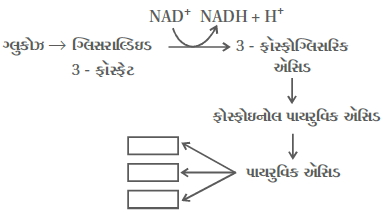
Pyruvic acid is the end product of glycolysis. What are the three metabolic fates of pyruvic acid under aerobic and anaerobic conditions? Write them in the space provided in the diagram.
Solution
(N/A) The three metabolic fates of pyruvic acid are:
$(a)$ Lactic acid: Formed during anaerobic respiration in animal muscle cells (e.g., striated muscles) when oxygen is limited.
$(b)$ Ethanol and $CO_2$: Formed during anaerobic respiration (fermentation) in microorganisms like yeast.
$(c)$ Acetyl $CoA$: Formed during aerobic respiration in the mitochondria, which then enters the Krebs cycle.
The conversion of pyruvic acid to Acetyl $CoA$ is represented by the reaction:
Pyruvic acid $+ CoA + NAD^+ \xrightarrow{Mg^{+2}, \text{Pyruvate dehydrogenase}} \text{Acetyl } CoA + CO_2 + NADH + H^+$
$(a)$ Lactic acid: Formed during anaerobic respiration in animal muscle cells (e.g., striated muscles) when oxygen is limited.
$(b)$ Ethanol and $CO_2$: Formed during anaerobic respiration (fermentation) in microorganisms like yeast.
$(c)$ Acetyl $CoA$: Formed during aerobic respiration in the mitochondria, which then enters the Krebs cycle.
The conversion of pyruvic acid to Acetyl $CoA$ is represented by the reaction:
Pyruvic acid $+ CoA + NAD^+ \xrightarrow{Mg^{+2}, \text{Pyruvate dehydrogenase}} \text{Acetyl } CoA + CO_2 + NADH + H^+$
0 likes
View Solution90
Medium
The energy yield in terms of $ATP$ is higher in aerobic respiration than during anaerobic respiration. Explain.
Solution
(N/A)
| Aerobic Respiration | Anaerobic Respiration |
|---|---|
| $(1)$ In aerobic respiration,there is complete oxidation of substrate molecules,leading to a higher yield of $ATP$ molecules. | $(1)$ In anaerobic respiration,there is incomplete oxidation of substrate molecules,resulting in a significantly lower yield of $ATP$ molecules. |
| $(2)$ Aerobic respiration of one molecule of glucose typically produces $36$ to $38$ $ATP$ molecules,along with $H_{2}O$ and $CO_{2}$. | $(2)$ Anaerobic respiration (fermentation) of one molecule of glucose,for example in yeast,produces only $2$ $ATP$ molecules,along with ethanol and $CO_{2}$. |
0 likes
View Solution91
Easy
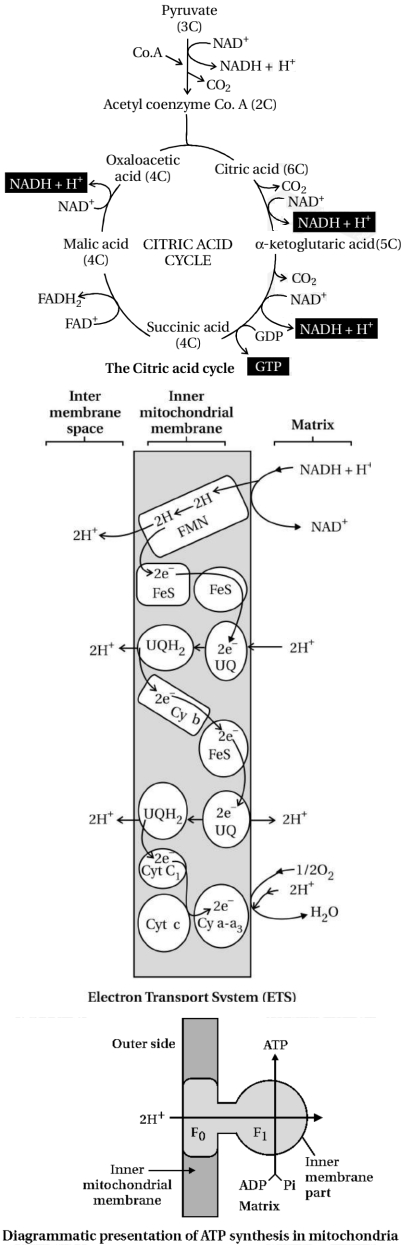
Mention the important series of events of aerobic respiration that occur in the matrix of the mitochondrion as well as one that take place in the inner membrane of the mitochondrion.
Solution
(N/A) The events occurring in the mitochondrial matrix include the Tricarboxylic Acid $(TCA)$ cycle (Krebs cycle). The cycle begins with the condensation of an acetyl group $(2C)$ with oxaloacetic acid ($OAA$,$4C$) and water to yield citric acid $(6C)$,catalyzed by citrate synthase.
Following this,citric acid undergoes isomerization to isocitrate,followed by two successive steps of decarboxylation,forming $\alpha$-ketoglutaric acid and then succinyl-$CoA$.
Succinyl-$CoA$ is then oxidized to $OAA$ to complete the cycle. During this process,$GTP$ is synthesized via substrate-level phosphorylation,which is then converted to $ATP$. Additionally,$NAD^{+}$ is reduced to $NADH + H^{+}$ at three points,and $FAD^{+}$ is reduced to $FADH_{2}$ at one point.
The event occurring in the inner mitochondrial membrane is the Electron Transport System $(ETS)$. In this process,electrons from $NADH$ and $FADH_{2}$ (produced in the matrix) are passed through a series of complexes ($Complex-I$ to $IV$).
As electrons move through the $ETS$,protons $(H^{+})$ are pumped into the intermembrane space,creating a proton gradient. This gradient drives $ATP$ synthase $(Complex-V)$,which synthesizes $ATP$ from $ADP$ and inorganic phosphate $(Pi)$ as protons flow back into the matrix. Oxygen acts as the final electron acceptor,combining with electrons and protons to form water.
Following this,citric acid undergoes isomerization to isocitrate,followed by two successive steps of decarboxylation,forming $\alpha$-ketoglutaric acid and then succinyl-$CoA$.
Succinyl-$CoA$ is then oxidized to $OAA$ to complete the cycle. During this process,$GTP$ is synthesized via substrate-level phosphorylation,which is then converted to $ATP$. Additionally,$NAD^{+}$ is reduced to $NADH + H^{+}$ at three points,and $FAD^{+}$ is reduced to $FADH_{2}$ at one point.
The event occurring in the inner mitochondrial membrane is the Electron Transport System $(ETS)$. In this process,electrons from $NADH$ and $FADH_{2}$ (produced in the matrix) are passed through a series of complexes ($Complex-I$ to $IV$).
As electrons move through the $ETS$,protons $(H^{+})$ are pumped into the intermembrane space,creating a proton gradient. This gradient drives $ATP$ synthase $(Complex-V)$,which synthesizes $ATP$ from $ADP$ and inorganic phosphate $(Pi)$ as protons flow back into the matrix. Oxygen acts as the final electron acceptor,combining with electrons and protons to form water.
0 likes
View Solution92
MediumMCQ
Analogy type questions:
$(1)$ For gas exchange in animals : Specialized organs :: In plants : .......
$(2)$ During aerobic respiration in animals : $CO_2$,water,and energy :: During anaerobic respiration : .....
$(1)$ For gas exchange in animals : Specialized organs :: In plants : .......
$(2)$ During aerobic respiration in animals : $CO_2$,water,and energy :: During anaerobic respiration : .....
A
Stomata and lenticels
B
Lactic acid
C
Ethanol and $CO_2$
D
Both $(1)$ and $(2)$
Solution
(D) $(1)$ In plants,gas exchange occurs through stomata (in leaves) and lenticels (in stems). Thus,the answer is stomata and lenticels.
$(2)$ In animals,anaerobic respiration (e.g.,in muscle cells) produces lactic acid. In other organisms like yeast,it produces ethanol and $CO_2$. Given the context of animal physiology,the primary product of anaerobic respiration is lactic acid.
$(2)$ In animals,anaerobic respiration (e.g.,in muscle cells) produces lactic acid. In other organisms like yeast,it produces ethanol and $CO_2$. Given the context of animal physiology,the primary product of anaerobic respiration is lactic acid.
0 likes
View Solution93
Medium
Analogy type questions:
$(1)$ Krebs cycle : Hans Krebs :: Glycolysis : ......
$(2)$ Glycolysis : Absence of oxygen :: Krebs cycle : ......
$(1)$ Krebs cycle : Hans Krebs :: Glycolysis : ......
$(2)$ Glycolysis : Absence of oxygen :: Krebs cycle : ......
Solution
(N/A) $(1)$ Embden,Meyerhof,and Parnas ($EMP$ pathway).
$(2)$ Presence of oxygen.
$(2)$ Presence of oxygen.
0 likes
View Solution94
MediumMCQ
Select the correct option to complete the following statements:
$(1)$ The $TCA$ cycle begins with the condensation of $OAA$ and water with $Acetyl-CoA$ to yield $Citric$ $acid$.
$(2)$ In fermentation,yeast converts glucose into ethanol under $Anaerobic$ conditions.
$(1)$ The $TCA$ cycle begins with the condensation of $OAA$ and water with $Acetyl-CoA$ to yield $Citric$ $acid$.
$(2)$ In fermentation,yeast converts glucose into ethanol under $Anaerobic$ conditions.
A
$(1)$ Citric acid,$(2)$ Anaerobic
B
$(1)$ Acetic acid,$(2)$ Aerobic
C
$(1)$ Citric acid,$(2)$ Aerobic
D
$(1)$ Acetic acid,$(2)$ Anaerobic
Solution
(A) $(1)$ The $TCA$ cycle (Tricarboxylic Acid cycle) begins with the condensation of the acetyl group with oxaloacetic acid $(OAA)$ and water to yield citric acid,a reaction catalyzed by the enzyme citrate synthase.
$(2)$ Fermentation is a process of incomplete oxidation of glucose that occurs under anaerobic conditions (in the absence of oxygen). In yeast,this process converts glucose into ethanol and carbon dioxide.
$(2)$ Fermentation is a process of incomplete oxidation of glucose that occurs under anaerobic conditions (in the absence of oxygen). In yeast,this process converts glucose into ethanol and carbon dioxide.
0 likes
View Solution95
MediumMCQ
Choose the correct option:
$(1)$ Sucrose is converted into glucose and fructose with the help of the enzyme $Invertase$ / $Maltase$.
$(2)$ In fermentation,glucose is converted into ethanol by yeast under $Aerobic$ / $Anaerobic$ conditions.
$(1)$ Sucrose is converted into glucose and fructose with the help of the enzyme $Invertase$ / $Maltase$.
$(2)$ In fermentation,glucose is converted into ethanol by yeast under $Aerobic$ / $Anaerobic$ conditions.
A
$(1)$ Invertase,$(2)$ Aerobic
B
$(1)$ Invertase,$(2)$ Anaerobic
C
$(1)$ Maltase,$(2)$ Aerobic
D
$(1)$ Maltase,$(2)$ Anaerobic
Solution
(B) $(1)$ Sucrose is a disaccharide. It is hydrolyzed into glucose and fructose by the enzyme $Invertase$.
$(2)$ Fermentation is a type of anaerobic respiration where glucose is partially oxidized into ethanol and $CO_2$ by yeast in the absence of oxygen ($Anaerobic$ conditions).
$(2)$ Fermentation is a type of anaerobic respiration where glucose is partially oxidized into ethanol and $CO_2$ by yeast in the absence of oxygen ($Anaerobic$ conditions).
0 likes
View Solution96
DifficultMCQ
Select the correct option regarding the following statements:
$(1)$ During glycolysis/fermentation,$2 \, ATP$ molecules are produced from one molecule of glucose.
$(2)$ If the respiratory substrate is fat/carbohydrate,the $RQ$ of the respiring cells is less than one.
$(1)$ During glycolysis/fermentation,$2 \, ATP$ molecules are produced from one molecule of glucose.
$(2)$ If the respiratory substrate is fat/carbohydrate,the $RQ$ of the respiring cells is less than one.
A
Statement $(1)$ is correct,Statement $(2)$ is incorrect.
B
Statement $(1)$ is incorrect,Statement $(2)$ is correct.
C
Both statements $(1)$ and $(2)$ are correct.
D
Both statements $(1)$ and $(2)$ are incorrect.
Solution
(A) $(1)$ Glycolysis produces a net gain of $2 \, ATP$ molecules per glucose molecule. Fermentation also results in a net gain of $2 \, ATP$ molecules.
$(2)$ The Respiratory Quotient $(RQ)$ for carbohydrates is $1.0$,while for fats,it is approximately $0.7$. Since the statement claims $RQ$ is less than one for both fats and carbohydrates,it is incorrect because it is not less than one for carbohydrates.
$(2)$ The Respiratory Quotient $(RQ)$ for carbohydrates is $1.0$,while for fats,it is approximately $0.7$. Since the statement claims $RQ$ is less than one for both fats and carbohydrates,it is incorrect because it is not less than one for carbohydrates.
0 likes
View Solution97
MediumMCQ
Select the correct option:
$(1)$ Fermentation / Aerobic respiration does not have an electron transport system.
$(2)$ Combustion / Respiration is a biochemical process.
$(1)$ Fermentation / Aerobic respiration does not have an electron transport system.
$(2)$ Combustion / Respiration is a biochemical process.
A
$(1)$ Fermentation,$(2)$ Respiration
B
$(1)$ Aerobic respiration,$(2)$ Combustion
C
$(1)$ Fermentation,$(2)$ Combustion
D
$(1)$ Aerobic respiration,$(2)$ Respiration
Solution
(A) $(1)$ Fermentation is an anaerobic process that does not involve an electron transport system $(ETS)$,whereas aerobic respiration relies on the $ETS$ located in the inner mitochondrial membrane.
$(2)$ Respiration is a controlled biochemical process occurring within living cells,whereas combustion is a rapid,uncontrolled physical-chemical process that releases energy as heat and light.
$(2)$ Respiration is a controlled biochemical process occurring within living cells,whereas combustion is a rapid,uncontrolled physical-chemical process that releases energy as heat and light.
0 likes
View Solution98
MediumMCQ
$ATP$ formation occurs through which of the following?
A
Photophosphorylation
B
Oxidative phosphorylation
C
Substrate level phosphorylation
D
All of these
Solution
(D) $ATP$ can be synthesized through three primary mechanisms: photophosphorylation,oxidative phosphorylation,and substrate-level phosphorylation.
$1$. Photophosphorylation: $ATP$ is synthesized from $ADP$ and inorganic phosphate using light energy,typically occurring in chloroplasts.
$2$. Substrate-level phosphorylation: $A$ phosphoryl group is directly transferred from a high-energy substrate molecule to $ADP$ to form $ATP$,occurring in glycolysis and the Krebs cycle.
$3$. Oxidative phosphorylation: $ATP$ is synthesized by $ATP$ synthase using the energy derived from the electron transport system,where electrons are transferred from $NADH$ or $FADH_2$ to $O_2$.
$1$. Photophosphorylation: $ATP$ is synthesized from $ADP$ and inorganic phosphate using light energy,typically occurring in chloroplasts.
$2$. Substrate-level phosphorylation: $A$ phosphoryl group is directly transferred from a high-energy substrate molecule to $ADP$ to form $ATP$,occurring in glycolysis and the Krebs cycle.
$3$. Oxidative phosphorylation: $ATP$ is synthesized by $ATP$ synthase using the energy derived from the electron transport system,where electrons are transferred from $NADH$ or $FADH_2$ to $O_2$.
0 likes
View Solution99
MediumMCQ
In which of the following is energy released?
A
Conversion of glucose into pyruvate
B
Formation of proteins from amino acids
C
Conversion of glucose into lactic acid
D
Both $(a)$ and $(c)$
Solution
(D) Energy is released during the breakdown of glucose in both aerobic and anaerobic respiration.
$1$. The conversion of glucose into pyruvate (Glycolysis) is a catabolic process that releases energy in the form of $ATP$ and $NADH$.
$2$. The conversion of glucose into lactic acid (Lactic acid fermentation) is an anaerobic process that also releases energy in the form of $ATP$.
$3$. The formation of proteins from amino acids is an anabolic process that requires energy ($ATP$ consumption),not its release.
Therefore,both $(a)$ and $(c)$ are processes where energy is released.
$1$. The conversion of glucose into pyruvate (Glycolysis) is a catabolic process that releases energy in the form of $ATP$ and $NADH$.
$2$. The conversion of glucose into lactic acid (Lactic acid fermentation) is an anaerobic process that also releases energy in the form of $ATP$.
$3$. The formation of proteins from amino acids is an anabolic process that requires energy ($ATP$ consumption),not its release.
Therefore,both $(a)$ and $(c)$ are processes where energy is released.
0 likes
View Solution100
MediumMCQ
$A$ student has taken a twig from a plant. She/he observes a droplet of fluid exuding from the cut surface of the twig. What is this fluid?
A
Plant latex
B
Phloem sap
C
Xylem sap
D
Both $(b)$ and $(c)$
Solution
(B) When a twig is freshly cut from a plant,the fluid that exudes from the cut surface is primarily phloem sap.
Phloem sap consists of water,sugars (mainly sucrose),amino acids,and other organic nutrients being transported from the source (leaves) to the sink (other plant parts).
Since the phloem is under positive pressure (pressure flow hypothesis),cutting the stem causes the sap to exude from the phloem tubes.
Therefore,the correct answer is $B$.
Phloem sap consists of water,sugars (mainly sucrose),amino acids,and other organic nutrients being transported from the source (leaves) to the sink (other plant parts).
Since the phloem is under positive pressure (pressure flow hypothesis),cutting the stem causes the sap to exude from the phloem tubes.
Therefore,the correct answer is $B$.
0 likes
View SolutionRespiration in Plants — Mix Examples- Respiration in Plants · Frequently Asked Questions
1Are these Respiration in Plants questions useful for JEE and NEET?
Yes. All questions in this section are mapped to JEE Main and NEET exam patterns. Previous year questions from JEE Main, NEET, GUJCET and state-level exams are included with full solutions.
2Can I switch to Hindi or Gujarati for these questions?
Yes. Use the language tabs in the hero section or the sidebar to view the same questions and solutions in English, Hindi or Gujarati.
3How do I generate a question paper from this subtopic?
Use the Vedclass Exam Paper Generator — select the chapter and subtopic, set difficulty, and generate Sets A, B, C, D automatically. First 3 chapters of every subject are free.
Vedclass Products
For Students
Vedclass Test Series
Mock tests in real JEE/NEET style with performance analysis. 5-day free trial.
Start Free TrialFor Teachers
Exam Paper Generator
Generate Set A/B/C/D papers from this chapter in 2 minutes. 3 chapters free.
Try FreeFor Institutes
Online Exam Module
Live online exams with unlimited students, 360° analytics & white-label branding.
See DemoFor Teachers & Institutes
Generate a Respiration in Plants Exam Paper in 2 Minutes
Select subtopic & difficulty — Sets A, B, C, D auto-generated with No Repeat logic.
First 3 chapters of every subject are free — no payment required.