
A English
Mix Examples- Respiration in Plants Questions in English
Class 11 Biology · Respiration in Plants · Mix Examples- Respiration in Plants
141+
Questions
English
Language
100%
With Solutions
Showing 41 of 141 questions in English
101
MediumMCQ
Which of the following statements regarding hydathodes is correct?
A
They open to release excessive pure water from leaves.
B
They contain a loosely arranged parenchyma called epithem.
C
They are found at the tips of the veins in leaves.
D
More than one option is correct.
Solution
(D) Hydathodes are specialized pores found in the epidermis of leaves,typically at the tips or margins of veins.
They are involved in the process of guttation,which is the exudation of water droplets from the leaves.
Key characteristics of hydathodes include:
$1$. They are located at the vein endings (tips of veins).
$2$. They contain a specialized,loosely arranged,chlorophyll-free parenchyma tissue known as epithem.
$3$. They facilitate the release of water (often containing dissolved salts) when root pressure is high.
Since options $A$,$B$,and $C$ are all correct descriptions of hydathodes,the correct choice is $D$.
They are involved in the process of guttation,which is the exudation of water droplets from the leaves.
Key characteristics of hydathodes include:
$1$. They are located at the vein endings (tips of veins).
$2$. They contain a specialized,loosely arranged,chlorophyll-free parenchyma tissue known as epithem.
$3$. They facilitate the release of water (often containing dissolved salts) when root pressure is high.
Since options $A$,$B$,and $C$ are all correct descriptions of hydathodes,the correct choice is $D$.
0 likes
View Solution102
EasyMCQ
For the existence of nitrogen in its stable molecular form,how many nitrogen atoms are required?
A
Three
B
Two
C
Four
D
One
Solution
(B) Nitrogen exists in the atmosphere as a diatomic molecule $(N_2)$.
In this molecule,two nitrogen atoms are bonded together by a triple covalent bond $(N \equiv N)$.
Therefore,two nitrogen atoms are required for the existence of a stable nitrogen molecule.
In this molecule,two nitrogen atoms are bonded together by a triple covalent bond $(N \equiv N)$.
Therefore,two nitrogen atoms are required for the existence of a stable nitrogen molecule.
0 likes
View Solution103
MediumMCQ
Photosynthesis and respiration are similar because:
$I$. In eukaryotes,both processes occur in specialized organelles.
$II$. $ATP$ synthesis in both is explained by the chemiosmotic theory.
$III$. Both use an $ETC$ (Electron Transport Chain).
Select the correct option.
$I$. In eukaryotes,both processes occur in specialized organelles.
$II$. $ATP$ synthesis in both is explained by the chemiosmotic theory.
$III$. Both use an $ETC$ (Electron Transport Chain).
Select the correct option.
A
$I$ and $II$
B
$II$ and $III$
C
$I$ and $III$
D
$I, II$ and $III$
Solution
(D) Photosynthesis and respiration share several fundamental similarities:
$1$. In eukaryotes,photosynthesis occurs in chloroplasts and respiration occurs in mitochondria,both of which are specialized double-membrane organelles.
$2$. The synthesis of $ATP$ in both chloroplasts (photophosphorylation) and mitochondria (oxidative phosphorylation) is explained by the chemiosmotic theory,which involves the establishment of a proton gradient across a membrane.
$3$. Both processes utilize an Electron Transport Chain $(ETC)$ to facilitate the movement of electrons and the generation of the proton motive force required for $ATP$ synthesis.
Therefore,all three statements are correct.
$1$. In eukaryotes,photosynthesis occurs in chloroplasts and respiration occurs in mitochondria,both of which are specialized double-membrane organelles.
$2$. The synthesis of $ATP$ in both chloroplasts (photophosphorylation) and mitochondria (oxidative phosphorylation) is explained by the chemiosmotic theory,which involves the establishment of a proton gradient across a membrane.
$3$. Both processes utilize an Electron Transport Chain $(ETC)$ to facilitate the movement of electrons and the generation of the proton motive force required for $ATP$ synthesis.
Therefore,all three statements are correct.
0 likes
View Solution104
MediumMCQ
What is the correct order of the stages of cellular respiration?
A
Krebs' cycle $-$ Electron transport chain $-$ Glycolysis
B
Electron transport chain $-$ Krebs' cycle $-$ Glycolysis
C
Glycolysis $-$ Krebs' cycle $-$ Electron transport chain
D
Glycolysis $-$ Electron transport chain $-$ Krebs' cycle
Solution
(C) Cellular respiration is a metabolic process that breaks down glucose to release energy.
$1$. Glycolysis: Occurs in the cytoplasm,where glucose is broken down into pyruvate.
$2$. Krebs' cycle (Citric Acid Cycle): Occurs in the mitochondrial matrix,where acetyl-CoA is oxidized to produce $NADH$,$FADH_2$,and $ATP$.
$3$. Electron Transport Chain $(ETC)$: Occurs in the inner mitochondrial membrane,where electrons from $NADH$ and $FADH_2$ are used to create a proton gradient,ultimately producing $ATP$ and water.
$1$. Glycolysis: Occurs in the cytoplasm,where glucose is broken down into pyruvate.
$2$. Krebs' cycle (Citric Acid Cycle): Occurs in the mitochondrial matrix,where acetyl-CoA is oxidized to produce $NADH$,$FADH_2$,and $ATP$.
$3$. Electron Transport Chain $(ETC)$: Occurs in the inner mitochondrial membrane,where electrons from $NADH$ and $FADH_2$ are used to create a proton gradient,ultimately producing $ATP$ and water.
0 likes
View Solution105
EasyMCQ
Steps of respiration are controlled by
A
Substrates
B
Enzymes
C
Hormone
D
Bile juice
Solution
(B) Cellular respiration is a complex metabolic process consisting of a series of biochemical reactions. Each step of these reactions is catalyzed and regulated by specific enzymes to ensure the efficient release of energy in the form of $ATP$.
0 likes
View Solution106
MediumMCQ
The co-factors required for the formation of acetyl $Co-A$ are:
A
$TPP$
B
Lipoic acid
C
$Mg^{2+}, Co-A$
D
All of these
Solution
(D) The formation of acetyl $Co-A$ from pyruvate is catalyzed by the pyruvate dehydrogenase complex.
This reaction requires several co-factors,including $TPP$ (thiamine pyrophosphate),lipoic acid,$Mg^{2+}$,$NAD^+$,and $Co-A$.
Since all the listed options are essential co-factors for this enzymatic process,the correct answer is 'All of these'.
This reaction requires several co-factors,including $TPP$ (thiamine pyrophosphate),lipoic acid,$Mg^{2+}$,$NAD^+$,and $Co-A$.
Since all the listed options are essential co-factors for this enzymatic process,the correct answer is 'All of these'.
0 likes
View Solution107
MediumMCQ
The following is a simplified scheme showing the fate of glucose during aerobic and anaerobic respiration. Identify the end products that are formed at stages indicated as $A, B, C$ and $D$. Identify the correct option from those given below.
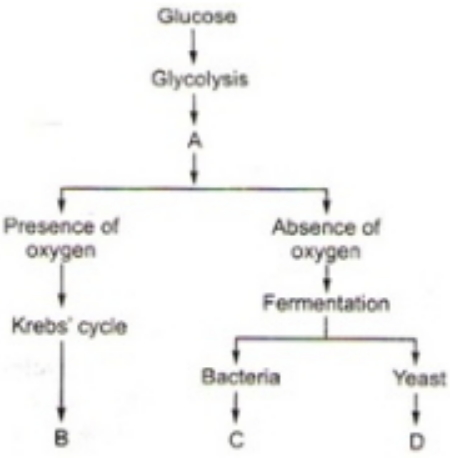
A
$A$- Pyruvic acid,$B$- Carbon dioxide and water,$C$- Lactic acid,$D$- Ethyl alcohol and carbon dioxide
B
$A$- Pyruvic acid,$B$- Carbon dioxide and water,$C$- Ethyl alcohol and carbon dioxide,$D$- Lactic acid
C
$A$- Carbon dioxide and water,$B$- Pyruvic acid,$C$- Ethyl alcohol and carbon dioxide,$D$- Lactic acid
D
$A$- Pyruvic acid,$B$- Ethyl alcohol and carbon dioxide,$C$- Lactic acid,$D$- Carbon dioxide and water
Solution
(A) In the process of respiration,glucose undergoes glycolysis to produce $A$ (Pyruvic acid).
In the presence of oxygen,pyruvic acid enters the Krebs' cycle,resulting in the formation of $B$ ($CO_{2}$ and $H_{2}O$).
In the absence of oxygen (fermentation),pyruvic acid is converted into different products depending on the organism.
In bacteria,it is converted into $C$ (Lactic acid).
In yeast,it is converted into $D$ (Ethyl alcohol and $CO_{2}$).
Therefore,the correct sequence is $A$- Pyruvic acid,$B$- Carbon dioxide and water,$C$- Lactic acid,$D$- Ethyl alcohol and carbon dioxide.
In the presence of oxygen,pyruvic acid enters the Krebs' cycle,resulting in the formation of $B$ ($CO_{2}$ and $H_{2}O$).
In the absence of oxygen (fermentation),pyruvic acid is converted into different products depending on the organism.
In bacteria,it is converted into $C$ (Lactic acid).
In yeast,it is converted into $D$ (Ethyl alcohol and $CO_{2}$).
Therefore,the correct sequence is $A$- Pyruvic acid,$B$- Carbon dioxide and water,$C$- Lactic acid,$D$- Ethyl alcohol and carbon dioxide.
0 likes
View Solution108
MediumMCQ
Breakdown of complex molecules to yield energy takes place in
A
Cytoplasm and mitochondria
B
Chloroplast
C
Cytoplasm and plastids
D
Mitochondria and chloroplast
Solution
(A) The breakdown of complex molecules (glucose) to yield energy occurs through cellular respiration.
In eukaryotes,this process involves two main stages:
$1$. Glycolysis: This occurs in the cytoplasm,where glucose is broken down into pyruvate.
$2$. Krebs cycle ($TCA$ cycle) and Electron Transport System $(ETS)$: These occur in the mitochondria,where pyruvate is further oxidized to produce $ATP$.
Therefore,the correct answer is Cytoplasm and mitochondria.
In eukaryotes,this process involves two main stages:
$1$. Glycolysis: This occurs in the cytoplasm,where glucose is broken down into pyruvate.
$2$. Krebs cycle ($TCA$ cycle) and Electron Transport System $(ETS)$: These occur in the mitochondria,where pyruvate is further oxidized to produce $ATP$.
Therefore,the correct answer is Cytoplasm and mitochondria.
0 likes
View Solution109
MediumMCQ
Which of the following substances can undergo oxidation and release energy?
A
Inorganic acids
B
Organic food
C
Organic acid
D
Both $(b) \& (c)$
Solution
(D) Organic food (such as carbohydrates,proteins,and fats) and organic acids (such as malic acid) undergo a catabolic process known as cellular respiration to release energy in the form of $ATP$.
0 likes
View Solution110
MediumMCQ
Mark the incorrect statement.
A
Breaking of $C-C$ bonds of complex organic molecules by oxidation in cells leading to the release of a lot of energy is called cellular respiration.
B
Initial stage of cellular respiration takes place in the cytoplasm.
C
Incomplete oxidation of pyruvate by the stepwise removal of all the hydrogen atoms,leaving three molecules of $CO_2$.
D
$TCA$ cycle starts with the condensation of acetyl group with $OAA$ and $H_2O$ to yield citric acid.
Solution
(C) The correct answer is $C$. The statement in option $C$ is incorrect because complete oxidation of pyruvate involves the removal of all hydrogen atoms and the release of three molecules of $CO_2$ in the mitochondrial matrix during the $TCA$ cycle. Incomplete oxidation,such as in fermentation,does not release three molecules of $CO_2$ and does not involve the complete removal of all hydrogen atoms.
0 likes
View Solution111
MediumMCQ
Transfer of yeast cells from anaerobic to aerobic condition will
A
Decrease sugar breakdown
B
Decrease $CO_2$ evolution
C
Increase $CO_2$ evolution
D
More than one option is correct
Solution
(D) When yeast cells are transferred from anaerobic to aerobic conditions,the Pasteur effect occurs. In anaerobic conditions,yeast performs fermentation,which is less efficient in terms of $ATP$ production,requiring a higher rate of sugar breakdown to meet energy demands. In aerobic conditions,cellular respiration is much more efficient,leading to a decrease in the rate of sugar breakdown. Consequently,the rate of $CO_2$ evolution also decreases compared to the high rate observed during fermentation. Therefore,both sugar breakdown and $CO_2$ evolution decrease.
0 likes
View Solution112
MediumMCQ
$A$: In $PPP$ $(HMS)$,complete oxidation of one glucose molecule would produce $6CO_2$ molecules and $12$ $NADPH_2$ molecules.
$R$: It occurs in cytoplasm and chloroplast,in presence of $O_2$.
$R$: It occurs in cytoplasm and chloroplast,in presence of $O_2$.
A
Assertion and Reason both are correct and Reason is the correct explanation of Assertion.
B
Assertion and Reason both are correct but Reason is not the correct explanation of Assertion.
C
Assertion is correct,but Reason is incorrect.
D
Both Assertion and Reason are incorrect.
Solution
(C) The Pentose Phosphate Pathway $(PPP)$,also known as the Hexose Monophosphate Shunt $(HMS)$,is an alternative pathway for glucose oxidation.
In this pathway,one molecule of glucose-$6$-phosphate is completely oxidized to produce $6CO_2$ and $12$ $NADPH_2$ molecules.
Therefore,the Assertion is correct.
However,the Reason is incorrect because $PPP$ is an anaerobic process that occurs in the cytoplasm of the cell and does not require $O_2$.
In this pathway,one molecule of glucose-$6$-phosphate is completely oxidized to produce $6CO_2$ and $12$ $NADPH_2$ molecules.
Therefore,the Assertion is correct.
However,the Reason is incorrect because $PPP$ is an anaerobic process that occurs in the cytoplasm of the cell and does not require $O_2$.
0 likes
View Solution113
MediumMCQ
$A$: Four $ATP$ molecules are produced directly during glycolysis.
$R$: Substrate level phosphorylation occurs at two steps for a glucose broken down in mitochondrial matrix.
$R$: Substrate level phosphorylation occurs at two steps for a glucose broken down in mitochondrial matrix.
A
Assertion and Reason both are correct and Reason is the correct explanation of Assertion.
B
Assertion and Reason both are correct but Reason is not the correct explanation of Assertion.
C
Assertion is correct,but Reason is incorrect.
D
Both Assertion and Reason are incorrect.
Solution
(D) In glycolysis,$4$ $ATP$ molecules are produced by substrate-level phosphorylation,but $2$ $ATP$ molecules are consumed during the preparatory phase. Thus,the net gain is $2$ $ATP$. The statement that $4$ $ATP$ are produced 'directly' is often interpreted as the gross yield,but in the context of standard biological questions,the assertion is considered incorrect because the net yield is $2$ $ATP$.
Regarding the Reason,substrate-level phosphorylation in the mitochondrial matrix occurs during the Krebs cycle (Citric Acid Cycle) at only one step: the conversion of succinyl-$CoA$ to succinate. Therefore,the Reason is also incorrect.
Regarding the Reason,substrate-level phosphorylation in the mitochondrial matrix occurs during the Krebs cycle (Citric Acid Cycle) at only one step: the conversion of succinyl-$CoA$ to succinate. Therefore,the Reason is also incorrect.
0 likes
View Solution114
MediumMCQ
The lactic acid generated during muscle contraction is converted to glycogen in
A
Muscles
B
Kidney
C
Pancreas
D
Liver
Solution
(D) During intense muscle contraction,anaerobic respiration leads to the accumulation of lactic acid in the muscle cells.
This lactic acid is transported via the blood to the liver.
In the liver,the process known as the Cori cycle occurs,where lactic acid is converted back into pyruvic acid and subsequently into glucose or glycogen through gluconeogenesis.
Therefore,the liver is the primary site for the conversion of lactic acid into glycogen.
This lactic acid is transported via the blood to the liver.
In the liver,the process known as the Cori cycle occurs,where lactic acid is converted back into pyruvic acid and subsequently into glucose or glycogen through gluconeogenesis.
Therefore,the liver is the primary site for the conversion of lactic acid into glycogen.
0 likes
View Solution115
EasyMCQ
The soil with the poorest water-holding capacity is
A
Clay
B
Loam
C
Sandy
D
None of these
Solution
(C) Water-holding capacity is the extent to which a soil can hold capillary water against gravity.
It is defined as the amount of water retained by a unit weight of dry soil when immersed in water under standardized conditions.
Sandy soil consists of large particles with large pore spaces,which allows water to drain away quickly,resulting in the poorest water-holding capacity among soil types.
It is defined as the amount of water retained by a unit weight of dry soil when immersed in water under standardized conditions.
Sandy soil consists of large particles with large pore spaces,which allows water to drain away quickly,resulting in the poorest water-holding capacity among soil types.
0 likes
View Solution116
MediumMCQ
Select the correct statement regarding microfibrils.
A
They are present in guard cells.
B
They are made of cellulose.
C
They are arranged in a radial orientation,which facilitates the opening of the stomatal pore.
D
All of the above.
Solution
(D) Microfibrils in the guard cells are composed of cellulose.
These cellulose microfibrils are arranged in a radial orientation rather than a longitudinal one.
This specific radial arrangement allows the guard cells to expand more easily in length and width,which pulls the inner walls apart and facilitates the opening of the stomatal pore during turgidity.
These cellulose microfibrils are arranged in a radial orientation rather than a longitudinal one.
This specific radial arrangement allows the guard cells to expand more easily in length and width,which pulls the inner walls apart and facilitates the opening of the stomatal pore during turgidity.
0 likes
View Solution117
EasyMCQ
Select the correct option for respiratory substrates.
A
They are the reactants of the respiration process.
B
Proteins,fats,and organic acids are examples of respiratory substrates.
C
The compounds that are oxidized during the process of respiration are called respiratory substrates.
D
All of the above.
Solution
(D) Respiratory substrates are the organic compounds that are oxidized during the process of respiration to release energy.
$1$. They act as reactants in the respiration process.
$2$. Carbohydrates are the most common respiratory substrates,but proteins,fats,and organic acids can also be used as respiratory substrates under certain conditions.
Therefore,all the given statements are correct.
$1$. They act as reactants in the respiration process.
$2$. Carbohydrates are the most common respiratory substrates,but proteins,fats,and organic acids can also be used as respiratory substrates under certain conditions.
Therefore,all the given statements are correct.
0 likes
View Solution118
MediumMCQ
Select the correct statements from the following:
$I-$ During respiration,plants take in $CO_2$ and release $O_2$.
$II-$ The surface of most cells in plants is in contact with air.
$III-$ The loose arrangement of parenchyma cells in leaves,stems,and roots creates a network of air spaces.
$IV-$ The energy released during respiration is stored in the form of $ATP$.
$V-$ Glucose is oxidized to release energy in only a single step.
$I-$ During respiration,plants take in $CO_2$ and release $O_2$.
$II-$ The surface of most cells in plants is in contact with air.
$III-$ The loose arrangement of parenchyma cells in leaves,stems,and roots creates a network of air spaces.
$IV-$ The energy released during respiration is stored in the form of $ATP$.
$V-$ Glucose is oxidized to release energy in only a single step.
A
$2$
B
$3$
C
$4$
D
$5$
Solution
(B) Let's analyze each statement:
$I-$ Incorrect. During respiration,plants take in $O_2$ and release $CO_2$. The statement describes photosynthesis.
$II-$ Correct. In plants,most cells are located near the surface and are in contact with air,allowing for gas exchange.
$III-$ Correct. Parenchyma cells in leaves,stems,and roots are loosely arranged,forming a network of air spaces that facilitate gas diffusion.
$IV-$ Correct. The energy released during cellular respiration is trapped in the form of $ATP$ (Adenosine Triphosphate).
$V-$ Incorrect. Glucose oxidation occurs through a series of slow,stepwise reactions (like Glycolysis and the $TCA$ cycle) to ensure energy is released in a controlled manner,not in a single step.
Therefore,statements $II, III,$ and $IV$ are correct. The total number of correct statements is $3$.
$I-$ Incorrect. During respiration,plants take in $O_2$ and release $CO_2$. The statement describes photosynthesis.
$II-$ Correct. In plants,most cells are located near the surface and are in contact with air,allowing for gas exchange.
$III-$ Correct. Parenchyma cells in leaves,stems,and roots are loosely arranged,forming a network of air spaces that facilitate gas diffusion.
$IV-$ Correct. The energy released during cellular respiration is trapped in the form of $ATP$ (Adenosine Triphosphate).
$V-$ Incorrect. Glucose oxidation occurs through a series of slow,stepwise reactions (like Glycolysis and the $TCA$ cycle) to ensure energy is released in a controlled manner,not in a single step.
Therefore,statements $II, III,$ and $IV$ are correct. The total number of correct statements is $3$.
0 likes
View Solution119
MediumMCQ
Match the following columns:
| Column-$I$ | Column-$II$ |
|---|---|
| $P$. Aerobic respiration | $I$. Yeast |
| $Q$. Lactic acid fermentation | $II$. Some bacteria and animal muscles |
| $R$. Alcoholic fermentation | $III$. Human leukocytes |
A
$P-III, Q-II, R-I$
B
$P-I, Q-II, R-III$
C
$P-III, Q-I, R-II$
D
$P-II, Q-III, R-I$
Solution
(C) The correct matches are as follows:
$P$. Aerobic respiration: Occurs in human leukocytes (white blood cells) which require oxygen for energy production. Thus,$P-III$.
$Q$. Lactic acid fermentation: Occurs in some bacteria and animal muscle cells during anaerobic conditions. Thus,$Q-II$.
$R$. Alcoholic fermentation: Occurs in yeast,where pyruvic acid is converted into ethanol and $CO_2$. Thus,$R-I$.
Therefore,the correct matching is $P-III, Q-II, R-I$.
$P$. Aerobic respiration: Occurs in human leukocytes (white blood cells) which require oxygen for energy production. Thus,$P-III$.
$Q$. Lactic acid fermentation: Occurs in some bacteria and animal muscle cells during anaerobic conditions. Thus,$Q-II$.
$R$. Alcoholic fermentation: Occurs in yeast,where pyruvic acid is converted into ethanol and $CO_2$. Thus,$R-I$.
Therefore,the correct matching is $P-III, Q-II, R-I$.
0 likes
View Solution120
MediumMCQ
How many molecules of $CO_2$ are released during the complete oxidation of one molecule of pyruvic acid?
A
$1$
B
$3$
C
$2$
D
$6$
Solution
(B) Pyruvic acid $(CH_3COCOOH)$ is a $3$-carbon compound produced at the end of glycolysis.
During aerobic respiration,pyruvic acid undergoes oxidative decarboxylation to form Acetyl-CoA,releasing one molecule of $CO_2$.
Subsequently,the Acetyl-CoA enters the Krebs cycle (Tricarboxylic Acid Cycle),where it is completely oxidized to release two more molecules of $CO_2$.
Therefore,the total number of $CO_2$ molecules released during the complete oxidation of one molecule of pyruvic acid is $1 + 2 = 3$.
During aerobic respiration,pyruvic acid undergoes oxidative decarboxylation to form Acetyl-CoA,releasing one molecule of $CO_2$.
Subsequently,the Acetyl-CoA enters the Krebs cycle (Tricarboxylic Acid Cycle),where it is completely oxidized to release two more molecules of $CO_2$.
Therefore,the total number of $CO_2$ molecules released during the complete oxidation of one molecule of pyruvic acid is $1 + 2 = 3$.
0 likes
View Solution121
MediumMCQ
Select the correct option regarding the relationship between the components of aerobic respiration.
A
$Electron \text{ } Transport \text{ } System = Oxidative \text{ } Phosphorylation + ATP \text{ } Synthase$
B
$Oxidative \text{ } Phosphorylation = Electron \text{ } Transport \text{ } System + ATP \text{ } Synthase$
C
$ATP \text{ } Synthase = Oxidative \text{ } Phosphorylation + Electron \text{ } Transport \text{ } System$
D
None of the above.
Solution
(B) The process of aerobic respiration involves the Electron Transport System $(ETS)$ and Oxidative Phosphorylation.
$ETS$ refers to the series of complexes ($I$ through $IV$) that transfer electrons to oxygen, creating a proton gradient.
Oxidative Phosphorylation is the overall process by which $ATP$ is synthesized using the energy derived from the electron transport chain.
This synthesis is catalyzed by the enzyme $ATP$ Synthase (Complex $V$).
Therefore, Oxidative Phosphorylation is the combined result of the $ETS$ (which creates the proton motive force) and the activity of $ATP$ Synthase (which utilizes that force to produce $ATP$).
Thus, the correct relationship is $Oxidative \text{ } Phosphorylation = Electron \text{ } Transport \text{ } System + ATP \text{ } Synthase$.
$ETS$ refers to the series of complexes ($I$ through $IV$) that transfer electrons to oxygen, creating a proton gradient.
Oxidative Phosphorylation is the overall process by which $ATP$ is synthesized using the energy derived from the electron transport chain.
This synthesis is catalyzed by the enzyme $ATP$ Synthase (Complex $V$).
Therefore, Oxidative Phosphorylation is the combined result of the $ETS$ (which creates the proton motive force) and the activity of $ATP$ Synthase (which utilizes that force to produce $ATP$).
Thus, the correct relationship is $Oxidative \text{ } Phosphorylation = Electron \text{ } Transport \text{ } System + ATP \text{ } Synthase$.
0 likes
View Solution122
MediumMCQ
Match List $-I$ with List $-II :$
Choose the correct answer from the options given below:
| List $-I$ | List $-II$ |
|---|---|
| $a$. Porins | $i$. Pink coloured nodules |
| $b$. Leg-haemoglobin | $ii$. Lumen of thylakoid |
| $c$. $H^{+}$ accumulation | $iii$. Amphibolic pathway |
| $d$. Respiration | $iv$. Huge pores in outer membrane of mitochondria |
Choose the correct answer from the options given below:
A
$(a) - (ii), (b) - (i), (c) - (iv), (d) - (iii)$
B
$(a) - (iv), (b) - (i), (c) - (ii), (d) - (iii)$
C
$(a) - (iii), (b) - (iv), (c) - (ii), (d) - (i)$
D
$(a) - (ii), (b) - (iv), (c) - (i), (d) - (iii)$
Solution
(B) The correct matches are as follows:
$a$. Porins are proteins that form huge pores in the outer membranes of mitochondria,plastids,and some bacteria. Thus,$a - iv$.
$b$. Leg-haemoglobin is a pigment found in the root nodules of leguminous plants,which gives them a pink colour. Thus,$b - i$.
$c$. $H^{+}$ accumulation occurs in the lumen of the thylakoid during the light reaction of photosynthesis. Thus,$c - ii$.
$d$. Respiration is considered an amphibolic pathway because it involves both catabolic (breakdown) and anabolic (synthesis) processes. Thus,$d - iii$.
Therefore,the correct sequence is $(a) - (iv), (b) - (i), (c) - (ii), (d) - (iii)$.
$a$. Porins are proteins that form huge pores in the outer membranes of mitochondria,plastids,and some bacteria. Thus,$a - iv$.
$b$. Leg-haemoglobin is a pigment found in the root nodules of leguminous plants,which gives them a pink colour. Thus,$b - i$.
$c$. $H^{+}$ accumulation occurs in the lumen of the thylakoid during the light reaction of photosynthesis. Thus,$c - ii$.
$d$. Respiration is considered an amphibolic pathway because it involves both catabolic (breakdown) and anabolic (synthesis) processes. Thus,$d - iii$.
Therefore,the correct sequence is $(a) - (iv), (b) - (i), (c) - (ii), (d) - (iii)$.
0 likes
View Solution123
MediumMCQ
Match List-$I$ with List-$II$ :
Choose the correct answer from the options given below :
| List-$I$ | List-$II$ |
| $A$. Oxidative decarboxylation | $I$. Citrate synthase |
| $B$. Glycolysis | $II$. Pyruvate dehydrogenase |
| $C$. Oxidative phosphorylation | $III$. Electron transport system |
| $D$. Tricarboxylic acid cycle | $IV$. $EMP$ pathway |
Choose the correct answer from the options given below :
A
$A-II, B-IV, C-III, D-I$
B
$A-III, B-IV, C-II, D-I$
C
$A-II, B-IV, C-I, D-III$
D
$A-III, B-I, C-II, D-IV$
Solution
(A) $1$. Oxidative decarboxylation: Pyruvate, formed by glycolysis in the cytosol, enters the mitochondrial matrix and undergoes oxidative decarboxylation catalyzed by the enzyme complex pyruvate dehydrogenase $(A-II)$.
$2$. Glycolysis: The scheme of glycolysis was proposed by Gustav Embden, Otto Meyerhof, and $J$. Parnas, and is commonly known as the $EMP$ pathway $(B-IV)$.
$3$. Oxidative phosphorylation: In the electron transport system, the energy from oxidation-reduction reactions is used to create a proton gradient, which drives the phosphorylation of $ADP$ to $ATP$ $(C-III)$.
$4$. Tricarboxylic acid cycle $(TCA)$: The $TCA$ cycle begins with the condensation of an acetyl group with oxaloacetic acid $(OAA)$ and water to form citric acid, a reaction catalyzed by citrate synthase $(D-I)$.
Therefore, the correct matching is $A-II, B-IV, C-III, D-I$.
$2$. Glycolysis: The scheme of glycolysis was proposed by Gustav Embden, Otto Meyerhof, and $J$. Parnas, and is commonly known as the $EMP$ pathway $(B-IV)$.
$3$. Oxidative phosphorylation: In the electron transport system, the energy from oxidation-reduction reactions is used to create a proton gradient, which drives the phosphorylation of $ADP$ to $ATP$ $(C-III)$.
$4$. Tricarboxylic acid cycle $(TCA)$: The $TCA$ cycle begins with the condensation of an acetyl group with oxaloacetic acid $(OAA)$ and water to form citric acid, a reaction catalyzed by citrate synthase $(D-I)$.
Therefore, the correct matching is $A-II, B-IV, C-III, D-I$.
0 likes
View Solution124
MediumMCQ
Match List $I$ with List $II$:
Choose the correct answer from the options given below:
| List $I$ | List $II$ |
|---|---|
| $A$. Citric acid cycle | $I$. Cytoplasm |
| $B$. Glycolysis | $II$. Mitochondrial matrix |
| $C$. Electron transport system | $III$. Intermembrane space of mitochondria |
| $D$. Proton gradient | $IV$. Inner mitochondrial membrane |
Choose the correct answer from the options given below:
A
$A-II, B-I, C-IV, D-III$
B
$A-III, B-IV, C-I, D-II$
C
$A-IV, B-III, C-II, D-I$
D
$A-I, B-II, C-III, D-IV$
Solution
(A) The Citric acid cycle (Krebs cycle) takes place in the mitochondrial matrix.
Glycolysis occurs in the cytoplasm (cytosol) of the cell.
The Electron transport system $(ETS)$ is located on the inner mitochondrial membrane.
$A$ proton gradient is established across the inner mitochondrial membrane,accumulating protons in the intermembrane space of the mitochondria.
Therefore,the correct matching is $A-II, B-I, C-IV, D-III$.
Glycolysis occurs in the cytoplasm (cytosol) of the cell.
The Electron transport system $(ETS)$ is located on the inner mitochondrial membrane.
$A$ proton gradient is established across the inner mitochondrial membrane,accumulating protons in the intermembrane space of the mitochondria.
Therefore,the correct matching is $A-II, B-I, C-IV, D-III$.
0 likes
View Solution125
EasyMCQ
Which of the following is not correct with reference to fermentation and aerobic respiration?
A
Fermentation accounts for only a partial breakdown of glucose.
B
Relatively more molecules of $ATP$ are generated under aerobic conditions.
C
In fermentation there is a net gain of only two molecules of $ATP$ for each molecule of sucrose degraded to pyruvic acid.
D
$NADH$ is oxidised to $NAD^+$ quite vigorously in aerobic respiration.
Solution
(C) $1$. Fermentation involves the partial breakdown of glucose into ethanol or lactic acid,which is correct.
$2$. Aerobic respiration yields significantly more $ATP$ molecules compared to fermentation,which is correct.
$3$. In fermentation,glucose is broken down into pyruvic acid,and then further into ethanol or lactic acid. The net gain of $ATP$ is $2$ molecules per glucose molecule. However,the statement mentions sucrose. Sucrose is a disaccharide that breaks down into glucose and fructose. Therefore,the degradation of one molecule of sucrose yields $4$ molecules of $ATP$ (as it produces two glucose units),not $2$. Thus,this statement is incorrect.
$4$. In aerobic respiration,$NADH$ is oxidized to $NAD^+$ through the electron transport system,which is correct.
$2$. Aerobic respiration yields significantly more $ATP$ molecules compared to fermentation,which is correct.
$3$. In fermentation,glucose is broken down into pyruvic acid,and then further into ethanol or lactic acid. The net gain of $ATP$ is $2$ molecules per glucose molecule. However,the statement mentions sucrose. Sucrose is a disaccharide that breaks down into glucose and fructose. Therefore,the degradation of one molecule of sucrose yields $4$ molecules of $ATP$ (as it produces two glucose units),not $2$. Thus,this statement is incorrect.
$4$. In aerobic respiration,$NADH$ is oxidized to $NAD^+$ through the electron transport system,which is correct.
0 likes
View Solution126
EasyMCQ
Match the following columns:
| Column-$I$ | Column-$II$ |
| $(A)$ $RQ$ of fats | $(I)$ Less than $7$ percent |
| $(B)$ Energy released in fermentation | $(II)$ Less than $1$ |
| $(C)$ $RQ$ of glucose | $(III)$ $1$ |
| $(D)$ Net $\text{ATP}$ produced in fermentation | $(IV)$ $2$ |
A
$A-I, B-II, C-IV, D-III$
B
$A-II, B-IV, C-III, D-I$
C
$A-III, B-II, C-I, D-IV$
D
$A-II, B-I, C-III, D-IV$
Solution
(D) The Respiratory Quotient $(RQ)$ is the ratio of the volume of $\text{CO}_2$ evolved to the volume of $\text{O}_2$ consumed.
$(A)$ The $RQ$ of fats is always less than $1$ (typically about $0.7$). Thus,$A-II$.
$(B)$ Fermentation is an incomplete oxidation process,releasing less than $7$ percent of the energy present in glucose. Thus,$B-I$.
$(C)$ The $RQ$ of glucose (a carbohydrate) is $1$ because the volume of $\text{CO}_2$ evolved equals the volume of $\text{O}_2$ consumed. Thus,$C-III$.
$(D)$ In fermentation,the net gain of $\text{ATP}$ per glucose molecule is $2$. Thus,$D-IV$.
Therefore,the correct matching is $A-II, B-I, C-III, D-IV$.
$(A)$ The $RQ$ of fats is always less than $1$ (typically about $0.7$). Thus,$A-II$.
$(B)$ Fermentation is an incomplete oxidation process,releasing less than $7$ percent of the energy present in glucose. Thus,$B-I$.
$(C)$ The $RQ$ of glucose (a carbohydrate) is $1$ because the volume of $\text{CO}_2$ evolved equals the volume of $\text{O}_2$ consumed. Thus,$C-III$.
$(D)$ In fermentation,the net gain of $\text{ATP}$ per glucose molecule is $2$. Thus,$D-IV$.
Therefore,the correct matching is $A-II, B-I, C-III, D-IV$.
0 likes
View Solution127
MediumMCQ
Match the following and choose the correct option from those given below.
| Column $A$ | Column $B$ |
|---|---|
| $A$. Molecular oxygen | $(i)$. $\alpha$-Ketoglutaric acid |
| $B$. Electron acceptor | $(ii)$. Hydrogen acceptor |
| $C$. Pyruvate dehydrogenase | $(iii)$. Cytochrome $c$ |
| $D$. Decarboxylation | $(iv)$. Acetyl $CoA$ |
A
$A-(ii), B-(iii), C-(iv), D-(i)$
B
$A-(iii), B-(iv), C-(ii), D-(i)$
C
$A-(ii), B-(i), C-(iii), D-(iv)$
D
$A-(iv), B-(iii), C-(i), D-(ii)$
Solution
(A) . Molecular oxygen acts as the final hydrogen acceptor in the electron transport system $(ETS)$.
$B$. Cytochrome $c$ is a small protein attached to the outer surface of the inner mitochondrial membrane and acts as a mobile electron carrier (electron acceptor).
$C$. Pyruvate dehydrogenase is the enzyme complex responsible for the oxidative decarboxylation of pyruvate to form Acetyl $CoA$.
$D$. $\alpha$-Ketoglutaric acid is involved in the Krebs cycle where decarboxylation occurs.
Therefore,the correct matching is $A-(ii), B-(iii), C-(iv), D-(i)$.
$B$. Cytochrome $c$ is a small protein attached to the outer surface of the inner mitochondrial membrane and acts as a mobile electron carrier (electron acceptor).
$C$. Pyruvate dehydrogenase is the enzyme complex responsible for the oxidative decarboxylation of pyruvate to form Acetyl $CoA$.
$D$. $\alpha$-Ketoglutaric acid is involved in the Krebs cycle where decarboxylation occurs.
Therefore,the correct matching is $A-(ii), B-(iii), C-(iv), D-(i)$.
0 likes
View Solution128
MediumMCQ
Read the following statements and choose the set of correct statements :
$(A)$ In fermentation,the reducing agent is $NADH + H^+$.
$(B)$ There are three major ways in which different cells handle pyruvic acid produced by glycolysis.
$(C)$ The complete oxidation of pyruvate occurs by the stepwise removal of all the hydrogen atoms,leaving two molecules of $CO_2$.
$(D)$ The $NADH$ synthesised in glycolysis is transferred into the mitochondria and undergoes oxidative phosphorylation.
$(E)$ Complex-$IV$ of $ETS$ refers to cytochrome $c$ oxidase complex.
Choose the most appropriate answer from the options given below :
$(A)$ In fermentation,the reducing agent is $NADH + H^+$.
$(B)$ There are three major ways in which different cells handle pyruvic acid produced by glycolysis.
$(C)$ The complete oxidation of pyruvate occurs by the stepwise removal of all the hydrogen atoms,leaving two molecules of $CO_2$.
$(D)$ The $NADH$ synthesised in glycolysis is transferred into the mitochondria and undergoes oxidative phosphorylation.
$(E)$ Complex-$IV$ of $ETS$ refers to cytochrome $c$ oxidase complex.
Choose the most appropriate answer from the options given below :
A
$D$ and $E$ only
B
$A$ and $D$ only
C
$A, B$ and $D$ only
D
$B, C$ and $D$ only
Solution
(C) Statement $(A)$ is correct: In fermentation,$NADH + H^+$ acts as the reducing agent to reduce pyruvate to lactic acid or acetaldehyde to ethanol.
Statement $(B)$ is correct: Cells handle pyruvic acid in three major ways: lactic acid fermentation,alcoholic fermentation,and aerobic respiration.
Statement $(C)$ is incorrect: The complete oxidation of pyruvate involves the removal of all hydrogen atoms and the release of $3$ molecules of $CO_2$ (one in the link reaction and two in the Krebs cycle),not $2$.
Statement $(D)$ is correct: In aerobic respiration,$NADH$ produced in the cytoplasm during glycolysis is transported into the mitochondria to enter the electron transport system $(ETS)$ for oxidative phosphorylation.
Statement $(E)$ is incorrect: Complex-$IV$ of $ETS$ is the cytochrome $c$ oxidase complex,not the cytochrome $c$ reductase complex (which is Complex-$III$).
Therefore,statements $(A), (B),$ and $(D)$ are correct.
Statement $(B)$ is correct: Cells handle pyruvic acid in three major ways: lactic acid fermentation,alcoholic fermentation,and aerobic respiration.
Statement $(C)$ is incorrect: The complete oxidation of pyruvate involves the removal of all hydrogen atoms and the release of $3$ molecules of $CO_2$ (one in the link reaction and two in the Krebs cycle),not $2$.
Statement $(D)$ is correct: In aerobic respiration,$NADH$ produced in the cytoplasm during glycolysis is transported into the mitochondria to enter the electron transport system $(ETS)$ for oxidative phosphorylation.
Statement $(E)$ is incorrect: Complex-$IV$ of $ETS$ is the cytochrome $c$ oxidase complex,not the cytochrome $c$ reductase complex (which is Complex-$III$).
Therefore,statements $(A), (B),$ and $(D)$ are correct.
0 likes
View Solution129
EasyMCQ
During respiration,substrate level phosphorylation occurs in . . . . . . .
A
Cytoplasm only
B
Mitochondrial matrix only
C
Cytoplasm and mitochondrial matrix
D
Intermembrane space of mitochondria
Solution
(C) Substrate-level phosphorylation is the direct synthesis of $ATP$ from $ADP$ by the transfer of a phosphate group from a high-energy phosphorylated intermediate substrate.
In glycolysis,which occurs in the cytoplasm,substrate-level phosphorylation takes place during the conversion of $1,3-bisphosphoglycerate$ to $3-phosphoglycerate$ and $phosphoenolpyruvate$ to $pyruvate$.
In the Krebs cycle (citric acid cycle),which occurs in the mitochondrial matrix,substrate-level phosphorylation takes place during the conversion of $succinyl-CoA$ to $succinate$.
In glycolysis,which occurs in the cytoplasm,substrate-level phosphorylation takes place during the conversion of $1,3-bisphosphoglycerate$ to $3-phosphoglycerate$ and $phosphoenolpyruvate$ to $pyruvate$.
In the Krebs cycle (citric acid cycle),which occurs in the mitochondrial matrix,substrate-level phosphorylation takes place during the conversion of $succinyl-CoA$ to $succinate$.
0 likes
View Solution130
EasyMCQ
During how many steps is Co-$A$ used in aerobic respiration?
A
One
B
Two
C
Three
D
Nil
Solution
(B) Co-$A$ (Coenzyme $A$) is used in two specific steps during aerobic respiration:
$1$. During the link reaction,where pyruvate is converted into acetyl-CoA by the enzyme pyruvate dehydrogenase complex.
$2$. During the citric acid cycle (Krebs cycle),where $\alpha$-ketoglutarate is converted into succinyl-CoA by the $\alpha$-ketoglutarate dehydrogenase complex,releasing $CO_2$.
$1$. During the link reaction,where pyruvate is converted into acetyl-CoA by the enzyme pyruvate dehydrogenase complex.
$2$. During the citric acid cycle (Krebs cycle),where $\alpha$-ketoglutarate is converted into succinyl-CoA by the $\alpha$-ketoglutarate dehydrogenase complex,releasing $CO_2$.
0 likes
View Solution131
EasyMCQ
Match the processes involved in aerobic respiration given in Column-$I$ with their occurrence in the cell from Column-$II$ and choose the correct option.
| Column-$I$ | Column-$II$ |
| $i$. Glycolysis | $b$. Cytoplasm |
| $ii$. Krebs cycle | $a$. Mitochondrial matrix |
| $iii$. $ETS$ | $c$. Inner mitochondrial membrane |
A
$i-b, ii-a, iii-c$
B
$i-c, ii-b, iii-a$
C
$i-c, ii-a, iii-b$
D
$i-a, ii-c, iii-b$
Solution
(A) The process of aerobic respiration occurs in different parts of the cell:
$1$. Glycolysis occurs in the cytoplasm of the cell,where glucose is broken down into pyruvate.
$2$. The Krebs cycle ($TCA$ cycle) takes place in the mitochondrial matrix.
$3$. The Electron Transport System $(ETS)$ is located on the inner mitochondrial membrane.
Therefore,the correct matching is $i-b, ii-a, iii-c$.
$1$. Glycolysis occurs in the cytoplasm of the cell,where glucose is broken down into pyruvate.
$2$. The Krebs cycle ($TCA$ cycle) takes place in the mitochondrial matrix.
$3$. The Electron Transport System $(ETS)$ is located on the inner mitochondrial membrane.
Therefore,the correct matching is $i-b, ii-a, iii-c$.
0 likes
View Solution132
EasyMCQ
Given below are two statements:
Statement-$I$: Acetyl $CoA$ formation takes place by oxidative decarboxylation of pyruvic acid.
Statement-$II$: $\beta$-oxidation of fatty acid produces acetyl $CoA$.
In the light of above statements,choose the most appropriate answer from the options given below.
Statement-$I$: Acetyl $CoA$ formation takes place by oxidative decarboxylation of pyruvic acid.
Statement-$II$: $\beta$-oxidation of fatty acid produces acetyl $CoA$.
In the light of above statements,choose the most appropriate answer from the options given below.
A
Statement $I$ is correct but Statement $II$ is incorrect.
B
Statement $I$ is incorrect but Statement $II$ is correct.
C
Both Statement $I$ and Statement $II$ are correct.
D
Both Statement $I$ and Statement $II$ are incorrect.
Solution
(C) Statement-$I$ is correct: During aerobic respiration,pyruvic acid produced in glycolysis enters the mitochondrial matrix and undergoes oxidative decarboxylation by the enzyme complex pyruvic dehydrogenase to form acetyl $CoA$.
Statement-$II$ is correct: Fatty acids undergo $\beta$-oxidation in the mitochondria,where they are broken down into two-carbon units of acetyl $CoA$,which then enter the Krebs cycle.
Therefore,both statements are correct.
Statement-$II$ is correct: Fatty acids undergo $\beta$-oxidation in the mitochondria,where they are broken down into two-carbon units of acetyl $CoA$,which then enter the Krebs cycle.
Therefore,both statements are correct.
0 likes
View Solution133
EasyMCQ
How many statements from the following are correct?
$(a)$ In plants,phosphorylation occurs by three different ways.
$(b)$ Substrate level phosphorylation is a direct phosphorylation of $ADP$ by transfer of a phosphate group from any suitable substance.
$(c)$ Substrate level phosphorylation occurs in the cytoplasm of the cell only.
$(d)$ Oxidative phosphorylation occurs on the inner mitochondrial membrane only.
$(a)$ In plants,phosphorylation occurs by three different ways.
$(b)$ Substrate level phosphorylation is a direct phosphorylation of $ADP$ by transfer of a phosphate group from any suitable substance.
$(c)$ Substrate level phosphorylation occurs in the cytoplasm of the cell only.
$(d)$ Oxidative phosphorylation occurs on the inner mitochondrial membrane only.
A
$(a)$,$(b)$ and $(c)$ only
B
$(b)$ and $(c)$ only
C
$(a)$ only
D
$(a)$,$(b)$ and $(d)$ only
Solution
(D) Statement $(a)$ is correct: Phosphorylation in plants occurs via three ways: photophosphorylation,oxidative phosphorylation,and substrate-level phosphorylation.
Statement $(b)$ is correct: Substrate-level phosphorylation involves the direct transfer of a phosphate group from a high-energy substrate to $ADP$ to form $ATP$.
Statement $(c)$ is incorrect: Substrate-level phosphorylation occurs in the cytoplasm (e.g.,glycolysis) as well as in the mitochondrial matrix (e.g.,Krebs cycle,conversion of succinyl-$CoA$ to succinate).
Statement $(d)$ is correct: Oxidative phosphorylation takes place specifically on the inner mitochondrial membrane (cristae) where the electron transport system $(ETS)$ is located.
Therefore,statements $(a)$,$(b)$,and $(d)$ are correct. The total number of correct statements is $3$.
Statement $(b)$ is correct: Substrate-level phosphorylation involves the direct transfer of a phosphate group from a high-energy substrate to $ADP$ to form $ATP$.
Statement $(c)$ is incorrect: Substrate-level phosphorylation occurs in the cytoplasm (e.g.,glycolysis) as well as in the mitochondrial matrix (e.g.,Krebs cycle,conversion of succinyl-$CoA$ to succinate).
Statement $(d)$ is correct: Oxidative phosphorylation takes place specifically on the inner mitochondrial membrane (cristae) where the electron transport system $(ETS)$ is located.
Therefore,statements $(a)$,$(b)$,and $(d)$ are correct. The total number of correct statements is $3$.
0 likes
View Solution134
EasyMCQ
Given below are two statements.
Statement-$I$: Conversion of pyruvic acid to acetaldehyde in prokaryotes occurs in cytoplasm.
Statement-$II$: Conversion of pyruvic acid to acetyl CoA in eukaryotes occurs in mitochondria.
In the light of above statements,choose the correct answer from the options given below.
Statement-$I$: Conversion of pyruvic acid to acetaldehyde in prokaryotes occurs in cytoplasm.
Statement-$II$: Conversion of pyruvic acid to acetyl CoA in eukaryotes occurs in mitochondria.
In the light of above statements,choose the correct answer from the options given below.
A
Statement-$I$ is incorrect but Statement-$II$ is correct.
B
Both Statement-$I$ and Statement-$II$ are correct.
C
Both Statement-$I$ and Statement-$II$ are incorrect.
D
Statement-$I$ is correct but Statement-$II$ is correct.
Solution
(B) Statement-$I$ is correct: In prokaryotes,anaerobic respiration (fermentation) occurs in the cytoplasm. The conversion of pyruvic acid to acetaldehyde is a step in alcoholic fermentation,which takes place in the cytoplasm.
Statement-$II$ is correct: In eukaryotes,the link reaction (conversion of pyruvic acid to acetyl CoA) occurs in the mitochondrial matrix,which is the site for aerobic respiration.
Statement-$II$ is correct: In eukaryotes,the link reaction (conversion of pyruvic acid to acetyl CoA) occurs in the mitochondrial matrix,which is the site for aerobic respiration.
0 likes
View Solution135
EasyMCQ
Given below are two statements.
$Statement-I$: Enzyme pyruvate dehydrogenase complex brings about oxidative decarboxylation of pyruvic acid.
$Statement-II$: Enzyme pyruvate dehydrogenase is not present in cytosol of prokaryotes.
In the light of the above statements, choose the correct answer from the options given below:
$Statement-I$: Enzyme pyruvate dehydrogenase complex brings about oxidative decarboxylation of pyruvic acid.
$Statement-II$: Enzyme pyruvate dehydrogenase is not present in cytosol of prokaryotes.
In the light of the above statements, choose the correct answer from the options given below:
A
Both $Statement-I$ and $Statement-II$ are incorrect.
B
$Statement-I$ is correct but $Statement-II$ is incorrect.
C
$Statement-I$ is incorrect but $Statement-II$ is correct.
D
Both $Statement-I$ and $Statement-II$ are correct.
Solution
(B) $Statement-I$ is correct because the pyruvate dehydrogenase complex catalyzes the oxidative decarboxylation of pyruvic acid to form acetyl-$CoA$, $CO_2$, and $NADH$ in the presence of $NAD^+$ and $CoA$.
$Statement-II$ is incorrect because prokaryotes (like bacteria) perform aerobic respiration in their cytosol, and therefore, the pyruvate dehydrogenase complex is present in their cytosol to facilitate this process.
$Statement-II$ is incorrect because prokaryotes (like bacteria) perform aerobic respiration in their cytosol, and therefore, the pyruvate dehydrogenase complex is present in their cytosol to facilitate this process.
0 likes
View Solution136
EasyMCQ
Match Column-$I$ with Column-$II$ and select the correct option.
| Column-$I$ | Column-$II$ |
|---|---|
| $a.$ Cis-aconitate | $i.$ $4 \ C$-compound |
| $b.$ $\alpha$-ketoglutarate | $ii.$ $3 \ C$-compound |
| $c.$ Fumarate | $iii.$ $6 \ C$-compound |
| $d.$ $1,3$-diphosphoglyceric acid | $iv.$ $5 \ C$-compound |
A
$(a)-(iii), (b)-(iv), (c)-(i), (d)-(ii)$
B
$(a)-(ii), (b)-(iii), (c)-(i), (d)-(iv)$
C
$(a)-(i), (b)-(ii), (c)-(iii), (d)-(iv)$
D
$(a)-(iv), (b)-(iii), (c)-(ii), (d)-(i)$
Solution
(A) The correct matching is based on the number of carbon atoms in the intermediates of the Krebs cycle and glycolysis:
$1$. Cis-aconitate is an intermediate in the Krebs cycle formed from citrate,which is a $6 \ C$-compound $(a-iii)$.
$2$. $\alpha$-ketoglutarate is a key intermediate in the Krebs cycle and is a $5 \ C$-compound $(b-iv)$.
$3$. Fumarate is a $4 \ C$-dicarboxylic acid formed in the Krebs cycle $(c-i)$.
$4$. $1,3$-diphosphoglyceric acid is an intermediate in glycolysis and is a $3 \ C$-compound $(d-ii)$.
Thus,the correct sequence is $(a)-(iii), (b)-(iv), (c)-(i), (d)-(ii)$.
$1$. Cis-aconitate is an intermediate in the Krebs cycle formed from citrate,which is a $6 \ C$-compound $(a-iii)$.
$2$. $\alpha$-ketoglutarate is a key intermediate in the Krebs cycle and is a $5 \ C$-compound $(b-iv)$.
$3$. Fumarate is a $4 \ C$-dicarboxylic acid formed in the Krebs cycle $(c-i)$.
$4$. $1,3$-diphosphoglyceric acid is an intermediate in glycolysis and is a $3 \ C$-compound $(d-ii)$.
Thus,the correct sequence is $(a)-(iii), (b)-(iv), (c)-(i), (d)-(ii)$.
0 likes
View Solution137
EasyMCQ
Given below are some reactions and the enzymes involved. Identify the $CORRECT$ pairs.
| Column $I$ | Column $II$ |
|---|---|
| $a.$ Fructose $1,6$-diphosphate $\rightarrow$ $3$-$PGAL$ + $DHAP$ | $i.$ Enolase |
| $b.$ Citrate $\rightarrow$ $CIS$-aconitate | $ii.$ Thiokinase |
| $c.$ Succinyl $CoA$ $\rightarrow$ Succinate | $iii.$ Aconitase |
| $d.$ $2$-$PGA$ $\rightarrow$ $PEP$ | $iv.$ Aldolase |
A
$a-iv, b-iii, c-ii, d-i$
B
$a-i, b-ii, c-iii, d-iv$
C
$a-ii, b-iii, c-iv, d-i$
D
$a-iv, b-i, c-ii, d-iii$
Solution
(A) The correct matching is as follows:
$1$. Fructose $1,6$-diphosphate $\rightarrow$ $3$-$PGAL$ + $DHAP$ is catalyzed by the enzyme $Aldolase$ $(a-iv)$.
$2$. Citrate $\rightarrow$ $CIS$-aconitate is catalyzed by the enzyme $Aconitase$ $(b-iii)$.
$3$. Succinyl $CoA$ $\rightarrow$ Succinate is catalyzed by the enzyme $Succinyl$ $CoA$ $synthetase$ or $Thiokinase$ $(c-ii)$.
$4$. $2$-$PGA$ $\rightarrow$ $PEP$ (Phosphoenolpyruvate) is catalyzed by the enzyme $Enolase$ $(d-i)$.
Thus,the correct sequence is $a-iv, b-iii, c-ii, d-i$.
$1$. Fructose $1,6$-diphosphate $\rightarrow$ $3$-$PGAL$ + $DHAP$ is catalyzed by the enzyme $Aldolase$ $(a-iv)$.
$2$. Citrate $\rightarrow$ $CIS$-aconitate is catalyzed by the enzyme $Aconitase$ $(b-iii)$.
$3$. Succinyl $CoA$ $\rightarrow$ Succinate is catalyzed by the enzyme $Succinyl$ $CoA$ $synthetase$ or $Thiokinase$ $(c-ii)$.
$4$. $2$-$PGA$ $\rightarrow$ $PEP$ (Phosphoenolpyruvate) is catalyzed by the enzyme $Enolase$ $(d-i)$.
Thus,the correct sequence is $a-iv, b-iii, c-ii, d-i$.
0 likes
View Solution138
EasyMCQ
Out of $95\%$ of surplus water lost by plants in atmosphere through aerial parts, the water lost in liquid form constitutes . . . . . . .
A
$0.01$
B
$0.02$
C
$0.05$
D
$0.99$
Solution
(C) Plants lose water through two main processes: transpiration (loss of water as vapor) and guttation (loss of water as liquid droplets).
Transpiration accounts for the vast majority of water loss, while guttation is a minor process.
Out of the total water lost by plants, approximately $95\%$ is lost through transpiration (vapor form).
The remaining $5\%$ (or $0.05$) represents the water lost in liquid form through hydathodes, a process known as guttation.
Transpiration accounts for the vast majority of water loss, while guttation is a minor process.
Out of the total water lost by plants, approximately $95\%$ is lost through transpiration (vapor form).
The remaining $5\%$ (or $0.05$) represents the water lost in liquid form through hydathodes, a process known as guttation.
0 likes
View Solution139
EasyMCQ
Choose the correct statement.
A
Oxygen is vital in respiration for the removal of hydrogen.
B
Pyruvate is formed in the mitochondrial matrix.
C
There is complete breakdown of glucose in fermentation.
D
During the conversion of succinyl-CoA to succinic acid,a molecule of $ATP$ is synthesised.
Solution
(A) is the correct statement because oxygen acts as the final electron acceptor in the electron transport chain,combining with hydrogen ions to form water,which is essential for the removal of hydrogen.
$B$ is incorrect because pyruvate is formed in the cytosol during glycolysis.
$C$ is incorrect because fermentation involves the incomplete oxidation of glucose under anaerobic conditions.
$D$ is incorrect because during the conversion of succinyl-CoA to succinic acid in the Krebs cycle,a molecule of $GTP$ (guanosine triphosphate) is synthesised,not $ATP$.
$B$ is incorrect because pyruvate is formed in the cytosol during glycolysis.
$C$ is incorrect because fermentation involves the incomplete oxidation of glucose under anaerobic conditions.
$D$ is incorrect because during the conversion of succinyl-CoA to succinic acid in the Krebs cycle,a molecule of $GTP$ (guanosine triphosphate) is synthesised,not $ATP$.
0 likes
View Solution140
EasyMCQ
Match the location of the cell given in Column $I$ with its function in Column $II$.
| Column $I$ | Column $II$ |
|---|---|
| $A$. Mitochondrial matrix | $i$. Krebs' cycle |
| $B$. Cytoplasm | $ii$. $ETC$ |
| $C$. $F_0$ and $F_1$ | $iii$. Glycolysis |
| $D$. Inner Mitochondrial membrane | $iv$. $ATP$ synthesis |
A
$(A)-(i); (B)-(iii); (C)-(iv); (D)-(ii)$
B
$(A)-(ii); (B)-(iv); (C)-(i); (D)-(iii)$
C
$(A)-(iii); (B)-(ii); (C)-(i); (D)-(iv)$
D
$(A)-(iv); (B)-(i); (C)-(iii); (D)-(ii)$
Solution
(A) Mitochondrial matrix is the site for the Krebs' cycle $(i)$.
$(B)$ Cytoplasm is the site for Glycolysis $(iii)$.
$(C)$ $F_0$ and $F_1$ particles ($ATP$ synthase) are responsible for $ATP$ synthesis $(iv)$.
$(D)$ Inner mitochondrial membrane is the site for the Electron Transport Chain $(ETC)$ $(ii)$.
Therefore,the correct matching is $(A)-(i), (B)-(iii), (C)-(iv), (D)-(ii)$.
$(B)$ Cytoplasm is the site for Glycolysis $(iii)$.
$(C)$ $F_0$ and $F_1$ particles ($ATP$ synthase) are responsible for $ATP$ synthesis $(iv)$.
$(D)$ Inner mitochondrial membrane is the site for the Electron Transport Chain $(ETC)$ $(ii)$.
Therefore,the correct matching is $(A)-(i), (B)-(iii), (C)-(iv), (D)-(ii)$.
0 likes
View Solution141
MediumMCQ
Match List-$I$ with List-$II$ :
Choose the correct answer from the options given below :
| List-$I$ (Process) | List-$II$ (Location) |
| $A$. Glycolysis | $I$. Mitochondrial Membrane |
| $B$. $ETS$ | $II$. Mitochondrial Matrix |
| $C$. Accumulation of protons | $III$. Cytoplasm |
| $D$. Krebs' cycle | $IV$. Intermembrane space |
Choose the correct answer from the options given below :
A
$(1)$ $A-IV, B-II, C-I, D-III$
B
$(2)$ $A-I, B-IV, C-III, D-II$
C
$(3)$ $A-II, B-III, C-IV, D-I$
D
$(4)$ $A-III, B-I, C-IV, D-II$
Solution
(D) $1$. Glycolysis occurs in the cytoplasm $(A-III)$.
$2$. Electron Transport System $(ETS)$ is located in the inner mitochondrial membrane $(B-I)$.
$3$. Protons accumulate in the intermembrane space of mitochondria during oxidative phosphorylation $(C-IV)$.
$4$. The Krebs' cycle occurs in the mitochondrial matrix $(D-II)$.
Therefore,the correct matching is $A-III, B-I, C-IV, D-II$.
$2$. Electron Transport System $(ETS)$ is located in the inner mitochondrial membrane $(B-I)$.
$3$. Protons accumulate in the intermembrane space of mitochondria during oxidative phosphorylation $(C-IV)$.
$4$. The Krebs' cycle occurs in the mitochondrial matrix $(D-II)$.
Therefore,the correct matching is $A-III, B-I, C-IV, D-II$.
0 likes
View SolutionRespiration in Plants — Mix Examples- Respiration in Plants · Frequently Asked Questions
1Are these Respiration in Plants questions useful for JEE and NEET?
Yes. All questions in this section are mapped to JEE Main and NEET exam patterns. Previous year questions from JEE Main, NEET, GUJCET and state-level exams are included with full solutions.
2Can I switch to Hindi or Gujarati for these questions?
Yes. Use the language tabs in the hero section or the sidebar to view the same questions and solutions in English, Hindi or Gujarati.
3How do I generate a question paper from this subtopic?
Use the Vedclass Exam Paper Generator — select the chapter and subtopic, set difficulty, and generate Sets A, B, C, D automatically. First 3 chapters of every subject are free.
Vedclass Products
For Students
Vedclass Test Series
Mock tests in real JEE/NEET style with performance analysis. 5-day free trial.
Start Free TrialFor Teachers
Exam Paper Generator
Generate Set A/B/C/D papers from this chapter in 2 minutes. 3 chapters free.
Try FreeFor Institutes
Online Exam Module
Live online exams with unlimited students, 360° analytics & white-label branding.
See DemoFor Teachers & Institutes
Generate a Respiration in Plants Exam Paper in 2 Minutes
Select subtopic & difficulty — Sets A, B, C, D auto-generated with No Repeat logic.
First 3 chapters of every subject are free — no payment required.