
A English
Kreb's cycle Questions in English
Class 11 Biology · Respiration in Plants · Kreb's cycle
232+
Questions
English
Language
100%
With Solutions
Showing 50 of 232 questions in English
151
MediumMCQ
Kreb's cycle is completed with the formation of
A
Citric acid
B
Oxaloacetic acid $(OAA)$
C
Succinic acid
D
Malic acid
Solution
(B) The Kreb's cycle,also known as the Citric Acid Cycle or Tricarboxylic Acid $(TCA)$ cycle,is a series of chemical reactions used by all aerobic organisms to release stored energy.
It begins with the condensation of acetyl-CoA with oxaloacetic acid $(OAA)$ to form citric acid.
Throughout the cycle,a series of enzymatic reactions occur,involving various intermediates such as isocitrate,alpha-ketoglutarate,succinyl-CoA,succinate,fumarate,and malate.
The cycle is completed when malate is oxidized to regenerate oxaloacetic acid $(OAA)$,which then acts as the acceptor for another molecule of acetyl-CoA to restart the cycle.
Therefore,the regeneration of $OAA$ marks the completion of the cycle.
It begins with the condensation of acetyl-CoA with oxaloacetic acid $(OAA)$ to form citric acid.
Throughout the cycle,a series of enzymatic reactions occur,involving various intermediates such as isocitrate,alpha-ketoglutarate,succinyl-CoA,succinate,fumarate,and malate.
The cycle is completed when malate is oxidized to regenerate oxaloacetic acid $(OAA)$,which then acts as the acceptor for another molecule of acetyl-CoA to restart the cycle.
Therefore,the regeneration of $OAA$ marks the completion of the cycle.
0 likes
View Solution152
MediumMCQ
Krebs' cycle begins with the reaction
A
Citric acid + acetyl Co-$A$
B
Oxaloacetic acid + pyruvic acid
C
Oxaloacetic acid + citric acid
D
Oxaloacetic acid + acetyl Co-$A$
Solution
(D) The Krebs' cycle begins with the condensation reaction of acetyl Co-$A$ $(2C)$ with oxaloacetic acid $(4C)$ to form citric acid $(6C)$.
This reaction is catalyzed by the enzyme citrate synthase in the presence of water.
This reaction is catalyzed by the enzyme citrate synthase in the presence of water.
0 likes
View Solution153
MediumMCQ
In which of the following,reduction of $NAD$ does not occur?
A
Isocitric acid $\rightarrow \alpha$-ketoglutaric acid
B
Malic acid $\rightarrow$ Oxaloacetic acid
C
Pyruvic acid $\rightarrow$ Acetyl coenzyme $A$
D
Succinic acid $\rightarrow$ Fumaric acid
Solution
(D) In the Krebs' cycle,the conversion of Succinic acid to Fumaric acid is catalyzed by the enzyme Succinic acid dehydrogenase. In this specific reaction,$FAD$ is reduced to $FADH_2$ instead of $NAD$ being reduced to $NADH + H^+$.
In contrast,the conversion of Isocitric acid to $\alpha$-ketoglutaric acid,Malic acid to Oxaloacetic acid,and Pyruvic acid to Acetyl Co-$A$ all involve the reduction of $NAD^+$ to $NADH + H^+$.
In contrast,the conversion of Isocitric acid to $\alpha$-ketoglutaric acid,Malic acid to Oxaloacetic acid,and Pyruvic acid to Acetyl Co-$A$ all involve the reduction of $NAD^+$ to $NADH + H^+$.
0 likes
View Solution154
MediumMCQ
In aerobic respiration,the complete oxidation of pyruvate by the stepwise removal of all the hydrogen atoms produces how many molecules of $CO_{2}$?
A
$2$
B
$3$
C
$4$
D
$5$
Solution
(B) Aerobic respiration occurs within the mitochondria. The final product of glycolysis,pyruvate,is transported from the cytoplasm into the mitochondria.
The major events in aerobic respiration are:
$1$. The complete oxidation of pyruvate by the stepwise removal of all the hydrogen atoms,which releases $3$ molecules of $CO_{2}$.
$2$. The passing on of the electrons removed as part of the hydrogen atoms to molecular $O_{2}$ with the simultaneous synthesis of $ATP$.
The major events in aerobic respiration are:
$1$. The complete oxidation of pyruvate by the stepwise removal of all the hydrogen atoms,which releases $3$ molecules of $CO_{2}$.
$2$. The passing on of the electrons removed as part of the hydrogen atoms to molecular $O_{2}$ with the simultaneous synthesis of $ATP$.
0 likes
View Solution155
MediumMCQ
The fate of pyruvic acid during aerobic respiration is:
A
Lactic acid fermentation
B
Alcoholic fermentation
C
Oxidative decarboxylation
D
Oxidative phosphorylation
Solution
(C) Pyruvic acid,generated in the cytosol,is transported into the mitochondria to initiate the second phase of respiration.
Before pyruvic acid enters the Krebs cycle,which occurs in the mitochondrial matrix,it undergoes a reaction known as oxidative decarboxylation.
In this process,one of the three carbon atoms of pyruvic acid is oxidized to $CO_2$,and the remaining two-carbon acetyl group is attached to Coenzyme $A$ to form Acetyl-$CoA$.
Before pyruvic acid enters the Krebs cycle,which occurs in the mitochondrial matrix,it undergoes a reaction known as oxidative decarboxylation.
In this process,one of the three carbon atoms of pyruvic acid is oxidized to $CO_2$,and the remaining two-carbon acetyl group is attached to Coenzyme $A$ to form Acetyl-$CoA$.
0 likes
View Solution156
MediumMCQ
Identify $A$ and $B$ in the given reaction:
$\text{Pyruvic acid} + \text{CoA} + \text{NAD}^+ \xrightarrow{\text{Mg}^{2+}} A + B + \text{NADH} + \text{H}^+$
$\text{Pyruvic acid} + \text{CoA} + \text{NAD}^+ \xrightarrow{\text{Mg}^{2+}} A + B + \text{NADH} + \text{H}^+$
A
$A - \text{PEP}; B - \text{CO}_2$
B
$A - \text{Acetyl CoA}; B - \text{CO}_2$
C
$A - \text{CO}_2; B - \text{H}_2\text{O}$
D
$A - \text{Acetyl CoA}; B - \text{H}_2\text{O}$
Solution
(B) Pyruvic acid is a $3$-carbon compound.
In the process of oxidative decarboxylation,one carbon atom of pyruvic acid is oxidized to carbon dioxide $(B = \text{CO}_2)$.
Pyruvate is first decarboxylated and then oxidized by the enzyme complex pyruvate dehydrogenase.
The remaining $2$-carbon acetate unit combines with coenzyme $A$ (CoA) to form acetyl CoA $(A = \text{Acetyl CoA})$.
The reaction is: $\text{Pyruvic acid} + \text{CoA} + \text{NAD}^+ \xrightarrow{\text{Mg}^{2+}} \text{Acetyl CoA} + \text{CO}_2 + \text{NADH} + \text{H}^+$.
In the process of oxidative decarboxylation,one carbon atom of pyruvic acid is oxidized to carbon dioxide $(B = \text{CO}_2)$.
Pyruvate is first decarboxylated and then oxidized by the enzyme complex pyruvate dehydrogenase.
The remaining $2$-carbon acetate unit combines with coenzyme $A$ (CoA) to form acetyl CoA $(A = \text{Acetyl CoA})$.
The reaction is: $\text{Pyruvic acid} + \text{CoA} + \text{NAD}^+ \xrightarrow{\text{Mg}^{2+}} \text{Acetyl CoA} + \text{CO}_2 + \text{NADH} + \text{H}^+$.
0 likes
View Solution157
MediumMCQ
Oxalosuccinic acid,an intermediary compound of the Krebs' cycle,is a:
A
$5$-carbon compound
B
$6$-carbon compound
C
$4$-carbon compound
D
$3$-carbon compound
Solution
(B) In the Krebs' cycle,the sequence of carbon compounds is as follows:
$1$. Citric acid $(6C)$ is converted to Isocitric acid $(6C)$.
$2$. Isocitric acid is oxidized to Oxalosuccinic acid,which is a $6$-carbon compound.
$3$. Oxalosuccinic acid then undergoes decarboxylation to form $\alpha$-ketoglutarate,which is a $5$-carbon compound.
$4$. Malate is a $4$-carbon compound.
$5$. Pyruvic acid is a $3$-carbon compound.
Therefore,Oxalosuccinic acid is a $6$-carbon compound.
$1$. Citric acid $(6C)$ is converted to Isocitric acid $(6C)$.
$2$. Isocitric acid is oxidized to Oxalosuccinic acid,which is a $6$-carbon compound.
$3$. Oxalosuccinic acid then undergoes decarboxylation to form $\alpha$-ketoglutarate,which is a $5$-carbon compound.
$4$. Malate is a $4$-carbon compound.
$5$. Pyruvic acid is a $3$-carbon compound.
Therefore,Oxalosuccinic acid is a $6$-carbon compound.
0 likes
View Solution158
MediumMCQ
In the citric acid cycle,the first step is:
A
Acetyl Co-$A$ combines with oxaloacetic acid
B
Acetyl Co-$A$ combines with citric acid
C
Citric acid combines with oxaloacetic acid
D
Citric acid combines with malic acid
Solution
(A) In the first reaction of the citric acid cycle,one molecule of acetyl Co-$A$ ($2$ carbons) condenses with a $4$-carbon compound,oxaloacetic acid $(OAA)$,in the presence of water to form a $6$-carbon compound,citric acid,and Co-$A$ is released. This reaction is catalyzed by the enzyme citrate synthase.
0 likes
View Solution159
MediumMCQ
$FAD$ is an electron acceptor during the oxidation of which of the following?
A
$\alpha$-ketoglutarate $\rightarrow$ Succinyl Co-$A$
B
Succinic acid $\rightarrow$ Fumaric acid
C
Succinyl Co-$A$ $\rightarrow$ Succinic acid
D
Fumaric acid $\rightarrow$ Malic acid
Solution
(B) In the Krebs' cycle,when Succinic acid undergoes oxidation (dehydrogenation) to form Fumaric acid,two hydrogen atoms are transferred to $FAD$.
$FAD$ is reduced to $FADH_2$,and the enzyme involved in this specific step is Succinic acid dehydrogenase.
$FAD$ is reduced to $FADH_2$,and the enzyme involved in this specific step is Succinic acid dehydrogenase.
0 likes
View Solution160
EasyMCQ
The enzyme ..... is used to catalyze the condensation of an acetyl group with oxaloacetic acid to yield citric acid.
A
Citrate permeate
B
Citrate synthase
C
Citrate burate
D
Citrate maliate
Solution
(B) The $TCA$ cycle (also known as the Krebs cycle) begins with the condensation of an acetyl group $(2C)$ with oxaloacetic acid ($OAA$,$4C$) and water to yield citric acid $(6C)$.
This initial reaction is catalyzed by the enzyme citrate synthase.
This initial reaction is catalyzed by the enzyme citrate synthase.
0 likes
View Solution161
MediumMCQ
All enzymes of the $TCA$ cycle are located in the mitochondrial matrix except one,which is located in the inner mitochondrial membrane in eukaryotes and in the cytosol in prokaryotes. This enzyme is
A
Lactate Dehydrogenase
B
Isocitrate Dehydrogenase
C
Malate Dehydrogenase
D
Succinate Dehydrogenase
Solution
(D) The $TCA$ cycle (also known as the Krebs cycle) occurs primarily in the mitochondrial matrix.
However,the enzyme $Succinate$ $dehydrogenase$ is an exception.
It is embedded in the inner mitochondrial membrane in eukaryotes,where it also functions as $Complex$ $II$ of the electron transport chain.
In prokaryotes,this enzyme is located in the cytosol.
However,the enzyme $Succinate$ $dehydrogenase$ is an exception.
It is embedded in the inner mitochondrial membrane in eukaryotes,where it also functions as $Complex$ $II$ of the electron transport chain.
In prokaryotes,this enzyme is located in the cytosol.
0 likes
View Solution162
MediumMCQ
Most of the biological energy is supplied by mitochondria through
A
Breaking of proteins
B
Reduction of $NAD P^{+}$
C
Breaking of sugars
D
Oxidising $TCA$ (tricarboxylic acid) substrate
Solution
(D) Mitochondria generate the majority of biological energy through the oxidation of $TCA$ (tricarboxylic acid) cycle substrates.
In the $TCA$ cycle,substrates are oxidized,releasing $NADH + H^{+}$,which subsequently enters the electron transport chain to produce $ATP$ molecules.
Specifically,for one glucose molecule,the $TCA$ cycle produces $6$ $NADH + H^{+}$,which yields $18$ $ATP$ via the electron transport chain,and $2$ $FADH_{2}$,which yields $4$ $ATP$.
Thus,the oxidation of $TCA$ substrates is the primary mechanism for energy production in mitochondria.
In the $TCA$ cycle,substrates are oxidized,releasing $NADH + H^{+}$,which subsequently enters the electron transport chain to produce $ATP$ molecules.
Specifically,for one glucose molecule,the $TCA$ cycle produces $6$ $NADH + H^{+}$,which yields $18$ $ATP$ via the electron transport chain,and $2$ $FADH_{2}$,which yields $4$ $ATP$.
Thus,the oxidation of $TCA$ substrates is the primary mechanism for energy production in mitochondria.
0 likes
View Solution163
MediumMCQ
In Krebs' cycle,$GTP$ is formed in
A
Oxidative phosphorylation
B
Substrate level phosphorylation
C
Photophosphorylation
D
Decarboxylation
Solution
(B) The synthesis of $ATP$ or $GTP$ from $ADP$ or $GDP$ during metabolic pathways without the involvement of an electron transport chain is known as substrate-level phosphorylation.
In the Krebs' cycle,the conversion of succinyl-$CoA$ to succinate is catalyzed by the enzyme succinyl-$CoA$ synthetase.
This reaction is coupled with the phosphorylation of $GDP$ to $GTP$,which is a classic example of substrate-level phosphorylation.
In the Krebs' cycle,the conversion of succinyl-$CoA$ to succinate is catalyzed by the enzyme succinyl-$CoA$ synthetase.
This reaction is coupled with the phosphorylation of $GDP$ to $GTP$,which is a classic example of substrate-level phosphorylation.
0 likes
View Solution164
MediumMCQ
Net yield of $ATP$ molecules in aerobic respiration during Krebs' cycle per glucose molecule is
A
$2$ $ATP$ molecules
B
$8$ $ATP$ molecules
C
$36$ $ATP$ molecules
D
$38$ $ATP$ molecules
Solution
(A) In aerobic respiration,one molecule of glucose produces two molecules of acetyl Co-$A$ through glycolysis and the transition reaction.
Each acetyl Co-$A$ molecule enters the Krebs' cycle and produces $1$ $ATP$ (or $GTP$) molecule via substrate-level phosphorylation.
Since there are two acetyl Co-$A$ molecules per glucose,the total yield of $ATP$ directly from the Krebs' cycle is $2$ $ATP$ molecules.
Each acetyl Co-$A$ molecule enters the Krebs' cycle and produces $1$ $ATP$ (or $GTP$) molecule via substrate-level phosphorylation.
Since there are two acetyl Co-$A$ molecules per glucose,the total yield of $ATP$ directly from the Krebs' cycle is $2$ $ATP$ molecules.
0 likes
View Solution165
MediumMCQ
Which enzyme is required for the following conversion?
Pyruvic acid + $CoA + NAD^+ \longrightarrow$ Acetyl $CoA + CO_2 + NADH + H^+$
Pyruvic acid + $CoA + NAD^+ \longrightarrow$ Acetyl $CoA + CO_2 + NADH + H^+$
A
Pyruvate dehydrogenase
B
Phosphoglucomutase
C
Pyruvate oxidase
D
Pyruvate carboxylase
Solution
(A) The conversion of Pyruvic acid to Acetyl $CoA$ is known as the link reaction or oxidative decarboxylation of pyruvate.
This reaction is catalyzed by the multi-enzyme complex known as Pyruvate dehydrogenase.
This complex requires several cofactors including $NAD^+$,$CoA$,$TPP$,$Mg^{2+}$,and Lipoic acid to function.
This reaction is catalyzed by the multi-enzyme complex known as Pyruvate dehydrogenase.
This complex requires several cofactors including $NAD^+$,$CoA$,$TPP$,$Mg^{2+}$,and Lipoic acid to function.
0 likes
View Solution166
MediumMCQ
Number of acetyl $CoA$ formed from one molecule of glucose is
A
$1$
B
$2$
C
$4$
D
$6$
Solution
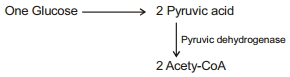
(B) During glycolysis,one molecule of glucose ($6$ carbons) is broken down into two molecules of pyruvic acid ($3$ carbons each).
Each molecule of pyruvic acid undergoes oxidative decarboxylation to form one molecule of acetyl $CoA$ ($2$ carbons).
Since there are two molecules of pyruvic acid produced from one glucose molecule,the total number of acetyl $CoA$ molecules formed is $2 \times 1 = 2$.
Each molecule of pyruvic acid undergoes oxidative decarboxylation to form one molecule of acetyl $CoA$ ($2$ carbons).
Since there are two molecules of pyruvic acid produced from one glucose molecule,the total number of acetyl $CoA$ molecules formed is $2 \times 1 = 2$.
0 likes
View Solution167
MediumMCQ
How many carbon atoms are present in Acetyl $CoA$?
A
$2$
B
$6$
C
$4$
D
$3$
Solution
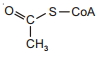
(A) Acetyl $CoA$ is a two-carbon compound.
It is formed by the oxidative decarboxylation of pyruvate ($3$ carbons) during the link reaction (pyruvate dehydrogenase complex).
The acetyl group $(CH_3CO-)$ contains two carbon atoms,which are then attached to Coenzyme $A$ $(CoA)$.
Therefore,the correct answer is $2$.
It is formed by the oxidative decarboxylation of pyruvate ($3$ carbons) during the link reaction (pyruvate dehydrogenase complex).
The acetyl group $(CH_3CO-)$ contains two carbon atoms,which are then attached to Coenzyme $A$ $(CoA)$.
Therefore,the correct answer is $2$.
0 likes
View Solution168
MediumMCQ
Which of the following products is formed by the Krebs cycle?
A
Acetyl $CoA$
B
$ADP$
C
$ATP$
D
$NAD^+$
Solution
(C) The Krebs cycle (also known as the Citric Acid Cycle) occurs in the mitochondrial matrix.
During this process,acetyl $CoA$ is oxidized to produce $CO_2$,$ATP$ (or $GTP$),$NADH$,and $FADH_2$.
Among the given options,$ATP$ is a direct product of the Krebs cycle.
During this process,acetyl $CoA$ is oxidized to produce $CO_2$,$ATP$ (or $GTP$),$NADH$,and $FADH_2$.
Among the given options,$ATP$ is a direct product of the Krebs cycle.
0 likes
View Solution169
MediumMCQ
Citric acid is formed in the Krebs cycle by the combination of oxaloacetate with:
A
Oxaloacetate $(OAA)$
B
Acetyl $CoA$
C
Malic acid
D
Pyruvic acid
Solution
(B) In the Krebs cycle, the first step is the condensation reaction where the $2$-carbon compound Acetyl $CoA$ combines with the $4$-carbon compound Oxaloacetate $(OAA)$ in the presence of water and the enzyme Citrate synthase to form a $6$-carbon compound called Citric acid (Citrate).
Reaction: $OAA + \text{Acetyl } CoA + H_2O \xrightarrow{\text{Citrate synthase}} \text{Citric acid} + CoA + H^+$
Reaction: $OAA + \text{Acetyl } CoA + H_2O \xrightarrow{\text{Citrate synthase}} \text{Citric acid} + CoA + H^+$
0 likes
View Solution170
MediumMCQ
The enzymes of the Krebs cycle where $NADH + H^+$ are produced are:
A
Isocitrate dehydrogenase,succinate dehydrogenase and malic dehydrogenase
B
Succinate thiokinase,succinate dehydrogenase and aconitase
C
Isocitrate dehydrogenase,$\alpha$-ketoglutaric dehydrogenase,malic dehydrogenase
D
Isocitrate dehydrogenase,$\alpha$-ketoglutaric dehydrogenase and succinate dehydrogenase
Solution
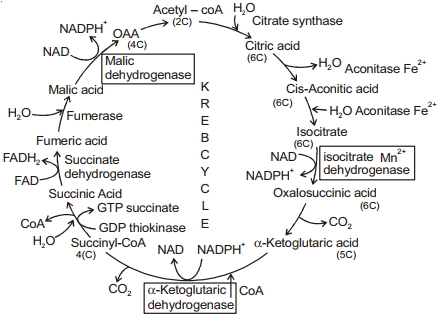
(C) In the Krebs cycle ($TCA$ cycle),$NADH + H^+$ is produced during three oxidative decarboxylation or oxidation steps:
$1$. Conversion of Isocitrate to $\alpha$-ketoglutaric acid by the enzyme Isocitrate dehydrogenase.
$2$. Conversion of $\alpha$-ketoglutaric acid to Succinyl-CoA by the enzyme $\alpha$-ketoglutaric dehydrogenase.
$3$. Conversion of Malic acid to Oxaloacetic acid $(OAA)$ by the enzyme Malic dehydrogenase.
Therefore,the correct enzymes are Isocitrate dehydrogenase,$\alpha$-ketoglutaric dehydrogenase,and Malic dehydrogenase.
$1$. Conversion of Isocitrate to $\alpha$-ketoglutaric acid by the enzyme Isocitrate dehydrogenase.
$2$. Conversion of $\alpha$-ketoglutaric acid to Succinyl-CoA by the enzyme $\alpha$-ketoglutaric dehydrogenase.
$3$. Conversion of Malic acid to Oxaloacetic acid $(OAA)$ by the enzyme Malic dehydrogenase.
Therefore,the correct enzymes are Isocitrate dehydrogenase,$\alpha$-ketoglutaric dehydrogenase,and Malic dehydrogenase.
0 likes
View Solution171
MediumMCQ
How many molecules of $CO_2$ are released during two turns of the Krebs cycle?
A
$2$
B
$6$
C
$4$
D
$3$
Solution
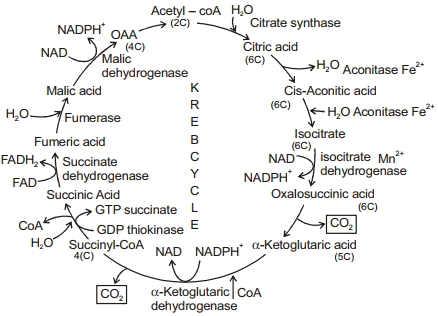
(C) In one turn of the Krebs cycle,two molecules of $CO_2$ are released (one during the conversion of isocitrate to $\alpha$-ketoglutarate and one during the conversion of $\alpha$-ketoglutarate to succinyl-CoA).
Since one glucose molecule produces two molecules of acetyl-CoA,the Krebs cycle runs twice for every glucose molecule.
Therefore,in two turns of the Krebs cycle,$2 \times 2 = 4$ molecules of $CO_2$ are released.
Since one glucose molecule produces two molecules of acetyl-CoA,the Krebs cycle runs twice for every glucose molecule.
Therefore,in two turns of the Krebs cycle,$2 \times 2 = 4$ molecules of $CO_2$ are released.
0 likes
View Solution172
EasyMCQ
What is the net gain in a Krebs cycle?
A
$1 FADH_2, 2 NADH_2$ and $1$ $ATP$
B
$2 FADH_2, 2 NADH_2$ and $2$ $ATP$
C
$1 FADH_2, 3 NADH_2$ and $1$ $ATP$
D
$1 FADH_2, 6 NADH_2$ and $2$ $ATP$
Solution
(C) The Krebs cycle (also known as the Citric Acid Cycle) occurs in the mitochondrial matrix.
In one complete turn of the Krebs cycle,one molecule of Acetyl-CoA is oxidized.
The net gain from one turn of the cycle is $3 NADH_2$,$1 FADH_2$,and $1 ATP$ (or $GTP$ which is equivalent to $ATP$ in energy terms).
Therefore,the correct option is $C$.
In one complete turn of the Krebs cycle,one molecule of Acetyl-CoA is oxidized.
The net gain from one turn of the cycle is $3 NADH_2$,$1 FADH_2$,and $1 ATP$ (or $GTP$ which is equivalent to $ATP$ in energy terms).
Therefore,the correct option is $C$.
0 likes
View Solution173
MediumMCQ
Succinate dehydrogenase catalyzes the formation of
A
$FADH_{2} \longrightarrow FAD$
B
$FAD \longrightarrow FADH_{2}$
C
$NAD \longrightarrow NADH + H^{+}$
D
$NADH + H^{+} \longrightarrow FADH_{2}$
Solution
(B) Succinate dehydrogenase is an enzyme found in the inner mitochondrial membrane that plays a crucial role in the Krebs cycle (Citric Acid Cycle).
It catalyzes the oxidation of succinate to fumarate.
During this reaction,the electrons removed from succinate are transferred to the coenzyme $FAD$ (Flavin Adenine Dinucleotide),which gets reduced to $FADH_{2}$.
The reaction is: $Succinate + FAD \xrightarrow{\text{Succinate dehydrogenase}} Fumarate + FADH_{2}$.
It catalyzes the oxidation of succinate to fumarate.
During this reaction,the electrons removed from succinate are transferred to the coenzyme $FAD$ (Flavin Adenine Dinucleotide),which gets reduced to $FADH_{2}$.
The reaction is: $Succinate + FAD \xrightarrow{\text{Succinate dehydrogenase}} Fumarate + FADH_{2}$.
0 likes
View Solution174
MediumMCQ
How many $ATP$ molecules are formed by oxidative phosphorylation from $NADH$ produced during a single Krebs cycle?
A
$6$
B
$18$
C
$30$
D
$9$
Solution
(D) During a single Krebs cycle,$3$ molecules of $NADH$ are produced.
Each $NADH$ molecule yields $3$ $ATP$ molecules through oxidative phosphorylation in the electron transport system.
Therefore,the total number of $ATP$ molecules produced from $NADH$ in one Krebs cycle is $3 \times 3 = 9$ $ATP$.
Each $NADH$ molecule yields $3$ $ATP$ molecules through oxidative phosphorylation in the electron transport system.
Therefore,the total number of $ATP$ molecules produced from $NADH$ in one Krebs cycle is $3 \times 3 = 9$ $ATP$.
0 likes
View Solution175
EasyMCQ
The primary acceptor of the $TCA$ cycle is:
A
$OAA$
B
Acetyl $CoA$
C
Citric acid
D
Pyruvic acid
Solution
(A) The $TCA$ cycle (also known as the Krebs cycle) begins with the condensation of an acetyl group from acetyl $CoA$ with a four-carbon compound, oxaloacetic acid $(OAA)$, to form a six-carbon compound, citric acid.
Therefore, $OAA$ acts as the primary acceptor of the acetyl group in the $TCA$ cycle.
Reaction: $OAA + \text{Acetyl } CoA \rightarrow \text{Citric acid}$.
Therefore, $OAA$ acts as the primary acceptor of the acetyl group in the $TCA$ cycle.
Reaction: $OAA + \text{Acetyl } CoA \rightarrow \text{Citric acid}$.
0 likes
View Solution176
MediumMCQ
In $TCA$ cycle,how many reduced coenzymes are produced from one Acetyl $CoA$?
A
$3 NADH + H^+, 1 FADH_2$
B
$2 NADH + H^+, 1 FADH_2$
C
$4 NADH + H^+, 2 FADH_2$
D
$5 NADH + H^+, 1 FADH_2$
Solution
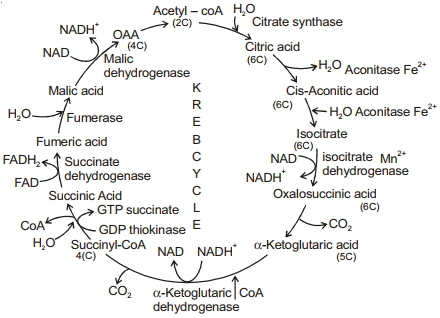
(A) The $TCA$ cycle (Tricarboxylic Acid cycle) or Krebs cycle involves a series of enzymatic reactions where one molecule of Acetyl $CoA$ is oxidized.
During one turn of the $TCA$ cycle,the following steps produce reduced coenzymes:
$1$. Isocitrate to $\alpha$-Ketoglutarate: $1 NADH + H^+$ is produced.
$2$. $\alpha$-Ketoglutarate to Succinyl-$CoA$: $1 NADH + H^+$ is produced.
$3$. Succinate to Fumarate: $1 FADH_2$ is produced.
$4$. Malate to Oxaloacetate: $1 NADH + H^+$ is produced.
Thus,for one molecule of Acetyl $CoA$,the total yield is $3 NADH + H^+$ and $1 FADH_2$.
During one turn of the $TCA$ cycle,the following steps produce reduced coenzymes:
$1$. Isocitrate to $\alpha$-Ketoglutarate: $1 NADH + H^+$ is produced.
$2$. $\alpha$-Ketoglutarate to Succinyl-$CoA$: $1 NADH + H^+$ is produced.
$3$. Succinate to Fumarate: $1 FADH_2$ is produced.
$4$. Malate to Oxaloacetate: $1 NADH + H^+$ is produced.
Thus,for one molecule of Acetyl $CoA$,the total yield is $3 NADH + H^+$ and $1 FADH_2$.
0 likes
View Solution177
MediumMCQ
Which is the $5C$ intermediate molecule in the $TCA$ cycle?
A
Citric acid
B
Succinyl $CoA$
C
$\alpha$-ketoglutaric acid
D
Fumaric acid
Solution
(C) In the $TCA$ cycle (Tricarboxylic Acid Cycle),also known as the $Krebs$ cycle,the $5C$ (five-carbon) intermediate molecule is $\alpha$-ketoglutaric acid.
It is formed by the oxidative decarboxylation of $isocitrate$.
It is formed by the oxidative decarboxylation of $isocitrate$.
0 likes
View Solution178
MediumMCQ
Number of total $ATP$ generated in $TCA$ cycle per Acetyl $CoA$ molecule is
A
$10$
B
$12$
C
$14$
D
$24$
Solution
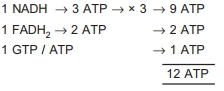
(B) In the $TCA$ cycle (also known as the Krebs cycle),one molecule of Acetyl $CoA$ undergoes a series of reactions to produce the following energy-rich molecules:
$1$. $3$ molecules of $NADH$ are produced,which yield $3 \times 3 = 9$ $ATP$ molecules via oxidative phosphorylation.
$2$. $1$ molecule of $FADH_2$ is produced,which yields $2$ $ATP$ molecules via oxidative phosphorylation.
$3$. $1$ molecule of $GTP$ (or $ATP$) is produced directly via substrate-level phosphorylation,which is equivalent to $1$ $ATP$.
Adding these together,the total $ATP$ yield per Acetyl $CoA$ molecule is $9 + 2 + 1 = 12$ $ATP$.
$1$. $3$ molecules of $NADH$ are produced,which yield $3 \times 3 = 9$ $ATP$ molecules via oxidative phosphorylation.
$2$. $1$ molecule of $FADH_2$ is produced,which yields $2$ $ATP$ molecules via oxidative phosphorylation.
$3$. $1$ molecule of $GTP$ (or $ATP$) is produced directly via substrate-level phosphorylation,which is equivalent to $1$ $ATP$.
Adding these together,the total $ATP$ yield per Acetyl $CoA$ molecule is $9 + 2 + 1 = 12$ $ATP$.
0 likes
View Solution179
MediumMCQ
Substrate level phosphorylation in $TCA$ occurs when
A
Succinic acid changes to fumaric acid
B
Fumaric acid changes to malic acid
C
Succinyl $CoA$ changes to succinic acid
D
Oxalosuccinic acid changes to $\alpha$-ketoglutaric acid
Solution
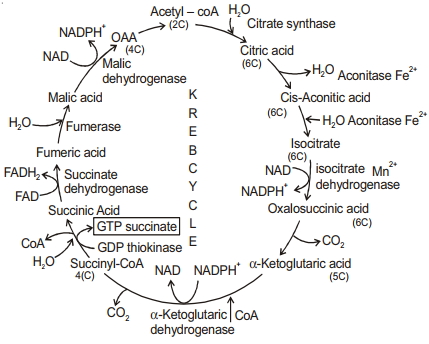
(C) Substrate-level phosphorylation is a process where a phosphate group is transferred from a high-energy substrate molecule directly to $ADP$ or $GDP$ to form $ATP$ or $GTP$,respectively.
In the $TCA$ cycle (also known as the Krebs cycle),this occurs during the conversion of succinyl-$CoA$ to succinic acid.
This reaction is catalyzed by the enzyme succinyl-$CoA$ synthetase (or thiokinase).
During this step,the energy released from the cleavage of the high-energy thioester bond in succinyl-$CoA$ is used to synthesize $GTP$ (which is then converted to $ATP$) from $GDP$ and inorganic phosphate $(Pi)$.
In the $TCA$ cycle (also known as the Krebs cycle),this occurs during the conversion of succinyl-$CoA$ to succinic acid.
This reaction is catalyzed by the enzyme succinyl-$CoA$ synthetase (or thiokinase).
During this step,the energy released from the cleavage of the high-energy thioester bond in succinyl-$CoA$ is used to synthesize $GTP$ (which is then converted to $ATP$) from $GDP$ and inorganic phosphate $(Pi)$.
0 likes
View Solution180
EasyMCQ
The mineral activator required for the enzyme isocitrate dehydrogenase of the $TCA$ cycle is
A
$Fe$
B
$Mg$
C
$Mn$
D
$Cu$
Solution
(C) The enzyme isocitrate dehydrogenase catalyzes the oxidative decarboxylation of isocitrate to alpha-ketoglutarate in the $TCA$ cycle.
This enzyme requires divalent metal ions as cofactors for its catalytic activity.
Specifically,$Mn^{2+}$ (manganese) or $Mg^{2+}$ (magnesium) ions act as essential mineral activators for this enzyme.
Among the given options,$Mn$ is the recognized mineral activator for isocitrate dehydrogenase.
This enzyme requires divalent metal ions as cofactors for its catalytic activity.
Specifically,$Mn^{2+}$ (manganese) or $Mg^{2+}$ (magnesium) ions act as essential mineral activators for this enzyme.
Among the given options,$Mn$ is the recognized mineral activator for isocitrate dehydrogenase.
0 likes
View Solution181
MediumMCQ
The enzyme $Fumarase$ catalyzes which of the following conversions?
A
Succinic acid to malic acid
B
Succinic acid to fumaric acid
C
Fumaric acid to malic acid
D
Fumaric acid to citric acid
Solution
(C) In the $Krebs$ cycle (also known as the $TCA$ cycle or Citric Acid Cycle),the enzyme $Fumarase$ (or $Fumarate$ $hydratase$) catalyzes the reversible hydration of $Fumaric$ $acid$ to $Malic$ $acid$.
This reaction involves the addition of a water molecule $(H_2O)$ across the double bond of $Fumaric$ $acid$ to produce $L-Malate$ (Malic acid).
Therefore,the correct conversion is $Fumaric$ $acid$ to $Malic$ $acid$.
This reaction involves the addition of a water molecule $(H_2O)$ across the double bond of $Fumaric$ $acid$ to produce $L-Malate$ (Malic acid).
Therefore,the correct conversion is $Fumaric$ $acid$ to $Malic$ $acid$.
0 likes
View Solution182
MediumMCQ
$A$ Krebs cycle intermediate as raw material for chlorophyll production is synthesised after
A
Condensation
B
Substrate level phosphorylation
C
Hydration
D
Oxidative decarboxylation
Solution
(D) The Krebs cycle intermediate that serves as a raw material for chlorophyll synthesis is $Succinyl \ Co-A$.
This intermediate is produced during the conversion of $\alpha-Ketoglutaric \ acid$ to $Succinyl \ Co-A$.
This specific reaction involves the removal of a carbon dioxide molecule $(decarboxylation)$ and the oxidation of the substrate $(oxidation)$,coupled with the addition of Coenzyme $A$.
Therefore,this step is known as $Oxidative \ decarboxylation$.
This intermediate is produced during the conversion of $\alpha-Ketoglutaric \ acid$ to $Succinyl \ Co-A$.
This specific reaction involves the removal of a carbon dioxide molecule $(decarboxylation)$ and the oxidation of the substrate $(oxidation)$,coupled with the addition of Coenzyme $A$.
Therefore,this step is known as $Oxidative \ decarboxylation$.

0 likes
View Solution183
MediumMCQ
Select the correct statement with respect to the Krebs cycle.
A
Occurs in the cytoplasm and mitochondria in the absence of $O_2$.
B
Favoured by coenzyme $NADP^+$.
C
Intermediate products contain four,five,and six carbon atoms.
D
Substrate molecule is a $3C$ compound.
Solution
(C) The Krebs cycle involves various intermediate organic acids that contain $4, 5,$ and $6$ carbon atoms.
For example:
- Citric acid,Isocitric acid,and Oxalosuccinic acid are $6C$ compounds.
- $\alpha$-Ketoglutaric acid is a $5C$ compound.
- Succinic acid,Fumaric acid,Malic acid,and Oxaloacetic acid are $4C$ compounds.
Therefore,option $C$ is the correct statement.
For example:
- Citric acid,Isocitric acid,and Oxalosuccinic acid are $6C$ compounds.
- $\alpha$-Ketoglutaric acid is a $5C$ compound.
- Succinic acid,Fumaric acid,Malic acid,and Oxaloacetic acid are $4C$ compounds.
Therefore,option $C$ is the correct statement.
0 likes
View Solution184
MediumMCQ
The connecting link between respiration ($TCA$ cycle) and protein synthesis is:
A
Citric acid
B
$\alpha$-ketoglutaric acid
C
Succinic acid
D
Fumaric acid
Solution
(B) The $TCA$ cycle (Krebs cycle) provides several intermediates that serve as precursors for the biosynthesis of various amino acids. Specifically,$\alpha$-ketoglutaric acid is a key intermediate in the $TCA$ cycle that undergoes transamination to form glutamic acid,which is a fundamental amino acid used in protein synthesis. Thus,it acts as a connecting link between respiratory metabolism and protein synthesis.
0 likes
View Solution185
MediumMCQ
The correct sequence in the Krebs cycle is:
A
Oxaloacetic acid $\rightarrow \alpha$-ketoglutaric acid $\rightarrow$ Isocitric acid
B
Oxaloacetic acid $\rightarrow$ Isocitric acid $\rightarrow \alpha$-ketoglutaric acid
C
$\alpha$-ketoglutaric acid $\rightarrow$ Isocitric acid $\rightarrow$ Oxaloacetic acid
D
Isocitric acid $\rightarrow \alpha$-ketoglutaric acid $\rightarrow$ Oxaloacetic acid
Solution
(D) The Krebs cycle (also known as the Citric Acid Cycle) involves a series of enzymatic reactions.
Starting from Isocitric acid,it undergoes oxidative decarboxylation to form $\alpha$-ketoglutaric acid.
Subsequently,$\alpha$-ketoglutaric acid undergoes further reactions to eventually regenerate Oxaloacetic acid,which is the starting substrate for the cycle.
Therefore,the correct sequence among the given options is: Isocitric acid $\rightarrow \alpha$-ketoglutaric acid $\rightarrow$ Oxaloacetic acid.
Starting from Isocitric acid,it undergoes oxidative decarboxylation to form $\alpha$-ketoglutaric acid.
Subsequently,$\alpha$-ketoglutaric acid undergoes further reactions to eventually regenerate Oxaloacetic acid,which is the starting substrate for the cycle.
Therefore,the correct sequence among the given options is: Isocitric acid $\rightarrow \alpha$-ketoglutaric acid $\rightarrow$ Oxaloacetic acid.
0 likes
View Solution186
EasyMCQ
Location of $SDH$ (Succinate dehydrogenase) enzyme of the Krebs cycle in plants is
A
Plasma membrane
B
Inner mitochondrial membrane
C
Cytoplasm
D
Matrix
Solution
(B) The $SDH$ (Succinate dehydrogenase) enzyme is a unique component of the Krebs cycle because it is embedded in the inner mitochondrial membrane. It acts as a link between the Krebs cycle and the electron transport chain,functioning as Complex $II$.
0 likes
View Solution187
MediumMCQ
$A$: Succinyl $CoA$ is the precursor of pyrrole group-containing compounds.
$R$: Succinyl $CoA$ is an intermediate of the $TCA$ cycle.
$R$: Succinyl $CoA$ is an intermediate of the $TCA$ cycle.
A
Assertion and Reason both are correct and Reason is the correct explanation of Assertion.
B
Assertion and Reason both are correct but Reason is not the correct explanation of Assertion.
C
Assertion is correct,but Reason is incorrect.
D
Both Assertion and Reason are incorrect.
Solution
(B) Succinyl $CoA$ is a key intermediate in the $TCA$ cycle (Krebs cycle).
It also serves as a precursor for the synthesis of porphyrins,which are pyrrole group-containing compounds such as chlorophyll,cytochromes,and hemoglobin.
Since both statements are scientifically accurate and the role of Succinyl $CoA$ in the $TCA$ cycle is a distinct metabolic fact from its role as a biosynthetic precursor,the Reason does not explain the Assertion.
It also serves as a precursor for the synthesis of porphyrins,which are pyrrole group-containing compounds such as chlorophyll,cytochromes,and hemoglobin.
Since both statements are scientifically accurate and the role of Succinyl $CoA$ in the $TCA$ cycle is a distinct metabolic fact from its role as a biosynthetic precursor,the Reason does not explain the Assertion.
0 likes
View Solution188
MediumMCQ
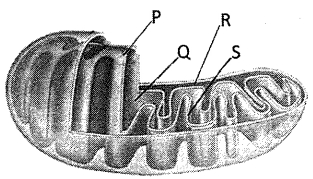
In the given organelle,where does the Krebs cycle take place?
A
$P$
B
$Q$
C
$R$
D
$S$
Solution
(B) The given organelle is a mitochondrion.
$P$ represents the cristae (inner membrane folds).
$Q$ represents the matrix.
$R$ represents the intermembrane space.
$S$ represents the outer membrane.
The Krebs cycle (also known as the citric acid cycle) occurs in the mitochondrial matrix $(Q)$.
Therefore,the correct option is $B$.
$P$ represents the cristae (inner membrane folds).
$Q$ represents the matrix.
$R$ represents the intermembrane space.
$S$ represents the outer membrane.
The Krebs cycle (also known as the citric acid cycle) occurs in the mitochondrial matrix $(Q)$.
Therefore,the correct option is $B$.
0 likes
View Solution189
EasyMCQ
Where does the $Krebs$ cycle take place?
A
Cytosol
B
Inner mitochondrial membrane
C
Mitochondrial matrix
D
Outer mitochondrial membrane
Solution
(C) The $Krebs$ cycle,also known as the citric acid cycle or $TCA$ cycle,is a series of chemical reactions used by all aerobic organisms to generate energy. In eukaryotic cells,this process occurs in the mitochondrial matrix. The enzymes required for the $Krebs$ cycle are located within the matrix,except for succinate dehydrogenase,which is bound to the inner mitochondrial membrane.
0 likes
View Solution190
MediumMCQ
Identify the enzyme and cofactor required for the following reaction:
Pyruvic acid + $CoA + NAD^+ \rightarrow$ Acetyl $CoA + CO_2 + NADH + H^+$
Pyruvic acid + $CoA + NAD^+ \rightarrow$ Acetyl $CoA + CO_2 + NADH + H^+$
A
Pyruvate dehydrogenase,$Mg^{2+}$
B
Pyruvate dehydrogenase,$Mn^{2+}$
C
Pyruvate decarboxylase,$Mg^{2+}$
D
Pyruvate decarboxylase,$Mn^{2+}$
Solution
(A) The reaction shown is the oxidative decarboxylation of pyruvic acid,which acts as a link reaction between glycolysis and the Krebs cycle.
This reaction is catalyzed by the Pyruvate Dehydrogenase Complex.
The Pyruvate Dehydrogenase Complex requires several cofactors,including $Mg^{2+}$ ions,$NAD^+$,$CoA$,$TPP$ (Thiamine pyrophosphate),and Lipoic acid.
Among the given options,Pyruvate dehydrogenase with $Mg^{2+}$ is the correct combination.
This reaction is catalyzed by the Pyruvate Dehydrogenase Complex.
The Pyruvate Dehydrogenase Complex requires several cofactors,including $Mg^{2+}$ ions,$NAD^+$,$CoA$,$TPP$ (Thiamine pyrophosphate),and Lipoic acid.
Among the given options,Pyruvate dehydrogenase with $Mg^{2+}$ is the correct combination.
0 likes
View Solution191
MediumMCQ
At how many steps does oxidation occur when pyruvic acid enters the Krebs cycle?
A
$1$
B
$3$
C
$4$
D
$5$
Solution
(C) When pyruvic acid enters the Krebs cycle (after conversion to Acetyl-CoA),it undergoes oxidation at the following steps:
$1$. Isocitrate to $\alpha$-ketoglutarate (Isocitrate dehydrogenase).
$2$. $\alpha$-ketoglutarate to Succinyl-CoA ($\alpha$-ketoglutarate dehydrogenase).
$3$. Succinate to Fumarate (Succinate dehydrogenase).
$4$. Malate to Oxaloacetate (Malate dehydrogenase).
Thus,there are $4$ steps of oxidation in the Krebs cycle.
$1$. Isocitrate to $\alpha$-ketoglutarate (Isocitrate dehydrogenase).
$2$. $\alpha$-ketoglutarate to Succinyl-CoA ($\alpha$-ketoglutarate dehydrogenase).
$3$. Succinate to Fumarate (Succinate dehydrogenase).
$4$. Malate to Oxaloacetate (Malate dehydrogenase).
Thus,there are $4$ steps of oxidation in the Krebs cycle.
0 likes
View Solution192
MediumMCQ
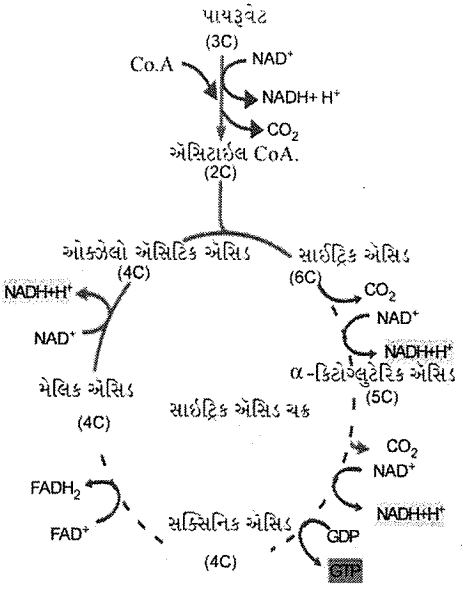
Identify the location of the chemical cycle shown below.
A
Cristae
B
Mitochondrial matrix
C
Stroma of chloroplast
D
Peroxisomes
Solution
(B) The chemical cycle shown in the image is the Krebs cycle (also known as the Citric Acid Cycle or $TCA$ cycle).
In eukaryotic cells,the Krebs cycle takes place in the mitochondrial matrix.
Pyruvate,produced during glycolysis in the cytoplasm,enters the mitochondria and is converted into Acetyl-CoA,which then enters the Krebs cycle within the matrix.
In eukaryotic cells,the Krebs cycle takes place in the mitochondrial matrix.
Pyruvate,produced during glycolysis in the cytoplasm,enters the mitochondria and is converted into Acetyl-CoA,which then enters the Krebs cycle within the matrix.
0 likes
View Solution193
MediumMCQ
Identify the location of the enzyme for the given reaction in the Krebs cycle:
Succinic acid $+ FAD \rightarrow$ Fumaric acid $+ FADH_2$
Succinic acid $+ FAD \rightarrow$ Fumaric acid $+ FADH_2$
A
Cytosol
B
Inner mitochondrial membrane
C
Outer mitochondrial membrane
D
Mitochondrial matrix
Solution
(B) The reaction involving the conversion of succinic acid to fumaric acid is catalyzed by the enzyme succinate dehydrogenase.
This enzyme is unique in the Krebs cycle because it is embedded in the inner mitochondrial membrane.
It also functions as Complex-$II$ of the electron transport chain $(ETC)$.
Therefore,the correct location for this specific enzyme is the inner mitochondrial membrane.
This enzyme is unique in the Krebs cycle because it is embedded in the inner mitochondrial membrane.
It also functions as Complex-$II$ of the electron transport chain $(ETC)$.
Therefore,the correct location for this specific enzyme is the inner mitochondrial membrane.
0 likes
View Solution194
MediumMCQ
Where does the following reaction take place?
$Pyruvic \text{ } acid + 4NAD^+ + FAD^+ + 2H_2O + ADP + Pi \rightarrow 3CO_2 + 4NADH + 4H^+ + FADH_2 + ATP$
$Pyruvic \text{ } acid + 4NAD^+ + FAD^+ + 2H_2O + ADP + Pi \rightarrow 3CO_2 + 4NADH + 4H^+ + FADH_2 + ATP$
A
Cytosol
B
Inner mitochondrial membrane
C
Outer mitochondrial membrane
D
Mitochondrial matrix
Solution
(D) The given reaction represents the $Krebs$ cycle (also known as the $Tricarboxylic$ $Acid$ $(TCA)$ cycle or $Citric$ $Acid$ cycle).
$1$. The $Krebs$ cycle occurs in the mitochondrial matrix of eukaryotic cells.
$2$. During this process, $Pyruvic$ $acid$ (derived from glycolysis) is completely oxidized to release $CO_2$, and high-energy electrons are transferred to $NAD^+$ and $FAD$ to form $NADH$ and $FADH_2$, respectively.
$3$. $ATP$ is produced via substrate-level phosphorylation.
Therefore, the correct location for this process is the mitochondrial matrix.
$1$. The $Krebs$ cycle occurs in the mitochondrial matrix of eukaryotic cells.
$2$. During this process, $Pyruvic$ $acid$ (derived from glycolysis) is completely oxidized to release $CO_2$, and high-energy electrons are transferred to $NAD^+$ and $FAD$ to form $NADH$ and $FADH_2$, respectively.
$3$. $ATP$ is produced via substrate-level phosphorylation.
Therefore, the correct location for this process is the mitochondrial matrix.
0 likes
View Solution195
MediumMCQ
How many $ATP$ molecules are produced by substrate-level phosphorylation during the complete oxidation of one molecule of pyruvic acid?
A
$1$
B
$14$
C
$30$
D
$2$
Solution
(A) The complete oxidation of one molecule of pyruvic acid involves the link reaction,the Krebs cycle,and the electron transport system.
$1$. In the link reaction (pyruvate to acetyl-CoA),no $ATP$ is produced by substrate-level phosphorylation.
$2$. In the Krebs cycle,one molecule of $GTP$ (which is equivalent to $ATP$) is produced per turn via substrate-level phosphorylation (conversion of succinyl-CoA to succinic acid).
$3$. Therefore,for one molecule of pyruvic acid,$1$ $ATP$ is produced by substrate-level phosphorylation.
$1$. In the link reaction (pyruvate to acetyl-CoA),no $ATP$ is produced by substrate-level phosphorylation.
$2$. In the Krebs cycle,one molecule of $GTP$ (which is equivalent to $ATP$) is produced per turn via substrate-level phosphorylation (conversion of succinyl-CoA to succinic acid).
$3$. Therefore,for one molecule of pyruvic acid,$1$ $ATP$ is produced by substrate-level phosphorylation.
0 likes
View Solution196
MediumMCQ
The number of time$(s)$ decarboxylation of isocitrate occurs during a single $TCA$ cycle is:
A
One
B
Two
C
Three
D
Four
Solution
(B) In the $TCA$ cycle (Krebs cycle),decarboxylation refers to the removal of a carbon atom in the form of $CO_2$.
$1$. The first decarboxylation occurs when isocitrate $(6C)$ is converted to $\alpha$-ketoglutarate $(5C)$ by the enzyme isocitrate dehydrogenase.
$2$. The second decarboxylation occurs when $\alpha$-ketoglutarate $(5C)$ is converted to succinyl-$CoA$ $(4C)$ by the $\alpha$-ketoglutarate dehydrogenase complex.
Therefore,decarboxylation occurs twice during a single $TCA$ cycle.
$1$. The first decarboxylation occurs when isocitrate $(6C)$ is converted to $\alpha$-ketoglutarate $(5C)$ by the enzyme isocitrate dehydrogenase.
$2$. The second decarboxylation occurs when $\alpha$-ketoglutarate $(5C)$ is converted to succinyl-$CoA$ $(4C)$ by the $\alpha$-ketoglutarate dehydrogenase complex.
Therefore,decarboxylation occurs twice during a single $TCA$ cycle.
0 likes
View Solution197
EasyMCQ
The $5-C$ compound formed during the $TCA$ cycle is:
A
$\alpha$-ketoglutaric acid
B
Oxalosuccinic acid
C
Succinic acid
D
Fumaric acid
Solution
(A) The $TCA$ cycle (Tricarboxylic Acid cycle),also known as the Krebs cycle,involves a series of enzymatic reactions in the mitochondrial matrix.
In this cycle,isocitrate $(6-C)$ undergoes oxidative decarboxylation to form $\alpha$-ketoglutaric acid $(5-C)$.
This is the only step in the cycle where a $5-C$ compound is produced.
Therefore,the correct answer is $\alpha$-ketoglutaric acid.
In this cycle,isocitrate $(6-C)$ undergoes oxidative decarboxylation to form $\alpha$-ketoglutaric acid $(5-C)$.
This is the only step in the cycle where a $5-C$ compound is produced.
Therefore,the correct answer is $\alpha$-ketoglutaric acid.
0 likes
View Solution198
MediumMCQ
Identify the step in the tricarboxylic acid cycle,which does not involve oxidation of the substrate.
A
Succinic acid $\rightarrow$ Malic acid
B
Succinyl-$CoA$ $\rightarrow$ Succinic acid
C
Isocitrate $\rightarrow \alpha$-ketoglutaric acid
D
Malic acid $\rightarrow$ Oxaloacetic acid
Solution
(B) Oxidation involves the loss of electrons or hydrogen atoms from a substrate,which is typically coupled with the reduction of an electron carrier like $NAD^+$ or $FAD$.
In the tricarboxylic acid cycle ($TCA$ cycle):
$1$. Isocitrate $\rightarrow \alpha$-ketoglutaric acid involves the reduction of $NAD^+$ to $NADH + H^+$.
$2$. Succinic acid $\rightarrow$ Malic acid involves the reduction of $FAD$ to $FADH_2$.
$3$. Malic acid $\rightarrow$ Oxaloacetic acid involves the reduction of $NAD^+$ to $NADH + H^+$.
$4$. The conversion of Succinyl-$CoA$ to Succinic acid is a substrate-level phosphorylation step where $GDP$ (or $ADP$) is phosphorylated to $GTP$ (or $ATP$). This step does not involve the removal of electrons or hydrogen atoms from the substrate,hence it is not an oxidation reaction.
In the tricarboxylic acid cycle ($TCA$ cycle):
$1$. Isocitrate $\rightarrow \alpha$-ketoglutaric acid involves the reduction of $NAD^+$ to $NADH + H^+$.
$2$. Succinic acid $\rightarrow$ Malic acid involves the reduction of $FAD$ to $FADH_2$.
$3$. Malic acid $\rightarrow$ Oxaloacetic acid involves the reduction of $NAD^+$ to $NADH + H^+$.
$4$. The conversion of Succinyl-$CoA$ to Succinic acid is a substrate-level phosphorylation step where $GDP$ (or $ADP$) is phosphorylated to $GTP$ (or $ATP$). This step does not involve the removal of electrons or hydrogen atoms from the substrate,hence it is not an oxidation reaction.
0 likes
View Solution199
MediumMCQ
The number of substrate level phosphorylations $(SLP)$ for one molecule of glucose in the citric acid cycle is:
A
$3$
B
$0$
C
$1$
D
$2$
Solution
(D) In the citric acid cycle (Krebs cycle),substrate-level phosphorylation occurs during the conversion of succinyl-CoA to succinate.
This step is catalyzed by the enzyme succinyl-CoA synthetase,which produces one molecule of $GTP$ (or $ATP$) per turn of the cycle.
Since one molecule of glucose produces two molecules of acetyl-CoA through glycolysis and the link reaction,the citric acid cycle runs twice for each glucose molecule.
Therefore,the total number of substrate-level phosphorylations for one molecule of glucose in the citric acid cycle is $1 \times 2 = 2$.
This step is catalyzed by the enzyme succinyl-CoA synthetase,which produces one molecule of $GTP$ (or $ATP$) per turn of the cycle.
Since one molecule of glucose produces two molecules of acetyl-CoA through glycolysis and the link reaction,the citric acid cycle runs twice for each glucose molecule.
Therefore,the total number of substrate-level phosphorylations for one molecule of glucose in the citric acid cycle is $1 \times 2 = 2$.
0 likes
View Solution200
DifficultMCQ
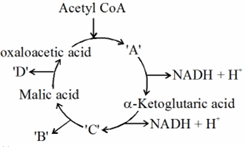
$(i)$ Label $A, B, C$ and $D$.
$(ii)$ How many $CO_2$ molecules are evolved between $A$ and Malic acid?
Choose the correct option from the following regarding the answers to the above questions $:-$
$(ii)$ How many $CO_2$ molecules are evolved between $A$ and Malic acid?
Choose the correct option from the following regarding the answers to the above questions $:-$
A
$(i) A=PGA, B=CO_2, C=PGAL, D= ATP \ (ii) \ 3 CO_2$
B
$(i) A=\text{Citric acid}, B=CO_2, C=\text{Succinic acid}, D=FADH_2 \ (ii) \ 2 CO_2$
C
$(i) A=\text{Citric acid}, B=FADH_2, C=\text{Succinic acid}, D=NADH+H^{+} \ (ii) \ 2 CO_2$
D
$(i) A=\text{pyruvic acid}, B=FADH_2, C=\text{Succinyl CoA}, D=GTP \ (ii) \ 4 CO_2$
Solution
(B) In the Krebs cycle ($TCA$ cycle):
$1$. Acetyl CoA combines with Oxaloacetic acid to form $A = \text{Citric acid}$.
$2$. $\alpha$-Ketoglutaric acid is converted to $C = \text{Succinyl CoA}$,releasing $B = CO_2$ and producing $NADH+H^+$.
$3$. Succinyl CoA is converted to Succinic acid,producing $GTP$ (or $ATP$).
$4$. Succinic acid is converted to Fumaric acid,producing $D = FADH_2$.
$5$. Fumaric acid is converted to Malic acid.
$6$. Between Citric acid $(A)$ and Malic acid,two molecules of $CO_2$ are released (one during the conversion of Isocitric acid to $\alpha$-Ketoglutaric acid and one during the conversion of $\alpha$-Ketoglutaric acid to Succinyl CoA).
Therefore,the correct labels are $A = \text{Citric acid}, B = CO_2, C = \text{Succinyl CoA}, D = FADH_2$ and the number of $CO_2$ molecules evolved is $2$.
$1$. Acetyl CoA combines with Oxaloacetic acid to form $A = \text{Citric acid}$.
$2$. $\alpha$-Ketoglutaric acid is converted to $C = \text{Succinyl CoA}$,releasing $B = CO_2$ and producing $NADH+H^+$.
$3$. Succinyl CoA is converted to Succinic acid,producing $GTP$ (or $ATP$).
$4$. Succinic acid is converted to Fumaric acid,producing $D = FADH_2$.
$5$. Fumaric acid is converted to Malic acid.
$6$. Between Citric acid $(A)$ and Malic acid,two molecules of $CO_2$ are released (one during the conversion of Isocitric acid to $\alpha$-Ketoglutaric acid and one during the conversion of $\alpha$-Ketoglutaric acid to Succinyl CoA).
Therefore,the correct labels are $A = \text{Citric acid}, B = CO_2, C = \text{Succinyl CoA}, D = FADH_2$ and the number of $CO_2$ molecules evolved is $2$.
0 likes
View SolutionRespiration in Plants — Kreb's cycle · Frequently Asked Questions
1Are these Respiration in Plants questions useful for JEE and NEET?
Yes. All questions in this section are mapped to JEE Main and NEET exam patterns. Previous year questions from JEE Main, NEET, GUJCET and state-level exams are included with full solutions.
2Can I switch to Hindi or Gujarati for these questions?
Yes. Use the language tabs in the hero section or the sidebar to view the same questions and solutions in English, Hindi or Gujarati.
3How do I generate a question paper from this subtopic?
Use the Vedclass Exam Paper Generator — select the chapter and subtopic, set difficulty, and generate Sets A, B, C, D automatically. First 3 chapters of every subject are free.
Vedclass Products
For Students
Vedclass Test Series
Mock tests in real JEE/NEET style with performance analysis. 5-day free trial.
Start Free TrialFor Teachers
Exam Paper Generator
Generate Set A/B/C/D papers from this chapter in 2 minutes. 3 chapters free.
Try FreeFor Institutes
Online Exam Module
Live online exams with unlimited students, 360° analytics & white-label branding.
See DemoFor Teachers & Institutes
Generate a Respiration in Plants Exam Paper in 2 Minutes
Select subtopic & difficulty — Sets A, B, C, D auto-generated with No Repeat logic.
First 3 chapters of every subject are free — no payment required.