
A English
Kreb's cycle Questions in English
Class 11 Biology · Respiration in Plants · Kreb's cycle
232+
Questions
English
Language
100%
With Solutions
Showing 32 of 232 questions in English
201
MediumMCQ
When $1$ molecule of pyruvate is completely oxidized,how many moles of carbon dioxide are produced?
A
$1$
B
$2$
C
$3$
D
$4$
Solution
(C) Pyruvate is a $3$-carbon compound $(CH_3COCOOH)$.
During aerobic respiration,pyruvate undergoes oxidative decarboxylation to form Acetyl-CoA,releasing $1$ molecule of $CO_2$.
Subsequently,the Acetyl-CoA enters the Krebs cycle ($TCA$ cycle),where the remaining $2$ carbons are released as $CO_2$ molecules.
Therefore,the complete oxidation of $1$ molecule of pyruvate results in the production of $3$ molecules of $CO_2$.
During aerobic respiration,pyruvate undergoes oxidative decarboxylation to form Acetyl-CoA,releasing $1$ molecule of $CO_2$.
Subsequently,the Acetyl-CoA enters the Krebs cycle ($TCA$ cycle),where the remaining $2$ carbons are released as $CO_2$ molecules.
Therefore,the complete oxidation of $1$ molecule of pyruvate results in the production of $3$ molecules of $CO_2$.
0 likes
View Solution202
MediumMCQ
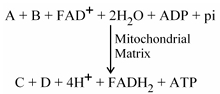
Find the correct option for the given reaction in the mitochondrial matrix:-
A
$A \rightarrow$ Pyruvate, $B \rightarrow 4 NAD^{+}$, $C \rightarrow 3 CO_2$, $D \rightarrow 4 NADH$
B
$A \rightarrow$ Pyruvate, $B \rightarrow 4 NADH$, $C \rightarrow 2 CO_2$, $D \rightarrow 4 NAD^{+}$
C
$A \rightarrow$ Acetyl CoA, $B \rightarrow 3 NAD^{+}$, $C \rightarrow 3 CO_2$, $D \rightarrow 3 NADH$
D
$A \rightarrow$ Acetyl CoA, $B \rightarrow 3 NADH$, $C \rightarrow 3 CO_2$, $D \rightarrow 3 NAD^{+}$
Solution
(C) The given reaction represents the Krebs cycle (Tricarboxylic Acid cycle) occurring in the mitochondrial matrix.
In one turn of the Krebs cycle, one molecule of Acetyl CoA enters the cycle.
It reacts with $3 NAD^{+}$, $FAD^{+}$, $GDP$ (or $ADP$), and $P_i$ to produce $3 NADH + H^{+}$, $FADH_2$, $GTP$ (or $ATP$), and $2 CO_2$.
However, the question asks for the stoichiometry of the overall process starting from Acetyl CoA.
Looking at the options, option $C$ correctly identifies the input as Acetyl CoA and the products as $3 CO_2$ (if considering the complete oxidation of the acetyl group) and $3 NADH$.
Therefore, $A = \text{Acetyl CoA}$, $B = 3 NAD^{+}$, $C = 3 CO_2$, and $D = 3 NADH$.
In one turn of the Krebs cycle, one molecule of Acetyl CoA enters the cycle.
It reacts with $3 NAD^{+}$, $FAD^{+}$, $GDP$ (or $ADP$), and $P_i$ to produce $3 NADH + H^{+}$, $FADH_2$, $GTP$ (or $ATP$), and $2 CO_2$.
However, the question asks for the stoichiometry of the overall process starting from Acetyl CoA.
Looking at the options, option $C$ correctly identifies the input as Acetyl CoA and the products as $3 CO_2$ (if considering the complete oxidation of the acetyl group) and $3 NADH$.
Therefore, $A = \text{Acetyl CoA}$, $B = 3 NAD^{+}$, $C = 3 CO_2$, and $D = 3 NADH$.
0 likes
View Solution203
MediumMCQ
Assertion: In Krebs cycle,there is a one step where substrate level phosphorylation occurs.
Reason: During the formation of succinyl $\text{CoA}$ to succinic acid,a molecule of $\text{GTP}$ is synthesized.
Reason: During the formation of succinyl $\text{CoA}$ to succinic acid,a molecule of $\text{GTP}$ is synthesized.
A
Assertion and Reason both are correct and Reason is correct explanation of Assertion.
B
Assertion and Reason both are correct but Reason is not correct explanation of Assertion.
C
Assertion is correct and Reason is incorrect.
D
Assertion is incorrect and Reason is correct.
Solution
(A) In the Krebs cycle (also known as the Citric Acid Cycle),the conversion of succinyl $\text{CoA}$ to succinic acid is catalyzed by the enzyme succinyl $\text{CoA}$ synthetase.
This reaction involves the coupling of the cleavage of the high-energy thioester bond of succinyl $\text{CoA}$ with the phosphorylation of $\text{GDP}$ (or $\text{ADP}$) to form $\text{GTP}$ (or $\text{ATP}$).
This process is known as substrate-level phosphorylation because the phosphate group is transferred directly from a substrate to $\text{GDP}$/$\text{ADP}$ without the involvement of the electron transport chain.
Therefore,both the Assertion and the Reason are correct,and the Reason provides the correct explanation for the Assertion.
This reaction involves the coupling of the cleavage of the high-energy thioester bond of succinyl $\text{CoA}$ with the phosphorylation of $\text{GDP}$ (or $\text{ADP}$) to form $\text{GTP}$ (or $\text{ATP}$).
This process is known as substrate-level phosphorylation because the phosphate group is transferred directly from a substrate to $\text{GDP}$/$\text{ADP}$ without the involvement of the electron transport chain.
Therefore,both the Assertion and the Reason are correct,and the Reason provides the correct explanation for the Assertion.
0 likes
View Solution204
EasyMCQ
How many times does decarboxylation take place during the complete oxidation of one molecule of acetyl $\text{CoA}$ in aerobic respiration?
A
$5$
B
$2$
C
$3$
D
$4$
Solution
(B) In aerobic respiration,one molecule of acetyl $\text{CoA}$ ($2$-carbon compound) enters the Krebs cycle ($TCA$ cycle).
During the Krebs cycle,decarboxylation occurs at two specific steps:
$1$. Conversion of isocitrate to $\alpha$-ketoglutarate (catalyzed by isocitrate dehydrogenase).
$2$. Conversion of $\alpha$-ketoglutarate to succinyl $\text{CoA}$ (catalyzed by $\alpha$-ketoglutarate dehydrogenase).
Each of these steps releases one molecule of $\text{CO}_2$.
Therefore,a total of $2$ decarboxylation events occur during the complete oxidation of one molecule of acetyl $\text{CoA}$.
During the Krebs cycle,decarboxylation occurs at two specific steps:
$1$. Conversion of isocitrate to $\alpha$-ketoglutarate (catalyzed by isocitrate dehydrogenase).
$2$. Conversion of $\alpha$-ketoglutarate to succinyl $\text{CoA}$ (catalyzed by $\alpha$-ketoglutarate dehydrogenase).
Each of these steps releases one molecule of $\text{CO}_2$.
Therefore,a total of $2$ decarboxylation events occur during the complete oxidation of one molecule of acetyl $\text{CoA}$.
0 likes
View Solution205
MediumMCQ
One molecule of $\text{GTP}$ is synthesised in the citric acid cycle,during conversion of :
A
Citric acid to $\alpha$-ketoglutaric acid
B
Succinic acid to succinyl $\text{CoA}$
C
Succinyl $\text{CoA}$ to succinic acid
D
Malic acid to oxaloacetic acid
Solution
(C) In the citric acid cycle (also known as the Krebs cycle),the conversion of succinyl $\text{CoA}$ to succinic acid is catalyzed by the enzyme succinyl $\text{CoA}$ synthetase.
This reaction involves the substrate-level phosphorylation where a molecule of $\text{GDP}$ (guanosine diphosphate) is phosphorylated to $\text{GTP}$ (guanosine triphosphate) using an inorganic phosphate group.
Therefore,the correct option is $C$.
This reaction involves the substrate-level phosphorylation where a molecule of $\text{GDP}$ (guanosine diphosphate) is phosphorylated to $\text{GTP}$ (guanosine triphosphate) using an inorganic phosphate group.
Therefore,the correct option is $C$.
0 likes
View Solution206
EasyMCQ
Pyruvate is converted to Acetyl CoA by the process of . . . . . . .
A
Oxidative Carboxylation
B
Oxidative decarboxylation
C
Acetylation and Carboxylation
D
Reductive decarboxylation
Solution
(B) During aerobic respiration,the pyruvate produced in the cytoplasm via glycolysis enters the mitochondrial matrix.
Here,it undergoes a reaction catalyzed by the pyruvate dehydrogenase complex.
This reaction involves the removal of a carbon dioxide molecule (decarboxylation) and the oxidation of the remaining two-carbon fragment (oxidation) to form Acetyl CoA.
Therefore,the process is known as oxidative decarboxylation.
Here,it undergoes a reaction catalyzed by the pyruvate dehydrogenase complex.
This reaction involves the removal of a carbon dioxide molecule (decarboxylation) and the oxidation of the remaining two-carbon fragment (oxidation) to form Acetyl CoA.
Therefore,the process is known as oxidative decarboxylation.
0 likes
View Solution207
EasyMCQ
Acetyl Co-$A$ reacts with . . . . . . to begin Krebs cycle.
A
Succinate
B
Fumarate
C
Oxaloacetate
D
Malate
Solution
(C) The Krebs cycle (also known as the Citric Acid Cycle) begins with the condensation of an acetyl group from $Acetyl-CoA$ $(2C)$ with a $4C$ compound called $Oxaloacetate$ to form a $6C$ compound called $Citrate$. This reaction is catalyzed by the enzyme $Citrate$ $Synthase$.
0 likes
View Solution208
EasyMCQ
Select the correct sequence of intermediates formed during the Krebs cycle.
A
$Malate \rightarrow OAA \rightarrow Fumarate \rightarrow Succinate$
B
$Fumarate \rightarrow Succinate \rightarrow Malate \rightarrow OAA$
C
$Succinate \rightarrow Malate \rightarrow OAA \rightarrow Fumarate$
D
$Succinate \rightarrow Fumarate \rightarrow Malate \rightarrow OAA$
Solution
(D) The Krebs cycle (also known as the Citric Acid Cycle) involves a series of enzymatic reactions in the mitochondrial matrix.
Starting from Succinate,the sequence of reactions is as follows:
$1$. Succinate is oxidized to Fumarate by the enzyme succinate dehydrogenase.
$2$. Fumarate is hydrated to form Malate by the enzyme fumarase.
$3$. Malate is oxidized to Oxaloacetate $(OAA)$ by the enzyme malate dehydrogenase.
Therefore,the correct sequence is $Succinate \rightarrow Fumarate \rightarrow Malate \rightarrow OAA$.
Starting from Succinate,the sequence of reactions is as follows:
$1$. Succinate is oxidized to Fumarate by the enzyme succinate dehydrogenase.
$2$. Fumarate is hydrated to form Malate by the enzyme fumarase.
$3$. Malate is oxidized to Oxaloacetate $(OAA)$ by the enzyme malate dehydrogenase.
Therefore,the correct sequence is $Succinate \rightarrow Fumarate \rightarrow Malate \rightarrow OAA$.
0 likes
View Solution209
EasyMCQ
How many $ATP$ molecule$(s)$ is/are directly formed during one turn of Krebs cycle?
A
$12$
B
$10$
C
$2$
D
$1$
Solution
(D) In one turn of the Krebs cycle,$1$ $ATP$ (or $GTP$ in some organisms) is formed directly through substrate-level phosphorylation.
This occurs during the conversion of succinyl-$CoA$ to succinic acid,catalyzed by the enzyme succinyl-$CoA$ synthetase.
This occurs during the conversion of succinyl-$CoA$ to succinic acid,catalyzed by the enzyme succinyl-$CoA$ synthetase.
0 likes
View Solution210
EasyMCQ
Which one of the following types of reaction occurs during the conversion of isocitrate $\rightarrow$ oxalosuccinate?
A
Oxidation
B
Decarboxylation
C
Hydration
D
Dephosphorylation
Solution
(A) In the citric acid cycle (Krebs cycle),the conversion of isocitrate to oxalosuccinate is catalyzed by the enzyme isocitrate dehydrogenase.
This reaction involves the removal of hydrogen atoms from the substrate,which are transferred to $NAD^+$ to form $NADH + H^+$.
Since the process involves the removal of hydrogen (a form of oxidation),this reaction is classified as an oxidation reaction.
This reaction involves the removal of hydrogen atoms from the substrate,which are transferred to $NAD^+$ to form $NADH + H^+$.
Since the process involves the removal of hydrogen (a form of oxidation),this reaction is classified as an oxidation reaction.
0 likes
View Solution211
EasyMCQ
The citric acid cycle begins with the reaction . . . . . . .
A
$OAA$ + citric acid
B
$OAA$ + citric acid + acetyl CoA
C
$OAA$ + acetyl CoA + $H_2O$
D
citric acid + acetyl CoA
Solution
(C) The citric acid cycle (also known as the Krebs cycle) begins with the condensation of an acetyl group from acetyl-CoA $(2C)$ with oxaloacetic acid ($OAA$,$4C$) and water $(H_2O)$ to form citric acid $(6C)$.
This reaction is catalyzed by the enzyme citrate synthase.
This reaction is catalyzed by the enzyme citrate synthase.
0 likes
View Solution212
EasyMCQ
How many oxidation steps occur during one turn of the Krebs cycle?
A
Two
B
Three
C
Four
D
Five
Solution
(C) In one turn of the Krebs cycle,there are four oxidation steps where electrons are removed and transferred to electron carriers:
$1$. Isocitrate to Oxalosuccinic acid (Reduction of $NAD^+$ to $NADH + H^+$).
$2$. $\alpha$-Ketoglutarate to Succinyl-CoA (Reduction of $NAD^+$ to $NADH + H^+$).
$3$. Succinate to Fumarate (Reduction of $FAD$ to $FADH_2$).
$4$. Malate to Oxaloacetate (Reduction of $NAD^+$ to $NADH + H^+$).
Therefore,there are $4$ oxidation steps in total.
$1$. Isocitrate to Oxalosuccinic acid (Reduction of $NAD^+$ to $NADH + H^+$).
$2$. $\alpha$-Ketoglutarate to Succinyl-CoA (Reduction of $NAD^+$ to $NADH + H^+$).
$3$. Succinate to Fumarate (Reduction of $FAD$ to $FADH_2$).
$4$. Malate to Oxaloacetate (Reduction of $NAD^+$ to $NADH + H^+$).
Therefore,there are $4$ oxidation steps in total.
0 likes
View Solution213
EasyMCQ
In the process of aerobic respiration, the first $CO_2$ is released during
A
glycolysis
B
formation of acetyl $CoA$
C
formation of $\alpha$-ketoglutarate
D
formation of acetaldehyde from pyruvic acid
Solution
(B) In aerobic respiration, the process begins with glycolysis, which occurs in the cytoplasm and does not release $CO_2$.
Following glycolysis, the pyruvic acid enters the mitochondrial matrix.
Here, it undergoes oxidative decarboxylation to form acetyl $CoA$, a reaction catalyzed by the pyruvate dehydrogenase complex.
During this step, one molecule of $CO_2$ is released for each molecule of pyruvic acid, making it the first instance of $CO_2$ release in aerobic respiration.
Therefore, the correct option is $B$.
Following glycolysis, the pyruvic acid enters the mitochondrial matrix.
Here, it undergoes oxidative decarboxylation to form acetyl $CoA$, a reaction catalyzed by the pyruvate dehydrogenase complex.
During this step, one molecule of $CO_2$ is released for each molecule of pyruvic acid, making it the first instance of $CO_2$ release in aerobic respiration.
Therefore, the correct option is $B$.
0 likes
View Solution214
EasyMCQ
Match the enzyme involved in the Krebs cycle given in column-$I$ with the reactions they catalyse given in column-$II$. Choose the correct option.
| Column $I$ | Column $II$ |
|---|---|
| $i.$ Isocitrate dehydrogenase | $a.$ Citrate $\rightarrow$ Cis-aconitate |
| $ii.$ Fumarase | $b.$ Succinate $\rightarrow$ Fumarate |
| $iii.$ Aconitase | $c.$ Fumarate $\rightarrow$ Malate |
| $iv.$ Succinate dehydrogenase | $d.$ Isocitrate $\rightarrow$ Oxalosuccinic acid |
A
$i-d, ii-b, iii-a, iv-c$
B
$i-d, ii-c, iii-b, iv-a$
C
$i-d, ii-c, iii-a, iv-b$
D
$i-c, ii-b, iii-a, iv-d$
Solution
(C) The correct matching is as follows:
$1$. $i.$ Isocitrate dehydrogenase catalyzes the conversion of Isocitrate to Oxalosuccinic acid $(i-d)$.
$2$. $ii.$ Fumarase catalyzes the hydration of Fumarate to Malate $(ii-c)$.
$3$. $iii.$ Aconitase catalyzes the conversion of Citrate to Cis-aconitate $(iii-a)$.
$4$. $iv.$ Succinate dehydrogenase catalyzes the oxidation of Succinate to Fumarate $(iv-b)$.
Therefore,the correct sequence is $i-d, ii-c, iii-a, iv-b$.
$1$. $i.$ Isocitrate dehydrogenase catalyzes the conversion of Isocitrate to Oxalosuccinic acid $(i-d)$.
$2$. $ii.$ Fumarase catalyzes the hydration of Fumarate to Malate $(ii-c)$.
$3$. $iii.$ Aconitase catalyzes the conversion of Citrate to Cis-aconitate $(iii-a)$.
$4$. $iv.$ Succinate dehydrogenase catalyzes the oxidation of Succinate to Fumarate $(iv-b)$.
Therefore,the correct sequence is $i-d, ii-c, iii-a, iv-b$.
0 likes
View Solution215
EasyMCQ
Two molecules of acetyl CoA form . . . . . . after entering the Krebs cycle.
A
$3 NADH + 1 FADH_2 + 1 GTP$
B
$6 NADH + 2 FADH_2 + 2 GTP$
C
$2 NADH + 2 FADH_2 + 1 GTP$
D
$3 NADH + 2 FADH_2 + 4 GTP$
Solution
(B) The Krebs cycle (also known as the Citric Acid Cycle) processes one molecule of acetyl CoA at a time.
For one molecule of acetyl CoA,the products generated are $3 NADH$,$1 FADH_2$,and $1 GTP$ (or $ATP$).
Since the question asks for the products from two molecules of acetyl CoA,we multiply the products of one cycle by $2$.
Therefore,$2 \times (3 NADH + 1 FADH_2 + 1 GTP) = 6 NADH + 2 FADH_2 + 2 GTP$.
For one molecule of acetyl CoA,the products generated are $3 NADH$,$1 FADH_2$,and $1 GTP$ (or $ATP$).
Since the question asks for the products from two molecules of acetyl CoA,we multiply the products of one cycle by $2$.
Therefore,$2 \times (3 NADH + 1 FADH_2 + 1 GTP) = 6 NADH + 2 FADH_2 + 2 GTP$.
0 likes
View Solution216
EasyMCQ
The acetyl group of acetyl CoA contains how many carbon atoms?
A
$4$
B
$1$
C
$2$
D
$3$
Solution
(C) Acetyl CoA is formed during the link reaction (pyruvate oxidation) where pyruvate $(3C)$ undergoes oxidative decarboxylation to form acetyl CoA $(2C)$.
The acetyl group $(CH_3CO-)$ attached to Coenzyme $A$ consists of $2$ carbon atoms.
Therefore,the correct answer is $2$.
The acetyl group $(CH_3CO-)$ attached to Coenzyme $A$ consists of $2$ carbon atoms.
Therefore,the correct answer is $2$.
0 likes
View Solution217
EasyMCQ
Which one of the following is the decarboxylated compound formed during the $TCA$ cycle?
A
Citrate
B
$\alpha$-ketoglutarate
C
Isocitrate
D
Cis-aconitate
Solution
(B) In the $TCA$ cycle (also known as the $Krebs$ cycle),decarboxylation occurs at two specific steps:
$1$. The conversion of isocitrate to $\alpha$-ketoglutarate,where one molecule of $CO_2$ is released.
$2$. The conversion of $\alpha$-ketoglutarate to succinyl-$CoA$,where another molecule of $CO_2$ is released.
Among the given options,$\alpha$-ketoglutarate is the compound formed after the first decarboxylation step of the cycle.
$1$. The conversion of isocitrate to $\alpha$-ketoglutarate,where one molecule of $CO_2$ is released.
$2$. The conversion of $\alpha$-ketoglutarate to succinyl-$CoA$,where another molecule of $CO_2$ is released.
Among the given options,$\alpha$-ketoglutarate is the compound formed after the first decarboxylation step of the cycle.
0 likes
View Solution218
EasyMCQ
Reduced coenzyme $FADH_2$ is formed between which of the following intermediates in the Krebs cycle?
A
Iso-citrate and oxalosuccinate
B
Succinate and fumarate
C
Malate and oxaloacetate
D
Fumarate and malate
Solution
(B) In the Krebs cycle (also known as the Citric Acid Cycle),the oxidation of succinate to fumarate is catalyzed by the enzyme succinate dehydrogenase.
During this specific reaction,two hydrogen atoms are removed from succinate and transferred to the electron carrier $FAD$ (Flavin Adenine Dinucleotide).
This process results in the reduction of $FAD$ to $FADH_2$.
Therefore,$FADH_2$ is formed during the conversion of succinate to fumarate.
During this specific reaction,two hydrogen atoms are removed from succinate and transferred to the electron carrier $FAD$ (Flavin Adenine Dinucleotide).
This process results in the reduction of $FAD$ to $FADH_2$.
Therefore,$FADH_2$ is formed during the conversion of succinate to fumarate.
0 likes
View Solution219
EasyMCQ
During the Krebs cycle,the intermediate $\alpha$-ketoglutarate is formed as a result of . . . . . . .
A
hydration of oxalosuccinate
B
oxidation of succinyl co-$A$
C
oxidation of cis-aconitate
D
decarboxylation of oxalosuccinate
Solution
(D) In the Krebs cycle,isocitrate undergoes oxidation to form oxalosuccinate,which is a $6C$ compound.
Subsequently,oxalosuccinate undergoes decarboxylation (removal of $CO_2$) to form $\alpha$-ketoglutarate,which is a $5C$ compound.
This reaction is catalyzed by the enzyme isocitrate dehydrogenase.
Subsequently,oxalosuccinate undergoes decarboxylation (removal of $CO_2$) to form $\alpha$-ketoglutarate,which is a $5C$ compound.
This reaction is catalyzed by the enzyme isocitrate dehydrogenase.
0 likes
View Solution220
EasyMCQ
$A$ single turn of the Krebs cycle yields . . . . . . .
A
$4 NADH_2, 2 FADH_2$ and $2$ $GTP$
B
$4 NADH_2, 1 FADH_2$ and $2$ $GTP$
C
$3 NADH_2, 1 FADH_2$ and $1$ $GTP$
D
$3 NADH_2, 1 FADH_2$ and $2$ $GTP$
Solution
(C) The Krebs cycle (also known as the Citric Acid Cycle) occurs in the mitochondrial matrix.
For every single molecule of Acetyl-CoA that enters the cycle,the following products are formed:
$1$. $3$ molecules of $NADH + H^+$
$2$. $1$ molecule of $FADH_2$
$3$. $1$ molecule of $GTP$ (or $ATP$)
Since one glucose molecule produces two Acetyl-CoA molecules,the cycle turns twice per glucose molecule. However,the question asks for a 'single turn'.
Therefore,a single turn yields $3 NADH_2$,$1 FADH_2$,and $1$ $GTP$. Note: Option $C$ is the most accurate representation of the products per turn.
For every single molecule of Acetyl-CoA that enters the cycle,the following products are formed:
$1$. $3$ molecules of $NADH + H^+$
$2$. $1$ molecule of $FADH_2$
$3$. $1$ molecule of $GTP$ (or $ATP$)
Since one glucose molecule produces two Acetyl-CoA molecules,the cycle turns twice per glucose molecule. However,the question asks for a 'single turn'.
Therefore,a single turn yields $3 NADH_2$,$1 FADH_2$,and $1$ $GTP$. Note: Option $C$ is the most accurate representation of the products per turn.
0 likes
View Solution221
EasyMCQ
The number of carbon atoms per molecule of citric acid,oxaloacetic acid,and pyruvic acid respectively are . . . . . . .
A
$6$,$4$,and $3$
B
$6$,$3$,and $2$
C
$4$,$6$,and $3$
D
$4$,$4$,and $3$
Solution
(A) Citric acid is a tricarboxylic acid formed by the condensation of acetyl-CoA $(2C)$ with oxaloacetic acid $(4C)$,resulting in a $6C$ compound.
Oxaloacetic acid $(OAA)$ is a $4C$ dicarboxylic acid that acts as the initial acceptor in the Krebs cycle.
Pyruvic acid is the end product of glycolysis and is a $3C$ compound.
Therefore,the number of carbon atoms in citric acid,oxaloacetic acid,and pyruvic acid are $6, 4,$ and $3$ respectively.
Oxaloacetic acid $(OAA)$ is a $4C$ dicarboxylic acid that acts as the initial acceptor in the Krebs cycle.
Pyruvic acid is the end product of glycolysis and is a $3C$ compound.
Therefore,the number of carbon atoms in citric acid,oxaloacetic acid,and pyruvic acid are $6, 4,$ and $3$ respectively.
0 likes
View Solution222
EasyMCQ
Citrate,the first stable product of the Krebs cycle,undergoes how many oxidation and decarboxylation steps respectively to regenerate oxaloacetate?
A
Four and two
B
Three and two
C
Two and two
D
Two and four
Solution
(A) In the Krebs cycle (Tricarboxylic Acid Cycle),$1$ molecule of citrate $(6C)$ is converted back to oxaloacetate $(4C)$.
During this process,the following steps occur:
$1$. Decarboxylation: Two molecules of $CO_2$ are released. One during the conversion of isocitrate to $\alpha$-ketoglutarate,and another during the conversion of $\alpha$-ketoglutarate to succinyl-CoA.
$2$. Oxidation: Four oxidation steps occur where $NAD^+$ or $FAD$ are reduced to $NADH$ or $FADH_2$. These are: $(i)$ Isocitrate to $\alpha$-ketoglutarate,(ii) $\alpha$-ketoglutarate to succinyl-CoA,(iii) Succinate to fumarate,and (iv) Malate to oxaloacetate.
Therefore,there are $4$ oxidation steps and $2$ decarboxylation steps.
During this process,the following steps occur:
$1$. Decarboxylation: Two molecules of $CO_2$ are released. One during the conversion of isocitrate to $\alpha$-ketoglutarate,and another during the conversion of $\alpha$-ketoglutarate to succinyl-CoA.
$2$. Oxidation: Four oxidation steps occur where $NAD^+$ or $FAD$ are reduced to $NADH$ or $FADH_2$. These are: $(i)$ Isocitrate to $\alpha$-ketoglutarate,(ii) $\alpha$-ketoglutarate to succinyl-CoA,(iii) Succinate to fumarate,and (iv) Malate to oxaloacetate.
Therefore,there are $4$ oxidation steps and $2$ decarboxylation steps.
0 likes
View Solution223
EasyMCQ
In a single Krebs cycle,decarboxylation takes place at how many steps?
A
Five
B
Four
C
Three
D
Two
Solution
(D) In the Krebs cycle (also known as the Citric Acid Cycle),decarboxylation refers to the removal of a carbon atom in the form of $CO_2$.
$1$. The first decarboxylation occurs during the conversion of $Isocitrate$ $(6C)$ to $\alpha-Ketoglutarate$ $(5C)$.
$2$. The second decarboxylation occurs during the conversion of $\alpha-Ketoglutarate$ $(5C)$ to $Succinyl-CoA$ $(4C)$.
Therefore,decarboxylation takes place at $2$ steps in a single Krebs cycle.
$1$. The first decarboxylation occurs during the conversion of $Isocitrate$ $(6C)$ to $\alpha-Ketoglutarate$ $(5C)$.
$2$. The second decarboxylation occurs during the conversion of $\alpha-Ketoglutarate$ $(5C)$ to $Succinyl-CoA$ $(4C)$.
Therefore,decarboxylation takes place at $2$ steps in a single Krebs cycle.
0 likes
View Solution224
EasyMCQ
The $TCA$ cycle starts with the condensation of an acetyl group with:
A
$\alpha$-Ketoglutaric acid
B
Succinic acid
C
Oxaloacetic acid
D
Citric acid
Solution
(C) The correct answer is $C$.
The $TCA$ cycle (also known as the Krebs cycle or Citric acid cycle) begins with the condensation of an acetyl group $(2C)$ with Oxaloacetic acid $(4C)$ in the presence of water to form Citric acid $(6C)$.
This reaction is catalyzed by the enzyme Citrate synthase.
The $TCA$ cycle (also known as the Krebs cycle or Citric acid cycle) begins with the condensation of an acetyl group $(2C)$ with Oxaloacetic acid $(4C)$ in the presence of water to form Citric acid $(6C)$.
This reaction is catalyzed by the enzyme Citrate synthase.
0 likes
View Solution225
EasyMCQ
Which is the intermediate compound that links the end product of Glycolysis with the $TCA$ Cycle?
A
Acetyl CoA
B
Pyruvic Acid
C
$OAA$
D
Citric acid
Solution
(A) The correct answer is $A$.
Glycolysis results in the production of $2$ molecules of $Pyruvic$ $Acid$ from one molecule of glucose.
In the presence of oxygen, $Pyruvic$ $Acid$ undergoes oxidative decarboxylation to form $Acetyl$ $CoA$.
$Acetyl$ $CoA$ acts as the connecting link between glycolysis and the $TCA$ cycle (Krebs cycle) by entering the mitochondrial matrix and initiating the cycle.
Glycolysis results in the production of $2$ molecules of $Pyruvic$ $Acid$ from one molecule of glucose.
In the presence of oxygen, $Pyruvic$ $Acid$ undergoes oxidative decarboxylation to form $Acetyl$ $CoA$.
$Acetyl$ $CoA$ acts as the connecting link between glycolysis and the $TCA$ cycle (Krebs cycle) by entering the mitochondrial matrix and initiating the cycle.
0 likes
View Solution226
EasyMCQ
During the citric acid cycle,various organic acids undergo decarboxylation. Which of the following organic acids of the cycle have $4C$,$5C$,and $6C$ respectively?
A
Pyruvic acid,$\alpha$-Ketoglutaric acid and Citric acid
B
Oxaloacetic acid,Citric acid and Succinic acid
C
Succinic acid,$\alpha$-Ketoglutaric acid and Citric acid
D
Pyruvic acid,Malic acid and $\alpha$-Ketoglutaric acid
Solution
(C) The correct answer is $C$.
In the citric acid cycle (Krebs cycle),the organic acids have different numbers of carbon atoms.
$1$. Succinic acid is a $4C$ organic acid.
$2$. $\alpha$-Ketoglutaric acid is a $5C$ organic acid.
$3$. Citric acid is a $6C$ organic acid.
Therefore,the sequence $4C, 5C, 6C$ corresponds to Succinic acid,$\alpha$-Ketoglutaric acid,and Citric acid respectively.
In the citric acid cycle (Krebs cycle),the organic acids have different numbers of carbon atoms.
$1$. Succinic acid is a $4C$ organic acid.
$2$. $\alpha$-Ketoglutaric acid is a $5C$ organic acid.
$3$. Citric acid is a $6C$ organic acid.
Therefore,the sequence $4C, 5C, 6C$ corresponds to Succinic acid,$\alpha$-Ketoglutaric acid,and Citric acid respectively.
0 likes
View Solution227
EasyMCQ
In the following reaction,identify $X$ and $Y$ respectively.
$\text{Pyruvic acid} + \text{CoA} + \text{NAD}^+ \xrightarrow[X]{\text{Mg}^{2+}} Y + \text{CO}_2 + \text{NADH} + \text{H}^+$
$\text{Pyruvic acid} + \text{CoA} + \text{NAD}^+ \xrightarrow[X]{\text{Mg}^{2+}} Y + \text{CO}_2 + \text{NADH} + \text{H}^+$
A
Water,Acetyl CoA
B
Acetyl CoA,Pyruvate dehydrogenase
C
Pyruvate dehydrogenase,Acetyl CoA
D
Pyruvate dehydrogenase,Oxaloacetic acid
Solution
(C) The correct answer is $C$.
In the given reaction,Pyruvic acid undergoes oxidative decarboxylation to form Acetyl CoA.
This reaction is catalyzed by the enzyme complex Pyruvate dehydrogenase in the presence of $Mg^{2+}$ ions.
Therefore,$X$ represents the enzyme Pyruvate dehydrogenase and $Y$ represents the product Acetyl CoA.
The overall reaction is:
$\text{Pyruvic acid} + \text{CoA} + \text{NAD}^+ \xrightarrow[\text{Pyruvate dehydrogenase}]{\text{Mg}^{2+}} \text{Acetyl CoA} + \text{CO}_2 + \text{NADH} + \text{H}^+$
In the given reaction,Pyruvic acid undergoes oxidative decarboxylation to form Acetyl CoA.
This reaction is catalyzed by the enzyme complex Pyruvate dehydrogenase in the presence of $Mg^{2+}$ ions.
Therefore,$X$ represents the enzyme Pyruvate dehydrogenase and $Y$ represents the product Acetyl CoA.
The overall reaction is:
$\text{Pyruvic acid} + \text{CoA} + \text{NAD}^+ \xrightarrow[\text{Pyruvate dehydrogenase}]{\text{Mg}^{2+}} \text{Acetyl CoA} + \text{CO}_2 + \text{NADH} + \text{H}^+$
0 likes
View Solution228
EasyMCQ
Oxidative decarboxylation occurs during the formation of
A
citric acid and succinic acid
B
citric acid and oxaloacetic acid
C
acetyl CoA and succinyl CoA
D
oxaloacetic acid and oxalosuccinic acid
Solution
(C) The correct answer is $C$. Oxidative decarboxylation occurs during the formation of both acetyl CoA from pyruvate and succinyl CoA from $\alpha$-ketoglutarate.
In these reactions,a carboxyl group is removed as $CO_2$,and $NAD^+$ is reduced to $NADH$.
These steps are key parts of cellular respiration,particularly in the link reaction (pyruvate to acetyl CoA) and the Krebs cycle ($\alpha$-ketoglutarate to succinyl CoA).
$1. \text{Pyruvate} + CoA + NAD^+ \longrightarrow \text{Acetyl CoA} + CO_2 + NADH + H^+$
This reaction is catalyzed by the enzyme pyruvate dehydrogenase.
$2. \alpha\text{-Ketoglutarate} + CoA + NAD^+ \longrightarrow \text{Succinyl CoA} + CO_2 + NADH + H^+$
This reaction is catalyzed by the enzyme $\alpha$-ketoglutarate dehydrogenase.
In these reactions,a carboxyl group is removed as $CO_2$,and $NAD^+$ is reduced to $NADH$.
These steps are key parts of cellular respiration,particularly in the link reaction (pyruvate to acetyl CoA) and the Krebs cycle ($\alpha$-ketoglutarate to succinyl CoA).
$1. \text{Pyruvate} + CoA + NAD^+ \longrightarrow \text{Acetyl CoA} + CO_2 + NADH + H^+$
This reaction is catalyzed by the enzyme pyruvate dehydrogenase.
$2. \alpha\text{-Ketoglutarate} + CoA + NAD^+ \longrightarrow \text{Succinyl CoA} + CO_2 + NADH + H^+$
This reaction is catalyzed by the enzyme $\alpha$-ketoglutarate dehydrogenase.
0 likes
View Solution229
EasyMCQ
The site of Krebs cycle is
A
cytoplasm
B
mitochondrial matrix
C
intermembrane space of mitochondria
D
Racker's particles
Solution
(B) The correct answer is $B$ (mitochondrial matrix).
The Krebs cycle,also known as the citric acid cycle or $TCA$ cycle,takes place in the mitochondrial matrix.
During the cycle,acetyl $CoA$ is oxidized to produce $ATP$,$NADH$,$FADH_2$,and $CO_2$,which are essential for energy production in cells.
The mitochondrial matrix provides the necessary environment and enzymes for this process to occur efficiently.
The Krebs cycle,also known as the citric acid cycle or $TCA$ cycle,takes place in the mitochondrial matrix.
During the cycle,acetyl $CoA$ is oxidized to produce $ATP$,$NADH$,$FADH_2$,and $CO_2$,which are essential for energy production in cells.
The mitochondrial matrix provides the necessary environment and enzymes for this process to occur efficiently.
0 likes
View Solution230
EasyMCQ
Which one of the following reactions is an example of oxidative decarboxylation?
A
Conversion of succinate to fumarate
B
Conversion of fumarate to malate
C
Conversion of pyruvate to acetyl CoA
D
Conversion of citrate to isocitrate
Solution
(C) The correct answer is $C$. The conversion of pyruvate to acetyl CoA is a classic example of oxidative decarboxylation.
In this reaction,pyruvate $(3C)$ undergoes both oxidation and decarboxylation (loss of $CO_2$) to form acetyl CoA $(2C)$.
Simultaneously,$NAD^+$ is reduced to $NADH + H^+$.
This reaction is catalyzed by the pyruvate dehydrogenase complex and serves as a vital link between glycolysis and the Krebs cycle.
In this reaction,pyruvate $(3C)$ undergoes both oxidation and decarboxylation (loss of $CO_2$) to form acetyl CoA $(2C)$.
Simultaneously,$NAD^+$ is reduced to $NADH + H^+$.
This reaction is catalyzed by the pyruvate dehydrogenase complex and serves as a vital link between glycolysis and the Krebs cycle.
0 likes
View Solution231
EasyMCQ
Pyruvate dehydrogenase complex,needed for the conversion of pyruvic acid to acetyl CoA,is located in . . . . . .
A
matrix of mitochondria
B
intermembrane space of mitochondria
C
grana of chloroplast
D
cytoplasm
Solution
(A) matrix of mitochondria.
The pyruvate dehydrogenase complex,which is essential for the oxidative decarboxylation of pyruvic acid into acetyl $CoA$,is located in the mitochondrial matrix.
This reaction serves as a crucial link between glycolysis (which occurs in the cytoplasm) and the $Kreb's$ cycle (which occurs in the mitochondrial matrix).
The pyruvate dehydrogenase complex,which is essential for the oxidative decarboxylation of pyruvic acid into acetyl $CoA$,is located in the mitochondrial matrix.
This reaction serves as a crucial link between glycolysis (which occurs in the cytoplasm) and the $Kreb's$ cycle (which occurs in the mitochondrial matrix).
0 likes
View Solution232
EasyMCQ
Match the compounds given in column-$I$ with the number of carbon atoms present in them which are listed under column-$II$. Choose the answer which shows the correct combination of alphabets of the two columns.
| Column-$I$ | Column-$II$ |
| $A$. Oxaloacetate | $p$. $6-C$ compound |
| $B$. Phosphoglyceraldehyde | $q$. $5-C$ compound |
| $C$. Isocitrate | $r$. $4-C$ compound |
| $D$. $\alpha$-Ketoglutarate | $s$. $3-C$ compound |
| $t$. $2-C$ compound |
A
$A = r, B = t, C = p, D = q$
B
$A = q, B = s, C = p, D = t$
C
$A = s, B = t, C = q, D = r$
D
$A = r, B = s, C = p, D = q$
Solution
(D) The correct match is $A-r, B-s, C-p, D-q$.
$1$. Oxaloacetate $(A)$ is a $4-C$ dicarboxylic acid involved in the Krebs cycle.
$2$. Phosphoglyceraldehyde $(B)$ is a $3-C$ triose phosphate intermediate in glycolysis.
$3$. Isocitrate $(C)$ is a $6-C$ tricarboxylic acid formed during the Krebs cycle.
$4$. $\alpha$-Ketoglutarate $(D)$ is a $5-C$ dicarboxylic acid formed after the decarboxylation of isocitrate in the Krebs cycle.
$1$. Oxaloacetate $(A)$ is a $4-C$ dicarboxylic acid involved in the Krebs cycle.
$2$. Phosphoglyceraldehyde $(B)$ is a $3-C$ triose phosphate intermediate in glycolysis.
$3$. Isocitrate $(C)$ is a $6-C$ tricarboxylic acid formed during the Krebs cycle.
$4$. $\alpha$-Ketoglutarate $(D)$ is a $5-C$ dicarboxylic acid formed after the decarboxylation of isocitrate in the Krebs cycle.
0 likes
View SolutionRespiration in Plants — Kreb's cycle · Frequently Asked Questions
1Are these Respiration in Plants questions useful for JEE and NEET?
Yes. All questions in this section are mapped to JEE Main and NEET exam patterns. Previous year questions from JEE Main, NEET, GUJCET and state-level exams are included with full solutions.
2Can I switch to Hindi or Gujarati for these questions?
Yes. Use the language tabs in the hero section or the sidebar to view the same questions and solutions in English, Hindi or Gujarati.
3How do I generate a question paper from this subtopic?
Use the Vedclass Exam Paper Generator — select the chapter and subtopic, set difficulty, and generate Sets A, B, C, D automatically. First 3 chapters of every subject are free.
Vedclass Products
For Students
Vedclass Test Series
Mock tests in real JEE/NEET style with performance analysis. 5-day free trial.
Start Free TrialFor Teachers
Exam Paper Generator
Generate Set A/B/C/D papers from this chapter in 2 minutes. 3 chapters free.
Try FreeFor Institutes
Online Exam Module
Live online exams with unlimited students, 360° analytics & white-label branding.
See DemoFor Teachers & Institutes
Generate a Respiration in Plants Exam Paper in 2 Minutes
Select subtopic & difficulty — Sets A, B, C, D auto-generated with No Repeat logic.
First 3 chapters of every subject are free — no payment required.