
A English
Bryophytes (General) Questions in English
Class 11 Biology · Plant Kingdom · Bryophytes (General)
441+
Questions
English
Language
100%
With Solutions
Showing 46 of 441 questions in English
301
MediumMCQ
Which of the following is correct for $Funaria$?
A
Pteridophytes - embryonic development from zygote
B
Gymnosperm - presence of coralloid roots
C
Bryophytes - known as amphibians of the plant kingdom
D
Algae - contain red coloured pigments
Solution
(C) $Funaria$ belongs to the group $Bryophyta$.
$Bryophytes$ are called the amphibians of the plant kingdom because these plants can live in soil but are dependent on water for sexual reproduction.
Option $A$ is incorrect as it describes $Pteridophytes$.
Option $B$ is incorrect as it describes $Gymnosperms$ (specifically $Cycas$).
Option $D$ is incorrect as it describes $Rhodophyceae$ ($Red$ $Algae$).
$Bryophytes$ are called the amphibians of the plant kingdom because these plants can live in soil but are dependent on water for sexual reproduction.
Option $A$ is incorrect as it describes $Pteridophytes$.
Option $B$ is incorrect as it describes $Gymnosperms$ (specifically $Cycas$).
Option $D$ is incorrect as it describes $Rhodophyceae$ ($Red$ $Algae$).
0 likes
View Solution302
MediumMCQ
The sporophyte is subsidiary and parasitic on the gametophyte in
A
Bryophytes
B
Pteridophytes
C
Gymnosperms
D
Angiosperms
Solution
(A) In $Bryophytes$,the main plant body is a haploid gametophyte.
The sporophyte is not free-living but remains attached to the photosynthetic gametophyte for nourishment and protection.
Therefore,the sporophyte is considered subsidiary and parasitic on the gametophyte.
The sporophyte is not free-living but remains attached to the photosynthetic gametophyte for nourishment and protection.
Therefore,the sporophyte is considered subsidiary and parasitic on the gametophyte.
0 likes
View Solution303
MediumMCQ
Some species of $Sphagnum$ provide....
A
$CO_2$
B
Peat
C
Petrol
D
Diesel
Solution
(B) Some species of $Sphagnum$,a moss,provide peat.
Peat is a dark,fibrous material formed by the partial decomposition of organic matter in wetlands.
It has long been used as a fuel and as packing material for trans-shipment of living material because of its capacity to hold water.
Peat is a dark,fibrous material formed by the partial decomposition of organic matter in wetlands.
It has long been used as a fuel and as packing material for trans-shipment of living material because of its capacity to hold water.
0 likes
View Solution304
MediumMCQ
Mosses and liverworts are classified as:
A
Pteridophytes
B
Gymnosperms
C
Bryophytes
D
Monera
Solution
(C) The plant kingdom is divided into various groups based on their characteristics.
Mosses (class $Bryopsida$) and liverworts (class $Hepaticopsida$) belong to the division $Bryophyta$.
$Bryophytes$ are non-vascular land plants that lack true roots,stems,and leaves.
Therefore,the correct classification for both mosses and liverworts is $Bryophytes$.
Mosses (class $Bryopsida$) and liverworts (class $Hepaticopsida$) belong to the division $Bryophyta$.
$Bryophytes$ are non-vascular land plants that lack true roots,stems,and leaves.
Therefore,the correct classification for both mosses and liverworts is $Bryophytes$.
0 likes
View Solution305
EasyMCQ
What is the first phase of the moss life cycle?
A
Protonema
B
Leafy stage
C
Prothallus
D
Dikaryophase
Solution
(A) The life cycle of a moss (a type of bryophyte) consists of two main stages: the protonema stage and the leafy stage.
$1$. The $Protonema$ stage is the first phase,which develops directly from a germinating spore.
$2$. It is a creeping,green,branched,and frequently filamentous structure.
$3$. The leafy stage develops from the secondary protonema as a lateral bud.
$4$. $Prothallus$ is characteristic of pteridophytes,and $Dikaryophase$ is a stage in the life cycle of fungi.
$1$. The $Protonema$ stage is the first phase,which develops directly from a germinating spore.
$2$. It is a creeping,green,branched,and frequently filamentous structure.
$3$. The leafy stage develops from the secondary protonema as a lateral bud.
$4$. $Prothallus$ is characteristic of pteridophytes,and $Dikaryophase$ is a stage in the life cycle of fungi.
0 likes
View Solution306
MediumMCQ
What is incorrect for $Sphagnum$?
A
It is an example of moss.
B
The sporophyte is more simple than that in liverworts.
C
Gametophyte has two phases.
D
Vegetative reproduction occurs through fragmentation and budding.
Solution
(B) In $Sphagnum$ (a moss),the sporophyte is more elaborate and complex than that of liverworts. Liverworts have a simpler sporophyte consisting of a foot,seta,and capsule,whereas mosses like $Sphagnum$ have a more differentiated sporophyte. Therefore,the statement that the sporophyte is simpler than that in liverworts is incorrect.
0 likes
View Solution307
MediumMCQ
Which of the following species of a moss provides peat?
A
Some of the Sphagnum.
B
Some of the Rhizobium.
C
Some of the Pyrenoids.
D
All of the species of moss.
Solution
(A) The moss $Sphagnum$ is known for its ability to provide peat.
$Sphagnum$ is a genus of approximately $380$ accepted species of mosses,commonly known as peat moss.
These mosses grow in bogs and accumulate dead organic matter,which over time compresses to form peat.
Peat is widely used as a fuel and as a soil conditioner in gardening due to its high water-holding capacity.
$Sphagnum$ is a genus of approximately $380$ accepted species of mosses,commonly known as peat moss.
These mosses grow in bogs and accumulate dead organic matter,which over time compresses to form peat.
Peat is widely used as a fuel and as a soil conditioner in gardening due to its high water-holding capacity.
0 likes
View Solution308
MediumMCQ
Which of the following mechanisms of mosses is more elaborate?
A
Spore dispersal
B
Gametophyte is divided into two stages
C
After fertilization,the zygote develops into sporophyte
D
All of the above
Solution
(A) In mosses,the sporophyte is more elaborate than that in liverworts. The sporophyte consists of a foot,seta,and capsule. Inside the capsule,spores are produced. The mechanism of spore dispersal in mosses is highly elaborate,involving structures like the peristome teeth which regulate the release of spores based on environmental humidity. While the gametophyte stage and zygote development are characteristic of bryophytes,the complexity and elaboration of the spore dispersal mechanism are specifically highlighted as a key evolutionary advancement in mosses.
0 likes
View Solution309
MediumMCQ
Identify the Bryophyte from the following options.
A
Colletotrichum
B
Polytrichum
C
Pinus
D
Fern
Solution
(B) The plant kingdom is classified into various groups based on their characteristics.
$A$. $Colletotrichum$ is a genus of fungi.
$B$. $Polytrichum$ is a well-known genus of mosses,which belong to the group Bryophyta.
$C$. $Pinus$ is a gymnosperm.
$D$. $Fern$ is a pteridophyte.
Therefore,$Polytrichum$ is the correct answer.
$A$. $Colletotrichum$ is a genus of fungi.
$B$. $Polytrichum$ is a well-known genus of mosses,which belong to the group Bryophyta.
$C$. $Pinus$ is a gymnosperm.
$D$. $Fern$ is a pteridophyte.
Therefore,$Polytrichum$ is the correct answer.
0 likes
View Solution310
MediumMCQ
Marchantia is an example of.
A
Pteridophytes
B
Brown algae
C
Mosses
D
Liverwort
Solution
(D) Marchantia belongs to the class Hepaticopsida,commonly known as liverworts.
Liverworts are a group of non-vascular plants within the division Bryophyta.
They are characterized by a thalloid plant body,which is dorsiventrally flattened and closely appressed to the substrate.
Therefore,the correct classification for Marchantia is a liverwort.
Liverworts are a group of non-vascular plants within the division Bryophyta.
They are characterized by a thalloid plant body,which is dorsiventrally flattened and closely appressed to the substrate.
Therefore,the correct classification for Marchantia is a liverwort.
0 likes
View Solution311
MediumMCQ
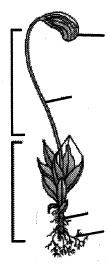
Identify the figure.
A
Porphyra
B
Sphagnum
C
Funaria
D
Equisetum
Solution
(C) The provided figure represents the moss $Funaria$.
$Funaria$ is a common moss belonging to the class Bryopsida under the division Bryophyta.
The figure shows the gametophyte (the leafy shoot with rhizoids) and the sporophyte (consisting of a foot,seta,and capsule) attached to it.
$Porphyra$ is a red alga,$Sphagnum$ is a peat moss with a different branching structure,and $Equisetum$ is a pteridophyte (horsetail).
$Funaria$ is a common moss belonging to the class Bryopsida under the division Bryophyta.
The figure shows the gametophyte (the leafy shoot with rhizoids) and the sporophyte (consisting of a foot,seta,and capsule) attached to it.
$Porphyra$ is a red alga,$Sphagnum$ is a peat moss with a different branching structure,and $Equisetum$ is a pteridophyte (horsetail).
0 likes
View Solution312
MediumMCQ
The plant body is thalloid in
A
Sunflower
B
Maize
C
Adiantum
D
Marchantia
Solution
(D) The plant body of $Marchantia$ is thalloid,which means it is a flat,green,dorsiventrally differentiated structure without true roots,stems,or leaves.
$Sunflower$ and $Maize$ are angiosperms with well-differentiated plant bodies consisting of roots,stems,and leaves.
$Adiantum$ is a pteridophyte,which also possesses a well-differentiated plant body with true roots,stems,and leaves.
Therefore,$Marchantia$ (a liverwort) is the correct answer.
$Sunflower$ and $Maize$ are angiosperms with well-differentiated plant bodies consisting of roots,stems,and leaves.
$Adiantum$ is a pteridophyte,which also possesses a well-differentiated plant body with true roots,stems,and leaves.
Therefore,$Marchantia$ (a liverwort) is the correct answer.
0 likes
View Solution313
MediumMCQ
They are called amphibians of the plant kingdom.
A
Algae
B
Pteridophyte
C
Bryophytes
D
Gymnosperm
Solution
(C) Bryophytes are known as the amphibians of the plant kingdom because these plants can live in soil but are dependent on water for sexual reproduction.
They require water for the movement of male gametes (antherozoids) to the female sex organ (archegonium) to complete fertilization.
Therefore,they are found in damp,humid,and shaded localities.
They require water for the movement of male gametes (antherozoids) to the female sex organ (archegonium) to complete fertilization.
Therefore,they are found in damp,humid,and shaded localities.
0 likes
View Solution314
MediumMCQ
Archegoniophore is present in .
A
Marchantia
B
Chara
C
Adiantum
D
Archaebacteria
Solution
(A) The archegoniophore is a specialized stalk-like structure that bears the archegonia (female reproductive organs) in certain liverworts.
$Marchantia$ is a dioecious bryophyte belonging to the class Hepaticopsida.
In $Marchantia$,the female thallus produces a stalked structure called the archegoniophore,which supports the archegonia.
Therefore,the correct option is $A$.
$Marchantia$ is a dioecious bryophyte belonging to the class Hepaticopsida.
In $Marchantia$,the female thallus produces a stalked structure called the archegoniophore,which supports the archegonia.
Therefore,the correct option is $A$.
0 likes
View Solution315
MediumMCQ
In a moss,the sporophyte:
A
Produces gametes that give rise to the gametophyte
B
Arises from a spore produced from the gametophyte
C
Manufactures food for itself as well as for the gametophyte
D
Is partially or totally parasitic on the gametophyte
Solution
(D) In bryophytes,including mosses,the life cycle exhibits a dominant gametophytic phase $(n)$.
The sporophyte $(2n)$ is formed after the fusion of gametes (syngamy) to form a zygote,which develops into the sporophyte.
The sporophyte is not free-living; it remains attached to the photosynthetic gametophyte for nutrition.
Therefore,the sporophyte is partially or totally dependent (parasitic) on the gametophyte for its nourishment.
The sporophyte $(2n)$ is formed after the fusion of gametes (syngamy) to form a zygote,which develops into the sporophyte.
The sporophyte is not free-living; it remains attached to the photosynthetic gametophyte for nutrition.
Therefore,the sporophyte is partially or totally dependent (parasitic) on the gametophyte for its nourishment.
0 likes
View Solution316
MediumMCQ
The protonema is formed during the life cycle of $..........$.
A
Riccia
B
Funaria
C
Chlamydomonas
D
Spirogyra
Solution
(B) The life cycle of mosses (Bryophyta) includes a juvenile stage known as the protonema.
$1$. The protonema is a creeping,green,branched,and frequently filamentous stage.
$2$. It develops directly from a spore.
$3$. Among the given options,$Funaria$ is a moss,whereas $Riccia$ is a liverwort,and $Chlamydomonas$ and $Spirogyra$ are algae.
$4$. Therefore,the protonema is characteristic of the life cycle of $Funaria$.
$1$. The protonema is a creeping,green,branched,and frequently filamentous stage.
$2$. It develops directly from a spore.
$3$. Among the given options,$Funaria$ is a moss,whereas $Riccia$ is a liverwort,and $Chlamydomonas$ and $Spirogyra$ are algae.
$4$. Therefore,the protonema is characteristic of the life cycle of $Funaria$.
0 likes
View Solution317
MediumMCQ
The peristome of mosses is involved in .............
A
Spore dispersal
B
Photosynthesis
C
Protection
D
Absorption
Solution
(A) The peristome is a specialized structure found in the capsule of mosses (Bryophyta).
It consists of a ring of tooth-like appendages surrounding the opening of the capsule.
These teeth are hygroscopic,meaning they respond to changes in humidity.
When the air is dry,the peristome teeth bend outward,allowing the spores inside the capsule to be released and dispersed by the wind.
Therefore,the primary function of the peristome is the regulation of spore dispersal.
It consists of a ring of tooth-like appendages surrounding the opening of the capsule.
These teeth are hygroscopic,meaning they respond to changes in humidity.
When the air is dry,the peristome teeth bend outward,allowing the spores inside the capsule to be released and dispersed by the wind.
Therefore,the primary function of the peristome is the regulation of spore dispersal.
0 likes
View Solution318
EasyMCQ
In the capsule of $Funaria$,the apophysis is located at the $..........$ .
A
lower part
B
upper part
C
middle part
D
fertile part
Solution
(A) The capsule of $Funaria$ is differentiated into three distinct regions: the $apophysis$,the $theca$,and the $operculum$.
$1$. The $apophysis$ is the sterile,basal (lower) part of the capsule that connects it to the $seta$.
$2$. The $theca$ is the middle,fertile part containing the $spore$ sac.
$3$. The $operculum$ is the upper,lid-like part of the capsule.
Therefore,the $apophysis$ is located at the lower part of the capsule.
$1$. The $apophysis$ is the sterile,basal (lower) part of the capsule that connects it to the $seta$.
$2$. The $theca$ is the middle,fertile part containing the $spore$ sac.
$3$. The $operculum$ is the upper,lid-like part of the capsule.
Therefore,the $apophysis$ is located at the lower part of the capsule.
0 likes
View Solution319
MediumMCQ
Bryophytes are called the amphibians of the plant kingdom because:
A
They require water for sexual reproduction.
B
They are found in moist and shady places.
C
They are mostly aquatic.
D
All of the above.
Solution
(A) Bryophytes are known as the amphibians of the plant kingdom because they can live in soil but are dependent on water for sexual reproduction. Specifically,the male gametes (antherozoids) require a film of water to swim to the female sex organ (archegonium) for fertilization. While they are found in moist and shady habitats,their classification as 'amphibians' is primarily due to this critical dependence on water for the completion of their life cycle.
0 likes
View Solution320
MediumMCQ
In which of the following is the largest gametophyte found?
A
Cycas
B
Angiosperms
C
Selaginella
D
Bryophytes
Solution
(D) In the plant kingdom,the gametophyte generation shows a trend of reduction as evolution progresses.
In $Bryophytes$,the gametophyte is the dominant,independent,and photosynthetic phase,making it the largest among the given options.
In $Pteridophytes$ (like $Selaginella$) and $Gymnosperms$ (like $Cycas$),the gametophyte is reduced and dependent on the sporophyte.
In $Angiosperms$,the gametophyte is highly reduced,consisting of only a few cells (e.g.,pollen grain and embryo sac).
In $Bryophytes$,the gametophyte is the dominant,independent,and photosynthetic phase,making it the largest among the given options.
In $Pteridophytes$ (like $Selaginella$) and $Gymnosperms$ (like $Cycas$),the gametophyte is reduced and dependent on the sporophyte.
In $Angiosperms$,the gametophyte is highly reduced,consisting of only a few cells (e.g.,pollen grain and embryo sac).
0 likes
View Solution321
MediumMCQ
Which plant group is characterized by the presence of spores and embryos but lacks vascular tissues and seeds?
A
Pteridophytes
B
Rhodophyta
C
Bryophytes
D
Phaeophyta
Solution
(C) The plant group that produces spores and embryos but lacks vascular tissues ($xylem$ and $phloem$) and seeds is known as $Bryophytes$.
$1$. $Bryophytes$ are often called the amphibians of the plant kingdom.
$2$. They possess a multicellular embryo stage in their life cycle.
$3$. They reproduce via spores.
$4$. Unlike $Pteridophytes$, $Gymnosperms$, and $Angiosperms$, they do not have specialized vascular tissues for the conduction of water and nutrients.
$1$. $Bryophytes$ are often called the amphibians of the plant kingdom.
$2$. They possess a multicellular embryo stage in their life cycle.
$3$. They reproduce via spores.
$4$. Unlike $Pteridophytes$, $Gymnosperms$, and $Angiosperms$, they do not have specialized vascular tissues for the conduction of water and nutrients.
0 likes
View Solution322
MediumMCQ
In mosses $(Funaria)$,the plant body is ......
A
Completely sporophytic
B
Completely gametophytic
C
Gametophytic with dominant sporophyte
D
Sporophytic with dominant gametophyte
Solution
(B) In bryophytes,including mosses like $Funaria$,the dominant phase of the life cycle is the gametophyte.
The plant body is haploid $(n)$ and represents the gametophytic generation.
The sporophyte $(2n)$ is dependent on the gametophyte for its nutrition and anchorage.
Therefore,the plant body is primarily gametophytic.
The plant body is haploid $(n)$ and represents the gametophytic generation.
The sporophyte $(2n)$ is dependent on the gametophyte for its nutrition and anchorage.
Therefore,the plant body is primarily gametophytic.
0 likes
View Solution323
MediumMCQ
In which of the following are elaters found in the mature spore capsule to assist in spore dispersal?
A
Riccia
B
Marchantia
C
Funaria
D
Sphagnum
Solution
(B) Elaters are hygroscopic,elongated,spindle-shaped cells found within the spore capsule of certain liverworts.
They respond to changes in humidity by twisting and untwisting,which helps in the mechanical dispersal of spores.
Among the given options,$Marchantia$ is a liverwort that possesses elaters in its capsule.
$Riccia$ lacks elaters,while $Funaria$ and $Sphagnum$ are mosses that possess a different structure called a peristome for spore dispersal.
They respond to changes in humidity by twisting and untwisting,which helps in the mechanical dispersal of spores.
Among the given options,$Marchantia$ is a liverwort that possesses elaters in its capsule.
$Riccia$ lacks elaters,while $Funaria$ and $Sphagnum$ are mosses that possess a different structure called a peristome for spore dispersal.
0 likes
View Solution324
MediumMCQ
Multicellular branched rhizoids and leafy gametophytes are characteristic of $........$.
A
All Bryophytes
B
Some Bryophytes
C
All Pteridophytes
D
Some Pteridophytes
Solution
(B) In the plant kingdom,$Bryophytes$ are divided into liverworts and mosses.
$Mosses$ (class $Bryopsida$) are characterized by the presence of a leafy gametophyte stage.
They also possess multicellular and branched rhizoids,which help in anchorage and absorption of water and minerals.
Therefore,these features are characteristic of some bryophytes (specifically mosses).
$Mosses$ (class $Bryopsida$) are characterized by the presence of a leafy gametophyte stage.
They also possess multicellular and branched rhizoids,which help in anchorage and absorption of water and minerals.
Therefore,these features are characteristic of some bryophytes (specifically mosses).
0 likes
View Solution325
MediumMCQ
Bryophytes differ from algae because they ......
A
have a thalloid body.
B
lack vascular tissues.
C
possess an archegonium surrounded by a layer of sterile cells.
D
have chloroplasts in their cells.
Solution
(C) Bryophytes are land-dwelling plants that exhibit a significant evolutionary advancement over algae.
One of the key differences is the structure of their reproductive organs.
In bryophytes,the female reproductive organ,known as the archegonium,is multicellular and flask-shaped,and it is protected by a jacket of sterile cells.
In contrast,algae typically have unicellular reproductive organs that lack such a protective sterile layer.
Therefore,the presence of an archegonium surrounded by sterile cells is a characteristic feature that distinguishes bryophytes from algae.
One of the key differences is the structure of their reproductive organs.
In bryophytes,the female reproductive organ,known as the archegonium,is multicellular and flask-shaped,and it is protected by a jacket of sterile cells.
In contrast,algae typically have unicellular reproductive organs that lack such a protective sterile layer.
Therefore,the presence of an archegonium surrounded by sterile cells is a characteristic feature that distinguishes bryophytes from algae.
0 likes
View Solution326
MediumMCQ
Bryophytes are dependent on water because...
A
Water is essential for their homosporous nature.
B
Water is required for vegetative growth.
C
Male gametes can easily reach the egg cells within the archegonium.
D
The archegonium must be filled with water for fertilization to occur.
Solution
(C) Bryophytes are often called the 'amphibians of the plant kingdom' because they require water for fertilization.
In bryophytes,the male gametes (antherozoids) are flagellated and motile.
These male gametes require a film of water to swim from the antheridium to the archegonium,where the egg is located.
Without water,the male gametes cannot reach the egg,and fertilization cannot take place.
In bryophytes,the male gametes (antherozoids) are flagellated and motile.
These male gametes require a film of water to swim from the antheridium to the archegonium,where the egg is located.
Without water,the male gametes cannot reach the egg,and fertilization cannot take place.
0 likes
View Solution327
MediumMCQ
Which of the following is true for $Bryophytes$?
A
They possess archegonia.
B
They contain chloroplasts.
C
They are thalloid.
D
All of the above.
Solution
(D) $Bryophytes$ are known as the amphibians of the plant kingdom. The following statements are true for them:
$1$. They possess $archegonia$ as the female sex organ.
$2$. They are photosynthetic organisms,hence they contain $chloroplasts$.
$3$. Their plant body is $thalloid$,meaning it is not differentiated into true roots,stems,or leaves.
Therefore,all the given statements are correct,and the correct option is $D$.
$1$. They possess $archegonia$ as the female sex organ.
$2$. They are photosynthetic organisms,hence they contain $chloroplasts$.
$3$. Their plant body is $thalloid$,meaning it is not differentiated into true roots,stems,or leaves.
Therefore,all the given statements are correct,and the correct option is $D$.
0 likes
View Solution328
MediumMCQ
Bryophytes possess:
A
$A$ long-lived sporophytic phase.
B
$A$ dominant sporophytic phase that is parasitic.
C
$A$ dominant gametophytic phase that produces spores.
D
$A$ small sporophytic phase that is parasitic on the gametophyte.
Solution
(D) In $Bryophytes$,the main plant body is a haploid gametophyte $(n)$,which is dominant and independent. The sporophyte $(2n)$ is multicellular and dependent on the gametophyte for its nutrition. Therefore,the sporophyte is considered parasitic on the gametophyte. Thus,the correct statement is that they possess a small sporophytic phase that is parasitic on the gametophyte.
0 likes
View Solution329
EasyMCQ
Dichotomous branching is found in ...........
A
Ferns
B
Funaria
C
Liverworts
D
Marchantia
Solution
(D) Dichotomous branching is a type of branching where the apical meristem divides into two equal branches. This pattern is characteristic of the thallus of liverworts,specifically $Marchantia$. In $Marchantia$,the thallus is dorsiventrally flattened and exhibits this distinct dichotomous branching pattern.
0 likes
View Solution330
EasyMCQ
The antherozoids of $Funaria$ are ....
A
Aflagellate
B
Biflagellate
C
Multiflagellate
D
Uniflagellate
Solution
(B) $Funaria$ is a genus of mosses belonging to the division $Bryophyta$.
In bryophytes,the male gametes are known as antherozoids.
These antherozoids are comma-shaped and possess two flagella at the anterior end,which helps them swim in water to reach the archegonium.
Therefore,they are described as biflagellate.
In bryophytes,the male gametes are known as antherozoids.
These antherozoids are comma-shaped and possess two flagella at the anterior end,which helps them swim in water to reach the archegonium.
Therefore,they are described as biflagellate.
0 likes
View Solution331
MediumMCQ
Peat moss is used as a packing material for sending flowers and live plants to distant places because . . . . . . .
A
It is hygroscopic (water-absorbing).
B
It reduces transpiration.
C
It acts as an antiseptic.
D
It is easily available.
Solution
(A) Peat moss,specifically $Sphagnum$,is a type of bryophyte known for its remarkable water-holding capacity.
It is hygroscopic,meaning it can absorb and retain large amounts of water.
Because of this property,it is used as a packing material for transporting live plants and flowers to distant places,as it keeps them moist and prevents them from drying out during transit.
Additionally,$Sphagnum$ has antiseptic properties that help prevent the growth of decay-causing microorganisms.
It is hygroscopic,meaning it can absorb and retain large amounts of water.
Because of this property,it is used as a packing material for transporting live plants and flowers to distant places,as it keeps them moist and prevents them from drying out during transit.
Additionally,$Sphagnum$ has antiseptic properties that help prevent the growth of decay-causing microorganisms.
0 likes
View Solution332
MediumMCQ
In some liverworts,the ......... helps in the dispersal of spores.
A
Elaters
B
Indusium
C
Calyptra
D
Peristome teeth
Solution
(A) In liverworts (like $Marchantia$),the capsule contains spores and specialized hygroscopic cells called $elaters$.
These $elaters$ are elongated,spindle-shaped cells with spiral wall thickenings.
They are sensitive to changes in humidity; as the capsule dries,the $elaters$ twist and untwist,which helps in the effective dispersal of spores into the environment.
These $elaters$ are elongated,spindle-shaped cells with spiral wall thickenings.
They are sensitive to changes in humidity; as the capsule dries,the $elaters$ twist and untwist,which helps in the effective dispersal of spores into the environment.
0 likes
View Solution333
MediumMCQ
In which of the following are the male and female gametophytes independent and free-living?
A
Mustard
B
Castor
C
Pinus
D
Sphagnum
Solution
(D) In $Sphagnum$,which belongs to the group $Bryophyta$,the gametophyte is the dominant,independent,and free-living phase of the life cycle.
In $Bryophytes$,the male and female gametophytes are independent and free-living organisms that produce gametes.
In contrast,$Mustard$ and $Castor$ are $Angiosperms$,where the gametophyte is highly reduced and dependent on the sporophyte.
$Pinus$ is a $Gymnosperm$,where the gametophyte is also dependent on the sporophyte.
In $Bryophytes$,the male and female gametophytes are independent and free-living organisms that produce gametes.
In contrast,$Mustard$ and $Castor$ are $Angiosperms$,where the gametophyte is highly reduced and dependent on the sporophyte.
$Pinus$ is a $Gymnosperm$,where the gametophyte is also dependent on the sporophyte.
0 likes
View Solution334
MediumMCQ
In which of the following does chlorenchyma tissue develop?
A
Pollen tube of Pinus
B
Cytoplasm of Chlorella
C
Green fungi like Aspergillus
D
Capsule of moss
Solution
(D) Chlorenchyma is a type of parenchyma tissue that contains chloroplasts and is specialized for photosynthesis. In the life cycle of mosses (Bryophytes),the sporophyte consists of a foot,seta,and capsule. The capsule is the photosynthetic part of the sporophyte,which contains chlorenchyma tissue to produce food for the developing spores. Therefore,the correct answer is the capsule of moss.
0 likes
View Solution335
MediumMCQ
Assertion : Mosses are evolved from algae.
Reason : Protonema of mosses is similar to some green algae.
Reason : Protonema of mosses is similar to some green algae.
A
If both Assertion and Reason are correct and the Reason is a correct explanation of the Assertion.
B
If both Assertion and Reason are correct but Reason is not a correct explanation of the Assertion.
C
If the Assertion is correct but Reason is incorrect.
D
If both the Assertion and Reason are incorrect.
Solution
(A) Mosses,which belong to the group $Bryophytes$,are considered to have evolved from green algae.
The evidence for this evolutionary link is supported by the fact that the $Protonema$ stage of mosses is filamentous and resembles the thallus structure of certain green algae,such as $Chara$ or $Ulothrix$.
Therefore,both the assertion and the reason are correct,and the reason provides a valid explanation for the evolutionary origin of mosses.
The evidence for this evolutionary link is supported by the fact that the $Protonema$ stage of mosses is filamentous and resembles the thallus structure of certain green algae,such as $Chara$ or $Ulothrix$.
Therefore,both the assertion and the reason are correct,and the reason provides a valid explanation for the evolutionary origin of mosses.
0 likes
View Solution336
MediumMCQ
Assertion: The peristome is a fringe of teeth-like projections found at the mouth of the capsule.
Reason: It may be of two types: nematodontous and orthodontous.
Reason: It may be of two types: nematodontous and orthodontous.
A
If both Assertion and Reason are correct and the Reason is a correct explanation of the Assertion.
B
If both Assertion and Reason are correct but Reason is not a correct explanation of the Assertion.
C
If the Assertion is correct but Reason is incorrect.
D
If both the Assertion and Reason are incorrect.
Solution
(B) The peristome is a specialized structure consisting of a fringe of teeth-like projections located at the mouth of the capsule in mosses.
These teeth help in the gradual dispersal of spores.
Peristome teeth are classified into two main types based on their structure:
$1$. Nematodontous: These are solid structures composed of bundles of dead cells. Examples include $Polytrichum$,$Pogonatum$,and $Tetraphis$.
$2$. Orthodontous: These are composed of thin,membranous,transversely barred teeth,formed by the thickened portions of the cell walls of adjacent cells.
Since both the definition of the peristome and its classification are correct,the Assertion and Reason are both true,but the Reason does not explain why the peristome is a fringe of teeth-like projections.
These teeth help in the gradual dispersal of spores.
Peristome teeth are classified into two main types based on their structure:
$1$. Nematodontous: These are solid structures composed of bundles of dead cells. Examples include $Polytrichum$,$Pogonatum$,and $Tetraphis$.
$2$. Orthodontous: These are composed of thin,membranous,transversely barred teeth,formed by the thickened portions of the cell walls of adjacent cells.
Since both the definition of the peristome and its classification are correct,the Assertion and Reason are both true,but the Reason does not explain why the peristome is a fringe of teeth-like projections.
0 likes
View Solution337
Medium
Describe the common characteristics of Bryophytic plants.
Solution
(N/A) $\rightarrow$Habitat: They are commonly found growing in moist,shaded areas in the hills.
$\rightarrow$Bryophytes are often called the amphibians of the plant kingdom because they can live in soil but are dependent on water for sexual reproduction.
$\rightarrow$They play an important role in plant succession on bare rocks and soil.
$\rightarrow$Body structure: The plant body of bryophytes is more differentiated than that of algae.
$\rightarrow$It is thallus-like and either prostrate or erect.
$\rightarrow$They are attached to the substratum by unicellular or multicellular rhizoids.
$\rightarrow$They lack true roots,stems,or leaves. They may possess root-like,leaf-like,or stem-like structures.
$\rightarrow$The main plant body is haploid and is called a gametophyte.
$\rightarrow$Reproductive organs: The sex organs in bryophytes are multicellular.
$\rightarrow$The male sex organ is called antheridium,which produces biflagellate antherozoids.
$\rightarrow$The female sex organ is called archegonium. It is flask-shaped and produces a single egg.
$\rightarrow$Fertilization: The antherozoids are released into water,where they come in contact with the archegonium.
$\rightarrow$An antherozoid fuses with the egg to produce a zygote.
$\rightarrow$Zygotes do not undergo reduction division (meiosis) immediately; they produce a multicellular body called a sporophyte.
$\rightarrow$The sporophyte is not free-living but is attached to the photosynthetic gametophyte and derives nourishment from it.
$\rightarrow$Some cells of the sporophyte undergo reduction division to produce haploid spores.
$\rightarrow$Economic Importance: While generally of little economic importance,some mosses provide food for herbaceous mammals,birds,and other animals.
$\rightarrow$Species of $Sphagnum$,a moss,provide peat,which has long been used as fuel and as packing material for the trans-shipment of living material due to its high water-holding capacity.
$\rightarrow$Bryophytes are often called the amphibians of the plant kingdom because they can live in soil but are dependent on water for sexual reproduction.
$\rightarrow$They play an important role in plant succession on bare rocks and soil.
$\rightarrow$Body structure: The plant body of bryophytes is more differentiated than that of algae.
$\rightarrow$It is thallus-like and either prostrate or erect.
$\rightarrow$They are attached to the substratum by unicellular or multicellular rhizoids.
$\rightarrow$They lack true roots,stems,or leaves. They may possess root-like,leaf-like,or stem-like structures.
$\rightarrow$The main plant body is haploid and is called a gametophyte.
$\rightarrow$Reproductive organs: The sex organs in bryophytes are multicellular.
$\rightarrow$The male sex organ is called antheridium,which produces biflagellate antherozoids.
$\rightarrow$The female sex organ is called archegonium. It is flask-shaped and produces a single egg.
$\rightarrow$Fertilization: The antherozoids are released into water,where they come in contact with the archegonium.
$\rightarrow$An antherozoid fuses with the egg to produce a zygote.
$\rightarrow$Zygotes do not undergo reduction division (meiosis) immediately; they produce a multicellular body called a sporophyte.
$\rightarrow$The sporophyte is not free-living but is attached to the photosynthetic gametophyte and derives nourishment from it.
$\rightarrow$Some cells of the sporophyte undergo reduction division to produce haploid spores.
$\rightarrow$Economic Importance: While generally of little economic importance,some mosses provide food for herbaceous mammals,birds,and other animals.
$\rightarrow$Species of $Sphagnum$,a moss,provide peat,which has long been used as fuel and as packing material for the trans-shipment of living material due to its high water-holding capacity.
0 likes
View Solution338
Easy
Write a note on Liverworts.
Solution
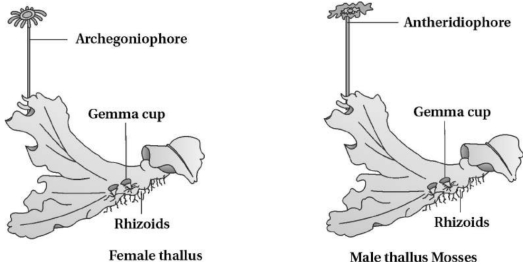
(N/A) $\rightarrow$ Habitat: Liverworts usually grow in moist,shady habitats such as banks of streams,marshy ground,damp soil,bark of trees,and deep in the woods. The plant body of a liverwort is thalloid,e.g.,$Marchantia$.
$\rightarrow$ The leafy members have tiny leaf-like appendages in two rows on the stem-like structures.
$\rightarrow$ Reproduction: Asexual reproduction in liverworts takes place by fragmentation of thalli or by the formation of specialised structures called gemmae.
$\rightarrow$ Gemmae develop in small receptacles called gemma cups located on the thalli. The gemmae become detached from the parent body and germinate to form new individuals.
$\rightarrow$ Sexual reproduction: During sexual reproduction,male and female sex organs are produced either on the same or on different thalli.
$\rightarrow$ The sporophyte is differentiated into a foot,seta,and capsule. After meiosis,spores are produced within the capsule. These spores germinate to form free-living gametophytes.
$\rightarrow$ The leafy members have tiny leaf-like appendages in two rows on the stem-like structures.
$\rightarrow$ Reproduction: Asexual reproduction in liverworts takes place by fragmentation of thalli or by the formation of specialised structures called gemmae.
$\rightarrow$ Gemmae develop in small receptacles called gemma cups located on the thalli. The gemmae become detached from the parent body and germinate to form new individuals.
$\rightarrow$ Sexual reproduction: During sexual reproduction,male and female sex organs are produced either on the same or on different thalli.
$\rightarrow$ The sporophyte is differentiated into a foot,seta,and capsule. After meiosis,spores are produced within the capsule. These spores germinate to form free-living gametophytes.
0 likes
View Solution339
Easy
Write a note on Moss.
Solution
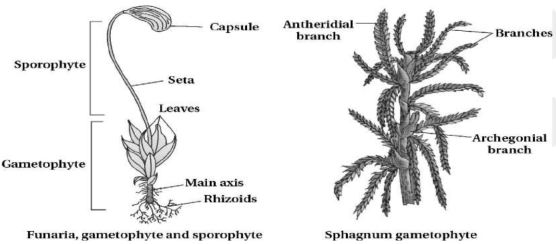
(N/A) Body structure: The predominant stage of the life cycle of a moss is the gametophyte,which consists of two stages:
$(i)$ The first stage: The first stage is the protonema stage,which develops directly from a spore. It is a creeping,green,branched,and frequently filamentous stage.
(ii) The second stage: The second stage is the leafy stage,which develops from the secondary protonema as a lateral bud. They consist of upright,slender axes bearing spirally arranged leaves. They are attached to the soil through multicellular and branched rhizoids. This stage bears the sex organs.
Reproduction in Moss:
Vegetative Reproduction: Vegetative reproduction in mosses occurs by fragmentation and budding in the secondary protonema.
Sexual Reproduction: In sexual reproduction,the sex organs,antheridia and archegonia,are produced at the apex of the leafy shoots. After fertilization,the zygote develops into a sporophyte,consisting of a foot,seta,and capsule. The sporophyte in mosses is more elaborate than that in liverworts. The capsule contains spores. Mosses have an elaborate mechanism of spore dispersal. Common examples of mosses are Funaria,Polytrichum,and Sphagnum.
$(i)$ The first stage: The first stage is the protonema stage,which develops directly from a spore. It is a creeping,green,branched,and frequently filamentous stage.
(ii) The second stage: The second stage is the leafy stage,which develops from the secondary protonema as a lateral bud. They consist of upright,slender axes bearing spirally arranged leaves. They are attached to the soil through multicellular and branched rhizoids. This stage bears the sex organs.
Reproduction in Moss:
Vegetative Reproduction: Vegetative reproduction in mosses occurs by fragmentation and budding in the secondary protonema.
Sexual Reproduction: In sexual reproduction,the sex organs,antheridia and archegonia,are produced at the apex of the leafy shoots. After fertilization,the zygote develops into a sporophyte,consisting of a foot,seta,and capsule. The sporophyte in mosses is more elaborate than that in liverworts. The capsule contains spores. Mosses have an elaborate mechanism of spore dispersal. Common examples of mosses are Funaria,Polytrichum,and Sphagnum.
0 likes
View Solution340
MediumMCQ
Why are bryophytes called the amphibians of the plant kingdom?
A
They can live in soil but are dependent on water for sexual reproduction.
B
They can live in water but are dependent on soil for sexual reproduction.
C
They are aquatic plants that can survive on land for a short period.
D
They are terrestrial plants that can survive in water for a long period.
Solution
(A) Bryophytes are known as the amphibians of the plant kingdom because they can live in soil (terrestrial habitat) but are dependent on water for sexual reproduction.
Specifically,the male gametes (antherozoids) require a film of water to swim to the female sex organ (archegonium) for fertilization to occur.
Since they require both land for growth and water for the completion of their life cycle,they are analogous to amphibians in the animal kingdom.
Specifically,the male gametes (antherozoids) require a film of water to swim to the female sex organ (archegonium) for fertilization to occur.
Since they require both land for growth and water for the completion of their life cycle,they are analogous to amphibians in the animal kingdom.
0 likes
View Solution341
EasyMCQ
Describe the reproduction in Bryophytes.
A
Vegetative reproduction only
B
Asexual reproduction only
C
Sexual reproduction only
D
Both vegetative and sexual reproduction
Solution
(D) Bryophytes reproduce primarily through vegetative and sexual methods.
$1$. Vegetative reproduction: It occurs through fragmentation,budding,or specialized structures like gemmae (e.g.,in Marchantia).
$2$. Sexual reproduction: It is oogamous. The male sex organ is called the antheridium,which produces biflagellate antherozoids. The female sex organ is the flask-shaped archegonium,which produces a single egg. The antherozoids are released into water,where they come in contact with the archegonium. An antherozoid fuses with the egg to produce the zygote. Zygotes do not undergo reduction division immediately; they produce a multicellular body called a sporophyte.
$1$. Vegetative reproduction: It occurs through fragmentation,budding,or specialized structures like gemmae (e.g.,in Marchantia).
$2$. Sexual reproduction: It is oogamous. The male sex organ is called the antheridium,which produces biflagellate antherozoids. The female sex organ is the flask-shaped archegonium,which produces a single egg. The antherozoids are released into water,where they come in contact with the archegonium. An antherozoid fuses with the egg to produce the zygote. Zygotes do not undergo reduction division immediately; they produce a multicellular body called a sporophyte.
0 likes
View Solution342
Medium
Give the economic importance of bryophytic plants.
Solution
(N/A) $\rightarrow$ Bryophytes generally have little economic importance,but some mosses provide food for herbaceous mammals,birds,and other animals.
$\rightarrow$ Species of $Sphagnum$,a moss,provide peat that has long been used as fuel and as packing material for the trans-shipment of living material due to its high water-holding capacity.
$\rightarrow$ Mosses,along with lichens,are the first organisms to colonize rocks,which is of great ecological and economic significance.
$\rightarrow$ They decompose rocks,making the substrate suitable for the growth of higher plants.
$\rightarrow$ Since mosses form dense mats on the soil,they reduce the impact of falling rain and prevent soil erosion.
$\rightarrow$ Species of $Sphagnum$,a moss,provide peat that has long been used as fuel and as packing material for the trans-shipment of living material due to its high water-holding capacity.
$\rightarrow$ Mosses,along with lichens,are the first organisms to colonize rocks,which is of great ecological and economic significance.
$\rightarrow$ They decompose rocks,making the substrate suitable for the growth of higher plants.
$\rightarrow$ Since mosses form dense mats on the soil,they reduce the impact of falling rain and prevent soil erosion.
0 likes
View Solution343
EasyMCQ
Describe the reproduction in Liverworts.
A
Asexual reproduction by fragmentation or gemmae.
B
Sexual reproduction involves male and female sex organs.
C
Both $A$ and $B$.
D
None of the above.
Solution
(C) Liverworts reproduce both asexually and sexually.
$1$. Asexual reproduction: This occurs by the fragmentation of the thalli or by the formation of specialized structures called gemmae. Gemmae are green,multicellular,asexual buds that develop in small receptacles called gemma cups located on the thalli. When detached from the parent body,they germinate to form new individuals.
$2$. Sexual reproduction: During sexual reproduction,male and female sex organs are produced either on the same or on different thalli. The sporophyte is differentiated into a foot,seta,and capsule. After meiosis,spores are produced within the capsule,which germinate to form free-living gametophytes.
$1$. Asexual reproduction: This occurs by the fragmentation of the thalli or by the formation of specialized structures called gemmae. Gemmae are green,multicellular,asexual buds that develop in small receptacles called gemma cups located on the thalli. When detached from the parent body,they germinate to form new individuals.
$2$. Sexual reproduction: During sexual reproduction,male and female sex organs are produced either on the same or on different thalli. The sporophyte is differentiated into a foot,seta,and capsule. After meiosis,spores are produced within the capsule,which germinate to form free-living gametophytes.
0 likes
View Solution344
MediumMCQ
Give information about the body structure of mosses.
A
Protonema stage
B
Leafy stage
C
Rhizoids
D
All of the above
Solution
(D) $(i)$ The first stage: The first stage is the protonema stage,which develops directly from a spore.
$\Rightarrow$ It is a creeping,green,branched,and frequently filamentous stage.
$(ii)$ The second stage: The second stage is the leafy stage,which develops from the secondary protonema as a lateral bud.
$\Rightarrow$ They consist of upright,slender axes bearing spirally arranged leaves.
$\Rightarrow$ They are attached to the soil through multicellular and branched rhizoids. This stage bears the sex organs.
$\Rightarrow$ It is a creeping,green,branched,and frequently filamentous stage.
$(ii)$ The second stage: The second stage is the leafy stage,which develops from the secondary protonema as a lateral bud.
$\Rightarrow$ They consist of upright,slender axes bearing spirally arranged leaves.
$\Rightarrow$ They are attached to the soil through multicellular and branched rhizoids. This stage bears the sex organs.
0 likes
View Solution345
MediumMCQ
Describe the body structure of mosses.
A
Thalloid and prostrate
B
Differentiated into root,stem,and leaves
C
Consists of a protonema stage and a leafy stage
D
Unicellular and filamentous
Solution
(C) The life cycle of a moss consists of two stages:
$1$. The $Protonema$ stage: This develops directly from a spore. It is a creeping,green,branched,and frequently filamentous stage.
$2$. The $Leafy$ stage: This develops from the secondary protonema as a lateral bud. It consists of upright,slender axes bearing spirally arranged leaves. They are attached to the soil through multicellular and branched $Rhizoids$. This stage bears the sex organs.
$1$. The $Protonema$ stage: This develops directly from a spore. It is a creeping,green,branched,and frequently filamentous stage.
$2$. The $Leafy$ stage: This develops from the secondary protonema as a lateral bud. It consists of upright,slender axes bearing spirally arranged leaves. They are attached to the soil through multicellular and branched $Rhizoids$. This stage bears the sex organs.
0 likes
View Solution346
Medium
'Peat' is an important source of domestic fuel in several countries. How is 'Peat' formed in nature?
Solution
(N/A) $\rightarrow$ Peat is an accumulation of partially decayed vegetation or organic matter.
$\rightarrow$ Formation of Peat: When plant material,usually in wet areas,is prevented from decaying fully because of acidic and anaerobic conditions,it results in the formation of peat.
$\rightarrow$ Peat is mainly composed of wetland vegetation. $Sphagnum$ (a moss) is the primary producer of peat,although many other plants may also be involved in its formation.
$\rightarrow$ Peat accumulation is a slow process,occurring at a rate of approximately $1 \ mm$ per year.
$\rightarrow$ Formation of Peat: When plant material,usually in wet areas,is prevented from decaying fully because of acidic and anaerobic conditions,it results in the formation of peat.
$\rightarrow$ Peat is mainly composed of wetland vegetation. $Sphagnum$ (a moss) is the primary producer of peat,although many other plants may also be involved in its formation.
$\rightarrow$ Peat accumulation is a slow process,occurring at a rate of approximately $1 \ mm$ per year.
0 likes
View SolutionPlant Kingdom — Bryophytes (General) · Frequently Asked Questions
1Are these Plant Kingdom questions useful for JEE and NEET?
Yes. All questions in this section are mapped to JEE Main and NEET exam patterns. Previous year questions from JEE Main, NEET, GUJCET and state-level exams are included with full solutions.
2Can I switch to Hindi or Gujarati for these questions?
Yes. Use the language tabs in the hero section or the sidebar to view the same questions and solutions in English, Hindi or Gujarati.
3How do I generate a question paper from this subtopic?
Use the Vedclass Exam Paper Generator — select the chapter and subtopic, set difficulty, and generate Sets A, B, C, D automatically. First 3 chapters of every subject are free.
Vedclass Products
For Students
Vedclass Test Series
Mock tests in real JEE/NEET style with performance analysis. 5-day free trial.
Start Free TrialFor Teachers
Exam Paper Generator
Generate Set A/B/C/D papers from this chapter in 2 minutes. 3 chapters free.
Try FreeFor Institutes
Online Exam Module
Live online exams with unlimited students, 360° analytics & white-label branding.
See DemoFor Teachers & Institutes
Generate a Plant Kingdom Exam Paper in 2 Minutes
Select subtopic & difficulty — Sets A, B, C, D auto-generated with No Repeat logic.
First 3 chapters of every subject are free — no payment required.