
A English
Bryophytes (General) Questions in English
Class 11 Biology · Plant Kingdom · Bryophytes (General)
441+
Questions
English
Language
100%
With Solutions
Showing 50 of 441 questions in English
351
Medium
What is the importance of the following structures in Bryophytes?
$(i)$ Rhizoids
$(ii)$ Gemmae
$(i)$ Rhizoids
$(ii)$ Gemmae
Solution
(N/A) $(i)$ In bryophytes,instead of true roots,special hair-like structures are present for fixation to the substratum and absorption of water and minerals; these are called rhizoids.
$(ii)$ In liverworts,small cup-shaped structures called gemma cups develop on the thallus. They contain gemmae,which are green,multicellular,asexual buds that detach from the parent body and germinate to form new individuals.
$(ii)$ In liverworts,small cup-shaped structures called gemma cups develop on the thallus. They contain gemmae,which are green,multicellular,asexual buds that detach from the parent body and germinate to form new individuals.
0 likes
View Solution352
EasyMCQ
Who is known as the father of Indian Bryology?
A
Prof. Shivram Kashyap
B
Prof. Birbal Sahni
C
Prof. $P$. Maheshwari
D
Prof. $M$.$S$. Swaminathan
Solution
(A) Prof. Shivram Kashyap is widely recognized as the father of Indian Bryology. He made significant contributions to the study of liverworts and mosses in India,particularly in the Himalayas.
0 likes
View Solution353
EasyMCQ
What is the contribution of the botanist Rothmaler in the classification of plants?
A
He classified Algae into $3$ classes.
B
He divided Bryophytes into $3$ classes.
C
He classified Pteridophytes into $4$ classes.
D
He proposed the system of classification for Angiosperms.
Solution
(B) The botanist Rothmaler is known for his contribution to the classification of the plant kingdom,specifically regarding Bryophytes.
He divided the group Bryophyta into $3$ distinct classes: Hepaticopsida (Liverworts),Anthocerotopsida (Hornworts),and Bryopsida (Mosses).
He divided the group Bryophyta into $3$ distinct classes: Hepaticopsida (Liverworts),Anthocerotopsida (Hornworts),and Bryopsida (Mosses).
0 likes
View Solution354
Medium
Why are bryophytes called the amphibians of the plant kingdom?
Solution
(N/A) Bryophytes are known as the amphibians of the plant kingdom because they can live in soil but are dependent on water for sexual reproduction.
$1$. These plants typically grow in moist,shaded,and damp areas.
$2$. The male gametes,known as antherozoids,are flagellated and motile.
$3$. They require an external film of water to swim from the male sex organ (antheridium) to the female sex organ (archegonium) to achieve fertilization.
$4$. Since they require both land for survival and water for the completion of their life cycle,they are termed amphibians of the plant kingdom.
$1$. These plants typically grow in moist,shaded,and damp areas.
$2$. The male gametes,known as antherozoids,are flagellated and motile.
$3$. They require an external film of water to swim from the male sex organ (antheridium) to the female sex organ (archegonium) to achieve fertilization.
$4$. Since they require both land for survival and water for the completion of their life cycle,they are termed amphibians of the plant kingdom.
0 likes
View Solution355
Easy
Gametophyte is a dominant phase in the life cycle of a bryophyte. Explain.
Solution
(N/A) $\rightarrow$ In the life cycle of bryophytes,the gametophytic stage is haploid and multicellular at the adult stage.
$\rightarrow$ It possesses male reproductive organs called $antheridia$ and female reproductive organs called $archegonia$,which produce haploid $antherozoids$ and female gametes,respectively.
$\rightarrow$ In mosses,liverworts,and hornworts,the gametophyte is the main dominant phase and is the most prominent stage in their life cycles. The gametophyte of mosses arises from haploid spores. The initial stage of a moss is the $protonema$.
$\rightarrow$ The $protonema$ develops into the main plant body (thallus) of the bryophyte. It is thalloid or prostrate/erect and is attached to the substratum by unicellular or multicellular $rhizoids$. They may possess root-like,stem-like,or leaf-like structures.
$\rightarrow$ It possesses male reproductive organs called $antheridia$ and female reproductive organs called $archegonia$,which produce haploid $antherozoids$ and female gametes,respectively.
$\rightarrow$ In mosses,liverworts,and hornworts,the gametophyte is the main dominant phase and is the most prominent stage in their life cycles. The gametophyte of mosses arises from haploid spores. The initial stage of a moss is the $protonema$.
$\rightarrow$ The $protonema$ develops into the main plant body (thallus) of the bryophyte. It is thalloid or prostrate/erect and is attached to the substratum by unicellular or multicellular $rhizoids$. They may possess root-like,stem-like,or leaf-like structures.
0 likes
View Solution356
Easy
Choose the correct option to fill in the blanks:
$(i)$ In oogamy,the female gamete is large,passive,non-motile,and laden with food (yolk).
$(ii)$ The gametophyte bears antheridia and archegonia.
$(i)$ In oogamy,the female gamete is large,passive,non-motile,and laden with food (yolk).
$(ii)$ The gametophyte bears antheridia and archegonia.
Solution
(A) $(i)$ Oogamy
$(ii)$ Gametophyte
Explanation:
$1$. Oogamy is a type of sexual reproduction where the female gamete is large,non-motile,and food-rich,while the male gamete is small and motile.
$2$. In the life cycle of bryophytes,the dominant phase is the gametophyte,which produces sex organs known as antheridia (male) and archegonia (female).
$(ii)$ Gametophyte
Explanation:
$1$. Oogamy is a type of sexual reproduction where the female gamete is large,non-motile,and food-rich,while the male gamete is small and motile.
$2$. In the life cycle of bryophytes,the dominant phase is the gametophyte,which produces sex organs known as antheridia (male) and archegonia (female).
0 likes
View Solution357
MediumMCQ
The plant body in higher plants is well differentiated and well developed. Roots are the organs used for the purpose of absorption. What is the equivalent of roots in the less developed lower plants?
A
Rhizoids
B
Stems
C
Leaves
D
Flowers
Solution
(A) In lower plants such as bryophytes,the plant body is not differentiated into true roots,stems,and leaves.
Instead,they possess root-like structures called $Rhizoids$ that help in the absorption of water and minerals from the substrate.
Unlike higher plants (gymnosperms and angiosperms),these lower plants lack a complex vascular tissue system.
Instead,they possess root-like structures called $Rhizoids$ that help in the absorption of water and minerals from the substrate.
Unlike higher plants (gymnosperms and angiosperms),these lower plants lack a complex vascular tissue system.
0 likes
View Solution358
MediumMCQ
In bryophytes,male and female sex organs are called $......$ and $.......$.
A
Antheridia and Archegonia
B
Archegonia and Antheridia
C
Stamen and Pistil
D
Ovary and Testis
Solution
(A) In Bryophytes,the male reproductive organ is the $Antheridium$ (plural: $Antheridia$) and the female reproductive organ is the $Archegonium$ (plural: $Archegonia$).
These organs are produced on the haploid gametophyte body.
The $Antheridia$ produce biflagellate motile male gametes called $antherozoids$.
The $Archegonium$ is flask-shaped and produces a single egg cell.
Water is essential for the transfer of $antherozoids$ to the $archegonium$ for fertilization.
These organs are produced on the haploid gametophyte body.
The $Antheridia$ produce biflagellate motile male gametes called $antherozoids$.
The $Archegonium$ is flask-shaped and produces a single egg cell.
Water is essential for the transfer of $antherozoids$ to the $archegonium$ for fertilization.
0 likes
View Solution359
EasyMCQ
$Sphagnum$,a moss,is used as a packing material for transporting living materials because of its:
A
Water holding capacity
B
Creeping capacity
C
Alkaline nature as it does not undergo decay
D
All of the above
Solution
(A) $Sphagnum$ is a bryophyte,commonly known as bog moss or peat moss.
It is highly hygroscopic and possesses a remarkable water-holding capacity.
Due to this property,it is used as a packing material for the transportation of living materials such as flowers,live plants,tubers,bulbs,and seedlings,as it keeps them moist.
Additionally,it is used in seed-beds and moss-sticks.
It is highly hygroscopic and possesses a remarkable water-holding capacity.
Due to this property,it is used as a packing material for the transportation of living materials such as flowers,live plants,tubers,bulbs,and seedlings,as it keeps them moist.
Additionally,it is used in seed-beds and moss-sticks.
0 likes
View Solution360
MediumMCQ
Bryophytes include
A
Liverworts and mosses
B
Lycopods and mosses
C
Lycopods and liverworts
D
Liverworts and Volvox
Solution
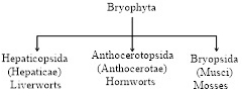
(A) The plant kingdom group Bryophyta is primarily divided into three classes:
$1$. Hepaticopsida (Liverworts)
$2$. Anthocerotopsida (Hornworts)
$3$. Bryopsida (Mosses)
Therefore,bryophytes include liverworts,hornworts,and mosses. Among the given options,liverworts and mosses are the correct components of the bryophyte group.
$1$. Hepaticopsida (Liverworts)
$2$. Anthocerotopsida (Hornworts)
$3$. Bryopsida (Mosses)
Therefore,bryophytes include liverworts,hornworts,and mosses. Among the given options,liverworts and mosses are the correct components of the bryophyte group.
0 likes
View Solution361
MediumMCQ
Which of the following plant groups lack true roots,stems,and leaves?
A
Angiosperms
B
Gymnosperms
C
Pteridophytes
D
Bryophytes
Solution
(D) The plant body of $Bryophytes$ is thalloid or leafy and attached to the substratum by unicellular or multicellular $rhizoids$. They lack true roots,stems,and leaves. Instead,they possess root-like,stem-like,and leaf-like structures. In contrast,$Pteridophytes$,$Gymnosperms$,and $Angiosperms$ possess well-differentiated plant bodies with true roots,stems,and leaves.
0 likes
View Solution362
MediumMCQ
Peat moss is
A
Funaria
B
Fern
C
Algae
D
Sphagnum
Solution
(D) $Sphagnum$ and other mosses are the primary constituents of peat. Due to this property,$Sphagnum$ is commonly known as peat moss.
0 likes
View Solution363
MediumMCQ
Bryophytes are called the amphibians of the plant kingdom because
A
Their reproductive phase requires water
B
Their sex organs are multicellular and jacketed
C
They have tracheids
D
All of the above
Solution
(A) Bryophytes are known as the amphibians of the plant kingdom because they can live in soil but are dependent on water for sexual reproduction.
Specifically,the male gametes (antherozoids) require a film of water to swim to the female sex organ (archegonium) for fertilization to occur.
Option $A$ is the correct reason for this classification.
Options $B$ is a characteristic of bryophytes but not the reason they are called amphibians.
Option $C$ is incorrect because bryophytes lack vascular tissues like tracheids.
Specifically,the male gametes (antherozoids) require a film of water to swim to the female sex organ (archegonium) for fertilization to occur.
Option $A$ is the correct reason for this classification.
Options $B$ is a characteristic of bryophytes but not the reason they are called amphibians.
Option $C$ is incorrect because bryophytes lack vascular tissues like tracheids.
0 likes
View Solution364
EasyMCQ
In Funaria,the number of peristomial teeth is
A
$6$
B
$10$
C
$16$
D
$32$
Solution
(D) In the moss $Funaria$,the capsule contains a specialized structure called the peristome.
This peristome consists of $32$ peristomial teeth.
These teeth are arranged in two concentric rings,with $16$ teeth in each ring.
This peristome consists of $32$ peristomial teeth.
These teeth are arranged in two concentric rings,with $16$ teeth in each ring.
0 likes
View Solution365
MediumMCQ
Moss spores germinate to form:
A
Sporophyte
B
Protonema
C
Seta
D
Capsule
Solution
(B) Haploid spores represent the first cell of the gametophytic generation in mosses.
Upon germination,these spores develop into a filamentous,green,branched structure known as the protonema.
The cells of the protonema contain chloroplasts and are responsible for the vegetative growth of the moss gametophyte.
Upon germination,these spores develop into a filamentous,green,branched structure known as the protonema.
The cells of the protonema contain chloroplasts and are responsible for the vegetative growth of the moss gametophyte.
0 likes
View Solution366
MediumMCQ
The amphibians of the plant kingdom are:
A
Multicellular non-motile algae
B
Bryophytes with simple internal organization
C
Unicellular motile algae
D
Pteridophytes with complex internal organization
Solution
(B) Although bryophytes are land plants,water is essential for their fertilization.
Water provides a medium for the transport of male gametes (antherozoids) to the female reproductive organ (archegonia).
Because they require both land for growth and water for reproduction,bryophytes are known as the amphibians of the plant kingdom.
Water provides a medium for the transport of male gametes (antherozoids) to the female reproductive organ (archegonia).
Because they require both land for growth and water for reproduction,bryophytes are known as the amphibians of the plant kingdom.
0 likes
View Solution367
MediumMCQ
Moss peat is used as a packing material for sending flowers and live plants to distant places because
A
It is easily available
B
It is hygroscopic
C
It reduces transpiration
D
It serves as a disinfectant
Solution
(B) $Sphagnum$ is a bryophyte,commonly called bog moss or peat moss.
It is hygroscopic and possesses a remarkable water-holding capacity.
Hence,it is used as a packing material in the transportation of flowers,live plants,tubers,bulbs,seedlings,etc.
It is also used in seedbeds and in moss-sticks.
It is hygroscopic and possesses a remarkable water-holding capacity.
Hence,it is used as a packing material in the transportation of flowers,live plants,tubers,bulbs,seedlings,etc.
It is also used in seedbeds and in moss-sticks.
0 likes
View Solution368
MediumMCQ
The moss plant is
A
Sometimes gametophyte and sometimes sporophyte
B
Predominantly gametophyte with sporophyte attached to it
C
Gametophyte
D
Sporophyte
Solution
(B) In mosses,the haploid gametophyte is the dominant,long-lived,green,and independent phase of the life cycle. The diploid sporophyte is short-lived and remains attached to the gametophyte for its nutrition and support.
0 likes
View Solution369
MediumMCQ
Consider the following statements:
$I.$ The liverworts grow usually in moist,shady habitats such as banks of streams,marshy ground,damp soil,bark of trees,and deep in the woods.
$II.$ The leafy members of liverwort have tiny leaf-like appendages in two rows on the stem-like structures.
Choose the correct option.
$I.$ The liverworts grow usually in moist,shady habitats such as banks of streams,marshy ground,damp soil,bark of trees,and deep in the woods.
$II.$ The leafy members of liverwort have tiny leaf-like appendages in two rows on the stem-like structures.
Choose the correct option.
A
$I$ is true,$II$ is false.
B
$I$ is false,$II$ is true.
C
$I$ and $II$ are true.
D
$I$ and $II$ are false.
Solution
(C) Statement $I$ is true because liverworts are bryophytes that typically inhabit moist,shady areas,including stream banks,marshy ground,damp soil,tree bark,and deep forests.
Statement $II$ is true because leafy liverworts possess small,leaf-like appendages arranged in two rows on their stem-like axes,which distinguishes them from the thalloid forms.
Statement $II$ is true because leafy liverworts possess small,leaf-like appendages arranged in two rows on their stem-like axes,which distinguishes them from the thalloid forms.
0 likes
View Solution370
MediumMCQ
In $Funaria$ capsule,dispersal of spores takes place through
A
Peristomial teeth
B
Annulus
C
Calyptra
D
Operculum
Solution
(A) In the moss $Funaria$,the dispersal of spores is facilitated by the hygroscopic movements of the peristomial teeth (the lengthening and shortening of these teeth due to moisture changes).
These peristomial teeth act as a regulatory mechanism,where the inner peristome functions like a sieve,allowing only a few spores to escape at a time,ensuring efficient dispersal.
These peristomial teeth act as a regulatory mechanism,where the inner peristome functions like a sieve,allowing only a few spores to escape at a time,ensuring efficient dispersal.
0 likes
View Solution371
EasyMCQ
The father of Indian Bryology is:
A
Raj Kumar
B
$SR$ Kashyap
C
Maheshwari
D
Khurana
Solution
(B) $SR$ Kashyap is known as the father of Indian Bryology due to his extensive research and significant contributions to the study of bryophytes in India.
0 likes
View Solution372
MediumMCQ
In liverworts,asexual reproduction takes place by
A
Gemmae and fragmentation of thalli
B
Fragmentation and zoospores
C
Gemmae formation and spores formation
D
Isogamy and anisogamy
Solution
(A) Liverworts reproduce asexually by the formation of specialised structures called gemmae or through the fragmentation of thalli.
Gemmae are asexual buds,which originate from small receptacles called gemma cups.
Gemmae are asexual buds,which originate from small receptacles called gemma cups.
0 likes
View Solution373
MediumMCQ
In moss,the sporophyte is differentiated into
A
Seta and capsule
B
Foot and seta
C
Protonema,foot and capsule
D
Foot,seta and capsule
Solution
(D) In mosses (like $Funaria$),the sporophyte is more elaborate than that in liverworts. It is differentiated into three distinct parts: $Foot$,$Seta$,and $Capsule$.
0 likes
View Solution374
MediumMCQ
Which of the following statements is correct about Marchantia?
$I.$ Plant body is thallus-like and closely attached to the substrate.
$II.$ Sporophyte is differentiated into foot,seta,and capsule.
$III.$ Gemma cups are located on the thalli.
$I.$ Plant body is thallus-like and closely attached to the substrate.
$II.$ Sporophyte is differentiated into foot,seta,and capsule.
$III.$ Gemma cups are located on the thalli.
A
$I$ and $II$
B
$I$ and $III$
C
$II$ and $III$
D
$I, II$ and $III$
Solution
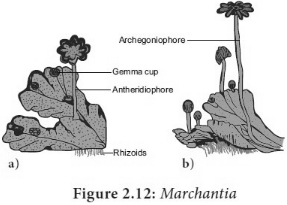
(D) The vegetative plant body of Marchantia is a dorsiventral,lobed thallus that is closely attached to the substrate.
The sporophyte of bryophytes is known as a sporogonium. In Marchantia,the sporogonium is differentiated into three parts: foot,seta,and capsule.
Asexual reproduction in Marchantia takes place by the formation of gemmae,which are green,multicellular,asexual buds that develop in small receptacles called gemma cups,located on the thalli.
Since all three statements ($I, II,$ and $III$) are correct,the correct option is $D$.
The sporophyte of bryophytes is known as a sporogonium. In Marchantia,the sporogonium is differentiated into three parts: foot,seta,and capsule.
Asexual reproduction in Marchantia takes place by the formation of gemmae,which are green,multicellular,asexual buds that develop in small receptacles called gemma cups,located on the thalli.
Since all three statements ($I, II,$ and $III$) are correct,the correct option is $D$.
0 likes
View Solution375
MediumMCQ
The positive evidence of aquatic ancestry of bryophytes is indicated by
A
Absence of vascular tissue
B
Gametophytic body
C
Biflagellate gametes
D
Peristomial teeth
Solution
(C) The presence of biflagellated antherozoids (male gametes) and the absolute necessity of water for the process of fertilization are strong indicators that bryophytes have evolved from aquatic ancestors.
0 likes
View Solution376
MediumMCQ
Mosses occur in moist places because
A
They cannot grow on land
B
Their gametes fuse in water
C
They lack vascular tissue
D
They lack roots and stomata
Solution
(B) Mosses belong to the group Bryophyta. In these plants,fertilization is dependent on water because the male gametes (antherozoids) are flagellated and require a water medium to swim to the female gametes (egg) for fusion. Therefore,mosses are restricted to moist and shady habitats.
0 likes
View Solution377
MediumMCQ
Bryophytes resemble algae in the following aspect.
A
Filamentous body,presence of vascular tissues and autotrophic nutrition
B
Differentiation of plant body into root,stem and leaves and autotrophic nutrition
C
Thallus like plant body,presence of roots and autotrophic nutrition
D
Thallus like plant body,lack of vascular tissues and autotrophic nutrition
Solution
(D) Bryophytes resemble algae in several aspects:
$(i)$ Both have a thalloid plant body.
$(ii)$ Both lack true roots,stems,and leaves.
$(iii)$ Both lack complex vascular tissues ($xylem$ and $phloem$).
$(iv)$ Both exhibit an autotrophic mode of nutrition.
$(v)$ Both store food material as starch.
$(i)$ Both have a thalloid plant body.
$(ii)$ Both lack true roots,stems,and leaves.
$(iii)$ Both lack complex vascular tissues ($xylem$ and $phloem$).
$(iv)$ Both exhibit an autotrophic mode of nutrition.
$(v)$ Both store food material as starch.
0 likes
View Solution378
MediumMCQ
Which statement is incorrect regarding bryophytes?
A
Water is essential for sexual reproduction.
B
Presence of antheridium.
C
Presence of flagellated sperms.
D
Presence of autotrophic independent sporophyte.
Solution
(D) In bryophytes,the main plant body is a haploid gametophyte. The diploid sporophyte is short-lived and remains attached to the photosynthetic gametophyte for nutrition. Therefore,the sporophyte is not independent or autotrophic.
0 likes
View Solution379
MediumMCQ
Choose the correct statements about protonema.
A
Juvenile stage of moss is protonema.
B
It consists of a slender,green,branching system of filaments.
C
Develops directly from a spore.
D
All of the above.
Solution
(D) The protonema is the juvenile stage in the life cycle of mosses.
It develops directly from the germination of a haploid spore.
It is characterized as a creeping,green,slender,branched,and frequently filamentous structure.
It develops directly from the germination of a haploid spore.
It is characterized as a creeping,green,slender,branched,and frequently filamentous structure.
0 likes
View Solution380
MediumMCQ
Choose the incorrect statement about mosses.
A
Sexual reproduction occurs by the fusion of gametes produced by antheridia and archegonia present at the apex of the leafy shoots.
B
Sporophyte is differentiated into foot,seta and capsule.
C
Seta and capsule bear spores,which give rise to gametophyte after meiosis.
D
The sporophyte in mosses is more elaborate than that in liverworts.
Solution
(C) In mosses,the sporophyte is differentiated into foot,seta,and capsule.
Only the capsule contains the spore sac where meiosis occurs to produce haploid spores.
These spores germinate to form the protonema,which eventually develops into the leafy gametophyte.
Therefore,the statement that 'Seta and capsule bear spores' is incorrect because the seta does not produce spores; only the capsule does.
Only the capsule contains the spore sac where meiosis occurs to produce haploid spores.
These spores germinate to form the protonema,which eventually develops into the leafy gametophyte.
Therefore,the statement that 'Seta and capsule bear spores' is incorrect because the seta does not produce spores; only the capsule does.
0 likes
View Solution381
MediumMCQ
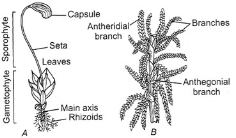
Which of the following options correctly identifies the plants and their groups from the following structure?
A
$A$-Funaria-Moss; $B$-Sphagnum-Moss
B
$A$-Funaria-Liverwort; $B$-Sphagnum-Moss
C
$A$-Selaginella-Bryophytes; $B$-Funaria-Liverwort
D
$A$-Selaginella-Pteridophytes; $B$-Funaria-Moss
Solution
(A) In the given figure,$A$ represents $Funaria$,which is a type of moss belonging to the class Bryopsida under Bryophytes.
$B$ represents $Sphagnum$,which is also a type of moss (peat moss) belonging to the class Bryopsida under Bryophytes.
Both $Funaria$ and $Sphagnum$ are classified as mosses within the Bryophytes group.
Therefore,the correct identification is $A$-Funaria-Moss and $B$-Sphagnum-Moss.
$B$ represents $Sphagnum$,which is also a type of moss (peat moss) belonging to the class Bryopsida under Bryophytes.
Both $Funaria$ and $Sphagnum$ are classified as mosses within the Bryophytes group.
Therefore,the correct identification is $A$-Funaria-Moss and $B$-Sphagnum-Moss.
0 likes
View Solution382
MediumMCQ
Calyptra develops from
A
Venter of archegonium
B
Outgrowth of gametophyte
C
Jacket cells of archegonium
D
Paraphysis of the archegonial branch
Solution
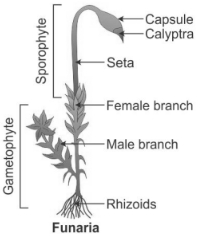
(A) In bryophytes like $Funaria$,the zygote develops into a sporophyte within the archegonium.
As the sporophyte grows,the venter of the archegonium also enlarges to accommodate it.
This enlarged,haploid,protective covering derived from the venter of the archegonium is known as the calyptra.
It serves to protect the developing young capsule from desiccation and mechanical injury.
As the sporophyte grows,the venter of the archegonium also enlarges to accommodate it.
This enlarged,haploid,protective covering derived from the venter of the archegonium is known as the calyptra.
It serves to protect the developing young capsule from desiccation and mechanical injury.
0 likes
View Solution383
MediumMCQ
The bryophytes are fundamentally terrestrial plants but require the presence of water to complete their life cycle. The water is needed for
$I.$ dehiscence of antheridia $II.$ liberation of antherozoids
$III.$ transfer of sperms from antheridia to archegonia
$IV.$ opening of archegonial neck $V.$ the movement of antherozoids into the archegonial neck
Which of the statements given above are correct?
$I.$ dehiscence of antheridia $II.$ liberation of antherozoids
$III.$ transfer of sperms from antheridia to archegonia
$IV.$ opening of archegonial neck $V.$ the movement of antherozoids into the archegonial neck
Which of the statements given above are correct?
A
$I, II$ and $IV$
B
$II, III, IV$ and $V$
C
$III, IV$ and $V$
D
$I, II, III, IV$ and $V$
Solution
(D) In bryophytes,water is essential for the following processes:
$(i)$ Dehiscence of antheridia: Water absorption causes the antheridia to burst.
$(ii)$ Liberation of antherozoids: The motile male gametes (antherozoids) are released into the water.
$(iii)$ Transfer of sperms from antheridia to archegonia: Water acts as a medium for the swimming of antherozoids.
$(iv)$ Opening of archegonial neck: The neck canal cells and ventral canal cell degenerate to form a mucilaginous mass,which absorbs water and swells,causing the neck to open.
$(v)$ The movement of antherozoids into the archegonial neck: Antherozoids are attracted chemotactically to the archegonium through the water.
Thus,all the given statements $(I, II, III, IV, V)$ are correct. Because of this dependence on water for fertilization,bryophytes are known as the 'amphibians of the plant kingdom'.
$(i)$ Dehiscence of antheridia: Water absorption causes the antheridia to burst.
$(ii)$ Liberation of antherozoids: The motile male gametes (antherozoids) are released into the water.
$(iii)$ Transfer of sperms from antheridia to archegonia: Water acts as a medium for the swimming of antherozoids.
$(iv)$ Opening of archegonial neck: The neck canal cells and ventral canal cell degenerate to form a mucilaginous mass,which absorbs water and swells,causing the neck to open.
$(v)$ The movement of antherozoids into the archegonial neck: Antherozoids are attracted chemotactically to the archegonium through the water.
Thus,all the given statements $(I, II, III, IV, V)$ are correct. Because of this dependence on water for fertilization,bryophytes are known as the 'amphibians of the plant kingdom'.
0 likes
View Solution384
MediumMCQ
In mosses,the second gametophytic stage is the leafy stage. Consider the following statements about the leafy stage:
$I.$ The leafy stage is produced from the secondary protonema as a lateral bud.
$II.$ They consist of upright,slender axes bearing spirally arranged leaves.
$III.$ They are attached to the soil through multicellular rhizoids.
$IV.$ This leafy stage bears the sex organs.
Which of the statements given above are correct?
$I.$ The leafy stage is produced from the secondary protonema as a lateral bud.
$II.$ They consist of upright,slender axes bearing spirally arranged leaves.
$III.$ They are attached to the soil through multicellular rhizoids.
$IV.$ This leafy stage bears the sex organs.
Which of the statements given above are correct?
A
$I, II$ and $III$
B
$I, III$ and $IV$
C
$II, III$ and $IV$
D
$I, II, III$ and $IV$
Solution
(D) All the statements provided are correct regarding the leafy stage of mosses.
$I.$ The leafy stage develops directly from the secondary protonema as a lateral bud.
$II.$ The plant body consists of an upright,slender axis that bears leaves arranged in a spiral pattern.
$III.$ The plant is anchored to the substrate (soil) by multicellular,branched rhizoids.
$IV.$ The leafy stage represents the mature gametophyte and is responsible for bearing the sex organs (antheridia and archegonia).
$I.$ The leafy stage develops directly from the secondary protonema as a lateral bud.
$II.$ The plant body consists of an upright,slender axis that bears leaves arranged in a spiral pattern.
$III.$ The plant is anchored to the substrate (soil) by multicellular,branched rhizoids.
$IV.$ The leafy stage represents the mature gametophyte and is responsible for bearing the sex organs (antheridia and archegonia).
0 likes
View Solution385
MediumMCQ
Which of the following in a moss capsule is haploid/gametophytic tissue?
A
Annulus and peristome
B
Calyptra and spore
C
Columella and theca
D
Operculum,foot,and seta
Solution
(B) In mosses,the sporophyte is dependent on the gametophyte. The sporophyte consists of the foot,seta,and capsule,which are diploid $(2n)$. The calyptra is a remnant of the archegonium (part of the gametophyte) and is therefore haploid $(n)$. Spores are produced via meiosis and are also haploid $(n)$. Thus,calyptra and spores represent haploid/gametophytic tissue.
0 likes
View Solution386
MediumMCQ
Consider the following statements about bryophyte plants:
$I.$ The tea prepared from $Polytrichum$ $commune$ is used to dissolve kidney and gall bladder stones.
$II.$ Many chemical products such as alcohol,ammonium sulphate,paraffin,brown dye,etc.,can be obtained from peat.
Choose the correct option.
$I.$ The tea prepared from $Polytrichum$ $commune$ is used to dissolve kidney and gall bladder stones.
$II.$ Many chemical products such as alcohol,ammonium sulphate,paraffin,brown dye,etc.,can be obtained from peat.
Choose the correct option.
A
$I$ is true,$II$ is false
B
$II$ is true,$I$ is false
C
Both $I$ and $II$ are true
D
Both $I$ and $II$ are false
Solution
(C) Some bryophytes have important medicinal and industrial uses.
Statement $I$ is true: The tea prepared from the moss $Polytrichum$ $commune$ is traditionally used to dissolve kidney and gall bladder stones.
Statement $II$ is true: $Sphagnum$,a genus of moss,forms peat. Peat is used as fuel and is a source of various chemical products including alcohol,ammonium sulphate,peat tar,paraffin,nitrates,brown dye,and tanning materials.
Therefore,both statements are correct.
Statement $I$ is true: The tea prepared from the moss $Polytrichum$ $commune$ is traditionally used to dissolve kidney and gall bladder stones.
Statement $II$ is true: $Sphagnum$,a genus of moss,forms peat. Peat is used as fuel and is a source of various chemical products including alcohol,ammonium sulphate,peat tar,paraffin,nitrates,brown dye,and tanning materials.
Therefore,both statements are correct.
0 likes
View Solution387
MediumMCQ
Choose the correct statement about liverworts.
$I.$ In liverworts,sexual reproduction occurs by the fusion of antherozoids and egg,which are produced in antheridium and archegonium,respectively.
$II.$ Both male and female sex organs may be present on the same thallus or different thalli.
$III.$ The zygote gives rise to a sporophyte,which is differentiated into foot,seta,and capsule.
$IV.$ Some cells of the capsule undergo meiosis and give rise to haploid spores.
$I.$ In liverworts,sexual reproduction occurs by the fusion of antherozoids and egg,which are produced in antheridium and archegonium,respectively.
$II.$ Both male and female sex organs may be present on the same thallus or different thalli.
$III.$ The zygote gives rise to a sporophyte,which is differentiated into foot,seta,and capsule.
$IV.$ Some cells of the capsule undergo meiosis and give rise to haploid spores.
A
$I, II$ and $III$
B
$II, III$ and $IV$
C
$I, III$ and $IV$
D
$I, II, III$ and $IV$
Solution
(D) All the statements are correct.
Sexual reproduction in liverworts occurs by the fusion of gametes produced in specialized sex organs. The male antheridia and female archegonia are produced either on the same thallus or on different thalli.
After fertilization,the zygote develops into a sporophyte,which is differentiated into three parts: foot,seta,and capsule.
Inside the capsule,diploid spore mother cells undergo meiosis to produce haploid spores.
These spores germinate to form free-living gametophytes.
Sexual reproduction in liverworts occurs by the fusion of gametes produced in specialized sex organs. The male antheridia and female archegonia are produced either on the same thallus or on different thalli.
After fertilization,the zygote develops into a sporophyte,which is differentiated into three parts: foot,seta,and capsule.
Inside the capsule,diploid spore mother cells undergo meiosis to produce haploid spores.
These spores germinate to form free-living gametophytes.
0 likes
View Solution388
MediumMCQ
Consider the following statements:
$I.$ The plants have a magnificent property of retaining water. They can withhold water $200$ times more than their own weight. Hence,they are widely used by gardeners to keep cut plant parts moist during transportation and propagation.
$II.$ These plants grow as semiaquatic or submerged in acidic marshes. The older portions of the plant die but do not decay due to peculiar germicidal properties.
The above statements belong to which of the following bryophytic plants?
$I.$ The plants have a magnificent property of retaining water. They can withhold water $200$ times more than their own weight. Hence,they are widely used by gardeners to keep cut plant parts moist during transportation and propagation.
$II.$ These plants grow as semiaquatic or submerged in acidic marshes. The older portions of the plant die but do not decay due to peculiar germicidal properties.
The above statements belong to which of the following bryophytic plants?
A
Pogonatum
B
Funaria
C
Sphagnum
D
Marchantia
Solution
(C) The statements describe the characteristics of $Sphagnum$,a genus of mosses commonly known as 'peat moss' or 'bog moss'.
$1.$ $Sphagnum$ has a high water-holding capacity,often absorbing up to $200$ times its own weight in water. This property makes it useful in horticulture for keeping plant cuttings moist during transport.
$2.$ $Sphagnum$ grows in acidic bogs or marshes. As the plant grows,the older parts die and accumulate,forming peat. Due to the presence of phenolic compounds,these dead parts do not decay easily,exhibiting germicidal properties.
Therefore,the correct option is $C$.
$1.$ $Sphagnum$ has a high water-holding capacity,often absorbing up to $200$ times its own weight in water. This property makes it useful in horticulture for keeping plant cuttings moist during transport.
$2.$ $Sphagnum$ grows in acidic bogs or marshes. As the plant grows,the older parts die and accumulate,forming peat. Due to the presence of phenolic compounds,these dead parts do not decay easily,exhibiting germicidal properties.
Therefore,the correct option is $C$.
0 likes
View Solution389
MediumMCQ
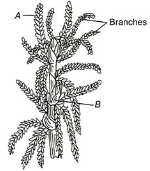
In the given figure of $Sphagnum$,what do $A$ and $B$ represent?
A
$A$-Gametophyte branch,$B$-Sporophyte branch
B
$A$-Antheridial branch,$B$-Archegonial branch
C
$A$-Archegonial branch,$B$-Antheridial branch
D
$A$-Sporophyte branch,$B$-Gametophyte branch
Solution
(B) The given figure represents the moss $Sphagnum$ (a type of bryophyte).
In $Sphagnum$,the gametophyte is the dominant phase.
The figure shows different types of branches on the gametophyte.
$A$ represents the antheridial branch,which bears the male sex organs (antheridia).
$B$ represents the archegonial branch,which bears the female sex organs (archegonia).
Therefore,the correct identification is $A$-Antheridial branch and $B$-Archegonial branch.
In $Sphagnum$,the gametophyte is the dominant phase.
The figure shows different types of branches on the gametophyte.
$A$ represents the antheridial branch,which bears the male sex organs (antheridia).
$B$ represents the archegonial branch,which bears the female sex organs (archegonia).
Therefore,the correct identification is $A$-Antheridial branch and $B$-Archegonial branch.
0 likes
View Solution390
MediumMCQ
Mosses (along with lichen) are of great ecological importance because
A
They colonise on barren rocks and decompose rock
B
Its contribution to prevent soil erosion
C
Its contribution in ecological succession
D
All of the above
Solution
(D) Mosses and lichens are pioneer species in ecological succession.
They colonise barren rocks and secrete acids to decompose the rock,which helps in soil formation.
They also form dense mats on the soil surface,which prevents soil erosion by binding the soil particles together.
Therefore,they play a significant role in both ecological succession and soil conservation.
They colonise barren rocks and secrete acids to decompose the rock,which helps in soil formation.
They also form dense mats on the soil surface,which prevents soil erosion by binding the soil particles together.
Therefore,they play a significant role in both ecological succession and soil conservation.
0 likes
View Solution391
MediumMCQ
Choose the correct statements for the sporophyte of bryophytes:
$I$. The sporophyte is multicellular,not free-living,but attached to the gametophyte for nourishment.
$II$. Some cells of the sporophyte undergo meiosis to produce haploid spores.
$III$. These spores germinate to produce the gametophyte.
$I$. The sporophyte is multicellular,not free-living,but attached to the gametophyte for nourishment.
$II$. Some cells of the sporophyte undergo meiosis to produce haploid spores.
$III$. These spores germinate to produce the gametophyte.
A
$I$ and $II$
B
$I$ and $III$
C
$II$ and $III$
D
$I, II$ and $III$
Solution
(D) All the statements are correct.
The life cycle of bryophytes consists of two distinct phases:
$(i)$ The gametophytic phase.
$(ii)$ The sporophytic phase.
The haploid gametophyte is dominant,long-lived,green,and independent,whereas the diploid sporophyte is short-lived and dependent upon the gametophyte for nutrition.
Some cells of the sporophyte undergo meiosis to produce haploid spores.
These spores germinate to produce the gametophyte.
The life cycle of bryophytes consists of two distinct phases:
$(i)$ The gametophytic phase.
$(ii)$ The sporophytic phase.
The haploid gametophyte is dominant,long-lived,green,and independent,whereas the diploid sporophyte is short-lived and dependent upon the gametophyte for nutrition.
Some cells of the sporophyte undergo meiosis to produce haploid spores.
These spores germinate to produce the gametophyte.
0 likes
View Solution392
MediumMCQ
Which of the following statements is incorrect regarding bryophytes?
A
They are dependent on water for sexual reproduction.
B
The main plant body is diploid.
C
They usually occur in damp,humid and shaded localities.
D
They play an important role in plant succession on bare rocks.
Solution
(B) In bryophytes,the main plant body is a free-living gametophyte,which is haploid $(n)$. The sporophyte is dependent on the gametophyte. Therefore,the statement that the main plant body is diploid is incorrect.
0 likes
View Solution393
MediumMCQ
Peat is obtained from
A
Sphagnum
B
Funaria
C
Riccia
D
Marchantia
Solution
(A) Peat is a dark,fibrous material formed by the partial decomposition of organic matter,primarily mosses,in wetlands or bogs.
$Sphagnum$,a genus of mosses commonly known as peat moss,is the primary source of peat.
Over time,$Sphagnum$ accumulates and compresses in waterlogged,acidic conditions,forming peat,which is used as fuel and in horticulture.
$Sphagnum$,a genus of mosses commonly known as peat moss,is the primary source of peat.
Over time,$Sphagnum$ accumulates and compresses in waterlogged,acidic conditions,forming peat,which is used as fuel and in horticulture.
0 likes
View Solution394
MediumMCQ
Liverworts reproduce asexually by
A
Gemmae
B
Fragmentation
C
Mitospores
D
Both $(A)$ and $(B)$
Solution
(D) Liverworts reproduce asexually by the formation of specialized structures called gemmae and also through the fragmentation of the thallus.
0 likes
View Solution395
MediumMCQ
Which of the following is used by gardeners to keep cut plants moist during transportation and propagation?
A
Marchantia
B
Sphagnum
C
Equisetum
D
Funaria
Solution
(B) Sphagnum is a genus of mosses,commonly known as peat moss. It has a remarkable capacity to hold water,which makes it highly effective for keeping cut plants moist during transportation and propagation. Gardeners use it as a packing material for trans-shipment of living plant materials.
0 likes
View Solution396
MediumMCQ
In mosses,the sex organs are present in the
A
Protonema stage
B
Sporophytic stage
C
Leafy stage
D
Both $(a)$ and $(b)$
Solution
(C) In mosses,the life cycle consists of two stages in the gametophyte: the protonema stage and the leafy stage. The protonema develops directly from a spore. The leafy stage develops from the secondary protonema as a lateral bud. The sex organs (antheridia and archegonia) are produced at the apex of the leafy shoots in the leafy stage.
0 likes
View Solution397
MediumMCQ
Haplo-diplontic condition is exhibited by
A
Most algae
B
Bryophytes
C
Angiosperms
D
Gymnosperms
Solution
(B) In a haplo-diplontic life cycle,both multicellular haploid and diploid phases exist.
Bryophytes exhibit a haplo-diplontic life cycle where the gametophyte (haploid) is the dominant,photosynthetic,independent phase,and the sporophyte (diploid) is short-lived and dependent on the gametophyte.
Most algae exhibit a haplontic life cycle,while Angiosperms and Gymnosperms exhibit a diplontic life cycle.
Bryophytes exhibit a haplo-diplontic life cycle where the gametophyte (haploid) is the dominant,photosynthetic,independent phase,and the sporophyte (diploid) is short-lived and dependent on the gametophyte.
Most algae exhibit a haplontic life cycle,while Angiosperms and Gymnosperms exhibit a diplontic life cycle.
0 likes
View Solution398
MediumMCQ
Bryophytes are not characterized by:
A
Sporophyte parasitic over gametophyte
B
Independent gametophyte
C
Absence of vascular tissues
D
Independent sporophyte
Solution
(D) In $Bryophytes$,the main plant body is a gametophyte,which is independent.
The sporophyte is not free-living but is attached to the photosynthetic gametophyte and derives nourishment from it,making it parasitic or dependent.
Therefore,an independent sporophyte is not a characteristic of $Bryophytes$.
The sporophyte is not free-living but is attached to the photosynthetic gametophyte and derives nourishment from it,making it parasitic or dependent.
Therefore,an independent sporophyte is not a characteristic of $Bryophytes$.
0 likes
View Solution399
MediumMCQ
Stems and leaves of bryophytes are
A
Analogous to vascular plants
B
Homologous to vascular plants
C
Analogous to algae and fungal thallus
D
None of these
Solution
(A) Bryophytes are non-vascular plants that possess root-like,stem-like,and leaf-like structures. These structures are not homologous to the true roots,stems,and leaves of vascular plants (Pteridophytes,Gymnosperms,and Angiosperms) because they lack complex vascular tissues like xylem and phloem. However,they perform similar functions of support and photosynthesis,making them analogous to the organs of vascular plants.
0 likes
View Solution400
MediumMCQ
Which of the following is a non-vascular embryophyte with leaves?
A
Riccia
B
Porella
C
Selaginella
D
Macrocystis
Solution
(B) The plant kingdom is divided into various groups. Embryophytes include bryophytes,pteridophytes,gymnosperms,and angiosperms.
Among these,bryophytes are non-vascular plants.
$Riccia$ is a liverwort that is thalloid and lacks true leaves.
$Porella$ is a leafy liverwort (a type of bryophyte) that possesses leaf-like structures.
$Selaginella$ is a pteridophyte,which is a vascular plant.
$Macrocystis$ is a brown alga,which is not an embryophyte.
Therefore,the correct answer is $Porella$.
Among these,bryophytes are non-vascular plants.
$Riccia$ is a liverwort that is thalloid and lacks true leaves.
$Porella$ is a leafy liverwort (a type of bryophyte) that possesses leaf-like structures.
$Selaginella$ is a pteridophyte,which is a vascular plant.
$Macrocystis$ is a brown alga,which is not an embryophyte.
Therefore,the correct answer is $Porella$.
0 likes
View SolutionPlant Kingdom — Bryophytes (General) · Frequently Asked Questions
1Are these Plant Kingdom questions useful for JEE and NEET?
Yes. All questions in this section are mapped to JEE Main and NEET exam patterns. Previous year questions from JEE Main, NEET, GUJCET and state-level exams are included with full solutions.
2Can I switch to Hindi or Gujarati for these questions?
Yes. Use the language tabs in the hero section or the sidebar to view the same questions and solutions in English, Hindi or Gujarati.
3How do I generate a question paper from this subtopic?
Use the Vedclass Exam Paper Generator — select the chapter and subtopic, set difficulty, and generate Sets A, B, C, D automatically. First 3 chapters of every subject are free.
Vedclass Products
For Students
Vedclass Test Series
Mock tests in real JEE/NEET style with performance analysis. 5-day free trial.
Start Free TrialFor Teachers
Exam Paper Generator
Generate Set A/B/C/D papers from this chapter in 2 minutes. 3 chapters free.
Try FreeFor Institutes
Online Exam Module
Live online exams with unlimited students, 360° analytics & white-label branding.
See DemoFor Teachers & Institutes
Generate a Plant Kingdom Exam Paper in 2 Minutes
Select subtopic & difficulty — Sets A, B, C, D auto-generated with No Repeat logic.
First 3 chapters of every subject are free — no payment required.