
A English
Bryophytes (General) Questions in English
Class 11 Biology · Plant Kingdom · Bryophytes (General)
441+
Questions
English
Language
100%
With Solutions
Showing 41 of 441 questions in English
401
MediumMCQ
Find the set of features related to $Funaria$:
$a.$ Protonema $b.$ Prothallus
$c.$ Gametophore $d.$ Prostate thallus body
$e.$ $NCC$ in antheridium $f.$ Haplodiplontic
$g.$ True plant organs in sporophyte
$h.$ Fragmentation
$a.$ Protonema $b.$ Prothallus
$c.$ Gametophore $d.$ Prostate thallus body
$e.$ $NCC$ in antheridium $f.$ Haplodiplontic
$g.$ True plant organs in sporophyte
$h.$ Fragmentation
A
$b, d, e, g$
B
$a, d, f, g$
C
$a, c, f, g, h$
D
$a, c, f, h$
Solution
(D) $Funaria$ is a moss belonging to the class Bryopsida.
- $a.$ Protonema: It is the juvenile stage in the life cycle of mosses,which develops from a spore.
- $c.$ Gametophore: The leafy stage of the moss that bears sex organs.
- $f.$ Haplodiplontic: Bryophytes exhibit a haplodiplontic life cycle where both haploid and diploid phases are multicellular.
- $h.$ Fragmentation: It is a common method of vegetative reproduction in mosses like $Funaria$.
- $b.$ Prothallus is characteristic of Pteridophytes.
- $d.$ Prostate thallus body is characteristic of Liverworts (e.g.,$Marchantia$).
- $e.$ $NCC$ (Neck Canal Cells) are present in the archegonium,not the antheridium.
- $g.$ True plant organs (roots,stems,leaves) are absent in the sporophyte of Bryophytes.
Therefore,the correct features are $a, c, f, h$.
- $a.$ Protonema: It is the juvenile stage in the life cycle of mosses,which develops from a spore.
- $c.$ Gametophore: The leafy stage of the moss that bears sex organs.
- $f.$ Haplodiplontic: Bryophytes exhibit a haplodiplontic life cycle where both haploid and diploid phases are multicellular.
- $h.$ Fragmentation: It is a common method of vegetative reproduction in mosses like $Funaria$.
- $b.$ Prothallus is characteristic of Pteridophytes.
- $d.$ Prostate thallus body is characteristic of Liverworts (e.g.,$Marchantia$).
- $e.$ $NCC$ (Neck Canal Cells) are present in the archegonium,not the antheridium.
- $g.$ True plant organs (roots,stems,leaves) are absent in the sporophyte of Bryophytes.
Therefore,the correct features are $a, c, f, h$.
0 likes
View Solution402
MediumMCQ
In $Funaria$,$20$ chromosomes are present in rhizoids,then the number of chromosomes in calyptra,theca,and foot will be
A
$20, 40, 40$ respectively
B
$40, 20, 20$ respectively
C
$20, 40, 20$ respectively
D
$40, 10, 20$ respectively
Solution
(A) $Funaria$ is a bryophyte where the main plant body is haploid $(n)$.
Rhizoids are part of the gametophyte,so they are haploid $(n = 20)$.
Calyptra is derived from the venter of the archegonium,which is part of the gametophyte,so it is haploid $(n = 20)$.
Theca and foot are parts of the sporophyte,which is diploid $(2n)$.
Therefore,theca $(2n = 40)$ and foot $(2n = 40)$.
Thus,the number of chromosomes in calyptra,theca,and foot are $20, 40, 40$ respectively.
Rhizoids are part of the gametophyte,so they are haploid $(n = 20)$.
Calyptra is derived from the venter of the archegonium,which is part of the gametophyte,so it is haploid $(n = 20)$.
Theca and foot are parts of the sporophyte,which is diploid $(2n)$.
Therefore,theca $(2n = 40)$ and foot $(2n = 40)$.
Thus,the number of chromosomes in calyptra,theca,and foot are $20, 40, 40$ respectively.
0 likes
View Solution403
MediumMCQ
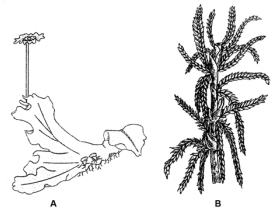
Identify the plants $A$ and $B$ in the figures given below.
A
$A$ - Female Marchantia,$B$ - Sphagnum
B
$A$ - Female Marchantia,$B$ - Funaria
C
$A$ - Male Marchantia,$B$ - Funaria
D
$A$ - Male Marchantia,$B$ - Sphagnum
Solution
(D) In the given figure,plant '$A$' represents a male thallus of $Marchantia$. This is identified by the presence of antheridiophore,which has a disc-shaped head.
Plant '$B$' represents $Sphagnum$,a moss,which is characterized by its branched,leafy gametophyte structure.
Plant '$B$' represents $Sphagnum$,a moss,which is characterized by its branched,leafy gametophyte structure.
0 likes
View Solution404
MediumMCQ
$A$: $Funaria$ archegonium has maximum concentration of sucrose at the tip of the neck.
$R$: Male gametes show chemotropic movement.
$R$: Male gametes show chemotropic movement.
A
Assertion and Reason both are correct and Reason is the correct explanation of Assertion.
B
Assertion and Reason both are correct but Reason is not the correct explanation of Assertion.
C
Assertion is correct,but Reason is incorrect.
D
Both Assertion and Reason are incorrect.
Solution
(C) In $Funaria$ (a moss),the archegonium secretes sucrose at the tip of the neck to attract the male gametes (antherozoids). This movement of male gametes towards the chemical stimulus (sucrose) is known as chemotactic movement,not chemotropic movement. Chemotropism refers to the growth of a plant part in response to a chemical stimulus,whereas chemotaxis refers to the movement of a whole organism or cell (like a motile gamete) in response to a chemical stimulus. Therefore,the Assertion is correct,but the Reason is incorrect because it uses the wrong terminology.
0 likes
View Solution405
MediumMCQ
$A$ : In mosses,the second stage of the gametophyte consists of upright,slender axes bearing spirally arranged leaves.
$R$ : This stage of the gametophyte consists of sex organs.
$R$ : This stage of the gametophyte consists of sex organs.
A
Assertion and Reason both are correct and Reason is the correct explanation of Assertion.
B
Assertion and Reason both are correct but Reason is not the correct explanation of Assertion.
C
Assertion is correct,but Reason is incorrect.
D
Both Assertion and Reason are incorrect.
Solution
(A) The life cycle of a moss consists of two stages in the gametophyte generation: the protonema stage and the leafy stage.
The first stage is the protonema stage,which develops directly from a spore.
The second stage is the leafy stage,which develops from the secondary protonema as a lateral bud.
This leafy stage consists of upright,slender axes bearing spirally arranged leaves.
This stage bears the sex organs,which are responsible for sexual reproduction.
Therefore,both the Assertion and the Reason are correct.
The first stage is the protonema stage,which develops directly from a spore.
The second stage is the leafy stage,which develops from the secondary protonema as a lateral bud.
This leafy stage consists of upright,slender axes bearing spirally arranged leaves.
This stage bears the sex organs,which are responsible for sexual reproduction.
Therefore,both the Assertion and the Reason are correct.
0 likes
View Solution406
MediumMCQ
In case of $Marchantia$,antheridiophore is produced by
A
Female thallus
B
Male thallus
C
Monoecious plant
D
None of above
Solution
(B) $Marchantia$ is a dioecious plant,meaning the male and female sex organs are borne on separate thalli.
Antheridiophore is the specialized stalk-like structure that bears the antheridia (male sex organs).
Since antheridia produce male gametes,the antheridiophore is produced by the male thallus.
Therefore,the correct option is $B$.
Antheridiophore is the specialized stalk-like structure that bears the antheridia (male sex organs).
Since antheridia produce male gametes,the antheridiophore is produced by the male thallus.
Therefore,the correct option is $B$.
0 likes
View Solution407
MediumMCQ
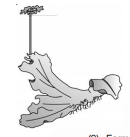
Choose the correct option with respect to the given thallus.
A
Produces male gametes.
B
Forms sexual branches as antheridiophore.
C
After fertilisation,it possesses a zygote.
D
More than one option is correct.
Solution
(D) The image shows a male thallus of Marchantia,which is a liverwort.
$1$. The male thallus produces male gametes (antherozoids) within the antheridia located on the antheridiophore.
$2$. It forms specialized sexual branches known as antheridiophores,which bear the antheridia.
$3$. Since both options $(a)$ and $(b)$ are correct,the most appropriate choice is $(d)$.
$1$. The male thallus produces male gametes (antherozoids) within the antheridia located on the antheridiophore.
$2$. It forms specialized sexual branches known as antheridiophores,which bear the antheridia.
$3$. Since both options $(a)$ and $(b)$ are correct,the most appropriate choice is $(d)$.
0 likes
View Solution408
MediumMCQ
In which of the following are gemmae found?
A
Mosses
B
Pteridophytes
C
Some liverworts
D
Some gymnosperms
Solution
(C) Gemmae are specialized asexual reproductive structures found in liverworts,such as $Marchantia$.
They are green,multicellular,asexual buds that develop in small receptacles called gemma cups located on the thalli.
When detached from the parent plant,these gemmae germinate to form new individuals.
Therefore,the correct option is $C$.
They are green,multicellular,asexual buds that develop in small receptacles called gemma cups located on the thalli.
When detached from the parent plant,these gemmae germinate to form new individuals.
Therefore,the correct option is $C$.
1 likes
View Solution409
MediumMCQ
Mosses and liverworts are included in .......
A
Algae
B
Bryophytes
C
Pteridophytes
D
Gymnosperms
Solution
(B) Mosses and liverworts belong to the group $Bryophytes$.
$Bryophytes$ are non-vascular land plants that include mosses,liverworts,and hornworts.
They are often called the amphibians of the plant kingdom because they require water for fertilization.
Therefore,the correct option is $B$.
$Bryophytes$ are non-vascular land plants that include mosses,liverworts,and hornworts.
They are often called the amphibians of the plant kingdom because they require water for fertilization.
Therefore,the correct option is $B$.
0 likes
View Solution410
MediumMCQ
Choose the correct option for $Bryophytes$.
A
They are amphibians of the plant kingdom.
B
They depend on water for fertilization.
C
They are found in damp,humid,and shaded places.
D
All of the above.
Solution
(D) $Bryophytes$ are known as the amphibians of the plant kingdom because they can live in soil but are dependent on water for sexual reproduction.
They require water for the movement of antherozoids to the archegonium for fertilization.
They typically grow in damp,humid,and shaded localities.
Therefore,all the given statements are correct.
They require water for the movement of antherozoids to the archegonium for fertilization.
They typically grow in damp,humid,and shaded localities.
Therefore,all the given statements are correct.
0 likes
View Solution411
MediumMCQ
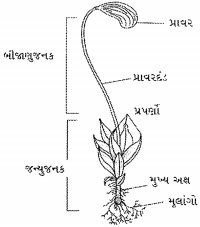
Which plant is shown in the given image?
A
Marchantia
B
Funaria
C
Sphagnum
D
Fern
Solution
(B) The given image represents the life cycle stage of a moss,specifically $Funaria$.
It shows the gametophyte (main plant body) and the sporophyte (capsule,seta,and foot).
The presence of a distinct capsule,seta,and leafy gametophyte with rhizoids is characteristic of $Funaria$.
It shows the gametophyte (main plant body) and the sporophyte (capsule,seta,and foot).
The presence of a distinct capsule,seta,and leafy gametophyte with rhizoids is characteristic of $Funaria$.
0 likes
View Solution412
MediumMCQ
Select the incorrect statement for $Sphagnum$.
A
The main plant body of $Sphagnum$ is the gametophyte.
B
$Sphagnum$ is a member of Bryophyta.
C
$Sphagnum$ provides peat.
D
$Sphagnum$ is a monoecious plant.
Solution
(D) $Sphagnum$ (also known as peat moss) belongs to the division Bryophyta.
In bryophytes,the dominant phase is the gametophyte.
$Sphagnum$ is used as fuel and for trans-shipment of living material because of its water-holding capacity,forming peat.
$Sphagnum$ is monoecious,meaning both male and female sex organs are present on the same plant body.
Therefore,the statement '$Sphagnum$ is a monoecious plant' is correct,and the statement '$Sphagnum$ is a dioecious (unisexual) plant' would be incorrect. Since option $D$ states it is unisexual (eklingi),it is the incorrect statement.
In bryophytes,the dominant phase is the gametophyte.
$Sphagnum$ is used as fuel and for trans-shipment of living material because of its water-holding capacity,forming peat.
$Sphagnum$ is monoecious,meaning both male and female sex organs are present on the same plant body.
Therefore,the statement '$Sphagnum$ is a monoecious plant' is correct,and the statement '$Sphagnum$ is a dioecious (unisexual) plant' would be incorrect. Since option $D$ states it is unisexual (eklingi),it is the incorrect statement.
0 likes
View Solution413
MediumMCQ
Select the incorrect statement regarding the sporophyte of $Bryophytes$.
A
The sporophyte remains attached to the photosynthetic gametophyte.
B
All cells of the sporophyte undergo meiosis to produce haploid spores.
C
The sporophyte is a secondary stage.
D
The sporophyte is diploid $(2n)$.
Solution
(B) In $Bryophytes$,the main plant body is a haploid gametophyte.
The sporophyte is multicellular and diploid $(2n)$,but it is not free-living; it remains attached to the photosynthetic gametophyte for nutrition.
The sporophyte consists of a foot,seta,and capsule.
Inside the capsule,some specialized cells called spore mother cells undergo meiosis to produce haploid spores.
It is incorrect to state that all cells of the sporophyte undergo meiosis; only the spore mother cells do so.
Therefore,option $B$ is the incorrect statement.
The sporophyte is multicellular and diploid $(2n)$,but it is not free-living; it remains attached to the photosynthetic gametophyte for nutrition.
The sporophyte consists of a foot,seta,and capsule.
Inside the capsule,some specialized cells called spore mother cells undergo meiosis to produce haploid spores.
It is incorrect to state that all cells of the sporophyte undergo meiosis; only the spore mother cells do so.
Therefore,option $B$ is the incorrect statement.
0 likes
View Solution414
MediumMCQ
Which of the following plants is used as fuel?
A
Marchantia
B
Sphagnum
C
Funaria
D
Polytrichum
Solution
(B) Sphagnum is a genus of approximately $380$ accepted species of mosses,commonly known as peat moss.
It is used as fuel because it forms peat,which is a brown,soil-like material characteristic of boggy,acid ground,consisting of partly decomposed vegetable matter.
Peat has been used as a source of fuel for centuries in many parts of the world.
Therefore,the correct option is $B$.
It is used as fuel because it forms peat,which is a brown,soil-like material characteristic of boggy,acid ground,consisting of partly decomposed vegetable matter.
Peat has been used as a source of fuel for centuries in many parts of the world.
Therefore,the correct option is $B$.
0 likes
View Solution415
MediumMCQ
Select the correct option for mosses:
A
They provide food for herbaceous mammals,birds,and other animals.
B
They prevent soil erosion by forming a dense mat on the soil surface during heavy rainfall.
C
They help in the decomposition of rocks.
D
All of the above.
Solution
(D) Mosses (Bryophytes) play a significant role in the ecosystem:
$1$. They provide food for herbaceous mammals,birds,and other animals.
$2$. They form dense mats on the soil,which reduces the impact of falling rain and prevents soil erosion.
$3$. Along with lichens,they are the first organisms to colonize rocks and contribute to the decomposition of rocks,making the substrate suitable for the growth of higher plants.
$1$. They provide food for herbaceous mammals,birds,and other animals.
$2$. They form dense mats on the soil,which reduces the impact of falling rain and prevents soil erosion.
$3$. Along with lichens,they are the first organisms to colonize rocks and contribute to the decomposition of rocks,making the substrate suitable for the growth of higher plants.
0 likes
View Solution416
MediumMCQ
What is the habitat of liverworts?
A
Banks of streams
B
Moist,shady habitats such as banks of streams,marshy ground,damp soil,bark of trees,and deep in the woods
C
On the bark of trees and in the hollows of wood
D
All of the above
Solution
(D) Liverworts usually grow in moist,shady habitats. Their habitat includes banks of streams,marshy ground,damp soil,bark of trees,and deep in the woods. Therefore,all the given options are correct.
0 likes
View Solution417
MediumMCQ
Select the correct option for gemmae:
A
They are green,multicellular,asexual buds.
B
They develop in small receptacles called gemma cups.
C
Gemmae become detached from the parent body and germinate to form new plants.
D
All of the above.
Solution
(D) Gemmae are specialized asexual reproductive structures found in liverworts (e.g.,$Marchantia$).
$1$. They are green,multicellular,and asexual buds.
$2$. They develop in small receptacles called gemma cups located on the thalli.
$3$. When gemmae become detached from the parent body,they germinate to form new individuals.
Therefore,all the given statements are correct.
$1$. They are green,multicellular,and asexual buds.
$2$. They develop in small receptacles called gemma cups located on the thalli.
$3$. When gemmae become detached from the parent body,they germinate to form new individuals.
Therefore,all the given statements are correct.
0 likes
View Solution418
MediumMCQ
What is the dominant phase of a liverwort?
A
$n$
B
$2n$
C
$3n$
D
$4n$
Solution
(A) In liverworts,the plant body is a gametophyte,which is haploid $(n)$.
This gametophyte represents the dominant,independent,and photosynthetic phase of the life cycle.
The sporophyte $(2n)$ is dependent on the gametophyte for its nutrition and is relatively short-lived.
Therefore,the dominant phase is haploid $(n)$.
This gametophyte represents the dominant,independent,and photosynthetic phase of the life cycle.
The sporophyte $(2n)$ is dependent on the gametophyte for its nutrition and is relatively short-lived.
Therefore,the dominant phase is haploid $(n)$.
0 likes
View Solution419
DifficultMCQ
The protonema stage and the leafy stage are parts of the life cycle of which of the following?
A
Liverwort - Gametophyte
B
Liverwort - Sporophyte
C
Moss - Gametophyte
D
Moss - Sporophyte
Solution
(C) The life cycle of mosses (Bryopsida) consists of two distinct stages in the gametophyte generation:
$1$. The protonema stage: This is the juvenile stage that develops directly from a spore. It is a creeping,green,branched,and frequently filamentous structure.
$2$. The leafy stage: This stage develops from the secondary protonema as a lateral bud. It consists of upright,slender axes bearing spirally arranged leaves.
Both these stages are part of the gametophyte generation of mosses.
$1$. The protonema stage: This is the juvenile stage that develops directly from a spore. It is a creeping,green,branched,and frequently filamentous structure.
$2$. The leafy stage: This stage develops from the secondary protonema as a lateral bud. It consists of upright,slender axes bearing spirally arranged leaves.
Both these stages are part of the gametophyte generation of mosses.
0 likes
View Solution420
MediumMCQ
The protonema stage develops from $........$,and the leafy stage develops from $........$.
A
Haploid spore,secondary protonema
B
Haploid spore,primary protonema
C
Diploid spore,secondary protonema
D
Diploid spore,primary protonema
Solution
(A) In mosses (Bryophytes),the life cycle includes two stages in the gametophyte generation.
$1$. The first stage is the protonema stage,which develops directly from a haploid spore.
$2$. The second stage is the leafy stage,which develops from the secondary protonema as a lateral bud.
Therefore,the protonema stage develops from a haploid spore,and the leafy stage develops from the secondary protonema.
$1$. The first stage is the protonema stage,which develops directly from a haploid spore.
$2$. The second stage is the leafy stage,which develops from the secondary protonema as a lateral bud.
Therefore,the protonema stage develops from a haploid spore,and the leafy stage develops from the secondary protonema.
0 likes
View Solution421
MediumMCQ
Select the correct option for $Marchantia$.
A
Dioecious
B
Monoecious
C
Bisexual
D
Both $B$ and $C$
Solution
(A) $Marchantia$ is a genus of liverworts belonging to the group Bryophyta.
In $Marchantia$,the male and female sex organs are produced on separate thalli (plants).
Therefore,$Marchantia$ is dioecious (unisexual).
Since it is dioecious,it cannot be monoecious or bisexual.
Thus,the correct option is $A$.
In $Marchantia$,the male and female sex organs are produced on separate thalli (plants).
Therefore,$Marchantia$ is dioecious (unisexual).
Since it is dioecious,it cannot be monoecious or bisexual.
Thus,the correct option is $A$.
0 likes
View Solution422
MediumMCQ
Identify the mosses and liverworts from the following list:
$I$ - $Sphagnum$,$II$ - $Funaria$,
$III$ - $Marchantia$,$IV$ - $Polytrichum$
$\text{Mosses} \quad\quad \text{Liverworts}$
$I$ - $Sphagnum$,$II$ - $Funaria$,
$III$ - $Marchantia$,$IV$ - $Polytrichum$
$\text{Mosses} \quad\quad \text{Liverworts}$
A
$I, IV \quad\quad II, III$
B
$II, III \quad\quad I, IV$
C
$III \quad\quad I, II, IV$
D
$I, II, IV \quad\quad III$
Solution
(D) Bryophytes are divided into two main groups: Liverworts and Mosses.
$1$. $Marchantia$ is a classic example of a liverwort.
$2$. $Sphagnum$,$Funaria$,and $Polytrichum$ are examples of mosses.
Therefore,the correct classification is:
Mosses: $I$ $(Sphagnum)$,$II$ $(Funaria)$,$IV$ $(Polytrichum)$
Liverworts: $III$ $(Marchantia)$
Thus,the correct option is $D$.
$1$. $Marchantia$ is a classic example of a liverwort.
$2$. $Sphagnum$,$Funaria$,and $Polytrichum$ are examples of mosses.
Therefore,the correct classification is:
Mosses: $I$ $(Sphagnum)$,$II$ $(Funaria)$,$IV$ $(Polytrichum)$
Liverworts: $III$ $(Marchantia)$
Thus,the correct option is $D$.
0 likes
View Solution423
MediumMCQ
How are gametes produced in bryophytes?
A
Mitosis
B
Meiosis
C
Amitosis
D
All of the above
Solution
(A) In bryophytes,the main plant body is haploid $(n)$.
It produces gametes by the process of mitosis.
The sex organs in bryophytes are multicellular.
The male sex organ is called antheridium and the female sex organ is called archegonium.
Since the plant body is already haploid,the production of gametes occurs through mitotic division.
It produces gametes by the process of mitosis.
The sex organs in bryophytes are multicellular.
The male sex organ is called antheridium and the female sex organ is called archegonium.
Since the plant body is already haploid,the production of gametes occurs through mitotic division.
0 likes
View Solution424
MediumMCQ
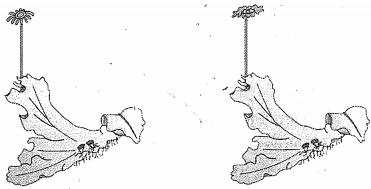
Select the correct option for the given figure.
A
Chara - Monoecious plant
B
Chara - Dioecious plant
C
Marchantia - Monoecious plant
D
Marchantia - Dioecious plant
Solution
(D) The provided figure shows the male and female thalli of the liverwort $Marchantia$.
In $Marchantia$,the male and female sex organs are produced on separate thalli,which means the plant is dioecious.
The left part of the figure shows the female thallus with an archegoniophore,and the right part shows the male thallus with an antheridiophore.
Therefore,the correct option is $D$.
In $Marchantia$,the male and female sex organs are produced on separate thalli,which means the plant is dioecious.
The left part of the figure shows the female thallus with an archegoniophore,and the right part shows the male thallus with an antheridiophore.
Therefore,the correct option is $D$.
0 likes
View Solution425
MediumMCQ
Given below are two statements: One labelled as Assertion $A$ and the other labelled as Reason $R$:
Assertion $A$: The first stage of gametophyte in the life cycle of moss is protonema stage.
Reason $R$: Protonema develops directly from spores produced in capsule.
In the light of the above statements,choose the most appropriate answer from options given below:
Assertion $A$: The first stage of gametophyte in the life cycle of moss is protonema stage.
Reason $R$: Protonema develops directly from spores produced in capsule.
In the light of the above statements,choose the most appropriate answer from options given below:
A
$A$ is not correct but $R$ is correct
B
Both $A$ and $R$ are correct and $R$ is the correct explanation of $A$
C
Both $A$ and $R$ are correct but $R$ is $NOT$ the correct explanation of $A$
D
$A$ is correct but $R$ is not correct
Solution
(B) The life cycle of a moss consists of a dominant gametophyte phase which includes two stages.
The first stage is the protonema stage,which develops directly from a haploid spore.
These spores are produced within the capsule of the sporophyte generation.
Since the protonema is the direct product of spore germination,the Reason $R$ correctly explains the Assertion $A$.
The first stage is the protonema stage,which develops directly from a haploid spore.
These spores are produced within the capsule of the sporophyte generation.
Since the protonema is the direct product of spore germination,the Reason $R$ correctly explains the Assertion $A$.
0 likes
View Solution426
DifficultMCQ
The correct sequence of events in the life cycle of bryophytes is:
$A.$ Fusion of antherozoid with egg.
$B.$ Attachment of gametophyte to substratum.
$C.$ Reduction division to produce haploid spores.
$D.$ Formation of sporophyte.
$E.$ Release of antherozoids into water.
Choose the correct answer from the options given below.
$A.$ Fusion of antherozoid with egg.
$B.$ Attachment of gametophyte to substratum.
$C.$ Reduction division to produce haploid spores.
$D.$ Formation of sporophyte.
$E.$ Release of antherozoids into water.
Choose the correct answer from the options given below.
A
$D, E, A, C, B$
B
$B, E, A, C, D$
C
$B, E, A, D, C$
D
$D, E, A, B, C$
Solution
(C) The life cycle of bryophytes follows these steps:
$1$. The gametophyte attaches to the substratum $(B)$.
$2$. Antherozoids are released into the water to reach the egg $(E)$.
$3$. Fusion of antherozoid with the egg occurs to form a zygote $(A)$.
$4$. The zygote develops into a sporophyte $(D)$.
$5$. The sporophyte undergoes reduction division (meiosis) to produce haploid spores $(C)$.
Therefore,the correct sequence is $B, E, A, D, C$.
$1$. The gametophyte attaches to the substratum $(B)$.
$2$. Antherozoids are released into the water to reach the egg $(E)$.
$3$. Fusion of antherozoid with the egg occurs to form a zygote $(A)$.
$4$. The zygote develops into a sporophyte $(D)$.
$5$. The sporophyte undergoes reduction division (meiosis) to produce haploid spores $(C)$.
Therefore,the correct sequence is $B, E, A, D, C$.
0 likes
View Solution427
MediumMCQ
In bryophytes,the gemmae help in which one of the following?
A
Sexual reproduction
B
Asexual reproduction
C
Nutrient absorption
D
Gaseous exchange
Solution
(B) Gemmae are specialized green,multicellular,asexual buds that develop in small receptacles called gemma cups located on the thalli of certain liverworts (e.g.,$Marchantia$).
When these gemmae detach from the parent plant body,they germinate to form new individuals.
Therefore,gemmae are primarily involved in asexual reproduction (vegetative propagation) in bryophytes.
When these gemmae detach from the parent plant body,they germinate to form new individuals.
Therefore,gemmae are primarily involved in asexual reproduction (vegetative propagation) in bryophytes.
0 likes
View Solution428
MediumMCQ
Statement-$I$: In liverworts,male and female sex organs are produced either on the same or on different thalli.
Statement-$II$: The sporophyte is differentiated into foot,seta,and capsule in bryophytes.
Statement-$II$: The sporophyte is differentiated into foot,seta,and capsule in bryophytes.
A
Both statement $I$ and statement $II$ are correct
B
Statement $I$ is correct but statement $II$ is incorrect
C
Statement $I$ is incorrect but statement $II$ is correct
D
Both statement $I$ and statement $II$ are incorrect
Solution
(A) Statement-$I$ is correct: Liverworts (e.g.,Marchantia) can be monoecious (same thallus) or dioecious (different thalli).
Statement-$II$ is correct: In bryophytes,the sporophyte is multicellular and differentiated into three parts: foot,seta,and capsule. Note: The original statement incorrectly used 'gametophyte' instead of 'sporophyte',which is a common point of confusion; however,in the context of biological classification,the sporophyte is indeed the structure differentiated into these parts.
Statement-$II$ is correct: In bryophytes,the sporophyte is multicellular and differentiated into three parts: foot,seta,and capsule. Note: The original statement incorrectly used 'gametophyte' instead of 'sporophyte',which is a common point of confusion; however,in the context of biological classification,the sporophyte is indeed the structure differentiated into these parts.
0 likes
View Solution429
MediumMCQ
Protonema is generally produced in the life cycle of
A
Liverworts
B
Hornworts
C
Mosses
D
Both $1$ and $2$
Solution
(C) The life cycle of mosses (class Bryopsida) includes a distinct juvenile stage known as the protonema.
$1$. The spores germinate to produce a creeping,green,branched,and frequently filamentous stage called the protonema.
$2$. The protonema develops from the spore and eventually gives rise to the leafy gametophyte stage.
$3$. Liverworts and hornworts do not produce a protonema stage; instead,they typically develop a thalloid structure directly from the spore.
$1$. The spores germinate to produce a creeping,green,branched,and frequently filamentous stage called the protonema.
$2$. The protonema develops from the spore and eventually gives rise to the leafy gametophyte stage.
$3$. Liverworts and hornworts do not produce a protonema stage; instead,they typically develop a thalloid structure directly from the spore.
0 likes
View Solution430
DifficultMCQ
Read the following statements$-$
$(i)$ The plant body of bryophytes is less differentiated than that of algae.
$(ii)$ The main plant body of the bryophytes is haploid.
$(iii)$ Sex organs in bryophytes are unicellular.
$(iv)$ Zygotes do not undergo reduction division immediately in bryophytes.
$(v)$ Bryophytes depend on insects for sexual reproduction.
How many of the above statements are correct?
$(i)$ The plant body of bryophytes is less differentiated than that of algae.
$(ii)$ The main plant body of the bryophytes is haploid.
$(iii)$ Sex organs in bryophytes are unicellular.
$(iv)$ Zygotes do not undergo reduction division immediately in bryophytes.
$(v)$ Bryophytes depend on insects for sexual reproduction.
How many of the above statements are correct?
A
$4$
B
$3$
C
$2$
D
$1$
Solution
(C) Let us analyze each statement:
$(i)$ Incorrect: The plant body of bryophytes is more differentiated than that of algae (thalloid structure with root-like,leaf-like,and stem-like structures).
$(ii)$ Correct: The main plant body of bryophytes is haploid (gametophyte).
$(iii)$ Incorrect: Sex organs in bryophytes are multicellular,not unicellular.
$(iv)$ Correct: Zygotes in bryophytes do not undergo reduction division immediately; they produce a multicellular sporophyte.
$(v)$ Incorrect: Bryophytes depend on water for sexual reproduction (fertilization),not insects.
Thus,only statements $(ii)$ and $(iv)$ are correct. The total number of correct statements is $2$.
$(i)$ Incorrect: The plant body of bryophytes is more differentiated than that of algae (thalloid structure with root-like,leaf-like,and stem-like structures).
$(ii)$ Correct: The main plant body of bryophytes is haploid (gametophyte).
$(iii)$ Incorrect: Sex organs in bryophytes are multicellular,not unicellular.
$(iv)$ Correct: Zygotes in bryophytes do not undergo reduction division immediately; they produce a multicellular sporophyte.
$(v)$ Incorrect: Bryophytes depend on water for sexual reproduction (fertilization),not insects.
Thus,only statements $(ii)$ and $(iv)$ are correct. The total number of correct statements is $2$.
0 likes
View Solution431
MediumMCQ
Bryophytes differ from algae in having $:-$
A
Prothallus
B
Chlorophyll ' $a$ '
C
Vascular tissue
D
Archegonia
Solution
(D) Bryophytes are land-dwelling plants that exhibit several evolutionary advancements over algae.
$1$. Both algae and bryophytes contain chlorophyll '$a$' and '$b$',so this is not a distinguishing feature.
$2$. Prothallus is a characteristic structure found in Pteridophytes,not Bryophytes.
$3$. Vascular tissues (xylem and phloem) are absent in both algae and bryophytes.
$4$. Bryophytes possess multicellular sex organs,specifically the female sex organ called the archegonium,which is protected by a sterile jacket. Algae typically have unicellular sex organs (or if multicellular,they lack a sterile jacket layer). Therefore,the presence of archegonia is a key feature that distinguishes bryophytes from algae.
$1$. Both algae and bryophytes contain chlorophyll '$a$' and '$b$',so this is not a distinguishing feature.
$2$. Prothallus is a characteristic structure found in Pteridophytes,not Bryophytes.
$3$. Vascular tissues (xylem and phloem) are absent in both algae and bryophytes.
$4$. Bryophytes possess multicellular sex organs,specifically the female sex organ called the archegonium,which is protected by a sterile jacket. Algae typically have unicellular sex organs (or if multicellular,they lack a sterile jacket layer). Therefore,the presence of archegonia is a key feature that distinguishes bryophytes from algae.
0 likes
View Solution432
MediumMCQ
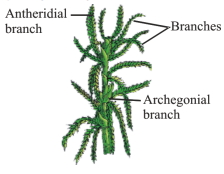
Identify the given figure.
A
Salvinia
B
Ulothrix
C
Sphagnum
D
Pinus
Solution
(C) The provided figure shows a plant with distinct branches labeled as 'Antheridial branch' and 'Archegonial branch'.
This morphology is characteristic of the moss $Sphagnum$.
$Sphagnum$ is a genus of mosses belonging to the division Bryophyta.
It is known for its ability to hold large amounts of water and is often used in the packaging of living material for transport.
This morphology is characteristic of the moss $Sphagnum$.
$Sphagnum$ is a genus of mosses belonging to the division Bryophyta.
It is known for its ability to hold large amounts of water and is often used in the packaging of living material for transport.
0 likes
View Solution433
MediumMCQ
Statement-$I$: Bryophytes play an important role in plant succession on bare rocks/soil.
Statement-$II$: Peat moss is used as packing material for trans-shipment of living material because of its capacity to hold water.
Statement-$II$: Peat moss is used as packing material for trans-shipment of living material because of its capacity to hold water.
A
Statement $I$ and $II$ both are correct.
B
Statement $I$ and $II$ both are incorrect.
C
Only Statement $I$ is correct.
D
Only Statement $II$ is correct.
Solution
(A) Statement-$I$ is correct: Bryophytes,especially mosses,are pioneer species in plant succession on bare rocks. They secrete acids to dissolve rocks,helping in the formation of soil,which allows higher plants to grow.
Statement-$II$ is correct: Peat moss (Sphagnum) has a high water-holding capacity. Due to this property,it is widely used as a packing material for the trans-shipment of living plant materials to keep them moist during transit.
Therefore,both statements are correct.
Statement-$II$ is correct: Peat moss (Sphagnum) has a high water-holding capacity. Due to this property,it is widely used as a packing material for the trans-shipment of living plant materials to keep them moist during transit.
Therefore,both statements are correct.
0 likes
View Solution434
EasyMCQ
Arrange the following events in a correct sequence with respect to the life cycle of mosses$:-$
$(I)$ Fertilization
$(II)$ Dispersal of spores
$(III)$ Protonema
$(IV)$ Leafy stage
$(I)$ Fertilization
$(II)$ Dispersal of spores
$(III)$ Protonema
$(IV)$ Leafy stage
A
$(II), (III), (IV), (I)$
B
$(II), (III), (I), (IV)$
C
$(I), (II), (IV), (III)$
D
$(I), (IV), (III), (II)$
Solution
(A) The life cycle of a moss (like $Funaria$) follows this sequence:
$1.$ The cycle begins with the dispersal of spores $(II)$.
$2.$ These spores germinate to form the protonema stage $(III)$.
$3.$ The protonema develops into the leafy stage $(IV)$.
$4.$ The leafy stage produces gametes,which undergo fertilization $(I)$ to form a zygote,eventually leading back to the sporophyte and spore production.
Therefore,the correct sequence is $(II) \rightarrow (III) \rightarrow (IV) \rightarrow (I)$.
$1.$ The cycle begins with the dispersal of spores $(II)$.
$2.$ These spores germinate to form the protonema stage $(III)$.
$3.$ The protonema develops into the leafy stage $(IV)$.
$4.$ The leafy stage produces gametes,which undergo fertilization $(I)$ to form a zygote,eventually leading back to the sporophyte and spore production.
Therefore,the correct sequence is $(II) \rightarrow (III) \rightarrow (IV) \rightarrow (I)$.
0 likes
View Solution435
MediumMCQ
The antherozoids of Bryophytes possess $:-$
A
$2$ flagella
B
$1$ flagellum
C
Multiflagella
D
No flagella
Solution
(A) Bryophytes are non-vascular land plants that include mosses,liverworts,and hornworts.
In Bryophytes,the male sex organ is called the antheridium,which produces biflagellate antherozoids (male gametes).
These antherozoids are motile and possess $2$ flagella,which help them swim through a film of water to reach the female sex organ,the archegonium.
Therefore,the correct answer is $2$ flagella.
In Bryophytes,the male sex organ is called the antheridium,which produces biflagellate antherozoids (male gametes).
These antherozoids are motile and possess $2$ flagella,which help them swim through a film of water to reach the female sex organ,the archegonium.
Therefore,the correct answer is $2$ flagella.
0 likes
View Solution436
MediumMCQ
The sporophyte of $Funaria$ is $:-$
A
Free living
B
Differentiated into root,leaf and stem
C
Differentiated into foot,seta and capsule
D
Possess root-like,leaf-like and stem-like structures
Solution
(C) In $Funaria$ (a moss),the plant body is a gametophyte which is independent.
The sporophyte is dependent on the gametophyte for nutrition.
The sporophyte of $Funaria$ is structurally differentiated into three distinct parts: $foot$,$seta$,and $capsule$.
Therefore,option $C$ is the correct description.
The sporophyte is dependent on the gametophyte for nutrition.
The sporophyte of $Funaria$ is structurally differentiated into three distinct parts: $foot$,$seta$,and $capsule$.
Therefore,option $C$ is the correct description.
0 likes
View Solution437
EasyMCQ
Read the given statements and choose the correct option:
Statement $I$: Gemmae are green unicellular sexual buds which develop in receptacles called gemma cups.
Statement $II$: Protonema develops directly from a spore.
Statement $I$: Gemmae are green unicellular sexual buds which develop in receptacles called gemma cups.
Statement $II$: Protonema develops directly from a spore.
A
Statement $I$ is false but Statement $II$ is true
B
Both Statement $I$ and Statement $II$ are false
C
Both Statement $I$ and Statement $II$ are true
D
Statement $I$ is true but Statement $II$ is false
Solution
(A) Statement $I$ is false because gemmae are green,multicellular,asexual buds,not sexual buds.
Statement $II$ is true because in mosses,the spore germinates to form a filamentous,creeping,green,branched,and frequently filamentous stage called the protonema.
Therefore,Statement $I$ is false and Statement $II$ is true.
Statement $II$ is true because in mosses,the spore germinates to form a filamentous,creeping,green,branched,and frequently filamentous stage called the protonema.
Therefore,Statement $I$ is false and Statement $II$ is true.
0 likes
View Solution438
EasyMCQ
$Marchantia$ is considered as a heterothallic plant because it is
A
monoecious
B
heterogametic
C
dioecious
D
bisexual
Solution
(C) $Marchantia$ is considered a heterothallic plant because it is dioecious.
In $Marchantia$,the male and female reproductive structures (antheridiophore and archegoniophore) are borne on separate individual thalli.
Therefore,the plant body is unisexual,which is referred to as dioecious or heterothallic.
In $Marchantia$,the male and female reproductive structures (antheridiophore and archegoniophore) are borne on separate individual thalli.
Therefore,the plant body is unisexual,which is referred to as dioecious or heterothallic.
0 likes
View Solution439
EasyMCQ
Gametophyte is the dominant phase in the life cycle of
A
Hibiscus
B
Nephrolepis
C
Cycas
D
Riccia
Solution
(D) $Riccia$,a liverwort within the $Bryophyta$,exhibits a dominant gametophyte phase in its life cycle.
In bryophytes,the gametophyte is the main stage,whereas the sporophyte is smaller and dependent on the gametophyte for nutrition.
In bryophytes,the gametophyte is the main stage,whereas the sporophyte is smaller and dependent on the gametophyte for nutrition.
0 likes
View Solution440
EasyMCQ
Bryophytes resemble algae in the following aspects:
A
thallus-like plant body,presence of roots and autotrophic nutrition
B
thallus-like plant body,lack of vascular tissues and autotrophic nutrition
C
filamentous body,presence of vascular tissue and autotrophic nutrition
D
differentiation of plant body into root,stem and leaves and autotrophic nutrition
Solution
(B) thallus-like plant body,lack of vascular tissues and autotrophic nutrition.
Bryophytes resemble algae in their thallus-like plant body,lack of vascular tissues,and autotrophic nutrition.
Both groups have simple,non-differentiated structures and rely on photosynthesis for nutrition.
Neither group possesses the specialized vascular tissues ($xylem$ and $phloem$) found in higher plants for transporting water and nutrients.
Bryophytes resemble algae in their thallus-like plant body,lack of vascular tissues,and autotrophic nutrition.
Both groups have simple,non-differentiated structures and rely on photosynthesis for nutrition.
Neither group possesses the specialized vascular tissues ($xylem$ and $phloem$) found in higher plants for transporting water and nutrients.
0 likes
View Solution441
EasyMCQ
Which one of the following is not a characteristic feature of bryophytes?
A
Filamentous rhizoids
B
Dominant gametophytic generation
C
Vascular tissues
D
Amphibious habitat
Solution
(C) The correct answer is $C$.
Bryophytes are known as non-vascular plants because they lack specialized vascular tissues,namely $Xylem$ and $Phloem$,which are responsible for the conduction of water and nutrients in higher plants.
$A$,$B$,and $D$ are characteristic features of bryophytes: they possess filamentous rhizoids for attachment,have a dominant gametophytic generation,and are often referred to as the amphibians of the plant kingdom due to their requirement for water for fertilization.
Bryophytes are known as non-vascular plants because they lack specialized vascular tissues,namely $Xylem$ and $Phloem$,which are responsible for the conduction of water and nutrients in higher plants.
$A$,$B$,and $D$ are characteristic features of bryophytes: they possess filamentous rhizoids for attachment,have a dominant gametophytic generation,and are often referred to as the amphibians of the plant kingdom due to their requirement for water for fertilization.
0 likes
View SolutionPlant Kingdom — Bryophytes (General) · Frequently Asked Questions
1Are these Plant Kingdom questions useful for JEE and NEET?
Yes. All questions in this section are mapped to JEE Main and NEET exam patterns. Previous year questions from JEE Main, NEET, GUJCET and state-level exams are included with full solutions.
2Can I switch to Hindi or Gujarati for these questions?
Yes. Use the language tabs in the hero section or the sidebar to view the same questions and solutions in English, Hindi or Gujarati.
3How do I generate a question paper from this subtopic?
Use the Vedclass Exam Paper Generator — select the chapter and subtopic, set difficulty, and generate Sets A, B, C, D automatically. First 3 chapters of every subject are free.
Vedclass Products
For Students
Vedclass Test Series
Mock tests in real JEE/NEET style with performance analysis. 5-day free trial.
Start Free TrialFor Teachers
Exam Paper Generator
Generate Set A/B/C/D papers from this chapter in 2 minutes. 3 chapters free.
Try FreeFor Institutes
Online Exam Module
Live online exams with unlimited students, 360° analytics & white-label branding.
See DemoFor Teachers & Institutes
Generate a Plant Kingdom Exam Paper in 2 Minutes
Select subtopic & difficulty — Sets A, B, C, D auto-generated with No Repeat logic.
First 3 chapters of every subject are free — no payment required.