
A English
Bryophytes (General) Questions in English
Class 11 Biology · Plant Kingdom · Bryophytes (General)
441+
Questions
English
Language
100%
With Solutions
Showing 50 of 441 questions in English
201
MediumMCQ
In bryophytes,which of the following is absent?
A
Embryo formation
B
Fertilization
C
Motile gametes
D
True roots and vascular tissues
Solution
(D) Bryophytes are non-vascular land plants. They lack true roots,stems,and leaves,and they do not possess specialized vascular tissues (xylem and phloem) for the conduction of water and minerals. Instead,they have root-like structures called rhizoids. They do undergo fertilization,produce embryos,and possess motile male gametes (antherozoids).
0 likes
View Solution202
MediumMCQ
Bryophytes include .........
A
Mosses
B
Club mosses
C
Spike mosses
D
All of the above
Solution
(A) Bryophytes are a group of non-vascular land plants that include mosses,liverworts,and hornworts.
Club mosses (e.g.,$Lycopodium$) and spike mosses (e.g.,$Selaginella$) are actually Pteridophytes,not Bryophytes.
Therefore,among the given options,only mosses belong to the group Bryophyta.
Club mosses (e.g.,$Lycopodium$) and spike mosses (e.g.,$Selaginella$) are actually Pteridophytes,not Bryophytes.
Therefore,among the given options,only mosses belong to the group Bryophyta.
0 likes
View Solution203
MediumMCQ
Which of the following is a bryophyte?
A
$Funaria$
B
$Volvox$
C
$Chlorella$
D
$Spirullina$
Solution
(A) The plant kingdom is classified into various groups based on their characteristics.
$Funaria$ is a well-known moss,which belongs to the group $Bryophyta$.
$Volvox$ and $Chlorella$ are green algae (Chlorophyceae).
$Spirullina$ is a cyanobacterium (blue-green alga).
Therefore,$Funaria$ is the correct answer.
$Funaria$ is a well-known moss,which belongs to the group $Bryophyta$.
$Volvox$ and $Chlorella$ are green algae (Chlorophyceae).
$Spirullina$ is a cyanobacterium (blue-green alga).
Therefore,$Funaria$ is the correct answer.
0 likes
View Solution204
MediumMCQ
The sex organs in bryophytes are $.......$.
A
Unicellular and jacketed
B
Unicellular and non-jacketed
C
Multicellular and jacketed
D
Multicellular and non-jacketed
Solution
(C) Bryophytes are non-vascular land plants.
Their sex organs are multicellular and jacketed.
The male sex organ is called antheridium,and the female sex organ is called archegonium.
The sterile jacket layer protects the developing gametes from desiccation.
Their sex organs are multicellular and jacketed.
The male sex organ is called antheridium,and the female sex organ is called archegonium.
The sterile jacket layer protects the developing gametes from desiccation.
0 likes
View Solution205
MediumMCQ
The aquatic ancestry of bryophytes can be proven by which of the following?
A
Their green color
B
Protonema resembling green algae
C
Many aquatic bryophytes
D
Flagellated male gametes
Solution
(D) The aquatic ancestry of bryophytes is primarily supported by the presence of flagellated male gametes (antherozoids).
These male gametes require a film of water to swim and reach the female gamete (egg) for fertilization.
This dependence on water for the process of fertilization is a primitive trait inherited from their aquatic algal ancestors.
These male gametes require a film of water to swim and reach the female gamete (egg) for fertilization.
This dependence on water for the process of fertilization is a primitive trait inherited from their aquatic algal ancestors.
0 likes
View Solution206
MediumMCQ
Which of the following statements is true for bryophytes?
A
They are devoid of photosynthesis.
B
The gametophyte is formed after the germination of the zygote.
C
Spores form the gametophyte plant body after germination.
D
They possess vascular tissues.
0 likes
View Solution207
EasyMCQ
Which plant is used as a substitute for cotton?
A
$Sphagnum$
B
$Funaria$
C
$Riccia$
D
$Andria$
Solution
(A) The genus $Sphagnum$,commonly known as peat moss,is a type of bryophyte. It has a high water-holding capacity and is often used in nurseries to keep plants moist during transport. Due to its absorbent and soft nature,it has historically been used as a substitute for cotton in surgical dressings and bandages.
0 likes
View Solution208
MediumMCQ
The oblique septa found in rhizoids are a characteristic feature of $......$.
A
Liverworts
B
Hornworts
C
Mosses
D
Ferns
Solution
(C) In $Bryophytes$, the rhizoids are root-like structures that help in anchorage and absorption of water and minerals.
In $Liverworts$ (e.g., $Marchantia$), the rhizoids are unicellular and unbranched.
In $Mosses$ (e.g., $Funaria$), the rhizoids are multicellular, branched, and possess oblique septa.
Therefore, the presence of oblique septa in rhizoids is a characteristic feature of $Mosses$.
In $Liverworts$ (e.g., $Marchantia$), the rhizoids are unicellular and unbranched.
In $Mosses$ (e.g., $Funaria$), the rhizoids are multicellular, branched, and possess oblique septa.
Therefore, the presence of oblique septa in rhizoids is a characteristic feature of $Mosses$.
0 likes
View Solution209
MediumMCQ
Which bryophyte is of economic importance?
A
$Funaria$
B
$Marchantia$
C
$Riccia$
D
$Sphagnum$
Solution
(D) The bryophyte $Sphagnum$ is of great economic importance.
It provides peat,which has long been used as fuel.
Because of its capacity to hold water,it is also used as packing material for the trans-shipment of living material.
It provides peat,which has long been used as fuel.
Because of its capacity to hold water,it is also used as packing material for the trans-shipment of living material.
0 likes
View Solution210
MediumMCQ
Bryophytes are not tall because they-
A
lack meristematic tissue
B
lack vascular tissue
C
possess a root system
D
all of the above
Solution
(B) Bryophytes are non-vascular land plants.
They lack specialized vascular tissues,namely $Xylem$ and $Phloem$,which are responsible for the conduction of water and nutrients in higher plants.
Due to the absence of these tissues,water and nutrients must move through the plant body via diffusion,which is a slow process.
This limitation restricts the height of bryophytes,keeping them small and close to the ground.
They lack specialized vascular tissues,namely $Xylem$ and $Phloem$,which are responsible for the conduction of water and nutrients in higher plants.
Due to the absence of these tissues,water and nutrients must move through the plant body via diffusion,which is a slow process.
This limitation restricts the height of bryophytes,keeping them small and close to the ground.
0 likes
View Solution211
MediumMCQ
Bryophytes prefer to grow in moist places because-
A
They absorb moisture from underground water due to the absence of roots.
B
Male gametes require water to swim.
C
They lack a water-resistant cuticle layer on their aerial surfaces to prevent water loss.
D
All of the above.
0 likes
View Solution212
MediumMCQ
Plants with multicellular rhizoids,leafy gametophytes,and sporophytes differentiated into foot,seta,and capsule should be included in:
A
Psilopsida
B
Hepaticopsida
C
Bryopsida
D
Lycopsida
Solution
(C) The characteristics described,such as multicellular rhizoids,leafy gametophytes,and a sporophyte differentiated into foot,seta,and capsule,are diagnostic features of the class $Bryopsida$ (commonly known as mosses) within the division $Bryophyta$.
In $Bryopsida$,the gametophyte consists of two stages: the protonema stage and the leafy stage.
The sporophyte is more elaborate than in liverworts and is differentiated into foot,seta,and capsule.
In $Bryopsida$,the gametophyte consists of two stages: the protonema stage and the leafy stage.
The sporophyte is more elaborate than in liverworts and is differentiated into foot,seta,and capsule.
0 likes
View Solution213
MediumMCQ
In mosses,the structure that produces gametes is formed by which of the following?
A
Spore
B
Bud
C
Protonema
D
Zygote
Solution
(C) In mosses (Bryophytes),the life cycle involves two stages: the protonema stage and the leafy stage.
$1$. The protonema develops directly from a spore.
$2$. The leafy stage develops from the secondary protonema as a lateral bud.
$3$. This leafy stage bears the sex organs (antheridia and archegonia),which produce gametes.
$4$. Therefore,the structure that produces gametes (the leafy gametophore) is formed from the protonema.
$1$. The protonema develops directly from a spore.
$2$. The leafy stage develops from the secondary protonema as a lateral bud.
$3$. This leafy stage bears the sex organs (antheridia and archegonia),which produce gametes.
$4$. Therefore,the structure that produces gametes (the leafy gametophore) is formed from the protonema.
0 likes
View Solution214
MediumMCQ
The stem and leaf-like structures of bryophytes are . . . . . . .
A
Analogous to the stems and leaves of higher plants.
B
Homologous to the stems and leaves of higher plants.
C
Both analogous and homologous to the stems and leaves of higher plants.
D
None of the above.
Solution
(A) Bryophytes are non-vascular plants that lack true roots,stems,and leaves.
Their body is thalloid or leafy,but these structures are not anatomically equivalent to the true vascular tissues found in higher plants (tracheophytes).
Since they perform similar functions (like photosynthesis and support) but have different evolutionary origins and internal structures,they are considered analogous to the stems and leaves of higher plants.
Their body is thalloid or leafy,but these structures are not anatomically equivalent to the true vascular tissues found in higher plants (tracheophytes).
Since they perform similar functions (like photosynthesis and support) but have different evolutionary origins and internal structures,they are considered analogous to the stems and leaves of higher plants.
0 likes
View Solution215
MediumMCQ
Protonema is found in .......
A
Liverworts
B
Hornworts
C
Mosses
D
Ferns
Solution
(C) The life cycle of mosses (Bryophyta) includes a distinct stage called the protonema.
$1$. In mosses,the spore germinates to produce a creeping,green,branched,and frequently filamentous stage known as the protonema.
$2$. The protonema is the juvenile gametophyte stage in mosses.
$3$. Liverworts and hornworts do not produce a protonema stage; instead,they typically develop a thalloid gametophyte directly from the spore.
$4$. Ferns are Pteridophytes and have a different life cycle involving a prothallus.
Therefore,the correct answer is $C$ (Mosses).
$1$. In mosses,the spore germinates to produce a creeping,green,branched,and frequently filamentous stage known as the protonema.
$2$. The protonema is the juvenile gametophyte stage in mosses.
$3$. Liverworts and hornworts do not produce a protonema stage; instead,they typically develop a thalloid gametophyte directly from the spore.
$4$. Ferns are Pteridophytes and have a different life cycle involving a prothallus.
Therefore,the correct answer is $C$ (Mosses).
0 likes
View Solution216
MediumMCQ
Bryophytes differ from Thallophytes in which of the following?
A
Embryo
B
Rhizoids
C
Sterile jacket around reproductive organs
D
All of the above
Solution
(D) Bryophytes are considered more advanced than Thallophytes (like algae) due to several key evolutionary features:
$1$. Embryo formation: Bryophytes show the presence of an embryo after fertilization,which is absent in Thallophytes.
$2$. Rhizoids: While Thallophytes lack true roots,Bryophytes possess root-like structures called rhizoids for anchorage.
$3$. Sterile jacket: The sex organs in Bryophytes are multicellular and are surrounded by a sterile jacket layer,which provides protection,a feature absent in the simple reproductive structures of Thallophytes.
Therefore,all these features distinguish Bryophytes from Thallophytes.
$1$. Embryo formation: Bryophytes show the presence of an embryo after fertilization,which is absent in Thallophytes.
$2$. Rhizoids: While Thallophytes lack true roots,Bryophytes possess root-like structures called rhizoids for anchorage.
$3$. Sterile jacket: The sex organs in Bryophytes are multicellular and are surrounded by a sterile jacket layer,which provides protection,a feature absent in the simple reproductive structures of Thallophytes.
Therefore,all these features distinguish Bryophytes from Thallophytes.
0 likes
View Solution217
MediumMCQ
Bryophytes are ...... .
A
The first successful land plants
B
Vascular cryptogams
C
Non-vascular cryptogams
D
Vascular embryophytes
Solution
(C) Bryophytes are non-vascular land plants.
They lack specialized vascular tissues ($xylem$ and $phloem$) for the conduction of water and nutrients.
Because they do not produce seeds or flowers,they are classified as cryptogams.
Therefore,they are referred to as non-vascular cryptogams.
They lack specialized vascular tissues ($xylem$ and $phloem$) for the conduction of water and nutrients.
Because they do not produce seeds or flowers,they are classified as cryptogams.
Therefore,they are referred to as non-vascular cryptogams.
0 likes
View Solution218
MediumMCQ
Non-vascular embryophytes are ...... .
A
Thallophyta
B
Bryophytes
C
Pteridophytes
D
Both $(A)$ and $(B)$
Solution
(B) Embryophytes are plants that produce embryos during their life cycle.
Bryophytes are the first group of land plants that are embryophytes but lack vascular tissues (xylem and phloem),hence they are called non-vascular embryophytes.
Thallophyta (like algae) do not produce embryos.
Pteridophytes are vascular embryophytes.
Therefore,the correct answer is Bryophytes.
Bryophytes are the first group of land plants that are embryophytes but lack vascular tissues (xylem and phloem),hence they are called non-vascular embryophytes.
Thallophyta (like algae) do not produce embryos.
Pteridophytes are vascular embryophytes.
Therefore,the correct answer is Bryophytes.
0 likes
View Solution219
MediumMCQ
Which of the following statements is true for $Bryophytes$?
A
Roots provide anchorage and absorption of water.
B
The sporophyte is the dominant phase.
C
The gametophyte is the dominant phase,and the sporophyte is mostly parasitic.
D
The gametophyte is parasitic.
Solution
(C) In $Bryophytes$,the main plant body is a haploid gametophyte,which is the dominant phase of the life cycle.
$Bryophytes$ do not have true roots; instead,they possess rhizoids for anchorage and water absorption.
The sporophyte is multicellular and dependent on the gametophyte for nutrition,often described as being parasitic on the gametophyte.
Therefore,the statement that the gametophyte is the dominant phase and the sporophyte is mostly parasitic is correct.
$Bryophytes$ do not have true roots; instead,they possess rhizoids for anchorage and water absorption.
The sporophyte is multicellular and dependent on the gametophyte for nutrition,often described as being parasitic on the gametophyte.
Therefore,the statement that the gametophyte is the dominant phase and the sporophyte is mostly parasitic is correct.
0 likes
View Solution220
MediumMCQ
The motile antherozoids of bryophytes possess . . . . . . .
A
$2$ flagella
B
$1$ flagellum
C
multiflagellate
D
none of these
Solution
(A) Bryophytes are non-vascular land plants that require water for fertilization. The male gametes,known as antherozoids,are produced in the antheridium. These antherozoids are biflagellate,meaning they possess $2$ flagella,which allow them to swim through a film of water to reach the female gamete (egg) located in the archegonium.
0 likes
View Solution221
MediumMCQ
The sporophyte of moss can be differentiated into ..........
A
Stem and leaves
B
Root,stem,and leaves
C
Foot,seta,and capsule
D
None of the above
Solution
(C) In mosses (Bryophytes),the sporophyte is not free-living but attached to the photosynthetic gametophyte and derives nourishment from it. The sporophyte of a moss is more elaborate than that in liverworts and is differentiated into three distinct parts: $Foot$,$Seta$,and $Capsule$.
0 likes
View Solution222
MediumMCQ
Seedless non-vascular plants are .....
A
Angiosperms
B
Gymnosperms
C
Pteridophytes
D
Bryophytes
Solution
(D) Plants are classified based on the presence or absence of vascular tissues and seeds.
$1$. Bryophytes are non-vascular plants,meaning they lack specialized tissues like xylem and phloem for transport.
$2$. They are also seedless,as they reproduce via spores.
$3$. Pteridophytes are vascular but seedless.
$4$. Gymnosperms and Angiosperms are both vascular and seed-bearing plants.
Therefore,Bryophytes are the correct category for seedless non-vascular plants.
$1$. Bryophytes are non-vascular plants,meaning they lack specialized tissues like xylem and phloem for transport.
$2$. They are also seedless,as they reproduce via spores.
$3$. Pteridophytes are vascular but seedless.
$4$. Gymnosperms and Angiosperms are both vascular and seed-bearing plants.
Therefore,Bryophytes are the correct category for seedless non-vascular plants.
0 likes
View Solution223
MediumMCQ
Bryophytes are economically important plants because they-
A
are the best producers in nature
B
are pioneer species on bare rocks
C
are decomposers
D
are nitrifying plants
Solution
(B) Bryophytes,particularly mosses,play a crucial role in ecological succession. They are often the first organisms to colonize bare rocks (pioneer species). By secreting acids,they break down rocks,creating conditions suitable for the growth of higher plants. Therefore,they are ecologically and economically significant in soil formation and preventing soil erosion.
0 likes
View Solution224
MediumMCQ
The sporophyte of a bryophyte is .......
A
Parasitic
B
Autotrophic
C
Saprophytic
D
Semi-parasitic or parasitic
Solution
(D) In bryophytes,the main plant body is the gametophyte $(n)$,which is independent and photosynthetic. The sporophyte $(2n)$ is multicellular and is attached to the gametophyte for its nutrition. Because the sporophyte depends on the gametophyte for water and nutrients,it is considered parasitic or semi-parasitic on the gametophyte.
0 likes
View Solution225
MediumMCQ
Which bryophyte is known as peat moss?
A
$Riccia$
B
$Riella$
C
$Sphagnum$
D
$Marchantia$
Solution
(C) $Sphagnum$,a moss,provides peat that has long been used as fuel and as packing material for trans-shipment of living material because of its capacity to hold water. Therefore,$Sphagnum$ is commonly known as peat moss.
0 likes
View Solution226
MediumMCQ
The archegonium is present in $.......$.
A
Marchantia
B
Chara
C
Adiantum
D
Funaria
Solution
(A) The archegonium is the female sex organ in bryophytes,pteridophytes,and gymnosperms.
Among the given options,$Marchantia$ is a liverwort (bryophyte),$Funaria$ is a moss (bryophyte),and $Adiantum$ is a fern (pteridophyte).
However,in the context of standard biology questions regarding the presence of archegonia in specific groups,$Marchantia$ is a classic example of a bryophyte possessing archegonia.
Note: Both $Marchantia$ and $Funaria$ possess archegonia,but $Marchantia$ is frequently cited as the primary example in $NCERT$ textbooks for this structure.
Among the given options,$Marchantia$ is a liverwort (bryophyte),$Funaria$ is a moss (bryophyte),and $Adiantum$ is a fern (pteridophyte).
However,in the context of standard biology questions regarding the presence of archegonia in specific groups,$Marchantia$ is a classic example of a bryophyte possessing archegonia.
Note: Both $Marchantia$ and $Funaria$ possess archegonia,but $Marchantia$ is frequently cited as the primary example in $NCERT$ textbooks for this structure.
0 likes
View Solution227
EasyMCQ
The bryophyte that can absorb water up to $18$ times its own weight is ....
A
$Anthoceros$
B
$Sphagnum$
C
$Dawsonia$
D
$Marchantia$
Solution
(B) $Sphagnum$,a genus of mosses,is commonly known as peat moss.
It has a unique ability to hold large amounts of water,often up to $18$ to $20$ times its own dry weight.
Due to this property,it is widely used in horticulture for packing materials for trans-shipment of living plant materials.
It has a unique ability to hold large amounts of water,often up to $18$ to $20$ times its own dry weight.
Due to this property,it is widely used in horticulture for packing materials for trans-shipment of living plant materials.
0 likes
View Solution228
EasyMCQ
What type of fertilization is observed in Bryophytes?
A
Siphonogamous
B
Zooidogamous
C
Zooido-siphonogamous
D
Fertilization is not observed
Solution
(B) In Bryophytes,the male gametes (antherozoids) are flagellated and motile. They require a film of water to swim to the female sex organ (archegonium) to reach the egg. This process of fertilization,where motile male gametes swim through water to reach the egg,is known as $Zooidogamous$ fertilization.
0 likes
View Solution229
MediumMCQ
The saprophytic bryophyte found in the Himalayas is ......
A
$Buxbaumia$
B
$Marchantia$
C
$Porella$
D
$Sphagnum$
Solution
(A) $Buxbaumia$ is a genus of mosses that are known to be saprophytic or partially saprophytic in nature. It is found in the Himalayan region. Unlike most bryophytes,which are photosynthetic,$Buxbaumia$ species lack chlorophyll in their gametophyte stage and obtain nutrients from decaying organic matter,making them unique among bryophytes.
0 likes
View Solution230
MediumMCQ
The most distinct alternation of generations is exhibited by:
A
Angiosperms
B
Pteridophytes
C
Gymnosperms
D
Bryophytes
Solution
(D) In the plant kingdom,alternation of generations refers to the life cycle that alternates between a multicellular haploid $(n)$ gametophyte generation and a multicellular diploid $(2n)$ sporophyte generation.
Bryophytes exhibit a distinct alternation of generations where the gametophyte is the dominant,independent,and photosynthetic phase,while the sporophyte is short-lived and dependent on the gametophyte.
This clear,distinct morphological difference between the two phases makes the alternation of generations most prominent in Bryophytes.
Bryophytes exhibit a distinct alternation of generations where the gametophyte is the dominant,independent,and photosynthetic phase,while the sporophyte is short-lived and dependent on the gametophyte.
This clear,distinct morphological difference between the two phases makes the alternation of generations most prominent in Bryophytes.
0 likes
View Solution231
MediumMCQ
The sterile jacket cells surrounding the reproductive organs are a characteristic feature of:
A
Algae
B
Bryophytes
C
Fungi
D
Thallophyta
Solution
(B) In the plant kingdom,the presence of sterile jacket cells surrounding the sex organs (antheridia and archegonia) is a characteristic feature of $Bryophytes$.
These sterile cells protect the developing gametes from desiccation and mechanical injury.
Algae and Fungi generally lack such complex,multicellular,sterile protective layers around their reproductive structures.
These sterile cells protect the developing gametes from desiccation and mechanical injury.
Algae and Fungi generally lack such complex,multicellular,sterile protective layers around their reproductive structures.
0 likes
View Solution232
MediumMCQ
Sporophytes with indeterminate growth are found in ......
A
Liverworts
B
Hornworts
C
Mosses
D
Ferns
Solution
(B) In $Anthoceros$ (commonly known as hornworts),the sporophyte exhibits indeterminate growth. This is because the sporophyte possesses a basal meristematic zone that allows it to continue growing for a prolonged period,unlike the sporophytes of liverworts or mosses which have a determinate growth pattern.
0 likes
View Solution233
MediumMCQ
Which of the following are saprophytic bryophytes?
A
Buxbaumia
B
Cryptothallus
C
Anthoceros
D
Both $(A)$ and $(B)$
Solution
(D) Saprophytic bryophytes are those that derive nutrients from decaying organic matter rather than through photosynthesis.
$Buxbaumia$ (a moss) and $Cryptothallus$ (a liverwort) are well-known examples of saprophytic bryophytes.
$Anthoceros$ is a photosynthetic hornwort.
Therefore,both $Buxbaumia$ and $Cryptothallus$ are saprophytic.
$Buxbaumia$ (a moss) and $Cryptothallus$ (a liverwort) are well-known examples of saprophytic bryophytes.
$Anthoceros$ is a photosynthetic hornwort.
Therefore,both $Buxbaumia$ and $Cryptothallus$ are saprophytic.
0 likes
View Solution234
MediumMCQ
Mosses are called 'youthcher' (protonema-bearing plants) because they-
A
possess vascular tissues.
B
show indirect germination of spores.
C
show direct germination of spores.
D
possess spore mother cells.
Solution
(C) In mosses,the spore germinates to form a filamentous,branched,and green structure known as the protonema. This is considered a direct germination process because the spore develops directly into the juvenile stage (protonema) without forming a prothallus (as seen in ferns). This protonema stage is a characteristic feature of mosses,distinguishing them from other bryophytes like liverworts.
0 likes
View Solution235
DifficultMCQ
In $Bryophytes$,the structure responsible for spore dispersal is known as:
A
Elaters
B
Pseudo-elaters
C
Peristome teeth
D
All of the above
Solution
(D) In $Bryophytes$,spore dispersal is facilitated by specialized structures that respond to changes in humidity.
$1$. $Elaters$ are hygroscopic,spindle-shaped cells found in the capsule of liverworts (e.g.,$Marchantia$) that help in spore dispersal.
$2$. $Pseudo-elaters$ are found in hornworts (e.g.,$Anthoceros$) and perform a similar function.
$3$. $Peristome$ $teeth$ are specialized structures located at the mouth of the capsule in mosses (e.g.,$Funaria$) that regulate the release of spores based on moisture levels.
Since all these structures are involved in spore dispersal in different groups of $Bryophytes$,the correct answer is $D$.
$1$. $Elaters$ are hygroscopic,spindle-shaped cells found in the capsule of liverworts (e.g.,$Marchantia$) that help in spore dispersal.
$2$. $Pseudo-elaters$ are found in hornworts (e.g.,$Anthoceros$) and perform a similar function.
$3$. $Peristome$ $teeth$ are specialized structures located at the mouth of the capsule in mosses (e.g.,$Funaria$) that regulate the release of spores based on moisture levels.
Since all these structures are involved in spore dispersal in different groups of $Bryophytes$,the correct answer is $D$.
0 likes
View Solution236
EasyMCQ
The fossil fuel produced from a bog is .....
A
Tar
B
Peat
C
Biogas
D
Petrol
Solution
(B) bog is a type of wetland that accumulates peat,a deposit of dead plant material—often mosses,specifically Sphagnum moss.
Under anaerobic conditions,the partial decomposition of this organic matter leads to the formation of peat.
Peat is considered the first stage in the formation of coal and is often used as a fuel source in various regions.
Under anaerobic conditions,the partial decomposition of this organic matter leads to the formation of peat.
Peat is considered the first stage in the formation of coal and is often used as a fuel source in various regions.
0 likes
View Solution237
EasyMCQ
Identify the organism shown in the given figure.
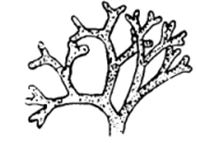
A
Riccia
B
Marchantia
C
Funaria
D
Anthoceros
Solution
(B) The figure shows the thallus of a liverwort,specifically $Marchantia$.
$Marchantia$ is characterized by a dorsiventrally flattened,dichotomously branched thallus.
$Riccia$ has a more compact,rosette-like thallus.
$Funaria$ is a moss with a leafy gametophyte.
$Anthoceros$ has a lobed,irregular thallus with a horn-like sporophyte.
Therefore,the correct option is $B$.
$Marchantia$ is characterized by a dorsiventrally flattened,dichotomously branched thallus.
$Riccia$ has a more compact,rosette-like thallus.
$Funaria$ is a moss with a leafy gametophyte.
$Anthoceros$ has a lobed,irregular thallus with a horn-like sporophyte.
Therefore,the correct option is $B$.
0 likes
View Solution238
EasyMCQ
Identify the plant shown in the figure.
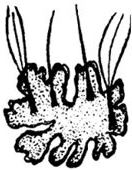
A
Riccia
B
Marchantia
C
Anthoceros
D
Rhynia
Solution
(B) The figure shows the thallus of a liverwort,specifically $Marchantia$. It is characterized by a dorsiventrally flattened,dichotomously branched thallus with rhizoids and scales on the ventral surface. The presence of gemma cups (though not explicitly labeled,the overall morphology is diagnostic) and the specific branching pattern identify it as $Marchantia$.
0 likes
View Solution239
MediumMCQ
To which division does the plant shown in the figure belong?
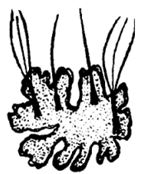
A
Bryophyta
B
Thallophyta
C
Pteridophyta
D
Gymnospermae
Solution
(A) The figure shows a thalloid structure,which is characteristic of the division Thallophyta (specifically algae like Riccia or similar liverworts,but in the context of general classification,the thalloid body is a primary feature of Thallophyta). However,looking closely at the provided image,it represents a liverwort (a type of Bryophyte). Specifically,it resembles the thallus of Riccia. Therefore,it belongs to the division Bryophyta.
0 likes
View Solution240
MediumMCQ
What is true for the given figure?
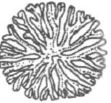
A
Primitive embryophyte
B
Gametophytic stage is secondary
C
First land-dwelling plant
D
Vascular tissue present
Solution
(C) The provided image represents the thallus of Riccia,which is a liverwort belonging to the group Bryophyta.
Bryophytes are known as the 'amphibians of the plant kingdom' because they live in soil but are dependent on water for sexual reproduction.
They are considered the first land-dwelling plants (embryophytes) that evolved from aquatic ancestors.
In Bryophytes,the gametophyte is the dominant,independent phase,while the sporophyte is dependent on the gametophyte.
Therefore,the statement 'First land-dwelling plant' is the most accurate description among the given options.
Bryophytes are known as the 'amphibians of the plant kingdom' because they live in soil but are dependent on water for sexual reproduction.
They are considered the first land-dwelling plants (embryophytes) that evolved from aquatic ancestors.
In Bryophytes,the gametophyte is the dominant,independent phase,while the sporophyte is dependent on the gametophyte.
Therefore,the statement 'First land-dwelling plant' is the most accurate description among the given options.
0 likes
View Solution241
MediumMCQ
Mosses are included in which of the following groups?
A
Pteridophytes
B
Bryophytes
C
Conifers
D
Angiosperms
Solution
(B) Mosses (such as $Funaria$,$Polytrichum$,and $Sphagnum$) belong to the group $Bryophytes$. $Bryophytes$ are non-vascular land plants that lack true roots,stems,and leaves,and they reproduce via spores. Therefore,the correct option is $B$.
0 likes
View Solution242
MediumMCQ
Which plant group is non-vascular and embryo-producing?
A
Bryophytes
B
Pteridophytes
C
Gymnosperms
D
Angiosperms
Solution
(A) The plant kingdom is classified based on the presence or absence of vascular tissues and the production of seeds or embryos.
$1$. Bryophytes are non-vascular plants (lacking xylem and phloem) that produce embryos.
$2$. Pteridophytes,Gymnosperms,and Angiosperms are vascular plants.
$3$. Therefore,Bryophytes are the only group among the options that are non-vascular and embryo-producing.
$1$. Bryophytes are non-vascular plants (lacking xylem and phloem) that produce embryos.
$2$. Pteridophytes,Gymnosperms,and Angiosperms are vascular plants.
$3$. Therefore,Bryophytes are the only group among the options that are non-vascular and embryo-producing.
0 likes
View Solution243
EasyMCQ
The most simple and primitive embryophytes are .....
A
Lichens
B
Bryophytes
C
Pteridophytes
D
Gymnosperms
Solution
(B) Embryophytes are plants that produce embryos during their life cycle. Among the given options, $Bryophytes$ are considered the most primitive group of embryophytes. They are the first land plants to show the formation of a multicellular embryo from a zygote, although they lack true vascular tissues.
0 likes
View Solution244
MediumMCQ
Which of the following is not an example of a bryophyte?
A
Rhynia
B
Riccia
C
Anthoceros
D
Funaria
Solution
(A) Bryophytes are non-vascular land plants that include mosses,liverworts,and hornworts.
$Riccia$ is a liverwort,$Anthoceros$ is a hornwort,and $Funaria$ is a moss.
$Rhynia$ is a fossil plant belonging to the group Rhyniophyta,which are considered the earliest known vascular plants (tracheophytes).
Therefore,$Rhynia$ is not a bryophyte.
$Riccia$ is a liverwort,$Anthoceros$ is a hornwort,and $Funaria$ is a moss.
$Rhynia$ is a fossil plant belonging to the group Rhyniophyta,which are considered the earliest known vascular plants (tracheophytes).
Therefore,$Rhynia$ is not a bryophyte.
0 likes
View Solution245
MediumMCQ
Assertion $(A)$: $Riccia$ is a very simple and primitive bryophyte.
Reason $(R)$: In $Riccia$,after fertilization,the zygote undergoes division to form an embryo.
Reason $(R)$: In $Riccia$,after fertilization,the zygote undergoes division to form an embryo.
A
$A$ and $R$ are both true,and $R$ is the correct explanation of $A$.
B
$A$ and $R$ are both true,but $R$ is not the correct explanation of $A$.
C
$A$ is true,but $R$ is false.
D
$A$ is false,but $R$ is true.
Solution
(B) $Riccia$ is considered a simple and primitive bryophyte because its plant body is a thallus and it lacks complex internal differentiation.
In bryophytes,the zygote undergoes mitotic divisions to form a multicellular structure called an embryo.
However,the statement in $R$ is technically incorrect in the context of $Riccia$ being 'primitive' because the formation of an embryo is a characteristic feature of all embryophytes (including bryophytes,pteridophytes,gymnosperms,and angiosperms).
Specifically,in $Riccia$,the zygote divides to form a sporophyte which is very simple and lacks a foot and seta,consisting only of a capsule.
Since the assertion is true but the reason provided is not the specific biological explanation for why $Riccia$ is considered 'primitive' (as embryo formation is common to all bryophytes),the correct choice is $B$.
In bryophytes,the zygote undergoes mitotic divisions to form a multicellular structure called an embryo.
However,the statement in $R$ is technically incorrect in the context of $Riccia$ being 'primitive' because the formation of an embryo is a characteristic feature of all embryophytes (including bryophytes,pteridophytes,gymnosperms,and angiosperms).
Specifically,in $Riccia$,the zygote divides to form a sporophyte which is very simple and lacks a foot and seta,consisting only of a capsule.
Since the assertion is true but the reason provided is not the specific biological explanation for why $Riccia$ is considered 'primitive' (as embryo formation is common to all bryophytes),the correct choice is $B$.
0 likes
View Solution246
MediumMCQ
Which of the following plants contains chlorophyll?
A
Fungi
B
Mushroom
C
Bacteriophage
D
Bryophytes
Solution
(D) Chlorophyll is a green pigment found in plants,algae,and cyanobacteria that is essential for photosynthesis.
$A$. Fungi are heterotrophic organisms that lack chlorophyll.
$B$. Mushrooms are a type of fungus and also lack chlorophyll.
$C$. Bacteriophages are viruses that infect bacteria and do not contain chlorophyll.
$D$. Bryophytes are non-vascular land plants that possess chlorophyll and perform photosynthesis.
Therefore,the correct option is $D$.
$A$. Fungi are heterotrophic organisms that lack chlorophyll.
$B$. Mushrooms are a type of fungus and also lack chlorophyll.
$C$. Bacteriophages are viruses that infect bacteria and do not contain chlorophyll.
$D$. Bryophytes are non-vascular land plants that possess chlorophyll and perform photosynthesis.
Therefore,the correct option is $D$.
0 likes
View Solution247
MediumMCQ
The presence of antheridia and archegonia is a characteristic feature of:
A
Spirogyra
B
Mucor
C
Mosses
D
Bacteria
Solution
(C) Antheridia (male sex organs) and archegonia (female sex organs) are specialized reproductive structures found in Bryophytes and Pteridophytes.
Among the given options,Mosses belong to the division Bryophyta.
Spirogyra is an alga,Mucor is a fungus,and Bacteria are prokaryotes,none of which possess archegonia.
Among the given options,Mosses belong to the division Bryophyta.
Spirogyra is an alga,Mucor is a fungus,and Bacteria are prokaryotes,none of which possess archegonia.
0 likes
View Solution248
EasyMCQ
Which of the following stages is considered the dominant phase in bryophytes?
A
Gametophyte
B
Sporophyte
C
Isogametophyte
D
Heterosporous
Solution
(A) In bryophytes,the plant body is more differentiated than that of algae. It is thallus-like and prostrate or erect,and attached to the substratum by unicellular or multicellular rhizoids. The main plant body of the bryophyte is haploid $(n)$. It produces gametes,hence it is called a gametophyte. The sporophyte is multicellular and dependent on the gametophyte for nutrition. Therefore,the gametophyte is the dominant,independent,and photosynthetic phase in the life cycle of bryophytes.
0 likes
View Solution249
MediumMCQ
The plant group that occupies an intermediate position between algae and pteridophytes is .....
A
Lichens
B
Bryophytes
C
Pteridophytes
D
Gymnosperms
Solution
(B) Bryophytes are known as the amphibians of the plant kingdom because they require water for fertilization. They represent an evolutionary link between algae (which are mostly aquatic) and pteridophytes (which are the first vascular land plants). Thus,they occupy an intermediate position in the evolutionary sequence.
0 likes
View Solution250
MediumMCQ
In which of the following plants are vascular tissues absent?
A
Funaria
B
Maize
C
Equisetum
D
Selaginella
Solution
(A) Vascular tissues ($Xylem$ and $Phloem$) are characteristic features of $Tracheophytes$ (Pteridophytes, Gymnosperms, and Angiosperms).
$Funaria$ belongs to the group $Bryophyta$.
$Bryophytes$ lack true vascular tissues ($Xylem$ and $Phloem$), which is why they are often referred to as non-vascular plants.
$Maize$ is an Angiosperm, while $Equisetum$ and $Selaginella$ are Pteridophytes; all three possess vascular tissues.
Therefore, the correct answer is $Funaria$.
$Funaria$ belongs to the group $Bryophyta$.
$Bryophytes$ lack true vascular tissues ($Xylem$ and $Phloem$), which is why they are often referred to as non-vascular plants.
$Maize$ is an Angiosperm, while $Equisetum$ and $Selaginella$ are Pteridophytes; all three possess vascular tissues.
Therefore, the correct answer is $Funaria$.
0 likes
View SolutionPlant Kingdom — Bryophytes (General) · Frequently Asked Questions
1Are these Plant Kingdom questions useful for JEE and NEET?
Yes. All questions in this section are mapped to JEE Main and NEET exam patterns. Previous year questions from JEE Main, NEET, GUJCET and state-level exams are included with full solutions.
2Can I switch to Hindi or Gujarati for these questions?
Yes. Use the language tabs in the hero section or the sidebar to view the same questions and solutions in English, Hindi or Gujarati.
3How do I generate a question paper from this subtopic?
Use the Vedclass Exam Paper Generator — select the chapter and subtopic, set difficulty, and generate Sets A, B, C, D automatically. First 3 chapters of every subject are free.
Vedclass Products
For Students
Vedclass Test Series
Mock tests in real JEE/NEET style with performance analysis. 5-day free trial.
Start Free TrialFor Teachers
Exam Paper Generator
Generate Set A/B/C/D papers from this chapter in 2 minutes. 3 chapters free.
Try FreeFor Institutes
Online Exam Module
Live online exams with unlimited students, 360° analytics & white-label branding.
See DemoFor Teachers & Institutes
Generate a Plant Kingdom Exam Paper in 2 Minutes
Select subtopic & difficulty — Sets A, B, C, D auto-generated with No Repeat logic.
First 3 chapters of every subject are free — no payment required.