
A English
Bryophytes (General) Questions in English
Class 11 Biology · Plant Kingdom · Bryophytes (General)
441+
Questions
English
Language
100%
With Solutions
Showing 50 of 441 questions in English
251
MediumMCQ
Assertion $(A)$: In mosses,vegetative reproduction occurs through fragmentation and budding.
Reason $(R)$: The spore-producing sporophyte stage in mosses is responsible for asexual reproduction.
Reason $(R)$: The spore-producing sporophyte stage in mosses is responsible for asexual reproduction.
A
$A$ and $R$ are both true,and $R$ is the correct explanation of $A$.
B
$A$ and $R$ are both true,but $R$ is not the correct explanation of $A$.
C
$A$ is true,but $R$ is false.
D
$A$ is false,but $R$ is true.
Solution
(C) Assertion $(A)$ is true: In mosses (like $Funaria$),vegetative reproduction takes place by fragmentation and budding in the secondary protonema.
Reason $(R)$ is false: In mosses,the sporophyte is not responsible for asexual reproduction; rather,it produces spores through meiosis for sexual reproduction (dispersal). Asexual reproduction in mosses is primarily vegetative. Therefore,the statement that the sporophyte is responsible for asexual reproduction is incorrect.
Reason $(R)$ is false: In mosses,the sporophyte is not responsible for asexual reproduction; rather,it produces spores through meiosis for sexual reproduction (dispersal). Asexual reproduction in mosses is primarily vegetative. Therefore,the statement that the sporophyte is responsible for asexual reproduction is incorrect.
0 likes
View Solution252
EasyMCQ
Who is known as the father of Indian Bryology?
A
Shiv Ram Kashyap
B
Rothmaler Kashyap
C
Talsan Kashyap
D
Iyengar Kashyap
Solution
(A) Professor $Shiv$ $Ram$ $Kashyap$ $(1882-1934)$ is widely recognized as the father of Indian Bryology. He made significant contributions to the study of liverworts and mosses in India,particularly in the Himalayan region. His work on the taxonomy and distribution of bryophytes remains a cornerstone in Indian botanical research.
0 likes
View Solution253
MediumMCQ
In which of the following plants are the male and female gametophytes haploid,autotrophic,and independent free-living?
A
Ricinus
B
Pinus
C
Anthoceros
D
Brassica
Solution
(C) The male and female gametophytes of $Anthoceros$ (a member of Bryophyta,specifically Hornworts) are haploid $(n)$,autotrophic (photosynthetic),and independent free-living organisms.
In contrast,$Pinus$ (Gymnosperm) has dependent gametophytes,while $Ricinus$ and $Brassica$ (Angiosperms) have highly reduced,dependent gametophytes that are not free-living.
In contrast,$Pinus$ (Gymnosperm) has dependent gametophytes,while $Ricinus$ and $Brassica$ (Angiosperms) have highly reduced,dependent gametophytes that are not free-living.
0 likes
View Solution254
EasyMCQ
Into how many classes did Rothmaler divide the Bryophytes?
A
Two
B
Four
C
Three
D
Five
Solution
(C) Rothmaler $(1951)$ classified the division Bryophyta into $3$ classes: $1$. Hepaticae (Liverworts),$2$. Anthocerotae (Hornworts),and $3$. Musci (Mosses).
0 likes
View Solution255
MediumMCQ
In bryophytes,vegetative reproduction occurs through which of the following?
A
Fragmentation
B
Adventitious branches
C
Gemmae
D
All of the above
Solution
(D) Vegetative reproduction in bryophytes occurs through various methods:
$1$. Fragmentation: The plant body breaks into smaller pieces,each capable of developing into a new plant.
$2$. Adventitious branches: These are branches that arise from parts other than the normal axillary buds,which can detach and grow independently.
$3$. Gemmae: These are specialized asexual reproductive structures found in many liverworts (e.g.,Marchantia) that detach from the parent plant to form new individuals.
Therefore,all the listed methods are involved in the vegetative reproduction of bryophytes.
$1$. Fragmentation: The plant body breaks into smaller pieces,each capable of developing into a new plant.
$2$. Adventitious branches: These are branches that arise from parts other than the normal axillary buds,which can detach and grow independently.
$3$. Gemmae: These are specialized asexual reproductive structures found in many liverworts (e.g.,Marchantia) that detach from the parent plant to form new individuals.
Therefore,all the listed methods are involved in the vegetative reproduction of bryophytes.
0 likes
View Solution256
MediumMCQ
In this group,the gametophytic plant body is thalloid or erect.
A
Bryophytes
B
Pteridophytes
C
Gymnosperms
D
Lichens
Solution
(A) The plant body of $Bryophytes$ is more differentiated than that of algae. It is thallus-like (thalloid) and prostrate or erect,and attached to the substratum by unicellular or multicellular $rhizoids$. They lack true roots,stem,or leaves. Therefore,the correct option is $A$.
0 likes
View Solution257
MediumMCQ
Which of the following is true for the sporophyte stage of $Riccia$?
A
Main stage
B
Autotrophic
C
Haploid
D
Parasitic/Dependent
Solution
(D) In $Riccia$,which belongs to the class $Hepaticopsida$ (liverworts),the plant body is a gametophyte $(n)$,which is the dominant,independent,and photosynthetic phase. The sporophyte $(2n)$ is highly reduced and consists only of a capsule. It is completely dependent on the gametophyte for nutrition and protection. Therefore,it is parasitic or dependent on the gametophyte.
0 likes
View Solution258
MediumMCQ
Which of the following is associated with the gametophytic phase of bryophytes?
A
It is the dominant phase that performs sexual reproduction.
B
The gametes are autotrophic.
C
It produces male and female gametes.
D
All of the above.
0 likes
View Solution259
MediumMCQ
The plant group that lives in an amphibious state between algae and pteridophytes is ........
A
Lichens
B
Bryophytes
C
Pteridophytes
D
Gymnosperms
Solution
(B) Bryophytes are known as the amphibians of the plant kingdom because they live in soil but are dependent on water for sexual reproduction. They represent an evolutionary stage between algae (which are primarily aquatic) and pteridophytes (which are the first terrestrial plants with vascular tissues). Therefore,bryophytes occupy an intermediate position between algae and pteridophytes.
0 likes
View Solution260
MediumMCQ
Which of the following is a class of Bryophytes?
A
Hepaticopsida
B
Anthocerotopsida
C
Bryopsida
D
All of the above
Solution
(D) Bryophytes are classified into three main classes:
$1$. $Hepaticopsida$ (Liverworts)
$2$. $Anthocerotopsida$ (Hornworts)
$3$. $Bryopsida$ (Mosses)
Since all three options listed are valid classes of Bryophytes,the correct answer is $D$.
$1$. $Hepaticopsida$ (Liverworts)
$2$. $Anthocerotopsida$ (Hornworts)
$3$. $Bryopsida$ (Mosses)
Since all three options listed are valid classes of Bryophytes,the correct answer is $D$.
0 likes
View Solution261
MediumMCQ
In $Bryophytes$,which stage produces diploid,heterosporous spores?
A
Sporophyte
B
Gametophyte
C
Alternation of generation
D
Syngamy
Solution
(A) In $Bryophytes$,the main plant body is a haploid $Gametophyte$.
After fertilization,the zygote develops into a $Sporophyte$.
The $Sporophyte$ is diploid and produces haploid spores through meiosis.
However,the question asks for the stage that produces spores.
Note: $Bryophytes$ are generally homosporous,but the $Sporophyte$ is the stage responsible for spore production.
After fertilization,the zygote develops into a $Sporophyte$.
The $Sporophyte$ is diploid and produces haploid spores through meiosis.
However,the question asks for the stage that produces spores.
Note: $Bryophytes$ are generally homosporous,but the $Sporophyte$ is the stage responsible for spore production.
0 likes
View Solution262
EasyMCQ
In bryophytes,the plant body is in which phase?
A
Gametophytic
B
Sporophytic
C
Sexual
D
Asexual
Solution
(A) In bryophytes,the main plant body is haploid $(n)$.
It produces gametes,hence it is called the gametophyte.
The sporophyte is multicellular and dependent on the gametophyte for nutrition.
Therefore,the dominant phase in the life cycle of bryophytes is the gametophytic phase.
It produces gametes,hence it is called the gametophyte.
The sporophyte is multicellular and dependent on the gametophyte for nutrition.
Therefore,the dominant phase in the life cycle of bryophytes is the gametophytic phase.
0 likes
View Solution263
EasyMCQ
What is the secondary stage of bryophytes?
A
Alternation of generation
B
Gametophyte
C
Sporophyte
D
Both $(B)$ and $(C)$
Solution
(C) In bryophytes,the main plant body is the gametophyte $(n)$,which is the dominant and independent phase.
The sporophyte $(2n)$ is the secondary stage,which is multicellular and dependent on the gametophyte for its nutrition.
Therefore,the sporophyte represents the secondary stage in the life cycle of bryophytes.
The sporophyte $(2n)$ is the secondary stage,which is multicellular and dependent on the gametophyte for its nutrition.
Therefore,the sporophyte represents the secondary stage in the life cycle of bryophytes.
0 likes
View Solution264
MediumMCQ
In bryophytes,sexual reproduction occurs through which organs?
A
Antheridium
B
Archegonium
C
Sporangium
D
Both $(A)$ and $(B)$
Solution
(D) In bryophytes,the plant body is gametophytic.
Sexual reproduction is oogamous.
The male sex organ is called the antheridium,which produces biflagellate antherozoids.
The female sex organ is called the archegonium,which is flask-shaped and produces a single egg.
Therefore,both antheridium and archegonium are involved in sexual reproduction.
Sexual reproduction is oogamous.
The male sex organ is called the antheridium,which produces biflagellate antherozoids.
The female sex organ is called the archegonium,which is flask-shaped and produces a single egg.
Therefore,both antheridium and archegonium are involved in sexual reproduction.
0 likes
View Solution265
EasyMCQ
Which plants are found on moist soil,damp walls,and humid rocks?
A
Thallophytes
B
Bryophytes
C
Pteridophytes
D
Gymnosperms
Solution
(B) Bryophytes are often referred to as the 'amphibians of the plant kingdom' because they can live in soil but are dependent on water for sexual reproduction. They are commonly found in moist,shaded,and damp areas such as damp walls,moist soil,and humid rocks.
0 likes
View Solution266
EasyMCQ
What is the ploidy of the spores in Bryophytes?
A
Triploid
B
Haploid
C
Tetraploid
D
Diploid
Solution
(B) In the life cycle of Bryophytes,the main plant body is gametophytic $(n)$.
The sporophyte $(2n)$ produces spores through meiosis.
Since meiosis is a reductional division,the resulting spores are haploid $(n)$.
The sporophyte $(2n)$ produces spores through meiosis.
Since meiosis is a reductional division,the resulting spores are haploid $(n)$.
0 likes
View Solution267
MediumMCQ
Which of the following is incorrect for the gametophytic phase of bryophytes?
A
Haploid
B
Secondary
C
Autotrophic
D
Responsible for sexual reproduction
Solution
(B) In bryophytes,the plant body is a gametophyte,which is the dominant phase of the life cycle.
$1$. The gametophyte is haploid $(n)$ in nature.
$2$. It is the primary phase of the life cycle,not secondary.
$3$. It is autotrophic,meaning it can synthesize its own food through photosynthesis.
$4$. It bears sex organs and is responsible for sexual reproduction.
Therefore,the statement that it is 'secondary' is incorrect.
$1$. The gametophyte is haploid $(n)$ in nature.
$2$. It is the primary phase of the life cycle,not secondary.
$3$. It is autotrophic,meaning it can synthesize its own food through photosynthesis.
$4$. It bears sex organs and is responsible for sexual reproduction.
Therefore,the statement that it is 'secondary' is incorrect.
0 likes
View Solution268
MediumMCQ
The first terrestrial plants are .......
A
Thallophytes
B
Bryophytes
C
Pteridophytes
D
Gymnosperms
Solution
(B) The first terrestrial plants are the $Bryophytes$.
$Bryophytes$ are considered the amphibians of the plant kingdom because they live in soil but are dependent on water for sexual reproduction.
While $Pteridophytes$ were the first terrestrial plants to possess vascular tissues ($xylem$ and $phloem$),$Bryophytes$ are historically recognized as the first group of plants to colonize land.
$Bryophytes$ are considered the amphibians of the plant kingdom because they live in soil but are dependent on water for sexual reproduction.
While $Pteridophytes$ were the first terrestrial plants to possess vascular tissues ($xylem$ and $phloem$),$Bryophytes$ are historically recognized as the first group of plants to colonize land.
0 likes
View Solution269
MediumMCQ
Which of the following characteristics are found in $Bryophytes$?
A
Presence of $Archegonia$
B
Gametophytic phase is dominant and the sporophytic phase is parasitic
C
Thalloid plant body
D
All of the above
Solution
(D) The characteristics of $Bryophytes$ are as follows:
$1$. They possess $Archegonia$ as the female sex organ.
$2$. The $Gametophytic$ phase is dominant and independent,while the $Sporophytic$ phase is dependent or parasitic on the $Gametophyte$.
$3$. The plant body is $Thalloid$ in nature.
Therefore,the correct answer is $D$.
$1$. They possess $Archegonia$ as the female sex organ.
$2$. The $Gametophytic$ phase is dominant and independent,while the $Sporophytic$ phase is dependent or parasitic on the $Gametophyte$.
$3$. The plant body is $Thalloid$ in nature.
Therefore,the correct answer is $D$.
0 likes
View Solution270
EasyMCQ
In bryophytes,the adult plant body is:
A
Epiphyte
B
Gametophyte
C
Sporophyte
D
Sporophyll
Solution
(B) In bryophytes,the life cycle is dominated by the gametophytic phase. The main plant body is haploid $(n)$ and is called the gametophyte. It produces gametes,which fuse to form a zygote. The zygote develops into a sporophyte $(2n)$,which is dependent on the gametophyte for nutrition and support. Therefore,the adult plant body is the gametophyte.
0 likes
View Solution271
EasyMCQ
The group of plants that were the first to colonize land is .......
A
Thallophyta
B
Lichens
C
Angiosperms
D
Bryophyta
Solution
(D) The $Bryophyta$ are often referred to as the amphibians of the plant kingdom. They were the first group of plants to successfully colonize land,although they still require water for fertilization. While $Lichens$ (a symbiotic association of algae and fungi) are often the pioneer species in primary succession on bare rocks,$Bryophyta$ represents the first major group of land plants in the evolutionary sequence.
0 likes
View Solution272
MediumMCQ
Which group of plants does not possess vascular tissues?
A
Bryophytes
B
Pteridophytes
C
Angiosperms
D
Dicotyledons
Solution
(A) The plant kingdom is classified based on the presence or absence of vascular tissues (xylem and phloem).
$1$. Bryophytes are non-vascular plants,meaning they lack specialized tissues for the conduction of water and nutrients.
$2$. Pteridophytes,Gymnosperms,and Angiosperms are vascular plants (Tracheophytes).
Therefore,Bryophytes are the group that does not possess vascular tissues.
$1$. Bryophytes are non-vascular plants,meaning they lack specialized tissues for the conduction of water and nutrients.
$2$. Pteridophytes,Gymnosperms,and Angiosperms are vascular plants (Tracheophytes).
Therefore,Bryophytes are the group that does not possess vascular tissues.
0 likes
View Solution273
EasyMCQ
Which is the first group of embryophyte plants?
A
Dicotyledons
B
Bryophytes
C
Pteridophytes
D
Monocotyledons
Solution
(B) Embryophytes are plants that produce an embryo during their life cycle. The transition from aquatic to terrestrial life in plants began with the Bryophytes. They are the first group of plants to exhibit the formation of a multicellular embryo from a zygote,which is retained within the female sex organ. Therefore,Bryophytes are considered the first embryophytes.
0 likes
View Solution274
EasyMCQ
In terms of nutrition,what is the nature of the gametophytic stage in bryophytes?
A
Heterotrophic
B
Saprophytic
C
Autotrophic
D
All of the above $(A), (B)$ and $(C)$
Solution
(C) In bryophytes,the main plant body is the gametophyte,which is haploid $(n)$.
This gametophyte is independent and photosynthetic,meaning it can synthesize its own food.
Therefore,in terms of nutrition,the gametophytic stage is autotrophic.
This gametophyte is independent and photosynthetic,meaning it can synthesize its own food.
Therefore,in terms of nutrition,the gametophytic stage is autotrophic.
0 likes
View Solution275
EasyMCQ
In terms of nutrition,what is the nature of the sporophyte stage in $Bryophytes$?
A
Heterotrophic
B
Chemosynthetic
C
Photosynthetic
D
Autotrophic
Solution
(A) In $Bryophytes$,the main plant body is a gametophyte,which is independent and photosynthetic. The sporophyte is not free-living but is attached to the photosynthetic gametophyte and derives nourishment from it. Therefore,the sporophyte stage is heterotrophic in terms of nutrition.
0 likes
View Solution276
EasyMCQ
What is the chromosomal status of the gametophytic stage in bryophytes?
A
Diploid
B
Triploid
C
Haploid
D
All $(A), (B)$ and $(C)$
Solution
(C) In the life cycle of bryophytes,the dominant phase is the gametophyte.
This stage is haploid $(n)$ because it produces gametes through mitosis.
The sporophyte,which is formed after fertilization,is diploid $(2n)$.
Therefore,the chromosomal status of the gametophytic stage is haploid.
This stage is haploid $(n)$ because it produces gametes through mitosis.
The sporophyte,which is formed after fertilization,is diploid $(2n)$.
Therefore,the chromosomal status of the gametophytic stage is haploid.
0 likes
View Solution277
EasyMCQ
In bryophytes,the sporophyte stage is responsible for which of the following?
A
Asexual reproduction
B
Vegetative reproduction
C
Sexual reproduction
D
Both $A$ and $B$
Solution
(A) In bryophytes,the plant body is a gametophyte $(n)$,which is the dominant phase and is responsible for sexual reproduction by producing gametes.
The sporophyte $(2n)$ is dependent on the gametophyte for nutrition and is responsible for asexual reproduction through the production of spores via meiosis.
The sporophyte $(2n)$ is dependent on the gametophyte for nutrition and is responsible for asexual reproduction through the production of spores via meiosis.
0 likes
View Solution278
MediumMCQ
In bryophytes,vegetative reproduction occurs through which of the following?
A
Adventitious branches
B
Tubers
C
Gemmae
D
$A, B$ and $C$ all
Solution
(D) In bryophytes,vegetative reproduction occurs through various methods.
$1$. Adventitious branches: These are small branches that develop from the plant body and detach to form new plants.
$2$. Tubers: These are storage organs that can develop into new plants under favorable conditions.
$3$. Gemmae: These are specialized asexual reproductive structures found in many liverworts (e.g.,Marchantia) that detach from the parent plant to grow into new individuals.
Therefore,all these methods are used for vegetative reproduction in bryophytes.
$1$. Adventitious branches: These are small branches that develop from the plant body and detach to form new plants.
$2$. Tubers: These are storage organs that can develop into new plants under favorable conditions.
$3$. Gemmae: These are specialized asexual reproductive structures found in many liverworts (e.g.,Marchantia) that detach from the parent plant to grow into new individuals.
Therefore,all these methods are used for vegetative reproduction in bryophytes.
0 likes
View Solution279
MediumMCQ
In bryophytes,reproduction occurs through which sex organs?
A
Archegonium
B
Antheridium
C
Both $(A)$ and $(B)$
D
Pistil
Solution
(C) Bryophytes are non-vascular land plants. In these plants,the male sex organ is called the $Antheridium$,which produces biflagellate antherozoids. The female sex organ is called the $Archegonium$,which is flask-shaped and produces a single egg. Therefore,reproduction in bryophytes involves both these sex organs.
0 likes
View Solution280
MediumMCQ
Which of the following is a bryophyte?
A
Funaria
B
Rhynia
C
Selaginella
D
Sargassum
Solution
(A) The plant kingdom is classified into various groups based on their characteristics.
$1$. $Funaria$ is a well-known moss,which belongs to the group $Bryophyta$.
$2$. $Rhynia$ is an extinct genus of vascular plants.
$3$. $Selaginella$ is a pteridophyte.
$4$. $Sargassum$ is a brown alga,which belongs to the group $Phaeophyceae$.
Therefore,$Funaria$ is the correct answer.
$1$. $Funaria$ is a well-known moss,which belongs to the group $Bryophyta$.
$2$. $Rhynia$ is an extinct genus of vascular plants.
$3$. $Selaginella$ is a pteridophyte.
$4$. $Sargassum$ is a brown alga,which belongs to the group $Phaeophyceae$.
Therefore,$Funaria$ is the correct answer.
0 likes
View Solution281
EasyMCQ
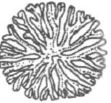
To which group does the plant shown in the given figure belong?
A
Algae
B
Fungi
C
Bryophytes
D
Pteridophytes
Solution
(C) The figure shows the thallus of a liverwort,specifically a member of the group Bryophytes.
Liverworts like Riccia or Marchantia exhibit a thalloid body structure which is dorsiventrally flattened and closely appressed to the substrate.
Therefore,the correct group is Bryophytes.
Liverworts like Riccia or Marchantia exhibit a thalloid body structure which is dorsiventrally flattened and closely appressed to the substrate.
Therefore,the correct group is Bryophytes.
0 likes
View Solution282
EasyMCQ
Which plant is shown in the given figure?
A
Riccia
B
Moss
C
Anthoceros
D
Parmelia
Solution
(A) The figure shows the thallus of the liverwort $Riccia$.
$Riccia$ is a genus of liverworts in the order Marchantiales.
The thallus is green,dorsiventrally flattened,and dichotomously branched,forming a rosette-like structure as seen in the image.
$Riccia$ is a genus of liverworts in the order Marchantiales.
The thallus is green,dorsiventrally flattened,and dichotomously branched,forming a rosette-like structure as seen in the image.
0 likes
View Solution283
MediumMCQ
What is the dominant phase of the plant shown in the given figure?
A
Sporophyte
B
Gametophyte
C
Alternation of generation
D
All $(A)$,$(B)$ and $(C)$
Solution
(B) The figure shows a thalloid structure,which is characteristic of the gametophytic phase in Bryophytes (like liverworts,e.g.,Marchantia). In Bryophytes,the plant body is a haploid gametophyte,which represents the dominant phase of the life cycle. The sporophyte is dependent on the gametophyte for nutrition and is not the dominant phase.
0 likes
View Solution284
DifficultMCQ
Identify the plant shown in the given figure.
A
Anthoceros
B
Funaria (Moss)
C
Riccia
D
Marsilea
Solution
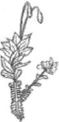
(B) The figure shows the gametophyte of the moss $Funaria$.
$Funaria$ is a common moss belonging to the class Bryopsida under the division Bryophyta.
It is characterized by a leafy gametophyte stage with a central axis bearing spirally arranged leaves and a sporophyte attached to it,which consists of a foot,seta,and capsule.
Therefore,the correct option is $B$.
$Funaria$ is a common moss belonging to the class Bryopsida under the division Bryophyta.
It is characterized by a leafy gametophyte stage with a central axis bearing spirally arranged leaves and a sporophyte attached to it,which consists of a foot,seta,and capsule.
Therefore,the correct option is $B$.
0 likes
View Solution285
MediumMCQ
In the given figure,which stage is haploid and autotrophic?
A
Sporophyte
B
Alternation of generation
C
Gametophyte
D
All $(A), (B)$ and $(C)$
Solution
(C) The provided figure represents a moss (e.g.,Funaria),which belongs to the group Bryophyta.
In Bryophytes,the main plant body is a gametophyte,which is haploid $(n)$ and autotrophic (photosynthetic).
The sporophyte is dependent on the gametophyte for nutrition and is diploid $(2n)$.
Therefore,the haploid and autotrophic stage is the gametophyte.
In Bryophytes,the main plant body is a gametophyte,which is haploid $(n)$ and autotrophic (photosynthetic).
The sporophyte is dependent on the gametophyte for nutrition and is diploid $(2n)$.
Therefore,the haploid and autotrophic stage is the gametophyte.
0 likes
View Solution286
EasyMCQ
Which of the following plants has a haploid and autotrophic gametophyte?
A
Funaria
B
Parmelia
C
Strigula
D
Rhynia
Solution
(A) In the life cycle of bryophytes like $Funaria$ (a moss),the dominant phase is the gametophyte.
$1$. The gametophyte is haploid $(n)$ and autotrophic,meaning it can perform photosynthesis to produce its own food.
$2$. $Parmelia$ is a lichen,which is a symbiotic association between algae and fungi.
$3$. $Strigula$ is a lichen.
$4$. $Rhynia$ is a fossil pteridophyte.
Therefore,$Funaria$ is the correct answer.
$1$. The gametophyte is haploid $(n)$ and autotrophic,meaning it can perform photosynthesis to produce its own food.
$2$. $Parmelia$ is a lichen,which is a symbiotic association between algae and fungi.
$3$. $Strigula$ is a lichen.
$4$. $Rhynia$ is a fossil pteridophyte.
Therefore,$Funaria$ is the correct answer.
0 likes
View Solution287
EasyMCQ
Reproduction by gemmae is .........
A
Vegetative reproduction.
B
Sexual reproduction.
C
Asexual reproduction by spores.
D
Sexual reproduction by gametes.
Solution
(A) Gemmae are specialized green,multicellular,asexual buds that develop in small receptacles called gemma cups located on the thalli of liverworts (e.g.,$Marchantia$).
These gemmae become detached from the parent body and germinate to form new individuals.
Since this process involves the formation of vegetative structures that develop into new plants without the fusion of gametes,it is classified as a form of vegetative reproduction (a type of asexual reproduction).
These gemmae become detached from the parent body and germinate to form new individuals.
Since this process involves the formation of vegetative structures that develop into new plants without the fusion of gametes,it is classified as a form of vegetative reproduction (a type of asexual reproduction).
0 likes
View Solution288
EasyMCQ
Which plant group has a dominant, haploid, and photosynthetic gametophyte stage?
A
Bryophytes
B
Pteridophytes
C
Gymnosperms
D
Monocots
Solution
(A) In $Bryophytes$, the main plant body is a haploid gametophyte $(n)$.
This gametophyte is independent, photosynthetic, and represents the dominant phase of the life cycle.
In contrast, $Pteridophytes$, $Gymnosperms$, and $Angiosperms$ (including $Monocots$) have a dominant diploid sporophyte $(2n)$ phase, while the gametophyte is reduced and dependent.
This gametophyte is independent, photosynthetic, and represents the dominant phase of the life cycle.
In contrast, $Pteridophytes$, $Gymnosperms$, and $Angiosperms$ (including $Monocots$) have a dominant diploid sporophyte $(2n)$ phase, while the gametophyte is reduced and dependent.
0 likes
View Solution289
MediumMCQ
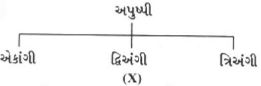
Which of the following is correct for '$X$' in the given chart? (The chart classifies non-flowering plants into Thallophyta,Bryophyta,and Pteridophyta)
A
Marchantia
B
Rhynia
C
Bennetitties
D
Parmelia
Solution
(A) The chart classifies non-flowering plants (Cryptogams) into three groups: Thallophyta (Ekangi),Bryophyta (Dwi-angi),and Pteridophyta (Tri-angi).
'$X$' represents the group Bryophyta.
Among the given options,Marchantia is a well-known example of a Bryophyte (a liverwort).
Rhynia is a fossil Pteridophyte,Bennetitties is a group of extinct gymnosperms,and Parmelia is a lichen (Thallophyta).
Therefore,Marchantia is the correct answer.
'$X$' represents the group Bryophyta.
Among the given options,Marchantia is a well-known example of a Bryophyte (a liverwort).
Rhynia is a fossil Pteridophyte,Bennetitties is a group of extinct gymnosperms,and Parmelia is a lichen (Thallophyta).
Therefore,Marchantia is the correct answer.
0 likes
View Solution290
MediumMCQ
Consider the following statements:
$X:$ Rothmaler divided Bryophyta into three classes.
$Y:$ Iyengar is considered the father of Indian Bryology.
$Z:$ Shiv Ram Kashyap is considered the father of Phycology.
$X:$ Rothmaler divided Bryophyta into three classes.
$Y:$ Iyengar is considered the father of Indian Bryology.
$Z:$ Shiv Ram Kashyap is considered the father of Phycology.
A
$X$ is false,$Y$ and $Z$ are true.
B
$Y$ is true,$X$ and $Z$ are false.
C
$X$ is true,$Y$ and $Z$ are false.
D
$X$ and $Z$ are true,$Y$ is false.
Solution
(C) $X:$ Rothmaler $(1951)$ classified Bryophyta into three classes: Hepaticopsida,Anthocerotopsida,and Bryopsida. This statement is true.
$Y:$ Prof. $S$.$R$. Kashyap is known as the father of Indian Bryology,not Iyengar. Therefore,this statement is false.
$Z:$ $M$.$O$.$P$. Iyengar is known as the father of Indian Phycology,not Shiv Ram Kashyap. Therefore,this statement is false.
Thus,only statement $X$ is true,while $Y$ and $Z$ are false.
$Y:$ Prof. $S$.$R$. Kashyap is known as the father of Indian Bryology,not Iyengar. Therefore,this statement is false.
$Z:$ $M$.$O$.$P$. Iyengar is known as the father of Indian Phycology,not Shiv Ram Kashyap. Therefore,this statement is false.
Thus,only statement $X$ is true,while $Y$ and $Z$ are false.
0 likes
View Solution291
EasyMCQ
Which of the following is responsible for peat formation?
A
Marchantia
B
Riccia
C
Funaria
D
Sphagnum
Solution
(D) : Among the bryophytes,$Sphagnum$ holds the most significant economic importance. It is popularly known as bog moss or peat moss. It is a perennial plant,and its growth continues year after year.
Older portions of the plant die but do not decompose due to the secretion of acids,which provide antibacterial and antifungal properties.
The increasing mass of dead remains accumulates over time,forming a compact,dark-colored,carbon-rich substance known as peat.
Peat is used as a fuel source. Additionally,substances like paraffin,acetic acid,peat tar,and ammonia are produced as by-products from peat for industrial applications.
Older portions of the plant die but do not decompose due to the secretion of acids,which provide antibacterial and antifungal properties.
The increasing mass of dead remains accumulates over time,forming a compact,dark-colored,carbon-rich substance known as peat.
Peat is used as a fuel source. Additionally,substances like paraffin,acetic acid,peat tar,and ammonia are produced as by-products from peat for industrial applications.
0 likes
View Solution292
MediumMCQ
The plant body is thalloid in
A
Sphagnum
B
Salvinia
C
Marchantia
D
Funaria
Solution
(C) $Sphagnum$ and $Funaria$ belong to Class $Bryopsida$ of Division $Bryophyta$. They are typically mosses. The plant body has radial symmetry and is essentially leafy.
$Salvinia$ belongs to Division $Pteridophyta$. It has a sporophyte plant body with true leaves,stem,and roots.
$Marchantia$ belongs to Class $Hepaticopsida$ of Division $Bryophyta$. They are also called liverworts. The plant body is a dorsoventrally flattened thallus.
$Salvinia$ belongs to Division $Pteridophyta$. It has a sporophyte plant body with true leaves,stem,and roots.
$Marchantia$ belongs to Class $Hepaticopsida$ of Division $Bryophyta$. They are also called liverworts. The plant body is a dorsoventrally flattened thallus.
0 likes
View Solution293
EasyMCQ
Archegoniophore is present in
A
Marchantia
B
Chara
C
Adiantum
D
Funaria
Solution
(A) $Marchantia$ is a dioecious plant.
Male plants bear antheridiophores,and female plants bear archegoniophores.
Antheridiophores consist of a stalk and a disc-like portion called a receptacle.
Archegoniophore is composed of a stalk and a disc-like receptacle at its distal end.
Male plants bear antheridiophores,and female plants bear archegoniophores.
Antheridiophores consist of a stalk and a disc-like portion called a receptacle.
Archegoniophore is composed of a stalk and a disc-like receptacle at its distal end.
0 likes
View Solution294
MediumMCQ
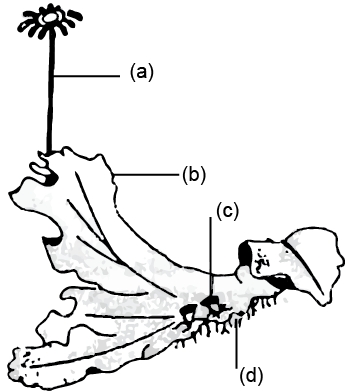
Examine the figure given below and select the correct option identifying all the four parts $(a, b, c$ and $d)$ correctly.
A
$(a)$-Archegoniophore,$(b)$-Female thallus,$(c)$-Gemma cup,$(d)$-Rhizoids
B
$(a)$-Archegoniophore,$(b)$-Female thallus,$(c)$-Bud,$(d)$-Foot
C
$(a)$-Seta,$(b)$-Sporophyte,$(c)$-Protonema,$(d)$-Rhizoids
D
$(a)$-Antheridiophore,$(b)$-Male thallus,$(c)$-Globule,$(d)$-Roots
Solution
(A) The given figure represents the female thallus of $Marchantia$,a liverwort belonging to the group Bryophyta.
In the diagram:
$(a)$ represents the Archegoniophore,which is the stalk bearing the female sex organs (archegonia).
$(b)$ represents the Female thallus,the main plant body.
$(c)$ represents the Gemma cup,which is a structure involved in asexual reproduction.
$(d)$ represents the Rhizoids,which are root-like structures that help in anchorage and absorption of water and minerals.
Therefore,the correct option is $(a)$.
In the diagram:
$(a)$ represents the Archegoniophore,which is the stalk bearing the female sex organs (archegonia).
$(b)$ represents the Female thallus,the main plant body.
$(c)$ represents the Gemma cup,which is a structure involved in asexual reproduction.
$(d)$ represents the Rhizoids,which are root-like structures that help in anchorage and absorption of water and minerals.
Therefore,the correct option is $(a)$.
0 likes
View Solution295
MediumMCQ
Male and female gametophytes are independent and free-living in
A
mustard
B
castor
C
Pinus
D
Sphagnum
Solution
(D) $Sphagnum$ is a bryophyte in which the dominant phase or plant body is an independent and free-living gametophyte.
The sporophyte is parasitic over the gametophyte.
In $Pinus$ (a gymnosperm),mustard,and castor (angiosperms),the main plant body is sporophytic.
The gametophyte is highly reduced and is completely dependent on the sporophyte.
The sporophyte is parasitic over the gametophyte.
In $Pinus$ (a gymnosperm),mustard,and castor (angiosperms),the main plant body is sporophytic.
The gametophyte is highly reduced and is completely dependent on the sporophyte.
0 likes
View Solution296
MediumMCQ
Spore dissemination in some liverworts is aided by
A
indusium
B
calyptra
C
peristome teeth
D
elaters
Solution
(D) : An $elater$ is a cell (or structure attached to a cell) that is hygroscopic,and therefore will change shape in response to changes in moisture in the environment.
Elaters come in a variety of forms,but are always associated with plant spores.
In plants that do not have seeds,they function in dispersing the spores to a new location.
In the liverworts,$elaters$ are cells that develop in the sporophyte alongside the spores.
They are complete cells,usually with helical thickenings at maturity that respond to moisture content.
In most liverworts,the $elaters$ are unattached,but in some leafy species (such as $Frullania$) a few $elaters$ will remain attached to the inside of the sporangium (spore capsule).
The $elaters$ by hygroscopic movement help in spore dispersal.
Elaters come in a variety of forms,but are always associated with plant spores.
In plants that do not have seeds,they function in dispersing the spores to a new location.
In the liverworts,$elaters$ are cells that develop in the sporophyte alongside the spores.
They are complete cells,usually with helical thickenings at maturity that respond to moisture content.
In most liverworts,the $elaters$ are unattached,but in some leafy species (such as $Frullania$) a few $elaters$ will remain attached to the inside of the sporangium (spore capsule).
The $elaters$ by hygroscopic movement help in spore dispersal.
0 likes
View Solution297
MediumMCQ
Peat moss is used as a packing material for sending flowers and live plants to distant places because
A
it serves as a disinfectant
B
it is easily available
C
it is hygroscopic
D
it reduces transpiration.
Solution
(C) $Sphagnum$ is a genus of mosses commonly known as peat moss.
It has a remarkable capacity to hold and retain water for long periods due to its hygroscopic nature.
Because of this property,it is used as a packing material for transporting live plants and flowers to distant places,as it keeps them moist and prevents them from drying out during transit.
It has a remarkable capacity to hold and retain water for long periods due to its hygroscopic nature.
Because of this property,it is used as a packing material for transporting live plants and flowers to distant places,as it keeps them moist and prevents them from drying out during transit.
0 likes
View Solution298
MediumMCQ
In a moss,the sporophyte
A
manufactures food for itself,as well as for the gametophyte
B
is partially parasitic on the gametophyte
C
produces gametes that give rise to the gametophyte
D
arises from a spore produced from the gametophyte.
Solution
(B) In mosses (Bryophytes),the plant body is a gametophyte,which is independent and photosynthetic.
The sporophyte is dependent on the gametophyte for its nutrition and anchorage.
It is attached to the gametophyte and derives nutrients from it,making it partially parasitic or dependent on the gametophyte for survival.
Therefore,the correct statement is that the sporophyte is partially parasitic on the gametophyte.
The sporophyte is dependent on the gametophyte for its nutrition and anchorage.
It is attached to the gametophyte and derives nutrients from it,making it partially parasitic or dependent on the gametophyte for survival.
Therefore,the correct statement is that the sporophyte is partially parasitic on the gametophyte.
0 likes
View Solution299
EasyMCQ
Which organism has a haploid plant body?
A
Pteridophytes
B
Gymnosperms
C
Angiosperms
D
Bryophytes
Solution
(D) In the plant kingdom,the life cycle involves an alternation of generations between a haploid gametophyte and a diploid sporophyte.
$1$. Bryophytes (such as mosses and liverworts) have a dominant,independent haploid gametophyte stage,which represents the main plant body.
$2$. Pteridophytes,Gymnosperms,and Angiosperms have a dominant diploid sporophyte plant body,while the gametophyte stage is reduced and dependent.
Therefore,the correct answer is $D$ (Bryophytes).
$1$. Bryophytes (such as mosses and liverworts) have a dominant,independent haploid gametophyte stage,which represents the main plant body.
$2$. Pteridophytes,Gymnosperms,and Angiosperms have a dominant diploid sporophyte plant body,while the gametophyte stage is reduced and dependent.
Therefore,the correct answer is $D$ (Bryophytes).
0 likes
View Solution300
EasyMCQ
Archegoniophore and antheridiophore are part of the reproductive organs of.........
A
Earthworm
B
Chara
C
Marchantia
D
Sweet potato
Solution
(C) $Marchantia$ is a dioecious bryophyte (liverwort).
In $Marchantia$,the male sex organs (antheridia) are borne on a stalked structure called the antheridiophore.
The female sex organs (archegonia) are borne on a stalked structure called the archegoniophore.
Therefore,these structures are characteristic of $Marchantia$.
In $Marchantia$,the male sex organs (antheridia) are borne on a stalked structure called the antheridiophore.
The female sex organs (archegonia) are borne on a stalked structure called the archegoniophore.
Therefore,these structures are characteristic of $Marchantia$.
0 likes
View SolutionPlant Kingdom — Bryophytes (General) · Frequently Asked Questions
1Are these Plant Kingdom questions useful for JEE and NEET?
Yes. All questions in this section are mapped to JEE Main and NEET exam patterns. Previous year questions from JEE Main, NEET, GUJCET and state-level exams are included with full solutions.
2Can I switch to Hindi or Gujarati for these questions?
Yes. Use the language tabs in the hero section or the sidebar to view the same questions and solutions in English, Hindi or Gujarati.
3How do I generate a question paper from this subtopic?
Use the Vedclass Exam Paper Generator — select the chapter and subtopic, set difficulty, and generate Sets A, B, C, D automatically. First 3 chapters of every subject are free.
Vedclass Products
For Students
Vedclass Test Series
Mock tests in real JEE/NEET style with performance analysis. 5-day free trial.
Start Free TrialFor Teachers
Exam Paper Generator
Generate Set A/B/C/D papers from this chapter in 2 minutes. 3 chapters free.
Try FreeFor Institutes
Online Exam Module
Live online exams with unlimited students, 360° analytics & white-label branding.
See DemoFor Teachers & Institutes
Generate a Plant Kingdom Exam Paper in 2 Minutes
Select subtopic & difficulty — Sets A, B, C, D auto-generated with No Repeat logic.
First 3 chapters of every subject are free — no payment required.