
A English
Growth Questions in English
Class 11 Biology · Plant Growth and Development · Growth
243+
Questions
English
Language
100%
With Solutions
Showing 43 of 243 questions in English
201
Medium
Why is plant growth indeterminate?
Solution
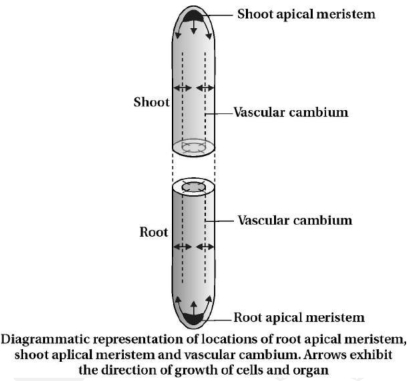
(N/A) Plant growth is unique because plants retain the capacity for unlimited growth throughout their life.
This ability of the plants is due to the presence of meristems at certain locations in their body.
The cells of such meristems have the capacity to divide and self-perpetuate.
The product,however,soon loses the capacity to divide and such cells make up the plant body.
This form of growth,wherein new cells are always being added to the plant body by the activity of the meristem,is called the open form of growth.
The root apical meristem and the shoot apical meristem are responsible for the primary growth of the plants and principally contribute to the elongation of the plants along their axis.
In dicotyledonous plants and gymnosperms,the lateral meristems,vascular cambium,and cork cambium appear later in life.
These are the meristems that cause the increase in the girth of the organs in which they are active. This is known as secondary growth of the plant.
This ability of the plants is due to the presence of meristems at certain locations in their body.
The cells of such meristems have the capacity to divide and self-perpetuate.
The product,however,soon loses the capacity to divide and such cells make up the plant body.
This form of growth,wherein new cells are always being added to the plant body by the activity of the meristem,is called the open form of growth.
The root apical meristem and the shoot apical meristem are responsible for the primary growth of the plants and principally contribute to the elongation of the plants along their axis.
In dicotyledonous plants and gymnosperms,the lateral meristems,vascular cambium,and cork cambium appear later in life.
These are the meristems that cause the increase in the girth of the organs in which they are active. This is known as secondary growth of the plant.
0 likes
View Solution202
Medium
Provide a quantitative comparison of growth rates.
Solution
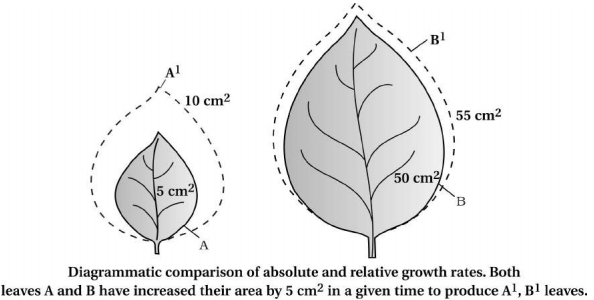
(N/A) The diagram shows a comparison of absolute and relative growth rates. Both leaves $A$ and $B$ have increased their area by $5 \ cm^{2}$ in a given time to produce leaves $A^{1}$ and $B^{1}$.
- The quantitative comparison between the growth of living systems is done in the following two ways:
$(1)$ Absolute Growth Rate: It is the measurement and comparison of total growth per unit time.
$(2)$ Relative Growth Rate: It is the growth of the given system per unit time expressed on a common basis,e.g.,per unit initial parameter.
- Leaves $A$ and $B$ shown in the figure have grown $5 \ cm^{2}$ in one day.
Although their initial sizes are different,i.e.,$5 \ cm^{2}$ and $50 \ cm^{2}$ respectively,both show an absolute increase in area in the given time to produce leaves $A^{1}$ and $B^{1}$,which is $5 \ cm^{2}$ in both cases.
Out of these two,the relative growth rate is higher in leaf $A^{1}$ because the initial area of leaf $A$ is smaller compared to leaf $B$.
- The quantitative comparison between the growth of living systems is done in the following two ways:
$(1)$ Absolute Growth Rate: It is the measurement and comparison of total growth per unit time.
$(2)$ Relative Growth Rate: It is the growth of the given system per unit time expressed on a common basis,e.g.,per unit initial parameter.
- Leaves $A$ and $B$ shown in the figure have grown $5 \ cm^{2}$ in one day.
Although their initial sizes are different,i.e.,$5 \ cm^{2}$ and $50 \ cm^{2}$ respectively,both show an absolute increase in area in the given time to produce leaves $A^{1}$ and $B^{1}$,which is $5 \ cm^{2}$ in both cases.
Out of these two,the relative growth rate is higher in leaf $A^{1}$ because the initial area of leaf $A$ is smaller compared to leaf $B$.
0 likes
View Solution203
MediumMCQ
What changes are observed in the cell during the elongation phase?
A
Increased vacuolation
B
Cell enlargement
C
New cell wall deposition
D
All of the above
Solution
(D) The cells proximal (just next,away from the tip) to the meristematic zone represent the phase of elongation.
Increased vacuolation,cell enlargement,and new cell wall deposition are the characteristics of the cells in this phase.
Further away from the apex,i.e.,more proximal to the phase of elongation lies the portion of the axis which is undergoing the phase of maturation.
The cells of this zone attain their maximal size in terms of wall thickening and protoplasmic modifications.
Increased vacuolation,cell enlargement,and new cell wall deposition are the characteristics of the cells in this phase.
Further away from the apex,i.e.,more proximal to the phase of elongation lies the portion of the axis which is undergoing the phase of maturation.
The cells of this zone attain their maximal size in terms of wall thickening and protoplasmic modifications.
0 likes
View Solution204
MediumMCQ
Describe the log phase in geometrical growth.
A
Initial slow growth phase
B
Phase of rapid exponential growth
C
Phase where growth stops
D
Phase of senescence
Solution
(B) The log phase,also known as the exponential phase,is the middle phase of growth.
It is characterized by very fast and rapid growth of the plant body.
After the initiation of growth,the cell number increases rapidly at an exponential rate $(W_1 = W_0 e^{rt})$.
During this phase,both progeny cells resulting from mitotic cell division retain the ability to divide and continue dividing as long as the nutrient supply is adequate.
It is characterized by very fast and rapid growth of the plant body.
After the initiation of growth,the cell number increases rapidly at an exponential rate $(W_1 = W_0 e^{rt})$.
During this phase,both progeny cells resulting from mitotic cell division retain the ability to divide and continue dividing as long as the nutrient supply is adequate.
0 likes
View Solution205
Medium
With the help of a graph, describe arithmetic growth.
Solution
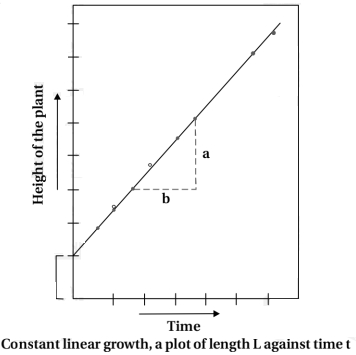
(N/A) Arithmetic growth is a type of growth where one daughter cell continues to divide while the other differentiates and matures. The simplest expression of arithmetic growth is exemplified by a root elongating at a constant rate.
- Refer to the provided graph, which shows constant linear growth by plotting the length of the organ $(L)$ against time $(t)$.
- On plotting the length of the organ against time, a linear curve is obtained.
- Mathematically, it is expressed as:
$L_{t} = L_{0} + rt$
Where:
$L_{t} = \text{length at time } t$
$L_{0} = \text{length at time zero}$
$r = \text{growth rate / elongation per unit time}$
- Refer to the provided graph, which shows constant linear growth by plotting the length of the organ $(L)$ against time $(t)$.
- On plotting the length of the organ against time, a linear curve is obtained.
- Mathematically, it is expressed as:
$L_{t} = L_{0} + rt$
Where:
$L_{t} = \text{length at time } t$
$L_{0} = \text{length at time zero}$
$r = \text{growth rate / elongation per unit time}$
0 likes
View Solution206
Medium
Define the term: Circummutation.
Solution
(N/A) Circummutation is the spontaneous,rhythmic,and circular or elliptical growth movement of the tip of a growing plant organ,such as a stem,tendril,or coleoptile.
This movement occurs because the cells on different sides of the organ grow at different rates in a sequential manner.
As a result,the tip of the growing stem traces a helical or spiral curve in space as it elongates.
This movement occurs because the cells on different sides of the organ grow at different rates in a sequential manner.
As a result,the tip of the growing stem traces a helical or spiral curve in space as it elongates.
0 likes
View Solution207
Easy
Define the term: Etiolated position.
Solution
(N/A) The stems of plants growing in the dark become long,thin,yellow,and weak due to the lack of light. This specific physiological condition is known as the 'etiolated position' or 'etiolation'.
0 likes
View Solution208
Medium
$A$ primary root grows from $5 \, cm$ to $19 \, cm$ in a week. Calculate the growth rate and relative growth rate over the period.
Solution
(N/A) Growth is measured by the increase in size over time.
$1$. Absolute Growth Rate: This is the total growth per unit time.
Absolute Growth Rate = $\frac{\text{Final size} - \text{Initial size}}{\text{Time}} = \frac{19 \, cm - 5 \, cm}{7 \, days} = \frac{14 \, cm}{7 \, days} = 2 \, cm/day$.
$2$. Relative Growth Rate: This is the growth per unit initial size per unit time.
Relative Growth Rate = $\frac{\text{Growth}}{\text{Initial size}} = \frac{19 \, cm - 5 \, cm}{5 \, cm} = \frac{14}{5} = 2.8$.
Thus, the absolute growth rate is $2 \, cm/day$ and the relative growth rate is $2.8$.
$1$. Absolute Growth Rate: This is the total growth per unit time.
Absolute Growth Rate = $\frac{\text{Final size} - \text{Initial size}}{\text{Time}} = \frac{19 \, cm - 5 \, cm}{7 \, days} = \frac{14 \, cm}{7 \, days} = 2 \, cm/day$.
$2$. Relative Growth Rate: This is the growth per unit initial size per unit time.
Relative Growth Rate = $\frac{\text{Growth}}{\text{Initial size}} = \frac{19 \, cm - 5 \, cm}{5 \, cm} = \frac{14}{5} = 2.8$.
Thus, the absolute growth rate is $2 \, cm/day$ and the relative growth rate is $2.8$.
0 likes
View Solution209
Easy
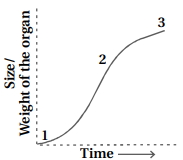
In the figure of the sigmoid growth curve given below,label segments $1$,$2$,and $3$.
Solution
(N/A) The sigmoid growth curve represents the growth of an organism or organ over time. The segments are labeled as follows:
$(1)$ Lag phase: This is the initial phase where growth is slow as the organism or cells are adjusting to the environment.
$(2)$ Exponential phase (or Log phase): This is the phase of rapid growth where the rate of growth increases significantly.
$(3)$ Stationary phase: This is the final phase where the growth rate slows down and eventually levels off due to limited resources or other environmental factors.
$(1)$ Lag phase: This is the initial phase where growth is slow as the organism or cells are adjusting to the environment.
$(2)$ Exponential phase (or Log phase): This is the phase of rapid growth where the rate of growth increases significantly.
$(3)$ Stationary phase: This is the final phase where the growth rate slows down and eventually levels off due to limited resources or other environmental factors.
0 likes
View Solution210
MediumMCQ
In $......$,growth occurs throughout life,whereas in $......$,growth is observed only up to a certain age.
A
Plants,Animals
B
Animals,Plants
C
Fungi,Blue-green algae
D
Blue-green algae,Fungi
Solution
(A) In living organisms,growth is a characteristic feature.
In plants,cell division occurs continuously throughout their lifespan,which means they exhibit indeterminate growth.
In contrast,animals exhibit determinate growth,where growth occurs only up to a certain age.
Therefore,the correct sequence is Plants and Animals.
In plants,cell division occurs continuously throughout their lifespan,which means they exhibit indeterminate growth.
In contrast,animals exhibit determinate growth,where growth occurs only up to a certain age.
Therefore,the correct sequence is Plants and Animals.
0 likes
View Solution211
MediumMCQ
The first step in the process of plant growth is $.......$.
A
Flowering
B
Seed germination
C
Leaf formation
D
All of the above
Solution
(B) The process of plant growth begins with the germination of the seed.
Seed germination is the initial stage where the embryo inside the seed resumes metabolic activity and begins to grow into a new plant under favorable conditions.
Flowering and leaf formation are subsequent developmental stages that occur after the plant has established itself.
Seed germination is the initial stage where the embryo inside the seed resumes metabolic activity and begins to grow into a new plant under favorable conditions.
Flowering and leaf formation are subsequent developmental stages that occur after the plant has established itself.
0 likes
View Solution212
MediumMCQ
$A$ single cell in the root apical meristem of maize can give rise to more than $......$ new cells per hour.
A
$3,50,000$ or more
B
$17,500$ or more
C
$2,50,000$ or more
D
$7,500$ or more
Solution
(B) In the context of plant growth,specifically regarding the root apical meristem of maize $(Zea \ mays)$,it has been observed that a single cell can divide and produce more than $17,500$ new cells per hour. This high rate of cell division is characteristic of meristematic tissues,which are responsible for the continuous growth of the plant.
0 likes
View Solution213
MediumMCQ
In watermelon,cells can increase in size up to $...........$ times.
A
$17,500$
B
$3,50,000$
C
$7,500$
D
$1,50,000$
Solution
(B) According to the $NCERT$ textbook,growth is a fundamental characteristic of living organisms. In certain cases,such as the growth of cells in a watermelon,the cells can increase in size by up to $3,50,000$ times.
This massive increase in cell volume is a classic example of cell enlargement contributing to plant growth.
This massive increase in cell volume is a classic example of cell enlargement contributing to plant growth.
0 likes
View Solution214
MediumMCQ
Identify the types of growth shown in the given figure.
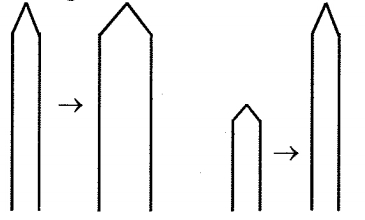
A
Secondary growth,Secondary growth
B
Secondary growth,Primary growth
C
Primary growth,Secondary growth
D
Primary growth,Primary growth
Solution
(C) In the given figure,the first part shows an increase in the length of the plant organ (like a stem or root),which is characteristic of primary growth. This occurs due to the activity of apical meristems.
The second part shows an increase in the thickness or girth of the plant organ,which is characteristic of secondary growth. This occurs due to the activity of lateral meristems (vascular cambium and cork cambium).
The second part shows an increase in the thickness or girth of the plant organ,which is characteristic of secondary growth. This occurs due to the activity of lateral meristems (vascular cambium and cork cambium).
0 likes
View Solution215
MediumMCQ
Identify the phases of growth in sequential order.
A
Meristematic phase $\rightarrow$ Elongation phase $\rightarrow$ Maturation phase
B
Maturation phase $\rightarrow$ Elongation phase $\rightarrow$ Meristematic phase
C
Elongation phase $\rightarrow$ Meristematic phase $\rightarrow$ Maturation phase
D
Maturation phase $\rightarrow$ Meristematic phase $\rightarrow$ Elongation phase
Solution
(A) The growth of a plant is divided into three distinct phases:
$1$. Meristematic phase: Cells in the root and shoot apices are constantly dividing.
$2$. Elongation phase: Cells proximal to the meristematic zone undergo enlargement,leading to increased cell size.
$3$. Maturation phase: Cells reach their maximum size in terms of wall thickening and protoplasmic modification,becoming specialized for specific functions.
Therefore,the correct sequence is Meristematic $\rightarrow$ Elongation $\rightarrow$ Maturation.
$1$. Meristematic phase: Cells in the root and shoot apices are constantly dividing.
$2$. Elongation phase: Cells proximal to the meristematic zone undergo enlargement,leading to increased cell size.
$3$. Maturation phase: Cells reach their maximum size in terms of wall thickening and protoplasmic modification,becoming specialized for specific functions.
Therefore,the correct sequence is Meristematic $\rightarrow$ Elongation $\rightarrow$ Maturation.
0 likes
View Solution216
MediumMCQ
Match the following columns regarding the parameters of growth:
| Column-$I$ (Structure for growth) | Column-$II$ (Parameter) |
| $P$. Maize root apical cell | $I$. Length |
| $Q$. Watermelon cell | $II$. Number |
| $R$. Pollen tube | $III$. Size |
| $S$. Dorsiventral leaf surface | $IV$. Surface area |
A
$(P-III), (Q-II), (R-I), (S-IV)$
B
$(P-II), (Q-III), (R-I), (S-IV)$
C
$(P-II), (Q-III), (R-IV), (S-I)$
D
$(P-I), (Q-II), (R-III), (S-IV)$
Solution
(B) The parameters of growth are measured by different criteria based on the biological structure:
$1$. Maize root apical cells increase in $Number$ $(P-II)$.
$2$. Watermelon cells increase in $Size$ $(Q-III)$.
$3$. Pollen tubes increase in $Length$ $(R-I)$.
$4$. Dorsiventral leaf surfaces increase in $Surface area$ $(S-IV)$.
Thus, the correct matching is $(P-II), (Q-III), (R-I), (S-IV)$.
$1$. Maize root apical cells increase in $Number$ $(P-II)$.
$2$. Watermelon cells increase in $Size$ $(Q-III)$.
$3$. Pollen tubes increase in $Length$ $(R-I)$.
$4$. Dorsiventral leaf surfaces increase in $Surface area$ $(S-IV)$.
Thus, the correct matching is $(P-II), (Q-III), (R-I), (S-IV)$.
0 likes
View Solution217
MediumMCQ
Select the correct option for the cells in the region of elongation.
A
Cells possess large vacuoles.
B
Cells increase in size.
C
Cells synthesize new cell walls.
D
All of the above.
Solution
(D) The region of elongation is characterized by increased vacuolation,cell enlargement,and new cell wall deposition. These processes are essential for the growth of the plant organ. Therefore,all the given options are correct.
0 likes
View Solution218
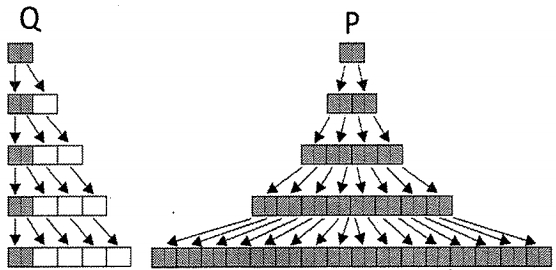
MediumMCQ
Identify the types of growth shown in the figure below.
A
Arithmetic growth and Geometric growth
B
Arithmetic growth and Arithmetic growth
C
Geometric growth and Arithmetic growth
D
Geometric growth and Geometric growth
Solution
(C) In the provided figure,$Q$ represents arithmetic growth,where only one daughter cell continues to divide while the other differentiates and matures. This results in a linear increase in growth.
$P$ represents geometric growth,where both daughter cells continue to divide,leading to an exponential increase in the number of cells.
$P$ represents geometric growth,where both daughter cells continue to divide,leading to an exponential increase in the number of cells.
0 likes
View Solution219
MediumMCQ
Arithmetic growth can be expressed as $......$ and geometric growth can be expressed as $......$.
A
$L_t = L_0 + rt, \quad W_1 = W_0 e^{rt}$
B
$W_1 = W_0 e^{rt}, \quad L_t = L_0 + rt$
C
$W_1 = W_0 e^{rt}, \quad L_0 = L_t + rt$
D
$L_0 = L_t + rt, \quad W_1 = W_0 e^{rt}$
Solution
(A) In arithmetic growth,the rate of growth is constant,and it is expressed as $L_t = L_0 + rt$,where $L_t$ is the length at time $t$,$L_0$ is the length at time $0$,$r$ is the growth rate,and $t$ is the time.
In geometric growth,both offspring cells retain the ability to divide,leading to an exponential increase in growth,expressed as $W_1 = W_0 e^{rt}$,where $W_1$ is the final size,$W_0$ is the initial size,$r$ is the relative growth rate,$t$ is the time,and $e$ is the base of natural logarithms.
In geometric growth,both offspring cells retain the ability to divide,leading to an exponential increase in growth,expressed as $W_1 = W_0 e^{rt}$,where $W_1$ is the final size,$W_0$ is the initial size,$r$ is the relative growth rate,$t$ is the time,and $e$ is the base of natural logarithms.
0 likes
View Solution220
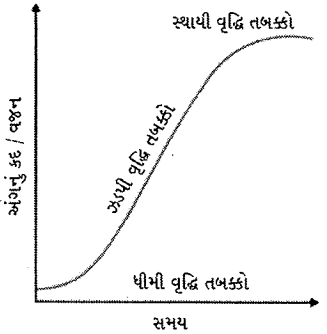
MediumMCQ
The graph of organ size/weight versus time for the given growth shows a sigmoid curve.
A
Geometric growth
B
Arithmetic growth
C
Both
D
None of these
Solution
(A) Geometric growth is characterized by a sigmoid or $S$-shaped curve when plotting the size or weight of an organ against time.
This growth pattern includes a lag phase (slow growth),an exponential or log phase (rapid growth),and a stationary phase (growth slows down and stops).
Arithmetic growth,on the other hand,produces a linear graph when plotting size against time.
This growth pattern includes a lag phase (slow growth),an exponential or log phase (rapid growth),and a stationary phase (growth slows down and stops).
Arithmetic growth,on the other hand,produces a linear graph when plotting size against time.
0 likes
View Solution221
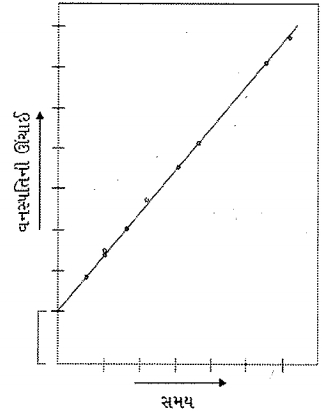
MediumMCQ
The given graph of length versus time shows a linear curve for which type of growth?
A
Geometric growth
B
Arithmetic growth
C
Both
D
None of these
Solution
(B) In arithmetic growth,only one daughter cell continues to divide while the other differentiates and matures. The mathematical expression for this is $L_t = L_0 + rt$,where $L_t$ is length at time $t$,$L_0$ is length at time zero,and $r$ is the growth rate. This equation represents a linear relationship,resulting in a straight-line graph when length is plotted against time.
0 likes
View Solution222
MediumMCQ
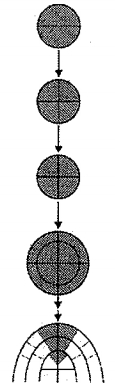
Which type of growth is shown in the given figure?
A
Arithmetic growth
B
Geometric growth
C
Both
D
None of these
Solution
(B) The figure illustrates geometric growth. In geometric growth,all cells or progeny of the mitotic division retain the ability to divide and continue to do so. As a result,the number of cells increases exponentially,which is characteristic of early embryonic development and growth in many plant tissues.
0 likes
View Solution223
MediumMCQ
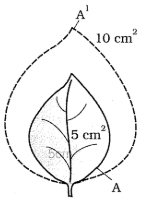
Select the correct option for the absolute growth and relative growth of the leaf shown below.
A
$50 \% \quad 5 \, cm^2$
B
$5 \, cm^2 \quad 50 \%$
C
$100 \% \quad 5 \, cm^2$
D
$5 \, cm^2 \quad 100 \%$
Solution
(D) Absolute growth is the total growth of a system per unit time. Here,the leaf grows from $5 \, cm^2$ to $10 \, cm^2$,so the absolute growth is $10 \, cm^2 - 5 \, cm^2 = 5 \, cm^2$.
Relative growth is the growth per unit time expressed on a common basis (initial size). It is calculated as: $\text{Relative growth} = \frac{\text{Absolute growth}}{\text{Initial size}} \times 100$.
Relative growth = $\frac{5 \, cm^2}{5 \, cm^2} \times 100 = 100 \%$.
Therefore,the absolute growth is $5 \, cm^2$ and the relative growth is $100 \%$.
Relative growth is the growth per unit time expressed on a common basis (initial size). It is calculated as: $\text{Relative growth} = \frac{\text{Absolute growth}}{\text{Initial size}} \times 100$.
Relative growth = $\frac{5 \, cm^2}{5 \, cm^2} \times 100 = 100 \%$.
Therefore,the absolute growth is $5 \, cm^2$ and the relative growth is $100 \%$.
0 likes
View Solution224
MediumMCQ
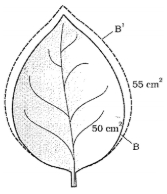
Select the correct option for the absolute growth and relative growth of the leaf shown below.
A
$110 \% \quad 5 \, cm^2$
B
$5 \, cm^2 \quad 10 \%$
C
$10 \% \quad 5 \, cm^2$
D
$5 \, cm^2 \quad 110 \%$
Solution
(B) Absolute growth is the total growth of a system per unit time. Here,the initial area is $50 \, cm^2$ and the final area is $55 \, cm^2$.
Absolute growth = $55 \, cm^2 - 50 \, cm^2 = 5 \, cm^2$.
Relative growth is the growth per unit time expressed on a common basis (initial size).
Relative growth = $\frac{\text{Absolute growth}}{\text{Initial size}} \times 100 = \frac{5 \, cm^2}{50 \, cm^2} \times 100 = 10 \%$.
Therefore,the absolute growth is $5 \, cm^2$ and the relative growth is $10 \%$.
Absolute growth = $55 \, cm^2 - 50 \, cm^2 = 5 \, cm^2$.
Relative growth is the growth per unit time expressed on a common basis (initial size).
Relative growth = $\frac{\text{Absolute growth}}{\text{Initial size}} \times 100 = \frac{5 \, cm^2}{50 \, cm^2} \times 100 = 10 \%$.
Therefore,the absolute growth is $5 \, cm^2$ and the relative growth is $10 \%$.
0 likes
View Solution225
MediumMCQ
Which of the following factors are essential for growth?
$I-$ Water,$II-$ Oxygen,$III-$ Nutrients,$IV-$ Temperature,$V-$ Light,$VI-$ Gravity
$I-$ Water,$II-$ Oxygen,$III-$ Nutrients,$IV-$ Temperature,$V-$ Light,$VI-$ Gravity
A
$I, II, IV, V$
B
$I, II, IV, V$
C
$I, II, III, IV, V, VI$
D
$I, III, V, VI$
Solution
(C) Plant growth is a complex process that requires a variety of environmental and internal factors to occur effectively.
$1.$ Water: Essential for cell enlargement,turgidity,and as a medium for enzymatic activities.
$2.$ Oxygen: Required for aerobic respiration,which provides the energy $(ATP)$ needed for growth.
$3.$ Nutrients: Macro and micronutrients are necessary for the synthesis of protoplasm and structural components.
$4.$ Temperature: Enzymes involved in metabolic processes have optimal temperature ranges for activity.
$5.$ Light: Crucial for photosynthesis (in green plants) and photomorphogenesis.
$6.$ Gravity: Influences the direction of growth (gravitropism) in roots and shoots.
Therefore,all the listed factors $(I, II, III, IV, V, VI)$ are essential for the growth and development of plants.
$1.$ Water: Essential for cell enlargement,turgidity,and as a medium for enzymatic activities.
$2.$ Oxygen: Required for aerobic respiration,which provides the energy $(ATP)$ needed for growth.
$3.$ Nutrients: Macro and micronutrients are necessary for the synthesis of protoplasm and structural components.
$4.$ Temperature: Enzymes involved in metabolic processes have optimal temperature ranges for activity.
$5.$ Light: Crucial for photosynthesis (in green plants) and photomorphogenesis.
$6.$ Gravity: Influences the direction of growth (gravitropism) in roots and shoots.
Therefore,all the listed factors $(I, II, III, IV, V, VI)$ are essential for the growth and development of plants.
0 likes
View Solution226
MediumMCQ
Growth of pollen tube can be measured in terms of $:-$
A
Increase in volume
B
Increase in surface area
C
Increase in length
D
Increase in cell number
Solution
(C) Growth is defined as an irreversible permanent increase in size of an organ or its parts or even of an individual cell.
In the case of a pollen tube,growth is characterized by the elongation of the tube as it travels through the style towards the ovary.
Therefore,the growth of the pollen tube is primarily measured in terms of its increase in length.
In the case of a pollen tube,growth is characterized by the elongation of the tube as it travels through the style towards the ovary.
Therefore,the growth of the pollen tube is primarily measured in terms of its increase in length.
0 likes
View Solution227
MediumMCQ
Which one is the correct graph for arithmetic growth?
A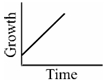
B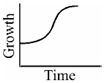
C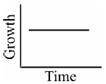
D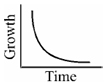
Solution
(A) In arithmetic growth,only one daughter cell continues to divide while the other differentiates and matures. The mathematical expression for arithmetic growth is $L_t = L_0 + rt$,where $L_t$ is the length at time $t$,$L_0$ is the length at time $0$,and $r$ is the growth rate/elongation per unit time. This equation represents a linear relationship between growth $(L_t)$ and time $(t)$. Therefore,when plotting growth against time,it results in a linear graph.
0 likes
View Solution228
MediumMCQ
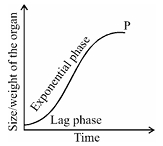
What is $P$ in the given curve?
A
$P=$ Lag phase
B
$P=$ Log phase
C
$P=$ Exponential phase
D
$P=$ Stationary phase
Solution
(D) The given curve represents a sigmoid growth curve,which is characteristic of growth in many biological systems.
It consists of three distinct phases:
$1$. Lag phase: The initial phase where growth is slow.
$2$. Exponential (or Log) phase: The phase where growth is rapid.
$3$. Stationary phase: The final phase where growth slows down and eventually levels off as resources become limited.
In the provided diagram,$P$ represents the final plateau region where the growth rate decreases and stabilizes,which is known as the stationary phase.
It consists of three distinct phases:
$1$. Lag phase: The initial phase where growth is slow.
$2$. Exponential (or Log) phase: The phase where growth is rapid.
$3$. Stationary phase: The final phase where growth slows down and eventually levels off as resources become limited.
In the provided diagram,$P$ represents the final plateau region where the growth rate decreases and stabilizes,which is known as the stationary phase.
0 likes
View Solution229
MediumMCQ
The exponential growth can be expressed as $w_1 = w_0 \cdot e^{rt}$. Identify $r$ in the given equation :
A
Relative Growth Rate
B
Ability of plant to produce new plant material.
C
Efficiency index.
D
All of the above.
Solution
(D) In the exponential growth equation $w_1 = w_0 \cdot e^{rt}$,the term $r$ represents the growth rate.
It is defined as the relative growth rate because it measures the growth of the plant per unit time relative to the initial size.
It also indicates the ability of the plant to produce new plant material,which is why it is often referred to as the efficiency index.
Since all three descriptions ($A$,$B$,and $C$) correctly define $r$,the correct option is $D$.
It is defined as the relative growth rate because it measures the growth of the plant per unit time relative to the initial size.
It also indicates the ability of the plant to produce new plant material,which is why it is often referred to as the efficiency index.
Since all three descriptions ($A$,$B$,and $C$) correctly define $r$,the correct option is $D$.
0 likes
View Solution230
DifficultMCQ
Elongation of roots:
$a.$ Occurs at a constant rate
$b.$ Can be expressed by equation $W_t = W_0 e^{rt}$
$c.$ Shows arithmetic growth pattern
$a.$ Occurs at a constant rate
$b.$ Can be expressed by equation $W_t = W_0 e^{rt}$
$c.$ Shows arithmetic growth pattern
A
Only $a$ is true
B
Both $a$ & $b$ are true
C
Only $b$ is true
D
Both $a$ & $c$ are true
Solution
(D) Root elongation typically follows an arithmetic growth pattern,where the growth rate is constant over time.
In arithmetic growth,the mathematical expression is $L_t = L_0 + rt$,where $L_t$ is the length at time $t$,$L_0$ is the initial length,and $r$ is the growth rate.
Statement $a$ is true because the rate of elongation is constant.
Statement $c$ is true because root elongation is a classic example of arithmetic growth.
Statement $b$ is false because the equation $W_t = W_0 e^{rt}$ represents geometric (exponential) growth,which is characteristic of cell division,not the linear elongation of roots.
Therefore,both $a$ and $c$ are true.
In arithmetic growth,the mathematical expression is $L_t = L_0 + rt$,where $L_t$ is the length at time $t$,$L_0$ is the initial length,and $r$ is the growth rate.
Statement $a$ is true because the rate of elongation is constant.
Statement $c$ is true because root elongation is a classic example of arithmetic growth.
Statement $b$ is false because the equation $W_t = W_0 e^{rt}$ represents geometric (exponential) growth,which is characteristic of cell division,not the linear elongation of roots.
Therefore,both $a$ and $c$ are true.
0 likes
View Solution231
EasyMCQ
During the phase of cell enlargement in plant growth,solute concentration favours . . . . . . .
A
endosmosis
B
plasmolysis
C
imbibition
D
exosmosis
Solution
(A) During the phase of cell enlargement,the plant cell needs to increase its volume and turgor pressure.
To achieve this,the cell accumulates solutes (such as sugars and ions) in its vacuole.
This increase in solute concentration lowers the water potential inside the cell,which creates a gradient that favours the movement of water into the cell from the surrounding environment.
This process of water moving into the cell is known as endosmosis.
Consequently,the increased turgor pressure helps in the expansion and enlargement of the cell wall.
To achieve this,the cell accumulates solutes (such as sugars and ions) in its vacuole.
This increase in solute concentration lowers the water potential inside the cell,which creates a gradient that favours the movement of water into the cell from the surrounding environment.
This process of water moving into the cell is known as endosmosis.
Consequently,the increased turgor pressure helps in the expansion and enlargement of the cell wall.
0 likes
View Solution232
EasyMCQ
The efficiency index of growth in plants represents . . . . . . .
A
total increase in growth per unit time
B
the increase in number of cells only
C
growth of a particular system only
D
permanent change in the structure of cells only
Solution
(A) The efficiency index of growth in plants is a measure of the ability of a plant or its parts to produce new plant material.
It is defined as the ratio of the final size to the initial size of the plant or its parts.
Mathematically,it is expressed as the rate of growth per unit initial parameter.
Therefore,it represents the total increase in growth per unit time relative to the initial amount of growth material.
It is defined as the ratio of the final size to the initial size of the plant or its parts.
Mathematically,it is expressed as the rate of growth per unit initial parameter.
Therefore,it represents the total increase in growth per unit time relative to the initial amount of growth material.
0 likes
View Solution233
EasyMCQ
Arithmetic growth can be expressed mathematically by the formula $L_t = L_0 + rt$,where $L_t$ stands for . . . . . . .
A
time of growth
B
growth rate
C
length at time 'zero'
D
length at time 't'
Solution
(D) In the formula $L_t = L_0 + rt$:
$L_t$ represents the length at time '$t$'.
$L_0$ represents the length at time 'zero'.
$r$ represents the growth rate.
$t$ represents the time of growth.
$L_t$ represents the length at time '$t$'.
$L_0$ represents the length at time 'zero'.
$r$ represents the growth rate.
$t$ represents the time of growth.
0 likes
View Solution234
EasyMCQ
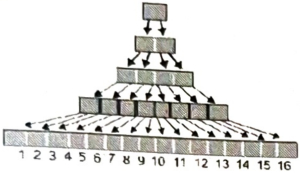
In geometric growth,the total number of cells produced after four successive mitotic divisions will be . . . . . .
A
$2$
B
$4$
C
$12$
D
$16$
Solution
(D) In geometric growth,each cell divides mitotically into two daughter cells. Both daughter cells continue to divide and redivide repeatedly.
Following the formula $2^n$,where $n$ is the number of mitotic divisions:
- After $1$ mitotic division: $2^1 = 2$ cells.
- After $2$ mitotic divisions: $2^2 = 4$ cells.
- After $3$ mitotic divisions: $2^3 = 8$ cells.
- After $4$ mitotic divisions: $2^4 = 16$ cells.
Therefore,after four successive mitotic divisions,$16$ cells will be produced.
Following the formula $2^n$,where $n$ is the number of mitotic divisions:
- After $1$ mitotic division: $2^1 = 2$ cells.
- After $2$ mitotic divisions: $2^2 = 4$ cells.
- After $3$ mitotic divisions: $2^3 = 8$ cells.
- After $4$ mitotic divisions: $2^4 = 16$ cells.
Therefore,after four successive mitotic divisions,$16$ cells will be produced.
0 likes
View Solution235
EasyMCQ
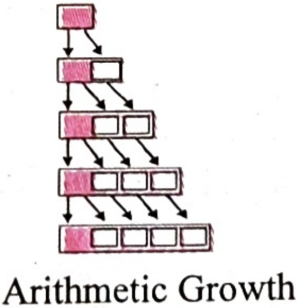
After four successive mitotic divisions of a cell,in an arithmetic growth pattern,the total number of cells that have lost the ability of cell division is . . . . . . .
A
$1$
B
$2$
C
$3$
D
$4$
Solution
(D) In arithmetic growth,the rate of growth is constant.
After each mitotic division,one daughter cell remains meristematic (continues to divide),while the other daughter cell undergoes differentiation and maturation,thereby losing its ability to divide.
Therefore,after $1$st division,$1$ cell differentiates.
After $2$nd division,another $1$ cell differentiates (total $2$).
After $3$rd division,another $1$ cell differentiates (total $3$).
After $4$th division,another $1$ cell differentiates (total $4$).
Thus,after $4$ successive mitotic divisions,the total number of cells that have lost the ability of cell division is $4$.
After each mitotic division,one daughter cell remains meristematic (continues to divide),while the other daughter cell undergoes differentiation and maturation,thereby losing its ability to divide.
Therefore,after $1$st division,$1$ cell differentiates.
After $2$nd division,another $1$ cell differentiates (total $2$).
After $3$rd division,another $1$ cell differentiates (total $3$).
After $4$th division,another $1$ cell differentiates (total $4$).
Thus,after $4$ successive mitotic divisions,the total number of cells that have lost the ability of cell division is $4$.
0 likes
View Solution236
EasyMCQ
Which of the following statements are correct regarding the conditions necessary for plant growth?
i. Microelements and macroelements are required for the proper growth of the plant.
ii. For proper growth of plant,optimum temperature ranges between $15^{\circ} C-25^{\circ} C$.
iii. In the absence of oxygen,the process of respiration and release of energy takes place in all plants.
iv. Gravitational force decides the direction of growth of the shoot and root.
v. Light is essential for the germination of some seeds and photosynthesis.
i. Microelements and macroelements are required for the proper growth of the plant.
ii. For proper growth of plant,optimum temperature ranges between $15^{\circ} C-25^{\circ} C$.
iii. In the absence of oxygen,the process of respiration and release of energy takes place in all plants.
iv. Gravitational force decides the direction of growth of the shoot and root.
v. Light is essential for the germination of some seeds and photosynthesis.
A
i,ii and iii only
B
ii,iii and iv only
C
i,ii,iii and iv only
D
i,iv and v only
Solution
(D) Statement $i$ is correct: Plants require both macroelements and microelements for essential metabolic activities and growth.
Statement $ii$ is incorrect: The optimum temperature for the growth of most plants typically ranges between $25^{\circ} C$ and $35^{\circ} C$,not $15^{\circ} C-25^{\circ} C$.
Statement $iii$ is incorrect: Respiration is an oxygen-dependent process in aerobic plants; in the absence of oxygen,aerobic respiration cannot occur,and energy release is severely limited.
Statement $iv$ is correct: Gravitropism (or geotropism) is the growth of plant parts in response to gravity,determining the downward growth of roots and upward growth of shoots.
Statement $v$ is correct: Light is a critical factor for photosynthesis and acts as a signal for the germination of photoblastic seeds.
Therefore,statements $i, iv,$ and $v$ are correct.
Statement $ii$ is incorrect: The optimum temperature for the growth of most plants typically ranges between $25^{\circ} C$ and $35^{\circ} C$,not $15^{\circ} C-25^{\circ} C$.
Statement $iii$ is incorrect: Respiration is an oxygen-dependent process in aerobic plants; in the absence of oxygen,aerobic respiration cannot occur,and energy release is severely limited.
Statement $iv$ is correct: Gravitropism (or geotropism) is the growth of plant parts in response to gravity,determining the downward growth of roots and upward growth of shoots.
Statement $v$ is correct: Light is a critical factor for photosynthesis and acts as a signal for the germination of photoblastic seeds.
Therefore,statements $i, iv,$ and $v$ are correct.
0 likes
View Solution237
EasyMCQ
If the leaf '$X$' grows from $50 \ cm^2$ to $100 \ cm^2$ in a day and another leaf '$Y$' grows from $50 \ cm^2$ to $55 \ cm^2$ in a day,then Relative Growth Rate $(RGR)$ of leaf $X$ and $Y$ respectively will be . . . . . . $\%$ and . . . . . . $\%$.
A
$25$ and $50$
B
$50$ and $55$
C
$50$ and $100$
D
$100$ and $10$
Solution
(D) The Relative Growth Rate $(RGR)$ is calculated as the ratio of growth per unit time to the initial size,expressed as a percentage.
Formula: $RGR = \frac{\text{Final Size} - \text{Initial Size}}{\text{Initial Size}} \times 100$.
For leaf $X$: Initial size = $50 \ cm^2$,Final size = $100 \ cm^2$. $RGR = \frac{100 - 50}{50} \times 100 = \frac{50}{50} \times 100 = 100\%$.
For leaf $Y$: Initial size = $50 \ cm^2$,Final size = $55 \ cm^2$. $RGR = \frac{55 - 50}{50} \times 100 = \frac{5}{50} \times 100 = 10\%$.
Therefore,the $RGR$ of leaf $X$ and $Y$ are $100\%$ and $10\%$ respectively.
Formula: $RGR = \frac{\text{Final Size} - \text{Initial Size}}{\text{Initial Size}} \times 100$.
For leaf $X$: Initial size = $50 \ cm^2$,Final size = $100 \ cm^2$. $RGR = \frac{100 - 50}{50} \times 100 = \frac{50}{50} \times 100 = 100\%$.
For leaf $Y$: Initial size = $50 \ cm^2$,Final size = $55 \ cm^2$. $RGR = \frac{55 - 50}{50} \times 100 = \frac{5}{50} \times 100 = 10\%$.
Therefore,the $RGR$ of leaf $X$ and $Y$ are $100\%$ and $10\%$ respectively.
0 likes
View Solution238
EasyMCQ
Which one of the following occurs maximum during the exponential growth phase in plants?
A
Cell formation
B
Cell elongation
C
Cell differentiation
D
Cell dedifferentiation
Solution
(B) During the exponential growth phase,the rate of growth is maximum.
Cells produced by the meristematic phase absorb water,become turgid,and undergo rapid expansion.
This process involves the synthesis of new cell wall materials and protoplasm,which results in maximum cell elongation.
Cells produced by the meristematic phase absorb water,become turgid,and undergo rapid expansion.
This process involves the synthesis of new cell wall materials and protoplasm,which results in maximum cell elongation.
0 likes
View Solution239
EasyMCQ
Given below are two statements about plant growth.
Statement $I$: Curve for arithmetic growth is linear.
Statement $II$: Curve for geometric growth is exponential.
In the light of the above two statements,choose the most appropriate answer from the options given below.
Statement $I$: Curve for arithmetic growth is linear.
Statement $II$: Curve for geometric growth is exponential.
In the light of the above two statements,choose the most appropriate answer from the options given below.
A
Both statement $I$ and statement $II$ are correct.
B
Both statement $I$ and statement $II$ are incorrect.
C
Statement $I$ is correct but statement $II$ is incorrect.
D
Statement $I$ is incorrect but statement $II$ is correct.
Solution
(A) In arithmetic growth,only one daughter cell continues to divide while the other differentiates and matures. The mathematical expression is $L_t = L_0 + rt$,which represents a linear growth curve.
In geometric growth,both daughter cells resulting from mitosis continue to divide. This leads to an exponential increase in the number of cells,represented by the formula $W_1 = W_0 e^{rt}$,which results in a sigmoid or exponential curve.
Therefore,both Statement $I$ and Statement $II$ are correct.
In geometric growth,both daughter cells resulting from mitosis continue to divide. This leads to an exponential increase in the number of cells,represented by the formula $W_1 = W_0 e^{rt}$,which results in a sigmoid or exponential curve.
Therefore,both Statement $I$ and Statement $II$ are correct.
0 likes
View Solution240
EasyMCQ
The term "Grand period of growth" was given by
A
Sachs
B
$F.W. Went$
C
Gane
D
Kurosawa
Solution
(A) The term "Grand period of growth" was coined by Julius von Sachs.
It refers to the total time period during which the maximum rate of growth occurs, encompassing all phases of growth from initiation to maturation.
It refers to the total time period during which the maximum rate of growth occurs, encompassing all phases of growth from initiation to maturation.
0 likes
View Solution241
EasyMCQ
Which part of the plant shows determinate growth?
A
Root
B
Branches
C
Stem
D
Fruit
Solution
(D) Determinate growth refers to growth that stops after a certain size or stage is reached.
In plants,vegetative structures like roots,stems,and branches exhibit indeterminate growth because they possess meristems that allow for continuous growth throughout the life of the plant.
In contrast,reproductive structures like flowers and fruits exhibit determinate growth,as they grow to a specific size and then stop growing or mature.
Therefore,among the given options,the fruit is the correct answer.
In plants,vegetative structures like roots,stems,and branches exhibit indeterminate growth because they possess meristems that allow for continuous growth throughout the life of the plant.
In contrast,reproductive structures like flowers and fruits exhibit determinate growth,as they grow to a specific size and then stop growing or mature.
Therefore,among the given options,the fruit is the correct answer.
0 likes
View Solution242
EasyMCQ
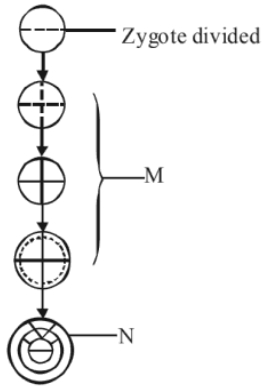
In the following diagrammatic representation showing stages of embryonic development,identify the type of growth phase labelled as $M$ and $N$.
A
$M$ is geometric phase and $N$ is arithmetic phase.
B
Both $M$ and $N$ are arithmetic phases.
C
$M$ is arithmetic phase and $N$ is geometric phase.
D
Both $M$ and $N$ are geometric phases.
Solution
(A) In the provided diagram,the phase labelled as $M$ represents the geometric phase of growth. In this phase,both daughter cells resulting from mitosis retain the ability to divide and continue to do so,leading to an exponential increase in cell number.
The phase labelled as $N$ represents the arithmetic phase of growth. In this phase,following mitotic cell division,only one daughter cell continues to divide while the other differentiates and matures,resulting in a linear increase in cell number.
The phase labelled as $N$ represents the arithmetic phase of growth. In this phase,following mitotic cell division,only one daughter cell continues to divide while the other differentiates and matures,resulting in a linear increase in cell number.
0 likes
View Solution243
MediumMCQ
Which one of the following is not a characteristic of plant cells in the phase of elongation?
A
New cell wall deposition
B
Cell enlargement
C
Large conspicuous nuclei
D
Increased vacuolation
Solution
(C) During the elongation phase of plant growth,cells undergo significant enlargement,increased vacuolation,and new cell wall deposition. As the vacuole grows in size,the cytoplasm is pushed towards the periphery,causing the nucleus to become peripheral and less conspicuous. Therefore,having large,conspicuous nuclei is not a characteristic of cells in the elongation phase.
0 likes
View SolutionPlant Growth and Development — Growth · Frequently Asked Questions
1Are these Plant Growth and Development questions useful for JEE and NEET?
Yes. All questions in this section are mapped to JEE Main and NEET exam patterns. Previous year questions from JEE Main, NEET, GUJCET and state-level exams are included with full solutions.
2Can I switch to Hindi or Gujarati for these questions?
Yes. Use the language tabs in the hero section or the sidebar to view the same questions and solutions in English, Hindi or Gujarati.
3How do I generate a question paper from this subtopic?
Use the Vedclass Exam Paper Generator — select the chapter and subtopic, set difficulty, and generate Sets A, B, C, D automatically. First 3 chapters of every subject are free.
Vedclass Products
For Students
Vedclass Test Series
Mock tests in real JEE/NEET style with performance analysis. 5-day free trial.
Start Free TrialFor Teachers
Exam Paper Generator
Generate Set A/B/C/D papers from this chapter in 2 minutes. 3 chapters free.
Try FreeFor Institutes
Online Exam Module
Live online exams with unlimited students, 360° analytics & white-label branding.
See DemoFor Teachers & Institutes
Generate a Plant Growth and Development Exam Paper in 2 Minutes
Select subtopic & difficulty — Sets A, B, C, D auto-generated with No Repeat logic.
First 3 chapters of every subject are free — no payment required.