
A English
Growth Questions in English
Class 11 Biology · Plant Growth and Development · Growth
243+
Questions
English
Language
100%
With Solutions
Showing 50 of 243 questions in English
101
MediumMCQ
Which of the following is a characteristic of cells in the meristematic phase of growth?
A
Small vacuoles
B
Cell wall deposition
C
Rich in protoplasm
D
Dead cells
Solution
(C) The meristematic phase of growth is characterized by cells that are actively dividing.
These cells possess specific features:
$1$. They have a large,conspicuous nucleus.
$2$. They are rich in protoplasm.
$3$. They have thin,cellulosic cell walls with abundant plasmodesmatal connections.
$4$. They typically have very small or no vacuoles.
Therefore,being rich in protoplasm is a key characteristic of cells in this phase.
These cells possess specific features:
$1$. They have a large,conspicuous nucleus.
$2$. They are rich in protoplasm.
$3$. They have thin,cellulosic cell walls with abundant plasmodesmatal connections.
$4$. They typically have very small or no vacuoles.
Therefore,being rich in protoplasm is a key characteristic of cells in this phase.
0 likes
View Solution102
MediumMCQ
In the exponential growth equation $W_1 = W_0 e^{rt}$,what does $r$ represent?
A
Growth rate
B
Time of growth
C
Initial size at the beginning of the period
D
Final size
Solution
(A) The exponential growth equation is given by $W_1 = W_0 e^{rt}$.
Here,$W_1$ represents the final size at time $t$.
$W_0$ represents the initial size at the beginning of the period.
$r$ represents the growth rate.
$t$ represents the time of growth.
$e$ represents the base of natural logarithms.
Therefore,$r$ is the growth rate.
Here,$W_1$ represents the final size at time $t$.
$W_0$ represents the initial size at the beginning of the period.
$r$ represents the growth rate.
$t$ represents the time of growth.
$e$ represents the base of natural logarithms.
Therefore,$r$ is the growth rate.
0 likes
View Solution103
MediumMCQ
Match the following (Condition for growth):
| $P$ | $Q$ |
| $1.$ Nutrients (Macro and Micro) | $a.$ Medium for enzymatic activities |
| $2.$ Oxygen | $b.$ Synthesis of protoplasm and act as a source of energy |
| $3.$ Water | $c.$ Releasing metabolic energy for growth activities |
A
$1-b, 2-a, 3-c$
B
$1-c, 2-b, 3-a$
C
$1-a, 2-b, 3-c$
D
$1-b, 2-c, 3-a$
Solution
(D) The conditions for plant growth are as follows:
$1$. Nutrients (Macro and Micro): These are essential for the synthesis of protoplasm and act as a source of energy for the plant $(1-b)$.
$2$. Oxygen: It is required for aerobic respiration,which releases metabolic energy necessary for various growth activities $(2-c)$.
$3$. Water: It provides the medium for enzymatic activities and maintains cell turgidity,which is essential for cell enlargement $(3-a)$.
Therefore,the correct matching is $1-b, 2-c, 3-a$.
$1$. Nutrients (Macro and Micro): These are essential for the synthesis of protoplasm and act as a source of energy for the plant $(1-b)$.
$2$. Oxygen: It is required for aerobic respiration,which releases metabolic energy necessary for various growth activities $(2-c)$.
$3$. Water: It provides the medium for enzymatic activities and maintains cell turgidity,which is essential for cell enlargement $(3-a)$.
Therefore,the correct matching is $1-b, 2-c, 3-a$.
0 likes
View Solution104
MediumMCQ
Plant growth is unique because
A
Plants retain the capacity for unlimited growth throughout their life.
B
Plants retain the capacity for limited growth.
C
Plants have less growth that differs from animals.
D
Plant growth is seen only in the juvenile phase.
Solution
(A) Plant growth is unique because plants retain the capacity for unlimited growth throughout their life. This is due to the presence of meristems at certain locations in the plant body. Meristems are regions where cells have the capacity to divide and self-perpetuate. This type of growth,where new cells are always being added to the plant body by the activity of the meristem,is called open form of growth.
0 likes
View Solution105
MediumMCQ
Growth at the cellular level is the increase in the amount of:
A
Cell wall
B
Cell membrane
C
Protoplasm
D
Nucleus
Solution
(C) Growth is defined as an irreversible permanent increase in the size of an organ or its parts or even of an individual cell. At the cellular level,growth is primarily the result of an increase in the amount of protoplasm. Protoplasm includes the cytoplasm and the nucleus,and its accumulation is essential for cell division and enlargement.
0 likes
View Solution106
MediumMCQ
Growth in plants is measured by the increase in
$I.$ Fresh weight. $II.$ Dry weight
$III.$ Length,area and volume $IV.$ Cell number
Choose the correct option.
$I.$ Fresh weight. $II.$ Dry weight
$III.$ Length,area and volume $IV.$ Cell number
Choose the correct option.
A
All except $I$ and $II$
B
All except $III$
C
All except $IV$
D
$I, II, III$ and $IV$
Solution
(D) Growth in plants is an irreversible,permanent increase in size,which can be measured by various parameters.
These parameters include:
$I.$ Fresh weight: An increase in fresh weight is a common measure of growth.
$II.$ Dry weight: An increase in dry weight is considered a more reliable measure of growth as it excludes water content.
$III.$ Length,area,and volume: These are standard morphological measurements of growth.
$IV.$ Cell number: Growth can also be measured by the increase in the number of cells due to cell division.
Since all these parameters are valid indicators of plant growth,the correct option is $I, II, III$ and $IV$.
These parameters include:
$I.$ Fresh weight: An increase in fresh weight is a common measure of growth.
$II.$ Dry weight: An increase in dry weight is considered a more reliable measure of growth as it excludes water content.
$III.$ Length,area,and volume: These are standard morphological measurements of growth.
$IV.$ Cell number: Growth can also be measured by the increase in the number of cells due to cell division.
Since all these parameters are valid indicators of plant growth,the correct option is $I, II, III$ and $IV$.
0 likes
View Solution107
MediumMCQ
The growth period of a plant is generally divided into how many phases?
A
Four phases
B
Three phases
C
Two phases
D
Five phases
Solution
(B) The growth period of a plant is generally divided into $3$ distinct phases based on the rate of growth:
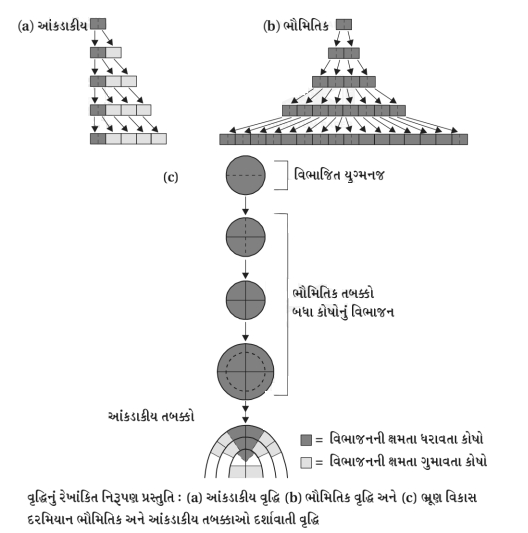
$1$. The phase of cell division (meristematic phase): In this phase,cells are constantly dividing.
$2$. The phase of cell enlargement (elongation phase): In this phase,cells increase in size due to water uptake and cell wall expansion.
$3$. The phase of cell maturation (maturation phase): In this phase,cells differentiate and attain their final form and function.
$1$. The phase of cell division (meristematic phase): In this phase,cells are constantly dividing.
$2$. The phase of cell enlargement (elongation phase): In this phase,cells increase in size due to water uptake and cell wall expansion.
$3$. The phase of cell maturation (maturation phase): In this phase,cells differentiate and attain their final form and function.
0 likes
View Solution108
MediumMCQ
Constantly dividing cells,both at the root apex and shoot apex,represent:
A
Elongation phase of growth
B
Meristematic phase of growth
C
Maturation phase of growth
D
Base of natural logarithms
Solution
(B) The growth of a plant is divided into three phases: the meristematic phase,the elongation phase,and the maturation phase.
$1$. The meristematic phase involves cells at the root apex and shoot apex that are constantly dividing.
$2$. The elongation phase is characterized by increased vacuolation,cell enlargement,and new cell wall deposition.
$3$. The maturation phase involves cells attaining their maximal size in terms of wall thickening and protoplasmic modifications.
Therefore,the constant division of cells at the root and shoot apices represents the meristematic phase of growth.
$1$. The meristematic phase involves cells at the root apex and shoot apex that are constantly dividing.
$2$. The elongation phase is characterized by increased vacuolation,cell enlargement,and new cell wall deposition.
$3$. The maturation phase involves cells attaining their maximal size in terms of wall thickening and protoplasmic modifications.
Therefore,the constant division of cells at the root and shoot apices represents the meristematic phase of growth.
0 likes
View Solution109
MediumMCQ
In geometrical growth,the lag phase is represented by:
A
Initial rapid growth
B
Latter rapid growth
C
Initial slow growth
D
Latter slow growth
Solution
(C) In geometrical growth,the growth pattern follows an $S$-shaped or sigmoid curve.
$1$. The $lag$ phase is the initial phase where the growth rate is very slow because the cells are preparing for division.
$2$. The $log$ or $exponential$ phase follows,where growth is rapid.
$3$. The $stationary$ phase is the final phase where growth slows down due to limited resources.
Therefore,the $lag$ phase represents the initial slow growth.
$1$. The $lag$ phase is the initial phase where the growth rate is very slow because the cells are preparing for division.
$2$. The $log$ or $exponential$ phase follows,where growth is rapid.
$3$. The $stationary$ phase is the final phase where growth slows down due to limited resources.
Therefore,the $lag$ phase represents the initial slow growth.
0 likes
View Solution110
MediumMCQ
In the expression,$W_1 = W_0 e^{rt}$,what do $W_1, W_0, r,$ and $t$ represent?
A
$W_0 =$ Initial size,$W_1 =$ Final size,$r =$ Growth rate,$t =$ Time of growth
B
$W_0 =$ Final size,$W_1 =$ Initial size,$r =$ Growth rate,$t =$ Time of growth
C
$W_0 =$ Final size,$W_1 =$ Initial size,$r =$ Growth rate,$t =$ Time of dividing
D
$W_0 =$ Initial size,$W_1 =$ Final size,$r =$ Growth rate,$t =$ Time of dividing
Solution
(A) The expression $W_1 = W_0 e^{rt}$ represents the exponential growth of a plant or plant organ.
In this formula:
$W_1$ represents the final size (weight,height,or number) at time $t$.
$W_0$ represents the initial size at the beginning of the period.
$r$ represents the relative growth rate,which is the measure of the ability of the plant to produce new plant material.
$t$ represents the time of growth.
$e$ is the base of natural logarithms.
Therefore,the correct representation is $W_1 =$ Final size,$W_0 =$ Initial size,$r =$ Growth rate,and $t =$ Time of growth.
In this formula:
$W_1$ represents the final size (weight,height,or number) at time $t$.
$W_0$ represents the initial size at the beginning of the period.
$r$ represents the relative growth rate,which is the measure of the ability of the plant to produce new plant material.
$t$ represents the time of growth.
$e$ is the base of natural logarithms.
Therefore,the correct representation is $W_1 =$ Final size,$W_0 =$ Initial size,$r =$ Growth rate,and $t =$ Time of growth.
0 likes
View Solution111
MediumMCQ
Efficiency index in the exponential phase of geometrical growth is the ability of plants to produce.
A
Cell wall
B
New enzyme only
C
New plant material
D
Young ones through mitosis
Solution
(C) In the exponential phase of geometrical growth,the growth rate is proportional to the size of the plant or the amount of living material present.
The efficiency index is a measure of the ability of the plant to produce new plant material (biomass) per unit of existing material.
Mathematically,it is represented as $W_1 = W_0 e^{rt}$,where $W_1$ is the final size,$W_0$ is the initial size,$r$ is the growth rate (efficiency index),and $t$ is time.
Therefore,the correct option is $C$.
The efficiency index is a measure of the ability of the plant to produce new plant material (biomass) per unit of existing material.
Mathematically,it is represented as $W_1 = W_0 e^{rt}$,where $W_1$ is the final size,$W_0$ is the initial size,$r$ is the growth rate (efficiency index),and $t$ is time.
Therefore,the correct option is $C$.
0 likes
View Solution112
MediumMCQ
Which of the following is essential for plant growth?
A
$H_2O$
B
$O_2$
C
Nutrients
D
All of these
Solution
(D) Plant growth is a complex process that requires several environmental and internal factors.
$1$. $H_2O$ (Water) is essential for cell enlargement, maintaining turgidity, and as a medium for enzymatic reactions.
$2$. $O_2$ (Oxygen) is required for aerobic respiration, which provides the energy $(ATP)$ necessary for growth processes.
$3$. Nutrients (both macro and micro) are essential for the synthesis of protoplasm and various metabolic activities.
Since all these factors are necessary for the growth and development of a plant, the correct answer is $\text{All of these}$.
$1$. $H_2O$ (Water) is essential for cell enlargement, maintaining turgidity, and as a medium for enzymatic reactions.
$2$. $O_2$ (Oxygen) is required for aerobic respiration, which provides the energy $(ATP)$ necessary for growth processes.
$3$. Nutrients (both macro and micro) are essential for the synthesis of protoplasm and various metabolic activities.
Since all these factors are necessary for the growth and development of a plant, the correct answer is $\text{All of these}$.
0 likes
View Solution113
MediumMCQ
Typical growth curve in plants is
A
Linear
B
Stair-step shaped
C
Parabolic
D
Sigmoid
Solution
(D) The typical growth curve in plants,when plotted as the increase in size or weight against time,is $S$-shaped or $Sigmoid$.
This curve consists of three phases:
$1$. The $Lag$ phase,where growth is slow.
$2$. The $Log$ or $Exponential$ phase,where growth is rapid and at its maximum.
$3$. The $Stationary$ phase,where growth slows down and eventually stops due to limited resources or maturity.
This curve consists of three phases:
$1$. The $Lag$ phase,where growth is slow.
$2$. The $Log$ or $Exponential$ phase,where growth is rapid and at its maximum.
$3$. The $Stationary$ phase,where growth slows down and eventually stops due to limited resources or maturity.
0 likes
View Solution114
MediumMCQ
In arithmetic growth,following mitotic cell division,only one daughter cell continues to divide while the other ...........
A
Becomes dead
B
Differentiates and matures
C
Also continues to divide
D
Divides and suddenly dies
Solution
(B) In arithmetic growth,the rate of growth is constant. Following mitotic cell division,only one daughter cell continues to divide,while the other differentiates and matures. This pattern is represented by the linear equation $L_t = L_0 + rt$,where $L_t$ is the length at time $t$,$L_0$ is the length at time $0$,and $r$ is the growth rate.
0 likes
View Solution115
MediumMCQ
Growth is measured by a variety of parameters,some of which are an increase in:
$a.$ Dry weight
$b.$ Fresh weight
$c.$ Volume
$d.$ Cell number
$a.$ Dry weight
$b.$ Fresh weight
$c.$ Volume
$d.$ Cell number
A
$a$ and $b$ only
B
$b$ and $d$ only
C
$a, b$ and $d$ only
D
All given $a, b, c$ and $d$
Solution
(D) Growth is defined as an irreversible permanent increase in the size of an organ or its parts or even of an individual cell.
It is a complex phenomenon that can be measured by a variety of parameters.
These parameters include an increase in fresh weight,dry weight,length,area,volume,and cell number.
For example,the growth of a pollen tube is measured in terms of length,an increase in surface area denotes the growth of a dorsiventral leaf,and an increase in cell number is observed in the growth of watermelon.
Therefore,all the given parameters ($a, b, c,$ and $d$) are valid measures of growth.
It is a complex phenomenon that can be measured by a variety of parameters.
These parameters include an increase in fresh weight,dry weight,length,area,volume,and cell number.
For example,the growth of a pollen tube is measured in terms of length,an increase in surface area denotes the growth of a dorsiventral leaf,and an increase in cell number is observed in the growth of watermelon.
Therefore,all the given parameters ($a, b, c,$ and $d$) are valid measures of growth.
0 likes
View Solution116
MediumMCQ
Exponential growth can be expressed as
A
$W_0 = W_1 e^{rt}$
B
$W_1 = e^{st} W_0$
C
$W_1 = W_0 e^{rt}$
D
$W_0 = W_1 (e + rt)$
Solution
(C) Exponential growth in plants is a type of growth where the growth rate is proportional to the size of the organism at a given time.
The mathematical expression for exponential growth is $W_1 = W_0 e^{rt}$.
Here,$W_1$ represents the final size (weight,height,number,etc.) at time $t$.
$W_0$ represents the initial size at the beginning of the period.
$r$ represents the relative growth rate.
$t$ represents the time of growth.
$e$ is the base of natural logarithms (approximately $2.718$).
Therefore,option $C$ is the correct representation.
The mathematical expression for exponential growth is $W_1 = W_0 e^{rt}$.
Here,$W_1$ represents the final size (weight,height,number,etc.) at time $t$.
$W_0$ represents the initial size at the beginning of the period.
$r$ represents the relative growth rate.
$t$ represents the time of growth.
$e$ is the base of natural logarithms (approximately $2.718$).
Therefore,option $C$ is the correct representation.
0 likes
View Solution117
MediumMCQ
Choose the correct statement.
A
In dicotyledonous plants and gymnosperms,the lateral meristems,vascular cambium,and cork cambium appear later in life.
B
Growth is expressed as an increase in cell number and in the size of the cell.
C
Growth can be defined as an irreversible permanent increase in the size of an organ,its parts,or even an individual cell.
D
Cells in a watermelon may increase in size up to $3,50,000$ times.
Solution
(B) Option $B$ is correct because growth is fundamentally characterized by an increase in cell number (via cell division) and an increase in cell size (via cell enlargement).
Option $A$ is incorrect because lateral meristems,such as vascular cambium and cork cambium,are secondary meristems that appear later in the life of dicots and gymnosperms,not earlier.
Option $C$ is incorrect because growth is defined as an irreversible permanent increase in size,not a reversible one.
Option $D$ is incorrect because cells in a watermelon can increase in size up to $3,50,000$ times,not $17,500$ times.
Option $A$ is incorrect because lateral meristems,such as vascular cambium and cork cambium,are secondary meristems that appear later in the life of dicots and gymnosperms,not earlier.
Option $C$ is incorrect because growth is defined as an irreversible permanent increase in size,not a reversible one.
Option $D$ is incorrect because cells in a watermelon can increase in size up to $3,50,000$ times,not $17,500$ times.
0 likes
View Solution118
MediumMCQ
The cells in this zone attain their maximal size in terms of wall thickening and protoplasmic modifications.
A
Maturation phase
B
Cell division and cell elongation zone
C
Elongation zone
D
Cell division zone
Solution
(A) The plant growth process is divided into three phases: the phase of cell division (meristematic phase),the phase of elongation,and the phase of maturation.
In the phase of maturation,the cells attain their maximal size in terms of wall thickening and protoplasmic modifications.
These cells differentiate to perform specific functions in the plant body.
Therefore,the correct option is $A$.
In the phase of maturation,the cells attain their maximal size in terms of wall thickening and protoplasmic modifications.
These cells differentiate to perform specific functions in the plant body.
Therefore,the correct option is $A$.
0 likes
View Solution119
MediumMCQ
When growth is exemplified by a root elongation at a constant rate,mathematically,it is expressed as:
A
$L_t = L_1 + L_0$
B
$W_1 = W_0 e^{rt}$
C
$L_t = L_0 + rt$
D
$W_0 = W_1 e^{rt}$
Solution
(C) In arithmetic growth,the rate of growth is constant,and the increase in length over time is linear.
Mathematically,this is expressed as $L_t = L_0 + rt$,where:
$L_t$ = length at time $t$
$L_0$ = length at time zero
$r$ = growth rate
$t$ = time.
This linear growth is characteristic of root and shoot elongation.
Mathematically,this is expressed as $L_t = L_0 + rt$,where:
$L_t$ = length at time $t$
$L_0$ = length at time zero
$r$ = growth rate
$t$ = time.
This linear growth is characteristic of root and shoot elongation.
0 likes
View Solution120
MediumMCQ
What does $r$ represent in the equation $W_1 = W_0 e^{rt}$?
A
Growth rate
B
Efficiency index
C
Time of growth
D
Initial size at the beginning of the period
Solution
(B) The equation $W_1 = W_0 e^{rt}$ represents exponential growth in plants.
In this equation:
$W_1$ = Final size (weight,height,number,etc.)
$W_0$ = Initial size at the beginning of the period
$r$ = Efficiency index (growth rate)
$t$ = Time of growth
$e$ = Base of natural logarithms
Therefore,$r$ is the efficiency index,which measures the ability of the plant to produce new plant material.
In this equation:
$W_1$ = Final size (weight,height,number,etc.)
$W_0$ = Initial size at the beginning of the period
$r$ = Efficiency index (growth rate)
$t$ = Time of growth
$e$ = Base of natural logarithms
Therefore,$r$ is the efficiency index,which measures the ability of the plant to produce new plant material.
0 likes
View Solution121
MediumMCQ
Growth is possible when......
A
Anabolism is lower than catabolism
B
Catabolism and anabolism rate become same
C
Ratio of anabolism is more than catabolism
D
Catabolism and anabolism both are decrease.
Solution
(C) Metabolism is the sum total of all chemical reactions occurring in a living organism. It consists of two types of processes:
$1$. Anabolism: Constructive processes where complex molecules are synthesized from simpler ones,leading to growth and storage of energy.
$2$. Catabolism: Destructive processes where complex molecules are broken down into simpler ones,releasing energy.
Growth occurs when the rate of synthesis (anabolism) exceeds the rate of breakdown (catabolism). Therefore,for net growth to occur,the anabolic processes must be greater than the catabolic processes.
$1$. Anabolism: Constructive processes where complex molecules are synthesized from simpler ones,leading to growth and storage of energy.
$2$. Catabolism: Destructive processes where complex molecules are broken down into simpler ones,releasing energy.
Growth occurs when the rate of synthesis (anabolism) exceeds the rate of breakdown (catabolism). Therefore,for net growth to occur,the anabolic processes must be greater than the catabolic processes.
0 likes
View Solution122
EasyMCQ
In plants,growth occurs by $...$ through their life span. Choose an appropriate option to complete the given $NCERT$ statement.
A
cell dedifferentiation
B
cell differentiation
C
cell division
D
None of these
Solution
(C) In plants,growth is indeterminate and occurs by cell division throughout their life span. This continuous cell division occurs in specific regions known as meristems. Therefore,the correct option is $C$.
0 likes
View Solution123
MediumMCQ
Which of the following increases in the absence of light?
A
Upward movement of mineral elements
B
Absorption of water
C
Elongation of internodes
D
Ascent of sap
Solution
(C) In the absence of light,plants exhibit a phenomenon known as etiolation.
Etiolation is a process in flowering plants grown in partial or complete absence of light.
It is characterized by long,weak stems,smaller leaves due to longer internodes,and a pale yellow color.
Therefore,the elongation of internodes increases significantly in the absence of light as the plant attempts to reach a light source.
Etiolation is a process in flowering plants grown in partial or complete absence of light.
It is characterized by long,weak stems,smaller leaves due to longer internodes,and a pale yellow color.
Therefore,the elongation of internodes increases significantly in the absence of light as the plant attempts to reach a light source.
1 likes
View Solution124
MediumMCQ
The clinostat is used for the study of which of the following?
A
Osmosis
B
Growth movements
C
Photosynthesis
D
Respiration
Solution
(B) $clinostat$ is a device used to eliminate the effect of gravity on plant growth.
It consists of a rotating shaft that slowly turns a plant,ensuring that the gravitational force is applied equally from all directions.
This helps in studying $geotropism$ (or $gravitropism$) and other growth movements by neutralizing the directional influence of gravity.
It consists of a rotating shaft that slowly turns a plant,ensuring that the gravitational force is applied equally from all directions.
This helps in studying $geotropism$ (or $gravitropism$) and other growth movements by neutralizing the directional influence of gravity.
0 likes
View Solution125
MediumMCQ
What type of phenomenon is the blooming of a flower from a floral bud?
A
Spontaneous movement of variation
B
Nastic movement of growth
C
Spontaneous movement of growth
D
Spontaneous movement of locomotion
Solution
(C) The blooming of a flower from a floral bud is a type of growth movement.
It occurs due to the differential growth of the inner and outer surfaces of the petals.
Since this growth is independent of any external directional stimulus,it is classified as a spontaneous movement of growth (also known as nutation or autonomic growth movement).
It occurs due to the differential growth of the inner and outer surfaces of the petals.
Since this growth is independent of any external directional stimulus,it is classified as a spontaneous movement of growth (also known as nutation or autonomic growth movement).
0 likes
View Solution126
MediumMCQ
The coiling of garden pea tendrils around a support is an example of which phenomenon?
A
Thigmotaxis
B
Thigmonasty
C
Thigmotropism
D
Thermotaxis
Solution
(C) The coiling of tendrils in garden pea $(Pisum \text{ } sativum)$ around a support is a growth movement in response to touch or contact.
This directional growth movement towards a stimulus (contact) is known as thigmotropism.
Thigmotropism is a type of tropism where the plant organ grows towards or away from a mechanical stimulus.
Therefore, the correct option is $C$.
This directional growth movement towards a stimulus (contact) is known as thigmotropism.
Thigmotropism is a type of tropism where the plant organ grows towards or away from a mechanical stimulus.
Therefore, the correct option is $C$.
0 likes
View Solution127
MediumMCQ
When certain tomato plants are kept in a dark room for a few days,they develop an albinism-like color. What is this phenomenon called?
A
Mutation
B
Embolism
C
Etiolation
D
Senescence
Solution
(C) When plants are grown or kept in the absence of light,they fail to synthesize chlorophyll,which is the green pigment required for photosynthesis.
This condition,characterized by pale yellow or white stems and leaves due to the lack of chlorophyll and elongated growth,is known as $Etiolation$.
$Mutation$ refers to changes in $DNA$,$Embolism$ refers to air bubbles in xylem,and $Senescence$ refers to the aging process of plant organs.
This condition,characterized by pale yellow or white stems and leaves due to the lack of chlorophyll and elongated growth,is known as $Etiolation$.
$Mutation$ refers to changes in $DNA$,$Embolism$ refers to air bubbles in xylem,and $Senescence$ refers to the aging process of plant organs.
0 likes
View Solution128
MediumMCQ
Identify the correct and incorrect statements from the following.
$(i)$ $17,500$ new cells are produced per hour by a single maize root apical meristem.
$(ii)$ With the help of length,growth of pollen tube is measured.
$(iii)$ The growth of the leaf is measured in terms of volume.
$(iv)$ Cells in a watermelon may increase in size by up to $3,50,000$ times.
$(i)$ $17,500$ new cells are produced per hour by a single maize root apical meristem.
$(ii)$ With the help of length,growth of pollen tube is measured.
$(iii)$ The growth of the leaf is measured in terms of volume.
$(iv)$ Cells in a watermelon may increase in size by up to $3,50,000$ times.
A
$(i), (ii), (iii)$ are correct and $(iv)$ is incorrect.
B
$(i), (ii), (iv)$ are correct and $(iii)$ is incorrect.
C
$(ii), (iii)$ are correct and $(i), (iv)$ are incorrect.
D
$(i), (iv)$ are correct and $(ii), (iii)$ are incorrect.
Solution
(B) Statement $(i)$ is correct: $A$ single maize root apical meristem can produce more than $17,500$ new cells per hour.
Statement $(ii)$ is correct: The growth of a pollen tube is measured in terms of length.
Statement $(iii)$ is incorrect: The growth of a leaf is measured in terms of surface area,not volume.
Statement $(iv)$ is correct: Cells in a watermelon may increase in size by up to $3,50,000$ times.
Therefore,statements $(i), (ii),$ and $(iv)$ are correct,while $(iii)$ is incorrect.
Statement $(ii)$ is correct: The growth of a pollen tube is measured in terms of length.
Statement $(iii)$ is incorrect: The growth of a leaf is measured in terms of surface area,not volume.
Statement $(iv)$ is correct: Cells in a watermelon may increase in size by up to $3,50,000$ times.
Therefore,statements $(i), (ii),$ and $(iv)$ are correct,while $(iii)$ is incorrect.
0 likes
View Solution129
EasyMCQ
Phytotron is a facility to
A
grow plants under disease-free conditions
B
conserve endangered species of plants
C
grow plants under controlled conditions
D
induce mutations
Solution
(C) $Phytotron$ is a specialized growth chamber or facility designed to allow researchers to grow plants under strictly controlled environmental conditions,such as temperature,humidity,light intensity,and photoperiod. This allows for the study of plant responses to specific environmental factors.
0 likes
View Solution130
Medium
Why is not any one parameter good enough to demonstrate growth throughout the life of a flowering plant?
Solution
(N/A) In plants,growth is defined as an irreversible increase in size,which is fundamentally linked to an increase in the amount of protoplasm.
Measuring the growth of protoplasm is complex and involves various parameters such as the fresh weight,dry weight,length,area,volume,and cell number of the plant tissues.
Since different parts of a plant grow at different rates and utilize different physiological processes,relying on a single parameter (like length or weight alone) fails to capture the comprehensive developmental changes occurring throughout the life cycle of a flowering plant.
Therefore,multiple parameters are required to accurately demonstrate and quantify growth.
Measuring the growth of protoplasm is complex and involves various parameters such as the fresh weight,dry weight,length,area,volume,and cell number of the plant tissues.
Since different parts of a plant grow at different rates and utilize different physiological processes,relying on a single parameter (like length or weight alone) fails to capture the comprehensive developmental changes occurring throughout the life cycle of a flowering plant.
Therefore,multiple parameters are required to accurately demonstrate and quantify growth.
0 likes
View Solution131
Difficult
Describe briefly:
$(a)$ Arithmetic growth
$(b)$ Geometric growth
$(c)$ Sigmoid growth curve
$(d)$ Absolute and relative growth rates
$(a)$ Arithmetic growth
$(b)$ Geometric growth
$(c)$ Sigmoid growth curve
$(d)$ Absolute and relative growth rates
Solution
(N/A) Arithmetic growth
In arithmetic growth,following mitotic cell division,only one daughter cell continues to divide while the other differentiates and matures. $A$ constant linear growth,such as the elongation of roots at a constant rate,is an example of arithmetic growth.
$(b)$ Geometric growth
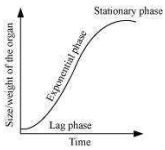
In geometric growth,both daughter cells derived from mitosis retain the ability to divide and continue to do so. Initially,the growth is slow (lag phase),followed by a rapid increase (exponential phase) due to the exponential increase in cell number,and finally,it slows down due to limited nutrient supply.
$(c)$ Sigmoid growth curve
The growth of living organisms in their natural environment is characterised by an $S$-shaped curve called a sigmoid growth curve. This curve is divided into three phases: the lag phase,the log phase (or exponential phase) of rapid growth,and the stationary phase.
Exponential growth can be expressed as:
$W_{1} = W_{0} e^{rt}$
Where,
$W_{1} =$ Final size
$W_{0} =$ Initial size
$r =$ Growth rate
$t =$ Time of growth
$e =$ Base of natural logarithms
$(d)$ Absolute and relative growth rates
Absolute growth rate refers to the measurement and comparison of total growth per unit time.
Relative growth rate refers to the growth of a given system per unit time,expressed on a common basis,i.e.,per unit initial parameter.
In arithmetic growth,following mitotic cell division,only one daughter cell continues to divide while the other differentiates and matures. $A$ constant linear growth,such as the elongation of roots at a constant rate,is an example of arithmetic growth.
$(b)$ Geometric growth
In geometric growth,both daughter cells derived from mitosis retain the ability to divide and continue to do so. Initially,the growth is slow (lag phase),followed by a rapid increase (exponential phase) due to the exponential increase in cell number,and finally,it slows down due to limited nutrient supply.
$(c)$ Sigmoid growth curve
The growth of living organisms in their natural environment is characterised by an $S$-shaped curve called a sigmoid growth curve. This curve is divided into three phases: the lag phase,the log phase (or exponential phase) of rapid growth,and the stationary phase.
Exponential growth can be expressed as:
$W_{1} = W_{0} e^{rt}$
Where,
$W_{1} =$ Final size
$W_{0} =$ Initial size
$r =$ Growth rate
$t =$ Time of growth
$e =$ Base of natural logarithms
$(d)$ Absolute and relative growth rates
Absolute growth rate refers to the measurement and comparison of total growth per unit time.
Relative growth rate refers to the growth of a given system per unit time,expressed on a common basis,i.e.,per unit initial parameter.
0 likes
View Solution132
Difficult
'Both growth and differentiation in higher plants are open'. Comment.
Solution
(N/A) Growth and differentiation in higher plants are referred to as 'open' because these plants possess meristematic tissues that retain the capacity to divide throughout their life cycle.
These meristems are located at specific positions,such as the root and shoot apices,and continuously produce new cells that differentiate into various specialized tissues.
Unlike animals,where growth is determinate and stops after a certain stage,plants can continuously add new organs and tissues,allowing for indeterminate growth.
These meristems are located at specific positions,such as the root and shoot apices,and continuously produce new cells that differentiate into various specialized tissues.
Unlike animals,where growth is determinate and stops after a certain stage,plants can continuously add new organs and tissues,allowing for indeterminate growth.
0 likes
View Solution133
Easy
Define growth and explain it.
Solution
(N/A) Definition: Growth is defined as an irreversible,permanent increase in the size of an organ,its parts,or an individual cell.
Explanation: Growth is considered one of the most fundamental and conspicuous characteristics of a living organism.
Growth is accompanied by metabolic processes (both anabolic and catabolic) that occur at the expense of energy.
Example: The expansion of a leaf is considered growth,whereas the swelling of a piece of wood when placed in water is not considered growth because it is reversible and not metabolic.
Explanation: Growth is considered one of the most fundamental and conspicuous characteristics of a living organism.
Growth is accompanied by metabolic processes (both anabolic and catabolic) that occur at the expense of energy.
Example: The expansion of a leaf is considered growth,whereas the swelling of a piece of wood when placed in water is not considered growth because it is reversible and not metabolic.
0 likes
View Solution134
Easy
Vegetation growth is usually immeasurable. Explain.
Solution
(N/A) Growth is defined as an irreversible permanent increase in the size of an organ or its parts or even an individual cell. In plants,growth is generally indeterminate because plants retain the capacity for unlimited growth throughout their life. This is due to the presence of meristems at certain locations in the plant body. The cells of such meristems have the capacity to divide and self-perpetuate. The product of these divisions soon becomes part of the plant body. Therefore,the growth of plants is not limited to a specific period or size,making it 'indeterminate' rather than 'immeasurable'.
0 likes
View Solution135
EasyMCQ
Vegetation grows in a unique way. Describe.
A
Growth is indeterminate.
B
Growth is determinate.
C
Growth is limited to specific organs.
D
Growth is uniform throughout the plant.
Solution
(A) Plant growth is unique because plants retain the capacity for unlimited growth throughout their life. This is due to the presence of meristems at certain locations in their body. The cells of meristems have the capacity to divide and self-perpetuate. The product of these divisions soon becomes part of the plant body. This form of growth,where new cells are always being added to the plant body by the activity of the meristem,is called the open form of growth.
0 likes
View Solution136
Easy
What are the different phases of growth?
Solution
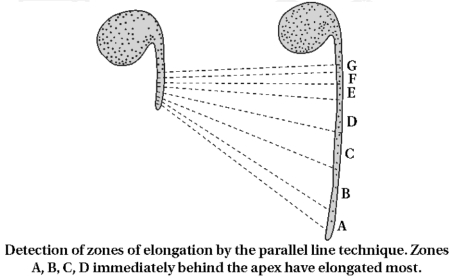
(N/A) The period of growth is generally divided into three phases: meristematic,elongation,and maturation.
This can be understood by looking at the root tips:
- The constantly dividing cells,both at the root apex and the shoot apex,represent the meristematic phase of growth.
- The cells in this region are rich in protoplasm and possess large,conspicuous nuclei.
- Their cell walls are primary in nature,thin,and cellulosic with abundant plasmodesmatal connections.
The cells proximal (just next,away from the tip) to the meristematic zone represent the phase of elongation.
- Increased vacuolation,cell enlargement,and new cell wall deposition are the characteristics of the cells in this phase.
Further away from the apex,i.e.,more proximal to the phase of elongation,lies the portion of the axis which is undergoing the phase of maturation.
- The cells of this zone attain their maximal size in terms of wall thickening and protoplasmic modifications.
This can be understood by looking at the root tips:
- The constantly dividing cells,both at the root apex and the shoot apex,represent the meristematic phase of growth.
- The cells in this region are rich in protoplasm and possess large,conspicuous nuclei.
- Their cell walls are primary in nature,thin,and cellulosic with abundant plasmodesmatal connections.
The cells proximal (just next,away from the tip) to the meristematic zone represent the phase of elongation.
- Increased vacuolation,cell enlargement,and new cell wall deposition are the characteristics of the cells in this phase.
Further away from the apex,i.e.,more proximal to the phase of elongation,lies the portion of the axis which is undergoing the phase of maturation.
- The cells of this zone attain their maximal size in terms of wall thickening and protoplasmic modifications.
0 likes
View Solution137
EasyMCQ
How can growth be measured?
A
Increase in fresh weight
B
Increase in dry weight
C
Increase in cell number
D
All of the above
Solution
(D) $\Rightarrow$ At a cellular level,growth is principally a consequence of an increase in the amount of protoplasm.
Increase in protoplasm is difficult to measure directly; therefore,one generally measures some quantity which is more or less proportional to it.
Growth is measured by a variety of parameters,some of which are an increase in fresh weight,dry weight,length,area,volume,and cell number.
It is amazing to know that one single maize root apical meristem can give rise to more than $17,500$ new cells per hour,whereas cells in a watermelon may increase in size by up to $3,50,000$ times.
In the former case,growth is expressed as an increase in cell number; the latter expresses growth as an increase in the size of the cell.
While the growth of a pollen tube is measured in terms of its length,an increase in surface area denotes the growth in a dorsiventral leaf.
Increase in protoplasm is difficult to measure directly; therefore,one generally measures some quantity which is more or less proportional to it.
Growth is measured by a variety of parameters,some of which are an increase in fresh weight,dry weight,length,area,volume,and cell number.
It is amazing to know that one single maize root apical meristem can give rise to more than $17,500$ new cells per hour,whereas cells in a watermelon may increase in size by up to $3,50,000$ times.
In the former case,growth is expressed as an increase in cell number; the latter expresses growth as an increase in the size of the cell.
While the growth of a pollen tube is measured in terms of its length,an increase in surface area denotes the growth in a dorsiventral leaf.
0 likes
View Solution138
Medium
Explain the phases of growth in plants.
Solution
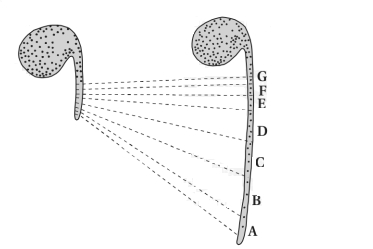
(N/A) The period of growth is generally divided into three phases: meristematic,elongation,and maturation.
$1$. Meristematic Phase: The cells in the root and shoot apices are constantly dividing. These cells are rich in protoplasm and possess large,conspicuous nuclei. Their cell walls are primary,thin,and cellulosic with abundant plasmodesmatal connections.
$2$. Elongation Phase: Cells proximal to the meristematic zone represent the phase of elongation. This phase is characterized by increased vacuolation,cell enlargement,and new cell wall deposition.
$3$. Maturation Phase: Further away from the apex,cells reach their maximal size in terms of wall thickening and protoplasmic modifications. This is the maturation phase,where cells differentiate to perform specific functions.
$1$. Meristematic Phase: The cells in the root and shoot apices are constantly dividing. These cells are rich in protoplasm and possess large,conspicuous nuclei. Their cell walls are primary,thin,and cellulosic with abundant plasmodesmatal connections.
$2$. Elongation Phase: Cells proximal to the meristematic zone represent the phase of elongation. This phase is characterized by increased vacuolation,cell enlargement,and new cell wall deposition.
$3$. Maturation Phase: Further away from the apex,cells reach their maximal size in terms of wall thickening and protoplasmic modifications. This is the maturation phase,where cells differentiate to perform specific functions.
0 likes
View Solution139
Medium
Describe different types of growth rates.
Solution
(N/A) Growth rate is defined as the increased growth per unit time.
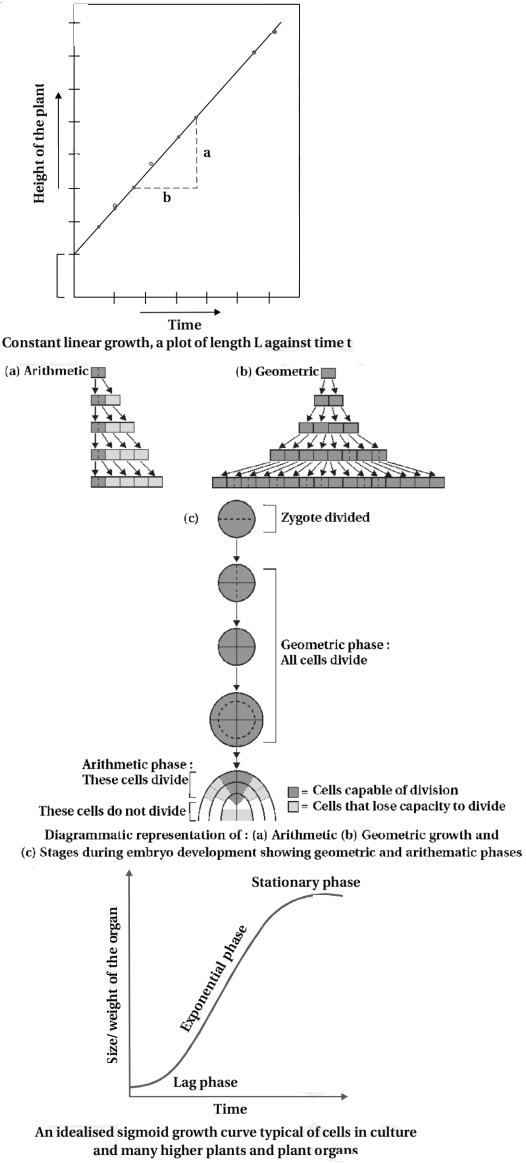
Growth can be expressed mathematically and can be categorized into two main types:
$1$. Arithmetic Growth: In this type,following mitotic cell division,only one daughter cell continues to divide,while the other differentiates and matures. $A$ simple example is the elongation of a root at a constant rate. Mathematically,it is expressed as: $L_t = L_0 + rt$,where $L_t$ is the length at time $t$,$L_0$ is the length at time zero,and $r$ is the growth rate or elongation per unit time.
$2$. Geometrical Growth: In this pattern,the growth follows three distinct phases:
$(a)$ Lag phase: The initial phase characterized by very slow growth.
$(b)$ Log phase (Exponential phase): The middle phase where growth is rapid and exponential. Both progeny cells retain the ability to divide,provided nutrient supply is adequate.
$(c)$ Stationary phase: The final phase where growth slows down due to limited resources.
When the growth parameter is plotted against time,it results in a characteristic sigmoid curve. The exponential growth is expressed as: $W_1 = W_0 e^{rt}$,where $W_1$ is the final size,$W_0$ is the initial size,$t$ is the time of growth,$r$ is the relative growth rate (efficiency index),and $e$ is the base of natural logarithms.
Growth can be expressed mathematically and can be categorized into two main types:
$1$. Arithmetic Growth: In this type,following mitotic cell division,only one daughter cell continues to divide,while the other differentiates and matures. $A$ simple example is the elongation of a root at a constant rate. Mathematically,it is expressed as: $L_t = L_0 + rt$,where $L_t$ is the length at time $t$,$L_0$ is the length at time zero,and $r$ is the growth rate or elongation per unit time.
$2$. Geometrical Growth: In this pattern,the growth follows three distinct phases:
$(a)$ Lag phase: The initial phase characterized by very slow growth.
$(b)$ Log phase (Exponential phase): The middle phase where growth is rapid and exponential. Both progeny cells retain the ability to divide,provided nutrient supply is adequate.
$(c)$ Stationary phase: The final phase where growth slows down due to limited resources.
When the growth parameter is plotted against time,it results in a characteristic sigmoid curve. The exponential growth is expressed as: $W_1 = W_0 e^{rt}$,where $W_1$ is the final size,$W_0$ is the initial size,$t$ is the time of growth,$r$ is the relative growth rate (efficiency index),and $e$ is the base of natural logarithms.
0 likes
View Solution140
Medium
Describe various conditions or factors necessary for growth.
Solution
(N/A) - The growth of a plant is influenced by a variety of external and internal factors.
- Growth of a plant involves the synthesis of protoplasm,cell division,cell enlargement,and cell differentiation.
- Some of the factors that influence the growth of plants are mentioned below:
- $(a)$ Water: It is the first and foremost requirement for the plants for the enlargement of cells,maintaining the turgidity of growing cells,and for the extension of growth. It also acts as a medium for many enzymatic activities. In water stress conditions,the growth of the plants seems to be retarded.
- $(b)$ Oxygen: It helps in releasing metabolic energy essential for growth activities.
- $(c)$ Nutrients: These act as major raw materials (macro and micro essential elements) for protoplasmic synthesis and also act as a source of energy. Under nutrient-deficient conditions,the growth of the plant is affected.
- $(d)$ Light: It helps in the synthesis of food. It also determines the root and shoot growth. Along with light,gravity also serves as an environmental signal that affects certain phases or stages of growth.
- $(e)$ Temperature: For the normal and appropriate growth of a plant,an optimum temperature range is necessary,i.e.,$25-30^{\circ}C$ (this is because enzymatic reactions are very fast at the optimum temperature range).
- Growth of a plant involves the synthesis of protoplasm,cell division,cell enlargement,and cell differentiation.
- Some of the factors that influence the growth of plants are mentioned below:
- $(a)$ Water: It is the first and foremost requirement for the plants for the enlargement of cells,maintaining the turgidity of growing cells,and for the extension of growth. It also acts as a medium for many enzymatic activities. In water stress conditions,the growth of the plants seems to be retarded.
- $(b)$ Oxygen: It helps in releasing metabolic energy essential for growth activities.
- $(c)$ Nutrients: These act as major raw materials (macro and micro essential elements) for protoplasmic synthesis and also act as a source of energy. Under nutrient-deficient conditions,the growth of the plant is affected.
- $(d)$ Light: It helps in the synthesis of food. It also determines the root and shoot growth. Along with light,gravity also serves as an environmental signal that affects certain phases or stages of growth.
- $(e)$ Temperature: For the normal and appropriate growth of a plant,an optimum temperature range is necessary,i.e.,$25-30^{\circ}C$ (this is because enzymatic reactions are very fast at the optimum temperature range).
0 likes
View Solution141
Medium
Explain the representation of absolute and relative growth rate using the provided diagram.
Solution
(N/A) Growth can be expressed in two ways:
$1$. Absolute Growth Rate: It is the measurement and comparison of total growth per unit time. It represents the actual increase in size or area.
For leaf $A$: Absolute growth = $10 \ cm^2 - 5 \ cm^2 = 5 \ cm^2$.
For leaf $B$: Absolute growth = $55 \ cm^2 - 50 \ cm^2 = 5 \ cm^2$.
Both leaves show the same absolute growth of $5 \ cm^2$.
$2$. Relative Growth Rate: It is the growth of a given system per unit time expressed on a common basis (e.g.,per unit initial parameter).
Formula: $\text{Relative Growth Rate} = \frac{\text{Absolute Growth}}{\text{Initial Size}} \times 100$.
For leaf $A$: Relative growth rate = $(5 / 5) \times 100 = 100\%$.
For leaf $B$: Relative growth rate = $(5 / 50) \times 100 = 10\%$.
Thus,leaf $A$ shows a higher relative growth rate compared to leaf $B$.
$1$. Absolute Growth Rate: It is the measurement and comparison of total growth per unit time. It represents the actual increase in size or area.
For leaf $A$: Absolute growth = $10 \ cm^2 - 5 \ cm^2 = 5 \ cm^2$.
For leaf $B$: Absolute growth = $55 \ cm^2 - 50 \ cm^2 = 5 \ cm^2$.
Both leaves show the same absolute growth of $5 \ cm^2$.
$2$. Relative Growth Rate: It is the growth of a given system per unit time expressed on a common basis (e.g.,per unit initial parameter).
Formula: $\text{Relative Growth Rate} = \frac{\text{Absolute Growth}}{\text{Initial Size}} \times 100$.
For leaf $A$: Relative growth rate = $(5 / 5) \times 100 = 100\%$.
For leaf $B$: Relative growth rate = $(5 / 50) \times 100 = 10\%$.
Thus,leaf $A$ shows a higher relative growth rate compared to leaf $B$.
0 likes
View Solution142
Medium
Explain the conditions for growth in plants.
Solution
(N/A) Growth in plants is a complex process that requires several essential conditions to occur effectively:
$1$. Water: Water is essential for cell enlargement by turgor pressure. It also provides the medium for enzymatic activities and metabolic processes.
$2$. Oxygen: Oxygen is required for the release of metabolic energy $(ATP)$ through aerobic respiration,which is necessary for growth activities.
$3$. Nutrients: Macro and micro-nutrients are required for the synthesis of protoplasm and act as sources of energy.
$4$. Temperature: Every plant has an optimum temperature range for growth. Deviations from this range can inhibit growth or cause damage.
$5$. Light: Light is crucial for photosynthesis,which provides the energy and carbon skeletons required for growth. It also influences photomorphogenesis.
$1$. Water: Water is essential for cell enlargement by turgor pressure. It also provides the medium for enzymatic activities and metabolic processes.
$2$. Oxygen: Oxygen is required for the release of metabolic energy $(ATP)$ through aerobic respiration,which is necessary for growth activities.
$3$. Nutrients: Macro and micro-nutrients are required for the synthesis of protoplasm and act as sources of energy.
$4$. Temperature: Every plant has an optimum temperature range for growth. Deviations from this range can inhibit growth or cause damage.
$5$. Light: Light is crucial for photosynthesis,which provides the energy and carbon skeletons required for growth. It also influences photomorphogenesis.
0 likes
View Solution143
Medium
Explain the factors affecting growth.
Solution
(N/A) Growth in plants is a complex phenomenon influenced by several intrinsic and extrinsic factors:
$1$. $Intrinsic$ $Factors$: These include genetic factors (genotype) and intracellular factors like plant growth regulators (hormones) such as auxins, gibberellins, cytokinins, abscisic acid, and ethylene.
$2$. $Extrinsic$ $Factors$: These are environmental factors that influence growth:
- $Water$: It is essential for cell enlargement, turgidity, and enzymatic activities. It provides the medium for metabolic reactions.
- $Oxygen$: It is required for aerobic respiration, which releases the energy necessary for growth.
- $Nutrients$: Macro and micronutrients are required for the synthesis of protoplasm and act as sources of energy.
- $Temperature$: Every plant has an optimum temperature range for growth. Extremes can denature enzymes or inhibit metabolic processes.
- $Light$: Light intensity, quality, and duration (photoperiodism) significantly affect growth and development.
$1$. $Intrinsic$ $Factors$: These include genetic factors (genotype) and intracellular factors like plant growth regulators (hormones) such as auxins, gibberellins, cytokinins, abscisic acid, and ethylene.
$2$. $Extrinsic$ $Factors$: These are environmental factors that influence growth:
- $Water$: It is essential for cell enlargement, turgidity, and enzymatic activities. It provides the medium for metabolic reactions.
- $Oxygen$: It is required for aerobic respiration, which releases the energy necessary for growth.
- $Nutrients$: Macro and micronutrients are required for the synthesis of protoplasm and act as sources of energy.
- $Temperature$: Every plant has an optimum temperature range for growth. Extremes can denature enzymes or inhibit metabolic processes.
- $Light$: Light intensity, quality, and duration (photoperiodism) significantly affect growth and development.
0 likes
View Solution144
EasyMCQ
What is the difference between growth in corn and watermelon?
A
Corn shows determinate growth,while watermelon shows indeterminate growth.
B
Corn shows indeterminate growth,while watermelon shows determinate growth.
C
Both show determinate growth.
D
Both show indeterminate growth.
Solution
(D) In plants,growth is generally indeterminate,meaning they continue to grow throughout their life due to the presence of meristems.
However,specific organs like leaves,flowers,and fruits exhibit determinate growth,meaning they stop growing after reaching a certain size.
Corn (a monocot) and watermelon (a dicot) both exhibit indeterminate growth as whole organisms because they possess apical meristems that remain active throughout their life cycle.
Therefore,there is no fundamental difference in the nature of their overall growth; both are indeterminate.
However,specific organs like leaves,flowers,and fruits exhibit determinate growth,meaning they stop growing after reaching a certain size.
Corn (a monocot) and watermelon (a dicot) both exhibit indeterminate growth as whole organisms because they possess apical meristems that remain active throughout their life cycle.
Therefore,there is no fundamental difference in the nature of their overall growth; both are indeterminate.
0 likes
View Solution145
Medium
Write the characteristics of the growth phase.
Solution
(N/A) The growth phase of a plant is typically divided into three distinct stages: the meristematic phase,the elongation phase,and the maturation phase.
$1$. Meristematic Phase: Cells in the root and shoot apices are constantly dividing. These cells are rich in protoplasm,possess large conspicuous nuclei,and have thin primary cell walls with abundant plasmodesmatal connections.
$2$. Elongation Phase: Cells proximal to the meristematic zone undergo enlargement. This phase is characterized by increased vacuolation,cell enlargement,and new cell wall deposition.
$3$. Maturation Phase: Cells reach their maximum size in terms of wall thickening and protoplasmic modification. They differentiate to perform specific functions and attain their final structural form.
$1$. Meristematic Phase: Cells in the root and shoot apices are constantly dividing. These cells are rich in protoplasm,possess large conspicuous nuclei,and have thin primary cell walls with abundant plasmodesmatal connections.
$2$. Elongation Phase: Cells proximal to the meristematic zone undergo enlargement. This phase is characterized by increased vacuolation,cell enlargement,and new cell wall deposition.
$3$. Maturation Phase: Cells reach their maximum size in terms of wall thickening and protoplasmic modification. They differentiate to perform specific functions and attain their final structural form.
0 likes
View Solution146
Easy
Explain the stages of growth in plants.
Solution
(N/A) The growth of a plant is a complex process that occurs in three main stages:
$1$. $Meristematic$ $phase$: This stage occurs in the root and shoot apices. Cells in this region are constantly dividing by mitosis. These cells are rich in protoplasm and possess large, conspicuous nuclei. The cell walls are primary, thin, and cellulosic with abundant plasmodesmatal connections.
$2$. $Elongation$ $phase$: This stage occurs just proximal to the meristematic zone. The cells undergo significant enlargement, which is responsible for the increased length of the organ. This phase is characterized by increased vacuolation, cell enlargement, and new cell wall deposition.
$3$. $Maturation$ $phase$: This stage occurs further away from the apex. The cells attain their maximal size in terms of wall thickening and protoplasmic modifications. The cells differentiate to perform specific functions, becoming mature tissues.
$1$. $Meristematic$ $phase$: This stage occurs in the root and shoot apices. Cells in this region are constantly dividing by mitosis. These cells are rich in protoplasm and possess large, conspicuous nuclei. The cell walls are primary, thin, and cellulosic with abundant plasmodesmatal connections.
$2$. $Elongation$ $phase$: This stage occurs just proximal to the meristematic zone. The cells undergo significant enlargement, which is responsible for the increased length of the organ. This phase is characterized by increased vacuolation, cell enlargement, and new cell wall deposition.
$3$. $Maturation$ $phase$: This stage occurs further away from the apex. The cells attain their maximal size in terms of wall thickening and protoplasmic modifications. The cells differentiate to perform specific functions, becoming mature tissues.
0 likes
View Solution147
Easy
Write the characteristics of the maturation stage.
Solution
(N/A) The maturation stage is the final phase of plant growth where cells attain their maximal size in terms of wall thickening and protoplasmic modifications.
$1$. The cells in this stage reach their maximum size.
$2$. There is significant thickening of the cell wall.
$3$. Protoplasmic modifications occur to adapt the cell for specific physiological functions.
$4$. Metabolic activity often decreases compared to the elongation phase,as the cell prepares for its specialized role (e.g.,becoming part of xylem or phloem).
$1$. The cells in this stage reach their maximum size.
$2$. There is significant thickening of the cell wall.
$3$. Protoplasmic modifications occur to adapt the cell for specific physiological functions.
$4$. Metabolic activity often decreases compared to the elongation phase,as the cell prepares for its specialized role (e.g.,becoming part of xylem or phloem).
0 likes
View Solution148
EasyMCQ
Introduce the mathematical form of growth.
A
Arithmetic growth: $L_t = L_0 + rt$
B
Geometric growth: $W_1 = W_0 e^{rt}$
C
Both $A$ and $B$
D
None of the above
Solution
(C) Growth can be expressed mathematically in two primary forms:
$1$. Arithmetic growth: In this type of growth,only one daughter cell continues to divide while the other differentiates and matures. The mathematical expression is $L_t = L_0 + rt$,where $L_t$ is the length at time $t$,$L_0$ is the length at time $0$,and $r$ is the growth rate.
$2$. Geometric growth: In this type of growth,both daughter cells continue to divide. The mathematical expression is $W_1 = W_0 e^{rt}$,where $W_1$ is the final size,$W_0$ is the initial size,$r$ is the relative growth rate,$t$ is the time of growth,and $e$ is the base of natural logarithms.
$1$. Arithmetic growth: In this type of growth,only one daughter cell continues to divide while the other differentiates and matures. The mathematical expression is $L_t = L_0 + rt$,where $L_t$ is the length at time $t$,$L_0$ is the length at time $0$,and $r$ is the growth rate.
$2$. Geometric growth: In this type of growth,both daughter cells continue to divide. The mathematical expression is $W_1 = W_0 e^{rt}$,where $W_1$ is the final size,$W_0$ is the initial size,$r$ is the relative growth rate,$t$ is the time of growth,and $e$ is the base of natural logarithms.
0 likes
View Solution149
EasyMCQ
Explain the formula for rapid growth in plants.
A
Geometric growth: $W_1 = W_0 e^{rt}$
B
Arithmetic growth: $L_t = L_0 + rt$
C
Absolute growth rate: $W_1 - W_0$
D
Relative growth rate: $(W_1 - W_0) / W_0$
Solution
(A) In plants,rapid growth is typically represented by geometric growth,where both daughter cells resulting from mitosis retain the ability to divide and continue to do so.
The formula for geometric growth is $W_1 = W_0 e^{rt}$.
Here,$W_1$ represents the final size (weight,height,or number).
$W_0$ represents the initial size at the beginning of the period.
$r$ represents the relative growth rate.
$t$ represents the time of growth.
$e$ represents the base of natural logarithms (approximately $2.718$).
This exponential growth leads to a sigmoid curve when plotted against time.
The formula for geometric growth is $W_1 = W_0 e^{rt}$.
Here,$W_1$ represents the final size (weight,height,or number).
$W_0$ represents the initial size at the beginning of the period.
$r$ represents the relative growth rate.
$t$ represents the time of growth.
$e$ represents the base of natural logarithms (approximately $2.718$).
This exponential growth leads to a sigmoid curve when plotted against time.
0 likes
View Solution150
EasyMCQ
How does water affect the growth of plants?
A
It provides a medium for enzymatic activities.
B
It maintains the turgidity of growing cells.
C
It is required for cell enlargement.
D
All of the above.
Solution
(D) Water is the most essential requirement for plant growth for several reasons:
$1$. It is necessary for cell enlargement by maintaining the turgidity of growing cells,which facilitates the extension of growth.
$2$. It acts as a vital medium for various enzymatic activities occurring within the plant cells.
$3$. Under water stress conditions,the growth of plants is significantly retarded or inhibited.
$1$. It is necessary for cell enlargement by maintaining the turgidity of growing cells,which facilitates the extension of growth.
$2$. It acts as a vital medium for various enzymatic activities occurring within the plant cells.
$3$. Under water stress conditions,the growth of plants is significantly retarded or inhibited.
0 likes
View SolutionPlant Growth and Development — Growth · Frequently Asked Questions
1Are these Plant Growth and Development questions useful for JEE and NEET?
Yes. All questions in this section are mapped to JEE Main and NEET exam patterns. Previous year questions from JEE Main, NEET, GUJCET and state-level exams are included with full solutions.
2Can I switch to Hindi or Gujarati for these questions?
Yes. Use the language tabs in the hero section or the sidebar to view the same questions and solutions in English, Hindi or Gujarati.
3How do I generate a question paper from this subtopic?
Use the Vedclass Exam Paper Generator — select the chapter and subtopic, set difficulty, and generate Sets A, B, C, D automatically. First 3 chapters of every subject are free.
Vedclass Products
For Students
Vedclass Test Series
Mock tests in real JEE/NEET style with performance analysis. 5-day free trial.
Start Free TrialFor Teachers
Exam Paper Generator
Generate Set A/B/C/D papers from this chapter in 2 minutes. 3 chapters free.
Try FreeFor Institutes
Online Exam Module
Live online exams with unlimited students, 360° analytics & white-label branding.
See DemoFor Teachers & Institutes
Generate a Plant Growth and Development Exam Paper in 2 Minutes
Select subtopic & difficulty — Sets A, B, C, D auto-generated with No Repeat logic.
First 3 chapters of every subject are free — no payment required.