
A English
Growth Questions in English
Class 11 Biology · Plant Growth and Development · Growth
243+
Questions
English
Language
100%
With Solutions
Showing 50 of 243 questions in English
151
Easy
Define the following terms:
$(1)$ Growth
$(2)$ Growth rate
$(1)$ Growth
$(2)$ Growth rate
Solution
(N/A) $(1)$ Growth is an irreversible,permanent increase in the size,volume,or weight of an organism,organ,or cell.
$(2)$ Growth rate is defined as the increased growth per unit of time. It represents the speed at which an organism or its parts grow.
$(2)$ Growth rate is defined as the increased growth per unit of time. It represents the speed at which an organism or its parts grow.
0 likes
View Solution152
Easy
Define and explain the following terms related to plant growth:
$(1)$ Absolute growth
$(2)$ Relative growth
$(1)$ Absolute growth
$(2)$ Relative growth
Solution
(N/A) $(1)$ Absolute growth: It refers to the total growth of a plant or its organ measured over a specific period of time. It is expressed as the difference between the final size and the initial size of the plant organ.
$(2)$ Relative growth: It is the growth of a given system per unit time expressed on a common basis,i.e.,per unit initial parameter. It is calculated as the ratio of the increase in size to the initial size,often expressed as a percentage.
$(2)$ Relative growth: It is the growth of a given system per unit time expressed on a common basis,i.e.,per unit initial parameter. It is calculated as the ratio of the increase in size to the initial size,often expressed as a percentage.
0 likes
View Solution153
Easy
Does the growth pattern in plants differ from that in animals? Do all the parts of plants grow indefinitely? If not,name the regions of plants which can grow indefinitely.
Solution
(N/A) Yes,the growth pattern in plants differs from that in animals.
Plant growth is unique because plants retain the capacity for unlimited growth throughout their life.
This ability is due to the presence of meristems at certain locations in their body.
The cells of such meristems have the capacity to divide and self-perpetuate.
The products of these divisions soon lose the capacity to divide and differentiate to form the plant body.
This form of growth,wherein new cells are always being added to the plant body by the activity of the meristem,is called the open form of growth.
In contrast,growth in animals is determinate,meaning they have a limited growth period after which further growth of their body stops.
The regions of plants that can grow indefinitely are the meristematic regions,such as the root apical meristem and the shoot apical meristem.
Plant growth is unique because plants retain the capacity for unlimited growth throughout their life.
This ability is due to the presence of meristems at certain locations in their body.
The cells of such meristems have the capacity to divide and self-perpetuate.
The products of these divisions soon lose the capacity to divide and differentiate to form the plant body.
This form of growth,wherein new cells are always being added to the plant body by the activity of the meristem,is called the open form of growth.
In contrast,growth in animals is determinate,meaning they have a limited growth period after which further growth of their body stops.
The regions of plants that can grow indefinitely are the meristematic regions,such as the root apical meristem and the shoot apical meristem.
0 likes
View Solution154
Medium
$A$ rubber band stretches and reverts back to its original position. Bubble gum stretches,but it would not return to its original position. Is there any difference between the two processes? Discuss it with respect to plant growth. [Hint: Elasticity (reversible),Plasticity (irreversible)]
Solution
(N/A) The two processes represent fundamentally different physical properties: elasticity and plasticity.
| Elasticity | Plasticity |
|---|---|
| $(1)$ Elasticity refers to the reversible stretchability of plant cells or products,such as rubber or latex. | $(1)$ Plasticity refers to the ability of plants to follow different pathways in response to the environment or phases of life to form different kinds of structures. |
| $(2)$ Elastic substances can revert to their original form in a relaxed state,e.g.,the stretching of a rubber band. | $(2)$ Plastic substances and the phenomenon of plasticity are irreversible. For example,the difference in leaf shapes produced in air versus those produced in water in buttercup $(Ranunculus)$. This is also known as heterophylly. |
0 likes
View Solution155
Medium
Both animals and plants grow. Why do we say that growth and differentiation in plants is open and not so in animals? Does this statement hold true for sponges also?
Solution
(N/A)
Regarding sponges: The statement does not hold true for sponges. Sponges are simple multicellular animals that lack true tissues and organs. They exhibit a high degree of plasticity and regenerative capacity,and their growth pattern does not follow the typical determinate growth seen in higher animals.
| Growth in Plants | Growth in Animals |
|---|---|
| $1$. Plant growth is indeterminate,meaning cells can divide and enlarge continuously throughout their lifetime. | $1$. Animal growth is determinate,meaning they grow until a finite period,mature,and then stop growing. |
| $2$. Growth is open due to the presence of meristematic cells that keep dividing,allowing for the continuous addition of new organs. | $2$. Cell division is distributed throughout the body to replace old and damaged cells,rather than being localized at specific regions. |
| $3$. Structures at the tips or meristematic zones are never 'complete' because of open-ended apices. | $3$. After a specific embryonic period,the growth rate reduces in the juvenile phase and ceases upon reaching maturity. |
Regarding sponges: The statement does not hold true for sponges. Sponges are simple multicellular animals that lack true tissues and organs. They exhibit a high degree of plasticity and regenerative capacity,and their growth pattern does not follow the typical determinate growth seen in higher animals.
0 likes
View Solution156
EasyMCQ
The process of growth is maximum during:
A
Dormancy
B
Log phase
C
Lag phase
D
Senescence
Solution
(B) The growth rate is not uniform throughout the life cycle of an organism.
$1$. $Lag$ phase: This is the initial phase where growth is slow as the cells are preparing for division.
$2$. $Log$ phase (Exponential phase): During this phase,the growth rate is maximum because the cells divide rapidly and exponentially.
$3$. $Stationary$ phase: Growth slows down and eventually stops due to limited resources.
$4$. $Senescence$: This is the phase of decline or aging.
Therefore,the process of growth is maximum during the $Log$ phase.
$1$. $Lag$ phase: This is the initial phase where growth is slow as the cells are preparing for division.
$2$. $Log$ phase (Exponential phase): During this phase,the growth rate is maximum because the cells divide rapidly and exponentially.
$3$. $Stationary$ phase: Growth slows down and eventually stops due to limited resources.
$4$. $Senescence$: This is the phase of decline or aging.
Therefore,the process of growth is maximum during the $Log$ phase.
0 likes
View Solution157
MediumMCQ
During which phase is the rate of growth the maximum?
A
Log phase
B
Lag phase
C
Senescence
D
Dormancy
Solution
(A) The growth curve of an organism or population typically follows a sigmoid pattern.
$1$. The $Lag$ phase is the initial period of slow growth.
$2$. The $Log$ phase (or exponential phase) is the period where the rate of growth is at its maximum because the resources are abundant and the organisms are actively dividing.
$3$. The stationary phase follows,where growth slows down due to limited resources.
$4$. Senescence is the phase of decline.
Therefore,the rate of growth is maximum during the $Log$ phase.
$1$. The $Lag$ phase is the initial period of slow growth.
$2$. The $Log$ phase (or exponential phase) is the period where the rate of growth is at its maximum because the resources are abundant and the organisms are actively dividing.
$3$. The stationary phase follows,where growth slows down due to limited resources.
$4$. Senescence is the phase of decline.
Therefore,the rate of growth is maximum during the $Log$ phase.
0 likes
View Solution158
MediumMCQ
Which of the following statements regarding growth is incorrect?
A
In plants,growth by cell division is seen only up to a certain stage.
B
Growth exhibited by non-living objects is by accumulation of material on the surface.
C
$A$ multicellular organism grows by cell division.
D
Growth in in vitro culture of unicellular organisms can be observed by counting the number of cells.
Solution
(A) In plants,growth by cell division occurs continuously throughout their life span.
This continuous growth in plants is unique.
Therefore,the statement that growth in plants occurs only up to a certain stage is incorrect.
This continuous growth in plants is unique.
Therefore,the statement that growth in plants occurs only up to a certain stage is incorrect.
0 likes
View Solution159
EasyMCQ
Nutation is shown by
A
Root
B
Stem
C
Tendril
D
None of these
Solution
(C) Nutation is a type of autonomous growth movement where the growing tips of plants,particularly climbing organs like tendrils,exhibit a spiral or nodding motion. This occurs due to unequal growth rates on different sides of the organ,causing it to coil around a support.
0 likes
View Solution160
EasyMCQ
The plants,which are able to send their roots up to the fringe of water table are called
A
Xerophytic plants
B
Terrestrial plants
C
Phreatophytes
D
Mesophytes
Solution
(C) Very few plants are able to send their roots up to the fringe of the water table because of the limited availability of air at that depth.
Phreatophytes are specialized plants that can extend their root systems deep into the ground to reach and absorb water directly from the water table.
Examples of such plants include $Populus \ deltoides$ (cottonwood) and $Tamarix$ (salt cedar).
Phreatophytes are specialized plants that can extend their root systems deep into the ground to reach and absorb water directly from the water table.
Examples of such plants include $Populus \ deltoides$ (cottonwood) and $Tamarix$ (salt cedar).
0 likes
View Solution161
EasyMCQ
The optimum temperature preferred for plant growth is
A
Less than $15^{\circ}C$
B
Between $15^{\circ}C$ and $30^{\circ}C$
C
Less than $10^{\circ}C$
D
More than $30^{\circ}C$
Solution
(B) Plant growth is highly dependent on environmental factors,among which temperature plays a crucial role. Most plants exhibit optimal physiological and metabolic activities,including enzymatic reactions necessary for growth,within a temperature range of $15^{\circ}C$ to $30^{\circ}C$. Temperatures significantly below or above this range can inhibit growth or cause stress to the plant.
0 likes
View Solution162
EasyMCQ
Shock movement in 'touch-me-not' plant is
A
Seismonasty
B
Photonasty
C
Chemonasty
D
Thermonasty
Solution
(A) Seismonastic movement is a type of nastic movement. It occurs in response to touch or mechanical shock,and this phenomenon is known as seismonasty. For example,the leaflets of $Mimosa$ $pudica$ (touch-me-not plant) fold inward when touched.
The nastic movements in response to light,chemicals,and temperature are called photonastic,chemonastic,and thermonastic movements,respectively.
The nastic movements in response to light,chemicals,and temperature are called photonastic,chemonastic,and thermonastic movements,respectively.
0 likes
View Solution163
EasyMCQ
Auxanometer is used to detect
A
Respiration
B
Transpiration
C
Plant movement
D
Growth
Solution
(D) An auxanometer is a scientific instrument used to measure the growth of plants in length. There are two main types of auxanometers: the $Arc$ auxanometer and the $Pfeffer's$ automatic auxanometer. These devices track the increase in the height of a plant over a specific period.
0 likes
View Solution164
MediumMCQ
Constantly dividing cells,both at the root apex and shoot apex,represent:
A
Elongation phase of the growth
B
Meristematic phase of the growth
C
Maturation phase of the growth
D
None of the above
Solution
(B) The meristematic phase is also known as the formative or cell formation phase.
In this phase,constantly dividing cells are present at the root apex and shoot apex.
The cells in this region are rich in protoplasm,possess large conspicuous nuclei,and have thin,cellulosic cell walls with abundant plasmodesmatal connections.
In this phase,constantly dividing cells are present at the root apex and shoot apex.
The cells in this region are rich in protoplasm,possess large conspicuous nuclei,and have thin,cellulosic cell walls with abundant plasmodesmatal connections.
0 likes
View Solution165
MediumMCQ
The growth period of a plant is generally divided into:
A
Four phases
B
Three phases
C
Two phases
D
Five phases
Solution
(B) The period of growth in plants is generally divided into three distinct phases:
$(i)$ Meristematic phase: Characterized by constant cell division.
$(ii)$ Elongation phase: Characterized by increased cell size,vacuolation,and new cell wall deposition.
$(iii)$ Maturation phase: Characterized by cell differentiation and attainment of maximum size and structural maturity.
$(i)$ Meristematic phase: Characterized by constant cell division.
$(ii)$ Elongation phase: Characterized by increased cell size,vacuolation,and new cell wall deposition.
$(iii)$ Maturation phase: Characterized by cell differentiation and attainment of maximum size and structural maturity.
0 likes
View Solution166
MediumMCQ
Grand place of growth is another name for:
A
Lag phase
B
Stationary phase
C
Diminishing growth phase
D
Exponential growth phase
Solution
(D) The $log$ phase or $exponential$ growth phase is also known as the $grand$ $phase$ of growth.
In this phase,the rate of growth is maximum and is maintained for some time.
It appears as an upright line in the growth curve,representing the period of most rapid increase in biomass or cell number.
In this phase,the rate of growth is maximum and is maintained for some time.
It appears as an upright line in the growth curve,representing the period of most rapid increase in biomass or cell number.
0 likes
View Solution167
MediumMCQ
Increased growth per unit time is termed as
A
Nascent growth rate
B
Growth rate
C
Biomass
D
All of these
Solution
(B) The increased growth per unit time is termed as growth rate.
Thus,the rate of growth can be expressed mathematically.
An organism,or a part of an organism,can produce more cells in a variety of ways.
The growth rate shows an increase that may be $(i)$ Arithmetic and $(ii)$ Geometrical.
Thus,the rate of growth can be expressed mathematically.
An organism,or a part of an organism,can produce more cells in a variety of ways.
The growth rate shows an increase that may be $(i)$ Arithmetic and $(ii)$ Geometrical.
0 likes
View Solution168
MediumMCQ
Growth at the cellular level is the increase in the amount of:
A
Cell wall
B
Cell membrane
C
Protoplasm
D
All of the above
Solution
(C) Growth,at the cellular level,is primarily a consequence of an increase in the amount of protoplasm.
Since the increase in protoplasm is difficult to measure directly,one generally measures a quantity that is more or less proportional to it.
Therefore,growth is measured by a variety of parameters,such as an increase in fresh weight,dry weight,length,area,volume,and cell number.
Since the increase in protoplasm is difficult to measure directly,one generally measures a quantity that is more or less proportional to it.
Therefore,growth is measured by a variety of parameters,such as an increase in fresh weight,dry weight,length,area,volume,and cell number.
0 likes
View Solution169
MediumMCQ
Water is required in plant growth for
A
Enzymatic reactions
B
Cell enlargement
C
Extension growth
D
All of these
Solution
(D) All of the above.
Water,oxygen,nutrients,and other factors are essential elements for growth.
$(i)$ Plant cells increase in size through cell enlargement,which requires water. The turgidity of cells helps in extension growth. Thus,plant growth and development are intimately linked to the water status of the plant.
$(ii)$ Water provides the necessary medium for enzymatic reactions.
$(iii)$ Oxygen helps in releasing metabolic energy essential for growth activities.
$(iv)$ Nutrients are required by plants for the synthesis of protoplasm and as sources of energy.
Water,oxygen,nutrients,and other factors are essential elements for growth.
$(i)$ Plant cells increase in size through cell enlargement,which requires water. The turgidity of cells helps in extension growth. Thus,plant growth and development are intimately linked to the water status of the plant.
$(ii)$ Water provides the necessary medium for enzymatic reactions.
$(iii)$ Oxygen helps in releasing metabolic energy essential for growth activities.
$(iv)$ Nutrients are required by plants for the synthesis of protoplasm and as sources of energy.
0 likes
View Solution170
EasyMCQ
Thigmotropism is best seen in
A
Tendrils
B
Leaf apex
C
Root apex
D
Stem apex
Solution
(A) Thigmotropism is a directional growth movement in response to touch or physical contact with a solid object.
It is most clearly observed in tendrils,which are specialized structures that coil around a support upon contact.
This mechanism provides mechanical support to climbing plants,such as those in the family $Cucurbitaceae$.
It is most clearly observed in tendrils,which are specialized structures that coil around a support upon contact.
This mechanism provides mechanical support to climbing plants,such as those in the family $Cucurbitaceae$.
0 likes
View Solution171
MediumMCQ
Growth of the plant is
A
Determinate
B
Indeterminate
C
Both $(a)$ and $(b)$
D
None of the above
Solution
(C) Plant growth is generally considered indeterminate because plants possess meristematic tissues that allow them to continue growing throughout their life cycle.
However,specific plant structures such as leaves,flowers,and fruits exhibit determinate growth,where they reach a fixed size and shape.
Therefore,plants exhibit both determinate and indeterminate growth patterns depending on the specific organ or tissue being considered.
However,specific plant structures such as leaves,flowers,and fruits exhibit determinate growth,where they reach a fixed size and shape.
Therefore,plants exhibit both determinate and indeterminate growth patterns depending on the specific organ or tissue being considered.
0 likes
View Solution172
MediumMCQ
In geometrical growth,the log phase is represented by:
A
Rapid consumption of nutrients
B
Rapid increment of cell number
C
Highest growth rate
D
All of the above
Solution
(D) In the exponential phase (log phase) of growth,which follows an $S$-shaped curve,there is a rapid increase in the size,cell number,and mass of an organism.
This phase is characterized by the rapid consumption of nutrients by the cells.
Due to the abundant availability of resources and rapid metabolic activity,the growth rate is at its highest during this phase.
Therefore,all the given options correctly describe the characteristics of the log phase.
This phase is characterized by the rapid consumption of nutrients by the cells.
Due to the abundant availability of resources and rapid metabolic activity,the growth rate is at its highest during this phase.
Therefore,all the given options correctly describe the characteristics of the log phase.
0 likes
View Solution173
EasyMCQ
Which of the following movements is induced by injury?
A
Aerotropism
B
Geotropism
C
Tromonasty
D
Traumatropism
Solution
(D) Injury-induced growth movement is called $Traumatropism$.
Growth away from the injured side is known as negative $Traumatropism$,while growth towards the injured side is known as positive $Traumatropism$.
Growth away from the injured side is known as negative $Traumatropism$,while growth towards the injured side is known as positive $Traumatropism$.
0 likes
View Solution174
MediumMCQ
Developing embryo (in vitro) shows
A
Geometric growth
B
Arithmetic growth
C
Geometric and arithmetic growth
D
None of the above
Solution
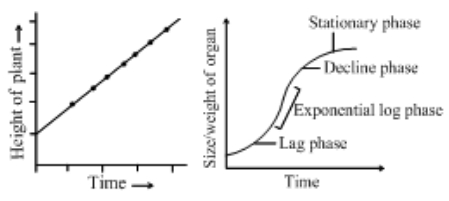
(C) developing embryo exhibits both types of growth: geometric and arithmetic.
$1$. Geometric Growth: Initially,the zygote undergoes mitotic divisions where both daughter cells retain the ability to divide. This leads to an exponential increase in cell number,characteristic of geometric growth.
$2$. Arithmetic Growth: As development proceeds,some cells lose the ability to divide and differentiate into specific tissues,while others continue to divide. This pattern,where one daughter cell remains meristematic and the other differentiates,results in arithmetic growth.
Therefore,the overall process of embryonic development involves a transition from geometric to arithmetic growth patterns.
$1$. Geometric Growth: Initially,the zygote undergoes mitotic divisions where both daughter cells retain the ability to divide. This leads to an exponential increase in cell number,characteristic of geometric growth.
$2$. Arithmetic Growth: As development proceeds,some cells lose the ability to divide and differentiate into specific tissues,while others continue to divide. This pattern,where one daughter cell remains meristematic and the other differentiates,results in arithmetic growth.
Therefore,the overall process of embryonic development involves a transition from geometric to arithmetic growth patterns.
0 likes
View Solution175
MediumMCQ
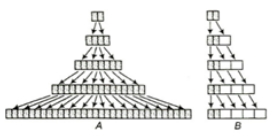
In the given diagram,what do $A$ and $B$ indicate? Choose the correct option.
A
$A-$ Mitosis; $B-$ Meiosis
B
$A-$ Arithmetic growth; $B-$ Geometric growth
C
$A-$ Geometric growth; $B-$ Arithmetic growth
D
$A-$ Multiplicative phase; $B-$ Replicative growth
Solution
(C) In the given diagram,$A$ represents geometric growth,where both daughter cells resulting from mitosis continue to divide. This leads to an exponential increase in the number of cells.
$B$ represents arithmetic growth,where only one daughter cell continues to divide,while the other differentiates and matures. This results in a linear increase in the number of cells.
$B$ represents arithmetic growth,where only one daughter cell continues to divide,while the other differentiates and matures. This results in a linear increase in the number of cells.
0 likes
View Solution176
MediumMCQ
The phase of maturation is characterised by:
$I.$ Cells attaining their maximal size
$II.$ Proper wall thickening and protoplasmic modification
$III.$ Rapid cell division
Select the correct option.
$I.$ Cells attaining their maximal size
$II.$ Proper wall thickening and protoplasmic modification
$III.$ Rapid cell division
Select the correct option.
A
$I$ and $II$
B
$II$ and $III$
C
$I$ and $III$
D
$I, II$ and $III$
Solution
(A) The phase of maturation is located further away from the apex,proximal to the phase of elongation.
In this phase,cells attain their maximal size in terms of wall thickening and protoplasmic modifications.
Rapid cell division is a characteristic of the phase of meristematic activity,not the phase of maturation.
Therefore,statements $I$ and $II$ are correct.
In this phase,cells attain their maximal size in terms of wall thickening and protoplasmic modifications.
Rapid cell division is a characteristic of the phase of meristematic activity,not the phase of maturation.
Therefore,statements $I$ and $II$ are correct.
0 likes
View Solution177
MediumMCQ
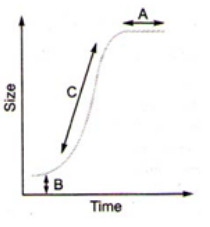
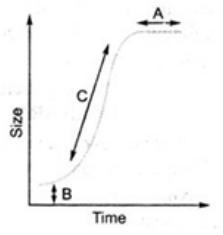
Given below is a graph drawn on the parameters of growth versus time. $A, B$ and $C$ respectively represent
A
Exponential phase,log phase and steady state phase
B
Steady state phase,lag phase and log phase
C
Slow growing phase/lag phase,log phase and steady state phase
D
Lag phase,steady state phase and log phase
Solution
(B) The graph represents the growth of an organism or population against time,resulting in an $S$-shaped or sigmoid curve.
$A$ represents the steady state phase (stationary phase),where growth slows down and eventually stops due to limited resources.
$B$ represents the lag phase,which is the initial phase of slow growth.
$C$ represents the log phase (exponential phase),where the growth rate is at its maximum.
Therefore,$A, B$ and $C$ represent the steady state phase,lag phase,and log phase respectively.
$A$ represents the steady state phase (stationary phase),where growth slows down and eventually stops due to limited resources.
$B$ represents the lag phase,which is the initial phase of slow growth.
$C$ represents the log phase (exponential phase),where the growth rate is at its maximum.
Therefore,$A, B$ and $C$ represent the steady state phase,lag phase,and log phase respectively.
0 likes
View Solution178
MediumMCQ
Maximum elongation takes place in
A
Conducting tissue
B
Fibre
C
Both $(A)$ and $(B)$
D
Cell wall and membrane
Solution
(C) Cell enlargement or elongation occurs in various plant cells.
In isodiametric parenchymatous cells,enlargement occurs in all directions.
However,in many specialized tissues,cell enlargement takes place predominantly in a linear direction,which is referred to as the phase of cell elongation.
Maximum elongation is observed in conducting tissues (like xylem vessels and tracheids) and fibres,as these cells need to extend significantly to perform their structural and transport functions.
In isodiametric parenchymatous cells,enlargement occurs in all directions.
However,in many specialized tissues,cell enlargement takes place predominantly in a linear direction,which is referred to as the phase of cell elongation.
Maximum elongation is observed in conducting tissues (like xylem vessels and tracheids) and fibres,as these cells need to extend significantly to perform their structural and transport functions.
0 likes
View Solution179
MediumMCQ
Plant growth is unique because
A
Plant retains the capacity for unlimited growth
B
Plant retains the capacity for limited growth
C
Plants have diffused growth that differs from animals
D
None of the above
Solution
(A) Plant growth is unique because plants retain the capacity for unlimited growth throughout their life.
This is primarily due to the presence of meristems at specific locations in their body.
The cells of these meristems have the capacity to divide and self-perpetuate.
This form of growth,where new cells are continuously added to the plant body by the activity of the meristem,is known as the open form of growth.
This is primarily due to the presence of meristems at specific locations in their body.
The cells of these meristems have the capacity to divide and self-perpetuate.
This form of growth,where new cells are continuously added to the plant body by the activity of the meristem,is known as the open form of growth.
0 likes
View Solution180
MediumMCQ
Intussusception is
A
Removal of old material from cell wall
B
Deposition of new material into cell wall during differentiation
C
Deposition of new material into cell wall during cell division
D
Another name of cell division
Solution
(B) During the phase of elongation or enlargement,the cell wall of the enlarging cell shows plastic extension through enzymatic loosening of microfibrils and the deposition of new material.
This process of deposition of new material into the existing cell wall is called intussusception.
This process of deposition of new material into the existing cell wall is called intussusception.
0 likes
View Solution181
MediumMCQ
$I.$ Increased vacuolation
$II.$ Cell enlargement
$III.$ New cell wall deposition
Which of the above are the characteristics of the phase of elongation?
Choose the correct option accordingly.
$II.$ Cell enlargement
$III.$ New cell wall deposition
Which of the above are the characteristics of the phase of elongation?
Choose the correct option accordingly.
A
$I$ and $II$
B
$II$ and $III$
C
$I$ and $III$
D
$I, II$ and $III$
Solution
(D) The phase of elongation is characterized by the following processes:
$(i)$ Increased vacuolation: The cells absorb water,leading to the formation of large vacuoles.
$(ii)$ Cell enlargement: The cell size increases significantly due to the influx of water and turgor pressure.
$(iii)$ New cell wall deposition: New cell wall material is synthesized and deposited to support the expanding cell.
Therefore,all three statements ($I, II,$ and $III$) are characteristics of the phase of elongation.
$(i)$ Increased vacuolation: The cells absorb water,leading to the formation of large vacuoles.
$(ii)$ Cell enlargement: The cell size increases significantly due to the influx of water and turgor pressure.
$(iii)$ New cell wall deposition: New cell wall material is synthesized and deposited to support the expanding cell.
Therefore,all three statements ($I, II,$ and $III$) are characteristics of the phase of elongation.
0 likes
View Solution182
MediumMCQ
Study the following statements:
$I.$ $O_2$ helps in releasing metabolic energy,which is essential for growth.
$II.$ Nutrients are required by plants for the synthesis of protoplasm.
$III.$ Change in temperature could be detrimental for the survival of an organism.
$IV.$ Light and gravity do not affect the stages of growth.
Choose the correct option.
$I.$ $O_2$ helps in releasing metabolic energy,which is essential for growth.
$II.$ Nutrients are required by plants for the synthesis of protoplasm.
$III.$ Change in temperature could be detrimental for the survival of an organism.
$IV.$ Light and gravity do not affect the stages of growth.
Choose the correct option.
A
$I, II, III$ and $IV$
B
$I, II$ and $III$
C
$I, III$ and $IV$
D
$I, II$ and $IV$
Solution
(B) Statement $I$ is correct because $O_2$ is essential for aerobic respiration,which releases energy required for growth.
Statement $II$ is correct because nutrients are the building blocks for the synthesis of protoplasm,which is necessary for cell division and growth.
Statement $III$ is correct because every organism has an optimum temperature range for its metabolic activities; any significant deviation can be detrimental to its survival.
Statement $IV$ is incorrect because environmental factors like light and gravity significantly influence various stages of plant growth,such as phototropism and gravitropism.
Therefore,statements $I, II,$ and $III$ are correct.
Statement $II$ is correct because nutrients are the building blocks for the synthesis of protoplasm,which is necessary for cell division and growth.
Statement $III$ is correct because every organism has an optimum temperature range for its metabolic activities; any significant deviation can be detrimental to its survival.
Statement $IV$ is incorrect because environmental factors like light and gravity significantly influence various stages of plant growth,such as phototropism and gravitropism.
Therefore,statements $I, II,$ and $III$ are correct.
0 likes
View Solution183
MediumMCQ
Which of the following structures show unlimited growth in plants?
A
Leaves
B
Flowers
C
Fruits
D
Roots
Solution
(D) Roots and stems exhibit continuous or indeterminate growth throughout their life cycle due to the presence of apical meristems at their tips.
In contrast,leaves,flowers,and fruits exhibit closed or determinate growth,meaning they stop growing after reaching a certain size.
In contrast,leaves,flowers,and fruits exhibit closed or determinate growth,meaning they stop growing after reaching a certain size.
0 likes
View Solution184
MediumMCQ
Growth of an organ is defined as
A
Infinite increase in size
B
Irreversible increase in size
C
Reversible increase in size
D
Infinite and reversible increase in size
Solution
(B) Growth is defined as an irreversible permanent increase in the size of an organ or its parts or even of an individual cell.
It is generally accompanied by metabolic processes (both anabolic and catabolic) that occur at the expense of energy.
In plants,growth is typically determinate (limited) for organs like leaves and flowers,and indeterminate for meristematic regions.
It is generally accompanied by metabolic processes (both anabolic and catabolic) that occur at the expense of energy.
In plants,growth is typically determinate (limited) for organs like leaves and flowers,and indeterminate for meristematic regions.
0 likes
View Solution185
MediumMCQ
Plant growth is unique in being
A
Closed
B
Unlimited
C
Diffuse
D
Limited
Solution
(B) Plants exhibit indeterminate or unlimited growth throughout their life cycle due to the presence of meristems at specific locations. Hence,plant growth is unique in being unlimited.
0 likes
View Solution186
MediumMCQ
Which parameter is used to measure the growth in flat organs like leaves?
A
Increase in dry weight
B
Increase in cell size
C
Increase in surface area
D
Increase in length
Solution
(C) Growth in plants can be measured by a variety of parameters depending on the organ.
For flat organs such as leaves,the most appropriate parameter to measure growth is the increase in surface area.
Other parameters like increase in dry weight,cell number,or length are used for different types of growth measurements in plants.
For flat organs such as leaves,the most appropriate parameter to measure growth is the increase in surface area.
Other parameters like increase in dry weight,cell number,or length are used for different types of growth measurements in plants.
0 likes
View Solution187
MediumMCQ
Which of the following is difficult to measure directly?
A
Increase in protoplasm content
B
Increase in surface area
C
Increase in dry weight
D
Increase in volume
Solution
(A) Growth is a complex phenomenon that can be measured by various parameters.
Increase in protoplasm content is very difficult to measure directly because it is a dynamic and internal cellular component.
In contrast,parameters like increase in surface area,increase in dry weight,and increase in volume can be measured relatively easily using standard experimental techniques.
Increase in protoplasm content is very difficult to measure directly because it is a dynamic and internal cellular component.
In contrast,parameters like increase in surface area,increase in dry weight,and increase in volume can be measured relatively easily using standard experimental techniques.
0 likes
View Solution188
MediumMCQ
Deposition of new materials inside the cell wall of cells starts in
A
Meristematic phase
B
Reproductive phase
C
Maturation phase
D
Elongation phase
Solution
(D) The growth of a plant is divided into three phases: the meristematic phase,the elongation phase,and the maturation phase.
During the elongation phase,the cells increase in size due to the deposition of new cell wall materials,such as cellulose and other polysaccharides,which provide structural support and allow for expansion.
During the elongation phase,the cells increase in size due to the deposition of new cell wall materials,such as cellulose and other polysaccharides,which provide structural support and allow for expansion.
0 likes
View Solution189
MediumMCQ
Which phase of a sigmoid curve explains the initial phase of growth when growth rate is very slow?
A
Log phase
B
Lag phase
C
Stationary phase
D
Maturation phase
Solution
(B) The sigmoid growth curve represents the growth pattern of an organism or population over time.
It consists of three main phases:
$1$. $Lag$ phase: This is the initial phase where the growth rate is very slow as the organism is adjusting to the environment.
$2$. $Log$ (or exponential) phase: This is the phase where the growth rate is maximum and rapid.
$3$. $Stationary$ phase: This is the final phase where the growth rate slows down and eventually stops due to limited resources.
Therefore,the initial phase with a very slow growth rate is the $Lag$ phase.
It consists of three main phases:
$1$. $Lag$ phase: This is the initial phase where the growth rate is very slow as the organism is adjusting to the environment.
$2$. $Log$ (or exponential) phase: This is the phase where the growth rate is maximum and rapid.
$3$. $Stationary$ phase: This is the final phase where the growth rate slows down and eventually stops due to limited resources.
Therefore,the initial phase with a very slow growth rate is the $Lag$ phase.
0 likes
View Solution190
MediumMCQ
. . . . . . curve is obtained for cells in culture.
A
$J$-shaped
B
Linear
C
$V$-shaped
D
$S$-shaped
Solution
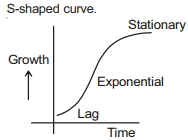
(D) When cells are grown in a culture medium with limited resources,they exhibit a characteristic growth pattern known as the sigmoid or $S$-shaped curve.
This curve consists of three distinct phases:
$1$. Lag phase: Initial slow growth as cells adapt to the environment.
$2$. Exponential (log) phase: Rapid growth where cells divide at a constant rate.
$3$. Stationary phase: Growth slows down and eventually plateaus due to the depletion of nutrients and accumulation of metabolic waste products.
Therefore,the correct answer is $S$-shaped.
This curve consists of three distinct phases:
$1$. Lag phase: Initial slow growth as cells adapt to the environment.
$2$. Exponential (log) phase: Rapid growth where cells divide at a constant rate.
$3$. Stationary phase: Growth slows down and eventually plateaus due to the depletion of nutrients and accumulation of metabolic waste products.
Therefore,the correct answer is $S$-shaped.
0 likes
View Solution191
MediumMCQ
$A$ leaf of $20 \; cm^{2}$ grows $5 \; cm^{2}$ per hour and a leaf of $25 \; cm^{2}$ grows $5 \; cm^{2}$ per hour. The relative growth rate of leaf $A$ and $B$ respectively is:
A
$25 \%$ and $20 \%$
B
$20 \%$ and $25 \%$
C
$50 \%$ and $100 \%$
D
$25 \%$ and $50 \%$
Solution
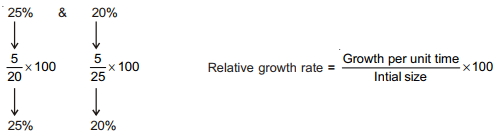
(A) The relative growth rate is calculated using the formula: $\text{Relative growth rate} = \frac{\text{Growth per unit time}}{\text{Initial size}} \times 100$.
For leaf $A$:
Initial size = $20 \; cm^{2}$,Growth = $5 \; cm^{2}/h$.
Relative growth rate = $(5 / 20) \times 100 = 25 \%$.
For leaf $B$:
Initial size = $25 \; cm^{2}$,Growth = $5 \; cm^{2}/h$.
Relative growth rate = $(5 / 25) \times 100 = 20 \%$.
Thus,the relative growth rates for leaf $A$ and $B$ are $25 \%$ and $20 \%$ respectively.
For leaf $A$:
Initial size = $20 \; cm^{2}$,Growth = $5 \; cm^{2}/h$.
Relative growth rate = $(5 / 20) \times 100 = 25 \%$.
For leaf $B$:
Initial size = $25 \; cm^{2}$,Growth = $5 \; cm^{2}/h$.
Relative growth rate = $(5 / 25) \times 100 = 20 \%$.
Thus,the relative growth rates for leaf $A$ and $B$ are $25 \%$ and $20 \%$ respectively.
0 likes
View Solution192
MediumMCQ
What happens to the growth of roots during water logging conditions?
A
Growth is accelerated
B
Growth is inhibited
C
Growth remains constant
D
First growth is accelerated and then stops
Solution
(B) Water logging leads to a decrease in the availability of oxygen in the soil,creating an anaerobic environment.
Since root growth requires aerobic respiration to generate energy for cell division and elongation,the lack of oxygen inhibits the growth of roots.
Since root growth requires aerobic respiration to generate energy for cell division and elongation,the lack of oxygen inhibits the growth of roots.
0 likes
View Solution193
MediumMCQ
Which factor determines the direction of movement of the main root and stem?
A
Oxygen
B
Gravity
C
Temperature
D
Nutrients
Solution
(B) The growth movement of plant parts in response to gravity is known as geotropism. The main root shows positive geotropism,meaning it grows towards the direction of gravity (downwards). The stem shows negative geotropism,meaning it grows away from the direction of gravity (upwards). Therefore,gravity is the factor that determines the direction of movement for both.
0 likes
View Solution194
MediumMCQ
Growth in plant organs is:
A
Qualitative and extrinsic
B
Quantitative and intrinsic
C
Qualitative and intrinsic
D
Quantitative and extrinsic
Solution
(B) Growth is defined as an irreversible permanent increase in the size of an organ or its parts or even of an individual cell. It is a quantitative increase in size,volume,or weight,which is an intrinsic process occurring within the plant body due to cell division,cell enlargement,and cell differentiation.
0 likes
View Solution195
MediumMCQ
The growth in plants differs from growth in animals in
A
Being localized and indefinite
B
Being indefinite
C
Having indefinite life span
D
Having definite life span
Solution
(A) Plant growth is unique because it is indeterminate,meaning plants retain the capacity for unlimited growth throughout their life. This is due to the presence of meristems at certain locations in their body. In contrast,animal growth is generally determinate and localized to specific developmental stages.
0 likes
View Solution196
MediumMCQ
Find out the correct statement$(s)$.
$(a)$ Growth in plants is internal/intrinsic and open-ended.
$(b)$ Formation of cellular materials is called real or protoplasmic growth.
$(c)$ Plant growth is diffused only during the early embryonic stage.
$(a)$ Growth in plants is internal/intrinsic and open-ended.
$(b)$ Formation of cellular materials is called real or protoplasmic growth.
$(c)$ Plant growth is diffused only during the early embryonic stage.
A
Only $(a)$ and $(b)$
B
$(b)$ only
C
Only $(b)$ and $(c)$
D
$(a), (b)$ and $(c)$
Solution
(A) Statement $(a)$ is correct: Plant growth is intrinsic (internal) and open-ended because plants retain the capacity for unlimited growth throughout their life due to the presence of meristems.
Statement $(b)$ is correct: The synthesis of new protoplasm and cellular materials (like cell wall components) is referred to as real or protoplasmic growth.
Statement $(c)$ is incorrect: Plant growth is not limited to the embryonic stage; it occurs throughout the life of the plant,and it is not 'diffused' in the sense implied. Meristematic activity allows for continuous growth.
Therefore,statements $(a)$ and $(b)$ are correct.
Statement $(b)$ is correct: The synthesis of new protoplasm and cellular materials (like cell wall components) is referred to as real or protoplasmic growth.
Statement $(c)$ is incorrect: Plant growth is not limited to the embryonic stage; it occurs throughout the life of the plant,and it is not 'diffused' in the sense implied. Meristematic activity allows for continuous growth.
Therefore,statements $(a)$ and $(b)$ are correct.
0 likes
View Solution197
EasyMCQ
Phytotron is
A
$A$ controlled condition chamber
B
$A$ leaf culture process
C
$A$ special culture of plants
D
$A$ root culture process
Solution
(A) Phytotron is a chamber in which plants can be grown under controlled environmental conditions to study the effects of these conditions on their growth and development.
0 likes
View Solution198
EasyMCQ
The maximum growth rate occurs in
A
Stationary phase
B
Senescence phase
C
Lag phase
D
Exponential phase
Solution
(D) In a growth curve,the exponential phase or $log$ phase is characterized by a rapid increase in population. During this phase,the growth rate is at its maximum because resources are abundant and the population doubles at a constant rate.
0 likes
View Solution199
MediumMCQ
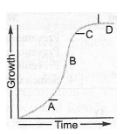
In the sigmoid growth curve,the alphabets indicate the sequence of events. Choose the correct option where the alphabet specifies the event.
A
$A-$ Phase of slow growth
$B-$ Phase of exponential growth
$C-$ Phase of diminishing growth
$D-$ Stationary phase
$B-$ Phase of exponential growth
$C-$ Phase of diminishing growth
$D-$ Stationary phase
B
$A-$ Phase of rapid growth
$B-$ Phase of diminishing growth
$C-$ Stationary phase
$D-$ Phase of slow growth
$B-$ Phase of diminishing growth
$C-$ Stationary phase
$D-$ Phase of slow growth
C
$A-$ Diminishing growth
$B-$ Exponential growth
$C-$ Slow growth
$D-$ Stationary phase
$B-$ Exponential growth
$C-$ Slow growth
$D-$ Stationary phase
D
$A-$ Stationary phase
$B-$ Phase of slow growth
$C-$ Phase of rapid growth
$D-$ Phase of diminishing growth
$B-$ Phase of slow growth
$C-$ Phase of rapid growth
$D-$ Phase of diminishing growth
Solution
(A) The sigmoid growth curve represents the growth of an organism over time,characterized by an $S-$shaped pattern.
$1$. $A$ represents the lag phase or the phase of slow growth,where the organism is adjusting to the environment.
$2$. $B$ represents the log phase or the phase of exponential growth,where the growth rate is maximum.
$3$. $C$ represents the phase of diminishing growth,where the growth rate starts to slow down due to limited resources.
$4$. $D$ represents the stationary phase,where the growth rate becomes zero as the population reaches the carrying capacity of the environment.
$1$. $A$ represents the lag phase or the phase of slow growth,where the organism is adjusting to the environment.
$2$. $B$ represents the log phase or the phase of exponential growth,where the growth rate is maximum.
$3$. $C$ represents the phase of diminishing growth,where the growth rate starts to slow down due to limited resources.
$4$. $D$ represents the stationary phase,where the growth rate becomes zero as the population reaches the carrying capacity of the environment.
0 likes
View Solution200
MediumMCQ
Exponential growth in plants can be expressed as
A
$L_{t} = L_{0} + rt$
B
$L_{t} = L_{0} e^{rt}$
C
$W_{1} = W_{0} e^{rt}$
D
$W_{t} = W_{0} e^{rt}$
Solution
(D) Exponential growth in plants is expressed by the mathematical formula:
$W_{t} = W_{0} e^{rt}$
Where:
$W_{t} =$ Final size (weight,height,number,etc.) at time $t$.
$W_{0} =$ Initial size at the beginning of the period.
$r =$ Growth rate.
$t =$ Time of growth.
$e =$ Base of natural logarithms.
In this equation,$r$ represents the relative growth rate,which is also a measure of the plant's ability to produce new plant material,often referred to as the efficiency index. Thus,the final size $W_{t}$ depends on the initial size $W_{0}$ and the exponential growth factor.
$W_{t} = W_{0} e^{rt}$
Where:
$W_{t} =$ Final size (weight,height,number,etc.) at time $t$.
$W_{0} =$ Initial size at the beginning of the period.
$r =$ Growth rate.
$t =$ Time of growth.
$e =$ Base of natural logarithms.
In this equation,$r$ represents the relative growth rate,which is also a measure of the plant's ability to produce new plant material,often referred to as the efficiency index. Thus,the final size $W_{t}$ depends on the initial size $W_{0}$ and the exponential growth factor.
0 likes
View SolutionPlant Growth and Development — Growth · Frequently Asked Questions
1Are these Plant Growth and Development questions useful for JEE and NEET?
Yes. All questions in this section are mapped to JEE Main and NEET exam patterns. Previous year questions from JEE Main, NEET, GUJCET and state-level exams are included with full solutions.
2Can I switch to Hindi or Gujarati for these questions?
Yes. Use the language tabs in the hero section or the sidebar to view the same questions and solutions in English, Hindi or Gujarati.
3How do I generate a question paper from this subtopic?
Use the Vedclass Exam Paper Generator — select the chapter and subtopic, set difficulty, and generate Sets A, B, C, D automatically. First 3 chapters of every subject are free.
Vedclass Products
For Students
Vedclass Test Series
Mock tests in real JEE/NEET style with performance analysis. 5-day free trial.
Start Free TrialFor Teachers
Exam Paper Generator
Generate Set A/B/C/D papers from this chapter in 2 minutes. 3 chapters free.
Try FreeFor Institutes
Online Exam Module
Live online exams with unlimited students, 360° analytics & white-label branding.
See DemoFor Teachers & Institutes
Generate a Plant Growth and Development Exam Paper in 2 Minutes
Select subtopic & difficulty — Sets A, B, C, D auto-generated with No Repeat logic.
First 3 chapters of every subject are free — no payment required.