
A English
The Discovery of Plant Growth Regulators Questions in English
Class 11 Biology · Plant Growth and Development · The Discovery of Plant Growth Regulators
33+
Questions
English
Language
100%
With Solutions
Showing 33 of 33 questions in English
1
MediumMCQ
The natural plant hormones were first isolated from:
A
Corn germ oil and human urine
B
Cotton fruits,spinach leaves and rice plants
C
Avena coleoptile,spinach leaves and the fungus Gibberella
D
Human urine and rice seedlings
Solution
(D) The discovery of plant growth regulators involved several key findings:
$1$. Auxins were first isolated from human urine by $F.W. Went$ and others.
$2$. Gibberellins were first discovered by $E. Kurosawa$ from the fungus $Gibberella$ $fujikuroi$ (which causes 'bakanae' disease in rice seedlings).
$3$. Cytokinins were first isolated from autoclaved herring sperm $DNA$,and later from corn germ oil (zeatin).
Therefore,the historical isolation of these natural plant hormones is primarily associated with human urine and rice seedlings (in the context of the discovery of gibberellins).
$1$. Auxins were first isolated from human urine by $F.W. Went$ and others.
$2$. Gibberellins were first discovered by $E. Kurosawa$ from the fungus $Gibberella$ $fujikuroi$ (which causes 'bakanae' disease in rice seedlings).
$3$. Cytokinins were first isolated from autoclaved herring sperm $DNA$,and later from corn germ oil (zeatin).
Therefore,the historical isolation of these natural plant hormones is primarily associated with human urine and rice seedlings (in the context of the discovery of gibberellins).
0 likes
View Solution2
EasyMCQ
Who used the term 'phytohormones' for plant hormones?
A
Balis
B
Morgan
C
Went
D
Thimann
Solution
(D) The term 'phytohormones' was introduced by Kenneth $V$. Thimann in $1948$ to describe chemical substances that regulate plant growth and development. Therefore,the correct option is $D$.
0 likes
View Solution3
MediumMCQ
Which of the following substances act as a key growth regulator?
A
$ATP$ and food
B
Hormones
C
Enzymes
D
Auxin and vitamins
Solution
(B) Plant growth regulators (PGRs),commonly known as plant hormones,are small,simple molecules of diverse chemical composition. These substances act as key regulators of plant growth and development by either promoting (e.g.,auxins,gibberellins,cytokinins) or inhibiting (e.g.,abscisic acid,ethylene) various physiological processes. Therefore,hormones are the primary substances that function as key growth regulators.
0 likes
View Solution4
MediumMCQ
Substances which originate at the tip of stem and root and control the growth of different organs are
A
Enzymes
B
Hormones
C
Vitamins
D
Food substances
Solution
(B) Plant growth regulators,commonly known as plant hormones or phytohormones,are chemical substances produced in various parts of the plant,particularly at the tips of stems and roots (apical meristems).
These substances are transported to other parts of the plant where they regulate and control physiological processes such as growth,development,and differentiation of different organs.
Examples include auxins,which are primarily synthesized at the shoot and root apices.
These substances are transported to other parts of the plant where they regulate and control physiological processes such as growth,development,and differentiation of different organs.
Examples include auxins,which are primarily synthesized at the shoot and root apices.
0 likes
View Solution5
EasyMCQ
Who for the first time speculated the presence of organ-forming substances in plants,now called hormones?
A
Darwin
B
Went
C
Yabuta
D
Sachs
Solution
(D) Julius von $Sachs$ was a German botanist who,in the late $19$th century,speculated that plants contain specific chemical substances responsible for organ formation.
He proposed that these substances are synthesized in different parts of the plant and are responsible for the growth and differentiation of organs.
These substances are now known as plant hormones or phytohormones.
He proposed that these substances are synthesized in different parts of the plant and are responsible for the growth and differentiation of organs.
These substances are now known as plant hormones or phytohormones.
0 likes
View Solution6
MediumMCQ
Which of the following techniques is employed for the separation and identification of phytohormones?
A
Polarizing microscopy
B
Autoradiography
C
Gas chromatography
D
Cell fractionation
Solution
(C) . Phytohormones are organic compounds produced in small quantities in plants. Historically, they were measured using bioassays. However, in modern analytical chemistry, techniques such as $Gas \text{ chromatography}$ $(GC)$, $High \text{ performance liquid chromatography}$ $(HPLC)$, and $Immunoassay$ techniques are primarily employed for the precise separation, identification, and quantification of these hormones.
0 likes
View Solution7
MediumMCQ
Certain chemical substances having a profound effect on growth are called
A
Catalytic agents
B
Phytohormones
C
Enzymes
D
Compost
Solution
(B) Plant growth regulators (PGRs),also known as $Phytohormones$,are small,simple molecules of diverse chemical composition.
These substances are produced naturally in plants and have a profound effect on growth and development even in very low concentrations.
Examples include auxins,gibberellins,cytokinins,ethylene,and abscisic acid.
These substances are produced naturally in plants and have a profound effect on growth and development even in very low concentrations.
Examples include auxins,gibberellins,cytokinins,ethylene,and abscisic acid.
0 likes
View Solution8
EasyMCQ
Classical experiments on growth were performed by
A
Lamarck and Boysen-Jensen
B
Boysen-Jensen and Darwin
C
Darwin and Lamarck
D
de Vries and Paul
Solution
(B) The discovery of the first plant growth hormone originated from the experiments conducted by $Charles$ $Darwin$ and his son $Francis$ $Darwin$. They observed that the coleoptile of canary grass ($Phalaris$ $canariensis$) exhibited phototropism (bending towards light) only when the tip was exposed to unilateral light.
Later, $Peter$ $Boysen-Jensen$ demonstrated that this signal was a chemical substance that could diffuse through a gelatin block, which was eventually identified as $Auxin$.
Later, $Peter$ $Boysen-Jensen$ demonstrated that this signal was a chemical substance that could diffuse through a gelatin block, which was eventually identified as $Auxin$.
0 likes
View Solution9
EasyMCQ
"Morphactins" are
A
Synthetic growth regulators
B
Synthetic auxins
C
Synthetic gibberellins
D
None of the above
Solution
(A) Morphactins are synthetic growth regulators that act in a variety of ways on the natural regulation mechanisms of plants.
They are derivatives of fluorene-$9$-carboxylic acid and are known to interfere with various physiological processes such as cell division, cell enlargement, and organ differentiation.
They are derivatives of fluorene-$9$-carboxylic acid and are known to interfere with various physiological processes such as cell division, cell enlargement, and organ differentiation.
0 likes
View Solution10
MediumMCQ
The red-far red light response is mediated by which of the following?
A
Phytochrome
B
Cryptochrome
C
Phototropin
D
Zeaxanthin
Solution
(A) The red-far red light response is a classic photomorphogenic response in plants.
This response is mediated by a pigment protein known as Phytochrome.
Phytochrome exists in two interconvertible forms: $P_r$ (which absorbs red light) and $P_{fr}$ (which absorbs far-red light).
When $P_r$ absorbs red light,it converts to $P_{fr}$,and when $P_{fr}$ absorbs far-red light,it converts back to $P_r$.
This response is mediated by a pigment protein known as Phytochrome.
Phytochrome exists in two interconvertible forms: $P_r$ (which absorbs red light) and $P_{fr}$ (which absorbs far-red light).
When $P_r$ absorbs red light,it converts to $P_{fr}$,and when $P_{fr}$ absorbs far-red light,it converts back to $P_r$.
0 likes
View Solution11
MediumMCQ
Phytohormones are:
A
Hormones regulating growth from seed to adulthood
B
Growth regulators synthesised by plants and influencing physiological processes
C
Hormones regulating flowering
D
Hormones regulating secondary growth
Solution
(B) Phytohormones,also known as plant growth regulators (PGRs),are chemical substances produced naturally by plants. They are synthesized in small quantities in various parts of the plant and are transported to other regions where they influence physiological processes such as growth,development,differentiation,and responses to environmental stimuli. Therefore,option $(b)$ is the most comprehensive and accurate definition.
0 likes
View Solution12
MediumMCQ
What are phytohormones?
A
These hormones regulate growth from seed to maturity.
B
Physiological processes in plants are induced by growth regulators.
C
Hormones regulate flowering.
D
Secondary growth is regulated by hormones.
Solution
(A) Phytohormones,also known as plant growth regulators $(PGRs)$,are chemical substances that are produced naturally in plants. They are organic compounds that regulate various physiological processes such as growth,development,and responses to environmental stimuli. These hormones control the entire life cycle of a plant,from seed germination to maturity,flowering,and senescence. Therefore,all the given options describe the functions of phytohormones,but the most comprehensive definition is that they are chemical substances that regulate growth and physiological processes throughout the plant's life cycle.
0 likes
View Solution13
EasyMCQ
What are plant hormones?
A
Chemical regulators for flowering
B
Chemical regulators for secondary growth
C
Hormones that regulate growth for seed maturation
D
Regulators synthesized by plants for physiological processes
Solution
(D) Plant hormones,also known as phytohormones,are chemical substances produced by plants that act as regulators.
They influence various physiological processes such as growth,development,and movement within the plant.
Examples include $Auxins$,$Gibberellins$,$Cytokinins$,and $Abscisic$ $acid$.
They influence various physiological processes such as growth,development,and movement within the plant.
Examples include $Auxins$,$Gibberellins$,$Cytokinins$,and $Abscisic$ $acid$.
0 likes
View Solution14
MediumMCQ
In which direction does the transport of plant hormones occur?
A
Around the site of synthesis,unidirectional.
B
From the site of synthesis to other parts,unidirectional.
C
Diffusion within the same part where synthesis occurs.
D
From roots to shoot tips and shoot tips to root tips,bidirectional.
Solution
(B) Plant hormones (phytohormones) are chemical substances produced in specific regions of the plant,such as shoot tips,root tips,or developing seeds.
Once synthesized,these hormones are transported from their site of synthesis to other target organs or tissues where they exert their physiological effects.
This transport is generally unidirectional,moving from the source (site of production) to the sink (site of action).
Once synthesized,these hormones are transported from their site of synthesis to other target organs or tissues where they exert their physiological effects.
This transport is generally unidirectional,moving from the source (site of production) to the sink (site of action).
0 likes
View Solution15
MediumMCQ
Choose the incorrect statement.
A
$PGR$ has diverse physiological effects on plants.
B
$PGR$ may act synergically or antagonistically.
C
Two $PGR$ can have same effect.
D
$PGRs$ are divided into three groups based on their functions in a living plant body.
Solution
(D) The correct answer is $D$.
$PGRs$ (Plant Growth Regulators) are not divided into three groups based on their functions.
Instead,they are broadly classified into two main groups based on their physiological roles:
$1$. Plant Growth Promoters (e.g.,auxins,gibberellins,and cytokinins) which promote growth activities like cell division,cell enlargement,and pattern formation.
$2$. Plant Growth Inhibitors (e.g.,abscisic acid) which play a role in plant responses to wounds and stresses of biotic and abiotic origin,and are involved in various growth-inhibiting activities like dormancy and abscission.
Therefore,the statement that they are divided into three groups is incorrect.
$PGRs$ (Plant Growth Regulators) are not divided into three groups based on their functions.
Instead,they are broadly classified into two main groups based on their physiological roles:
$1$. Plant Growth Promoters (e.g.,auxins,gibberellins,and cytokinins) which promote growth activities like cell division,cell enlargement,and pattern formation.
$2$. Plant Growth Inhibitors (e.g.,abscisic acid) which play a role in plant responses to wounds and stresses of biotic and abiotic origin,and are involved in various growth-inhibiting activities like dormancy and abscission.
Therefore,the statement that they are divided into three groups is incorrect.
0 likes
View Solution16
MediumMCQ
Match the following columns regarding the discovery of plant growth regulators:
Select the correct matching sequence:
| Column-$I$ | Column-$II$ |
| $A$. $F. W. Went$ | $1$. $Kinetin$ |
| $B$. $E. Kurosawa$ | $2$. $Gibberellic$ $acid$ |
| $C$. $Skoog$ $and$ $Miller$ | $3$. $Auxin$ |
| $D$. $Cousin$ | $4$. $Ethylene$ |
Select the correct matching sequence:
A
$1 - 2 - 3 - 4$
B
$3 - 2 - 1 - 4$
C
$4 - 3 - 2 - 1$
D
$3 - 2 - 4 - 1$
Solution
(B) The correct matches are as follows:
$A$. $F. W. Went$ isolated $Auxin$ from the tips of oat seedlings.
$B$. $E. Kurosawa$ discovered $Gibberellic$ $acid$ $(GA)$ from the fungus $Gibberella$ $fujikuroi$.
$C$. $Skoog$ and $Miller$ identified and crystallized the cytokinesis-promoting active substance,$Kinetin$.
$D$. $Cousin$ confirmed the release of a volatile substance from ripened oranges that hastened the ripening of stored unripened bananas,which was later identified as $Ethylene$.
Therefore,the correct sequence is $A-3, B-2, C-1, D-4$.
$A$. $F. W. Went$ isolated $Auxin$ from the tips of oat seedlings.
$B$. $E. Kurosawa$ discovered $Gibberellic$ $acid$ $(GA)$ from the fungus $Gibberella$ $fujikuroi$.
$C$. $Skoog$ and $Miller$ identified and crystallized the cytokinesis-promoting active substance,$Kinetin$.
$D$. $Cousin$ confirmed the release of a volatile substance from ripened oranges that hastened the ripening of stored unripened bananas,which was later identified as $Ethylene$.
Therefore,the correct sequence is $A-3, B-2, C-1, D-4$.
0 likes
View Solution17
MediumMCQ
What are plant growth regulators (PGRs)?
A
Chemical regulators for flowering
B
Chemical regulators for secondary growth
C
Hormones that regulate growth for seed maturation
D
Chemicals synthesized by plants to regulate physiological processes
Solution
(D) Plant growth regulators (PGRs) are small,simple molecules of diverse chemical composition. They are synthesized by plants in very small amounts and are responsible for regulating various physiological processes such as growth,development,and responses to environmental stimuli. Therefore,they are defined as chemical substances synthesized by the plant that regulate its physiological processes.
0 likes
View Solution18
Easy
Explain the properties of plant hormones by stating the characteristics of growth regulators.
Solution
(N/A) Plant growth regulators (PGRs) are small,simple molecules of diverse chemical composition.
They can be indole compounds (e.g.,$IAA$),adenine derivatives (e.g.,$kinetin$),derivatives of carotenoids (e.g.,$abscisic$ $acid$),terpenes (e.g.,$gibberellic$ $acid$),or gases (e.g.,$ethylene$).
Key characteristics of PGRs include:
$1$. They are synthesized in various parts of the plant and can be transported to other regions.
$2$. They act in very small concentrations to regulate physiological processes.
$3$. They control growth,differentiation,and development within the plant.
$4$. They can act synergistically or antagonistically to influence plant responses to environmental stimuli.
They can be indole compounds (e.g.,$IAA$),adenine derivatives (e.g.,$kinetin$),derivatives of carotenoids (e.g.,$abscisic$ $acid$),terpenes (e.g.,$gibberellic$ $acid$),or gases (e.g.,$ethylene$).
Key characteristics of PGRs include:
$1$. They are synthesized in various parts of the plant and can be transported to other regions.
$2$. They act in very small concentrations to regulate physiological processes.
$3$. They control growth,differentiation,and development within the plant.
$4$. They can act synergistically or antagonistically to influence plant responses to environmental stimuli.
0 likes
View Solution19
Easy
Explain the discovery of plant growth regulators.
Solution
(N/A) The discovery of plant growth regulators (PGRs) is a result of various observations and experiments:
$1$. Auxins: Charles Darwin and his son Francis Darwin observed that the coleoptiles of canary grass responded to unilateral illumination by growing towards the light source (phototropism). This led to the isolation of Auxin by $F$.$W$. Went from tips of oat seedlings.
$2$. Gibberellins: $E$. Kurosawa reported the appearance of symptoms of 'bakanae' (foolish seedling) disease in rice seedlings caused by the fungus Gibberella fujikuroi. The active substance was later identified as Gibberellic Acid.
$3$. Cytokinins: $F$. Skoog and Miller identified that the cytokinin (kinetin) was a modified form of adenine,which promotes cell division in tobacco pith culture.
$4$. Ethylene: $E$. Cousins confirmed the release of a volatile substance from ripened oranges that hastened the ripening of stored unripened bananas.
$5$. Abscisic Acid $(ABA)$: Three independent researchers reported the purification and chemical characterization of three different kinds of inhibitors: Inhibitor-$B$,Abscisin $II$,and Dormin. All three were later proven to be chemically identical and named Abscisic Acid.
$1$. Auxins: Charles Darwin and his son Francis Darwin observed that the coleoptiles of canary grass responded to unilateral illumination by growing towards the light source (phototropism). This led to the isolation of Auxin by $F$.$W$. Went from tips of oat seedlings.
$2$. Gibberellins: $E$. Kurosawa reported the appearance of symptoms of 'bakanae' (foolish seedling) disease in rice seedlings caused by the fungus Gibberella fujikuroi. The active substance was later identified as Gibberellic Acid.
$3$. Cytokinins: $F$. Skoog and Miller identified that the cytokinin (kinetin) was a modified form of adenine,which promotes cell division in tobacco pith culture.
$4$. Ethylene: $E$. Cousins confirmed the release of a volatile substance from ripened oranges that hastened the ripening of stored unripened bananas.
$5$. Abscisic Acid $(ABA)$: Three independent researchers reported the purification and chemical characterization of three different kinds of inhibitors: Inhibitor-$B$,Abscisin $II$,and Dormin. All three were later proven to be chemically identical and named Abscisic Acid.
0 likes
View Solution20
MediumMCQ
Describe the transport peculiarity of plant hormones.
A
They are transported only through the xylem.
B
They are transported in very small amounts and often show polar movement.
C
They are transported only through the phloem.
D
They are not transported within the plant body.
Solution
(B) $1$. Plant hormones,also known as plant growth regulators (PGRs),are chemical substances that regulate growth and development.
$2$. $A$ key peculiarity of their transport is that they are transported throughout the plant body,but in very small amounts.
$3$. Unlike nutrients which move in bulk,hormones often exhibit polar transport (unidirectional movement from the source to the sink).
$4$. When a plant part undergoes senescence,nutrients are withdrawn from those regions and moved to the growing parts,and hormones play a regulatory role in this redistribution process.
$2$. $A$ key peculiarity of their transport is that they are transported throughout the plant body,but in very small amounts.
$3$. Unlike nutrients which move in bulk,hormones often exhibit polar transport (unidirectional movement from the source to the sink).
$4$. When a plant part undergoes senescence,nutrients are withdrawn from those regions and moved to the growing parts,and hormones play a regulatory role in this redistribution process.
0 likes
View Solution21
Medium
In animals,there are special glands secreting hormones,whereas there are no glands in plants. Where are plant hormones formed? How are the hormones translocated to the site of activity?
Solution
(N/A) In plants,hormones are synthesized in various tissues such as shoot tips,root tips,meristematic tissues,developing leaves,and apical buds.
Hormones are translocated to the site of activity through the vascular tissues,specifically the $xylem$ and $phloem$.
Hormones are translocated to the site of activity through the vascular tissues,specifically the $xylem$ and $phloem$.
0 likes
View Solution22
EasyMCQ
Plant growth regulators are also described as
A
Plant growth substance
B
Plant hormones
C
Phytohormones
D
All of these
Solution
(D) Plant growth regulators $(PGRs)$ are chemical compounds that influence the growth and development of plants. They are also known as plant hormones,plant growth substances,or phytohormones. Therefore,all the given options are correct.
0 likes
View Solution23
MediumMCQ
Plant growth regulators $(PGR)$ or plant hormones are generally
A
Produced from many parts of plant
B
Produced from shoot apices and stem apices
C
Produce single effect
D
Are basic in nature
Solution
(A) $(i)$ Generally,plant hormones are produced by many parts of a plant,not just a single site.
$(ii)$ $A$ single plant hormone can produce many different physiological effects depending on the target tissue.
$(iii)$ Most plant hormones like $ABA$,auxins,and $GA$ are acidic in nature,not basic.
$(iv)$ Therefore,the correct statement is that they are produced from many parts of the plant.
$(ii)$ $A$ single plant hormone can produce many different physiological effects depending on the target tissue.
$(iii)$ Most plant hormones like $ABA$,auxins,and $GA$ are acidic in nature,not basic.
$(iv)$ Therefore,the correct statement is that they are produced from many parts of the plant.
0 likes
View Solution24
MediumMCQ
Plant growth regulators $(PGRs)$ are
A
Simple organic substances of different chemical composition
B
Complex organic substances of different chemical composition
C
Simple and complex organic substances of same chemical composition
D
Small organic substances of same chemical composition
Solution
(A) Plant growth regulators $(PGRs)$ are small,simple molecules of diverse chemical composition. They include compounds like indole compounds (e.g.,$IAA$),adenine derivatives (e.g.,$kinetin$),derivatives of carotenoids (e.g.,$ABA$),terpenes (e.g.,$GA_3$),and gases (e.g.,$ethylene$). Since they belong to different chemical classes,they are described as having different chemical compositions.
0 likes
View Solution25
Medium
Mention the characteristics and types of plant growth regulators.
Solution
(N/A) The plant growth regulators $(PGRs)$ are small,simple molecules of diverse chemical composition.
They can be indole compounds (indole-$3$-acetic acid,$IAA$); adenine derivatives ($N^{6}$-furfurylamino purine,kinetin); derivatives of carotenoids (abscisic acid,$ABA$); terpenes (gibberellic acid,$GA_{3}$); or gases (ethylene,$C_{2}H_{4}$).
Plant growth regulators are variously described as plant growth substances,plant hormones,or phytohormones in literature.
Types of $PGRs$:
The $PGRs$ can be broadly divided into two groups based on their functions in a living plant body:
$1$. Plant Growth Promoters: These are involved in growth-promoting activities,such as cell division,cell enlargement,pattern formation,tropic growth,flowering,fruiting,and seed formation. Examples include auxins,gibberellins,and cytokinins.
$2$. Plant Growth Inhibitors: The $PGRs$ of this group play an important role in plant responses to wounds and stresses of biotic and abiotic origin. They are also involved in various growth-inhibiting activities such as dormancy and abscission. Abscisic acid $(ABA)$ belongs to this group.
Note: The gaseous $PGR$,ethylene,could fit into either of the groups,but it is largely an inhibitor of growth activities.
They can be indole compounds (indole-$3$-acetic acid,$IAA$); adenine derivatives ($N^{6}$-furfurylamino purine,kinetin); derivatives of carotenoids (abscisic acid,$ABA$); terpenes (gibberellic acid,$GA_{3}$); or gases (ethylene,$C_{2}H_{4}$).
Plant growth regulators are variously described as plant growth substances,plant hormones,or phytohormones in literature.
Types of $PGRs$:
The $PGRs$ can be broadly divided into two groups based on their functions in a living plant body:
$1$. Plant Growth Promoters: These are involved in growth-promoting activities,such as cell division,cell enlargement,pattern formation,tropic growth,flowering,fruiting,and seed formation. Examples include auxins,gibberellins,and cytokinins.
$2$. Plant Growth Inhibitors: The $PGRs$ of this group play an important role in plant responses to wounds and stresses of biotic and abiotic origin. They are also involved in various growth-inhibiting activities such as dormancy and abscission. Abscisic acid $(ABA)$ belongs to this group.
Note: The gaseous $PGR$,ethylene,could fit into either of the groups,but it is largely an inhibitor of growth activities.
0 likes
View Solution26
Medium
How were different plant growth regulators discovered?
Solution
(N/A) The discovery of all five major groups of plant growth regulators occurred largely by accident.
Discovery of Auxin:
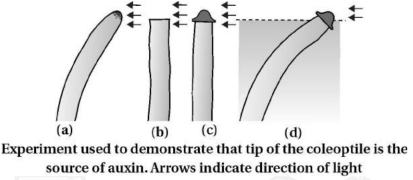
This was the first growth hormone to be discovered. Observations of canary grass coleoptiles showed they responded to unilateral illumination by growing towards the light source (a phenomenon known as phototropism). After a series of experiments,it was concluded that the coleoptile tip was the site of production of a transmittable influence that caused the bending of the entire coleoptile. The first $PGR$ in the auxin group was isolated by $F.W. Went$ in $1928$ from the coleoptile tips of oat seedlings.
Discovery of Gibberellins:
In the early $20^{th}$ century,the 'bakane' (foolish seedling) disease of rice was reported to be caused by a fungal pathogen,$Gibberella$ $fujikuroi$. Symptoms included elongated stems and little or no grain production,leading to weak plants. It was later identified that the active substance was gibberellic acid. The Japanese plant pathologist $E. Kurosawa$ reported that uninfected rice seedlings developed these symptoms when treated with sterile filtrates of the fungus.
Discovery of Cytokinins:
$F. Skoog$ and his co-workers,while studying the nutritional requirements of tissue culture derived from tobacco stem internodes,observed that the callus (a mass of undifferentiated cells) proliferated only when the nutrient medium was supplemented with extracts of vascular tissues,yeast,coconut milk,or $DNA$. It was later found that the active substance was a modified form of adenine,which was crystallized and identified as kinetin. Compounds exhibiting kinetin-like properties were termed cytokinins.
Discovery of Abscisic Acid:
During the mid-$1960s$,three independent researchers reported the purification and chemical characterization of three different inhibitors: inhibitor-$B$,abscission $II$,and dormin. Later,all three were proven to be chemically identical and were named Abscisic Acid $(ABA)$.
Discovery of Ethylene:
$Cousins$ $(1910)$ confirmed the release of a volatile substance from ripened oranges that enhanced the ripening of stored unripened bananas. This volatile substance was later identified as the gaseous plant growth regulator,ethylene.
Discovery of Auxin:
This was the first growth hormone to be discovered. Observations of canary grass coleoptiles showed they responded to unilateral illumination by growing towards the light source (a phenomenon known as phototropism). After a series of experiments,it was concluded that the coleoptile tip was the site of production of a transmittable influence that caused the bending of the entire coleoptile. The first $PGR$ in the auxin group was isolated by $F.W. Went$ in $1928$ from the coleoptile tips of oat seedlings.
Discovery of Gibberellins:
In the early $20^{th}$ century,the 'bakane' (foolish seedling) disease of rice was reported to be caused by a fungal pathogen,$Gibberella$ $fujikuroi$. Symptoms included elongated stems and little or no grain production,leading to weak plants. It was later identified that the active substance was gibberellic acid. The Japanese plant pathologist $E. Kurosawa$ reported that uninfected rice seedlings developed these symptoms when treated with sterile filtrates of the fungus.
Discovery of Cytokinins:
$F. Skoog$ and his co-workers,while studying the nutritional requirements of tissue culture derived from tobacco stem internodes,observed that the callus (a mass of undifferentiated cells) proliferated only when the nutrient medium was supplemented with extracts of vascular tissues,yeast,coconut milk,or $DNA$. It was later found that the active substance was a modified form of adenine,which was crystallized and identified as kinetin. Compounds exhibiting kinetin-like properties were termed cytokinins.
Discovery of Abscisic Acid:
During the mid-$1960s$,three independent researchers reported the purification and chemical characterization of three different inhibitors: inhibitor-$B$,abscission $II$,and dormin. Later,all three were proven to be chemically identical and were named Abscisic Acid $(ABA)$.
Discovery of Ethylene:
$Cousins$ $(1910)$ confirmed the release of a volatile substance from ripened oranges that enhanced the ripening of stored unripened bananas. This volatile substance was later identified as the gaseous plant growth regulator,ethylene.
0 likes
View Solution27
Medium
What is the role of $PGR$?
Solution
(N/A) $PGR$ (Plant Growth Regulators) play a vital role in every phase of plant growth,differentiation,and development.
These roles can be complementary or antagonistic,and they may act individually or synergistically.
In many physiological events,such as seed or bud dormancy,abscission,senescence,and apical dominance,multiple $PGRs$ interact to regulate the process.
$PGRs$ represent a form of intrinsic control within the plant.
Along with genomic control and extrinsic factors,they are essential for regulating plant growth and development.
Many extrinsic factors,such as temperature and light,influence plant growth and development by modulating the activity of $PGRs$.
Examples of such processes include vernalization,flowering,dormancy,seed germination,and plant movements.
These roles can be complementary or antagonistic,and they may act individually or synergistically.
In many physiological events,such as seed or bud dormancy,abscission,senescence,and apical dominance,multiple $PGRs$ interact to regulate the process.
$PGRs$ represent a form of intrinsic control within the plant.
Along with genomic control and extrinsic factors,they are essential for regulating plant growth and development.
Many extrinsic factors,such as temperature and light,influence plant growth and development by modulating the activity of $PGRs$.
Examples of such processes include vernalization,flowering,dormancy,seed germination,and plant movements.
0 likes
View Solution28
Medium
How were cytokinins discovered?
Solution
(N/A) $F. Skoog$ and his co-workers,while studying the nutritional requirements of tissue culture derived from the internodal segments of tobacco stems,observed that the internodal segments (a mass of undifferentiated cells called callus) proliferated only when the nutrient medium containing auxin was supplemented with extracts of vascular tissues,yeast,coconut milk (liquid endosperm of coconut),or $DNA$.
$\Rightarrow$ It was later found that the active substance was a modified form of adenine,which was crystallized and identified as kinetin.
Further,the compounds that exhibited kinetin-like properties were termed as cytokinins.
$\Rightarrow$ It was later found that the active substance was a modified form of adenine,which was crystallized and identified as kinetin.
Further,the compounds that exhibited kinetin-like properties were termed as cytokinins.
0 likes
View Solution29
Easy
Define or explain: Plant growth regulators.
Solution
(N/A) Plant growth regulators (PGRs) are small,simple molecules with diverse chemical compositions. They are specific organic compounds synthesized by plants that act as chemical messengers to regulate various physiological processes,including growth,development,and responses to environmental stimuli. Examples include auxins,gibberellins,cytokinins,abscisic acid,and ethylene.
0 likes
View Solution30
MediumMCQ
What are plant growth regulators also known as?
A
Plant growth substances
B
Plant hormones
C
Phytohormones
D
All of the above
Solution
(D) Plant growth regulators (PGRs) are small,simple molecules of diverse chemical composition. They are also referred to as plant growth substances,plant hormones,or phytohormones. These chemical compounds play a crucial role in regulating various physiological processes in plants,such as growth,development,and response to environmental stimuli. Therefore,all the given options are correct.
0 likes
View Solution31
MediumMCQ
Which scientists observed that the coleoptiles of canary grass respond to unilateral illumination by growing towards the light source?
A
Charles Darwin and Francis Darwin
B
$F. W. Went$
C
$F. Skoog$
D
Cousins
Solution
(A) Charles Darwin and his son Francis Darwin observed that the coleoptiles of canary grass $(Phalaris \text{ canariensis})$ respond to unilateral illumination by growing towards the light source (phototropism). They concluded that the tip of the coleoptile was the site of transmittable influence that caused the bending of the entire coleoptile.
0 likes
View Solution32
MediumMCQ
Match List-$I$ with List-$II$:
Choose the correct answer:
| List-$I$ | List-$II$ |
|---|---|
| $A$. Auxin | $I$. Miller et al. |
| $B$. Gibberellins | $II$. $H$.$H$. Cousins |
| $C$. Ethylene | $III$. $E$. Kurosawa |
| $D$. Cytokinin | $IV$. Charles Darwin and Francis Darwin |
Choose the correct answer:
A
$A-II, B-I, C-IV, D-III$
B
$A-IV, B-III, C-II, D-I$
C
$A-I, B-III, C-IV, D-II$
D
$A-III, B-II, C-I, D-IV$
Solution
(B) The correct matches are as follows:
$A$. Auxin: Charles Darwin and Francis Darwin observed the coleoptiles of canary grass $(IV)$.
$B$. Gibberellins: $E$. Kurosawa reported the appearance of symptoms of 'bakanae' disease in rice seedlings $(III)$.
$C$. Ethylene: $H$.$H$. Cousins confirmed the release of a volatile substance from ripened oranges that hastened the ripening of stored unripened bananas $(II)$.
$D$. Cytokinin: Miller et al. identified and crystallized the cytokinesis-promoting active substance that they termed kinetin $(I)$.
Therefore,the correct sequence is $A-IV, B-III, C-II, D-I$.
$A$. Auxin: Charles Darwin and Francis Darwin observed the coleoptiles of canary grass $(IV)$.
$B$. Gibberellins: $E$. Kurosawa reported the appearance of symptoms of 'bakanae' disease in rice seedlings $(III)$.
$C$. Ethylene: $H$.$H$. Cousins confirmed the release of a volatile substance from ripened oranges that hastened the ripening of stored unripened bananas $(II)$.
$D$. Cytokinin: Miller et al. identified and crystallized the cytokinesis-promoting active substance that they termed kinetin $(I)$.
Therefore,the correct sequence is $A-IV, B-III, C-II, D-I$.
0 likes
View Solution33
EasyMCQ
The term hormone was coined by . . . . . . .
A
$F$.$W$. Went
B
Carns and Addicott
C
Thiemann and Pincus
D
Starling
Solution
(D) The term $hormone$ was first coined by $E.H. Starling$ in $1906$ in the context of animal physiology.
These chemical messengers regulate various physiological processes in organisms.
In plants,such regulatory substances are referred to as phytohormones or plant growth regulators.
These chemical messengers regulate various physiological processes in organisms.
In plants,such regulatory substances are referred to as phytohormones or plant growth regulators.
0 likes
View SolutionPlant Growth and Development — The Discovery of Plant Growth Regulators · Frequently Asked Questions
1Are these Plant Growth and Development questions useful for JEE and NEET?
Yes. All questions in this section are mapped to JEE Main and NEET exam patterns. Previous year questions from JEE Main, NEET, GUJCET and state-level exams are included with full solutions.
2Can I switch to Hindi or Gujarati for these questions?
Yes. Use the language tabs in the hero section or the sidebar to view the same questions and solutions in English, Hindi or Gujarati.
3How do I generate a question paper from this subtopic?
Use the Vedclass Exam Paper Generator — select the chapter and subtopic, set difficulty, and generate Sets A, B, C, D automatically. First 3 chapters of every subject are free.
Vedclass Products
For Students
Vedclass Test Series
Mock tests in real JEE/NEET style with performance analysis. 5-day free trial.
Start Free TrialFor Teachers
Exam Paper Generator
Generate Set A/B/C/D papers from this chapter in 2 minutes. 3 chapters free.
Try FreeFor Institutes
Online Exam Module
Live online exams with unlimited students, 360° analytics & white-label branding.
See DemoFor Teachers & Institutes
Generate a Plant Growth and Development Exam Paper in 2 Minutes
Select subtopic & difficulty — Sets A, B, C, D auto-generated with No Repeat logic.
First 3 chapters of every subject are free — no payment required.