
A English
Development Questions in English
Class 11 Biology · Plant Growth and Development · Development
55+
Questions
English
Language
100%
With Solutions
Showing 50 of 55 questions in English
1
MediumMCQ
Leaves fall from the branches on account of
A
Completing their duration of life
B
Formation of abscission layer external to cork
C
Shortening of day time
D
Fall in atmospheric temperature
Solution
(B) The process of leaf fall is known as abscission.
At the base of the petiole,a specialized layer of thin-walled parenchymatous cells,called the abscission layer,is formed.
Enzymes like cellulase and pectinase dissolve the middle lamella and cell walls in this region,weakening the attachment of the leaf to the stem.
Simultaneously,a protective layer of suberized,thick-walled cork cells is formed on the stem side (proximal to the abscission layer) to prevent water loss and pathogen infection after the leaf falls.
At the base of the petiole,a specialized layer of thin-walled parenchymatous cells,called the abscission layer,is formed.
Enzymes like cellulase and pectinase dissolve the middle lamella and cell walls in this region,weakening the attachment of the leaf to the stem.
Simultaneously,a protective layer of suberized,thick-walled cork cells is formed on the stem side (proximal to the abscission layer) to prevent water loss and pathogen infection after the leaf falls.
0 likes
View Solution2
MediumMCQ
The sequence of steps in the history of an organism is called
A
Growth
B
Development
C
Differentiation
D
Life history
Solution
(B) $Development$ is the sequence of events that occurs in the life history of a cell, organ, or organism, which includes growth, differentiation, maturation, and senescence.
Therefore, the correct option is $B$.
Therefore, the correct option is $B$.
0 likes
View Solution3
MediumMCQ
Reversal of etiolation effect by light is called
A
Richmond Lang effect
B
Red-far red light interaction
C
Photomorphogenesis
D
Anisotropic wall expansion
Solution
(C) The reversal of etiolation by light involves two primary processes:
$1$. Biochemical level: Synthesis of chlorophyll and other pigments.
$2$. Morphogenetic level: Light promotes the expansion of leaves and the development of the shoot system.
This overall phenomenon,where light controls plant growth and development independent of photosynthesis,is known as $Photomorphogenesis$.
$1$. Biochemical level: Synthesis of chlorophyll and other pigments.
$2$. Morphogenetic level: Light promotes the expansion of leaves and the development of the shoot system.
This overall phenomenon,where light controls plant growth and development independent of photosynthesis,is known as $Photomorphogenesis$.
0 likes
View Solution4
MediumMCQ
Juvenile and adult plants are
A
Morphologically different
B
Physiologically same
C
$(a)$ and $(b)$ both
D
None of the above
Solution
(A) The juvenile phase represents the early stage of development in a plant's life cycle,while the adult phase represents the reproductive stage. These two phases often exhibit significant differences in their external appearance (morphology),such as leaf shape or branching patterns,making them morphologically different. Therefore,the correct answer is $(a)$.
0 likes
View Solution5
EasyMCQ
Formation,growth,and development of a new individual beginning from an egg is known as:
A
Embryology
B
Cytology
C
Genetics
D
Ethnobotany
Solution
(A) Embryology is the branch of biology that studies the formation,growth,and development of a new individual from an egg (zygote).
Cytology is the study of the structure and function of cells.
Genetics is the study of heredity and the variation of inherited characteristics.
Ethnobotany is the study of the relationship between people and plants.
Cytology is the study of the structure and function of cells.
Genetics is the study of heredity and the variation of inherited characteristics.
Ethnobotany is the study of the relationship between people and plants.
0 likes
View Solution6
EasyMCQ
The development of the structure and shape of an organism is known as:
A
Morphology
B
Multiplication
C
Morphogenesis
D
Budding
Solution
(C) Morphogenesis is the biological process that causes an organism to develop its shape. It involves the controlled growth and differentiation of cells and tissues during embryonic development to form specific structures and organs.
0 likes
View Solution7
EasyMCQ
Due to viral infection in green tissues of plants,there is an alteration in the normal development of chlorophyll. This is called:
A
Chlorosis
B
Necrosis
C
Yellowing
D
Mosaic
Solution
(D) When plants are infected by viruses,the normal development of chlorophyll is disrupted,leading to a patchy appearance of green and non-green areas on the leaves. This condition is known as $Mosaic$ formation. $Chlorosis$ refers to the loss of chlorophyll causing yellowing,while $Necrosis$ refers to the death of tissues. Therefore,the specific term for the pattern caused by viral infection is $Mosaic$.
0 likes
View Solution8
MediumMCQ
Which type of plants possess adaptations to check transpiration?
A
Xerophytes
B
Lithophytes
C
Halophytes
D
Epiphytes
Solution
(A) The correct answer is $A$.
$Xerophytes$ are plants adapted to survive in environments with little liquid water, such as deserts.
They possess various structural adaptations to minimize water loss through transpiration.
These adaptations include a thick cuticle, sunken stomata, and a dense covering of hairs on the epidermis.
These features create an insulating layer that reduces the rate of evaporation and helps in conserving water.
$Xerophytes$ are plants adapted to survive in environments with little liquid water, such as deserts.
They possess various structural adaptations to minimize water loss through transpiration.
These adaptations include a thick cuticle, sunken stomata, and a dense covering of hairs on the epidermis.
These features create an insulating layer that reduces the rate of evaporation and helps in conserving water.
0 likes
View Solution9
EasyMCQ
Plants growing near the seashore are an example of:
A
Halophyte
B
Mesophyte
C
Hydrophyte
D
Submerged plant
Solution
(A) Plants growing near the seashore,such as in mangrove forests,are known as halophytes.
These plants are adapted to survive in environments with high salinity (salt concentration) and often waterlogged,marshy soil conditions.
Halophytes possess specialized mechanisms to tolerate or excrete excess salt,allowing them to thrive in saline habitats where most other plants would perish.
These plants are adapted to survive in environments with high salinity (salt concentration) and often waterlogged,marshy soil conditions.
Halophytes possess specialized mechanisms to tolerate or excrete excess salt,allowing them to thrive in saline habitats where most other plants would perish.
0 likes
View Solution10
MediumMCQ
Ripened fruits become soft due to the .....
A
Conversion of starch into sugars
B
Solubilization of the middle lamella
C
Formation of organic acids
D
Conversion of fats into carbohydrates
Solution
(B) The middle lamella is a thin layer of pectin-rich material that acts as a cementing substance between the cell walls of adjacent plant cells.
During the ripening process of fruits,enzymes such as pectinases and cellulases are activated.
These enzymes break down the pectin compounds in the middle lamella,causing it to solubilize.
As the middle lamella dissolves,the adhesion between adjacent cells decreases,which leads to the softening of the fruit tissue.
During the ripening process of fruits,enzymes such as pectinases and cellulases are activated.
These enzymes break down the pectin compounds in the middle lamella,causing it to solubilize.
As the middle lamella dissolves,the adhesion between adjacent cells decreases,which leads to the softening of the fruit tissue.
0 likes
View Solution11
MediumMCQ
In hypogeal germination,which part of the embryo undergoes the greatest elongation?
A
Epicotyl
B
Radicle
C
Hypocotyl
D
Cotyledon
Solution
(A) In hypogeal germination,the cotyledons remain below the soil surface.
This occurs because the $epicotyl$ (the portion of the embryonic axis above the cotyledons) elongates rapidly,pushing the plumule out of the soil.
In contrast,in epigeal germination,the $hypocotyl$ elongates,pushing the cotyledons above the soil surface.
This occurs because the $epicotyl$ (the portion of the embryonic axis above the cotyledons) elongates rapidly,pushing the plumule out of the soil.
In contrast,in epigeal germination,the $hypocotyl$ elongates,pushing the cotyledons above the soil surface.
0 likes
View Solution12
EasyMCQ
How many times does flowering occur in a biennial plant?
A
Once
B
Twice
C
Many times
D
None
Solution
(A) biennial plant is a flowering plant that takes two years to complete its biological life cycle. In the first year,the plant grows leaves,stems,and roots. In the second year,it produces flowers,fruits,and seeds,after which the plant dies. Therefore,flowering occurs only once in the life cycle of a biennial plant.
0 likes
View Solution13
MediumMCQ
The protective layer found at the site of abscission is ..........
A
Parenchymatous
B
Collenchymatous
C
Sclerenchymatous
D
Suberized
Solution
(D) The abscission zone is the region where leaves,flowers,or fruits detach from the plant body.
During the process of abscission,a protective layer is formed to prevent water loss and pathogen entry after the organ falls off.
This layer is typically composed of suberized cells (cork cells),which are impregnated with suberin,a waxy,waterproof substance.
Therefore,the protective layer found at the site of abscission is suberized.
During the process of abscission,a protective layer is formed to prevent water loss and pathogen entry after the organ falls off.
This layer is typically composed of suberized cells (cork cells),which are impregnated with suberin,a waxy,waterproof substance.
Therefore,the protective layer found at the site of abscission is suberized.
0 likes
View Solution14
MediumMCQ
The abscission layer is composed of .........
A
Epidermal cells
B
Sclerenchymatous cells
C
Collenchymatous cells
D
Parenchymatous cells
Solution
(D) The abscission layer is a specialized zone of cells that forms at the base of a petiole, fruit stalk, or flower stalk, leading to the separation of the organ from the plant body. This layer consists of thin-walled, small, and non-lignified $Parenchymatous$ cells. During the process of abscission, the middle lamella of these cells dissolves due to the action of enzymes like cellulase and pectinase, which weakens the connection and allows the organ to fall off.
0 likes
View Solution15
MediumMCQ
Assertion $A$: Morphogenesis occurs during the process of development.
Reason $R$: Tissues are formed as a result of differentiation in embryonic cells.
Which option is correct for Assertion $A$ and Reason $R$?
Reason $R$: Tissues are formed as a result of differentiation in embryonic cells.
Which option is correct for Assertion $A$ and Reason $R$?
A
$A$ and $R$ are both true and $R$ is the correct explanation of $A$.
B
$A$ and $R$ are both true but $R$ is not the correct explanation of $A$.
C
$A$ is true and $R$ is false.
D
$A$ is false and $R$ is true.
Solution
(A) Morphogenesis is the biological process that causes an organism to develop its shape. It involves the organized movement and differentiation of cells to form tissues and organs during embryonic development.
Differentiation is the process by which less specialized cells become more specialized cell types. As embryonic cells undergo differentiation,they organize into specific tissues,which is a fundamental component of morphogenesis.
Therefore,both the assertion and the reason are true,and the reason correctly explains why morphogenesis occurs.
Differentiation is the process by which less specialized cells become more specialized cell types. As embryonic cells undergo differentiation,they organize into specific tissues,which is a fundamental component of morphogenesis.
Therefore,both the assertion and the reason are true,and the reason correctly explains why morphogenesis occurs.
0 likes
View Solution16
EasyMCQ
Development = ........
A
Growth + Morphogenesis
B
Morphogenesis + Differentiation
C
Morphogenesis + Adaptation
D
Adaptation + Differentiation
Solution
(B) In plants,development is a term that includes all changes that an organism goes through during its life cycle,from germination of the seed to senescence.
Development is defined as the sum of two processes: Morphogenesis and Differentiation.
Therefore,Development = Morphogenesis + Differentiation.
Development is defined as the sum of two processes: Morphogenesis and Differentiation.
Therefore,Development = Morphogenesis + Differentiation.
0 likes
View Solution17
EasyMCQ
Which of the following events occur during the process of development in plants?
A
Morphogenesis
B
Differentiation
C
Morphogenesis and differentiation
D
Adaptation
Solution
(C) Development is a term that includes all changes that an organism goes through during its life cycle, from germination of the seed to senescence.
In plants, development involves two major processes:
$1$. $Morphogenesis$: The process of development of form and structure.
$2$. $Differentiation$: The process by which cells derived from root apical and shoot-apical meristems and cambium differentiate and mature to perform specific functions.
Therefore, both morphogenesis and differentiation are essential components of the developmental process in plants.
In plants, development involves two major processes:
$1$. $Morphogenesis$: The process of development of form and structure.
$2$. $Differentiation$: The process by which cells derived from root apical and shoot-apical meristems and cambium differentiate and mature to perform specific functions.
Therefore, both morphogenesis and differentiation are essential components of the developmental process in plants.
0 likes
View Solution18
MediumMCQ
During which process does morphogenesis occur?
A
Growth
B
Metabolism
C
Adaptation
D
Development
Solution
(D) Morphogenesis is the biological process that causes an organism to develop its shape. It is a fundamental aspect of $Development$. During development, cells differentiate and organize into tissues and organs, establishing the body plan of the organism.
0 likes
View Solution19
MediumMCQ
Which of the following best illustrates "feedback" in development?
A
Tissue $X$ secretes $RNA$ which changes the development of tissue $Y$.
B
As tissue $X$ develops, it secretes enzymes that inhibit the development of tissue $Y$.
C
As tissue $X$ develops, it secretes something that induces tissue $Y$ to develop.
D
As tissue $X$ develops, it secretes something that slows down the growth of tissue $Y$.
Solution
(C) The correct answer is $(C)$.
Feedback in biological development refers to a process where the product or activity of one tissue influences the developmental pathway of another tissue.
Option $(C)$ describes a scenario where the development of tissue $X$ induces the development of tissue $Y$, which is a classic example of a positive feedback or inductive signaling mechanism in embryogenesis.
Feedback in biological development refers to a process where the product or activity of one tissue influences the developmental pathway of another tissue.
Option $(C)$ describes a scenario where the development of tissue $X$ induces the development of tissue $Y$, which is a classic example of a positive feedback or inductive signaling mechanism in embryogenesis.
0 likes
View Solution20
MediumMCQ
Reduction in vascular tissue,mechanical tissue and cuticle is characteristic of
A
mesophytes
B
epiphytes
C
hydrophytes
D
xerophytes
Solution
(C) The correct answer is $C$. In $hydrophytes$,the vascular tissue (xylem),mechanical tissue (sclerenchyma),and cuticle are either significantly reduced or entirely absent. This is an adaptation to their aquatic environment where water is abundant and buoyancy provides support,making extensive vascular and mechanical systems unnecessary.
0 likes
View Solution21
MediumMCQ
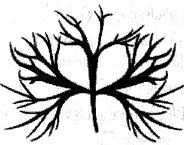
Identify the figure shown.
A
Larkspur
B
Neem
C
Buttercup
D
Coriander
Solution
(C) The figure represents the phenomenon of heterophylly in plants,which is an example of plasticity.
In $Buttercup$ (Ranunculus),the leaves produced in air are different in shape from those produced in water.
The provided image shows the dissected,finely divided leaves of the aquatic form of $Buttercup$.
In $Buttercup$ (Ranunculus),the leaves produced in air are different in shape from those produced in water.
The provided image shows the dissected,finely divided leaves of the aquatic form of $Buttercup$.
0 likes
View Solution22
MediumMCQ
Plasticity means
A
Capacity to change their shape easily
B
Process for senescence
C
To change a shape like another plant
D
Process to differentiate easily and then death
Solution
(A) Plasticity in plants refers to the ability of plants to follow different pathways or produce different structures in response to the environment or phases of life.
For example,heterophylly in cotton,coriander,and larkspur is a classic example of plasticity,where the leaves of the juvenile plant are different in shape from those in mature plants.
Therefore,plasticity is the capacity of plants to change their shape or structure in response to environmental conditions or developmental stages.
For example,heterophylly in cotton,coriander,and larkspur is a classic example of plasticity,where the leaves of the juvenile plant are different in shape from those in mature plants.
Therefore,plasticity is the capacity of plants to change their shape or structure in response to environmental conditions or developmental stages.
0 likes
View Solution23
MediumMCQ
The final structure at maturity of a cell/tissue is determined by:
A
Type of cells
B
Type of cell division
C
Location of cell within tissue
D
Nutrient in cells
Solution
(C) In plant development,the final structure at maturity of a cell or tissue is primarily determined by its location within the plant body. This is known as positional information. As cells divide and differentiate,their specific position relative to other cells and tissues provides signals that dictate their ultimate fate,shape,and function. Therefore,the correct option is $C$.
0 likes
View Solution24
MediumMCQ
Plants follow .....$A$.... pathways in response to environment or phases of life to form different kind of structures. This ability is called ....$B$...... Complete the given statement with the correct combination of options.
A
$A -$ same; $B -$ elasticity
B
$A -$ elasticity; $B -$ same
C
$A -$ different; $B -$ plasticity
D
$A -$ same; $B -$ plasticity
Solution
(C) Plants exhibit the ability to modify their growth and development in response to environmental cues or different phases of their life cycle.
This phenomenon allows them to produce different types of structures,such as heterophylly in plants like buttercup or coriander,where leaves of different shapes are produced in response to aquatic or terrestrial environments.
This capacity of plants to follow different developmental pathways is known as plasticity.
This phenomenon allows them to produce different types of structures,such as heterophylly in plants like buttercup or coriander,where leaves of different shapes are produced in response to aquatic or terrestrial environments.
This capacity of plants to follow different developmental pathways is known as plasticity.
0 likes
View Solution25
EasyMCQ
What is the term for the series of changes that occur from the larval stage to the adult stage after embryonic development?
A
Regeneration
B
Metamorphosis
C
Growth
D
Senescence
Solution
(B) The process of transformation from an immature form (larva) to an adult form in two or more distinct stages is known as $Metamorphosis$. This is commonly observed in insects like butterflies and frogs. $Regeneration$ is the ability to regrow lost body parts. $Growth$ refers to an increase in size or mass. $Senescence$ refers to the process of aging.
0 likes
View Solution26
MediumMCQ
Assertion: Senescence is the time when age-associated defects are manifested.
Reason: Certain genes may be undergoing sequential switching on and off during one's life.
Reason: Certain genes may be undergoing sequential switching on and off during one's life.
A
If both Assertion and Reason are correct and the Reason is a correct explanation of the Assertion.
B
If both Assertion and Reason are correct but Reason is not a correct explanation of the Assertion.
C
If the Assertion is correct but Reason is incorrect.
D
If both the Assertion and Reason are incorrect.
Solution
(A) Senescence refers to the period of decline in biological functions associated with aging,where age-related defects become apparent.
The programmed senescence theory suggests that aging is genetically controlled,involving the sequential activation (switching on) and inactivation (switching off) of specific genes throughout an individual's lifespan.
Therefore,the Reason correctly explains why senescence occurs as a manifestation of these genetic changes.
Thus,both Assertion and Reason are correct,and the Reason is the correct explanation of the Assertion.
The programmed senescence theory suggests that aging is genetically controlled,involving the sequential activation (switching on) and inactivation (switching off) of specific genes throughout an individual's lifespan.
Therefore,the Reason correctly explains why senescence occurs as a manifestation of these genetic changes.
Thus,both Assertion and Reason are correct,and the Reason is the correct explanation of the Assertion.
0 likes
View Solution27
Easy
Explain development in detail.
Solution
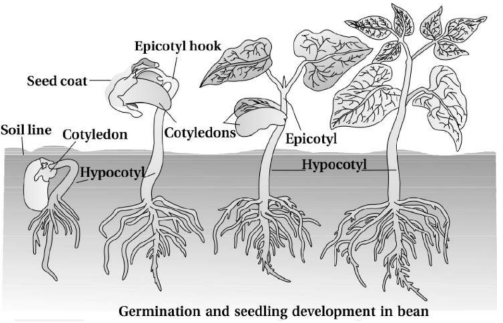
(N/A) Development $=$ Growth $+$ Differentiation.
It is essential to understand that the development of a mature plant from a zygote (fertilised egg) follows a precise and highly ordered succession of events.
During this process,a complex body organization is formed that produces roots,leaves,branches,flowers,fruits,and seeds,and eventually,the plant dies.
Developmental processes are controlled and governed by certain factors.
These factors are both intrinsic (internal) and extrinsic (external) to the plant.
It is essential to understand that the development of a mature plant from a zygote (fertilised egg) follows a precise and highly ordered succession of events.
During this process,a complex body organization is formed that produces roots,leaves,branches,flowers,fruits,and seeds,and eventually,the plant dies.
Developmental processes are controlled and governed by certain factors.
These factors are both intrinsic (internal) and extrinsic (external) to the plant.
0 likes
View Solution28
MediumMCQ
Which type of curiosity arises in our mind when we think about plants?
A
How do plants grow in height and girth?
B
Why do leaves,flowers,and fruits appear and fall periodically?
C
How do cells derived from a single zygote perform different functions?
D
All of the above
0 likes
View Solution29
Medium
Define the term 'stress' for plants. Discuss briefly the two types of stress encountered by plants.
Solution
(N/A) In plant biology,'stress' refers to any external condition that negatively impacts the plant's growth,development,or productivity. These conditions deviate from the optimal range required for normal physiological processes.
The two main types of stress are:
$1$. Abiotic Stress: These are non-living environmental factors that cause stress,such as drought (water deficit),salinity (high salt concentration),extreme temperatures (cold or heat),and heavy metal toxicity.
$2$. Biotic Stress: These are stresses caused by living organisms,such as pathogens (bacteria,fungi,viruses),pests (insects),and competition from weeds.
The two main types of stress are:
$1$. Abiotic Stress: These are non-living environmental factors that cause stress,such as drought (water deficit),salinity (high salt concentration),extreme temperatures (cold or heat),and heavy metal toxicity.
$2$. Biotic Stress: These are stresses caused by living organisms,such as pathogens (bacteria,fungi,viruses),pests (insects),and competition from weeds.
0 likes
View Solution30
EasyMCQ
Select the correct option regarding senescence (aging).
A
Metabolism becomes faster.
B
Metabolism slows down.
C
Digestion becomes faster.
D
Gradual increase in body agility.
Solution
(B) Senescence or aging is the final phase of the life cycle of an organism. During this phase,the metabolic activities of the body slow down,leading to a decline in physiological functions. Therefore,the correct option is that metabolism slows down.
0 likes
View Solution31
MediumMCQ
$A$ gradual decrease in the size of the tail during metamorphosis in the life cycle of a frog is a good example of:
A
Programmed cell death
B
Cell necrosis
C
Cell senescence
D
Pinocytic activity
Solution
(A) During the metamorphosis of a frog,the tadpole undergoes significant physiological changes. The gradual reduction and eventual disappearance of the tail is a classic example of programmed cell death,also known as apoptosis. This process is triggered by thyroid hormones ($T_{3}$ and $T_{4}$),which signal the cells of the tail to undergo controlled self-destruction,allowing the nutrients to be recycled for the development of other adult structures.
0 likes
View Solution32
MediumMCQ
Go through the following pairs and choose the correct pairs from the options given below:
| $I$. Nerium | Sunken stomata | Lower epidermis of leaves to reduce loss of water |
| $II$. Calotropis | Non-succulent | Root cells with thickened cell walls |
| $III$. Peperomia | Leaf succulent | Leaf epidermal cell,store water |
| $IV$. Ammophila | Dicot | Curl their leaves to minimise loss of water |
| $V$. Tribulus | Ephemeral | Water is stored in stem |
A
All pairs are correct
B
$I, II$ and $III$ are correct pairs
C
$IV$ and $V$ pairs are correct
D
$I, IV$ and $V$ are correct pairs only
Solution
(B) Plants growing in xeric habitats exhibit various adaptations to minimize water loss.
$I$. Nerium is a classic xerophyte that possesses sunken stomata in the lower epidermis of its leaves to reduce transpiration.
$II$. Calotropis is a non-succulent xerophyte that survives in dry conditions through structural adaptations.
$III$. Peperomia is a leaf succulent that stores water in its leaf epidermal cells.
$IV$. Ammophila (Marram grass) is a monocot,not a dicot,that curls its leaves to minimize water loss.
$V$. Tribulus is an ephemeral plant that completes its life cycle during the rainy season; it does not store water in its stem.
Therefore,pairs $I, II,$ and $III$ are correct.
$I$. Nerium is a classic xerophyte that possesses sunken stomata in the lower epidermis of its leaves to reduce transpiration.
$II$. Calotropis is a non-succulent xerophyte that survives in dry conditions through structural adaptations.
$III$. Peperomia is a leaf succulent that stores water in its leaf epidermal cells.
$IV$. Ammophila (Marram grass) is a monocot,not a dicot,that curls its leaves to minimize water loss.
$V$. Tribulus is an ephemeral plant that completes its life cycle during the rainy season; it does not store water in its stem.
Therefore,pairs $I, II,$ and $III$ are correct.
0 likes
View Solution33
EasyMCQ
The deteriorative processes in plants that naturally terminate their functional life are collectively called
A
Wilting
B
Abscission
C
Plasmolysis
D
Senescence
Solution
(D) Senescence occurs prior to the death of an organ or organism.
It is defined as the total sum of deteriorative processes that naturally terminate the functional life of an organism or its parts.
It is defined as the total sum of deteriorative processes that naturally terminate the functional life of an organism or its parts.
0 likes
View Solution34
MediumMCQ
$I.$ Plasmatic growth
$II.$ Differentiation
$III.$ Maturation
$IV.$ Senescence
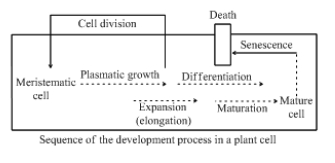
Identify the correct sequence of the following events occurring in plants and choose the correct option accordingly.
$II.$ Differentiation
$III.$ Maturation
$IV.$ Senescence
Identify the correct sequence of the following events occurring in plants and choose the correct option accordingly.
A
$I \rightarrow II \rightarrow III \rightarrow IV$
B
$I \rightarrow II \rightarrow IV \rightarrow III$
C
$IV \rightarrow III \rightarrow II \rightarrow I$
D
$IV \rightarrow I \rightarrow II \rightarrow III$
Solution
(A) Development is a term that includes all changes that an organism goes through during its life cycle from the germination of the seed to senescence.
According to the developmental sequence in a plant cell,the process starts with plasmatic growth,followed by differentiation,then maturation,and finally senescence leading to death.
Therefore,the correct sequence is $I \rightarrow II \rightarrow III \rightarrow IV$.
According to the developmental sequence in a plant cell,the process starts with plasmatic growth,followed by differentiation,then maturation,and finally senescence leading to death.
Therefore,the correct sequence is $I \rightarrow II \rightarrow III \rightarrow IV$.
0 likes
View Solution35
MediumMCQ
The ability of a plant to follow different pathways and produce different structures in response to the environment is known as:
A
Heterophylly
B
Plasticity
C
Efficiency index
D
Vernalisation
Solution
(B) Plants follow different pathways in response to the environment or phases of life to form different kinds of structures. This ability is called $Plasticity$.
For example,heterophylly in cotton,coriander,and larkspur is a classic example of plasticity where leaves of the juvenile plant and mature plant are different in shape.
$Heterophylly$ is a specific type of plasticity,whereas $Plasticity$ is the broader term for the ability to change structure in response to environmental cues.
For example,heterophylly in cotton,coriander,and larkspur is a classic example of plasticity where leaves of the juvenile plant and mature plant are different in shape.
$Heterophylly$ is a specific type of plasticity,whereas $Plasticity$ is the broader term for the ability to change structure in response to environmental cues.
0 likes
View Solution36
MediumMCQ
Larkspur,$Ranunculus$,and cotton plants are similar in the presence of
A
Developmental heterophylly
B
Plasticity
C
Environmental heterophylly
D
Homospory
Solution
(B) Plasticity is defined as the ability of plants to follow different pathways in response to the environment or phases of life to form different kinds of structures.
In $Larkspur$,$Ranunculus$,and cotton,the leaves of the juvenile plant are different in shape from those in mature plants. This phenomenon is known as heterophylly,which is a type of plasticity.
In $Larkspur$,$Ranunculus$,and cotton,the leaves of the juvenile plant are different in shape from those in mature plants. This phenomenon is known as heterophylly,which is a type of plasticity.
0 likes
View Solution37
MediumMCQ
Suitable environmental conditions for seed germination are
A
Adequate moisture,light,anaerobic conditions
B
Adequate moisture,low temperature,light
C
Adequate moisture,suitable temperature and oxygen
D
Light,water,absence of oxygen
Solution
(C) Seed germination is a metabolic process that requires energy.
$1$. Adequate moisture (water) is essential for the activation of enzymes and the softening of the seed coat.
$2$. Suitable temperature is required for the optimal activity of enzymes involved in respiration and mobilization of stored food.
$3$. Oxygen $(O_2)$ is necessary for aerobic respiration to provide the energy required for the growth of the embryo.
Therefore,the correct combination is adequate moisture,suitable temperature,and oxygen.
$1$. Adequate moisture (water) is essential for the activation of enzymes and the softening of the seed coat.
$2$. Suitable temperature is required for the optimal activity of enzymes involved in respiration and mobilization of stored food.
$3$. Oxygen $(O_2)$ is necessary for aerobic respiration to provide the energy required for the growth of the embryo.
Therefore,the correct combination is adequate moisture,suitable temperature,and oxygen.
0 likes
View Solution38
MediumMCQ
$A$: Development is the emergence of a multicellular organism from a single group of cells.
$R$: Development involves growth,differentiation,and morphogenesis.
$R$: Development involves growth,differentiation,and morphogenesis.
A
Assertion and Reason both are correct and Reason is the correct explanation of Assertion.
B
Assertion and Reason both are correct but Reason is not the correct explanation of Assertion.
C
Assertion is correct,but Reason is incorrect.
D
Both Assertion and Reason are incorrect.
Solution
(C) The Assertion is incorrect because development is the emergence of a multicellular organism from a single cell (the zygote),not a group of cells.
The Reason is correct because biological development involves three fundamental processes: growth (increase in size/number of cells),differentiation (specialization of cells),and morphogenesis (the development of the shape and structure of the organism).
Since the Assertion is false and the Reason is true,the correct option is $C$.
The Reason is correct because biological development involves three fundamental processes: growth (increase in size/number of cells),differentiation (specialization of cells),and morphogenesis (the development of the shape and structure of the organism).
Since the Assertion is false and the Reason is true,the correct option is $C$.
0 likes
View Solution39
MediumMCQ
Differentiation of various tissues and organs in response to light is called
A
Morphogenesis
B
Photomorphogenesis
C
Organogenesis
D
Embryogenesis
Solution
(B) In plants,growth is influenced by the availability of food,light intensity,and light quality.
$Photomorphogenesis$ is defined as the light-mediated development of plants,where light acts as a signal to control the differentiation of various tissues and organs.
For example,the development of leaves,stems,and roots is regulated by light signals perceived by photoreceptors like phytochromes and cryptochromes.
Therefore,the differentiation of tissues and organs in response to light is specifically termed $Photomorphogenesis$.
$Photomorphogenesis$ is defined as the light-mediated development of plants,where light acts as a signal to control the differentiation of various tissues and organs.
For example,the development of leaves,stems,and roots is regulated by light signals perceived by photoreceptors like phytochromes and cryptochromes.
Therefore,the differentiation of tissues and organs in response to light is specifically termed $Photomorphogenesis$.
0 likes
View Solution40
MediumMCQ
Plants follow different pathways in response to the environment or phases of life to form different kinds of structures. This ability is called:
A
Elasticity
B
Plasticity
C
Flexibility
D
Maturity
Solution
(B) Plants exhibit the ability to alter their developmental pathways in response to the environment or phases of life,leading to the formation of different kinds of structures. This phenomenon is known as $Plasticity$.
For example,heterophylly in $Larkspur$,$Buttercup$,and $Cotton$ is a classic example of plasticity,where the leaves produced in juvenile phases are different in shape from those produced in mature phases.
For example,heterophylly in $Larkspur$,$Buttercup$,and $Cotton$ is a classic example of plasticity,where the leaves produced in juvenile phases are different in shape from those produced in mature phases.
1 likes
View Solution41
Medium
Write a short note on: Development.
Solution
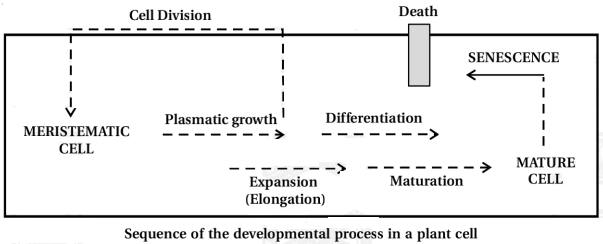
(N/A) Development is a term that includes all changes that an organism undergoes during its life cycle,from the germination of the seed to senescence.
The sequence of processes that constitute the development of a cell in higher plants is represented as follows: Meristematic cell $\rightarrow$ Plasmatic growth $\rightarrow$ Expansion (Elongation) $\rightarrow$ Differentiation $\rightarrow$ Maturation $\rightarrow$ Mature cell $\rightarrow$ Senescence $\rightarrow$ Death.
This process is also applicable to tissues and organs.
In broad terms,development is the sum total of both growth and differentiation in plants.
The developmental process of growth and differentiation is controlled by several intrinsic and extrinsic factors:
$(i)$ Intrinsic factors: These include both intracellular (genetic) or intercellular factors (such as plant growth regulators).
$(ii)$ Extrinsic factors: These include light,temperature,water,oxygen,nutrition,etc.
The sequence of processes that constitute the development of a cell in higher plants is represented as follows: Meristematic cell $\rightarrow$ Plasmatic growth $\rightarrow$ Expansion (Elongation) $\rightarrow$ Differentiation $\rightarrow$ Maturation $\rightarrow$ Mature cell $\rightarrow$ Senescence $\rightarrow$ Death.
This process is also applicable to tissues and organs.
In broad terms,development is the sum total of both growth and differentiation in plants.
The developmental process of growth and differentiation is controlled by several intrinsic and extrinsic factors:
$(i)$ Intrinsic factors: These include both intracellular (genetic) or intercellular factors (such as plant growth regulators).
$(ii)$ Extrinsic factors: These include light,temperature,water,oxygen,nutrition,etc.
0 likes
View Solution42
Medium
What is plasticity? Give examples.
Solution
(N/A) Plasticity is the ability of plants to follow different pathways in response to the environment or phases of life,resulting in the formation of different kinds of structures. This phenomenon is known as plasticity.
Examples of plasticity:
$1$. Heterophylly in plants like cotton,coriander,and larkspur: In these plants,the leaves of the juvenile plant are different in shape from those in mature plants.
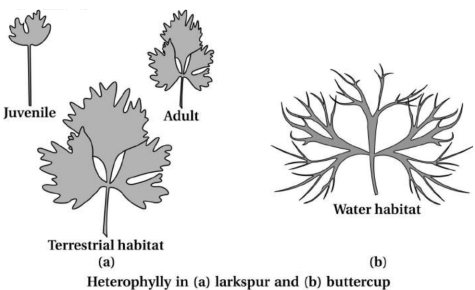
$2$. Environmental heterophylly in buttercup: The difference in the shapes of leaves produced in air versus those produced in water represents heterophyllous development due to the environment.
These examples demonstrate how plants adapt their morphology based on their life stage or environmental conditions.
Examples of plasticity:
$1$. Heterophylly in plants like cotton,coriander,and larkspur: In these plants,the leaves of the juvenile plant are different in shape from those in mature plants.
$2$. Environmental heterophylly in buttercup: The difference in the shapes of leaves produced in air versus those produced in water represents heterophyllous development due to the environment.
These examples demonstrate how plants adapt their morphology based on their life stage or environmental conditions.
0 likes
View Solution43
Medium
Differentiate between Senescence and Ageing.
Solution
(N/A)
| Senescence | Ageing |
|---|---|
| $(1)$ It refers to all collective,progressive,and deteriorative processes which ultimately lead to a complete loss of organization and function. | $(1)$ It includes all the chemical and structural changes that occur during the life span of a plant or its organ. |
| $(2)$ It includes only degenerative and deteriorative changes in a plant or its parts. | $(2)$ It is the sum total of metabolic changes that occur in a plant or its parts. |
| $(3)$ Senescence occurs as a result of ageing and leads to death. | $(3)$ Ageing is a permanent feature of all living organisms. |
0 likes
View Solution44
Easy
Define/Explain: Senescence/Ageing.
Solution
(N/A) Senescence is the final phase of the life cycle of an organism,occurring between the period of complete maturation and the death of the individual. It is characterized by progressive deterioration in structure and function,commonly referred to as ageing.
0 likes
View Solution45
MediumMCQ
Which one of the following plants does not show plasticity?
A
Coriander
B
Buttercup
C
Maize
D
Cotton
Solution
(C) Plasticity is the ability of plants to follow different pathways in response to the environment or phases of life to form different kinds of structures. This ability is known as plasticity.
Plants like $Coriander$,$Buttercup$,and $Cotton$ exhibit heterophylly,which is a form of plasticity where leaves of different shapes are produced in response to different environmental conditions (e.g.,terrestrial vs. aquatic habitats).
$Maize$ does not exhibit this type of plasticity in its leaf structure. Therefore,the correct answer is $Maize$.
Plants like $Coriander$,$Buttercup$,and $Cotton$ exhibit heterophylly,which is a form of plasticity where leaves of different shapes are produced in response to different environmental conditions (e.g.,terrestrial vs. aquatic habitats).
$Maize$ does not exhibit this type of plasticity in its leaf structure. Therefore,the correct answer is $Maize$.
0 likes
View Solution46
MediumMCQ
Select the incorrect statement for higher plants.
A
Leaves,flowers,and fruits on the same plant have the same limited life span.
B
The development of a mature tree occurs from a zygote.
C
All plant organs are made up of various types of tissues.
D
Development = Growth + Differentiation
Solution
(A) In higher plants,different organs such as leaves,flowers,and fruits exhibit different life spans even when they are present on the same plant.
Therefore,the statement that they have the same limited life span is incorrect.
Development in plants is defined as the sum of growth and differentiation.
$A$ mature tree develops from a single-celled zygote through the processes of cell division,growth,and differentiation.
All plant organs are composed of various types of tissues that perform specialized functions.
Therefore,the statement that they have the same limited life span is incorrect.
Development in plants is defined as the sum of growth and differentiation.
$A$ mature tree develops from a single-celled zygote through the processes of cell division,growth,and differentiation.
All plant organs are composed of various types of tissues that perform specialized functions.
0 likes
View Solution47
MediumMCQ
Select the correct option regarding plant development.
A
Development $=$ Growth $+$ Differentiation
B
Differentiation $=$ Growth $+$ Development
C
Growth $=$ Development $+$ Differentiation
D
None of these.
Solution
(A) In plants,development is a term that includes all changes that an organism goes through during its life cycle,from germination of the seed to senescence.
It is fundamentally the sum of two processes: growth and differentiation.
Growth refers to an irreversible increase in size,while differentiation refers to the maturation of cells into specialized structures.
Therefore,the correct equation is: Development $=$ Growth $+$ Differentiation.
It is fundamentally the sum of two processes: growth and differentiation.
Growth refers to an irreversible increase in size,while differentiation refers to the maturation of cells into specialized structures.
Therefore,the correct equation is: Development $=$ Growth $+$ Differentiation.
0 likes
View Solution48
MediumMCQ
Which of the following are examples of plasticity in plants?
A
Heterophylly in cotton and coriander
B
Heterophylly in larkspur and buttercup
C
Heterophylly in buttercup
D
All of the above
Solution
(D) Plasticity refers to the ability of plants to follow different pathways in response to the environment or phases of life to form different kinds of structures. This ability is called plasticity.
Examples of plasticity include:
$1$. Heterophylly in cotton,coriander,and larkspur: In these plants,the leaves of the juvenile plant are different in shape from those in mature plants.
$2$. Heterophylly in buttercup: In this plant,the leaves produced in air and those produced in water have different shapes.
Since all the mentioned examples represent different forms of plasticity,the correct answer is $D$.
Examples of plasticity include:
$1$. Heterophylly in cotton,coriander,and larkspur: In these plants,the leaves of the juvenile plant are different in shape from those in mature plants.
$2$. Heterophylly in buttercup: In this plant,the leaves produced in air and those produced in water have different shapes.
Since all the mentioned examples represent different forms of plasticity,the correct answer is $D$.
0 likes
View Solution49
MediumMCQ
Identify the factors affecting development in plants.
A
Extrinsic factors: Light,water,oxygen,nutrients; Intrinsic factors: Temperature,genes,growth regulators.
B
Extrinsic factors: Genes,growth regulators; Intrinsic factors: Light,water,oxygen,temperature,nutrients.
C
Extrinsic factors: Light,water,oxygen,temperature,nutrients; Intrinsic factors: Genes,growth regulators.
D
Extrinsic factors: Temperature,genes,growth regulators; Intrinsic factors: Light,water,oxygen,nutrients.
Solution
(C) Plant development is controlled by two main types of factors:
$1$. Intrinsic factors: These are internal factors such as genetic constitution (genes) and intracellular factors like plant growth regulators (PGRs).
$2$. Extrinsic factors: These are external environmental factors such as light,temperature,water,oxygen,and mineral nutrients.
Therefore,option $C$ correctly categorizes these factors.
$1$. Intrinsic factors: These are internal factors such as genetic constitution (genes) and intracellular factors like plant growth regulators (PGRs).
$2$. Extrinsic factors: These are external environmental factors such as light,temperature,water,oxygen,and mineral nutrients.
Therefore,option $C$ correctly categorizes these factors.
0 likes
View Solution50
EasyMCQ
Identify the correct sequence of events in the life cycle of a plant from beginning to end.
A
Seed germination $\rightarrow$ Senescent phase $\rightarrow$ Vegetative phase $\rightarrow$ Reproductive phase $\rightarrow$ Death
B
Seed germination $\rightarrow$ Reproductive phase $\rightarrow$ Senescent phase $\rightarrow$ Vegetative phase $\rightarrow$ Death
C
Seed germination $\rightarrow$ Reproductive phase $\rightarrow$ Vegetative phase $\rightarrow$ Senescent phase $\rightarrow$ Death
D
Seed germination $\rightarrow$ Vegetative phase $\rightarrow$ Reproductive phase $\rightarrow$ Senescent phase $\rightarrow$ Death
Solution
(D) The life cycle of a plant follows a specific biological progression:
$1$. Seed germination: The process by which a seed develops into a new plant.
$2$. Vegetative phase: The period of growth where the plant develops roots,stems,and leaves.
$3$. Reproductive phase: The period where the plant produces flowers,fruits,and seeds.
$4$. Senescent phase: The aging phase where metabolic activities decline.
$5$. Death: The final stage of the life cycle.
Therefore,the correct sequence is: Seed germination $\rightarrow$ Vegetative phase $\rightarrow$ Reproductive phase $\rightarrow$ Senescent phase $\rightarrow$ Death.
$1$. Seed germination: The process by which a seed develops into a new plant.
$2$. Vegetative phase: The period of growth where the plant develops roots,stems,and leaves.
$3$. Reproductive phase: The period where the plant produces flowers,fruits,and seeds.
$4$. Senescent phase: The aging phase where metabolic activities decline.
$5$. Death: The final stage of the life cycle.
Therefore,the correct sequence is: Seed germination $\rightarrow$ Vegetative phase $\rightarrow$ Reproductive phase $\rightarrow$ Senescent phase $\rightarrow$ Death.
0 likes
View SolutionPlant Growth and Development — Development · Frequently Asked Questions
1Are these Plant Growth and Development questions useful for JEE and NEET?
Yes. All questions in this section are mapped to JEE Main and NEET exam patterns. Previous year questions from JEE Main, NEET, GUJCET and state-level exams are included with full solutions.
2Can I switch to Hindi or Gujarati for these questions?
Yes. Use the language tabs in the hero section or the sidebar to view the same questions and solutions in English, Hindi or Gujarati.
3How do I generate a question paper from this subtopic?
Use the Vedclass Exam Paper Generator — select the chapter and subtopic, set difficulty, and generate Sets A, B, C, D automatically. First 3 chapters of every subject are free.
Vedclass Products
For Students
Vedclass Test Series
Mock tests in real JEE/NEET style with performance analysis. 5-day free trial.
Start Free TrialFor Teachers
Exam Paper Generator
Generate Set A/B/C/D papers from this chapter in 2 minutes. 3 chapters free.
Try FreeFor Institutes
Online Exam Module
Live online exams with unlimited students, 360° analytics & white-label branding.
See DemoFor Teachers & Institutes
Generate a Plant Growth and Development Exam Paper in 2 Minutes
Select subtopic & difficulty — Sets A, B, C, D auto-generated with No Repeat logic.
First 3 chapters of every subject are free — no payment required.