
A English
Auxin Questions in English
Class 11 Biology · Plant Growth and Development · Auxin
251+
Questions
English
Language
100%
With Solutions
Showing 50 of 251 questions in English
1
MediumMCQ
Which of the following is the best explanation for the excurrent $(pyramidal)$ shape of $Pinus$ (the branches giving the plant the appearance of a tall cone)?
A
Competition among adjoining trees for sunlight
B
The effect of auxins on growth of stem tips
C
Adaptation for wind pollination
D
Efficiency of water transport from ground to leaves
Solution
(B) The excurrent or pyramidal shape of $Pinus$ is primarily due to the phenomenon of apical dominance.
Apical dominance is controlled by the hormone auxin,which is produced in the terminal buds (stem tips).
This hormone inhibits the growth of lateral buds,causing the main stem to grow vertically much faster than the side branches.
As a result,the branches are shorter at the top and longer at the bottom,giving the tree its characteristic conical or pyramidal appearance.
Apical dominance is controlled by the hormone auxin,which is produced in the terminal buds (stem tips).
This hormone inhibits the growth of lateral buds,causing the main stem to grow vertically much faster than the side branches.
As a result,the branches are shorter at the top and longer at the bottom,giving the tree its characteristic conical or pyramidal appearance.
0 likes
View Solution2
MediumMCQ
Maximum amount of growth in roots occurs due to
A
Auxins
B
Root cap region
C
Presence of light
D
Darkness
Solution
(A) Auxins are plant hormones that play a crucial role in root development.
In roots,low concentrations of auxins promote cell elongation and growth.
While high concentrations of auxins inhibit root growth,the physiological process of root elongation is primarily regulated by the distribution and activity of auxins within the root tissues.
In roots,low concentrations of auxins promote cell elongation and growth.
While high concentrations of auxins inhibit root growth,the physiological process of root elongation is primarily regulated by the distribution and activity of auxins within the root tissues.
0 likes
View Solution3
EasyMCQ
The function of zinc is:
A
Synthesis of chlorophyll
B
Biosynthesis of $IAA$
C
Closing of stomata
D
Oxidation of carbohydrate
Solution
(B) Zinc $(Zn^{2+})$ is essential for the synthesis of tryptophan,which is a precursor of indole$-3-$acetic acid $(IAA)$,a major plant hormone belonging to the auxin group. Therefore,zinc plays a critical role in the biosynthesis of $IAA$.
0 likes
View Solution4
EasyMCQ
Which of the following trace elements is essential for auxin synthesis in plants?
A
Molybdenum
B
Chlorine
C
Zinc
D
Boron
Solution
(C) Zinc is a crucial micronutrient required by plants for various physiological processes.
One of its most significant roles is in the biosynthesis of the plant growth hormone auxin,specifically Indole$-3-$Acetic Acid $(IAA)$.
Zinc acts as a cofactor for enzymes involved in the synthesis of tryptophan,which is the primary precursor amino acid for $IAA$ production.
One of its most significant roles is in the biosynthesis of the plant growth hormone auxin,specifically Indole$-3-$Acetic Acid $(IAA)$.
Zinc acts as a cofactor for enzymes involved in the synthesis of tryptophan,which is the primary precursor amino acid for $IAA$ production.
0 likes
View Solution5
MediumMCQ
Grass coleoptile tips bend towards the source of light because:
A
It likes the sun
B
It is heavy
C
It needs darkness
D
Due to some secretion from the tip
Solution
(D) . Charles Darwin and his son Francis Darwin observed that the coleoptile of canary grass responded to unilateral illumination by growing towards the light source. Later,Peter Boysen-Jensen demonstrated that this response was due to the migration of a chemical substance produced at the tip,which was subsequently identified as auxin. Auxin accumulates on the shaded side of the coleoptile,causing cells on that side to elongate more rapidly than those on the illuminated side,resulting in the bending of the coleoptile towards the light.
0 likes
View Solution6
MediumMCQ
By hormone application,it is possible to obtain seedless fruits. In which of the following is it $NOT$ desirable to obtain seedless fruits?
A
Tomato
B
Orange
C
Watermelon
D
Pomegranate
Solution
(D) The process of producing seedless fruits through hormone application is known as parthenocarpy.
In many fruits like tomato,orange,and watermelon,seedless varieties are commercially desirable and preferred by consumers.
However,in pomegranate $(Anar)$,the edible part is the juicy seed coat (aril).
Therefore,obtaining seedless fruits in pomegranate is not desirable because the seeds are the primary edible component.
In many fruits like tomato,orange,and watermelon,seedless varieties are commercially desirable and preferred by consumers.
However,in pomegranate $(Anar)$,the edible part is the juicy seed coat (aril).
Therefore,obtaining seedless fruits in pomegranate is not desirable because the seeds are the primary edible component.
0 likes
View Solution7
MediumMCQ
Leaf fall occurs when the abscission layer is formed due to a change in the content of:
A
Auxin increases
B
Auxin decreases
C
Abscisic acid decreases
D
Gibberellic acid decreases
Solution
(B) Auxin inhibits the abscission of leaves and fruits. The abscission layer is formed when the concentration of auxin in the leaf petiole falls below a critical minimum level,which triggers the enzymatic degradation of the cell walls in the abscission zone.
0 likes
View Solution8
MediumMCQ
Auxins were discovered by
A
Thimann
B
Went
C
Butler
D
Skoog
Solution
(B) The first isolation of auxins was reported by $F.W. \text{Went}$ from the tips of oat seedlings $(Avena \text{ sativa})$.
$F.W. \text{Went}$ successfully extracted the growth-promoting substance, which he named auxin, using the agar diffusion method.
Therefore, the correct answer is $B$.
$F.W. \text{Went}$ successfully extracted the growth-promoting substance, which he named auxin, using the agar diffusion method.
Therefore, the correct answer is $B$.
0 likes
View Solution9
MediumMCQ
Apical dominance in higher plants is due to
A
Balance between auxin and cytokinin
B
Enzyme activity and metabolism
C
Carbohydrates
D
Photoperiodism
Solution
(A) Apical dominance is a phenomenon where the main central stem of the plant grows more dominantly than the side stems.
This process is primarily controlled by the hormone auxin,which is produced in the apical bud and inhibits the growth of lateral buds.
Cytokinins,on the other hand,promote the growth of lateral buds and help in breaking apical dominance.
Therefore,the balance between auxin and cytokinin levels determines the extent of apical dominance in higher plants.
This process is primarily controlled by the hormone auxin,which is produced in the apical bud and inhibits the growth of lateral buds.
Cytokinins,on the other hand,promote the growth of lateral buds and help in breaking apical dominance.
Therefore,the balance between auxin and cytokinin levels determines the extent of apical dominance in higher plants.
0 likes
View Solution10
MediumMCQ
Cell elongation in plants is caused by
A
Auxin
B
Gibberellin
C
Florigen
D
Traumatin
Solution
(A) $Auxins$ promote elongation and growth of stems and roots and the enlargement of many fruits by stimulating the elongation of cells in all directions.
Therefore,the correct answer is $Auxin$.
Therefore,the correct answer is $Auxin$.
0 likes
View Solution11
MediumMCQ
Indole-$3$-acetic acid,known as auxin,was first isolated from:
A
Human urine
B
Corn germ oil
C
Fusarium
D
Rhizopus
Solution
(A) The first naturally occurring auxin,i.e.,Indole-$3$-acetic acid $(IAA)$,was isolated by Kogl and Haagen-Smit from human urine.
0 likes
View Solution12
MediumMCQ
Which of the following movements is not related to changes in auxin levels?
A
Nyctinastic leaf movement
B
Movement of roots towards soil
C
Movement of sunflower tracking the direction of the sun
D
Movement of shoot towards light
Solution
(A) Auxin is a plant hormone primarily responsible for growth-related movements such as phototropism (movement of shoot towards light) and geotropism (movement of roots towards soil).
Nyctinastic movements (sleep movements) are primarily caused by changes in turgor pressure within the pulvinus cells,not by auxin-mediated growth.
Therefore,nyctinastic leaf movement is not related to changes in auxin levels.
Nyctinastic movements (sleep movements) are primarily caused by changes in turgor pressure within the pulvinus cells,not by auxin-mediated growth.
Therefore,nyctinastic leaf movement is not related to changes in auxin levels.
0 likes
View Solution13
MediumMCQ
Parthenocarpy is induced by
A
$ABA$
B
Auxins
C
Zeatin
D
Cytokinin
Solution
(B) Parthenocarpy is the development of fruit without fertilization.
Auxins are plant hormones that can induce parthenocarpy in many plants.
When auxins are applied to unfertilized ovaries,they stimulate the ovary to develop into a fruit,bypassing the need for fertilization.
Auxins are plant hormones that can induce parthenocarpy in many plants.
When auxins are applied to unfertilized ovaries,they stimulate the ovary to develop into a fruit,bypassing the need for fertilization.
0 likes
View Solution14
MediumMCQ
Who among the following discovered the $Avena$ curvature test to find out the concentration of auxins?
A
$F.W. Went$
B
$L.J. Audus$
C
$K.V. Thimann$
D
$F. Skoog$
Solution
(A) $F.W. Went$ discovered the $Avena$ curvature test in $1928$.
This bioassay is used to measure the concentration of auxins, specifically $Indole-3-acetic$ $\text{acid}$ $(IAA)$, based on the curvature produced in oat $(Avena$ $\text{sativa})$ coleoptile segments.
Therefore, the correct option is $A$.
This bioassay is used to measure the concentration of auxins, specifically $Indole-3-acetic$ $\text{acid}$ $(IAA)$, based on the curvature produced in oat $(Avena$ $\text{sativa})$ coleoptile segments.
Therefore, the correct option is $A$.
0 likes
View Solution15
MediumMCQ
High concentration of synthetic auxins would
A
Kill plants
B
Prevent lateral buds to grow
C
Control cell division
D
Cause photoperiodism
Solution
(B) The correct answer is $B$. In many plants,the apical bud grows and the lower axillary buds are suppressed,a phenomenon known as apical dominance.
Synthetic auxins,when applied in high concentrations,mimic this effect or enhance it,thereby preventing the growth of lateral buds.
Removal of the apical bud results in the growth of lower buds because the source of auxin $(IAA)$ is removed,which otherwise inhibits the growth of lateral buds.
Synthetic auxins,when applied in high concentrations,mimic this effect or enhance it,thereby preventing the growth of lateral buds.
Removal of the apical bud results in the growth of lower buds because the source of auxin $(IAA)$ is removed,which otherwise inhibits the growth of lateral buds.
0 likes
View Solution16
MediumMCQ
Which of the following is not a naturally occurring plant hormone?
A
$2, 4-D$
B
$GA_2$
C
Gibberellin
D
$IAA$
Solution
(A) $2, 4-D$ ($2, 4$-dichlorophenoxyacetic acid) is a synthetic auxin,not a naturally occurring plant hormone.
$IAA$ (Indole$-3-$acetic acid) is a natural auxin.
$GA_2$ and other gibberellins are naturally occurring plant hormones.
$IAA$ (Indole$-3-$acetic acid) is a natural auxin.
$GA_2$ and other gibberellins are naturally occurring plant hormones.
0 likes
View Solution17
MediumMCQ
Highest concentration of auxins exists in
A
At the base of various plant organs
B
Growing tip of plants
C
In leaves
D
In xylem and phloem cells only
Solution
(B) Auxins are plant hormones that are primarily synthesized in the shoot apical meristems and young leaves.
Because they are responsible for cell elongation and apical dominance,their concentration is highest in the growing tips (apical buds) of plants.
Therefore,the correct option is $B$.
Because they are responsible for cell elongation and apical dominance,their concentration is highest in the growing tips (apical buds) of plants.
Therefore,the correct option is $B$.
0 likes
View Solution18
MediumMCQ
$A$ well-known naturally occurring auxin is, or a natural growth regulator (hormone) is:
A
$2, 4-D$
B
Indole acetic acid
C
$NAA$
D
Maleic hydrazide
Solution
(B) Auxins are a class of plant hormones that promote growth.
Indole$-3-$acetic acid $(IAA)$ is the most common and well-known naturally occurring auxin in plants.
$2, 4-D$ $(2, 4-\text{dichlorophenoxyacetic acid})$ and $NAA$ $(Naphthalene acetic acid)$ are synthetic auxins.
Maleic hydrazide is a plant growth inhibitor.
Indole$-3-$acetic acid $(IAA)$ is the most common and well-known naturally occurring auxin in plants.
$2, 4-D$ $(2, 4-\text{dichlorophenoxyacetic acid})$ and $NAA$ $(Naphthalene acetic acid)$ are synthetic auxins.
Maleic hydrazide is a plant growth inhibitor.
0 likes
View Solution19
MediumMCQ
$A$ high concentration of synthetic auxin is generally used for
A
Control of cell enlargement
B
Weed control
C
Prevention of the growth of lateral buds
D
Enhancing root initiation
Solution
(B) Synthetic auxins like $2,4-D$ $(2,4-\text{dichlorophenoxyacetic acid})$ are widely used in agriculture as herbicides.
These compounds are applied in high concentrations to selectively kill broad-leaved weeds without affecting mature monocotyledonous crops.
Therefore, high concentrations of synthetic auxin are primarily used for weed control.
These compounds are applied in high concentrations to selectively kill broad-leaved weeds without affecting mature monocotyledonous crops.
Therefore, high concentrations of synthetic auxin are primarily used for weed control.
0 likes
View Solution20
EasyMCQ
The primary precursor of $IAA$ is
A
Phenylalanine
B
Tyrosine
C
Tryptophan
D
Leucine
Solution
(C) $IAA$ (Indole$-3-$acetic acid) is the most common naturally occurring auxin in plants.
Natural auxins are synthesized in physiologically active parts of plants,such as shoot apices,leaf primordia,developing seeds,buds,and embryos.
The amino acid tryptophan serves as the primary precursor for the biosynthesis of $IAA$ in plants.
Natural auxins are synthesized in physiologically active parts of plants,such as shoot apices,leaf primordia,developing seeds,buds,and embryos.
The amino acid tryptophan serves as the primary precursor for the biosynthesis of $IAA$ in plants.
0 likes
View Solution21
MediumMCQ
Auxins inhibit the growth of
A
Apical bud
B
Lateral axillary buds
C
Roots on stem cuttings
D
Parthenocarpic development of fruits
Solution
(B) Auxins are plant hormones that promote apical dominance. In this phenomenon,the growth of the apical bud is stimulated,while the growth of lateral axillary buds is inhibited. This is why removing the apical bud often leads to the growth of lateral branches.
0 likes
View Solution22
MediumMCQ
Phototropism in shoots is attributed to
A
Auxin
B
Gibberellins
C
Cytokinins
D
Abscisic acid
Solution
(A) Phototropism is the growth of a plant part in response to a light source.
In shoots,this phenomenon is primarily caused by the unequal distribution of the hormone $Auxin$.
When a shoot is exposed to light from one side,$Auxin$ migrates to the shaded side of the stem.
Since $Auxin$ promotes cell elongation,the cells on the shaded side grow faster than those on the illuminated side,causing the shoot to bend towards the light source.
In shoots,this phenomenon is primarily caused by the unequal distribution of the hormone $Auxin$.
When a shoot is exposed to light from one side,$Auxin$ migrates to the shaded side of the stem.
Since $Auxin$ promotes cell elongation,the cells on the shaded side grow faster than those on the illuminated side,causing the shoot to bend towards the light source.
0 likes
View Solution23
MediumMCQ
In unisexual plants,sex can be changed by the application of
A
Ethanol
B
Auxins
C
Cytokinin
D
$ABA$
Solution
(B) In unisexual plants such as $Cannabis$ $sativa$,the application of auxins can induce the development of male flowers on a female plant and vice-versa.
This phenomenon is known as sex-change,where plant hormones regulate the expression of floral sex characteristics.
This phenomenon is known as sex-change,where plant hormones regulate the expression of floral sex characteristics.
0 likes
View Solution24
MediumMCQ
Most of the information regarding auxins has been obtained from
A
Rice plant
B
Maize grains
C
Avena coleoptile
D
Wheat ear
Solution
(C) The discovery of auxins was initiated by the observations of Charles Darwin and his son Francis Darwin,who worked on the coleoptiles of canary grass. Later,$F$.$W$. Went isolated auxin from the tips of Avena coleoptiles (oat seedlings). Therefore,most of the fundamental information regarding the physiological effects and properties of auxins was derived from experiments conducted on Avena coleoptiles.
0 likes
View Solution25
EasyMCQ
The chemical formula of auxin $a$ is:
A
$C_{18}H_{30}$
B
$C_{18}H_{32}$
C
$C_{18}H_{32}O_5$
D
$C_{18}H_{40}O_{10}$
Solution
(C) Auxins are a class of plant hormones. The most common natural auxin is Indole$-3-$acetic acid $(IAA)$. However,in specific biochemical literature regarding the chemical structure of certain auxin derivatives or related compounds,the formula $C_{18}H_{32}O_5$ is identified as the molecular formula for specific auxin-related substances. Based on the provided options,$C_{18}H_{32}O_5$ is the correct chemical representation.
0 likes
View Solution26
EasyMCQ
Phenyl acetic acid is a:
A
Natural plant hormone
B
$A$ synthetic growth hormone
C
Antihormone compound
D
None of the above
Solution
(A) Phenyl acetic acid $(PAA)$ is a naturally occurring auxin found in plants. It acts as a plant growth regulator,specifically belonging to the class of auxins,which are responsible for cell elongation and various developmental processes in plants.
0 likes
View Solution27
MediumMCQ
$NAA$ is
A
Nicotinic acid
B
Nitroacetic acid
C
Naphthalene acetic acid
D
Naphthalene acetic anhydride
Solution
(C) $NAA$ stands for $Naphthalene$ $acetic$ $acid$.
It is a synthetic auxin,which is a type of plant hormone.
It is widely used in agriculture and horticulture for rooting cuttings,preventing premature fruit drop,and promoting flowering.
It is a synthetic auxin,which is a type of plant hormone.
It is widely used in agriculture and horticulture for rooting cuttings,preventing premature fruit drop,and promoting flowering.
0 likes
View Solution28
MediumMCQ
Which of the following has auxin-like properties?
A
$\alpha$-naphthalene acetic acid
B
$\beta$-naphthalene acetic acid
C
Both $(a)$ and $(b)$
D
None of the above
Solution
(A) Auxins are a class of plant hormones that promote growth. Synthetic auxins are widely used in agriculture and horticulture. $\alpha$-naphthalene acetic acid $(NAA)$ is a well-known synthetic auxin. While $\beta$-naphthalene acetic acid is an isomer,it does not possess the same physiological activity as the $\alpha$-form. Therefore,only $\alpha$-naphthalene acetic acid exhibits auxin-like properties.
0 likes
View Solution29
MediumMCQ
Which of the following is $2, 4-D$?
A
$2, 4$-dichloroacetic acid
B
$2, 4$-dichloroacetaldehyde
C
$2, 4$-dichloropropane
D
$2, 4$-dichlorophenoxy acetic acid
Solution
(D) $2, 4-D$ stands for $2, 4$-dichlorophenoxy acetic acid.
It is a synthetic auxin used as a herbicide to kill broad-leaved weeds.
It is widely used in agriculture and horticulture to control unwanted plant growth.
It is a synthetic auxin used as a herbicide to kill broad-leaved weeds.
It is widely used in agriculture and horticulture to control unwanted plant growth.
0 likes
View Solution30
MediumMCQ
Indole propionic acid is a:
A
Toxic substance
B
Acid obtained from fruits
C
$A$ substance obtained from hormone
D
$A$ derivative of carbohydrate
Solution
(C) Indole propionic acid $(IPA)$ is a naturally occurring indole derivative. It is structurally related to the plant hormone Indole$-3-$acetic acid $(IAA)$,which is a type of auxin. Therefore,it is considered a substance related to or derived from plant hormones.
0 likes
View Solution31
MediumMCQ
The place where auxins are active is
A
Tip of stem
B
Growing fruit
C
Growing embryo
D
All the above
Solution
(D) Auxins are plant growth regulators that are primarily synthesized in the shoot apices (tips of stems) and root apices. From these sites,they are transported to other parts of the plant where they promote cell elongation and division. Auxins are also found in high concentrations in developing tissues such as growing fruits and developing embryos,where they play a crucial role in growth and development. Therefore,all the mentioned locations are sites where auxins are active.
0 likes
View Solution32
MediumMCQ
According to $F. \text{ Went}$,auxins transmit:
A
From apex to downward
B
Opposite to $A$
C
From centre to periphery
D
Opposite to $C$
Solution
(A) According to $F. \text{ Went}$,auxins exhibit polar transport in plants.
This means that auxins move primarily in a specific direction,typically from the apex (shoot tip) towards the base (downward).
This polar movement is essential for processes like apical dominance and phototropism.
This means that auxins move primarily in a specific direction,typically from the apex (shoot tip) towards the base (downward).
This polar movement is essential for processes like apical dominance and phototropism.
0 likes
View Solution33
MediumMCQ
$A$ practical application of an auxin is to induce
A
Germination
B
Transpiration
C
Rooting in stem cuttings
D
Photosynthesis
Solution
(C) Auxins,such as $IAA$ (Indole$-3-$acetic acid) and $IBA$ (Indole$-3-$butyric acid),are widely used in plant propagation.
One of the most common practical applications of auxins is to initiate rooting in stem cuttings.
When stem cuttings are treated with auxin solutions,it promotes the development of adventitious roots,which facilitates the growth of new plants.
One of the most common practical applications of auxins is to initiate rooting in stem cuttings.
When stem cuttings are treated with auxin solutions,it promotes the development of adventitious roots,which facilitates the growth of new plants.
0 likes
View Solution34
MediumMCQ
The fruits and leaves fall before maturity in the absence of:
A
Auxin
B
Gibberellin
C
Cytokinin
D
None of the above
Solution
(A) In many plants,the shedding of leaves and fruits occurs due to the formation of an abscission layer.
Auxin is a plant hormone that prevents the formation of the abscission layer.
Therefore,the application of auxin can delay the fall of fruits and leaves until they are fully matured.
In the absence of auxin,this premature abscission occurs.
Auxin is a plant hormone that prevents the formation of the abscission layer.
Therefore,the application of auxin can delay the fall of fruits and leaves until they are fully matured.
In the absence of auxin,this premature abscission occurs.
0 likes
View Solution35
MediumMCQ
In tobacco,enzymatic activity can be retarded by
A
Minerals
B
Auxins
C
By more $N_2$
D
None of the above
Solution
(B) In tobacco plants,the application of $Auxins$ (a type of plant growth regulator) is known to inhibit or retard certain enzymatic activities,particularly those related to senescence or specific metabolic pathways. This is a common physiological response used in agricultural practices to manage plant growth and development.
0 likes
View Solution36
MediumMCQ
$IBA$ is a
A
Auxin
B
Gibberellin
C
Kinetin
D
None of the above
Solution
(A) $IBA$ stands for Indole$-3-$butyric acid.
It is a synthetic form of auxin, a plant hormone that promotes root initiation and growth.
Therefore, $IBA$ is classified as an auxin.
It is a synthetic form of auxin, a plant hormone that promotes root initiation and growth.
Therefore, $IBA$ is classified as an auxin.
0 likes
View Solution37
MediumMCQ
The substances which have proved very effective to induce rooting from the cut end of the stem are:
A
Phenyl acetic acid
B
$\alpha$-naphthalene acetic acid
C
Indole acetic acid
D
Indole butyric acid
Solution
(D) Many new plants are usually propagated by stem cutting. If we dip the lower cut end of a cutting in a dilute solution of auxins (especially $IBA$),a large number of roots are developed on the cut ends very soon,due to which these cuttings develop into successful plants. Among the auxins,$IBA$ (Indole$-3-$butyric acid) is widely used in horticulture for inducing root formation in stem cuttings.
0 likes
View Solution38
EasyMCQ
The number of auxins isolated from Phaseolus vulgaris is
A
$2$
B
$3$
C
$4$
D
$8$
Solution
(C) Auxins were first isolated from human urine. Later,various forms of auxins were identified in plants. Specifically,from $Phaseolus \ vulgaris$ (French bean),$4$ types of auxins have been isolated and identified.
0 likes
View Solution39
MediumMCQ
Which of the following effects of auxins on plants is the basis for commercial application?
A
Callus formation
B
Curvature of stem
C
Induction of root formation in stem cuttings
D
All of the above
Solution
(C) Auxins,such as $IAA$ (Indole$-3-$acetic acid) and synthetic auxins like $IBA$ (Indole$-3-$butyric acid) and $NAA$ (Naphthalene acetic acid),are widely used in agriculture and horticulture.
Specifically,the induction of root formation in stem cuttings is a primary commercial application of auxins,which allows for the vegetative propagation of plants.
While auxins are involved in callus formation and stem curvature,the induction of rooting is the most significant commercial use among the given options.
Specifically,the induction of root formation in stem cuttings is a primary commercial application of auxins,which allows for the vegetative propagation of plants.
While auxins are involved in callus formation and stem curvature,the induction of rooting is the most significant commercial use among the given options.
0 likes
View Solution40
MediumMCQ
$2, 4-D$ is a
A
Insecticide
B
Weedicide
C
Nematicide
D
Rodenticide
Solution
(B) $2, 4-D$ ($2, 4$-dichlorophenoxyacetic acid) is a synthetic auxin used as a selective weedicide.
It is highly toxic to broad-leaved plants.
It increases carbohydrate metabolism to such an extent that it causes uncontrolled growth and eventual death in dicot weeds,while leaving monocot crops largely unaffected.
It is highly toxic to broad-leaved plants.
It increases carbohydrate metabolism to such an extent that it causes uncontrolled growth and eventual death in dicot weeds,while leaving monocot crops largely unaffected.
0 likes
View Solution41
MediumMCQ
Which plant hormone is translocated to other parts of the plant to promote growth?
A
Indole acetic acid
B
Gibberellins
C
Cytokinins
D
None of the above
Solution
(A) Plant hormones,also known as phytohormones,are chemical substances that regulate plant growth and development.
$1$. Indole acetic acid $(IAA)$ is a type of auxin that is synthesized in the shoot tips and is translocated to other parts of the plant to promote cell elongation and growth.
$2$. While gibberellins and cytokinins also promote growth,$IAA$ is the primary hormone classically associated with polar transport and translocation for growth regulation.
Therefore,$IAA$ is the correct answer.
$1$. Indole acetic acid $(IAA)$ is a type of auxin that is synthesized in the shoot tips and is translocated to other parts of the plant to promote cell elongation and growth.
$2$. While gibberellins and cytokinins also promote growth,$IAA$ is the primary hormone classically associated with polar transport and translocation for growth regulation.
Therefore,$IAA$ is the correct answer.
0 likes
View Solution42
EasyMCQ
The bioassay for auxin is:
A
Avena curvature test
B
Green leaf test
C
Dwarf maize test
D
Cell division test
Solution
(A) The $Avena$ curvature test is a classic bioassay used to detect and measure the concentration of auxin.
In this test,the coleoptile tips of $Avena$ $sativa$ (oat) seedlings are removed,and agar blocks containing auxin are placed asymmetrically on the cut surface.
The auxin diffuses into the coleoptile,causing differential growth and resulting in the curvature of the coleoptile towards the side opposite to the agar block.
The degree of curvature is proportional to the concentration of auxin present.
In this test,the coleoptile tips of $Avena$ $sativa$ (oat) seedlings are removed,and agar blocks containing auxin are placed asymmetrically on the cut surface.
The auxin diffuses into the coleoptile,causing differential growth and resulting in the curvature of the coleoptile towards the side opposite to the agar block.
The degree of curvature is proportional to the concentration of auxin present.
0 likes
View Solution43
MediumMCQ
Substances which originate at the tip of the stem and control growth elsewhere are
A
Food material
B
Auxins or hormones
C
Vitamins
D
Enzymes
Solution
(B) The substances that originate at the tip of the stem and control growth in other parts of the plant are known as plant hormones or phytohormones.
Specifically,$Auxins$ are produced in the apical meristems (tips) of stems and are transported to other parts of the plant to regulate growth,cell elongation,and development.
Therefore,the correct option is $(b)$.
Specifically,$Auxins$ are produced in the apical meristems (tips) of stems and are transported to other parts of the plant to regulate growth,cell elongation,and development.
Therefore,the correct option is $(b)$.
0 likes
View Solution44
MediumMCQ
Auxins are
A
Growth catalysts
B
Destroyers of growth
C
Growth hormones
D
Inhibitors of growth
Solution
(C) Auxins are a class of plant hormones (phytohormones) that play a crucial role in the growth and development of plants.
They are primarily involved in cell elongation,root initiation,and apical dominance.
Since they promote various growth processes in plants,they are classified as growth hormones.
They are primarily involved in cell elongation,root initiation,and apical dominance.
Since they promote various growth processes in plants,they are classified as growth hormones.
0 likes
View Solution45
MediumMCQ
Auxins are abundantly produced in
A
Root
B
Meristematic region of the root
C
Shoot
D
Meristematic region of the shoot
Solution
(D) Auxins are plant growth regulators that are primarily synthesized in the growing apices of stems and roots. However,they are produced in the highest concentrations in the apical meristems of the shoot,which are responsible for primary growth and apical dominance. Therefore,the meristematic region of the shoot is the primary site of abundant auxin production.
0 likes
View Solution46
MediumMCQ
$A$ substance which accelerates the growth in stem is
A
Etiolin
B
Auxin
C
Vitamin
D
Enzyme
Solution
(B) $Auxin$ is a plant hormone that is primarily responsible for cell elongation in stems.
It promotes the growth of the stem by stimulating cell division and elongation in the apical meristem region.
Therefore,$Auxin$ is the substance that accelerates growth in the stem.
It promotes the growth of the stem by stimulating cell division and elongation in the apical meristem region.
Therefore,$Auxin$ is the substance that accelerates growth in the stem.
0 likes
View Solution47
MediumMCQ
In plants,auxin synthesis occurs in
A
Cortex
B
Phloem cells
C
Root and shoot tips
D
Xylem cells
Solution
(C) Auxins are a class of plant hormones (phytohormones) that play a crucial role in plant growth and development.
They are primarily synthesized in the actively growing regions of the plant,specifically the apical meristems located at the root and shoot tips.
From these sites of synthesis,auxins are transported to other parts of the plant to regulate processes such as cell elongation,apical dominance,and root initiation.
They are primarily synthesized in the actively growing regions of the plant,specifically the apical meristems located at the root and shoot tips.
From these sites of synthesis,auxins are transported to other parts of the plant to regulate processes such as cell elongation,apical dominance,and root initiation.
0 likes
View Solution48
MediumMCQ
Which of the following is not a characteristic of auxin?
A
Polar translocation
B
Delay in abscission
C
Apical dominance
D
Induce lateral bud formation
Solution
(D) Auxins are plant hormones that promote apical dominance,meaning they inhibit the growth of lateral buds. Therefore,inducing lateral bud formation is not a characteristic of auxin; rather,it is a characteristic of cytokinins. Auxins exhibit polar transport,delay leaf and fruit abscission,and promote cell elongation.
0 likes
View Solution49
EasyMCQ
Observe the following structure. The above structure is of an auxin,which is:
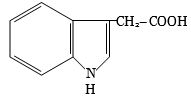
A
$IAA$
B
Auxin $b$
C
Auxin $a$
D
None of the above
Solution
(A) The chemical structure shown is Indole$-3-$acetic acid,commonly abbreviated as $IAA$.
$IAA$ is the most common and naturally occurring auxin found in plants.
$IAA$ is the most common and naturally occurring auxin found in plants.
0 likes
View Solution50
MediumMCQ
Apical dominance is caused by
A
Auxin
B
Gibberellin
C
Kinetin
D
$ABA$
Solution
(A) Apical dominance is a phenomenon in plants where the main central stem of the plant grows more dominantly than the side (lateral) stems.
This process is primarily regulated by the plant hormone $Auxin$.
$Auxin$ is synthesized in the apical meristem and transported downwards,where it inhibits the growth of lateral buds,thereby maintaining the dominance of the apical bud.
This process is primarily regulated by the plant hormone $Auxin$.
$Auxin$ is synthesized in the apical meristem and transported downwards,where it inhibits the growth of lateral buds,thereby maintaining the dominance of the apical bud.
0 likes
View SolutionPlant Growth and Development — Auxin · Frequently Asked Questions
1Are these Plant Growth and Development questions useful for JEE and NEET?
Yes. All questions in this section are mapped to JEE Main and NEET exam patterns. Previous year questions from JEE Main, NEET, GUJCET and state-level exams are included with full solutions.
2Can I switch to Hindi or Gujarati for these questions?
Yes. Use the language tabs in the hero section or the sidebar to view the same questions and solutions in English, Hindi or Gujarati.
3How do I generate a question paper from this subtopic?
Use the Vedclass Exam Paper Generator — select the chapter and subtopic, set difficulty, and generate Sets A, B, C, D automatically. First 3 chapters of every subject are free.
Vedclass Products
For Students
Vedclass Test Series
Mock tests in real JEE/NEET style with performance analysis. 5-day free trial.
Start Free TrialFor Teachers
Exam Paper Generator
Generate Set A/B/C/D papers from this chapter in 2 minutes. 3 chapters free.
Try FreeFor Institutes
Online Exam Module
Live online exams with unlimited students, 360° analytics & white-label branding.
See DemoFor Teachers & Institutes
Generate a Plant Growth and Development Exam Paper in 2 Minutes
Select subtopic & difficulty — Sets A, B, C, D auto-generated with No Repeat logic.
First 3 chapters of every subject are free — no payment required.