
A English
Auxin Questions in English
Class 11 Biology · Plant Growth and Development · Auxin
251+
Questions
English
Language
100%
With Solutions
Showing 50 of 251 questions in English
151
MediumMCQ
Which of the following inhibits leaf abscission?
A
$GA_3$
B
$NAA$
C
Ethylene
D
Zeatin
Solution
(B) Auxins,such as $NAA$ (Naphthalene Acetic Acid),are known to inhibit leaf abscission by preventing the formation of the abscission layer at the base of the petiole. While ethylene promotes abscission,auxins act as antagonists to this process in young leaves and fruits,thereby delaying the shedding process.
0 likes
View Solution152
MediumMCQ
If a plant is deficient in the element $Zinc$,which plant hormone's biosynthesis will be affected in that plant?
A
Abscisic acid
B
Auxin
C
Cytokinin
D
Ethylene
Solution
(B) $Zinc$ is an essential micronutrient required for the synthesis of $Auxin$ (specifically $Indole-3-acetic$ $acid$ or $IAA$) in plants. $Zinc$ acts as a cofactor for the enzymes involved in the tryptophan-dependent pathway of $Auxin$ biosynthesis. Therefore,a deficiency of $Zinc$ leads to a reduction in the production of $Auxin$,which subsequently affects plant growth and development.
0 likes
View Solution153
MediumMCQ
What is the physiological effect of apical dominance in plants?
A
It inhibits the growth of lateral buds.
B
It promotes rapid growth of the shoot apex after pruning.
C
It releases hormones that heal wounds.
D
It induces the differentiation of new shoots in the rootstock.
Solution
(A) Apical dominance is a phenomenon where the apical bud (shoot tip) suppresses the growth of lateral (axillary) buds.
This is primarily mediated by the hormone auxin,which is produced in the shoot apex and transported downwards.
When the apical bud is removed (pruning),the inhibitory effect on the lateral buds is lifted,allowing them to grow and develop into branches.
Therefore,the presence of the apical bud keeps the lateral buds in a dormant or inhibited state.
This is primarily mediated by the hormone auxin,which is produced in the shoot apex and transported downwards.
When the apical bud is removed (pruning),the inhibitory effect on the lateral buds is lifted,allowing them to grow and develop into branches.
Therefore,the presence of the apical bud keeps the lateral buds in a dormant or inhibited state.
0 likes
View Solution154
MediumMCQ
Phototropic curvature is the result of an uneven distribution of which of the following?
A
Gibberellin
B
Phytochrome
C
Cytokinin
D
Auxin
Solution
(D) Phototropic curvature in plants is primarily caused by the uneven distribution of the hormone $Auxin$ (specifically $Indole-3-acetic$ $acid$ or $IAA$).
When a plant is exposed to unilateral light,$Auxin$ migrates to the shaded side of the stem.
This higher concentration of $Auxin$ on the shaded side stimulates greater cell elongation compared to the illuminated side.
As a result,the stem bends towards the light source,a phenomenon known as phototropism.
When a plant is exposed to unilateral light,$Auxin$ migrates to the shaded side of the stem.
This higher concentration of $Auxin$ on the shaded side stimulates greater cell elongation compared to the illuminated side.
As a result,the stem bends towards the light source,a phenomenon known as phototropism.
0 likes
View Solution155
MediumMCQ
Dr. $F$. Went removed the coleoptile tips and placed them in agar for one hour. The agar block then caused curvature in decapitated coleoptiles. What does this experiment demonstrate?
A
It enables the identification and isolation of auxin.
B
It indicates the presence of a growth-promoting substance produced in very small quantities.
C
It supports the hypothesis that $IAA$ is the only auxin.
D
It demonstrates the polar movement of auxin.
Solution
(B) Dr. $F$. Went's experiment demonstrated that a chemical substance diffuses from the coleoptile tip into the agar block. When this agar block is placed on a decapitated coleoptile,it induces curvature. This experiment proves that a growth-promoting substance is produced in the plant in very small quantities,which can be isolated and transferred through agar.
0 likes
View Solution156
MediumMCQ
Which of the following is used for the bioassay of $Auxin$?
A
Length of $Lupinus$ hypocotyl
B
$Avena$ coleoptile curvature test
C
Hydroponics
D
Potometer
Solution
(B) The bioassay for $Auxin$ is the $Avena$ coleoptile curvature test.
This test was developed by $F.W. Went$ to measure the activity of $Auxin$ (specifically $IAA$).
In this experiment,the tip of the $Avena$ coleoptile is removed,and an agar block containing $Auxin$ is placed asymmetrically on the cut surface.
The $Auxin$ diffuses into the coleoptile,causing differential growth and resulting in the curvature of the coleoptile towards the side opposite to the agar block.
This test was developed by $F.W. Went$ to measure the activity of $Auxin$ (specifically $IAA$).
In this experiment,the tip of the $Avena$ coleoptile is removed,and an agar block containing $Auxin$ is placed asymmetrically on the cut surface.
The $Auxin$ diffuses into the coleoptile,causing differential growth and resulting in the curvature of the coleoptile towards the side opposite to the agar block.
0 likes
View Solution157
MediumMCQ
You are provided with a tissue to initiate differentiation in an artificial culture. Which of the following pairs of hormones would you add to the medium to induce the development of shoots and roots?
A
Auxin and Abscisic acid
B
Gibberellins and Abscisic acid
C
Indole Acetic Acid $(IAA)$ and Gibberellins
D
Auxin and Cytokinins
Solution
(D) In plant tissue culture,the process of organogenesis (development of shoots and roots) is controlled by the balance of plant growth regulators in the culture medium.
$1$. Cytokinins are primarily responsible for promoting shoot development (caulogenesis).
$2$. Auxins are primarily responsible for promoting root development (rhizogenesis).
$3$. By manipulating the ratio of Auxin to Cytokinin,researchers can induce the formation of roots,shoots,or undifferentiated callus tissue. Therefore,a combination of Auxin and Cytokinin is essential for organ differentiation.
$1$. Cytokinins are primarily responsible for promoting shoot development (caulogenesis).
$2$. Auxins are primarily responsible for promoting root development (rhizogenesis).
$3$. By manipulating the ratio of Auxin to Cytokinin,researchers can induce the formation of roots,shoots,or undifferentiated callus tissue. Therefore,a combination of Auxin and Cytokinin is essential for organ differentiation.
0 likes
View Solution158
MediumMCQ
The Avena curvature test is used for the bioassay of which of the following?
A
Gibberellins $(GA_3)$
B
Indole$-3-$acetic acid $(IAA)$
C
Ethylene
D
Abscisic acid $(ABA)$
Solution
(B) The Avena curvature test is a classic bioassay used to detect and measure the activity of auxins,specifically Indole$-3-$acetic acid $(IAA)$.
This test was developed by Frits Went in $1928$.
In this experiment,agar blocks containing the substance to be tested are placed asymmetrically on the cut coleoptile tips of Avena sativa (oat) seedlings.
The auxin diffuses into the coleoptile,causing differential growth (curvature) on the side where the block is placed.
The degree of curvature is directly proportional to the concentration of the auxin present in the agar block.
This test was developed by Frits Went in $1928$.
In this experiment,agar blocks containing the substance to be tested are placed asymmetrically on the cut coleoptile tips of Avena sativa (oat) seedlings.
The auxin diffuses into the coleoptile,causing differential growth (curvature) on the side where the block is placed.
The degree of curvature is directly proportional to the concentration of the auxin present in the agar block.
0 likes
View Solution159
MediumMCQ
The abscission of fruits and leaves at an early stage can be prevented by the application of which of the following?
A
Cytokinin
B
Ethylene
C
Auxin
D
Gibberellic acid
Solution
(C) Auxins are plant hormones that play a crucial role in regulating plant growth and development.
One of the primary functions of auxins,such as $IAA$ (Indole$-3-$acetic acid) and $NAA$ (Naphthalene acetic acid),is to prevent the premature abscission (falling off) of fruits and leaves.
They inhibit the formation of the abscission layer at the base of the petiole or fruit stalk,thereby keeping them attached to the plant for a longer duration.
Therefore,the application of auxin is used in agriculture to prevent premature fruit drop.
One of the primary functions of auxins,such as $IAA$ (Indole$-3-$acetic acid) and $NAA$ (Naphthalene acetic acid),is to prevent the premature abscission (falling off) of fruits and leaves.
They inhibit the formation of the abscission layer at the base of the petiole or fruit stalk,thereby keeping them attached to the plant for a longer duration.
Therefore,the application of auxin is used in agriculture to prevent premature fruit drop.
0 likes
View Solution160
EasyMCQ
Which of the following chemicals is used to remove leaves from forest trees?
A
$Amo-1618$
B
$Phosphon-D$
C
Maleic hydrazide
D
$2, 4-D$
Solution
(D) The chemical $2, 4-D$ ($2, 4-dichlorophenoxyacetic$ acid) is a synthetic auxin that acts as a herbicide.
It is widely used to control broad-leaved weeds and is also known as a defoliant,meaning it causes leaves to fall off from plants or trees.
Therefore,it is used to remove leaves from forest trees.
It is widely used to control broad-leaved weeds and is also known as a defoliant,meaning it causes leaves to fall off from plants or trees.
Therefore,it is used to remove leaves from forest trees.
0 likes
View Solution161
MediumMCQ
Avena curvature test is a bioassay for examining the activity of
A
auxins
B
gibberellins
C
cytokinins
D
ethylene
Solution
(A) The Avena curvature test is a classic bioassay developed by Frits Went in $1928$.
It is specifically used to detect and measure the biological activity of auxins,particularly Indole$-3-$Acetic Acid $(IAA)$.
In this experiment,agar blocks containing auxin are placed asymmetrically on the coleoptile tips of Avena sativa (oat) seedlings,causing the coleoptile to curve due to differential growth.
It is specifically used to detect and measure the biological activity of auxins,particularly Indole$-3-$Acetic Acid $(IAA)$.
In this experiment,agar blocks containing auxin are placed asymmetrically on the coleoptile tips of Avena sativa (oat) seedlings,causing the coleoptile to curve due to differential growth.
0 likes
View Solution162
MediumMCQ
Assertion : Auxins help to prevent fruit and leaf drop at early stages.
Reason : Auxins promote the abscission of older mature leaves and fruits.
Reason : Auxins promote the abscission of older mature leaves and fruits.
A
If both Assertion and Reason are correct and the Reason is a correct explanation of the Assertion.
B
If both Assertion and Reason are correct but Reason is not a correct explanation of the Assertion.
C
If the Assertion is correct but Reason is incorrect.
D
If both the Assertion and Reason are incorrect.
Solution
(B) Auxins,such as $IAA$ (Indole$-3-$acetic acid),play a dual role in the process of abscission.
In the early stages of development,auxins prevent the formation of the abscission layer,thereby preventing the premature drop of young leaves and fruits.
Conversely,in older or mature leaves and fruits,auxins promote the process of abscission.
Since the Assertion describes the inhibitory role in early stages and the Reason describes the promoting role in mature stages,both statements are correct,but the Reason does not explain why auxins prevent drop in early stages. Thus,the Reason is not the correct explanation of the Assertion.
In the early stages of development,auxins prevent the formation of the abscission layer,thereby preventing the premature drop of young leaves and fruits.
Conversely,in older or mature leaves and fruits,auxins promote the process of abscission.
Since the Assertion describes the inhibitory role in early stages and the Reason describes the promoting role in mature stages,both statements are correct,but the Reason does not explain why auxins prevent drop in early stages. Thus,the Reason is not the correct explanation of the Assertion.
0 likes
View Solution163
MediumMCQ
Bean seeds were planted and put on a sunny windowsill. As the plants grew,their stems bent toward the window. This bending was most likely caused by an
A
unequal distribution of auxin in the stem.
B
unequal distribution of a neurotransmitter in the stem.
C
equal distribution of auxin in the stem.
D
equal distribution of a neurotransmitter in the stem.
Solution
(A) The plant hormone,$Auxin$,is distributed more on the side away from the unilateral illumination,causing cells to grow faster in the darker side. This differential growth causes the plant to bend toward the light,a phenomenon known as phototropism. If the distribution were equal,the plant would grow straight upwards. Neurotransmitters are chemicals secreted by multicellular animals and are used in transmitting impulses in the nervous system,not in plant growth responses.
0 likes
View Solution164
EasyMCQ
Describe the physiological effects of auxin in plants.
A
Promotes apical dominance and cell elongation.
B
Inhibits root initiation and fruit development.
C
Causes rapid senescence and leaf abscission.
D
Induces dormancy in seeds and buds.
Solution
(A) Auxins are a class of plant hormones that play a crucial role in plant growth and development. The primary physiological effects include:
$1$. Apical Dominance: Auxins produced in the apical bud inhibit the growth of lateral buds,ensuring the plant grows vertically.
$2$. Cell Elongation: They promote the elongation of stems and coleoptiles by increasing cell wall plasticity.
$3$. Root Initiation: Auxins are widely used in horticulture to induce root formation in stem cuttings.
$4$. Fruit Development: They promote fruit growth and prevent premature fruit drop (e.g.,in apples).
$5$. Weed Control: Synthetic auxins like $2,4-D$ are used as herbicides to kill broad-leaved weeds without affecting monocot crops.
$1$. Apical Dominance: Auxins produced in the apical bud inhibit the growth of lateral buds,ensuring the plant grows vertically.
$2$. Cell Elongation: They promote the elongation of stems and coleoptiles by increasing cell wall plasticity.
$3$. Root Initiation: Auxins are widely used in horticulture to induce root formation in stem cuttings.
$4$. Fruit Development: They promote fruit growth and prevent premature fruit drop (e.g.,in apples).
$5$. Weed Control: Synthetic auxins like $2,4-D$ are used as herbicides to kill broad-leaved weeds without affecting monocot crops.
0 likes
View Solution165
Easy
Write a short note on Auxins.
Solution
(N/A) Auxin (Greek 'auxein': to grow) was initially isolated from human urine,but later its presence was also found in plants,proving it to be the first $PGR$ (Plant Growth Regulator) ever known.
The primary natural plant auxin is chemically known as Indole-$3$-Acetic Acid $(IAA)$.
The term 'auxin' is also applied to other natural and synthetic compounds having various growth-regulating properties.
Production of auxin generally takes place in the growing apices of stems and roots,from where they migrate to the site of action.
Types of Auxin:
$(a)$ Natural Auxins: These occur naturally in plants and fungi,e.g.,Indole Acetic Acid $(IAA)$ and Indole Butyric Acid $(IBA)$.
$(b)$ Synthetic Auxins: These are prepared from synthetic compounds that cause several responses similar to $IAA$,e.g.,Naphthalene Acetic Acid $(NAA)$ and $2,4$-Dichlorophenoxyacetic acid $(2,4-D)$.
Functions of Auxins:
$(a)$ Cell Elongation: Auxin stimulates the elongation of cells in shoots.
$(b)$ Initiation of Roots: In contrast to stems,higher concentrations of auxin inhibit shoot elongation but initiate lateral root formation.
$(c)$ Inhibition of Abscission: Natural auxins delay the abscission of young fruits and leaves and are used to control pre-harvest fruit drop.
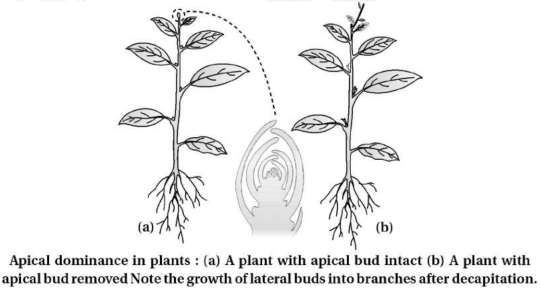
$(d)$ Apical Dominance: The presence of auxin in higher concentrations in the shoot apex promotes apical dominance,where the apical bud inhibits the growth of lateral buds. Lateral buds only develop into branches when the apical bud is removed (decapitation).
$(e)$ Promotes Flowering: Auxin helps in promoting flowering in plants like pineapple and litchi.
$(f)$ Parthenocarpy: Auxins are used to induce parthenocarpy in unpollinated pistils,which increases market value.
$(g)$ Metabolism: Application of auxin can enhance metabolism due to the mobilization of plant resources.
$(h)$ Eradication of Weeds: Auxins are used as weedicides. For example,$2,4-D$ is widely used to kill dicotyledonous weeds without affecting mature monocotyledonous plants.
$(i)$ Cell Division: Besides cell elongation,auxin may also be active in cell division.
The primary natural plant auxin is chemically known as Indole-$3$-Acetic Acid $(IAA)$.
The term 'auxin' is also applied to other natural and synthetic compounds having various growth-regulating properties.
Production of auxin generally takes place in the growing apices of stems and roots,from where they migrate to the site of action.
Types of Auxin:
$(a)$ Natural Auxins: These occur naturally in plants and fungi,e.g.,Indole Acetic Acid $(IAA)$ and Indole Butyric Acid $(IBA)$.
$(b)$ Synthetic Auxins: These are prepared from synthetic compounds that cause several responses similar to $IAA$,e.g.,Naphthalene Acetic Acid $(NAA)$ and $2,4$-Dichlorophenoxyacetic acid $(2,4-D)$.
Functions of Auxins:
$(a)$ Cell Elongation: Auxin stimulates the elongation of cells in shoots.
$(b)$ Initiation of Roots: In contrast to stems,higher concentrations of auxin inhibit shoot elongation but initiate lateral root formation.
$(c)$ Inhibition of Abscission: Natural auxins delay the abscission of young fruits and leaves and are used to control pre-harvest fruit drop.
$(d)$ Apical Dominance: The presence of auxin in higher concentrations in the shoot apex promotes apical dominance,where the apical bud inhibits the growth of lateral buds. Lateral buds only develop into branches when the apical bud is removed (decapitation).
$(e)$ Promotes Flowering: Auxin helps in promoting flowering in plants like pineapple and litchi.
$(f)$ Parthenocarpy: Auxins are used to induce parthenocarpy in unpollinated pistils,which increases market value.
$(g)$ Metabolism: Application of auxin can enhance metabolism due to the mobilization of plant resources.
$(h)$ Eradication of Weeds: Auxins are used as weedicides. For example,$2,4-D$ is widely used to kill dicotyledonous weeds without affecting mature monocotyledonous plants.
$(i)$ Cell Division: Besides cell elongation,auxin may also be active in cell division.
0 likes
View Solution166
Easy
Describe the plant secretion found in human urine.
Solution
(N/A) The plant hormone found in human urine is $Indole-3-acetic \text{ acid } (IAA)$, which is the most common naturally occurring auxin in plants. $IAA$ was first isolated from human urine. It is a phytohormone that promotes cell elongation, root initiation, and apical dominance in plants. Its presence in human urine is attributed to the consumption of plant-based foods, as the human body does not synthesize $IAA$ endogenously.
0 likes
View Solution167
EasyMCQ
If one can induce parthenocarpy through the application of growth substances,which fruits would you select to induce parthenocarpy and why?
A
Fruits with many seeds,to make them easier to eat.
B
Fruits that are naturally seedless,to increase their size.
C
Economically important fruits like orange,lemon,or watermelon,to produce seedless varieties.
D
Fruits that do not require pollination,to save time.
Solution
(C) Parthenocarpy is the process of developing fruits without the process of fertilization or seed formation.
Therefore,the seedless varieties of economically important fruits such as orange,lemon,and watermelon are produced using this technique.
This technique involves inducing fruit formation by the application of plant growth hormones,specifically auxins and gibberellins.
By inducing parthenocarpy,we can eliminate seeds in fruits where seeds are considered a nuisance,thereby increasing their market value and consumer preference.
Therefore,the seedless varieties of economically important fruits such as orange,lemon,and watermelon are produced using this technique.
This technique involves inducing fruit formation by the application of plant growth hormones,specifically auxins and gibberellins.
By inducing parthenocarpy,we can eliminate seeds in fruits where seeds are considered a nuisance,thereby increasing their market value and consumer preference.
0 likes
View Solution168
EasyMCQ
What is the precursor of auxin?
A
Tryptophan
B
Methionine
C
Phenylalanine
D
Tyrosine
Solution
(A) The primary precursor for the biosynthesis of the most common natural auxin,Indole$-3-$acetic acid $(IAA)$,is the amino acid Tryptophan.
During the biosynthetic pathway,Tryptophan undergoes enzymatic conversion to form $IAA$ in plants.
During the biosynthetic pathway,Tryptophan undergoes enzymatic conversion to form $IAA$ in plants.
0 likes
View Solution169
EasyMCQ
Write the use of $2, 4-D$.
A
It is used as a herbicide to kill dicotyledonous weeds.
B
It is used to promote fruit ripening.
C
It is used to induce flowering in pineapples.
D
It is used to delay leaf senescence.
Solution
(A) $2, 4-D$ stands for $2, 4-dichlorophenoxyacetic$ acid.
It is a synthetic auxin.
It is widely used as a herbicide to kill dicotyledonous weeds without affecting mature monocotyledonous plants.
Therefore,it is commonly used in agriculture to clear fields of unwanted broad-leaved weeds.
It is a synthetic auxin.
It is widely used as a herbicide to kill dicotyledonous weeds without affecting mature monocotyledonous plants.
Therefore,it is commonly used in agriculture to clear fields of unwanted broad-leaved weeds.
0 likes
View Solution170
Easy
Provide the full names for the following abbreviations:
$(1)$ $PGRs$
$(2)$ $IAA$
$(1)$ $PGRs$
$(2)$ $IAA$
Solution
(N/A) $(1)$ $PGRs$ stands for $\text{Plant Growth Regulators}$. These are small,simple molecules of diverse chemical composition that regulate plant growth and development.
$(2)$ $IAA$ stands for $\text{Indole-3-Acetic Acid}$. It is the most common naturally occurring auxin in plants,responsible for cell elongation and various developmental processes.
$(2)$ $IAA$ stands for $\text{Indole-3-Acetic Acid}$. It is the most common naturally occurring auxin in plants,responsible for cell elongation and various developmental processes.
0 likes
View Solution171
Easy
Provide the full names of the following plant growth regulators:
$(1)$ $IBA$
$(2)$ $2,4-D$
$(1)$ $IBA$
$(2)$ $2,4-D$
Solution
(N/A) $(1)$ $IBA$ stands for Indole$-3-$butyric acid. It is a synthetic auxin used to promote root initiation in plant cuttings.
$(2)$ $2,4-D$ stands for $2,4-$Dichlorophenoxyacetic acid. It is a synthetic auxin widely used as a selective herbicide to kill broad-leaved weeds.
$(2)$ $2,4-D$ stands for $2,4-$Dichlorophenoxyacetic acid. It is a synthetic auxin widely used as a selective herbicide to kill broad-leaved weeds.
0 likes
View Solution172
Easy
Provide the full names of the following plant growth regulators:
$(1)$ $NAA$
$(2)$ $IPA$
$(1)$ $NAA$
$(2)$ $IPA$
Solution
(N/A) $(1)$ $NAA$ stands for $Naphthaleneacetic \text{ } acid$. It is a synthetic auxin used in agriculture for rooting and preventing fruit drop.
$(2)$ $IPA$ stands for $Indole-3-propionic \text{ } acid$. It is a naturally occurring auxin found in plants that promotes cell elongation and growth.
$(2)$ $IPA$ stands for $Indole-3-propionic \text{ } acid$. It is a naturally occurring auxin found in plants that promotes cell elongation and growth.
0 likes
View Solution173
EasyMCQ
What is the full form of $IAAL$?
A
Indole$-3-$Acetic Acid Lactone
B
Indole$-3-$Acetic Acid Lysine
C
Indole$-3-$Acetic Acid Leucine
D
Indole$-3-$Acetic Acid Linkage
Solution
(C) The term $IAAL$ refers to $Indole-3-Acetic Acid$ conjugated with $Leucine$.
$IAAL$ is a conjugate of the plant hormone $Auxin$ $(IAA)$ with the amino acid $Leucine$.
Such conjugates are involved in the storage and transport of $Auxin$ in plants.
$IAAL$ is a conjugate of the plant hormone $Auxin$ $(IAA)$ with the amino acid $Leucine$.
Such conjugates are involved in the storage and transport of $Auxin$ in plants.
0 likes
View Solution174
Easy
Auxins are growth hormones capable of promoting cell elongation. They have been used in horticulture to promote growth,flowering,and rooting. Write a line to explain the meaning of the following terms related to auxins:
$(a)$ Auxin precursors
$(b)$ Antiauxins
$(c)$ Synthetic auxins
$(a)$ Auxin precursors
$(b)$ Antiauxins
$(c)$ Synthetic auxins
Solution
(N/A) Auxin precursors: These are substances that serve as the biological starting material for the synthesis of auxins. For example,tryptophan is a well-known precursor for the biosynthesis of indole$-3-$acetic acid $(IAA)$ in plants.
$(b)$ Antiauxins: These are chemical substances that inhibit or antagonize the physiological actions of auxins. Examples include $p$-chlorophenoxyisobutyric acid $(PCIB)$ and $2,3,5$-triiodobenzoic acid $(TIBA)$.
$(c)$ Synthetic auxins: These are artificially synthesized chemical compounds that mimic the physiological properties and effects of natural auxins. Examples include naphthalene acetic acid $(NAA)$ and $2,4$-dichlorophenoxyacetic acid $(2,4-D)$.
$(b)$ Antiauxins: These are chemical substances that inhibit or antagonize the physiological actions of auxins. Examples include $p$-chlorophenoxyisobutyric acid $(PCIB)$ and $2,3,5$-triiodobenzoic acid $(TIBA)$.
$(c)$ Synthetic auxins: These are artificially synthesized chemical compounds that mimic the physiological properties and effects of natural auxins. Examples include naphthalene acetic acid $(NAA)$ and $2,4$-dichlorophenoxyacetic acid $(2,4-D)$.
0 likes
View Solution175
EasyMCQ
Which phenomenon describes how apical buds inhibit the growth of lateral buds? How can this be overcome?
A
Apical dominance; by applying cytokinins or removing the apical bud.
B
Phototropism; by increasing light intensity.
C
Geotropism; by changing the orientation of the plant.
D
Senescence; by adding fertilizers.
Solution
(A) The phenomenon where apical buds inhibit the growth of lateral buds is known as $Apical \text{ } Dominance$.
This is primarily caused by the plant hormone $Auxin$, which is synthesized in the apical meristem and transported downwards.
This inhibition can be overcome by two methods:
$1$. $Decapitation$: Removing the apical bud (trimming) eliminates the source of $Auxin$, allowing lateral buds to grow.
$2$. $Cytokinin \text{ } Application$: Applying $Cytokinins$ to the lateral buds promotes their growth, as $Cytokinins$ counteract the inhibitory effect of $Auxin$.
This is primarily caused by the plant hormone $Auxin$, which is synthesized in the apical meristem and transported downwards.
This inhibition can be overcome by two methods:
$1$. $Decapitation$: Removing the apical bud (trimming) eliminates the source of $Auxin$, allowing lateral buds to grow.
$2$. $Cytokinin \text{ } Application$: Applying $Cytokinins$ to the lateral buds promotes their growth, as $Cytokinins$ counteract the inhibitory effect of $Auxin$.
0 likes
View Solution176
MediumMCQ
To get a carpet-like grass,lawns are mowed regularly. Is there any scientific explanation for this?
A
Mowing removes the apical dominance,which promotes the growth of lateral buds.
B
Mowing stimulates the production of gibberellins in the roots.
C
Mowing increases the rate of photosynthesis in the grass.
D
Mowing removes the dead leaves and allows new leaves to grow.
Solution
(A) To get a carpet-like grass,lawns are mowed regularly because mowing causes the removal of the shoot apex (decapitation).
In many plants,the apical bud produces auxins which inhibit the growth of lateral buds,a phenomenon known as apical dominance.
By removing the shoot apex through mowing,the source of auxin is eliminated,which releases the lateral buds from inhibition and promotes their growth.
This results in a denser,bushier growth of grass,giving the lawn a carpet-like appearance.
In many plants,the apical bud produces auxins which inhibit the growth of lateral buds,a phenomenon known as apical dominance.
By removing the shoot apex through mowing,the source of auxin is eliminated,which releases the lateral buds from inhibition and promotes their growth.
This results in a denser,bushier growth of grass,giving the lawn a carpet-like appearance.
0 likes
View Solution177
Medium
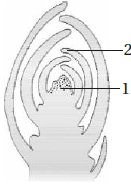
Label the diagram.
$(A)$ This is which part of a dicotyledonous plant?
$(B)$ If we remove part $1$ from the plant,what will happen?
$(A)$ This is which part of a dicotyledonous plant?
$(B)$ If we remove part $1$ from the plant,what will happen?
Solution
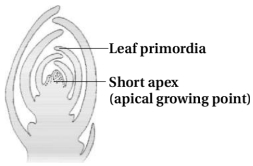
(N/A) The diagram represents the shoot apical meristem of a dicotyledonous plant.
$(b)$ If we remove part $1$ (the shoot apical meristem),the phenomenon of apical dominance is lost. This leads to the inhibition of the apical bud and promotes the growth of axillary buds,causing the plant to become bushier.
Labeling:
$1 \rightarrow$ Shoot apical meristem
$2 \rightarrow$ Leaf primordium
$(b)$ If we remove part $1$ (the shoot apical meristem),the phenomenon of apical dominance is lost. This leads to the inhibition of the apical bud and promotes the growth of axillary buds,causing the plant to become bushier.
Labeling:
$1 \rightarrow$ Shoot apical meristem
$2 \rightarrow$ Leaf primordium
0 likes
View Solution178
Easy
Define parthenocarpy. Name the plant hormone used to induce parthenocarpy.
Solution
(N/A) Parthenocarpy is the process in which fruits develop without the process of fertilisation,resulting in seedless fruits.
Plant hormones such as auxins and gibberellins are used to induce parthenocarpy artificially in plants like grapes,papaya,and tomatoes.
Plant hormones such as auxins and gibberellins are used to induce parthenocarpy artificially in plants like grapes,papaya,and tomatoes.
0 likes
View Solution179
EasyMCQ
$A$ gardener finds some broad-leaved dicot weeds growing in his lawns. What can be done to get rid of the weeds efficiently?
A
Spray $2,4-D$ ($2$,$4$-Dichlorophenoxyacetic acid).
B
Spray $ABA$ (Abscisic acid).
C
Spray $GA_3$ (Gibberellic acid).
D
Spray $Ethylene$.
Solution
(A) The broad-leaved dicot weeds can be killed and eliminated by the spray of the weedicide $2,4-D$ ($2,4$-Dichlorophenoxyacetic acid).
$2,4-D$ is a synthetic auxin that acts as a selective herbicide.
It specifically targets and kills broad-leaved dicot plants while leaving monocot plants (like lawn grasses) unaffected.
Therefore,spraying $2,4-D$ is an efficient method for a gardener to clear weeds from a lawn.
$2,4-D$ is a synthetic auxin that acts as a selective herbicide.
It specifically targets and kills broad-leaved dicot plants while leaving monocot plants (like lawn grasses) unaffected.
Therefore,spraying $2,4-D$ is an efficient method for a gardener to clear weeds from a lawn.
0 likes
View Solution180
DifficultMCQ
Apical dominance is caused by
A
Auxin
B
Ethylene
C
Gibberellin
D
Cytokinin
Solution
(A) Apical dominance is a phenomenon where the main central stem of the plant grows more dominantly than the side stems.
This process is primarily caused by the hormone $Auxin$,which is synthesized at the shoot tips.
$Auxin$ inhibits the growth of lateral buds,thereby promoting the vertical growth of the plant.
This process is primarily caused by the hormone $Auxin$,which is synthesized at the shoot tips.
$Auxin$ inhibits the growth of lateral buds,thereby promoting the vertical growth of the plant.
0 likes
View Solution181
DifficultMCQ
Water can be absorbed from a hypertonic external solution by
A
Withdrawing more water from the external solution
B
Auxin treated cells
C
Adding a buffer in the external solution
D
Cytokinin treated cells
Solution
(B) Normally,water moves from a region of higher water potential to a region of lower water potential (osmosis). In a hypertonic solution,the external environment has a lower water potential than the cell,which usually leads to water loss (exosmosis).
However,$Auxin$ treated cells exhibit an increase in metabolic activity,specifically respiration.
This increased respiration provides the necessary metabolic energy required for the active absorption of water against the concentration gradient,allowing the cells to absorb water even from a hypertonic solution.
However,$Auxin$ treated cells exhibit an increase in metabolic activity,specifically respiration.
This increased respiration provides the necessary metabolic energy required for the active absorption of water against the concentration gradient,allowing the cells to absorb water even from a hypertonic solution.
0 likes
View Solution182
MediumMCQ
Plants which are deficient in zinc will show reduction in the biosynthesis of
A
Ethylene
B
Coenzyme $A$
C
Ferredoxin
D
Auxin
Solution
(D) Zinc $(Zn^{2+})$ acts as an essential cofactor for various enzymes,including those involved in the synthesis of the plant growth hormone auxin (indole$-3-$acetic acid).
Specifically,zinc is required for the synthesis of tryptophan,which is the precursor for auxin biosynthesis.
Therefore,a deficiency in zinc leads to a reduction in the levels of auxin in plants,resulting in stunted growth.
Ferredoxin synthesis requires iron $(Fe)$,not zinc.
Specifically,zinc is required for the synthesis of tryptophan,which is the precursor for auxin biosynthesis.
Therefore,a deficiency in zinc leads to a reduction in the levels of auxin in plants,resulting in stunted growth.
Ferredoxin synthesis requires iron $(Fe)$,not zinc.
0 likes
View Solution183
MediumMCQ
In plants,phototropism is the movement:
A
Towards the light source
B
Away from the light source
C
Parallel to the light source
D
Lateral to the light source
Solution
(A) Phototropism is the growth or movement of a plant part in response to a light stimulus.
Specifically,positive phototropism refers to the growth of plant organs,such as stems,towards the light source.
Charles Darwin and his son Francis Darwin observed that the coleoptiles of canary grass respond to unilateral illumination by bending and growing towards the light source.
Specifically,positive phototropism refers to the growth of plant organs,such as stems,towards the light source.
Charles Darwin and his son Francis Darwin observed that the coleoptiles of canary grass respond to unilateral illumination by bending and growing towards the light source.
0 likes
View Solution184
MediumMCQ
$I.$ Cell elongation
$II.$ Cell division
$III.$ Cell differentiation
Among the above mentioned,what is/are the function$(s)$ of auxin?
$II.$ Cell division
$III.$ Cell differentiation
Among the above mentioned,what is/are the function$(s)$ of auxin?
A
$I$ and $II$
B
$III$ and $I$
C
$II$ and $III$
D
$I, II$ and $III$
Solution
(D) Auxins are plant hormones that play a crucial role in various growth processes.
$1.$ Auxin promotes cell elongation,particularly in the cells located just below the apical meristem of the shoot.
$2.$ It is involved in the regulation of cell division,especially in the cambium.
$3.$ Auxin also plays a significant role in cell differentiation,such as in the formation of vascular tissues.
Therefore,all three processes ($I, II,$ and $III$) are functions of auxin.
$1.$ Auxin promotes cell elongation,particularly in the cells located just below the apical meristem of the shoot.
$2.$ It is involved in the regulation of cell division,especially in the cambium.
$3.$ Auxin also plays a significant role in cell differentiation,such as in the formation of vascular tissues.
Therefore,all three processes ($I, II,$ and $III$) are functions of auxin.
0 likes
View Solution185
MediumMCQ
What is the primary function of auxin in plants?
A
Cell elongation
B
Fruit ripening
C
Cell division
D
Inhibition of root growth
Solution
(A) Auxins are a class of plant hormones that primarily induce cell elongation in stems and coleoptiles. $IAA$ (Indole$-3-$acetic acid) is the most common naturally occurring auxin. Auxins are generally acidic in nature and play a crucial role in phototropism and apical dominance.
0 likes
View Solution186
MediumMCQ
Which of the following movements in plants is due to the increased concentration of $Auxin$?
A
Movement of shoot towards the source of light
B
Nyctinasty
C
Movement of sunflower towards sun
D
All of the above
Solution
(A) $Auxin$ concentration increases in the shaded area,meaning $Auxins$ accumulate on the side opposite to the light source.
Increased $Auxin$ concentration stimulates cell elongation in the shoot.
Because of this,the shaded side grows faster than the side exposed to light.
This differential growth causes the shoot to bend towards the light,a phenomenon known as phototropism.
Increased $Auxin$ concentration stimulates cell elongation in the shoot.
Because of this,the shaded side grows faster than the side exposed to light.
This differential growth causes the shoot to bend towards the light,a phenomenon known as phototropism.
0 likes
View Solution187
MediumMCQ
Which of the following processes is concerned with the Cholodny-Went theory?
A
Photomorphogenesis
B
Photoperiodism
C
Phototropism
D
Photorespiration
Solution
(C) The Cholodny-Went theory explains the mechanism of phototropism in plants.
It states that when a plant is exposed to unilateral light,auxin $(IAA)$ is redistributed to the shaded side of the stem.
This higher concentration of auxin on the shaded side causes faster cell elongation compared to the illuminated side.
Consequently,the plant stem bends towards the light source,a phenomenon known as phototropism.
It states that when a plant is exposed to unilateral light,auxin $(IAA)$ is redistributed to the shaded side of the stem.
This higher concentration of auxin on the shaded side causes faster cell elongation compared to the illuminated side.
Consequently,the plant stem bends towards the light source,a phenomenon known as phototropism.
0 likes
View Solution188
MediumMCQ
After a series of experiments,it was concluded that the ...$A$... of coleoptile was the site of transmittable influence that caused the ...$B$... of the entire coleoptile. Complete the given statement with the correct combination of options given in the codes below.
A
$A-$ root site; $B-$ bending
B
$A-$ lateral side; $B-$ bending
C
$A-$ side-shoot; $B-$ bending
D
$A-$ tip; $B-$ bending
Solution
(D) The experiments conducted by Charles Darwin and his son Francis Darwin on canary grass coleoptiles demonstrated that the coleoptile tip is the site of perception of light.
When the tip was removed or covered,the coleoptile did not bend towards the light.
This indicated that the tip produces a transmittable influence (later identified as auxin) that causes the bending of the entire coleoptile towards the light source.
Therefore,$A$ is the tip and $B$ is the bending.
When the tip was removed or covered,the coleoptile did not bend towards the light.
This indicated that the tip produces a transmittable influence (later identified as auxin) that causes the bending of the entire coleoptile towards the light source.
Therefore,$A$ is the tip and $B$ is the bending.
0 likes
View Solution189
MediumMCQ
The substance related to phototropism in the shoot is
A
Ethanol
B
Cytokinins
C
Auxin
D
Gibberellins
Solution
(C) Auxin concentration increases in the shaded area (the side opposite to the light source).
Increased auxin concentrations stimulate cell elongation in the shoot.
Therefore,the shaded side shows more growth compared to the side facing the light.
This differential growth causes the shoot to bend towards the light,a phenomenon known as phototropism.
Increased auxin concentrations stimulate cell elongation in the shoot.
Therefore,the shaded side shows more growth compared to the side facing the light.
This differential growth causes the shoot to bend towards the light,a phenomenon known as phototropism.
0 likes
View Solution190
MediumMCQ
The most common auxin is
A
$GA$
B
$ABA$
C
Kinetin
D
$IAA$
Solution
(D) The most common auxin is Indole Acetic Acid $(IAA)$,which is the principal naturally occurring auxin in all higher plants.
It performs many physiological functions in plants,such as cell elongation,apical dominance,and root initiation.
It performs many physiological functions in plants,such as cell elongation,apical dominance,and root initiation.
0 likes
View Solution191
MediumMCQ
If shoot cuttings are treated with auxin,then:
A
Root production takes place
B
Shoot elongation takes place
C
Both $(a)$ and $(b)$
D
Lateral dominance takes place
Solution
(A) Auxins are plant hormones that play a crucial role in root initiation. When shoot cuttings are treated with auxin,it stimulates the formation of adventitious roots at the base of the cutting. This property is widely utilized in horticulture for the vegetative propagation of plants.
0 likes
View Solution192
MediumMCQ
Auxins promote
A
Cell growth and enlargement
B
Cambial activity
C
Apical dominance
D
All of the above
Solution
(D) Auxins are plant hormones that perform several physiological functions.
$1$. They promote cell enlargement and cell division.
$2$. They stimulate the activity of the vascular cambium,which is essential for secondary growth.
$3$. They are responsible for apical dominance,where the terminal bud suppresses the growth of lateral buds.
$4$. Therefore,all the listed processes are promoted by auxins.
$1$. They promote cell enlargement and cell division.
$2$. They stimulate the activity of the vascular cambium,which is essential for secondary growth.
$3$. They are responsible for apical dominance,where the terminal bud suppresses the growth of lateral buds.
$4$. Therefore,all the listed processes are promoted by auxins.
0 likes
View Solution193
MediumMCQ
Which of the following is not an influence of auxin?
A
Apical dominance
B
Parthenocarpy
C
Tropic movements
D
Bolting
Solution
(D) Auxins are plant hormones that promote cell elongation,apical dominance,and tropic movements (like phototropism). They are also used to induce parthenocarpy in plants such as tomatoes,apples,and cucumbers.
Bolting,which refers to the internode elongation just prior to flowering,is primarily induced by gibberellins,not auxins. Therefore,bolting is not an influence of auxin.
Bolting,which refers to the internode elongation just prior to flowering,is primarily induced by gibberellins,not auxins. Therefore,bolting is not an influence of auxin.
0 likes
View Solution194
MediumMCQ
Charles Darwin and Francis Darwin are related with
A
Vernalisation
B
Phototropism
C
Photoperiodism
D
Effect of plant hormones (auxin)
Solution
(B) Charles Darwin and his son Francis Darwin conducted experiments on the coleoptiles of canary grass $(Phalaris \text{ canariensis})$.
They observed that the coleoptiles bent towards a light source, a phenomenon known as phototropism.
They concluded that the tip of the coleoptile is the site of perception of light and that some transmissible influence (later identified as auxin) is produced in the apical part, which causes the bending of the plant towards the light.
They observed that the coleoptiles bent towards a light source, a phenomenon known as phototropism.
They concluded that the tip of the coleoptile is the site of perception of light and that some transmissible influence (later identified as auxin) is produced in the apical part, which causes the bending of the plant towards the light.
0 likes
View Solution195
MediumMCQ
Which hormone was first isolated from human urine?
A
Auxin
B
$ABA$
C
Ethylene
D
Gibberellic acid
Solution
(A) Auxin (derived from the Greek word 'auxein',which means 'to grow') was the first plant hormone to be isolated from human urine.
Kogl and Haagen-Smit $(1931)$ isolated three chemicals from human urine and named them as auxin.
Kogl and Haagen-Smit $(1931)$ isolated three chemicals from human urine and named them as auxin.
0 likes
View Solution196
MediumMCQ
Which member of the auxin group is widely used to kill dicotyledonous weeds?
A
$IAA$
B
$IBA$
C
$NAA$
D
$2,4-D$
Solution
(D) Auxins are widely used as herbicides in agriculture.
$2,4-D$ ($2$,$4$-Dichlorophenoxyacetic acid) is a synthetic auxin that is specifically used to kill broad-leaved dicotyledonous weeds.
It does not affect mature monocotyledonous plants,making it an effective selective herbicide for crops like wheat and maize.
$2,4-D$ ($2$,$4$-Dichlorophenoxyacetic acid) is a synthetic auxin that is specifically used to kill broad-leaved dicotyledonous weeds.
It does not affect mature monocotyledonous plants,making it an effective selective herbicide for crops like wheat and maize.
0 likes
View Solution197
MediumMCQ
In coleoptile tissue,auxin is
A
Not transported because it is used where it is made
B
Transported by diffusion
C
Transported from the base to tip by osmosis
D
Produced by growing apices of stem,which migrate to the region of its action
Solution
(D) Auxin is synthesized primarily in the growing apical regions of the plant,such as the shoot and root apices. From these sites of production,it is transported to the regions where it exerts its physiological effects,such as promoting cell elongation. This transport is typically polar (often basipetal) and is an active process,not simple diffusion or osmosis.
0 likes
View Solution198
MediumMCQ
Natural and synthetic auxins $(IAA, NAA, IBA, 2,4-D)$ have been used extensively in:
A
Agriculture
B
Horticulture
C
Both $(A)$ and $(B)$
D
Sericulture
Solution
(C) Auxins,such as $IAA$ (Indole$-3-$acetic acid) and $IBA$ (Indole$-3-$butyric acid) are natural auxins,while $NAA$ (Naphthalene acetic acid) and $2,4-D$ ($2$,$4$-dichlorophenoxyacetic acid) are synthetic auxins.
These plant growth regulators are widely used in agriculture for crop management and in horticulture for practices like rooting of cuttings,preventing premature fruit drop,and promoting flowering.
These plant growth regulators are widely used in agriculture for crop management and in horticulture for practices like rooting of cuttings,preventing premature fruit drop,and promoting flowering.
0 likes
View Solution199
MediumMCQ
Which of the following movements in plants is not related to a change in auxin level?
A
Nyctinastic leaf movement
B
Movement of root towards soil
C
Movement of sunflower,tracking the direction of sun
D
Movement of shoot towards light
Solution
(A) Nyctinastic or sleep movements are primarily caused by changes in turgor pressure within the pulvinus cells,which is triggered by the alternation of day and night. These movements are independent of auxin concentration. In contrast,the movement of roots towards soil (geotropism),the movement of shoots towards light (phototropism),and the tracking of the sun by sunflowers (heliotropism) are all growth-related movements mediated by the differential distribution of auxin.
0 likes
View Solution200
MediumMCQ
The plant hormone produced by $Rhizobium$ for nodulation is
A
$IBA$
B
$NAA$
C
$2,4-D$
D
$IAA$
Solution
(D) $Rhizobium$ is a nitrogen-fixing bacterium that inhabits the root nodules in leguminous crops.
This bacterium induces the production of the plant hormone $IAA$ (Indole$-3-$acetic acid),which is a type of auxin.
$IAA$ is known to stimulate cell division and expansion,thereby facilitating the formation of root nodules in legume plants.
This bacterium induces the production of the plant hormone $IAA$ (Indole$-3-$acetic acid),which is a type of auxin.
$IAA$ is known to stimulate cell division and expansion,thereby facilitating the formation of root nodules in legume plants.
0 likes
View SolutionPlant Growth and Development — Auxin · Frequently Asked Questions
1Are these Plant Growth and Development questions useful for JEE and NEET?
Yes. All questions in this section are mapped to JEE Main and NEET exam patterns. Previous year questions from JEE Main, NEET, GUJCET and state-level exams are included with full solutions.
2Can I switch to Hindi or Gujarati for these questions?
Yes. Use the language tabs in the hero section or the sidebar to view the same questions and solutions in English, Hindi or Gujarati.
3How do I generate a question paper from this subtopic?
Use the Vedclass Exam Paper Generator — select the chapter and subtopic, set difficulty, and generate Sets A, B, C, D automatically. First 3 chapters of every subject are free.
Vedclass Products
For Students
Vedclass Test Series
Mock tests in real JEE/NEET style with performance analysis. 5-day free trial.
Start Free TrialFor Teachers
Exam Paper Generator
Generate Set A/B/C/D papers from this chapter in 2 minutes. 3 chapters free.
Try FreeFor Institutes
Online Exam Module
Live online exams with unlimited students, 360° analytics & white-label branding.
See DemoFor Teachers & Institutes
Generate a Plant Growth and Development Exam Paper in 2 Minutes
Select subtopic & difficulty — Sets A, B, C, D auto-generated with No Repeat logic.
First 3 chapters of every subject are free — no payment required.