
A English
Auxin Questions in English
Class 11 Biology · Plant Growth and Development · Auxin
251+
Questions
English
Language
100%
With Solutions
Showing 50 of 251 questions in English
201
MediumMCQ
In most of the higher plants,the growing $A$ bud inhibits the growth of $B$ bud,a phenomenon called apical dominance. Removal of the shoot tips usually results in growth of $C$ buds.
A
$A-$ lateral,$B-$ axillary,$C-$ axillary
B
$A-$ apical,$B-$ lateral,$C-$ apical
C
$A-$ apical,$B-$ lateral,$C-$ lateral
D
$A-$ lateral,$B-$ apical,$C-$ lateral
Solution
(C) Apical dominance is a phenomenon in plants where the growing apical bud suppresses the growth of lateral (axillary) buds.
This occurs due to the production of auxins in the shoot apex.
When the shoot tip (apical bud) is removed,the source of auxin is eliminated,which allows the lateral (axillary) buds to grow,resulting in a bushier plant.
Therefore,$A$ is apical,$B$ is lateral,and $C$ is lateral.
This occurs due to the production of auxins in the shoot apex.
When the shoot tip (apical bud) is removed,the source of auxin is eliminated,which allows the lateral (axillary) buds to grow,resulting in a bushier plant.
Therefore,$A$ is apical,$B$ is lateral,and $C$ is lateral.
0 likes
View Solution202
MediumMCQ
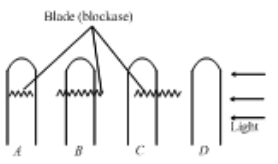
Four coleoptiles are used for an experiment. Which coleoptiles will bend toward the light? Choose the correct option.
A
$A$ and $B$
B
$C$ and $D$
C
$A$ and $D$
D
$C$ and $B$
Solution
(C) Phototropism is the growth or movement of a plant organ (like a coleoptile) towards a light source,which is mediated by the hormone auxin.
Auxin is produced in the apical tip and moves downwards. When light is present,auxin accumulates on the shaded side,causing faster cell elongation on that side,which results in bending towards the light.
$1$. In coleoptile $A$,the blade (blockage) is on the side facing the light. This prevents auxin from moving down the illuminated side,allowing it to accumulate on the shaded side,which promotes bending towards the light.
$2$. In coleoptile $B$,the blade blocks the entire cross-section,preventing any downward movement of auxin. Therefore,no bending occurs.
$3$. In coleoptile $C$,the blade is on the shaded side. This prevents auxin from reaching the shaded side,so the plant cannot bend towards the light.
$4$. In coleoptile $D$,there is no blockage,so auxin moves normally,and the coleoptile bends towards the light.
Thus,coleoptiles $A$ and $D$ will bend towards the light.
Auxin is produced in the apical tip and moves downwards. When light is present,auxin accumulates on the shaded side,causing faster cell elongation on that side,which results in bending towards the light.
$1$. In coleoptile $A$,the blade (blockage) is on the side facing the light. This prevents auxin from moving down the illuminated side,allowing it to accumulate on the shaded side,which promotes bending towards the light.
$2$. In coleoptile $B$,the blade blocks the entire cross-section,preventing any downward movement of auxin. Therefore,no bending occurs.
$3$. In coleoptile $C$,the blade is on the shaded side. This prevents auxin from reaching the shaded side,so the plant cannot bend towards the light.
$4$. In coleoptile $D$,there is no blockage,so auxin moves normally,and the coleoptile bends towards the light.
Thus,coleoptiles $A$ and $D$ will bend towards the light.
0 likes
View Solution203
MediumMCQ
Auxin originates at the tip of the stem and controls growth elsewhere. The movement of auxin is largely
A
Basipetal
B
Acropetal
C
Both $(a)$ and $(b)$
D
Centripetal
Solution
(A) Auxins are synthesized at the shoot apices and are transported downwards towards the base of the stem. This downward movement from the apex to the base is known as basipetal transport. In the roots,auxin is transported from the root tip towards the shoot,which is known as acropetal transport. However,in the context of the stem tip mentioned in the question,the primary movement is basipetal.
0 likes
View Solution204
MediumMCQ
Identify the functions of auxin and choose the correct option.
$I.$ Initiate rooting in stem cuttings
$II.$ Promote flowering in pineapples
$III.$ Controls xylem differentiation
$I.$ Initiate rooting in stem cuttings
$II.$ Promote flowering in pineapples
$III.$ Controls xylem differentiation
A
$I$ and $II$
B
$II$ and $III$
C
$III$ and $I$
D
$I, II$ and $III$
Solution
(D) The functions of auxin include:
$(i)$ Auxin helps to initiate rooting in stem cuttings,which is a widely used application for plant propagation.
$(ii)$ Auxin promotes flowering in plants like pineapples.
$(iii)$ Auxin plays a crucial role in controlling xylem differentiation and helps in cell division.
Since all three statements ($I, II,$ and $III$) are correct functions of auxin,the correct option is $D$.
$(i)$ Auxin helps to initiate rooting in stem cuttings,which is a widely used application for plant propagation.
$(ii)$ Auxin promotes flowering in plants like pineapples.
$(iii)$ Auxin plays a crucial role in controlling xylem differentiation and helps in cell division.
Since all three statements ($I, II,$ and $III$) are correct functions of auxin,the correct option is $D$.
0 likes
View Solution205
MediumMCQ
Which type of phytohormone is made up of indole compounds?
A
Zeatin
B
$ABA$
C
Auxin
D
Gibberellins
Solution
(C) Auxins are a class of phytohormones that are chemically derived from indole compounds.
Common examples of naturally occurring auxins include Indole-$3$-acetic acid $(IAA)$ and Indole butyric acid $(IBA)$.
Therefore,the correct answer is Auxin.
Common examples of naturally occurring auxins include Indole-$3$-acetic acid $(IAA)$ and Indole butyric acid $(IBA)$.
Therefore,the correct answer is Auxin.
0 likes
View Solution206
MediumMCQ
Two synthetic auxins are
A
$IAA$ and $IBA$
B
$2, 4-D$ and $NAA$
C
$IAA$ and $NAA$
D
$2, 4-D$ and $IBA$
Solution
(B) $IAA$ (Indole$-3-$acetic acid) and $IBA$ (Indole$-3-$butyric acid) are natural auxins found in plants.
$2, 4-D$ ($2, 4$-Dichlorophenoxyacetic acid) and $NAA$ (Naphthalene acetic acid) are synthetic auxins produced artificially in laboratories.
$2, 4-D$ ($2, 4$-Dichlorophenoxyacetic acid) and $NAA$ (Naphthalene acetic acid) are synthetic auxins produced artificially in laboratories.
0 likes
View Solution207
MediumMCQ
Which phytohormone promotes falling of old leaves whereas inhibits falling of young leaves?
A
$ABA$
B
Cytokinin
C
$GA$
D
Auxin
Solution
(D) Auxin is a plant hormone that plays a dual role in leaf abscission.
It inhibits the abscission of young leaves by maintaining the physiological activity of the cells in the abscission zone.
Conversely,it promotes the abscission of old leaves by stimulating the formation of the abscission layer.
It inhibits the abscission of young leaves by maintaining the physiological activity of the cells in the abscission zone.
Conversely,it promotes the abscission of old leaves by stimulating the formation of the abscission layer.
0 likes
View Solution208
MediumMCQ
Which auxins are used in diluted form to produce parthenocarpic fruits?
A
$IAA$ and $IBA$
B
$2, 4-D$ and $IBA$
C
$NAA$ and $GA$
D
$2, 4-D$ and $IAA$
Solution
(A) Auxins like $IAA$ (Indole$-3-$acetic acid) and $IBA$ (Indole$-3-$butyric acid) are used to induce parthenocarpy.
Parthenocarpic fruits are seedless fruits that develop without fertilization.
By applying these auxins in a diluted form to the flowers,the development of fruit is stimulated without the need for pollination or fertilization,as seen in tomatoes.
Parthenocarpic fruits are seedless fruits that develop without fertilization.
By applying these auxins in a diluted form to the flowers,the development of fruit is stimulated without the need for pollination or fertilization,as seen in tomatoes.
0 likes
View Solution209
MediumMCQ
Which of the following auxins is widely used as a weedicide?
A
$IAA$
B
$IBA$
C
$2, 4-D$
D
$NAA$
Solution
(C) $2, 4-D$ ($2, 4$-dichlorophenoxyacetic acid) is a synthetic auxin that is widely used as a weedicide.
It is specifically used to eliminate unwanted broad-leaved weeds in fields of monocotyledonous crops like wheat and maize without affecting the main crop.
It is specifically used to eliminate unwanted broad-leaved weeds in fields of monocotyledonous crops like wheat and maize without affecting the main crop.
0 likes
View Solution210
MediumMCQ
If an etiolated stem is first saturated with auxin by spraying and then exposed to a streak of light from one side,it will:
A
Bend towards the light
B
Bend away from the light
C
Grow straight upwards
D
Be prevented from growing
Solution
(C) Phototropism is primarily caused by the unequal distribution of auxin in the stem. When a plant is exposed to unilateral light,auxin accumulates on the shaded side,causing that side to grow faster and resulting in the stem bending towards the light. If the stem is already saturated with auxin,the exogenous auxin overrides the natural gradient,leading to uniform growth on all sides. Consequently,the stem will grow straight upwards despite the unilateral light exposure.
0 likes
View Solution211
MediumMCQ
Which is not a physiological effect of auxins?
A
Cell elongation
B
Development of parthenocarpic fruits
C
Prevention of abscission of leaves and fruits
D
Reversal of genetic dwarfism
Solution
(D) Auxins are plant hormones that promote cell elongation,the development of parthenocarpic fruits,and the prevention of abscission of leaves and fruits.
Reversal of genetic dwarfism is a physiological effect primarily associated with Gibberellins,not Auxins.
Reversal of genetic dwarfism is a physiological effect primarily associated with Gibberellins,not Auxins.
0 likes
View Solution212
MediumMCQ
The direction of the transport of auxins is
A
Polar in basipetal
B
Polar in acropetal
C
Through xylem
D
Through phloem
Solution
(A) The transport of auxins is polar in nature.
In the stem,auxins are transported from the shoot apex towards the base,which is known as basipetal transport.
Therefore,the correct direction of auxin transport is polar and basipetal.
In the stem,auxins are transported from the shoot apex towards the base,which is known as basipetal transport.
Therefore,the correct direction of auxin transport is polar and basipetal.
0 likes
View Solution213
MediumMCQ
Pruning of tea plants is done to discard the effects of
A
$GA_3$
B
Auxin
C
Cytokinin
D
$ABA$
Solution
(B) Tea plants are pruned to remove the apical buds.
Apical buds are the primary sites of auxin synthesis.
Auxin is responsible for apical dominance,which inhibits the growth of lateral buds.
By removing the apical buds,the effect of auxin is eliminated,allowing the lateral buds to grow and resulting in a bushier plant.
Apical buds are the primary sites of auxin synthesis.
Auxin is responsible for apical dominance,which inhibits the growth of lateral buds.
By removing the apical buds,the effect of auxin is eliminated,allowing the lateral buds to grow and resulting in a bushier plant.
0 likes
View Solution214
MediumMCQ
Which of the following hormones is a weak organic acid having unsaturated ring structures and is derived from an amino acid?
A
Cytokinin
B
Auxin
C
Gibberellins
D
Ethylene
Solution
(B) Auxin is a plant growth regulator that acts as a weak organic acid. It possesses an unsaturated ring structure (specifically an indole ring in the case of $IAA$). It is biosynthesized from the amino acid $Tryptophan$.
0 likes
View Solution215
MediumMCQ
$A$: If a plant is kept horizontally,auxin accumulates on the lower surface.
$R$: Displacement of statoliths and other cell organelles to the lower surface modifies the translocation pattern of auxin.
$R$: Displacement of statoliths and other cell organelles to the lower surface modifies the translocation pattern of auxin.
A
Assertion and Reason both are correct and Reason is the correct explanation of Assertion.
B
Assertion and Reason both are correct but Reason is not the correct explanation of Assertion.
C
Assertion is correct,but Reason is incorrect.
D
Both Assertion and Reason are incorrect.
Solution
(A) When a plant is placed horizontally,the gravity-sensing organelles known as statoliths (starch-filled amyloplasts) settle at the lower side of the cells due to gravity.
This displacement of statoliths triggers a signaling pathway that causes the redistribution of the plant hormone auxin.
Consequently,auxin accumulates on the lower surface of the stem or root,leading to differential growth (gravitropism).
Therefore,both the Assertion and the Reason are correct,and the Reason provides the correct explanation for the phenomenon described in the Assertion.
This displacement of statoliths triggers a signaling pathway that causes the redistribution of the plant hormone auxin.
Consequently,auxin accumulates on the lower surface of the stem or root,leading to differential growth (gravitropism).
Therefore,both the Assertion and the Reason are correct,and the Reason provides the correct explanation for the phenomenon described in the Assertion.
0 likes
View Solution216
MediumMCQ
$A$ : Auxin treatment causes acidification of the cell wall and helps in cell elongation.
$R$ : Loosening of cell wall microfibrils occurs.
$R$ : Loosening of cell wall microfibrils occurs.
A
Assertion and Reason both are correct and Reason is the correct explanation of Assertion.
B
Assertion and Reason both are correct but Reason is not the correct explanation of Assertion.
C
Assertion is correct,but Reason is incorrect.
D
Both Assertion and Reason are incorrect.
Solution
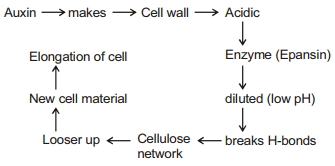
(A) According to the acid growth hypothesis,auxin stimulates the proton pumps in the plasma membrane,which increases the concentration of $H^+$ ions in the cell wall,leading to acidification.
This acidic environment activates cell wall-loosening enzymes known as expansins.
These enzymes break the hydrogen bonds between cellulose microfibrils,causing the cell wall to loosen.
This loosening allows the cell wall to extend under turgor pressure,resulting in cell elongation.
Therefore,both the Assertion and the Reason are correct,and the Reason correctly explains the mechanism behind the Assertion.
This acidic environment activates cell wall-loosening enzymes known as expansins.
These enzymes break the hydrogen bonds between cellulose microfibrils,causing the cell wall to loosen.
This loosening allows the cell wall to extend under turgor pressure,resulting in cell elongation.
Therefore,both the Assertion and the Reason are correct,and the Reason correctly explains the mechanism behind the Assertion.
0 likes
View Solution217
MediumMCQ
$A$: $2, 4-D$ is widely used by farmers in agricultural and horticultural practices.
$R$: Flowering in most plants can be initiated by using high concentration of Auxin.
$R$: Flowering in most plants can be initiated by using high concentration of Auxin.
A
Assertion and Reason both are correct and Reason is the correct explanation of Assertion.
B
Assertion and Reason both are correct but Reason is not the correct explanation of Assertion.
C
Assertion is correct,but Reason is incorrect.
D
Both Assertion and Reason are incorrect.
Solution
(C) $2, 4-D$ ($2, 4$-dichlorophenoxyacetic acid) is a synthetic auxin used extensively as a herbicide to kill dicotyledonous weeds without affecting mature monocotyledonous crop plants.
Therefore,the Assertion is correct.
However,flowering in most plants is not initiated by high concentrations of auxin. In fact,auxin generally inhibits flowering in most plants,with the notable exception of pineapple,where it promotes flowering. The primary hormone responsible for inducing flowering is florigen.
Therefore,the Reason is incorrect.
Therefore,the Assertion is correct.
However,flowering in most plants is not initiated by high concentrations of auxin. In fact,auxin generally inhibits flowering in most plants,with the notable exception of pineapple,where it promotes flowering. The primary hormone responsible for inducing flowering is florigen.
Therefore,the Reason is incorrect.
0 likes
View Solution218
MediumMCQ
The plant hormone used to destroy weeds in a field is:
A
$IAA$
B
$NAA$
C
$2,4-D$
D
$IBA$
Solution
(C) The plant hormone $2,4-D$ ($2$,$4$-dichlorophenoxyacetic acid) is a synthetic auxin.
It is widely used as a herbicide to kill dicotyledonous weeds in fields of monocotyledonous crops like wheat and maize.
It does not affect mature monocotyledonous plants,making it a selective weed killer.
Therefore,the correct option is $C$.
It is widely used as a herbicide to kill dicotyledonous weeds in fields of monocotyledonous crops like wheat and maize.
It does not affect mature monocotyledonous plants,making it a selective weed killer.
Therefore,the correct option is $C$.
0 likes
View Solution219
MediumMCQ
Plants with zinc deficiency show reduced biosynthesis of $..........$
A
Auxin
B
Cytokinin
C
Ethylene
D
Gibberellin
Solution
(A) Zinc $(Zn^{2+})$ is an essential micronutrient required by plants for various physiological processes.
Zinc is a critical cofactor for the enzyme tryptophan synthetase,which is involved in the biosynthesis of the plant growth hormone auxin (indole$-3-$acetic acid).
Therefore,a deficiency of zinc leads to a significant reduction in the biosynthesis of auxin,resulting in stunted growth and smaller leaves in plants.
Zinc is a critical cofactor for the enzyme tryptophan synthetase,which is involved in the biosynthesis of the plant growth hormone auxin (indole$-3-$acetic acid).
Therefore,a deficiency of zinc leads to a significant reduction in the biosynthesis of auxin,resulting in stunted growth and smaller leaves in plants.
0 likes
View Solution220
Medium
Give scientific reasons: Plants bend toward the source of light.
Solution
(N/A) The shoot apex exhibits positive phototropism. This phenomenon occurs because of differential growth in the stem,which is caused by the unequal distribution of the hormone auxin. When light falls on one side of the shoot,auxin migrates to the shaded side. Higher concentration of auxin on the shaded side promotes faster cell elongation compared to the illuminated side,causing the plant to bend toward the light source.
0 likes
View Solution221
Medium
Give scientific reasons: When the apical bud is removed,the next axillary bud begins to grow out.
Solution
(N/A) $1$. The apical bud is the primary site of $Auxin$ synthesis in plants.
$2$. $Auxin$ produced in the apical bud moves downwards and suppresses the growth of lateral or axillary buds,a phenomenon known as $Apical$ $Dominance$.
$3$. When the apical bud is removed,the source of $Auxin$ is eliminated.
$4$. Due to the absence of $Auxin$,the inhibitory effect on the axillary buds is lifted,allowing them to grow out and develop into new branches.
$2$. $Auxin$ produced in the apical bud moves downwards and suppresses the growth of lateral or axillary buds,a phenomenon known as $Apical$ $Dominance$.
$3$. When the apical bud is removed,the source of $Auxin$ is eliminated.
$4$. Due to the absence of $Auxin$,the inhibitory effect on the axillary buds is lifted,allowing them to grow out and develop into new branches.
0 likes
View Solution222
Medium
Give scientific reasons: Auxins fail to enhance the growth of intact plants.
Solution
(N/A) In an intact plant,the endogenous level of auxins is already optimal for growth.
Adding exogenous auxins does not further enhance growth because the plant's physiological processes are already saturated with respect to the auxin concentration required for normal development.
Therefore,the plant does not show a significant growth response to additional external application.
Adding exogenous auxins does not further enhance growth because the plant's physiological processes are already saturated with respect to the auxin concentration required for normal development.
Therefore,the plant does not show a significant growth response to additional external application.
0 likes
View Solution223
Medium
Give scientific reasons: Indole-$3$-acetic acid $(IAA)$ is not the only naturally occurring auxin.
Solution
(N/A) Auxins are a class of plant hormones that promote growth. While Indole-$3$-acetic acid $(IAA)$ is the most common and primary natural auxin,it is not the only one. Other chemical substances,such as $4$-chloro $IAA$ and phenylacetic acid $(PAA)$,have been isolated from various plant species. These compounds exhibit auxin-like physiological effects,such as cell elongation and root initiation,and are therefore classified as naturally occurring auxins.
0 likes
View Solution224
Medium
Define/Explain: Auxin.
Solution
(N/A) Auxin is a generic term for a group of plant growth hormones,primarily indole$-3-$acetic acid $(IAA)$ and other natural and synthetic compounds having growth-regulating properties.
These hormones are synthesized at the shoot and root apices (tips) and are responsible for cell elongation,apical dominance,and various other developmental processes in plants.
These hormones are synthesized at the shoot and root apices (tips) and are responsible for cell elongation,apical dominance,and various other developmental processes in plants.
0 likes
View Solution225
MediumMCQ
In botanical gardens and tea gardens,gardeners trim the plants regularly so that they remain bushy. Does this practice have any scientific explanation?
A
Yes,it removes apical dominance and promotes lateral growth.
B
Yes,it increases the rate of photosynthesis.
C
No,it is just a traditional practice.
D
Yes,it helps in the absorption of more water.
Solution
(A) The scientific explanation for this practice is the phenomenon of apical dominance.
In many plants,the apical bud produces auxins which inhibit the growth of lateral buds.
By trimming or removing the shoot apex (apical bud),the source of these inhibitory auxins is removed.
This allows the lateral buds to develop,promoting lateral branching and making the plant appear more bushy.
In many plants,the apical bud produces auxins which inhibit the growth of lateral buds.
By trimming or removing the shoot apex (apical bud),the source of these inhibitory auxins is removed.
This allows the lateral buds to develop,promoting lateral branching and making the plant appear more bushy.
0 likes
View Solution226
Medium
What is the mechanism underlying the phenomenon by which the terminal/apical bud suppresses the growth of lateral buds? Suggest measures to overcome this phenomenon.
Solution
(N/A) The phenomenon by which the terminal/apical bud suppresses the growth of lateral buds is known as apical dominance.
It is primarily caused by the hormone $Auxin$, which is synthesized in the apical buds and transported downwards, inhibiting the development of lateral buds.
To overcome this phenomenon, one can perform decapitation, which involves the physical removal of the apical bud.
Alternatively, the application of $Cytokinin$ can promote the growth of lateral buds, thereby counteracting the effect of $Auxin$.
It is primarily caused by the hormone $Auxin$, which is synthesized in the apical buds and transported downwards, inhibiting the development of lateral buds.
To overcome this phenomenon, one can perform decapitation, which involves the physical removal of the apical bud.
Alternatively, the application of $Cytokinin$ can promote the growth of lateral buds, thereby counteracting the effect of $Auxin$.
0 likes
View Solution227
EasyMCQ
$IAA$ and $IBA$ synthesis requires:
A
Iron
B
Manganese
C
Zinc
D
Boron
Solution
(C) The synthesis of the plant growth hormone $IAA$ (Indole$-3-$acetic acid) and its synthetic analog $IBA$ (Indole$-3-$butyric acid) requires the micronutrient $Zinc$ $(Zn)$.
$Zinc$ is essential for the synthesis of $Tryptophan$,which is the precursor amino acid for the biosynthesis of $Auxins$ like $IAA$.
$Zinc$ is essential for the synthesis of $Tryptophan$,which is the precursor amino acid for the biosynthesis of $Auxins$ like $IAA$.
0 likes
View Solution228
MediumMCQ
Who first isolated auxin?
A
Charles Darwin and Francis Darwin
B
$F$.$W$. Went
C
$F$. Skoog
D
Kurosawa
Solution
(B) Auxin was first isolated by $F.W. Went$ from the tips of $Avena$ (oat) seedlings. While Charles and Francis Darwin observed the phototropic response,it was $F.W. Went$ who successfully isolated the growth-promoting substance and named it auxin.
0 likes
View Solution229
MediumMCQ
Identify the synthetic auxin and natural auxin from the following.
A
$IAA$ and $2,4-D$ $\quad$ $NAA$ and $IBA$
B
$NAA$ and $2,4-D$ $\quad$ $IAA$ and $IBA$
C
$IAA$ and $IBA$ $\quad$ $NAA$ and $2,4-D$
D
$NAA$ and $IBA$ $\quad$ $IAA$ and $2,4-D$
Solution
(C) Auxins are plant growth regulators.
$IAA$ (Indole$-3-$acetic acid) and $IBA$ (Indole$-3-$butyric acid) are naturally occurring auxins found in plants.
$NAA$ (Naphthalene acetic acid) and $2,4-D$ ($2$,$4$-dichlorophenoxyacetic acid) are synthetic auxins produced in laboratories.
Therefore,the correct pair for natural auxins is $IAA$ and $IBA$,and for synthetic auxins is $NAA$ and $2,4-D$.
$IAA$ (Indole$-3-$acetic acid) and $IBA$ (Indole$-3-$butyric acid) are naturally occurring auxins found in plants.
$NAA$ (Naphthalene acetic acid) and $2,4-D$ ($2$,$4$-dichlorophenoxyacetic acid) are synthetic auxins produced in laboratories.
Therefore,the correct pair for natural auxins is $IAA$ and $IBA$,and for synthetic auxins is $NAA$ and $2,4-D$.
0 likes
View Solution230
EasyMCQ
What is the full form of $IAA$?
A
Indole-$1$-acetic acid
B
Indole-$2$-acetic acid
C
Indole-$3$-acetic acid
D
Indole-$4$-acetic acid
Solution
(C) $IAA$ stands for Indole-$3$-acetic acid.
It is the most common and naturally occurring auxin in plants.
It plays a crucial role in various physiological processes such as cell elongation,apical dominance,and root initiation.
It is the most common and naturally occurring auxin in plants.
It plays a crucial role in various physiological processes such as cell elongation,apical dominance,and root initiation.
0 likes
View Solution231
MediumMCQ
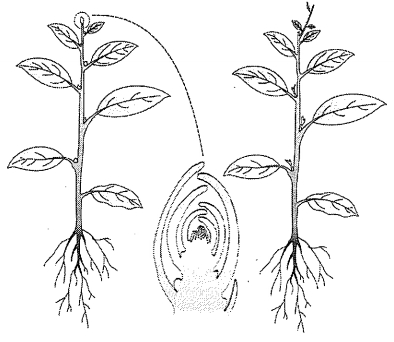
Select the correct option for the given figure.
A
Auxin - Apical dormancy in plants
B
Auxin - Apical dominance in plants
C
Gibberellins - Apical dormancy in plants
D
Gibberellins - Apical dominance in plants
Solution
(B) The figure illustrates the phenomenon of apical dominance in plants.
Apical dominance is the phenomenon where the growing apical bud inhibits the growth of lateral buds.
This process is primarily regulated by the plant hormone Auxin,which is synthesized at the shoot apex.
When the apical bud is removed (as shown in the figure),the inhibition on the lateral buds is lifted,allowing them to grow into branches.
Therefore,the correct association is Auxin - Apical dominance.
Apical dominance is the phenomenon where the growing apical bud inhibits the growth of lateral buds.
This process is primarily regulated by the plant hormone Auxin,which is synthesized at the shoot apex.
When the apical bud is removed (as shown in the figure),the inhibition on the lateral buds is lifted,allowing them to grow into branches.
Therefore,the correct association is Auxin - Apical dominance.
0 likes
View Solution232
EasyMCQ
Which of the following is used to kill dicotyledonous weeds?
A
$2,4-D$
B
$IAA$
C
$NAA$
D
$IBA$
Solution
(A) $2,4-D$ ($2,4$-dichlorophenoxyacetic acid) is a synthetic auxin.
It is widely used as a herbicide to eliminate broad-leaved or dicotyledonous weeds.
It does not affect mature monocotyledonous plants,making it useful for protecting cereal crops.
It is widely used as a herbicide to eliminate broad-leaved or dicotyledonous weeds.
It does not affect mature monocotyledonous plants,making it useful for protecting cereal crops.
0 likes
View Solution233
MediumMCQ
Which plant hormone prevents the premature shedding of leaves and fruits but promotes the abscission of older,mature leaves and fruits?
A
Auxin
B
Gibberellins
C
Ethylene
D
Cytokinins
Solution
(A) The correct answer is $A$ (Auxin).
Auxins are known to prevent the premature abscission of young leaves and fruits by maintaining the integrity of the abscission zone.
However,at higher concentrations or in specific physiological contexts,they can also promote the abscission of older,mature leaves and fruits by stimulating the production of ethylene,which triggers the formation of the abscission layer.
Auxins are known to prevent the premature abscission of young leaves and fruits by maintaining the integrity of the abscission zone.
However,at higher concentrations or in specific physiological contexts,they can also promote the abscission of older,mature leaves and fruits by stimulating the production of ethylene,which triggers the formation of the abscission layer.
0 likes
View Solution234
MediumMCQ
Which hormone is used to create a hedge in a garden?
A
Auxins
B
Gibberellins
C
Ethylene
D
Cytokinins
Solution
(A) Auxins are plant hormones that promote apical dominance.
In gardening,pruning the apical bud removes the source of auxins,which allows lateral buds to grow,resulting in a bushy appearance.
Therefore,auxins are responsible for the growth patterns that allow gardeners to shape plants into hedges.
In gardening,pruning the apical bud removes the source of auxins,which allows lateral buds to grow,resulting in a bushy appearance.
Therefore,auxins are responsible for the growth patterns that allow gardeners to shape plants into hedges.
0 likes
View Solution235
MediumMCQ
Auxin is used by gardeners to prepare weed-free lawns. But no damage is caused to grass as auxin
A
promotes abscission of mature leaves only.
B
does not affect mature monocotyledonous plants.
C
can help in cell division in grasses,to produce growth.
D
promotes apical dominance.
Solution
(B) Sol. Auxin,specifically synthetic auxins like $2,4-D$ ($2$,$4$-Dichlorophenoxyacetic acid),is used as a selective herbicide. It does not affect mature monocotyledonous plants like grasses. This is because monocots possess a different vascular structure and show limited translocation of the applied auxin,leading to its rapid degradation,thereby sparing the grass while killing broad-leaved weeds.
0 likes
View Solution236
MediumMCQ
Which of the following hormones is used in root formation on stem cutting?
A
Kinetin
B
$GA$
C
$ABA$
D
$IBA$
Solution
(D) Auxins are a class of plant hormones that promote cell elongation and root initiation.
$IBA$ (Indole$-3-$butyric acid) is a synthetic auxin that is widely used in horticulture to induce root formation in stem cuttings.
$GA$ (Gibberellic acid) is primarily involved in stem elongation and seed germination.
$ABA$ (Abscisic acid) acts as a growth inhibitor and promotes dormancy.
Kinetin is a type of cytokinin that promotes cell division.
$IBA$ (Indole$-3-$butyric acid) is a synthetic auxin that is widely used in horticulture to induce root formation in stem cuttings.
$GA$ (Gibberellic acid) is primarily involved in stem elongation and seed germination.
$ABA$ (Abscisic acid) acts as a growth inhibitor and promotes dormancy.
Kinetin is a type of cytokinin that promotes cell division.
0 likes
View Solution237
EasyMCQ
Low ratio of cytokinin to auxin induces . . . . . . in plants.
A
Root development
B
Shoot development
C
Fruiting
D
Flowering
Solution
(A) In plant tissue culture,the morphogenetic response is determined by the ratio of cytokinin to auxin.
$1$. $A$ high cytokinin to auxin ratio promotes shoot development.
$2$. $A$ low cytokinin to auxin ratio (i.e.,high auxin relative to cytokinin) promotes root development.
Therefore,a low ratio of cytokinin to auxin induces root development.
$1$. $A$ high cytokinin to auxin ratio promotes shoot development.
$2$. $A$ low cytokinin to auxin ratio (i.e.,high auxin relative to cytokinin) promotes root development.
Therefore,a low ratio of cytokinin to auxin induces root development.
0 likes
View Solution238
EasyMCQ
Which plant hormone prevents pre-mature fruit drop in apple,pear and orange?
A
Cytokinin
B
Ethylene
C
$ABA$
D
Auxin
Solution
(D) Auxins are a class of plant hormones that play a crucial role in regulating plant growth and development.
One of the primary physiological effects of auxins,such as $NAA$ (Naphthalene Acetic Acid) and $IBA$ (Indole$-3-$Butyric Acid),is the prevention of premature abscission of leaves,flowers,and fruits.
In commercial horticulture,synthetic auxins are sprayed on fruit trees like apple,pear,and orange to prevent the premature drop of fruits,thereby increasing the yield.
Therefore,the correct option is $D$.
One of the primary physiological effects of auxins,such as $NAA$ (Naphthalene Acetic Acid) and $IBA$ (Indole$-3-$Butyric Acid),is the prevention of premature abscission of leaves,flowers,and fruits.
In commercial horticulture,synthetic auxins are sprayed on fruit trees like apple,pear,and orange to prevent the premature drop of fruits,thereby increasing the yield.
Therefore,the correct option is $D$.
0 likes
View Solution239
EasyMCQ
Which plant hormone hastens early rooting in cuttings during vegetative propagation?
A
Gibberellins
B
Ethylene
C
Cytokinin
D
Auxin
Solution
(D) Auxins,such as Indole$-3-$acetic acid $(IAA)$ and Indole$-3-$butyric acid $(IBA)$,are widely used in plant tissue culture and horticulture to induce and accelerate root formation in stem cuttings. This property makes them essential for vegetative propagation.
0 likes
View Solution240
EasyMCQ
Formation of intrafascicular cambium is induced by
A
$ABA$
B
Auxin
C
Gibberellins
D
Cytokinin
Solution
(B) The formation of intrafascicular cambium is primarily induced by the plant hormone $Auxin$.
$Auxin$ promotes cell division and differentiation in the vascular cambium,which is essential for secondary growth in plants.
While other hormones like $Cytokinin$ and $Gibberellins$ also play roles in plant growth and development,$Auxin$ is specifically known to stimulate the activity of the cambium.
$Auxin$ promotes cell division and differentiation in the vascular cambium,which is essential for secondary growth in plants.
While other hormones like $Cytokinin$ and $Gibberellins$ also play roles in plant growth and development,$Auxin$ is specifically known to stimulate the activity of the cambium.
0 likes
View Solution241
EasyMCQ
Premature fruit drop in orange and pear is prevented by . . . . . . .
A
Ethylene
B
$ABA$
C
Cytokinin
D
Auxins
Solution
(D) Auxins are plant hormones that play a crucial role in regulating plant growth.
Specifically,auxins prevent the premature abscission (falling) of fruits by inhibiting the formation of the abscission layer at the pedicel.
Additionally,auxins are known to break seed dormancy and promote rapid seed germination.
Specifically,auxins prevent the premature abscission (falling) of fruits by inhibiting the formation of the abscission layer at the pedicel.
Additionally,auxins are known to break seed dormancy and promote rapid seed germination.
0 likes
View Solution242
EasyMCQ
In parthenocarpic fruits,the enlargement of the ovary into a fruit is brought about by the auxin . . . . . . .
A
$2,4-D$
B
$IBA$
C
$IAA$
D
$NAA$
Solution
(C) $IAA$ (Indole$-3-$acetic acid) is a naturally occurring auxin that induces parthenocarpy.
It promotes cell division,cell differentiation,and cell elongation in the ovary wall,which leads to the development of the ovary into a fruit without fertilization.
It promotes cell division,cell differentiation,and cell elongation in the ovary wall,which leads to the development of the ovary into a fruit without fertilization.
0 likes
View Solution243
EasyMCQ
The term $auxin$ was coined by
A
Boysen Jensen
B
Paal
C
Darwin
D
$F$.$W$. Went
Solution
(D) The term $auxin$ was coined by $F.W. Went$ in $1928$.
$F.W. Went$ isolated $auxin$ from the tips of $Avena$ coleoptiles.
$Charles$ $Darwin$ and his son $Francis$ $Darwin$ observed the coleoptiles of $Phalaris$ $canariensis$ and noted that they responded to unilateral illumination by growing towards the light source.
$Boysen$ $Jensen$ demonstrated that the stimulus was a chemical substance that could diffuse through gelatin.
$Paal$ showed that the growth curvature was due to the unequal distribution of a growth-promoting substance.
$F.W. Went$ isolated $auxin$ from the tips of $Avena$ coleoptiles.
$Charles$ $Darwin$ and his son $Francis$ $Darwin$ observed the coleoptiles of $Phalaris$ $canariensis$ and noted that they responded to unilateral illumination by growing towards the light source.
$Boysen$ $Jensen$ demonstrated that the stimulus was a chemical substance that could diffuse through gelatin.
$Paal$ showed that the growth curvature was due to the unequal distribution of a growth-promoting substance.
0 likes
View Solution244
EasyMCQ
In plants,the precursor of auxins is:
A
Tryptophan
B
Mevalonic acid
C
Ethephon
D
Cytokinins
Solution
(A) The primary precursor of $IAA$ (Indole$-3-$acetic acid) in plants is $Tryptophan$.
$IAA$ is the most common natural auxin produced in plants.
$IAA$ is the most common natural auxin produced in plants.
0 likes
View Solution245
EasyMCQ
To induce flowering in Litchi and Pineapple,which hormones are used for foliar spray?
A
$IBA$ and $2, 4-D$
B
$NAA$ and $2, 4-D$
C
$NAA$ and $IAA$
D
$IAA$ and $IBA$
Solution
(B) In plant physiology,synthetic auxins are widely used to regulate growth and development.
$NAA$ (Naphthalene Acetic Acid) is commonly used to induce flowering in $Litchi$.
$2, 4-D$ ($2$,$4$-Dichlorophenoxyacetic acid) is effectively used to induce flowering in $Pineapple$.
Therefore,the combination of $NAA$ and $2, 4-D$ is the correct answer for these specific applications.
$NAA$ (Naphthalene Acetic Acid) is commonly used to induce flowering in $Litchi$.
$2, 4-D$ ($2$,$4$-Dichlorophenoxyacetic acid) is effectively used to induce flowering in $Pineapple$.
Therefore,the combination of $NAA$ and $2, 4-D$ is the correct answer for these specific applications.
0 likes
View Solution246
EasyMCQ
Which auxin should be used to eradicate dicotyledonous weeds from a monocotyledonous crop field?
A
$IAA$
B
$2,4-D$
C
$IBA$
D
$NAA$
Solution
(B) $2, 4-D$ ($2, 4$-dichlorophenoxyacetic acid) is a synthetic auxin.
It is widely used as a selective herbicide (weedicide) to eradicate broad-leaved dicotyledonous weeds from monocotyledonous crop fields like wheat or maize.
It does not affect the monocotyledonous crops, making it an effective tool for agricultural weed management.
It is widely used as a selective herbicide (weedicide) to eradicate broad-leaved dicotyledonous weeds from monocotyledonous crop fields like wheat or maize.
It does not affect the monocotyledonous crops, making it an effective tool for agricultural weed management.
0 likes
View Solution247
EasyMCQ
In plants,lower branches are larger than upper branches due to . . . . . . .
A
Axillary buds near apical bud receive auxin in more concentration.
B
Lower axillary buds receive auxin in minute concentration.
C
Lower axillary buds receive auxin in more concentration.
D
Auxin formed in apical bud does not get transported towards lower axillary buds.
Solution
(B) In plants,the apical bud produces auxin,which is transported downwards and inhibits the growth of lateral (axillary) buds,a phenomenon known as apical dominance.
As the distance from the apical bud increases,the concentration of auxin decreases.
Therefore,the lower axillary buds receive a very low concentration of auxin compared to the upper ones.
Due to this reduced concentration of auxin,the inhibitory effect is minimized,allowing the lower branches to grow larger and more profusely.
As the distance from the apical bud increases,the concentration of auxin decreases.
Therefore,the lower axillary buds receive a very low concentration of auxin compared to the upper ones.
Due to this reduced concentration of auxin,the inhibitory effect is minimized,allowing the lower branches to grow larger and more profusely.
0 likes
View Solution248
EasyMCQ
Select an appropriate plant hormone responsible for apical dominance from the following.
A
Auxins
B
Ethylene
C
Gibberellins
D
Cytokinins
Solution
(A) Apical dominance is a phenomenon where the main central stem of the plant grows more dominantly than the side (lateral) buds.
This process is primarily controlled by $Auxins$, specifically $Indole-3-acetic \text{ } acid$ $(IAA)$.
$Auxins$ produced in the apical meristem inhibit the growth of lateral buds, thereby maintaining the dominance of the main shoot.
Therefore, the correct option is $A$.
This process is primarily controlled by $Auxins$, specifically $Indole-3-acetic \text{ } acid$ $(IAA)$.
$Auxins$ produced in the apical meristem inhibit the growth of lateral buds, thereby maintaining the dominance of the main shoot.
Therefore, the correct option is $A$.
0 likes
View Solution249
EasyMCQ
Which of the following hormones does not naturally occur in plants?
A
$GA$
B
$ABA$
C
$2,4-D$
D
$IAA$
Solution
(C) $2, 4-D$ is a synthetic auxin and does not occur naturally in plants.
$GA$ (Gibberellins), $ABA$ (Abscisic acid), and $IAA$ (Indole-3-acetic acid) are all naturally occurring plant hormones.
Therefore, the correct option is $C$.
$GA$ (Gibberellins), $ABA$ (Abscisic acid), and $IAA$ (Indole-3-acetic acid) are all naturally occurring plant hormones.
Therefore, the correct option is $C$.
0 likes
View Solution250
EasyMCQ
Apical dominance in plants is due to the presence of . . . . . .
A
Gibberellins in the lateral bud
B
Cytokinins in the leaf apex
C
Abscisic acid at the shoot tip
D
Auxins at the shoot tip
Solution
(D) The correct answer is $D$.
Apical dominance is a phenomenon in plants where the main central stem of the plant grows more dominantly than the side stems (lateral buds).
This process is primarily controlled by the hormone $Auxin$,which is synthesized at the shoot tip (apical meristem).
These $Auxins$ are transported downwards and inhibit the growth of lateral buds,thereby maintaining the dominance of the apical shoot.
Apical dominance is a phenomenon in plants where the main central stem of the plant grows more dominantly than the side stems (lateral buds).
This process is primarily controlled by the hormone $Auxin$,which is synthesized at the shoot tip (apical meristem).
These $Auxins$ are transported downwards and inhibit the growth of lateral buds,thereby maintaining the dominance of the apical shoot.
0 likes
View SolutionPlant Growth and Development — Auxin · Frequently Asked Questions
1Are these Plant Growth and Development questions useful for JEE and NEET?
Yes. All questions in this section are mapped to JEE Main and NEET exam patterns. Previous year questions from JEE Main, NEET, GUJCET and state-level exams are included with full solutions.
2Can I switch to Hindi or Gujarati for these questions?
Yes. Use the language tabs in the hero section or the sidebar to view the same questions and solutions in English, Hindi or Gujarati.
3How do I generate a question paper from this subtopic?
Use the Vedclass Exam Paper Generator — select the chapter and subtopic, set difficulty, and generate Sets A, B, C, D automatically. First 3 chapters of every subject are free.
Vedclass Products
For Students
Vedclass Test Series
Mock tests in real JEE/NEET style with performance analysis. 5-day free trial.
Start Free TrialFor Teachers
Exam Paper Generator
Generate Set A/B/C/D papers from this chapter in 2 minutes. 3 chapters free.
Try FreeFor Institutes
Online Exam Module
Live online exams with unlimited students, 360° analytics & white-label branding.
See DemoFor Teachers & Institutes
Generate a Plant Growth and Development Exam Paper in 2 Minutes
Select subtopic & difficulty — Sets A, B, C, D auto-generated with No Repeat logic.
First 3 chapters of every subject are free — no payment required.