
A English
Auxin Questions in English
Class 11 Biology · Plant Growth and Development · Auxin
251+
Questions
English
Language
100%
With Solutions
Showing 50 of 251 questions in English
51
EasyMCQ
The Avena coleoptile test detects the presence of:
A
$IAA$
B
$GA$
C
$NAA$
D
$BA$
Solution
(A) The Avena curvature test, developed by $F.W. Went$, was used to demonstrate the effect of auxins on plant growth using oat $(Avena \, sativa)$ coleoptiles.
$IAA$ (Indole$-3-$acetic acid) is the primary naturally occurring auxin in plants.
Therefore, the Avena coleoptile test is specifically used to detect the presence and activity of $IAA$.
$IAA$ (Indole$-3-$acetic acid) is the primary naturally occurring auxin in plants.
Therefore, the Avena coleoptile test is specifically used to detect the presence and activity of $IAA$.
0 likes
View Solution52
MediumMCQ
$IAA$ stands for:
A
Indole-$3$-acetic anhydride
B
Indole-$3$-acetic acid
C
Indole-$3$-acetic acetate
D
Indole-$3$-acetoacetic acid
Solution
(B) $IAA$ stands for Indole-$3$-acetic acid.
It is the most common and naturally occurring auxin hormone in plants.
Auxins are responsible for various growth processes such as cell elongation,apical dominance,and root initiation.
It is the most common and naturally occurring auxin hormone in plants.
Auxins are responsible for various growth processes such as cell elongation,apical dominance,and root initiation.
0 likes
View Solution53
EasyMCQ
Auxin $-B$ was first isolated by
A
Kogl and Erxlaben
B
Kogl,Erxlaben and Hagen Smit
C
Miller and Skoog
D
Yabuta and Sumiki
Solution
(B) Auxin $-B$ (also known as auxentriolic acid) was first isolated from human urine by $Kogl$,$Erxlaben$,and $Hagen$ $Smit$ in $1934$. They also isolated Auxin $-A$ and Heteroauxin (Indole$-3-$acetic acid) from the same source.
0 likes
View Solution54
MediumMCQ
Low concentration of auxin lowers the growth of
A
Root
B
Stem
C
Leaves
D
Dicot plants
Solution
(A) Auxins exhibit different effects on different plant organs based on their concentration.
$1$. Auxins promote the growth of the stem at higher concentrations.
$2$. Conversely,roots are highly sensitive to auxins,and even a low concentration of auxin inhibits root growth,while a very low concentration promotes it.
$3$. Therefore,compared to the stem,a low concentration of auxin is inhibitory for the root.
$1$. Auxins promote the growth of the stem at higher concentrations.
$2$. Conversely,roots are highly sensitive to auxins,and even a low concentration of auxin inhibits root growth,while a very low concentration promotes it.
$3$. Therefore,compared to the stem,a low concentration of auxin is inhibitory for the root.
0 likes
View Solution55
MediumMCQ
Formation of auxin is checked by
A
Photosynthesis
B
Photo-oxidation
C
Phototropism
D
Darkness
Solution
(B) Auxin is a plant hormone that is sensitive to light. When exposed to intense light,auxin undergoes photo-oxidation,which leads to its degradation or inactivation. Therefore,the formation and activity of auxin are checked or inhibited by the process of photo-oxidation.
0 likes
View Solution56
MediumMCQ
Which of the following accelerates apical meristem and exerts direct effect on the growth of plant axis in length?
A
Cytokinin
B
Ethylene
C
Gibberellin
D
Auxin
Solution
(D) Auxins are a class of plant hormones that play a crucial role in plant growth and development.
$1$. Auxins are primarily produced in the shoot apical meristems and young leaves.
$2$. They are responsible for apical dominance,where the growth of the main stem is promoted while the growth of lateral buds is inhibited.
$3$. Auxins promote cell elongation in the stem,which directly contributes to the increase in the length of the plant axis.
Therefore,$Auxin$ is the hormone that accelerates apical meristem activity and promotes longitudinal growth.
$1$. Auxins are primarily produced in the shoot apical meristems and young leaves.
$2$. They are responsible for apical dominance,where the growth of the main stem is promoted while the growth of lateral buds is inhibited.
$3$. Auxins promote cell elongation in the stem,which directly contributes to the increase in the length of the plant axis.
Therefore,$Auxin$ is the hormone that accelerates apical meristem activity and promotes longitudinal growth.
0 likes
View Solution57
MediumMCQ
What happens when auxin is applied to the tip of a cut stump?
A
Tip is burnt
B
Flower is produced
C
Leaves are instantly developed
D
Callus is formed
Solution
(D) Auxins are plant hormones that promote cell division and cell enlargement. When auxin is applied to the tip of a cut stump,it stimulates the undifferentiated cells to divide and proliferate,leading to the formation of a mass of unorganized cells known as $Callus$.
0 likes
View Solution58
MediumMCQ
What is the cause of excurrent habit in Pinus?
A
Presence of gibberellin
B
Presence of apical dominance
C
High concentration of cytokinin
D
High concentration of $ABA$
Solution
(B) The excurrent habit in $Pinus$ refers to the conical shape of the tree,where the main stem grows continuously and the lateral branches are shorter,giving the tree a pyramidal appearance.
This growth pattern is primarily controlled by apical dominance,a phenomenon where the terminal bud (apical bud) suppresses the growth of lateral buds due to the high concentration of the hormone auxin produced at the apex.
Therefore,the presence of apical dominance is the direct cause of the excurrent habit in $Pinus$.
This growth pattern is primarily controlled by apical dominance,a phenomenon where the terminal bud (apical bud) suppresses the growth of lateral buds due to the high concentration of the hormone auxin produced at the apex.
Therefore,the presence of apical dominance is the direct cause of the excurrent habit in $Pinus$.
0 likes
View Solution59
MediumMCQ
Pruning makes the hedge plant dense because
A
Injury induces dense growth
B
Apical dominance is removed
C
Root sprouts additional branches
D
Pruning removes shade and allows germination of new seedlings to impart a dense growth
Solution
(B) Pruning involves the removal of the apical buds of the plant.
Apical buds produce auxins,which are responsible for apical dominance,a phenomenon where the main central stem grows more dominantly than the side branches.
When the apical bud is removed,the source of auxin is eliminated,which breaks the apical dominance.
This allows the lateral (axillary) buds to grow,resulting in the development of more branches and making the hedge plant appear dense.
Apical buds produce auxins,which are responsible for apical dominance,a phenomenon where the main central stem grows more dominantly than the side branches.
When the apical bud is removed,the source of auxin is eliminated,which breaks the apical dominance.
This allows the lateral (axillary) buds to grow,resulting in the development of more branches and making the hedge plant appear dense.
0 likes
View Solution60
MediumMCQ
Which one of the following plant functions is not generally governed or controlled by auxin?
A
Apical dominance
B
Phototropism
C
Photosynthesis
D
Growth
Solution
(C) Auxin is a plant hormone that primarily regulates growth-related processes.
$A$. Apical dominance is a well-known effect of auxin,where the apical bud inhibits the growth of lateral buds.
$B$. Phototropism is the growth of a plant towards a light source,which is mediated by the redistribution of auxin.
$D$. Growth,particularly cell elongation,is the primary function of auxin.
$C$. Photosynthesis is a metabolic process involving the conversion of light energy into chemical energy,which is governed by enzymes and chlorophyll,not by auxin. Therefore,photosynthesis is not controlled by auxin.
$A$. Apical dominance is a well-known effect of auxin,where the apical bud inhibits the growth of lateral buds.
$B$. Phototropism is the growth of a plant towards a light source,which is mediated by the redistribution of auxin.
$D$. Growth,particularly cell elongation,is the primary function of auxin.
$C$. Photosynthesis is a metabolic process involving the conversion of light energy into chemical energy,which is governed by enzymes and chlorophyll,not by auxin. Therefore,photosynthesis is not controlled by auxin.
0 likes
View Solution61
MediumMCQ
If the concentration of $IAA$ is increased in the roots of a plant,the absorption of water would
A
Increase
B
Decrease
C
First decrease then increase
D
Remain unaffected
Solution
(A) $IAA$ (Indole$-3-$acetic acid) is a type of auxin that promotes root growth and development.
Increased concentration of $IAA$ in the roots stimulates the growth of root hairs and increases the total surface area of the root system.
Since the absorption of water is directly proportional to the surface area of the roots,an increase in the root surface area leads to an increase in the rate of water absorption by the plant.
Increased concentration of $IAA$ in the roots stimulates the growth of root hairs and increases the total surface area of the root system.
Since the absorption of water is directly proportional to the surface area of the roots,an increase in the root surface area leads to an increase in the rate of water absorption by the plant.
0 likes
View Solution62
MediumMCQ
Seedless fruits can be obtained by treating a plant with
A
Enzyme
B
Auxin
C
Vitamin
D
$70^{\circ}C$ and light
Solution
(B) The correct answer is $B$.
Auxins are plant hormones that promote the development of fruit without fertilization,a process known as parthenocarpy.
By applying synthetic auxins to the flowers,seedless fruits can be artificially induced.
Auxins are plant hormones that promote the development of fruit without fertilization,a process known as parthenocarpy.
By applying synthetic auxins to the flowers,seedless fruits can be artificially induced.
0 likes
View Solution63
MediumMCQ
Flowering in pineapple is promoted by
A
$NAA$
B
$GA_3$
C
Short days
D
Cytokinin
Solution
(A) Auxins,specifically $NAA$ (Naphthalene Acetic Acid) and $2,4-D$ ($2$,$4$-Dichlorophenoxyacetic acid),are widely used in agriculture to promote flowering in pineapple plants. $NAA$ helps in inducing uniform flowering in the crop,which is a significant application of synthetic auxins in horticulture.
0 likes
View Solution64
MediumMCQ
Storage sprouting of potato tubers can be prevented by treatment with low concentrations of
A
Nicotinamide
B
Naphthalene acetic acid
C
Nitrogenous fertilizer
D
Natural sunlight
Solution
(B) The sprouting of lateral buds (eyes) of potato tubers during storage can be inhibited by the application of synthetic auxins,specifically Naphthalene acetic acid $(NAA)$.
$NAA$ acts as a growth regulator that suppresses the activity of the meristematic tissues in the buds,thereby preventing premature sprouting and extending the shelf life of the tubers.
$NAA$ acts as a growth regulator that suppresses the activity of the meristematic tissues in the buds,thereby preventing premature sprouting and extending the shelf life of the tubers.
0 likes
View Solution65
MediumMCQ
During germination,the stem grows upward and the root grows downward because:
A
It depends upon light
B
Of auxin
C
It does not depend on light
D
Of epinasty and hyponasty
Solution
(B) The growth response of plants to gravity is known as gravitropism.
Auxins are plant hormones that play a crucial role in this process.
In roots,a high concentration of auxin inhibits cell elongation,causing the root to grow downward (positive gravitropism).
In stems,a high concentration of auxin promotes cell elongation,causing the stem to grow upward (negative gravitropism).
Therefore,the differential distribution and effect of auxin are responsible for the directional growth of the stem and root during germination.
Auxins are plant hormones that play a crucial role in this process.
In roots,a high concentration of auxin inhibits cell elongation,causing the root to grow downward (positive gravitropism).
In stems,a high concentration of auxin promotes cell elongation,causing the stem to grow upward (negative gravitropism).
Therefore,the differential distribution and effect of auxin are responsible for the directional growth of the stem and root during germination.
0 likes
View Solution66
MediumMCQ
The presence of auxins in a solution can be tested by:
A
Avena sativa stem tip test
B
Carbon tetrachloride test
C
Iodine test
D
Defoliation test
Solution
(A) The $Avena$ $sativa$ coleoptile curvature test,also known as the $Avena$ curvature test,is a classic bioassay used to detect and quantify the presence of auxins.
This test was developed by Frits Went in $1928$.
In this experiment,agar blocks containing auxin are placed asymmetrically on the cut tip of $Avena$ coleoptiles.
The auxin diffuses into the coleoptile,causing differential growth (more growth on the side with auxin),which results in the curvature of the coleoptile.
The degree of curvature is proportional to the concentration of auxin present in the solution.
This test was developed by Frits Went in $1928$.
In this experiment,agar blocks containing auxin are placed asymmetrically on the cut tip of $Avena$ coleoptiles.
The auxin diffuses into the coleoptile,causing differential growth (more growth on the side with auxin),which results in the curvature of the coleoptile.
The degree of curvature is proportional to the concentration of auxin present in the solution.
0 likes
View Solution67
MediumMCQ
Which of the following ions is pumped into the apoplast by auxin during cell growth?
A
$Na^+$
B
$K^+$
C
$Mg^{2+}$
D
$H^+$
Solution
(D) According to the Acid Growth Hypothesis,auxin stimulates the activity of $H^+$-ATPase pumps in the plasma membrane.
These pumps actively transport $H^+$ ions from the cytoplasm into the cell wall (apoplast).
This acidification of the cell wall lowers the pH,which activates enzymes called expansins.
Expansins break the cross-links between cellulose microfibrils,allowing the cell wall to loosen and expand,which facilitates cell growth.
These pumps actively transport $H^+$ ions from the cytoplasm into the cell wall (apoplast).
This acidification of the cell wall lowers the pH,which activates enzymes called expansins.
Expansins break the cross-links between cellulose microfibrils,allowing the cell wall to loosen and expand,which facilitates cell growth.
0 likes
View Solution68
MediumMCQ
One of the preventive methods of fruit drop is by spraying
A
Auxin
B
Ethylene gas
C
Gibberellins
D
Cytokinin
Solution
(A) The abscission layer is formed when the concentration of $Auxin$ falls below a critical threshold.
Spraying $Auxin$ helps in preventing the premature abscission of leaves,fruits,and branches by maintaining the hormonal balance and inhibiting the formation of the abscission zone.
Spraying $Auxin$ helps in preventing the premature abscission of leaves,fruits,and branches by maintaining the hormonal balance and inhibiting the formation of the abscission zone.
0 likes
View Solution69
MediumMCQ
Which one among the following chemicals is used for causing defoliation of forest trees?
A
Amo $-1618$
B
Phosphon $-D$
C
Maleic hydrazide
D
$2, 4-D$
Solution
(D) $2, 4-D$ ($2$,$4$-Dichlorophenoxyacetic acid) is a synthetic auxin that acts as a herbicide. It is widely used to cause defoliation in forest trees and to control broad-leaved weeds.
0 likes
View Solution70
MediumMCQ
Which of the following is an auxin?
A
Maleic acid
B
Abscisic acid
C
Pyruvic acid
D
Indole acetic acid
Solution
(D) The correct answer is $D$.
$Indole-3-acetic acid$ $(IAA)$ is the most common and primary natural auxin found in plants.
$Maleic$ $acid$ is a dicarboxylic acid,$Abscisic$ $acid$ is a plant growth inhibitor,and $Pyruvic$ $acid$ is a key intermediate in cellular respiration.
$Indole-3-acetic acid$ $(IAA)$ is the most common and primary natural auxin found in plants.
$Maleic$ $acid$ is a dicarboxylic acid,$Abscisic$ $acid$ is a plant growth inhibitor,and $Pyruvic$ $acid$ is a key intermediate in cellular respiration.
0 likes
View Solution71
MediumMCQ
Abscission of fruits is prevented by
A
$ABA$
B
Ethylene
C
Cytokinin
D
$IBA$
Solution
(D) Auxins,such as $IBA$ (Indole$-3-$butyric acid),are plant hormones that play a crucial role in regulating plant growth and development.
One of their primary functions is to inhibit the abscission (shedding) of young fruits and leaves by maintaining the integrity of the abscission zone.
$ABA$ (Abscisic acid) promotes abscission,while Ethylene is the primary hormone responsible for fruit ripening and the acceleration of abscission.
Therefore,$IBA$ is used to prevent the premature dropping of fruits.
One of their primary functions is to inhibit the abscission (shedding) of young fruits and leaves by maintaining the integrity of the abscission zone.
$ABA$ (Abscisic acid) promotes abscission,while Ethylene is the primary hormone responsible for fruit ripening and the acceleration of abscission.
Therefore,$IBA$ is used to prevent the premature dropping of fruits.
0 likes
View Solution72
MediumMCQ
The movement of auxin is largely
A
Basipetal
B
Acropetal
C
Centripetal
D
Centrifugal
Solution
(A) Auxin exhibits polar transport. In the stem,the movement is primarily basipetal (from the apex towards the base),whereas in the root,it is acropetal (from the root tip towards the shoot). Therefore,the most characteristic and widely recognized movement of auxin in the plant body is basipetal.
0 likes
View Solution73
MediumMCQ
Which of the following plant hormones prevents the premature falling of fruits?
A
$GA_3$
B
$NAA$
C
Ethylene
D
Zeatin
Solution
(B) Auxins,such as $NAA$ (Naphthalene Acetic Acid),are synthetic plant hormones that are widely used in agriculture to prevent the premature abscission (falling) of fruits and leaves.
$NAA$ helps in retaining fruits on the plant by inhibiting the formation of the abscission layer at the pedicel.
In contrast,Ethylene promotes abscission,while $GA_3$ (Gibberellic acid) and Zeatin (a type of cytokinin) have different primary roles in growth and cell division.
$NAA$ helps in retaining fruits on the plant by inhibiting the formation of the abscission layer at the pedicel.
In contrast,Ethylene promotes abscission,while $GA_3$ (Gibberellic acid) and Zeatin (a type of cytokinin) have different primary roles in growth and cell division.
0 likes
View Solution74
EasyMCQ
Synthetic auxins are used for
A
Killing weeds
B
Ripening fruits
C
Increasing the size of the fruits
D
Stimulating growth of cells in tissue culture
Solution
(A) Synthetic auxins,such as $2,4-D$ ($2,4-dichlorophenoxyacetic$ acid),are widely used as herbicides to kill dicotyledonous weeds. They do not affect mature monocotyledonous plants. Therefore,they are commonly used in agriculture to clear fields of unwanted weeds.
0 likes
View Solution75
MediumMCQ
Auxin in plants is not responsible for:
A
Cell elongation
B
Fruit ripening
C
Cell division
D
Inhibit the root growth
Solution
(B) The correct answer is $B$. Auxin is a plant hormone primarily involved in cell elongation,cell division,and root initiation. Fruit ripening is primarily regulated by the gaseous hormone ethylene,not auxin.
0 likes
View Solution76
MediumMCQ
Apical dominance in plants is caused by
A
High concentration of auxins in the terminal bud
B
High concentration of gibberellins in the apical bud
C
High concentration of auxins in the lateral bud
D
Absence of auxins and gibberellins in the apical bud
Solution
(A) Apical dominance is the phenomenon where the main central stem of the plant grows more dominantly than the side (lateral) stems.
This process is primarily controlled by the hormone $Auxin$.
$Auxins$ are synthesized in the apical (terminal) buds and transported downwards.
High concentrations of $Auxin$ in the terminal bud inhibit the growth of lateral buds,thereby maintaining apical dominance.
Therefore,the correct answer is $A$.
This process is primarily controlled by the hormone $Auxin$.
$Auxins$ are synthesized in the apical (terminal) buds and transported downwards.
High concentrations of $Auxin$ in the terminal bud inhibit the growth of lateral buds,thereby maintaining apical dominance.
Therefore,the correct answer is $A$.
0 likes
View Solution77
MediumMCQ
Which of the following is an auxin herbicide?
A
$NAA$
B
$IAA$
C
$2,4-D$
D
$IBA$
Solution
(C) $2,4-D$ ($2,4$-dichlorophenoxyacetic acid) is a synthetic auxin that acts as a potent herbicide or weedicide. It is widely used to selectively kill broad-leaved weeds in cereal crops and lawns without affecting the monocotyledonous crop plants.
0 likes
View Solution78
DifficultMCQ
Levitt performed experiments. He observed that auxin-treated cells were able to absorb water even when kept in a hypertonic solution. Which explains this observation best?
A
Auxin-treated cells lose selective permeability
B
$ATP$ production increases and therefore much energy is available for active absorption
C
Auxin lowers the water potential of cells
D
Auxin increases the solute potential of cells
Solution
(C) Auxin promotes cell elongation by increasing the plasticity of the cell wall and by stimulating the active transport of solutes into the cell.
When auxin is applied, it increases the concentration of solutes within the cell, which in turn lowers the water potential $(\Psi_w)$ of the cell.
According to the principles of osmosis, water moves from a region of higher water potential to a region of lower water potential.
Even in a hypertonic solution, if the cell's internal water potential is lowered sufficiently by the accumulation of solutes, the cell can still absorb water from the surrounding medium.
Therefore, the correct explanation is that auxin lowers the water potential of the cells.
When auxin is applied, it increases the concentration of solutes within the cell, which in turn lowers the water potential $(\Psi_w)$ of the cell.
According to the principles of osmosis, water moves from a region of higher water potential to a region of lower water potential.
Even in a hypertonic solution, if the cell's internal water potential is lowered sufficiently by the accumulation of solutes, the cell can still absorb water from the surrounding medium.
Therefore, the correct explanation is that auxin lowers the water potential of the cells.
0 likes
View Solution79
MediumMCQ
Apical dominance is not affected by
A
Indole acetic acid
B
Gibberellic acid
C
Indole acetaldehyde
D
Indole butyric acid
Solution
(B) Apical dominance is primarily controlled by auxins,which are a class of plant hormones that include Indole acetic acid $(IAA)$,Indole acetaldehyde,and Indole butyric acid $(IBA)$.
These substances promote the growth of the apical bud while inhibiting the growth of lateral buds.
Gibberellic acid $(GA)$,on the other hand,is primarily involved in stem elongation,seed germination,and flowering,but it does not play a direct role in maintaining apical dominance.
These substances promote the growth of the apical bud while inhibiting the growth of lateral buds.
Gibberellic acid $(GA)$,on the other hand,is primarily involved in stem elongation,seed germination,and flowering,but it does not play a direct role in maintaining apical dominance.
0 likes
View Solution80
MediumMCQ
With which of the following processes is the Cholodny-Went theory concerned?
A
Phototropism
B
Photomorphogenesis
C
Photorespiration
D
Photoperiodism
Solution
(A) The Cholodny-Went theory explains the mechanism of phototropism in plants.
According to this theory,when a plant is exposed to unilateral light,auxin (a plant growth hormone) redistributes towards the shaded side of the stem.
This higher concentration of auxin on the shaded side stimulates greater cell elongation compared to the illuminated side.
Consequently,the differential growth causes the plant stem to bend towards the light source.
According to this theory,when a plant is exposed to unilateral light,auxin (a plant growth hormone) redistributes towards the shaded side of the stem.
This higher concentration of auxin on the shaded side stimulates greater cell elongation compared to the illuminated side.
Consequently,the differential growth causes the plant stem to bend towards the light source.
0 likes
View Solution81
MediumMCQ
If the growing coleoptile tip is cut,what happens to phototropism?
A
Phototropism stops
B
Phototropism increases
C
Rate of photoperiodism remains unchanged
D
None of the above
Solution
(A) Phototropism is the growth movement of a plant part in response to a light stimulus,primarily mediated by the hormone auxin produced in the coleoptile tip.
When the growing coleoptile tip is removed,the source of auxin is eliminated.
Since auxin is essential for the differential growth required for phototropic bending,the removal of the tip results in the cessation of phototropism.
Therefore,the correct answer is $A$.
When the growing coleoptile tip is removed,the source of auxin is eliminated.
Since auxin is essential for the differential growth required for phototropic bending,the removal of the tip results in the cessation of phototropism.
Therefore,the correct answer is $A$.
0 likes
View Solution82
MediumMCQ
If the seedlings are grown in darkness,what is their physical appearance compared to those grown in light?
A
They are of the same size as those grown in light.
B
They are much healthier than those grown in light.
C
They are similar to those grown in light.
D
They are taller than those grown in light.
Solution
(D) Seedlings grown in darkness exhibit a phenomenon known as etiolation. They become taller and thinner compared to those grown in light. This occurs because the concentration of the plant hormone $Auxin$ is higher in the absence of light,which promotes cell elongation in the stem.
0 likes
View Solution83
EasyMCQ
Negative phototropism occurs in
A
Root
B
Stem
C
Leaf
D
Flower
Solution
(A) Phototropism is the growth of an organism in response to a light stimulus.
Roots exhibit negative phototropism because they grow away from the light source,typically moving deeper into the soil.
In contrast,stems exhibit positive phototropism as they grow towards the light source.
Therefore,the correct answer is $A$ (Root).
Roots exhibit negative phototropism because they grow away from the light source,typically moving deeper into the soil.
In contrast,stems exhibit positive phototropism as they grow towards the light source.
Therefore,the correct answer is $A$ (Root).
0 likes
View Solution84
MediumMCQ
Phototropism of stem and root are due to
A
Differential hormonal effect
B
Epinasty and hyponasty
C
Effect of light
D
Graviperception
Solution
(A) Phototropism is the growth of a plant part in response to a light stimulus.
In stems,light causes the hormone $Auxin$ to redistribute to the shaded side,promoting cell elongation and causing the stem to bend towards the light (positive phototropism).
In roots,higher concentrations of $Auxin$ inhibit cell elongation,causing the root to grow away from the light (negative phototropism).
Therefore,the differential distribution and effect of hormones like $Auxin$ on different sides of the plant organ are responsible for this phenomenon.
In stems,light causes the hormone $Auxin$ to redistribute to the shaded side,promoting cell elongation and causing the stem to bend towards the light (positive phototropism).
In roots,higher concentrations of $Auxin$ inhibit cell elongation,causing the root to grow away from the light (negative phototropism).
Therefore,the differential distribution and effect of hormones like $Auxin$ on different sides of the plant organ are responsible for this phenomenon.
0 likes
View Solution85
MediumMCQ
$A$ potted plant placed near the window bends outwardly due to
A
Greater oxygen availability to the tip
B
More auxin content on the shaded side
C
Greater light availability to tip
D
Availability of necessary warmth to the tip
Solution
(B) The bending of a plant towards light is known as phototropism.
When a plant is placed near a window,the side away from the light (shaded side) receives more auxin compared to the illuminated side.
Auxin promotes cell elongation.
Therefore,the cells on the shaded side grow faster than those on the illuminated side,causing the stem to bend towards the light source.
When a plant is placed near a window,the side away from the light (shaded side) receives more auxin compared to the illuminated side.
Auxin promotes cell elongation.
Therefore,the cells on the shaded side grow faster than those on the illuminated side,causing the stem to bend towards the light source.
0 likes
View Solution86
MediumMCQ
Phototropism in shoots is attributed to or phototropic movements are due to:
A
Auxin
B
Gibberellins
C
Cytokinin
D
Abscisic acid
Solution
(A) Phototropism is the growth of an organism in response to a light stimulus.
In plant shoots,phototropism is primarily caused by the unequal distribution of the hormone $Auxin$.
When a shoot is exposed to light from one side,$Auxin$ migrates to the shaded side of the stem.
This higher concentration of $Auxin$ on the shaded side stimulates greater cell elongation in that region compared to the illuminated side.
As a result,the shoot bends towards the light source.
In plant shoots,phototropism is primarily caused by the unequal distribution of the hormone $Auxin$.
When a shoot is exposed to light from one side,$Auxin$ migrates to the shaded side of the stem.
This higher concentration of $Auxin$ on the shaded side stimulates greater cell elongation in that region compared to the illuminated side.
As a result,the shoot bends towards the light source.
0 likes
View Solution87
EasyMCQ
The positive geotropic response of a root is:
A
Always
B
Rarely
C
Mostly
D
Nil
Solution
(A) Roots exhibit positive geotropism,meaning they grow in the direction of gravity. This is a fundamental characteristic of root systems in plants,ensuring that they grow downwards into the soil to anchor the plant and absorb water and minerals. Therefore,the geotropic response of a root is always positive.
0 likes
View Solution88
MediumMCQ
Phototropic and geotropic movements are linked to
A
Gibberellins
B
Enzymes
C
Auxin
D
Cytokinins
Solution
(C) Phototropic and geotropic movements in plants are primarily regulated by the hormone $Auxin$.
$Auxin$ is synthesized at the shoot and root tips and is transported to the site of action.
In response to light (phototropism),$Auxin$ accumulates on the shaded side of the stem,causing cells to elongate more on that side,which results in the bending of the stem towards the light.
Similarly,in response to gravity (geotropism),$Auxin$ distribution influences the differential growth of roots and shoots,directing the growth of the plant.
$Auxin$ is synthesized at the shoot and root tips and is transported to the site of action.
In response to light (phototropism),$Auxin$ accumulates on the shaded side of the stem,causing cells to elongate more on that side,which results in the bending of the stem towards the light.
Similarly,in response to gravity (geotropism),$Auxin$ distribution influences the differential growth of roots and shoots,directing the growth of the plant.
0 likes
View Solution89
MediumMCQ
Geotropic response of roots is due to
A
Inhibition of stem growth
B
More growth on lower side
C
More growth on upper side
D
Uniform growth
Solution
(C) The geotropic response in roots is primarily due to the redistribution of auxin.
When a root is placed horizontally,auxin accumulates on the lower side due to gravity.
In roots,a high concentration of auxin inhibits cell elongation.
Therefore,the cells on the upper side grow faster than those on the lower side,causing the root to bend downwards towards gravity (positive geotropism).
When a root is placed horizontally,auxin accumulates on the lower side due to gravity.
In roots,a high concentration of auxin inhibits cell elongation.
Therefore,the cells on the upper side grow faster than those on the lower side,causing the root to bend downwards towards gravity (positive geotropism).
0 likes
View Solution90
MediumMCQ
The movement of a sunflower towards the direction of the sun is known as:
A
Photonasty
B
Phototropism
C
Nyctinasty
D
Seismonasty
Solution
(B) Phototropism is the growth or movement of an organism in response to a light stimulus. In the case of a sunflower,the plant exhibits heliotropism,which is a specific type of phototropism where the flower head tracks the sun's movement across the sky throughout the day. This movement is driven by differential growth on opposite sides of the stem,caused by the redistribution of the hormone auxin in response to light.
0 likes
View Solution91
EasyMCQ
Geotropic response is perceived by
A
Mature roots
B
Elongating cells
C
Root cap
D
Root hairs
Solution
(C) The geotropic stimulus (gravity) is perceived by the root cap in the case of roots and by the stem apex in the case of stems. The root cap contains specialized cells called statocytes,which contain starch-filled amyloplasts known as statoliths. These statoliths settle at the bottom of the cells due to gravity,signaling the direction of the gravitational pull to the plant.
0 likes
View Solution92
MediumMCQ
If a planter is interested in obtaining a good crop of tea leaves from a single plant,he should
A
Feed auxin to the plant through soil
B
Remove the apical bud of the main shoot and the branches
C
Cut off the tip of the plant and then apply auxins to the cut end
D
Supply auxin from the tip of the plant as well as through roots
Solution
(B) To obtain a good crop of tea leaves,the planter needs to increase the number of lateral branches,as tea leaves are harvested from these branches.
Apical dominance is a phenomenon where the apical bud inhibits the growth of lateral buds.
By removing the apical bud (decapitation),the inhibition on lateral buds is lifted,allowing them to grow into new branches.
Therefore,removing the apical bud of the main shoot and the branches is the correct practice to promote bushiness and increase leaf yield.
Apical dominance is a phenomenon where the apical bud inhibits the growth of lateral buds.
By removing the apical bud (decapitation),the inhibition on lateral buds is lifted,allowing them to grow into new branches.
Therefore,removing the apical bud of the main shoot and the branches is the correct practice to promote bushiness and increase leaf yield.
0 likes
View Solution93
MediumMCQ
Mowing a grass lawn facilitates better maintenance primarily owing to:
A
Removal of apical dominance and promotion of lateral meristem
B
Removal of apical dominance
C
Wounding which stimulates rapid regeneration
D
None of the above
Solution
(B) The correct answer is $B$.
In many plants,the apical bud inhibits the growth of lateral buds,a phenomenon known as apical dominance.
When a grass lawn is mowed,the apical buds are removed.
This removal eliminates the apical dominance,which allows the lateral buds to grow,resulting in a thicker and more uniform lawn.
In many plants,the apical bud inhibits the growth of lateral buds,a phenomenon known as apical dominance.
When a grass lawn is mowed,the apical buds are removed.
This removal eliminates the apical dominance,which allows the lateral buds to grow,resulting in a thicker and more uniform lawn.
0 likes
View Solution94
MediumMCQ
Apical dominance means
A
Suppression of growth of apical bud by axillary buds
B
Suppression of growth of axillary buds by presence of apical bud
C
Stimulation of growth of apical bud by removal of axillary buds
D
Inhibition of growth of axillary buds by removal of apical bud
Solution
(B) Apical dominance is a phenomenon in which the apical bud suppresses the growth of lateral or axillary buds.
This is primarily mediated by the hormone $Auxin$,which is produced in the apical meristem and transported downwards.
Therefore,the presence of the apical bud inhibits the development of axillary buds,maintaining the dominance of the main stem.
This is primarily mediated by the hormone $Auxin$,which is produced in the apical meristem and transported downwards.
Therefore,the presence of the apical bud inhibits the development of axillary buds,maintaining the dominance of the main stem.
0 likes
View Solution95
MediumMCQ
$A$ plant placed near a window bends outwards because
A
Its tip is able to get more oxygen
B
Its tip is able to obtain more light
C
Its tip is able to receive necessary warmth
D
The auxin contents on the shadow side is higher than that on the lighter side and as a result the shaded side elongate more than the cells on the illuminated side and the tip bends outwards
Solution
(D) The phenomenon of a plant bending towards a light source is known as phototropism. This occurs because the hormone $Auxin$ is synthesized at the shoot tip. When light falls on one side of the plant, $Auxin$ migrates to the shaded side. $A$ higher concentration of $Auxin$ on the shaded side promotes greater cell elongation in that region compared to the illuminated side. Consequently, the differential growth causes the plant stem to bend towards the light source.
0 likes
View Solution96
MediumMCQ
Which of the following statements is false with respect to the application of auxins?
A
Control the direction of growth of plants
B
Inhibit lateral bud growth
C
Initiate and promote cell division actively,particularly in tissue culture
D
Produce hyperelongation effect
Solution
(C) The correct answer is $C$. Auxins are primarily responsible for cell elongation and apical dominance. The function of initiating and promoting cell division,especially in tissue culture,is a primary characteristic of cytokinins,not auxins. Therefore,statement $C$ is false.
0 likes
View Solution97
MediumMCQ
$A$ green plant bends towards the source of light when exposed to light on only one side. Which of the following is the best explanation for this phenomenon?
A
The apices of their stems are attracted by light.
B
They need light for photosynthesis.
C
Some auxins accumulate on the shaded side to induce greater cell elongation on that side.
D
Light stimulates the cells on the illuminated side to increase in length.
Solution
(C) The phenomenon described is phototropism. When a plant is exposed to light from one side,the hormone auxin (indole$-3-$acetic acid) migrates to the shaded side of the stem. Auxin promotes cell elongation. As a result,the cells on the shaded side grow longer than those on the illuminated side,causing the stem to bend towards the light source.
0 likes
View Solution98
MediumMCQ
Which arrangement of an agar block on an oat coleoptile would result in $IAA$ collecting in the agar?
A
B
C
D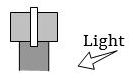
Solution
(B) The $IAA$ (auxin) is synthesized in the coleoptile tip and moves downwards through polar transport.
For $IAA$ to collect in an agar block,the block must be placed in contact with the base of the coleoptile tip so that the auxin can diffuse into it.
In option $B$,the coleoptile tip is placed directly on top of the agar block. As auxin is produced in the tip and moves basipetally (downward),it will accumulate in the agar block placed beneath it.
Therefore,the correct arrangement is the one where the tip is placed on the agar block.
For $IAA$ to collect in an agar block,the block must be placed in contact with the base of the coleoptile tip so that the auxin can diffuse into it.
In option $B$,the coleoptile tip is placed directly on top of the agar block. As auxin is produced in the tip and moves basipetally (downward),it will accumulate in the agar block placed beneath it.
Therefore,the correct arrangement is the one where the tip is placed on the agar block.
0 likes
View Solution99
EasyMCQ
Went $(1928)$ reported that auxin moves from apical to basal end,i.e.,basipetally. The movement is quite fast; in roots,it is about:
A
$0$ to $1$ $cm/h$
B
$0.1$ to $0.2$ $cm/h$
C
$0.2$ to $0.3$ $cm/h$
D
$0.3$ to $0.4$ $cm/h$
Solution
(C) Auxin exhibits polar transport in plants. $F$.$W$. Went $(1928)$ demonstrated that auxin moves basipetally (from the apex towards the base). In the roots,this polar transport of auxin is relatively rapid,occurring at a rate of approximately $0.2$ to $0.3$ $cm/h$.
0 likes
View Solution100
MediumMCQ
What causes a green plant to bend towards light as it grows?
A
Because green plants need light to carry on photosynthesis
B
Because green plants are phototropic
C
Light stimulates plant cells on the lighted side to grow faster
D
Auxin accumulates on the shaded side,stimulating greater cell elongation
Solution
(D) The bending of a plant towards light is known as phototropism. This phenomenon is primarily controlled by the plant hormone $Auxin$. When light falls on a plant from one side,$Auxin$ migrates to the shaded side of the stem. $Auxin$ promotes cell elongation. Since there is a higher concentration of $Auxin$ on the shaded side,the cells on that side elongate more rapidly than the cells on the illuminated side. This differential growth causes the stem to bend towards the light source.
0 likes
View SolutionPlant Growth and Development — Auxin · Frequently Asked Questions
1Are these Plant Growth and Development questions useful for JEE and NEET?
Yes. All questions in this section are mapped to JEE Main and NEET exam patterns. Previous year questions from JEE Main, NEET, GUJCET and state-level exams are included with full solutions.
2Can I switch to Hindi or Gujarati for these questions?
Yes. Use the language tabs in the hero section or the sidebar to view the same questions and solutions in English, Hindi or Gujarati.
3How do I generate a question paper from this subtopic?
Use the Vedclass Exam Paper Generator — select the chapter and subtopic, set difficulty, and generate Sets A, B, C, D automatically. First 3 chapters of every subject are free.
Vedclass Products
For Students
Vedclass Test Series
Mock tests in real JEE/NEET style with performance analysis. 5-day free trial.
Start Free TrialFor Teachers
Exam Paper Generator
Generate Set A/B/C/D papers from this chapter in 2 minutes. 3 chapters free.
Try FreeFor Institutes
Online Exam Module
Live online exams with unlimited students, 360° analytics & white-label branding.
See DemoFor Teachers & Institutes
Generate a Plant Growth and Development Exam Paper in 2 Minutes
Select subtopic & difficulty — Sets A, B, C, D auto-generated with No Repeat logic.
First 3 chapters of every subject are free — no payment required.