
A English
Light reaction Questions in English
Class 11 Biology · Photosynthesis in Higher Plants · Light reaction
383+
Questions
English
Language
100%
With Solutions
Showing 50 of 383 questions in English
151
MediumMCQ
$DCMU$ is an inhibitor of .......
A
$PS-I$
B
$PS-II$
C
Calvin cycle
D
Krebs cycle
Solution
(B) $DCMU$ ($3$-($3$,$4$-dichlorophenyl)$-1,1-$dimethylurea) is a potent herbicide that acts as an inhibitor of photosynthesis.
It specifically binds to the $Q_B$ binding site of the $D1$ protein in the $PS-II$ (Photosystem-$II$) complex.
By blocking the electron flow from $Q_A$ to $Q_B$,it prevents the reduction of plastoquinone,thereby halting the light-dependent reactions of photosynthesis.
It specifically binds to the $Q_B$ binding site of the $D1$ protein in the $PS-II$ (Photosystem-$II$) complex.
By blocking the electron flow from $Q_A$ to $Q_B$,it prevents the reduction of plastoquinone,thereby halting the light-dependent reactions of photosynthesis.
0 likes
View Solution152
EasyMCQ
During photosynthesis,energy is transferred from the light reaction to the dark reaction in the form of .........
A
$ADP$
B
$ATP$
C
$RuDP$
D
Chlorophyll
Solution
(B) During the light-dependent reactions of photosynthesis,solar energy is converted into chemical energy.
This chemical energy is stored in the form of $ATP$ (Adenosine Triphosphate) and $NADPH$.
These molecules are then utilized in the light-independent reactions (also known as the Calvin cycle or dark reaction) to fix carbon dioxide into glucose.
Therefore,$ATP$ acts as the primary energy carrier between the light and dark reactions.
This chemical energy is stored in the form of $ATP$ (Adenosine Triphosphate) and $NADPH$.
These molecules are then utilized in the light-independent reactions (also known as the Calvin cycle or dark reaction) to fix carbon dioxide into glucose.
Therefore,$ATP$ acts as the primary energy carrier between the light and dark reactions.
0 likes
View Solution153
EasyMCQ
In which of the following is solar energy converted into $ATP$?
A
Mitochondria
B
Chloroplast
C
Ribosome
D
Peroxisome
Solution
(B) Solar energy is converted into chemical energy ($ATP$ and $NADPH$) during the light-dependent reactions of photosynthesis. This process occurs in the thylakoid membranes of the chloroplast. Mitochondria are involved in cellular respiration where $ATP$ is produced from the breakdown of glucose,not solar energy. Ribosomes are sites of protein synthesis,and peroxisomes are involved in metabolic reactions like photorespiration and lipid metabolism. Therefore,the correct answer is chloroplast.
0 likes
View Solution154
MediumMCQ
The visible light wavelengths that are most effective in photosynthesis are.......
A
Green
B
Yellow
C
Red
D
Violet
Solution
(C) Photosynthesis occurs most efficiently in the blue and red regions of the visible light spectrum.
Among the given options,red light is highly effective for photosynthesis as it is well-absorbed by chlorophyll $a$ and $b$.
While blue light is also very effective,red light is typically cited in the context of action spectra for photosynthesis in many textbooks.
Among the given options,red light is highly effective for photosynthesis as it is well-absorbed by chlorophyll $a$ and $b$.
While blue light is also very effective,red light is typically cited in the context of action spectra for photosynthesis in many textbooks.
0 likes
View Solution155
MediumMCQ
In which of the following is the Hill reaction observed?
A
Plants growing at high altitudes
B
Complete darkness
C
Presence of ferricyanide
D
Absence of water
Solution
(C) The Hill reaction refers to the light-driven splitting of water (photolysis) by isolated chloroplasts in the presence of an artificial electron acceptor.
Robert Hill demonstrated that when isolated chloroplasts are illuminated in the presence of an artificial electron acceptor like ferricyanide (potassium ferricyanide),they evolve $O_2$ even in the absence of $CO_2$.
Therefore,the presence of an artificial electron acceptor like ferricyanide is essential for the Hill reaction to occur in isolated chloroplasts.
Robert Hill demonstrated that when isolated chloroplasts are illuminated in the presence of an artificial electron acceptor like ferricyanide (potassium ferricyanide),they evolve $O_2$ even in the absence of $CO_2$.
Therefore,the presence of an artificial electron acceptor like ferricyanide is essential for the Hill reaction to occur in isolated chloroplasts.
0 likes
View Solution156
EasyMCQ
When two pigment systems absorb light,the direction of energy flow between them must be:
A
$PS-II \rightarrow PS-I$
B
$PS-I \rightarrow PS-II$
C
$PS-I \rightarrow PS-I$
D
None of the above
Solution
(A) In the light-dependent reactions of photosynthesis,the two photosystems ($PS-II$ and $PS-I$) work in series to facilitate the non-cyclic electron transport chain ($Z$-scheme).
$PS-II$ (P680) absorbs light energy first,leading to the photolysis of water and the release of electrons.
These electrons are then transferred through an electron transport system to $PS-I$ (P700).
Therefore,the flow of energy and electrons occurs from $PS-II$ to $PS-I$.
$PS-II$ (P680) absorbs light energy first,leading to the photolysis of water and the release of electrons.
These electrons are then transferred through an electron transport system to $PS-I$ (P700).
Therefore,the flow of energy and electrons occurs from $PS-II$ to $PS-I$.
0 likes
View Solution157
EasyMCQ
$NADPH_2$ is also known as .........
A
Actual energy
B
Oxidizing agent
C
Powerhouse of energy
D
Reducing power
Solution
(D) $NADPH_2$ (or $NADPH + H^+$) is produced during the light-dependent reactions of photosynthesis.
It acts as a primary electron donor in the Calvin cycle (dark reactions).
Because it provides the electrons and hydrogen ions necessary to reduce $CO_2$ into glucose,it is biologically referred to as a 'reducing power'.
It acts as a primary electron donor in the Calvin cycle (dark reactions).
Because it provides the electrons and hydrogen ions necessary to reduce $CO_2$ into glucose,it is biologically referred to as a 'reducing power'.
0 likes
View Solution158
MediumMCQ
The wavelength required for the Emerson enhancement effect is........
A
Only $680 \ nm$ and above
B
Only $680 \ nm$ and below
C
Infrared wavelength
D
Both $680 \ nm$ and above and $680 \ nm$ and below
Solution
(D) The Emerson enhancement effect is the increase in the rate of photosynthesis when chloroplasts are exposed to light of two different wavelengths simultaneously,compared to the sum of the rates when exposed to each wavelength separately.
Robert Emerson observed that the rate of photosynthesis drops significantly when plants are exposed to light with a wavelength greater than $680 \ nm$ (far-red light).
However,when light of a shorter wavelength (less than $680 \ nm$) is provided along with the far-red light,the rate of photosynthesis increases dramatically.
Therefore,the enhancement effect requires both wavelengths greater than $680 \ nm$ and wavelengths less than $680 \ nm$ to activate both Photosystem-$I$ and Photosystem-$II$ simultaneously.
Robert Emerson observed that the rate of photosynthesis drops significantly when plants are exposed to light with a wavelength greater than $680 \ nm$ (far-red light).
However,when light of a shorter wavelength (less than $680 \ nm$) is provided along with the far-red light,the rate of photosynthesis increases dramatically.
Therefore,the enhancement effect requires both wavelengths greater than $680 \ nm$ and wavelengths less than $680 \ nm$ to activate both Photosystem-$I$ and Photosystem-$II$ simultaneously.
0 likes
View Solution159
MediumMCQ
During photosynthesis,oxygen is evolved from........
A
$H_2S$
B
$H_2O$
C
$CO_2$
D
$HCO_3^-$
Solution
(B) During the process of photosynthesis,the photolysis of water $(H_2O)$ occurs in the thylakoid lumen.
This process splits water molecules into protons $(H^+)$,electrons $(e^-)$,and oxygen $(O_2)$.
The oxygen released during photosynthesis is a byproduct of this water-splitting reaction,not from carbon dioxide $(CO_2)$.
This was experimentally proven by $C$.$B$. van Niel using purple and green sulfur bacteria.
This process splits water molecules into protons $(H^+)$,electrons $(e^-)$,and oxygen $(O_2)$.
The oxygen released during photosynthesis is a byproduct of this water-splitting reaction,not from carbon dioxide $(CO_2)$.
This was experimentally proven by $C$.$B$. van Niel using purple and green sulfur bacteria.
0 likes
View Solution160
EasyMCQ
In Photosystem-$I$ $(PS-I)$,the reaction center chlorophyll is ......... .
A
$P-600$
B
$P-680$
C
$P-700$
D
$P-720$
Solution
(C) In Photosystem-$I$ $(PS-I)$,the reaction center is a special form of chlorophyll-$a$ that absorbs light at a wavelength of $700 \ nm$. Hence,it is known as $P-700$. In contrast,the reaction center of Photosystem-$II$ $(PS-II)$ absorbs light at $680 \ nm$ and is known as $P-680$.
0 likes
View Solution161
MediumMCQ
Which element is essential for electron transport during the process of photosynthesis?
A
Zinc
B
Molybdenum
C
Boron
D
Manganese
Solution
(D) Manganese $(Mn^{2+})$ plays a crucial role in the process of photosynthesis,specifically in the photolysis of water. During the light-dependent reactions,the oxygen-evolving complex $(OEC)$ associated with Photosystem $II$ requires manganese ions to split water molecules $(2H_2O \rightarrow 4H^+ + 4e^- + O_2)$. This process releases electrons that are essential for the electron transport chain,thereby facilitating the synthesis of $ATP$ and $NADPH$.
0 likes
View Solution162
MediumMCQ
Photosynthesis is an oxidation-reduction process. In this process,the substance that gets oxidized is ......... .
A
$CO_2$
B
$NADP$
C
$H_2O$
D
$PGA$
Solution
(C) Photosynthesis is a redox reaction where water $(H_2O)$ is oxidized to oxygen $(O_2)$ and carbon dioxide $(CO_2)$ is reduced to glucose $(C_6H_{12}O_6)$.
During the light-dependent reactions,the photolysis of water occurs,where $H_2O$ molecules are split to release electrons,protons $(H^+)$,and oxygen $(O_2)$.
Since $H_2O$ loses electrons during this process,it undergoes oxidation.
During the light-dependent reactions,the photolysis of water occurs,where $H_2O$ molecules are split to release electrons,protons $(H^+)$,and oxygen $(O_2)$.
Since $H_2O$ loses electrons during this process,it undergoes oxidation.
0 likes
View Solution163
MediumMCQ
Which pigment system eventually donates electrons for the reduction of $NADP^+$?
A
$PS-II$
B
$PS-I$
C
$CO_2$
D
Plastoquinone
Solution
(B) In the light-dependent reactions of photosynthesis, the $Z$-scheme involves both photosystems.
$PS-II$ absorbs light and releases electrons, which pass through an electron transport chain to $PS-I$.
$PS-I$ ($P700$) absorbs light and gets excited, releasing high-energy electrons.
These electrons are passed to ferredoxin and finally to the enzyme $NADP$ reductase, which reduces $NADP^+$ to $NADPH + H^+$.
Therefore, $PS-I$ is the pigment system that eventually donates electrons for the reduction of $NADP^+$.
$PS-II$ absorbs light and releases electrons, which pass through an electron transport chain to $PS-I$.
$PS-I$ ($P700$) absorbs light and gets excited, releasing high-energy electrons.
These electrons are passed to ferredoxin and finally to the enzyme $NADP$ reductase, which reduces $NADP^+$ to $NADPH + H^+$.
Therefore, $PS-I$ is the pigment system that eventually donates electrons for the reduction of $NADP^+$.
0 likes
View Solution164
EasyMCQ
Photosystem-$I$ $(PS-I)$ is associated with which of the following?
A
Photolysis of water
B
Cyclic photophosphorylation
C
Non-cyclic photophosphorylation
D
Oxidative phosphorylation
Solution
(B) Photosystem-$I$ $(PS-I)$ is primarily associated with cyclic photophosphorylation.
In cyclic photophosphorylation,only $PS-I$ is functional.
The electrons are excited from the reaction center $P700$ and travel through an electron transport chain,returning back to $P700$.
This process results in the synthesis of $ATP$ but does not involve the photolysis of water or the production of $NADPH$.
In cyclic photophosphorylation,only $PS-I$ is functional.
The electrons are excited from the reaction center $P700$ and travel through an electron transport chain,returning back to $P700$.
This process results in the synthesis of $ATP$ but does not involve the photolysis of water or the production of $NADPH$.
0 likes
View Solution165
EasyMCQ
In the grana,the process $ADP + P_i = ATP$ is called .........
A
Phosphorylation
B
Oxidative photophosphorylation
C
Photophosphorylation
D
Photolysis
Solution
(C) The process of synthesis of $ATP$ from $ADP$ and inorganic phosphate $(P_i)$ in the presence of light in the chloroplast is known as photophosphorylation. Since this process occurs in the thylakoid membranes (grana) of the chloroplast during the light-dependent reactions of photosynthesis,it is specifically termed photophosphorylation.
0 likes
View Solution166
MediumMCQ
Which element is present in the $OEC$ (Oxygen Evolving Complex)?
A
$Mn^{2+}$
B
$Cl^-$
C
$Ca^{2+}$
D
All of these
Solution
(D) The $OEC$ (Oxygen Evolving Complex) is a protein complex associated with $Photosystem \ II$ $(PS \ II)$ in the thylakoid membrane of chloroplasts.
It is responsible for the photolysis of water,which releases oxygen as a byproduct.
The $OEC$ requires several inorganic cofactors to function,specifically $Manganese$ $(Mn^{2+})$,$Calcium$ $(Ca^{2+})$,and $Chloride$ $(Cl^-)$ ions.
Therefore,all the mentioned elements are essential components of the $OEC$.
It is responsible for the photolysis of water,which releases oxygen as a byproduct.
The $OEC$ requires several inorganic cofactors to function,specifically $Manganese$ $(Mn^{2+})$,$Calcium$ $(Ca^{2+})$,and $Chloride$ $(Cl^-)$ ions.
Therefore,all the mentioned elements are essential components of the $OEC$.
0 likes
View Solution167
MediumMCQ
The primary electron acceptor during the ionization of water is:
A
Chlorophyll
B
$NADP$
C
$OH^-$
D
Cytochrome
Solution
(A) During the light-dependent reactions of photosynthesis,water molecules undergo photolysis (ionization) in the presence of light and the oxygen-evolving complex.
When water $(H_2O)$ splits,it releases electrons,protons $(H^+)$,and oxygen $(O_2)$.
The electrons released from the photolysis of water are immediately accepted by the oxidized form of the reaction center of Photosystem $II$,which is $P_{680}^+$.
Therefore,the primary electron acceptor that replaces the electrons lost by chlorophyll $a$ in Photosystem $II$ is the reaction center itself,but in the context of the electron transport chain,the electrons are transferred to the primary electron acceptor of Photosystem $II$,which is pheophytin.
However,among the given options,the question refers to the immediate electron donor/acceptor relationship in the context of the water-splitting complex. Since the question asks for the primary electron acceptor during the ionization of water,it refers to the reaction center $P_{680}$ which gets reduced after accepting electrons from water. Given the standard options provided,$P_{680}$ (Chlorophyll $a$) is the correct biological entity.
When water $(H_2O)$ splits,it releases electrons,protons $(H^+)$,and oxygen $(O_2)$.
The electrons released from the photolysis of water are immediately accepted by the oxidized form of the reaction center of Photosystem $II$,which is $P_{680}^+$.
Therefore,the primary electron acceptor that replaces the electrons lost by chlorophyll $a$ in Photosystem $II$ is the reaction center itself,but in the context of the electron transport chain,the electrons are transferred to the primary electron acceptor of Photosystem $II$,which is pheophytin.
However,among the given options,the question refers to the immediate electron donor/acceptor relationship in the context of the water-splitting complex. Since the question asks for the primary electron acceptor during the ionization of water,it refers to the reaction center $P_{680}$ which gets reduced after accepting electrons from water. Given the standard options provided,$P_{680}$ (Chlorophyll $a$) is the correct biological entity.
0 likes
View Solution168
EasyMCQ
Which cofactor is essential for the photolysis of water?
A
$Mg$
B
$Mn$
C
$Fe$
D
$Cu$
Solution
(B) The photolysis of water (splitting of water molecules) occurs during the light-dependent reactions of photosynthesis.
This process takes place in the thylakoid lumen and is catalyzed by the Oxygen Evolving Complex $(OEC)$.
$Mn^{2+}$ (Manganese) ions,along with $Cl^-$ and $Ca^{2+}$ ions,are essential cofactors for the functioning of the $OEC$,which splits water into $O_2$,protons $(H^+)$,and electrons $(e^-)$.
Therefore,$Mn$ is the essential cofactor for the photolysis of water.
This process takes place in the thylakoid lumen and is catalyzed by the Oxygen Evolving Complex $(OEC)$.
$Mn^{2+}$ (Manganese) ions,along with $Cl^-$ and $Ca^{2+}$ ions,are essential cofactors for the functioning of the $OEC$,which splits water into $O_2$,protons $(H^+)$,and electrons $(e^-)$.
Therefore,$Mn$ is the essential cofactor for the photolysis of water.
0 likes
View Solution169
MediumMCQ
The function of chlorophyll in photosynthesis is ......... .
A
Absorption of $CO_2$
B
Absorption of light
C
Absorption of light and photochemical splitting of water
D
Absorption of water
Solution
(C) Chlorophyll is the primary photosynthetic pigment that absorbs light energy (photons).
This absorbed light energy is used to excite electrons,which drives the process of photosynthesis.
Specifically,in the light-dependent reactions,chlorophyll absorbs light energy to facilitate the photolysis (photochemical splitting) of water molecules into oxygen,protons,and electrons.
Therefore,the correct function includes both the absorption of light and the subsequent photochemical splitting of water.
This absorbed light energy is used to excite electrons,which drives the process of photosynthesis.
Specifically,in the light-dependent reactions,chlorophyll absorbs light energy to facilitate the photolysis (photochemical splitting) of water molecules into oxygen,protons,and electrons.
Therefore,the correct function includes both the absorption of light and the subsequent photochemical splitting of water.
0 likes
View Solution170
EasyMCQ
In the chloroplast,the site for oxygen production and photosynthetic phosphorylation is ......... .
A
Grana
B
Stroma
C
Chloroplast surface
D
Inner wall of chloroplast
Solution
(A) In the chloroplast,the light-dependent reactions of photosynthesis occur in the thylakoid membranes,which are stacked to form the $Grana$.
These membranes contain photosystems ($PS-I$ and $PS-II$) and the electron transport chain.
$PS-II$ is responsible for the photolysis of water,which results in the production of oxygen $(O_2)$.
Additionally,the electron transport chain facilitates the synthesis of $ATP$ through a process known as photophosphorylation.
Therefore,the $Grana$ is the site for both oxygen production and photosynthetic phosphorylation.
These membranes contain photosystems ($PS-I$ and $PS-II$) and the electron transport chain.
$PS-II$ is responsible for the photolysis of water,which results in the production of oxygen $(O_2)$.
Additionally,the electron transport chain facilitates the synthesis of $ATP$ through a process known as photophosphorylation.
Therefore,the $Grana$ is the site for both oxygen production and photosynthetic phosphorylation.
0 likes
View Solution171
DifficultMCQ
$PS$ $I$ is found in:
A
Appressed part of grana thylakoids
B
Non-appressed part of stroma thylakoids
C
Stroma
D
Both appressed and non-appressed parts of thylakoids
Solution
(B) In the chloroplast,the thylakoid membrane system is organized into grana and stroma lamellae (stroma thylakoids).
$PS$ $II$ is primarily located in the appressed regions of the grana thylakoids.
$PS$ $I$ is located in the non-appressed regions of the grana thylakoids and the entire stroma thylakoids (stroma lamellae).
Therefore,$PS$ $I$ is found in the non-appressed part of stroma thylakoids.
$PS$ $II$ is primarily located in the appressed regions of the grana thylakoids.
$PS$ $I$ is located in the non-appressed regions of the grana thylakoids and the entire stroma thylakoids (stroma lamellae).
Therefore,$PS$ $I$ is found in the non-appressed part of stroma thylakoids.
0 likes
View Solution172
MediumMCQ
The primary electron acceptor for the electron released by $P_{680}$ in the light reaction is ......... .
A
Plastoquinone
B
$ATP$
C
Ferredoxin
D
Pheophytin
Solution
(D) In the light-dependent reactions of photosynthesis,$P_{680}$ (the reaction center of Photosystem $II$) absorbs light energy and becomes excited,releasing an electron. This high-energy electron is immediately captured by the primary electron acceptor,which is $Pheophytin$. From $Pheophytin$,the electron is then passed to the electron transport chain,starting with Plastoquinone.
0 likes
View Solution173
MediumMCQ
Ferredoxin is a component of which of the following?
A
$PS-I$
B
$PS-II$
C
Hill reaction
D
$P_{680}$
Solution
(A) Ferredoxin is an iron-sulfur protein that acts as an electron carrier in the photosynthetic electron transport chain.
In the light-dependent reactions of photosynthesis,electrons are transferred from $PS-I$ to ferredoxin $(Fd)$ via the primary electron acceptor.
Therefore,ferredoxin is functionally associated with $PS-I$.
In the light-dependent reactions of photosynthesis,electrons are transferred from $PS-I$ to ferredoxin $(Fd)$ via the primary electron acceptor.
Therefore,ferredoxin is functionally associated with $PS-I$.
0 likes
View Solution174
MediumMCQ
In which of the following are Photosystem $I$ $(PS I)$ and Photosystem $II$ $(PS II)$ found?
A
Stroma of chloroplast
B
Grana of chloroplast
C
Matrix of mitochondria
D
Inner membrane of mitochondria
Solution
(B) Photosynthesis occurs in the chloroplasts of plant cells.
Light-dependent reactions involve two photosystems,$PS I$ and $PS II$.
These photosystems are embedded within the thylakoid membranes of the chloroplast.
The thylakoid membranes are organized into stacks called grana.
Therefore,both $PS I$ and $PS II$ are located in the grana of the chloroplast.
Light-dependent reactions involve two photosystems,$PS I$ and $PS II$.
These photosystems are embedded within the thylakoid membranes of the chloroplast.
The thylakoid membranes are organized into stacks called grana.
Therefore,both $PS I$ and $PS II$ are located in the grana of the chloroplast.
0 likes
View Solution175
EasyMCQ
Which of the following elements is essential for the photolysis of water?
A
$Fe$
B
$Mg$
C
$Mn$
D
$Cu$
Solution
(C) The photolysis of water (splitting of water molecules) occurs during the light-dependent reactions of photosynthesis.
This process is catalyzed by the Oxygen Evolving Complex $(OEC)$,which is associated with Photosystem $II$.
Essential elements required for this reaction include Manganese $(Mn^{2+})$,Calcium $(Ca^{2+})$,and Chloride $(Cl^-)$ ions.
Among the given options,Manganese $(Mn)$ is the primary element essential for the water-splitting reaction.
This process is catalyzed by the Oxygen Evolving Complex $(OEC)$,which is associated with Photosystem $II$.
Essential elements required for this reaction include Manganese $(Mn^{2+})$,Calcium $(Ca^{2+})$,and Chloride $(Cl^-)$ ions.
Among the given options,Manganese $(Mn)$ is the primary element essential for the water-splitting reaction.
0 likes
View Solution176
MediumMCQ
$DCMU$ ($3$-($3$,$4$-dichlorophenyl)$-1,1-$dimethylurea) is a chemical that acts as an inhibitor of photosynthesis. What is its specific mode of action?
A
Inhibits $PS-I$
B
Inhibits $PS-II$
C
Destroys chloroplasts
D
Inhibits oxidative phosphorylation
Solution
(B) $DCMU$ ($3$-($3$,$4$-dichlorophenyl)$-1,1-$dimethylurea) is a well-known herbicide that specifically inhibits photosynthesis.
It acts by binding to the $Q_B$ binding site of the $D1$ protein in the $PS-II$ complex.
By blocking this site,it prevents the transfer of electrons from $Q_A$ to $Q_B$,thereby halting the electron transport chain at the level of $PS-II$.
Consequently,the light-dependent reactions of photosynthesis are inhibited.
It acts by binding to the $Q_B$ binding site of the $D1$ protein in the $PS-II$ complex.
By blocking this site,it prevents the transfer of electrons from $Q_A$ to $Q_B$,thereby halting the electron transport chain at the level of $PS-II$.
Consequently,the light-dependent reactions of photosynthesis are inhibited.
0 likes
View Solution177
MediumMCQ
In photosynthesis,which of the following occurs?
A
Reduction of $H_2O$
B
Oxidation of $H_2O$
C
Oxidation of $CO_2$
D
Oxidation of $NO_2$
Solution
(B) In the process of photosynthesis,light energy is used to split water molecules $(H_2O)$ into oxygen,protons,and electrons. This process is known as photolysis of water. Since electrons are removed from water,it undergoes oxidation. The electrons released are used to reduce $NADP^+$ to $NADPH$,and $CO_2$ is reduced to carbohydrates. Therefore,the correct statement is that $H_2O$ undergoes oxidation.
0 likes
View Solution178
EasyMCQ
Which of the following is associated with the transfer of electrons in photosynthesis?
A
Phytochrome
B
Cytochrome
C
Photohormone
D
Desmosome
Solution
(B) In the process of photosynthesis, specifically during the light-dependent reactions, an electron transport chain $(ETC)$ is involved.
Cytochromes, such as $Cytochrome \, b_6f$ complex, are integral membrane proteins that act as electron carriers.
They facilitate the transfer of electrons from plastoquinone to plastocyanin, which is a crucial step in the generation of a proton gradient for $ATP$ synthesis.
Therefore, $Cytochrome$ is the correct component associated with electron transfer.
Cytochromes, such as $Cytochrome \, b_6f$ complex, are integral membrane proteins that act as electron carriers.
They facilitate the transfer of electrons from plastoquinone to plastocyanin, which is a crucial step in the generation of a proton gradient for $ATP$ synthesis.
Therefore, $Cytochrome$ is the correct component associated with electron transfer.
0 likes
View Solution179
EasyMCQ
What is produced during cyclic photophosphorylation?
A
$ATP$ and $NADPH_2$
B
Only $ATP$
C
$ATP$ and $O_2$
D
$NADPH_2$
Solution
(B) Cyclic photophosphorylation involves only Photosystem $I$ $(PS I)$.
In this process,the excited electrons are cycled back to the reaction center $(P700)$ through an electron transport chain.
As electrons pass through the electron transport system,a proton gradient is generated,which drives the synthesis of $ATP$ from $ADP$ and inorganic phosphate.
Unlike non-cyclic photophosphorylation,cyclic photophosphorylation does not involve the photolysis of water,so no $O_2$ is released.
Additionally,$NADP^+$ is not reduced to $NADPH_2$ because the electrons are returned to the photosystem rather than being used to reduce $NADP^+$.
Therefore,only $ATP$ is produced during this process.
In this process,the excited electrons are cycled back to the reaction center $(P700)$ through an electron transport chain.
As electrons pass through the electron transport system,a proton gradient is generated,which drives the synthesis of $ATP$ from $ADP$ and inorganic phosphate.
Unlike non-cyclic photophosphorylation,cyclic photophosphorylation does not involve the photolysis of water,so no $O_2$ is released.
Additionally,$NADP^+$ is not reduced to $NADPH_2$ because the electrons are returned to the photosystem rather than being used to reduce $NADP^+$.
Therefore,only $ATP$ is produced during this process.
0 likes
View Solution180
EasyMCQ
$P_{680}$ is associated with:
A
$PS-I$
B
$PS-II$
C
Hill reaction
D
None of these
Solution
(B) In the light-dependent reactions of photosynthesis,the reaction center of $PS-II$ (Photosystem $II$) is known as $P_{680}$ because it absorbs light at a wavelength of $680 \ nm$.
Conversely,the reaction center of $PS-I$ (Photosystem $I$) is known as $P_{700}$ because it absorbs light at a wavelength of $700 \ nm$.
Therefore,$P_{680}$ is associated with $PS-II$.
Conversely,the reaction center of $PS-I$ (Photosystem $I$) is known as $P_{700}$ because it absorbs light at a wavelength of $700 \ nm$.
Therefore,$P_{680}$ is associated with $PS-II$.
0 likes
View Solution181
EasyMCQ
The Hill reaction takes place in which of the following conditions?
A
Light
B
Dark
C
Both
D
None of these
Solution
(A) The Hill reaction,also known as the light-dependent reaction of photosynthesis,involves the photolysis of water and the reduction of an electron acceptor in the presence of light.
It was discovered by Robert Hill in $1937$.
Since this process requires light energy to excite electrons in chlorophyll molecules,it occurs only in the presence of light.
It was discovered by Robert Hill in $1937$.
Since this process requires light energy to excite electrons in chlorophyll molecules,it occurs only in the presence of light.
0 likes
View Solution182
EasyMCQ
Which of the following elements is essential for the photolysis of water during photosynthesis?
A
Copper
B
Iron
C
Manganese
D
Zinc
Solution
(C) During the light-dependent reactions of photosynthesis,the photolysis of water (splitting of water molecules) occurs in the thylakoid lumen. This process is catalyzed by the Oxygen Evolving Complex $(OEC)$,which requires specific mineral elements as cofactors. Manganese $(Mn^{2+})$,along with Chloride $(Cl^-)$ and Calcium $(Ca^{2+})$,is essential for the functioning of this complex. Without manganese,the splitting of water into protons,electrons,and oxygen cannot occur,thereby halting the photosynthetic process.
0 likes
View Solution183
MediumMCQ
The synthesis of $ATP$ during photosynthesis is called:
A
Phosphorylation
B
Oxidative phosphorylation
C
Photophosphorylation
D
Photorespiration
Solution
(C) The process of synthesis of $ATP$ from $ADP$ and inorganic phosphate $(Pi)$ in the presence of light in chloroplasts is known as photophosphorylation.
This process occurs during the light-dependent reactions of photosynthesis.
Oxidative phosphorylation occurs in mitochondria during cellular respiration,while photophosphorylation is specific to the light energy-driven process in plants.
This process occurs during the light-dependent reactions of photosynthesis.
Oxidative phosphorylation occurs in mitochondria during cellular respiration,while photophosphorylation is specific to the light energy-driven process in plants.
0 likes
View Solution184
MediumMCQ
The first step in the light reaction of photosynthesis is . . . . . . .
A
Formation of $ATP$
B
Ionization of water
C
Attachment of $CO_2$ to a pentose sugar
D
Excitation of an electron of chlorophyll by a photon of light
Solution
(D) The light reaction of photosynthesis begins with the absorption of light energy by the pigment molecules (chlorophyll) in the photosystems.
When a photon of light strikes the chlorophyll molecule,it transfers its energy to the electrons of the chlorophyll.
This causes the electrons to become excited and move to a higher energy state,which is the primary photochemical event that initiates the entire process of photosynthesis.
When a photon of light strikes the chlorophyll molecule,it transfers its energy to the electrons of the chlorophyll.
This causes the electrons to become excited and move to a higher energy state,which is the primary photochemical event that initiates the entire process of photosynthesis.
0 likes
View Solution185
MediumMCQ
The photochemical reaction in the chloroplast is directly associated with ...
A
Fixation of carbon dioxide
B
Synthesis of glucose and starch
C
Formation of phosphoglyceric acid
D
Photolysis of water and phosphorylation of $ADP$ to $ATP$
Solution
(D) The photochemical phase (or light reaction) of photosynthesis occurs in the thylakoid membranes of the chloroplast.
During this phase,light energy is captured by chlorophyll pigments.
The primary events include the photolysis of water (splitting of water molecules into $H^+$,$e^-$,and $O_2$) and the synthesis of energy-rich compounds,namely $ATP$ and $NADPH$.
The process of converting $ADP$ to $ATP$ using light energy is known as photophosphorylation.
Therefore,the photochemical reaction is directly associated with the photolysis of water and the phosphorylation of $ADP$ to $ATP$.
During this phase,light energy is captured by chlorophyll pigments.
The primary events include the photolysis of water (splitting of water molecules into $H^+$,$e^-$,and $O_2$) and the synthesis of energy-rich compounds,namely $ATP$ and $NADPH$.
The process of converting $ADP$ to $ATP$ using light energy is known as photophosphorylation.
Therefore,the photochemical reaction is directly associated with the photolysis of water and the phosphorylation of $ADP$ to $ATP$.
0 likes
View Solution186
MediumMCQ
Which of the following photosynthetic pigments is responsible for the photolysis of water,leading to the release of molecular oxygen?
A
Chlorophyll-$a$
B
Carotenoids
C
Phycobilins
D
Chlorophyll-$b$
Solution
(A) The process of photolysis of water occurs in the thylakoid lumen during the light-dependent reactions of photosynthesis.
This process is catalyzed by the Oxygen Evolving Complex $(OEC)$,which is associated with Photosystem-$II$ ($PS$-$II$).
Within the reaction center of $PS$-$II$,the primary pigment is a specialized form of Chlorophyll-$a$ known as $P_{680}$.
When $P_{680}$ absorbs light energy,it becomes excited and loses an electron,creating a strong oxidizing agent that extracts electrons from water molecules,resulting in the splitting of water $(2H_2O \rightarrow 4H^+ + 4e^- + O_2)$ and the release of molecular oxygen $(O_2)$.
This process is catalyzed by the Oxygen Evolving Complex $(OEC)$,which is associated with Photosystem-$II$ ($PS$-$II$).
Within the reaction center of $PS$-$II$,the primary pigment is a specialized form of Chlorophyll-$a$ known as $P_{680}$.
When $P_{680}$ absorbs light energy,it becomes excited and loses an electron,creating a strong oxidizing agent that extracts electrons from water molecules,resulting in the splitting of water $(2H_2O \rightarrow 4H^+ + 4e^- + O_2)$ and the release of molecular oxygen $(O_2)$.
0 likes
View Solution187
MediumMCQ
The chemiosmotic hypothesis for the synthesis of $ATP$ in chloroplasts and mitochondria is based on which of the following?
A
Proton gradient
B
Accumulation of $K^+$ ions
C
Accumulation of $Na^+$ ions
D
Membrane potential
Solution
(A) The chemiosmotic hypothesis,proposed by Peter Mitchell,explains how $ATP$ is synthesized in chloroplasts and mitochondria.
This process relies on the development of a proton gradient ($H^+$ gradient) across the membrane (thylakoid membrane in chloroplasts and inner mitochondrial membrane in mitochondria).
The movement of protons from a region of higher concentration to a region of lower concentration through the $ATP$ synthase enzyme provides the energy required to phosphorylate $ADP$ into $ATP$.
This process relies on the development of a proton gradient ($H^+$ gradient) across the membrane (thylakoid membrane in chloroplasts and inner mitochondrial membrane in mitochondria).
The movement of protons from a region of higher concentration to a region of lower concentration through the $ATP$ synthase enzyme provides the energy required to phosphorylate $ADP$ into $ATP$.
0 likes
View Solution188
MediumMCQ
Primitive photosynthetic plants used solar energy through ....
A
Cyclic photophosphorylation
B
$Z$-scheme
C
Both $(A)$ and $(B)$
D
Calvin cycle
Solution
(A) Primitive photosynthetic organisms,such as early bacteria,performed photosynthesis using only cyclic photophosphorylation. In this process,electrons are cycled back to the reaction center,allowing for the synthesis of $ATP$ without the production of $NADPH$ or the evolution of $O_2$. The $Z$-scheme (non-cyclic photophosphorylation) evolved later with the development of $PS-II$,which allows for water splitting and oxygen production. Therefore,primitive plants relied on cyclic photophosphorylation.
0 likes
View Solution189
MediumMCQ
In which of the following,$NADP^+$ is reduced to $NADPH + H^+$?
A
$PS-I$
B
$PS-II$
C
Calvin cycle
D
Non-cyclic photophosphorylation
Solution
(D) In the process of non-cyclic photophosphorylation ($Z$-scheme),electrons are transferred from $PS-II$ to $PS-I$ through an electron transport chain.
Finally,the electrons from $PS-I$ are passed to $NADP^+$ reductase enzyme,which reduces $NADP^+$ to $NADPH + H^+$.
This step is a crucial part of the light-dependent reactions where light energy is converted into chemical energy.
Finally,the electrons from $PS-I$ are passed to $NADP^+$ reductase enzyme,which reduces $NADP^+$ to $NADPH + H^+$.
This step is a crucial part of the light-dependent reactions where light energy is converted into chemical energy.
0 likes
View Solution190
MediumMCQ
In green plants exposed to light,$ATP$ is produced from glucose. This process is called .........
A
Photophosphorylation
B
Hill reaction
C
Oxidative phosphorylation
D
None of these
Solution
(A) The process described in the question is biologically incorrect as stated. In green plants exposed to light,$ATP$ is produced from $ADP$ and inorganic phosphate $(Pi)$ during the light-dependent reactions of photosynthesis,a process known as $Photophosphorylation$.
Glucose is the product of the Calvin cycle (dark reaction),and its breakdown to produce $ATP$ occurs during cellular respiration,specifically through $Oxidative$ $phosphorylation$ in the mitochondria.
Since the question asks for the process of $ATP$ production in light-exposed green plants (implying photosynthesis),the most relevant term is $Photophosphorylation$. However,if the question implies the breakdown of glucose to produce $ATP$ in light,that is $Respiration$ (not listed). Given the context of photosynthesis,$Photophosphorylation$ is the intended answer.
Glucose is the product of the Calvin cycle (dark reaction),and its breakdown to produce $ATP$ occurs during cellular respiration,specifically through $Oxidative$ $phosphorylation$ in the mitochondria.
Since the question asks for the process of $ATP$ production in light-exposed green plants (implying photosynthesis),the most relevant term is $Photophosphorylation$. However,if the question implies the breakdown of glucose to produce $ATP$ in light,that is $Respiration$ (not listed). Given the context of photosynthesis,$Photophosphorylation$ is the intended answer.
0 likes
View Solution191
MediumMCQ
According to the chemiosmotic hypothesis of $P. Mitchell$ $(1978)$,the synthesis of $ATP$ in the membrane is due to:
A
Proton gradient
B
Electron gradient
C
Osmosis
D
From $H_2SO_4$
Solution
(A) According to the chemiosmotic hypothesis proposed by $P. Mitchell$ $(1978)$,the synthesis of $ATP$ is driven by the proton gradient across the membrane.
When protons $(H^+)$ accumulate in the intermembrane space or thylakoid lumen,a proton gradient is created.
The movement of these protons back across the membrane through the $ATP$ synthase enzyme complex releases energy,which is used to synthesize $ATP$ from $ADP$ and inorganic phosphate $(Pi)$.
When protons $(H^+)$ accumulate in the intermembrane space or thylakoid lumen,a proton gradient is created.
The movement of these protons back across the membrane through the $ATP$ synthase enzyme complex releases energy,which is used to synthesize $ATP$ from $ADP$ and inorganic phosphate $(Pi)$.
0 likes
View Solution192
MediumMCQ
What do herbicides primarily interfere with?
A
Water absorption
B
Sugar transport
C
Photolysis of water
D
Absorption of $CO_2$
Solution
(C) Herbicides,particularly those like $DCMU$ ($3$-($3$,$4$-dichlorophenyl)$-1,1-$dimethylurea),are known to act as inhibitors of photosynthesis.
Specifically,they interfere with the electron transport chain in the light-dependent reactions.
They block the electron flow from Photosystem $II$ to plastoquinone,which effectively inhibits the photolysis of water (the splitting of water molecules) and the subsequent production of $ATP$ and $NADPH$.
Specifically,they interfere with the electron transport chain in the light-dependent reactions.
They block the electron flow from Photosystem $II$ to plastoquinone,which effectively inhibits the photolysis of water (the splitting of water molecules) and the subsequent production of $ATP$ and $NADPH$.
0 likes
View Solution193
MediumMCQ
Which of the following is required for the synthesis of $ATP$ via photophosphorylation?
A
Cristae
B
Thylakoid
C
Stroma
D
All of the above
Solution
(B) Photophosphorylation is the process of synthesizing $ATP$ from $ADP$ and inorganic phosphate $(Pi)$ using light energy.
This process occurs in the chloroplasts of plants.
Specifically,the light-dependent reactions,including the electron transport chain and the synthesis of $ATP$ by $ATP$ synthase,take place across the thylakoid membrane.
The thylakoid membrane provides the necessary environment for the establishment of a proton gradient,which drives $ATP$ synthesis.
Therefore,the thylakoid is the site required for photophosphorylation.
This process occurs in the chloroplasts of plants.
Specifically,the light-dependent reactions,including the electron transport chain and the synthesis of $ATP$ by $ATP$ synthase,take place across the thylakoid membrane.
The thylakoid membrane provides the necessary environment for the establishment of a proton gradient,which drives $ATP$ synthesis.
Therefore,the thylakoid is the site required for photophosphorylation.
0 likes
View Solution194
MediumMCQ
Where does the process of photophosphorylation occur in the chloroplast?
A
Stroma
B
Intergranal lamellae
C
Thylakoid
D
Outer membrane
Solution
(C) Photophosphorylation is the process of synthesizing $ATP$ from $ADP$ and inorganic phosphate $(Pi)$ in the presence of light.
This process occurs in the thylakoid membranes of the chloroplast.
The light-dependent reactions,including the electron transport system and the formation of a proton gradient,take place within the thylakoid membrane and lumen.
Therefore,the correct site for photophosphorylation is the thylakoid.
This process occurs in the thylakoid membranes of the chloroplast.
The light-dependent reactions,including the electron transport system and the formation of a proton gradient,take place within the thylakoid membrane and lumen.
Therefore,the correct site for photophosphorylation is the thylakoid.
0 likes
View Solution195
MediumMCQ
Which of the following contains the components required for photo-phosphorylation?
A
Thylakoid
B
Ribosomes
C
Circular $DNA$
D
Stroma
Solution
(A) Photo-phosphorylation is the process of synthesizing $ATP$ from $ADP$ and inorganic phosphate $(Pi)$ in the presence of light.
This process occurs in the thylakoid membranes of chloroplasts.
The thylakoid membrane contains the photosystems ($PS-I$ and $PS-II$),electron transport chain components,and $ATP$ synthase enzyme,which are essential for the light-dependent reactions of photosynthesis.
This process occurs in the thylakoid membranes of chloroplasts.
The thylakoid membrane contains the photosystems ($PS-I$ and $PS-II$),electron transport chain components,and $ATP$ synthase enzyme,which are essential for the light-dependent reactions of photosynthesis.
0 likes
View Solution196
MediumMCQ
In the given figure,for which process is '$A$' important?
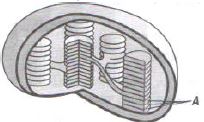
A
Krebs cycle
B
Dark reaction
C
Light reaction
D
Food storage process
Solution
(C) The given figure represents a chloroplast. The label '$A$' points to the thylakoids,which are stacked to form grana. Thylakoids contain chlorophyll pigments and are the primary sites for the light-dependent reactions of photosynthesis,where light energy is converted into chemical energy ($ATP$ and $NADPH$).
0 likes
View Solution197
EasyMCQ
$NADP$ stands for:
A
Nicotinamide Adenine Dinucleotide Phosphate
B
Nicotinamine Adenine Dihydroxy Phosphate
C
Nicotinamide Adenine Dinucleoside Phosphate
D
Nicotinamine Acetyl Disulfide Phosphate
Solution
(A) $NADP$ stands for Nicotinamide Adenine Dinucleotide Phosphate.
It is a coenzyme that acts as an electron carrier in various metabolic reactions,particularly in photosynthesis (light-dependent reactions) and biosynthetic pathways.
It is a coenzyme that acts as an electron carrier in various metabolic reactions,particularly in photosynthesis (light-dependent reactions) and biosynthetic pathways.
0 likes
View Solution198
MediumMCQ
The oxygen evolved during photosynthesis comes from water molecules. Which one of the following pairs of elements is involved in this reaction?
A
Magnesium and Molybdenum
B
Magnesium and Chlorine
C
Manganese and Chlorine
D
Manganese and Potassium
Solution
(C) The correct answer is $C$. Oxygen is evolved during photosynthesis through the process of photolysis of water,which occurs in the membranes of grana thylakoids.
The phenomenon of breaking down water into hydrogen and oxygen in illuminated chloroplasts is called photolysis or photocatalytic splitting of water.
Light energy,an Oxygen Evolving Complex $(OEC)$,and electron carriers are required for this process. The Oxygen Evolving Complex is attached to the inner surface of the thylakoid membrane and contains four $Mn$ ions.
Light-energized changes in $Mn$ $(Mn^{2+}, Mn^{3+}, Mn^{4+})$ remove electrons from the $OH^-$ component of water,resulting in the formation of oxygen.
The liberation of $O_2$ also requires two other essential ions: $Ca^{2+}$ and $Cl^-$.
The reaction is as follows:
$4H_2O \rightleftharpoons 4H^+ + 4OH^-$
$4OH^- \xrightarrow[Mn^{2+}, Ca^{2+}, Cl^-]{\text{Oxygen evolving complex}} 2H_2O + O_2 \uparrow + 4e^-$
The phenomenon of breaking down water into hydrogen and oxygen in illuminated chloroplasts is called photolysis or photocatalytic splitting of water.
Light energy,an Oxygen Evolving Complex $(OEC)$,and electron carriers are required for this process. The Oxygen Evolving Complex is attached to the inner surface of the thylakoid membrane and contains four $Mn$ ions.
Light-energized changes in $Mn$ $(Mn^{2+}, Mn^{3+}, Mn^{4+})$ remove electrons from the $OH^-$ component of water,resulting in the formation of oxygen.
The liberation of $O_2$ also requires two other essential ions: $Ca^{2+}$ and $Cl^-$.
The reaction is as follows:
$4H_2O \rightleftharpoons 4H^+ + 4OH^-$
$4OH^- \xrightarrow[Mn^{2+}, Ca^{2+}, Cl^-]{\text{Oxygen evolving complex}} 2H_2O + O_2 \uparrow + 4e^-$
0 likes
View Solution199
MediumMCQ
In a chloroplast,the highest number of protons are found in:
A
intermembrane space
B
antennae complex
C
stroma
D
lumen of thylakoids
Solution
(D) During the light-dependent reactions of photosynthesis,protons $(H^+)$ are pumped from the stroma into the lumen of the thylakoids. This process is driven by the electron transport chain and the photolysis of water. As a result,a high concentration of protons accumulates within the thylakoid lumen,creating a proton gradient across the thylakoid membrane. This gradient is essential for the synthesis of $ATP$ via the enzyme $ATP$ synthase. Therefore,the highest concentration of protons is found in the lumen of the thylakoids.
0 likes
View Solution200
MediumMCQ
Emerson's enhancement effect and Red drop have been instrumental in the discovery of
A
photophosphorylation and cyclic electron transport
B
oxidative phosphorylation
C
photophosphorylation and non-cyclic electron transport
D
two photosystems operating simultaneously.
Solution
(D) : Emerson et al. $(1957)$ found that if light of shorter wavelengths was provided at the same time as the longer red wavelengths,photosynthesis was even faster than the sum of the two rates with either colour alone. This synergism or enhancement became known as the Emerson enhancement effect. The two separate groups of pigments or photosystems cooperate in photosynthesis and that such long red wavelengths are absorbed only by one photosystem,called photosystem $I$ $(PS\ I)$. The second photosystem,photosystem $II$ $(PS\ II)$,absorbs wavelengths shorter than $690 \ nm$,and for maximum photosynthesis,wavelengths absorbed by both systems must function together. The two photosystems normally cooperate to cause photosynthesis at all wavelengths shorter than $690 \ nm$,because both photosystems absorb those wavelengths. The importance of Emerson's work is that it suggested the presence of two distinct photosystems.
0 likes
View SolutionPhotosynthesis in Higher Plants — Light reaction · Frequently Asked Questions
1Are these Photosynthesis in Higher Plants questions useful for JEE and NEET?
Yes. All questions in this section are mapped to JEE Main and NEET exam patterns. Previous year questions from JEE Main, NEET, GUJCET and state-level exams are included with full solutions.
2Can I switch to Hindi or Gujarati for these questions?
Yes. Use the language tabs in the hero section or the sidebar to view the same questions and solutions in English, Hindi or Gujarati.
3How do I generate a question paper from this subtopic?
Use the Vedclass Exam Paper Generator — select the chapter and subtopic, set difficulty, and generate Sets A, B, C, D automatically. First 3 chapters of every subject are free.
Vedclass Products
For Students
Vedclass Test Series
Mock tests in real JEE/NEET style with performance analysis. 5-day free trial.
Start Free TrialFor Teachers
Exam Paper Generator
Generate Set A/B/C/D papers from this chapter in 2 minutes. 3 chapters free.
Try FreeFor Institutes
Online Exam Module
Live online exams with unlimited students, 360° analytics & white-label branding.
See DemoFor Teachers & Institutes
Generate a Photosynthesis in Higher Plants Exam Paper in 2 Minutes
Select subtopic & difficulty — Sets A, B, C, D auto-generated with No Repeat logic.
First 3 chapters of every subject are free — no payment required.