
A English
Light reaction Questions in English
Class 11 Biology · Photosynthesis in Higher Plants · Light reaction
383+
Questions
English
Language
100%
With Solutions
Showing 50 of 383 questions in English
251
Medium
What is a reaction centre? Explain.
Solution
(N/A) The reaction centre is the specific site within a photosystem where the primary photochemical reaction of photosynthesis occurs.
$1$. In a photosystem,the reaction centre consists of a single molecule of chlorophyll $a$ along with primary electron acceptors.
$2$. The reaction centre is surrounded by hundreds of pigment molecules (accessory pigments) organized into Light Harvesting Complexes $(LHC)$.
$3$. These $LHC$ molecules absorb light energy of various wavelengths and transfer it to the reaction centre.
$4$. When the reaction centre receives this energy,it becomes excited and releases an electron,initiating the electron transport chain.
$5$. There are two types of photosystems: Photosystem-$I$ $(PS-I)$ and Photosystem-$II$ $(PS-II)$.
$6$. In $PS-I$,the reaction centre chlorophyll $a$ has an absorption peak at $700 \ nm$ (known as $P700$),while in $PS-II$,it has an absorption peak at $680 \ nm$ (known as $P680$).
$1$. In a photosystem,the reaction centre consists of a single molecule of chlorophyll $a$ along with primary electron acceptors.
$2$. The reaction centre is surrounded by hundreds of pigment molecules (accessory pigments) organized into Light Harvesting Complexes $(LHC)$.
$3$. These $LHC$ molecules absorb light energy of various wavelengths and transfer it to the reaction centre.
$4$. When the reaction centre receives this energy,it becomes excited and releases an electron,initiating the electron transport chain.
$5$. There are two types of photosystems: Photosystem-$I$ $(PS-I)$ and Photosystem-$II$ $(PS-II)$.
$6$. In $PS-I$,the reaction centre chlorophyll $a$ has an absorption peak at $700 \ nm$ (known as $P700$),while in $PS-II$,it has an absorption peak at $680 \ nm$ (known as $P680$).
0 likes
View Solution252
Medium
Explain: Electron Transport.
Solution
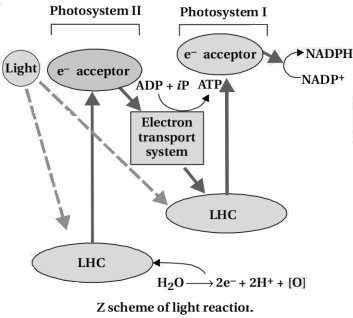
(N/A) In photosystem $II$ $(PS-II)$,the reaction centre chlorophyll-$a$ absorbs $680 \ nm$ wavelength of red light,causing electrons to become excited and jump into an orbit farther from the atomic nucleus.
These electrons are picked up by an electron acceptor,which passes them to an electron transport system.
This movement of electrons is downhill in terms of an oxidation-reduction or redox potential scale.
The electrons are not used up as they pass through the electron transport chain but are passed on to the pigments of photosystem $I$ $(PS-I)$.
Simultaneously,electrons in the reaction centre of $PS-I$ are also excited when they receive red light of wavelength $700 \ nm$ and are transferred to another acceptor molecule that has a greater redox potential.
These electrons are then moved downhill again,this time to a molecule of energy-rich $NADP^+$. The addition of these electrons reduces $NADP^+$ to $NADPH + H^+$.
This is a whole scheme of transfer of electrons,starting from the $PS-II$,uphill to the acceptor,down the electron transport chain to $PS-I$,excitation of electrons,transfer to another acceptor,and finally downhill to $NADP^+$ causing it to be reduced to $NADPH + H^+$.
This is called the $Z$-scheme due to its characteristic shape,which is formed when all the carriers are placed in a sequence on a redox potential scale.
These electrons are picked up by an electron acceptor,which passes them to an electron transport system.
This movement of electrons is downhill in terms of an oxidation-reduction or redox potential scale.
The electrons are not used up as they pass through the electron transport chain but are passed on to the pigments of photosystem $I$ $(PS-I)$.
Simultaneously,electrons in the reaction centre of $PS-I$ are also excited when they receive red light of wavelength $700 \ nm$ and are transferred to another acceptor molecule that has a greater redox potential.
These electrons are then moved downhill again,this time to a molecule of energy-rich $NADP^+$. The addition of these electrons reduces $NADP^+$ to $NADPH + H^+$.
This is a whole scheme of transfer of electrons,starting from the $PS-II$,uphill to the acceptor,down the electron transport chain to $PS-I$,excitation of electrons,transfer to another acceptor,and finally downhill to $NADP^+$ causing it to be reduced to $NADPH + H^+$.
This is called the $Z$-scheme due to its characteristic shape,which is formed when all the carriers are placed in a sequence on a redox potential scale.
0 likes
View Solution253
Easy
Describe the $Z$-scheme of the light reaction.
Solution
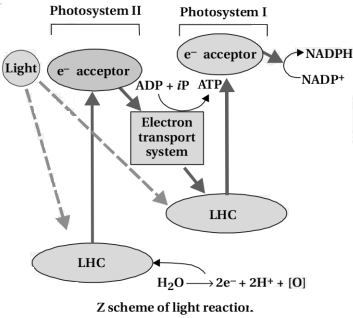
(N/A) In photosystem $II$ $(PS-II)$,the reaction centre chlorophyll-$a$ absorbs $680 \ nm$ wavelength of red light,causing electrons to become excited and jump into an orbit farther from the atomic nucleus.
These electrons are picked up by an electron acceptor,which passes them to an electron transport system.
This movement of electrons is downhill in terms of an oxidation-reduction or redox potential scale.
The electrons are not used up as they pass through the electron transport chain but are passed on to the pigments of photosystem $I$ $(PS-I)$.
Simultaneously,electrons in the reaction centre of $PS-I$ are also excited when they receive red light of wavelength $700 \ nm$ and are transferred to another acceptor molecule that has a greater redox potential.
These electrons are then moved downhill again,this time to a molecule of energy-rich $NADP^+$. The addition of these electrons reduces $NADP^+$ to $NADPH + H^+$.
This is the whole scheme of electron transfer,starting from $PS-II$,moving uphill to the acceptor,down the electron transport chain to $PS-I$,excitation of electrons,transfer to another acceptor,and finally downhill to $NADP^+$ causing it to be reduced to $NADPH + H^+$.
This is called the $Z$-scheme due to its characteristic shape,which is formed when all the carriers are placed in a sequence on a redox potential scale.
These electrons are picked up by an electron acceptor,which passes them to an electron transport system.
This movement of electrons is downhill in terms of an oxidation-reduction or redox potential scale.
The electrons are not used up as they pass through the electron transport chain but are passed on to the pigments of photosystem $I$ $(PS-I)$.
Simultaneously,electrons in the reaction centre of $PS-I$ are also excited when they receive red light of wavelength $700 \ nm$ and are transferred to another acceptor molecule that has a greater redox potential.
These electrons are then moved downhill again,this time to a molecule of energy-rich $NADP^+$. The addition of these electrons reduces $NADP^+$ to $NADPH + H^+$.
This is the whole scheme of electron transfer,starting from $PS-II$,moving uphill to the acceptor,down the electron transport chain to $PS-I$,excitation of electrons,transfer to another acceptor,and finally downhill to $NADP^+$ causing it to be reduced to $NADPH + H^+$.
This is called the $Z$-scheme due to its characteristic shape,which is formed when all the carriers are placed in a sequence on a redox potential scale.
0 likes
View Solution254
Easy
Explain the splitting of water.
Solution
(N/A) - The electrons that are removed from photosystem-$II$ $(PS-II)$ must be replaced.
- This replacement is achieved by electrons made available through the splitting of water.
- The splitting of water is associated with $PS-II$; water is split into protons $(H^{+})$,nascent oxygen $([O])$,and electrons $(e^{-})$.
- The chemical equation for this process is: $2H_{2}O \longrightarrow 4H^{+} + O_{2} + 4e^{-}$.
- This process releases oxygen,which is one of the net products of photosynthesis.
- The water-splitting complex is physically located on the inner side of the thylakoid membrane,associated with $PS-II$.
- This replacement is achieved by electrons made available through the splitting of water.
- The splitting of water is associated with $PS-II$; water is split into protons $(H^{+})$,nascent oxygen $([O])$,and electrons $(e^{-})$.
- The chemical equation for this process is: $2H_{2}O \longrightarrow 4H^{+} + O_{2} + 4e^{-}$.
- This process releases oxygen,which is one of the net products of photosynthesis.
- The water-splitting complex is physically located on the inner side of the thylakoid membrane,associated with $PS-II$.
0 likes
View Solution255
Medium
Describe the photolysis of water.
Solution
(N/A) The electrons that were removed from photosystem-$II$ $(PS-II)$ must be replaced to maintain the continuous flow of electrons.
This is achieved by electrons made available through the splitting of water,a process known as photolysis.
Explanation of the process:
- The splitting of water is associated with $PS-II$. Water is split into protons $(H^+)$,nascent oxygen $([O])$,and electrons $(e^-)$.
- The chemical equation for this process is: $2H_2O \longrightarrow 4H^+ + O_2 + 4e^-$.
- This reaction releases oxygen $(O_2)$ as a byproduct,which is one of the net products of photosynthesis.
- The electrons required to replace those removed from $PS-II$ are provided by this water-splitting complex.
- The water-splitting complex is physically located on the inner side of the thylakoid membrane,ensuring that the protons released accumulate within the lumen.
This is achieved by electrons made available through the splitting of water,a process known as photolysis.
Explanation of the process:
- The splitting of water is associated with $PS-II$. Water is split into protons $(H^+)$,nascent oxygen $([O])$,and electrons $(e^-)$.
- The chemical equation for this process is: $2H_2O \longrightarrow 4H^+ + O_2 + 4e^-$.
- This reaction releases oxygen $(O_2)$ as a byproduct,which is one of the net products of photosynthesis.
- The electrons required to replace those removed from $PS-II$ are provided by this water-splitting complex.
- The water-splitting complex is physically located on the inner side of the thylakoid membrane,ensuring that the protons released accumulate within the lumen.
0 likes
View Solution256
Medium
Explain: Non-cyclic Photophosphorylation.
Solution
(N/A) $1$. Definition: Photophosphorylation is the process of synthesizing $ATP$ from $ADP$ and inorganic phosphate $(Pi)$ in the presence of light.
$2$. Mechanism: In non-cyclic photophosphorylation,the two photosystems,$PS-II$ and $PS-I$,work in a series connected by an electron transport chain.
$3$. Process: Electrons are released from $PS-II$ upon light absorption,pass through an electron transport system,and reach $PS-I$. During this transport,a proton gradient is generated,leading to $ATP$ synthesis.
$4$. Final Step: Electrons from $PS-I$ are finally accepted by $NADP^+$ to form $NADPH + H^+$.
$5$. Significance: This process results in the production of both $ATP$ and $NADPH + H^+$,which are essential for the biosynthetic phase of photosynthesis.
$2$. Mechanism: In non-cyclic photophosphorylation,the two photosystems,$PS-II$ and $PS-I$,work in a series connected by an electron transport chain.
$3$. Process: Electrons are released from $PS-II$ upon light absorption,pass through an electron transport system,and reach $PS-I$. During this transport,a proton gradient is generated,leading to $ATP$ synthesis.
$4$. Final Step: Electrons from $PS-I$ are finally accepted by $NADP^+$ to form $NADPH + H^+$.
$5$. Significance: This process results in the production of both $ATP$ and $NADPH + H^+$,which are essential for the biosynthetic phase of photosynthesis.
0 likes
View Solution257
Medium
Explain cyclic photophosphorylation.
Solution
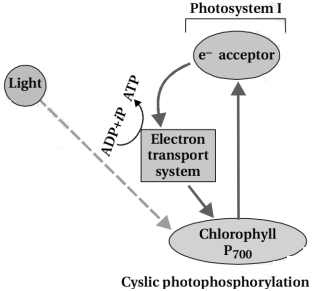
(N/A) When only $PS-I$ is functional,the electron is circulated within the photosystem and the phosphorylation occurs due to the cyclic flow of electrons. This is called cyclic photophosphorylation.
$A$ possible location where this occurs is in the stroma lamellae.
While the membrane or lamellae of the grana have both $PS-I$ and $PS-II$,the stroma lamellae lack $PS-II$ as well as the $NADP$ reductase enzyme.
The excited electron does not pass on to $NADP^+$.
It is cycled back to the $PS-I$ complex through the electron transport chain.
The cyclic flow,therefore,results only in the synthesis of $ATP$ but not of $NADPH + H^+$.
Cyclic photophosphorylation also occurs when only light of wavelengths beyond $680 \ nm$ is available for excitation.
$A$ possible location where this occurs is in the stroma lamellae.
While the membrane or lamellae of the grana have both $PS-I$ and $PS-II$,the stroma lamellae lack $PS-II$ as well as the $NADP$ reductase enzyme.
The excited electron does not pass on to $NADP^+$.
It is cycled back to the $PS-I$ complex through the electron transport chain.
The cyclic flow,therefore,results only in the synthesis of $ATP$ but not of $NADPH + H^+$.
Cyclic photophosphorylation also occurs when only light of wavelengths beyond $680 \ nm$ is available for excitation.
0 likes
View Solution258
Medium
Describe the Chemiosmotic Hypothesis.
Solution
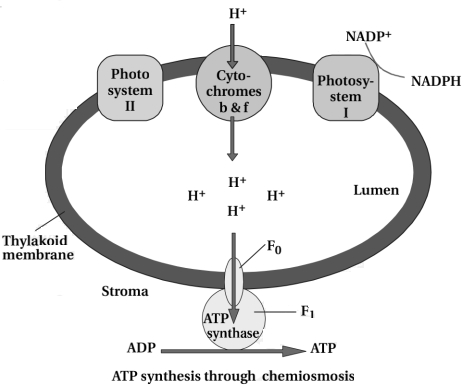
(N/A) The chemiosmotic hypothesis explains the mechanism of $ATP$ synthesis in chloroplasts.
- Similar to respiration,in photosynthesis,$ATP$ synthesis is linked to the development of a proton gradient across a membrane,specifically the thylakoid membrane.
- Main difference: In respiration,protons $(H^{+})$ accumulate in the intermembrane space of the mitochondria during electron transport system $(ETS)$ activity.
Formation of proton gradient:
$(a)$ Since water splitting occurs on the inner side of the membrane,the protons $(H^{+})$ produced accumulate within the lumen of the thylakoids.
$(b)$ As electrons move through the photosystems,protons are transported across the membrane. The primary electron acceptor,located on the outer side of the membrane,transfers its electron to an $H$ carrier rather than an electron carrier. This molecule removes a proton from the stroma while transporting an electron. When it passes the electron to the carrier on the inner side,the proton is released into the lumen.
Reduction of $NADP^{+}$:
$(c)$ The $NADP$ reductase enzyme is located on the stroma side. Along with electrons from $PS I$,protons are required for the reduction of $NADP^{+}$ to $NADPH + H^{+}$. These protons are also removed from the stroma.
$NADP^{+} + 2H^{+} \longrightarrow NADPH + H^{+}$
- Consequently,protons in the stroma decrease,while they accumulate in the lumen,creating a proton gradient and a measurable decrease in $pH$ in the lumen.
Importance: The breakdown of this gradient releases energy. Protons move back to the stroma through the transmembrane channel of the $ATPase$ enzyme.
Structure of $ATPase$ enzyme:
- $F_{0}$: This part is embedded in the membrane and forms a transmembrane channel that facilitates the diffusion of protons.
- $F_{1}$: This portion protrudes on the outer surface of the thylakoid membrane facing the stroma. The energy released from the gradient breakdown causes a conformational change in $F_{1}$,enabling the synthesis of $ATP$.
Requirements of Chemiosmosis:
$(a)$ $A$ membrane,a proton pump,a proton gradient,and $ATPase$.
$(b)$ Energy is used to pump protons across the membrane to create a high concentration within the thylakoid lumen.
$(c)$ $ATPase$ allows proton diffusion back to the stroma,releasing energy to catalyze $ATP$ formation.
Usage: $ATP$ and $NADPH$ produced are used immediately in the biosynthetic reactions in the stroma for $CO_{2}$ fixation and sugar synthesis ($C_{3}$ pathway).
- Similar to respiration,in photosynthesis,$ATP$ synthesis is linked to the development of a proton gradient across a membrane,specifically the thylakoid membrane.
- Main difference: In respiration,protons $(H^{+})$ accumulate in the intermembrane space of the mitochondria during electron transport system $(ETS)$ activity.
Formation of proton gradient:
$(a)$ Since water splitting occurs on the inner side of the membrane,the protons $(H^{+})$ produced accumulate within the lumen of the thylakoids.
$(b)$ As electrons move through the photosystems,protons are transported across the membrane. The primary electron acceptor,located on the outer side of the membrane,transfers its electron to an $H$ carrier rather than an electron carrier. This molecule removes a proton from the stroma while transporting an electron. When it passes the electron to the carrier on the inner side,the proton is released into the lumen.
Reduction of $NADP^{+}$:
$(c)$ The $NADP$ reductase enzyme is located on the stroma side. Along with electrons from $PS I$,protons are required for the reduction of $NADP^{+}$ to $NADPH + H^{+}$. These protons are also removed from the stroma.
$NADP^{+} + 2H^{+} \longrightarrow NADPH + H^{+}$
- Consequently,protons in the stroma decrease,while they accumulate in the lumen,creating a proton gradient and a measurable decrease in $pH$ in the lumen.
Importance: The breakdown of this gradient releases energy. Protons move back to the stroma through the transmembrane channel of the $ATPase$ enzyme.
Structure of $ATPase$ enzyme:
- $F_{0}$: This part is embedded in the membrane and forms a transmembrane channel that facilitates the diffusion of protons.
- $F_{1}$: This portion protrudes on the outer surface of the thylakoid membrane facing the stroma. The energy released from the gradient breakdown causes a conformational change in $F_{1}$,enabling the synthesis of $ATP$.
Requirements of Chemiosmosis:
$(a)$ $A$ membrane,a proton pump,a proton gradient,and $ATPase$.
$(b)$ Energy is used to pump protons across the membrane to create a high concentration within the thylakoid lumen.
$(c)$ $ATPase$ allows proton diffusion back to the stroma,releasing energy to catalyze $ATP$ formation.
Usage: $ATP$ and $NADPH$ produced are used immediately in the biosynthetic reactions in the stroma for $CO_{2}$ fixation and sugar synthesis ($C_{3}$ pathway).
0 likes
View Solution259
EasyMCQ
State the path of $e^-$ in the $Z$-scheme.
A
$PS II \rightarrow$ Electron Transport System $\rightarrow PS I \rightarrow NADP^+$
B
$PS I \rightarrow$ Electron Transport System $\rightarrow PS II \rightarrow NADP^+$
C
$PS II \rightarrow PS I \rightarrow$ Electron Transport System $\rightarrow NADP^+$
D
$NADP^+ \rightarrow PS I \rightarrow$ Electron Transport System $\rightarrow PS II$
Solution
(A) The $Z$-scheme represents the light-dependent reactions of photosynthesis, specifically non-cyclic photophosphorylation.
In this process, electrons are first excited in Photosystem $II$ $(PS II)$ by light energy.
These electrons are then transferred through an electron transport system $(ETS)$ consisting of plastoquinone, cytochrome complex, and plastocyanin.
From the $ETS$, the electrons reach Photosystem $I$ $(PS I)$.
Finally, the excited electrons from $PS I$ are transferred to $NADP^+$ to form $NADPH + H^+$.
Thus, the path is $PS II \rightarrow$ Electron Transport System $\rightarrow PS I \rightarrow NADP^+$.
In this process, electrons are first excited in Photosystem $II$ $(PS II)$ by light energy.
These electrons are then transferred through an electron transport system $(ETS)$ consisting of plastoquinone, cytochrome complex, and plastocyanin.
From the $ETS$, the electrons reach Photosystem $I$ $(PS I)$.
Finally, the excited electrons from $PS I$ are transferred to $NADP^+$ to form $NADPH + H^+$.
Thus, the path is $PS II \rightarrow$ Electron Transport System $\rightarrow PS I \rightarrow NADP^+$.
0 likes
View Solution260
MediumMCQ
Why do proton gradients form across the thylakoid membrane during the light reaction of photosynthesis?
A
Due to the splitting of water molecules on the inner side of the membrane.
B
Due to the movement of protons from the stroma to the lumen during electron transport.
C
Due to the reduction of $NADP^+$ to $NADPH$ in the stroma.
D
All of the above.
Solution
(D) The proton gradient across the thylakoid membrane is essential for $ATP$ synthesis via chemiosmosis. It is formed due to the following reasons:
$1$. The splitting of water molecules $(H_2O \rightarrow 2H^+ + [O] + 2e^-)$ occurs on the inner side of the thylakoid membrane,releasing protons into the lumen.
$2$. As electrons move through the photosystems and electron transport chain,protons are actively pumped from the stroma into the lumen.
$3$. The reduction of $NADP^+$ to $NADPH$ by $NADP$ reductase occurs on the stroma side of the membrane,which removes protons from the stroma,further increasing the concentration difference.
Therefore,all these processes contribute to the formation of a proton gradient.
$1$. The splitting of water molecules $(H_2O \rightarrow 2H^+ + [O] + 2e^-)$ occurs on the inner side of the thylakoid membrane,releasing protons into the lumen.
$2$. As electrons move through the photosystems and electron transport chain,protons are actively pumped from the stroma into the lumen.
$3$. The reduction of $NADP^+$ to $NADPH$ by $NADP$ reductase occurs on the stroma side of the membrane,which removes protons from the stroma,further increasing the concentration difference.
Therefore,all these processes contribute to the formation of a proton gradient.
0 likes
View Solution261
MediumMCQ
Name the essential ingredients for the light reaction of photosynthesis.
A
Water,$NADP^+$,$ADP$,and light
B
Glucose,$O_2$,and $ATP$
C
$CO_2$,$H_2O$,and light
D
Glucose,$NADP^+$,and $H_2O$
Solution
(A) The light reaction of photosynthesis occurs in the thylakoid membranes of the chloroplasts.
It requires light energy to drive the photolysis of water and the synthesis of energy carriers.
The essential ingredients for the light reaction are:
$1$. Light energy (photons).
$2$. Water $(H_2O)$,which acts as an electron donor.
$3$. $NADP^+$,which acts as the final electron acceptor to form $NADPH$.
$4$. $ADP$ and inorganic phosphate $(Pi)$,which are phosphorylated to form $ATP$.
Therefore,the correct combination is water,$NADP^+$,$ADP$,and light.
It requires light energy to drive the photolysis of water and the synthesis of energy carriers.
The essential ingredients for the light reaction are:
$1$. Light energy (photons).
$2$. Water $(H_2O)$,which acts as an electron donor.
$3$. $NADP^+$,which acts as the final electron acceptor to form $NADPH$.
$4$. $ADP$ and inorganic phosphate $(Pi)$,which are phosphorylated to form $ATP$.
Therefore,the correct combination is water,$NADP^+$,$ADP$,and light.
0 likes
View Solution262
MediumMCQ
What is the name of the light-dependent phase of photosynthesis?
A
Dark reaction
B
Light reaction
C
Calvin cycle
D
Respiration
Solution
(B) The light-dependent phase of photosynthesis is known as the $Light \text{ } reaction$ or the $Photochemical \text{ } phase$.
During this phase, light energy is captured by chlorophyll pigments and converted into chemical energy in the form of $ATP$ and $NADPH$.
This process occurs in the thylakoid membranes of the chloroplasts.
During this phase, light energy is captured by chlorophyll pigments and converted into chemical energy in the form of $ATP$ and $NADPH$.
This process occurs in the thylakoid membranes of the chloroplasts.
0 likes
View Solution263
EasyMCQ
What is the composition of the enzyme $ATPase$?
A
It consists of $F_0$ and $F_1$ particles.
B
It consists of $P_1$ and $P_2$ particles.
C
It consists of $C_1$ and $C_2$ particles.
D
It consists of $S_1$ and $S_2$ particles.
Solution
(A) The enzyme $ATPase$ is composed of two major parts: $F_0$ and $F_1$.
$F_0$ is an intrinsic membrane protein complex that acts as a channel for protons ($H^+$ ions) to cross the membrane.
$F_1$ is the peripheral membrane protein complex that contains the site for $ATP$ synthesis from $ADP$ and inorganic phosphate $(Pi)$.
$F_0$ is an intrinsic membrane protein complex that acts as a channel for protons ($H^+$ ions) to cross the membrane.
$F_1$ is the peripheral membrane protein complex that contains the site for $ATP$ synthesis from $ADP$ and inorganic phosphate $(Pi)$.
0 likes
View Solution264
Medium
Provide definitions/explanations for the following terms:
$(1)$ Photosynthesis
$(2)$ Light reaction
$(1)$ Photosynthesis
$(2)$ Light reaction
Solution
(N/A) $(1)$ Photosynthesis: It is the process by which green plants synthesize energy-rich organic compounds (glucose) from low-energy inorganic substances like $CO_2$ and $H_2O$ in the presence of sunlight and chlorophyll.
$(2)$ Light reaction: It is the first phase of photosynthesis that occurs in the thylakoid membranes of chloroplasts. This phase is light-dependent and involves the absorption of light energy to produce $ATP$ and $NADPH$,which are essential for the subsequent biosynthetic phase.
$(2)$ Light reaction: It is the first phase of photosynthesis that occurs in the thylakoid membranes of chloroplasts. This phase is light-dependent and involves the absorption of light energy to produce $ATP$ and $NADPH$,which are essential for the subsequent biosynthetic phase.
0 likes
View Solution265
Easy
What are the full names of the following abbreviations used in photosynthesis?
$(1)$ $PS-I$
$(2)$ $PS-II$
$(1)$ $PS-I$
$(2)$ $PS-II$
Solution
(N/A) $(1)$ $PS-I$ stands for Photosystem $I$.
$(2)$ $PS-II$ stands for Photosystem $II$.
These are protein complexes involved in the light-dependent reactions of photosynthesis.
$(2)$ $PS-II$ stands for Photosystem $II$.
These are protein complexes involved in the light-dependent reactions of photosynthesis.
0 likes
View Solution266
Medium
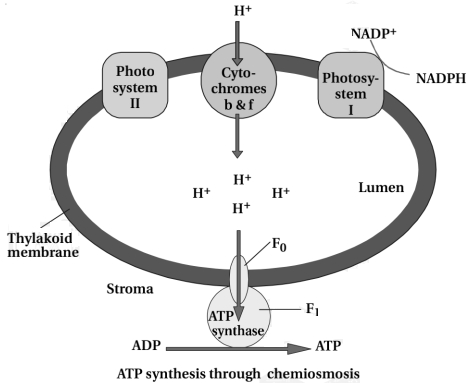
Explain how during the light reaction of photosynthesis,$ATP$ synthesis is a chemiosmotic phenomenon.
Solution
(N/A) To describe the process of synthesis of $ATP$ in the chloroplast,the chemiosmotic hypothesis has been put forward to explain the mechanism.
Like in respiration,in photosynthesis too,$ATP$ synthesis is linked to the development of a proton gradient across a membrane. These are the membranes of the thylakoid.
Main difference: In respiration,protons $(H^{+})$ accumulate in the intermembrane space of the mitochondria when electrons move through the $ETS$.
Formation of proton gradient:
$(a)$ Since the splitting of the water molecule takes place on the inner side of the membrane,the protons or hydrogen ions $(H^{+})$ that are produced by the splitting of water accumulate within the lumen of the thylakoids.
$(b)$ As electrons move through the photosystems,protons are transported across the membrane. This happens because the primary acceptor of electrons,which is located towards the outer side of the membrane,transfers its electron not to an electron carrier but to an $H$ carrier. Hence,this molecule removes a proton from the stroma while transporting an electron. When this molecule passes on its electron to the electron carrier on the inner side of the membrane,the proton is released into the inner side or the lumen side of the membrane.
Reduction of $NADP^{+}$:
$(c)$ The $NADP$ reductase enzyme is located on the stroma side of the membrane. Along with electrons that come from the acceptor of electrons of $PS I$,protons are necessary for the reduction of $NADP^{+}$ to $NADPH + H^{+}$. These protons are also removed from the stroma.
$NADP^{+} + 2H^{+} \longrightarrow NADPH + H^{+}$
Hence,within the chloroplast,protons in the stroma decrease in number,while in the lumen there is an accumulation of protons. This creates a proton gradient across the thylakoid membrane as well as a measurable decrease in $pH$ in the lumen.
Importance: This proton gradient is important because it is the breakdown of this gradient that leads to the release of energy. The gradient is broken down due to the movement of protons across the membrane to the stroma through the transmembrane channel.
Structure of $ATPase$ enzyme:
- $F_{0}$: The $ATPase$ enzyme consists of two parts: one called the $F_{0}$ is embedded in the membrane and forms a transmembrane channel that carries out facilitated diffusion of protons across the membrane.
- $F_{1}$: The other portion is called $F_{1}$ and protrudes on the outer surface of the thylakoid membrane on the side that faces the stroma.
- The breakdown of the gradient provides enough energy to cause a conformational change in the $F_{1}$ particle of the $ATPase$,which makes the enzyme synthesize several molecules of energy-packed $ATP$.
Necessary elements of Chemiosmosis:
$(a)$ Chemiosmosis requires a membrane,a proton pump,a proton gradient,and $ATPase$.
$(b)$ Energy is used to pump protons across a membrane to create a gradient or a high concentration of protons within the thylakoid lumen.
$(c)$ $ATPase$ has a channel that allows the diffusion of protons back across the membrane; this releases enough energy to activate the $ATPase$ enzyme that catalyses the formation of $ATP$.
Like in respiration,in photosynthesis too,$ATP$ synthesis is linked to the development of a proton gradient across a membrane. These are the membranes of the thylakoid.
Main difference: In respiration,protons $(H^{+})$ accumulate in the intermembrane space of the mitochondria when electrons move through the $ETS$.
Formation of proton gradient:
$(a)$ Since the splitting of the water molecule takes place on the inner side of the membrane,the protons or hydrogen ions $(H^{+})$ that are produced by the splitting of water accumulate within the lumen of the thylakoids.
$(b)$ As electrons move through the photosystems,protons are transported across the membrane. This happens because the primary acceptor of electrons,which is located towards the outer side of the membrane,transfers its electron not to an electron carrier but to an $H$ carrier. Hence,this molecule removes a proton from the stroma while transporting an electron. When this molecule passes on its electron to the electron carrier on the inner side of the membrane,the proton is released into the inner side or the lumen side of the membrane.
Reduction of $NADP^{+}$:
$(c)$ The $NADP$ reductase enzyme is located on the stroma side of the membrane. Along with electrons that come from the acceptor of electrons of $PS I$,protons are necessary for the reduction of $NADP^{+}$ to $NADPH + H^{+}$. These protons are also removed from the stroma.
$NADP^{+} + 2H^{+} \longrightarrow NADPH + H^{+}$
Hence,within the chloroplast,protons in the stroma decrease in number,while in the lumen there is an accumulation of protons. This creates a proton gradient across the thylakoid membrane as well as a measurable decrease in $pH$ in the lumen.
Importance: This proton gradient is important because it is the breakdown of this gradient that leads to the release of energy. The gradient is broken down due to the movement of protons across the membrane to the stroma through the transmembrane channel.
Structure of $ATPase$ enzyme:
- $F_{0}$: The $ATPase$ enzyme consists of two parts: one called the $F_{0}$ is embedded in the membrane and forms a transmembrane channel that carries out facilitated diffusion of protons across the membrane.
- $F_{1}$: The other portion is called $F_{1}$ and protrudes on the outer surface of the thylakoid membrane on the side that faces the stroma.
- The breakdown of the gradient provides enough energy to cause a conformational change in the $F_{1}$ particle of the $ATPase$,which makes the enzyme synthesize several molecules of energy-packed $ATP$.
Necessary elements of Chemiosmosis:
$(a)$ Chemiosmosis requires a membrane,a proton pump,a proton gradient,and $ATPase$.
$(b)$ Energy is used to pump protons across a membrane to create a gradient or a high concentration of protons within the thylakoid lumen.
$(c)$ $ATPase$ has a channel that allows the diffusion of protons back across the membrane; this releases enough energy to activate the $ATPase$ enzyme that catalyses the formation of $ATP$.
0 likes
View Solution267
Medium
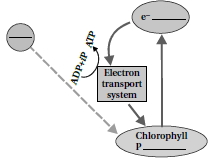
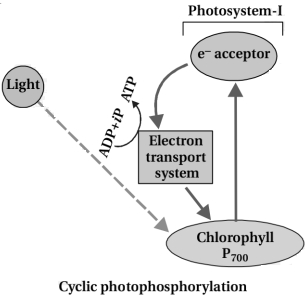
Complete the flow chart for cyclic photophosphorylation of the photosystem $-I$.
Solution
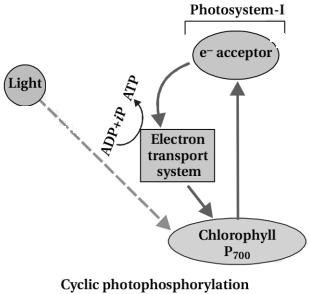
(N/A) In cyclic photophosphorylation,the process is restricted to Photosystem $-I$ $(PS-I)$. When the reaction center,Chlorophyll $P_{700}$,absorbs light,it becomes excited and emits electrons. These electrons are captured by an electron acceptor and then passed through an electron transport system. As the electrons move through the transport system,energy is released,which is used to synthesize $ATP$ from $ADP$ and inorganic phosphate $(iP)$. Finally,the electrons are returned to the reaction center,Chlorophyll $P_{700}$,completing the cycle. Thus,the missing labels are 'Light' for the circle,'e$^-$ acceptor' for the top oval,and '$P_{700}$' for the bottom oval.
0 likes
View Solution268
MediumMCQ
The entire process of photosynthesis consists of a number of reactions. Where in the cell do each of these take place? Synthesis of $ATP$ and $NADPH$ occurs in/at:
A
Stroma
B
Thylakoid membrane
C
Outer membrane of chloroplast
D
Inner membrane of chloroplast
Solution
(B) The light-dependent reactions of photosynthesis,which include the synthesis of $ATP$ and $NADPH$,take place in the thylakoid membranes of the chloroplast.
Specifically,the photosystems ($PS-I$ and $PS-II$) and the electron transport chain components are embedded within the thylakoid membrane,where they facilitate the conversion of light energy into chemical energy.
Specifically,the photosystems ($PS-I$ and $PS-II$) and the electron transport chain components are embedded within the thylakoid membrane,where they facilitate the conversion of light energy into chemical energy.
0 likes
View Solution269
MediumMCQ
The entire process of photosynthesis consists of a number of reactions. Where in the cell do each of these take place? Photolysis of water ...........
A
Stroma
B
Inner side of the thylakoid membrane
C
Outer side of the thylakoid membrane
D
Cytoplasm
Solution
(B) The process of photolysis of water,also known as the water-splitting complex,is associated with $PSII$. This complex is located on the inner side of the thylakoid membrane. During this process,water molecules are split into $2H^+$,$[O]$,and electrons,releasing oxygen as a byproduct.
0 likes
View Solution270
Medium
What are the important events and end products of the light reaction?
Solution
(N/A) $(i)$ Chlorophyll gets excited and releases a pair of electrons,the energy of which is used to combine $ADP + Pi$ to form $ATP$. This process is known as photophosphorylation.
$(ii)$ Splitting of water molecule (photolysis of water):
$(a)$ $2H_{2}O \rightarrow 4H^{+} + 4e^{-} + O_{2}$
$(b)$ $NADP^{+} + 2H^{+} + 2e^{-} \rightarrow NADPH + H^{+}$
- The final products of the light reaction are $ATP$,$NADPH$,and $O_{2}$ (as a byproduct).
- The $ATP$ and $NADPH$ produced are utilized in the dark reaction (biosynthetic phase) for the fixation of $CO_{2}$.
$(ii)$ Splitting of water molecule (photolysis of water):
$(a)$ $2H_{2}O \rightarrow 4H^{+} + 4e^{-} + O_{2}$
$(b)$ $NADP^{+} + 2H^{+} + 2e^{-} \rightarrow NADPH + H^{+}$
- The final products of the light reaction are $ATP$,$NADPH$,and $O_{2}$ (as a byproduct).
- The $ATP$ and $NADPH$ produced are utilized in the dark reaction (biosynthetic phase) for the fixation of $CO_{2}$.
0 likes
View Solution271
Medium
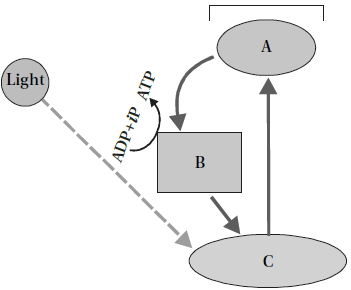
In the diagram shown below,label $A, B, C$. What type of phosphorylation is possible in this?
Solution
(N/A) Based on the provided diagram,the labels are as follows:
$A$: Electron acceptor
$B$: Electron transport system
$C$: Chlorophyll $P_{700}$ (Photosystem-$I$)
The process shown is cyclic photophosphorylation. In this process,electrons are excited by light and travel through an electron transport system,which releases energy to synthesize $ATP$ from $ADP$ and inorganic phosphate $(iP)$. The electrons then return to the original chlorophyll molecule $(P_{700})$,completing the cycle. Thus,the type of phosphorylation is cyclic photophosphorylation.
$A$: Electron acceptor
$B$: Electron transport system
$C$: Chlorophyll $P_{700}$ (Photosystem-$I$)
The process shown is cyclic photophosphorylation. In this process,electrons are excited by light and travel through an electron transport system,which releases energy to synthesize $ATP$ from $ADP$ and inorganic phosphate $(iP)$. The electrons then return to the original chlorophyll molecule $(P_{700})$,completing the cycle. Thus,the type of phosphorylation is cyclic photophosphorylation.
0 likes
View Solution272
MediumMCQ
Why does cyclic photophosphorylation occur in stroma lamellae?
A
Presence of both $PS$-$I$ and $PS$-$II$
B
Absence of $PS$-$II$ and $NADP$ reductase
C
Presence of $NADP$ reductase
D
Absence of $PS$-$I$
Solution
(B) Cyclic photophosphorylation occurs in the stroma lamellae due to the following reasons:
- The stroma lamellae membranes lack $PS-II$ and the enzyme $NADP$ reductase.
- Because $PS-II$ is absent,water splitting (photolysis) does not occur,and there is no supply of electrons from water.
- Since $NADP$ reductase is absent,the excited electrons from $PS-I$ cannot be used to reduce $NADP^+$ to $NADPH$.
- Consequently,the excited electrons are cycled back to the $PS-I$ complex through the electron transport chain,resulting in the synthesis of $ATP$ only.
- The stroma lamellae membranes lack $PS-II$ and the enzyme $NADP$ reductase.
- Because $PS-II$ is absent,water splitting (photolysis) does not occur,and there is no supply of electrons from water.
- Since $NADP$ reductase is absent,the excited electrons from $PS-I$ cannot be used to reduce $NADP^+$ to $NADPH$.
- Consequently,the excited electrons are cycled back to the $PS-I$ complex through the electron transport chain,resulting in the synthesis of $ATP$ only.
0 likes
View Solution273
Medium
Describe the structure of the $ATPase$ enzyme.
Solution
(N/A) The $ATPase$ enzyme consists of two major components:
- $F_{0}$: This part is embedded in the thylakoid membrane and forms a transmembrane channel that facilitates the diffusion of protons ($H^+$ ions) across the membrane.
- $F_{1}$: This portion protrudes on the outer surface of the thylakoid membrane,specifically on the side facing the stroma.
- Mechanism: The breakdown of the proton gradient provides sufficient energy to induce a conformational change in the $F_{1}$ particle of the $ATPase$ enzyme,which catalyzes the synthesis of $ATP$ molecules from $ADP$ and inorganic phosphate $(Pi)$.
- $F_{0}$: This part is embedded in the thylakoid membrane and forms a transmembrane channel that facilitates the diffusion of protons ($H^+$ ions) across the membrane.
- $F_{1}$: This portion protrudes on the outer surface of the thylakoid membrane,specifically on the side facing the stroma.
- Mechanism: The breakdown of the proton gradient provides sufficient energy to induce a conformational change in the $F_{1}$ particle of the $ATPase$ enzyme,which catalyzes the synthesis of $ATP$ molecules from $ADP$ and inorganic phosphate $(Pi)$.
0 likes
View Solution274
Medium
Give the necessary elements of chemiosmosis.
Solution
(N/A) Chemiosmosis requires four essential components: a membrane,a proton pump,a proton gradient,and the enzyme $ATPase$.
$(a)$ $A$ membrane is required to separate the two compartments (e.g.,thylakoid lumen and stroma).
$(b)$ $A$ proton pump uses energy to move protons across the membrane,creating a proton gradient or a high concentration of protons within the thylakoid lumen.
$(c)$ $ATPase$ contains a channel that allows the facilitated diffusion of protons back across the membrane to the stroma. This movement releases sufficient energy to activate the $ATPase$ enzyme,which catalyzes the formation of $ATP$ from $ADP$ and inorganic phosphate.
$(a)$ $A$ membrane is required to separate the two compartments (e.g.,thylakoid lumen and stroma).
$(b)$ $A$ proton pump uses energy to move protons across the membrane,creating a proton gradient or a high concentration of protons within the thylakoid lumen.
$(c)$ $ATPase$ contains a channel that allows the facilitated diffusion of protons back across the membrane to the stroma. This movement releases sufficient energy to activate the $ATPase$ enzyme,which catalyzes the formation of $ATP$ from $ADP$ and inorganic phosphate.
0 likes
View Solution275
Medium
$2 H_{2} O \rightarrow 4 H^{+} + O_{2} + 4 e^{-}$
Based on the above equation,answer the following questions:
$(a)$ Where does this reaction take place in plants?
$(b)$ What is the significance of this reaction?
Based on the above equation,answer the following questions:
$(a)$ Where does this reaction take place in plants?
$(b)$ What is the significance of this reaction?
Solution
(N/A) This reaction takes place in $PS-II$,which is located on the inner side of the thylakoid membrane. It is the site of water splitting (photolysis of water),where electrons are released from water molecules. Ions like $Mn^{2+}$ and $Cl^{-}$ act as essential cofactors for this process.
$(b)$ The significance of water splitting in photosynthesis is as follows:
$(i)$ $O_{2}$ is released as a byproduct,which is the primary source of atmospheric oxygen essential for the survival of aerobic organisms.
$(ii)$ The $H^{+}$ ions produced contribute to the proton gradient across the thylakoid membrane and are used to reduce $NADP^{+}$ to $NADPH$,which acts as a strong reducing agent in the biosynthetic phase.
$(iii)$ The electrons $(e^{-})$ released are transferred from $PS-II$ to $PS-I$ via the electron transport system,facilitating the synthesis of $ATP$ through photophosphorylation.
$(b)$ The significance of water splitting in photosynthesis is as follows:
$(i)$ $O_{2}$ is released as a byproduct,which is the primary source of atmospheric oxygen essential for the survival of aerobic organisms.
$(ii)$ The $H^{+}$ ions produced contribute to the proton gradient across the thylakoid membrane and are used to reduce $NADP^{+}$ to $NADPH$,which acts as a strong reducing agent in the biosynthetic phase.
$(iii)$ The electrons $(e^{-})$ released are transferred from $PS-II$ to $PS-I$ via the electron transport system,facilitating the synthesis of $ATP$ through photophosphorylation.
0 likes
View Solution276
MediumMCQ
$(a)$ $NADP$ reductase enzyme is located on $.....$
$(b)$ Breakdown of proton gradient leads to release of $.........$
$(b)$ Breakdown of proton gradient leads to release of $.........$
A
Outer side of thylakoid membrane; Energy
B
Inner side of thylakoid membrane; $ATP$
C
Stroma; $NADP$
D
Lumen; $NADPH$
Solution
(B) The $NADP$ reductase enzyme is located on the outer side of the thylakoid membrane,facing the stroma.
$(b)$ The breakdown of the proton gradient across the thylakoid membrane leads to the release of energy,which is used by the $ATP$ synthase enzyme to synthesize $ATP$ from $ADP$ and inorganic phosphate.
$(b)$ The breakdown of the proton gradient across the thylakoid membrane leads to the release of energy,which is used by the $ATP$ synthase enzyme to synthesize $ATP$ from $ADP$ and inorganic phosphate.
0 likes
View Solution277
EasyMCQ
In light reaction,plastoquinone facilitates the transfer of electrons from
A
$PS-I$ to $ATP$ synthase
B
$PS-II$ to $Cytb_{6}f$ complex
C
$Cytb_{6}f$ complex to $PS-I$
D
$PS-I$ to $NADP^{+}$
Solution
(B) In the light reaction of photosynthesis,electrons are excited in $PS-II$ and are captured by the primary electron acceptor. From there,they are passed to an electron transport system consisting of cytochromes. Plastoquinone $(PQ)$ acts as a mobile electron carrier that facilitates the transfer of electrons from $PS-II$ to the $Cytb_{6}f$ complex. This movement of electrons is coupled with the pumping of protons into the lumen,creating a proton gradient.
0 likes
View Solution278
MediumMCQ
In the light reaction,plastoquinone facilitates the transfer of electrons from:
A
$PS-II$ to $Cytb_{6}f$ complex
B
$Cytb_{6}f$ complex to $PS-I$
C
$PS-I$ to $NADP^{+}$
D
$PS-I$ to $ATP$ synthase
Solution
(A) In the light-dependent reactions of photosynthesis,the electron transport chain involves a series of carriers.
Plastoquinone $(PQ)$ acts as a mobile electron carrier.
It accepts electrons from the primary electron acceptor of $PS-II$ (pheophytin) and transfers them to the $Cytb_{6}f$ complex.
This movement of electrons through the $Cytb_{6}f$ complex is coupled with the pumping of protons into the thylakoid lumen,creating a proton gradient.
Plastoquinone $(PQ)$ acts as a mobile electron carrier.
It accepts electrons from the primary electron acceptor of $PS-II$ (pheophytin) and transfers them to the $Cytb_{6}f$ complex.
This movement of electrons through the $Cytb_{6}f$ complex is coupled with the pumping of protons into the thylakoid lumen,creating a proton gradient.
0 likes
View Solution279
EasyMCQ
During non-cyclic photophosphorylation,when electrons are lost from the reaction centre at $PS$ $II$,what is the source which replaces these electrons?
A
Light
B
Oxygen
C
Water
D
Carbon dioxide
Solution
(C) During non-cyclic photophosphorylation,the reaction centre of $PS$ $II$ $(P680)$ loses electrons upon excitation by light.
These electrons are replaced by the photolysis of water $(H_2O)$,which splits into protons $(H^+)$,electrons $(e^-)$,and oxygen $(O_2)$.
This process ensures a continuous supply of electrons for the electron transport chain.
These electrons are replaced by the photolysis of water $(H_2O)$,which splits into protons $(H^+)$,electrons $(e^-)$,and oxygen $(O_2)$.
This process ensures a continuous supply of electrons for the electron transport chain.
0 likes
View Solution280
EasyMCQ
Copper is present in
A
Plasmalemma
B
Plastoquinone
C
Plastocyanin
D
Ferredoxin
Solution
(C) Plastocyanin is a copper-containing protein that facilitates electron transport in the photosynthetic electron transport chain. It functions by cycling the copper ion between the $Cu^{2+}$ (oxidized) and $Cu^{+}$ (reduced) states during the process of photophosphorylation.
0 likes
View Solution281
EasyMCQ
The minerals involved in the water-splitting reaction during photosynthesis are:
A
Magnesium and chlorine
B
Potassium and manganese
C
Manganese and chlorine
D
Molybdenum and manganese
Solution
(C) The photolysis of water (water-splitting reaction) occurs in the thylakoid lumen and is associated with Photosystem-$II$ $(PS-II)$.
This process is catalyzed by the oxygen-evolving complex,which requires essential mineral ions,specifically Manganese $(Mn^{2+})$ and Chloride $(Cl^-)$ ions.
These ions facilitate the splitting of water molecules into protons $(H^+)$,electrons $(e^-)$,and oxygen $(O_2)$.
This process is catalyzed by the oxygen-evolving complex,which requires essential mineral ions,specifically Manganese $(Mn^{2+})$ and Chloride $(Cl^-)$ ions.
These ions facilitate the splitting of water molecules into protons $(H^+)$,electrons $(e^-)$,and oxygen $(O_2)$.
0 likes
View Solution282
MediumMCQ
Electrons which get excited in $PS-I$ must be replaced. These replacements ultimately come from
A
$ATP$
B
$H_2O$
C
$PS-II$
D
$NAD$
Solution
(B) In the light reaction of photosynthesis,electrons excited in $PS-I$ are used to reduce $NADP^+$ to $NADPH + H^+$.
To maintain the continuous flow of electrons,$PS-I$ receives electrons from $PS-II$ via the electron transport chain.
$PS-II$ itself gets its electrons from the photolysis (splitting) of $H_2O$.
Therefore,the ultimate source of electrons for $PS-I$ is $H_2O$.
To maintain the continuous flow of electrons,$PS-I$ receives electrons from $PS-II$ via the electron transport chain.
$PS-II$ itself gets its electrons from the photolysis (splitting) of $H_2O$.
Therefore,the ultimate source of electrons for $PS-I$ is $H_2O$.
0 likes
View Solution283
MediumMCQ
Light reaction of photosynthesis occurs inside
A
Stroma
B
Grana
C
Endoplasmic reticulum
D
Cytoplasm
Solution
(B) The light reaction of photosynthesis takes place in the thylakoid membranes of the chloroplasts.
Grana are stacks of thylakoids that contain photosynthetic pigments like chlorophyll.
Therefore,the grana are the specific sites where the light-dependent reactions occur.
Grana are stacks of thylakoids that contain photosynthetic pigments like chlorophyll.
Therefore,the grana are the specific sites where the light-dependent reactions occur.
0 likes
View Solution284
MediumMCQ
What happens to the chloroplast pigments when they absorb light?
A
They become reduced
B
They become excited
C
They lose potential energy
D
Calvin cycle is triggered
Solution
(B) The light reaction begins with $PS-II$. In photosystem-$II$,the reaction center chlorophyll-$a$ absorbs $680 \ nm$ wavelength of red light,causing electrons to become excited and jump into an orbit further from the nucleus.
These excited electrons are then picked up by an electron acceptor,which passes them to an electron transport system consisting of cytochromes.
These excited electrons are then picked up by an electron acceptor,which passes them to an electron transport system consisting of cytochromes.
0 likes
View Solution285
MediumMCQ
Which chemical compound/molecule supplies electrons continuously to $PS-II$?
A
$CO_{2}$
B
$O_{2}$
C
$H_{2}O$
D
$NADPH$
Solution
(C) During the light-dependent reactions of photosynthesis,$PS-II$ (Photosystem $II$) loses electrons when it absorbs light energy.
To maintain the continuous flow of electrons,$PS-II$ requires a constant supply of electrons.
This supply is provided by the photolysis (splitting) of water molecules $(H_{2}O)$.
The reaction is: $2H_{2}O \rightarrow 4H^{+} + O_{2} + 4e^{-}$.
These electrons are then transferred to the electron transport chain,eventually leading to the formation of $NADPH$.
To maintain the continuous flow of electrons,$PS-II$ requires a constant supply of electrons.
This supply is provided by the photolysis (splitting) of water molecules $(H_{2}O)$.
The reaction is: $2H_{2}O \rightarrow 4H^{+} + O_{2} + 4e^{-}$.
These electrons are then transferred to the electron transport chain,eventually leading to the formation of $NADPH$.
0 likes
View Solution286
MediumMCQ
The water splitting complex is associated with
A
$PS-I$
B
$PS-II$
C
Carotenoid
D
Xanthophyll
Solution
(B) The electrons that are removed from photosystem $II$ must be replaced. This is achieved by electrons made available due to the splitting of water.
The water splitting complex is physically associated with the $PS-II$ (Photosystem $II$) located on the inner side of the thylakoid membrane.
Water is split into protons $(H^+)$,oxygen $(O_2)$,and electrons $(e^-)$ according to the reaction: $2H_2O \rightarrow 4H^+ + O_2 + 4e^-$.
This process provides the necessary electrons to replace those lost by the reaction center of $PS-II$ during the light-dependent reactions of photosynthesis.
The water splitting complex is physically associated with the $PS-II$ (Photosystem $II$) located on the inner side of the thylakoid membrane.
Water is split into protons $(H^+)$,oxygen $(O_2)$,and electrons $(e^-)$ according to the reaction: $2H_2O \rightarrow 4H^+ + O_2 + 4e^-$.
This process provides the necessary electrons to replace those lost by the reaction center of $PS-II$ during the light-dependent reactions of photosynthesis.
0 likes
View Solution287
MediumMCQ
During the light reaction,the water splits into
A
$2H^{+} + \frac{1}{2}O_{2} + 2e^{-}$
B
$H_{2} + O_{2} + 2e^{-}$
C
$2H^{+} + O_{2} + 2e^{-}$
D
$\frac{1}{2}H_{2} + \frac{1}{2}O_{2} + 2e^{-}$
Solution
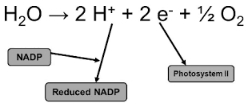
(A) During the light reaction,the photolysis of water occurs,which splits water into two protons $(2H^{+})$,one-half oxygen molecule $(\frac{1}{2}O_{2})$,and two electrons $(2e^{-})$.
This reaction is represented as: $H_{2}O \rightarrow 2H^{+} + \frac{1}{2}O_{2} + 2e^{-}$.
Protons are used in the formation of a proton gradient across the thylakoid membrane.
Oxygen is released as a byproduct.
Electrons are supplied to $PS-II$ to replace those lost during the light-dependent reactions.
This reaction is represented as: $H_{2}O \rightarrow 2H^{+} + \frac{1}{2}O_{2} + 2e^{-}$.
Protons are used in the formation of a proton gradient across the thylakoid membrane.
Oxygen is released as a byproduct.
Electrons are supplied to $PS-II$ to replace those lost during the light-dependent reactions.
0 likes
View Solution288
MediumMCQ
The $ATP$ase enzyme consists of
$I$. $F_{0}$
$II$. $F_{1}$
$III$. $F_{2}$
Select the correct option.
$I$. $F_{0}$
$II$. $F_{1}$
$III$. $F_{2}$
Select the correct option.
A
$I$ and $III$
B
$I$ and $II$
C
Only $I$
D
$II$ and $III$
Solution
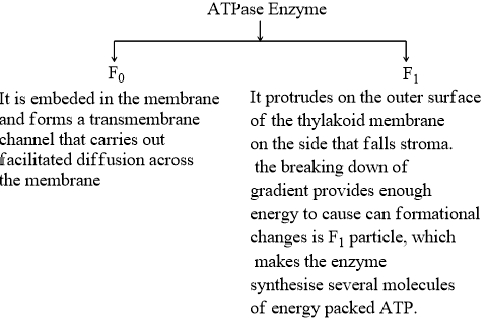
(B) The $ATP$ase enzyme consists of two parts: $F_{0}$ and $F_{1}$.
$F_{0}$ is embedded in the membrane and forms a transmembrane channel that carries out facilitated diffusion of protons across the membrane.
$F_{1}$ protrudes on the outer surface of the thylakoid membrane on the side that faces the stroma.
The breakdown of the proton gradient provides enough energy to cause conformational changes in the $F_{1}$ particle,which makes the enzyme synthesize several molecules of energy-packed $ATP$.
Therefore,the correct components are $I$ $(F_{0})$ and $II$ $(F_{1})$.
$F_{0}$ is embedded in the membrane and forms a transmembrane channel that carries out facilitated diffusion of protons across the membrane.
$F_{1}$ protrudes on the outer surface of the thylakoid membrane on the side that faces the stroma.
The breakdown of the proton gradient provides enough energy to cause conformational changes in the $F_{1}$ particle,which makes the enzyme synthesize several molecules of energy-packed $ATP$.
Therefore,the correct components are $I$ $(F_{0})$ and $II$ $(F_{1})$.
0 likes
View Solution289
MediumMCQ
The flow of electrons in non-cyclic photophosphorylation is:
A
Unidirectional (from $PS-I$ to $PS-II$)
B
Amphidirectional
C
Bidirectional
D
Unidirectional (from $PS-II$ to $PS-I$)
Solution
(D) In non-cyclic photophosphorylation,also known as the $Z$-scheme,electrons are released from $PS-II$ upon excitation by light. These electrons travel through an electron transport chain to $PS-I$. Consequently,the flow of electrons is strictly unidirectional,moving from $PS-II$ to $PS-I$.
0 likes
View Solution290
EasyMCQ
In photosynthesis,energy from light reaction to dark reaction is transferred in the form of
A
$ADP$
B
$ATP$
C
$RuBP$
D
$chlorophyll$
Solution
(B) As a result of the light reaction,oxygen,$NADPH$,and $ATP$ are formed.
Oxygen is released into the atmosphere as a byproduct.
$NADPH$ and $ATP$ produced during the light reaction are utilized in the dark reaction (Calvin cycle) for the reduction of carbon dioxide into carbohydrates.
Oxygen is released into the atmosphere as a byproduct.
$NADPH$ and $ATP$ produced during the light reaction are utilized in the dark reaction (Calvin cycle) for the reduction of carbon dioxide into carbohydrates.
0 likes
View Solution291
MediumMCQ
Photophosphorylation differs from oxidative phosphorylation in requiring input of energy in the form of
A
Light
B
Heat
C
$AMP$
D
$NAD$
Solution
(A) Photophosphorylation is the process of $ATP$ synthesis in chloroplasts during photosynthesis,which requires light energy to excite electrons and create a proton gradient.
In contrast,oxidative phosphorylation occurs in mitochondria and uses energy derived from the oxidation of nutrients (like glucose) to drive $ATP$ synthesis.
Therefore,photophosphorylation specifically requires light energy to initiate the electron transport chain.
In contrast,oxidative phosphorylation occurs in mitochondria and uses energy derived from the oxidation of nutrients (like glucose) to drive $ATP$ synthesis.
Therefore,photophosphorylation specifically requires light energy to initiate the electron transport chain.
0 likes
View Solution292
MediumMCQ
During non-cyclic photophosphorylation,which of the following does the electron produced through photolysis enter?
A
$PS-II$
B
$PC$
C
$PQ$
D
$PS-I$
Solution
(A) Non-cyclic photophosphorylation involves both Photosystem $II$ $(PS-II)$ and Photosystem $I$ $(PS-I)$.
During the light reaction,water molecules undergo photolysis to release electrons,protons $(H^+)$,and oxygen.
The electrons released from the photolysis of water are immediately donated to the reaction center of $PS-II$,which is $P_{680}$.
This replenishment is necessary because $PS-II$ loses electrons when it is excited by light.
Therefore,the electrons from photolysis enter $PS-II$ to replace the lost electrons.
During the light reaction,water molecules undergo photolysis to release electrons,protons $(H^+)$,and oxygen.
The electrons released from the photolysis of water are immediately donated to the reaction center of $PS-II$,which is $P_{680}$.
This replenishment is necessary because $PS-II$ loses electrons when it is excited by light.
Therefore,the electrons from photolysis enter $PS-II$ to replace the lost electrons.
0 likes
View Solution293
MediumMCQ
$PS-I$ is located on the
A
Non-appressed part of grana thylakoids
B
Stroma thylakoids
C
Appressed part of grana thylakoids
D
Both $(a)$ and $(b)$
Solution
(D) $PS-I$ is present on both the non-appressed part of grana thylakoids as well as on stroma thylakoids. In contrast,$PS-II$ is primarily located on the appressed part of the grana thylakoids.
0 likes
View Solution294
MediumMCQ
What is the advantage of light reactions producing $ATP$ and $NADPH$ on the stromal side of the thylakoid membrane?
A
Calvin cycle consumes $ATP$ and $NADPH$ from the stroma.
B
Light reaction occurs in the stroma.
C
Dark reaction occurs in grana and needs $ATP + NADPH$.
D
$CO_{2}$ is produced in the stroma.
Solution
(A) During the light-dependent reactions,$ATP$ and $NADPH$ are produced on the stromal side of the thylakoid membrane.
This is advantageous because these molecules are immediately available in the stroma,where the enzymes of the Calvin cycle (dark reaction) are located.
The Calvin cycle utilizes this $ATP$ and $NADPH$ to fix $CO_{2}$ and synthesize carbohydrates (sugars).
This is advantageous because these molecules are immediately available in the stroma,where the enzymes of the Calvin cycle (dark reaction) are located.
The Calvin cycle utilizes this $ATP$ and $NADPH$ to fix $CO_{2}$ and synthesize carbohydrates (sugars).
0 likes
View Solution295
MediumMCQ
The electrons in the reaction centre of $PS-I$ are
A
Excited simultaneously with $PS-II$
B
Excited simultaneously with $P_{680}$
C
Excited simultaneously with $P_{700}$
D
Either $(a)$ or $(b)$
Solution
(A) The electrons in the reaction centre of $PS-I$ are excited simultaneously with $PS-II$ $(P_{680})$.
In the electron transport system $(ETS)$ of photosynthesis,the movement of electrons is downhill in terms of the oxidation-reduction or redox potential scale.
The electrons released from $PS-II$ are passed through the electron transport chain to the pigments of $PS-I$.
Simultaneously,the reaction centre of $PS-I$ $(P_{700})$ absorbs red light of wavelength $700 \; nm$,causing its electrons to become excited.
These excited electrons are then transferred to another acceptor molecule with a greater redox potential and are eventually used to reduce $NADP^+$ to $NADPH + H^+$.
In the electron transport system $(ETS)$ of photosynthesis,the movement of electrons is downhill in terms of the oxidation-reduction or redox potential scale.
The electrons released from $PS-II$ are passed through the electron transport chain to the pigments of $PS-I$.
Simultaneously,the reaction centre of $PS-I$ $(P_{700})$ absorbs red light of wavelength $700 \; nm$,causing its electrons to become excited.
These excited electrons are then transferred to another acceptor molecule with a greater redox potential and are eventually used to reduce $NADP^+$ to $NADPH + H^+$.
0 likes
View Solution296
MediumMCQ
During the light reaction,electrons are transferred by the splitting of $H_2O$ through the $ETC$,which results in the reduction of:
A
$NAD$ to $NADH + H^+$
B
$NADPH$ to $H^+$
C
$NADP^+$ to $NADPH + H^+$
D
$NAD$ to $NADPH + H^+$
Solution
(C) The correct option is $C$,which is $NADP^+$ to $NADPH + H^+$.
During the light reaction of photosynthesis:
$1$. Photolysis of water $(H_2O)$ occurs,releasing electrons,protons,and oxygen.
$2$. These electrons are transferred through the Electron Transport Chain $(ETC)$.
$3$. The final electron acceptor in the non-cyclic photophosphorylation pathway is $NADP^+$.
$4$. $NADP^+$ accepts these electrons and protons to get reduced into $NADPH + H^+$.
During the light reaction of photosynthesis:
$1$. Photolysis of water $(H_2O)$ occurs,releasing electrons,protons,and oxygen.
$2$. These electrons are transferred through the Electron Transport Chain $(ETC)$.
$3$. The final electron acceptor in the non-cyclic photophosphorylation pathway is $NADP^+$.
$4$. $NADP^+$ accepts these electrons and protons to get reduced into $NADPH + H^+$.
0 likes
View Solution297
MediumMCQ
Which activity is performed by $PS-I$ in light reaction?
A
Reduction of $NADPH$
B
Reduction of $NADP^{+}$
C
Oxidation of $NADP^{+}$
D
Oxidation of $NAD$
Solution
(B) The correct activity performed by $PS-I$ in the light reaction is the reduction of $NADP^{+}$.
$1$. Light reaction begins with $PS-II$. In $PS-II$,the reaction center chlorophyll-$a$ absorbs light of $680 \; nm$ wavelength,causing electrons to become excited.
$2$. These electrons are passed through an electron transport system $(ETS)$ consisting of cytochromes to $PS-I$.
$3$. Simultaneously,electrons in the reaction center of $PS-I$ are excited by absorbing light of $700 \; nm$ wavelength.
$4$. These excited electrons are transferred to an electron acceptor with a higher redox potential.
$5$. Finally,these electrons are used to reduce $NADP^{+}$ to $NADPH + H^{+}$ with the help of the enzyme $FNR$ (Ferredoxin-$NADP$ reductase).
$1$. Light reaction begins with $PS-II$. In $PS-II$,the reaction center chlorophyll-$a$ absorbs light of $680 \; nm$ wavelength,causing electrons to become excited.
$2$. These electrons are passed through an electron transport system $(ETS)$ consisting of cytochromes to $PS-I$.
$3$. Simultaneously,electrons in the reaction center of $PS-I$ are excited by absorbing light of $700 \; nm$ wavelength.
$4$. These excited electrons are transferred to an electron acceptor with a higher redox potential.
$5$. Finally,these electrons are used to reduce $NADP^{+}$ to $NADPH + H^{+}$ with the help of the enzyme $FNR$ (Ferredoxin-$NADP$ reductase).
0 likes
View Solution298
MediumMCQ
In the grana of the chloroplast,the reaction $ADP + Pi = ATP$ during the day shows:
A
Oxidative phosphorylation
B
Photophosphorylation
C
Substrate level phosphorylation
D
Dephosphorylation
Solution
(B) The process of synthesis of $ATP$ from $ADP$ and inorganic phosphate $(Pi)$ in the presence of light in the chloroplast is known as Photophosphorylation.
This reaction occurs in the thylakoid membranes (grana) of the chloroplast during the light-dependent reactions of photosynthesis.
This reaction occurs in the thylakoid membranes (grana) of the chloroplast during the light-dependent reactions of photosynthesis.
0 likes
View Solution299
EasyMCQ
Plastocyanin contains
A
Copper
B
Iron
C
Calcium
D
Potassium
Solution
(A) Plastocyanin is a copper-containing protein that acts as an electron carrier in the photosynthetic electron transport chain.
It facilitates the transfer of electrons between the cytochrome $b_6f$ complex and Photosystem $I$ $(PSI)$.
Copper is a vital component or activator for several enzymes,including cytochrome oxidase,$RuBP$ carboxylase,and plastocyanin.
It plays a significant role in electron transport,carbohydrate metabolism,nitrogen balance,and chlorophyll synthesis.
It facilitates the transfer of electrons between the cytochrome $b_6f$ complex and Photosystem $I$ $(PSI)$.
Copper is a vital component or activator for several enzymes,including cytochrome oxidase,$RuBP$ carboxylase,and plastocyanin.
It plays a significant role in electron transport,carbohydrate metabolism,nitrogen balance,and chlorophyll synthesis.
0 likes
View Solution300
MediumMCQ
The minerals involved in the photolysis of water are:
$I$ Manganese
$II$ Calcium
$III$ Magnesium
$IV$ Chloride
$I$ Manganese
$II$ Calcium
$III$ Magnesium
$IV$ Chloride
A
$I$ and $II$ only
B
$I, II$ and $IV$ only
C
$I, II$ and $III$ only
D
$I$ and $IV$ only
Solution
(B) The photolysis of water (splitting of water) occurs in the thylakoid lumen and is associated with Photosystem-$II$.
This process requires specific mineral ions to act as cofactors for the oxygen-evolving complex.
The essential ions involved in the photolysis of water are Manganese $(Mn^{2+})$,Calcium $(Ca^{2+})$,and Chloride $(Cl^-)$ ions.
Therefore,$I$ (Manganese),$II$ (Calcium),and $IV$ (Chloride) are involved in this process.
This process requires specific mineral ions to act as cofactors for the oxygen-evolving complex.
The essential ions involved in the photolysis of water are Manganese $(Mn^{2+})$,Calcium $(Ca^{2+})$,and Chloride $(Cl^-)$ ions.
Therefore,$I$ (Manganese),$II$ (Calcium),and $IV$ (Chloride) are involved in this process.
0 likes
View SolutionPhotosynthesis in Higher Plants — Light reaction · Frequently Asked Questions
1Are these Photosynthesis in Higher Plants questions useful for JEE and NEET?
Yes. All questions in this section are mapped to JEE Main and NEET exam patterns. Previous year questions from JEE Main, NEET, GUJCET and state-level exams are included with full solutions.
2Can I switch to Hindi or Gujarati for these questions?
Yes. Use the language tabs in the hero section or the sidebar to view the same questions and solutions in English, Hindi or Gujarati.
3How do I generate a question paper from this subtopic?
Use the Vedclass Exam Paper Generator — select the chapter and subtopic, set difficulty, and generate Sets A, B, C, D automatically. First 3 chapters of every subject are free.
Vedclass Products
For Students
Vedclass Test Series
Mock tests in real JEE/NEET style with performance analysis. 5-day free trial.
Start Free TrialFor Teachers
Exam Paper Generator
Generate Set A/B/C/D papers from this chapter in 2 minutes. 3 chapters free.
Try FreeFor Institutes
Online Exam Module
Live online exams with unlimited students, 360° analytics & white-label branding.
See DemoFor Teachers & Institutes
Generate a Photosynthesis in Higher Plants Exam Paper in 2 Minutes
Select subtopic & difficulty — Sets A, B, C, D auto-generated with No Repeat logic.
First 3 chapters of every subject are free — no payment required.