
A English
Mechanism of Concentration of the Filtrate Questions in English
Class 11 Biology · Excretory Products and their Elimination · Mechanism of Concentration of the Filtrate
76+
Questions
English
Language
100%
With Solutions
Showing 26 of 76 questions in English
51
EasyMCQ
Vasa recta is
A
$L-$shaped
B
$U-$shaped
C
$S-$shaped
D
$V-$shaped
Solution
(B) The vasa recta is a $U-$shaped capillary network that arises from the efferent arteriole of the juxtamedullary nephrons.
It runs parallel to the loop of Henle.
In the vasa recta,blood flows in the opposite direction to the flow of the filtrate in the loop of Henle,which helps in maintaining the concentration gradient in the medullary interstitium.
It runs parallel to the loop of Henle.
In the vasa recta,blood flows in the opposite direction to the flow of the filtrate in the loop of Henle,which helps in maintaining the concentration gradient in the medullary interstitium.
0 likes
View Solution52
MediumMCQ
We can produce a concentrated urine. This is facilitated by a special mechanism. Identify the mechanism.
A
Reabsorption from $PCT$
B
Reabsorption from collecting duct
C
Reabsorption/secretion in $DCT$
D
Counter current mechanism in Henle's loop/vasa recta
Solution
(D) Countercurrent mechanism: The arrangement of the loop of Henle and the vasa recta,in which the filtrate and blood flow in opposite directions,facilitates an increase in osmolarity towards the inner medullary interstitium. This gradient increases from $300 \; mOsmL^{-1}$ in the cortex to about $1200 \; mOsmL^{-1}$ in the inner medulla,allowing for the production of concentrated urine.
0 likes
View Solution53
MediumMCQ
The main function of the loop of Henle is
A
Blood filtration
B
Urine formation
C
Water conservation
D
Both $(a)$ and $(b)$
Solution
(C) The loop of Henle plays a critical role in the concentration of urine. Its primary function is the conservation of water through the countercurrent mechanism,which creates an osmotic gradient in the renal medulla,allowing for the reabsorption of water from the collecting duct.
0 likes
View Solution54
MediumMCQ
What is the osmolarity of the filtrate at the hairpin bend of the loop of Henle?
A
$300 \; mOsmL^{-1}$
B
$1200 \; mOsmL^{-1}$
C
$600 \; mOsmL^{-1}$
D
$800 \; mOsmL^{-1}$
Solution
(B) The loop of Henle plays a crucial role in the concentration of urine through a counter-current mechanism.
As the filtrate moves down the descending limb of the loop of Henle,water is reabsorbed into the medullary interstitium,causing the filtrate to become increasingly concentrated.
At the hairpin bend (the deepest part of the medulla),the osmolarity of the filtrate reaches its maximum value of approximately $1200 \; mOsmL^{-1}$.
Therefore,the correct osmolarity at this point is $1200 \; mOsmL^{-1}$.
As the filtrate moves down the descending limb of the loop of Henle,water is reabsorbed into the medullary interstitium,causing the filtrate to become increasingly concentrated.
At the hairpin bend (the deepest part of the medulla),the osmolarity of the filtrate reaches its maximum value of approximately $1200 \; mOsmL^{-1}$.
Therefore,the correct osmolarity at this point is $1200 \; mOsmL^{-1}$.
0 likes
View Solution55
MediumMCQ
The concentration of sodium and chloride ions is lowest in which of the following regions?
A
Near the cortex
B
Deep in the medulla
C
In the interstitial fluid
D
In the middle of Henle's loop
Solution
(A) The osmolarity of the kidney tissue near the cortex is approximately $200-300 \; mOsmL^{-1}$.
As we move deeper into the medulla,the osmolarity increases significantly,reaching up to $1200 \; mOsmL^{-1}$ near the inner medulla.
Since the concentration of $Na^+$ and $Cl^-$ ions is directly proportional to the osmolarity of the interstitial fluid,their concentration is lowest in the cortical region.
As we move deeper into the medulla,the osmolarity increases significantly,reaching up to $1200 \; mOsmL^{-1}$ near the inner medulla.
Since the concentration of $Na^+$ and $Cl^-$ ions is directly proportional to the osmolarity of the interstitial fluid,their concentration is lowest in the cortical region.
0 likes
View Solution56
MediumMCQ
$A :$ In the descending limb of the loop of Henle,the urine is hypertonic,while in the ascending limb of the loop of Henle,the urine is hypotonic.
$R :$ The descending limb is impermeable to $Na^+$,while the ascending limb is impermeable to $H_2O$.
$R :$ The descending limb is impermeable to $Na^+$,while the ascending limb is impermeable to $H_2O$.
A
Assertion and Reason both are correct and Reason is the correct explanation of Assertion.
B
Assertion and Reason both are correct but Reason is not the correct explanation of Assertion.
C
Assertion is correct,but Reason is incorrect.
D
Both Assertion and Reason are incorrect.
Solution
(A) The descending limb of the loop of Henle is permeable to water but nearly impermeable to electrolytes. As the filtrate moves down,water is lost to the hypertonic medullary interstitium,making the filtrate hypertonic.
The ascending limb of the loop of Henle is impermeable to water but allows the transport of electrolytes ($Na^+$,$Cl^-$) actively or passively. As the filtrate moves up,electrolytes are removed,making the filtrate hypotonic.
Therefore,both the Assertion and the Reason are correct,and the Reason correctly explains why the tonicity changes in the respective limbs.
The ascending limb of the loop of Henle is impermeable to water but allows the transport of electrolytes ($Na^+$,$Cl^-$) actively or passively. As the filtrate moves up,electrolytes are removed,making the filtrate hypotonic.
Therefore,both the Assertion and the Reason are correct,and the Reason correctly explains why the tonicity changes in the respective limbs.
0 likes
View Solution57
MediumMCQ
$A$: The final reabsorption of water from urine into blood occurs through the collecting duct of a mammalian nephron,resulting in the production of hyperosmotic urine.
$R$: The loop of Henle is responsible for the formation of a sodium gradient across the depth of the medullary interstitium of a mammalian kidney.
$R$: The loop of Henle is responsible for the formation of a sodium gradient across the depth of the medullary interstitium of a mammalian kidney.
A
Both Assertion and Reason are correct and Reason is the correct explanation of Assertion.
B
Both Assertion and Reason are correct but Reason is not the correct explanation of Assertion.
C
Assertion is correct,but Reason is incorrect.
D
Both Assertion and Reason are incorrect.
Solution
(B) The Assertion is correct: The collecting duct allows for the final reabsorption of water,which is regulated by $ADH$ (antidiuretic hormone),leading to the concentration of urine (hyperosmotic urine).
The Reason is also correct: The loop of Henle plays a crucial role in the counter-current mechanism,which creates a high osmolarity (sodium gradient) in the medullary interstitium.
However,the Reason is not the direct explanation for the Assertion because the reabsorption in the collecting duct is primarily dependent on $ADH$ levels,whereas the loop of Henle provides the osmotic gradient that makes this reabsorption possible.
The Reason is also correct: The loop of Henle plays a crucial role in the counter-current mechanism,which creates a high osmolarity (sodium gradient) in the medullary interstitium.
However,the Reason is not the direct explanation for the Assertion because the reabsorption in the collecting duct is primarily dependent on $ADH$ levels,whereas the loop of Henle provides the osmotic gradient that makes this reabsorption possible.
0 likes
View Solution58
EasyMCQ
Which ions enter the vasa recta?
A
Sodium and potassium ions
B
Sodium chloride and urea
C
Potassium and urea
D
Chloride and bicarbonate ions
Solution
(B) The vasa recta plays a crucial role in the counter-current mechanism of the kidney.
$NaCl$ is transported by the ascending limb of the loop of Henle and is exchanged with the descending limb of the vasa recta.
Similarly,urea enters the interstitium from the collecting duct and is transported into the ascending limb of the vasa recta.
Therefore,both $NaCl$ and urea enter the vasa recta to maintain the concentration gradient in the renal medulla.
$NaCl$ is transported by the ascending limb of the loop of Henle and is exchanged with the descending limb of the vasa recta.
Similarly,urea enters the interstitium from the collecting duct and is transported into the ascending limb of the vasa recta.
Therefore,both $NaCl$ and urea enter the vasa recta to maintain the concentration gradient in the renal medulla.
0 likes
View Solution59
MediumMCQ
To maintain the required osmotic concentration in the medullary interstitium of the kidneys of ureotelic animals,some amount of ..... is retained.
A
Urea
B
Uric acid
C
$K^+$
D
Ammonia
Solution
(A) In ureotelic animals,such as mammals,the kidneys maintain a high osmolarity in the medullary interstitium to facilitate the concentration of urine.
This process is primarily achieved through the counter-current mechanism involving the loop of $Henle$ and the $vasa$ $recta$.
Specifically,some amount of urea is reabsorbed from the collecting duct into the medullary interstitium.
This urea contributes significantly to the osmotic gradient,allowing for the reabsorption of water from the filtrate,thereby producing concentrated urine.
This process is primarily achieved through the counter-current mechanism involving the loop of $Henle$ and the $vasa$ $recta$.
Specifically,some amount of urea is reabsorbed from the collecting duct into the medullary interstitium.
This urea contributes significantly to the osmotic gradient,allowing for the reabsorption of water from the filtrate,thereby producing concentrated urine.
0 likes
View Solution60
EasyMCQ
The descending limb of the loop of Henle is permeable to ........ .
A
$Na^+$
B
$Cl^-$
C
Water
D
Both $A$ and $B$
Solution
(C) The loop of Henle is a crucial part of the nephron involved in the concentration of urine.
The descending limb of the loop of Henle is permeable to water but almost impermeable to electrolytes like $Na^+$ and $Cl^-$.
This allows water to move out of the filtrate into the interstitial fluid due to the high osmolarity of the medulla,thereby concentrating the filtrate.
Conversely,the ascending limb is permeable to electrolytes but impermeable to water.
The descending limb of the loop of Henle is permeable to water but almost impermeable to electrolytes like $Na^+$ and $Cl^-$.
This allows water to move out of the filtrate into the interstitial fluid due to the high osmolarity of the medulla,thereby concentrating the filtrate.
Conversely,the ascending limb is permeable to electrolytes but impermeable to water.
0 likes
View Solution61
MediumMCQ
Which part of the nephron plays a significant role in the maintenance of high osmolarity of the interstitial fluid?
A
Proximal Convoluted Tubule $(PCT)$
B
Loop of Henle
C
Distal Convoluted Tubule $(DCT)$
D
Collecting Duct
Solution
(B) The $Loop$ $of$ $Henle$ plays a crucial role in the maintenance of high osmolarity of the medullary interstitial fluid.
This is achieved through a mechanism known as the counter-current mechanism.
The descending limb of the $Loop$ $of$ $Henle$ is permeable to water but nearly impermeable to electrolytes,while the ascending limb is impermeable to water but allows transport of electrolytes.
This differential permeability creates a concentration gradient in the medullary interstitium,which is essential for the concentration of urine.
This is achieved through a mechanism known as the counter-current mechanism.
The descending limb of the $Loop$ $of$ $Henle$ is permeable to water but nearly impermeable to electrolytes,while the ascending limb is impermeable to water but allows transport of electrolytes.
This differential permeability creates a concentration gradient in the medullary interstitium,which is essential for the concentration of urine.
0 likes
View Solution62
MediumMCQ
The concentration of urine depends upon $........$.
A
Proximal convoluted tubule
B
Loop of Henle
C
Distal convoluted tubule
D
Collecting duct
Solution
(B) The concentration of urine is primarily regulated by the $Loop \ of \ Henle$ and the $Collecting \ duct$. However, the $Loop \ of \ Henle$ plays a critical role in creating a medullary interstitial gradient through the counter-current mechanism, which is essential for the concentration of urine. The $Collecting \ duct$ then utilizes this gradient to reabsorb water under the influence of $ADH$ (Antidiuretic Hormone) to produce concentrated urine. Among the given options, the $Loop \ of \ Henle$ is the primary structure responsible for the counter-current mechanism that establishes the osmotic gradient necessary for urine concentration.
0 likes
View Solution63
MediumMCQ
The human kidneys produce urine that is approximately .......... times more concentrated than the initial filtrate.
A
$2$
B
$3$
C
$4$
D
$5$
Solution
(C) The human kidneys have the ability to produce concentrated urine to conserve water.
This is achieved through the counter-current mechanism involving the Loop of Henle and the vasa recta.
The initial filtrate formed in the glomerulus is isotonic to blood plasma (approximately $300 \ mOsm/L$).
The human kidneys can produce urine that is up to $4$ times more concentrated than the initial filtrate,reaching a concentration of approximately $1200 \ mOsm/L$.
This is achieved through the counter-current mechanism involving the Loop of Henle and the vasa recta.
The initial filtrate formed in the glomerulus is isotonic to blood plasma (approximately $300 \ mOsm/L$).
The human kidneys can produce urine that is up to $4$ times more concentrated than the initial filtrate,reaching a concentration of approximately $1200 \ mOsm/L$.
0 likes
View Solution64
MediumMCQ
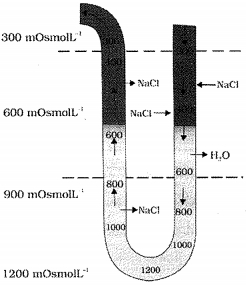
What does the following figure represent?
A
Proximal Convoluted Tubule
B
Distal Convoluted Tubule
C
Collecting Duct
D
Vasa Recta
Solution
(D) The provided figure illustrates the counter-current mechanism occurring in the $Vasa$ $Recta$.
This mechanism is essential for maintaining the concentration gradient in the medullary interstitium,which allows for the concentration of urine.
The $Vasa$ $Recta$ is a capillary network that runs parallel to the $Loop$ $of$ $Henle$ and plays a crucial role in the reabsorption of water and solutes,thereby maintaining the osmotic gradient of $300$ $mOsmolL^{-1}$ in the cortex to $1200$ $mOsmolL^{-1}$ in the inner medulla.
This mechanism is essential for maintaining the concentration gradient in the medullary interstitium,which allows for the concentration of urine.
The $Vasa$ $Recta$ is a capillary network that runs parallel to the $Loop$ $of$ $Henle$ and plays a crucial role in the reabsorption of water and solutes,thereby maintaining the osmotic gradient of $300$ $mOsmolL^{-1}$ in the cortex to $1200$ $mOsmolL^{-1}$ in the inner medulla.
0 likes
View Solution65
MediumMCQ
Which of the following plays a significant role in the production of concentrated urine?
A
Vasa recta and Loop of Henle
B
Vasa recta and Proximal Convoluted Tubule
C
Loop of Henle and Proximal Convoluted Tubule
D
Loop of Henle and Distal Convoluted Tubule
Solution
(A) The production of concentrated urine is primarily achieved through the counter-current mechanism.
This mechanism involves the $Loop of Henle$ and the $Vasa recta$.
The $Loop of Henle$ creates a concentration gradient in the medullary interstitium, while the $Vasa recta$ helps in maintaining this gradient by the counter-current exchange of solutes and water.
Therefore, both structures are essential for concentrating urine.
This mechanism involves the $Loop of Henle$ and the $Vasa recta$.
The $Loop of Henle$ creates a concentration gradient in the medullary interstitium, while the $Vasa recta$ helps in maintaining this gradient by the counter-current exchange of solutes and water.
Therefore, both structures are essential for concentrating urine.
0 likes
View Solution66
MediumMCQ
The flow of $P$ in the limbs of the Loop of Henle and the flow of $Q$ in the limbs of the vasa recta create a counter-current mechanism.
$\quad P \quad\quad Q$
$\quad P \quad\quad Q$
A
Blood $\quad\quad$ Filtrate
B
Filtrate $\quad\quad$ Blood
C
Filtrate $\quad\quad$ Filtrate
D
Blood $\quad\quad$ Blood
Solution
(B) The counter-current mechanism is essential for concentrating urine in the kidneys.
$1$. In the Loop of Henle,the filtrate flows in opposite directions in the descending and ascending limbs,creating a counter-current.
$2$. In the vasa recta,the blood flows in opposite directions in the descending and ascending limbs,also creating a counter-current.
$3$. Therefore,$P$ represents the filtrate and $Q$ represents the blood.
$1$. In the Loop of Henle,the filtrate flows in opposite directions in the descending and ascending limbs,creating a counter-current.
$2$. In the vasa recta,the blood flows in opposite directions in the descending and ascending limbs,also creating a counter-current.
$3$. Therefore,$P$ represents the filtrate and $Q$ represents the blood.
0 likes
View Solution67
MediumMCQ
What is the range of osmolarity from the renal cortex to the inner medulla?
A
$300$ to $800 \, mOsm/L$
B
$800$ to $300 \, mOsm/L$
C
$1200$ to $300 \, mOsm/L$
D
$300$ to $1200 \, mOsm/L$
Solution
(D) The human kidney has the ability to produce concentrated urine.
This is achieved through a counter-current mechanism involving the Loop of Henle and the vasa recta.
The osmolarity of the interstitial fluid in the renal cortex is approximately $300 \, mOsm/L$.
As we move deeper into the renal medulla,the osmolarity increases significantly due to the accumulation of $NaCl$ and urea.
In the inner medulla,the osmolarity reaches up to $1200 \, mOsm/L$.
Therefore,the gradient from the cortex to the inner medulla ranges from $300 \, mOsm/L$ to $1200 \, mOsm/L$.
This is achieved through a counter-current mechanism involving the Loop of Henle and the vasa recta.
The osmolarity of the interstitial fluid in the renal cortex is approximately $300 \, mOsm/L$.
As we move deeper into the renal medulla,the osmolarity increases significantly due to the accumulation of $NaCl$ and urea.
In the inner medulla,the osmolarity reaches up to $1200 \, mOsm/L$.
Therefore,the gradient from the cortex to the inner medulla ranges from $300 \, mOsm/L$ to $1200 \, mOsm/L$.
0 likes
View Solution68
MediumMCQ
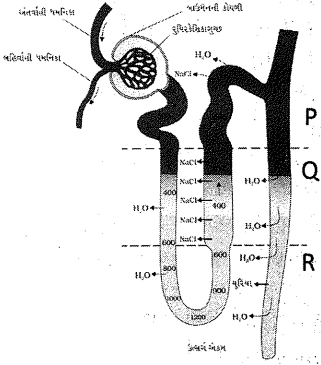
In the given diagram,what are the regions $P, Q,$ and $R$?
$P \quad\quad Q \quad \quad R$
$P \quad\quad Q \quad \quad R$
A
Inner Medulla $\quad$ Outer Medulla $\quad$ Cortex
B
Cortex $\quad$ Outer Medulla $\quad$ Inner Medulla
C
Medulla $\quad$ Outer Cortex $\quad$ Inner Cortex
D
Inner Cortex $\quad$ Outer Cortex $\quad$ Medulla
Solution
(B) The diagram represents the structure of a nephron and the counter-current mechanism in the kidney.
$1$. Region $P$ is the outermost part of the kidney where the glomerulus and convoluted tubules are located,known as the Cortex.
$2$. Region $Q$ represents the upper part of the medulla,known as the Outer Medulla.
$3$. Region $R$ represents the deeper part of the medulla,known as the Inner Medulla.
Therefore,the correct sequence is $P$ = Cortex,$Q$ = Outer Medulla,$R$ = Inner Medulla.
$1$. Region $P$ is the outermost part of the kidney where the glomerulus and convoluted tubules are located,known as the Cortex.
$2$. Region $Q$ represents the upper part of the medulla,known as the Outer Medulla.
$3$. Region $R$ represents the deeper part of the medulla,known as the Inner Medulla.
Therefore,the correct sequence is $P$ = Cortex,$Q$ = Outer Medulla,$R$ = Inner Medulla.
0 likes
View Solution69
MediumMCQ
The osmotic concentration in the interstitial fluid is primarily due to the presence of $.....$.
A
Uric acid and $NaCl$
B
Urea and $KCl$
C
Urea and $NaCl$
D
Uric acid and $KCl$
Solution
(C) The osmotic gradient in the renal medulla is maintained by the counter-current mechanism involving the Loop of Henle and the vasa recta.
This interstitial gradient is primarily generated by the accumulation of $NaCl$ and urea.
$NaCl$ is transported by the ascending limb of the Loop of Henle,which is exchanged with the descending limb of the vasa recta.
Urea enters the interstitium from the collecting duct,further contributing to the high osmolarity of the medullary interstitium.
Therefore,the correct combination is urea and $NaCl$.
This interstitial gradient is primarily generated by the accumulation of $NaCl$ and urea.
$NaCl$ is transported by the ascending limb of the Loop of Henle,which is exchanged with the descending limb of the vasa recta.
Urea enters the interstitium from the collecting duct,further contributing to the high osmolarity of the medullary interstitium.
Therefore,the correct combination is urea and $NaCl$.
0 likes
View Solution70
EasyMCQ
In human kidneys,which substances are mainly responsible for creating the osmolarity gradient of the medullary interstitial fluid?
A
$CaCl_2$ and $NaCl$
B
$NaCl$ and urea
C
Urea and carbonic acid
D
Urea and uric acid
Solution
(B) The osmolarity gradient in the medullary interstitial fluid of the human kidney is primarily maintained by two substances: $NaCl$ and urea.
$NaCl$ is transported by the ascending limb of the loop of Henle,which is exchanged with the descending limb of the vasa recta.
Urea is transported back to the interstitium by the collecting duct.
This mechanism,known as the counter-current mechanism,helps in concentrating the urine.
$NaCl$ is transported by the ascending limb of the loop of Henle,which is exchanged with the descending limb of the vasa recta.
Urea is transported back to the interstitium by the collecting duct.
This mechanism,known as the counter-current mechanism,helps in concentrating the urine.
0 likes
View Solution71
EasyMCQ
$\text{NaCl}$ from the ascending limb of Henle's loop is exchanged with:
A
ascending limb of vasa recta
B
descending limb of vasa recta
C
afferent arteriole
D
descending limb of Henle's loop
Solution
(B) The concentration of urine is maintained by the counter-current mechanism involving the loop of Henle and the vasa recta.
$\text{NaCl}$ is transported out of the ascending limb of the loop of Henle into the interstitial fluid.
This $\text{NaCl}$ is then picked up by the descending limb of the vasa recta.
Conversely,urea is picked up by the ascending limb of the vasa recta.
This exchange helps in maintaining the concentration gradient in the medullary interstitium,which is essential for the concentration of urine.
$\text{NaCl}$ is transported out of the ascending limb of the loop of Henle into the interstitial fluid.
This $\text{NaCl}$ is then picked up by the descending limb of the vasa recta.
Conversely,urea is picked up by the ascending limb of the vasa recta.
This exchange helps in maintaining the concentration gradient in the medullary interstitium,which is essential for the concentration of urine.
0 likes
View Solution72
EasyMCQ
Given below are two statements with respect to counter current mechanism.
$Statement-I$: Tissue fluid around the descending limb of Henle's loop becomes concentrated, during the counter current mechanism.
$Statement-II$: Water moves out from the descending limb of Henle's loop into the tissue fluid by osmosis.
In the light of the above statements, select the correct option from the codes given below:
$Statement-I$: Tissue fluid around the descending limb of Henle's loop becomes concentrated, during the counter current mechanism.
$Statement-II$: Water moves out from the descending limb of Henle's loop into the tissue fluid by osmosis.
In the light of the above statements, select the correct option from the codes given below:
A
Both $Statement-I$ and $Statement-II$ are incorrect.
B
Both $Statement-I$ and $Statement-II$ are correct.
C
$Statement-I$ is incorrect but $Statement-II$ is correct.
D
$Statement-I$ is correct but $Statement-II$ is incorrect.
Solution
(B) The counter current mechanism involves the flow of filtrate in opposite directions in the two limbs of the loop of Henle.
$Statement-II$ is correct: The descending limb of the loop of Henle is permeable to water but almost impermeable to electrolytes. As the filtrate moves down, water moves out into the hypertonic medullary tissue fluid by osmosis, concentrating the filtrate.
$Statement-I$ is correct: As water leaves the descending limb, the surrounding medullary tissue fluid becomes concentrated (hypertonic). This high osmolarity is essential for the reabsorption of water from the collecting duct.
Therefore, both statements are correct.
$Statement-II$ is correct: The descending limb of the loop of Henle is permeable to water but almost impermeable to electrolytes. As the filtrate moves down, water moves out into the hypertonic medullary tissue fluid by osmosis, concentrating the filtrate.
$Statement-I$ is correct: As water leaves the descending limb, the surrounding medullary tissue fluid becomes concentrated (hypertonic). This high osmolarity is essential for the reabsorption of water from the collecting duct.
Therefore, both statements are correct.
0 likes
View Solution73
EasyMCQ
Vasa recta refers to . . . . . . .
A
loop-shaped capillary network around Henle's loop of juxtamedullary nephrons.
B
juxtaglomerular apparatus of nephrons.
C
neuronal circuit of hypothalamus.
D
vascular portion of pia mater of $CNS$.
Solution
(A) The $Vasa$ $recta$ is a fine capillary network that runs parallel to the $Henle's$ loop in the juxtamedullary nephrons.
It is formed from the efferent arteriole of the juxtamedullary nephrons.
This structure plays a crucial role in the counter-current mechanism,which helps in concentrating the urine.
Therefore,the correct option is $A$.
It is formed from the efferent arteriole of the juxtamedullary nephrons.
This structure plays a crucial role in the counter-current mechanism,which helps in concentrating the urine.
Therefore,the correct option is $A$.
0 likes
View Solution74
EasyMCQ
Which one of the following animals has a longer loop of Henle?
A
Monkey
B
Rat
C
Labeo
D
Camel
Solution
(D) The length of the loop of Henle is directly related to the animal's ability to concentrate urine and conserve water.
Animals living in arid or desert environments,such as the camel,possess a very long loop of Henle to facilitate maximum water reabsorption from the filtrate.
This adaptation allows them to produce highly concentrated urine,which is essential for survival in water-scarce conditions.
Therefore,among the given options,the camel has the longest loop of Henle.
Animals living in arid or desert environments,such as the camel,possess a very long loop of Henle to facilitate maximum water reabsorption from the filtrate.
This adaptation allows them to produce highly concentrated urine,which is essential for survival in water-scarce conditions.
Therefore,among the given options,the camel has the longest loop of Henle.
0 likes
View Solution75
EasyMCQ
In the nephron, the transport of substances like sodium chloride and urea is facilitated by a special arrangement called the counter-current mechanism, which comprises of:
A
Vasa recta and collecting duct
B
Ascending limb and collecting duct
C
Henle's loop and vasa recta
D
Henle's loop and glomerulus
Solution
(C) The correct answer is $C$.
In the nephron, the counter-current mechanism is a specialized arrangement that maintains the concentration gradient in the medullary interstitium.
This mechanism is primarily facilitated by the close proximity and opposite flow of filtrate in the $Henle's$ loop and blood in the $vasa \text{ } recta$.
This system helps in concentrating the urine by allowing the reabsorption of water and solutes.
In the nephron, the counter-current mechanism is a specialized arrangement that maintains the concentration gradient in the medullary interstitium.
This mechanism is primarily facilitated by the close proximity and opposite flow of filtrate in the $Henle's$ loop and blood in the $vasa \text{ } recta$.
This system helps in concentrating the urine by allowing the reabsorption of water and solutes.
0 likes
View Solution76
EasyMCQ
Compare the statements $A$ and $B$.
$\text{Statement } A$: When the urine moves through the descending limb,it becomes hypertonic,and as it passes through the ascending limb of Henle's loop,it becomes hypotonic.
$\text{Statement } B$: The descending limb is permeable to sodium ions,while the ascending limb is impermeable to sodium ions.
$\text{Statement } A$: When the urine moves through the descending limb,it becomes hypertonic,and as it passes through the ascending limb of Henle's loop,it becomes hypotonic.
$\text{Statement } B$: The descending limb is permeable to sodium ions,while the ascending limb is impermeable to sodium ions.
A
Statement $A$ is correct and $B$ is incorrect.
B
Statement $A$ is wrong and $B$ is correct.
C
Both statements $A$ and $B$ are incorrect.
D
Both statements $A$ and $B$ are correct.
Solution
(A) Statement $A$ is correct and $B$ is incorrect.
The descending limb of Henle's loop is permeable to water but nearly impermeable to electrolytes. As the filtrate moves down,water is reabsorbed,making the filtrate hypertonic.
The ascending limb of Henle's loop is impermeable to water but allows the transport of electrolytes (like $Na^+$) out of the tubule. This makes the filtrate hypotonic.
Statement $B$ is incorrect because the descending limb is actually impermeable to sodium ions,whereas the ascending limb is permeable to sodium ions (via active transport).
The descending limb of Henle's loop is permeable to water but nearly impermeable to electrolytes. As the filtrate moves down,water is reabsorbed,making the filtrate hypertonic.
The ascending limb of Henle's loop is impermeable to water but allows the transport of electrolytes (like $Na^+$) out of the tubule. This makes the filtrate hypotonic.
Statement $B$ is incorrect because the descending limb is actually impermeable to sodium ions,whereas the ascending limb is permeable to sodium ions (via active transport).
0 likes
View SolutionExcretory Products and their Elimination — Mechanism of Concentration of the Filtrate · Frequently Asked Questions
1Are these Excretory Products and their Elimination questions useful for JEE and NEET?
Yes. All questions in this section are mapped to JEE Main and NEET exam patterns. Previous year questions from JEE Main, NEET, GUJCET and state-level exams are included with full solutions.
2Can I switch to Hindi or Gujarati for these questions?
Yes. Use the language tabs in the hero section or the sidebar to view the same questions and solutions in English, Hindi or Gujarati.
3How do I generate a question paper from this subtopic?
Use the Vedclass Exam Paper Generator — select the chapter and subtopic, set difficulty, and generate Sets A, B, C, D automatically. First 3 chapters of every subject are free.
Vedclass Products
For Students
Vedclass Test Series
Mock tests in real JEE/NEET style with performance analysis. 5-day free trial.
Start Free TrialFor Teachers
Exam Paper Generator
Generate Set A/B/C/D papers from this chapter in 2 minutes. 3 chapters free.
Try FreeFor Institutes
Online Exam Module
Live online exams with unlimited students, 360° analytics & white-label branding.
See DemoFor Teachers & Institutes
Generate a Excretory Products and their Elimination Exam Paper in 2 Minutes
Select subtopic & difficulty — Sets A, B, C, D auto-generated with No Repeat logic.
First 3 chapters of every subject are free — no payment required.