
A English
Function of the Tubules Questions in English
Class 11 Biology · Excretory Products and their Elimination · Function of the Tubules
133+
Questions
English
Language
100%
With Solutions
Showing 50 of 133 questions in English
51
MediumMCQ
Removal of the proximal convoluted tubule from the nephron will result in:
A
no change in quality and quantity of urine
B
no urine formation
C
more diluted urine
D
more concentrated urine
Solution
(D) The correct answer is $D$.
Approximately $65\%$ of the glomerular filtrate is normally reabsorbed in the proximal convoluted tubule $(PCT)$ before reaching the loop of Henle.
The $PCT$ is responsible for the reabsorption of essential nutrients such as glucose,amino acids,vitamins,hormones,$Na^+$,$K^+$,$Cl^-$,phosphates,bicarbonates,water,and urea.
If the $PCT$ is removed,the reabsorption of these solutes and water is significantly impaired.
Consequently,a larger volume of fluid reaches the distal parts of the nephron,but because the primary reabsorptive site for water and solutes is absent,the final urine produced will be more concentrated due to the inability to regulate the osmotic balance effectively.
Approximately $65\%$ of the glomerular filtrate is normally reabsorbed in the proximal convoluted tubule $(PCT)$ before reaching the loop of Henle.
The $PCT$ is responsible for the reabsorption of essential nutrients such as glucose,amino acids,vitamins,hormones,$Na^+$,$K^+$,$Cl^-$,phosphates,bicarbonates,water,and urea.
If the $PCT$ is removed,the reabsorption of these solutes and water is significantly impaired.
Consequently,a larger volume of fluid reaches the distal parts of the nephron,but because the primary reabsorptive site for water and solutes is absent,the final urine produced will be more concentrated due to the inability to regulate the osmotic balance effectively.
0 likes
View Solution52
MediumMCQ
The maximum amount of electrolytes and water $(70-80\ \%)$ from the glomerular filtrate is reabsorbed in which part of the nephron?
A
Ascending limb of loop of Henle
B
Distal convoluted tubule
C
Proximal convoluted tubule
D
Descending limb of loop of Henle
Solution
(C) The correct answer is $(C)$.
During glomerular filtration in the kidneys,ultrafiltration of blood occurs,meaning almost all constituents of plasma except proteins pass into the Bowman's capsule.
Following this,nearly $99\%$ of the filtrate is reabsorbed by the renal tubules.
The Proximal Convoluted Tubule $(PCT)$ is responsible for the maximum reabsorption.
Approximately $70-80\%$ of electrolytes and water,along with nearly all essential nutrients (like glucose and amino acids),are reabsorbed in this segment of the nephron.
During glomerular filtration in the kidneys,ultrafiltration of blood occurs,meaning almost all constituents of plasma except proteins pass into the Bowman's capsule.
Following this,nearly $99\%$ of the filtrate is reabsorbed by the renal tubules.
The Proximal Convoluted Tubule $(PCT)$ is responsible for the maximum reabsorption.
Approximately $70-80\%$ of electrolytes and water,along with nearly all essential nutrients (like glucose and amino acids),are reabsorbed in this segment of the nephron.
0 likes
View Solution53
MediumMCQ
Which one of the following is not a part of a renal pyramid?
A
Peritubular capillaries
B
Convoluted tubules
C
Collecting ducts
D
Loop of Henle
Solution
(B) The kidney medulla is divided into several conical regions known as renal pyramids.
Peritubular capillaries,the loop of Henle,and collecting ducts are located within the medulla (renal pyramids).
In contrast,the convoluted tubules (both proximal and distal) are located in the renal cortex of the kidney.
Therefore,convoluted tubules are not a part of the renal pyramid.
Peritubular capillaries,the loop of Henle,and collecting ducts are located within the medulla (renal pyramids).
In contrast,the convoluted tubules (both proximal and distal) are located in the renal cortex of the kidney.
Therefore,convoluted tubules are not a part of the renal pyramid.
0 likes
View Solution54
MediumMCQ
Removal of proximal convoluted tubule $(PCT)$ from the nephron will result in:
A
More concentrated urine
B
No change in quality and quantity of urine
C
No urine formation
D
More diluted urine
Solution
(D) The proximal convoluted tubule $(PCT)$ is responsible for the reabsorption of $70-80\%$ of electrolytes and water from the glomerular filtrate.
If the $PCT$ is removed,the reabsorption of water and essential nutrients like glucose and amino acids will not occur.
As a result,a large volume of the filtrate will pass into the loop of Henle,and the final urine produced will be much more diluted than normal because the primary site for water reabsorption is missing.
If the $PCT$ is removed,the reabsorption of water and essential nutrients like glucose and amino acids will not occur.
As a result,a large volume of the filtrate will pass into the loop of Henle,and the final urine produced will be much more diluted than normal because the primary site for water reabsorption is missing.
0 likes
View Solution55
MediumMCQ
Which of the following pairs is incorrect?
A
$PCT -$ Helps to maintain the $pH$ and ionic balance
B
Henle's loop - Selective reabsorption in this segment is maximum
C
$DCT -$ Conditional reabsorption of $Na^+$ and $H_2O$ takes place
D
Collecting duct - Large amount of water is reabsorbed from this segment
Solution
(B) The correct answer is $B$.
$1$. $PCT$ (Proximal Convoluted Tubule) is responsible for the reabsorption of $70-80\%$ of electrolytes and water, and it helps maintain the $pH$ and ionic balance of body fluids by selective secretion of $H^+$, $NH_3$ and $K^+$ ions.
$2$. Henle's loop is primarily involved in the maintenance of high osmolarity in the medullary interstitial fluid. The statement that selective reabsorption is maximum in this segment is incorrect; reabsorption is maximum in the $PCT$.
$3$. $DCT$ (Distal Convoluted Tubule) allows for conditional reabsorption of $Na^+$ and $H_2O$ under the influence of hormones like aldosterone and $ADH$.
$4$. The Collecting duct extends from the cortex to the inner parts of the medulla and allows for the reabsorption of large amounts of water to produce concentrated urine.
$1$. $PCT$ (Proximal Convoluted Tubule) is responsible for the reabsorption of $70-80\%$ of electrolytes and water, and it helps maintain the $pH$ and ionic balance of body fluids by selective secretion of $H^+$, $NH_3$ and $K^+$ ions.
$2$. Henle's loop is primarily involved in the maintenance of high osmolarity in the medullary interstitial fluid. The statement that selective reabsorption is maximum in this segment is incorrect; reabsorption is maximum in the $PCT$.
$3$. $DCT$ (Distal Convoluted Tubule) allows for conditional reabsorption of $Na^+$ and $H_2O$ under the influence of hormones like aldosterone and $ADH$.
$4$. The Collecting duct extends from the cortex to the inner parts of the medulla and allows for the reabsorption of large amounts of water to produce concentrated urine.
0 likes
View Solution56
MediumMCQ
.......... is absent or highly reduced in cortical nephrons.
A
Henle's loop
B
Vasa recta
C
Collecting duct
D
$PCT$
Solution
(B) In the human kidney, there are two types of nephrons: cortical nephrons and juxtamedullary nephrons.
Cortical nephrons have a short loop of Henle which extends only very little into the medulla.
In these nephrons, the $Vasa \text{ } recta$ is either absent or highly reduced.
Conversely, juxtamedullary nephrons have a long loop of Henle that runs deep into the medulla and are associated with a well-developed $Vasa \text{ } recta$.
Cortical nephrons have a short loop of Henle which extends only very little into the medulla.
In these nephrons, the $Vasa \text{ } recta$ is either absent or highly reduced.
Conversely, juxtamedullary nephrons have a long loop of Henle that runs deep into the medulla and are associated with a well-developed $Vasa \text{ } recta$.
0 likes
View Solution57
MediumMCQ
Which of the following statements is not true?
A
Descending limb of loop of Henle is impermeable to solutes.
B
Distal convoluted tubule functions in $K^+, Na^+$ homeostasis.
C
Descending limb of loop of Henle is impermeable to water.
D
Loop of Henle is largely responsible for concentrated urine.
Solution
(C) The correct answer is $C$.
$1$. The descending limb of the loop of Henle is permeable to water but nearly impermeable to electrolytes (solutes).
$2$. The ascending limb of the loop of Henle is impermeable to water but allows transport of electrolytes.
$3$. Therefore,the statement that the descending limb is impermeable to water is incorrect,as it is actually permeable to water.
$1$. The descending limb of the loop of Henle is permeable to water but nearly impermeable to electrolytes (solutes).
$2$. The ascending limb of the loop of Henle is impermeable to water but allows transport of electrolytes.
$3$. Therefore,the statement that the descending limb is impermeable to water is incorrect,as it is actually permeable to water.
0 likes
View Solution58
EasyMCQ
In which part of the nephron are all essential nutrients and $70-80 \%$ of electrolytes and water reabsorbed?
A
$PCT$
B
Henle's loop
C
$DCT$
D
Collecting duct
Solution
(A) The $PCT$ (Proximal Convoluted Tubule) is lined by simple cuboidal brush border epithelium which increases the surface area for reabsorption.
Nearly all of the essential nutrients and $70-80 \%$ of electrolytes and water are reabsorbed in this segment.
$PCT$ also helps to maintain the $pH$ and ionic balance of the body fluids by selective secretion of hydrogen ions,ammonia,and potassium ions into the filtrate and by absorption of $HCO_3^-$ from it.
Nearly all of the essential nutrients and $70-80 \%$ of electrolytes and water are reabsorbed in this segment.
$PCT$ also helps to maintain the $pH$ and ionic balance of the body fluids by selective secretion of hydrogen ions,ammonia,and potassium ions into the filtrate and by absorption of $HCO_3^-$ from it.
0 likes
View Solution59
MediumMCQ
During urine formation,the tubular cells secrete substances like ........... into the filtrate.
A
$Na^+, H^+, K^+$
B
$NaCl, H_2O, HCO_3^-$
C
Urea,$NaCl, H_2O$
D
$H^+, K^+,$ ammonia
Solution
(D) During urine formation,the tubular cells of the nephron perform tubular secretion.
Tubular secretion is an important step in urine formation as it helps in the maintenance of ionic and acid-base balance of body fluids.
Tubular cells secrete substances like $H^+$,$K^+$,and ammonia into the filtrate.
This process helps in maintaining the $pH$ and ionic balance of the blood.
Tubular secretion is an important step in urine formation as it helps in the maintenance of ionic and acid-base balance of body fluids.
Tubular cells secrete substances like $H^+$,$K^+$,and ammonia into the filtrate.
This process helps in maintaining the $pH$ and ionic balance of the blood.
0 likes
View Solution60
MediumMCQ
Reabsorption of useful substances from the glomerular filtrate occurs in the:
A
Collecting duct
B
Loop of Henle
C
Proximal convoluted tubule
D
Distal convoluted tubule
Solution
(C) The $Proximal \text{ Convoluted Tubule} (PCT)$ is the primary site for the reabsorption of useful substances from the glomerular filtrate.
Approximately $70-80\%$ of electrolytes and water, and $100\%$ of glucose and amino acids are reabsorbed in the $PCT$.
This process is essential for maintaining the internal environment and $pH$ balance of the body fluids.
Approximately $70-80\%$ of electrolytes and water, and $100\%$ of glucose and amino acids are reabsorbed in the $PCT$.
This process is essential for maintaining the internal environment and $pH$ balance of the body fluids.
0 likes
View Solution61
EasyMCQ
The brush border is a characteristic of ..........
A
Neck of nephron
B
Collecting duct
C
Proximal convoluted tubule
D
All of the above
Solution
(C) The $Proximal \text{ Convoluted Tubule } (PCT)$ of the nephron is lined by simple cuboidal brush border epithelium.
This brush border consists of numerous microvilli that significantly increase the surface area for the reabsorption of water, electrolytes, and nutrients from the filtrate.
Therefore, the brush border is a characteristic feature of the $PCT$.
This brush border consists of numerous microvilli that significantly increase the surface area for the reabsorption of water, electrolytes, and nutrients from the filtrate.
Therefore, the brush border is a characteristic feature of the $PCT$.
0 likes
View Solution62
EasyMCQ
The proximal and distal convoluted tubules are parts of the:
A
Seminiferous tubule
B
Nephron
C
Oviduct
D
Vas deferens
Solution
(B) The nephron is the structural and functional unit of the kidney.
It consists of a renal corpuscle (glomerulus and Bowman's capsule) and a renal tubule.
The renal tubule is further divided into the proximal convoluted tubule $(PCT)$,the loop of Henle,and the distal convoluted tubule $(DCT)$.
Therefore,both the proximal and distal convoluted tubules are integral parts of the nephron.
It consists of a renal corpuscle (glomerulus and Bowman's capsule) and a renal tubule.
The renal tubule is further divided into the proximal convoluted tubule $(PCT)$,the loop of Henle,and the distal convoluted tubule $(DCT)$.
Therefore,both the proximal and distal convoluted tubules are integral parts of the nephron.
0 likes
View Solution63
MediumMCQ
Under normal conditions,which substance is completely reabsorbed in the renal tubules?
A
Urea
B
Uric acid
C
Salts
D
Glucose
Solution
(D) In a healthy individual,the glomerular filtrate contains substances like water,glucose,amino acids,and salts.
As the filtrate passes through the renal tubules,essential substances are reabsorbed back into the blood.
Glucose is a high-threshold substance that is completely reabsorbed from the proximal convoluted tubule $(PCT)$ under normal physiological conditions.
Therefore,it is not normally found in the urine of a healthy person.
As the filtrate passes through the renal tubules,essential substances are reabsorbed back into the blood.
Glucose is a high-threshold substance that is completely reabsorbed from the proximal convoluted tubule $(PCT)$ under normal physiological conditions.
Therefore,it is not normally found in the urine of a healthy person.
0 likes
View Solution64
MediumMCQ
Glucose is reabsorbed from the glomerular filtrate by ......... .
A
Active transport
B
Passive transport
C
Osmosis
D
Diffusion
Solution
(A) In the nephron,the glomerular filtrate contains essential substances like glucose,amino acids,and electrolytes.
Glucose is reabsorbed from the proximal convoluted tubule $(PCT)$ of the nephron back into the blood.
This process occurs against the concentration gradient,which requires energy in the form of $ATP$.
Therefore,the reabsorption of glucose is an example of active transport.
Glucose is reabsorbed from the proximal convoluted tubule $(PCT)$ of the nephron back into the blood.
This process occurs against the concentration gradient,which requires energy in the form of $ATP$.
Therefore,the reabsorption of glucose is an example of active transport.
0 likes
View Solution65
MediumMCQ
Which of the following statements is correct regarding excretion by the human kidney?
A
The descending limb of the loop of Henle is impermeable to water.
B
The distal convoluted tubule is incapable of reabsorbing $HCO_3^-$.
C
Nearly $99\%$ of the glomerular filtrate is reabsorbed by the renal tubules.
D
The ascending limb of the loop of Henle is impermeable to electrolytes.
Solution
(C) The correct statement is that nearly $99\%$ of the glomerular filtrate is reabsorbed by the renal tubules.
$1$. The glomerular filtration rate $(GFR)$ is approximately $180$ liters per day,out of which only $1.5$ liters is excreted as urine.
$2$. This implies that approximately $99\%$ of the filtrate is reabsorbed by the renal tubules.
$3$. The descending limb of the loop of Henle is permeable to water but impermeable to electrolytes.
$4$. The ascending limb of the loop of Henle is permeable to electrolytes but impermeable to water.
$5$. The distal convoluted tubule $(DCT)$ is capable of reabsorbing $HCO_3^-$.
$1$. The glomerular filtration rate $(GFR)$ is approximately $180$ liters per day,out of which only $1.5$ liters is excreted as urine.
$2$. This implies that approximately $99\%$ of the filtrate is reabsorbed by the renal tubules.
$3$. The descending limb of the loop of Henle is permeable to water but impermeable to electrolytes.
$4$. The ascending limb of the loop of Henle is permeable to electrolytes but impermeable to water.
$5$. The distal convoluted tubule $(DCT)$ is capable of reabsorbing $HCO_3^-$.
0 likes
View Solution66
MediumMCQ
Which of the following statements correctly describes the function of a specific part of the human nephron?
A
Podocytes: Create minute spaces (filtration slits) for the filtration of blood into Bowman's capsule.
B
Loop of Henle: Most of the reabsorption of substances occurs from the filtrate of the glomerulus.
C
Distal convoluted tubule: Reabsorption of $K^+$ ions occurs into the surrounding peritubular capillaries.
D
Afferent arteriole: Carries blood away from the glomerulus towards the renal vein.
Solution
(A) $1$. Podocytes are specialized cells in the inner layer of Bowman's capsule that arrange themselves in an intricate manner to leave some minute spaces called filtration slits or slit pores,which are essential for the ultrafiltration of blood.
$2$. The Loop of Henle primarily functions in the concentration of urine,not the bulk reabsorption of substances (which occurs in the Proximal Convoluted Tubule).
$3$. The Distal Convoluted Tubule $(DCT)$ is involved in the conditional reabsorption of $Na^+$ and water,and the secretion of $H^+$,$K^+$,and ammonia,rather than the reabsorption of $K^+$ into the blood.
$4$. The Afferent arteriole brings blood into the glomerulus,while the Efferent arteriole carries blood away from it.
$2$. The Loop of Henle primarily functions in the concentration of urine,not the bulk reabsorption of substances (which occurs in the Proximal Convoluted Tubule).
$3$. The Distal Convoluted Tubule $(DCT)$ is involved in the conditional reabsorption of $Na^+$ and water,and the secretion of $H^+$,$K^+$,and ammonia,rather than the reabsorption of $K^+$ into the blood.
$4$. The Afferent arteriole brings blood into the glomerulus,while the Efferent arteriole carries blood away from it.
0 likes
View Solution67
EasyMCQ
In which part of the nephron are the majority of electrolytes and water ($70$ to $80\%$) reabsorbed from the glomerular filtrate?
A
Ascending limb of Henle's loop
B
Distal convoluted tubule
C
Proximal convoluted tubule
D
Descending limb of Henle's loop
Solution
(C) The $Proximal \text{ } Convoluted \text{ } Tubule$ $(PCT)$ is lined by simple cuboidal brush border epithelium which increases the surface area for reabsorption.
Nearly all of the essential nutrients and $70-80\%$ of electrolytes and water are reabsorbed in this segment.
Therefore, the correct answer is the $Proximal \text{ } Convoluted \text{ } Tubule$ $(PCT)$.
Nearly all of the essential nutrients and $70-80\%$ of electrolytes and water are reabsorbed in this segment.
Therefore, the correct answer is the $Proximal \text{ } Convoluted \text{ } Tubule$ $(PCT)$.
0 likes
View Solution68
EasyMCQ
Which part of the nephron is involved in the active reabsorption of sodium?
A
Bowman's capsule
B
Descending limb of loop of Henle
C
Distal convoluted tubule
D
Proximal convoluted tubule
Solution
(D) The $Proximal Convoluted Tubule$ $(PCT)$ is the primary site for the reabsorption of electrolytes and water.
In the $PCT$,sodium ions $(Na^+)$ are actively reabsorbed from the filtrate into the peritubular capillaries.
While the $Distal Convoluted Tubule$ $(DCT)$ also performs conditional reabsorption of sodium under the influence of aldosterone,the $PCT$ is responsible for the bulk of active sodium reabsorption.
In the $PCT$,sodium ions $(Na^+)$ are actively reabsorbed from the filtrate into the peritubular capillaries.
While the $Distal Convoluted Tubule$ $(DCT)$ also performs conditional reabsorption of sodium under the influence of aldosterone,the $PCT$ is responsible for the bulk of active sodium reabsorption.
0 likes
View Solution69
MediumMCQ
Which of the following statements is correct?
A
The ascending limb of the loop of Henle is impermeable to water.
B
The descending limb of the loop of Henle is impermeable to water.
C
The ascending limb of the loop of Henle is permeable to water.
D
The descending limb of the loop of Henle is permeable to electrolytes.
Solution
(A) The loop of Henle plays a crucial role in the concentration of urine.
$1$. The descending limb of the loop of Henle is permeable to water but almost impermeable to electrolytes. This allows water to move out of the filtrate into the interstitial fluid,concentrating the urine.
$2$. The ascending limb of the loop of Henle is impermeable to water but allows the transport of electrolytes (like $Na^+$,$Cl^-$) either passively or actively. This helps in diluting the filtrate.
Therefore,the statement that the ascending limb of the loop of Henle is impermeable to water is correct.
$1$. The descending limb of the loop of Henle is permeable to water but almost impermeable to electrolytes. This allows water to move out of the filtrate into the interstitial fluid,concentrating the urine.
$2$. The ascending limb of the loop of Henle is impermeable to water but allows the transport of electrolytes (like $Na^+$,$Cl^-$) either passively or actively. This helps in diluting the filtrate.
Therefore,the statement that the ascending limb of the loop of Henle is impermeable to water is correct.
0 likes
View Solution70
EasyMCQ
The $Duct$ of $Bellini$ is concerned with
A
Filtration of urine
B
Purification of urine
C
Conduction of urine
D
All the above
Solution
(C) The $Duct$ of $Bellini$ refers to the terminal part of the collecting ducts in the kidney.
These ducts are responsible for the conduction of urine from the nephrons to the renal pelvis.
They do not perform filtration or purification; their primary function is the transport of urine.
These ducts are responsible for the conduction of urine from the nephrons to the renal pelvis.
They do not perform filtration or purification; their primary function is the transport of urine.
0 likes
View Solution71
MediumMCQ
Match the following parts of a nephron with their function:
Select the correct option from the following:
| $(a)$ Descending limb of Henle's loop | $(i)$ Reabsorption of salts only |
| $(b)$ Proximal Convoluted tubule | $(ii)$ Reabsorption of water only |
| $(c)$ Ascending limb of Henle's loop | $(iii)$ Conditional reabsorption of sodium ion and water |
| $(d)$ Distal convoluted tubule | $(iv)$ Reabsorption of ion,water and organic nutrients |
Select the correct option from the following:
A
$(a)-(i), (b)-(iii), (c)-(ii), (d)-(iv)$
B
$(a)-(ii), (b)-(iv), (c)-(i), (d)-(iii)$
C
$(a)-(i), (b)-(iv), (c)-(ii), (d)-(iii)$
D
$(a)-(iv), (b)-(i), (c)-(iii), (d)-(ii)$
Solution
(B) The correct matching is as follows:
$(a)$ Descending limb of Henle's loop: It is permeable to water but nearly impermeable to electrolytes. Thus,it allows the reabsorption of water only $(ii)$.
$(b)$ Proximal Convoluted tubule $(PCT)$: It reabsorbs $70-80\%$ of electrolytes and water,and all essential nutrients like glucose and amino acids $(iv)$.
$(c)$ Ascending limb of Henle's loop: It is impermeable to water but allows the transport of electrolytes (salts) actively or passively $(i)$.
$(d)$ Distal convoluted tubule $(DCT)$: It allows for the conditional reabsorption of sodium ions and water under the influence of hormones like aldosterone and $ADH$ $(iii)$.
Therefore,the correct sequence is $(a)-(ii), (b)-(iv), (c)-(i), (d)-(iii)$.
$(a)$ Descending limb of Henle's loop: It is permeable to water but nearly impermeable to electrolytes. Thus,it allows the reabsorption of water only $(ii)$.
$(b)$ Proximal Convoluted tubule $(PCT)$: It reabsorbs $70-80\%$ of electrolytes and water,and all essential nutrients like glucose and amino acids $(iv)$.
$(c)$ Ascending limb of Henle's loop: It is impermeable to water but allows the transport of electrolytes (salts) actively or passively $(i)$.
$(d)$ Distal convoluted tubule $(DCT)$: It allows for the conditional reabsorption of sodium ions and water under the influence of hormones like aldosterone and $ADH$ $(iii)$.
Therefore,the correct sequence is $(a)-(ii), (b)-(iv), (c)-(i), (d)-(iii)$.
0 likes
View Solution72
EasyMCQ
Fill in the gaps:
Ascending limb of Henle's loop is ................ to water whereas the descending limb is ............... to it.
Ascending limb of Henle's loop is ................ to water whereas the descending limb is ............... to it.
A
permeable,impermeable
B
impermeable,permeable
C
permeable,permeable
D
impermeable,impermeable
Solution
(B) The ascending limb of Henle's loop is impermeable to water,which allows for the dilution of the filtrate.
Conversely,the descending limb of Henle's loop is permeable to water,which allows for the reabsorption of water from the filtrate into the interstitial fluid.
Conversely,the descending limb of Henle's loop is permeable to water,which allows for the reabsorption of water from the filtrate into the interstitial fluid.
0 likes
View Solution73
EasyMCQ
Indicate whether the following statement is true or false:
Glucose is actively reabsorbed in the proximal convoluted tubule.
Glucose is actively reabsorbed in the proximal convoluted tubule.
A
True
B
False
Solution
(A) The statement is True.
In the proximal convoluted tubule $(PCT)$,glucose is reabsorbed from the filtrate back into the blood via secondary active transport. This process is coupled with the movement of sodium ions $(Na^+)$ down their electrochemical gradient,which is maintained by the $Na^+/K^+$-ATPase pump on the basolateral membrane.
In the proximal convoluted tubule $(PCT)$,glucose is reabsorbed from the filtrate back into the blood via secondary active transport. This process is coupled with the movement of sodium ions $(Na^+)$ down their electrochemical gradient,which is maintained by the $Na^+/K^+$-ATPase pump on the basolateral membrane.
0 likes
View Solution74
Medium
Discuss the functions of the uriniferous tubule.
Solution
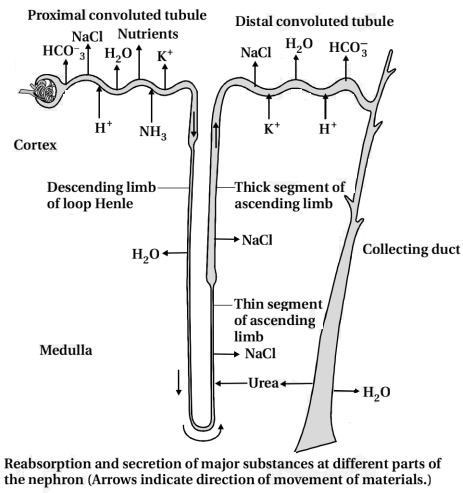
(N/A) The filtrate produced by the glomerulus is approximately similar to blood plasma. As it gradually passes through the uriniferous tubule,its composition changes,and urine is formed.
$(1)$ Proximal Convoluted Tubule $(PCT)$: $PCT$ is lined by simple cuboidal brush border epithelium,which increases the surface area for reabsorption.
Nearly $2/3$ of water and $NaCl$ are reabsorbed here.
$PCT$ also helps to maintain the $pH$ and ionic balance of the body fluids by selective secretion of $H^{+}$ ions,$NH_{3}$,and $K^{+}$ into the filtrate and absorption of buffer $HCO_{3}^{-}$.
The filtrate and blood plasma become isotonic.
$(2)$ Descending Limb of the Loop of Henle: Reabsorption in this part is minimal.
It plays a significant role in the maintenance of high osmolarity of medullary interstitial fluid. It is permeable to $H_{2}O$ but impermeable to electrolytes.
This concentrates the filtrate as it moves down.
The filtrate becomes hypertonic compared to blood plasma.
$(3)$ Ascending Limb of the Loop of Henle: It is impermeable to water but allows the transport of electrolytes actively or passively.
Therefore,as the concentrated filtrate passes upward,it gets diluted due to the passage of electrolytes.
$(4)$ Distal Convoluted Tubule $(DCT)$: Conditional reabsorption of $Na^{+}$ and $H_{2}O$ takes place here.
It is also capable of reabsorption of $HCO_{3}^{-}$ and selective secretion of $H^{+}$ and $K^{+}$ ions and $NH_{3}$ to maintain the $pH$ and $H^{+}-K^{+}$ balance in the blood.
$(5)$ Collecting Duct: This long duct extends from the cortex of the kidney to the inner parts of the medulla.
Large amounts of $H_{2}O$ are reabsorbed to produce concentrated urine.
It allows the passage of small amounts of urea into the medullary interstitium to maintain osmolarity,and the selective secretion of $H^{+}$ and $K^{+}$ ions maintains $pH$ and ionic balance.
$(1)$ Proximal Convoluted Tubule $(PCT)$: $PCT$ is lined by simple cuboidal brush border epithelium,which increases the surface area for reabsorption.
Nearly $2/3$ of water and $NaCl$ are reabsorbed here.
$PCT$ also helps to maintain the $pH$ and ionic balance of the body fluids by selective secretion of $H^{+}$ ions,$NH_{3}$,and $K^{+}$ into the filtrate and absorption of buffer $HCO_{3}^{-}$.
The filtrate and blood plasma become isotonic.
$(2)$ Descending Limb of the Loop of Henle: Reabsorption in this part is minimal.
It plays a significant role in the maintenance of high osmolarity of medullary interstitial fluid. It is permeable to $H_{2}O$ but impermeable to electrolytes.
This concentrates the filtrate as it moves down.
The filtrate becomes hypertonic compared to blood plasma.
$(3)$ Ascending Limb of the Loop of Henle: It is impermeable to water but allows the transport of electrolytes actively or passively.
Therefore,as the concentrated filtrate passes upward,it gets diluted due to the passage of electrolytes.
$(4)$ Distal Convoluted Tubule $(DCT)$: Conditional reabsorption of $Na^{+}$ and $H_{2}O$ takes place here.
It is also capable of reabsorption of $HCO_{3}^{-}$ and selective secretion of $H^{+}$ and $K^{+}$ ions and $NH_{3}$ to maintain the $pH$ and $H^{+}-K^{+}$ balance in the blood.
$(5)$ Collecting Duct: This long duct extends from the cortex of the kidney to the inner parts of the medulla.
Large amounts of $H_{2}O$ are reabsorbed to produce concentrated urine.
It allows the passage of small amounts of urea into the medullary interstitium to maintain osmolarity,and the selective secretion of $H^{+}$ and $K^{+}$ ions maintains $pH$ and ionic balance.
0 likes
View Solution75
Easy
Provide the full names for the following abbreviations:
$(1)$ $PCT$
$(2)$ $DCT$
$(1)$ $PCT$
$(2)$ $DCT$
Solution
(N/A) $(1)$ $PCT$ stands for Proximal Convoluted Tubule,which is the segment of the nephron between the Bowman's capsule and the loop of Henle.
$(2)$ $DCT$ stands for Distal Convoluted Tubule,which is the segment of the nephron between the loop of Henle and the collecting duct.
$(2)$ $DCT$ stands for Distal Convoluted Tubule,which is the segment of the nephron between the loop of Henle and the collecting duct.
0 likes
View Solution76
EasyMCQ
Where does the selective reabsorption of glomerular filtrate take place?
A
Proximal Convoluted Tubule $(PCT)$
B
Distal Convoluted Tubule $(DCT)$
C
Loop of Henle
D
Both $PCT$ and $DCT$
Solution
(D) The selective reabsorption of glomerular filtrate primarily occurs in the $PCT$ and $DCT$.
$\Rightarrow$ In the $PCT$ (Proximal Convoluted Tubule),nearly all essential nutrients and $70-80 \%$ of electrolytes and water are reabsorbed.
$\Rightarrow$ In the $DCT$ (Distal Convoluted Tubule),conditional reabsorption of $Na^{+}$ and water takes place to maintain the $pH$ and ionic balance of the blood.
$\Rightarrow$ In the $PCT$ (Proximal Convoluted Tubule),nearly all essential nutrients and $70-80 \%$ of electrolytes and water are reabsorbed.
$\Rightarrow$ In the $DCT$ (Distal Convoluted Tubule),conditional reabsorption of $Na^{+}$ and water takes place to maintain the $pH$ and ionic balance of the blood.
0 likes
View Solution77
Medium
Name two actively transported substances in glomerular filtrate.
Solution
(N/A) In the process of selective reabsorption within the nephron, certain substances are reabsorbed from the glomerular filtrate back into the blood via active transport. The two primary substances that undergo active transport are $Glucose$ and $Amino \text{ } acids$.
0 likes
View Solution78
MediumMCQ
Classify the following substances as actively or passively transported during the reabsorption of $GFR$: glucose,amino acids,nitrogenous wastes,$Na^+$,water.
A
Actively: glucose,amino acids,nitrogenous wastes; Passively: $Na^+$,water
B
Actively: $Na^+$,water; Passively: glucose,amino acids,nitrogenous wastes
C
Actively: glucose,$Na^+$; Passively: amino acids,nitrogenous wastes,water
D
Actively: amino acids,water; Passively: glucose,nitrogenous wastes,$Na^+$
Solution
(A) During the reabsorption of $GFR$ in the nephron,substances are transported back into the blood either actively or passively.
$1$. Actively transported substances: These require energy $(ATP)$ to move against their concentration gradient. Examples include glucose,amino acids,and nitrogenous wastes.
$2$. Passively transported substances: These move along their concentration gradient without the expenditure of energy. Examples include $Na^+$ (in certain segments) and water (via osmosis).
$1$. Actively transported substances: These require energy $(ATP)$ to move against their concentration gradient. Examples include glucose,amino acids,and nitrogenous wastes.
$2$. Passively transported substances: These move along their concentration gradient without the expenditure of energy. Examples include $Na^+$ (in certain segments) and water (via osmosis).
0 likes
View Solution79
Easy
Draw a labelled diagram showing reabsorption and secretion of major substances at different parts of the nephron.
Solution
(N/A) Reabsorption:
$A$ comparison of the volume of the filtrate formed per day $(180 \text{ litres per day})$ with that of the urine released $(1.5 \text{ litres})$,suggests that nearly $99\%$ of the filtrate is reabsorbed by the renal tubules. This process is called reabsorption.
This process takes place in the various parts of the uriniferous tubules. For example,substances like glucose,amino acids,and $Na^{+}$ in the filtrate are reabsorbed actively,whereas nitrogenous wastes are absorbed by passive transport in the $PCT$.
Filtrate flowing away from the $PCT$ gets concentrated in the loop of Henle. Urine is more concentrated if the length of the loop of Henle is greater.
Secretion:
This process occurs in the $DCT$ where tubular cells secrete substances like $H^{+}$,$K^{+}$,and ammonia into the filtrate. These substances are not filtered during glomerular filtration. Ammonia,uric acid,$H^{+}$ ions,and medicinal drugs like penicillin are secreted in this way.
Thus,urine is formed and transported to the collecting duct. Water is absorbed in the collecting duct,and highly concentrated urine is emptied into the renal pelvis.
$A$ comparison of the volume of the filtrate formed per day $(180 \text{ litres per day})$ with that of the urine released $(1.5 \text{ litres})$,suggests that nearly $99\%$ of the filtrate is reabsorbed by the renal tubules. This process is called reabsorption.
This process takes place in the various parts of the uriniferous tubules. For example,substances like glucose,amino acids,and $Na^{+}$ in the filtrate are reabsorbed actively,whereas nitrogenous wastes are absorbed by passive transport in the $PCT$.
Filtrate flowing away from the $PCT$ gets concentrated in the loop of Henle. Urine is more concentrated if the length of the loop of Henle is greater.
Secretion:
This process occurs in the $DCT$ where tubular cells secrete substances like $H^{+}$,$K^{+}$,and ammonia into the filtrate. These substances are not filtered during glomerular filtration. Ammonia,uric acid,$H^{+}$ ions,and medicinal drugs like penicillin are secreted in this way.
Thus,urine is formed and transported to the collecting duct. Water is absorbed in the collecting duct,and highly concentrated urine is emptied into the renal pelvis.
0 likes
View Solution80
MediumMCQ
How does tubular secretion help in maintaining ionic and acid-base balance in body fluids?
A
By removing excess $H^{+}$ and $K^{+}$ ions from the blood into the filtrate.
B
By reabsorbing water from the filtrate.
C
By filtering large proteins into the urine.
D
By increasing the glomerular filtration rate.
Solution
(A) Tubular secretion is a vital process that occurs primarily in the Distal Convoluted Tubule $(DCT)$ and the collecting duct.
During this process,tubular cells actively secrete substances such as $H^{+}$,$K^{+}$,and ammonia $(NH_{3})$ from the peritubular capillaries into the filtrate.
This mechanism helps in maintaining the ionic balance by regulating the concentration of potassium ions $(K^{+})$ and the acid-base balance by removing excess hydrogen ions $(H^{+})$ from the body fluids.
Additionally,it facilitates the excretion of metabolic wastes like uric acid and certain drugs (e.g.,penicillin) that were not filtered during the initial glomerular filtration process.
During this process,tubular cells actively secrete substances such as $H^{+}$,$K^{+}$,and ammonia $(NH_{3})$ from the peritubular capillaries into the filtrate.
This mechanism helps in maintaining the ionic balance by regulating the concentration of potassium ions $(K^{+})$ and the acid-base balance by removing excess hydrogen ions $(H^{+})$ from the body fluids.
Additionally,it facilitates the excretion of metabolic wastes like uric acid and certain drugs (e.g.,penicillin) that were not filtered during the initial glomerular filtration process.
0 likes
View Solution81
EasyMCQ
Cuboidal epithelium with brush border of microvilli is found in:
A
Eustachian tube
B
Lining of intestine
C
Ducts of salivary glands
D
Proximal convoluted tubule of nephron
Solution
(D) The proximal convoluted tubule $(PCT)$ of the nephron is lined by simple cuboidal epithelium. This epithelium possesses a prominent brush border of microvilli,which significantly increases the surface area for the reabsorption of water,electrolytes,and nutrients from the filtrate.
0 likes
View Solution82
MediumMCQ
In which part of the nephron is reabsorption minimum from the filtrate?
A
Henle's loop
B
Proximal convoluted tubule
C
Distal convoluted tubule
D
Collecting duct
Solution
(A) The $Proximal \text{ Convoluted Tubule } (PCT)$ is responsible for the reabsorption of $70-80\%$ of electrolytes and water.
The $Henle's \text{ loop}$ plays a significant role in the maintenance of high osmolarity of medullary interstitial fluid.
The $Distal \text{ Convoluted Tubule } (DCT)$ is a site for conditional reabsorption of $Na^+$ and water.
The $Ascending \text{ limb of Henle's loop}$ is impermeable to water and allows only the transport of electrolytes, making it the region where reabsorption is minimal compared to other segments of the nephron.
The $Henle's \text{ loop}$ plays a significant role in the maintenance of high osmolarity of medullary interstitial fluid.
The $Distal \text{ Convoluted Tubule } (DCT)$ is a site for conditional reabsorption of $Na^+$ and water.
The $Ascending \text{ limb of Henle's loop}$ is impermeable to water and allows only the transport of electrolytes, making it the region where reabsorption is minimal compared to other segments of the nephron.
0 likes
View Solution83
MediumMCQ
$A$ large quantity of fluid is filtered every day by the nephrons in the kidneys. Only about $1\%$ of it is excreted as urine. The remaining $99\%$ of the filtrate
A
Gets collected in the renal pelvis
B
Is lost as sweat
C
Is stored in the urinary bladder
D
Is reabsorbed into the blood
Solution
(D) The kidneys filter approximately $180 \text{ liters}$ of blood plasma per day,which results in the formation of about $180 \text{ liters}$ of glomerular filtrate.
Out of this,only about $1.5 \text{ liters}$ (approximately $1\%$) is excreted as urine.
The remaining $99\%$ of the filtrate is reabsorbed by the renal tubules back into the peritubular capillaries and the vasa recta,returning essential substances like water,glucose,and ions to the blood circulation.
Therefore,the correct option is $D$.
Out of this,only about $1.5 \text{ liters}$ (approximately $1\%$) is excreted as urine.
The remaining $99\%$ of the filtrate is reabsorbed by the renal tubules back into the peritubular capillaries and the vasa recta,returning essential substances like water,glucose,and ions to the blood circulation.
Therefore,the correct option is $D$.
0 likes
View Solution84
MediumMCQ
Glucose is mainly absorbed in
A
$PCT$
B
$DCT$
C
Henle's loop
D
Nephron
Solution
(A) Proximal convoluted tubule $(PCT)$ is involved in the complete reabsorption of glucose by active transport.
It also facilitates the reabsorption of most amino acids,vitamin-$C$,$Na^{+}$ $(70\%)$,$K^{+}$ $(75\%)$,and a large amount of $Ca^{2+}$ from the glomerular filtrate.
It also facilitates the reabsorption of most amino acids,vitamin-$C$,$Na^{+}$ $(70\%)$,$K^{+}$ $(75\%)$,and a large amount of $Ca^{2+}$ from the glomerular filtrate.
0 likes
View Solution85
MediumMCQ
How much percentage of the filtrate is reabsorbed in the renal tubules (in $, \%$)?
A
$5$
B
$25$
C
$90$
D
$99$
Solution
(D) comparison of the volume of the filtrate formed per day ($180\, \text{litres}$ per day) with that of the urine released $(1.5\, \text{litres})$,suggests that nearly $99\, \%$ of this filtrate has to be reabsorbed by the renal tubules. This process is called reabsorption.
0 likes
View Solution86
MediumMCQ
Transport of electrolytes through the loop of Henle takes place by:
A
Actively
B
Passively
C
Both $(a)$ and $(b)$
D
Diffusion
Solution
(C) The transport of electrolytes in the loop of Henle occurs through both active and passive mechanisms.
In the ascending limb of the loop of Henle,sodium $(Na^+)$ and chloride $(Cl^-)$ ions are transported actively into the medullary interstitium.
In the descending limb,the transport of electrolytes is primarily passive,facilitating the concentration of the filtrate.
In the ascending limb of the loop of Henle,sodium $(Na^+)$ and chloride $(Cl^-)$ ions are transported actively into the medullary interstitium.
In the descending limb,the transport of electrolytes is primarily passive,facilitating the concentration of the filtrate.
0 likes
View Solution87
EasyMCQ
Reabsorption of glucose occurs in ..... of the nephron.
A
Loop of Henle
B
$PCT$
C
$DCT$
D
Collecting duct
Solution
(B) The reabsorption of glucose,amino acids,and some urea occurs in the proximal convoluted tubule $(PCT)$.
Approximately $70-80\%$ of electrolytes and water are also reabsorbed in this region.
Approximately $70-80\%$ of electrolytes and water are also reabsorbed in this region.
0 likes
View Solution88
MediumMCQ
Glucose,$Na^+$,and amino acids are actively transported substances,because
A
Their movement occurs according to concentration gradient
B
Their movement occurs against concentration gradient
C
$ATP$ is not needed for transportation
D
They are transported by simple diffusion
Solution
(B) Active transport is the process of moving molecules across a cellular membrane through the use of cellular energy.
These substances are transported against their concentration gradient,which requires energy in the form of $ATP$.
$ATP$ is produced by mitochondria and provides the necessary energy to move these ions and molecules across the cell membrane against the gradient.
These substances are transported against their concentration gradient,which requires energy in the form of $ATP$.
$ATP$ is produced by mitochondria and provides the necessary energy to move these ions and molecules across the cell membrane against the gradient.
0 likes
View Solution89
MediumMCQ
The main function of the $DCT$ of the nephron is to maintain the:
A
$pH$ of the blood
B
$Na-K$ balance of the blood
C
Both $(a)$ and $(b)$
D
Temperature of the blood
Solution
(C) The Distal Convoluted Tubule $(DCT)$ plays a crucial role in the regulation of blood composition.
It performs conditional reabsorption of $Na^+$ and water,and is responsible for the selective secretion of hydrogen ions $(H^+)$,ammonia $(NH_3)$,and potassium ions $(K^+)$ into the filtrate.
By regulating the secretion of $H^+$ and the reabsorption of $HCO_3^-$,the $DCT$ maintains the $pH$ of the blood.
Additionally,the regulation of $Na^+$ and $K^+$ levels ensures the electrolyte balance of the blood.
Therefore,both $pH$ and $Na-K$ balance are maintained by the $DCT$.
It performs conditional reabsorption of $Na^+$ and water,and is responsible for the selective secretion of hydrogen ions $(H^+)$,ammonia $(NH_3)$,and potassium ions $(K^+)$ into the filtrate.
By regulating the secretion of $H^+$ and the reabsorption of $HCO_3^-$,the $DCT$ maintains the $pH$ of the blood.
Additionally,the regulation of $Na^+$ and $K^+$ levels ensures the electrolyte balance of the blood.
Therefore,both $pH$ and $Na-K$ balance are maintained by the $DCT$.
0 likes
View Solution90
MediumMCQ
During urine formation,which of the following processes creates high osmotic pressure in the uriniferous tubule?
A
Active $Na^{+}$ absorption,followed by absorption of $Cl^{-}$
B
Active $Cl^{-}$ absorption,followed by absorption of $Na^{+}$
C
Active secretion of $Na^{+}$ into efferent arteriole followed by absorption of $Cl^{-}$ into efferent renal arteriole
D
Active secretion of $Cl^{-}$ and absorption of $Na^{+}$ into efferent renal arteriole
Solution
(A) Osmotic pressure is a measure of the tendency to take in water by osmosis.
During urine formation,approximately two-thirds of the $NaCl$ and water filtered into Bowman's capsule is immediately reabsorbed across the walls of the proximal convoluted tubule $(PCT)$.
This reabsorption is driven by the active transport of $Na^{+}$ out of the filtrate and into the surrounding peritubular capillaries.
$Cl^{-}$ follows $Na^{+}$ passively due to electrical attraction,and water follows them both due to osmosis,which helps in maintaining the osmotic balance.
During urine formation,approximately two-thirds of the $NaCl$ and water filtered into Bowman's capsule is immediately reabsorbed across the walls of the proximal convoluted tubule $(PCT)$.
This reabsorption is driven by the active transport of $Na^{+}$ out of the filtrate and into the surrounding peritubular capillaries.
$Cl^{-}$ follows $Na^{+}$ passively due to electrical attraction,and water follows them both due to osmosis,which helps in maintaining the osmotic balance.
0 likes
View Solution91
MediumMCQ
Which one of the following is mismatched?
A
Bowman's capsule - Glomerular filtration
B
$PCT$ - Absorption of $Na^+$ and $K^+$
C
$DCT$ - Absorption of glucose
D
None of the above
Solution
(C) The process of urine formation involves three main steps: glomerular filtration,selective reabsorption,and tubular secretion.
$1$. Bowman's capsule is the site of glomerular filtration.
$2$. The $PCT$ (Proximal Convoluted Tubule) is the primary site for the reabsorption of electrolytes like $Na^+$ and $K^+$,as well as nutrients like glucose and amino acids.
$3$. The $DCT$ (Distal Convoluted Tubule) is primarily involved in the conditional reabsorption of $Na^+$ and water,and the secretion of $H^+$ and $K^+$. It does not reabsorb glucose.
Therefore,the pairing of $DCT$ with the absorption of glucose is incorrect.
$1$. Bowman's capsule is the site of glomerular filtration.
$2$. The $PCT$ (Proximal Convoluted Tubule) is the primary site for the reabsorption of electrolytes like $Na^+$ and $K^+$,as well as nutrients like glucose and amino acids.
$3$. The $DCT$ (Distal Convoluted Tubule) is primarily involved in the conditional reabsorption of $Na^+$ and water,and the secretion of $H^+$ and $K^+$. It does not reabsorb glucose.
Therefore,the pairing of $DCT$ with the absorption of glucose is incorrect.
0 likes
View Solution92
MediumMCQ
$PCT$ helps in the maintenance of $pH$ in the body fluid by
A
Selective secretion of $H^+$ ions
B
Selective secretion of ammonia
C
Selective secretion of $K^+$ ions
D
All of the above
Solution
(D) Nearly all of the essential nutrients and $70-80$ percent of electrolytes and water are reabsorbed by the $PCT$ segment.
$PCT$ also helps to maintain the $pH$ and ionic balance of the body fluids by the selective secretion of hydrogen ions $(H^+)$ and potassium ions $(K^+)$ into the filtrate and by the absorption of bicarbonate ions $(HCO_3^-)$ from it.
$PCT$ also helps to maintain the $pH$ and ionic balance of the body fluids by the selective secretion of hydrogen ions $(H^+)$ and potassium ions $(K^+)$ into the filtrate and by the absorption of bicarbonate ions $(HCO_3^-)$ from it.
0 likes
View Solution93
MediumMCQ
$I.$ Glucose $II.$ Amino acid $III.$ $Na^+$ $IV.$ Nitrogenous waste
Which of these are reabsorbed actively in the nephron?
Choose the correct option.
Which of these are reabsorbed actively in the nephron?
Choose the correct option.
A
$I$ and $II$
B
$I, II$ and $III$
C
$I$ and $III$
D
Only $I$
Solution
(B) In the nephron,substances like glucose,amino acids,and $Na^+$ are reabsorbed from the filtrate into the blood by active transport.
Active transport requires energy in the form of $ATP$ to move substances against their concentration gradient.
Nitrogenous wastes are generally reabsorbed by passive transport or are not reabsorbed at all,being excreted in the urine.
Therefore,$I, II,$ and $III$ are reabsorbed actively.
Active transport requires energy in the form of $ATP$ to move substances against their concentration gradient.
Nitrogenous wastes are generally reabsorbed by passive transport or are not reabsorbed at all,being excreted in the urine.
Therefore,$I, II,$ and $III$ are reabsorbed actively.
0 likes
View Solution94
MediumMCQ
Choose the mismatched part of the nephron with its function.
A
Bowman's capsule $-$ Glomerular filtration
B
$PCT$ $-$ Absorption of $Na^{+}$ and $K^{+}$
C
$DCT$ $-$ Absorption of glucose
D
Loop of Henle $-$ Urine concentration
Solution
(C) The correct answer is $C$.
$DCT$ (Distal Convoluted Tubule) is primarily involved in the conditional reabsorption of $Na^{+}$ and water,as well as the secretion of $H^{+}$,$K^{+}$,and $NH_{3}$ to maintain $pH$ and ionic balance.
Glucose is almost entirely reabsorbed in the $PCT$ (Proximal Convoluted Tubule),not the $DCT$.
Therefore,the statement '$DCT$ $-$ Absorption of glucose' is mismatched.
$DCT$ (Distal Convoluted Tubule) is primarily involved in the conditional reabsorption of $Na^{+}$ and water,as well as the secretion of $H^{+}$,$K^{+}$,and $NH_{3}$ to maintain $pH$ and ionic balance.
Glucose is almost entirely reabsorbed in the $PCT$ (Proximal Convoluted Tubule),not the $DCT$.
Therefore,the statement '$DCT$ $-$ Absorption of glucose' is mismatched.
0 likes
View Solution95
MediumMCQ
$I.$ Reabsorption of water occurs passively in the initial segment of nephron.
$II.$ Nitrogenous wastes are absorbed by active transport.
$III.$ Conditional reabsorption of $Na^{+}$ and water takes place in $DCT$.
$IV.$ $DCT$ reabsorbs glucose.
$V.$ $DCT$ is capable of selective secretion of $H^{+}$,$K^{+}$ and $NH_{3}$ to maintain $pH$ and $Na^{+}-K^{+}$ balance in blood.
$VI.$ Substances like glucose,amino acids,$Na^{+}$,etc.,in the filtrate are reabsorbed actively.
Choose the option with incorrect statements.
$II.$ Nitrogenous wastes are absorbed by active transport.
$III.$ Conditional reabsorption of $Na^{+}$ and water takes place in $DCT$.
$IV.$ $DCT$ reabsorbs glucose.
$V.$ $DCT$ is capable of selective secretion of $H^{+}$,$K^{+}$ and $NH_{3}$ to maintain $pH$ and $Na^{+}-K^{+}$ balance in blood.
$VI.$ Substances like glucose,amino acids,$Na^{+}$,etc.,in the filtrate are reabsorbed actively.
Choose the option with incorrect statements.
A
$I$ and $II$
B
$III$ and $IV$
C
$V$ and $VI$
D
$II$ and $IV$
Solution
(D) $I.$ Correct: Water is reabsorbed passively in the proximal convoluted tubule $(PCT)$.
$II.$ Incorrect: Nitrogenous wastes are absorbed by passive transport,not active transport.
$III.$ Correct: $DCT$ performs conditional reabsorption of $Na^{+}$ and water.
$IV.$ Incorrect: $DCT$ does not reabsorb glucose; glucose is reabsorbed in the $PCT$.
$V.$ Correct: $DCT$ secretes $H^{+}$,$K^{+}$,and $NH_{3}$ to maintain ionic and acid-base balance.
$VI.$ Correct: Glucose,amino acids,and $Na^{+}$ are reabsorbed actively in the $PCT$.
Therefore,statements $II$ and $IV$ are incorrect.
$II.$ Incorrect: Nitrogenous wastes are absorbed by passive transport,not active transport.
$III.$ Correct: $DCT$ performs conditional reabsorption of $Na^{+}$ and water.
$IV.$ Incorrect: $DCT$ does not reabsorb glucose; glucose is reabsorbed in the $PCT$.
$V.$ Correct: $DCT$ secretes $H^{+}$,$K^{+}$,and $NH_{3}$ to maintain ionic and acid-base balance.
$VI.$ Correct: Glucose,amino acids,and $Na^{+}$ are reabsorbed actively in the $PCT$.
Therefore,statements $II$ and $IV$ are incorrect.
0 likes
View Solution96
MediumMCQ
Out of the following:
$I.$ $PCT$
$II.$ $DCT$
$III.$ Loop of Henle
$IV.$ Collecting duct
Which contributes most in maintaining the $pH$ of blood?
$I.$ $PCT$
$II.$ $DCT$
$III.$ Loop of Henle
$IV.$ Collecting duct
Which contributes most in maintaining the $pH$ of blood?
A
$I$ and $II$
B
$II$ and $III$
C
$III$ and $IV$
D
$I$ and $IV$
Solution
(A) $PCT$ (Proximal Convoluted Tubule) helps to maintain the $pH$ and ionic balance of the body fluids by the selective secretion of hydrogen ions $(H^+)$,ammonia $(NH_3)$,and potassium ions $(K^+)$ into the filtrate and by the reabsorption of bicarbonate ions $(HCO_3^-)$ from it.
$DCT$ (Distal Convoluted Tubule) is also capable of reabsorption of bicarbonate ions $(HCO_3^-)$ and the selective secretion of hydrogen ions $(H^+)$,potassium ions $(K^+)$,and ammonia $(NH_3)$ to maintain the $pH$ and sodium-potassium balance in the blood.
Therefore,both $PCT$ and $DCT$ play a significant role in maintaining the $pH$ of the blood.
$DCT$ (Distal Convoluted Tubule) is also capable of reabsorption of bicarbonate ions $(HCO_3^-)$ and the selective secretion of hydrogen ions $(H^+)$,potassium ions $(K^+)$,and ammonia $(NH_3)$ to maintain the $pH$ and sodium-potassium balance in the blood.
Therefore,both $PCT$ and $DCT$ play a significant role in maintaining the $pH$ of the blood.
0 likes
View Solution97
EasyMCQ
Nearly all of the essential nutrients,and $70-80\%$ of electrolytes and water are reabsorbed in the
A
$PCT$
B
$Henle's \; loop$
C
$DCT$
D
$Collecting \; duct$
Solution
(A) $PCT$ (Proximal Convoluted Tubule) is the site where nearly all essential nutrients (like glucose,amino acids) and $70-80\%$ of electrolytes and water are reabsorbed. This process is known as obligatory reabsorption.
0 likes
View Solution98
EasyMCQ
Loop of Henle is found in
A
Green gland
B
Malpighian tubule
C
Neuron
D
Nephron
Solution
(D) The Loop of Henle is a $U$-shaped portion of the tubule that conducts urine within each nephron of the kidney of reptiles,birds,and mammals. It is primarily responsible for the concentration of urine.
0 likes
View Solution99
MediumMCQ
Glucose and amino acids in the filtrate are reabsorbed by tubular epithelial cells through
A
Active transport
B
Passive transport
C
Both $(a)$ and $(b)$
D
Osmosis
Solution
(A) In the nephron,the reabsorption of essential substances like glucose and amino acids occurs primarily in the proximal convoluted tubule $(PCT)$.
These substances are reabsorbed from the filtrate into the blood by the tubular epithelial cells using active transport,which requires energy in the form of $ATP$ to move molecules against their concentration gradient.
These substances are reabsorbed from the filtrate into the blood by the tubular epithelial cells using active transport,which requires energy in the form of $ATP$ to move molecules against their concentration gradient.
0 likes
View Solution100
MediumMCQ
Hormone responsible for the absorption of water in $DCT$ is
A
$ADH$
B
$ACTH$
C
$Oxytocin$
D
$Insulin$
Solution
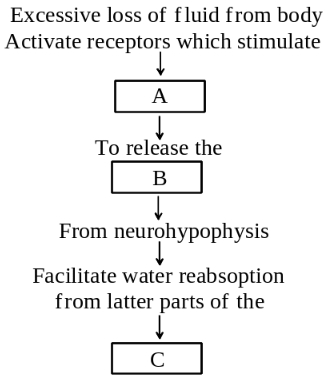
(A) $ADH$ (Antidiuretic Hormone),also known as vasopressin,is secreted by the neurosecretory cells of the hypothalamus and released from the posterior pituitary gland.
It acts on the distal convoluted tubule $(DCT)$ and collecting duct of the nephron to facilitate the reabsorption of water,thereby reducing urine volume and preventing dehydration.
It acts on the distal convoluted tubule $(DCT)$ and collecting duct of the nephron to facilitate the reabsorption of water,thereby reducing urine volume and preventing dehydration.
0 likes
View SolutionExcretory Products and their Elimination — Function of the Tubules · Frequently Asked Questions
1Are these Excretory Products and their Elimination questions useful for JEE and NEET?
Yes. All questions in this section are mapped to JEE Main and NEET exam patterns. Previous year questions from JEE Main, NEET, GUJCET and state-level exams are included with full solutions.
2Can I switch to Hindi or Gujarati for these questions?
Yes. Use the language tabs in the hero section or the sidebar to view the same questions and solutions in English, Hindi or Gujarati.
3How do I generate a question paper from this subtopic?
Use the Vedclass Exam Paper Generator — select the chapter and subtopic, set difficulty, and generate Sets A, B, C, D automatically. First 3 chapters of every subject are free.
Vedclass Products
For Students
Vedclass Test Series
Mock tests in real JEE/NEET style with performance analysis. 5-day free trial.
Start Free TrialFor Teachers
Exam Paper Generator
Generate Set A/B/C/D papers from this chapter in 2 minutes. 3 chapters free.
Try FreeFor Institutes
Online Exam Module
Live online exams with unlimited students, 360° analytics & white-label branding.
See DemoFor Teachers & Institutes
Generate a Excretory Products and their Elimination Exam Paper in 2 Minutes
Select subtopic & difficulty — Sets A, B, C, D auto-generated with No Repeat logic.
First 3 chapters of every subject are free — no payment required.