
A English
Function of the Tubules Questions in English
Class 11 Biology · Excretory Products and their Elimination · Function of the Tubules
133+
Questions
English
Language
100%
With Solutions
Showing 33 of 133 questions in English
101
MediumMCQ
Maximum water reabsorption occurs in
A
$DCT$
B
$PCT$
C
$Collecting \; duct$
D
Descending limb of loop of Henle
Solution
(B) $70-80\;\%$ of electrolytes,all of the essential nutrients,and most of the water are reabsorbed in the proximal convoluted tubule $(PCT)$.
This process is known as obligatory water reabsorption.
This process is known as obligatory water reabsorption.
0 likes
View Solution102
MediumMCQ
In which segment of the nephron,reabsorption is minimum?
A
Proximal convoluted tubule $(PCT)$
B
Distal convoluted tubule $(DCT)$
C
Loop of Henle
D
Both $(a)$ and $(b)$
Solution
(C) Reabsorption is maximum in the $PCT$ (Proximal Convoluted Tubule) because it is lined with simple cuboidal brush border epithelium which increases the surface area for reabsorption.
In contrast,reabsorption is minimum in the ascending limb of the loop of Henle,as it is largely impermeable to water and only allows for the active transport of electrolytes.
In contrast,reabsorption is minimum in the ascending limb of the loop of Henle,as it is largely impermeable to water and only allows for the active transport of electrolytes.
0 likes
View Solution103
MediumMCQ
$A :$ Tubular secretion is of considerable importance in marine teleost fishes.
$R :$ These have aglomerular kidney,$i.e.$,no filtration occurs and tubular secretion is the only way of excretion.
$R :$ These have aglomerular kidney,$i.e.$,no filtration occurs and tubular secretion is the only way of excretion.
A
Assertion and Reason both are correct and Reason is the correct explanation of Assertion.
B
Assertion and Reason both are correct but Reason is not the correct explanation of Assertion.
C
Assertion is correct,but Reason is incorrect.
D
Both Assertion and Reason are incorrect.
Solution
(A) In marine teleost fishes,the kidneys are aglomerular,meaning they lack glomeruli and thus do not perform ultrafiltration.
Because filtration does not occur,these organisms rely entirely on tubular secretion to remove metabolic wastes and regulate ionic balance.
Therefore,tubular secretion is of critical importance for their survival and excretion.
Both the Assertion and the Reason are correct,and the Reason provides the correct explanation for the Assertion.
Because filtration does not occur,these organisms rely entirely on tubular secretion to remove metabolic wastes and regulate ionic balance.
Therefore,tubular secretion is of critical importance for their survival and excretion.
Both the Assertion and the Reason are correct,and the Reason provides the correct explanation for the Assertion.
0 likes
View Solution104
EasyMCQ
What is the duct of Bellini?
A
$A$ part of the loop of Henle
B
$A$ large collecting duct formed by the convergence of many collecting ducts
C
$A$ segment of the proximal convoluted tubule
D
$A$ structure found in the renal corpuscle
Solution
(B) The distal convoluted tubules $(DCTs)$ of many nephrons open into a straight tube called the collecting duct.
Many collecting ducts converge and open into a larger duct known as the duct of Bellini (or papillary duct).
These ducts extend through the renal medulla and open into the renal pelvis at the renal papillae.
Many collecting ducts converge and open into a larger duct known as the duct of Bellini (or papillary duct).
These ducts extend through the renal medulla and open into the renal pelvis at the renal papillae.
0 likes
View Solution105
EasyMCQ
Which substances are reabsorbed in $PCT$?
A
Glucose and amino acids
B
Water and $Na^{+}$
C
All of the above
D
None of the above
Solution
(C) The $PCT$ (Proximal Convoluted Tubule) is responsible for the reabsorption of approximately $70-80\%$ of electrolytes and water, and $100\%$ of glucose and amino acids from the filtrate. Therefore, substances like glucose, amino acids, $Na^{+}$, and water are all reabsorbed in the $PCT$.
0 likes
View Solution106
EasyMCQ
Which substances are secreted in the $DCT$?
A
Ammonia,$H^{+}$ ions,and $K^{+}$ ions.
B
Glucose,amino acids,and water.
C
Urea,uric acid,and sodium ions.
D
Creatinine,$H^{+}$ ions,and $K^{+}$ ions.
Solution
(A) The Distal Convoluted Tubule $(DCT)$ is responsible for the tubular secretion of specific substances to maintain the ionic and acid-base balance of body fluids.
Specifically,the $DCT$ secretes $H^{+}$ ions,$K^{+}$ ions,and ammonia into the filtrate.
It also helps in the reabsorption of $HCO_3^{-}$ ions.
Therefore,the correct substances secreted in the $DCT$ are $H^{+}$ ions,$K^{+}$ ions,and ammonia.
Specifically,the $DCT$ secretes $H^{+}$ ions,$K^{+}$ ions,and ammonia into the filtrate.
It also helps in the reabsorption of $HCO_3^{-}$ ions.
Therefore,the correct substances secreted in the $DCT$ are $H^{+}$ ions,$K^{+}$ ions,and ammonia.
0 likes
View Solution107
Medium
Explain the function of collecting tubules.
Solution
(N/A) The collecting tubule plays a crucial role in the concentration of urine and the maintenance of homeostasis.
$1$. It allows for the reabsorption of large amounts of $H_{2}O$ to produce concentrated urine.
$2$. It allows the passage of small amounts of urea into the medullary interstitium to maintain the osmolarity of the medullary interstitium.
$3$. It helps in maintaining the $pH$ and ionic balance of the blood by the selective secretion of $H^{+}$ and $K^{+}$ ions.
$1$. It allows for the reabsorption of large amounts of $H_{2}O$ to produce concentrated urine.
$2$. It allows the passage of small amounts of urea into the medullary interstitium to maintain the osmolarity of the medullary interstitium.
$3$. It helps in maintaining the $pH$ and ionic balance of the blood by the selective secretion of $H^{+}$ and $K^{+}$ ions.
0 likes
View Solution108
MediumMCQ
The efferent arteriole emerging from the glomerulus forms a fine capillary network around the renal tubule, which is called .......
A
Vasa recta
B
Peritubular capillaries
C
Loop of Henle
D
Glomerulus
Solution
(B) The efferent arteriole emerging from the glomerulus forms a fine capillary network around the renal tubule known as the $Peritubular \text{ } capillaries$.
In the case of juxtamedullary nephrons, a minute vessel of this network runs parallel to the $Loop \text{ } of \text{ } Henle$ forming a '$U$' shaped structure called the $Vasa \text{ } recta$.
However, the general network surrounding the renal tubule is termed as $Peritubular \text{ } capillaries$.
In the case of juxtamedullary nephrons, a minute vessel of this network runs parallel to the $Loop \text{ } of \text{ } Henle$ forming a '$U$' shaped structure called the $Vasa \text{ } recta$.
However, the general network surrounding the renal tubule is termed as $Peritubular \text{ } capillaries$.
0 likes
View Solution109
MediumMCQ
The capillary network running parallel to the $Henle's$ loop is called the ......
A
Vasa recta
B
Peritubular capillary
C
Efferent arteriole
D
Afferent arteriole
Solution
(A) The $Henle's$ loop is a $U$-shaped portion of the nephron tubule.
In juxtamedullary nephrons,the efferent arteriole emerging from the glomerulus forms a fine capillary network around the renal tubule called the peritubular capillaries.
$A$ minute vessel of this network runs parallel to the $Henle's$ loop,forming a '$U$' shape,which is known as the $Vasa$ $recta$.
This structure plays a significant role in the concentration of urine.
In juxtamedullary nephrons,the efferent arteriole emerging from the glomerulus forms a fine capillary network around the renal tubule called the peritubular capillaries.
$A$ minute vessel of this network runs parallel to the $Henle's$ loop,forming a '$U$' shape,which is known as the $Vasa$ $recta$.
This structure plays a significant role in the concentration of urine.
0 likes
View Solution110
MediumMCQ
Select the incorrect option for the $Vasa$ $recta$.
A
It is a branch of the efferent arteriole.
B
It is a part of the renal tubule.
C
It is a capillary network running parallel to the $Henle's$ loop in most nephrons.
D
All of the above.
Solution
(B) The $Vasa$ $recta$ is a fine capillary network that runs parallel to the $Henle's$ loop in juxtamedullary nephrons.
It originates from the efferent arteriole.
It is a blood vessel,not a part of the renal tubule (which consists of $PCT$,$Henle's$ loop,$DCT$,and collecting duct).
Therefore,the statement that it is a part of the renal tubule is incorrect.
It originates from the efferent arteriole.
It is a blood vessel,not a part of the renal tubule (which consists of $PCT$,$Henle's$ loop,$DCT$,and collecting duct).
Therefore,the statement that it is a part of the renal tubule is incorrect.
0 likes
View Solution111
MediumMCQ
The distal convoluted tubule $(DCT)$ opens into the .......
A
Loop of Henle
B
Collecting duct
C
Proximal convoluted tubule
D
Vasa recta
Solution
(B) The nephron consists of a renal corpuscle and a renal tubule. The renal tubule begins with the Bowman's capsule,followed by the proximal convoluted tubule $(PCT)$,the loop of Henle,and the distal convoluted tubule $(DCT)$. The $DCT$ of many nephrons opens into a straight tube called the collecting duct. Therefore,the correct option is $B$.
0 likes
View Solution112
MediumMCQ
What percentage of the filtrate formed per day is reabsorbed by the renal tubules?
A
$25$
B
$15$
C
$90$
D
$99$
Solution
(D) The kidneys filter approximately $180 \ L$ of blood plasma per day,which is known as the Glomerular Filtration Rate $(GFR)$.
Out of this $180 \ L$ of filtrate,only about $1.5 \ L$ is excreted as urine.
This means that approximately $99\%$ of the filtrate is reabsorbed by the renal tubules back into the blood.
Therefore,the correct option is $D$.
Out of this $180 \ L$ of filtrate,only about $1.5 \ L$ is excreted as urine.
This means that approximately $99\%$ of the filtrate is reabsorbed by the renal tubules back into the blood.
Therefore,the correct option is $D$.
0 likes
View Solution113
MediumMCQ
Components reabsorbed by passive transport - $P$
Components reabsorbed by active transport - $Q$
$I - Na^+$,$II$ - Glucose,$III$ - Nitrogenous wastes,$IV$ - Amino acids,$V$ - Water
Select the correct option for $P$ and $Q$.
$P \quad \quad Q$
Components reabsorbed by active transport - $Q$
$I - Na^+$,$II$ - Glucose,$III$ - Nitrogenous wastes,$IV$ - Amino acids,$V$ - Water
Select the correct option for $P$ and $Q$.
$P \quad \quad Q$
A
$III, V \quad \quad I, II, IV$
B
$I, II, IV \quad \quad III, V$
C
$I, II, III \quad \quad IV, V$
D
$IV, V \quad \quad I, II, III$
Solution
(A) In the renal tubules,reabsorption occurs through both active and passive transport.
$1$. Active transport: Substances like $Na^+$,glucose $(II)$,and amino acids $(IV)$ are reabsorbed actively from the filtrate into the blood.
$2$. Passive transport: Substances like nitrogenous wastes $(III)$ and water $(V)$ are reabsorbed passively along the concentration gradient.
Therefore,$P$ (passive transport) includes $III$ and $V$,while $Q$ (active transport) includes $I$,$II$,and $IV$.
Correct option is $A$.
$1$. Active transport: Substances like $Na^+$,glucose $(II)$,and amino acids $(IV)$ are reabsorbed actively from the filtrate into the blood.
$2$. Passive transport: Substances like nitrogenous wastes $(III)$ and water $(V)$ are reabsorbed passively along the concentration gradient.
Therefore,$P$ (passive transport) includes $III$ and $V$,while $Q$ (active transport) includes $I$,$II$,and $IV$.
Correct option is $A$.
0 likes
View Solution114
EasyMCQ
The lining of the proximal convoluted tubule $(PCT)$ is made up of $.......$.
A
Squamous epithelium
B
Cuboidal epithelium
C
Columnar epithelium
D
Compound epithelium
Solution
(B) The proximal convoluted tubule $(PCT)$ is a part of the nephron in the kidney.
It is lined by simple cuboidal brush border epithelium.
This type of epithelium increases the surface area for the reabsorption of water,electrolytes,and nutrients from the filtrate.
Therefore,the correct option is $B$.
It is lined by simple cuboidal brush border epithelium.
This type of epithelium increases the surface area for the reabsorption of water,electrolytes,and nutrients from the filtrate.
Therefore,the correct option is $B$.
0 likes
View Solution115
EasyMCQ
In which part of the nephron does the maximum reabsorption occur?
A
Proximal Convoluted Tubule $(PCT)$
B
Descending limb of Loop of Henle
C
Ascending limb of Loop of Henle
D
Bowman's capsule
Solution
(A) The Proximal Convoluted Tubule $(PCT)$ is the primary site of reabsorption in the nephron.
It reabsorbs approximately $70-80\%$ of electrolytes and water,and $100\%$ of glucose and amino acids from the filtrate.
This high capacity for reabsorption is due to the presence of simple cuboidal brush border epithelium,which increases the surface area for absorption.
It reabsorbs approximately $70-80\%$ of electrolytes and water,and $100\%$ of glucose and amino acids from the filtrate.
This high capacity for reabsorption is due to the presence of simple cuboidal brush border epithelium,which increases the surface area for absorption.
0 likes
View Solution116
MediumMCQ
The following figure shows the reabsorption and secretion of major substances in different parts of the nephron. What do $P$,$Q$,and $R$ represent?
$P \quad\quad Q \quad\quad R$
$P \quad\quad Q \quad\quad R$
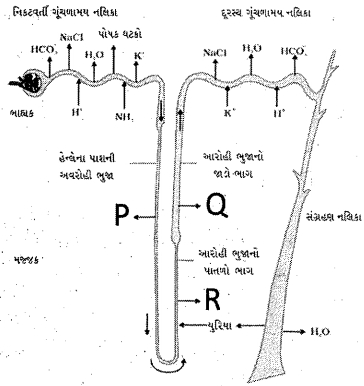
A
$H_2O \quad NaCl \quad NaCl$
B
$NaCl \quad H_2O \quad NaCl$
C
$H_2O \quad NaCl \quad H^+$
D
$NaCl \quad H_2O \quad \text{Urea}$
Solution
(A) In the nephron,the descending limb of the Loop of Henle is permeable to water but nearly impermeable to electrolytes. Therefore,water is reabsorbed from the filtrate into the medullary interstitium,which is represented by $P = H_2O$.
The ascending limb of the Loop of Henle is impermeable to water but allows the transport of electrolytes. In the thick segment of the ascending limb,$NaCl$ is actively transported out of the filtrate,represented by $Q = NaCl$.
In the thin segment of the ascending limb,$NaCl$ is transported out by diffusion,represented by $R = NaCl$.
Thus,$P = H_2O$,$Q = NaCl$,and $R = NaCl$.
The ascending limb of the Loop of Henle is impermeable to water but allows the transport of electrolytes. In the thick segment of the ascending limb,$NaCl$ is actively transported out of the filtrate,represented by $Q = NaCl$.
In the thin segment of the ascending limb,$NaCl$ is transported out by diffusion,represented by $R = NaCl$.
Thus,$P = H_2O$,$Q = NaCl$,and $R = NaCl$.
0 likes
View Solution117
EasyMCQ
The loop of Henle is located in the $.......$.
A
Renal cortex
B
Renal medulla
C
Renal pelvis
D
Ureter
Solution
(B) The nephron is the functional unit of the kidney. It consists of two main parts: the renal corpuscle and the renal tubule.
The renal tubule includes the proximal convoluted tubule $(PCT)$,the loop of Henle,and the distal convoluted tubule $(DCT)$.
The loop of Henle is a $U$-shaped portion of the nephron that extends from the renal cortex into the renal medulla.
While the glomerulus and convoluted tubules are primarily located in the renal cortex,the loop of Henle dips deep into the renal medulla to facilitate the concentration of urine through the counter-current mechanism.
Therefore,the loop of Henle is primarily located in the renal medulla.
The renal tubule includes the proximal convoluted tubule $(PCT)$,the loop of Henle,and the distal convoluted tubule $(DCT)$.
The loop of Henle is a $U$-shaped portion of the nephron that extends from the renal cortex into the renal medulla.
While the glomerulus and convoluted tubules are primarily located in the renal cortex,the loop of Henle dips deep into the renal medulla to facilitate the concentration of urine through the counter-current mechanism.
Therefore,the loop of Henle is primarily located in the renal medulla.
0 likes
View Solution118
EasyMCQ
Cuboidal epithelium with a brush border is a characteristic of which of the following?
A
Proximal Convoluted Tubule $(PCT)$
B
Descending limb of Loop of Henle
C
Collecting duct
D
All of the above
Solution
(A) The $PCT$ (Proximal Convoluted Tubule) is lined by simple cuboidal brush border epithelium.
This brush border is formed by numerous microvilli,which significantly increase the surface area for the reabsorption of water,electrolytes,and nutrients from the glomerular filtrate.
The descending limb of the Loop of Henle is lined by simple squamous epithelium,and the collecting duct is lined by simple cuboidal epithelium but lacks a prominent brush border.
This brush border is formed by numerous microvilli,which significantly increase the surface area for the reabsorption of water,electrolytes,and nutrients from the glomerular filtrate.
The descending limb of the Loop of Henle is lined by simple squamous epithelium,and the collecting duct is lined by simple cuboidal epithelium but lacks a prominent brush border.
0 likes
View Solution119
MediumMCQ
Components reabsorbed by the Proximal Convoluted Tubule $(PCT)$ - $P$
Components secreted by the Proximal Convoluted Tubule $(PCT)$ - $Q$
$I - K^{+}$,$II - \text{Ammonia}$,$III - HCO_{3}^{-}$,$IV - \text{Essential nutrients}$,$V - 70$ to $80\%$ $\text{electrolytes and water}$,$VI - H^{+}$
Select the correct option for $P$ and $Q$.
$P \quad\quad\quad Q$
Components secreted by the Proximal Convoluted Tubule $(PCT)$ - $Q$
$I - K^{+}$,$II - \text{Ammonia}$,$III - HCO_{3}^{-}$,$IV - \text{Essential nutrients}$,$V - 70$ to $80\%$ $\text{electrolytes and water}$,$VI - H^{+}$
Select the correct option for $P$ and $Q$.
$P \quad\quad\quad Q$
A
$IV, V \quad I, II, III, VI$
B
$I, II, III, VI \quad IV, V$
C
$I, II, VI \quad III, IV, V$
D
$III, IV, V \quad I, II, IV$
Solution
(A) The Proximal Convoluted Tubule $(PCT)$ is responsible for the reabsorption of all essential nutrients $(IV)$ and $70-80\%$ of electrolytes and water $(V)$. Thus, $P = IV, V$.
The $PCT$ also helps to maintain the $pH$ and ionic balance of the body fluids by the selective secretion of hydrogen ions $(VI)$, ammonia $(II)$, and potassium ions $(I)$ into the filtrate and by the absorption of $HCO_{3}^{-}$ $(III)$. Thus, $Q = I, II, III, VI$.
The $PCT$ also helps to maintain the $pH$ and ionic balance of the body fluids by the selective secretion of hydrogen ions $(VI)$, ammonia $(II)$, and potassium ions $(I)$ into the filtrate and by the absorption of $HCO_{3}^{-}$ $(III)$. Thus, $Q = I, II, III, VI$.
0 likes
View Solution120
EasyMCQ
The descending limb of the loop of Henle is ..........
A
permeable to water and impermeable to electrolytes
B
impermeable to water and permeable to electrolytes
C
permeable to both water and electrolytes
D
impermeable to both water and electrolytes
Solution
(A) The loop of Henle is a crucial part of the nephron involved in the concentration of urine.
The descending limb of the loop of Henle is permeable to water but almost impermeable to electrolytes.
This allows water to move out of the filtrate into the interstitial fluid due to the high osmolarity of the medullary interstitium,thereby concentrating the filtrate.
Conversely,the ascending limb is impermeable to water but allows the transport of electrolytes.
The descending limb of the loop of Henle is permeable to water but almost impermeable to electrolytes.
This allows water to move out of the filtrate into the interstitial fluid due to the high osmolarity of the medullary interstitium,thereby concentrating the filtrate.
Conversely,the ascending limb is impermeable to water but allows the transport of electrolytes.
0 likes
View Solution121
MediumMCQ
Which part of the nephron is responsible for secretion?
A
Proximal Convoluted Tubule $(PCT)$
B
Loop of Henle
C
Distal Convoluted Tubule $(DCT)$
D
Collecting Duct
Solution
(C) The process of tubular secretion involves the transport of substances like $H^+$,$K^+$,and ammonia into the filtrate.
While the $PCT$ is primarily responsible for reabsorption,the $DCT$ is the primary site for active tubular secretion of $H^+$,$K^+$,and ammonia to maintain the ionic and acid-base balance of body fluids.
Therefore,the $DCT$ is the part of the nephron most specifically associated with the active secretion process.
While the $PCT$ is primarily responsible for reabsorption,the $DCT$ is the primary site for active tubular secretion of $H^+$,$K^+$,and ammonia to maintain the ionic and acid-base balance of body fluids.
Therefore,the $DCT$ is the part of the nephron most specifically associated with the active secretion process.
0 likes
View Solution122
EasyMCQ
The ascending limb of the $Loop$ of $Henle$ is ........
A
permeable to water and impermeable to electrolytes
B
impermeable to water and permeable to electrolytes
C
permeable to both water and electrolytes
D
impermeable to both water and electrolytes
Solution
(B) The $Loop$ of $Henle$ plays a crucial role in the concentration of urine.
The descending limb of the $Loop$ of $Henle$ is permeable to water but impermeable to electrolytes,which allows water to move out of the filtrate.
Conversely,the ascending limb of the $Loop$ of $Henle$ is impermeable to water but permeable to electrolytes (like $Na^+$,$Cl^-$),which allows for the active or passive transport of these ions into the medullary interstitium.
This differential permeability is essential for maintaining the osmotic gradient in the kidney medulla.
The descending limb of the $Loop$ of $Henle$ is permeable to water but impermeable to electrolytes,which allows water to move out of the filtrate.
Conversely,the ascending limb of the $Loop$ of $Henle$ is impermeable to water but permeable to electrolytes (like $Na^+$,$Cl^-$),which allows for the active or passive transport of these ions into the medullary interstitium.
This differential permeability is essential for maintaining the osmotic gradient in the kidney medulla.
0 likes
View Solution123
MediumMCQ
Which part of the nephron transports a small amount of urea into the medullary interstitium to maintain the osmolarity?
A
Proximal Convoluted Tubule
B
Loop of Henle
C
Distal Convoluted Tubule
D
Collecting Duct
Solution
(D) The $Collecting \text{ } Duct$ is a long duct that extends from the cortex of the kidney to the inner parts of the medulla.
It plays a significant role in maintaining the osmolarity of the medullary interstitium.
It allows the passage of small amounts of urea into the medullary interstitium to keep up the osmolarity gradient, which is essential for the concentration of urine.
It plays a significant role in maintaining the osmolarity of the medullary interstitium.
It allows the passage of small amounts of urea into the medullary interstitium to keep up the osmolarity gradient, which is essential for the concentration of urine.
0 likes
View Solution124
MediumMCQ
Given below are two statements:
Statement $I$: In the nephron,the descending limb of the loop of Henle is impermeable to water and permeable to electrolytes.
Statement $II$: The proximal convoluted tubule is lined by simple columnar brush border epithelium and increases the surface area for reabsorption.
In the light of the above statements,choose the correct answer from the options given below:
Statement $I$: In the nephron,the descending limb of the loop of Henle is impermeable to water and permeable to electrolytes.
Statement $II$: The proximal convoluted tubule is lined by simple columnar brush border epithelium and increases the surface area for reabsorption.
In the light of the above statements,choose the correct answer from the options given below:
A
Both Statement $I$ and Statement $II$ are false.
B
Statement $I$ is true but Statement $II$ is false.
C
Statement $I$ is false but Statement $II$ is true.
D
Both Statement $I$ and Statement $II$ are true.
Solution
(A) The correct answer is option $(A)$ because:
Statement $I$ is false because the descending limb of the loop of Henle is permeable to water and almost impermeable to electrolytes.
Statement $II$ is false because the proximal convoluted tubule $(PCT)$ is lined by simple cuboidal brush border epithelium,not simple columnar epithelium. This specialized epithelium increases the surface area for reabsorption.
Statement $I$ is false because the descending limb of the loop of Henle is permeable to water and almost impermeable to electrolytes.
Statement $II$ is false because the proximal convoluted tubule $(PCT)$ is lined by simple cuboidal brush border epithelium,not simple columnar epithelium. This specialized epithelium increases the surface area for reabsorption.
1 likes
View Solution125
MediumMCQ
The maximum reabsorption of glomerular filtrate occurs in $:-$
A
$PCT$
B
$LOH$
C
$DCT$
D
$CD$
Solution
(A) The $PCT$ (Proximal Convoluted Tubule) is the primary site of reabsorption in the nephron.
Approximately $70-80\%$ of electrolytes and water,and $100\%$ of glucose and amino acids from the glomerular filtrate are reabsorbed here.
This high rate of reabsorption is facilitated by the presence of a brush border of microvilli,which increases the surface area for absorption.
Therefore,the correct option is $A$.
Approximately $70-80\%$ of electrolytes and water,and $100\%$ of glucose and amino acids from the glomerular filtrate are reabsorbed here.
This high rate of reabsorption is facilitated by the presence of a brush border of microvilli,which increases the surface area for absorption.
Therefore,the correct option is $A$.
0 likes
View Solution126
MediumMCQ
Part of the nephron where conditional reabsorption of $H_2O$ and $Na^+$ occurs is:
A
$PCT$
B
$DCT$
C
Henle's loop
D
Bowman's capsule
Solution
(B) The $DCT$ (Distal Convoluted Tubule) is the part of the nephron responsible for the conditional reabsorption of water $(H_2O)$ and sodium ions $(Na^+)$.
This process is regulated by hormones like aldosterone,which promotes $Na^+$ reabsorption,and $ADH$ (Antidiuretic Hormone),which promotes water reabsorption based on the body's hydration status.
$PCT$ is primarily responsible for the bulk reabsorption of nutrients and electrolytes.
Henle's loop is mainly involved in the concentration of urine.
Bowman's capsule is the site of ultrafiltration.
This process is regulated by hormones like aldosterone,which promotes $Na^+$ reabsorption,and $ADH$ (Antidiuretic Hormone),which promotes water reabsorption based on the body's hydration status.
$PCT$ is primarily responsible for the bulk reabsorption of nutrients and electrolytes.
Henle's loop is mainly involved in the concentration of urine.
Bowman's capsule is the site of ultrafiltration.
0 likes
View Solution127
MediumMCQ
Which substances are reabsorbed from the collecting duct?
A
Urea,water
B
Water,glucose
C
$H^{+}, K^{+}$ ions
D
Water,$H^{+}$ ions
Solution
(A) The collecting duct is a long duct that extends from the cortex of the kidney to the inner parts of the medulla.
It plays a significant role in the maintenance of $pH$ and ionic balance of blood by the selective secretion of $H^{+}$ and $K^{+}$ ions.
Large amounts of water could be reabsorbed from this region to produce a concentrated urine.
It also allows passage of small amounts of urea into the medullary interstitium to keep up the osmolarity.
It plays a significant role in the maintenance of $pH$ and ionic balance of blood by the selective secretion of $H^{+}$ and $K^{+}$ ions.
Large amounts of water could be reabsorbed from this region to produce a concentrated urine.
It also allows passage of small amounts of urea into the medullary interstitium to keep up the osmolarity.
0 likes
View Solution128
MediumMCQ
Statement $I$: Collecting duct of kidney extends from the cortex to the inner parts of medulla.
Statement $II$: Large amount of water could be reabsorbed from collecting duct to form a concentrated urine.
Statement $II$: Large amount of water could be reabsorbed from collecting duct to form a concentrated urine.
A
Statement $I$ and $II$ both are correct.
B
Statement $I$ and $II$ both are incorrect.
C
Statement $I$ is correct but $II$ is incorrect.
D
Statement $I$ is incorrect but $II$ is correct.
Solution
(A) Statement $I$ is correct: The collecting duct is a long duct that extends from the cortex of the kidney through the medulla to the renal pelvis.
Statement $II$ is correct: The collecting duct plays a crucial role in the concentration of urine by allowing the reabsorption of a large amount of water under the influence of antidiuretic hormone $(ADH)$,which helps in maintaining the body's water balance.
Statement $II$ is correct: The collecting duct plays a crucial role in the concentration of urine by allowing the reabsorption of a large amount of water under the influence of antidiuretic hormone $(ADH)$,which helps in maintaining the body's water balance.
0 likes
View Solution129
MediumMCQ
Which of the following is not reabsorbed through the $\text{PCT}$?
A
Essential nutrients
B
Electrolytes
C
Water
D
Urea
Solution
(D) The $\text{Proximal Convoluted Tubule}$ $(\text{PCT})$ is the site of maximum reabsorption in the nephron.
It reabsorbs all of the essential nutrients (like glucose and amino acids) and $70-80\%$ of electrolytes and water.
However,$\text{PCT}$ is not the primary site for the reabsorption of urea; in fact,urea is largely retained in the filtrate at this stage and is reabsorbed later in the collecting duct.
Therefore,urea is not reabsorbed through the $\text{PCT}$.
It reabsorbs all of the essential nutrients (like glucose and amino acids) and $70-80\%$ of electrolytes and water.
However,$\text{PCT}$ is not the primary site for the reabsorption of urea; in fact,urea is largely retained in the filtrate at this stage and is reabsorbed later in the collecting duct.
Therefore,urea is not reabsorbed through the $\text{PCT}$.
0 likes
View Solution130
EasyMCQ
The only mode of excretion in marine bony fishes and desert amphibians is . . . . . . .
A
Diffusion
B
Tubular secretion
C
Glomerular filtration
D
Selective reabsorption
Solution
(B) Marine bony fishes and desert amphibians often lack well-developed glomeruli or have reduced glomerular filtration rates to conserve water. In these organisms, the primary mechanism for the removal of nitrogenous wastes from the blood into the renal tubules is $Tubular \text{ } secretion$. This process allows for the active transport of waste products without relying heavily on the filtration of large volumes of water.
0 likes
View Solution131
EasyMCQ
Select the $CORRECT$ statements:
$i$. Tubular secretion involves secretion of $H^{+}$ ions in $PCT$.
$ii$. Augmentation involves secretion of $H^{+}$ ions in $DCT$ and $CT$.
$iii$. Augmentation plays an important role in regulation of $pH$ of blood.
$iv$. Glomerular filtrate as well as urine are acidic.
$i$. Tubular secretion involves secretion of $H^{+}$ ions in $PCT$.
$ii$. Augmentation involves secretion of $H^{+}$ ions in $DCT$ and $CT$.
$iii$. Augmentation plays an important role in regulation of $pH$ of blood.
$iv$. Glomerular filtrate as well as urine are acidic.
A
$i$ and $iv$ only
B
$i$ and $ii$ only
C
$ii$ and $iii$ only
D
$ii$ and $iv$ only
Solution
(C) Statement $i$ is incorrect because tubular secretion of $H^{+}$ ions occurs primarily in the $DCT$ and $CT$,not the $PCT$.
Statement $ii$ is correct; tubular secretion (often referred to as augmentation) involves the active secretion of $H^{+}$,$K^{+}$,and ammonia into the filtrate in the $DCT$ and $CT$.
Statement $iii$ is correct; by secreting $H^{+}$ ions,the kidneys maintain the acid-base balance and regulate the $pH$ of the blood.
Statement $iv$ is incorrect because the glomerular filtrate is typically isotonic and neutral to slightly alkaline,whereas only urine is acidic.
Therefore,statements $ii$ and $iii$ are correct.
Statement $ii$ is correct; tubular secretion (often referred to as augmentation) involves the active secretion of $H^{+}$,$K^{+}$,and ammonia into the filtrate in the $DCT$ and $CT$.
Statement $iii$ is correct; by secreting $H^{+}$ ions,the kidneys maintain the acid-base balance and regulate the $pH$ of the blood.
Statement $iv$ is incorrect because the glomerular filtrate is typically isotonic and neutral to slightly alkaline,whereas only urine is acidic.
Therefore,statements $ii$ and $iii$ are correct.
0 likes
View Solution132
EasyMCQ
Which of the following is the $CORRECT$ match?
A
$(A)$ $DCT$: Secretion of $H^{+}$ and $K^{+}$ ions.
B
$(B)$ Henle's loop: Reabsorption of glucose,water,and $Na^{+}$ ions.
C
$(C)$ Podocytes: Attached to the parietal layer of Bowman's capsule.
D
$(D)$ $JGA$: Rise in glomerular blood pressure activates it to release renin.
Solution
(A) $1$. $DCT$ (Distal Convoluted Tubule) is responsible for the conditional reabsorption of $Na^{+}$ and water,and the selective secretion of $H^{+}$,$K^{+}$,and ammonia to maintain $pH$ and sodium-potassium balance in the blood. Thus,option $(A)$ is correct.
$2$. Henle's loop is primarily involved in the concentration of urine. Reabsorption of glucose occurs mainly in the $PCT$ (Proximal Convoluted Tubule),not in Henle's loop. Thus,option $(B)$ is incorrect.
$3$. Podocytes are specialized cells found in the visceral layer of Bowman's capsule,not the parietal layer. They form filtration slits. Thus,option $(C)$ is incorrect.
$4$. $JGA$ (Juxtaglomerular Apparatus) is activated by a fall in glomerular blood pressure or glomerular blood flow,not a rise. This activation triggers the release of renin. Thus,option $(D)$ is incorrect.
$2$. Henle's loop is primarily involved in the concentration of urine. Reabsorption of glucose occurs mainly in the $PCT$ (Proximal Convoluted Tubule),not in Henle's loop. Thus,option $(B)$ is incorrect.
$3$. Podocytes are specialized cells found in the visceral layer of Bowman's capsule,not the parietal layer. They form filtration slits. Thus,option $(C)$ is incorrect.
$4$. $JGA$ (Juxtaglomerular Apparatus) is activated by a fall in glomerular blood pressure or glomerular blood flow,not a rise. This activation triggers the release of renin. Thus,option $(D)$ is incorrect.
0 likes
View Solution133
EasyMCQ
In which of the following regions of a nephron does maximum reabsorption of useful substances take place?
A
Glomerulus
B
Henle's loop
C
Distal convoluted tubule
D
Proximal convoluted tubule
Solution
(D) The $Proximal \text{ } Convoluted \text{ } Tubule$ $(PCT)$ is the primary site for the reabsorption of essential substances from the glomerular filtrate.
Approximately $70-80\%$ of electrolytes and water, along with all glucose and amino acids, are reabsorbed in the $PCT$.
This high rate of reabsorption is facilitated by the presence of a brush border of microvilli, which significantly increases the surface area for absorption.
Therefore, the correct option is $D$.
Approximately $70-80\%$ of electrolytes and water, along with all glucose and amino acids, are reabsorbed in the $PCT$.
This high rate of reabsorption is facilitated by the presence of a brush border of microvilli, which significantly increases the surface area for absorption.
Therefore, the correct option is $D$.
0 likes
View SolutionExcretory Products and their Elimination — Function of the Tubules · Frequently Asked Questions
1Are these Excretory Products and their Elimination questions useful for JEE and NEET?
Yes. All questions in this section are mapped to JEE Main and NEET exam patterns. Previous year questions from JEE Main, NEET, GUJCET and state-level exams are included with full solutions.
2Can I switch to Hindi or Gujarati for these questions?
Yes. Use the language tabs in the hero section or the sidebar to view the same questions and solutions in English, Hindi or Gujarati.
3How do I generate a question paper from this subtopic?
Use the Vedclass Exam Paper Generator — select the chapter and subtopic, set difficulty, and generate Sets A, B, C, D automatically. First 3 chapters of every subject are free.
Vedclass Products
For Students
Vedclass Test Series
Mock tests in real JEE/NEET style with performance analysis. 5-day free trial.
Start Free TrialFor Teachers
Exam Paper Generator
Generate Set A/B/C/D papers from this chapter in 2 minutes. 3 chapters free.
Try FreeFor Institutes
Online Exam Module
Live online exams with unlimited students, 360° analytics & white-label branding.
See DemoFor Teachers & Institutes
Generate a Excretory Products and their Elimination Exam Paper in 2 Minutes
Select subtopic & difficulty — Sets A, B, C, D auto-generated with No Repeat logic.
First 3 chapters of every subject are free — no payment required.