
A English
Excretory waste products Questions in English
Class 11 Biology · Excretory Products and their Elimination · Excretory waste products
242+
Questions
English
Language
100%
With Solutions
Showing 50 of 242 questions in English
151
EasyMCQ
Which of the following organisms has uric acid as the main nitrogenous waste product?
A
Earthworm
B
Cockroach
C
Frog
D
Human
Solution
(B) Organisms are classified based on their nitrogenous waste products:
$1$. Ammonotelic: Excrete ammonia (e.g.,most aquatic invertebrates,bony fishes).
$2$. Ureotelic: Excrete urea (e.g.,mammals,terrestrial amphibians like frogs,and marine fishes).
$3$. Uricotelic: Excrete uric acid (e.g.,reptiles,birds,land snails,and insects like cockroaches).
Cockroaches are uricotelic organisms,meaning they excrete nitrogenous waste in the form of uric acid pellets to conserve water.
$1$. Ammonotelic: Excrete ammonia (e.g.,most aquatic invertebrates,bony fishes).
$2$. Ureotelic: Excrete urea (e.g.,mammals,terrestrial amphibians like frogs,and marine fishes).
$3$. Uricotelic: Excrete uric acid (e.g.,reptiles,birds,land snails,and insects like cockroaches).
Cockroaches are uricotelic organisms,meaning they excrete nitrogenous waste in the form of uric acid pellets to conserve water.
0 likes
View Solution152
MediumMCQ
The main nitrogenous waste product in humans is synthesized in the .......
A
kidneys but primarily eliminated by the liver.
B
kidneys and also eliminated by the kidneys.
C
liver but eliminated through bile.
D
liver but primarily eliminated by the kidneys.
Solution
(D) In humans,the primary nitrogenous waste product is $Urea$.
$Urea$ is synthesized in the $Liver$ through the $Ornithine$ $cycle$ (also known as the $Urea$ $cycle$).
Once synthesized,$Urea$ is released into the blood and transported to the $Kidneys$.
The $Kidneys$ filter the blood and excrete the $Urea$ from the body in the form of $Urine$.
Therefore,it is synthesized in the liver but primarily eliminated by the kidneys.
$Urea$ is synthesized in the $Liver$ through the $Ornithine$ $cycle$ (also known as the $Urea$ $cycle$).
Once synthesized,$Urea$ is released into the blood and transported to the $Kidneys$.
The $Kidneys$ filter the blood and excrete the $Urea$ from the body in the form of $Urine$.
Therefore,it is synthesized in the liver but primarily eliminated by the kidneys.
0 likes
View Solution153
EasyMCQ
The uricotelic mode of excreting nitrogenous wastes is found in . . . . . . .
A
Reptiles and birds
B
Birds and annelids
C
Amphibians and reptiles
D
Insects and amphibians
Solution
(A) Organisms that excrete nitrogenous waste in the form of uric acid are called uricotelic organisms.
Uric acid is excreted in the form of a pellet or paste with a minimum loss of water,which is an adaptation for water conservation.
This mode of excretion is characteristic of reptiles,birds,land snails,and insects.
Therefore,among the given options,reptiles and birds exhibit the uricotelic mode of excretion.
Uric acid is excreted in the form of a pellet or paste with a minimum loss of water,which is an adaptation for water conservation.
This mode of excretion is characteristic of reptiles,birds,land snails,and insects.
Therefore,among the given options,reptiles and birds exhibit the uricotelic mode of excretion.
0 likes
View Solution154
MediumMCQ
What are inulin and raphides in plants?
A
Stored food materials
B
Waste products
C
Secretory substances
D
Insect attracting substances
Solution
(B) In plants,metabolic activities produce various substances that are not required for further physiological processes. These are known as waste products or excretory products.
Inulin is a polysaccharide stored in the roots of plants like Dahlia. However,in the context of plant physiology,raphides are needle-like crystals of calcium oxalate that act as waste products or defensive structures.
In many biological contexts,both are categorized under plant excretory or waste products that the plant stores or deposits in specific tissues.
Inulin is a polysaccharide stored in the roots of plants like Dahlia. However,in the context of plant physiology,raphides are needle-like crystals of calcium oxalate that act as waste products or defensive structures.
In many biological contexts,both are categorized under plant excretory or waste products that the plant stores or deposits in specific tissues.
0 likes
View Solution155
MediumMCQ
In mammals,which blood vessel typically carries the highest concentration of urea?
A
Dorsal aorta
B
Hepatic vein
C
Hepatic portal vein
D
Renal vein
Solution
(B) Urea is produced in the liver as a byproduct of the deamination of amino acids during the urea cycle.
Since the liver is the site of urea synthesis,the blood leaving the liver via the hepatic vein contains the highest concentration of urea compared to any other blood vessel in the body.
The hepatic portal vein carries blood from the digestive tract to the liver,while the renal vein carries blood away from the kidneys after filtration,and the dorsal aorta distributes oxygenated blood to the body tissues.
Since the liver is the site of urea synthesis,the blood leaving the liver via the hepatic vein contains the highest concentration of urea compared to any other blood vessel in the body.
The hepatic portal vein carries blood from the digestive tract to the liver,while the renal vein carries blood away from the kidneys after filtration,and the dorsal aorta distributes oxygenated blood to the body tissues.
0 likes
View Solution156
MediumMCQ
Which blood vessel in mammals would normally carry the largest amount of urea?
A
Dorsal aorta
B
Hepatic vein
C
Hepatic portal vein
D
Renal vein
Solution
(B) In mammals,urea is produced in the liver through the ornithine cycle (urea cycle) as a byproduct of amino acid metabolism.
Since the liver is the site of urea synthesis,the blood leaving the liver via the hepatic vein contains the highest concentration of urea compared to any other blood vessel in the body.
The renal vein carries blood away from the kidneys,which have already filtered the urea out of the blood,so it contains the lowest concentration of urea.
The dorsal aorta carries oxygenated blood to various parts of the body,and the hepatic portal vein carries blood from the digestive tract to the liver,neither of which has as high a concentration of urea as the hepatic vein.
Since the liver is the site of urea synthesis,the blood leaving the liver via the hepatic vein contains the highest concentration of urea compared to any other blood vessel in the body.
The renal vein carries blood away from the kidneys,which have already filtered the urea out of the blood,so it contains the lowest concentration of urea.
The dorsal aorta carries oxygenated blood to various parts of the body,and the hepatic portal vein carries blood from the digestive tract to the liver,neither of which has as high a concentration of urea as the hepatic vein.
0 likes
View Solution157
MediumMCQ
Assertion : During physiology of excretion,deamination does not take place in liver.
Reason : Deamination is a process to make use of excess of amino acids which cannot be incorporated into protoplasm.
Reason : Deamination is a process to make use of excess of amino acids which cannot be incorporated into protoplasm.
A
If both Assertion and Reason are correct and the Reason is a correct explanation of the Assertion.
B
If both Assertion and Reason are correct but Reason is not a correct explanation of the Assertion.
C
If the Assertion is correct but Reason is incorrect.
D
If both the Assertion and Reason are incorrect.
Solution
(D) Deamination is the process of removing an amino group $(-NH_2)$ from an amino acid,resulting in the formation of a keto acid and the release of ammonia $(NH_3)$.
This process primarily occurs in the liver,where the toxic ammonia is subsequently converted into urea via the urea cycle.
Therefore,the Assertion is incorrect because deamination does take place in the liver.
The Reason is correct as it accurately describes the biological purpose of deamination,which is to utilize excess amino acids that cannot be stored or incorporated into the protoplasm.
This process primarily occurs in the liver,where the toxic ammonia is subsequently converted into urea via the urea cycle.
Therefore,the Assertion is incorrect because deamination does take place in the liver.
The Reason is correct as it accurately describes the biological purpose of deamination,which is to utilize excess amino acids that cannot be stored or incorporated into the protoplasm.
0 likes
View Solution158
EasyMCQ
Assertion : Main constituent of human urine is ammonia.
Reason : If human urine is allowed to stand for some time,it smells strongly of ammonia.
Reason : If human urine is allowed to stand for some time,it smells strongly of ammonia.
A
If both Assertion and Reason are correct and the Reason is a correct explanation of the Assertion.
B
If both Assertion and Reason are correct but Reason is not a correct explanation of the Assertion.
C
If the Assertion is correct but Reason is incorrect.
D
If both the Assertion and Reason are incorrect.
Solution
(D) The main nitrogenous waste product in human urine is $Urea$,not $Ammonia$.
Therefore,the Assertion is incorrect.
However,when urine is left to stand,bacteria decompose the $Urea$ present in the urine,leading to the production of $Ammonia$,which causes a strong pungent smell.
Thus,the Reason is correct.
Therefore,the Assertion is incorrect.
However,when urine is left to stand,bacteria decompose the $Urea$ present in the urine,leading to the production of $Ammonia$,which causes a strong pungent smell.
Thus,the Reason is correct.
0 likes
View Solution159
EasyMCQ
What is meant by the term osmoregulation?
A
Regulation of body temperature
B
Regulation of water and salt balance in the body
C
Regulation of blood pressure
D
Regulation of heart rate
Solution
(B) Osmoregulation is a homeostatic mechanism that regulates the optimum concentration of water and salts in the tissues and body fluids.
It maintains the internal environment of the body by balancing water and ionic concentrations.
It maintains the internal environment of the body by balancing water and ionic concentrations.
0 likes
View Solution160
Medium
Terrestrial animals are generally either ureotelic or uricotelic,not ammonotelic. Why?
Solution
(N/A) Terrestrial animals are either ureotelic or uricotelic,and not ammonotelic. This is because of the following two main reasons:
$(a)$ Ammonia is highly toxic in nature. Therefore,it needs to be converted into a less toxic form such as urea or uric acid.
$(b)$ Terrestrial animals need to conserve water. Since ammonia is soluble in water,it cannot be eliminated continuously. Hence,it is converted into urea or uric acid. These forms are less toxic and also require significantly less water for excretion. This helps terrestrial animals conserve water.
$(a)$ Ammonia is highly toxic in nature. Therefore,it needs to be converted into a less toxic form such as urea or uric acid.
$(b)$ Terrestrial animals need to conserve water. Since ammonia is soluble in water,it cannot be eliminated continuously. Hence,it is converted into urea or uric acid. These forms are less toxic and also require significantly less water for excretion. This helps terrestrial animals conserve water.
0 likes
View Solution161
EasyMCQ
Fill in the gaps:
$A$ healthy adult human excretes (on an average) ............ $gm$ of urea/day.
$A$ healthy adult human excretes (on an average) ............ $gm$ of urea/day.
A
$10-15$
B
$25-30$
C
$5-10$
D
$40-45$
Solution
(B) healthy adult human excretes (on an average) $25-30$ $gm$ of urea per day.
Urea is the primary nitrogenous waste product in humans,produced in the liver via the urea cycle and excreted by the kidneys.
Urea is the primary nitrogenous waste product in humans,produced in the liver via the urea cycle and excreted by the kidneys.
0 likes
View Solution162
Easy
What is excretion? Name the excretory substances in animals.
Solution
(N/A) Excretion is the biological process by which an organism eliminates metabolic waste products from its body to maintain homeostasis.
Animals accumulate various metabolic wastes such as ammonia,urea,uric acid,carbon dioxide $(CO_{2})$,water,and ions like $Na^{+}$,$Cl^{-}$,$K^{+}$,phosphates,and sulphates.
These substances are collectively known as excretory substances,and the process of their removal is termed excretion.
Animals accumulate various metabolic wastes such as ammonia,urea,uric acid,carbon dioxide $(CO_{2})$,water,and ions like $Na^{+}$,$Cl^{-}$,$K^{+}$,phosphates,and sulphates.
These substances are collectively known as excretory substances,and the process of their removal is termed excretion.
0 likes
View Solution163
Easy
Which are the main excretory substances? Classify animals based on the excretory substance.
Solution
(N/A) The major forms of nitrogenous wastes are $Ammonia$, $Urea$, and $Uric \text{ } acid$.
$\Rightarrow$ $Ammonia$ is the most toxic form and requires a large amount of water for its elimination.
- $Uric \text{ } acid$ is the least toxic and can be removed with a minimum loss of water.
Based on the types of excretory substances, animals are categorized into three groups:
$(A)$ $Ammonotelic$ $(B)$ $Ureotelic$ $(C)$ $Uricotelic$
$(A)$ $Ammonotelic$: The deamination of amino acids produces $Ammonia$. It is a poisonous substance removed with the help of water.
- The method of excretion of $Ammonia$ is called the $Ammonotelic$ process.
- $Ammonia$, being readily soluble in water, is generally excreted by diffusion across body surfaces or through gill surfaces (in fish). Kidneys do not play any significant role in its removal.
- e.g., Aquatic insects, $Osteichthyes$, and tadpoles are $Ammonotelic$.
$(B)$ $Ureotelic$: $Ureotelic$ animals mainly excrete $Urea$.
- $Urea$ is a less poisonous nitrogenous substance. It is excreted mainly by terrestrial vertebrate animals.
- In such animals, $Ammonia$ produced by metabolism is converted into $Urea$ in the liver ($2$ molecules of $Ammonia + 1$ molecule of $CO_2 = Urea$) and released into the blood, which is filtered and excreted out by the kidneys.
$\Rightarrow$ Some amount of $Urea$ may be retained in the kidney matrix of some of these animals to maintain a desired osmolarity.
- The process in which excretion occurs in the form of $Urea$ is called $Ureotelism$. e.g., Mammals, $Chondrichthyes$, and adult amphibians.
$(C)$ $Uricotelic$: $Uric \text{ } acid$ is the least poisonous nitrogenous substance.
- In order to minimize the loss of water, these animals excrete $Uric \text{ } acid$ in the form of pellets or paste. $Uric \text{ } acid$ is formed in the liver from $Ammonia$ ($3$ molecules of $NH_3 + 2$ molecules of $CO_2 = Uric \text{ } acid$).
- e.g., Reptiles, birds, insects, and land snails.
- The process by which $Uric \text{ } acid$ is excreted is known as $Uricotelism$.
$\Rightarrow$ $Ammonia$ is the most toxic form and requires a large amount of water for its elimination.
- $Uric \text{ } acid$ is the least toxic and can be removed with a minimum loss of water.
Based on the types of excretory substances, animals are categorized into three groups:
$(A)$ $Ammonotelic$ $(B)$ $Ureotelic$ $(C)$ $Uricotelic$
$(A)$ $Ammonotelic$: The deamination of amino acids produces $Ammonia$. It is a poisonous substance removed with the help of water.
- The method of excretion of $Ammonia$ is called the $Ammonotelic$ process.
- $Ammonia$, being readily soluble in water, is generally excreted by diffusion across body surfaces or through gill surfaces (in fish). Kidneys do not play any significant role in its removal.
- e.g., Aquatic insects, $Osteichthyes$, and tadpoles are $Ammonotelic$.
$(B)$ $Ureotelic$: $Ureotelic$ animals mainly excrete $Urea$.
- $Urea$ is a less poisonous nitrogenous substance. It is excreted mainly by terrestrial vertebrate animals.
- In such animals, $Ammonia$ produced by metabolism is converted into $Urea$ in the liver ($2$ molecules of $Ammonia + 1$ molecule of $CO_2 = Urea$) and released into the blood, which is filtered and excreted out by the kidneys.
$\Rightarrow$ Some amount of $Urea$ may be retained in the kidney matrix of some of these animals to maintain a desired osmolarity.
- The process in which excretion occurs in the form of $Urea$ is called $Ureotelism$. e.g., Mammals, $Chondrichthyes$, and adult amphibians.
$(C)$ $Uricotelic$: $Uric \text{ } acid$ is the least poisonous nitrogenous substance.
- In order to minimize the loss of water, these animals excrete $Uric \text{ } acid$ in the form of pellets or paste. $Uric \text{ } acid$ is formed in the liver from $Ammonia$ ($3$ molecules of $NH_3 + 2$ molecules of $CO_2 = Uric \text{ } acid$).
- e.g., Reptiles, birds, insects, and land snails.
- The process by which $Uric \text{ } acid$ is excreted is known as $Uricotelism$.
0 likes
View Solution164
Easy
What are the components of urine,or what substances are found in human urine?
Solution
(N/A) $\Rightarrow$ Urine is a light yellow-coloured,watery fluid.
$\Rightarrow$ It is slightly acidic in nature with a $pH$ of approximately $6.0$ and possesses a characteristic odour.
$\Rightarrow$ On average,$25-30 \ gm$ of urea is excreted per day by a healthy adult.
$\Rightarrow$ The analysis of urine is crucial for the clinical diagnosis of various metabolic disorders and kidney malfunctions.
$\Rightarrow$ For instance,the presence of ketone bodies (Ketonuria) and glucose (Glycosuria) in the urine are strong indicators of $Diabetes \ Mellitus$.
$\Rightarrow$ It is slightly acidic in nature with a $pH$ of approximately $6.0$ and possesses a characteristic odour.
$\Rightarrow$ On average,$25-30 \ gm$ of urea is excreted per day by a healthy adult.
$\Rightarrow$ The analysis of urine is crucial for the clinical diagnosis of various metabolic disorders and kidney malfunctions.
$\Rightarrow$ For instance,the presence of ketone bodies (Ketonuria) and glucose (Glycosuria) in the urine are strong indicators of $Diabetes \ Mellitus$.
0 likes
View Solution165
Medium
Explain uricotelism.
Solution
(N/A) Uricotelism is the process of excreting nitrogenous waste in the form of uric acid.
Animals that exhibit uricotelism are known as uricotelic animals.
This mechanism is primarily an adaptation to minimize water loss,as uric acid is relatively non-toxic and can be excreted as a semi-solid pellet or paste.
Uric acid is synthesized in the liver from ammonia and carbon dioxide.
Examples of uricotelic organisms include reptiles,birds,insects,and land snails.
Animals that exhibit uricotelism are known as uricotelic animals.
This mechanism is primarily an adaptation to minimize water loss,as uric acid is relatively non-toxic and can be excreted as a semi-solid pellet or paste.
Uric acid is synthesized in the liver from ammonia and carbon dioxide.
Examples of uricotelic organisms include reptiles,birds,insects,and land snails.
0 likes
View Solution166
Medium
What is the difference between Ammonotelic and Ureotelic organisms?
Solution
(N/A)
| Ammonotelic | Ureotelic |
|---|---|
| $(1)$ Ammonia is dissolved in large amounts of water and eliminated. | $(1)$ Ammonia is converted into urea and then eliminated. |
| $(2)$ Energy is not utilized in the process. | $(2)$ Energy is utilized in the process. |
| $(3)$ Kidneys do not play a significant role in its elimination. | $(3)$ It is primarily removed by the kidneys. |
| $(4)$ Examples: Aquatic invertebrates,bony fishes (Osteichthyes),and tadpoles of amphibians. | $(4)$ Examples: Mammals,adult amphibians,and cartilaginous fishes (Chondrichthyes). |
0 likes
View Solution167
EasyMCQ
Aquatic insects,Osteichthyes and tadpoles are ammonotelic.
A
True
B
False
Solution
(A) Ammonia,produced as a result of the deamination of amino acids,is highly toxic.
Its elimination requires a large amount of water.
- Aquatic animals have access to sufficient water,so ammonia is excreted as a dilute solution.
- In aquatic insects,Osteichthyes (bony fishes),and tadpoles,ammonia is removed through the general body surface or gill surfaces.
Its elimination requires a large amount of water.
- Aquatic animals have access to sufficient water,so ammonia is excreted as a dilute solution.
- In aquatic insects,Osteichthyes (bony fishes),and tadpoles,ammonia is removed through the general body surface or gill surfaces.
0 likes
View Solution168
EasyMCQ
Importance of excretion cannot be avoided. Why is it necessary to eliminate metabolic wastes from the body?
A
To maintain homeostasis
B
To prevent the accumulation of toxic substances
C
To remove nitrogenous wastes and $CO_{2}$
D
All of the above
Solution
(D) The body requires nutritive substances and $O_{2}$ for survival.
Similarly,substances formed as a result of metabolic activities,which are poisonous or unwanted,must be eliminated from the body to maintain homeostasis.
Specifically,nitrogenous poisonous substances and $CO_{2}$ must be removed.
If these excretory substances are not removed,their accumulation can severely affect health and disrupt physiological functions.
Therefore,the importance of excretion cannot be avoided.
Similarly,substances formed as a result of metabolic activities,which are poisonous or unwanted,must be eliminated from the body to maintain homeostasis.
Specifically,nitrogenous poisonous substances and $CO_{2}$ must be removed.
If these excretory substances are not removed,their accumulation can severely affect health and disrupt physiological functions.
Therefore,the importance of excretion cannot be avoided.
0 likes
View Solution169
EasyMCQ
Why is it essential to maintain osmoregulation in the body?
A
To prevent dehydration
B
To facilitate the removal of metabolic wastes
C
To maintain fluid balance in cells and tissues
D
All of the above
Solution
(D) Osmoregulation is the process of maintaining the osmotic pressure of the fluids of an organism by the control of water and salt concentrations.
$1$. Our body consists of approximately $2/3$ water,and this proportion must be strictly maintained for physiological stability.
$2$. If the amount of $H_2O$ decreases,it leads to dehydration,which impairs cellular functions.
$3$. Excretory substances are removed via water; cellular waste enters the interstitial fluid,then the lymph,then the blood,and is finally transported to the excretory organs.
$4$. Excretory organs eliminate these wastes from the body. Therefore,a sufficient and regulated amount of water is essential for the effective removal of metabolic waste and the maintenance of homeostasis.
$1$. Our body consists of approximately $2/3$ water,and this proportion must be strictly maintained for physiological stability.
$2$. If the amount of $H_2O$ decreases,it leads to dehydration,which impairs cellular functions.
$3$. Excretory substances are removed via water; cellular waste enters the interstitial fluid,then the lymph,then the blood,and is finally transported to the excretory organs.
$4$. Excretory organs eliminate these wastes from the body. Therefore,a sufficient and regulated amount of water is essential for the effective removal of metabolic waste and the maintenance of homeostasis.
0 likes
View Solution170
EasyMCQ
What is the primary excretory product from the kidneys of reptiles?
A
Ammonia
B
Urea
C
Uric acid
D
Creatinine
Solution
(C) Reptiles,birds,land snails,and insects excrete nitrogenous wastes as uric acid in the form of a pellet or paste with a minimum loss of water. This process is known as uricotelism,which is an adaptation to conserve water in terrestrial environments.
0 likes
View Solution171
EasyMCQ
Aquatic animals are generally ammonotelic in nature,whereas terrestrial forms are not. Comment.
A
Ammonia is highly toxic and requires large amounts of water for excretion.
B
Terrestrial animals need to conserve water,so they excrete less toxic urea or uric acid.
C
Aquatic animals have abundant water available to flush out ammonia.
D
All of the above.
Solution
(D) Aquatic animals such as $Osteichthyes$ (bony fishes),aquatic amphibians,and aquatic insects excrete ammonia as their primary nitrogenous waste,hence they are known as ammonotelic.
Ammonia is highly soluble in water and requires a large volume of water to be dissolved and excreted through the body surface or gill surfaces.
Since aquatic animals live in water,the water required for the excretion of ammonia is easily available to them.
In contrast,terrestrial animals need to conserve water. Therefore,they excrete urea (ureotelic) or uric acid (uricotelic),which are less toxic than ammonia and require significantly less water for their removal. This is an essential evolutionary adaptation for water conservation in terrestrial environments.
Ammonia is highly soluble in water and requires a large volume of water to be dissolved and excreted through the body surface or gill surfaces.
Since aquatic animals live in water,the water required for the excretion of ammonia is easily available to them.
In contrast,terrestrial animals need to conserve water. Therefore,they excrete urea (ureotelic) or uric acid (uricotelic),which are less toxic than ammonia and require significantly less water for their removal. This is an essential evolutionary adaptation for water conservation in terrestrial environments.
0 likes
View Solution172
EasyMCQ
How have terrestrial organisms adapted themselves for the conservation of water?
A
By excreting ammonia directly.
B
By producing urea or uric acid as excretory waste.
C
By increasing the rate of perspiration.
D
By consuming large amounts of water.
Solution
(B) Terrestrial organisms have evolved specific excretory mechanisms to minimize water loss:
$1$. Terrestrial animals produce less toxic substances like urea or uric acid instead of highly toxic ammonia,which requires large amounts of water for dilution.
$2$. Mammals and many terrestrial amphibians are ureotelic,excreting urea,which requires significantly less $H_{2}O$ for elimination compared to ammonia.
$3$. Reptiles,birds,and insects are uricotelic,excreting uric acid in the form of a dry paste or pellet. This process requires negligible amounts of $H_{2}O$,making it an excellent adaptation for water conservation in arid environments.
$1$. Terrestrial animals produce less toxic substances like urea or uric acid instead of highly toxic ammonia,which requires large amounts of water for dilution.
$2$. Mammals and many terrestrial amphibians are ureotelic,excreting urea,which requires significantly less $H_{2}O$ for elimination compared to ammonia.
$3$. Reptiles,birds,and insects are uricotelic,excreting uric acid in the form of a dry paste or pellet. This process requires negligible amounts of $H_{2}O$,making it an excellent adaptation for water conservation in arid environments.
0 likes
View Solution173
EasyMCQ
What are excretory substances?
A
Substances produced during digestion
B
Waste products accumulated in the body that need to be eliminated
C
Nutrients required for growth
D
Hormones secreted by glands
Solution
(B) Animals accumulate metabolic waste products such as ammonia,urea,uric acid,carbon dioxide $(CO_{2})$,water,and ions like $Na^{+}$,$Cl^{-}$,$K^{+}$,phosphate,and sulphate through various metabolic activities. These substances are toxic or unnecessary for the body and are known as excretory substances,which must be eliminated to maintain homeostasis.
0 likes
View Solution174
Easy
If a fresh water fish is placed in an aquarium containing sea water,will the fish be able to survive? Explain giving reasons.
Solution
(N/A) No,the fresh water fish will not be able to survive in sea water.
Reasoning:
$1$. Sea water is hypertonic compared to the internal body fluids of a fresh water fish.
$2$. When placed in a hypertonic environment,the fish loses water from its body cells and tissues to the surrounding environment through the process of exosmosis.
$3$. This continuous loss of water leads to severe dehydration and physiological stress,ultimately resulting in the death of the fish.
Reasoning:
$1$. Sea water is hypertonic compared to the internal body fluids of a fresh water fish.
$2$. When placed in a hypertonic environment,the fish loses water from its body cells and tissues to the surrounding environment through the process of exosmosis.
$3$. This continuous loss of water leads to severe dehydration and physiological stress,ultimately resulting in the death of the fish.
0 likes
View Solution175
MediumMCQ
Which one of the following is not correct?
A
Humans - Ureotelic
B
Birds - Uricotelic
C
Lizards - Uricotelic
D
Whale - Ammonotelic
Solution
(D) Animals are classified based on their primary nitrogenous waste product.
$1$. Ureotelic animals excrete urea,which includes humans and all other mammals,including aquatic mammals like whales.
$2$. Uricotelic animals excrete uric acid,which includes birds and lizards.
$3$. Ammonotelic animals excrete ammonia,which is typical of many bony fishes and aquatic amphibians.
Since whales are mammals,they are ureotelic,not ammonotelic. Therefore,option $D$ is incorrect.
$1$. Ureotelic animals excrete urea,which includes humans and all other mammals,including aquatic mammals like whales.
$2$. Uricotelic animals excrete uric acid,which includes birds and lizards.
$3$. Ammonotelic animals excrete ammonia,which is typical of many bony fishes and aquatic amphibians.
Since whales are mammals,they are ureotelic,not ammonotelic. Therefore,option $D$ is incorrect.
0 likes
View Solution176
MediumMCQ
The excretory material of bony fish is
A
Urea
B
Protein
C
Ammonia
D
Amino acid
Solution
(C) Bony fishes (osteichthyes) are ammonotelic,meaning they excrete nitrogenous waste primarily in the form of ammonia. Ammonia is highly toxic and requires a large amount of water for its elimination,which is readily available to aquatic bony fishes.
0 likes
View Solution177
MediumMCQ
The conversion of dangerous nitrogenous waste into less toxic excretory matter is carried out in man in the
A
Blood
B
Liver
C
Kidney
D
Skin
Solution
(B) The conversion of toxic ammonia into less toxic urea occurs via the $Ornithine$ cycle (also known as the $Krebs-Henseleit$ cycle),which takes place in the liver cells.
This process continuously removes highly toxic ammonia and $CO_{2}$ from the blood and releases urea into the bloodstream.
The kidneys then filter this urea from the blood to excrete it in the urine.
This process continuously removes highly toxic ammonia and $CO_{2}$ from the blood and releases urea into the bloodstream.
The kidneys then filter this urea from the blood to excrete it in the urine.
0 likes
View Solution178
EasyMCQ
Uricotelic mode of passing out nitrogenous wastes is found in
A
Birds and annelids
B
Amphibians and reptiles
C
Insects and amphibians
D
Reptiles and birds
Solution
(D) Reptiles,birds,land snails,and insects excrete nitrogenous waste as uric acid in the form of a pellet or paste with a minimum loss of water. These organisms are called Uricotelic animals.
0 likes
View Solution179
MediumMCQ
Which of the following organs synthesises urea?
A
Duodenum
B
Kidney
C
Liver
D
Pancreas
Solution
(C) The synthesis of urea occurs in the liver via the $Krebs-Henseleit$ cycle (also known as the urea cycle).
In this cycle,ammonia $(NH_3)$ and carbon dioxide $(CO_2)$ are converted into urea $(NH_2CONH_2)$ through a series of enzymatic reactions involving amino acids like ornithine,citrulline,and arginine.
The overall process can be summarized as:
$1$. Ornithine + $NH_3$ + $CO_2$ $\rightarrow$ Citrulline + $H_2O$
$2$. Citrulline + $NH_3$ $\rightarrow$ Arginine + $H_2O$
$3$. Arginine $\rightarrow$ Urea + Ornithine
Therefore,the liver is the primary site for urea synthesis,while the kidneys are responsible for the filtration and excretion of urea from the blood.
In this cycle,ammonia $(NH_3)$ and carbon dioxide $(CO_2)$ are converted into urea $(NH_2CONH_2)$ through a series of enzymatic reactions involving amino acids like ornithine,citrulline,and arginine.
The overall process can be summarized as:
$1$. Ornithine + $NH_3$ + $CO_2$ $\rightarrow$ Citrulline + $H_2O$
$2$. Citrulline + $NH_3$ $\rightarrow$ Arginine + $H_2O$
$3$. Arginine $\rightarrow$ Urea + Ornithine
Therefore,the liver is the primary site for urea synthesis,while the kidneys are responsible for the filtration and excretion of urea from the blood.
0 likes
View Solution180
MediumMCQ
$A$ bird excretes nitrogenous waste materials in the form of
A
Uric acid
B
Ammonia
C
Urea
D
Amino acids
Solution
(A) The excretion of nitrogen in the form of uric acid as an excretory product is called Uricotelism,and the concerned animals are called Uricotelic,$e.g.,$ insects,birds,and reptiles.
Uric acid is the end product of purine metabolism and is excreted in a semi-solid form to conserve water.
Uric acid is the end product of purine metabolism and is excreted in a semi-solid form to conserve water.
0 likes
View Solution181
MediumMCQ
$A$ man consumes a large amount of proteins. He is likely to excrete a greater amount of:
A
Urea
B
Uric acid
C
Sugar
D
None of these
Solution
(A) Proteins are composed of amino acids. When excess proteins are consumed,the amino acids undergo deamination in the liver,where the amino group $(-NH_2)$ is removed and converted into ammonia $(NH_3)$. Since ammonia is toxic,it is converted into urea $(CO(NH_2)_2)$ via the urea cycle and subsequently excreted by the kidneys. Therefore,a high-protein diet leads to an increased excretion of urea.
0 likes
View Solution182
EasyMCQ
The yellow colour of urine is due to the presence of
A
Urea
B
Uric acid
C
Urochrome
D
Bilirubin
Solution
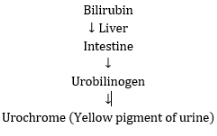
(C) The yellow colour of urine is due to the presence of the pigment Urochrome.
This pigment is a breakdown product of heme metabolism.
Bilirubin is processed in the liver and intestine to form urobilinogen,which is further oxidized to form Urochrome,the yellow pigment responsible for the characteristic colour of urine.
This pigment is a breakdown product of heme metabolism.
Bilirubin is processed in the liver and intestine to form urobilinogen,which is further oxidized to form Urochrome,the yellow pigment responsible for the characteristic colour of urine.
0 likes
View Solution183
MediumMCQ
Select the correct option regarding the synthesis and elimination of nitrogenous excretory products.
A
Nitrogenous excretory products are synthesised in the kidney and eliminated in the liver.
B
Nitrogenous excretory products are synthesised in the kidney and eliminated by the kidney.
C
Nitrogenous excretory products are synthesised in the liver and eliminated via bile juice.
D
Nitrogenous excretory products are synthesised in the liver and eliminated by the kidney.
Solution
(D) In humans,the principal nitrogenous excretory compound,urea,is synthesised in the liver through the ornithine cycle (also known as the urea cycle).
Once synthesised,urea is transported via the blood to the kidneys.
The kidneys filter the blood and eliminate urea from the body as the primary component of urine.
Once synthesised,urea is transported via the blood to the kidneys.
The kidneys filter the blood and eliminate urea from the body as the primary component of urine.
0 likes
View Solution184
MediumMCQ
Order of toxicity among ammonia,urea and uric acid (from lower to higher) is
A
Uric acid < urea < ammonia
B
Uric acid < ammonia < urea
C
Urea < uric acid < ammonia
D
Ammonia < urea < uric acid
Solution
(A) $(i)$ Ammonia $(NH_{3})$: It is the primary metabolic waste of protein metabolism. Ammonia is produced in the liver through the process of deamination. It is highly toxic and requires a large amount of water for its excretion.
$(ii)$ Urea: $A$ white crystalline solid product produced in the liver from $CO_{2}$ and $NH_{3}$. It is comparatively less toxic than ammonia. The normal level of urea in the blood is $18-38 \text{ mg}/100 \text{ mL}$.
$(iii)$ Uric Acid: It is the least toxic and is insoluble in water. It is produced in the liver by purine catabolism in birds and reptiles. It can be excreted in solid or semisolid form,which helps in water conservation. Therefore,the order of toxicity from lower to higher is: Uric acid < Urea < Ammonia.
$(ii)$ Urea: $A$ white crystalline solid product produced in the liver from $CO_{2}$ and $NH_{3}$. It is comparatively less toxic than ammonia. The normal level of urea in the blood is $18-38 \text{ mg}/100 \text{ mL}$.
$(iii)$ Uric Acid: It is the least toxic and is insoluble in water. It is produced in the liver by purine catabolism in birds and reptiles. It can be excreted in solid or semisolid form,which helps in water conservation. Therefore,the order of toxicity from lower to higher is: Uric acid < Urea < Ammonia.
0 likes
View Solution185
EasyMCQ
Which of the following is the first formed nitrogenous waste in vertebrates?
A
$NH_2$
B
$Urea$
C
$NH_3$
D
$NH_4$
Solution
(C) Nitrogenous compounds are produced by various metabolic processes,primarily through the process of deamination of amino acids.
In vertebrates,the first nitrogenous waste product formed during protein metabolism is ammonia $(NH_3)$.
Ammonia is highly toxic and requires a large amount of water for its elimination.
Since the earliest vertebrates were aquatic (fish),they could easily excrete ammonia directly into the surrounding water through their gills via diffusion.
Therefore,$NH_3$ is considered the primary and first-formed nitrogenous waste in the vertebrate lineage.
In vertebrates,the first nitrogenous waste product formed during protein metabolism is ammonia $(NH_3)$.
Ammonia is highly toxic and requires a large amount of water for its elimination.
Since the earliest vertebrates were aquatic (fish),they could easily excrete ammonia directly into the surrounding water through their gills via diffusion.
Therefore,$NH_3$ is considered the primary and first-formed nitrogenous waste in the vertebrate lineage.
0 likes
View Solution186
EasyMCQ
Uric acid is the chief nitrogenous excretory component of
A
Man
B
Earthworm
C
Cockroach
D
Frog
Solution
(C) Cockroach excretes uric acid as the chief nitrogenous excretory product,which is known as uricotelism.
Man excretes urea as the chief nitrogenous excretory product,making them ureotelic.
Earthworm is ureotelic in terrestrial conditions and ammonotelic in aquatic conditions,excreting $40\, \%$ urea,$20\, \%$ ammonia,and $40\, \%$ amino acids.
Frog excretes urea as the chief nitrogenous product in its adult stage,making it ureotelic.
Man excretes urea as the chief nitrogenous excretory product,making them ureotelic.
Earthworm is ureotelic in terrestrial conditions and ammonotelic in aquatic conditions,excreting $40\, \%$ urea,$20\, \%$ ammonia,and $40\, \%$ amino acids.
Frog excretes urea as the chief nitrogenous product in its adult stage,making it ureotelic.
0 likes
View Solution187
MediumMCQ
Animals that excrete urea,which is produced during the metabolism of amino acids,belong to which category?
A
Ureotelism
B
Uricotelism
C
Ammonotelism
D
Aminotelism
Solution
(A) Urea is the primary nitrogenous waste product in many animals.
Animals that excrete urea as their main nitrogenous waste are known as ureotelic animals.
The process of excreting urea is called ureotelism.
Examples of ureotelic animals include mammals,adult amphibians,and marine fishes.
Animals that excrete urea as their main nitrogenous waste are known as ureotelic animals.
The process of excreting urea is called ureotelism.
Examples of ureotelic animals include mammals,adult amphibians,and marine fishes.
0 likes
View Solution188
EasyMCQ
Excretion of nitrogenous waste products in semisolid form occurs in
A
Ureotelic animals
B
Ammonotelic animals
C
Uricotelic animals
D
Amniotes
Solution
(C) Uricotelism is the process of excreting nitrogenous waste in the form of uric acid or urates.
This method is primarily found in animals that need to conserve water,such as birds,reptiles,and insects.
In these animals,nitrogenous waste is eliminated as a paste or in a semisolid state to minimize water loss.
This method is primarily found in animals that need to conserve water,such as birds,reptiles,and insects.
In these animals,nitrogenous waste is eliminated as a paste or in a semisolid state to minimize water loss.
0 likes
View Solution189
EasyMCQ
Physiologically,urea is produced by the action of which enzyme?
A
Arginase
B
Urease
C
Uricase
D
None of these
Solution
(A) The urea cycle takes place in liver cells,where the hydrolytic enzyme $Arginase$ plays a crucial role. $Arginase$ catalyzes the hydrolysis of $Arginine$ into urea and ornithine,resulting in the production of urea as an excretory product.
0 likes
View Solution190
MediumMCQ
Blood leaving the liver and going towards the heart is rich in:
A
Bile
B
Urea
C
Ammonia
D
Oxygen
Solution
(B) The liver is the primary site for the detoxification of ammonia into urea via the ornithine cycle (urea cycle).
Since the liver synthesizes urea,the blood that leaves the liver through the hepatic vein and travels towards the heart contains a significantly higher concentration of urea compared to the blood entering the liver.
Since the liver synthesizes urea,the blood that leaves the liver through the hepatic vein and travels towards the heart contains a significantly higher concentration of urea compared to the blood entering the liver.
0 likes
View Solution191
EasyMCQ
Ammonia is converted into urea in
A
Kidney
B
Lungs
C
Liver
D
Spleen
Solution
(C) Ammonia is a highly toxic substance produced during the metabolism of amino acids. In the human body,ammonia is converted into urea through the $Urea$ cycle,also known as the $Krebs-Henseleit$ cycle. This process primarily takes place in the liver,where the liver cells (hepatocytes) utilize enzymes to combine ammonia with carbon dioxide to form urea,which is then transported to the kidneys for excretion.
0 likes
View Solution192
MediumMCQ
Choose the correct option containing compounds of the ornithine cycle from the options given below.
A
Ornithine,citrulline and fumaric acid
B
Ornithine,citrulline and alanine
C
Ornithine,citrulline and arginine
D
Ornithine,citrulline and tyrosine
Solution
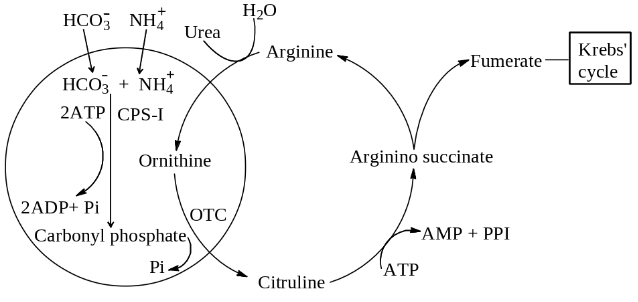
(C) The urea cycle,also known as the Krebs-Henseleit cycle $(1932)$,is a series of biochemical reactions that occur in the liver to convert toxic ammonia into urea.
$1$. The cycle involves the formation and transformation of three key amino acids: ornithine,citrulline,and arginine.
$2$. Ornithine combines with carbamoyl phosphate to form citrulline.
$3$. Citrulline then reacts with aspartate to form argininosuccinate,which is subsequently converted into arginine.
$4$. Finally,arginine is hydrolyzed to release urea and regenerate ornithine,allowing the cycle to continue.
Therefore,the correct option containing the primary amino acids involved in the cycle is ornithine,citrulline,and arginine.
$1$. The cycle involves the formation and transformation of three key amino acids: ornithine,citrulline,and arginine.
$2$. Ornithine combines with carbamoyl phosphate to form citrulline.
$3$. Citrulline then reacts with aspartate to form argininosuccinate,which is subsequently converted into arginine.
$4$. Finally,arginine is hydrolyzed to release urea and regenerate ornithine,allowing the cycle to continue.
Therefore,the correct option containing the primary amino acids involved in the cycle is ornithine,citrulline,and arginine.
0 likes
View Solution193
MediumMCQ
In humans,the waste products of nucleotide metabolism are excreted as
A
Ammonia
B
Uric acid
C
Urea
D
Amino acid
Solution
(B) Nucleotide metabolism,specifically the catabolism of purines (adenine and guanine),results in the formation of uric acid in humans.
Unlike many other vertebrates that possess the enzyme urate oxidase to further break down uric acid into allantoin,humans lack this enzyme.
Therefore,uric acid is excreted as the final waste product of purine nucleotide metabolism.
While urea is the primary nitrogenous waste product of protein metabolism in humans,uric acid is the specific end product of nucleotide (purine) metabolism.
Unlike many other vertebrates that possess the enzyme urate oxidase to further break down uric acid into allantoin,humans lack this enzyme.
Therefore,uric acid is excreted as the final waste product of purine nucleotide metabolism.
While urea is the primary nitrogenous waste product of protein metabolism in humans,uric acid is the specific end product of nucleotide (purine) metabolism.
0 likes
View Solution194
EasyMCQ
With respect to the mode of excretion,bony fishes are?
A
Osmoconformers
B
Ammonotelic
C
Uricotelic
D
Ureotelic
Solution
(B) Most aquatic animals like aquatic arthropods,bony fishes,freshwater fishes,and amphibian tadpoles excrete nitrogenous waste in the form of ammonia. This phenomenon is known as ammonotelism,and the animals that exhibit this mode of excretion are called ammonotelic.
0 likes
View Solution195
MediumMCQ
Which of the following is both an osmoregulator as well as a nitrogenous product?
A
$NH_3$
B
Urea
C
Uric acid
D
All of these
Solution
(B) Urea serves as both a nitrogenous waste product and an osmoregulator.
It is the primary excretory product in humans and other mammals,as well as in organisms like $Ascaris$,earthworms,and certain fishes such as sharks and stingrays.
In these organisms,urea is retained in the body fluids to maintain osmotic balance,making it a key molecule for osmoregulation.
It is the primary excretory product in humans and other mammals,as well as in organisms like $Ascaris$,earthworms,and certain fishes such as sharks and stingrays.
In these organisms,urea is retained in the body fluids to maintain osmotic balance,making it a key molecule for osmoregulation.
0 likes
View Solution196
EasyMCQ
The excretory product of a spider is:
A
Uric acid
B
Ammonia
C
Guanine
D
None of these
Solution
(C) Spiders excrete guanine as their primary nitrogenous waste product,and therefore,they are classified as guanotelic organisms.
Guanine is a metabolic waste product derived from the breakdown of nucleotides (purine metabolism).
Guanine is a metabolic waste product derived from the breakdown of nucleotides (purine metabolism).
0 likes
View Solution197
MediumMCQ
For brain cells,ammonia is very toxic because:
A
Ammonia ($NH_4^+$ ions) affects brain cell functioning by changing the polarity of the cell membrane.
B
Ammonia is not very toxic to cells other than brain cells.
C
Ammonia is highly stable in brain cells.
D
Ammonia penetrates the cell membrane of brain cells.
Solution
(A) Ammonia ($NH_4^+$ ions) is highly toxic to brain cells because it interferes with the normal functioning of the nervous system.
Specifically,these ions affect the brain cell functioning by altering the electrical polarity of the cell membrane.
This change in polarity disrupts the electrochemical gradients required for nerve impulse transmission and transport across the cell membrane,leading to neurological dysfunction.
Specifically,these ions affect the brain cell functioning by altering the electrical polarity of the cell membrane.
This change in polarity disrupts the electrochemical gradients required for nerve impulse transmission and transport across the cell membrane,leading to neurological dysfunction.
0 likes
View Solution198
MediumMCQ
The characteristic that is shared by urea,uric acid and ammonia is/are:
$I.$ They are nitrogenous wastes.
$II.$ They all need very large amount of water for excretion.
$III.$ They are all equally toxic.
$IV.$ They are equally in the kidneys.
$I.$ They are nitrogenous wastes.
$II.$ They all need very large amount of water for excretion.
$III.$ They are all equally toxic.
$IV.$ They are equally in the kidneys.
A
$I$ and $III$
B
$I$ and $IV$
C
$I, III$ and $IV$
D
$I$ only
Solution
(D) Urea,uric acid,and ammonia are all nitrogenous waste products produced during metabolism.
Therefore,statement $I$ is correct.
Ammonia is highly toxic and requires a large amount of water for excretion. Urea is less toxic than ammonia and requires less water. Uric acid is the least toxic and is excreted as a paste or pellet,requiring minimal water. Thus,statements $II$ and $III$ are incorrect.
Statement $IV$ is factually incorrect as they are processed differently in the body.
Hence,only statement $I$ is shared by all three.
Therefore,statement $I$ is correct.
Ammonia is highly toxic and requires a large amount of water for excretion. Urea is less toxic than ammonia and requires less water. Uric acid is the least toxic and is excreted as a paste or pellet,requiring minimal water. Thus,statements $II$ and $III$ are incorrect.
Statement $IV$ is factually incorrect as they are processed differently in the body.
Hence,only statement $I$ is shared by all three.
0 likes
View Solution199
MediumMCQ
Choose the correct option with respect to the maximum urea level.
A
Renal vein
B
Hepatic vein
C
Pulmonary artery
D
Pulmonary vein
Solution
(B) The $Hepatic$ $\text{vein}$ contains the highest concentration of urea in the body. This is because urea is synthesized in the liver through the ornithine cycle (urea cycle) and is then released into the blood via the hepatic vein.
0 likes
View Solution200
MediumMCQ
Marine teleost fishes excrete:
A
Urea
B
Ammonia
C
Uric acid
D
Amino acid
Solution
(B) Marine teleost fishes are primarily ammonotelic,meaning they excrete ammonia as their main nitrogenous waste product.
Ammonia is highly toxic and requires a large amount of water for its elimination,which is readily available to these fishes in their aquatic environment.
Although some marine teleosts may excrete small amounts of urea,they are classified as ammonotelic because ammonia is the principal excretory product.
Ammonia is highly toxic and requires a large amount of water for its elimination,which is readily available to these fishes in their aquatic environment.
Although some marine teleosts may excrete small amounts of urea,they are classified as ammonotelic because ammonia is the principal excretory product.
0 likes
View SolutionExcretory Products and their Elimination — Excretory waste products · Frequently Asked Questions
1Are these Excretory Products and their Elimination questions useful for JEE and NEET?
Yes. All questions in this section are mapped to JEE Main and NEET exam patterns. Previous year questions from JEE Main, NEET, GUJCET and state-level exams are included with full solutions.
2Can I switch to Hindi or Gujarati for these questions?
Yes. Use the language tabs in the hero section or the sidebar to view the same questions and solutions in English, Hindi or Gujarati.
3How do I generate a question paper from this subtopic?
Use the Vedclass Exam Paper Generator — select the chapter and subtopic, set difficulty, and generate Sets A, B, C, D automatically. First 3 chapters of every subject are free.
Vedclass Products
For Students
Vedclass Test Series
Mock tests in real JEE/NEET style with performance analysis. 5-day free trial.
Start Free TrialFor Teachers
Exam Paper Generator
Generate Set A/B/C/D papers from this chapter in 2 minutes. 3 chapters free.
Try FreeFor Institutes
Online Exam Module
Live online exams with unlimited students, 360° analytics & white-label branding.
See DemoFor Teachers & Institutes
Generate a Excretory Products and their Elimination Exam Paper in 2 Minutes
Select subtopic & difficulty — Sets A, B, C, D auto-generated with No Repeat logic.
First 3 chapters of every subject are free — no payment required.