
A English
Thyroid Gland Questions in English
Class 11 Biology · Chemical Coordination and Integration · Thyroid Gland
165+
Questions
English
Language
100%
With Solutions
Showing 49 of 165 questions in English
101
MediumMCQ
Which of the following endocrine glands stores its secretion in the extracellular space before releasing it into the blood?
A
Pancreas
B
Adrenal
C
Testis
D
Thyroid
Solution
(D) The $Thyroid$ gland is unique among endocrine glands because it stores its hormones in an inactive form within the extracellular space of the thyroid follicles, known as the colloid.
These hormones, $Thyroxine$ $(T_4)$ and $Triiodothyronine$ $(T_3)$, are synthesized and stored as part of the protein $Thyroglobulin$ in the follicular lumen.
When the body requires these hormones, they are reabsorbed from the colloid into the follicular cells, processed, and then released into the bloodstream.
These hormones, $Thyroxine$ $(T_4)$ and $Triiodothyronine$ $(T_3)$, are synthesized and stored as part of the protein $Thyroglobulin$ in the follicular lumen.
When the body requires these hormones, they are reabsorbed from the colloid into the follicular cells, processed, and then released into the bloodstream.
0 likes
View Solution102
EasyMCQ
Which of the following radioactive isotopes is used to detect thyroid cancer?
A
Iodine-$131$
B
Carbon-$14$
C
Uranium-$238$
D
Phosphorus-$32$
Solution
(A) The thyroid gland specifically absorbs iodine to synthesize thyroid hormones ($T_3$ and $T_4$).
Radioactive Iodine-$131$ $(^{131}I)$ is used in medical diagnostics and therapy because the thyroid gland concentrates it,allowing for the detection of cancerous cells or the destruction of overactive thyroid tissue.
Other isotopes like Carbon-$14$ are used for radiocarbon dating,Uranium-$238$ for geological dating,and Phosphorus-$32$ for molecular biology research.
Radioactive Iodine-$131$ $(^{131}I)$ is used in medical diagnostics and therapy because the thyroid gland concentrates it,allowing for the detection of cancerous cells or the destruction of overactive thyroid tissue.
Other isotopes like Carbon-$14$ are used for radiocarbon dating,Uranium-$238$ for geological dating,and Phosphorus-$32$ for molecular biology research.
0 likes
View Solution103
MediumMCQ
The hormone that controls the basal metabolic rate $(BMR)$ in our body is secreted by:
A
Pituitary
B
Thyroid
C
Adrenal cortex
D
Pancreas
Solution
(B) The thyroid gland secretes two main hormones: thyroxine $(T_4)$ and triiodothyronine $(T_3)$.
These hormones play a crucial role in regulating the basal metabolic rate $(BMR)$ of the body.
They also support the process of red blood cell formation,control the metabolism of carbohydrates,proteins,and fats,and maintain water and electrolyte balance.
Therefore,the correct answer is the thyroid gland.
These hormones play a crucial role in regulating the basal metabolic rate $(BMR)$ of the body.
They also support the process of red blood cell formation,control the metabolism of carbohydrates,proteins,and fats,and maintain water and electrolyte balance.
Therefore,the correct answer is the thyroid gland.
0 likes
View Solution104
MediumMCQ
Deficiency of thyroxine in adults leads to a condition characterized by:
$(i)$. Low metabolic rate
$(ii)$. Increase in body weight
$(iii)$. Tendency to retain water in tissues
This condition is known as:
$(i)$. Low metabolic rate
$(ii)$. Increase in body weight
$(iii)$. Tendency to retain water in tissues
This condition is known as:
A
Goitre
B
Myxoedema
C
Cretinism
D
Hypothyroidism
Solution
(B) The deficiency of thyroxine in adults leads to a condition called $Myxoedema$.
Key characteristics of $Myxoedema$ include:
$1$. $A$ significantly low metabolic rate.
$2$. An increase in body weight due to metabolic slowdown.
$3$. $A$ tendency for tissues to retain water,leading to puffiness.
$Cretinism$ is caused by thyroid deficiency in children,while $Goitre$ is an enlargement of the thyroid gland often due to iodine deficiency. $Hypothyroidism$ is the general term for the underactive thyroid state,but $Myxoedema$ is the specific clinical term for the adult condition described.
Key characteristics of $Myxoedema$ include:
$1$. $A$ significantly low metabolic rate.
$2$. An increase in body weight due to metabolic slowdown.
$3$. $A$ tendency for tissues to retain water,leading to puffiness.
$Cretinism$ is caused by thyroid deficiency in children,while $Goitre$ is an enlargement of the thyroid gland often due to iodine deficiency. $Hypothyroidism$ is the general term for the underactive thyroid state,but $Myxoedema$ is the specific clinical term for the adult condition described.
0 likes
View Solution105
MediumMCQ
Goitrogenic substances present in food,which interfere with the secretion of thyroxine,induce the development of:
A
Toxic goiter
B
Cretinism
C
Simple goiter
D
Thyrotoxicosis
Solution
(C) Goitrogens are substances that disrupt the production of thyroid hormones by interfering with iodine uptake in the thyroid gland.
When the synthesis of thyroxine $(T_4)$ is inhibited,the pituitary gland increases the secretion of Thyroid Stimulating Hormone $(TSH)$.
This constant stimulation of the thyroid gland leads to its enlargement,a condition known as simple goiter (or colloid goiter).
Therefore,the consumption of goitrogenic substances leads to the development of simple goiter.
When the synthesis of thyroxine $(T_4)$ is inhibited,the pituitary gland increases the secretion of Thyroid Stimulating Hormone $(TSH)$.
This constant stimulation of the thyroid gland leads to its enlargement,a condition known as simple goiter (or colloid goiter).
Therefore,the consumption of goitrogenic substances leads to the development of simple goiter.
0 likes
View Solution106
MediumMCQ
Match the given endocrine gland with its hormones,functions,and deficiency symptoms accurately.
A
$A$. Corpus Luteum - Testosterone - Stimulates spermatogenesis.
B
$B$. Anterior Pituitary - Oxytocin - Stimulates uterine contraction during childbirth.
C
$C$. Posterior Pituitary - Growth Hormone - Hypersecretion causes abnormal growth.
D
$D$. Thyroid Gland - Thyroxine - Iodine deficiency causes goiter.
Solution
(D) The correct match is $D$. The thyroid gland secretes thyroxine (or tetraiodothyronine). Iodine is an essential component for the synthesis of thyroid hormones. $A$ deficiency of iodine in the diet leads to hypothyroidism and enlargement of the thyroid gland,a condition known as goiter.
- Option $A$ is incorrect because the corpus luteum secretes progesterone,not testosterone.
- Option $B$ is incorrect because oxytocin is synthesized by the hypothalamus and released by the posterior pituitary,not the anterior pituitary.
- Option $C$ is incorrect because the growth hormone is secreted by the anterior pituitary,not the posterior pituitary.
- Option $A$ is incorrect because the corpus luteum secretes progesterone,not testosterone.
- Option $B$ is incorrect because oxytocin is synthesized by the hypothalamus and released by the posterior pituitary,not the anterior pituitary.
- Option $C$ is incorrect because the growth hormone is secreted by the anterior pituitary,not the posterior pituitary.
0 likes
View Solution107
MediumMCQ
$A$ pregnant woman delivers a child who suffers from stunted growth,mental retardation,low intelligence quotient $(IQ)$,and abnormal skin. This condition is likely due to:
A
Over-secretion of $Pars$ $distalis$
B
Deficiency of iodine in the diet
C
Lack of secretion of growth hormone
D
Cancer of the thyroid gland
Solution
(B) The symptoms described,such as stunted growth,mental retardation,low $IQ$,and abnormal skin,are characteristic of $Cretinism$.
$Cretinism$ is a condition caused by hypothyroidism during fetal development or early infancy.
Thyroid hormones ($T_3$ and $T_4$) are essential for the normal physical and mental development of a child.
Iodine is a crucial component for the synthesis of thyroid hormones.
If a pregnant woman has a deficiency of iodine in her diet,it leads to inadequate production of thyroid hormones,which affects the development of the fetus,resulting in $Cretinism$.
$Cretinism$ is a condition caused by hypothyroidism during fetal development or early infancy.
Thyroid hormones ($T_3$ and $T_4$) are essential for the normal physical and mental development of a child.
Iodine is a crucial component for the synthesis of thyroid hormones.
If a pregnant woman has a deficiency of iodine in her diet,it leads to inadequate production of thyroid hormones,which affects the development of the fetus,resulting in $Cretinism$.
0 likes
View Solution108
EasyMCQ
Graves' disease is caused by . . . . . . .
A
Hyposecretion of adrenal gland
B
Hypersecretion of adrenal gland
C
Hyposecretion of thyroid gland
D
Hypersecretion of thyroid gland
Solution
(D) Graves' disease,also known as exophthalmic goiter,is an autoimmune disorder.
It is caused by the hypersecretion of thyroid hormones ($T_3$ and $T_4$) by the thyroid gland.
Symptoms include enlargement of the thyroid gland,protrusion of the eyeballs (exophthalmos),increased basal metabolic rate,and weight loss.
Therefore,the correct option is $D$.
It is caused by the hypersecretion of thyroid hormones ($T_3$ and $T_4$) by the thyroid gland.
Symptoms include enlargement of the thyroid gland,protrusion of the eyeballs (exophthalmos),increased basal metabolic rate,and weight loss.
Therefore,the correct option is $D$.
0 likes
View Solution109
MediumMCQ
Tadpoles of a frog can be made to grow into giant-sized tadpoles if they are:
A
administered an antithyroid substance like thiourea.
B
administered large amounts of thyroxine.
C
reared on a diet rich in egg yolk.
D
reared on a diet rich in both egg yolk and glucose.
Solution
(A) The metamorphosis of a tadpole into an adult frog is regulated by the hormone thyroxine,which is secreted by the thyroid gland.
If the production of thyroxine is inhibited,the tadpole fails to undergo metamorphosis and continues to grow in size,eventually becoming a giant-sized tadpole.
Antithyroid substances,such as thiourea,inhibit the synthesis of thyroxine.
Therefore,administering thiourea prevents metamorphosis,allowing the tadpole to continue growing without transforming into an adult frog.
If the production of thyroxine is inhibited,the tadpole fails to undergo metamorphosis and continues to grow in size,eventually becoming a giant-sized tadpole.
Antithyroid substances,such as thiourea,inhibit the synthesis of thyroxine.
Therefore,administering thiourea prevents metamorphosis,allowing the tadpole to continue growing without transforming into an adult frog.
0 likes
View Solution110
MediumMCQ
Which one of the following hormones contains iodine?
A
Thyroxine
B
Testosterone
C
Insulin
D
Adrenaline
Solution
(A) The thyroid gland secretes a hormone known as thyroxine $(T_4)$.
Thyroxine is an iodinated derivative of the amino acid tyrosine,meaning it contains iodine atoms in its structure.
Iodine is essential for the synthesis of thyroid hormones.
$A$ deficiency of iodine in the diet leads to a decrease in the production of thyroxine,which can cause the thyroid gland to enlarge,a condition known as goitre.
Thyroxine is an iodinated derivative of the amino acid tyrosine,meaning it contains iodine atoms in its structure.
Iodine is essential for the synthesis of thyroid hormones.
$A$ deficiency of iodine in the diet leads to a decrease in the production of thyroxine,which can cause the thyroid gland to enlarge,a condition known as goitre.
0 likes
View Solution111
MediumMCQ
Assertion: Hormone calcitonin has an antagonistic effect to that of parathormone.
Reason: Calcitonin decreases blood calcium level while parathormone increases blood calcium level.
Reason: Calcitonin decreases blood calcium level while parathormone increases blood calcium level.
A
If both Assertion and Reason are correct and the Reason is a correct explanation of the Assertion.
B
If both Assertion and Reason are correct but Reason is not a correct explanation of the Assertion.
C
If the Assertion is correct but Reason is incorrect.
D
If both the Assertion and Reason are incorrect.
Solution
(A) Calcitonin (or thyrocalcitonin) is secreted by the parafollicular cells of the thyroid gland. It lowers blood calcium levels by inhibiting bone resorption and promoting calcium excretion in urine.
Parathormone $(PTH)$ is secreted by the chief cells of the parathyroid gland. It increases blood calcium levels by stimulating calcium absorption from the intestine,reabsorption from the renal tubules,and bone demineralization.
Since calcitonin lowers blood calcium and parathormone raises it,they have antagonistic effects.
Therefore,the Assertion is correct,the Reason is correct,and the Reason is the correct explanation of the Assertion.
Parathormone $(PTH)$ is secreted by the chief cells of the parathyroid gland. It increases blood calcium levels by stimulating calcium absorption from the intestine,reabsorption from the renal tubules,and bone demineralization.
Since calcitonin lowers blood calcium and parathormone raises it,they have antagonistic effects.
Therefore,the Assertion is correct,the Reason is correct,and the Reason is the correct explanation of the Assertion.
0 likes
View Solution112
Easy
Which hormonal deficiency is responsible for the following:
$(a)$ Diabetes mellitus
$(b)$ Goiter
$(c)$ Cretinism.
$(a)$ Diabetes mellitus
$(b)$ Goiter
$(c)$ Cretinism.
Solution
(N/A) Diabetes mellitus is characterized by abnormally high glucose levels in the blood due to the deficiency of the hormone insulin.
$(b)$ Goiter is characterized by an abnormal enlargement of the thyroid gland due to the deficiency of thyroxine hormone in the body.
$(c)$ Cretinism is characterized by stunted growth and mental retardation in children due to the deficiency of thyroid hormones during fetal development or early infancy.
$(b)$ Goiter is characterized by an abnormal enlargement of the thyroid gland due to the deficiency of thyroxine hormone in the body.
$(c)$ Cretinism is characterized by stunted growth and mental retardation in children due to the deficiency of thyroid hormones during fetal development or early infancy.
0 likes
View Solution113
Easy
Give information regarding the location of the thyroid gland and its hormones.
Solution
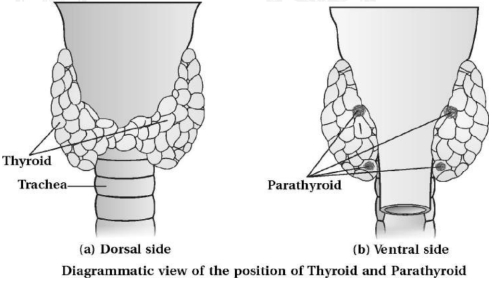
(N/A) Location: The thyroid gland is composed of two lobes which are located on either side of the trachea.
Both the lobes are interconnected with a thin flap of connective tissue called the isthmus.
Structure: The thyroid gland is composed of follicles and stromal tissues. Each thyroid follicle is composed of follicular cells,enclosing a cavity.
These follicular cells synthesize two hormones,tetraiodothyronine or thyroxine $(T_{4})$ and triiodothyronine $(T_{3})$.
Iodine is essential for the normal rate of hormone synthesis in the thyroid.
Deficiency of iodine in our diet results in hypothyroidism and enlargement of the thyroid gland,commonly called goitre.
Symptoms of goitre include stunted growth (cretinism),mental retardation,low intelligence quotient,abnormal skin,deaf-mutism,etc. Hypothyroidism during pregnancy causes defective development and maturation of the growing body.
In adult women,hypothyroidism may cause the menstrual cycle to become irregular.
Due to cancer of the thyroid gland or due to the development of nodules of the thyroid glands,the rate of synthesis and secretion of the thyroid hormones is increased to abnormally high levels,leading to a condition called hyperthyroidism,which adversely affects body physiology.
Functions:
$(i)$ Thyroid hormones play an important role in the regulation of the Basal Metabolic Rate $(BMR)$.
$(ii)$ They support the process of Red Blood Cell $(RBC)$ formation.
$(iii)$ Thyroid hormones control the metabolism of carbohydrates,proteins,and fats.
$(iv)$ Maintenance of water and electrolyte balance is also influenced by thyroid hormones.
$(v)$ The thyroid gland also secretes a protein hormone called thyrocalcitonin $(TCT)$,which regulates blood calcium levels.
Both the lobes are interconnected with a thin flap of connective tissue called the isthmus.
Structure: The thyroid gland is composed of follicles and stromal tissues. Each thyroid follicle is composed of follicular cells,enclosing a cavity.
These follicular cells synthesize two hormones,tetraiodothyronine or thyroxine $(T_{4})$ and triiodothyronine $(T_{3})$.
Iodine is essential for the normal rate of hormone synthesis in the thyroid.
Deficiency of iodine in our diet results in hypothyroidism and enlargement of the thyroid gland,commonly called goitre.
Symptoms of goitre include stunted growth (cretinism),mental retardation,low intelligence quotient,abnormal skin,deaf-mutism,etc. Hypothyroidism during pregnancy causes defective development and maturation of the growing body.
In adult women,hypothyroidism may cause the menstrual cycle to become irregular.
Due to cancer of the thyroid gland or due to the development of nodules of the thyroid glands,the rate of synthesis and secretion of the thyroid hormones is increased to abnormally high levels,leading to a condition called hyperthyroidism,which adversely affects body physiology.
Functions:
$(i)$ Thyroid hormones play an important role in the regulation of the Basal Metabolic Rate $(BMR)$.
$(ii)$ They support the process of Red Blood Cell $(RBC)$ formation.
$(iii)$ Thyroid hormones control the metabolism of carbohydrates,proteins,and fats.
$(iv)$ Maintenance of water and electrolyte balance is also influenced by thyroid hormones.
$(v)$ The thyroid gland also secretes a protein hormone called thyrocalcitonin $(TCT)$,which regulates blood calcium levels.
0 likes
View Solution114
Easy
Write a short note on the disorders/diseases of the thyroid gland.
Solution
(N/A) The thyroid gland is located on either side of the trachea and consists of two lobes interconnected by a thin flap of connective tissue called the isthmus. It is composed of follicles and stromal tissues. The follicular cells synthesize two hormones: tetraiodothyronine or thyroxine $(T_4)$ and triiodothyronine $(T_3)$. Iodine is essential for the normal rate of hormone synthesis.
$1$. Hypothyroidism: Deficiency of iodine in our diet leads to hypothyroidism and enlargement of the thyroid gland,commonly called goitre. Symptoms include stunted growth (cretinism),mental retardation,low intelligence quotient,abnormal skin,and deaf-mutism. Hypothyroidism during pregnancy causes defective development and maturation of the growing baby. In adult women,it may cause irregular menstrual cycles.
$2$. Hyperthyroidism: This condition occurs due to cancer of the thyroid gland or the development of nodules,which increases the synthesis and secretion of thyroid hormones to abnormally high levels,adversely affecting body physiology.
$3$. Graves' Disease (Exophthalmic Goitre): This is a form of hyperthyroidism characterized by the enlargement of the thyroid gland,protrusion of the eyeballs,increased basal metabolic rate,and weight loss.
$1$. Hypothyroidism: Deficiency of iodine in our diet leads to hypothyroidism and enlargement of the thyroid gland,commonly called goitre. Symptoms include stunted growth (cretinism),mental retardation,low intelligence quotient,abnormal skin,and deaf-mutism. Hypothyroidism during pregnancy causes defective development and maturation of the growing baby. In adult women,it may cause irregular menstrual cycles.
$2$. Hyperthyroidism: This condition occurs due to cancer of the thyroid gland or the development of nodules,which increases the synthesis and secretion of thyroid hormones to abnormally high levels,adversely affecting body physiology.
$3$. Graves' Disease (Exophthalmic Goitre): This is a form of hyperthyroidism characterized by the enlargement of the thyroid gland,protrusion of the eyeballs,increased basal metabolic rate,and weight loss.
0 likes
View Solution115
Medium
Name the endocrine gland that produces calcitonin and mention the role played by this hormone.
Solution
(N/A) The endocrine gland that produces calcitonin is the thyroid gland,specifically the parafollicular cells (also known as $C$-cells).
Calcitonin plays a crucial role in calcium homeostasis by lowering blood calcium levels.
It inhibits the activity of osteoclasts,thereby reducing the resorption (dissociation) of $Ca^{++}$ and phosphate from the bones into the blood.
Calcitonin plays a crucial role in calcium homeostasis by lowering blood calcium levels.
It inhibits the activity of osteoclasts,thereby reducing the resorption (dissociation) of $Ca^{++}$ and phosphate from the bones into the blood.
0 likes
View Solution116
Easy
Name at least two hormones which result in the fluctuation of $Ca^{++}$ levels.
Solution
(N/A) The two primary hormones responsible for regulating $Ca^{++}$ levels in the blood are Parathyroid hormone $(PTH)$ and Calcitonin.
$PTH$ is secreted by the parathyroid gland and acts to increase blood $Ca^{++}$ levels. It stimulates bone resorption (demineralization),increases $Ca^{++}$ reabsorption by renal tubules,and enhances $Ca^{++}$ absorption from digested food in the intestine.
Calcitonin is produced by the parafollicular cells ($C$-cells) of the thyroid gland. It acts antagonistically to $PTH$ by lowering blood $Ca^{++}$ levels,primarily by inhibiting bone resorption.
$PTH$ is secreted by the parathyroid gland and acts to increase blood $Ca^{++}$ levels. It stimulates bone resorption (demineralization),increases $Ca^{++}$ reabsorption by renal tubules,and enhances $Ca^{++}$ absorption from digested food in the intestine.
Calcitonin is produced by the parafollicular cells ($C$-cells) of the thyroid gland. It acts antagonistically to $PTH$ by lowering blood $Ca^{++}$ levels,primarily by inhibiting bone resorption.
0 likes
View Solution117
Medium
On an educational trip to Uttaranchal,Ketki and her friends observe that many local people have swollen necks. Please help Ketki and her friends to find out the solutions to the following questions.
$(a)$ Which probable disease are these people suffering from?
$(b)$ How is it caused?
$(c)$ What effect does this condition have on pregnancy?
$(a)$ Which probable disease are these people suffering from?
$(b)$ How is it caused?
$(c)$ What effect does this condition have on pregnancy?
Solution
(A) These people are likely suffering from goitre,which is characterized by a swollen neck.
$(b)$ Goitre is caused by a deficiency of iodine in the diet. Iodine is essential for the synthesis of thyroid hormones,$T_{3}$ (triiodothyronine) and $T_{4}$ (thyroxine). When iodine levels are low,the thyroid gland enlarges in an attempt to produce more hormones,leading to hypothyroidism.
$(c)$ During pregnancy,maternal hypothyroidism can severely affect the developing foetus. It may lead to cretinism,which is characterized by stunted growth,mental retardation,low intelligence quotient,abnormal skin,and deaf-mutism.
$(b)$ Goitre is caused by a deficiency of iodine in the diet. Iodine is essential for the synthesis of thyroid hormones,$T_{3}$ (triiodothyronine) and $T_{4}$ (thyroxine). When iodine levels are low,the thyroid gland enlarges in an attempt to produce more hormones,leading to hypothyroidism.
$(c)$ During pregnancy,maternal hypothyroidism can severely affect the developing foetus. It may lead to cretinism,which is characterized by stunted growth,mental retardation,low intelligence quotient,abnormal skin,and deaf-mutism.
0 likes
View Solution118
MediumMCQ
What are the effects of hypothyroidism (observed during pregnancy) on the development and maturation of a growing baby?
A
Enhanced physical growth and intelligence
B
Stunted growth (cretinism) and mental retardation
C
Rapid maturation of reproductive organs
D
Normal development with no significant impact
Solution
(B) Hypothyroidism during pregnancy leads to a deficiency of thyroid hormones in the developing foetus.
This condition results in stunted growth,a condition known as cretinism.
It also causes mental retardation,low intelligence quotient,abnormal skin texture,and deaf-mutism in the growing baby.
This condition results in stunted growth,a condition known as cretinism.
It also causes mental retardation,low intelligence quotient,abnormal skin texture,and deaf-mutism in the growing baby.
0 likes
View Solution119
Easy
Mention the difference between hypothyroidism and hyperthyroidism.
Solution
(N/A) Hypothyroidism: This condition is caused by the under-secretion of thyroid hormones. In children,it leads to cretinism,characterized by retarded physical and mental growth,short limbs,a protruding tongue,and dry skin. In adults,it causes myxedema,which is more common in females and is characterized by an abnormal metabolic rate and rough,dry skin.
Hyperthyroidism: This condition is caused by the over-secretion of thyroid hormones ($T_3$ and $T_4$). It leads to Grave's disease,which includes symptoms like an increased metabolic rate,weight loss,and nervousness. Exophthalmic goitre (protrusion of eyeballs) is often observed in adults. Toxic goitre,also known as Plummer's disease,occurs due to the excessive production of thyroxine.
Hyperthyroidism: This condition is caused by the over-secretion of thyroid hormones ($T_3$ and $T_4$). It leads to Grave's disease,which includes symptoms like an increased metabolic rate,weight loss,and nervousness. Exophthalmic goitre (protrusion of eyeballs) is often observed in adults. Toxic goitre,also known as Plummer's disease,occurs due to the excessive production of thyroxine.
0 likes
View Solution120
Easy
What is Isthmus?
Solution
(N/A) The thyroid gland is composed of two lobes which are located on either side of the trachea. Both these lobes are interconnected with a thin flap of connective tissue called the Isthmus.
0 likes
View Solution121
MediumMCQ
Thyroid follicular cells secrete which hormones?
A
Thyroxine $(T_4)$ and Triiodothyronine $(T_3)$
B
Thyrocalcitonin and Thyroxine $(T_4)$
C
Triiodothyronine $(T_3)$ and Thyrocalcitonin
D
Thyroid-stimulating hormone $(TSH)$
Solution
(A) The thyroid gland is composed of follicles and stromal tissues. Each thyroid follicle is composed of follicular cells,enclosing a cavity. These follicular cells synthesize two hormones: tetraiodothyronine or thyroxine $(T_4)$ and triiodothyronine $(T_3)$.
0 likes
View Solution122
MediumMCQ
What are the symptoms of goitre?
A
Increased metabolic rate and weight loss
B
Stunted growth,mental retardation,and deaf-mutism
C
Exophthalmos and rapid heartbeat
D
Excessive sweating and heat intolerance
Solution
(B) Goitre is an enlargement of the thyroid gland,often caused by iodine deficiency.
Symptoms associated with hypothyroidism (which often leads to goitre) include stunted growth (cretinism),mental retardation,low intelligence quotient $(IQ)$,abnormal skin,and deaf-mutism.
Hypothyroidism during pregnancy causes defective development and maturation of the growing fetus.
Symptoms associated with hypothyroidism (which often leads to goitre) include stunted growth (cretinism),mental retardation,low intelligence quotient $(IQ)$,abnormal skin,and deaf-mutism.
Hypothyroidism during pregnancy causes defective development and maturation of the growing fetus.
0 likes
View Solution123
MediumMCQ
Which are the symptoms of exophthalmic goitre?
A
Increased metabolic rate and weight loss
B
Protrusion of eyeballs
C
Enlargement of the thyroid gland
D
All of the above
Solution
(D) Exophthalmic goitre,also known as Graves' disease,is a form of hyperthyroidism caused by the overproduction of thyroid hormones.
Its primary symptoms include:
$1$. Enlargement of the thyroid gland (goitre).
$2$. Protrusion of the eyeballs (exophthalmos).
$3$. Increased basal metabolic rate $(BMR)$.
$4$. Weight loss despite increased appetite.
$5$. Rapid heartbeat and nervousness.
Its primary symptoms include:
$1$. Enlargement of the thyroid gland (goitre).
$2$. Protrusion of the eyeballs (exophthalmos).
$3$. Increased basal metabolic rate $(BMR)$.
$4$. Weight loss despite increased appetite.
$5$. Rapid heartbeat and nervousness.
0 likes
View Solution124
EasyMCQ
The hormone responsible for metamorphosis in a tadpole is:
A
Adrenaline
B
Thyroxine
C
Aldosterone
D
Vasopressin
Solution
(B) The hormone $Thyroxine$ is secreted by the thyroid gland.
$Thyroxine$ is essential for the process of metamorphosis in a tadpole,which transforms it into an adult frog.
Without sufficient iodine in the water,the thyroid gland cannot produce enough $Thyroxine$,and the tadpole will fail to undergo metamorphosis.
$Thyroxine$ is essential for the process of metamorphosis in a tadpole,which transforms it into an adult frog.
Without sufficient iodine in the water,the thyroid gland cannot produce enough $Thyroxine$,and the tadpole will fail to undergo metamorphosis.
0 likes
View Solution125
MediumMCQ
Which of the following hormones contains iodine?
A
Thyroxine
B
Insulin
C
Testosterone
D
Adrenaline
Solution
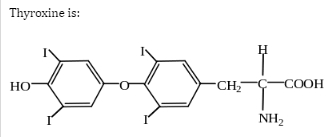
(A) Thyroxine,also known as $T_4$,is a hormone produced by the thyroid gland.
Its chemical structure contains four iodine atoms,as shown in the provided image.
Iodine is an essential component for the synthesis of thyroid hormones.
Insulin is a peptide hormone,testosterone is a steroid hormone,and adrenaline is an amino acid derivative (catecholamine),none of which contain iodine.
Its chemical structure contains four iodine atoms,as shown in the provided image.
Iodine is an essential component for the synthesis of thyroid hormones.
Insulin is a peptide hormone,testosterone is a steroid hormone,and adrenaline is an amino acid derivative (catecholamine),none of which contain iodine.
0 likes
View Solution126
MediumMCQ
$BMR$ is controlled by
A
Thyroxine
B
$ADH$
C
Aldosterone
D
Growth hormone
Solution
(A) $BMR$ (Basal Metabolic Rate) of an organism is the minimum rate of energy conversion required just to stay alive during complete rest or sleep.
$BMR$ is primarily regulated by the thyroxine hormone,which is secreted by the thyroid gland.
Thyroxine increases the rate of cellular respiration and metabolic activities in the body,thereby maintaining the basal metabolic rate.
$BMR$ is primarily regulated by the thyroxine hormone,which is secreted by the thyroid gland.
Thyroxine increases the rate of cellular respiration and metabolic activities in the body,thereby maintaining the basal metabolic rate.
0 likes
View Solution127
EasyMCQ
Which of the following disorders is related to the thyroid gland?
A
Diabetes mellitus
B
Hypercalcemia
C
Osteoporosis
D
Myxoedema
Solution
(D) $Myxoedema$ is caused due to the under-secretion of thyroid hormones in adults.
It is also known as $Gull's$ disease.
It is characterized by a puffy appearance due to the subcutaneous accumulation of fat, low $BMR$ (Basal Metabolic Rate), and a decreased heart rate.
It is also known as $Gull's$ disease.
It is characterized by a puffy appearance due to the subcutaneous accumulation of fat, low $BMR$ (Basal Metabolic Rate), and a decreased heart rate.
0 likes
View Solution128
MediumMCQ
Cretinism,mental retardation,low intelligence quotient,abnormal skin,deaf-mutism,etc.,are the results of:
A
Hyperthyroidism
B
Hypothyroidism
C
Hypercalcemia
D
Exophthalmic goitre
Solution
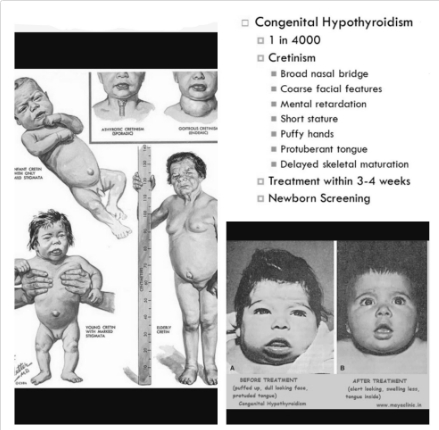
(B) Hypothyroidism during pregnancy causes defective development and maturation of the growing baby,leading to stunted growth (cretinism),mental retardation,low intelligence quotient,abnormal skin,and deaf-mutism.
In adult women,hypothyroidism may cause the menstrual cycle to become irregular.
In adult women,hypothyroidism may cause the menstrual cycle to become irregular.
0 likes
View Solution129
MediumMCQ
Select the incorrect option.
A
Thyroid gland is the largest endocrine gland in humans.
B
Thyroid secretes $T_{3}$ and $T_{4}$.
C
Thyroid gland is composed of follicle and stromal tissues.
D
Thyroid consists of four lobes.
Solution
(D) The thyroid gland is composed of two lobes,which are located on either side of the trachea. Both the lobes are interconnected with a thin flap of connective tissue called the isthmus. Therefore,the statement that the thyroid consists of four lobes is incorrect.
0 likes
View Solution130
MediumMCQ
Consider the following statements with respect to Calcitonin:
$I$. It is non-iodised.
$II$. It is secreted by parafollicular cells.
$III$. It regulates the calcium level in blood.
$IV$. It is also called as $TCT$ (Thyrocalcitonin).
$V$. It is a hyperglycemic agent.
Select the option containing correct statements from the above given statements.
$I$. It is non-iodised.
$II$. It is secreted by parafollicular cells.
$III$. It regulates the calcium level in blood.
$IV$. It is also called as $TCT$ (Thyrocalcitonin).
$V$. It is a hyperglycemic agent.
Select the option containing correct statements from the above given statements.
A
$I, II, III$ and $V$
B
$I, II, III$ and $IV$
C
$I, III, IV$ and $V$
D
$II, III, IV$ and $V$
Solution
(B) Calcitonin,also known as Thyrocalcitonin $(TCT)$,is a peptide hormone.
$1$. It is non-iodised,distinguishing it from the thyroid hormones $T_3$ and $T_4$.
$2$. It is secreted by the parafollicular cells (also called $C$-cells) of the thyroid gland.
$3$. It regulates the calcium level in the blood by lowering it,hence it is a hypocalcemic hormone.
$4$. It is correctly referred to as $TCT$ (Thyrocalcitonin).
$5$. It is $NOT$ a hyperglycemic agent; it has no role in glucose metabolism. Hyperglycemic agents increase blood glucose levels (e.g.,glucagon).
Therefore,statements $I, II, III$,and $IV$ are correct.
$1$. It is non-iodised,distinguishing it from the thyroid hormones $T_3$ and $T_4$.
$2$. It is secreted by the parafollicular cells (also called $C$-cells) of the thyroid gland.
$3$. It regulates the calcium level in the blood by lowering it,hence it is a hypocalcemic hormone.
$4$. It is correctly referred to as $TCT$ (Thyrocalcitonin).
$5$. It is $NOT$ a hyperglycemic agent; it has no role in glucose metabolism. Hyperglycemic agents increase blood glucose levels (e.g.,glucagon).
Therefore,statements $I, II, III$,and $IV$ are correct.
0 likes
View Solution131
MediumMCQ
$I.$ Regulation of $BMR$
$II.$ Supports the process of $RBC$ formation
$III.$ Controls the metabolism of carbohydrates,proteins and fat
$IV.$ Maintenance of water and electrolyte balance
$V.$ Secretion of $TCT$ hormone
Functions written above belong to which of the following glands?
$II.$ Supports the process of $RBC$ formation
$III.$ Controls the metabolism of carbohydrates,proteins and fat
$IV.$ Maintenance of water and electrolyte balance
$V.$ Secretion of $TCT$ hormone
Functions written above belong to which of the following glands?
A
Thyroid gland
B
Parathyroid gland
C
Adrenal gland
D
Pituitary gland
Solution
(A) The functions listed correspond to the thyroid gland:
$1.$ Regulation of $BMR$ (Basal Metabolic Rate).
$2.$ Supports the process of $RBC$ (Red Blood Cell) formation (erythropoiesis).
$3.$ Controls the metabolism of carbohydrates,proteins,and fats.
$4.$ Maintenance of water and electrolyte balance.
$5.$ Secretion of $TCT$ (Thyrocalcitonin) hormone,which regulates blood calcium levels.
Therefore,the correct option is $A$.
$1.$ Regulation of $BMR$ (Basal Metabolic Rate).
$2.$ Supports the process of $RBC$ (Red Blood Cell) formation (erythropoiesis).
$3.$ Controls the metabolism of carbohydrates,proteins,and fats.
$4.$ Maintenance of water and electrolyte balance.
$5.$ Secretion of $TCT$ (Thyrocalcitonin) hormone,which regulates blood calcium levels.
Therefore,the correct option is $A$.
0 likes
View Solution132
MediumMCQ
$A$ is essential for the normal rate of hormone synthesis in the thyroid. Deficiency of iodine in our diet results in $B$ and enlargement of the thyroid gland,commonly called $C$. Select the correct combination for $A, B$,and $C$.
A
$A-Ferrous, B-goitre, C-hypothyroidism$
B
$A-Iodine, B-hypothyroidism, C-goitre$
C
$A-Ferric, B-goitre, C-hypothyroidism$
D
$A-Sodium, B-goitre, C-hypothyroidism$
Solution
(B) Iodine is essential for the normal rate of hormone synthesis in the thyroid gland.
Deficiency of iodine in our diet results in hypothyroidism (low production of thyroid hormones) and enlargement of the thyroid gland,a condition commonly called goitre.
Therefore,the correct combination is $A-Iodine, B-hypothyroidism, C-goitre$.
Deficiency of iodine in our diet results in hypothyroidism (low production of thyroid hormones) and enlargement of the thyroid gland,a condition commonly called goitre.
Therefore,the correct combination is $A-Iodine, B-hypothyroidism, C-goitre$.
0 likes
View Solution133
EasyMCQ
The largest endocrine gland is:
A
Pituitary
B
Adrenal
C
Thyroid
D
Pineal
Solution
(C) The thyroid gland is the largest endocrine gland in the human body. It is located in the neck,anterior to the thyroid cartilage.
0 likes
View Solution134
MediumMCQ
The thyroid gland is composed of $A$ lobes which are located on either side of the $B$. The lobes are interconnected with a thin flap of connective tissue called $C$. Select the correct combination for $A, B$ and $C$.
A
$A-3, B-\text{trachea}, C-\text{isthmus}$
B
$A-4, B-\text{trachea}, C-\text{isthmus}$
C
$A-2, B-\text{trachea}, C-\text{isthmus}$
D
$A-1, B-\text{trachea}, C-\text{isthmus}$
Solution
(C) The thyroid gland is a bilobed endocrine gland located on either side of the trachea in the neck region.
These two lobes are connected by a thin flap of connective tissue known as the isthmus.
Therefore, $A = 2$ (lobes), $B = \text{trachea}$, and $C = \text{isthmus}$.
The correct combination is $A-2, B-\text{trachea}, C-\text{isthmus}$.
These two lobes are connected by a thin flap of connective tissue known as the isthmus.
Therefore, $A = 2$ (lobes), $B = \text{trachea}$, and $C = \text{isthmus}$.
The correct combination is $A-2, B-\text{trachea}, C-\text{isthmus}$.
0 likes
View Solution135
MediumMCQ
$I.$ Hypothyroidism causes irregularity of the menstrual cycle.
$II.$ Hyperthyroidism adversely affects body physiology.
$III.$ Hypothyroidism causes cretinism.
$IV.$ Hypothyroidism causes goitre.
Which of the above statements are correct?
$II.$ Hyperthyroidism adversely affects body physiology.
$III.$ Hypothyroidism causes cretinism.
$IV.$ Hypothyroidism causes goitre.
Which of the above statements are correct?
A
$III$ and $IV$
B
$I, II$ and $IV$
C
$I, II$ and $III$
D
All of these
Solution
(D) $I.$ Hypothyroidism (low thyroid hormone levels) can lead to menstrual irregularities in women.
$II.$ Hyperthyroidism (excessive thyroid hormone levels) increases metabolic rate and adversely affects body physiology.
$III.$ Hypothyroidism during pregnancy causes defective development and maturation of the growing baby,leading to stunted growth (cretinism).
$IV.$ Hypothyroidism,often due to iodine deficiency,leads to the enlargement of the thyroid gland,a condition known as goitre.
Since all the given statements are scientifically correct,the correct option is $D$.
$II.$ Hyperthyroidism (excessive thyroid hormone levels) increases metabolic rate and adversely affects body physiology.
$III.$ Hypothyroidism during pregnancy causes defective development and maturation of the growing baby,leading to stunted growth (cretinism).
$IV.$ Hypothyroidism,often due to iodine deficiency,leads to the enlargement of the thyroid gland,a condition known as goitre.
Since all the given statements are scientifically correct,the correct option is $D$.
0 likes
View Solution136
MediumMCQ
$A$ hormone which maintains $BMR$,regulates the metabolism of proteins and erythropoiesis is
A
Adrenaline
B
Thymine
C
Thyroxine
D
Thymosin
Solution
(C) Thyroxine: This hormone maintains the $BMR$ (Basal Metabolic Rate),regulates the metabolism of carbohydrates,proteins,and fats,and supports the process of erythropoiesis (red blood cell formation).
Adrenaline: This hormone is released during stress and initiates the 'fight or flight' response.
Thymine: This is a nitrogenous base found in $DNA$,not a hormone.
Thymosin: This is a hormone secreted by the thymus gland that plays a major role in the differentiation of $T$-lymphocytes,which provide cell-mediated immunity.
Adrenaline: This hormone is released during stress and initiates the 'fight or flight' response.
Thymine: This is a nitrogenous base found in $DNA$,not a hormone.
Thymosin: This is a hormone secreted by the thymus gland that plays a major role in the differentiation of $T$-lymphocytes,which provide cell-mediated immunity.
0 likes
View Solution137
MediumMCQ
Cretinism can be prevented or cured by the administration of
A
Renin
B
Aldosterone
C
Glucagon
D
Thyroxine
Solution
(D) Cretinism is a condition characterized by stunted physical growth and mental retardation,which is caused by a deficiency of thyroid hormones during fetal development or early childhood.
Since the thyroid gland fails to secrete adequate amounts of thyroid hormones,the administration of $Thyroxine$ (a thyroid hormone) can prevent or treat this condition by restoring normal hormone levels in the body.
Since the thyroid gland fails to secrete adequate amounts of thyroid hormones,the administration of $Thyroxine$ (a thyroid hormone) can prevent or treat this condition by restoring normal hormone levels in the body.
0 likes
View Solution138
MediumMCQ
$A$ gland $X$ is present over the surface of another gland $Y$. The latter secretes a hormone that controls the metabolism of proteins,fats,and carbohydrates. The $X$ and $Y$ are:
A
Parathyroid and thyroid gland,respectively
B
Thyroid and parathyroid gland,respectively
C
Adrenal gland and kidney,respectively
D
Thymus and heart,respectively
Solution
(A) Parathyroid glands (four in number) are present on the dorsal surface of the thyroid gland.
The thyroid gland secretes thyroxine (tetraiodothyronine) and triiodothyronine,which play a crucial role in regulating the basal metabolic rate $(BMR)$ and the metabolism of proteins,fats,and carbohydrates.
Therefore,$X$ is the parathyroid gland and $Y$ is the thyroid gland.
The thyroid gland secretes thyroxine (tetraiodothyronine) and triiodothyronine,which play a crucial role in regulating the basal metabolic rate $(BMR)$ and the metabolism of proteins,fats,and carbohydrates.
Therefore,$X$ is the parathyroid gland and $Y$ is the thyroid gland.
0 likes
View Solution139
MediumMCQ
The largest endocrine gland is:
A
Thyroid gland
B
Adrenal gland
C
Thymus
D
Pituitary gland
Solution
(A) The thyroid gland is the largest endocrine gland in the human body. It is located in the neck,anterior to the thyroid cartilage,and is responsible for producing hormones like thyroxine $(T_4)$ and triiodothyronine $(T_3)$,which regulate the body's metabolic rate.
0 likes
View Solution140
MediumMCQ
Failure of thyroid secretion from infancy leading to dwarfism and mental retardation is included under:
A
Grave's disease
B
Cretinism
C
Simple goitre
D
Myxoedema
Solution
(B) Failure of thyroid secretion from infancy leads to a condition known as $Cretinism$,which is characterized by stunted growth $(dwarfism)$,mental retardation,low intelligence quotient,abnormal skin,and deaf-mutism.
In contrast,the deficiency of thyroid hormone in adults causes $Myxoedema$ (also known as $Gull's$ disease),which is characterized by swelling of the face and hands.
In contrast,the deficiency of thyroid hormone in adults causes $Myxoedema$ (also known as $Gull's$ disease),which is characterized by swelling of the face and hands.
0 likes
View Solution141
MediumMCQ
Name the non-iodinised hormone secreted by parafollicular cells of the thyroid gland.
A
Calcitonin
B
Oxytocin
C
Vasopressin
D
Gonadotrophin
Solution
(A) The thyroid gland is composed of two types of cells: follicular cells and parafollicular cells (also known as $C$-cells).
Follicular cells secrete iodinated hormones like thyroxine $(T_4)$ and triiodothyronine $(T_3)$.
Parafollicular cells secrete a peptide hormone called calcitonin,which is non-iodinised.
Calcitonin plays a role in calcium homeostasis by lowering blood calcium levels.
Oxytocin,Vasopressin,and Gonadotrophins are hormones associated with the hypothalamus and pituitary gland,not the thyroid gland.
Follicular cells secrete iodinated hormones like thyroxine $(T_4)$ and triiodothyronine $(T_3)$.
Parafollicular cells secrete a peptide hormone called calcitonin,which is non-iodinised.
Calcitonin plays a role in calcium homeostasis by lowering blood calcium levels.
Oxytocin,Vasopressin,and Gonadotrophins are hormones associated with the hypothalamus and pituitary gland,not the thyroid gland.
0 likes
View Solution142
EasyMCQ
Symptoms like pot-bellied,pigeon-like chest,protruding tongue,and mental retardation are characteristic of:
A
Myxoedema
B
Cretinism
C
Cushing's Syndrome
D
Addison's disease
Solution
(B) Cretinism is caused by the deficiency of thyroid hormones (hypothyroidism) during fetal development or early childhood.
Key symptoms include stunted growth,mental retardation,low intelligence quotient $(IQ)$,abnormal skin,deaf-mutism,pot-bellied abdomen,pigeon-like chest,and a protruding tongue.
Myxoedema is caused by thyroid hormone deficiency in adults,characterized by puffy appearance and lack of alertness.
Cushing's Syndrome is caused by the oversecretion of cortisol,leading to obesity and muscle wasting.
Addison's disease is caused by the undersecretion of hormones from the adrenal cortex,leading to skin pigmentation and weakness.
Key symptoms include stunted growth,mental retardation,low intelligence quotient $(IQ)$,abnormal skin,deaf-mutism,pot-bellied abdomen,pigeon-like chest,and a protruding tongue.
Myxoedema is caused by thyroid hormone deficiency in adults,characterized by puffy appearance and lack of alertness.
Cushing's Syndrome is caused by the oversecretion of cortisol,leading to obesity and muscle wasting.
Addison's disease is caused by the undersecretion of hormones from the adrenal cortex,leading to skin pigmentation and weakness.
0 likes
View Solution143
EasyMCQ
Hyposecretion of which hormone is responsible for cretinism?
A
Thyroxine
B
Parathormone
C
Growth Hormone
D
Calcitonin
Solution
(A) Cretinism is caused by the hyposecretion of $Thyroxine$ (thyroid hormone) during early childhood.
This condition is characterized by stunted physical growth,mental retardation,low intelligence quotient,abnormal skin,and deaf-mutism.
This condition is characterized by stunted physical growth,mental retardation,low intelligence quotient,abnormal skin,and deaf-mutism.
0 likes
View Solution144
MediumMCQ
$A$: Thyroxine shows calorigenic effect.
$R$: Thyroxine increases catabolism,produces energy,and increases body temperature.
$R$: Thyroxine increases catabolism,produces energy,and increases body temperature.
A
Assertion and Reason both are correct and Reason is the correct explanation of Assertion.
B
Assertion and Reason both are correct but Reason is not the correct explanation of Assertion.
C
Assertion is correct,but Reason is incorrect.
D
Both Assertion and Reason are incorrect.
Solution
(A) Thyroxine shows a calorigenic effect because it increases the rate of catabolism in the body.
This process leads to the production of energy and an increase in body temperature.
The mechanism involves increased oxygen consumption and higher rates of $ATP$ hydrolysis,which releases heat as a byproduct.
This process leads to the production of energy and an increase in body temperature.
The mechanism involves increased oxygen consumption and higher rates of $ATP$ hydrolysis,which releases heat as a byproduct.
0 likes
View Solution145
EasyMCQ
Iodine is stored in which of the following glands in the body?
A
Pituitary gland
B
Thyroid gland
C
Parathyroid gland
D
Thymus
Solution
(B) The $Thyroid$ gland is the primary site for the storage of iodine in the human body.
Iodine is an essential trace element required for the synthesis of thyroid hormones,specifically $Thyroxine$ $(T_4)$ and $Triiodothyronine$ $(T_3)$.
The $Thyroid$ gland actively traps iodide ions from the blood and incorporates them into the protein $Thyroglobulin$ to produce these hormones.
Therefore,the correct option is $B$.
Iodine is an essential trace element required for the synthesis of thyroid hormones,specifically $Thyroxine$ $(T_4)$ and $Triiodothyronine$ $(T_3)$.
The $Thyroid$ gland actively traps iodide ions from the blood and incorporates them into the protein $Thyroglobulin$ to produce these hormones.
Therefore,the correct option is $B$.
0 likes
View Solution146
EasyMCQ
Which gland is responsible for maintaining the basal metabolic rate $(BMR)$?
A
Thymus
B
Parathyroid gland
C
Pituitary gland
D
Thyroid gland
Solution
(D) The thyroid gland secretes hormones like thyroxine $(T_4)$ and triiodothyronine $(T_3)$.
These hormones play a crucial role in regulating the basal metabolic rate $(BMR)$ of the body.
They also support the process of red blood cell formation and control the metabolism of carbohydrates,proteins,and fats.
Therefore,the correct answer is the thyroid gland.
These hormones play a crucial role in regulating the basal metabolic rate $(BMR)$ of the body.
They also support the process of red blood cell formation and control the metabolism of carbohydrates,proteins,and fats.
Therefore,the correct answer is the thyroid gland.
0 likes
View Solution147
MediumMCQ
Which of the following is $NOT$ a symptom of hypothyroidism in a growing child?
A
Stunted growth
B
Mental retardation
C
Exophthalmos
D
Abnormal skin
Solution
(C) Hypothyroidism in children leads to a condition known as cretinism.
Symptoms of cretinism include stunted growth,mental retardation,low intelligence quotient,abnormal skin,and deaf-mutism.
Exophthalmos (protrusion of eyeballs) is a characteristic symptom of hyperthyroidism (specifically Graves' disease),not hypothyroidism.
Therefore,the correct option is $C$.
Symptoms of cretinism include stunted growth,mental retardation,low intelligence quotient,abnormal skin,and deaf-mutism.
Exophthalmos (protrusion of eyeballs) is a characteristic symptom of hyperthyroidism (specifically Graves' disease),not hypothyroidism.
Therefore,the correct option is $C$.
0 likes
View Solution148
MediumMCQ
The thyroid gland is composed of $2$ lobes which are located on either side of the $trachea$.
A
Two,on either side of the bronchi
B
Two,on either side of the trachea
C
Four,on either side of the trachea
D
Four,on either side of the bronchi
Solution
(B) The thyroid gland is the largest endocrine gland in the human body.
It is composed of two lobes which are located on either side of the trachea (windpipe).
These lobes are interconnected with a thin flap of connective tissue called the isthmus.
It is composed of two lobes which are located on either side of the trachea (windpipe).
These lobes are interconnected with a thin flap of connective tissue called the isthmus.
0 likes
View Solution149
EasyMCQ
Hyperthyroidism causes which of the following diseases?
A
Cretinism
B
Goitre
C
Graves' disease
D
Addison's disease
Solution
(C) Hyperthyroidism is a condition caused by the over-secretion of thyroid hormones ($T_3$ and $T_4$).
Graves' disease is a form of hyperthyroidism characterized by an enlarged thyroid gland,protrusion of the eyeballs (exophthalmos),increased basal metabolic rate,and weight loss.
Cretinism is caused by hypothyroidism in children.
Goitre is typically associated with iodine deficiency (hypothyroidism).
Addison's disease is caused by the under-secretion of hormones from the adrenal cortex.
Graves' disease is a form of hyperthyroidism characterized by an enlarged thyroid gland,protrusion of the eyeballs (exophthalmos),increased basal metabolic rate,and weight loss.
Cretinism is caused by hypothyroidism in children.
Goitre is typically associated with iodine deficiency (hypothyroidism).
Addison's disease is caused by the under-secretion of hormones from the adrenal cortex.
0 likes
View SolutionChemical Coordination and Integration — Thyroid Gland · Frequently Asked Questions
1Are these Chemical Coordination and Integration questions useful for JEE and NEET?
Yes. All questions in this section are mapped to JEE Main and NEET exam patterns. Previous year questions from JEE Main, NEET, GUJCET and state-level exams are included with full solutions.
2Can I switch to Hindi or Gujarati for these questions?
Yes. Use the language tabs in the hero section or the sidebar to view the same questions and solutions in English, Hindi or Gujarati.
3How do I generate a question paper from this subtopic?
Use the Vedclass Exam Paper Generator — select the chapter and subtopic, set difficulty, and generate Sets A, B, C, D automatically. First 3 chapters of every subject are free.
Vedclass Products
For Students
Vedclass Test Series
Mock tests in real JEE/NEET style with performance analysis. 5-day free trial.
Start Free TrialFor Teachers
Exam Paper Generator
Generate Set A/B/C/D papers from this chapter in 2 minutes. 3 chapters free.
Try FreeFor Institutes
Online Exam Module
Live online exams with unlimited students, 360° analytics & white-label branding.
See DemoFor Teachers & Institutes
Generate a Chemical Coordination and Integration Exam Paper in 2 Minutes
Select subtopic & difficulty — Sets A, B, C, D auto-generated with No Repeat logic.
First 3 chapters of every subject are free — no payment required.