
A English
Parathyroid Gland Questions in English
Class 11 Biology · Chemical Coordination and Integration · Parathyroid Gland
64+
Questions
English
Language
100%
With Solutions
Showing 49 of 64 questions in English
1
MediumMCQ
Proper development of the bone depends on
A
Epinephrine
B
Thyroxine
C
Parathormone
D
Vasopressin
Solution
(C) The proper development and maintenance of bone tissue depend significantly on the hormone $Parathormone$ $(PTH)$,which is secreted by the parathyroid glands.
$PTH$ regulates calcium homeostasis in the blood by stimulating the release of calcium from bones into the bloodstream when blood calcium levels are low.
Additionally,$PTH$ promotes the activity of osteoclasts,which are cells responsible for bone resorption and remodeling,ensuring that bone structure remains healthy and functional.
While other hormones like $Thyroxine$ influence general metabolism and growth,$Parathormone$ is specifically critical for the mineral balance and structural integrity of the skeletal system.
$PTH$ regulates calcium homeostasis in the blood by stimulating the release of calcium from bones into the bloodstream when blood calcium levels are low.
Additionally,$PTH$ promotes the activity of osteoclasts,which are cells responsible for bone resorption and remodeling,ensuring that bone structure remains healthy and functional.
While other hormones like $Thyroxine$ influence general metabolism and growth,$Parathormone$ is specifically critical for the mineral balance and structural integrity of the skeletal system.
0 likes
View Solution2
MediumMCQ
Hypoparathyroidism results in:
A
Upset in metabolism
B
Improper gonadal function
C
Convulsions and tetany
D
Nervousness and wasting
Solution
(C) Hypoparathyroidism is a condition characterized by the under-secretion of parathyroid hormone $(PTH)$.
$PTH$ is responsible for maintaining calcium levels in the blood.
$A$ deficiency of $PTH$ leads to hypocalcemia (low blood calcium levels).
Low levels of calcium in the blood and extracellular fluid increase the excitability of nerves and muscles,leading to involuntary muscle contractions,spasms,and tremors,a condition known as tetany.
Severe cases can also lead to convulsions.
$PTH$ is responsible for maintaining calcium levels in the blood.
$A$ deficiency of $PTH$ leads to hypocalcemia (low blood calcium levels).
Low levels of calcium in the blood and extracellular fluid increase the excitability of nerves and muscles,leading to involuntary muscle contractions,spasms,and tremors,a condition known as tetany.
Severe cases can also lead to convulsions.
0 likes
View Solution3
MediumMCQ
Parathormone induces
A
Increase in serum calcium level
B
Decrease in serum potassium level
C
Increase in blood sugar level
D
Decrease in blood sugar level
Solution
(A) $Parathormone$ $(PTH)$ is a peptide hormone secreted by the parathyroid gland.
Its primary function is to regulate calcium homeostasis in the body.
It acts on bones to stimulate the process of bone resorption (dissolution/demineralization),which releases calcium into the blood.
Additionally,it promotes the reabsorption of calcium by the renal tubules and increases calcium absorption from the digested food in the intestine.
Therefore,$PTH$ increases the level of calcium ions in the blood (serum calcium level).
Its primary function is to regulate calcium homeostasis in the body.
It acts on bones to stimulate the process of bone resorption (dissolution/demineralization),which releases calcium into the blood.
Additionally,it promotes the reabsorption of calcium by the renal tubules and increases calcium absorption from the digested food in the intestine.
Therefore,$PTH$ increases the level of calcium ions in the blood (serum calcium level).
0 likes
View Solution4
MediumMCQ
If the parathyroid gland of a child is removed,which activity is disturbed?
A
Growth
B
Calcium concentration
C
Potassium concentration
D
None of these
Solution
(B) The parathyroid gland secretes Parathyroid Hormone $(PTH)$,which is a peptide hormone that plays a crucial role in regulating calcium levels in the blood.
$PTH$ increases the level of calcium ions $(Ca^{2+})$ in the blood by acting on bones (stimulating bone resorption),kidneys (increasing calcium reabsorption),and the intestine (increasing calcium absorption).
If the parathyroid gland is removed,the production of $PTH$ stops,leading to a significant decrease in blood calcium levels (hypocalcemia).
This disruption in calcium homeostasis affects various physiological processes,including muscle contraction and nerve impulse transmission.
$PTH$ increases the level of calcium ions $(Ca^{2+})$ in the blood by acting on bones (stimulating bone resorption),kidneys (increasing calcium reabsorption),and the intestine (increasing calcium absorption).
If the parathyroid gland is removed,the production of $PTH$ stops,leading to a significant decrease in blood calcium levels (hypocalcemia).
This disruption in calcium homeostasis affects various physiological processes,including muscle contraction and nerve impulse transmission.
0 likes
View Solution5
MediumMCQ
Tetany $(Irregular \text{ muscle contraction})$ and osteoporosis are caused due to the deficiency of
A
Cortisone
B
Estrogen
C
Insulin
D
Parathormone
Solution
(D) The correct answer is $(d)$.
Parathormone $(PTH)$ is secreted by the parathyroid gland and regulates calcium levels in the blood.
Hypoparathyroidism (deficiency of $PTH$) leads to hypocalcemia (low blood calcium levels), which causes skeletal muscles to fail to relax, resulting in tetany.
Conversely, hyperparathyroidism (excess of $PTH$) leads to the excessive dissolution of bone (demineralization), which causes osteoporosis and hypercalcemia.
Parathormone $(PTH)$ is secreted by the parathyroid gland and regulates calcium levels in the blood.
Hypoparathyroidism (deficiency of $PTH$) leads to hypocalcemia (low blood calcium levels), which causes skeletal muscles to fail to relax, resulting in tetany.
Conversely, hyperparathyroidism (excess of $PTH$) leads to the excessive dissolution of bone (demineralization), which causes osteoporosis and hypercalcemia.
0 likes
View Solution6
MediumMCQ
Parathormone is secreted during
A
Increased blood calcium level
B
Decreased blood calcium level
C
Increased blood sugar level
D
Decreased blood sugar level
Solution
(B) Parathormone $(PTH)$ is a peptide hormone secreted by the parathyroid glands.
Its primary function is to regulate calcium homeostasis in the blood.
When the blood calcium level decreases (hypocalcemia),the parathyroid glands are stimulated to release $PTH$.
$PTH$ acts on bones to stimulate the process of bone resorption (dissolution/demineralization),which releases calcium into the blood.
It also increases the reabsorption of calcium by the renal tubules and increases calcium absorption from the digested food in the intestine.
Thus,$PTH$ increases blood calcium levels and is secreted in response to low blood calcium levels.
Its primary function is to regulate calcium homeostasis in the blood.
When the blood calcium level decreases (hypocalcemia),the parathyroid glands are stimulated to release $PTH$.
$PTH$ acts on bones to stimulate the process of bone resorption (dissolution/demineralization),which releases calcium into the blood.
It also increases the reabsorption of calcium by the renal tubules and increases calcium absorption from the digested food in the intestine.
Thus,$PTH$ increases blood calcium levels and is secreted in response to low blood calcium levels.
0 likes
View Solution7
MediumMCQ
Parathormone in the blood causes
A
Hypocalcemia
B
Hyperglycemia
C
Hypercalcemia
D
None of the above
Solution
(C) Parathormone $(PTH)$ is a peptide hormone secreted by the parathyroid gland. Its primary function is to regulate calcium levels in the blood. When blood calcium levels are low,$PTH$ is released,which stimulates the resorption of bone,increases calcium reabsorption by the renal tubules,and promotes calcium absorption from digested food in the intestine. Consequently,it increases the blood calcium level,a condition known as hypercalcemia.
0 likes
View Solution8
MediumMCQ
Parathormone affects the absorption of calcium by regulating the metabolism of . . . . . . .
A
Vitamin $C$
B
Vitamin $D$
C
Vitamin $A$
D
Enterogastrone
Solution
(B) Parathormone $(PTH)$ is secreted by the parathyroid glands and plays a crucial role in maintaining calcium homeostasis in the blood.
It increases blood calcium levels by stimulating the absorption of calcium from the intestine.
This process is mediated by the activation of Vitamin $D$ (specifically,it promotes the conversion of calcidiol to calcitriol,the active form of Vitamin $D$ in the kidneys).
Therefore,Parathormone regulates calcium absorption by influencing the metabolism of Vitamin $D$.
It increases blood calcium levels by stimulating the absorption of calcium from the intestine.
This process is mediated by the activation of Vitamin $D$ (specifically,it promotes the conversion of calcidiol to calcitriol,the active form of Vitamin $D$ in the kidneys).
Therefore,Parathormone regulates calcium absorption by influencing the metabolism of Vitamin $D$.
0 likes
View Solution9
EasyMCQ
Parathormone $(PTH)$ regulates which of the following?
A
Blood calcium levels
B
Calcium-phosphate levels
C
Body temperature
D
None of the above
Solution
(A) Parathormone $(PTH)$ is a peptide hormone secreted by the parathyroid glands.
It plays a crucial role in maintaining calcium homeostasis in the blood.
$PTH$ increases the level of calcium ions in the blood by acting on bones (stimulating bone resorption),kidneys (increasing calcium reabsorption),and the digestive tract (indirectly by activating Vitamin $D$).
Therefore,it primarily regulates blood calcium levels.
It plays a crucial role in maintaining calcium homeostasis in the blood.
$PTH$ increases the level of calcium ions in the blood by acting on bones (stimulating bone resorption),kidneys (increasing calcium reabsorption),and the digestive tract (indirectly by activating Vitamin $D$).
Therefore,it primarily regulates blood calcium levels.
0 likes
View Solution10
MediumMCQ
Tetany in muscles is caused by the deficiency of:
A
Oxytocin
B
$STH$
C
$ADH$
D
Parathyroid hormone
Solution
(D) Tetany is a condition characterized by involuntary muscle contractions or spasms. It is primarily caused by hypocalcemia,which is a low level of calcium in the blood. The parathyroid hormone $(PTH)$ plays a crucial role in maintaining calcium homeostasis by increasing blood calcium levels. Therefore,a deficiency of parathyroid hormone leads to a decrease in blood calcium,resulting in tetany.
0 likes
View Solution11
EasyMCQ
What does parathormone regulate?
A
Metabolism of fatty acids
B
Metabolism of sodium and potassium
C
Metabolism of calcium and phosphate
D
Metabolism of proteins
Solution
(C) Parathormone $(PTH)$,secreted by the parathyroid gland,is a peptide hormone that plays a crucial role in calcium homeostasis.
It increases the levels of calcium ions $(Ca^{2+})$ in the blood by acting on bones (stimulating bone resorption/demineralization),kidneys (increasing reabsorption of $Ca^{2+}$),and the digestive tract (indirectly via vitamin $D$ activation).
Simultaneously,it decreases blood phosphate levels by promoting the excretion of phosphate ions in the urine.
Therefore,it regulates the metabolism of calcium and phosphate in the body.
It increases the levels of calcium ions $(Ca^{2+})$ in the blood by acting on bones (stimulating bone resorption/demineralization),kidneys (increasing reabsorption of $Ca^{2+}$),and the digestive tract (indirectly via vitamin $D$ activation).
Simultaneously,it decreases blood phosphate levels by promoting the excretion of phosphate ions in the urine.
Therefore,it regulates the metabolism of calcium and phosphate in the body.
0 likes
View Solution12
MediumMCQ
Hypersecretion of parathyroid hormone leads to:
A
Strengthening of bones due to increased calcium deposition.
B
Calcium deposition in various skeletal structures.
C
No effect on bone structure.
D
Weakening of bones due to excessive calcium loss.
Solution
(D) The parathyroid hormone $(PTH)$ is a peptide hormone that increases the level of calcium ions $(Ca^{2+})$ in the blood.
Hypersecretion of $PTH$ leads to excessive resorption of bone minerals,a process where calcium is pulled out from the bones into the bloodstream.
As a result,the bones lose their calcium content,become demineralized,and consequently become weak and brittle.
This condition is often associated with osteoporosis or osteitis fibrosa cystica.
Hypersecretion of $PTH$ leads to excessive resorption of bone minerals,a process where calcium is pulled out from the bones into the bloodstream.
As a result,the bones lose their calcium content,become demineralized,and consequently become weak and brittle.
This condition is often associated with osteoporosis or osteitis fibrosa cystica.
0 likes
View Solution13
MediumMCQ
Which of the following pairs of hormone and its associated disease is correct?
A
Relaxin - Gigantism
B
Prolactin - Dwarfism
C
Parathyroid hormone - Tetany
D
Insulin - Diabetes insipidus
Solution
(C) The correct pair is $C$.
$1$. Parathyroid hormone $(PTH)$ regulates calcium levels in the blood. $A$ deficiency of $PTH$ leads to low blood calcium levels,which causes involuntary muscle contractions and spasms,a condition known as Tetany.
$2$. Gigantism is caused by the over-secretion of Growth Hormone $(GH)$.
$3$. Dwarfism is caused by the under-secretion of Growth Hormone $(GH)$.
$4$. Diabetes insipidus is caused by the deficiency of Vasopressin $(ADH)$,not Insulin. Insulin deficiency leads to Diabetes mellitus.
$1$. Parathyroid hormone $(PTH)$ regulates calcium levels in the blood. $A$ deficiency of $PTH$ leads to low blood calcium levels,which causes involuntary muscle contractions and spasms,a condition known as Tetany.
$2$. Gigantism is caused by the over-secretion of Growth Hormone $(GH)$.
$3$. Dwarfism is caused by the under-secretion of Growth Hormone $(GH)$.
$4$. Diabetes insipidus is caused by the deficiency of Vasopressin $(ADH)$,not Insulin. Insulin deficiency leads to Diabetes mellitus.
0 likes
View Solution14
MediumMCQ
In humans,the removal of the parathyroid gland results in:
A
Acromegaly
B
Tetany
C
Polyuria
D
Diabetes mellitus
Solution
(B) The parathyroid gland secretes Parathyroid Hormone $(PTH)$,which regulates blood calcium levels by increasing calcium absorption from bones and kidneys.
Removal of the parathyroid gland leads to a significant decrease in blood calcium levels $(hypocalcemia)$.
Low calcium levels increase the excitability of nerves and muscles,leading to sustained muscle contractions or spasms,a condition known as Tetany.
Removal of the parathyroid gland leads to a significant decrease in blood calcium levels $(hypocalcemia)$.
Low calcium levels increase the excitability of nerves and muscles,leading to sustained muscle contractions or spasms,a condition known as Tetany.
0 likes
View Solution15
MediumMCQ
Which of the following causes an increase in blood calcium levels?
A
Both Calcitonin and Parathormone
B
Parathormone
C
Calcitonin
D
Thyroxine
Solution
(B) The parathyroid gland secretes a peptide hormone called Parathyroid Hormone $(PTH)$,also known as Parathormone.
$PTH$ increases the $Ca^{2+}$ levels in the blood.
It acts on bones and stimulates the process of bone resorption (dissolution/demineralization).
It also stimulates reabsorption of $Ca^{2+}$ by the renal tubules and increases $Ca^{2+}$ absorption from the digested food.
In contrast,Calcitonin is a thyroid hormone that lowers blood calcium levels.
Therefore,Parathormone is the correct answer.
$PTH$ increases the $Ca^{2+}$ levels in the blood.
It acts on bones and stimulates the process of bone resorption (dissolution/demineralization).
It also stimulates reabsorption of $Ca^{2+}$ by the renal tubules and increases $Ca^{2+}$ absorption from the digested food.
In contrast,Calcitonin is a thyroid hormone that lowers blood calcium levels.
Therefore,Parathormone is the correct answer.
0 likes
View Solution16
MediumMCQ
Parathormone is secreted during:
A
When blood calcium level increases
B
When blood calcium level decreases
C
When blood sugar level increases
D
When blood sugar level decreases
Solution
(B) The parathyroid gland secretes a peptide hormone called Parathyroid Hormone $(PTH)$.
$PTH$ is a hypercalcemic hormone,meaning it increases the levels of calcium ions $(Ca^{2+})$ in the blood.
It is secreted in response to low levels of calcium in the blood to restore homeostasis.
Therefore,$PTH$ is secreted when the blood calcium level decreases.
$PTH$ is a hypercalcemic hormone,meaning it increases the levels of calcium ions $(Ca^{2+})$ in the blood.
It is secreted in response to low levels of calcium in the blood to restore homeostasis.
Therefore,$PTH$ is secreted when the blood calcium level decreases.
0 likes
View Solution17
MediumMCQ
Deficiency of parathormone in humans leads to .....
A
Hypercalcemia
B
Hypocalcemia
C
Goiter
D
All of these
Solution
(B) Parathormone $(PTH)$ is a peptide hormone secreted by the parathyroid gland that increases blood calcium levels $(Ca^{2+})$.
Deficiency of $PTH$ leads to a decrease in blood calcium levels,a condition known as hypocalcemia.
This condition can cause tetany,which is characterized by sustained muscle contractions due to low calcium levels in the extracellular fluid.
Deficiency of $PTH$ leads to a decrease in blood calcium levels,a condition known as hypocalcemia.
This condition can cause tetany,which is characterized by sustained muscle contractions due to low calcium levels in the extracellular fluid.
0 likes
View Solution18
EasyMCQ
What is the normal range of blood calcium levels in an adult human?
A
$5 \, mg/dl$
B
$8.5 - 10.5 \, mg/dl$
C
$15.5 - 20 \, mg/dl$
D
$20 - 30 \, mg/dl$
Solution
(B) The normal concentration of calcium in the blood of an adult human is typically maintained between $8.5 \, mg/dl$ and $10.5 \, mg/dl$.
This level is tightly regulated by hormones such as parathyroid hormone $(PTH)$ and calcitonin to ensure proper physiological functions like muscle contraction,nerve impulse transmission,and blood clotting.
This level is tightly regulated by hormones such as parathyroid hormone $(PTH)$ and calcitonin to ensure proper physiological functions like muscle contraction,nerve impulse transmission,and blood clotting.
0 likes
View Solution19
EasyMCQ
Which of the following hormones was discovered by James Bertram Collip?
A
Parathyroid hormone
B
Thyroxine
C
$ADH$
D
Oxytocin
Solution
(A) James Bertram Collip was a Canadian biochemist who played a crucial role in the isolation of insulin. In $1925$,he successfully isolated the parathyroid hormone from the parathyroid glands. This discovery was significant for understanding calcium homeostasis in the body.
0 likes
View Solution20
MediumMCQ
Deformity in bones is caused due to the deficiency of which of the following?
A
$PTH$
B
Vitamin $D$
C
$STH$
D
Thyroxine
Solution
(B) Vitamin $D$ is essential for the absorption of calcium and phosphorus from the intestine,which are critical for bone mineralization.
Deficiency of Vitamin $D$ leads to improper bone development,causing conditions like rickets in children and osteomalacia in adults,which manifest as bone deformities.
$PTH$ (Parathyroid hormone) regulates calcium levels,but Vitamin $D$ deficiency is the primary cause of structural bone deformity due to lack of mineralization.
Deficiency of Vitamin $D$ leads to improper bone development,causing conditions like rickets in children and osteomalacia in adults,which manifest as bone deformities.
$PTH$ (Parathyroid hormone) regulates calcium levels,but Vitamin $D$ deficiency is the primary cause of structural bone deformity due to lack of mineralization.
0 likes
View Solution21
MediumMCQ
Parathyroid hormone $(PTH)$ acts in conjunction with which vitamin?
A
Vitamin $C$
B
Calciferol
C
Tocopherol
D
Vitamin $B_{12}$
Solution
(B) Parathyroid hormone $(PTH)$ is responsible for increasing blood calcium levels.
It works in conjunction with Vitamin $D$,which is also known as Calciferol.
Vitamin $D$ promotes the absorption of calcium from the digestive tract,while $PTH$ regulates the release of calcium from bones and its reabsorption in the kidneys.
Therefore,$PTH$ and Calciferol work together to maintain calcium homeostasis in the body.
It works in conjunction with Vitamin $D$,which is also known as Calciferol.
Vitamin $D$ promotes the absorption of calcium from the digestive tract,while $PTH$ regulates the release of calcium from bones and its reabsorption in the kidneys.
Therefore,$PTH$ and Calciferol work together to maintain calcium homeostasis in the body.
0 likes
View Solution22
MediumMCQ
Parathormone $(PTH)$ induces which of the following?
A
Hypercalcemia
B
Hyperglycemia
C
Hyperkalemia
D
Both hypocalcemia and hypoglycemia
Solution
(A) Parathormone $(PTH)$ is a peptide hormone secreted by the parathyroid gland.
Its primary function is to increase the levels of calcium ions $(Ca^{2+})$ in the blood.
It achieves this by stimulating the resorption of bone,increasing calcium reabsorption by the renal tubules,and promoting calcium absorption from digested food in the intestine.
Since it raises blood calcium levels,this condition is known as hypercalcemia.
Therefore,the correct option is $A$.
Its primary function is to increase the levels of calcium ions $(Ca^{2+})$ in the blood.
It achieves this by stimulating the resorption of bone,increasing calcium reabsorption by the renal tubules,and promoting calcium absorption from digested food in the intestine.
Since it raises blood calcium levels,this condition is known as hypercalcemia.
Therefore,the correct option is $A$.
0 likes
View Solution23
EasyMCQ
The parathyroid hormone is a/an.....
A
Peptide
B
Carbohydrate
C
Lipid
D
Steroid
Solution
(A) The parathyroid hormone $(PTH)$ is a peptide hormone secreted by the parathyroid glands.
It plays a crucial role in regulating calcium levels in the blood by acting on bones,kidneys,and the intestine.
Since it is composed of a chain of amino acids,it is classified as a peptide hormone.
It plays a crucial role in regulating calcium levels in the blood by acting on bones,kidneys,and the intestine.
Since it is composed of a chain of amino acids,it is classified as a peptide hormone.
0 likes
View Solution24
EasyMCQ
The hormone responsible for the regulation of calcium and phosphorus metabolism is secreted by:
A
Pancreas
B
Thyroid
C
Thymus
D
Parathyroid
Solution
(D) The hormone responsible for the regulation of calcium and phosphorus metabolism is Parathyroid Hormone $(PTH)$.
$PTH$ is secreted by the parathyroid glands.
It increases the blood calcium levels by acting on bones (bone resorption) and stimulating calcium reabsorption by the renal tubules and increasing calcium absorption from digested food.
Therefore,the correct option is $D$.
$PTH$ is secreted by the parathyroid glands.
It increases the blood calcium levels by acting on bones (bone resorption) and stimulating calcium reabsorption by the renal tubules and increasing calcium absorption from digested food.
Therefore,the correct option is $D$.
0 likes
View Solution25
MediumMCQ
What is the result of a deficiency of parathormone $(PTH)$?
A
Decrease in blood calcium levels.
B
Increase in blood calcium levels.
C
Occurrence of osteoporosis.
D
Hyperkalemia.
Solution
(A) Parathormone $(PTH)$ is a peptide hormone secreted by the parathyroid gland. Its primary function is to increase the levels of calcium ions $(Ca^{2+})$ in the blood by stimulating bone resorption (dissolution/demineralization) and promoting calcium reabsorption by the renal tubules and digestive tract. Therefore,a deficiency of $PTH$ leads to a significant decrease in blood calcium levels,a condition known as hypocalcemia. This can result in tetany,characterized by violent muscle spasms.
0 likes
View Solution26
EasyMCQ
The hormone that maintains the levels of calcium and phosphorus in the blood is secreted by which of the following?
A
Thyroid
B
Parathyroid
C
Pituitary
D
Thymus
Solution
(B) The hormone responsible for maintaining calcium and phosphorus levels in the blood is Parathyroid Hormone $(PTH)$.
$PTH$ is secreted by the parathyroid glands.
It increases blood calcium levels by stimulating bone resorption (demineralization) and increasing calcium reabsorption by the renal tubules and intestinal absorption of calcium.
Therefore,the correct option is $B$.
$PTH$ is secreted by the parathyroid glands.
It increases blood calcium levels by stimulating bone resorption (demineralization) and increasing calcium reabsorption by the renal tubules and intestinal absorption of calcium.
Therefore,the correct option is $B$.
0 likes
View Solution27
MediumMCQ
Removal of the parathyroid gland in humans leads to .....
A
Tetanus
B
Simmonds' disease
C
Myxedema
D
Addison's disease
Solution
(A) The parathyroid glands secrete parathyroid hormone $(PTH)$,which regulates calcium levels in the blood.
Removal of the parathyroid glands leads to a significant decrease in blood calcium levels $(hypocalcemia)$.
Low calcium levels increase the excitability of nerves and muscles,resulting in sustained muscle contractions or spasms,a condition known as $tetany$ (often confused with tetanus,but in this context,it refers to hypocalcemic tetany).
Therefore,the removal of the parathyroid gland leads to $tetany$.
Removal of the parathyroid glands leads to a significant decrease in blood calcium levels $(hypocalcemia)$.
Low calcium levels increase the excitability of nerves and muscles,resulting in sustained muscle contractions or spasms,a condition known as $tetany$ (often confused with tetanus,but in this context,it refers to hypocalcemic tetany).
Therefore,the removal of the parathyroid gland leads to $tetany$.
0 likes
View Solution28
MediumMCQ
Parathyroid hormone is released when:
A
It is produced by the thyroid gland.
B
Blood calcium levels decrease.
C
It stimulates osteoblasts for new bone formation.
D
It stimulates the release of calcitonin.
Solution
(B) Parathyroid hormone $(PTH)$ is a peptide hormone secreted by the parathyroid gland.
Its primary function is to regulate the level of calcium ions $(Ca^{2+})$ in the blood.
When blood calcium levels decrease,the parathyroid gland is stimulated to secrete $PTH$.
$PTH$ stimulates the process of bone resorption (demineralization) and increases the reabsorption of calcium by the kidneys,thereby increasing the calcium levels in the blood.
Its primary function is to regulate the level of calcium ions $(Ca^{2+})$ in the blood.
When blood calcium levels decrease,the parathyroid gland is stimulated to secrete $PTH$.
$PTH$ stimulates the process of bone resorption (demineralization) and increases the reabsorption of calcium by the kidneys,thereby increasing the calcium levels in the blood.
0 likes
View Solution29
EasyMCQ
What does parathormone $(PTH)$ stimulate?
A
Increase in blood glucose levels
B
Decrease in blood calcium levels
C
Increase in blood calcium levels
D
Decrease in blood glucose levels
Solution
(C) Parathormone $(PTH)$ is a peptide hormone secreted by the parathyroid glands.
Its primary function is to regulate calcium homeostasis in the body.
$PTH$ acts on bones to stimulate the process of bone resorption (dissolution/demineralization),which releases calcium into the blood.
Additionally,it promotes the reabsorption of calcium by the renal tubules and increases calcium absorption from the digested food in the intestine.
Therefore,the overall effect of $PTH$ is to increase the blood calcium levels ($hypercalcemic$ hormone).
Its primary function is to regulate calcium homeostasis in the body.
$PTH$ acts on bones to stimulate the process of bone resorption (dissolution/demineralization),which releases calcium into the blood.
Additionally,it promotes the reabsorption of calcium by the renal tubules and increases calcium absorption from the digested food in the intestine.
Therefore,the overall effect of $PTH$ is to increase the blood calcium levels ($hypercalcemic$ hormone).
0 likes
View Solution30
MediumMCQ
Statement $P$: The hormones of the parathyroid gland are steroid in nature.
Statement $Q$: Muscles contain globular proteins.
Statement $Q$: Muscles contain globular proteins.
A
Statement $P$ and Statement $Q$ are correct.
B
Statement $P$ and Statement $Q$ are incorrect.
C
Statement $P$ is correct and Statement $Q$ is incorrect.
D
Statement $P$ is incorrect and Statement $Q$ is correct.
Solution
(D) Statement $P$ is incorrect because parathyroid hormone $(PTH)$ is a peptide hormone,not a steroid hormone. Steroid hormones are derived from cholesterol.
Statement $Q$ is correct because muscles contain contractile proteins like actin and myosin,which are globular or fibrous proteins. Specifically,actin exists in a globular form ($G$-actin) that polymerizes into fibrous form ($F$-actin).
Statement $Q$ is correct because muscles contain contractile proteins like actin and myosin,which are globular or fibrous proteins. Specifically,actin exists in a globular form ($G$-actin) that polymerizes into fibrous form ($F$-actin).
0 likes
View Solution31
EasyMCQ
Identify the type of hormone secreted by the parathyroid gland.
A
Peptide
B
Steroid
C
Biogenic amine
D
Cryogenic amine
Solution
(A) The parathyroid gland secretes parathyroid hormone $(PTH)$.
$PTH$ is a peptide hormone,which is composed of a chain of amino acids.
Peptide hormones are synthesized in the rough endoplasmic reticulum and processed in the Golgi apparatus.
Therefore,the correct classification for the hormone secreted by the parathyroid gland is a peptide hormone.
$PTH$ is a peptide hormone,which is composed of a chain of amino acids.
Peptide hormones are synthesized in the rough endoplasmic reticulum and processed in the Golgi apparatus.
Therefore,the correct classification for the hormone secreted by the parathyroid gland is a peptide hormone.
0 likes
View Solution32
EasyMCQ
Low $Ca^{++}$ in the body fluid may be the cause of
A
tetany
B
anaemia
C
angina pectoris
D
gout
Solution
(A) Tetany is a condition characterized by involuntary muscle spasms and twitching,particularly in the face,hands,and feet.
This condition is primarily caused by a significant reduction in the blood calcium $(Ca^{++})$ level.
$A$ decrease in $Ca^{++}$ levels can result from underactive parathyroid glands (hypoparathyroidism),rickets,or alkalosis.
Therefore,the correct option is $A$.
This condition is primarily caused by a significant reduction in the blood calcium $(Ca^{++})$ level.
$A$ decrease in $Ca^{++}$ levels can result from underactive parathyroid glands (hypoparathyroidism),rickets,or alkalosis.
Therefore,the correct option is $A$.
0 likes
View Solution33
MediumMCQ
The blood calcium level is lowered by the deficiency of
A
both calcitonin and parathormone
B
calcitonin
C
parathormone
D
thyroxine
Solution
(C) $Parathormone$ $(PTH)$ is secreted by the chief cells of the parathyroid gland and plays a crucial role in regulating calcium and phosphate metabolism.
It increases blood calcium levels by promoting calcium absorption from the intestine,enhancing calcium reabsorption from the renal tubules of the kidneys,and stimulating bone resorption.
Therefore,a deficiency of $Parathormone$ leads to a decrease in blood calcium levels,a condition known as hypocalcemia.
It increases blood calcium levels by promoting calcium absorption from the intestine,enhancing calcium reabsorption from the renal tubules of the kidneys,and stimulating bone resorption.
Therefore,a deficiency of $Parathormone$ leads to a decrease in blood calcium levels,a condition known as hypocalcemia.
0 likes
View Solution34
MediumMCQ
$A$ person is having problems with calcium and phosphorus metabolism in his body. Which one of the following glands may not be functioning properly?
A
Parotid
B
Pancreas
C
Thyroid
D
Parathyroid
Solution
(D) : Parathormone $(PTH)$ is secreted by the chief cells of the parathyroid gland,which regulates the metabolism of calcium and phosphate in the body.
It increases calcium absorption from the intestine and also enhances calcium resorption from the nephrons of the kidneys.
Therefore,a deficiency or improper functioning of the parathyroid gland leads to an imbalance in calcium and phosphorus levels,specifically resulting in low blood calcium levels $(hypocalcemia)$.
It increases calcium absorption from the intestine and also enhances calcium resorption from the nephrons of the kidneys.
Therefore,a deficiency or improper functioning of the parathyroid gland leads to an imbalance in calcium and phosphorus levels,specifically resulting in low blood calcium levels $(hypocalcemia)$.
0 likes
View Solution35
MediumMCQ
Parathormone deficiency produces muscle cramps or tetany as a result of:
A
Lowered blood $Ca^{2+}$
B
Enhanced blood $Na^+$
C
Enhanced blood glucose
D
Enhanced blood $Ca^{2+}$
Solution
(A) Parathormone $(PTH)$ is a peptide hormone secreted by the parathyroid glands that plays a crucial role in calcium homeostasis.
$PTH$ increases blood calcium levels by stimulating bone resorption (releasing $Ca^{2+}$ from bones into the blood),increasing calcium reabsorption by the renal tubules,and promoting calcium absorption from digested food in the intestine.
$A$ deficiency of $PTH$ (hypoparathyroidism) leads to a significant decrease in blood calcium levels (hypocalcemia).
Calcium ions are essential for the normal functioning of muscles and nerves.
Low levels of $Ca^{2+}$ in the extracellular fluid increase the excitability of nerve and muscle fibers,leading to involuntary muscle contractions,spasms,or tetany.
$PTH$ increases blood calcium levels by stimulating bone resorption (releasing $Ca^{2+}$ from bones into the blood),increasing calcium reabsorption by the renal tubules,and promoting calcium absorption from digested food in the intestine.
$A$ deficiency of $PTH$ (hypoparathyroidism) leads to a significant decrease in blood calcium levels (hypocalcemia).
Calcium ions are essential for the normal functioning of muscles and nerves.
Low levels of $Ca^{2+}$ in the extracellular fluid increase the excitability of nerve and muscle fibers,leading to involuntary muscle contractions,spasms,or tetany.
0 likes
View Solution36
MediumMCQ
$PTH$ is a
A
Hypercalcemic hormone
B
Hypocalcemic hormone
C
Endocalcemic hormone
D
Exocalcemic hormone
Solution
(A) The Parathyroid Hormone $(PTH)$ is secreted by the parathyroid glands.
It acts to increase the blood calcium levels $(Ca^{2+})$ in the body.
It achieves this by stimulating the bone resorption process (dissolution/demineralization),reabsorption of calcium by the renal tubules,and increasing calcium absorption from the digested food in the intestine.
Since it increases the level of calcium in the blood,it is termed a hypercalcemic hormone.
It acts to increase the blood calcium levels $(Ca^{2+})$ in the body.
It achieves this by stimulating the bone resorption process (dissolution/demineralization),reabsorption of calcium by the renal tubules,and increasing calcium absorption from the digested food in the intestine.
Since it increases the level of calcium in the blood,it is termed a hypercalcemic hormone.
0 likes
View Solution37
MediumMCQ
How does the parathyroid hormone $(PTH)$ increase the $Ca^{2+}$ levels in the body?
A
Acts on bones and stimulates the process of bone resorption.
B
Stimulates reabsorption of $Ca^{2+}$ by the renal tubules.
C
Increases $Ca^{2+}$ absorption from the digested food.
D
All of the above.
Solution
(D) The parathyroid hormone $(PTH)$ is a peptide hormone secreted by the parathyroid glands that plays a crucial role in calcium homeostasis.
$1$. It acts on bones and stimulates the process of bone resorption (dissolution/demineralization),which releases calcium into the blood.
$2$. It stimulates the reabsorption of $Ca^{2+}$ by the renal tubules in the kidneys,reducing calcium loss in urine.
$3$. It also increases the absorption of $Ca^{2+}$ from digested food in the gastrointestinal tract (indirectly by stimulating the synthesis of active Vitamin $D_3$).
Therefore,all the given options are correct.
$1$. It acts on bones and stimulates the process of bone resorption (dissolution/demineralization),which releases calcium into the blood.
$2$. It stimulates the reabsorption of $Ca^{2+}$ by the renal tubules in the kidneys,reducing calcium loss in urine.
$3$. It also increases the absorption of $Ca^{2+}$ from digested food in the gastrointestinal tract (indirectly by stimulating the synthesis of active Vitamin $D_3$).
Therefore,all the given options are correct.
0 likes
View Solution38
MediumMCQ
If a person has problems with the metabolism of calcium and phosphorus in their body,which of the following glands is not functioning properly?
A
Parotid
B
Pancreas
C
Thyroid
D
Parathyroid
Solution
(D) The $Parathyroid$ gland secretes $Parathyroid$ $Hormone$ $(PTH)$.
$PTH$ is a peptide hormone that plays a crucial role in regulating the levels of calcium and phosphorus in the blood.
It increases the blood calcium levels by stimulating bone resorption (dissolution/demineralization),reabsorption of calcium by the renal tubules,and increasing calcium absorption from the digested food.
Therefore,any dysfunction in the $Parathyroid$ gland directly impacts calcium and phosphorus metabolism.
$PTH$ is a peptide hormone that plays a crucial role in regulating the levels of calcium and phosphorus in the blood.
It increases the blood calcium levels by stimulating bone resorption (dissolution/demineralization),reabsorption of calcium by the renal tubules,and increasing calcium absorption from the digested food.
Therefore,any dysfunction in the $Parathyroid$ gland directly impacts calcium and phosphorus metabolism.
0 likes
View Solution39
MediumMCQ
$A$ deficiency of which of the following leads to a decrease in blood calcium levels?
A
Calcitonin
B
Thyroxine
C
Both Calcitonin and Parathormone
D
Parathormone
Solution
(D) Parathormone $(PTH)$ is a peptide hormone secreted by the parathyroid glands.
It plays a crucial role in maintaining calcium homeostasis in the blood.
$PTH$ increases the calcium levels in the blood by stimulating bone resorption (demineralization),increasing calcium reabsorption by the renal tubules,and promoting calcium absorption from digested food in the intestine.
Therefore,a deficiency of $PTH$ leads to a decrease in blood calcium levels,a condition known as hypocalcemia.
It plays a crucial role in maintaining calcium homeostasis in the blood.
$PTH$ increases the calcium levels in the blood by stimulating bone resorption (demineralization),increasing calcium reabsorption by the renal tubules,and promoting calcium absorption from digested food in the intestine.
Therefore,a deficiency of $PTH$ leads to a decrease in blood calcium levels,a condition known as hypocalcemia.
0 likes
View Solution40
MediumMCQ
The pituitary gland,by virtue of its tropic hormones,controls the secretory activity of other endocrine glands. Which one of the following endocrine glands can function independently of the pituitary gland?
A
Thyroid
B
Gonads
C
Adrenals
D
Parathyroid
Solution
(D) The pituitary gland acts as the master gland,regulating most other endocrine glands through its tropic hormones.
However,the parathyroid gland functions independently of the pituitary gland.
It secretes parathormone $(PTH)$,which regulates the levels of $Ca^{2+}$ and $PO_4^{3-}$ ions in the blood based on the body's calcium requirements,rather than being controlled by pituitary secretions.
However,the parathyroid gland functions independently of the pituitary gland.
It secretes parathormone $(PTH)$,which regulates the levels of $Ca^{2+}$ and $PO_4^{3-}$ ions in the blood based on the body's calcium requirements,rather than being controlled by pituitary secretions.
0 likes
View Solution41
MediumMCQ
Which of the following conditions will stimulate the parathyroid gland to release parathyroid hormone?
A
Fall in active Vitamin $D$ levels
B
Fall in blood $Ca^{+2}$ levels
C
Fall in bone $Ca^{+2}$ levels
D
Rise in blood $Ca^{+2}$ levels
Solution
(B) The parathyroid gland is primarily regulated by the concentration of calcium ions in the blood.
When blood $Ca^{+2}$ levels fall (hypocalcemia),the parathyroid glands are stimulated to secrete parathyroid hormone $(PTH)$.
$PTH$ acts to increase blood calcium levels by promoting bone resorption (releasing calcium from bones),increasing calcium reabsorption in the kidneys,and stimulating the absorption of calcium from the digestive tract via Vitamin $D$ activation.
Therefore,a fall in blood $Ca^{+2}$ levels is the specific stimulus for $PTH$ release.
When blood $Ca^{+2}$ levels fall (hypocalcemia),the parathyroid glands are stimulated to secrete parathyroid hormone $(PTH)$.
$PTH$ acts to increase blood calcium levels by promoting bone resorption (releasing calcium from bones),increasing calcium reabsorption in the kidneys,and stimulating the absorption of calcium from the digestive tract via Vitamin $D$ activation.
Therefore,a fall in blood $Ca^{+2}$ levels is the specific stimulus for $PTH$ release.
0 likes
View Solution42
Medium
Give detailed information regarding the location,hormones,and physiological effects of the parathyroid gland.
Solution
(N/A) In humans,four parathyroid glands are present on the back side of the thyroid gland,one pair each in the two lobes of the thyroid gland.
The parathyroid glands secrete a peptide hormone called parathyroid hormone $(PTH)$.
The secretion of $PTH$ is regulated by the circulating levels of $Ca^{++}$ ions in the blood.
$PTH$ increases the $Ca^{++}$ levels in the blood.
$PTH$ acts on bones and stimulates the process of bone resorption (dissolution/demineralisation).
$PTH$ also stimulates the reabsorption of $Ca^{++}$ by the renal tubules and increases $Ca^{++}$ absorption from the digested food.
Thus,$PTH$ is a hypercalcemic hormone,i.e.,it increases the blood $Ca^{++}$ levels. Along with $TCT$ (Thyrocalcitonin),it plays a significant role in calcium balance in the body.
The parathyroid glands secrete a peptide hormone called parathyroid hormone $(PTH)$.
The secretion of $PTH$ is regulated by the circulating levels of $Ca^{++}$ ions in the blood.
$PTH$ increases the $Ca^{++}$ levels in the blood.
$PTH$ acts on bones and stimulates the process of bone resorption (dissolution/demineralisation).
$PTH$ also stimulates the reabsorption of $Ca^{++}$ by the renal tubules and increases $Ca^{++}$ absorption from the digested food.
Thus,$PTH$ is a hypercalcemic hormone,i.e.,it increases the blood $Ca^{++}$ levels. Along with $TCT$ (Thyrocalcitonin),it plays a significant role in calcium balance in the body.
0 likes
View Solution43
Easy
Exchange of calcium between bone and extracellular fluid takes place under the influence of certain hormones.
$(a)$ What will happen if there is an excess of $Ca^{++}$ in the extracellular fluid?
$(b)$ What will happen if there is a very low amount of $Ca^{++}$ in the extracellular fluid?
$(a)$ What will happen if there is an excess of $Ca^{++}$ in the extracellular fluid?
$(b)$ What will happen if there is a very low amount of $Ca^{++}$ in the extracellular fluid?
Solution
(N/A) An excess level of $Ca^{++}$ in the extracellular fluid is often associated with hyperparathyroidism. This leads to excessive demineralization of bones. The bones become soft and brittle,a condition that can lead to osteoporosis.
$(b)$ $A$ low level of $Ca^{++}$ in the extracellular fluid is associated with hypoparathyroidism. This condition increases the excitability of muscles and nerves. As a result,it causes tetany,characterized by sustained spasms or contractions of the muscles in the larynx,face,and limbs.
$(b)$ $A$ low level of $Ca^{++}$ in the extracellular fluid is associated with hypoparathyroidism. This condition increases the excitability of muscles and nerves. As a result,it causes tetany,characterized by sustained spasms or contractions of the muscles in the larynx,face,and limbs.
0 likes
View Solution44
Easy
Calcium ion concentration in blood affects muscle contraction. Does it lead to tetany in certain cases? How will you correlate fluctuation in blood calcium with tetany?
Solution
(N/A) Muscle contraction requires the exposure of the active sites on the thin filament. This occurs when $Ca^{2+}$ ions bind to the regulatory protein troponin,forming a $Ca^{2+}-troponin$ complex.
This complex causes a conformational change in tropomyosin,which shifts to expose the myosin-binding sites on the actin filament.
Once these sites are exposed,myosin heads bind to actin,and the filaments slide over each other,resulting in muscle contraction.
When the $Ca^{2+}$ concentration in the cytosol decreases,the binding sites are covered again,and contraction ceases.
Tetany is a condition characterized by involuntary muscle spasms or contractions.
It is caused by a low level of $Ca^{2+}$ in the body fluids,often resulting from the hyposecretion of the parathyroid hormone $(PTH)$ due to the underactivity of the parathyroid gland.
Since $PTH$ is responsible for maintaining blood calcium levels,its deficiency leads to hypocalcemia,which causes increased neuromuscular excitability,leading to tetany.
This complex causes a conformational change in tropomyosin,which shifts to expose the myosin-binding sites on the actin filament.
Once these sites are exposed,myosin heads bind to actin,and the filaments slide over each other,resulting in muscle contraction.
When the $Ca^{2+}$ concentration in the cytosol decreases,the binding sites are covered again,and contraction ceases.
Tetany is a condition characterized by involuntary muscle spasms or contractions.
It is caused by a low level of $Ca^{2+}$ in the body fluids,often resulting from the hyposecretion of the parathyroid hormone $(PTH)$ due to the underactivity of the parathyroid gland.
Since $PTH$ is responsible for maintaining blood calcium levels,its deficiency leads to hypocalcemia,which causes increased neuromuscular excitability,leading to tetany.
0 likes
View Solution45
EasyMCQ
What is the function of $PTH$?
A
Decreases blood $Ca^{++}$ levels
B
Increases blood $Ca^{++}$ levels
C
Stimulates bone formation
D
Inhibits calcium reabsorption in kidneys
Solution
(B) $PTH$ (Parathyroid hormone) is a peptide hormone secreted by the parathyroid glands.
- Its primary function is to increase the $Ca^{++}$ levels in the blood.
- $PTH$ acts on bones and stimulates the process of bone resorption (dissolution/demineralisation),which releases calcium into the bloodstream.
- Additionally,it stimulates the reabsorption of $Ca^{++}$ by the renal tubules and increases $Ca^{++}$ absorption from the digested food in the intestine.
- Its primary function is to increase the $Ca^{++}$ levels in the blood.
- $PTH$ acts on bones and stimulates the process of bone resorption (dissolution/demineralisation),which releases calcium into the bloodstream.
- Additionally,it stimulates the reabsorption of $Ca^{++}$ by the renal tubules and increases $Ca^{++}$ absorption from the digested food in the intestine.
0 likes
View Solution46
EasyMCQ
Which hormone increases $Ca^{++}$ levels?
A
Thyrocalcitonin
B
Parathyroid hormone $(PTH)$
C
Insulin
D
Thyroxine
Solution
(B) $PTH$ (Parathyroid hormone) stimulates the reabsorption of $Ca^{++}$ by the renal tubules.
It also increases $Ca^{++}$ absorption from the digested food in the intestine.
Thus,$PTH$ is a hypercalcemic hormone,meaning it increases the blood $Ca^{++}$ levels.
It also increases $Ca^{++}$ absorption from the digested food in the intestine.
Thus,$PTH$ is a hypercalcemic hormone,meaning it increases the blood $Ca^{++}$ levels.
0 likes
View Solution47
MediumMCQ
Calcium level decreases in the blood due to hyposecretion of
A
Parathyroid hormone
B
Calcitonin
C
Thyroxine
D
Adrenaline
Solution
(A) Parathyroid hormone $(PTH)$ is secreted by the parathyroid glands.
$PTH$ is a hypercalcemic hormone,meaning it increases the level of calcium ions $(Ca^{2+})$ in the blood.
It achieves this by stimulating the process of bone resorption (dissolution/demineralization) by osteoclasts,which releases calcium into the blood.
It also promotes the reabsorption of calcium by the renal tubules and increases calcium absorption from the digested food in the intestine.
Therefore,the hyposecretion (under-secretion) of $PTH$ leads to a decrease in blood calcium levels,which can cause tetany (sustained muscle contractions).
Conversely,calcitonin is a hypocalcemic hormone that lowers blood calcium levels.
$PTH$ is a hypercalcemic hormone,meaning it increases the level of calcium ions $(Ca^{2+})$ in the blood.
It achieves this by stimulating the process of bone resorption (dissolution/demineralization) by osteoclasts,which releases calcium into the blood.
It also promotes the reabsorption of calcium by the renal tubules and increases calcium absorption from the digested food in the intestine.
Therefore,the hyposecretion (under-secretion) of $PTH$ leads to a decrease in blood calcium levels,which can cause tetany (sustained muscle contractions).
Conversely,calcitonin is a hypocalcemic hormone that lowers blood calcium levels.
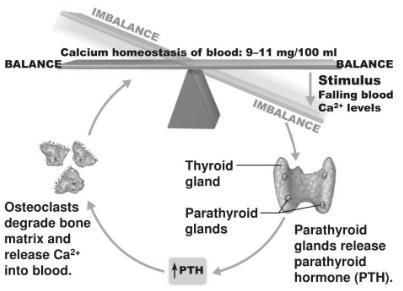
0 likes
View Solution48
MediumMCQ
Which of the following vitamins has some physiological effects similar to those of parathormone?
A
Vitamin-$A$
B
Vitamin-$D$
C
Vitamin-$C$
D
Vitamin-$B$
Solution
(B) Vitamin-$D$ and parathormone $(PTH)$ both play a crucial role in the regulation of calcium and phosphate levels in the body.
Parathormone increases blood calcium levels by stimulating bone resorption and increasing calcium reabsorption in the kidneys.
Vitamin-$D$ (specifically its active form,calcitriol) increases the absorption of calcium from the gastrointestinal tract,which complements the action of parathormone.
Vitamin-$C$ acts as an antioxidant and promotes wound healing.
Vitamin-$A$ is essential for normal vision and is involved in the formation of retinal pigments like rhodopsin and iodopsin.
Parathormone increases blood calcium levels by stimulating bone resorption and increasing calcium reabsorption in the kidneys.
Vitamin-$D$ (specifically its active form,calcitriol) increases the absorption of calcium from the gastrointestinal tract,which complements the action of parathormone.
Vitamin-$C$ acts as an antioxidant and promotes wound healing.
Vitamin-$A$ is essential for normal vision and is involved in the formation of retinal pigments like rhodopsin and iodopsin.
0 likes
View Solution49
MediumMCQ
Muscular tetany can be caused by the deficiency of:
A
Thyroxine
B
Oxytocin
C
$STH$
D
Parathyroid hormone
Solution
(D) Parathyroid hormone $(PTH)$ deficiency leads to an abnormally low level of ionized calcium in the blood (hypocalcemia).
This reduction in calcium levels increases the excitability of nerves and muscles,resulting in increased skeletal muscle tone and involuntary,painful muscle contractions known as hypocalcemic muscular tetany.
These spasms often cause characteristic bending inwards of the hands,forearms,and feet.
This reduction in calcium levels increases the excitability of nerves and muscles,resulting in increased skeletal muscle tone and involuntary,painful muscle contractions known as hypocalcemic muscular tetany.
These spasms often cause characteristic bending inwards of the hands,forearms,and feet.
0 likes
View SolutionChemical Coordination and Integration — Parathyroid Gland · Frequently Asked Questions
1Are these Chemical Coordination and Integration questions useful for JEE and NEET?
Yes. All questions in this section are mapped to JEE Main and NEET exam patterns. Previous year questions from JEE Main, NEET, GUJCET and state-level exams are included with full solutions.
2Can I switch to Hindi or Gujarati for these questions?
Yes. Use the language tabs in the hero section or the sidebar to view the same questions and solutions in English, Hindi or Gujarati.
3How do I generate a question paper from this subtopic?
Use the Vedclass Exam Paper Generator — select the chapter and subtopic, set difficulty, and generate Sets A, B, C, D automatically. First 3 chapters of every subject are free.
Vedclass Products
For Students
Vedclass Test Series
Mock tests in real JEE/NEET style with performance analysis. 5-day free trial.
Start Free TrialFor Teachers
Exam Paper Generator
Generate Set A/B/C/D papers from this chapter in 2 minutes. 3 chapters free.
Try FreeFor Institutes
Online Exam Module
Live online exams with unlimited students, 360° analytics & white-label branding.
See DemoFor Teachers & Institutes
Generate a Chemical Coordination and Integration Exam Paper in 2 Minutes
Select subtopic & difficulty — Sets A, B, C, D auto-generated with No Repeat logic.
First 3 chapters of every subject are free — no payment required.