
A English
The Pituitary Gland Questions in English
Class 11 Biology · Chemical Coordination and Integration · The Pituitary Gland
219+
Questions
English
Language
100%
With Solutions
Showing 50 of 219 questions in English
151
MediumMCQ
Which of the following is known as the birth hormone?
A
$ADH$
B
Relaxin
C
Oxytocin
D
Both $B$ and $C$
Solution
(C) The hormone $Oxytocin$ is known as the birth hormone because it acts on the uterine muscles of the mother and causes stronger uterine contractions,which leads to the expulsion of the baby from the uterus during parturition.
Relaxin is also secreted during the later stages of pregnancy to relax the pelvic ligaments and widen the birth canal,but $Oxytocin$ is specifically termed the 'birth hormone' due to its primary role in inducing labor contractions.
Relaxin is also secreted during the later stages of pregnancy to relax the pelvic ligaments and widen the birth canal,but $Oxytocin$ is specifically termed the 'birth hormone' due to its primary role in inducing labor contractions.
0 likes
View Solution152
EasyMCQ
Hormones stored and released from neurohypophysis are
A
Prolactin and Vasopressin
B
Thyroid stimulating hormone and Oxytocin
C
Oxytocin and Vasopressin
D
Follicle stimulating hormone and Leutinizing hormone
Solution
(C) Option $C$ is the correct answer.
The neurohypophysis (posterior pituitary) does not synthesize hormones itself; rather,it stores and releases two hormones: oxytocin and vasopressin (also known as antidiuretic hormone or $ADH$).
These hormones are synthesized by the hypothalamus and transported to the neurohypophysis via axonal transport.
Prolactin,thyroid-stimulating hormone $(TSH)$,follicle-stimulating hormone $(FSH)$,and luteinizing hormone $(LH)$ are synthesized and secreted by the adenohypophysis (anterior pituitary).
The neurohypophysis (posterior pituitary) does not synthesize hormones itself; rather,it stores and releases two hormones: oxytocin and vasopressin (also known as antidiuretic hormone or $ADH$).
These hormones are synthesized by the hypothalamus and transported to the neurohypophysis via axonal transport.
Prolactin,thyroid-stimulating hormone $(TSH)$,follicle-stimulating hormone $(FSH)$,and luteinizing hormone $(LH)$ are synthesized and secreted by the adenohypophysis (anterior pituitary).
0 likes
View Solution153
MediumMCQ
Oxytocin and $ADH$ are produced by the hypothalamus and released from:
A
Anterior pituitary
B
Posterior pituitary
C
Pineal gland
D
Thymus
Solution
(B) Oxytocin and anti-diuretic hormone $(ADH)$ are synthesized by the neurosecretory cells of the hypothalamus.
These hormones are transported axonally to the posterior pituitary (neurohypophysis).
From the posterior pituitary,they are stored and released into the bloodstream as required.
These hormones are transported axonally to the posterior pituitary (neurohypophysis).
From the posterior pituitary,they are stored and released into the bloodstream as required.
0 likes
View Solution154
MediumMCQ
$A$ circulatory system,which is formed by capillaries and ends with capillaries,is known as:
A
Renal
B
Hepatic
C
Double circulatory system
D
Hypophysial portal system
Solution
(D) portal system is defined as a system where a vein starts from capillaries and ends in another set of capillaries instead of directly returning to the heart.
In the $Hypophysial$ portal system,blood from the capillaries of the hypothalamus is collected by the $Hypophysial$ portal vein.
This vein then travels to the anterior lobe of the pituitary gland,where it breaks up into a second set of capillaries.
Therefore,it is a classic example of a portal system.
In the $Hypophysial$ portal system,blood from the capillaries of the hypothalamus is collected by the $Hypophysial$ portal vein.
This vein then travels to the anterior lobe of the pituitary gland,where it breaks up into a second set of capillaries.
Therefore,it is a classic example of a portal system.
0 likes
View Solution155
MediumMCQ
$ADH$ is secreted by
A
Anterior lobe of pituitary
B
Middle lobe of pituitary
C
Posterior lobe of pituitary
D
All of the above
Solution
(C) $ADH$ (Antidiuretic Hormone),also known as vasopressin,is synthesized by the hypothalamus and transported to the posterior lobe of the pituitary gland (neurohypophysis).
It is stored and released into the bloodstream from the posterior lobe of the pituitary gland.
Therefore,the posterior lobe of the pituitary is the site of secretion for $ADH$.
It is stored and released into the bloodstream from the posterior lobe of the pituitary gland.
Therefore,the posterior lobe of the pituitary is the site of secretion for $ADH$.
0 likes
View Solution156
EasyMCQ
$ADH$ is also called
A
Vasopressin
B
Prolactin
C
Urease
D
Oxytocin
Solution
(A) $ADH$ stands for Antidiuretic Hormone,which is secreted by the posterior pituitary gland.
It is also known as Vasopressin because it stimulates the constriction of blood vessels (vasoconstriction),which helps in increasing blood pressure.
Its primary function is to facilitate water reabsorption from the distal convoluted tubules and collecting ducts of the nephrons,thereby reducing urine volume.
It is also known as Vasopressin because it stimulates the constriction of blood vessels (vasoconstriction),which helps in increasing blood pressure.
Its primary function is to facilitate water reabsorption from the distal convoluted tubules and collecting ducts of the nephrons,thereby reducing urine volume.
0 likes
View Solution157
MediumMCQ
Which of the following is also known as antidiuretic hormone?
A
Oxytocin
B
Vasopressin
C
Adrenaline
D
Aldosterone
Solution
(B) Vasopressin is a hormone released by the posterior pituitary gland. It is also known as $ADH$ (antidiuretic hormone) because it helps in the reabsorption of water from the distal convoluted tubules and collecting ducts of the nephrons,thereby reducing the volume of urine produced.
0 likes
View Solution158
MediumMCQ
$A :$ Diabetes insipidus is marked by excessive urination and excessive thirst for water.
$R :$ Anti-diuretic hormone $(ADH)$ is synthesized by the posterior lobe of the pituitary gland.
$R :$ Anti-diuretic hormone $(ADH)$ is synthesized by the posterior lobe of the pituitary gland.
A
Assertion and Reason both are correct and Reason is the correct explanation of Assertion.
B
Assertion and Reason both are correct but Reason is not the correct explanation of Assertion.
C
Assertion is correct,but Reason is incorrect.
D
Both Assertion and Reason are incorrect.
Solution
(C) is correct: Diabetes insipidus is a condition characterized by the excretion of large amounts of dilute urine and extreme thirst (polydipsia) due to a deficiency of $ADH$.
$R$ is incorrect: $ADH$ (also known as vasopressin) is synthesized by the neurosecretory cells of the hypothalamus and is only stored and released by the posterior lobe of the pituitary gland. It is not synthesized by the posterior pituitary itself.
Therefore,the correct option is $C$.
$R$ is incorrect: $ADH$ (also known as vasopressin) is synthesized by the neurosecretory cells of the hypothalamus and is only stored and released by the posterior lobe of the pituitary gland. It is not synthesized by the posterior pituitary itself.
Therefore,the correct option is $C$.
0 likes
View Solution159
EasyMCQ
Which hormone is responsible for the contraction of the uterus?
A
Vasopressin
B
Oxytocin
C
Thyrotrophin
D
Gonadotrophin
Solution
(B) Oxytocin is a hormone secreted by the posterior lobe of the pituitary gland.
It stimulates the contraction of the smooth muscles of the uterus,which induces labour pain during childbirth.
Additionally,oxytocin induces the contraction of the myoepithelial cells of the mammary glands,facilitating the ejection of milk.
It stimulates the contraction of the smooth muscles of the uterus,which induces labour pain during childbirth.
Additionally,oxytocin induces the contraction of the myoepithelial cells of the mammary glands,facilitating the ejection of milk.
0 likes
View Solution160
EasyMCQ
The hormones oxytocin and vasopressin are secreted by
A
Neurohypophysis
B
Adenohypophysis
C
Pars intermedia
D
Adrenal medulla
Solution
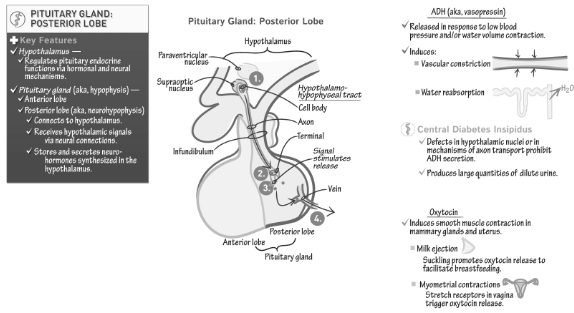
(A) The neurohypophysis,or posterior lobe of the pituitary gland,stores and releases two hormones,$i.e.$,oxytocin and vasopressin (also known as antidiuretic hormone or $ADH$).
These hormones are actually synthesized by the hypothalamus and transported to the neurohypophysis via axonal transport.
Oxytocin acts on the smooth muscles of our body and stimulates their contraction. In females,it stimulates a vigorous contraction of the uterus at the time of child birth,and milk ejection from the mammary gland.
Vasopressin acts mainly at the kidney and stimulates the resorption of water and electrolytes by the distal tubules and thereby reduces loss of water through urine (diuresis).
These hormones are actually synthesized by the hypothalamus and transported to the neurohypophysis via axonal transport.
Oxytocin acts on the smooth muscles of our body and stimulates their contraction. In females,it stimulates a vigorous contraction of the uterus at the time of child birth,and milk ejection from the mammary gland.
Vasopressin acts mainly at the kidney and stimulates the resorption of water and electrolytes by the distal tubules and thereby reduces loss of water through urine (diuresis).
0 likes
View Solution161
MediumMCQ
In human adult females,oxytocin:
A
Is secreted by anterior pituitary
B
Stimulates growth of mammary glands
C
Stimulates pituitary to secrete vasopressin
D
Causes strong uterine contractions during parturition
Solution
(D) Oxytocin is a hormone synthesized by the hypothalamus and stored and released by the posterior pituitary (neurohypophysis).
In adult females,its primary functions include:
$1$. It acts on the smooth muscles of the uterus and stimulates their vigorous contraction during childbirth (parturition).
$2$. It acts on the mammary glands to stimulate the 'milk-ejection reflex' (let-down reflex) after childbirth.
Therefore,option $D$ is the correct statement.
In adult females,its primary functions include:
$1$. It acts on the smooth muscles of the uterus and stimulates their vigorous contraction during childbirth (parturition).
$2$. It acts on the mammary glands to stimulate the 'milk-ejection reflex' (let-down reflex) after childbirth.
Therefore,option $D$ is the correct statement.
0 likes
View Solution162
EasyMCQ
$LH$ and $FSH$ are collectively called
A
Oxytocin
B
Somatotrophins
C
Luteotrophins
D
Gonadotrophins
Solution
(D) Most of the trophic (Trophe = nourishment) hormones are secreted by the anterior lobe of the pituitary gland.
Gonadotrophins or gonadotrophic hormones are those which stimulate the gonads (testes and ovaries),$e.g., FSH$ and $LH$.
Follicle-stimulating hormone $(FSH)$ stimulates the growth of ovarian follicles and the secretion of oestrogen in females,and spermatogenesis (formation of sperms) in males.
Luteinizing hormone $(LH)$ stimulates the corpus luteum of the ovary to secrete progesterone in females. In males,it activates the Leydig's (interstitial) cells of the testis to secrete androgens.
Gonadotrophins or gonadotrophic hormones are those which stimulate the gonads (testes and ovaries),$e.g., FSH$ and $LH$.
Follicle-stimulating hormone $(FSH)$ stimulates the growth of ovarian follicles and the secretion of oestrogen in females,and spermatogenesis (formation of sperms) in males.
Luteinizing hormone $(LH)$ stimulates the corpus luteum of the ovary to secrete progesterone in females. In males,it activates the Leydig's (interstitial) cells of the testis to secrete androgens.
0 likes
View Solution163
MediumMCQ
Acromegaly is due to hypersecretion of a hormone secreted from
A
Neurohypophysis
B
Adenohypophysis
C
Cells of Leydig
D
Pars intermedia
Solution
(B) The growth hormone,also known as somatotropin,is secreted by the anterior pituitary gland,which is also called the adenohypophysis.
In adults,the hypersecretion (overproduction) of this hormone leads to a condition known as acromegaly.
This condition is characterized by the elongation of the jaws and significant deformities in the bones of the face,hands,and feet.
In adults,the hypersecretion (overproduction) of this hormone leads to a condition known as acromegaly.
This condition is characterized by the elongation of the jaws and significant deformities in the bones of the face,hands,and feet.
0 likes
View Solution164
MediumMCQ
The smallest endocrine gland is
A
Thyroid
B
Parathyroid
C
Pituitary
D
Adrenal
Solution
(C) The pituitary gland is considered the smallest endocrine gland in the human body.
It is located in a bony cavity called the $sella \text{ } turcica$ of the sphenoid bone in the skull.
It is often referred to as the master endocrine gland because it regulates the activity of several other endocrine glands.
It is located in a bony cavity called the $sella \text{ } turcica$ of the sphenoid bone in the skull.
It is often referred to as the master endocrine gland because it regulates the activity of several other endocrine glands.
0 likes
View Solution165
MediumMCQ
Mammalian prolactin is secreted by
A
Adenohypophysis
B
Neurohypophysis
C
Adrenal cortex
D
Adrenal medulla
Solution
(A) The pituitary gland is divided into two main parts: the $Adenohypophysis$ (anterior pituitary) and the $Neurohypophysis$ (posterior pituitary).
$1$. $Adenohypophysis$: It secretes several hormones including Prolactin $(PRL)$, Growth Hormone $(GH)$, Thyroid Stimulating Hormone $(TSH)$, Adrenocorticotropic Hormone $(ACTH)$, Luteinizing Hormone $(LH)$, and Follicle Stimulating Hormone $(FSH)$. Prolactin is specifically responsible for regulating the growth of the mammary glands and the formation of milk in them.
$2$. $Neurohypophysis$: It stores and releases two hormones, Oxytocin and Vasopressin $(ADH)$, which are synthesized by the hypothalamus.
$3$. $Adrenal \text{ } cortex$: It secretes glucocorticoids (like cortisol) and mineralocorticoids (like aldosterone).
$4$. $Adrenal \text{ } medulla$: It secretes catecholamines like adrenaline (epinephrine) and noradrenaline (norepinephrine).
Therefore, prolactin is secreted by the $Adenohypophysis$.
$1$. $Adenohypophysis$: It secretes several hormones including Prolactin $(PRL)$, Growth Hormone $(GH)$, Thyroid Stimulating Hormone $(TSH)$, Adrenocorticotropic Hormone $(ACTH)$, Luteinizing Hormone $(LH)$, and Follicle Stimulating Hormone $(FSH)$. Prolactin is specifically responsible for regulating the growth of the mammary glands and the formation of milk in them.
$2$. $Neurohypophysis$: It stores and releases two hormones, Oxytocin and Vasopressin $(ADH)$, which are synthesized by the hypothalamus.
$3$. $Adrenal \text{ } cortex$: It secretes glucocorticoids (like cortisol) and mineralocorticoids (like aldosterone).
$4$. $Adrenal \text{ } medulla$: It secretes catecholamines like adrenaline (epinephrine) and noradrenaline (norepinephrine).
Therefore, prolactin is secreted by the $Adenohypophysis$.
0 likes
View Solution166
MediumMCQ
The formation of egg and sperm is affected by
A
$LH$
B
$MH$
C
$TSH$
D
$FSH$
Solution
(D) $FSH$ (Follicle Stimulating Hormone) is secreted from the anterior lobe of the pituitary gland.
It is secreted in both males and females.
In males,$FSH$ stimulates spermatogenesis and the development of seminiferous tubules.
In females,it stimulates the formation and growth of ovarian follicles in the ovary.
It is secreted in both males and females.
In males,$FSH$ stimulates spermatogenesis and the development of seminiferous tubules.
In females,it stimulates the formation and growth of ovarian follicles in the ovary.
0 likes
View Solution167
MediumMCQ
Hyposecretion of growth hormone causes
A
Dwarfism
B
Cretinism
C
Myxoedema
D
Acromegaly
Solution
(A) Dwarfism is caused by the deficiency of growth hormone $(GH)$ during childhood.
It is characterized by a small but well-proportioned body and sexual immaturity.
Acromegaly occurs due to the hypersecretion of growth hormone in adults.
Cretinism and Myxoedema are caused due to the hyposecretion of thyroid hormones.
It is characterized by a small but well-proportioned body and sexual immaturity.
Acromegaly occurs due to the hypersecretion of growth hormone in adults.
Cretinism and Myxoedema are caused due to the hyposecretion of thyroid hormones.
0 likes
View Solution168
MediumMCQ
Hyposecretion of which of the following can cause diabetes insipidus?
A
Insulin
B
Thyroxine
C
Glucagon
D
$ADH$
Solution
(D) Deficiency of anti-diuretic hormone $(ADH)$,also known as vasopressin,leads to diabetes insipidus.
In this condition,the kidneys are unable to conserve water,leading to frequent and copious urination.
This results in excessive loss of water from the body,causing severe dehydration and intense thirst.
In this condition,the kidneys are unable to conserve water,leading to frequent and copious urination.
This results in excessive loss of water from the body,causing severe dehydration and intense thirst.
0 likes
View Solution169
MediumMCQ
The abbreviation $TSH$ stands for
A
Thymine stimulating hormone
B
Thyroxine stimulating hormone
C
Thyroid stimulating hormone
D
None of the above
Solution
(C) $TSH$ stands for Thyroid Stimulating Hormone.
It is a hormone produced by the anterior pituitary gland that stimulates the thyroid gland to produce thyroxine $(T_4)$ and triiodothyronine $(T_3)$.
It is a hormone produced by the anterior pituitary gland that stimulates the thyroid gland to produce thyroxine $(T_4)$ and triiodothyronine $(T_3)$.
0 likes
View Solution170
MediumMCQ
$GnRH$ stimulates . . . . . . $A$ . . . . . . to produce/release . . . . . . $B$ . . . . . . .
A
$A$-Pituitary,$B$-Growth Hormone
B
$A$-Pituitary,$B$-Gonadotropins
C
$A$-Testis,$B$-Testosterone
D
$A$-Hypothalamus,$B$-Oxytocin
Solution
(B) $GnRH$ (Gonadotropin Releasing Hormone) is secreted by the hypothalamus.
It acts on the anterior pituitary gland to stimulate the synthesis and release of gonadotropins ($LH$ and $FSH$).
Therefore,$A$ is the pituitary gland and $B$ is gonadotropins.
It acts on the anterior pituitary gland to stimulate the synthesis and release of gonadotropins ($LH$ and $FSH$).
Therefore,$A$ is the pituitary gland and $B$ is gonadotropins.
0 likes
View Solution171
MediumMCQ
The hormones that initiate the ejection of milk,stimulate milk production,and promote the growth of ovarian follicles are respectively known as:
A
$PRL, OT, \text{ and } LH$
B
$OT, PRL, \text{ and } FSH$
C
$LH, PRL, \text{ and } FSH$
D
$PRH, OT, \text{ and } LH$
Solution
(B) $1$. The hormone that initiates the ejection of milk is Oxytocin $(OT)$. It causes the contraction of myoepithelial cells surrounding the mammary alveoli,leading to milk ejection.
$2$. The hormone that stimulates milk production (lactation) is Prolactin $(PRL)$. It acts on the mammary glands to synthesize milk.
$3$. The hormone that stimulates the growth and maturation of ovarian follicles is Follicle Stimulating Hormone $(FSH)$.
Therefore,the correct sequence is $OT, PRL, \text{ and } FSH$.
$2$. The hormone that stimulates milk production (lactation) is Prolactin $(PRL)$. It acts on the mammary glands to synthesize milk.
$3$. The hormone that stimulates the growth and maturation of ovarian follicles is Follicle Stimulating Hormone $(FSH)$.
Therefore,the correct sequence is $OT, PRL, \text{ and } FSH$.
0 likes
View Solution172
MediumMCQ
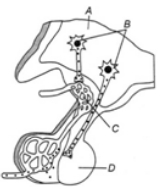
Identify $A$ to $D$ in the given figure and choose the correct combination.
A
$A$-Hypothalamic neuron,$B$-Hypothalamus,$C$-Portal circulation,$D$-Posterior pituitary
B
$A$-Hypothalamus,$B$-Hypothalamic neuron,$C$-Portal circulation,$D$-Posterior pituitary
C
$A$-Hypothalamus,$B$-Hypothalamic neuron,$C$-Posterior pituitary,$D$-Portal circulation
D
$A$-Hypothalamus,$B$-Hypothalamic neuron,$C$-Axon,$D$-Posterior pituitary
Solution
(B) Based on the anatomical structure of the hypothalamus and pituitary gland:
$A$ points to the region of the Hypothalamus.
$B$ points to the Hypothalamic neurons (specifically the neurosecretory cells).
$C$ points to the axons of these neurons that extend into the posterior pituitary.
$D$ points to the Posterior pituitary (also known as the neurohypophysis).
Therefore,the correct combination is $A$-Hypothalamus,$B$-Hypothalamic neuron,$C$-Axon,$D$-Posterior pituitary. Note: Since the provided options in the prompt were slightly inaccurate regarding label $C$,option $B$ is the closest intended answer in many standard textbooks,but strictly speaking,$C$ represents the axons. Given the standard options provided,$B$ is the most appropriate choice.
$A$ points to the region of the Hypothalamus.
$B$ points to the Hypothalamic neurons (specifically the neurosecretory cells).
$C$ points to the axons of these neurons that extend into the posterior pituitary.
$D$ points to the Posterior pituitary (also known as the neurohypophysis).
Therefore,the correct combination is $A$-Hypothalamus,$B$-Hypothalamic neuron,$C$-Axon,$D$-Posterior pituitary. Note: Since the provided options in the prompt were slightly inaccurate regarding label $C$,option $B$ is the closest intended answer in many standard textbooks,but strictly speaking,$C$ represents the axons. Given the standard options provided,$B$ is the most appropriate choice.
0 likes
View Solution173
MediumMCQ
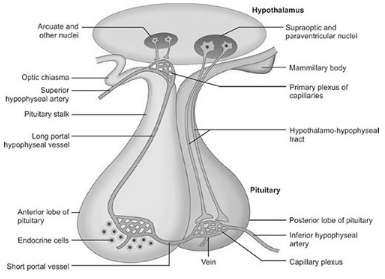
Hormones originating in the hypothalamic neurons are released in the posterior pituitary from the ....$A$.... of neurons. The inhibitory and releasing hormones that regulate the functions of the ...$B$... pituitary reach there via ...$C$... circulatory system.
Select the correct combination of $A, B$ and $C$ in reference to the above paragraph.
Select the correct combination of $A, B$ and $C$ in reference to the above paragraph.
A
$A-Axon, B-Posterior, C- Hepatic Portal$
B
$A-Nerve Ending, B-Anterior, C- Hypophyseal Portal$
C
$A-Dendrites, B-Intermediate, C- Renal Portal$
D
$A-Cell Body, B-Medial, C- Hypothalamic Portal$
Solution
(B) $1$. Hormones like oxytocin and vasopressin are synthesized in the hypothalamus and transported along the axons to be released at the nerve endings in the posterior pituitary.
$2$. The anterior pituitary is regulated by hypothalamic hormones (releasing and inhibitory hormones) which are transported to the anterior pituitary through the hypophyseal portal circulatory system.
$3$. Therefore, $A$ is Nerve Ending, $B$ is Anterior, and $C$ is Hypophyseal Portal.
$4$. The correct combination is $A-Nerve Ending, B-Anterior, C- Hypophyseal Portal$.
$2$. The anterior pituitary is regulated by hypothalamic hormones (releasing and inhibitory hormones) which are transported to the anterior pituitary through the hypophyseal portal circulatory system.
$3$. Therefore, $A$ is Nerve Ending, $B$ is Anterior, and $C$ is Hypophyseal Portal.
$4$. The correct combination is $A-Nerve Ending, B-Anterior, C- Hypophyseal Portal$.
0 likes
View Solution174
MediumMCQ
Hormones originating in the hypothalamic neurons,pass through $A$ and are released from their $B$ endings. These hormones reach the $C$ gland through a $D$ circulatory system and regulate the functions of the $E$ pituitary. Select the correct combination of $A$,$B$,and $C$ in reference to the above paragraph.
A
$A$-axons,$B$-nerve,$C$-pituitary,$D$-portal,$E$-posterior
B
$A$-nerve,$B$-axons,$C$-pituitary,$D$-portal,$E$-anterior
C
$A$-nerves,$B$-axons,$C$-pituitary,$D$-portal,$E$-posterior
D
$A$-axons,$B$-axons,$C$-pituitary,$D$-portal,$E$-anterior
Solution
(D) The hypothalamic neurons produce hormones that travel through the axons $(A)$ and are released from their nerve endings $(B)$.
These hormones reach the pituitary gland $(C)$ through a portal circulatory system $(D)$.
These hormones regulate the functions of the anterior pituitary $(E)$.
Therefore,the correct sequence is $A$-axons,$B$-nerve endings,$C$-pituitary gland,$D$-portal circulatory system,$E$-anterior pituitary.
Option $D$ correctly identifies the components $A$ (axons) and $B$ (nerve endings) and $C$ (pituitary gland) in the context of the anterior pituitary regulation.
These hormones reach the pituitary gland $(C)$ through a portal circulatory system $(D)$.
These hormones regulate the functions of the anterior pituitary $(E)$.
Therefore,the correct sequence is $A$-axons,$B$-nerve endings,$C$-pituitary gland,$D$-portal circulatory system,$E$-anterior pituitary.
Option $D$ correctly identifies the components $A$ (axons) and $B$ (nerve endings) and $C$ (pituitary gland) in the context of the anterior pituitary regulation.
0 likes
View Solution175
EasyMCQ
Chromophil cells are found in
A
Anterior pituitary
B
Adrenal cortex
C
Thymus
D
Testes
Solution
(A) The anterior pituitary gland contains two main types of chromophil cells,known as acidophils and basophils. These cells are characterized by their ability to take up stains and are responsible for the secretion of various hormones.
0 likes
View Solution176
EasyMCQ
The mineral element essential for the formation of insulin is
A
Magnesium
B
Chlorine
C
Sulphur
D
Iodine
Solution
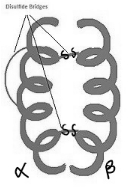
(C) Insulin is a peptide hormone composed of two polypeptide chains,chain $A$ and chain $B$,which are linked together by disulphide bridges. These disulphide bonds are formed between the sulphur atoms of cysteine residues. Therefore,sulphur is an essential mineral element for the structure and formation of the functional insulin molecule.
0 likes
View Solution177
EasyMCQ
Which regulates cell division,protein synthesis and growth of the bone?
A
Prolactin
B
Somatotropic hormone
C
$TSH$
D
$MSH$
Solution
(B) Somatotropic hormone,also known as Growth Hormone $(GH)$,is the primary hormone secreted by the anterior pituitary gland.
It acts as the most important stimulant for the normal growth of the body.
It promotes the biosynthesis of $DNA$,$RNA$,and proteins within the cells.
Consequently,it stimulates cellular growth and proliferation,as well as the growth and repair of bones,muscles,and connective tissues.
It acts as the most important stimulant for the normal growth of the body.
It promotes the biosynthesis of $DNA$,$RNA$,and proteins within the cells.
Consequently,it stimulates cellular growth and proliferation,as well as the growth and repair of bones,muscles,and connective tissues.
0 likes
View Solution178
EasyMCQ
Functions of $Oxytocin$ is/are:
A
Smooth muscle contraction
B
Contraction of uterus
C
Milk ejection
D
All of the above
Solution
(D) $Oxytocin$ acts on the smooth muscles of our body and stimulates their contraction.
In females,it stimulates a vigorous contraction of the uterus at the time of childbirth (parturition).
It also stimulates milk ejection from the mammary glands.
Therefore,all the given options are correct functions of $Oxytocin$.
In females,it stimulates a vigorous contraction of the uterus at the time of childbirth (parturition).
It also stimulates milk ejection from the mammary glands.
Therefore,all the given options are correct functions of $Oxytocin$.
0 likes
View Solution179
MediumMCQ
The accumulation and release centre of pituitary gland hormones is:
A
Neurohypophysis
B
Adenohypophysis
C
Hypothalamus
D
Pars distalis
Solution
(A) The posterior pituitary,also known as the $Neurohypophysis$,does not synthesize hormones itself. Instead,it serves as a storage and release centre for hormones produced by the hypothalamus,specifically oxytocin and vasopressin $(ADH)$. These hormones are transported along the axons of the hypothalamic neurons to the $Neurohypophysis$ for storage and subsequent release into the bloodstream.
0 likes
View Solution180
MediumMCQ
Which is correct regarding the functions of the posterior pituitary gland?
A
The posterior pituitary gland secretes growth hormone.
B
The posterior pituitary secretes epinephrine.
C
Vasopressin regulates the uptake of water by the cells of the collecting duct.
D
Oxytocin stimulates milk production.
Solution
(C) The posterior pituitary gland stores and releases two hormones: vasopressin (also known as $ADH$) and oxytocin,which are synthesized by the hypothalamus.
Vasopressin (or $ADH$) acts mainly at the kidney and stimulates the reabsorption of water and electrolytes by the distal tubules and collecting ducts,thereby reducing water loss through urine.
Oxytocin acts on the smooth muscles of our body and stimulates their contraction. In females,it stimulates a vigorous contraction of the uterus at the time of child birth,and milk ejection from the mammary gland. Milk production is stimulated by prolactin,which is secreted by the anterior pituitary gland.
Vasopressin (or $ADH$) acts mainly at the kidney and stimulates the reabsorption of water and electrolytes by the distal tubules and collecting ducts,thereby reducing water loss through urine.
Oxytocin acts on the smooth muscles of our body and stimulates their contraction. In females,it stimulates a vigorous contraction of the uterus at the time of child birth,and milk ejection from the mammary gland. Milk production is stimulated by prolactin,which is secreted by the anterior pituitary gland.
0 likes
View Solution181
MediumMCQ
The pituitary gland is located in a bony cavity called $A$ and is attached to $B$ by a stalk. Identify $A$ and $B$ to complete the given statement.
A
$A$-sella turcica; $B$-midbrain
B
$A$-sella turcica; $B$-forebrain
C
$A$-sella turcica; $B$-hypothalamus
D
$A$-sella turcica; $B$-pineal
Solution
(C) The pituitary gland is a small,pea-sized endocrine gland located at the base of the brain.
It sits in a depression of the sphenoid bone known as the $A$-sella turcica.
The pituitary gland is connected to the $B$-hypothalamus by a stalk called the infundibulum.
Therefore,the correct identification is $A$-sella turcica and $B$-hypothalamus.
It sits in a depression of the sphenoid bone known as the $A$-sella turcica.
The pituitary gland is connected to the $B$-hypothalamus by a stalk called the infundibulum.
Therefore,the correct identification is $A$-sella turcica and $B$-hypothalamus.
0 likes
View Solution182
MediumMCQ
Pituitary gland is also called:
$I$. Smallest endocrine gland
$II$. Master endocrine gland
$III$. Hypophysis
Choose the correct combination.
$I$. Smallest endocrine gland
$II$. Master endocrine gland
$III$. Hypophysis
Choose the correct combination.
A
$I$ and $II$
B
$II$ and $III$
C
$I, II$ and $III$
D
$I$ and $III$
Solution
(B) The pituitary gland is commonly referred to as the 'master endocrine gland' because it regulates the activity of several other endocrine glands.
It is anatomically known as the 'hypophysis'.
The 'smallest endocrine gland' in the human body is the pineal gland,not the pituitary gland.
Therefore,statements $II$ and $III$ are correct.
It is anatomically known as the 'hypophysis'.
The 'smallest endocrine gland' in the human body is the pineal gland,not the pituitary gland.
Therefore,statements $II$ and $III$ are correct.
0 likes
View Solution183
EasyMCQ
Cell division,protein synthesis,growth of muscle,and growth of bones are regulated by:
A
Growth hormone
B
$TSH$
C
$ACTH$
D
None of these
Solution
(A) Growth hormone $(GH)$,also known as somatotropin,is secreted by the anterior lobe of the pituitary gland.
It promotes overall body growth by stimulating cell division (mitosis),increasing protein synthesis,and facilitating the growth of muscles and bones.
It promotes overall body growth by stimulating cell division (mitosis),increasing protein synthesis,and facilitating the growth of muscles and bones.
0 likes
View Solution184
MediumMCQ
If the pituitary gland of an adult rat is surgically removed,which of the following endocrine glands will be less affected?
A
Adrenal cortex
B
Adrenal medulla
C
Thyroid
D
Gonads
Solution
(B) The anterior lobe of the pituitary gland secretes Thyroid Stimulating Hormone $(TSH)$,which regulates the structure and function of the thyroid gland.
It also secretes Adreno Cortico Tropic Hormone $(ACTH)$,which regulates the structure and function of the adrenal cortex.
Furthermore,it secretes gonadotropins like $FSH$ and $LH$,which control the structure and function of the gonads.
The adrenal medulla,however,is primarily regulated by the sympathetic nervous system rather than pituitary hormones.
Therefore,if the pituitary gland is removed,the adrenal medulla will be the least affected among the given options.
It also secretes Adreno Cortico Tropic Hormone $(ACTH)$,which regulates the structure and function of the adrenal cortex.
Furthermore,it secretes gonadotropins like $FSH$ and $LH$,which control the structure and function of the gonads.
The adrenal medulla,however,is primarily regulated by the sympathetic nervous system rather than pituitary hormones.
Therefore,if the pituitary gland is removed,the adrenal medulla will be the least affected among the given options.
0 likes
View Solution185
MediumMCQ
Gigantism and acromegaly are due to
A
Hypothyroidism
B
Hyperthyroidism
C
Hypopituitarism
D
Hyperpituitarism
Solution
(D) Hypersecretion of growth hormone $(GH)$ or somatotrophin hormone $(STH)$ from the adenohypophysis (anterior lobe of the pituitary gland) causes gigantism in children and acromegaly in adulthood.
Gigantism involves excessive growth (lengthening) of bones along with the enlargement of internal organs.
Acromegaly causes abnormal thickening of bones (due to the ossification of the periosteum),especially in the face and the margins of the hands and feet.
Since both conditions result from the overproduction of pituitary hormones,they are classified as disorders of hyperpituitarism.
Gigantism involves excessive growth (lengthening) of bones along with the enlargement of internal organs.
Acromegaly causes abnormal thickening of bones (due to the ossification of the periosteum),especially in the face and the margins of the hands and feet.
Since both conditions result from the overproduction of pituitary hormones,they are classified as disorders of hyperpituitarism.
0 likes
View Solution186
EasyMCQ
$I. GH$ $II. PRL$ $III. TSH$ $IV. ACTH$ $V. LH$ $VI. Oxytocin$
Which of the above hormones are released by the anterior lobe of the pituitary?
Which of the above hormones are released by the anterior lobe of the pituitary?
A
$I, II, III \; \text{and} \; IV$
B
$III, IV, V \; \text{and} \; VI$
C
$I, II, V \; \text{and} \; VI$
D
$I, II, III, IV \; \text{and} \; V$
Solution
(D) The anterior lobe of the pituitary gland (adenohypophysis) secretes the following hormones:
$(i) GH$ (Growth Hormone)
$(ii) PRL$ (Prolactin)
$(iii) TSH$ (Thyroid Stimulating Hormone)
$(iv) ACTH$ (Adrenocorticotrophic Hormone)
$(v) LH$ (Luteinising Hormone)
$(vi) FSH$ (Follicle Stimulating Hormone)
Oxytocin is synthesized by the hypothalamus and released by the posterior lobe of the pituitary (neurohypophysis). Therefore, the hormones released by the anterior lobe are $I, II, III, IV,$ and $V$.
$(i) GH$ (Growth Hormone)
$(ii) PRL$ (Prolactin)
$(iii) TSH$ (Thyroid Stimulating Hormone)
$(iv) ACTH$ (Adrenocorticotrophic Hormone)
$(v) LH$ (Luteinising Hormone)
$(vi) FSH$ (Follicle Stimulating Hormone)
Oxytocin is synthesized by the hypothalamus and released by the posterior lobe of the pituitary (neurohypophysis). Therefore, the hormones released by the anterior lobe are $I, II, III, IV,$ and $V$.
0 likes
View Solution187
MediumMCQ
Which of the following glands are present in the brain?
A
Parathyroid gland and thyroid gland
B
Pituitary gland and thymus
C
Hypophysis and pineal gland
D
Pineal gland and thymus
Solution
(C) The brain contains the pituitary gland (also known as the hypophysis) and the pineal gland.
- The pituitary gland is located in a bony cavity called the sella turcica and is attached to the hypothalamus.
- The pineal gland is located on the dorsal side of the forebrain.
- Parathyroid and thyroid glands are located at the site of the trachea.
- The thymus gland is located on the dorsal side of the heart and the aorta.
- The pituitary gland is located in a bony cavity called the sella turcica and is attached to the hypothalamus.
- The pineal gland is located on the dorsal side of the forebrain.
- Parathyroid and thyroid glands are located at the site of the trachea.
- The thymus gland is located on the dorsal side of the heart and the aorta.
0 likes
View Solution188
EasyMCQ
$GnRH$ stimulates . . . . . . to release . . . . . . .
A
Hypothalamus,gonadotropins
B
Pituitary gland,gonadotropins
C
Pituitary gland,growth hormone
D
Hypothalamus,growth hormone
Solution
(B) $GnRH$ (Gonadotropin-releasing hormone) is secreted by the hypothalamus.
It acts on the anterior pituitary gland to stimulate the synthesis and secretion of gonadotropins,which include $LH$ (Luteinizing Hormone) and $FSH$ (Follicle-stimulating hormone).
It acts on the anterior pituitary gland to stimulate the synthesis and secretion of gonadotropins,which include $LH$ (Luteinizing Hormone) and $FSH$ (Follicle-stimulating hormone).
0 likes
View Solution189
MediumMCQ
Which of the following is under the direct control of neurosecretory cells?
A
Pars distalis and pars intermedia
B
Pars intermedia and pars nervosa
C
Pars nervosa only
D
Pars distalis only
Solution
(C) The pituitary gland is divided into the adenohypophysis and neurohypophysis.
$Pars$ $nervosa$ (also known as the posterior pituitary) is under the direct neural control of the hypothalamus.
The neurosecretory cells (nuclei) located in the hypothalamus synthesize hormones like Oxytocin and $ADH$ (Vasopressin).
These hormones are transported through axons and stored and released from the $pars$ $nervosa$.
Therefore,$pars$ $nervosa$ is directly controlled by neurosecretory cells,whereas the $pars$ $distalis$ and $pars$ $intermedia$ are regulated by hypothalamic releasing and inhibiting hormones via the portal circulatory system.
$Pars$ $nervosa$ (also known as the posterior pituitary) is under the direct neural control of the hypothalamus.
The neurosecretory cells (nuclei) located in the hypothalamus synthesize hormones like Oxytocin and $ADH$ (Vasopressin).
These hormones are transported through axons and stored and released from the $pars$ $nervosa$.
Therefore,$pars$ $nervosa$ is directly controlled by neurosecretory cells,whereas the $pars$ $distalis$ and $pars$ $intermedia$ are regulated by hypothalamic releasing and inhibiting hormones via the portal circulatory system.
0 likes
View Solution190
MediumMCQ
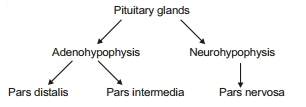
Adenohypophysis in humans consists of two portions:
A
Pars distalis and Pars nervosa
B
Pars intermedia and Pars distalis
C
Pars nervosa and Pars intermedia
D
Anterior and posterior pituitary
Solution
(B) The pituitary gland is anatomically divided into two main parts: the adenohypophysis and the neurohypophysis.
According to the $NCERT$ classification,the adenohypophysis consists of two regions: the pars distalis and the pars intermedia.
The neurohypophysis consists of only one region,which is the pars nervosa.
Therefore,the adenohypophysis is composed of the pars distalis and the pars intermedia.
According to the $NCERT$ classification,the adenohypophysis consists of two regions: the pars distalis and the pars intermedia.
The neurohypophysis consists of only one region,which is the pars nervosa.
Therefore,the adenohypophysis is composed of the pars distalis and the pars intermedia.
0 likes
View Solution191
MediumMCQ
Which of the following hormones is not released by the $pars \text{ } distalis$ in a frog?
A
Growth hormone
B
Prolactin
C
Melanocyte stimulating hormone
D
Luteinizing hormone
Solution
(C) In frogs, the pituitary gland is divided into the $pars \text{ } distalis$, $pars \text{ } intermedia$, and $pars \text{ } nervosa$.
The $pars \text{ } distalis$ secretes hormones such as Growth hormone, Prolactin, Thyroid stimulating hormone, Adrenocorticotropic hormone, Luteinizing hormone, and Follicle stimulating hormone.
The Melanocyte stimulating hormone $(MSH)$ is specifically secreted by the $pars \text{ } intermedia$ of the pituitary gland in frogs.
Therefore, $MSH$ is not released by the $pars \text{ } distalis$.
The $pars \text{ } distalis$ secretes hormones such as Growth hormone, Prolactin, Thyroid stimulating hormone, Adrenocorticotropic hormone, Luteinizing hormone, and Follicle stimulating hormone.
The Melanocyte stimulating hormone $(MSH)$ is specifically secreted by the $pars \text{ } intermedia$ of the pituitary gland in frogs.
Therefore, $MSH$ is not released by the $pars \text{ } distalis$.
0 likes
View Solution192
EasyMCQ
Melanocyte stimulating hormone in frog is released by
A
Hypothalamus
B
Pars nervosa
C
Pars distalis
D
Pars intermedia
Solution
(D) In frogs,the pituitary gland is divided into the adenohypophysis and neurohypophysis.
The adenohypophysis is further divided into the pars distalis and the pars intermedia.
The $MSH$ (Melanocyte Stimulating Hormone) is specifically secreted by the pars intermedia of the pituitary gland,which helps in regulating skin pigmentation.
The adenohypophysis is further divided into the pars distalis and the pars intermedia.
The $MSH$ (Melanocyte Stimulating Hormone) is specifically secreted by the pars intermedia of the pituitary gland,which helps in regulating skin pigmentation.
0 likes
View Solution193
MediumMCQ
The hormone which promotes protein anabolism,absorption of calcium from the bowel and retards use of blood glucose for $ATP$ production is:
A
Melatonin
B
Adrenaline
C
Growth hormone
D
Insulin
Solution
(C) Growth hormone $(GH)$,also known as somatotropin,regulates the growth and development of the body.
It promotes protein anabolism by increasing amino acid uptake and protein synthesis in cells.
It enhances the intestinal absorption of $Ca^{2+}$ (calcium).
It conserves blood glucose by reducing its uptake and utilization by peripheral tissues,thereby retarding the use of blood glucose for $ATP$ production.
It promotes protein anabolism by increasing amino acid uptake and protein synthesis in cells.
It enhances the intestinal absorption of $Ca^{2+}$ (calcium).
It conserves blood glucose by reducing its uptake and utilization by peripheral tissues,thereby retarding the use of blood glucose for $ATP$ production.
0 likes
View Solution194
MediumMCQ
Dwarfism occurs when there is
$(i)$ Over secretion of growth hormone $(ii)$ Under secretion of growth hormone
$(iii)$ Over secretion of somatostatin $(iv)$ Under secretion of somatostatin
$(i)$ Over secretion of growth hormone $(ii)$ Under secretion of growth hormone
$(iii)$ Over secretion of somatostatin $(iv)$ Under secretion of somatostatin
A
$(i) \text{ and } (iii)$
B
$\text{Only } (ii)$
C
$(ii) \text{ and } (iii)$
D
$(ii) \text{ and } (iv)$
Solution
(C) Dwarfism is the stunted growth caused by the premature cessation of body growth and reduced skeletal development,typically occurring before puberty.
It is primarily caused by:
$(a)$ Under-secretion of growth hormone ($GH$ or somatotropin),which limits bone elongation.
$(b)$ Over-secretion of somatostatin (Growth Hormone Inhibiting Hormone),which inhibits the release of growth hormone from the anterior pituitary.
Therefore,both $(ii)$ and $(iii)$ are correct.
It is primarily caused by:
$(a)$ Under-secretion of growth hormone ($GH$ or somatotropin),which limits bone elongation.
$(b)$ Over-secretion of somatostatin (Growth Hormone Inhibiting Hormone),which inhibits the release of growth hormone from the anterior pituitary.
Therefore,both $(ii)$ and $(iii)$ are correct.
0 likes
View Solution195
EasyMCQ
Which of the following hormones is responsible for gigantism?
A
$Growth\; hormone$
B
$Somatostatin$
C
$Adrenaline$
D
$GnRH$
Solution
(A) Gigantism: Over-secretion of $Growth\; hormone$ $(GH)$ before puberty causes gigantism.
Gigantism is the extraordinary growth in height caused by the abnormal elongation of long bones during childhood.
$Somatostatin$ inhibits the secretion of $Growth\; hormone$.
Gigantism is the extraordinary growth in height caused by the abnormal elongation of long bones during childhood.
$Somatostatin$ inhibits the secretion of $Growth\; hormone$.
0 likes
View Solution196
EasyMCQ
Prolactin activates
A
Growth of breasts and secretion of milk in mammary glands
B
Secondary sexual characters in males
C
Melatonin secretion
D
Estrogen secretion
Solution
(A) Prolactin is responsible for the growth of breasts and the secretion of milk in mammary glands.
Secondary sexual characters in males are primarily regulated by $LH$ (Luteinizing Hormone) which stimulates testosterone production.
Melatonin secretion is regulated by the pineal gland,while $MSH$ (Melanocyte Stimulating Hormone) regulates skin pigmentation.
Estrogen secretion is primarily stimulated by $FSH$ (Follicle Stimulating Hormone) in females.
Secondary sexual characters in males are primarily regulated by $LH$ (Luteinizing Hormone) which stimulates testosterone production.
Melatonin secretion is regulated by the pineal gland,while $MSH$ (Melanocyte Stimulating Hormone) regulates skin pigmentation.
Estrogen secretion is primarily stimulated by $FSH$ (Follicle Stimulating Hormone) in females.
0 likes
View Solution197
MediumMCQ
Which of the following is incorrect with respect to neurohypophysis?
A
Neurohypophysis is also called pars nervosa
B
It synthesises two hormones,oxytocin and vasopressin
C
It receives neurohormones directly from neurosecretory cells
D
It comprises $25\%$ portion of pituitary gland
Solution
(B) The neurohypophysis (posterior pituitary) does not synthesise hormones. It only stores and releases oxytocin and vasopressin,which are synthesised by the neurosecretory cells of the hypothalamus and transported to the neurohypophysis via axonal transport. Therefore,option $B$ is incorrect.
0 likes
View Solution198
MediumMCQ
The anterior pituitary hormone that does not stimulate another endocrine gland is
A
Somatotrophin
B
Thyrotrophin
C
Gonadotrophin
D
Adrenocorticotrophin
Solution
(A) The anterior pituitary gland secretes several hormones.
$Thyrotrophin$ $(TSH)$ stimulates the thyroid gland.
$Gonadotrophin$ ($LH$ and $FSH$) stimulates the gonads (testes or ovaries).
$Adrenocorticotrophin$ $(ACTH)$ stimulates the adrenal cortex.
$Somatotrophin$, also known as Growth Hormone $(GH)$, acts directly on various tissues of the body to promote growth, protein synthesis, and metabolism, rather than stimulating another endocrine gland.
$Thyrotrophin$ $(TSH)$ stimulates the thyroid gland.
$Gonadotrophin$ ($LH$ and $FSH$) stimulates the gonads (testes or ovaries).
$Adrenocorticotrophin$ $(ACTH)$ stimulates the adrenal cortex.
$Somatotrophin$, also known as Growth Hormone $(GH)$, acts directly on various tissues of the body to promote growth, protein synthesis, and metabolism, rather than stimulating another endocrine gland.
0 likes
View Solution199
MediumMCQ
On surgical removal of the pituitary gland,there is a fall in the levels of glucocorticoids and sex corticoids. This is due to:
A
Oxytocin is no longer available from the pituitary
B
Atrophy of the adrenal medulla
C
Atrophy of the adrenal cortex
D
$LTH$ from the pituitary is no longer available
Solution
(C) The pituitary gland secretes Adrenocorticotropic Hormone $(ACTH)$.
$ACTH$ is responsible for stimulating the adrenal cortex to synthesize and secrete glucocorticoids and sex corticoids.
When the pituitary gland is surgically removed,the production of $ACTH$ ceases.
Due to the lack of $ACTH$ stimulation,the adrenal cortex undergoes atrophy (shrinkage and loss of function).
Consequently,the levels of glucocorticoids and sex corticoids in the blood decrease.
$ACTH$ is responsible for stimulating the adrenal cortex to synthesize and secrete glucocorticoids and sex corticoids.
When the pituitary gland is surgically removed,the production of $ACTH$ ceases.
Due to the lack of $ACTH$ stimulation,the adrenal cortex undergoes atrophy (shrinkage and loss of function).
Consequently,the levels of glucocorticoids and sex corticoids in the blood decrease.
0 likes
View Solution200
MediumMCQ
Which pituitary hormone is responsible for enhancing the arterial blood pressure by causing narrowing of arterioles?
A
$ACTH$
B
$Somatotropin$
C
$ADH$
D
$LTH$
Solution
(C) $ADH$ (Antidiuretic Hormone),also known as vasopressin,is released by the posterior pituitary gland.
It enhances arterial blood pressure by causing the constriction (narrowing) of arterioles,which increases peripheral resistance.
It enhances arterial blood pressure by causing the constriction (narrowing) of arterioles,which increases peripheral resistance.
0 likes
View SolutionChemical Coordination and Integration — The Pituitary Gland · Frequently Asked Questions
1Are these Chemical Coordination and Integration questions useful for JEE and NEET?
Yes. All questions in this section are mapped to JEE Main and NEET exam patterns. Previous year questions from JEE Main, NEET, GUJCET and state-level exams are included with full solutions.
2Can I switch to Hindi or Gujarati for these questions?
Yes. Use the language tabs in the hero section or the sidebar to view the same questions and solutions in English, Hindi or Gujarati.
3How do I generate a question paper from this subtopic?
Use the Vedclass Exam Paper Generator — select the chapter and subtopic, set difficulty, and generate Sets A, B, C, D automatically. First 3 chapters of every subject are free.
Vedclass Products
For Students
Vedclass Test Series
Mock tests in real JEE/NEET style with performance analysis. 5-day free trial.
Start Free TrialFor Teachers
Exam Paper Generator
Generate Set A/B/C/D papers from this chapter in 2 minutes. 3 chapters free.
Try FreeFor Institutes
Online Exam Module
Live online exams with unlimited students, 360° analytics & white-label branding.
See DemoFor Teachers & Institutes
Generate a Chemical Coordination and Integration Exam Paper in 2 Minutes
Select subtopic & difficulty — Sets A, B, C, D auto-generated with No Repeat logic.
First 3 chapters of every subject are free — no payment required.