
A English
The Pituitary Gland Questions in English
Class 11 Biology · Chemical Coordination and Integration · The Pituitary Gland
219+
Questions
English
Language
100%
With Solutions
Showing 19 of 219 questions in English
201
MediumMCQ
$A$: Diabetes insipidus is marked by excessive urination and intense thirst.
$R$: Anti-diuretic hormone $(ADH)$ is released by the posterior lobe of the pituitary gland.
$R$: Anti-diuretic hormone $(ADH)$ is released by the posterior lobe of the pituitary gland.
A
Assertion and Reason both are correct and Reason is the correct explanation of Assertion.
B
Assertion and Reason both are correct but Reason is not the correct explanation of Assertion.
C
Assertion is correct,but Reason is incorrect.
D
Both Assertion and Reason are incorrect.
Solution
(A) Diabetes insipidus is a condition characterized by the excretion of large amounts of dilute urine (polyuria) and excessive thirst (polydipsia).
This occurs due to the deficiency of Anti-diuretic hormone $(ADH)$,also known as vasopressin.
$ADH$ is synthesized by the hypothalamus and stored and released by the posterior lobe of the pituitary gland (neurohypophysis).
Since the deficiency of $ADH$ leads to the symptoms described in the Assertion,the Reason correctly explains the physiological basis of the condition.
This occurs due to the deficiency of Anti-diuretic hormone $(ADH)$,also known as vasopressin.
$ADH$ is synthesized by the hypothalamus and stored and released by the posterior lobe of the pituitary gland (neurohypophysis).
Since the deficiency of $ADH$ leads to the symptoms described in the Assertion,the Reason correctly explains the physiological basis of the condition.
0 likes
View Solution202
MediumMCQ
$A$: Prolactin is unique among the pituitary hormones as it is under predominant inhibitory control of the hypothalamus.
$R$: The controlling agent is the neurotransmitter dopamine,produced by tuberoinfundibular neurons.
$R$: The controlling agent is the neurotransmitter dopamine,produced by tuberoinfundibular neurons.
A
Assertion and Reason both are correct and Reason is the correct explanation of Assertion.
B
Assertion and Reason both are correct but Reason is not the correct explanation of Assertion.
C
Assertion is correct,but Reason is incorrect.
D
Both Assertion and Reason are incorrect.
Solution
(A) Prolactin is unique among the anterior pituitary hormones because its secretion is primarily regulated by inhibitory control from the hypothalamus.
This inhibitory control is mediated by the neurotransmitter dopamine,which acts as the Prolactin Inhibiting Hormone $(PIH)$.
Dopamine is synthesized and released by the tuberoinfundibular neurons in the hypothalamus,which then travels through the hypophyseal portal system to inhibit the lactotrophs in the anterior pituitary.
Therefore,both the Assertion and the Reason are correct,and the Reason provides the correct explanation for the Assertion.
This inhibitory control is mediated by the neurotransmitter dopamine,which acts as the Prolactin Inhibiting Hormone $(PIH)$.
Dopamine is synthesized and released by the tuberoinfundibular neurons in the hypothalamus,which then travels through the hypophyseal portal system to inhibit the lactotrophs in the anterior pituitary.
Therefore,both the Assertion and the Reason are correct,and the Reason provides the correct explanation for the Assertion.
0 likes
View Solution203
MediumMCQ
$A$: Oxytocin stimulates contraction of uterine muscles during birth and initiates ejection of milk.
$R$: It is synthesized in the posterior lobe of pituitary.
$R$: It is synthesized in the posterior lobe of pituitary.
A
Assertion and Reason both are correct and Reason is the correct explanation of Assertion.
B
Assertion and Reason both are correct but Reason is not the correct explanation of Assertion.
C
Assertion is correct,but Reason is incorrect.
D
Both Assertion and Reason are incorrect.
Solution
(C) Oxytocin stimulates the contraction of uterine muscles during childbirth and initiates the ejection of milk from the mammary glands.
Oxytocin is synthesized in the hypothalamus and transported to the posterior pituitary gland (neurohypophysis) for storage and release.
Therefore,the Assertion is correct,but the Reason is incorrect because the posterior pituitary does not synthesize oxytocin; it only stores and releases it.
Oxytocin is synthesized in the hypothalamus and transported to the posterior pituitary gland (neurohypophysis) for storage and release.
Therefore,the Assertion is correct,but the Reason is incorrect because the posterior pituitary does not synthesize oxytocin; it only stores and releases it.
0 likes
View Solution204
MediumMCQ
Which hormone is responsible for the contraction of the uterus?
A
Vasopressin
B
Oxytocin
C
Thyrotropin
D
Gonadotropin
Solution
(B) Oxytocin is a hormone secreted by the neurohypophysis (posterior pituitary) of the pituitary gland.
It acts on the smooth muscles of the uterus and stimulates their vigorous contraction,which is essential for the process of parturition (childbirth) and the induction of labour pain.
It acts on the smooth muscles of the uterus and stimulates their vigorous contraction,which is essential for the process of parturition (childbirth) and the induction of labour pain.
0 likes
View Solution205
EasyMCQ
Which of the following can be termed as the milk-ejecting hormone?
A
Prolactin
B
Oestrogen
C
Progesterone
D
Oxytocin
Solution
(D) Oxytocin is known as the milk-ejecting hormone because it stimulates the contraction of the smooth muscles (myoepithelial cells) of the mammary glands,which leads to the ejection of milk. Prolactin,on the other hand,is responsible for the production of milk.
0 likes
View Solution206
MediumMCQ
$A$: Synthesis of milk is stimulated by a rise in the level of oxytocin.
$R$: Oxytocin is released from the adenohypophysis under the influence of the hypothalamus.
$R$: Oxytocin is released from the adenohypophysis under the influence of the hypothalamus.
A
Assertion and Reason both are correct and Reason is the correct explanation of Assertion.
B
Assertion and Reason both are correct but Reason is not the correct explanation of Assertion.
C
Assertion is correct,but Reason is incorrect.
D
Both Assertion and Reason are incorrect.
Solution
(D) The Assertion is incorrect because the synthesis of milk is stimulated by the hormone $Prolactin$,not oxytocin. Oxytocin is responsible for the ejection of milk (milk let-down reflex).
The Reason is incorrect because oxytocin is synthesized by the hypothalamus and stored/released from the $Neurohypophysis$ (posterior pituitary),not the $Adenohypophysis$ (anterior pituitary).
The Reason is incorrect because oxytocin is synthesized by the hypothalamus and stored/released from the $Neurohypophysis$ (posterior pituitary),not the $Adenohypophysis$ (anterior pituitary).
0 likes
View Solution207
EasyMCQ
The $Pars \text{ } distalis$ region of the pituitary gland is known as:
A
Anterior pituitary
B
Intermediate pituitary
C
Posterior pituitary
D
Hypothalamus
Solution
(A) The pituitary gland is anatomically divided into an adenohypophysis and a neurohypophysis.
The adenohypophysis consists of two portions: $Pars \text{ } distalis$ and $Pars \text{ } intermedia$.
The $Pars \text{ } distalis$ region of the pituitary is commonly called the anterior pituitary.
It produces several important hormones such as Growth Hormone $(GH)$, Prolactin $(PRL)$, Thyroid Stimulating Hormone $(TSH)$, Adrenocorticotrophic Hormone $(ACTH)$, Luteinizing Hormone $(LH)$, and Follicle Stimulating Hormone $(FSH)$.
The adenohypophysis consists of two portions: $Pars \text{ } distalis$ and $Pars \text{ } intermedia$.
The $Pars \text{ } distalis$ region of the pituitary is commonly called the anterior pituitary.
It produces several important hormones such as Growth Hormone $(GH)$, Prolactin $(PRL)$, Thyroid Stimulating Hormone $(TSH)$, Adrenocorticotrophic Hormone $(ACTH)$, Luteinizing Hormone $(LH)$, and Follicle Stimulating Hormone $(FSH)$.
0 likes
View Solution208
EasyMCQ
Which hormone regulates the development of mammary glands and the secretion of milk in them?
A
Prolactin
B
$ADH$
C
$MSH$
D
$GH$
Solution
(A) Prolactin is a hormone secreted by the anterior pituitary gland. Its primary function is to stimulate the growth and development of mammary glands and to promote the production and secretion of milk in them. Therefore,it is also known as the lactogenic hormone.
0 likes
View Solution209
MediumMCQ
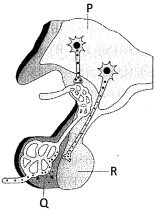
The following diagram shows the pituitary gland and its relationship with the hypothalamus. Identify $P, Q,$ and $R$.
A
Hypothalamus,Anterior pituitary,Posterior pituitary
B
Hypothalamus,Posterior pituitary,Anterior pituitary
C
Anterior pituitary,Hypothalamus,Posterior pituitary
D
Posterior pituitary,Hypothalamus,Anterior pituitary
Solution
(A) In the given diagram:
$P$ represents the Hypothalamus,which is the basal part of the diencephalon.
$Q$ represents the Anterior pituitary (Adenohypophysis),which is connected to the hypothalamus through a portal circulatory system.
$R$ represents the Posterior pituitary (Neurohypophysis),which is under the direct neural regulation of the hypothalamus.
Therefore,the correct sequence is $P$ = Hypothalamus,$Q$ = Anterior pituitary,$R$ = Posterior pituitary.
$P$ represents the Hypothalamus,which is the basal part of the diencephalon.
$Q$ represents the Anterior pituitary (Adenohypophysis),which is connected to the hypothalamus through a portal circulatory system.
$R$ represents the Posterior pituitary (Neurohypophysis),which is under the direct neural regulation of the hypothalamus.
Therefore,the correct sequence is $P$ = Hypothalamus,$Q$ = Anterior pituitary,$R$ = Posterior pituitary.
0 likes
View Solution210
MediumMCQ
What are the site of origin and site of action of $LH$ respectively?
A
Hypothalamus,Pituitary gland
B
Anterior pituitary gland,Gonads
C
Posterior pituitary gland,Gonads
D
Hypothalamus,Gonads
Solution
(B) $LH$ stands for Luteinizing Hormone.
It is synthesized and secreted by the gonadotropic cells of the anterior pituitary gland.
Its primary site of action is the gonads (testes in males and ovaries in females).
In males,$LH$ acts on the Leydig cells to stimulate the synthesis and secretion of androgens.
In females,$LH$ induces ovulation of fully mature follicles (Graafian follicles) and maintains the corpus luteum.
It is synthesized and secreted by the gonadotropic cells of the anterior pituitary gland.
Its primary site of action is the gonads (testes in males and ovaries in females).
In males,$LH$ acts on the Leydig cells to stimulate the synthesis and secretion of androgens.
In females,$LH$ induces ovulation of fully mature follicles (Graafian follicles) and maintains the corpus luteum.
0 likes
View Solution211
MediumMCQ
Select the correct statement from the following.
A
Oxytocin regulates the growth of the mammary gland.
B
$ACTH$ stimulates the synthesis and secretion of steroid hormones mineralocorticoid from the adrenal cortex.
C
Vasopressin stimulates the reabsorption of water and electrolytes by the distal tubules.
D
Parathyroid hormone decreases the $Ca^{2+}$ levels in the blood.
Solution
(C) $1$. Oxytocin acts on the smooth muscles of our body and stimulates their contraction. In females,it stimulates a vigorous contraction of the uterus at the time of child birth,and milk ejection from the mammary gland. Prolactin regulates the growth of the mammary gland.
$2$. $ACTH$ (Adrenocorticotropic hormone) stimulates the synthesis and secretion of steroid hormones called glucocorticoids from the adrenal cortex,not mineralocorticoids.
$3$. Vasopressin,also known as Antidiuretic Hormone $(ADH)$,acts mainly at the kidney and stimulates the reabsorption of water and electrolytes by the distal tubules and thereby reduces loss of water through urine (diuresis).
$4$. Parathyroid hormone $(PTH)$ increases the $Ca^{2+}$ levels in the blood by acting on bones and stimulating the process of bone resorption (dissolution/demineralization).
$2$. $ACTH$ (Adrenocorticotropic hormone) stimulates the synthesis and secretion of steroid hormones called glucocorticoids from the adrenal cortex,not mineralocorticoids.
$3$. Vasopressin,also known as Antidiuretic Hormone $(ADH)$,acts mainly at the kidney and stimulates the reabsorption of water and electrolytes by the distal tubules and thereby reduces loss of water through urine (diuresis).
$4$. Parathyroid hormone $(PTH)$ increases the $Ca^{2+}$ levels in the blood by acting on bones and stimulating the process of bone resorption (dissolution/demineralization).
0 likes
View Solution212
MediumMCQ
Gonadotropic hormones are:
A
Estrogen and progesterone
B
Luteinizing hormone and follicle stimulating hormone
C
Testosterone and androsterone
D
Prolactin and luteotropin
Solution
(B) Gonadotropic hormones, also known as gonadotropins, are hormones secreted by the anterior pituitary gland that act on the gonads (testes or ovaries) to regulate their growth and function.
These hormones include $Luteinizing \text{ } Hormone$ $(LH)$ and $Follicle \text{ } Stimulating \text{ } Hormone$ $(FSH)$.
$LH$ and $FSH$ stimulate the production of sex hormones and the maturation of gametes in both males and females.
Therefore, option $B$ is the correct answer.
These hormones include $Luteinizing \text{ } Hormone$ $(LH)$ and $Follicle \text{ } Stimulating \text{ } Hormone$ $(FSH)$.
$LH$ and $FSH$ stimulate the production of sex hormones and the maturation of gametes in both males and females.
Therefore, option $B$ is the correct answer.
0 likes
View Solution213
EasyMCQ
The hormone responsible for an increase in blood pressure and a decrease in the water content of urine is . . . . . . .
A
$FSH$
B
$ACTH$
C
vasopressin
D
oxytocin
Solution
(C) Vasopressin,also known as Antidiuretic Hormone $(ADH)$,is released by the posterior pituitary gland.
It acts primarily on the kidney tubules to facilitate the reabsorption of water and electrolytes into the blood.
By increasing water reabsorption,it reduces the volume of water excreted in the urine (making urine more concentrated).
Additionally,$ADH$ causes the constriction of blood vessels,which leads to an increase in blood pressure.
It acts primarily on the kidney tubules to facilitate the reabsorption of water and electrolytes into the blood.
By increasing water reabsorption,it reduces the volume of water excreted in the urine (making urine more concentrated).
Additionally,$ADH$ causes the constriction of blood vessels,which leads to an increase in blood pressure.
0 likes
View Solution214
EasyMCQ
Which one of the following first receives the hormones from the pituitary gland?
A
Superior vena cava
B
Hypophyseal portal vein
C
Inferior vena cava
D
Right pulmonary vein
Solution
(B) The pituitary gland,often called the master gland,releases hormones into the bloodstream.
Specifically,the hormones secreted by the anterior pituitary are transported via the $Hypophyseal$ $portal$ $vein$ system.
This specialized vascular system connects the hypothalamus to the anterior pituitary,allowing for the direct transport of regulatory hormones.
Therefore,the $Hypophyseal$ $portal$ $vein$ is the primary structure that receives these hormones to facilitate their distribution.
Specifically,the hormones secreted by the anterior pituitary are transported via the $Hypophyseal$ $portal$ $vein$ system.
This specialized vascular system connects the hypothalamus to the anterior pituitary,allowing for the direct transport of regulatory hormones.
Therefore,the $Hypophyseal$ $portal$ $vein$ is the primary structure that receives these hormones to facilitate their distribution.
0 likes
View Solution215
EasyMCQ
Given below are two statements.
Statement $I$ - Highest secretion of growth hormone $(GH)$ is seen till puberty.
Statement $II$ - The $GH$ is secreted continuously throughout life for repair and replacement of cells.
In the light of above statements,select the correct option given below:
Statement $I$ - Highest secretion of growth hormone $(GH)$ is seen till puberty.
Statement $II$ - The $GH$ is secreted continuously throughout life for repair and replacement of cells.
In the light of above statements,select the correct option given below:
A
Both statement $I$ and statement $II$ are correct.
B
Both statement $I$ and statement $II$ are incorrect.
C
Statement $I$ is correct but statement $II$ is incorrect.
D
Statement $I$ is incorrect but statement $II$ is correct.
Solution
(A) Statement $I$ is correct: Growth hormone $(GH)$,also known as somatotropin,is secreted by the anterior pituitary gland. Its levels are highest during childhood and adolescence,peaking during puberty to facilitate rapid body growth.
Statement $II$ is correct: Even after puberty,$GH$ continues to be secreted throughout life,although at lower levels. It plays a crucial role in metabolic processes,protein synthesis,and the repair and replacement of cells in various tissues.
Statement $II$ is correct: Even after puberty,$GH$ continues to be secreted throughout life,although at lower levels. It plays a crucial role in metabolic processes,protein synthesis,and the repair and replacement of cells in various tissues.
0 likes
View Solution216
EasyMCQ
An adult man feels excessive thirst and excretes large volume of dilute urine. He may be suffering from . . . . . . .
A
myxoedema
B
diabetes insipidus
C
Addison's disease
D
acromegaly
Solution
(B) $Diabetes \text{ } insipidus$ is a condition caused by the deficiency of $Antidiuretic \text{ } Hormone$ $(ADH)$, also known as $vasopressin$.
$ADH$ is secreted by the posterior pituitary gland and acts on the kidney tubules to facilitate the reabsorption of water.
When $ADH$ levels are low, the kidneys cannot reabsorb water efficiently, leading to the excretion of large volumes of dilute urine (polyuria) and a constant feeling of excessive thirst (polydipsia).
$ADH$ is secreted by the posterior pituitary gland and acts on the kidney tubules to facilitate the reabsorption of water.
When $ADH$ levels are low, the kidneys cannot reabsorb water efficiently, leading to the excretion of large volumes of dilute urine (polyuria) and a constant feeling of excessive thirst (polydipsia).
0 likes
View Solution217
EasyMCQ
Acromegaly is caused by hypersecretion of . . . . . . in the adult.
A
$ACTH$
B
$GH$
C
$MSH$
D
$TSH$
Solution
(B) Acromegaly is a condition caused by the hypersecretion of Growth Hormone $(GH)$ in adults.
In adults,the epiphyseal plates are closed,so the bones cannot grow in length.
Instead,the excess $GH$ causes the bones of the face,hands,and feet to thicken and enlarge,leading to the characteristic features of acromegaly.
$ACTH$ is Adrenocorticotropic Hormone,$MSH$ is Melanocyte-Stimulating Hormone,and $TSH$ is Thyroid-Stimulating Hormone,none of which are responsible for acromegaly.
In adults,the epiphyseal plates are closed,so the bones cannot grow in length.
Instead,the excess $GH$ causes the bones of the face,hands,and feet to thicken and enlarge,leading to the characteristic features of acromegaly.
$ACTH$ is Adrenocorticotropic Hormone,$MSH$ is Melanocyte-Stimulating Hormone,and $TSH$ is Thyroid-Stimulating Hormone,none of which are responsible for acromegaly.
0 likes
View Solution218
EasyMCQ
With reference to the pituitary gland,which of the following statements is true?
A
Neurohypophysis secretes vasopressin and oxytocin
B
Neurohypophysis secretes $TSH$ and $STH$
C
Neurohypophysis collects and stores vasopressin and oxytocin
D
Adenohypophysis secretes vasopressin and oxytocin
Solution
(C) is the correct answer.
The neurohypophysis (posterior pituitary) stores and releases oxytocin and vasopressin.
These hormones are synthesized in the hypothalamus and transported axonally to the neurohypophysis,where they are stored and later released into the bloodstream.
The neurohypophysis (posterior pituitary) stores and releases oxytocin and vasopressin.
These hormones are synthesized in the hypothalamus and transported axonally to the neurohypophysis,where they are stored and later released into the bloodstream.
0 likes
View Solution219
EasyMCQ
Identify from the following,a hormone produced by the pituitary gland in both males and females but functional only in females.
A
Relaxin
B
Vasopressin
C
Somatotropic hormone
D
Prolactin
Solution
(D) Prolactin.
$Prolactin$ is a hormone secreted by the anterior pituitary gland in both males and females.
Its primary function is to stimulate the growth of mammary glands and the production of milk in females after childbirth.
While it is present in males,it does not have a known physiological function in the male reproductive system,making it functional only in females.
$Prolactin$ is a hormone secreted by the anterior pituitary gland in both males and females.
Its primary function is to stimulate the growth of mammary glands and the production of milk in females after childbirth.
While it is present in males,it does not have a known physiological function in the male reproductive system,making it functional only in females.
0 likes
View SolutionChemical Coordination and Integration — The Pituitary Gland · Frequently Asked Questions
1Are these Chemical Coordination and Integration questions useful for JEE and NEET?
Yes. All questions in this section are mapped to JEE Main and NEET exam patterns. Previous year questions from JEE Main, NEET, GUJCET and state-level exams are included with full solutions.
2Can I switch to Hindi or Gujarati for these questions?
Yes. Use the language tabs in the hero section or the sidebar to view the same questions and solutions in English, Hindi or Gujarati.
3How do I generate a question paper from this subtopic?
Use the Vedclass Exam Paper Generator — select the chapter and subtopic, set difficulty, and generate Sets A, B, C, D automatically. First 3 chapters of every subject are free.
Vedclass Products
For Students
Vedclass Test Series
Mock tests in real JEE/NEET style with performance analysis. 5-day free trial.
Start Free TrialFor Teachers
Exam Paper Generator
Generate Set A/B/C/D papers from this chapter in 2 minutes. 3 chapters free.
Try FreeFor Institutes
Online Exam Module
Live online exams with unlimited students, 360° analytics & white-label branding.
See DemoFor Teachers & Institutes
Generate a Chemical Coordination and Integration Exam Paper in 2 Minutes
Select subtopic & difficulty — Sets A, B, C, D auto-generated with No Repeat logic.
First 3 chapters of every subject are free — no payment required.