
A English
The Pituitary Gland Questions in English
Class 11 Biology · Chemical Coordination and Integration · The Pituitary Gland
219+
Questions
English
Language
100%
With Solutions
Showing 50 of 219 questions in English
101
EasyMCQ
In mammals,prolactin is secreted by:
A
Adenohypophysis
B
Neurohypophysis
C
Adrenal cortex
D
Adrenal medulla
Solution
(A) Prolactin,also known as luteotropic hormone $(LTH)$,is a peptide hormone primarily secreted by the lactotroph cells of the anterior pituitary gland,which is known as the adenohypophysis. Its primary function is to stimulate milk production in the mammary glands of mammals.
0 likes
View Solution102
EasyMCQ
Growth hormone is secreted by . . . . . . .
A
Acidophilic cells
B
Neutrophilic cells
C
Basophilic cells
D
None of these
Solution
(A) The anterior pituitary gland (adenohypophysis) contains various types of secretory cells.
Growth hormone $(GH)$,also known as somatotropin,is synthesized and secreted by specialized cells called somatotrophs.
These somatotrophs are classified as acidophilic cells because they stain readily with acidic dyes.
Therefore,the correct answer is $A$.
Growth hormone $(GH)$,also known as somatotropin,is synthesized and secreted by specialized cells called somatotrophs.
These somatotrophs are classified as acidophilic cells because they stain readily with acidic dyes.
Therefore,the correct answer is $A$.
0 likes
View Solution103
MediumMCQ
Lorain-Levi syndrome is caused by the deficiency of:
A
Hyperactivity of the pituitary gland
B
Hypothyroidism
C
Hyperthyroidism
D
Growth hormone deficiency
Solution
(D) Lorain-Levi syndrome is a condition characterized by pituitary dwarfism.
It is caused by the deficiency of the growth hormone $(GH)$,also known as somatotropin,which is secreted by the anterior lobe of the pituitary gland.
This condition results in stunted physical growth while the individual's mental development remains normal.
It is caused by the deficiency of the growth hormone $(GH)$,also known as somatotropin,which is secreted by the anterior lobe of the pituitary gland.
This condition results in stunted physical growth while the individual's mental development remains normal.
0 likes
View Solution104
MediumMCQ
Hyposecretion of pituitary hormone leads to .....
A
Dwarfism
B
Diabetes insipidus
C
Goitre
D
Diabetes mellitus
Solution
(A) The pituitary gland secretes Growth Hormone $(GH)$, which is essential for body growth.
Hyposecretion (under-secretion) of $GH$ during childhood leads to stunted growth, a condition known as $Dwarfism$.
$Diabetes \text{ } insipidus$ is caused by the hyposecretion of $ADH$ (Vasopressin), which is also released by the posterior pituitary, but $Dwarfism$ is the most classic example associated with general pituitary hyposecretion of $GH$.
$Goitre$ is related to thyroid hormone deficiency.
$Diabetes \text{ } mellitus$ is related to insulin deficiency.
Hyposecretion (under-secretion) of $GH$ during childhood leads to stunted growth, a condition known as $Dwarfism$.
$Diabetes \text{ } insipidus$ is caused by the hyposecretion of $ADH$ (Vasopressin), which is also released by the posterior pituitary, but $Dwarfism$ is the most classic example associated with general pituitary hyposecretion of $GH$.
$Goitre$ is related to thyroid hormone deficiency.
$Diabetes \text{ } mellitus$ is related to insulin deficiency.
0 likes
View Solution105
EasyMCQ
Which gland is known as the "master gland" of the body?
A
Thyroid
B
Pituitary
C
Thymus
D
Adrenal
Solution
(B) The $Pituitary$ gland is often referred to as the "master gland" of the body.
This is because it secretes hormones that regulate the activity of several other endocrine glands, such as the thyroid, adrenal glands, and gonads.
Although the $Hypothalamus$ controls the pituitary gland, the pituitary remains the primary coordinator for peripheral endocrine functions.
This is because it secretes hormones that regulate the activity of several other endocrine glands, such as the thyroid, adrenal glands, and gonads.
Although the $Hypothalamus$ controls the pituitary gland, the pituitary remains the primary coordinator for peripheral endocrine functions.
0 likes
View Solution106
EasyMCQ
$LH$ and $FSH$ are collectively called as .....
A
Oxytocin
B
Somatotropins
C
Luteotropic
D
Gonadotropins
Solution
(D) $LH$ (Luteinizing Hormone) and $FSH$ (Follicle Stimulating Hormone) are synthesized and secreted by the anterior pituitary gland.
These hormones act on the gonads (testes in males and ovaries in females) to stimulate the production of gametes and sex hormones.
Due to their specific action on the gonads,they are collectively referred to as gonadotropins.
These hormones act on the gonads (testes in males and ovaries in females) to stimulate the production of gametes and sex hormones.
Due to their specific action on the gonads,they are collectively referred to as gonadotropins.
0 likes
View Solution107
EasyMCQ
The $ACTH$ hormone is produced in the .....
A
Adrenal
B
Thyroid
C
Pituitary
D
Thymus
Solution
(C) $ACTH$ stands for Adrenocorticotropic Hormone.
It is synthesized and secreted by the anterior lobe of the pituitary gland,also known as the adenohypophysis.
This hormone stimulates the adrenal cortex to produce glucocorticoids,which are essential for regulating metabolism and the body's response to stress.
It is synthesized and secreted by the anterior lobe of the pituitary gland,also known as the adenohypophysis.
This hormone stimulates the adrenal cortex to produce glucocorticoids,which are essential for regulating metabolism and the body's response to stress.
0 likes
View Solution108
EasyMCQ
$FSH$ is produced by:
A
Adrenal cortex
B
Anterior pituitary gland
C
Intermediate lobe of pituitary gland
D
Posterior pituitary gland
Solution
(B) $FSH$ stands for Follicle Stimulating Hormone.
It is a gonadotropin hormone.
It is synthesized and secreted by the gonadotroph cells of the anterior pituitary gland (adenohypophysis).
Therefore,the correct option is $B$.
It is a gonadotropin hormone.
It is synthesized and secreted by the gonadotroph cells of the anterior pituitary gland (adenohypophysis).
Therefore,the correct option is $B$.
0 likes
View Solution109
MediumMCQ
Hypersecretion of $STH$ results in .....
A
Dwarfism and Acromegaly
B
Goiter and Sterility
C
Dwarfism and Myxedema
D
Gigantism and Acromegaly
Solution
(D) $STH$ (Somatotropic Hormone),also known as Growth Hormone $(GH)$,is secreted by the anterior pituitary gland.
Hypersecretion of $GH$ during childhood leads to Gigantism,which is characterized by excessive growth of long bones.
Hypersecretion of $GH$ in adults,especially in middle age,leads to Acromegaly,which is characterized by severe disfigurement,particularly in the face and extremities.
Therefore,hypersecretion of $STH$ results in Gigantism and Acromegaly.
Hypersecretion of $GH$ during childhood leads to Gigantism,which is characterized by excessive growth of long bones.
Hypersecretion of $GH$ in adults,especially in middle age,leads to Acromegaly,which is characterized by severe disfigurement,particularly in the face and extremities.
Therefore,hypersecretion of $STH$ results in Gigantism and Acromegaly.
0 likes
View Solution110
EasyMCQ
Follicle-stimulating hormone $(FSH)$ is secreted by the .....
A
Posterior pituitary gland
B
Gonads
C
Thyroid gland
D
Anterior pituitary gland
Solution
(D) The correct option is $(D)$.
Follicle-stimulating hormone $(FSH)$ is a gonadotropin produced and secreted by the gonadotropic cells of the anterior pituitary gland $(adenohypophysis)$.
It plays a crucial role in the development,growth,pubertal maturation,and reproductive processes of the body.
In females,it stimulates the growth of ovarian follicles,while in males,it stimulates spermatogenesis in the testes.
Follicle-stimulating hormone $(FSH)$ is a gonadotropin produced and secreted by the gonadotropic cells of the anterior pituitary gland $(adenohypophysis)$.
It plays a crucial role in the development,growth,pubertal maturation,and reproductive processes of the body.
In females,it stimulates the growth of ovarian follicles,while in males,it stimulates spermatogenesis in the testes.
0 likes
View Solution111
MediumMCQ
The hormone of the adenohypophysis that is regulated by a feedback mechanism is ....
A
Oxytocin
B
$TSH$
C
Vasopressin
D
Cortisone
Solution
(B) The adenohypophysis (anterior pituitary) secretes several hormones,including $TSH$ (Thyroid Stimulating Hormone),$ACTH$,$GH$,$PRL$,$FSH$,and $LH$.
These hormones are regulated by a negative feedback mechanism involving the hypothalamus and the target endocrine glands.
For example,$TSH$ secretion is stimulated by $TRH$ from the hypothalamus and inhibited by high levels of thyroid hormones ($T_3$ and $T_4$) in the blood.
Oxytocin and Vasopressin are synthesized in the hypothalamus and released by the neurohypophysis (posterior pituitary),not the adenohypophysis.
Cortisone is a glucocorticoid hormone secreted by the adrenal cortex.
These hormones are regulated by a negative feedback mechanism involving the hypothalamus and the target endocrine glands.
For example,$TSH$ secretion is stimulated by $TRH$ from the hypothalamus and inhibited by high levels of thyroid hormones ($T_3$ and $T_4$) in the blood.
Oxytocin and Vasopressin are synthesized in the hypothalamus and released by the neurohypophysis (posterior pituitary),not the adenohypophysis.
Cortisone is a glucocorticoid hormone secreted by the adrenal cortex.
0 likes
View Solution112
EasyMCQ
$ACTH$ is secreted by.....
A
Thyroid gland
B
Thymus gland
C
Pituitary gland
D
Islets of Langerhans
Solution
(C) $ACTH$ stands for Adrenocorticotropic Hormone.
It is a polypeptide hormone produced and secreted by the anterior lobe of the pituitary gland.
It stimulates the adrenal cortex to secrete glucocorticoids.
It is a polypeptide hormone produced and secreted by the anterior lobe of the pituitary gland.
It stimulates the adrenal cortex to secrete glucocorticoids.
0 likes
View Solution113
MediumMCQ
What is the function of vasopressin?
A
Regulation of oogenesis.
B
Regulation of blood pressure and action on renal tubules.
C
Regulation of pigment formation.
D
Regulation of spermatogenesis.
Solution
(B) Vasopressin,also known as $Antidiuretic \ Hormone$ $(ADH)$,is synthesized by the hypothalamus and released by the posterior pituitary gland.
Its primary function is to act on the kidney,specifically on the distal convoluted tubules and collecting ducts,to facilitate the reabsorption of water and electrolytes.
By increasing water reabsorption,it reduces the volume of urine produced and helps in maintaining blood pressure and osmotic balance in the body.
Its primary function is to act on the kidney,specifically on the distal convoluted tubules and collecting ducts,to facilitate the reabsorption of water and electrolytes.
By increasing water reabsorption,it reduces the volume of urine produced and helps in maintaining blood pressure and osmotic balance in the body.
0 likes
View Solution114
EasyMCQ
Simmonds' disease is .....
A
Hyperthyroidism
B
Hypothyroidism
C
Hypopituitarism
D
Hyperpituitarism
Solution
(C) Simmonds' disease,also known as pituitary cachexia,is a condition caused by the destruction or dysfunction of the anterior pituitary gland.
This leads to a deficiency of multiple pituitary hormones,a state clinically referred to as hypopituitarism.
Symptoms include extreme weight loss,atrophy of internal organs,and loss of sexual function.
This leads to a deficiency of multiple pituitary hormones,a state clinically referred to as hypopituitarism.
Symptoms include extreme weight loss,atrophy of internal organs,and loss of sexual function.
0 likes
View Solution115
MediumMCQ
Hypersecretion of growth hormone in adults does not cause further increase in height,because
A
epiphyseal plates close after adolescence
B
bones lose their sensitivity to growth hormone in adults
C
muscle fibres do not grow in size after birth
D
growth hormone becomes inactive in adults
Solution
(A) : Epiphyseal plate is a hyaline cartilage plate in the metaphysis at each end of a long bone. It is the region of the long bone where new bone growth occurs during development. In adults,elevated levels of $GH$ result in acromegaly,a condition characterized by the thickening of bones rather than an increase in height,because the epiphyseal plates have already ossified (closed) after adolescence.
0 likes
View Solution116
MediumMCQ
The posterior pituitary gland is not a 'true' endocrine gland because
A
it is provided with a duct
B
it only stores and releases hormones
C
it is under the regulation of hypothalamus
D
it secretes enzymes.
Solution
(B) : The posterior lobe of the pituitary gland does not synthesize any hormones.
Its hormones,specifically $Oxytocin$ and $Vasopressin$ $(ADH)$,are synthesized by the neurosecretory cells of the hypothalamus.
The posterior pituitary only stores and releases these hormones into the bloodstream.
Therefore,it is not considered a 'true' endocrine gland as it lacks the secretory function characteristic of endocrine tissues.
Its hormones,specifically $Oxytocin$ and $Vasopressin$ $(ADH)$,are synthesized by the neurosecretory cells of the hypothalamus.
The posterior pituitary only stores and releases these hormones into the bloodstream.
Therefore,it is not considered a 'true' endocrine gland as it lacks the secretory function characteristic of endocrine tissues.
0 likes
View Solution117
MediumMCQ
Match the source gland with its respective hormone and function and select the correct option.
A
$A$. Anterior pituitary $\to$ Oxytocin $\to$ Contraction of uterus muscles during child birth
B
$B$. Posterior pituitary $\to$ Vasopressin $\to$ Stimulates reabsorption of water in the distal tubules in the nephron
C
$C$. Corpus luteum $\to$ Estrogen $\to$ Supports pregnancy
D
$D$. Thyroid $\to$ Thyroxine $\to$ Regulates blood calcium level
Solution
(B) is the correct option.
The posterior lobe of the pituitary gland (neurohypophysis) stores and releases two hormones: oxytocin and vasopressin.
These hormones are synthesized by the neurosecretory cells in the hypothalamus and are transported to the posterior pituitary via axons.
Vasopressin,also known as antidiuretic hormone $(ADH)$,acts primarily on the kidney.
It stimulates the reabsorption of water and electrolytes in the distal convoluted tubules $(DCT)$ and collecting ducts,thereby reducing water loss through urine.
The posterior lobe of the pituitary gland (neurohypophysis) stores and releases two hormones: oxytocin and vasopressin.
These hormones are synthesized by the neurosecretory cells in the hypothalamus and are transported to the posterior pituitary via axons.
Vasopressin,also known as antidiuretic hormone $(ADH)$,acts primarily on the kidney.
It stimulates the reabsorption of water and electrolytes in the distal convoluted tubules $(DCT)$ and collecting ducts,thereby reducing water loss through urine.
0 likes
View Solution118
MediumMCQ
Which of the following is an accumulation and release centre of neurohormones?
A
Anterior pituitary lobe
B
Hypothalamus
C
Intermediate lobe of the pituitary
D
Posterior pituitary lobe
Solution
(D) The posterior pituitary,also known as the $Neurohypophysis$,is not a gland in the traditional sense because it does not synthesize hormones itself. Instead,it is a structure under the direct regulation of the $Hypothalamus$. The axons of the neurons originating in the $Hypothalamus$ transport the hormones $Vasopressin$ $(ADH)$ and $Oxytocin$ to the posterior pituitary. These hormones are stored and accumulated in the posterior pituitary and are released into the bloodstream as needed. Therefore,the posterior pituitary lobe serves as the accumulation and release centre for these neurohormones.
0 likes
View Solution119
MediumMCQ
In human adult females,oxytocin:
A
stimulates the pituitary to secrete vasopressin
B
causes strong uterine contractions during parturition
C
is secreted by the anterior pituitary
D
stimulates the growth of mammary glands
Solution
(B) : In human adult females,oxytocin is a hormone synthesized by the hypothalamus and released by the posterior pituitary gland (neurohypophysis).
It plays a crucial role in parturition by causing strong contractions of the smooth muscles of the uterus (myometrium).
Additionally,it stimulates the ejection of milk from the mammary glands by causing the contraction of myoepithelial cells surrounding the milk ducts.
It plays a crucial role in parturition by causing strong contractions of the smooth muscles of the uterus (myometrium).
Additionally,it stimulates the ejection of milk from the mammary glands by causing the contraction of myoepithelial cells surrounding the milk ducts.
0 likes
View Solution120
EasyMCQ
The pituitary gland is located in a bony cavity called the $sella$ $turcica$ and is attached to the hypothalamus by a stalk. Which of the following is the correct anatomical location often referred to in the context of the sphenoid bone?
A
Pineal
B
Parathyroid
C
Pituitary
D
Adrenal
Solution
(C) The pituitary gland is a small,pea-sized endocrine gland located at the base of the brain.
It is situated in a depression of the sphenoid bone known as the $sella$ $turcica$.
This bony cavity protects the gland while allowing it to remain connected to the hypothalamus via the infundibulum (stalk).
Therefore,the correct option is $C$.
It is situated in a depression of the sphenoid bone known as the $sella$ $turcica$.
This bony cavity protects the gland while allowing it to remain connected to the hypothalamus via the infundibulum (stalk).
Therefore,the correct option is $C$.
0 likes
View Solution121
MediumMCQ
Pars intermedia is a part of
A
Neurohypophysis
B
Adenohypophysis
C
Posterior lobe of pituitary
D
Hypothalamus
Solution
(B) The pituitary gland is anatomically divided into two main parts: the adenohypophysis and the neurohypophysis.
$1$. The adenohypophysis consists of two portions: pars distalis and pars intermedia.
$2$. The pars distalis is commonly referred to as the anterior pituitary.
$3$. The pars intermedia is a small region located between the pars distalis and the neurohypophysis.
$4$. The neurohypophysis is also known as the posterior pituitary or pars nervosa.
Therefore,the pars intermedia is a part of the adenohypophysis.
$1$. The adenohypophysis consists of two portions: pars distalis and pars intermedia.
$2$. The pars distalis is commonly referred to as the anterior pituitary.
$3$. The pars intermedia is a small region located between the pars distalis and the neurohypophysis.
$4$. The neurohypophysis is also known as the posterior pituitary or pars nervosa.
Therefore,the pars intermedia is a part of the adenohypophysis.
0 likes
View Solution122
MediumMCQ
$ACTH$ is secreted by....
A
Anterior pituitary
B
Pineal gland
C
Thyroid
D
Pancreas
Solution
(A) $ACTH$ stands for Adrenocorticotropic hormone.
It is a peptide hormone produced and secreted by the anterior lobe of the pituitary gland.
It stimulates the adrenal cortex to release glucocorticoids,primarily cortisol.
It is a peptide hormone produced and secreted by the anterior lobe of the pituitary gland.
It stimulates the adrenal cortex to release glucocorticoids,primarily cortisol.
0 likes
View Solution123
MediumMCQ
Which of the following are gonadotropins?
A
$LH$ and $MSH$
B
$FSH$ and $TSH$
C
$FSH$ and $LH$
D
$ADH$ and $ACTH$
Solution
(C) Gonadotropins are hormones that stimulate the gonads (testes in males and ovaries in females).
$FSH$ (Follicle Stimulating Hormone) and $LH$ (Luteinizing Hormone) are secreted by the anterior pituitary gland and are collectively known as gonadotropins.
$TSH$ is Thyroid Stimulating Hormone,$MSH$ is Melanocyte Stimulating Hormone,$ADH$ is Antidiuretic Hormone,and $ACTH$ is Adrenocorticotropic Hormone. None of these are classified as gonadotropins.
$FSH$ (Follicle Stimulating Hormone) and $LH$ (Luteinizing Hormone) are secreted by the anterior pituitary gland and are collectively known as gonadotropins.
$TSH$ is Thyroid Stimulating Hormone,$MSH$ is Melanocyte Stimulating Hormone,$ADH$ is Antidiuretic Hormone,and $ACTH$ is Adrenocorticotropic Hormone. None of these are classified as gonadotropins.
0 likes
View Solution124
MediumMCQ
$A -$ The pituitary gland is located in a bony cavity called $sella$ $turcica$ and is attached to the hypothalamus by a stalk.
$R -$ Adenohypophysis consists of two portions,$pars$ $distalis$ and $pars$ $intermedia$.
$R -$ Adenohypophysis consists of two portions,$pars$ $distalis$ and $pars$ $intermedia$.
A
$A$ and $R$ both are correct.
B
$A$ and $R$ both are incorrect.
C
$A$ is correct and $R$ is incorrect.
D
$A$ is incorrect and $R$ is correct.
Solution
(A) Assertion $(A)$ is correct: The pituitary gland is indeed situated in a bony cavity known as $sella$ $turcica$ and is connected to the hypothalamus via a stalk (infundibulum).
Reason $(R)$ is correct: The adenohypophysis (anterior pituitary) is composed of two main parts: the $pars$ $distalis$ and the $pars$ $intermedia$. In humans,the $pars$ $intermedia$ is almost merged with the $pars$ $distalis$.
Reason $(R)$ is correct: The adenohypophysis (anterior pituitary) is composed of two main parts: the $pars$ $distalis$ and the $pars$ $intermedia$. In humans,the $pars$ $intermedia$ is almost merged with the $pars$ $distalis$.
0 likes
View Solution125
MediumMCQ
........ stimulates the melanocytes in skin.
A
$ACTH$
B
$FSH$
C
$MSH$
D
$STH$
Solution
(C) $MSH$ stands for Melanocyte Stimulating Hormone.
It is secreted by the pars intermedia of the pituitary gland.
This hormone acts on the melanocytes (melanin-containing cells) and regulates skin pigmentation by stimulating the synthesis and dispersion of melanin granules.
It is secreted by the pars intermedia of the pituitary gland.
This hormone acts on the melanocytes (melanin-containing cells) and regulates skin pigmentation by stimulating the synthesis and dispersion of melanin granules.
0 likes
View Solution126
MediumMCQ
In the intermediate lobe of the pituitary gland,$MSH$ is responsible for:
A
Pigmentation of skin in lower vertebrates.
B
Lightening of skin in lower vertebrates.
C
Both $(a)$ and $(b)$.
D
Pigmentation of skin in humans.
Solution
(A) $MSH$ stands for Melanocyte Stimulating Hormone,which is secreted by the intermediate lobe (pars intermedia) of the pituitary gland.
In lower vertebrates,$MSH$ acts on melanocytes and stimulates the synthesis of melanin,which results in the darkening (pigmentation) of the skin.
This process helps these organisms adapt to their environment by changing their skin color.
In lower vertebrates,$MSH$ acts on melanocytes and stimulates the synthesis of melanin,which results in the darkening (pigmentation) of the skin.
This process helps these organisms adapt to their environment by changing their skin color.
0 likes
View Solution127
MediumMCQ
$ADH$ or Vasopressin is:
A
An enzyme that stimulates the hydrolysis of peptides.
B
$A$ hormone secreted by the pituitary gland that stimulates water reabsorption from the glomerular filtrate.
C
$A$ hormone that stimulates glycogenolysis.
D
An energy-rich compound associated with muscle contraction.
Solution
(B) $ADH$ (Antidiuretic Hormone),also known as Vasopressin,is synthesized by the hypothalamus and released by the posterior pituitary gland (neurohypophysis).
Its primary function is to act on the distal convoluted tubules and collecting ducts of the nephrons in the kidneys.
It increases the permeability of these tubules to water,thereby promoting the reabsorption of water from the glomerular filtrate back into the blood.
This process helps in reducing the loss of water through urine (diuresis) and maintaining the body's water balance.
Its primary function is to act on the distal convoluted tubules and collecting ducts of the nephrons in the kidneys.
It increases the permeability of these tubules to water,thereby promoting the reabsorption of water from the glomerular filtrate back into the blood.
This process helps in reducing the loss of water through urine (diuresis) and maintaining the body's water balance.
0 likes
View Solution128
EasyMCQ
Gonadotropic hormones are produced by ...........
A
Interstitial cells of the testis
B
Adrenal cortex
C
Adenohypophysis of the pituitary
D
Posterior part of the thyroid
Solution
(C) Gonadotropic hormones,specifically $FSH$ (Follicle Stimulating Hormone) and $LH$ (Luteinizing Hormone),are secreted by the anterior lobe of the pituitary gland,which is known as the adenohypophysis.
These hormones play a crucial role in regulating the reproductive functions of the gonads (testes and ovaries).
These hormones play a crucial role in regulating the reproductive functions of the gonads (testes and ovaries).
0 likes
View Solution129
MediumMCQ
Melanocyte-stimulating hormone $(MSH)$ is produced by the ...... .
A
Anterior pituitary
B
Posterior pituitary
C
Pars intermedia of the pituitary
D
Parathyroid
Solution
(C) The pituitary gland is divided into three parts: the anterior pituitary (pars distalis),the intermediate lobe (pars intermedia),and the posterior pituitary (pars nervosa).
In humans,the pars intermedia is almost merged with the pars distalis.
The pars intermedia secretes only one hormone called Melanocyte-stimulating hormone $(MSH)$,which regulates skin pigmentation by stimulating melanocytes.
In humans,the pars intermedia is almost merged with the pars distalis.
The pars intermedia secretes only one hormone called Melanocyte-stimulating hormone $(MSH)$,which regulates skin pigmentation by stimulating melanocytes.
0 likes
View Solution130
EasyMCQ
Acromegaly is caused by the excess of .............
A
Excess of $STH$
B
Excess of $Thyroxine$
C
Deficiency of $Thyroxine$
D
Excess of $Adrenaline$
Solution
(A) Acromegaly is a hormonal disorder that develops when your pituitary gland produces too much growth hormone $(GH)$ or $STH$ ($Somatotropic$ $Hormone$) during adulthood.
When excess $GH$ is secreted in adults,it leads to the abnormal growth of bones,particularly in the face,hands,and feet,a condition known as acromegaly.
Therefore,the correct option is $A$.
When excess $GH$ is secreted in adults,it leads to the abnormal growth of bones,particularly in the face,hands,and feet,a condition known as acromegaly.
Therefore,the correct option is $A$.
0 likes
View Solution131
EasyMCQ
Which of the following acts as the site for storage and release of neurohormones?
A
Pars intermedia of pituitary gland
B
Hypothalamus
C
Pars distalis of pituitary gland
D
Pars nervosa of pituitary gland
Solution
(D) The posterior pituitary gland, also known as the $Pars \text{ } nervosa$ or $Neurohypophysis$, does not synthesize hormones itself.
Instead, it acts as a storage and release center for two neurohormones: $Oxytocin$ and $Vasopressin$ $(ADH)$.
These hormones are synthesized by the hypothalamic neurons and transported axonally to the $Pars \text{ } nervosa$ for storage and subsequent release into the blood.
Instead, it acts as a storage and release center for two neurohormones: $Oxytocin$ and $Vasopressin$ $(ADH)$.
These hormones are synthesized by the hypothalamic neurons and transported axonally to the $Pars \text{ } nervosa$ for storage and subsequent release into the blood.
0 likes
View Solution132
EasyMCQ
In an adult human female,oxytocin . . . . . . .
A
is secreted by the anterior pituitary.
B
stimulates the growth of mammary glands.
C
stimulates the pituitary to secrete vasopressin.
D
causes strong uterine contractions during parturition.
Solution
(D) Oxytocin is a hormone synthesized by the hypothalamus and stored and released by the posterior pituitary gland (neurohypophysis).
It acts on the smooth muscles of the uterus and stimulates their vigorous contraction during childbirth (parturition).
It also acts on the mammary glands to stimulate the ejection of milk (milk-ejection reflex).
Therefore,the correct statement is that it causes strong uterine contractions during parturition.
It acts on the smooth muscles of the uterus and stimulates their vigorous contraction during childbirth (parturition).
It also acts on the mammary glands to stimulate the ejection of milk (milk-ejection reflex).
Therefore,the correct statement is that it causes strong uterine contractions during parturition.
0 likes
View Solution133
MediumMCQ
Which of the following hormones is synthesized elsewhere but stored and released by the master gland?
A
Melanocyte-stimulating hormone
B
Antidiuretic hormone
C
Luteinizing hormone
D
Prolactin
Solution
(B) The $hypothalamus$ produces two hormones, $Oxytocin$ and $Antidiuretic$ $hormone$ ($ADH$ or $Vasopressin$). These hormones are transported axonally to the $posterior$ $pituitary$ ($neurohypophysis$), which is often referred to as the master gland's storage site. From there, they are stored and released into the bloodstream upon stimulation. Therefore, $ADH$ is synthesized in the $hypothalamus$ and released by the $posterior$ $pituitary$.
0 likes
View Solution134
MediumMCQ
The posterior pituitary gland is not a true endocrine gland because
A
It is under the regulation of the hypothalamus.
B
It secretes enzymes.
C
It contains ducts.
D
It only stores and releases hormones.
Solution
(D) The posterior pituitary gland (neurohypophysis) is not considered a true endocrine gland because it does not synthesize its own hormones.
Instead,the hormones $Oxytocin$ and $Vasopressin$ $(ADH)$ are synthesized by the neurosecretory cells of the hypothalamus.
These hormones are transported along the axons to the posterior pituitary,where they are stored and subsequently released into the bloodstream upon stimulation.
Since it lacks the ability to produce hormones independently,it functions primarily as a storage and release site.
Instead,the hormones $Oxytocin$ and $Vasopressin$ $(ADH)$ are synthesized by the neurosecretory cells of the hypothalamus.
These hormones are transported along the axons to the posterior pituitary,where they are stored and subsequently released into the bloodstream upon stimulation.
Since it lacks the ability to produce hormones independently,it functions primarily as a storage and release site.
0 likes
View Solution135
MediumMCQ
Excess secretion of growth hormone in adults does not cause further increase in height. This is because:
A
Growth hormone becomes inactive in adults.
B
Epiphyseal plates close after puberty.
C
Bones lose their sensitivity to growth hormones.
D
Muscle fibers do not increase in size after birth.
Solution
(B) In humans,the growth of long bones in height occurs primarily at the epiphyseal plates (growth plates) located at the ends of the bones.
These plates consist of cartilage that actively divides during childhood and adolescence to increase bone length.
Once an individual reaches puberty,these epiphyseal plates undergo ossification (turn into bone) and fuse,effectively stopping further longitudinal growth of the bones.
Therefore,even if there is an excess secretion of growth hormone in adults (a condition known as acromegaly),the bones can no longer increase in length,although they may thicken or grow in width.
These plates consist of cartilage that actively divides during childhood and adolescence to increase bone length.
Once an individual reaches puberty,these epiphyseal plates undergo ossification (turn into bone) and fuse,effectively stopping further longitudinal growth of the bones.
Therefore,even if there is an excess secretion of growth hormone in adults (a condition known as acromegaly),the bones can no longer increase in length,although they may thicken or grow in width.
0 likes
View Solution136
EasyMCQ
$GnRH$ is a hypothalamic hormone essential for reproduction. It acts on the ....
A
Anterior pituitary gland and stimulates the secretion of $LH$ and oxytocin.
B
Anterior pituitary gland and stimulates the secretion of $LH$ and $FSH$.
C
Posterior pituitary gland and stimulates the secretion of oxytocin and $FSH$.
D
Posterior pituitary gland and stimulates the secretion of $LH$ and relaxin.
Solution
(B) $GnRH$ stands for Gonadotropin-Releasing Hormone.
It is secreted by the hypothalamus.
It acts on the anterior pituitary gland to stimulate the synthesis and secretion of gonadotropins,which are Luteinizing Hormone $(LH)$ and Follicle-Stimulating Hormone $(FSH)$.
It is secreted by the hypothalamus.
It acts on the anterior pituitary gland to stimulate the synthesis and secretion of gonadotropins,which are Luteinizing Hormone $(LH)$ and Follicle-Stimulating Hormone $(FSH)$.
0 likes
View Solution137
MediumMCQ
Assertion : Diabetes insipidus is marked by excessive urination and too much thirst of water.
Reason : Anti-diuretic hormone $(ADH)$ is secreted by the posterior lobe of pituitary gland.
Reason : Anti-diuretic hormone $(ADH)$ is secreted by the posterior lobe of pituitary gland.
A
If both Assertion and Reason are correct and the Reason is a correct explanation of the Assertion.
B
If both Assertion and Reason are correct but Reason is not a correct explanation of the Assertion.
C
If the Assertion is correct but Reason is incorrect.
D
If both the Assertion and Reason are incorrect.
Solution
(A) Diabetes insipidus $(DI)$ is a condition characterized by the excretion of large amounts of dilute urine and excessive thirst (polydipsia).
This condition occurs due to the deficiency or lack of response to the antidiuretic hormone $(ADH)$,also known as vasopressin.
$ADH$ is synthesized by the hypothalamus and stored and released by the posterior lobe of the pituitary gland (neurohypophysis).
$ADH$ acts on the kidney tubules (specifically the collecting ducts) to increase water reabsorption.
When $ADH$ is deficient,the kidneys cannot conserve water,leading to excessive urination.
Therefore,both the Assertion and the Reason are correct,and the Reason explains why the lack of $ADH$ leads to the symptoms described in the Assertion.
This condition occurs due to the deficiency or lack of response to the antidiuretic hormone $(ADH)$,also known as vasopressin.
$ADH$ is synthesized by the hypothalamus and stored and released by the posterior lobe of the pituitary gland (neurohypophysis).
$ADH$ acts on the kidney tubules (specifically the collecting ducts) to increase water reabsorption.
When $ADH$ is deficient,the kidneys cannot conserve water,leading to excessive urination.
Therefore,both the Assertion and the Reason are correct,and the Reason explains why the lack of $ADH$ leads to the symptoms described in the Assertion.
0 likes
View Solution138
Easy
Which type of hormones are secreted by the pituitary gland? Mention their names and target organs.
Solution
(N/A) The pituitary gland is located in a bony cavity called sella turcica and is attached to the hypothalamus by a stalk.
Based on its internal structure,it is divided into two parts:
$(a)$ Adenohypophysis
$(b)$ Neurohypophysis
Adenohypophysis consists of two portions: pars distalis and pars intermedia. The pars distalis is also termed as the anterior pituitary.
The anterior pituitary produces the following hormones:
$(i)$ Growth Hormone $(GH)$: Targets most body tissues,stimulating growth.
$(ii)$ Prolactin $(PRL)$: Targets mammary glands,regulating growth and milk formation.
$(iii)$ Thyroid Stimulating Hormone $(TSH)$: Targets the thyroid gland,stimulating synthesis and secretion of thyroid hormones.
$(iv)$ Adrenocorticotrophic Hormone $(ACTH)$: Targets the adrenal cortex,stimulating the synthesis and secretion of glucocorticoids.
$(v)$ Luteinizing Hormone $(LH)$: Targets gonads (testis in males,ovaries in females).
$(vi)$ Follicle Stimulating Hormone $(FSH)$: Targets gonads (testis in males,ovaries in females).
The pars intermedia secretes Melanocyte Stimulating Hormone $(MSH)$,which acts on melanocytes to regulate skin pigmentation.
Neurohypophysis (posterior pituitary) stores and releases two hormones synthesized by the hypothalamus:
$(i)$ Oxytocin: Targets the uterus (stimulates contraction) and mammary glands (stimulates milk ejection).
$(ii)$ Vasopressin (Anti-Diuretic Hormone,$ADH$): Targets the kidney (distal tubules),stimulating water and electrolyte reabsorption to reduce urine loss.
Based on its internal structure,it is divided into two parts:
$(a)$ Adenohypophysis
$(b)$ Neurohypophysis
Adenohypophysis consists of two portions: pars distalis and pars intermedia. The pars distalis is also termed as the anterior pituitary.
The anterior pituitary produces the following hormones:
$(i)$ Growth Hormone $(GH)$: Targets most body tissues,stimulating growth.
$(ii)$ Prolactin $(PRL)$: Targets mammary glands,regulating growth and milk formation.
$(iii)$ Thyroid Stimulating Hormone $(TSH)$: Targets the thyroid gland,stimulating synthesis and secretion of thyroid hormones.
$(iv)$ Adrenocorticotrophic Hormone $(ACTH)$: Targets the adrenal cortex,stimulating the synthesis and secretion of glucocorticoids.
$(v)$ Luteinizing Hormone $(LH)$: Targets gonads (testis in males,ovaries in females).
$(vi)$ Follicle Stimulating Hormone $(FSH)$: Targets gonads (testis in males,ovaries in females).
The pars intermedia secretes Melanocyte Stimulating Hormone $(MSH)$,which acts on melanocytes to regulate skin pigmentation.
Neurohypophysis (posterior pituitary) stores and releases two hormones synthesized by the hypothalamus:
$(i)$ Oxytocin: Targets the uterus (stimulates contraction) and mammary glands (stimulates milk ejection).
$(ii)$ Vasopressin (Anti-Diuretic Hormone,$ADH$): Targets the kidney (distal tubules),stimulating water and electrolyte reabsorption to reduce urine loss.
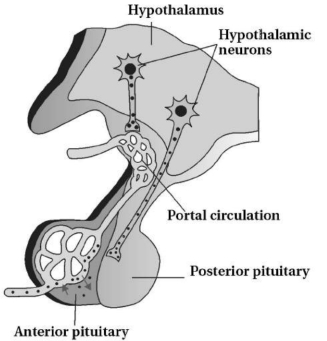
0 likes
View Solution139
Medium
Provide definitions/explanations for the following terms:
$(1)$ Hormone
$(2)$ Endocrine glands
$(3)$ Exocrine glands
$(4)$ Acromegaly
$(1)$ Hormone
$(2)$ Endocrine glands
$(3)$ Exocrine glands
$(4)$ Acromegaly
Solution
(N/A) $(1)$ Hormones are non-nutrient chemicals which act as intercellular messengers and are produced in trace amounts. They are synthesized by ductless glands,secreted into the blood,and transported to target organs.
$(2)$ Endocrine glands are ductless glands that synthesize hormones and pour their secretions directly into the blood to reach specific target organs.
$(3)$ Exocrine glands are glands that possess ducts. Their secretions (e.g.,enzymes,mucus,saliva) are transported through these ducts to the specific target sites or surfaces.
$(4)$ Acromegaly is a condition in adults caused by the excessive secretion of growth hormone $(GH)$. It is characterized by the abnormal enlargement of bones,particularly in the lower jaw,limbs,and facial features.
$(2)$ Endocrine glands are ductless glands that synthesize hormones and pour their secretions directly into the blood to reach specific target organs.
$(3)$ Exocrine glands are glands that possess ducts. Their secretions (e.g.,enzymes,mucus,saliva) are transported through these ducts to the specific target sites or surfaces.
$(4)$ Acromegaly is a condition in adults caused by the excessive secretion of growth hormone $(GH)$. It is characterized by the abnormal enlargement of bones,particularly in the lower jaw,limbs,and facial features.
0 likes
View Solution140
MediumMCQ
Name the only hormone secreted by the pars intermedia of the pituitary gland.
A
Growth hormone
B
Melanocyte stimulating hormone $(MSH)$
C
Prolactin
D
Oxytocin
Solution
(B) The pars intermedia is a region of the pituitary gland located between the anterior and posterior lobes.
In humans,it is often vestigial or fused with the anterior lobe.
It secretes only one hormone known as Melanocyte Stimulating Hormone $(MSH)$.
The primary function of $MSH$ is to regulate skin pigmentation by stimulating the dispersal of melanin granules in melanocytes.
In humans,it is often vestigial or fused with the anterior lobe.
It secretes only one hormone known as Melanocyte Stimulating Hormone $(MSH)$.
The primary function of $MSH$ is to regulate skin pigmentation by stimulating the dispersal of melanin granules in melanocytes.
0 likes
View Solution141
MediumMCQ
$A$ patient complains of constant thirst,excessive passing of urine,and low blood pressure. When the doctor checked the patient's blood glucose and blood insulin levels,the levels were normal or slightly low. The doctor diagnosed the condition as diabetes insipidus. However,the doctor decided to measure one more hormone in the patient's blood. Which hormone does the doctor intend to measure?
A
Glucagon
B
Antidiuretic hormone $(ADH)$
C
Aldosterone
D
Cortisol
Solution
(B) The symptoms described (constant thirst,excessive urination,and low blood pressure) are classic indicators of diabetes insipidus,which is caused by a deficiency of Antidiuretic Hormone $(ADH)$,also known as vasopressin.
Since the doctor has already diagnosed the condition as diabetes insipidus,they would intend to measure the level of $ADH$ in the blood to confirm the diagnosis.
$ADH$ is synthesized by the hypothalamus and released by the posterior pituitary gland. It facilitates water reabsorption from the distal convoluted tubules and collecting ducts of the nephrons,thereby preventing diuresis.
Since the doctor has already diagnosed the condition as diabetes insipidus,they would intend to measure the level of $ADH$ in the blood to confirm the diagnosis.
$ADH$ is synthesized by the hypothalamus and released by the posterior pituitary gland. It facilitates water reabsorption from the distal convoluted tubules and collecting ducts of the nephrons,thereby preventing diuresis.
0 likes
View Solution142
Medium
$A$ milkman is very upset one morning as his cow refuses to give any milk. The milkman's wife gets the calf from the shed. On feeding by the calf,the cow gave sufficient milk. Describe the role of the endocrine gland and the pathway associated with this response.
Solution
(N/A) Suckling by the calf triggers a neurohormonal reflex action.
When the calf suckles,sensory impulses are sent to the hypothalamus.
The hypothalamus stimulates the neurohypophysis (posterior pituitary) to release the hormone oxytocin into the bloodstream.
Oxytocin travels through the blood to the mammary glands.
It causes the contraction of smooth muscles (myoepithelial cells) surrounding the alveoli of the mammary glands,resulting in milk ejection.
The entire process can be summarized as follows:
Mammary gland (stimulation by suckling) $\rightarrow$ Brain (Hypothalamus) $\rightarrow$ Neurohypophysis $\rightarrow$ Blood (Oxytocin) $\rightarrow$ Mammary gland (smooth muscle contraction) $\rightarrow$ Milk ejection.
When the calf suckles,sensory impulses are sent to the hypothalamus.
The hypothalamus stimulates the neurohypophysis (posterior pituitary) to release the hormone oxytocin into the bloodstream.
Oxytocin travels through the blood to the mammary glands.
It causes the contraction of smooth muscles (myoepithelial cells) surrounding the alveoli of the mammary glands,resulting in milk ejection.
The entire process can be summarized as follows:
Mammary gland (stimulation by suckling) $\rightarrow$ Brain (Hypothalamus) $\rightarrow$ Neurohypophysis $\rightarrow$ Blood (Oxytocin) $\rightarrow$ Mammary gland (smooth muscle contraction) $\rightarrow$ Milk ejection.
0 likes
View Solution143
Medium
Select the correct option for each statement:
$(1)$ Hormones are non-nutrient/nutrient chemicals which act as intercellular messengers and are produced in trace amounts.
$(2)$ The posterior pituitary gland is under the direct neural/endocrine regulation of the hypothalamus.
$(3)$ The hormone produced by the posterior pituitary gland is oxytocin/prolactin.
$(1)$ Hormones are non-nutrient/nutrient chemicals which act as intercellular messengers and are produced in trace amounts.
$(2)$ The posterior pituitary gland is under the direct neural/endocrine regulation of the hypothalamus.
$(3)$ The hormone produced by the posterior pituitary gland is oxytocin/prolactin.
Solution
(NON-NUTRIENT, NEURAL REGULATION, OXYTOCIN) $(1)$ Hormones are non-nutrient chemicals that act as intercellular messengers and are produced in trace amounts.
$(2)$ The posterior pituitary gland is under the direct neural regulation of the hypothalamus.
$(3)$ The hormone stored and released by the posterior pituitary gland is oxytocin (it is synthesized by the hypothalamus).
$(2)$ The posterior pituitary gland is under the direct neural regulation of the hypothalamus.
$(3)$ The hormone stored and released by the posterior pituitary gland is oxytocin (it is synthesized by the hypothalamus).
0 likes
View Solution144
EasyMCQ
Which gland is under direct control of the hypothalamus?
A
Anterior pituitary
B
Posterior pituitary
C
Thyroid gland
D
Adrenal gland
Solution
(B) The hypothalamus regulates the pituitary gland through two distinct mechanisms.
$1$. The anterior pituitary is regulated by hypothalamic releasing and inhibitory hormones via a portal circulatory system.
$2$. The posterior pituitary (neurohypophysis) is under the direct neural regulation of the hypothalamus,as it stores and releases hormones (oxytocin and vasopressin) that are synthesized in the hypothalamic neurons.
$1$. The anterior pituitary is regulated by hypothalamic releasing and inhibitory hormones via a portal circulatory system.
$2$. The posterior pituitary (neurohypophysis) is under the direct neural regulation of the hypothalamus,as it stores and releases hormones (oxytocin and vasopressin) that are synthesized in the hypothalamic neurons.
0 likes
View Solution145
EasyMCQ
In which part is the pituitary gland protected?
A
Sella turcica
B
Foramen magnum
C
Cerebral aqueduct
D
Hypothalamus
Solution
(A) The pituitary gland is located in a bony cavity called the sella turcica.
It is situated at the base of the brain,specifically within the sphenoid bone of the skull.
This bony structure provides protection to the gland.
It is situated at the base of the brain,specifically within the sphenoid bone of the skull.
This bony structure provides protection to the gland.
0 likes
View Solution146
EasyMCQ
What is the cause of dwarfism?
A
Over-secretion of growth hormone $(GH)$
B
Under-secretion of growth hormone $(GH)$
C
Over-secretion of thyroid hormone
D
Under-secretion of thyroid hormone
Solution
(B) The growth hormone $(GH)$ secreted by the anterior pituitary gland is essential for the growth of the body.
Over-secretion of $GH$ stimulates abnormal growth of the body,leading to gigantism.
Conversely,low secretion or under-secretion of $GH$ results in stunted growth,which is known as pituitary dwarfism.
Over-secretion of $GH$ stimulates abnormal growth of the body,leading to gigantism.
Conversely,low secretion or under-secretion of $GH$ results in stunted growth,which is known as pituitary dwarfism.
0 likes
View Solution147
MediumMCQ
When is acromegaly formed?
A
Excessive secretion of $GH$ during childhood
B
Excessive secretion of $GH$ during adulthood
C
Deficiency of $GH$ during childhood
D
Deficiency of $GH$ during adulthood
Solution
(B) Acromegaly is caused by the excessive secretion of Growth Hormone $(GH)$ in adults.
This condition leads to severe physical changes,particularly in the facial features,such as the enlargement of the jaw and bones.
It is often associated with serious health complications and can lead to premature death if left untreated.
Initial diagnosis is difficult because the physical changes develop slowly over time.
This condition leads to severe physical changes,particularly in the facial features,such as the enlargement of the jaw and bones.
It is often associated with serious health complications and can lead to premature death if left untreated.
Initial diagnosis is difficult because the physical changes develop slowly over time.
0 likes
View Solution148
EasyMCQ
What is the function of $FSH$ in females?
A
Stimulates ovulation
B
Maintains the corpus luteum
C
Stimulates growth and development of ovarian follicles
D
Inhibits progesterone secretion
Solution
(C) In females,$LH$ induces ovulation of fully mature Graafian follicles and maintains the corpus luteum.
$FSH$ (Follicle Stimulating Hormone) stimulates the growth and development of the ovarian follicles in females.
$FSH$ (Follicle Stimulating Hormone) stimulates the growth and development of the ovarian follicles in females.
0 likes
View Solution149
EasyMCQ
Mention the function of oxytocin.
A
Stimulates skeletal muscle contraction
B
Stimulates uterine contraction and milk ejection
C
Regulates blood glucose levels
D
Promotes bone growth
Solution
(B) Oxytocin acts on the smooth muscles of our body and stimulates their contraction.
In females,it stimulates a vigorous contraction of the uterus at the time of childbirth (parturition) and facilitates milk ejection from the mammary glands.
In females,it stimulates a vigorous contraction of the uterus at the time of childbirth (parturition) and facilitates milk ejection from the mammary glands.
0 likes
View Solution150
MediumMCQ
Which pituitary hormone is required for the production of androgens?
A
$FSH$
B
$LH$
C
$GnRH$
D
Both $A$ and $B$
Solution
(B) In males,the pituitary gland secretes Luteinizing Hormone $(LH)$ and Follicle Stimulating Hormone $(FSH)$.
$LH$ acts on the Leydig cells (interstitial cells) of the testes and stimulates them to synthesize and secrete androgens (mainly testosterone).
$FSH$ acts on the Sertoli cells and stimulates the secretion of some factors which help in the process of spermiogenesis.
Therefore,$LH$ is the primary pituitary hormone required for androgen production.
$LH$ acts on the Leydig cells (interstitial cells) of the testes and stimulates them to synthesize and secrete androgens (mainly testosterone).
$FSH$ acts on the Sertoli cells and stimulates the secretion of some factors which help in the process of spermiogenesis.
Therefore,$LH$ is the primary pituitary hormone required for androgen production.
0 likes
View SolutionChemical Coordination and Integration — The Pituitary Gland · Frequently Asked Questions
1Are these Chemical Coordination and Integration questions useful for JEE and NEET?
Yes. All questions in this section are mapped to JEE Main and NEET exam patterns. Previous year questions from JEE Main, NEET, GUJCET and state-level exams are included with full solutions.
2Can I switch to Hindi or Gujarati for these questions?
Yes. Use the language tabs in the hero section or the sidebar to view the same questions and solutions in English, Hindi or Gujarati.
3How do I generate a question paper from this subtopic?
Use the Vedclass Exam Paper Generator — select the chapter and subtopic, set difficulty, and generate Sets A, B, C, D automatically. First 3 chapters of every subject are free.
Vedclass Products
For Students
Vedclass Test Series
Mock tests in real JEE/NEET style with performance analysis. 5-day free trial.
Start Free TrialFor Teachers
Exam Paper Generator
Generate Set A/B/C/D papers from this chapter in 2 minutes. 3 chapters free.
Try FreeFor Institutes
Online Exam Module
Live online exams with unlimited students, 360° analytics & white-label branding.
See DemoFor Teachers & Institutes
Generate a Chemical Coordination and Integration Exam Paper in 2 Minutes
Select subtopic & difficulty — Sets A, B, C, D auto-generated with No Repeat logic.
First 3 chapters of every subject are free — no payment required.