
A English
Nucleus and Chromosomes Questions in English
Class 11 Biology · Cell: The Unit of Life · Nucleus and Chromosomes
356+
Questions
English
Language
100%
With Solutions
Showing 50 of 356 questions in English
301
EasyMCQ
Chromosomes having equal or almost equal arms are called
A
metacentric
B
acrocentric
C
polycentric
D
acentric
Solution
(A) Centromeres consist of a complex combination of proteins and $DNA$. They are essential to the division and ensure the accurate segregation of chromosomes.
Metacentric chromosomes have the centromere in the centre,such that both sections are of equal length.
Human chromosome $1$ and $3$ are metacentric.
Metacentric chromosomes have the centromere in the centre,such that both sections are of equal length.
Human chromosome $1$ and $3$ are metacentric.
0 likes
View Solution302
MediumMCQ
Match column-$I$ with column-$II$ and choose the correct option.
| Column-$I$ (Chromosome) | Column-$II$ (Position of Centromere) |
| $A$. Metacentric | $I$. At the tip |
| $B$. Submetacentric | $II$. Almost near the tip |
| $C$. Acrocentric | $III$. At the middle |
| $D$. Telocentric | $IV$. Slightly away from the middle |
A
$A-III, B-IV, C-II, D-I$
B
$A-IV, B-III, C-II, D-I$
C
$A-I, B-II, C-III, D-IV$
D
$A-IV, B-III, C-I, D-II$
Solution
(A) Metacentric chromosomes have the centromere in the middle,dividing the chromosome into two equal arms.
Submetacentric chromosomes have the centromere slightly away from the middle,resulting in one shorter arm and one longer arm.
Acrocentric chromosomes have the centromere situated almost near the tip,forming one extremely short arm and one very long arm.
Telocentric chromosomes have the centromere located at the terminal tip of the chromosome.
Therefore,the correct matching is: $A-III, B-IV, C-II, D-I$.
Submetacentric chromosomes have the centromere slightly away from the middle,resulting in one shorter arm and one longer arm.
Acrocentric chromosomes have the centromere situated almost near the tip,forming one extremely short arm and one very long arm.
Telocentric chromosomes have the centromere located at the terminal tip of the chromosome.
Therefore,the correct matching is: $A-III, B-IV, C-II, D-I$.
0 likes
View Solution303
EasyMCQ
The nucleus was discovered by . . . . . . in . . . . . . .
A
Robert Hooke,$1931$
B
Anton van Leeuwenhoek,$1906$
C
Robert Brown,$1831$
D
Schleiden,$1981$
Solution
(C) The nucleus was discovered by Robert Brown in $1831$. He observed it in the cells of orchid roots.
0 likes
View Solution304
EasyMCQ
The structure present inside the nucleus responsible for ribosomal unit formation is
A
Mesosomes
B
Nucleoplasm
C
Nucleolus
D
$DNA$
Solution
(C) The $Nucleolus$ is a spherical structure present inside the nucleus that is not membrane-bound. It is the primary site for the synthesis of ribosomal $RNA$ $(rRNA)$ and the assembly of ribosomal subunits.
$Mesosomes$ $\rightarrow$ Infoldings of the plasma membrane in prokaryotes involved in $DNA$ replication,respiration,and cell wall formation.
$Nucleoplasm$ $\rightarrow$ The dense,protein-rich fluid (matrix) enclosed within the nuclear envelope.
$DNA$ $\rightarrow$ The hereditary genetic material found within the nucleus.
$Mesosomes$ $\rightarrow$ Infoldings of the plasma membrane in prokaryotes involved in $DNA$ replication,respiration,and cell wall formation.
$Nucleoplasm$ $\rightarrow$ The dense,protein-rich fluid (matrix) enclosed within the nuclear envelope.
$DNA$ $\rightarrow$ The hereditary genetic material found within the nucleus.
0 likes
View Solution305
EasyMCQ
Chromatin found in the nucleus was discovered by
A
Flemming
B
Schleiden
C
Schwann
D
Robert Brown
Solution
(A) The term 'chromatin' was coined by Walther Flemming,who discovered and described the thread-like structures within the nucleus that take up basic dyes.
$A$. Flemming: Discovered chromatin.
$B$. Schleiden: Proposed the plant cell theory.
$C$. Schwann: Proposed the animal cell theory.
$D$. Robert Brown: Discovered the nucleus.
$A$. Flemming: Discovered chromatin.
$B$. Schleiden: Proposed the plant cell theory.
$C$. Schwann: Proposed the animal cell theory.
$D$. Robert Brown: Discovered the nucleus.
0 likes
View Solution306
EasyMCQ
Chromatin is essentially composed of
A
$DNA$ only
B
$DNA$ and histones
C
$RNA$ only
D
$RNA$ and ribosomes
Solution
(B) Chromatin is the nucleoprotein fiber found in the nucleus of eukaryotic cells during interphase. It is essentially composed of $DNA$ and basic proteins called histones,along with some non-histone chromosomal proteins and $RNA$.
0 likes
View Solution307
EasyMCQ
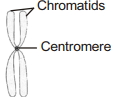
The chromatids of a chromosome are held together at a point called
A
Centrosome
B
Centriole
C
Satellite
D
Centromere
Solution
(D) The chromatids of a chromosome are held together at a primary constriction called the centromere.
Centrosome $\rightarrow$ An organelle that serves as the main microtubule organizing center $(MTOC)$ of the animal cell.
Centriole $\rightarrow$ $A$ cylindrical structure composed mainly of the protein tubulin,found in most eukaryotic cells.
Satellite $\rightarrow$ $A$ small fragment of a chromosome separated from the main body by a secondary constriction.
Centrosome $\rightarrow$ An organelle that serves as the main microtubule organizing center $(MTOC)$ of the animal cell.
Centriole $\rightarrow$ $A$ cylindrical structure composed mainly of the protein tubulin,found in most eukaryotic cells.
Satellite $\rightarrow$ $A$ small fragment of a chromosome separated from the main body by a secondary constriction.
0 likes
View Solution308
EasyMCQ
The chromosomes having centromere at terminal end are called
A
Sub-metacentric
B
Metacentric
C
Telocentric
D
Acrocentric
Solution
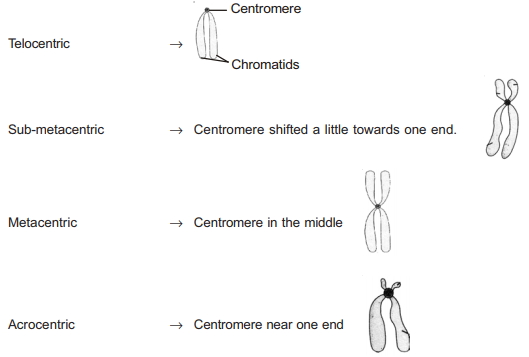
(C) Chromosomes are classified based on the position of the centromere:
$1$. Metacentric: The centromere is located in the middle of the chromosome,forming two equal arms.
$2$. Sub-metacentric: The centromere is slightly away from the middle,resulting in one shorter arm and one longer arm.
$3$. Acrocentric: The centromere is situated close to one end,resulting in one extremely short arm and one very long arm.
$4$. Telocentric: The centromere is located at the terminal end of the chromosome.
Therefore,chromosomes with the centromere at the terminal end are called Telocentric.
$1$. Metacentric: The centromere is located in the middle of the chromosome,forming two equal arms.
$2$. Sub-metacentric: The centromere is slightly away from the middle,resulting in one shorter arm and one longer arm.
$3$. Acrocentric: The centromere is situated close to one end,resulting in one extremely short arm and one very long arm.
$4$. Telocentric: The centromere is located at the terminal end of the chromosome.
Therefore,chromosomes with the centromere at the terminal end are called Telocentric.
0 likes
View Solution309
MediumMCQ
Satellite chromosomes have
A
Primary constriction only
B
Secondary constriction only
C
Tertiary constriction only
D
Both primary and secondary constriction
Solution
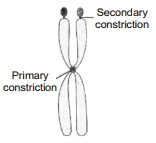
(D) chromosome typically possesses a primary constriction,also known as the centromere,which is essential for the attachment of spindle fibers during cell division.
In addition to the primary constriction,some chromosomes exhibit a secondary constriction at a constant location.
This secondary constriction is often referred to as the nucleolar organizer region $(NOR)$.
The small fragment of the chromosome beyond this secondary constriction is called a satellite.
Therefore,satellite chromosomes possess both a primary constriction (centromere) and a secondary constriction.
In addition to the primary constriction,some chromosomes exhibit a secondary constriction at a constant location.
This secondary constriction is often referred to as the nucleolar organizer region $(NOR)$.
The small fragment of the chromosome beyond this secondary constriction is called a satellite.
Therefore,satellite chromosomes possess both a primary constriction (centromere) and a secondary constriction.
0 likes
View Solution310
EasyMCQ
Diagrammatic representation of the karyotype of a species is called:
A
Cladogram
B
Dendrogram
C
Idiogram
D
More than one option is correct
Solution
(C) karyotype is the complete set of chromosomes in an organism. $A$ diagrammatic representation or a photograph of these chromosomes,arranged in a standard sequence (usually by size and centromere position),is known as an Idiogram.
0 likes
View Solution311
MediumMCQ
Which of the following statements is incorrect in relation to the nucleolus?
A
It is a spherical structure.
B
It is separated from the nucleoplasm by a nuclear envelope.
C
It is the site of $rRNA$ synthesis.
D
They are larger and more numerous in cells actively engaged in protein synthesis.
Solution
(B) The nucleolus is a non-membrane-bound structure present within the nucleus. It is not separated from the nucleoplasm by any membrane or envelope. Therefore,the statement that it is separated from the nucleoplasm by a nuclear envelope is incorrect.
0 likes
View Solution312
MediumMCQ
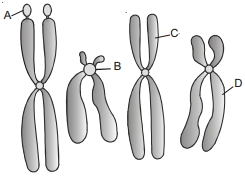
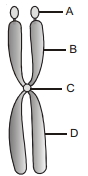
Identify the correct labels for the given diagrams of chromosomes.
A
$A$ - Satellite,$B$ - Secondary constriction,$C$ - Short arm,$D$ - Long arm
B
$A$ - Satellite,$B$ - Centromere,$C$ - Short arm,$D$ - Long arm
C
$A$ - Secondary constriction,$B$ - Satellite,$C$ - Long arm,$D$ - Short arm
D
$A$ - $NOR$,$B$ - Secondary constriction,$C$ - Short arm,$D$ - Long arm
Solution
(A) Based on the structure of chromosomes:
$A$ points to the terminal,small,rounded fragment known as the Satellite.
$B$ points to the Secondary constriction (which is often associated with the Nucleolar Organizer Region,$NOR$).
$C$ points to the shorter arm of the chromosome (p-arm).
$D$ points to the longer arm of the chromosome (q-arm).
Therefore,the correct labeling is $A$ - Satellite,$B$ - Secondary constriction,$C$ - Short arm,$D$ - Long arm.
$A$ points to the terminal,small,rounded fragment known as the Satellite.
$B$ points to the Secondary constriction (which is often associated with the Nucleolar Organizer Region,$NOR$).
$C$ points to the shorter arm of the chromosome (p-arm).
$D$ points to the longer arm of the chromosome (q-arm).
Therefore,the correct labeling is $A$ - Satellite,$B$ - Secondary constriction,$C$ - Short arm,$D$ - Long arm.
0 likes
View Solution313
EasyMCQ
Nucleolus is formed by
A
Primary constriction
B
Nucleolar organiser
C
Endoplasmic reticulum
D
Ribosomes
Solution
(B) The Nucleolus is a non-membrane-bound structure present within the nucleus.
It is formed at specific sites on certain chromosomes known as the Nucleolar Organiser Regions $(NOR)$.
These regions contain the genes for ribosomal $RNA$ $(rRNA)$ synthesis,which are essential for the assembly of ribosomes.
Therefore,the correct answer is the Nucleolar organiser.
It is formed at specific sites on certain chromosomes known as the Nucleolar Organiser Regions $(NOR)$.
These regions contain the genes for ribosomal $RNA$ $(rRNA)$ synthesis,which are essential for the assembly of ribosomes.
Therefore,the correct answer is the Nucleolar organiser.
0 likes
View Solution314
MediumMCQ
$A$: Lampbrush chromosomes show transcriptionally active loops.
$R$: Informosomes can be used in future for embryo development.
$R$: Informosomes can be used in future for embryo development.
A
Assertion and Reason both are correct and also correct explanation.
B
Assertion and Reason both are correct but not explanation of assertion.
C
Assertion is correct,but Reason is incorrect.
D
Both Assertion and Reason are incorrect.
Solution
(C) Lampbrush chromosomes are large chromosomes found in the oocytes of many vertebrates and invertebrates. They possess lateral loops that are sites of intense $RNA$ synthesis,making them transcriptionally active.
Informosomes are complexes of $mRNA$ and proteins found in the cytoplasm of eukaryotic cells,particularly in oocytes. They serve as a storage form of $mRNA$ that is translated later during development. However,the statement that they can be used in the future for embryo development is scientifically vague and not a standard biological fact in this context. Therefore,the Reason is considered incorrect or irrelevant to the Assertion.
Informosomes are complexes of $mRNA$ and proteins found in the cytoplasm of eukaryotic cells,particularly in oocytes. They serve as a storage form of $mRNA$ that is translated later during development. However,the statement that they can be used in the future for embryo development is scientifically vague and not a standard biological fact in this context. Therefore,the Reason is considered incorrect or irrelevant to the Assertion.
0 likes
View Solution315
MediumMCQ
$A$ : Telocentric chromosome has two unequal arms.
$R$ : The centromere is situated close to its end forming one extremely short arm.
$R$ : The centromere is situated close to its end forming one extremely short arm.
A
Assertion and Reason both are correct and also correct explanation.
B
Assertion and Reason both are correct but not explanation of assertion.
C
Assertion is correct,but Reason is incorrect.
D
Both Assertion and Reason are incorrect.
Solution
(D) The Assertion is incorrect because a telocentric chromosome has only one arm,not two unequal arms. $A$ chromosome with two unequal arms is called a submetacentric chromosome.
The Reason is also incorrect because in a telocentric chromosome,the centromere is situated at the terminal end,not close to the end. $A$ chromosome with the centromere close to the end is called an acrocentric chromosome.
Therefore,both the Assertion and the Reason are incorrect.
The Reason is also incorrect because in a telocentric chromosome,the centromere is situated at the terminal end,not close to the end. $A$ chromosome with the centromere close to the end is called an acrocentric chromosome.
Therefore,both the Assertion and the Reason are incorrect.

0 likes
View Solution316
MediumMCQ
Centromere is also called
A
Chromomere
B
Secondary constriction
C
Primary constriction
D
Chromocentre
Solution
(C) The centromere is the region where the two sister chromatids of a chromosome are joined together. This region appears as a narrowed or constricted area under a microscope,which is known as the primary constriction.
0 likes
View Solution317
MediumMCQ
The chemical nature of the chromosome is as follows:
A
Nucleic acids
B
Nucleic acid and histone proteins
C
Nucleic acids,histone and non-histone proteins
D
Nucleic acids and non-histone proteins
Solution
(C) The eukaryotic $DNA$ is organized in the form of chromosomes.
Chemically,a chromosome consists of nucleic acids ($DNA$ and $RNA$),histone proteins,and non-histone proteins.
Chemically,a chromosome consists of nucleic acids ($DNA$ and $RNA$),histone proteins,and non-histone proteins.
0 likes
View Solution318
EasyMCQ
Chromosomes are made up of
A
$DNA$ only
B
$RNA$ and $DNA$
C
$DNA$ and histone
D
Only histones
Solution
(C) Chromosomes are composed of chromatin,which consists of $DNA$ and basic proteins called histones.
$DNA$ molecules wrap around histone octamers to form nucleosomes,which further condense to form the structure of a chromosome.
$DNA$ molecules wrap around histone octamers to form nucleosomes,which further condense to form the structure of a chromosome.
0 likes
View Solution319
MediumMCQ
$A$ chromosome in which the centromere is situated close to its end so that one arm is very short and the other very long is:
A
Acrocentric
B
Metacentric
C
Sub-metacentric
D
Telocentric
Solution
(A) In acrocentric chromosomes,the centromere is situated close to its end,resulting in one very short arm and one very long arm.
0 likes
View Solution320
MediumMCQ
The shape of the chromosome is determined by
A
Centrosome
B
Centromere
C
Chromomere
D
Telomere
Solution
(B) The shape of a chromosome is primarily determined by the position of the centromere (also known as the primary constriction). Based on the position of the centromere,chromosomes can be classified as metacentric,submetacentric,acrocentric,or telocentric.
0 likes
View Solution321
EasyMCQ
The common point of attachment of all the arms of polytene chromosome is known as
A
Centromere
B
Chromomere
C
Chromocentre
D
Centrosome
Solution
(C) Polytene chromosomes radiate as $5$ long and $1$ short arm from a deeply staining and more or less amorphous structure called the chromocentre.
This chromocentre is formed by the fusion of the centromeric regions of all the chromosomes and,in males,the entire $Y$-chromosome.
This chromocentre is formed by the fusion of the centromeric regions of all the chromosomes and,in males,the entire $Y$-chromosome.
0 likes
View Solution322
MediumMCQ
When the centromere is situated in the middle of the two equal arms of a chromosome,it is called:
A
Submetacentric
B
Telocentric
C
Metacentric
D
Acrocentric
Solution
(C) chromosome is classified based on the position of the centromere:
$1$. Metacentric: The centromere is in the middle,resulting in two equal arms.
$2$. Submetacentric: The centromere is slightly away from the middle,resulting in one shorter and one longer arm.
$3$. Acrocentric: The centromere is situated close to the end,forming one extremely short and one very long arm.
$4$. Telocentric: The centromere is at the terminal end of the chromosome.
Therefore,when the centromere is in the middle of two equal arms,it is called Metacentric.
$1$. Metacentric: The centromere is in the middle,resulting in two equal arms.
$2$. Submetacentric: The centromere is slightly away from the middle,resulting in one shorter and one longer arm.
$3$. Acrocentric: The centromere is situated close to the end,forming one extremely short and one very long arm.
$4$. Telocentric: The centromere is at the terminal end of the chromosome.
Therefore,when the centromere is in the middle of two equal arms,it is called Metacentric.
0 likes
View Solution323
MediumMCQ
What is the function of nuclear pores?
A
To allow the passage of $RNA$ and protein molecules between the nucleus and cytoplasm.
B
To synthesize ribosomal $RNA$.
C
To store genetic information.
D
To provide structural support to the cell.
Solution
(A) Nuclear pores are minute openings in the nuclear envelope formed by the fusion of its two membranes.
These pores act as channels that facilitate the bidirectional movement of $RNA$ and protein molecules between the nucleus and the cytoplasm.
These pores act as channels that facilitate the bidirectional movement of $RNA$ and protein molecules between the nucleus and the cytoplasm.
0 likes
View Solution324
MediumMCQ
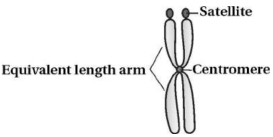
What is the feature of a metacentric chromosome?
A
The centromere is situated at the terminal end.
B
The centromere is situated in the middle of the chromosome,forming two equal arms.
C
The centromere is situated close to its end,forming one extremely short and one very long arm.
D
The centromere is situated slightly away from the middle,resulting in one shorter arm and one longer arm.
Solution
(B) In a metacentric chromosome,the centromere is located exactly in the middle of the chromosome.
This positioning divides the chromosome into two equal arms of the same length.
During anaphase,such chromosomes typically appear $V$-shaped.
This positioning divides the chromosome into two equal arms of the same length.
During anaphase,such chromosomes typically appear $V$-shaped.
0 likes
View Solution325
MediumMCQ
What is referred to as a satellite chromosome?
A
Chromosomes with primary constriction
B
Chromosomes with secondary constriction
C
Chromosomes with telomeres
D
Chromosomes with centromeres
Solution
(B) Sometimes,a few chromosomes possess non-staining secondary constrictions at a constant location.
This gives the appearance of a small fragment called a satellite.
Chromosomes $13, 14, 15, 21,$ and $22$ are known as satellite chromosomes ($SAT$-chromosomes).
This gives the appearance of a small fragment called a satellite.
Chromosomes $13, 14, 15, 21,$ and $22$ are known as satellite chromosomes ($SAT$-chromosomes).
0 likes
View Solution326
MediumMCQ
Match List-$I$ with List-$II$:
Choose the correct answer from the options given below:
| List-$I$ | List-$II$ |
|---|---|
| $(a)$ Metacentric chromosome | $(I)$ Centromere situated close to the end forming one extremely short and one very long arm |
| $(b)$ Acrocentric chromosome | $(II)$ Centromere at the terminal end |
| $(c)$ Sub-metacentric | $(III)$ Centromere in the middle forming two equal arms of chromosomes |
| $(d)$ Telocentric chromosome | $(IV)$ Centromere slightly away from the middle forming one shorter arm and one longer arm |
Choose the correct answer from the options given below:
A
$(a) - (i), (b) - (iii), (c) - (ii), (d) - (iv)$
B
$(a) - (ii), (b) - (iii), (c) - (iv), (d) - (i)$
C
$(a) - (i), (b) - (ii), (c) - (iii), (d) - (iv)$
D
$(a) - (iii), (b) - (i), (c) - (iv), (d) - (ii)$
Solution
(D) The classification of chromosomes is based on the position of the centromere:
$1$. Metacentric chromosome: The centromere is in the middle,resulting in two equal arms. This matches $(III)$.
$2$. Acrocentric chromosome: The centromere is situated close to the end,forming one extremely short and one very long arm. This matches $(I)$.
$3$. Sub-metacentric chromosome: The centromere is slightly away from the middle,forming one shorter arm and one longer arm. This matches $(IV)$.
$4$. Telocentric chromosome: The centromere is at the terminal end. This matches $(II)$.
Therefore,the correct matching is $(a)-(iii), (b)-(i), (c)-(iv), (d)-(ii)$.
$1$. Metacentric chromosome: The centromere is in the middle,resulting in two equal arms. This matches $(III)$.
$2$. Acrocentric chromosome: The centromere is situated close to the end,forming one extremely short and one very long arm. This matches $(I)$.
$3$. Sub-metacentric chromosome: The centromere is slightly away from the middle,forming one shorter arm and one longer arm. This matches $(IV)$.
$4$. Telocentric chromosome: The centromere is at the terminal end. This matches $(II)$.
Therefore,the correct matching is $(a)-(iii), (b)-(i), (c)-(iv), (d)-(ii)$.
0 likes
View Solution327
EasyMCQ
Which scientist discovered the nucleus?
A
Robert Hooke
B
Robert Brown
C
Anton van Leeuwenhoek
D
Flemming
Solution
(B) The nucleus was first described by the Scottish botanist $Robert \ Brown$ in $1831$. He observed it while studying the cells of orchid roots. Robert Hooke discovered the cell,while Anton van Leeuwenhoek was the first to observe living cells.
0 likes
View Solution328
MediumMCQ
Chromatin is $.......P......$ in nature,so it is stained with $......Q......$ type of stain.
A
Acidic,Acidic
B
Basic,Basic
C
Basic,Acidic
D
Acidic,Basic
Solution
(D) Chromatin consists of $DNA$ and basic proteins called histones.
Because $DNA$ is acidic in nature due to the presence of phosphate groups,chromatin is acidic.
To stain acidic components,a basic stain (such as acetocarmine or basic fuchsin) is used.
Therefore,$P$ is acidic and $Q$ is basic.
Because $DNA$ is acidic in nature due to the presence of phosphate groups,chromatin is acidic.
To stain acidic components,a basic stain (such as acetocarmine or basic fuchsin) is used.
Therefore,$P$ is acidic and $Q$ is basic.
0 likes
View Solution329
EasyMCQ
Chromatin was discovered by $...........$.
A
Robert Hooke
B
Robert Brown
C
Flemming
D
Matthias Schleiden
Solution
(C) The term 'chromatin' was coined and the structure was described by the German biologist $Walther \ Flemming$ in $1880$. He observed the thread-like structures within the nucleus that stained intensely with basic dyes during cell division. Therefore,the correct option is $C$.
0 likes
View Solution330
MediumMCQ
The width of the perinuclear space is $.............$.
A
$10$ to $55 \ nm$
B
$15$ to $50 \ nm$
C
$10$ to $55 \ \mu m$
D
$15$ to $50 \ \mu m$
Solution
(A) The nuclear envelope consists of two parallel membranes with a space between them called the perinuclear space. This space acts as a barrier between the materials present inside the nucleus and those of the cytoplasm. The width of this perinuclear space is typically $10$ to $55 \ nm$.
0 likes
View Solution331
MediumMCQ
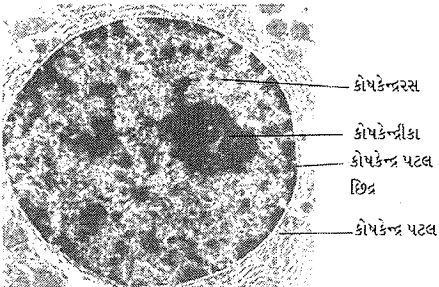
In which of the following organisms is the given structure $NOT$ found?
A
Fungi
B
Animal
C
Bacteria
D
Plant
Solution
(C) The image shows a eukaryotic nucleus,which contains a nuclear envelope,nucleolus,and nucleoplasm.
Eukaryotic cells (Fungi,Animals,and Plants) possess a well-defined nucleus with a nuclear membrane.
Bacteria are prokaryotic organisms and lack a membrane-bound nucleus.
Therefore,the structure shown is not found in bacteria.
Eukaryotic cells (Fungi,Animals,and Plants) possess a well-defined nucleus with a nuclear membrane.
Bacteria are prokaryotic organisms and lack a membrane-bound nucleus.
Therefore,the structure shown is not found in bacteria.
0 likes
View Solution332
MediumMCQ
Which of the following is true for a cell that is actively synthesizing proteins in large quantities?
A
It possesses a large nucleolus.
B
It possesses multiple nucleoli.
C
It possesses many lysosomes.
D
Both $A$ and $B$.
Solution
(D) The nucleolus is the site of ribosomal $RNA$ $(rRNA)$ synthesis and ribosome assembly. Since proteins are synthesized by ribosomes,cells that require high rates of protein synthesis (such as secretory cells or rapidly growing cells) need a large number of ribosomes. To meet this demand,these cells often exhibit a prominent,large nucleolus or multiple nucleoli to facilitate the rapid production of ribosomal subunits. Therefore,both $A$ and $B$ are correct characteristics of such cells.
0 likes
View Solution333
EasyMCQ
The nucleolus is the site for the synthesis of $.......$.
A
$rRNA$
B
$mRNA$
C
$tRNA$
D
All of the above
Solution
(A) The nucleolus is a spherical structure present inside the nucleus of eukaryotic cells.
It is not bounded by any membrane.
It is the primary site for the active synthesis of ribosomal $RNA$ $(rRNA)$.
These $rRNA$ molecules are essential for the assembly of ribosomes,which are the protein-synthesizing machinery of the cell.
It is not bounded by any membrane.
It is the primary site for the active synthesis of ribosomal $RNA$ $(rRNA)$.
These $rRNA$ molecules are essential for the assembly of ribosomes,which are the protein-synthesizing machinery of the cell.
0 likes
View Solution334
EasyMCQ
The protein present on the primary constriction is:
A
Centromere
B
Kinetochore
C
Satellite
D
None of these
Solution
(B) The primary constriction of a chromosome is known as the centromere.
On the sides of the centromere,disc-shaped structures are present,which are called kinetochores.
These kinetochores are proteinaceous structures that serve as the attachment sites for spindle fibers during cell division.
On the sides of the centromere,disc-shaped structures are present,which are called kinetochores.
These kinetochores are proteinaceous structures that serve as the attachment sites for spindle fibers during cell division.
0 likes
View Solution335
MediumMCQ
Match the following columns regarding chromosome types based on the position of the centromere:
| Column-$I$ | Column-$II$ |
|---|---|
| $P$. Metacentric | $I$. One arm shorter and one arm longer |
| $Q$. Sub-metacentric | $II$. One arm extremely short and one arm extremely long |
| $R$. Acrocentric | $III$. Terminal centromere |
| $S$. Telocentric | $IV$. Middle centromere forming two equal arms |
A
$P-I, Q-IV, R-II, S-III$
B
$P-I, Q-IV, R-III, S-II$
C
$P-IV, Q-I, R-II, S-III$
D
$P-IV, Q-I, R-II, S-III$
Solution
(D) The classification of chromosomes is based on the position of the centromere:
$1$. Metacentric $(P)$: The centromere is in the middle,forming two equal arms $(IV)$.
$2$. Sub-metacentric $(Q)$: The centromere is slightly away from the middle,resulting in one shorter and one longer arm $(I)$.
$3$. Acrocentric $(R)$: The centromere is situated close to the end,forming one extremely short and one extremely long arm $(II)$.
$4$. Telocentric $(S)$: The centromere is at the terminal end of the chromosome $(III)$.
Therefore,the correct matching is $P-IV, Q-I, R-II, S-III$.
$1$. Metacentric $(P)$: The centromere is in the middle,forming two equal arms $(IV)$.
$2$. Sub-metacentric $(Q)$: The centromere is slightly away from the middle,resulting in one shorter and one longer arm $(I)$.
$3$. Acrocentric $(R)$: The centromere is situated close to the end,forming one extremely short and one extremely long arm $(II)$.
$4$. Telocentric $(S)$: The centromere is at the terminal end of the chromosome $(III)$.
Therefore,the correct matching is $P-IV, Q-I, R-II, S-III$.
0 likes
View Solution336
EasyMCQ
Some chromosomes have non-staining secondary constrictions at a constant location. This gives the appearance of a small fragment called the ......
A
Centromere
B
Satellite
C
Kinetochore
D
Arm
Solution
(B) Some chromosomes have non-staining secondary constrictions at a constant location. This gives the appearance of a small fragment called the $Satellite$. These chromosomes are known as $SAT$-chromosomes.
0 likes
View Solution337
MediumMCQ
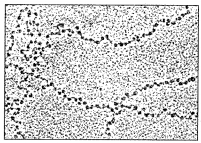
Identify the structure shown below.
A
Chromatin
B
Nucleosome
C
Chromosome
D
Chromatin fiber
Solution
(B) The image shows a 'beads-on-a-string' structure,which is characteristic of chromatin when viewed under an electron microscope. This structure represents the nucleosomes,which are the repeating units of chromatin,consisting of $DNA$ wrapped around a histone octamer. While the entire structure is chromatin,the specific repeating unit shown is the nucleosome.
0 likes
View Solution338
MediumMCQ
Which structure appears like 'beads-on-string'?
A
Nucleosome
B
Chromosome
C
Chromatin
D
Chromatin fiber
Solution
(C) The 'beads-on-string' structure is a characteristic appearance of chromatin under an electron microscope.
In this structure,the $DNA$ molecule is wrapped around a core of histone proteins to form units called nucleosomes.
These nucleosomes are connected by linker $DNA$,giving the appearance of beads on a string.
Therefore,the chromatin fiber is the structure that exhibits this specific morphology.
In this structure,the $DNA$ molecule is wrapped around a core of histone proteins to form units called nucleosomes.
These nucleosomes are connected by linker $DNA$,giving the appearance of beads on a string.
Therefore,the chromatin fiber is the structure that exhibits this specific morphology.
0 likes
View Solution339
MediumMCQ
Chromatin contains:
A
Non-histone proteins
B
Histone proteins
C
$DNA$
D
All of the above
Solution
(D) Chromatin is the complex of $DNA$ and proteins found in the eukaryotic cell nucleus.
It consists of $DNA$,basic histone proteins,and non-histone chromosomal proteins.
Histones are positively charged proteins that help in the packaging of negatively charged $DNA$ into nucleosomes.
Non-histone proteins are involved in various functions such as $DNA$ replication,transcription,and chromatin remodeling.
Therefore,chromatin contains all of the mentioned components.
It consists of $DNA$,basic histone proteins,and non-histone chromosomal proteins.
Histones are positively charged proteins that help in the packaging of negatively charged $DNA$ into nucleosomes.
Non-histone proteins are involved in various functions such as $DNA$ replication,transcription,and chromatin remodeling.
Therefore,chromatin contains all of the mentioned components.
0 likes
View Solution340
EasyMCQ
The nuclear envelope consists of two parallel membranes with a space between them called the perinuclear space,which is about:
A
$10$ to $50 \mathring A$
B
$100$ to $500 \mathring A$
C
$1000$ to $5000 \mathring A$
D
$1$ to $5 \mathring A$
Solution
(B) The nuclear envelope is a double-membrane structure that encloses the nucleus in eukaryotic cells.
It consists of two parallel membranes,the inner and outer nuclear membranes.
The space between these two membranes is known as the perinuclear space (or perinuclear cisterna).
The width of this perinuclear space typically ranges from $10$ to $50 \text{ nm}$,which is equivalent to $100$ to $500 \mathring A$ $(1 \text{ nm} = 10 \mathring A)$.
Therefore,the correct option is $B$.
It consists of two parallel membranes,the inner and outer nuclear membranes.
The space between these two membranes is known as the perinuclear space (or perinuclear cisterna).
The width of this perinuclear space typically ranges from $10$ to $50 \text{ nm}$,which is equivalent to $100$ to $500 \mathring A$ $(1 \text{ nm} = 10 \mathring A)$.
Therefore,the correct option is $B$.
0 likes
View Solution341
MediumMCQ
Chromatin is made up of:
A
$DNA$ and histone protein only
B
$DNA, RNA$ and histone protein only
C
$DNA$ and non-histone protein only
D
$DNA, RNA$,histone and non-histone protein
Solution
(D) Chromatin is the complex of $DNA$ and proteins that makes up chromosomes in eukaryotic cells.
It primarily consists of $DNA$ wrapped around histone proteins to form nucleosomes.
In addition to histones,chromatin also contains non-histone chromosomal proteins,which are involved in the packaging and regulation of gene expression.
$RNA$ is also associated with chromatin as it is synthesized during transcription.
Therefore,chromatin is composed of $DNA, RNA$,histone proteins,and non-histone proteins.
It primarily consists of $DNA$ wrapped around histone proteins to form nucleosomes.
In addition to histones,chromatin also contains non-histone chromosomal proteins,which are involved in the packaging and regulation of gene expression.
$RNA$ is also associated with chromatin as it is synthesized during transcription.
Therefore,chromatin is composed of $DNA, RNA$,histone proteins,and non-histone proteins.
0 likes
View Solution342
MediumMCQ
When the centromere is present slightly away from the middle of the chromosome,the chromosome is called $:-$
A
Metacentric chromosome
B
Sub-metacentric chromosome
C
Acrocentric chromosome
D
Telocentric chromosome
Solution
(B) Chromosomes are classified based on the position of the centromere:
$1$. $Metacentric$: The centromere is in the middle,forming two equal arms.
$2$. $Sub-metacentric$: The centromere is slightly away from the middle,resulting in one shorter arm and one longer arm.
$3$. $Acrocentric$: The centromere is situated close to the end,forming an extremely short arm and a very long arm.
$4$. $Telocentric$: The centromere is at the terminal end of the chromosome.
Therefore,when the centromere is slightly away from the middle,it is a $Sub-metacentric$ chromosome.
$1$. $Metacentric$: The centromere is in the middle,forming two equal arms.
$2$. $Sub-metacentric$: The centromere is slightly away from the middle,resulting in one shorter arm and one longer arm.
$3$. $Acrocentric$: The centromere is situated close to the end,forming an extremely short arm and a very long arm.
$4$. $Telocentric$: The centromere is at the terminal end of the chromosome.
Therefore,when the centromere is slightly away from the middle,it is a $Sub-metacentric$ chromosome.
0 likes
View Solution343
MediumMCQ
Which of the following is true for nucleolus?
A
It is a double membrane bound structure.
B
It takes part in spindle formation.
C
It is a site for active ribosomal $RNA$ synthesis.
D
It involves in oxidation of fats.
Solution
(C) The nucleolus is a dense region found inside the nucleus that is not surrounded by a membrane.
Its primary function is the synthesis of ribosomal $RNA$ $(rRNA)$ and the assembly of ribosomes.
Its primary function is the synthesis of ribosomal $RNA$ $(rRNA)$ and the assembly of ribosomes.
0 likes
View Solution344
MediumMCQ
The part of chromosome beyond the secondary constriction is known as $:-$
A
Chromomere
B
Satellite
C
Kinetochore
D
Centromere
Solution
(B) chromosome typically has a primary constriction called the centromere.
Some chromosomes possess an additional non-staining secondary constriction at a constant location.
The small fragment of the chromosome located beyond this secondary constriction is known as the $Satellite$ (or $SAT$-chromosome).
This region is often associated with the nucleolar organizer region $(NOR)$.
Some chromosomes possess an additional non-staining secondary constriction at a constant location.
The small fragment of the chromosome located beyond this secondary constriction is known as the $Satellite$ (or $SAT$-chromosome).
This region is often associated with the nucleolar organizer region $(NOR)$.
0 likes
View Solution345
MediumMCQ
Every chromosome essentially has $:-$
A
Secondary constriction
B
Primary constriction
C
Centromere
D
Both $(2)$ and $(3)$
Solution
(D) Every chromosome essentially possesses a primary constriction,which is also known as the centromere.
This region is essential for the attachment of spindle fibers during cell division.
While some chromosomes may also have a secondary constriction,the primary constriction (centromere) is a universal feature of all chromosomes.
Therefore,both options $(2)$ and $(3)$ refer to the same structure.
This region is essential for the attachment of spindle fibers during cell division.
While some chromosomes may also have a secondary constriction,the primary constriction (centromere) is a universal feature of all chromosomes.
Therefore,both options $(2)$ and $(3)$ refer to the same structure.
0 likes
View Solution346
MediumMCQ
Read the following statements $:-$
$(i)$ Centromere is present in the middle of the chromosomes and forms two equal arms.
$(ii)$ Chromosome has a terminal centromere.
$(iii)$ Centromere lies close to the end of the chromosome forming one extremely short and one very long arm.
$(iv)$ Centromere lies slightly away from the middle of the chromosome resulting in one shorter arm and one longer arm.
Select the correct option as per the codes given below $:-$
$(i)$ Centromere is present in the middle of the chromosomes and forms two equal arms.
$(ii)$ Chromosome has a terminal centromere.
$(iii)$ Centromere lies close to the end of the chromosome forming one extremely short and one very long arm.
$(iv)$ Centromere lies slightly away from the middle of the chromosome resulting in one shorter arm and one longer arm.
Select the correct option as per the codes given below $:-$
A
Metacentric $\rightarrow(ii)$,submetacentric $\rightarrow(iv)$,Acrocentric $\rightarrow(iii)$,Telocentric $\rightarrow(i)$
B
Metacentric $\rightarrow(i)$,submetacentric $\rightarrow(ii)$,Acrocentric $\rightarrow(iii)$,Telocentric $\rightarrow(iv)$
C
Metacentric $\rightarrow(i)$,submetacentric $\rightarrow(iv)$,Acrocentric $\rightarrow(iii)$,Telocentric $\rightarrow(ii)$
D
Metacentric $\rightarrow(iv)$,submetacentric $\rightarrow(ii)$,Acrocentric $\rightarrow(iii)$,Telocentric $\rightarrow(i)$
Solution
(C) The classification of chromosomes based on the position of the centromere is as follows:
$1$. Metacentric: The centromere is in the middle,forming two equal arms. This corresponds to statement $(i)$.
$2$. Submetacentric: The centromere is slightly away from the middle,resulting in one shorter arm and one longer arm. This corresponds to statement $(iv)$.
$3$. Acrocentric: The centromere is close to the end,forming one extremely short and one very long arm. This corresponds to statement $(iii)$.
$4$. Telocentric: The centromere is at the terminal position. This corresponds to statement $(ii)$.
Therefore,the correct matching is: Metacentric $\rightarrow(i)$,submetacentric $\rightarrow(iv)$,Acrocentric $\rightarrow(iii)$,Telocentric $\rightarrow(ii)$.
$1$. Metacentric: The centromere is in the middle,forming two equal arms. This corresponds to statement $(i)$.
$2$. Submetacentric: The centromere is slightly away from the middle,resulting in one shorter arm and one longer arm. This corresponds to statement $(iv)$.
$3$. Acrocentric: The centromere is close to the end,forming one extremely short and one very long arm. This corresponds to statement $(iii)$.
$4$. Telocentric: The centromere is at the terminal position. This corresponds to statement $(ii)$.
Therefore,the correct matching is: Metacentric $\rightarrow(i)$,submetacentric $\rightarrow(iv)$,Acrocentric $\rightarrow(iii)$,Telocentric $\rightarrow(ii)$.
0 likes
View Solution347
EasyMCQ
Feulgen showed that $DNA$ is present in . . . . . . .
A
chromosomes
B
nucleosomes
C
chromatin
D
nucleotides
Solution
(C) The $Feulgen$ reaction is a staining technique discovered by $Robert$ $Feulgen$ in $1924$. It is used to identify chromosomal material or $DNA$ in cell specimens. The reaction specifically stains the deoxyribose sugar of $DNA$ in the $chromatin$ of the cell nucleus. Therefore,$Feulgen$ demonstrated that $DNA$ is present in the $chromatin$ of the nucleus.
0 likes
View Solution348
EasyMCQ
Match the parts of the chromosome given in Column $I$ with their explanation in Column $II$:
Choose the correct answer from the following options.
| Column $I$ (Chromosome) | Column $II$ (Explanation) |
| $1$. Centromere | $a$. Disc-shaped plate where spindle fibres get attached during cell division. |
| $2$. Secondary constriction | $b$. Long unbranched slender highly coiled $DNA$. |
| $3$. Kinetochore | $c$. Place where $2$ chromatids are joined together. |
| $4$. Chromatonema | $d$. Nucleolus gets organised at this place. |
Choose the correct answer from the following options.
A
$1-c, 2-b, 3-d, 4-a$
B
$1-d, 2-c, 3-b, 4-a$
C
$1-c, 2-d, 3-a, 4-b$
D
$1-d, 2-a, 3-b, 4-c$
Solution
(C) The correct matching is as follows:
$1$. Centromere $(c)$: It is the primary constriction where two sister chromatids are held together.
$2$. Secondary constriction $(d)$: It is a region other than the primary constriction where the nucleolus is organized.
$3$. Kinetochore $(a)$: These are disc-shaped structures present on the sides of the centromere where spindle fibres attach during cell division.
$4$. Chromatonema $(b)$: It refers to the long,unbranched,slender,and highly coiled $DNA$ thread within the chromosome.
Thus,the correct sequence is $1-c, 2-d, 3-a, 4-b$.
$1$. Centromere $(c)$: It is the primary constriction where two sister chromatids are held together.
$2$. Secondary constriction $(d)$: It is a region other than the primary constriction where the nucleolus is organized.
$3$. Kinetochore $(a)$: These are disc-shaped structures present on the sides of the centromere where spindle fibres attach during cell division.
$4$. Chromatonema $(b)$: It refers to the long,unbranched,slender,and highly coiled $DNA$ thread within the chromosome.
Thus,the correct sequence is $1-c, 2-d, 3-a, 4-b$.
0 likes
View Solution349
EasyMCQ
Considering the position of the primary constriction (centromere),how many types of chromosomes are there in living organisms?
A
One
B
Two
C
Three
D
Four
Solution
(D) Based on the position of the primary constriction,also known as the centromere,chromosomes are classified into $4$ types:
$1$. Metacentric: Centromere is in the middle.
$2$. Sub-metacentric: Centromere is slightly away from the middle.
$3$. Acrocentric: Centromere is close to one end.
$4$. Telocentric: Centromere is at the terminal end.
$1$. Metacentric: Centromere is in the middle.
$2$. Sub-metacentric: Centromere is slightly away from the middle.
$3$. Acrocentric: Centromere is close to one end.
$4$. Telocentric: Centromere is at the terminal end.
0 likes
View Solution350
EasyMCQ
The . . . . . . is a primary constriction.
A
telomere
B
sarcomere
C
chromomere
D
centromere
Solution
(D) The $centromere$ is a specialized $DNA$ sequence of a chromosome that links a pair of sister chromatids.
During cell division, it appears as a primary constriction on the chromosome where the kinetochore is assembled.
It is essential for the proper segregation of chromosomes during mitosis and meiosis.
During cell division, it appears as a primary constriction on the chromosome where the kinetochore is assembled.
It is essential for the proper segregation of chromosomes during mitosis and meiosis.
0 likes
View SolutionCell: The Unit of Life — Nucleus and Chromosomes · Frequently Asked Questions
1Are these Cell: The Unit of Life questions useful for JEE and NEET?
Yes. All questions in this section are mapped to JEE Main and NEET exam patterns. Previous year questions from JEE Main, NEET, GUJCET and state-level exams are included with full solutions.
2Can I switch to Hindi or Gujarati for these questions?
Yes. Use the language tabs in the hero section or the sidebar to view the same questions and solutions in English, Hindi or Gujarati.
3How do I generate a question paper from this subtopic?
Use the Vedclass Exam Paper Generator — select the chapter and subtopic, set difficulty, and generate Sets A, B, C, D automatically. First 3 chapters of every subject are free.
Vedclass Products
For Students
Vedclass Test Series
Mock tests in real JEE/NEET style with performance analysis. 5-day free trial.
Start Free TrialFor Teachers
Exam Paper Generator
Generate Set A/B/C/D papers from this chapter in 2 minutes. 3 chapters free.
Try FreeFor Institutes
Online Exam Module
Live online exams with unlimited students, 360° analytics & white-label branding.
See DemoFor Teachers & Institutes
Generate a Cell: The Unit of Life Exam Paper in 2 Minutes
Select subtopic & difficulty — Sets A, B, C, D auto-generated with No Repeat logic.
First 3 chapters of every subject are free — no payment required.