
A English
Nucleus and Chromosomes Questions in English
Class 11 Biology · Cell: The Unit of Life · Nucleus and Chromosomes
356+
Questions
English
Language
100%
With Solutions
Showing 50 of 356 questions in English
251
MediumMCQ
In Hammerling's experiments, which part of Acetabularia was exchanged?
A
Cytoplasm
B
Nucleus
C
Rhizoids and stalk
D
Gametes
Solution
(C) Joachim Hammerling performed experiments on the unicellular green alga $Acetabularia$ to demonstrate the role of the nucleus in heredity.
He used two species, $Acetabularia$ $crenulata$ and $Acetabularia$ $mediterranea$.
In his experiments, he performed grafting by exchanging the $stalk$ (which contains the cytoplasm) and the $rhizoid$ (which contains the nucleus) between the two species.
He observed that the characteristics of the cap that regenerated were determined by the species from which the $rhizoid$ (nucleus) was taken, not the $stalk$.
Therefore, the parts exchanged in his experiments were the $rhizoids$ and the $stalks$.
He used two species, $Acetabularia$ $crenulata$ and $Acetabularia$ $mediterranea$.
In his experiments, he performed grafting by exchanging the $stalk$ (which contains the cytoplasm) and the $rhizoid$ (which contains the nucleus) between the two species.
He observed that the characteristics of the cap that regenerated were determined by the species from which the $rhizoid$ (nucleus) was taken, not the $stalk$.
Therefore, the parts exchanged in his experiments were the $rhizoids$ and the $stalks$.
0 likes
View Solution252
MediumMCQ
Hammerling's experiment on $Acetabularia$ proved the role of:
A
Cytoplasm in differentiation
B
Nucleus in heredity
C
Chromosomes in heredity
D
Nucleus/cytoplasmic ratio
Solution
(B) Joachim Hammerling conducted experiments on the unicellular green alga $Acetabularia$ to determine the role of the nucleus in heredity.
He used two species,$Acetabularia$ $crenulata$ and $Acetabularia$ $mediterranea$.
By performing grafting experiments,he observed that the cap morphology (the shape of the umbrella-like structure) was determined by the nucleus present in the rhizoid.
When the nucleus of one species was transplanted into the stalk of another,the regenerated cap always resembled the species from which the nucleus was derived.
This proved that the nucleus contains the genetic information responsible for controlling cellular traits and heredity.
He used two species,$Acetabularia$ $crenulata$ and $Acetabularia$ $mediterranea$.
By performing grafting experiments,he observed that the cap morphology (the shape of the umbrella-like structure) was determined by the nucleus present in the rhizoid.
When the nucleus of one species was transplanted into the stalk of another,the regenerated cap always resembled the species from which the nucleus was derived.
This proved that the nucleus contains the genetic information responsible for controlling cellular traits and heredity.
0 likes
View Solution253
EasyMCQ
Which of the following cell organelles lacks a membrane?
A
Nucleolus
B
Lysosome
C
Mitochondria
D
Chloroplast
Solution
(A) The $Nucleolus$ is a non-membrane-bound structure found within the nucleus of eukaryotic cells.
It is primarily involved in the synthesis of ribosomal $RNA$ $(rRNA)$ and the assembly of ribosomes.
In contrast,$Lysosomes$,$Mitochondria$,and $Chloroplasts$ are all membrane-bound organelles.
It is primarily involved in the synthesis of ribosomal $RNA$ $(rRNA)$ and the assembly of ribosomes.
In contrast,$Lysosomes$,$Mitochondria$,and $Chloroplasts$ are all membrane-bound organelles.
0 likes
View Solution254
EasyMCQ
The centromere is a part of the ......... .
A
Ribosomes
B
Chromosome
C
Mitochondria
D
Endoplasmic Reticulum
Solution
(B) The centromere is a specialized $DNA$ sequence of a chromosome that links a pair of sister chromatids. During mitosis,spindle fibers attach to the centromere via the kinetochore. Therefore,the centromere is an integral part of the chromosome structure.
0 likes
View Solution255
EasyMCQ
$DNA$ is primarily found in:
A
Nucleus
B
Cytoplasm
C
Both $(a)$ and $(b)$
D
Nucleolus
Solution
(A) $DNA$ (Deoxyribonucleic acid) is the genetic material of eukaryotic cells. It is primarily located within the nucleus,where it is organized into chromosomes. While small amounts of $DNA$ are also found in mitochondria and chloroplasts (which are organelles in the cytoplasm),the primary and most significant location for the bulk of cellular $DNA$ is the nucleus.
0 likes
View Solution256
EasyMCQ
Which of the following does not contain $DNA$?
A
Mature red blood cells $(RBCs)$
B
Enucleated ovum
C
Mature sperm
D
Hair root
Solution
(A) Mature mammalian red blood cells $(RBCs)$ are specialized cells that lose their nucleus and most organelles,including mitochondria and ribosomes,during maturation to maximize space for hemoglobin. Consequently,they do not contain $DNA$. In contrast,an enucleated ovum (if referring to a laboratory-manipulated one) lacks a nucleus,but a normal ovum contains $DNA$. Mature sperm cells contain a haploid nucleus with $DNA$. Hair roots contain living cells with nuclei and $DNA$.
0 likes
View Solution257
MediumMCQ
Ribosomal $RNA$ is actively synthesized in the .......... .
A
Lysosomes
B
Nucleolus
C
Nucleoplasm
D
Ribosome
Solution
(B) The nucleolus is a non-membrane-bound structure present within the nucleus of eukaryotic cells.
It is the primary site for the active synthesis of ribosomal $RNA$ $(rRNA)$.
After synthesis,these $rRNA$ molecules are assembled with ribosomal proteins to form ribosomal subunits,which are then exported to the cytoplasm for protein synthesis.
It is the primary site for the active synthesis of ribosomal $RNA$ $(rRNA)$.
After synthesis,these $rRNA$ molecules are assembled with ribosomal proteins to form ribosomal subunits,which are then exported to the cytoplasm for protein synthesis.
0 likes
View Solution258
MediumMCQ
What is the site of Balbiani rings?
A
$RNA$ and protein synthesis
B
Lipid synthesis
C
Nucleotide synthesis
D
Polysaccharide synthesis
Solution
(A) Balbiani rings are large puffs found on polytene chromosomes.
These structures are sites of intense gene transcription,where $DNA$ is actively transcribed into $RNA$.
Consequently,they are the primary sites for $RNA$ and protein synthesis within the cell nucleus.
These structures are sites of intense gene transcription,where $DNA$ is actively transcribed into $RNA$.
Consequently,they are the primary sites for $RNA$ and protein synthesis within the cell nucleus.
0 likes
View Solution259
EasyMCQ
Polytene chromosomes were first discovered in which of the following?
A
Drosophila
B
Chironomus
C
Musca nebula
D
Musca domestica
Solution
(B) Polytene chromosomes are giant chromosomes that are common to many dipteran flies. They were first discovered by $E.G. Balbiani$ in $1881$ in the salivary glands of $Chironomus$ larvae. These chromosomes are formed by repeated rounds of $DNA$ replication without cell division,a process known as endoreduplication.
0 likes
View Solution260
EasyMCQ
Where is ribosomal $RNA$ actively synthesized?
A
Lysosome
B
Nucleolus
C
Nucleoplasm
D
Ribosomes
Solution
(B) The nucleolus is a dense,spherical,non-membrane-bound structure found within the nucleus of eukaryotic cells.
It is the primary site for the transcription of ribosomal $RNA$ $(rRNA)$ genes and the assembly of ribosomal subunits.
Therefore,ribosomal $RNA$ is actively synthesized in the nucleolus.
It is the primary site for the transcription of ribosomal $RNA$ $(rRNA)$ genes and the assembly of ribosomal subunits.
Therefore,ribosomal $RNA$ is actively synthesized in the nucleolus.
0 likes
View Solution261
MediumMCQ
Balbiani rings (puffs) are sites of:
A
$DNA$ replication
B
$RNA$ and protein synthesis
C
Synthesis of polysaccharides
D
Synthesis of lipids
Solution
(B) Balbiani rings,also known as chromosomal puffs,are large,localized swellings found on polytene chromosomes in certain insect tissues (e.g.,salivary glands of Chironomus larvae).
These structures represent regions of intense gene activity where the chromatin is decondensed.
This decondensation allows for high levels of transcription,leading to the synthesis of large amounts of $mRNA$ (messenger $RNA$).
Consequently,these $mRNA$ molecules are subsequently used for protein synthesis in the cytoplasm.
Therefore,Balbiani rings are primarily sites of active $RNA$ transcription and subsequent protein synthesis.
These structures represent regions of intense gene activity where the chromatin is decondensed.
This decondensation allows for high levels of transcription,leading to the synthesis of large amounts of $mRNA$ (messenger $RNA$).
Consequently,these $mRNA$ molecules are subsequently used for protein synthesis in the cytoplasm.
Therefore,Balbiani rings are primarily sites of active $RNA$ transcription and subsequent protein synthesis.
0 likes
View Solution262
MediumMCQ
Polytene chromosomes in salivary glands are formed by the pairing of:
A
Absent
B
Sometimes
C
Non-homologous chromosomes
D
Homologous chromosomes
Solution
(D) Polytene chromosomes are giant chromosomes found in the salivary glands of Drosophila larvae and some other Dipteran insects.
They are formed through a process called endoreduplication,where the $DNA$ undergoes multiple rounds of replication without cell division.
These replicated chromatids remain attached to each other side-by-side,a process known as somatic pairing.
This pairing occurs specifically between homologous chromosomes,resulting in a bundle of many parallel chromatids.
They are formed through a process called endoreduplication,where the $DNA$ undergoes multiple rounds of replication without cell division.
These replicated chromatids remain attached to each other side-by-side,a process known as somatic pairing.
This pairing occurs specifically between homologous chromosomes,resulting in a bundle of many parallel chromatids.
0 likes
View Solution263
EasyMCQ
Polytene chromosomes have a common point of attachment. What is this point called?
A
Centriole
B
Centromere
C
Chromomere
D
Chromocenter
Solution
(D) Polytene chromosomes are giant chromosomes found in the salivary glands of Drosophila larvae.
These chromosomes consist of many chromatids that are held together at a common central point.
This central point where all the chromatids of the polytene chromosome converge is known as the $Chromocenter$.
These chromosomes consist of many chromatids that are held together at a common central point.
This central point where all the chromatids of the polytene chromosome converge is known as the $Chromocenter$.
0 likes
View Solution264
MediumMCQ
Which of the following contains more than one but fewer than five chromosomes?
A
Chromatid
B
Chromosome
C
Centromere
D
Telomere
Solution
(B) The question asks for a structure that contains more than one but fewer than five chromosomes.
In biological terminology,a single chromosome consists of two chromatids joined at a centromere during the $S$ phase and $G_2$ phase of the cell cycle.
However,the term 'chromosome' itself refers to the entire structure.
Looking at the options,a 'chromosome' is the fundamental unit.
If we consider the structure of a chromosome,it is composed of $DNA$ and proteins.
In certain contexts,such as polytene chromosomes found in salivary glands of Drosophila,the structure contains multiple strands of $DNA$ (chromonemata).
However,based on standard cell biology,the question is likely referring to the structure of a chromosome itself or a specific biological entity.
Given the options,the most appropriate answer in the context of basic cell biology is that a chromosome is the entity that holds genetic material.
Actually,the question is a bit ambiguous,but in many competitive biology contexts,it refers to the fact that a chromosome is a single unit,and the options provided are parts of it.
Re-evaluating: $A$ chromosome is a single structure. The question might be flawed or referring to a specific organism's ploidy.
However,based on standard curriculum,the answer is $B$.
In biological terminology,a single chromosome consists of two chromatids joined at a centromere during the $S$ phase and $G_2$ phase of the cell cycle.
However,the term 'chromosome' itself refers to the entire structure.
Looking at the options,a 'chromosome' is the fundamental unit.
If we consider the structure of a chromosome,it is composed of $DNA$ and proteins.
In certain contexts,such as polytene chromosomes found in salivary glands of Drosophila,the structure contains multiple strands of $DNA$ (chromonemata).
However,based on standard cell biology,the question is likely referring to the structure of a chromosome itself or a specific biological entity.
Given the options,the most appropriate answer in the context of basic cell biology is that a chromosome is the entity that holds genetic material.
Actually,the question is a bit ambiguous,but in many competitive biology contexts,it refers to the fact that a chromosome is a single unit,and the options provided are parts of it.
Re-evaluating: $A$ chromosome is a single structure. The question might be flawed or referring to a specific organism's ploidy.
However,based on standard curriculum,the answer is $B$.
0 likes
View Solution265
MediumMCQ
Polytene chromosomes in the salivary glands of Dipteran larvae are useful in gene mapping because they ..........
A
are very large in size.
B
are easily stained.
C
are paired.
D
contain endoreduplicated chromosomes.
Solution
(D) Polytene chromosomes are giant chromosomes found in the salivary glands of Dipteran larvae (e.g.,$Drosophila$).
They are formed by the process of endoreduplication (or endomitosis),where $DNA$ replication occurs repeatedly without cell division,leading to thousands of chromatids aligned side-by-side.
Because of their massive size and the presence of distinct banding patterns (chromomeres),they are extremely useful for gene mapping and studying chromosomal structure.
They are formed by the process of endoreduplication (or endomitosis),where $DNA$ replication occurs repeatedly without cell division,leading to thousands of chromatids aligned side-by-side.
Because of their massive size and the presence of distinct banding patterns (chromomeres),they are extremely useful for gene mapping and studying chromosomal structure.
0 likes
View Solution266
MediumMCQ
Select the incorrect match:
A
Polytene chromosomes - Oocytes of amphibians
B
Lampbrush chromosomes - Diplotene bivalents
C
Submetacentric chromosomes - $L$-shaped chromosomes
D
Allosomes - Sex chromosomes
Solution
(A) Polytene chromosomes are giant chromosomes found in the salivary glands of Drosophila (fruit fly) larvae and some other dipteran insects,not in the oocytes of amphibians.
Lampbrush chromosomes are observed in the diplotene stage of meiotic prophase-$I$ in the oocytes of many vertebrates,including amphibians.
Submetacentric chromosomes have a centromere slightly away from the center,resulting in unequal arms,which gives them an $L$-shape during anaphase.
Allosomes are the chromosomes that determine the sex of an organism,commonly known as sex chromosomes.
Therefore,the incorrect match is Polytene chromosomes - Oocytes of amphibians.
Lampbrush chromosomes are observed in the diplotene stage of meiotic prophase-$I$ in the oocytes of many vertebrates,including amphibians.
Submetacentric chromosomes have a centromere slightly away from the center,resulting in unequal arms,which gives them an $L$-shape during anaphase.
Allosomes are the chromosomes that determine the sex of an organism,commonly known as sex chromosomes.
Therefore,the incorrect match is Polytene chromosomes - Oocytes of amphibians.
0 likes
View Solution267
EasyMCQ
Which of the following is true for the nucleolus?
A
It is a site for active ribosomal $RNA$ synthesis.
B
Larger nucleoli are present in dividing cells.
C
It takes part in spindle formation.
D
It is a membrane-bound structure.
Solution
(A) The nucleolus is a spherical structure present in the nucleoplasm of the nucleus.
It is not a membrane-bound structure,meaning it lacks a limiting membrane.
Its primary function is the active synthesis of ribosomal $RNA$ $(rRNA)$.
Cells that are actively involved in protein synthesis contain larger and more numerous nucleoli.
Spindle formation is a function of the centrosome/microtubules,not the nucleolus.
Therefore,the statement that it is a site for active ribosomal $RNA$ synthesis is correct.
It is not a membrane-bound structure,meaning it lacks a limiting membrane.
Its primary function is the active synthesis of ribosomal $RNA$ $(rRNA)$.
Cells that are actively involved in protein synthesis contain larger and more numerous nucleoli.
Spindle formation is a function of the centrosome/microtubules,not the nucleolus.
Therefore,the statement that it is a site for active ribosomal $RNA$ synthesis is correct.
0 likes
View Solution268
EasyMCQ
The shorter and longer arms of a submetacentric chromosome are referred to as:
A
$s$-arm and $l$-arm respectively
B
$p$-arm and $q$-arm respectively
C
$q$-arm and $p$-arm respectively
D
$m$-arm and $n$-arm respectively
Solution
(B) In a submetacentric chromosome,the centromere is situated slightly away from the middle,resulting in one shorter arm and one longer arm.
By convention,the shorter arm is designated as the $p$-arm (from the French 'petit',meaning small).
The longer arm is designated as the $q$-arm (the letter following $p$ in the alphabet).
Therefore,the shorter and longer arms are referred to as the $p$-arm and $q$-arm respectively.
By convention,the shorter arm is designated as the $p$-arm (from the French 'petit',meaning small).
The longer arm is designated as the $q$-arm (the letter following $p$ in the alphabet).
Therefore,the shorter and longer arms are referred to as the $p$-arm and $q$-arm respectively.
0 likes
View Solution269
MediumMCQ
Assertion: Polytene chromosomes have a high amount of $DNA$.
Reason: Polytene chromosomes are formed by repeated replication.
Reason: Polytene chromosomes are formed by repeated replication.
A
If both Assertion and Reason are correct and the Reason is a correct explanation of the Assertion.
B
If both Assertion and Reason are correct but Reason is not a correct explanation of the Assertion.
C
If the Assertion is correct but Reason is incorrect.
D
If both the Assertion and Reason are incorrect.
Solution
(A) Polytene chromosomes are giant chromosomes found in the salivary glands of Drosophila larvae.
They are formed through a process called endoreduplication or endomitosis,where the $DNA$ replicates repeatedly without the cell dividing.
Because of this repeated replication of $DNA$ strands,these chromosomes contain a very high amount of $DNA$ and appear as thick,banded structures.
Therefore,the Assertion is correct,and the Reason correctly explains why they have a high amount of $DNA$.
They are formed through a process called endoreduplication or endomitosis,where the $DNA$ replicates repeatedly without the cell dividing.
Because of this repeated replication of $DNA$ strands,these chromosomes contain a very high amount of $DNA$ and appear as thick,banded structures.
Therefore,the Assertion is correct,and the Reason correctly explains why they have a high amount of $DNA$.
0 likes
View Solution270
MediumMCQ
Non-membranous nucleoplasmic structures in the nucleus are the site for active synthesis of:
A
Protein synthesis
B
$mRNA$
C
$rRNA$
D
$tRNA$
Solution
(C) The non-membranous nucleoplasmic structures present in the nucleus are known as nucleoli (singular: nucleolus).
These structures are not bounded by any membrane.
The nucleolus is the primary site for the active synthesis of ribosomal $RNA$ $(rRNA)$.
Ribosomal proteins are imported from the cytoplasm and assembled with $rRNA$ within the nucleolus to form ribosomal subunits.
These structures are not bounded by any membrane.
The nucleolus is the primary site for the active synthesis of ribosomal $RNA$ $(rRNA)$.
Ribosomal proteins are imported from the cytoplasm and assembled with $rRNA$ within the nucleolus to form ribosomal subunits.
0 likes
View Solution271
Medium
What are nuclear pores? State their function.
Solution
(N/A) Nuclear pores are complex proteinaceous structures formed by the fusion of the inner and outer nuclear membranes. These pores appear as tiny holes or gaps in the nuclear envelope.
Their primary function is to regulate the movement of molecules between the nucleus and the cytoplasm. They allow the selective transport of essential molecules such as $RNA$,ribosomal subunits,and proteins in both directions,ensuring proper cellular communication and gene expression.
Their primary function is to regulate the movement of molecules between the nucleus and the cytoplasm. They allow the selective transport of essential molecules such as $RNA$,ribosomal subunits,and proteins in both directions,ensuring proper cellular communication and gene expression.
0 likes
View Solution272
Difficult
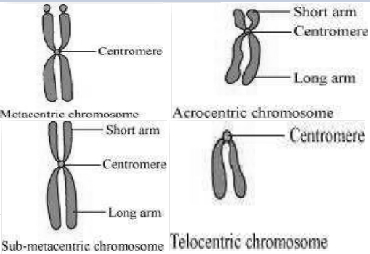
What is a centromere? How does the position of the centromere form the basis of the classification of chromosomes? Support your answer with a diagram showing the position of the centromere on different types of chromosomes.
Solution
(N/A) centromere is a primary constriction present on the chromosomes where the chromatids are held together.
Chromosomes are divided into four types based on the position of the centromere:
$(i)$ Metacentric chromosome: The chromosome in which the centromere is present in the middle and divides the chromosome into two equal arms.
$(ii)$ Sub-metacentric chromosome: The chromosome in which the centromere is slightly away from the middle region,resulting in one arm being slightly longer than the other.
$(iii)$ Acrocentric chromosome: The chromosome in which the centromere is located close to one of the terminal ends,resulting in one extremely long arm and one extremely short arm.
$(iv)$ Telocentric chromosome: The chromosome in which the centromere is located at one of the terminal ends.
Chromosomes are divided into four types based on the position of the centromere:
$(i)$ Metacentric chromosome: The chromosome in which the centromere is present in the middle and divides the chromosome into two equal arms.
$(ii)$ Sub-metacentric chromosome: The chromosome in which the centromere is slightly away from the middle region,resulting in one arm being slightly longer than the other.
$(iii)$ Acrocentric chromosome: The chromosome in which the centromere is located close to one of the terminal ends,resulting in one extremely long arm and one extremely short arm.
$(iv)$ Telocentric chromosome: The chromosome in which the centromere is located at one of the terminal ends.
0 likes
View Solution273
Medium
Explain why the nucleus is considered the central point of all activities of the cell.
Solution
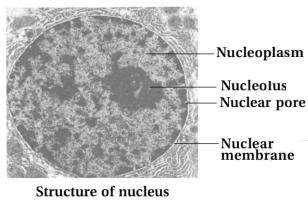
(N/A) $ \Rightarrow $ The nucleus as a cell organelle was first described by Robert Brown in $1831$. Later, the material of the nucleus stained by basic dyes was given the name chromatin by Flemming.
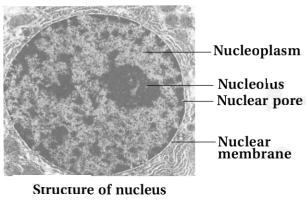
$ \Rightarrow $ The interphase nucleus contains highly extended and elaborate nucleoprotein fibres called chromatin, nuclear matrix, and one or more spherical bodies called nucleoli.
$ \Rightarrow $ The nuclear envelope consists of two parallel membranes with a space between them ($10$ to $50 \, nm$) called the perinuclear space. This forms a barrier between the materials present inside the nucleus and the cytoplasm.
$ \Rightarrow $ The outer membrane usually remains continuous with the endoplasmic reticulum and also bears ribosomes on its surface.
$ \Rightarrow $ At a number of places, the nuclear envelope is interrupted by minute pores, which are formed by the fusion of its two membranes. These nuclear pores are the passages through which the movement of $RNA$ and protein molecules takes place in both directions between the nucleus and the cytoplasm.
$ \Rightarrow $ Nucleoli: These are spherical structures present in the nucleoplasm. The content of the nucleolus is continuous with the rest of the nucleoplasm. It is a site for active ribosomal $RNA$ synthesis. Large and more numerous nucleoli are present in cells actively carrying out protein synthesis.
$ \Rightarrow $ The interphase nucleus contains highly extended and elaborate nucleoprotein fibres called chromatin, nuclear matrix, and one or more spherical bodies called nucleoli.
$ \Rightarrow $ The nuclear envelope consists of two parallel membranes with a space between them ($10$ to $50 \, nm$) called the perinuclear space. This forms a barrier between the materials present inside the nucleus and the cytoplasm.
$ \Rightarrow $ The outer membrane usually remains continuous with the endoplasmic reticulum and also bears ribosomes on its surface.
$ \Rightarrow $ At a number of places, the nuclear envelope is interrupted by minute pores, which are formed by the fusion of its two membranes. These nuclear pores are the passages through which the movement of $RNA$ and protein molecules takes place in both directions between the nucleus and the cytoplasm.
$ \Rightarrow $ Nucleoli: These are spherical structures present in the nucleoplasm. The content of the nucleolus is continuous with the rest of the nucleoplasm. It is a site for active ribosomal $RNA$ synthesis. Large and more numerous nucleoli are present in cells actively carrying out protein synthesis.
0 likes
View Solution274
Easy
Describe the nucleus in detail.
Solution
(N/A) $\Rightarrow$ The nucleus as a cell organelle was first described by Robert Brown in $1831$. Later,the material of the nucleus stained by basic dyes was given the name chromatin by Flemming.
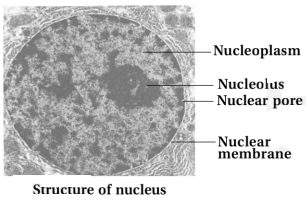
$\Rightarrow$ The interphase nucleus has highly extended and elaborate nucleoprotein fibres called chromatin,nuclear matrix,and one or more spherical bodies called nucleoli.
$\Rightarrow$ The nuclear envelope consists of two parallel membranes with a space between them ($10$ to $50 \ nm$) called the perinuclear space. This forms a barrier between the materials present inside the nucleus and those of the cytoplasm.
$\Rightarrow$ The outer membrane usually remains continuous with the endoplasmic reticulum and also bears ribosomes on it.
$\Rightarrow$ At a number of places,the nuclear envelope is interrupted by minute pores,which are formed by the fusion of its two membranes. These nuclear pores are the passages through which the movement of $RNA$ and protein molecules takes place in both directions between the nucleus and the cytoplasm.
$\Rightarrow$ Nucleoli: These are spherical structures present in the nucleoplasm. The content of the nucleolus is continuous with the rest of the nucleoplasm. It is a site for active ribosomal $RNA$ synthesis.
$\Rightarrow$ Large and more numerous nucleoli are present in cells actively carrying out protein synthesis.
$\Rightarrow$ The interphase nucleus has highly extended and elaborate nucleoprotein fibres called chromatin,nuclear matrix,and one or more spherical bodies called nucleoli.
$\Rightarrow$ The nuclear envelope consists of two parallel membranes with a space between them ($10$ to $50 \ nm$) called the perinuclear space. This forms a barrier between the materials present inside the nucleus and those of the cytoplasm.
$\Rightarrow$ The outer membrane usually remains continuous with the endoplasmic reticulum and also bears ribosomes on it.
$\Rightarrow$ At a number of places,the nuclear envelope is interrupted by minute pores,which are formed by the fusion of its two membranes. These nuclear pores are the passages through which the movement of $RNA$ and protein molecules takes place in both directions between the nucleus and the cytoplasm.
$\Rightarrow$ Nucleoli: These are spherical structures present in the nucleoplasm. The content of the nucleolus is continuous with the rest of the nucleoplasm. It is a site for active ribosomal $RNA$ synthesis.
$\Rightarrow$ Large and more numerous nucleoli are present in cells actively carrying out protein synthesis.
0 likes
View Solution275
Medium
Describe the composition, structure, and types of chromosomes.
Solution
(N/A) $ \Rightarrow $ Chromatin contains $DNA$, some basic proteins called histones, some non-histone proteins, and also $RNA$. $A$ single human cell has approximately $2 \, m$ long thread of $DNA$ distributed among its $46$ chromosomes ($23$ pairs).
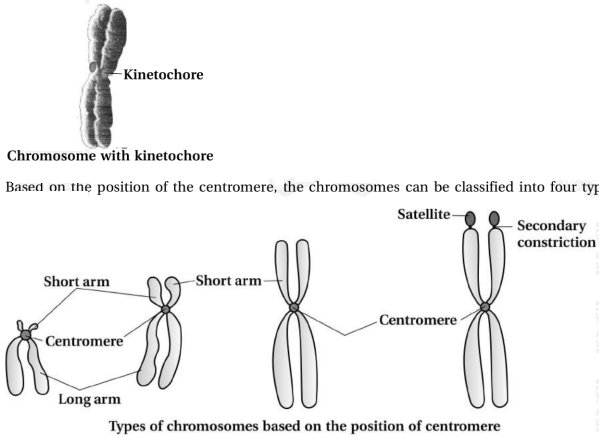
$ \Rightarrow $ Every chromosome essentially has a primary constriction or the centromere, on the sides of which disc-shaped structures called kinetochores are present.
$ \Rightarrow $ Based on the position of the centromere, chromosomes are classified into four types:
$ \Rightarrow $ Metacentric: The metacentric chromosome has a middle centromere forming two equal arms of the chromosome.
$ \Rightarrow $ Sub-metacentric: The sub-metacentric chromosome has a centromere slightly away from the middle of the chromosome, resulting in one shorter arm and one longer arm.
$ \Rightarrow $ Acrocentric: In the case of an acrocentric chromosome, the centromere is situated close to its end, forming one extremely short and one very long arm.
$ \Rightarrow $ Telocentric: $A$ telocentric chromosome has a terminal centromere.
$ \Rightarrow $ Every chromosome essentially has a primary constriction or the centromere, on the sides of which disc-shaped structures called kinetochores are present.
$ \Rightarrow $ Based on the position of the centromere, chromosomes are classified into four types:
$ \Rightarrow $ Metacentric: The metacentric chromosome has a middle centromere forming two equal arms of the chromosome.
$ \Rightarrow $ Sub-metacentric: The sub-metacentric chromosome has a centromere slightly away from the middle of the chromosome, resulting in one shorter arm and one longer arm.
$ \Rightarrow $ Acrocentric: In the case of an acrocentric chromosome, the centromere is situated close to its end, forming one extremely short and one very long arm.
$ \Rightarrow $ Telocentric: $A$ telocentric chromosome has a terminal centromere.
0 likes
View Solution276
MediumMCQ
How many types of chromosomes are there based on the position of the centromere? Explain.
A
Metacentric
B
Sub-metacentric
C
Acrocentric and Telocentric
D
All of the above
Solution
(D) Based on the position of the centromere,chromosomes are classified into $4$ types:
$1$. Metacentric: The centromere is in the middle,forming two equal arms.
$2$. Sub-metacentric: The centromere is slightly away from the middle,resulting in one shorter arm and one longer arm.
$3$. Acrocentric: The centromere is situated close to the end,forming one extremely short arm and one very long arm.
$4$. Telocentric: The centromere is located at the terminal end of the chromosome.
$1$. Metacentric: The centromere is in the middle,forming two equal arms.
$2$. Sub-metacentric: The centromere is slightly away from the middle,resulting in one shorter arm and one longer arm.
$3$. Acrocentric: The centromere is situated close to the end,forming one extremely short arm and one very long arm.
$4$. Telocentric: The centromere is located at the terminal end of the chromosome.
0 likes
View Solution277
Easy
Give a scientific reason: Explain why the nucleus is the central point of all activities of the cell.
Solution
(N/A) $ \Rightarrow $ The nucleus as a cell organelle was first described by Robert Brown in $1831$. Later, the material of the nucleus stained by basic dyes was named chromatin by Flemming.
$ \Rightarrow $ The interphase nucleus contains highly extended and elaborate nucleoprotein fibres called chromatin, nuclear matrix, and one or more spherical bodies called nucleoli.
$ \Rightarrow $ The nuclear envelope consists of two parallel membranes with a space between them ($10$ to $50 \ nm$) called the perinuclear space.
$ \Rightarrow $ This forms a barrier between the materials present inside the nucleus and the cytoplasm. The outer membrane usually remains continuous with the endoplasmic reticulum and also bears ribosomes on it.
$ \Rightarrow $ At a number of places, the nuclear envelope is interrupted by minute pores, which are formed by the fusion of its two membranes. These nuclear pores are the passages through which the movement of $RNA$ and protein molecules takes place in both directions between the nucleus and cytoplasm.
$ \Rightarrow $ Nucleoli: The nucleoli are spherical structures present in the nucleoplasm. The content of the nucleolus is continuous with the rest of the nucleoplasm. It is a site for active ribosomal $RNA$ synthesis. Large and more numerous nucleoli are present in cells actively carrying out protein synthesis. Thus, the nucleus acts as the control center of the cell by regulating gene expression and protein synthesis.
$ \Rightarrow $ The interphase nucleus contains highly extended and elaborate nucleoprotein fibres called chromatin, nuclear matrix, and one or more spherical bodies called nucleoli.
$ \Rightarrow $ The nuclear envelope consists of two parallel membranes with a space between them ($10$ to $50 \ nm$) called the perinuclear space.
$ \Rightarrow $ This forms a barrier between the materials present inside the nucleus and the cytoplasm. The outer membrane usually remains continuous with the endoplasmic reticulum and also bears ribosomes on it.
$ \Rightarrow $ At a number of places, the nuclear envelope is interrupted by minute pores, which are formed by the fusion of its two membranes. These nuclear pores are the passages through which the movement of $RNA$ and protein molecules takes place in both directions between the nucleus and cytoplasm.
$ \Rightarrow $ Nucleoli: The nucleoli are spherical structures present in the nucleoplasm. The content of the nucleolus is continuous with the rest of the nucleoplasm. It is a site for active ribosomal $RNA$ synthesis. Large and more numerous nucleoli are present in cells actively carrying out protein synthesis. Thus, the nucleus acts as the control center of the cell by regulating gene expression and protein synthesis.
0 likes
View Solution278
MediumMCQ
What was the contribution of the scientist Robert Brown in $1831$?
A
Discovery of the cell
B
Discovery of the nucleus
C
Formulation of the cell theory
D
Discovery of the Golgi apparatus
Solution
(B) In $1831$,the Scottish botanist Robert Brown discovered the nucleus within the cell. He observed this structure while studying orchid cells and named it the 'nucleus' (Latin for 'kernel'). This discovery was a significant milestone in cell biology,as it identified the central organelle responsible for controlling cellular activities.
0 likes
View Solution279
Medium
Discuss briefly the role of the nucleolus in cells actively involved in protein synthesis.
Solution
(N/A) The nucleolus is the primary site for $rRNA$ synthesis.
It acts as a center for producing the components of ribosomes.
It connects $rRNA$ with proteins to form the subunits of ribosomes.
These subunits are then transported into the cytoplasm,where they assemble to perform protein synthesis.
It acts as a center for producing the components of ribosomes.
It connects $rRNA$ with proteins to form the subunits of ribosomes.
These subunits are then transported into the cytoplasm,where they assemble to perform protein synthesis.
0 likes
View Solution280
Medium
What are histones? What are their functions?
Solution
(N/A) $\Rightarrow$ Histones are basic proteins rich in positively charged amino acids,specifically lysine and arginine.
$\Rightarrow$ They are found in the nuclei of eukaryotic cells and are responsible for the packaging of $DNA$ into structural units called nucleosomes.
$\Rightarrow$ Function: Histones possess positively charged ends that attract the negatively charged phosphate backbone of $DNA$,allowing the $DNA$ to wrap around the histone octamer.
$\Rightarrow$ This packaging is essential for condensing $DNA$ into chromatin,which helps in fitting the long $DNA$ molecules into the small volume of the nucleus and plays a crucial role in gene regulation.
$\Rightarrow$ They are found in the nuclei of eukaryotic cells and are responsible for the packaging of $DNA$ into structural units called nucleosomes.
$\Rightarrow$ Function: Histones possess positively charged ends that attract the negatively charged phosphate backbone of $DNA$,allowing the $DNA$ to wrap around the histone octamer.
$\Rightarrow$ This packaging is essential for condensing $DNA$ into chromatin,which helps in fitting the long $DNA$ molecules into the small volume of the nucleus and plays a crucial role in gene regulation.
0 likes
View Solution281
Medium
The genomic content of the nucleus is constant for a given species,whereas the extrachromosomal $DNA$ is found to be variable among the members of a population. Explain.
Solution
(N/A) The genomic $DNA$ (nuclear $DNA$) is replicated and distributed through a highly regulated process (mitosis/meiosis),ensuring that every cell of a given species contains a constant and identical amount of genetic material.
In contrast,extrachromosomal $DNA$,such as plasmids in bacteria or $DNA$ in mitochondria and chloroplasts,does not follow the same strict segregation pattern.
Plasmids are small,circular,extrachromosomal $DNA$ molecules that can be gained or lost through horizontal gene transfer (conjugation,transformation,transduction).
Similarly,the number of organelles like mitochondria varies depending on the metabolic activity of the cell. Since these organelles contain their own $DNA$,their variable copy number leads to variation in the total amount of extrachromosomal $DNA$ among different members of a population.
In contrast,extrachromosomal $DNA$,such as plasmids in bacteria or $DNA$ in mitochondria and chloroplasts,does not follow the same strict segregation pattern.
Plasmids are small,circular,extrachromosomal $DNA$ molecules that can be gained or lost through horizontal gene transfer (conjugation,transformation,transduction).
Similarly,the number of organelles like mitochondria varies depending on the metabolic activity of the cell. Since these organelles contain their own $DNA$,their variable copy number leads to variation in the total amount of extrachromosomal $DNA$ among different members of a population.
0 likes
View Solution282
EasyMCQ
Name a stain commonly used to colour chromosomes.
A
Acetocarmine
B
Giemsa stain
C
Orcein
D
All of the above
Solution
(D) Chromosomes are composed of chromatin,which consists of $DNA$ and proteins. To visualize them under a microscope,specific stains are used that bind to the $DNA$ or chromatin structure.
Commonly used stains for chromosomes include $Acetocarmine$,$Giemsa$ stain,and $Orcein$.
$Acetocarmine$ is frequently used for staining plant chromosomes,while $Giemsa$ stain is widely used in cytogenetics for $G-banding$ of chromosomes.
Therefore,all the listed options are correct stains used for coloring chromosomes.
Commonly used stains for chromosomes include $Acetocarmine$,$Giemsa$ stain,and $Orcein$.
$Acetocarmine$ is frequently used for staining plant chromosomes,while $Giemsa$ stain is widely used in cytogenetics for $G-banding$ of chromosomes.
Therefore,all the listed options are correct stains used for coloring chromosomes.
0 likes
View Solution283
Medium
Distinguish between: Euchromatin and Heterochromatin.
Solution
(N/A)
| Euchromatin | Heterochromatin |
|---|---|
| $(1)$ The region of chromatin that is loosely packed and stains light is referred to as euchromatin. | $(1)$ The region of chromatin that is densely packed and stains dark is referred to as heterochromatin. |
| $(2)$ It is transcriptionally active chromatin. | $(2)$ It is transcriptionally inactive chromatin. |
0 likes
View Solution284
EasyMCQ
How many chromosomes does a haploid cell of maize contain?
A
$20$
B
$12$
C
$34$
D
$10$
Solution
(D) The diploid number of chromosomes $(2n)$ in maize $(Zea \ mays)$ is $20$.
$A$ haploid cell $(n)$ contains half the number of chromosomes of a diploid cell.
Therefore,the number of chromosomes in a haploid cell of maize is $20 / 2 = 10$.
$A$ haploid cell $(n)$ contains half the number of chromosomes of a diploid cell.
Therefore,the number of chromosomes in a haploid cell of maize is $20 / 2 = 10$.
0 likes
View Solution285
EasyMCQ
Match the organism with the correct number of chromosomes present in its somatic cells.
| List-$I$ | List-$II$ |
| $(a)$ Human | $(1)$ $24$ |
| $(b)$ Apple | $(2)$ $20$ |
| $(c)$ Maize | $(3)$ $34$ |
| $(d)$ Rice | $(4)$ $46$ |
A
$a-2, b-4, c-1, d-3$
B
$a-4, b-3, c-2, d-1$
C
$a-3, b-2, c-1, d-4$
D
$a-1, b-3, c-2, d-4$
Solution
(B) The correct matches for the number of chromosomes in somatic cells are as follows:
$(a)$ Human: Humans have $46$ chromosomes in their somatic cells $(2n = 46)$. Thus, $(a-4)$.
$(b)$ Apple: Apple cells contain $34$ chromosomes $(2n = 34)$. Thus, $(b-3)$.
$(c)$ Maize: Maize cells contain $20$ chromosomes $(2n = 20)$. Thus, $(c-2)$.
$(d)$ Rice: Rice cells contain $24$ chromosomes $(2n = 24)$. Thus, $(d-1)$.
Therefore, the correct sequence is $(a-4, b-3, c-2, d-1)$.
$(a)$ Human: Humans have $46$ chromosomes in their somatic cells $(2n = 46)$. Thus, $(a-4)$.
$(b)$ Apple: Apple cells contain $34$ chromosomes $(2n = 34)$. Thus, $(b-3)$.
$(c)$ Maize: Maize cells contain $20$ chromosomes $(2n = 20)$. Thus, $(c-2)$.
$(d)$ Rice: Rice cells contain $24$ chromosomes $(2n = 24)$. Thus, $(d-1)$.
Therefore, the correct sequence is $(a-4, b-3, c-2, d-1)$.
0 likes
View Solution286
EasyMCQ
What is the approximate diameter of a typical nucleus?
A
$10^{6} \ m$
B
$10^{-6} \ m$
C
$10^{6} \ nm$
D
$10^{6} \ cm$
Solution
(B) The nucleus is a membrane-bound organelle found in eukaryotic cells.
Its size varies depending on the cell type,but a typical nucleus has a diameter of approximately $10^{-6} \ m$ (or $1 \ \mu m$).
This is equivalent to $1000 \ nm$.
Its size varies depending on the cell type,but a typical nucleus has a diameter of approximately $10^{-6} \ m$ (or $1 \ \mu m$).
This is equivalent to $1000 \ nm$.
0 likes
View Solution287
MediumMCQ
In which cell is $DNA$ organized as a large strand?
A
Plant cell
B
Animal cell
C
Viroid
D
Lactobacillus
Solution
(A, B) In eukaryotic cells,such as plant and animal cells,$DNA$ is organized into long,linear strands associated with histone proteins to form chromosomes.
Viroids consist of short,circular,single-stranded $RNA$ molecules without a protein coat.
Lactobacillus is a prokaryote where $DNA$ exists as a circular chromosome,which is not organized into the complex linear strands found in eukaryotes.
Therefore,both plant and animal cells contain $DNA$ organized as large,linear strands within the nucleus.
Viroids consist of short,circular,single-stranded $RNA$ molecules without a protein coat.
Lactobacillus is a prokaryote where $DNA$ exists as a circular chromosome,which is not organized into the complex linear strands found in eukaryotes.
Therefore,both plant and animal cells contain $DNA$ organized as large,linear strands within the nucleus.
0 likes
View Solution288
MediumMCQ
Which repeating units are present in chromatin?
A
$DNA$
B
$RNA$
C
Nucleosomes
D
Histones
Solution
(C) Chromatin is the complex of $DNA$ and proteins found in the eukaryotic nucleus.
Under an electron microscope,chromatin appears as 'beads-on-string' structures.
The 'beads' are known as nucleosomes.
Nucleosomes are the repeating structural units of chromatin,formed by the wrapping of $DNA$ around a core of eight histone proteins (histone octamer).
Therefore,nucleosomes are the fundamental repeating units of chromatin.
Under an electron microscope,chromatin appears as 'beads-on-string' structures.
The 'beads' are known as nucleosomes.
Nucleosomes are the repeating structural units of chromatin,formed by the wrapping of $DNA$ around a core of eight histone proteins (histone octamer).
Therefore,nucleosomes are the fundamental repeating units of chromatin.
0 likes
View Solution289
MediumMCQ
In which structure is the 'beads-on-a-string' appearance observed?
A
Mitochondria
B
Nucleus
C
Chloroplast
D
Cytoplasm of prokaryotes
Solution
(B) The 'beads-on-a-string' structure refers to the appearance of chromatin under an electron microscope.
This structure is formed by the wrapping of $DNA$ around histone octamers to form nucleosomes.
These nucleosomes are connected by linker $DNA$,giving the appearance of beads on a string.
This organization is characteristic of the chromatin found within the nucleus of eukaryotic cells.
This structure is formed by the wrapping of $DNA$ around histone octamers to form nucleosomes.
These nucleosomes are connected by linker $DNA$,giving the appearance of beads on a string.
This organization is characteristic of the chromatin found within the nucleus of eukaryotic cells.
0 likes
View Solution290
MediumMCQ
The loosely stained region of chromatin is known as .........
A
Heterochromatin
B
Euchromatin
C
Cytochromatin
D
Mytochromatin
Solution
(B) In the nucleus,chromatin is organized into two types based on its staining intensity during interphase:
$1$. Euchromatin: This is the loosely packed and lightly stained region of chromatin. It is transcriptionally active and contains genes that are expressed.
$2$. Heterochromatin: This is the densely packed and darkly stained region of chromatin. It is transcriptionally inactive and remains tightly coiled.
Therefore,the loosely stained region is known as Euchromatin.
$1$. Euchromatin: This is the loosely packed and lightly stained region of chromatin. It is transcriptionally active and contains genes that are expressed.
$2$. Heterochromatin: This is the densely packed and darkly stained region of chromatin. It is transcriptionally inactive and remains tightly coiled.
Therefore,the loosely stained region is known as Euchromatin.
0 likes
View Solution291
MediumMCQ
What is the chromatin that is densely packed and stains darkly called?
A
Chromosome
B
Chromostome
C
Euchromatin
D
Heterochromatin
Solution
(D) In the nucleus,chromatin is organized into two types based on its density and staining properties:
$1$. Euchromatin: This is loosely packed chromatin that stains lightly and is transcriptionally active.
$2$. Heterochromatin: This is densely packed chromatin that stains darkly and is transcriptionally inactive.
Therefore,the chromatin that is densely packed and stains darkly is known as Heterochromatin.
$1$. Euchromatin: This is loosely packed chromatin that stains lightly and is transcriptionally active.
$2$. Heterochromatin: This is densely packed chromatin that stains darkly and is transcriptionally inactive.
Therefore,the chromatin that is densely packed and stains darkly is known as Heterochromatin.
0 likes
View Solution292
EasyMCQ
Which structure is active for transcription?
A
Euchromatin
B
Heterochromatin
C
Chromatophore
D
Both $A$ and $B$
Solution
(A) In the nucleus,chromatin is organized into two types based on its staining intensity and transcriptional activity.
$1$. $Euchromatin$: This is the loosely packed region of chromatin that stains lightly. It is transcriptionally active because the $DNA$ is accessible to $RNA$ polymerase and other transcription factors.
$2$. $Heterochromatin$: This is the densely packed region of chromatin that stains darkly. It is transcriptionally inactive because the $DNA$ is tightly coiled and inaccessible to the transcriptional machinery.
Therefore,$Euchromatin$ is the structure active for transcription.
$1$. $Euchromatin$: This is the loosely packed region of chromatin that stains lightly. It is transcriptionally active because the $DNA$ is accessible to $RNA$ polymerase and other transcription factors.
$2$. $Heterochromatin$: This is the densely packed region of chromatin that stains darkly. It is transcriptionally inactive because the $DNA$ is tightly coiled and inaccessible to the transcriptional machinery.
Therefore,$Euchromatin$ is the structure active for transcription.
0 likes
View Solution293
MediumMCQ
What is the $K.I.$ (Karyoplasmic Index) in cancerous cells?
A
High
B
Low
C
Irregular
D
Cannot be determined
Solution
(A) The $K.I.$ (Karyoplasmic Index) is defined as the ratio of the volume of the nucleus to the volume of the cytoplasm $(K.I. = V_n / V_c)$.
In cancerous cells,the nucleus becomes enlarged and hyperchromatic,leading to an increase in the nuclear volume relative to the cytoplasm.
Therefore,cancerous cells exhibit a high $K.I.$ compared to normal cells.
In cancerous cells,the nucleus becomes enlarged and hyperchromatic,leading to an increase in the nuclear volume relative to the cytoplasm.
Therefore,cancerous cells exhibit a high $K.I.$ compared to normal cells.
0 likes
View Solution294
EasyMCQ
The biosynthesis of ribosomal $RNA$ occurs in
A
Nucleolus
B
Ribosomes
C
Golgi apparatus
D
Microbodies
Solution
(A) The biosynthesis of ribosomal $RNA$ $(rRNA)$ occurs in the nucleolus. The nucleolus is a non-membrane-bound structure present within the nucleus,which serves as the primary site for $rRNA$ transcription and the assembly of ribosomal subunits.
0 likes
View Solution295
MediumMCQ
$A$ : The nucleus of a plasma cell has a cart-wheel appearance.
$R$ : The nucleus contains peripheral clumps of heterochromatin.
$R$ : The nucleus contains peripheral clumps of heterochromatin.
A
Assertion and Reason both are correct and Reason is the correct explanation of Assertion.
B
Assertion and Reason both are correct but Reason is not the correct explanation of Assertion.
C
Assertion is correct,but Reason is incorrect.
D
Both Assertion and Reason are incorrect.
Solution
(A) The Assertion is true because the nucleus in plasma cells is eccentric,rounded,and exhibits a characteristic 'cart-wheel' appearance.
The Reason is also true because this 'cart-wheel' appearance is specifically caused by the arrangement of heterochromatin in peripheral clumps along the nuclear membrane.
Therefore,both Assertion and Reason are true,and the Reason is the correct explanation of the Assertion.
The Reason is also true because this 'cart-wheel' appearance is specifically caused by the arrangement of heterochromatin in peripheral clumps along the nuclear membrane.
Therefore,both Assertion and Reason are true,and the Reason is the correct explanation of the Assertion.
0 likes
View Solution296
MediumMCQ
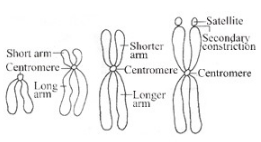
The given diagram shows the types of chromosomes (labelled as $A, B, C$ and $D$) based on the position of the centromere. Which one is the correct option for the labelled chromosomes $A, B, C$ and $D$?
A
$A-$ Telocentric chromosome,$B -$ Acrocentric chromosome,$C-$ Submetacentric chromosome,$D -$ Metacentric chromosome
B
$A -$ Acrocentric chromosome,$B -$ Telocentric chromosome,$C-$ Metacentric chromosome,$D -$ Submetacentric chromosome
C
$A -$ Submetacentric chromosome,$B -$ Metacentric chromosome,$C -$ Telocentric chromosome,$D-$ Acrocentric chromosome
D
$A-$ Metacentric chromosome,$B -$ Submetacentric chromosome,$C-$ Acrocentric chromosome,$D -$ Telocentric chromosome.
Solution
(A) Based on the position of the centromere,chromosomes are classified as follows:
$A$: Telocentric chromosome (centromere at the terminal end).
$B$: Acrocentric chromosome (centromere close to the end,forming one very short and one very long arm).
$C$: Submetacentric chromosome (centromere slightly away from the middle,forming unequal arms).
$D$: Metacentric chromosome (centromere in the middle,forming two equal arms).
Therefore,the correct sequence is $A-$ Telocentric,$B-$ Acrocentric,$C-$ Submetacentric,$D-$ Metacentric.
$A$: Telocentric chromosome (centromere at the terminal end).
$B$: Acrocentric chromosome (centromere close to the end,forming one very short and one very long arm).
$C$: Submetacentric chromosome (centromere slightly away from the middle,forming unequal arms).
$D$: Metacentric chromosome (centromere in the middle,forming two equal arms).
Therefore,the correct sequence is $A-$ Telocentric,$B-$ Acrocentric,$C-$ Submetacentric,$D-$ Metacentric.
0 likes
View Solution297
MediumMCQ
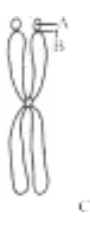
The following diagram represents a chromosome structure. Identify the structures marked as $A, B$ and $C$.
A
$A-$ Satellite,$B -$ Primary constriction,$C -$ Acrocentric
B
$A -$ Satellite,$B -$ Secondary constriction,$C -$ Metacentric
C
$A-$ Satellite,$B -$ Centromere,$C -$ Telocentric
D
$A -$ Satellite,$B -$ Centromere,$C -$ Submetacentric
Solution
(B) The figure shows the structure of a metacentric chromosome $(C)$.
$A$ represents the satellite,which is a small fragment of the chromosome separated by a secondary constriction.
$B$ represents the secondary constriction,which is a constant location on the chromosome.
Metacentric chromosomes have the centromere in the middle,resulting in two equal arms.
Human chromosomes $1$ and $3$ are examples of metacentric chromosomes.
$A$ represents the satellite,which is a small fragment of the chromosome separated by a secondary constriction.
$B$ represents the secondary constriction,which is a constant location on the chromosome.
Metacentric chromosomes have the centromere in the middle,resulting in two equal arms.
Human chromosomes $1$ and $3$ are examples of metacentric chromosomes.
0 likes
View Solution298
EasyMCQ
Which cellular structure helps in transferring genetic information from one generation to another?
A
$W$
B
$X$
C
$Y$
D
$Z$
Solution
(C) The cellular structure $Y$ (nucleus) helps in the transfer of genetic material from one generation to another.
Nucleus is a dense organelle present in most eukaryotic cells.
It is typically a single rounded structure bounded by a double membrane,containing the genetic material $(DNA)$ which acts as the blueprint for inheritance.
Nucleus is a dense organelle present in most eukaryotic cells.
It is typically a single rounded structure bounded by a double membrane,containing the genetic material $(DNA)$ which acts as the blueprint for inheritance.
0 likes
View Solution299
MediumMCQ
Nucleolus is
A
rounded structure found in cytoplasm near nucleus.
B
rounded structure inside nucleus and having $RNA$.
C
rod-shaped structure in cytoplasm near the nucleus.
D
none of the above.
Solution
(B) Nucleolus is a small rounded body within a resting nucleus that contains $RNA$ and proteins.
It is usually associated with a specific chromosomal site and is involved in ribosomal $RNA$ $(rRNA)$ synthesis and the formation of ribosomes.
It is usually associated with a specific chromosomal site and is involved in ribosomal $RNA$ $(rRNA)$ synthesis and the formation of ribosomes.
0 likes
View Solution300
MediumMCQ
What is meant by a satellite in the context of chromosomes?
A
Terminal part of the chromosome beyond the secondary constriction.
B
Terminal part of the chromosome beyond the primary constriction.
C
Terminal part of the chromosome beyond the tertiary constriction.
D
None of the above.
Solution
(A) satellite is a small chromosomal segment that is separated from the main body of the chromosome by a secondary constriction.
In humans,it is usually associated with the short arm of an acrocentric chromosome.
These segments play a vital role in the formation of the nucleolus after cell division.
In humans,chromosomes number $13, 14, 15, 21$,and $22$ are examples of $SAT$ (satellite) chromosomes.
In humans,it is usually associated with the short arm of an acrocentric chromosome.
These segments play a vital role in the formation of the nucleolus after cell division.
In humans,chromosomes number $13, 14, 15, 21$,and $22$ are examples of $SAT$ (satellite) chromosomes.
0 likes
View SolutionCell: The Unit of Life — Nucleus and Chromosomes · Frequently Asked Questions
1Are these Cell: The Unit of Life questions useful for JEE and NEET?
Yes. All questions in this section are mapped to JEE Main and NEET exam patterns. Previous year questions from JEE Main, NEET, GUJCET and state-level exams are included with full solutions.
2Can I switch to Hindi or Gujarati for these questions?
Yes. Use the language tabs in the hero section or the sidebar to view the same questions and solutions in English, Hindi or Gujarati.
3How do I generate a question paper from this subtopic?
Use the Vedclass Exam Paper Generator — select the chapter and subtopic, set difficulty, and generate Sets A, B, C, D automatically. First 3 chapters of every subject are free.
Vedclass Products
For Students
Vedclass Test Series
Mock tests in real JEE/NEET style with performance analysis. 5-day free trial.
Start Free TrialFor Teachers
Exam Paper Generator
Generate Set A/B/C/D papers from this chapter in 2 minutes. 3 chapters free.
Try FreeFor Institutes
Online Exam Module
Live online exams with unlimited students, 360° analytics & white-label branding.
See DemoFor Teachers & Institutes
Generate a Cell: The Unit of Life Exam Paper in 2 Minutes
Select subtopic & difficulty — Sets A, B, C, D auto-generated with No Repeat logic.
First 3 chapters of every subject are free — no payment required.